Category: UX\UI Research

  • UX Audit: The Ultimate Guide for Website Owners

    UX Audit: The Ultimate Guide for Website Owners

    A UX audit can make or break your website. It’s a deep dive into how users are using your site so you can find the problems and solutions. A UX audit looks at your whole website experience, from how people use it to how your site looks.

    You can see what’s working and what’s not. It leads to happier users, more people staying on your site and more sales. It’s like giving your website a health check-up to ensure it’s in top shape for visitors.

    UX audits aren’t just for big companies. If you have a website, you can benefit from one. You’ll be surprised at what you learn about how people are using your site and where they get stuck.

    However, to conduct a UX audit, you need to take proper steps and use an advanced UX analytics tool like FullSession. It helps you systematically evaluate your website’s user experience, identify pain points, and develop actionable insights to improve overall usability.

    This article will explain how UX audit helps you create a more user-friendly, engaging, and effective website and show how to use FullSession for this purpose.

    Let’s begin.

    What Is A UX Audit?
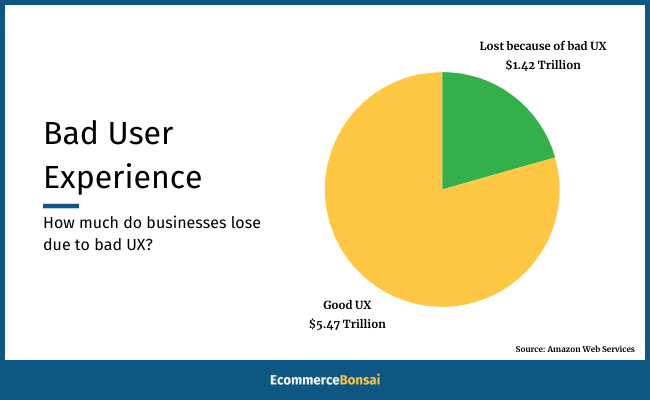
    UX audit

    Image source: Ecommerce Bonsai

    A UX audit is a health check for your website or app looking for user pain points. You can supplement Google Analytics data and see where users get stuck or confused. The goal is to make your site easier and more fun to use.

    Successful UX audit helps you:

    • Find parts that aren’t working well
    • See what users like and don’t like
    • Come up with ideas to fix issues

    You might do a user experience audit when:

    1. Your website isn’t getting the results you want
    2. You’re making big changes
    3. You want to stay ahead of the competition

    A good UX audit process looks at:

    • How easy it is to use your site
    • Can people find what they need
    • Whether your design looks good
    • If your site performs well on mobile devices

    UX testing can make your digital product work better for your visitors. It leads to happier users and better business results.

    Improve Your Website UX and UI

    Learn how to visualize, analyze, and optimize your site with FullSession.

    Key Components Of A Comprehensive UX Audit

    A good UX audit looks at many areas of your website or app to help you identify usability issues. Here are the main bits:

    1. User research and analysis: Learn about your users’ needs, goals and pain points. It helps you see your site from the user’s perspective.
    2. Usability testing: Watch how real people use your site. It shows you where they get stuck or confused.
    3. Information architecture review: Look at your content structure. Make sure users can quickly find what they need.
    4. Visual design review: Check if your site looks good and is on brand. Good design helps users trust and enjoy your site.
    5. Performance testing: Test how fast your site loads and works. Slow sites will frustrate users and make them leave.

    A UX audit looks at both the user interface and the overall experience. These steps will help you find ways to make your site better for users.

    Benefits Of Conducting UX Audits
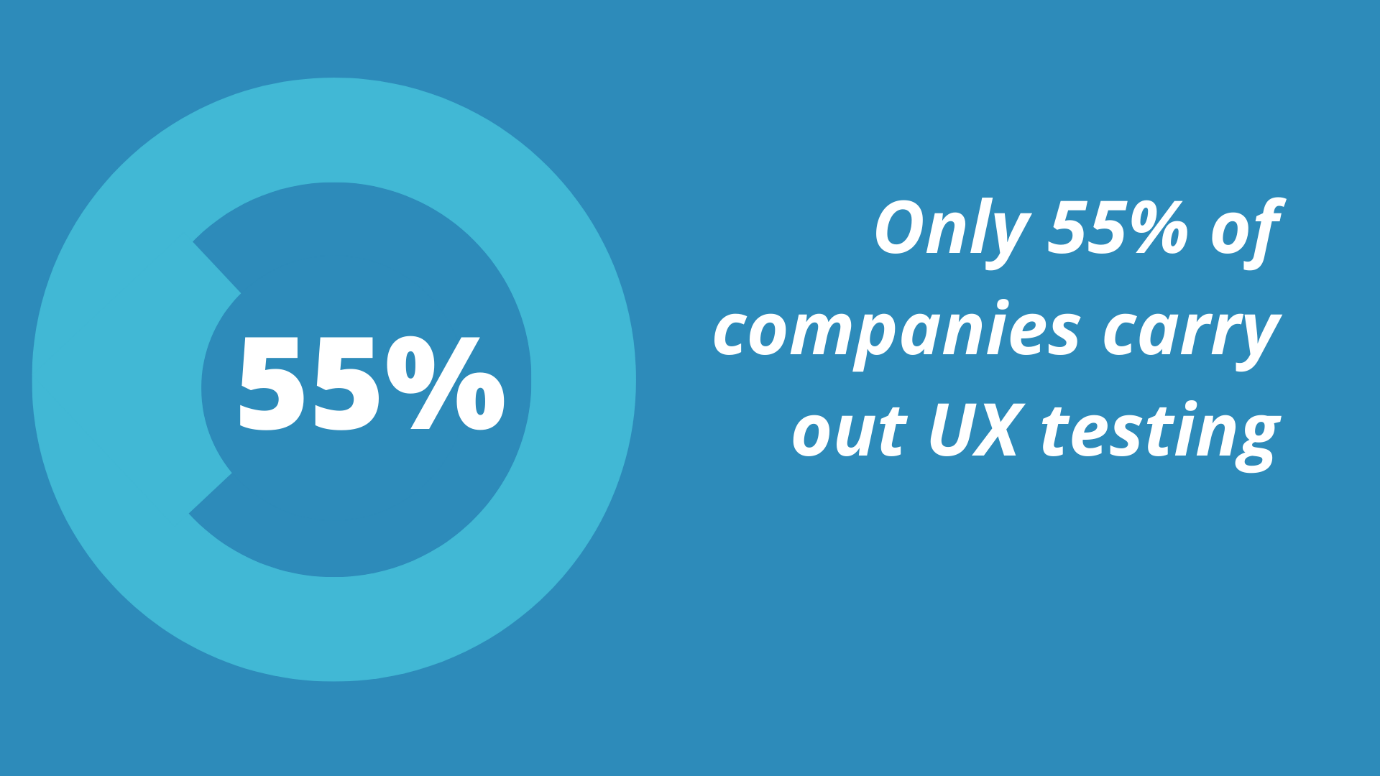
    user experience audit

    Image source: AovUp

    UX audits can really boost your website’s performance. They help you find and fix problems that might be bugging your users. Let’s look at some key ways UX audits can make your site better.

    Improved user satisfaction and retention

    UX audits help you create a positive user experience. When you fix usability issues, your visitors will be happier. They’ll find what they need more easily and enjoy using your site.

    Happy users are more likely to come back. They might even tell their friends about your great site. This word-of-mouth can bring in new visitors.

    UX audits can also help you spot trends in user behavior. You can use this info to make your site even better. For example, you might find that users love a certain feature. You could then make that feature more prominent.

    Increased conversion rates and ROI

    A good user experience can lead to more sales or sign-ups. When your site is easy to use, visitors are more likely to become customers.

    UX audits can help you find and fix issues in your sales funnel. Maybe there’s a confusing step that’s causing people to leave. Or perhaps your call-to-action buttons aren’t clear enough.

    By fixing these issues, you can boost your conversion rates. It means more bang for your buck from your website. Your marketing efforts will be more effective, too.

    Remember, even minor fixes can make a big difference. A tiny boost in conversions can mean a lot more revenue over time.

    Improved brand reputation and credibility

    A well-designed site shows you care about your users. It makes your brand look professional and trustworthy. UX audits help you create a site that’s appealing and works well. It can set you apart from competitors with clunky or outdated sites.

    A good user experience can also lead to better search engine rankings. Search engines like Google pay attention to how users interact with your site. If people stick around and engage, your site might rank higher.

    Higher rankings mean greater visibility for your business. It can lead to more traffic and more potential customers finding you online.

    Turn User Behavior into Growth Opportunities

    Learn how to visualize and analyze all user interactions in one intuitive dashboard.

    Preparing For a UX Audit
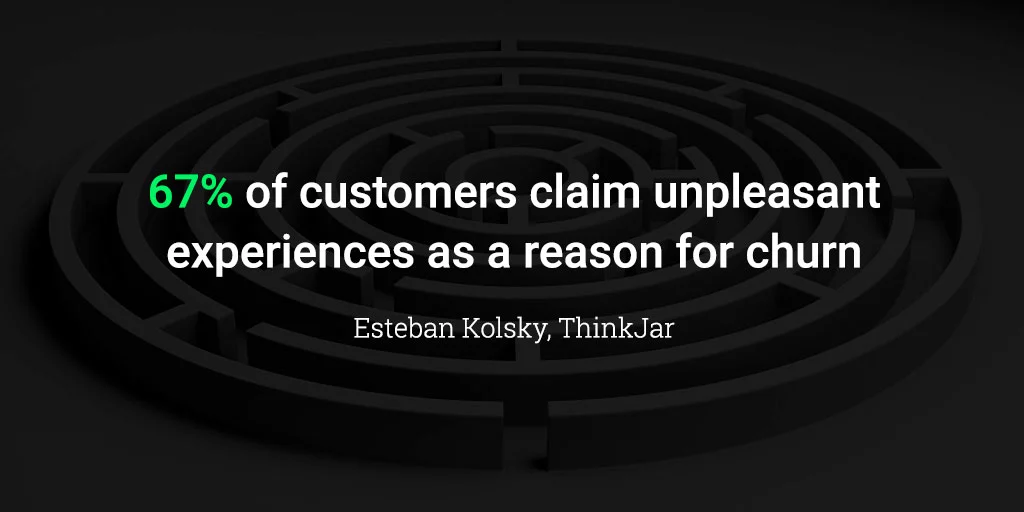
    UX audit

    Image source: Intechnic

    Preparation is key to a successful UX audit. You’ll need to set clear goals, gather the right team and collect important data. This groundwork will make your audit more valuable.

    Define the audit scope and objectives

    Start by setting clear goals for your UX audit. Ask yourself what you want to learn about your site. Do you want to increase sales, get more signups or make your site easier to use?

    Write down your business objectives. It will help you stay on track during the audit.

    Think about your target audience. Who are they? What do they need from your site? Knowing this will help you focus on the right areas.

    Set a time frame for your audit. Decide which parts of your site you’ll look at. It could be the whole site or just key pages.

    Gathering your UX audit team

    Get a team with different skills. You might need designers, developers and marketing people. Each brings a different perspective to the audit.

    Choose a team leader. This person will keep everyone on track and make sure the audit runs smoothly. Think about bringing in outside help, too. A fresh pair of eyes will spot things you might miss.

    Make sure everyone knows their role. Clear tasks will help the audit run smoothly. Set up regular check-ins. It will keep everyone in the loop and solve problems fast.

    Collecting data and resources

    Gather data from various sources. Use Google Analytics to see how people use your site. Look at page views and bounce rates.

    • Do user surveys to get feedback. Ask people what they like and dislike about your site.
    • Set up user interviews. It will give you deep insights into how people use your site.
    • Look at customer support logs. They will show you common issues people have on your site.
    • Get information on your competitors. See what they do well and where they fail.

    Make sure you have access to all areas of your website. It includes backend systems and design files.

    Understanding User Needs
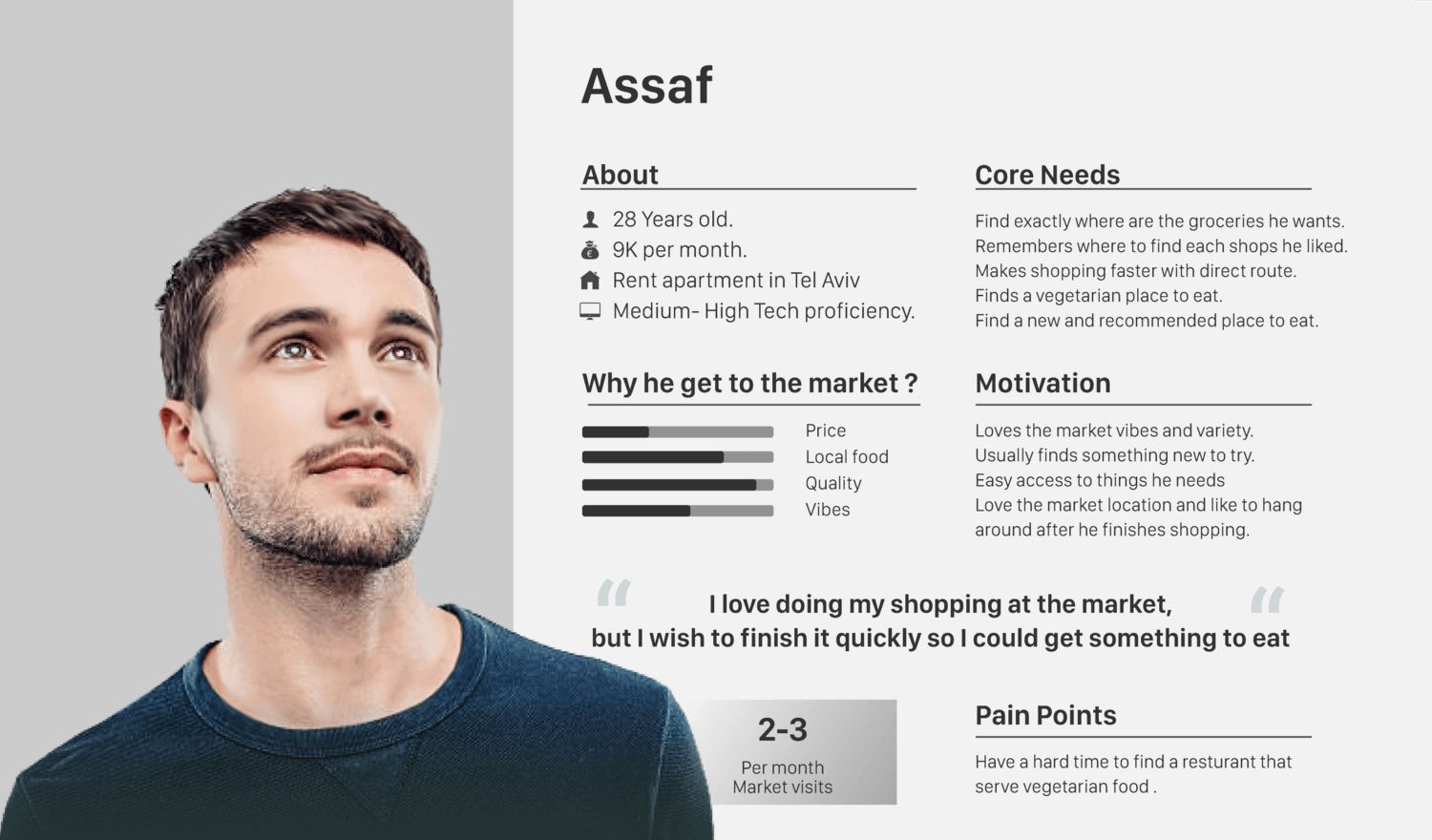
    creating user persona for ux audit

    Image source: Justinmind

    Knowing your users is key to a great website. You need to know who they are and how they use your site. It will help you make informed design and feature decisions.

    Creating user personas

    User personas are like characters that represent your typical users. They help you see your site through your users’ eyes. To create good personas:

    1. Collect real data from surveys and interviews
    2. Look for common patterns and behaviors
    3. Give each persona a name and backstory

    Your personas should include details like age, job, goals and frustrations. It will make them feel real. With solid personas and a thorough UX audit, you can make better design decisions that fit your actual users.

    Mapping user journeys

    Customer journey analytics captures the steps users take on your site. To map a journey:

    1. Choose a common task (like buying a product)
    2. List each step the user takes
    3. Note what they’re thinking and feeling at each point

    Look for parts of the journey that are frustrating or take too long. These are areas you can improve. A smooth journey keeps users happy and gets them to their goals faster.

    Implementing User Behavior Analytics With FullSession
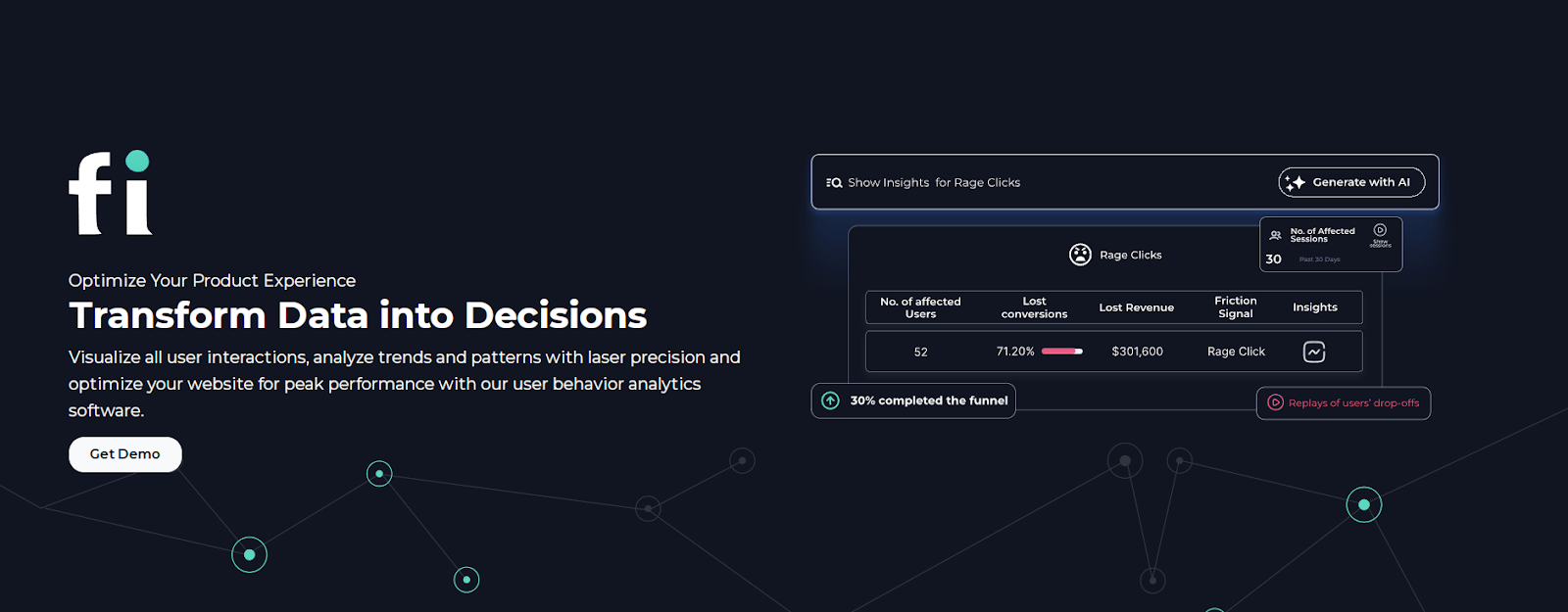
    FullSession user behavior analytics software

    If you want to improve your website’s user experience, user behavior analytics can help you significantly.

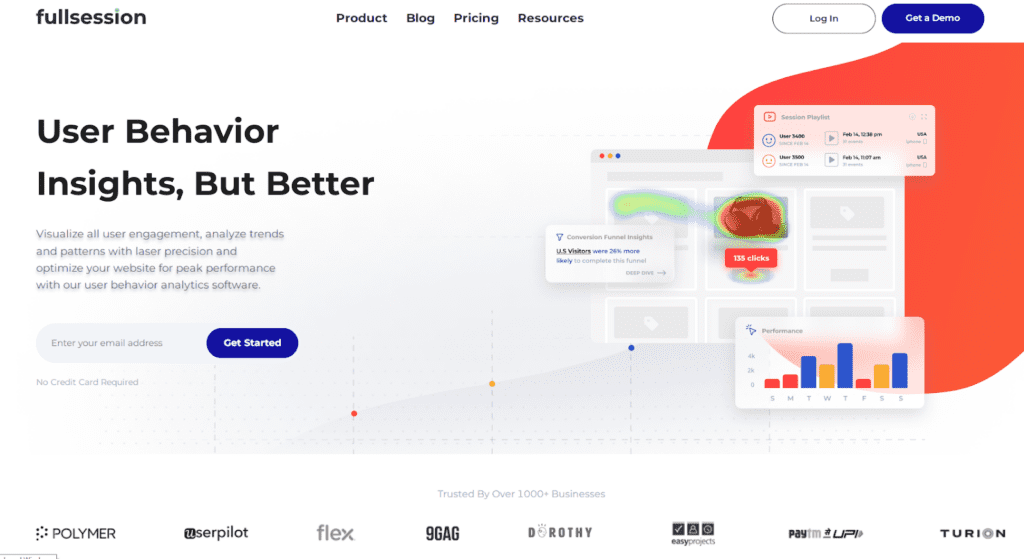
    FullSession provides the user behavior tools to observe how people use your site, visualize and analyze their interactions and optimize your UX, UI and website performance based on the insights.

    With FullSession user experience analysis, you can see what visitors do on your pages and all the issues they encounter in the journey. It includes how they navigate your site, where they click, how far they scroll and what they ignore.

    FullSession’s key features include:

    These real user monitoring tools will help you spot problems you might have missed using traditional analytics tools that provide only raw data.

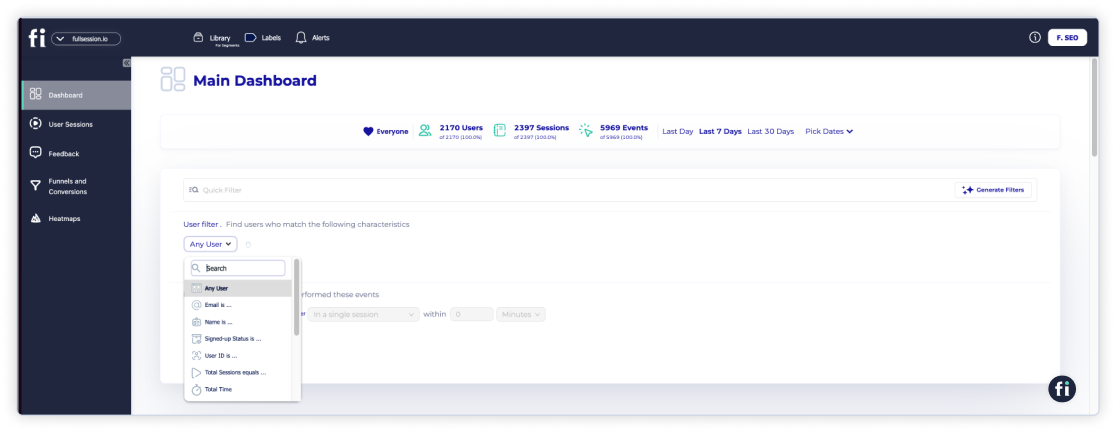
    The dashboard will give you a complete view of user behavior data. You’ll see trends and patterns over time and use these findings to make informed changes to your site.

    Remember, your site is for your visitors. With FullSession’s behavioral analysis software, you can make it better for them while protecting their privacy and data security, thanks to our GDPR, CCPA, and PCI compliance.

    Analyze User Behavior in Real-Time

    Learn how to detect and fix website issues before they affect your customer experience.

    FullSession’s Features And Benefits For UX Audits

    FullSession customers

    FullSession has the tools to help you do a proper UX audit. Its features will show how users use your site and how to improve it.

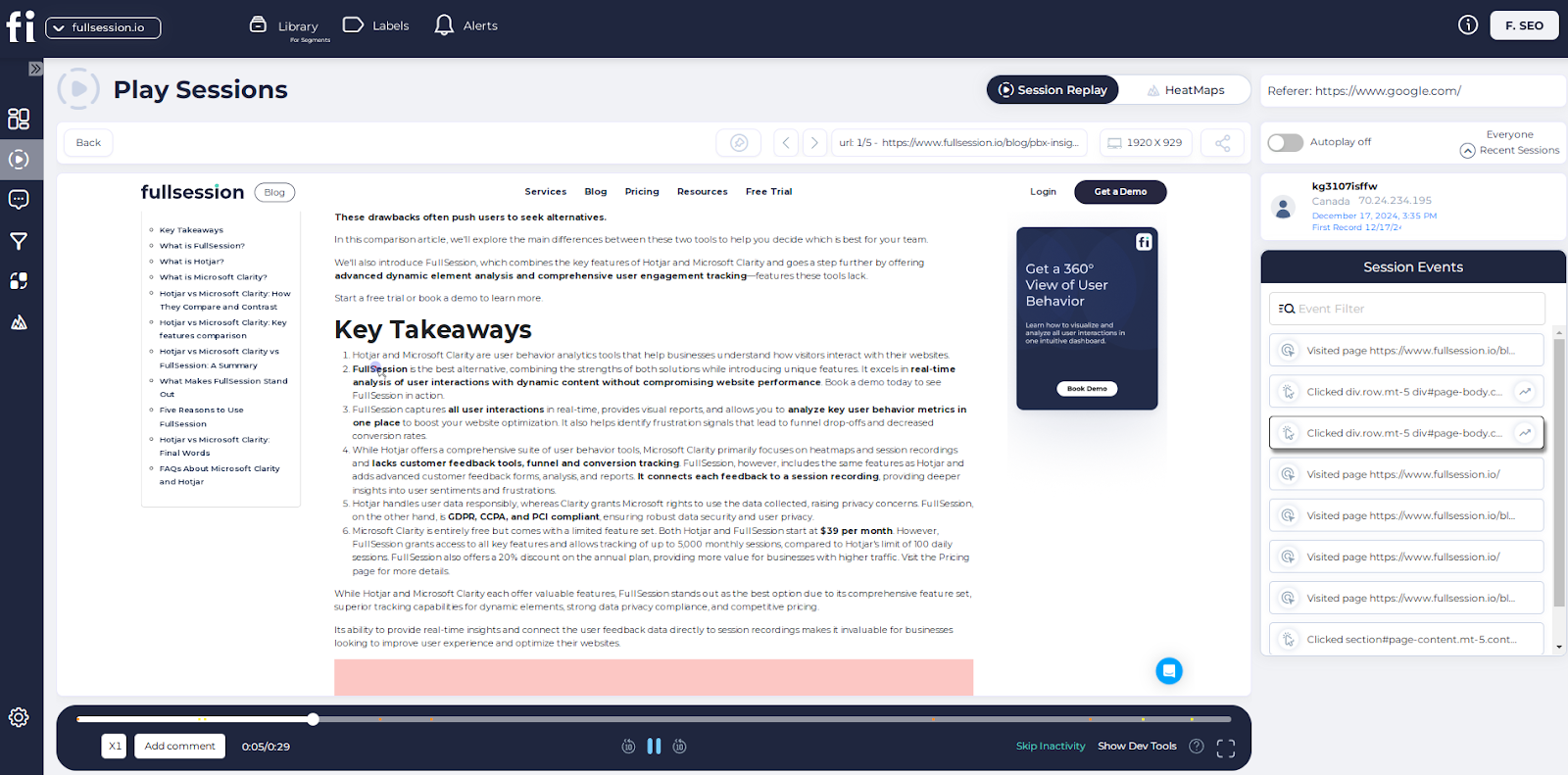
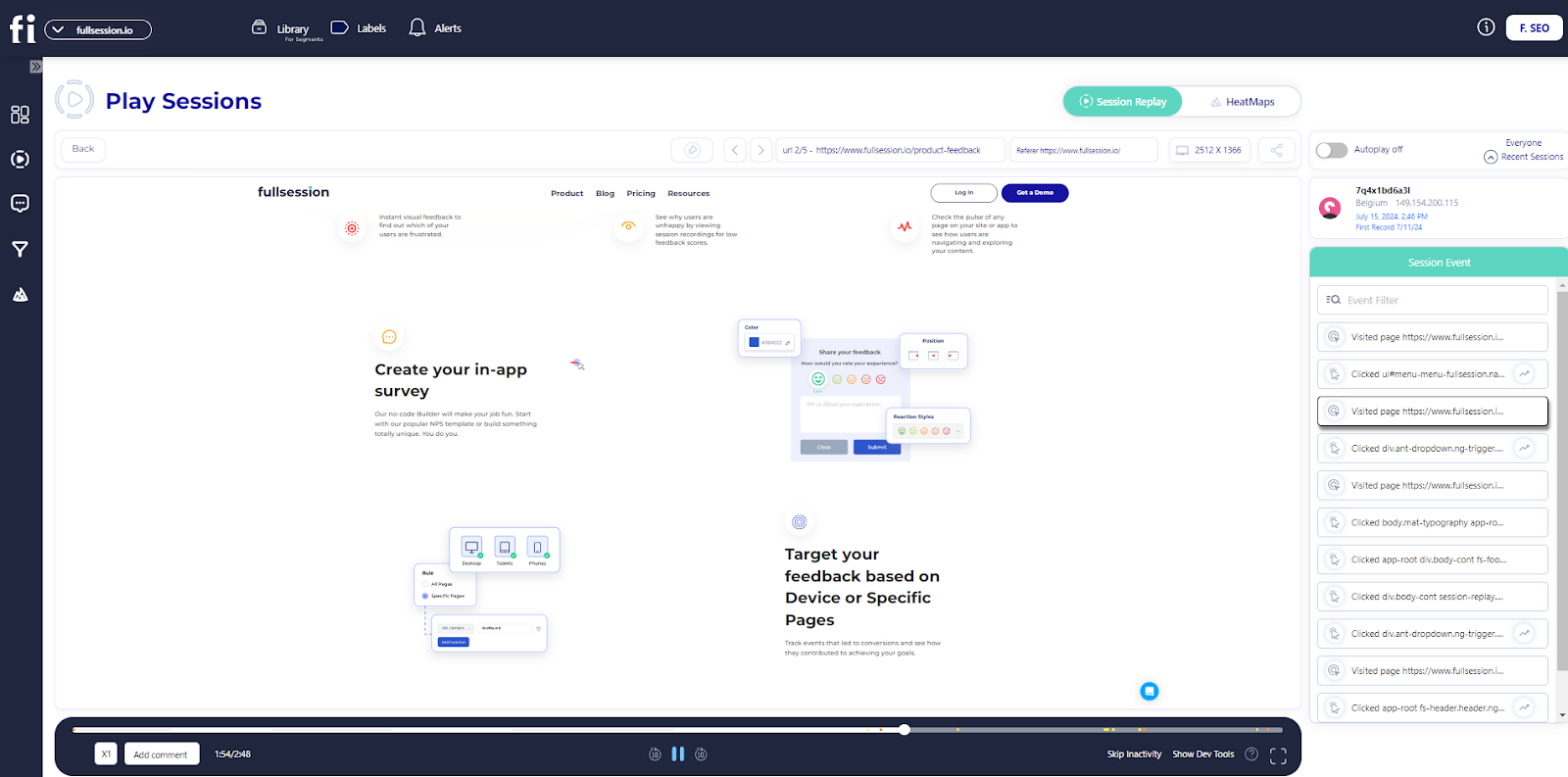
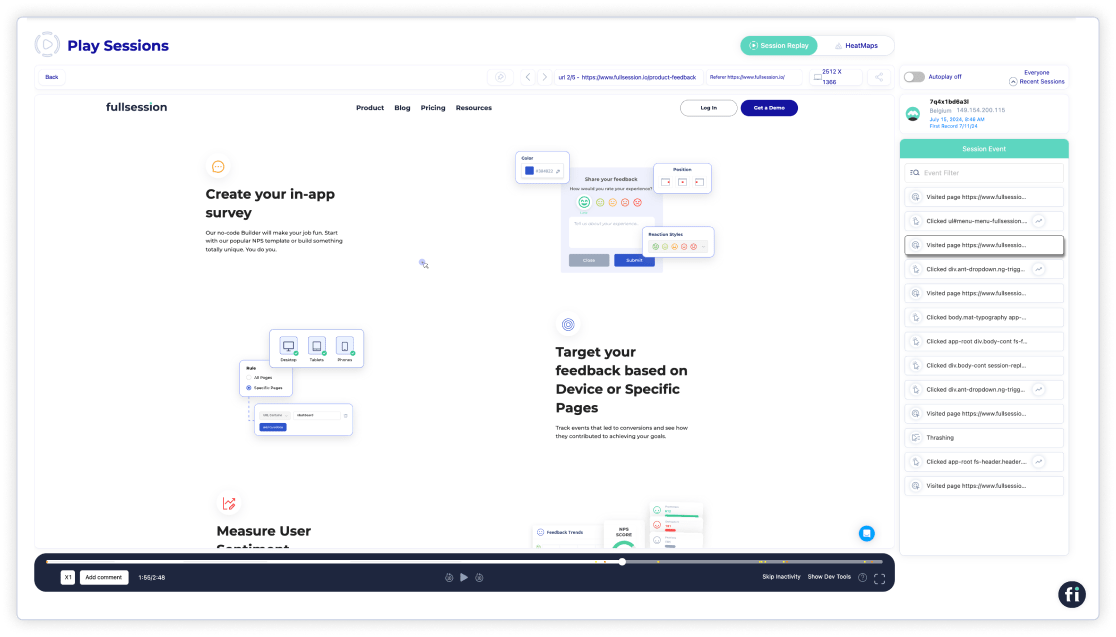
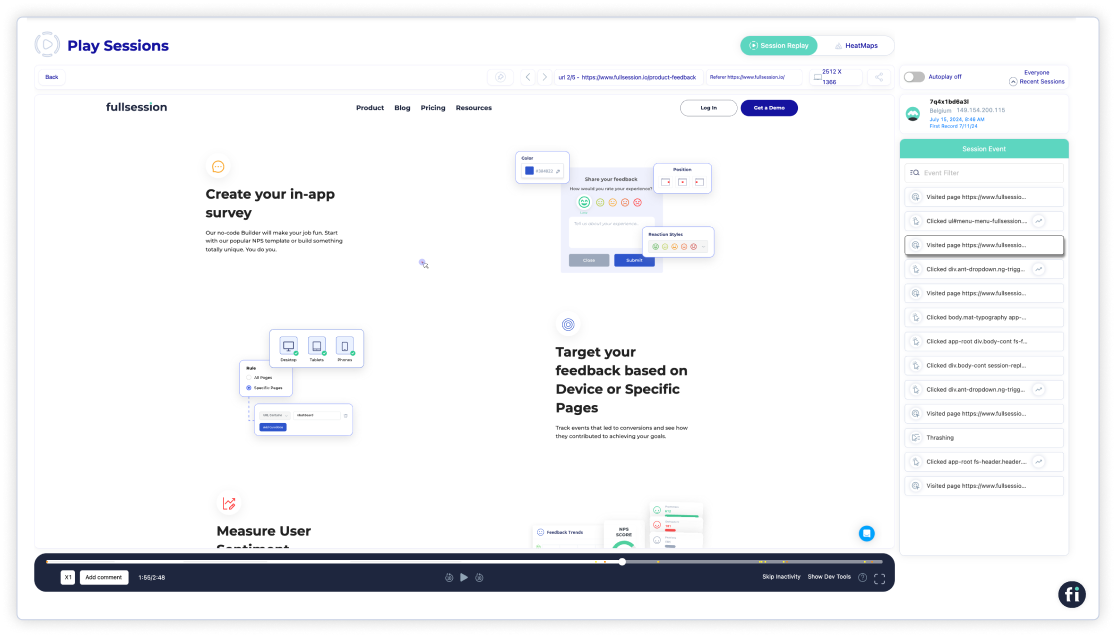
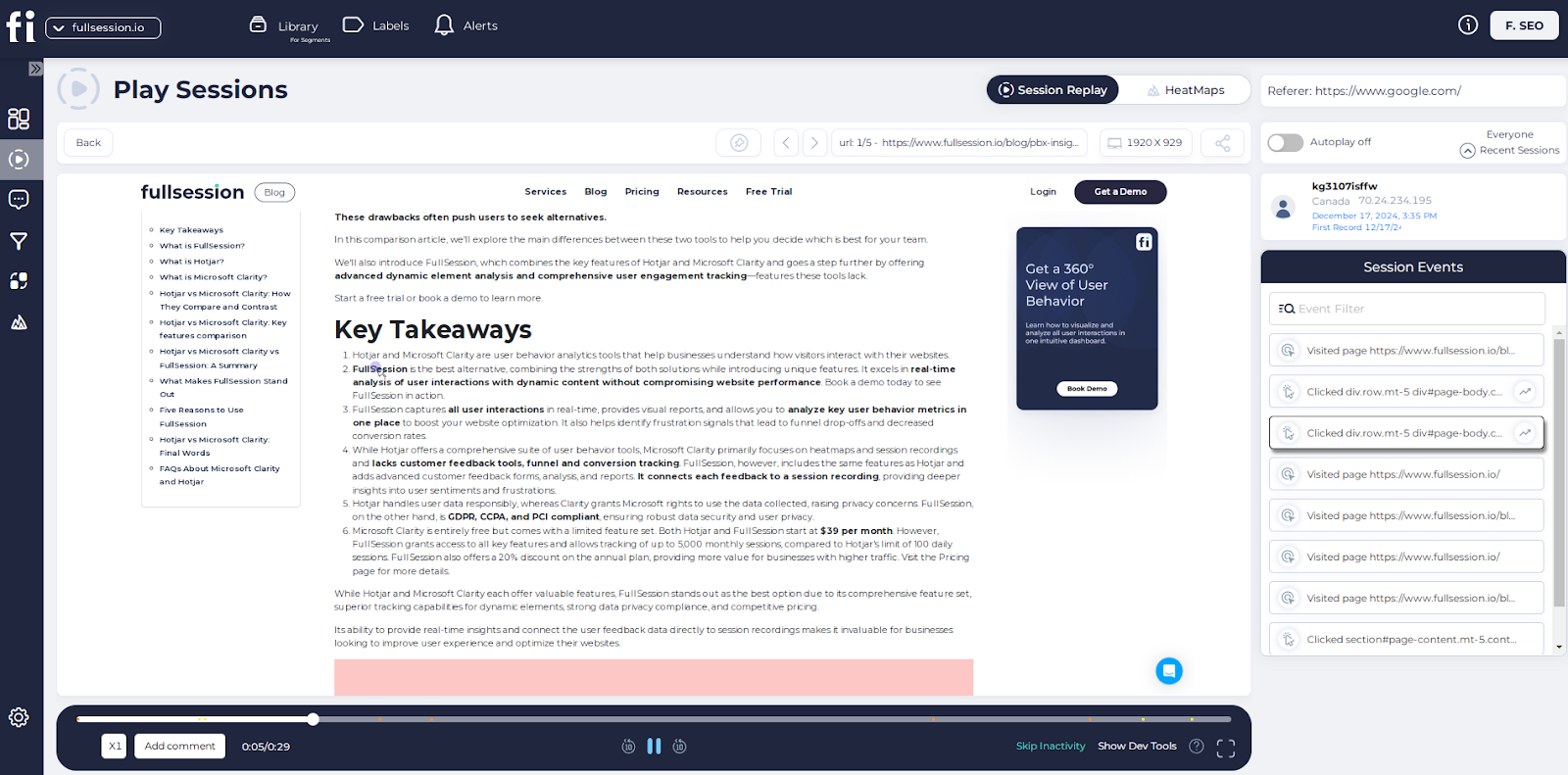
    Session recordings and replays
    session recordings for ux audit

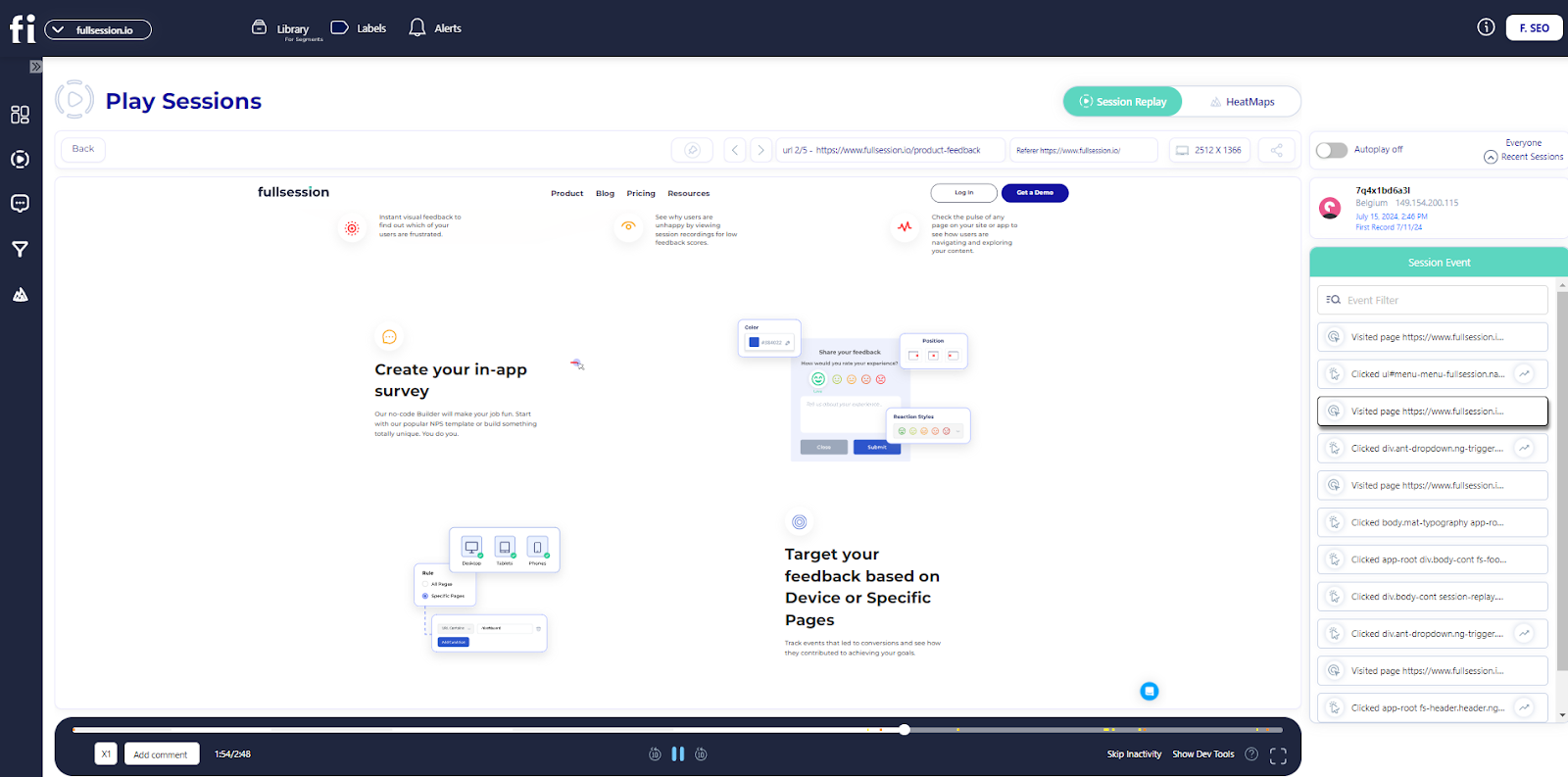
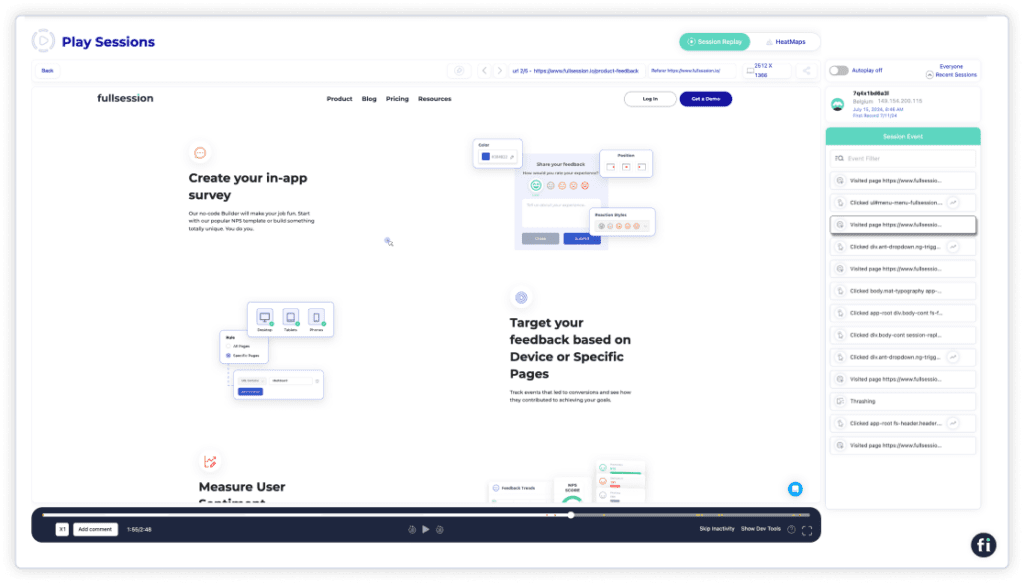
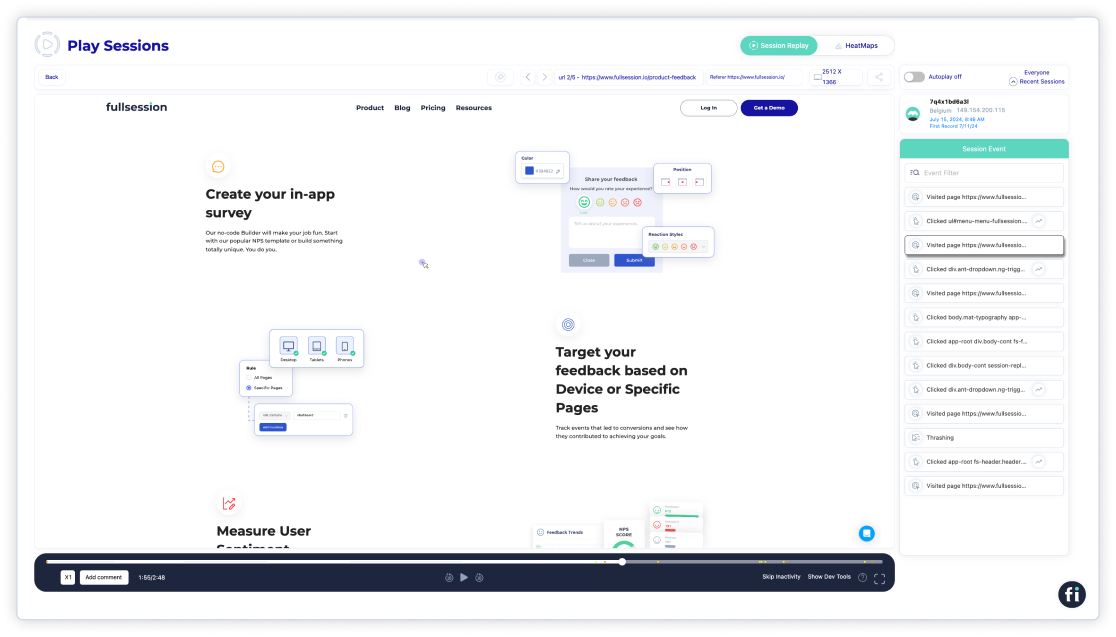
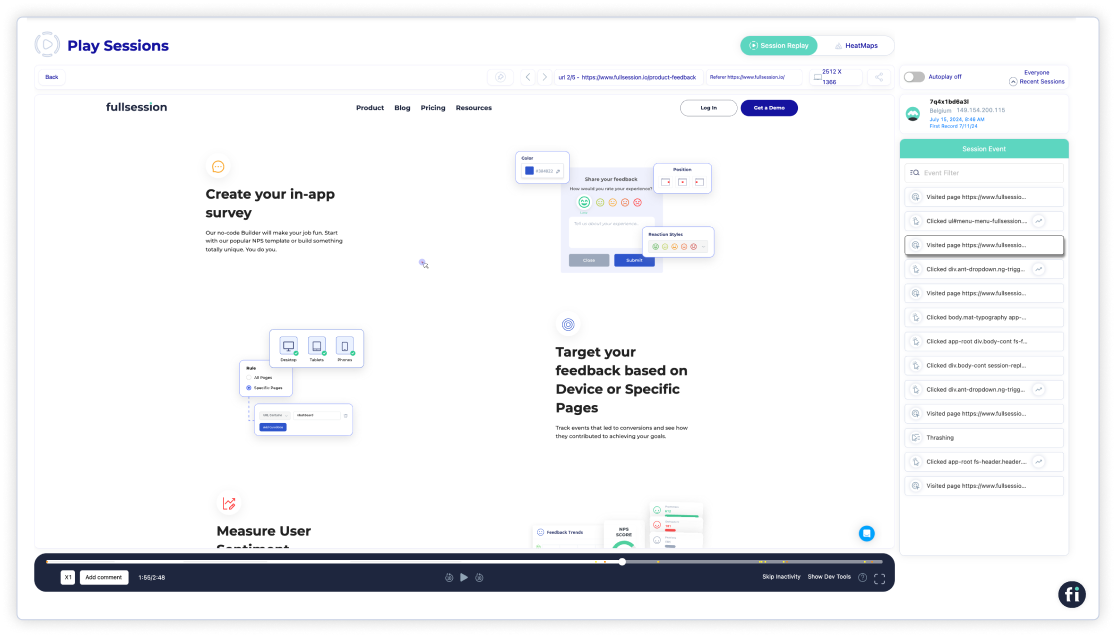
    FullSession’s session recordings will give you a front-row seat to user engagement. You can watch how people use your site in real time. It will help you spot issues faster.

    • Observe real-time user behavior with individual web pages
    • Identify scrolling patterns, rage clicks, and popular content areas
    • Detect broken links, bugs, and usability issues
    • Track time spent on pages and overall user trends
    • Monitor marketing campaign performance

    Session recordings will capture all interactions. But don’t worry – they will keep sensitive data private. You can search for specific actions or user types to focus on what matters most.

    By replaying sessions, you can see exactly where users get stuck. It will help you find and fix issues quickly. You’ll also see patterns in how people use your site, which will give you ideas for improvements.

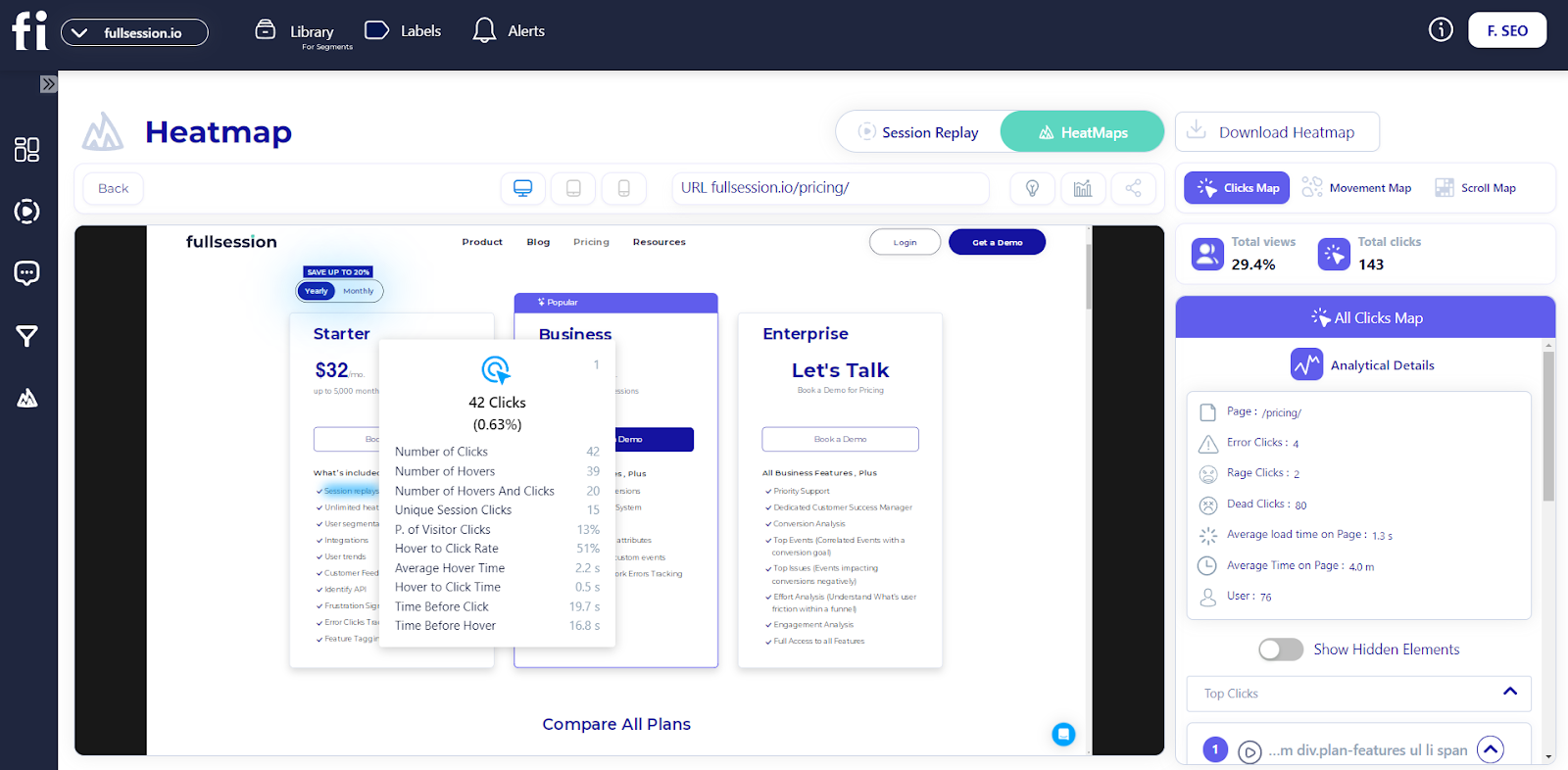
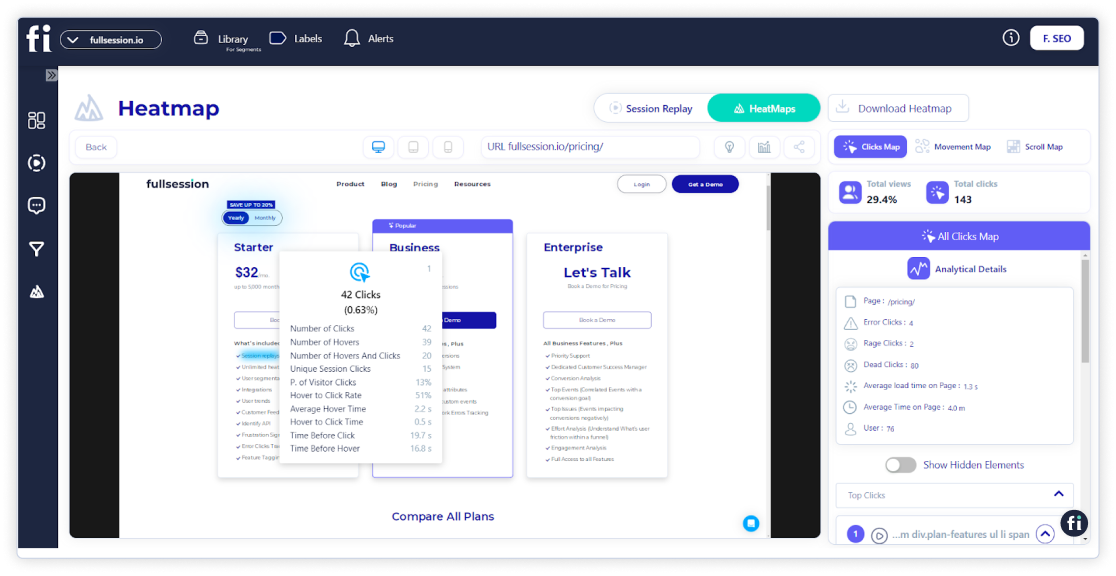
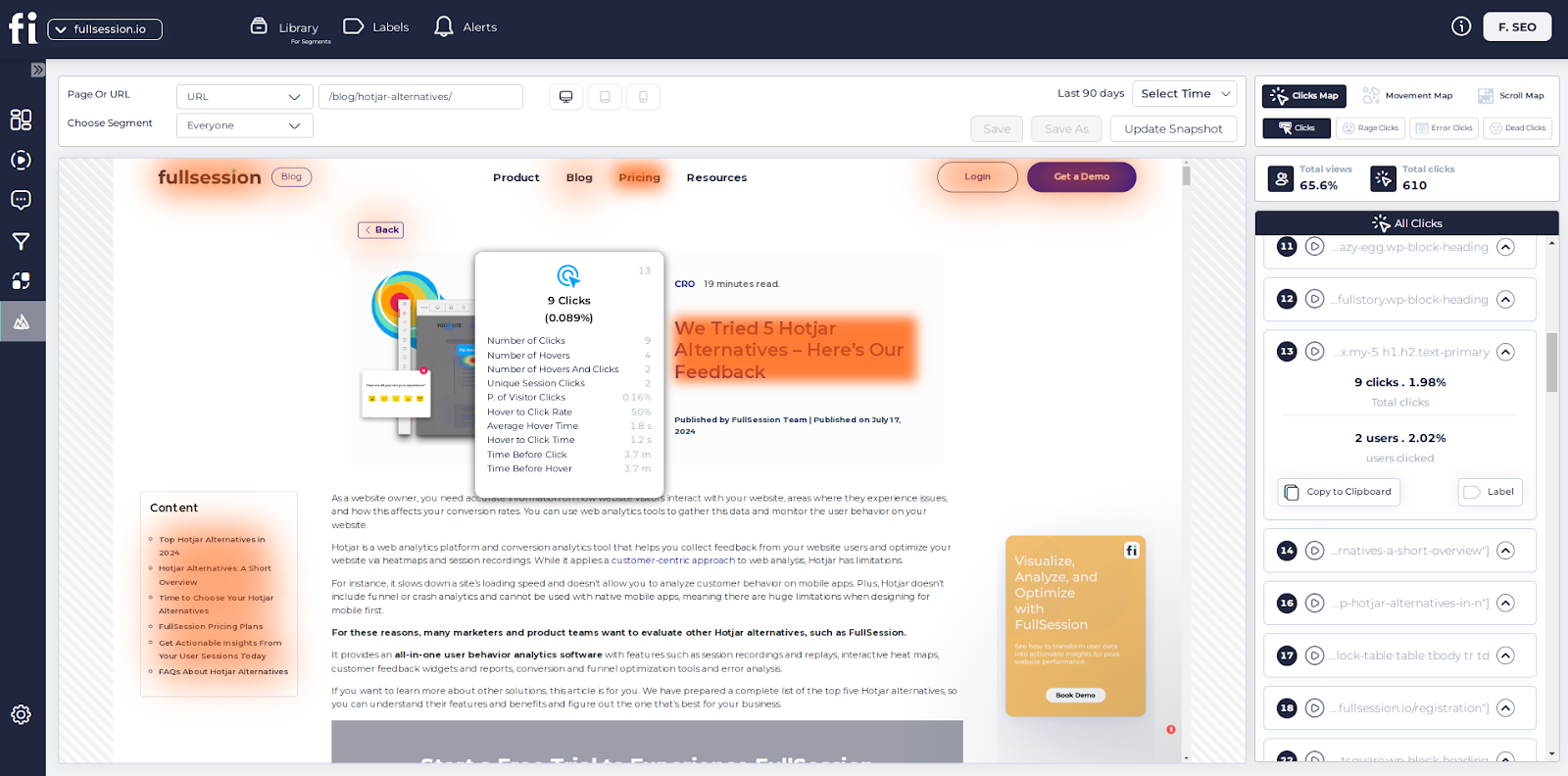
    Dynamic heatmaps
    dynamic heatmap for ux audit

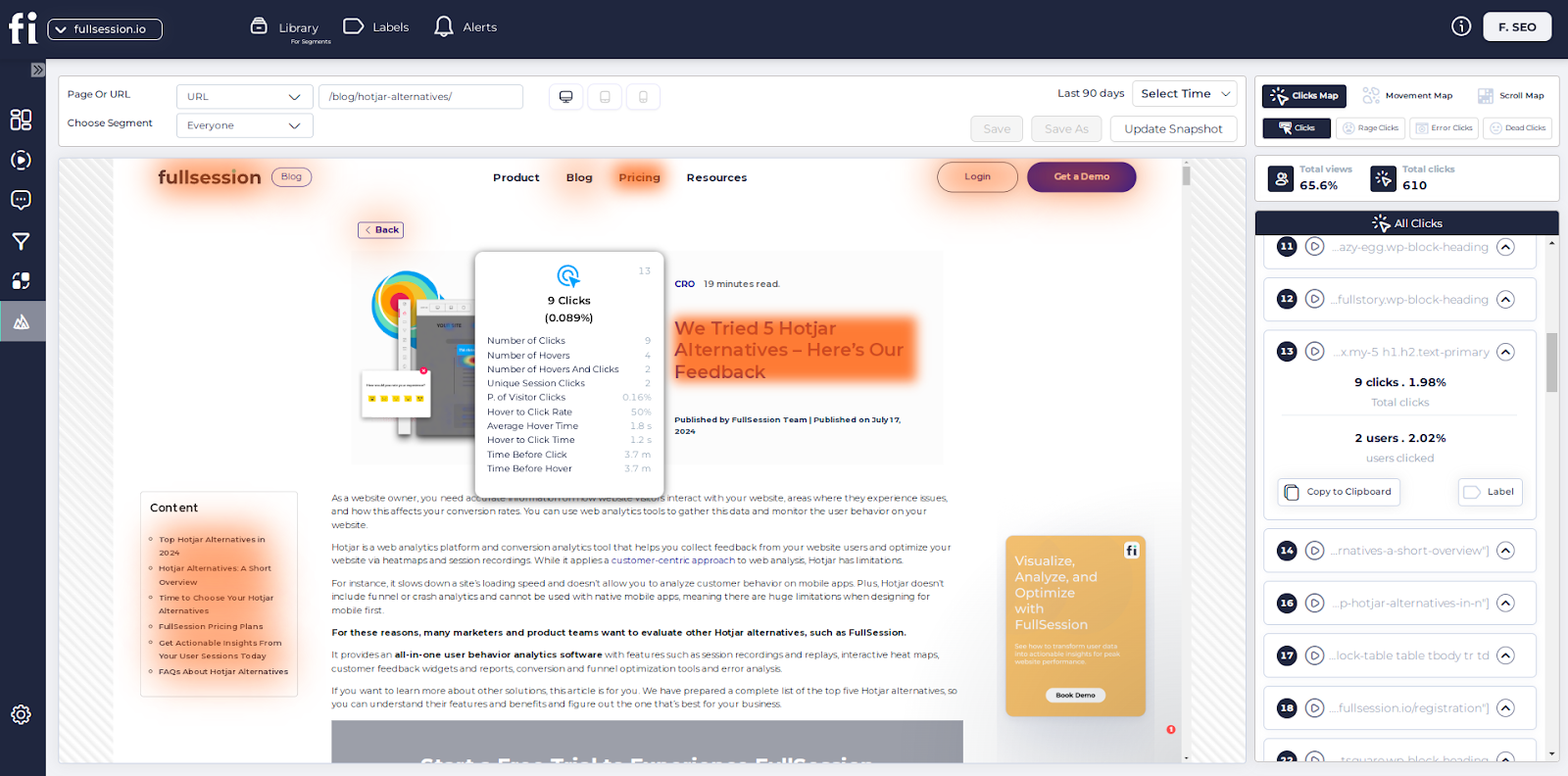
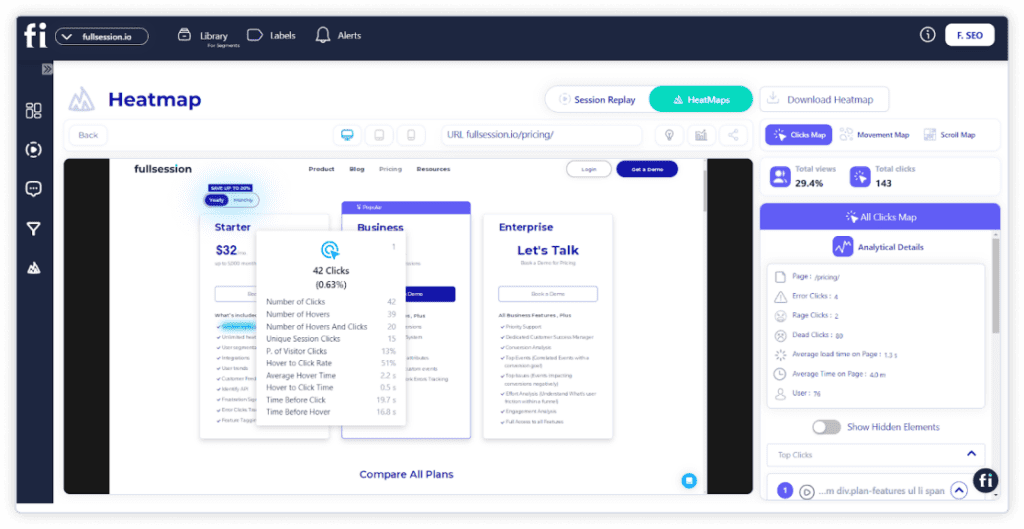
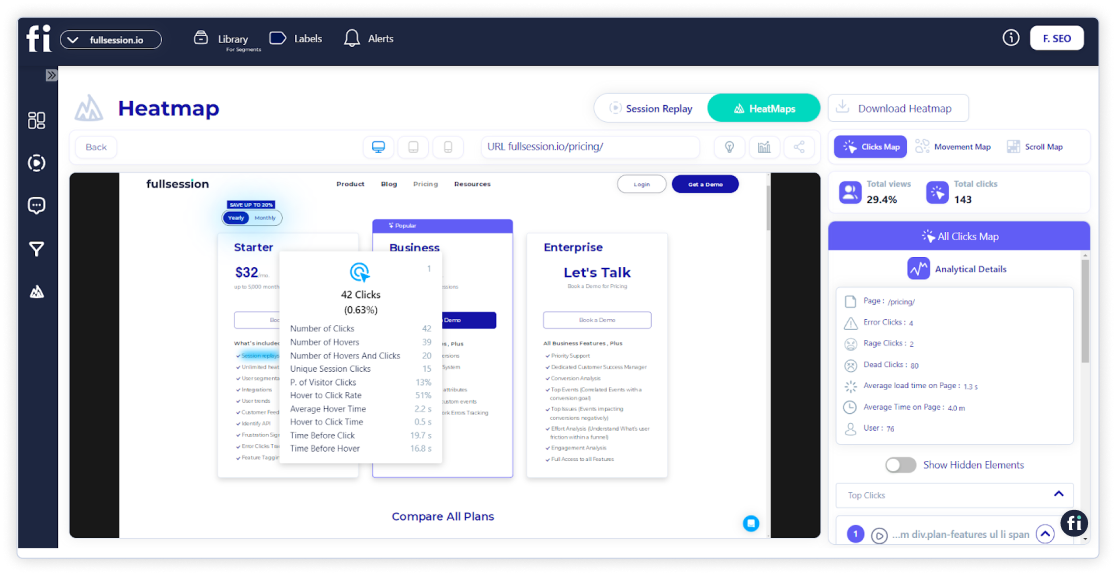
    FullSession’s dynamic heatmaps provide real-time data. You can switch between different types of heatmaps:

    These UX research tools will help you see your site’s popular areas and ignored parts. You can use this analysis to place important content where users will see it most.

    The best part is that FullSession’s heatmaps won’t slow down your site. You get fast insights without hurting your page speed.

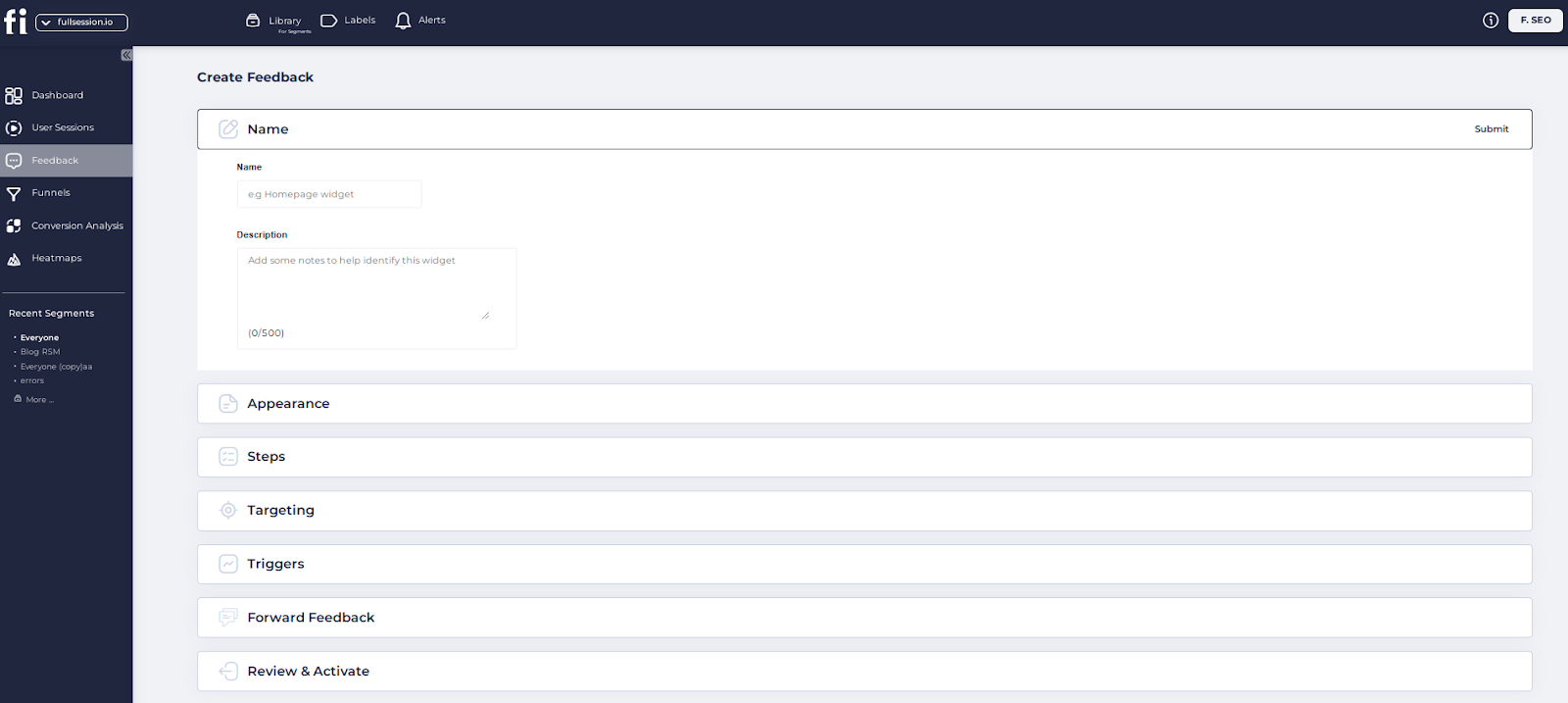
    Website feedback forms
    website feedback forms for ux audit

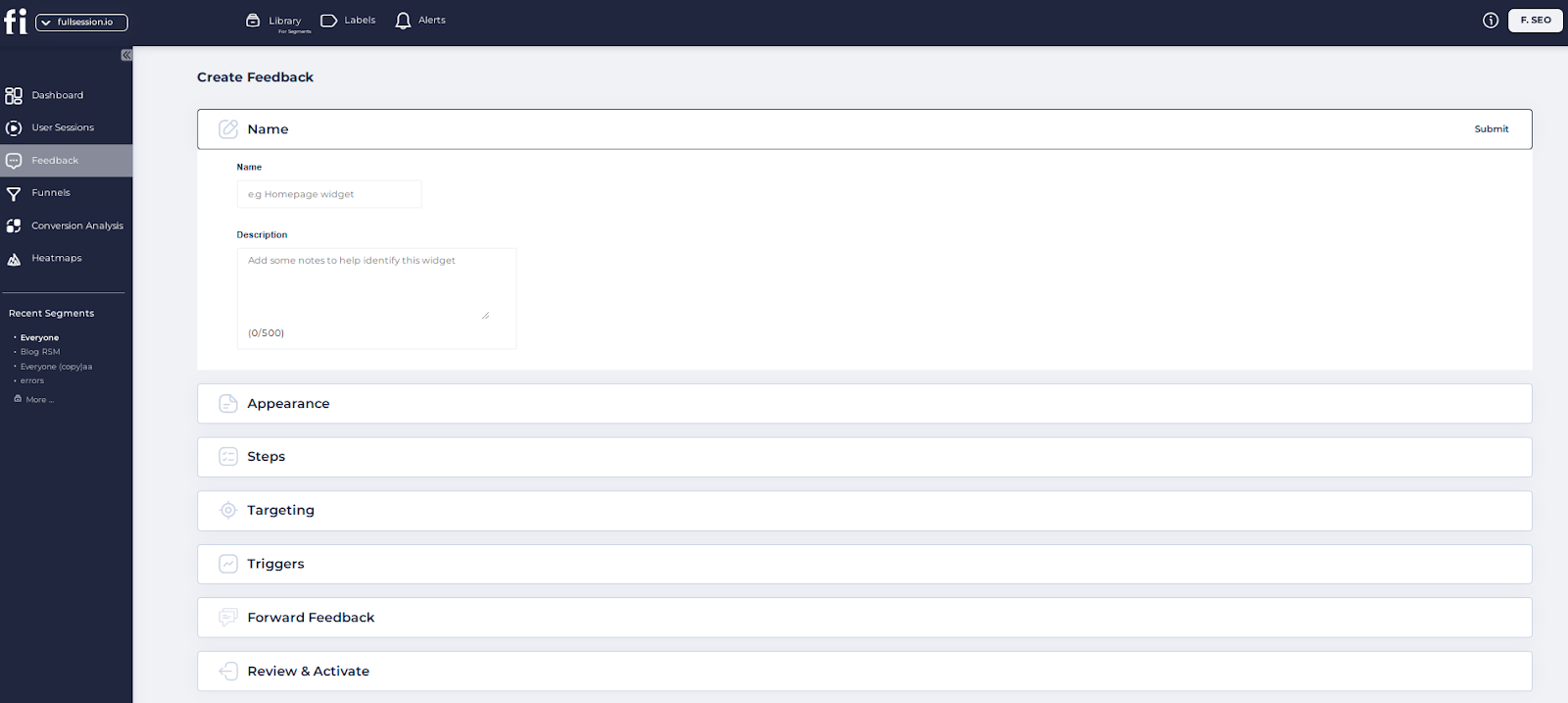
    Want to know what users really think? FullSession’s feedback forms let you ask them.

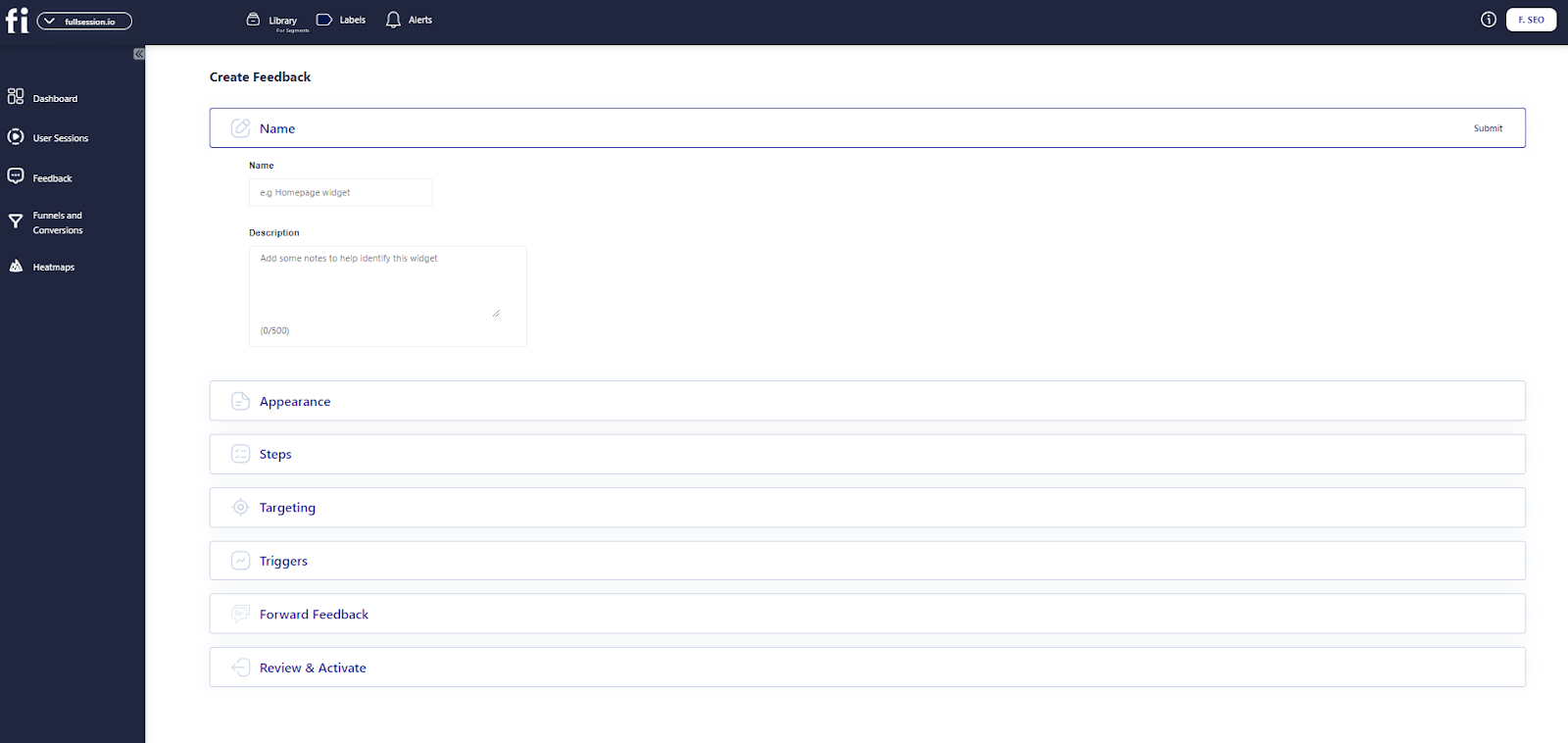
    You can create custom forms to match your brand’s look, define questions, choose devices for collecting user input and set up triggers to activate these forms.

    These website feedback tools will help you:

    • Get opinions on new features
    • Find out why users leave your site
    • Get ideas for improvements

    You can see the user information, such as: 

    • Email address
    • Location
    • The feedback customers submitted
    • Device type
    • Date of feedback
    • URL they engaged with

    The best part? You can watch the user’s session recording along with their feedback. It will give you context for their comments and help you understand their experience better.

    Use this to guide your UX changes. When users feel heard, they’ll stick around longer.

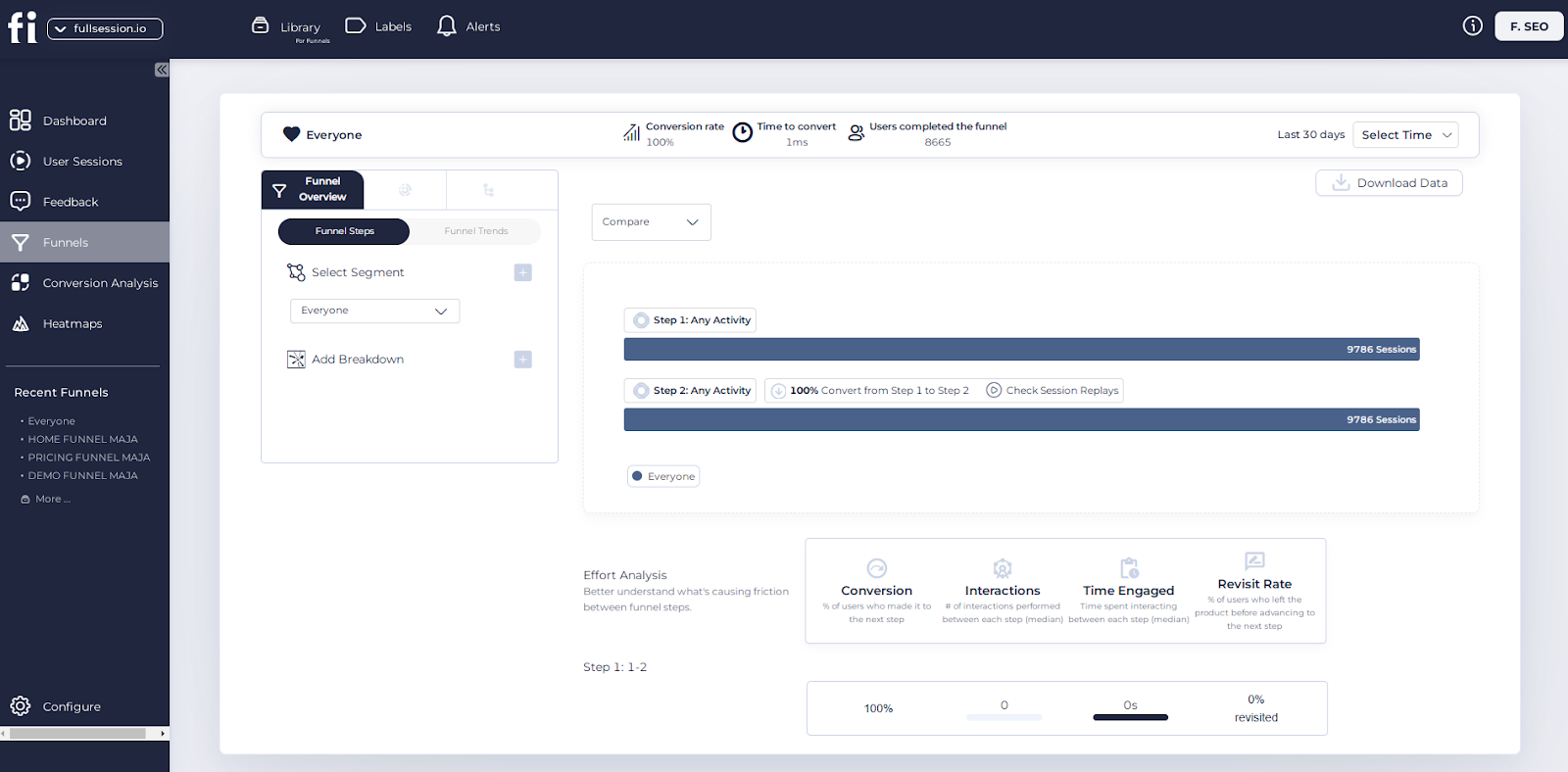
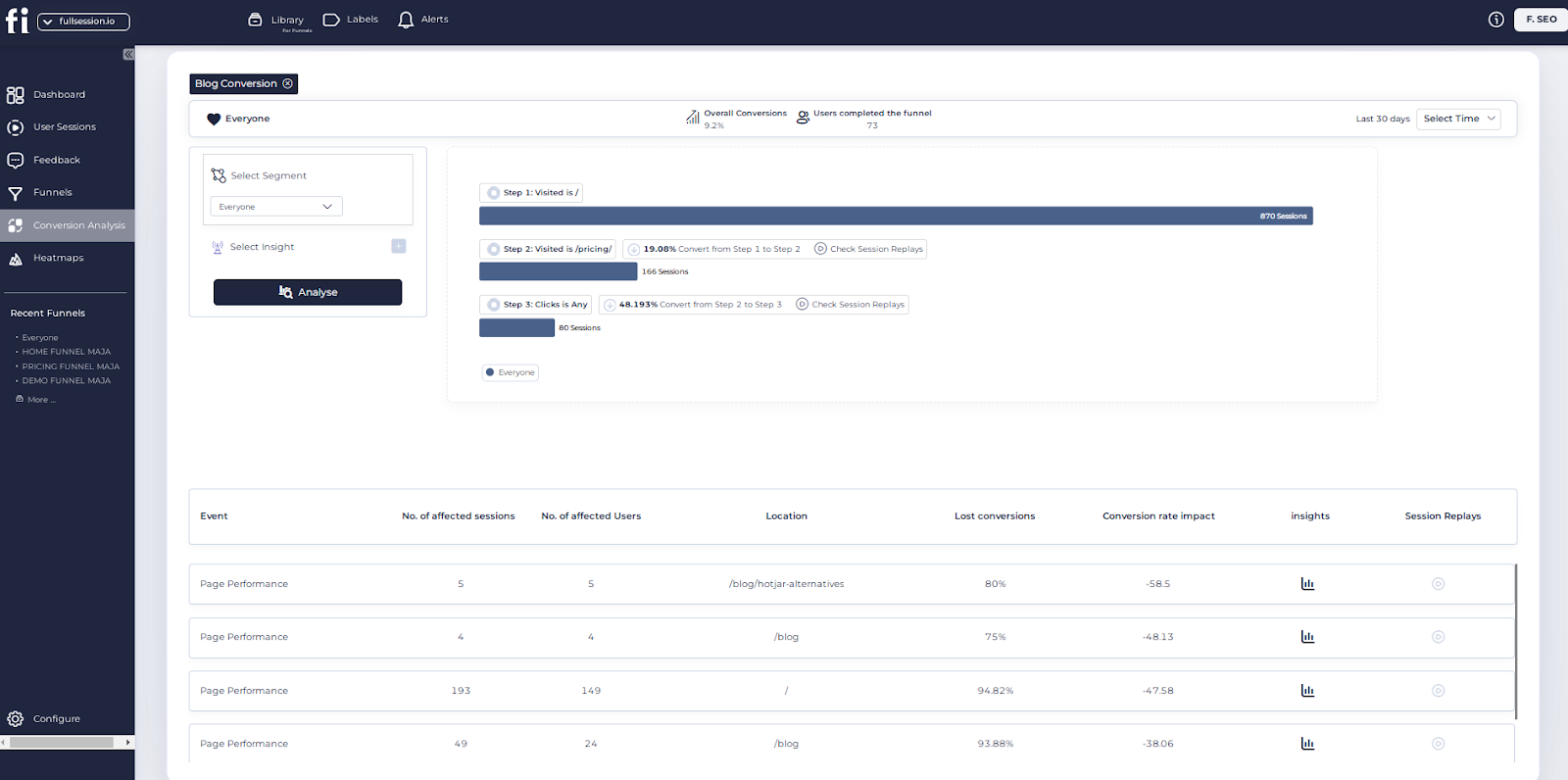
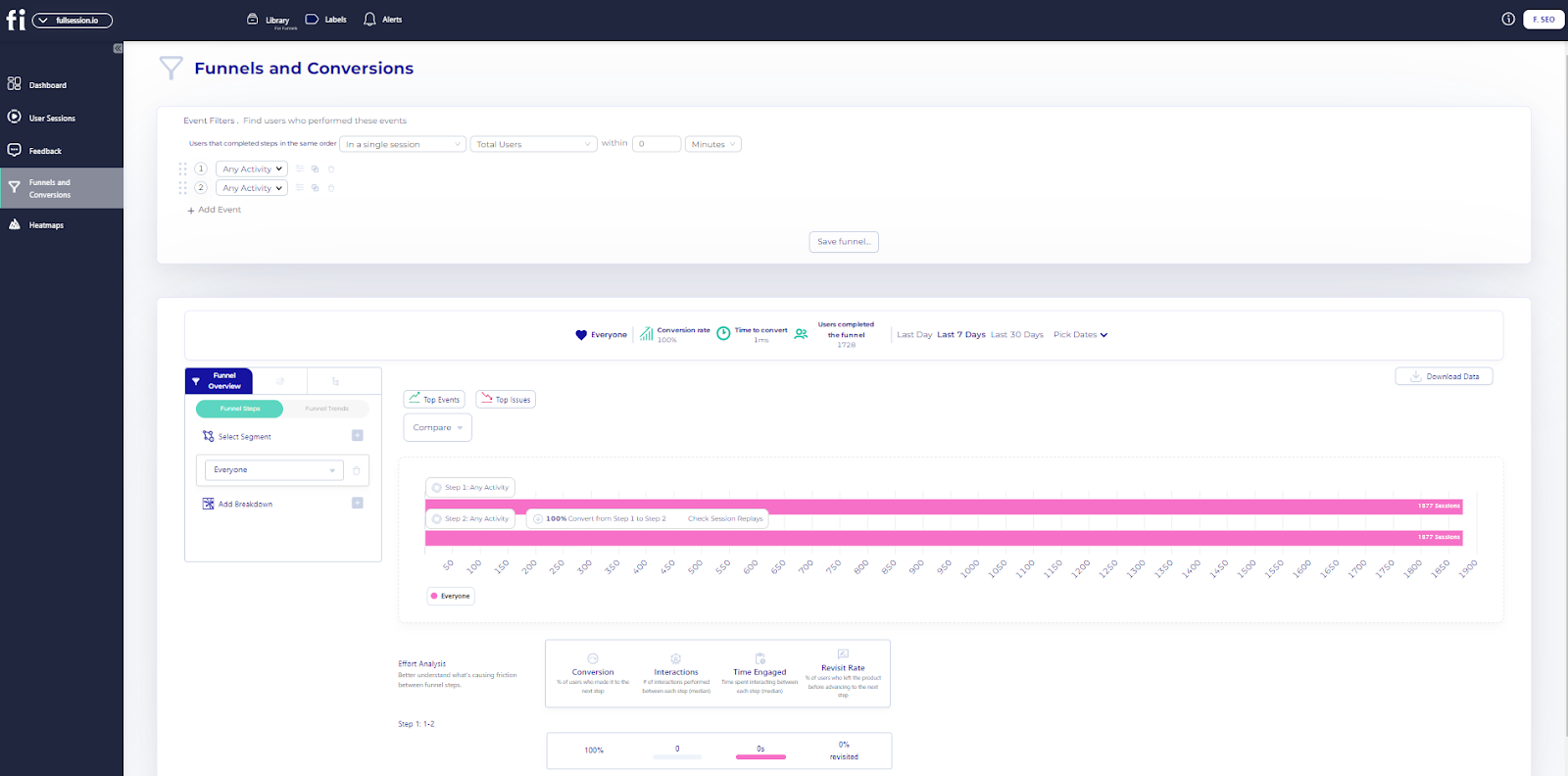
    Conversion funnel analysis
    FullSession conversion funnel analysis for ux audit

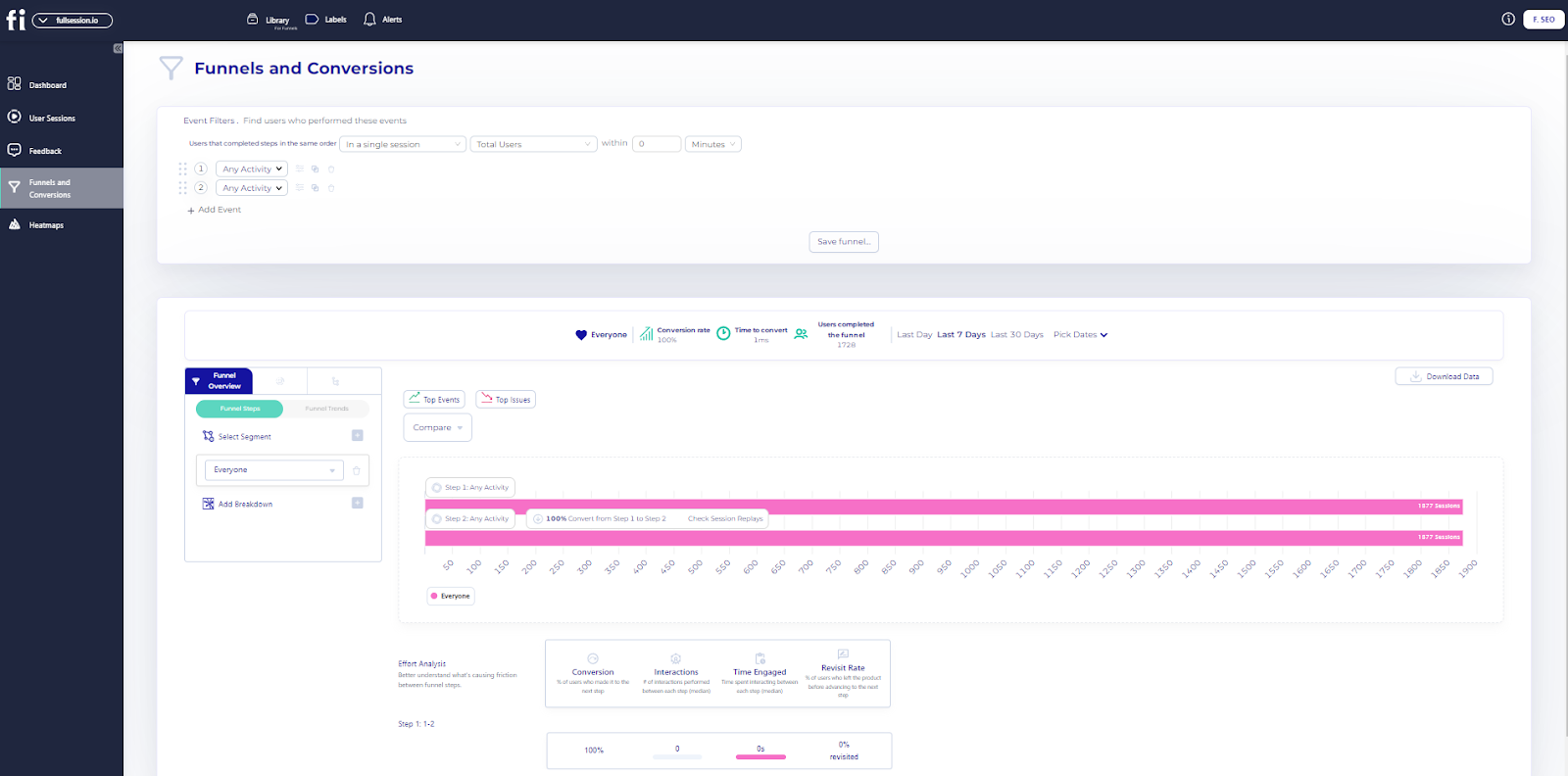
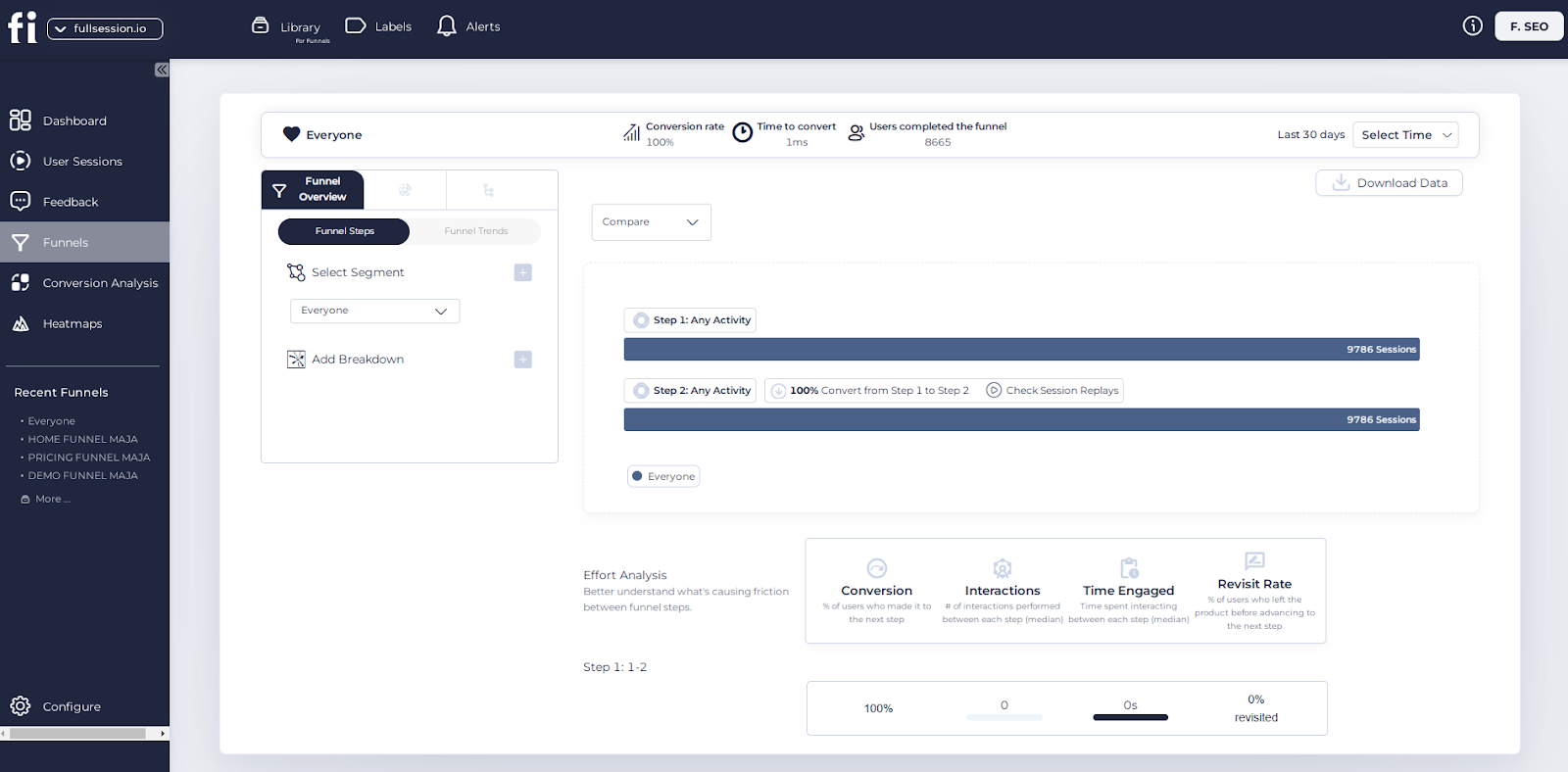
    FullSession will track users through your sales funnels. You can see where they drop off and why.

    It will show you:

    • Funnel steps: Visualize user progression and drop-off rates.
    • Funnel trends: Monitor changes in user flows over time.
    • Top events: Identify key actions boosting conversions.
    • Top issues: Detect and fix conversion obstacles.
    • Time engaged: Measure interaction time to spot frustration points.
    • Revisit rate: Track exits before advancement.
    • Segment analysis: Compare performance across user groups.
    • Time period comparison: Analyze trends over different periods.

    You can test different designs to see what works best. You’ll see hard data on what helps users complete key actions.

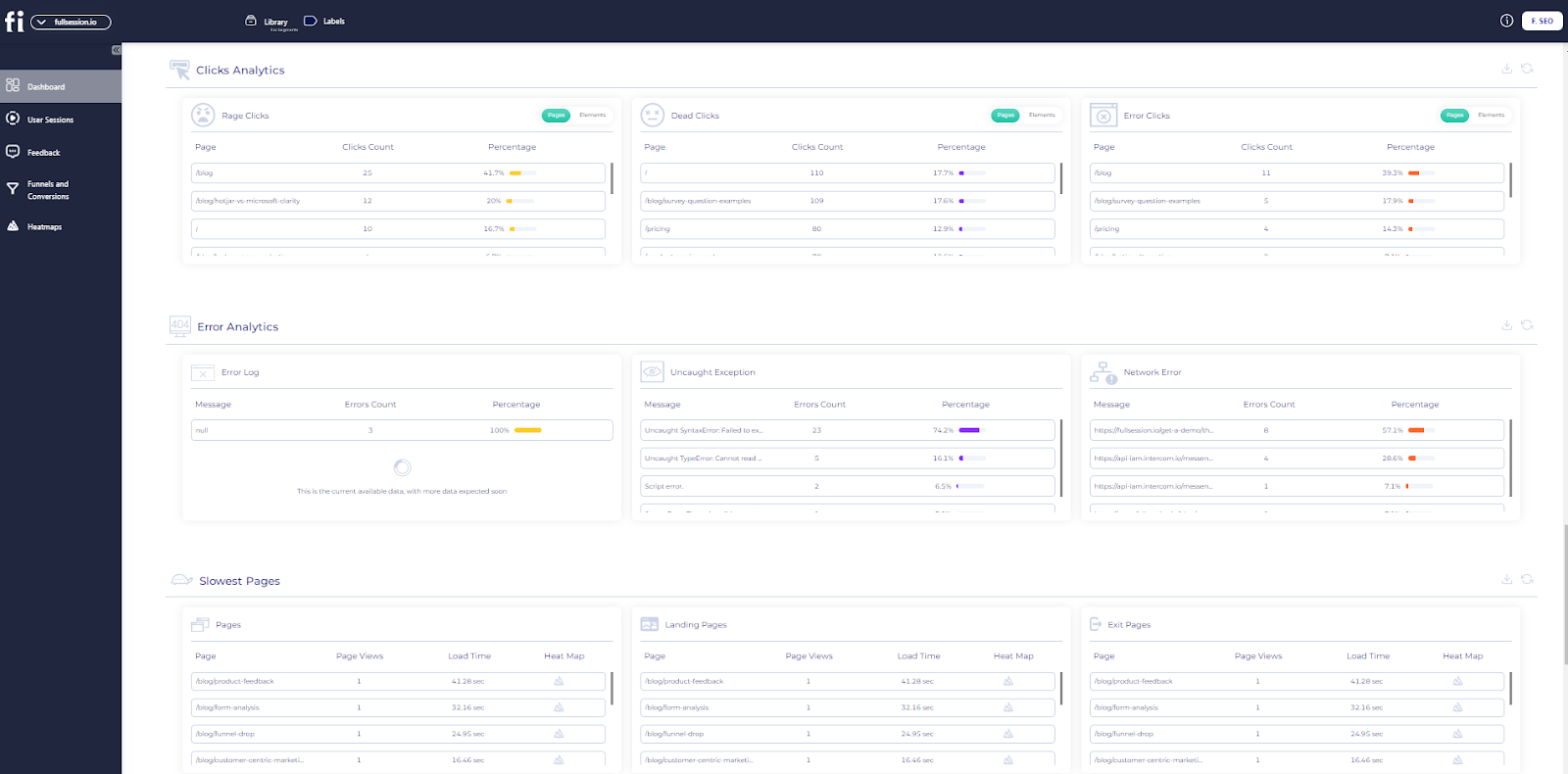
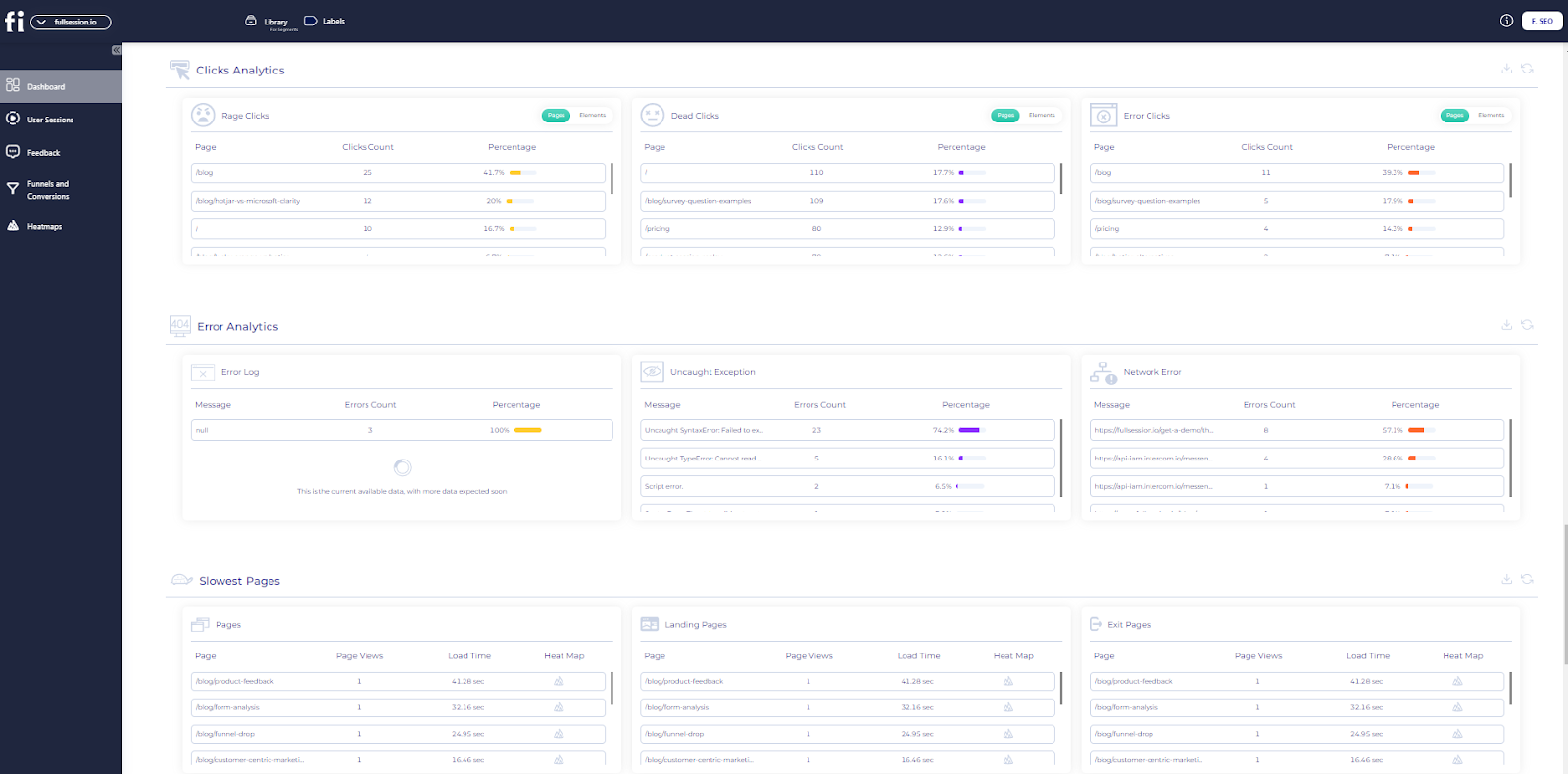
    Error tracking
    FullSession error analysis for ux audit

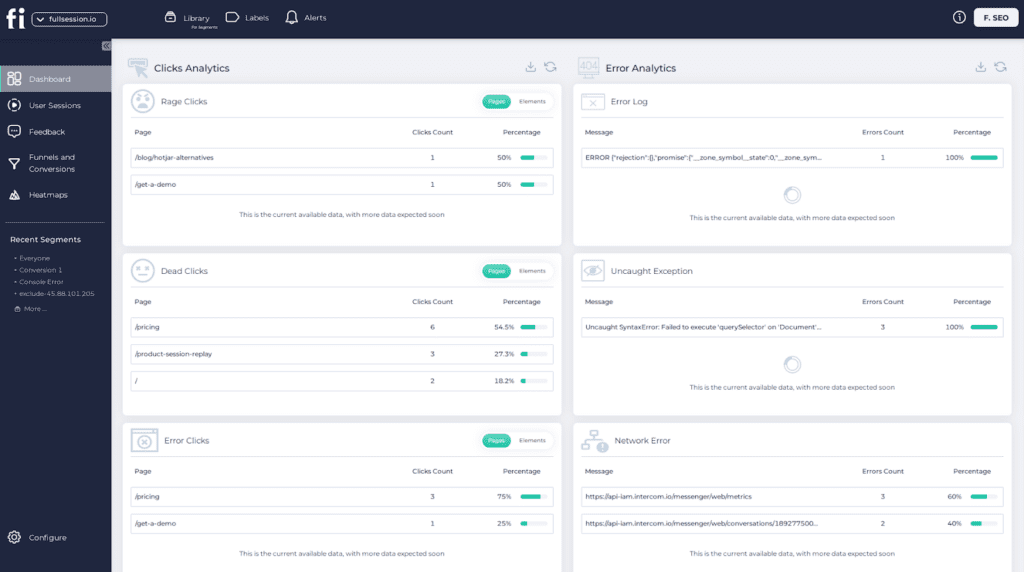
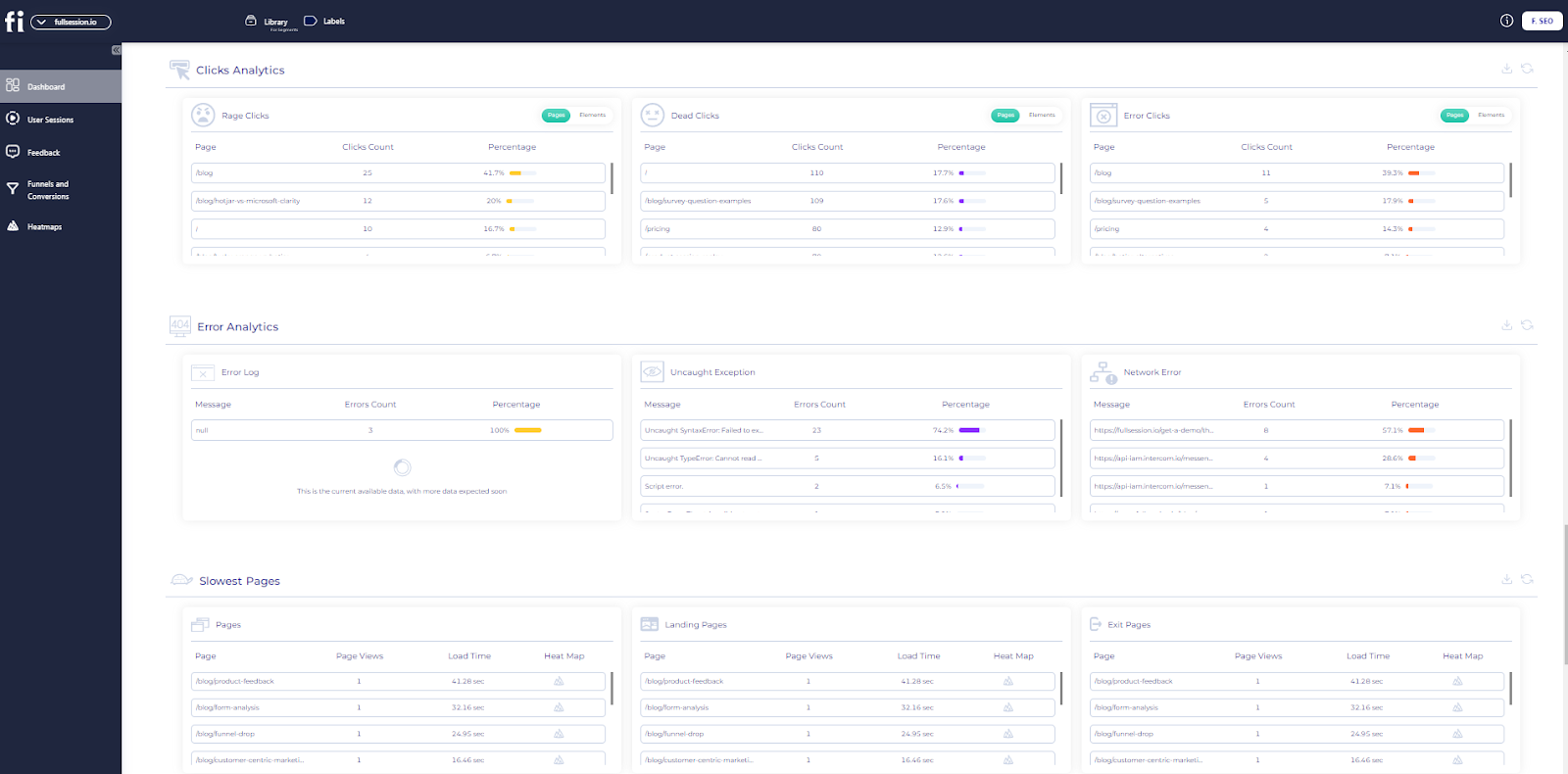
    Nothing kills user experience like errors. FullSession will automatically detect issues on your site, such as:

    • JavaScript errors
    • Network problems
    • Console errors
    • Failed API calls
    • Uncaught exceptions
    • Error logs and trends

    You’ll see which errors happen most often and how they affect users. The tool will show you the user’s journey before and after an error occurs.

    It will help you fix issues fast. You’ll know exactly what went wrong and can prevent it from happening again. You’ll keep users happy and your site running smoothly by catching and eliminating errors quickly.

    Maximize Your Conversion Rate With FullSession

    See how our CRO tools help you improve website performance to drive conversions.

    Conducting a UX Audit: Step-By-Step Process

    A UX audit looks at how easy your site is to use, how it’s organized and if it meets user needs. Let’s go through the key steps to do a UX audit.

    Heuristic evaluation and usability testing
    heuristic evaluation

    Image source: Adam Fard UX Studio

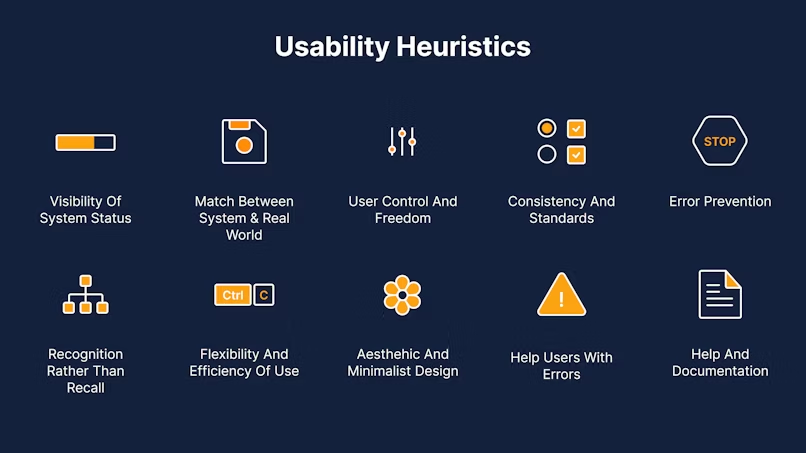
    Start your UX audit with a heuristic evaluation. It means checking your site against a set of usability guidelines. These guidelines will help you spot common problems.

    You can use Jakob Nielsen’s 10 usability heuristics. They cover:

    • Is your site’s status clear?
    • Does it match the real world?
    • Do users have control?
    • Is it consistent?

    Then, do some usability testing. Watch real users try your site. Ask them to do common tasks. Note where they get stuck or confused.

    Usability testing will show you real problems users face. They’ll often find issues you’d miss. Try to test with 5-8 users for best results.

    Analyzing site information architecture and navigation
    site information architecture

    Image source: UX Planet

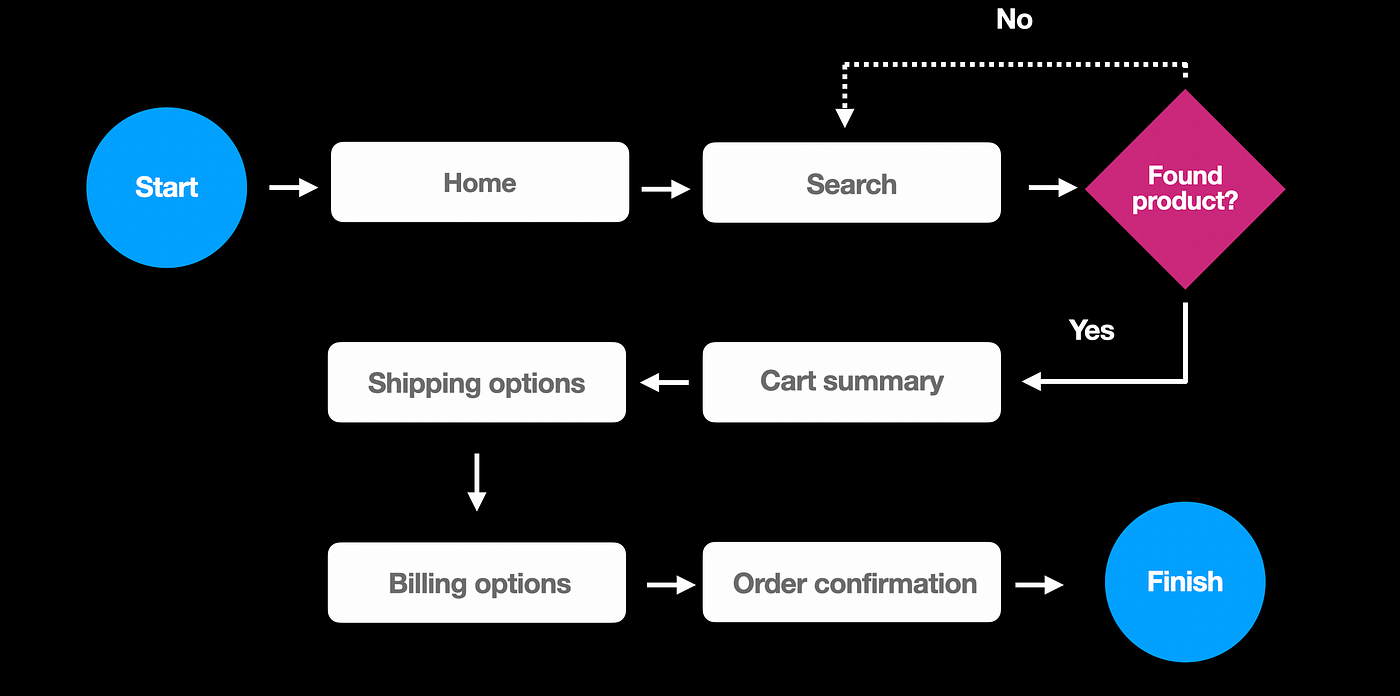
    Next, look at how your site is structured. This is information architecture. A good structure helps users find what they need fast.

    Look at your site’s main sections. Are they clear? Do they make sense to users? Look at your menus and links. Are they easy to use?

    Draw out your site’s structure. It will help you see if it’s too complex. You might find areas to simplify.

    Also, look at your search. Does it work? Can users find what they need?

    User flows are important, too. Map out common journeys users take. Are there any blockers? Look for ways to smooth these flows.

    Assessing visual design and branding consistency
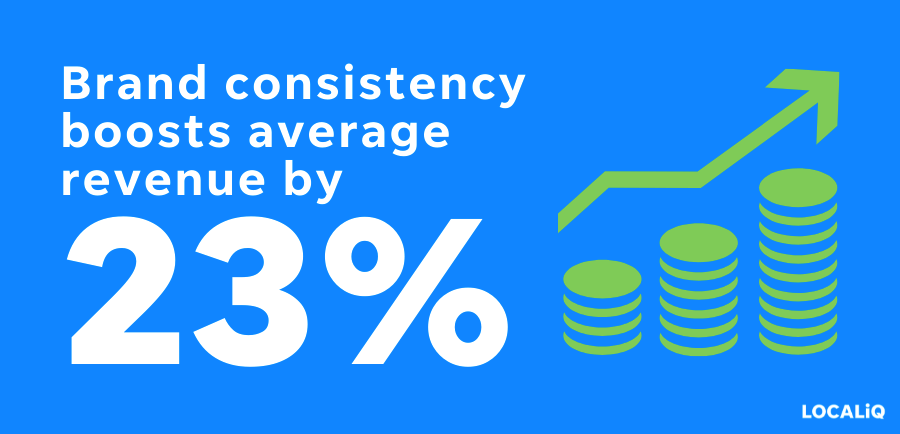
    Image source: LocalIQ

    Your site’s look is a big part of the user experience. Check if your visual design is clear and user-friendly. Look at your colour scheme. Does it match your brand? Is there enough contrast for readability?

    Check your fonts. Are they readable? Do they fit your brand style? Look at images and icons. Do they help explain things? Are they high-resolution?

    Make sure your design is consistent across all pages. It will help users feel comfortable as they move through your site.

    Don’t forget responsive design. Does your site look good on phones and tablets? It is key for user experience.

    Evaluating content quality and relevance
    content quality and relevance

    Image source: Visme

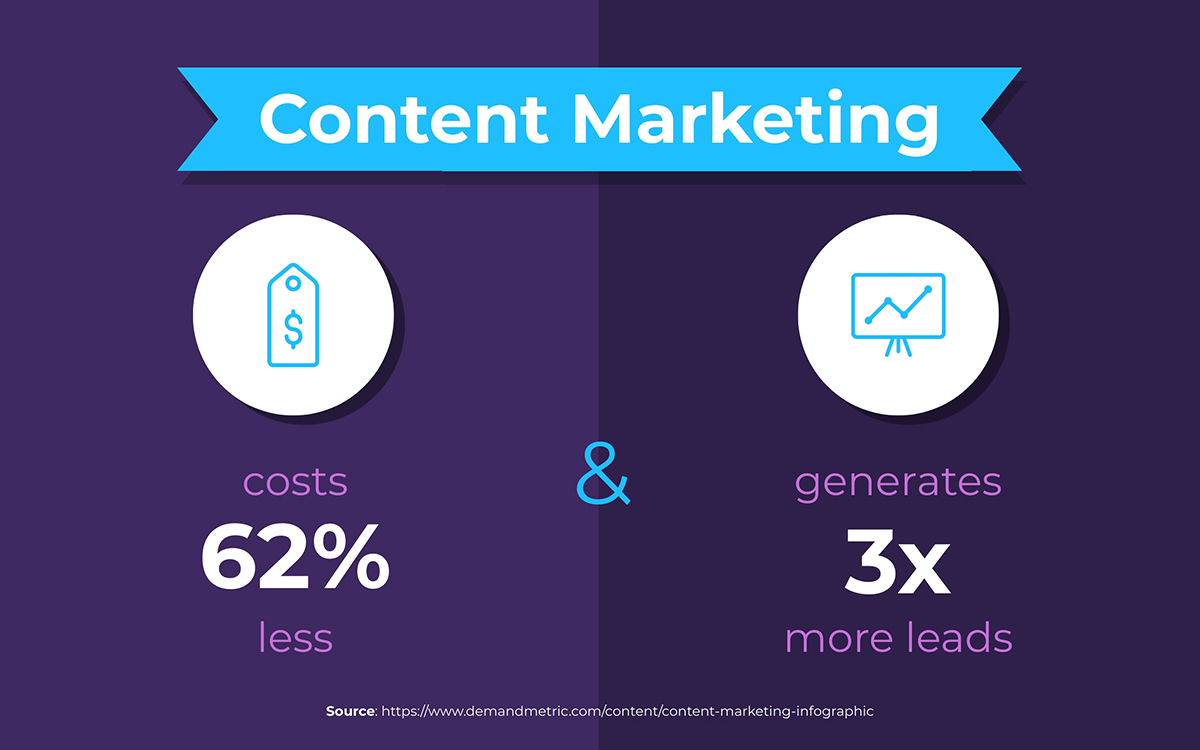
    Good content is a big part of user experience. It’s what users come to your site for. Check if your content is clear and easy to understand. Is it jargon-free? 

    Look at your headings and subheadings. Do they help users scan the page? Are they descriptive?

    Check for outdated info. Old or inaccurate content will frustrate users. Make sure everything is up to date.

    See if your content matches user needs. Does it answer common questions? Is it useful?

    Also, check your calls to action. Are they clear? Do they guide users to the next step?

    Checking for accessibility and inclusivity

    Image source: AudioEye

    An accessible site is suitable for all users. It’s also required by law in many places.

    Check your colour contrast. Is text readable against backgrounds? Tools like WebAIM can help with this. Look at your alt text for images. Does it describe images well for screen readers?

    Check if your site works only with a keyboard. Can users navigate without a mouse? Test with screen readers. How well does your site work for visually impaired users?

    Look at your forms. Are they clearly labelled? Do error messages make sense?

    Remember, an accessible site is a better site for everyone. It’s worth the effort to get it right.

    Identifying Common UX Issues
    common ux issues

    Image source: GeeksforGeeks

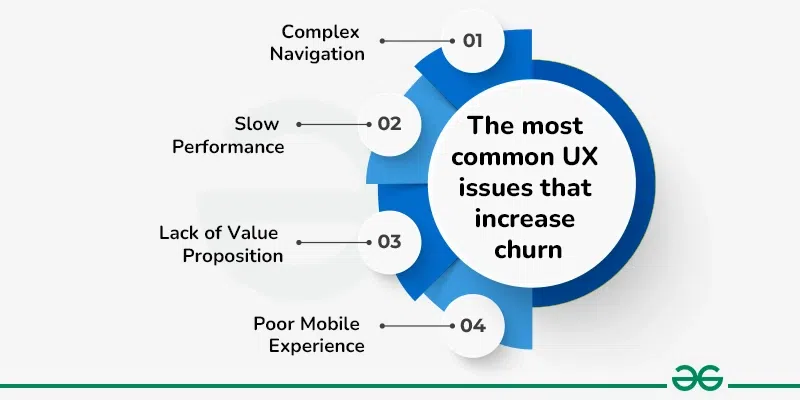
    A UX audit will help find problems that frustrate your site’s users. Let’s look at some of the common areas where issues arise.

    Navigation and wayfinding

    Is your site easy to navigate? Users should be able to find what they need without getting lost. Check if your menu makes sense and if the links are clear.

    Look for:

    • Confusing menu labels
    • Too many options that overwhelm visitors
    • No search function
    • Broken links that go nowhere

    Use a site map to see how pages connect. It will help you see where users might get stuck.

    Content readability and clarity issues

    Your words matter! Hard-to-read text will repel users. Look out for:

    • Long blocks of text without breaks
    • Tiny font sizes
    • Poor contrast between text and background
    • Jargon or complex language

    Try reading your content out loud. If you stumble, so will your users. Use short paragraphs and bullet points to make it easy to scan.

    Mobile responsiveness issues

    More people are browsing on phones than ever. Your site needs to work on small screens. Look for:

    • Text that’s too small to read
    • Buttons that are hard to tap
    • Images that don’t fit the screen
    • Forms that are hard to fill out on mobile

    Test your site on different devices. What looks good on a computer might not work on a phone.

    Page load speed and performance issues

    Slow sites are user pain points that will drive users away. Look for:

    • Large image files that take ages to load
    • Too many ads slowing things down
    • Clunky code that slows the site down
    • Plugins that add unnecessary weight

    Use speed test tools to see how fast your pages load. Aim for under 3 seconds to keep users happy.

    Creating a UX Audit Report

    UX audit report

    Image source: Freepik

    A UX audit report helps you collate your findings and plan changes. You’ll learn how to structure your report, prioritize issues and present data visually.

    Structuring your findings and recommendations

    Start by grouping your results into sections. It will make your UX audit report easier to read. Use sections like navigation, content and design.

    For each issue, add:

    • A clear description of the problem
    • Why it’s a problem for users
    • How to fix it

    Use bullet points or numbered lists to break up complex information. It will help readers quickly get the key points.

    Add screenshots or screen recordings to show exactly where the problems are. Visuals make your report more compelling.

    Prioritizing issues and suggested fixes

    Not all issues are created equal. Rank problems by:

    • How much do they affect users
    • How easy they are to fix
    • How they impact business goals

    You can use a simple scale:

    • High priority: Fix now
    • Medium priority: Fix soon
    • Low priority: Nice to have

    Create a table to show priorities clearly:

    IssuePriorityEffortImpact
    Slow load timeHighMediumHigh
    Confusing menuMediumLowMedium

    It  helps decision-makers focus on what matters most.

    Presenting data visually for maximum impact

    Graphs and charts make data easy to read at a glance. Use them to show:

    • User test results
    • Survey responses
    • Website analytics

    Pie charts are good for percentages. Bar graphs are good for comparisons. Actionable recommendations become clearer with before-and-after mockups. Show how your suggested changes will look.

    Make sure to explain each visual. A short caption will provide context and key points.

    Implementing UX Audit Recommendations

    Turning your UX audit findings into actual changes is key. You’ll need a plan, a team and a way to measure results. 

    Creating an action plan

    Start by listing all the issues from your audit. Group them by priority and how easy they are to fix. It will help you focus on what matters most.

    Set specific goals for each change. Maybe you want to increase sign ups or reduce customer service calls. Having goals will help you measure success later.

    Make a timeline for each task. Be realistic about how long it will take. Don’t forget to include testing time.

    Use a simple table to track progress. It will keep everyone on the same page and motivated.

    Collaborating with stakeholders and developers

    Get everyone involved early. Share your audit findings and action plan with the team. This will help build buy-in for the changes.

    Meet with developers to discuss technical requirements. They may find issues you didn’t or have ideas to make fixes easier. Work with designers to create mockups of UX improvements. Visuals help everyone understand the goal.

    Set up regular check-ins. This keeps the project moving and lets you solve problems fast.

    Don’t forget to loop in customer service and sales teams. They talk to users daily and have valuable insights.

    Measuring the impact of changes

    Choose your key metrics before you start making changes. These might be page views, time on site or conversion rates.

    Use tools like FullSession to track these numbers. Set up dashboards so you can see changes at a glance. Do user testing after each big change. It will give you direct feedback on how your fixes are working.

    Compare your metrics before and after the changes. Look for trends over time, not just spikes. Be prepared to adjust if the results aren’t what you expected. UX is a never-ending process.

    Don’t forget to celebrate with your team. Seeing results will keep everyone motivated to keep improving.

    UX Audit Best Practices to Follow

    To get the most out of your UX audit, follow these tips:

    • Don’t be personal: Look at your site with new eyes. Try to see it as a new user would.
    • Use data to back it up: Support your findings with numbers. It will make your recommendations stronger.
    • Get multiple perspectives: Ask others for their opinion. It will give you a broader view of how users see your site.
    • Combine analytics with user feedback: Look at what users do and what they say. It will give you the full picture.
    • Use metrics and observations: Track numbers and watch how people use your site. It will help you understand the why behind the data.
    • Triangulate data sources: Use multiple ways to gather info. It will make your findings more robust.
    • Schedule audits regularly: Don’t just do one audit. Make it a habit to keep your site in shape.
    • Track changes over time: See how your site is improving. It will show the value of your work.
    • Adapt to changing user needs: User requirements change, and so should your site. Be flexible and ready to adjust.

    By following these best practices, you’ll get more out of your UX audits. It will mean a better site for users to visit.

    Nurturing A Culture Of User-Centric Design
    user-centric design

    Image: GovNet

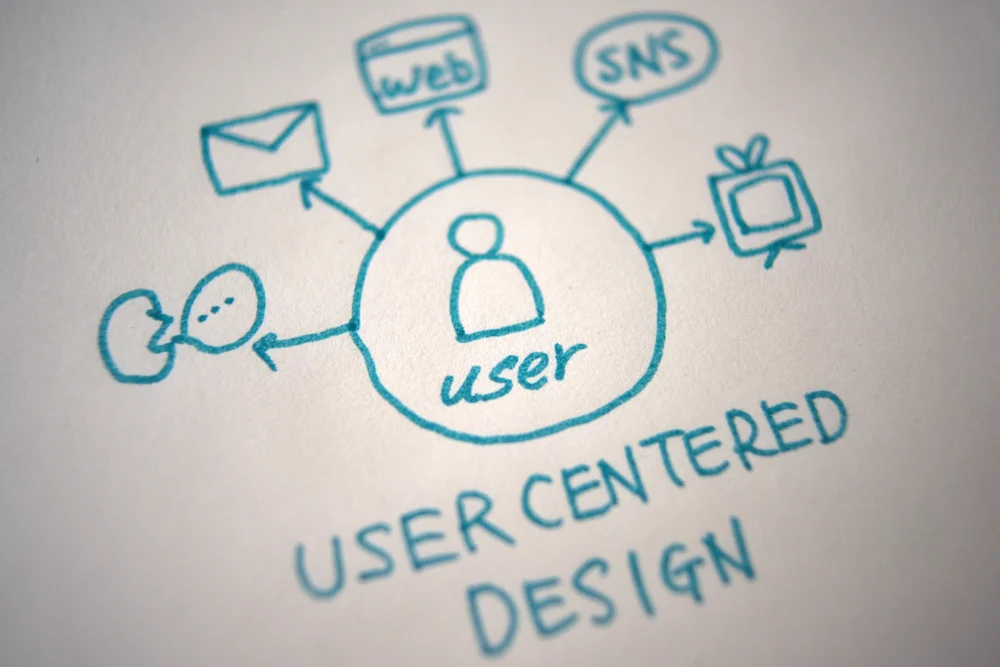
    A user-centric workplace requires everyone’s effort. It means putting users first in every decision and always trying to improve their experience.

    Educating teams on the importance of UX

    Start by teaching your teams why UX matters. Show them how good UX can increase conversion rates and brand reputation. Use real examples of how UX has helped other companies.

    Set up training sessions to cover UX 101. Get experts to talk about user research and design thinking. Make these sessions fun and hands-on.

    Create a UX library with books and online resources. Encourage team members to share UX articles and case studies. It will keep everyone learning and growing.

    Integrating UX principles into product development

    Make UX part of your product process. Start each project with user research to understand needs and pain points. Create user personas to guide decisions.

    Use tools like wireframes and prototypes to test ideas early. It will save time and money by catching issues before full development.

    Do UX reviews of your products regularly. Look for ways to improve based on user feedback and data. Make small changes often rather than big overhauls.

    Encouraging ongoing user feedback and iteration

    Set up ways to get constant user input. Use surveys, feedback forms, and user testing sessions. Pay attention to customer support issues as they often reveal UX problems.

    Create a system to track and act on user feedback. Share insights with all teams so everyone knows what users need.

    Test new features with real users before the full launch. Be ready to change based on what you learn. Celebrate when user feedback leads to changes.

    Remember, building a user-centric culture takes time. Stay patient and keep working at it. Your users will reward you with loyalty and positive reviews.

    Conclusion About UX Audit

    A UX audit is a great way to evaluate and improve the user experience of a digital product or service. It’s a systematic look at the user interface, interaction design and overall usability. By doing a UX audit, you can find pain points, usability issues and areas for improvement in your digital offerings.

    The methods and depth of a UX audit will differ depending on the project scope and resources but common elements include heuristic evaluation, user testing, analytics review and competitive analysis. The findings from a UX audit will give you actionable recommendations to improve the user experience.

    When it comes to doing a proper UX audit, you need the right tools. FullSession is the best user behavior analytics software for UX professionals and teams to streamline their audits and get valuable insights.

    Get a 360° View of User Behavior

    Discover why top brands trust our user behavior analytics software.

    FAQs About UX Audit 

    Let’s answer the most common questions about user experience audit.

    What is a UX audit?

    A UX audit is a deep dive into your website or app. It looks at how easy it is to use. It finds problems and makes things better. A UX audit will improve user experience and make your site work.

    What is a UX content audit?

    A UX content audit looks at the words and information on your site. It checks if your content is clear, helpful and findable. It makes sure your text matches what users need and want.

    How much to charge for a UX audit?

    The cost of a UX audit can vary greatly. It depends on the size of your site and how deep you want to go. Small audits will cost a few hundred dollars. Big, detailed audits will cost thousands. Talk to a few experts to get an idea of the cost of your project.

    What is the difference between UX audit and UX research?

    UX audits and UX research are related but different. An audit looks at your existing site to find problems. UX research is wider. It can include talking to users, watching them use your site and testing new ideas. Research will help you know your users better.


  • User Experience Optimization: Explore the Latest Techniques for 2026

    User Experience Optimization: Explore the Latest Techniques for 2026

    Picture this: It’s 2026, and your digital product is a seamless extension of your users’ lives. Frustration? Gone. Confusion? A thing of the past. Engagement? Through the roof.

    It isn’t a far-fetched dream—it’s the potential reality of user experience optimization done right.

    But let’s be real: Users are flooded with options, their attention spans are shrinking, and their expectations are high.

    You’re probably asking yourself: How do I cut through the noise? How do I not just meet but exceed user expectations? And most importantly, how do I turn casual browsers into loyal customers?

    To help you answer these questions, in this post, we’ll explore the latest user experience optimization strategies to help you make your site user-friendly and engaging, increase user interaction with your digital products and prevent users from bouncing off before conversion.

    Improve Your Website UX and UI

    Learn how to visualize, analyze, and optimize your site with FullSession.

    Understanding User Experience Optimization

    user experience optimization

    Image source: Freepik

    User experience optimization means creating a smooth interaction between users and digital products. It’s about optimizing website interfaces and digital content to improve usability and customer satisfaction.

    Key aspects of user experience optimization

    User experience optimization involves several key areas. By focusing on design, usability, and accessibility, you ensure that your digital product meets user needs. 

    It’s an ongoing process that involves regular testing and updates to keep the user interaction smooth and the website user experience optimal.

    Principles of UX design

    UX design principles are about usability, intuitiveness and engagement.

    A usable design means users can achieve their goals quickly. Intuitive interfaces make navigation instinctive and reduce cognitive load.

    Engagement happens when users find the site enjoyable and value-adding. These principles inform creating a customer experience that feels natural and rewarding.

    Keeping these principles in mind helps to improve user experience across all touchpoints, making the site functional and entertaining.

    Lean UX vs Agile UX

    Lean UX and Agile UX are the two design methodologies that stand out.

    Lean UX is about minimal deliverables and rapid iteration based on real-time user feedback. It’s about getting ideas out quickly to see what sticks with users.

    Agile UX, on the other hand, integrates the flexibility of agile development. It requires cross-functional collaboration to enable continuous testing and adaptation.

    By combining design work with agile practices, you can align the development process with user needs and improve the overall user experience.

    The Role of User Behavior in User Experience Optimization

    user behavior for user experience optimization

    Image source: CloudSystems

    User experience optimization starts with understanding how users interact with products or services. Focusing on user psychology and cognitive load helps you improve how users perceive and interact with your offerings.

    User psychology and behavior

    Understanding how users think and behave is key to creating intuitive designs. You need to find patterns in user behavior and preferences. That means studying how the target audience feels when using a product. Get insights by observing real users to see what they like and avoid.

    Surveys and interviews can give you feedback. These tools help you to understand what users care about. Pay attention to how users perceive visual elements like colors and layouts. It can have a big impact on how users interact with your platform.

    Analyzing user behavior also means tracking how users move through your site or app. It will show you the most common paths and obstacles they hit before conversion. When you know the customer journey, you can optimize it to make it smoother.

    The cognitive load in UX

    Cognitive load refers to the mental effort required by users to complete tasks. Reducing this load is key to improving user experience. When your interface is too complex, users will get frustrated.

    Simplifying navigation is a good starting point. Users can find what they need with clear labels and logical structure without extra effort. Use familiar icons and terminology to put users at ease and not overwhelm them.

    A good way to manage cognitive load is to make information visually digestible. Break down content into small chunks and use formats like bullet points or tables. It makes it easier for users to process information. Observe real users to see where the load is too high and adjust accordingly.

    Identifying UX Issues

    UX testing is key to user happiness. You can test site usability and use user behavior analytics software like FullSession to find and fix user experience problems.

    Conducting usability testing

    Live usability testing is a practical way to see how real users interact with your design. You ask participants to complete tasks while you observe and take notes on any pain points.

    During these tests, you’ll see if users struggle with navigation, forms or other elements. By noting where users get stuck or confused, you can find UX issues. It reveals problems and suggests fixes to make the product more user-friendly.

    Use direct feedback from participants to understand user expectations and design shortcomings. This real-world insight is gold for creating an intuitive user experience.

    Finding UX Issues with FullSession

    FullSession user experience analytics

    FullSession is an advanced user behavior analytics platform that captures all visitor interactions and helps you visualize and analyze trends and patterns in their actions. It enables you to optimize your website’s interface, usability, experience and performance.

    Our user-friendly dashboard lets you get a unified view of user behavior data. Go beyond basic statistics by observing live user interactions and mapping complete customer journeys.

    Identify underperforming areas, experiment with various page components, confirm design improvements and improve your site’s overall user experience and efficiency.

    Eliminate obstacles to conversion, optimize crucial stages in the user path, and reduce abandonment rates in your marketing and sales processes. Collect real-time user feedback, find the root causes of user dissatisfaction, and swiftly manage recurring problems with targeted solutions.

    FullSession customers

    Our platform adheres to GDPR, CCPA, and PCI standards, protecting your users’ privacy and data security.

    Implementing FullSession improves your ability to address poor user experience by providing concrete evidence of user struggles and successes.

    Turn User Behavior into Growth Opportunities

    Learn how to visualize and analyze all user interactions in one intuitive dashboard.

    Analyzing User Behavior Data

    When you’re working on improving user experience, understanding user behavior is key. Two ways to do this are using quantitative data for insights and combining qualitative feedback.

    Using quantitative data for UX insights

    Quantitative data gives you clear metrics and patterns of user behavior. By tracking user actions, you can gather insights into click, bounce, and conversion rates. This data will show you where to improve your website.

    Set specific goals and metrics so your data is actionable and relevant. Take note of user journey patterns, such as how long they stay on certain pages or the path they take through your site.

    The best digital analytics tools can track behavioral data from multiple sources and give you a complete view of user engagement. It will inform changes to improve the user experience by addressing specific issues found through quantitative analysis.

    Combining qualitative feedback with FullSession 

    website feedback forms for user experience optimization

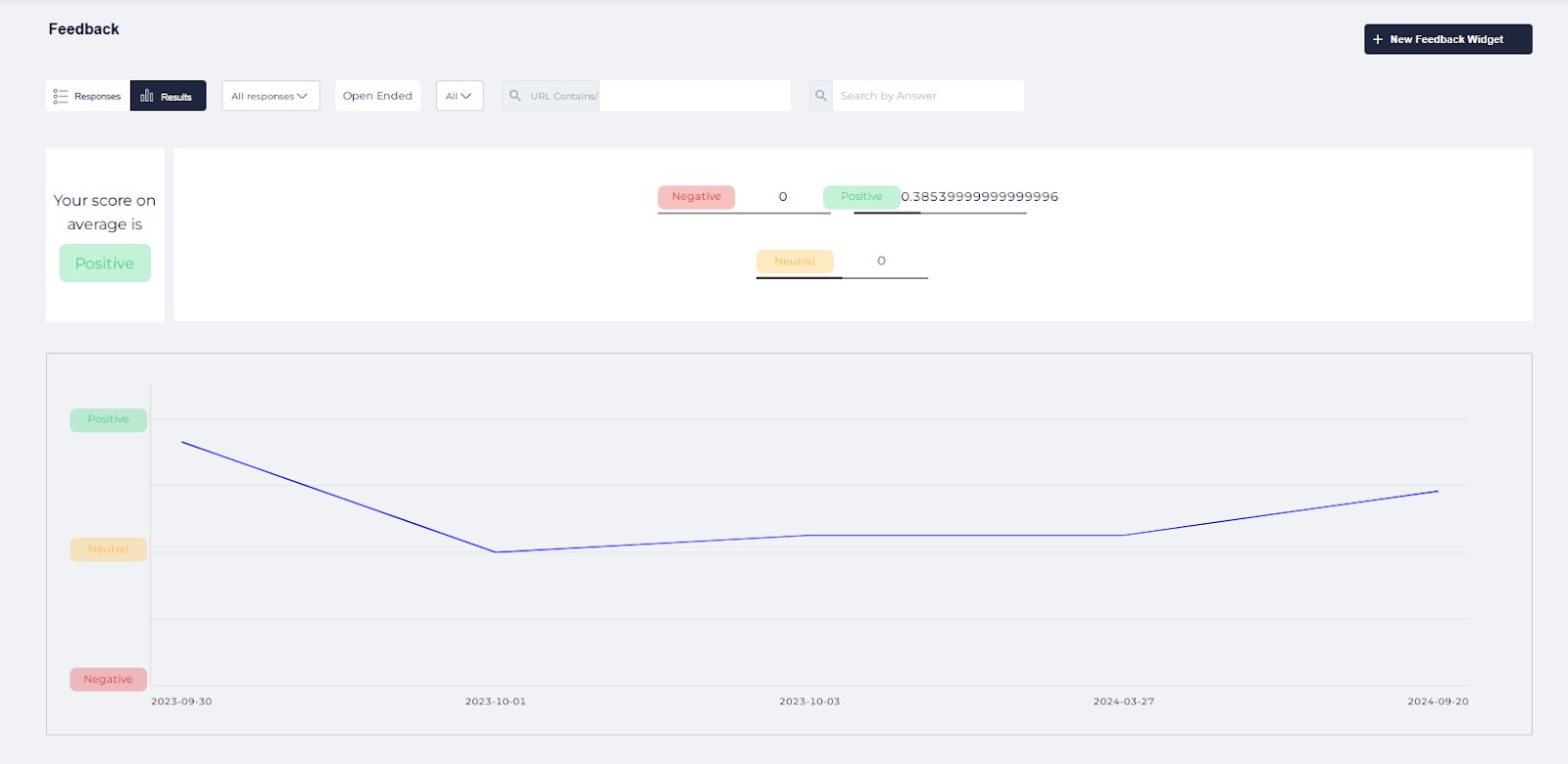
    While quantitative data is important, combining qualitative feedback adds more depth to your analysis. FullSession lets you add feedback forms directly to your website and capture user opinions and preferences in real time.

    FullSession’s customer feedback tools allow you to ask users direct questions about their experience and gather insights into how users feel about your design and functionality.

    website feedback report

    This feedback, combined with session recordings and replays for additional context, will show you areas not visible in numbers, like navigation issues or content clarity.

    Combining both data sources will give you a complete view of user behavior. This balanced perspective will help you make informed decisions to improve user experience.

    Ask users to share their thoughts and make collecting feedback a continuous process.

    Key User Experience Optimization Techniques

    User experience analysis often involves multiple approaches to improve users’ interaction with a website or app. By simplifying user journeys, improving UI design and optimizing content accessibility, you can increase user engagement and conversion rates.

    Simplifying user journeys

    Simplifying user journeys makes it easy for visitors to get to your site and achieve their goals. Start by looking at your site’s current navigation paths with FullSession.

    Use session recording tools to see where users spend time and what frustrates them. This user research allows you to:

    • Observe real-time user interactions with individual web pages
    • Identify scrolling patterns, rage clicks, and popular content areas
    • Detect broken links, bugs, and usability issues
    • Track time spent on pages and overall user trends
    • Monitor marketing campaign performance

    With session recordings, you can analyze key user data such as:

    • User location and IP address
    • Time spent on each page
    • Clicked URLs and session events
    • Visited web pages and referrals

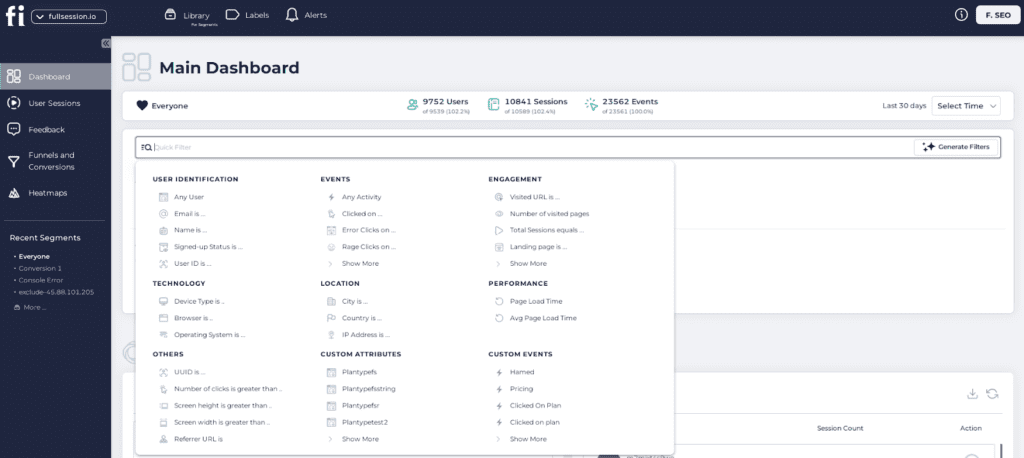
    Advanced filters help you pinpoint critical events in user sessions, eliminating guesswork and providing actionable insights.

    Consider a clear and simple menu and reduce the number of steps to complete a task.

    Improving user interface (UI) design

    The user interface design must be beautiful and functional. A good UI is about meeting user needs with clarity and style. Look at page layout, colour schemes and typography. These elements should all work together to create a user-friendly experience.

    Website heatmap tools can help by showing you where users click most so you can focus on the most important bits. The goal is to remove obstacles and improve the path from entry to conversion.

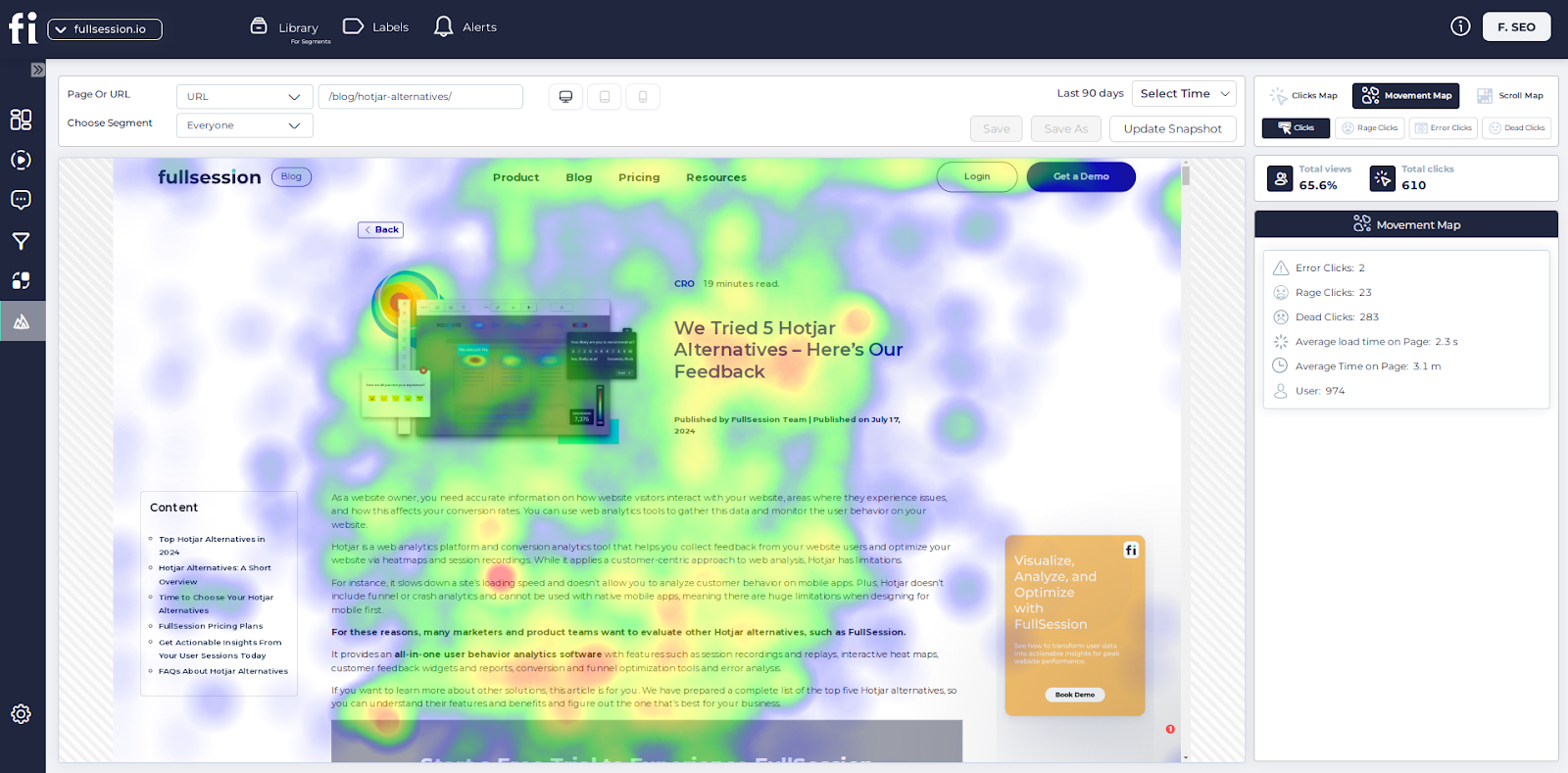
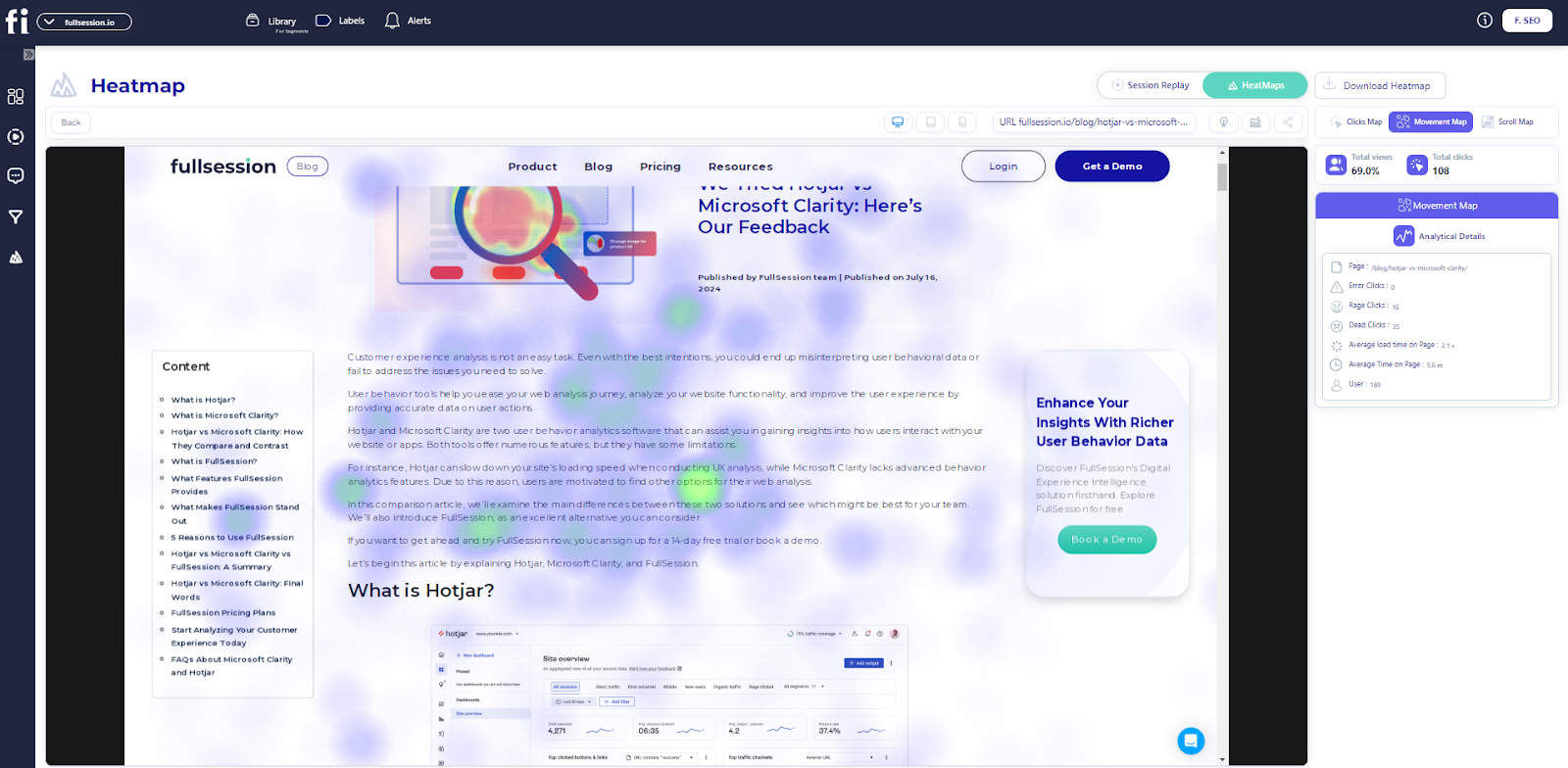
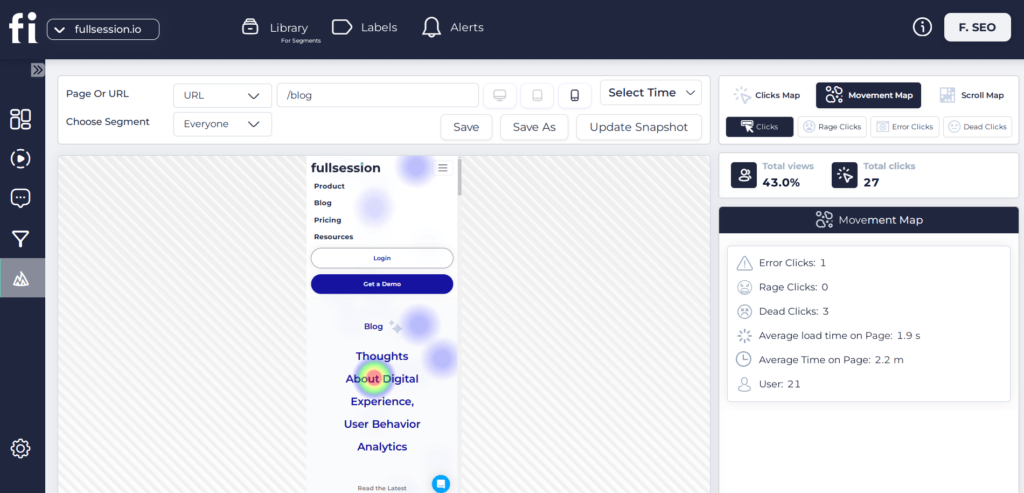
    FullSession movement map for user experience optimization

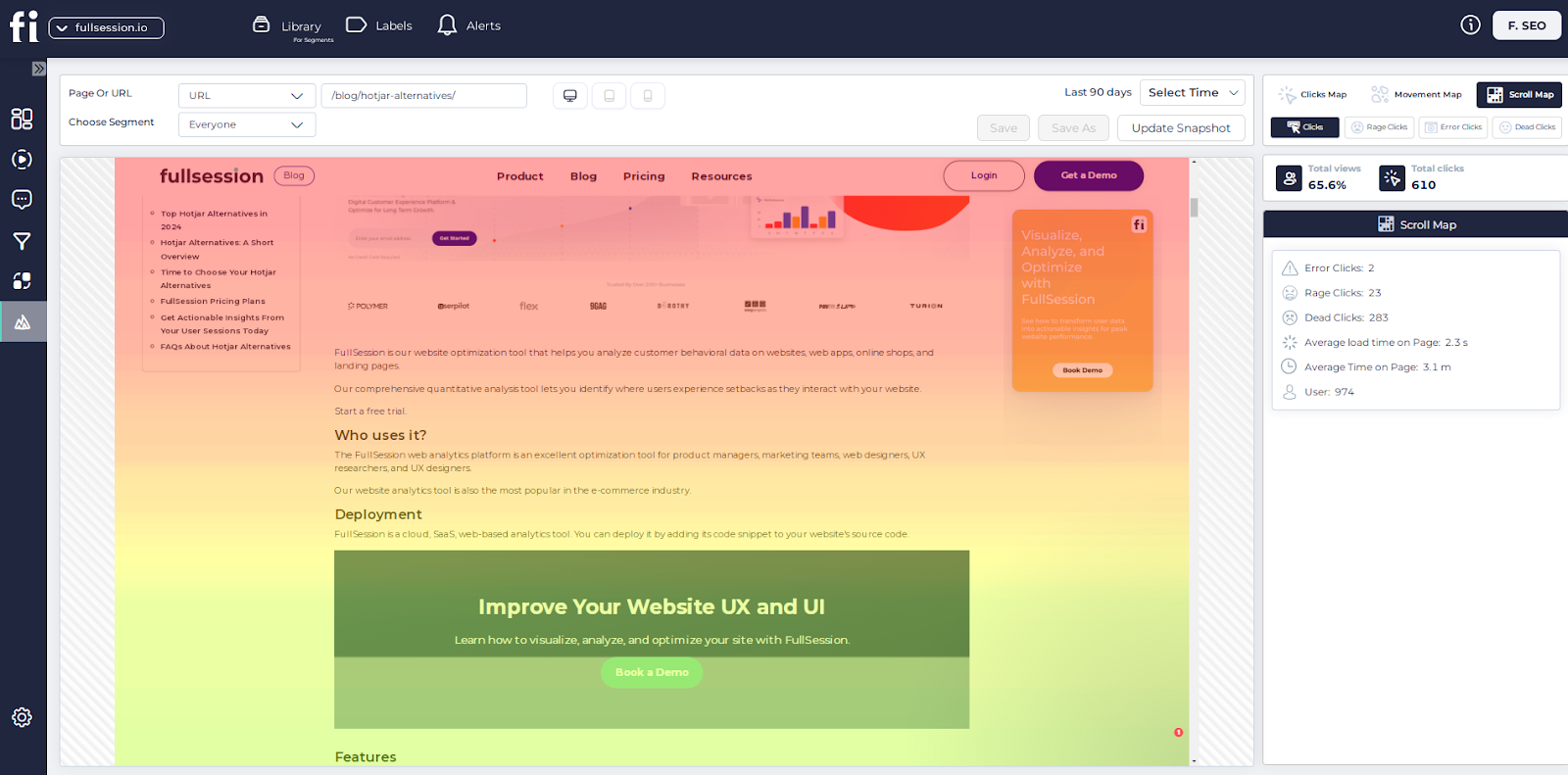
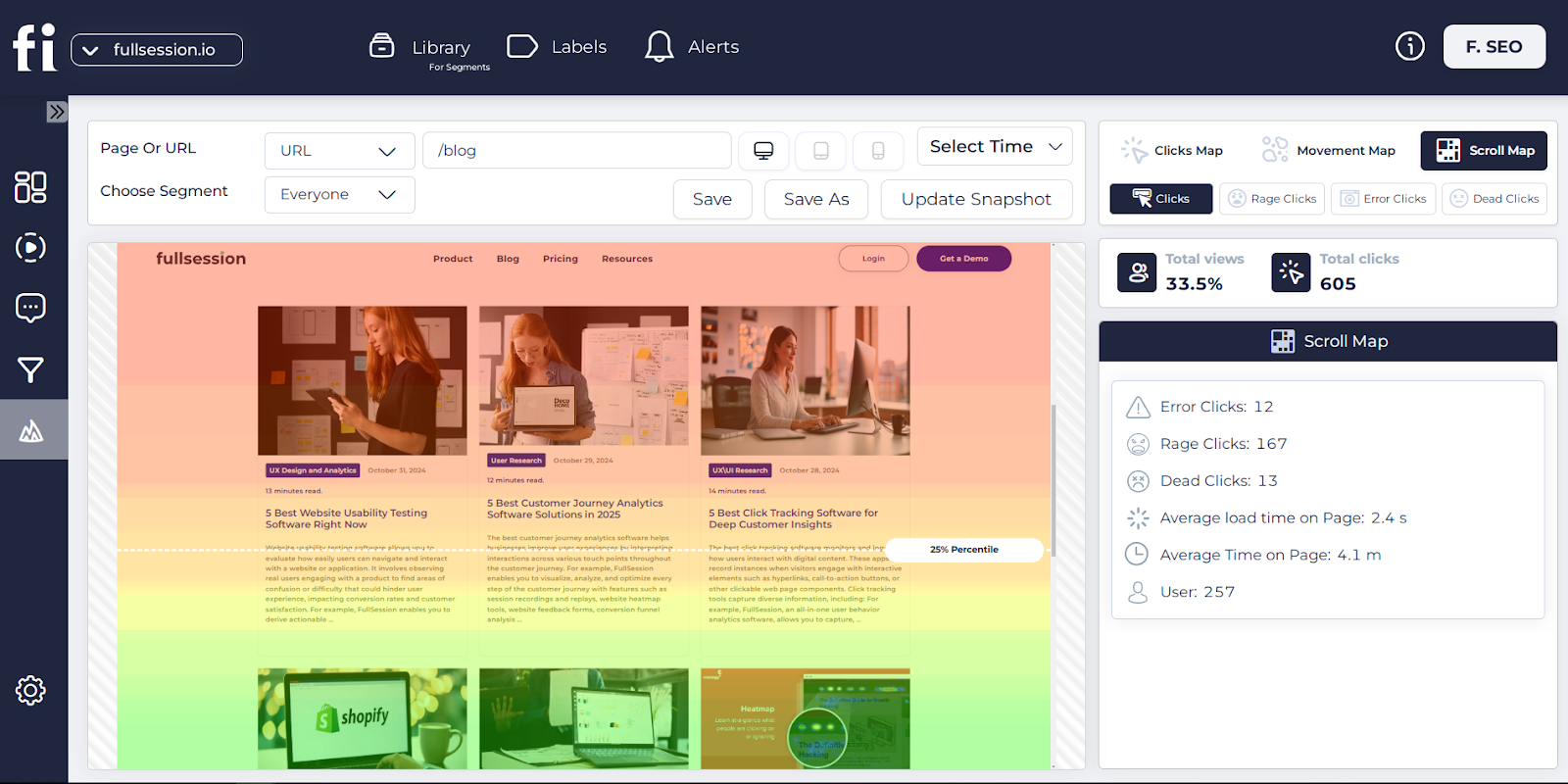
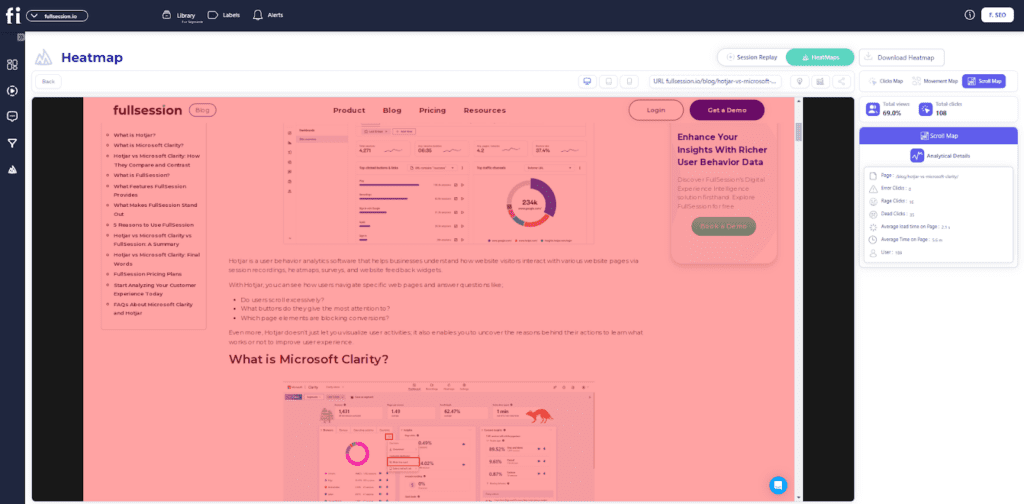
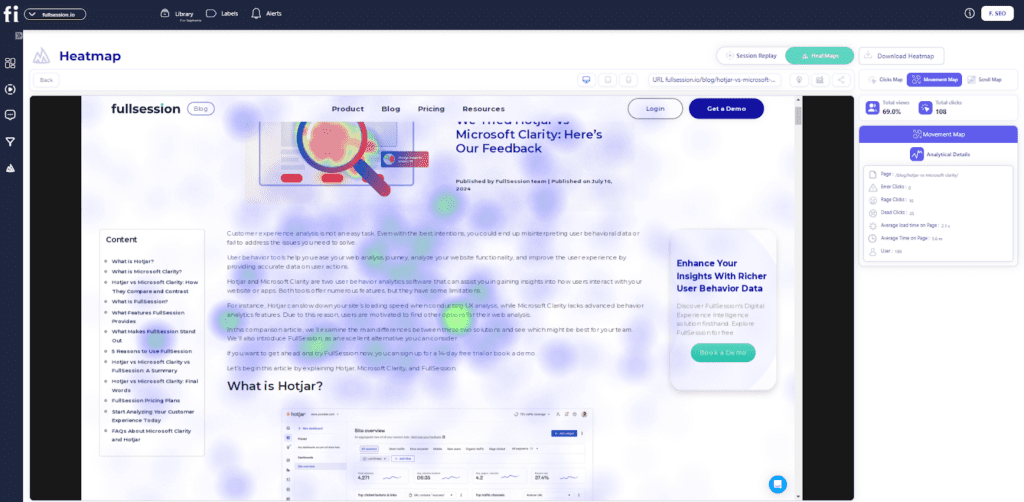
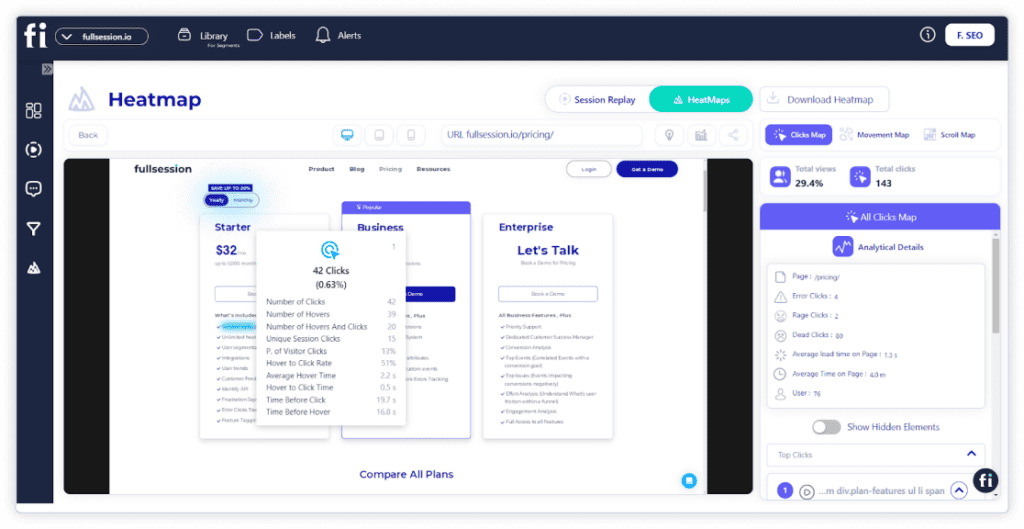
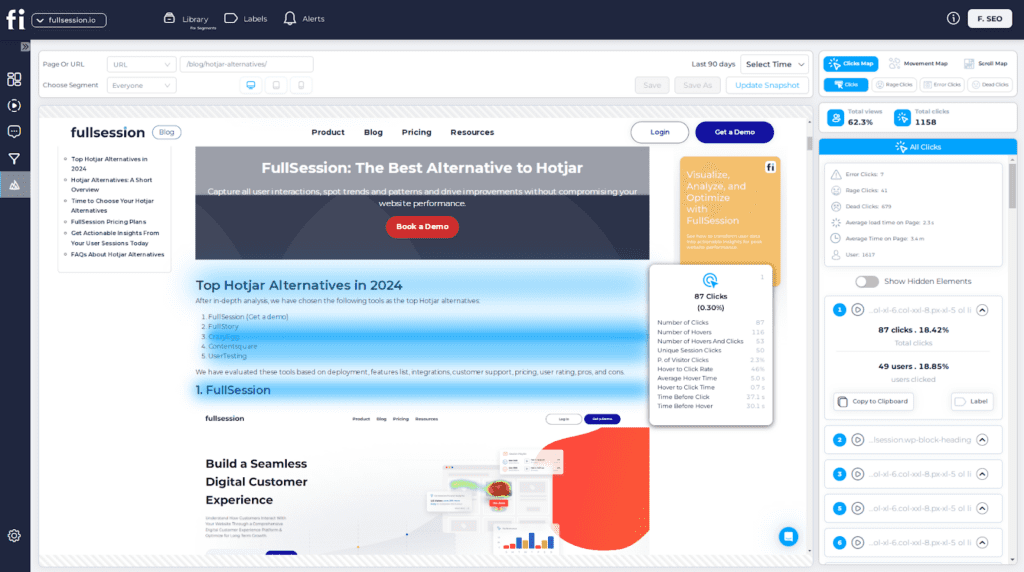
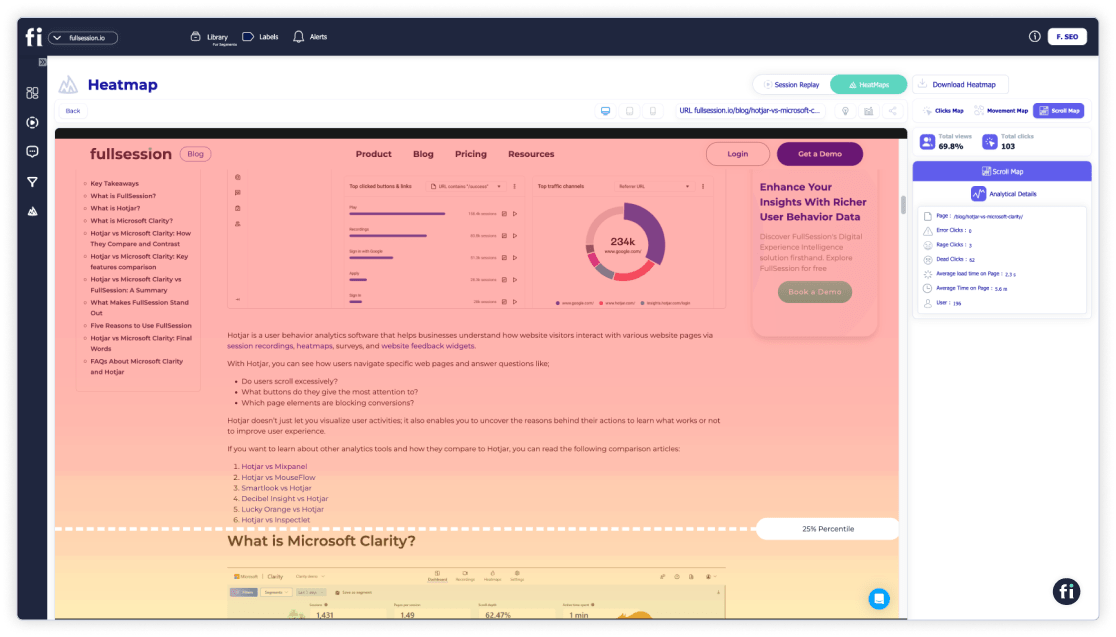
    FullSession’s UX heatmap tools offer visual reports of low and high-engagement areas on your web pages. These include:

    • Scroll maps: Analyze scroll depth across your site.
    • Click maps: Identify areas with the highest click rates.
    • Mouse maps: Observe user navigation behavior.

    These interactive heatmaps allow you to:

    • Preview heatmaps on different devices
    • Track error clicks, rage clicks, and dead clicks
    • Monitor average load and time on page
    • Analyze user visits and engagement metrics
    FullSession scroll map for user experience optimization

    You should be testing usability as part of your user experience optimization. Get real user interaction and improve based on feedback.

    A tidy interface means better engagement and can directly impact conversion rates by making the site navigable and enjoyable.

    Optimizing the path to conversions

    FullSession conversion funnel analysis

    Conversion funnel analysis is key when trying to improve the path to conversion. It means looking at the steps users take and their experience, from landing on your page to completing an action. Break each step down and see where users drop off.

    analysis of conversion funnel

    FullSession can help you with this. Our advanced conversion funnel tracking features let you review the following:

    • Funnel steps: Visualize user progression and drop-off rates
    • Funnel trends: Monitor changes in user flows over time
    • Top events: Identify key actions boosting conversions
    • Top issues: Detect and fix conversion obstacles
    • Time engaged: Measure interaction time to spot frustration points
    • Revisit rate: Track exits before advancement
    • Segment analysis: Compare performance across user groups
    • Time period comparison: Analyze trends over different periods

    Focus on the page elements that support user decisions, like strong CTAs and easy checkout. Make these steps clear and quick and you’ll increase your conversion rates and improve UX.

    Removing website issues

    FullSession error analysis

    Website errors can significantly impact user experience, often leading to frustration, decreased engagement, and potential loss of customers. FullSession’s error analysis feature lets you identify, analyze, and resolve issues that impact user experience. You can see:

    • Error clicks: Detect and fix non-responsive elements using session replays, improving interactivity.
    • Network errors: Monitor and analyze server request failures to ensure smooth data flow.
    • Console errors: Log and analyze JavaScript errors with session replays for quick debugging.
    • Error logs: Capture detailed error information to facilitate efficient troubleshooting.
    • Uncaught exceptions: Monitor and handle critical errors to prevent crashes and maintain app stability.
    • Error trends: Segment data and visualize error patterns over time for proactive problem-solving.
    • Alerts: Receive real-time notifications via Slack and customize alerts to stay informed of critical issues.

    This feature helps you to:

    • Quickly identify and resolve user-facing issues
    • Improve website reliability and performance
    • Improve overall user satisfaction by minimizing disruptions
    • Prioritize fixes based on error frequency and impact
    • Streamline the debugging process with comprehensive error data

    Using FullSession’s advanced dynamic element analysis ensures a reliable, error-free experience. 

    Analyze User Behavior in Real-Time

    Learn how to detect and fix website issues before they affect your customer experience.

    Improving content accessibility

    Making your content accessible means it can be consumed by all users, including those with disabilities. It means using a readable font size, providing text alternatives for images and making your site keyboard navigable.

    When you make content accessible, you meet the law and expand your audience by ensuring everyone can interact with your site.

    Using Engaging Content for Better UX

    Create a positive user experience maintaining high-quality content. Dynamic and personalized content helps you keep users on your site longer and improve satisfaction and engagement.

    Dynamic content for personalization

    Dynamic content makes your site feel more responsive and tailored to each visitor. By using cross-platform compatibility, you ensure a frictionless experience on any device. Facial recognition or login info can customize what users see and make it more relevant.

    Interactive elements like videos, quizzes or personalized product recommendations keep users engaged. This content adapts based on user interaction and creates a more interactive experience. 

    When users feel seen and valued through personalization, they will spend more time on your site and come back in the future.

    Creating content that resonates

    Creating content that connects with your audience starts with knowing what your users need and want. Survey your audience to find out what they’re interested in and what they like. 

    Like a clear content strategy, aligning your content to user expectations and needs is key to engagement.

    Think about language and visual elements that speak to your audience’s sensibilities. For example, regional slang or local cultural references can make the content more relatable. 

    The balance between informative and entertaining content is key. Providing value while keeping it fun will keep users engaged and coming back for more.

    Implementing and Testing UX Changes

    When improving user experience, you need to make thoughtful changes and test them. By using iterative design and A/B testing, you can refine your product to meet user needs. These methods will help you create a better and more enjoyable customer experience.

    Why iterative UX optimization works

    Iterative design is a flexible approach that lets you adapt your product based on user feedback and testing. You make small changes, test and then adjust. 

    By iterating the UX optimization process, you can quickly find out what works and what doesn’t. It speeds up the user experience optimization process because you’re continually improving based on real user behaviour.

    It’s like modelling clay – each tweak makes your design a little better. You learn and improve without making big, risky changes all at once.

    A/B testing for user experience optimization success

    A/B testing means comparing two versions of a page or app to see which one performs better. It’s a great way to test user response before making a big change.

    Let’s say you have two versions of a page, A and B. You show version A to some users and version B to others. You then measure which version performs better: higher engagement, easier navigation, or more conversions.

    A/B testing lets you make informed decisions to increase user satisfaction and engagement on your site or app.

    Measuring User Experience Optimization Results

    Knowing how your users interact with your digital product is key to a good user experience. You can measure success and improve where required by focusing on key performance indicators (KPIs) and user engagement metrics.

    Defining UX key performance indicators (KPIs)

    First, you need to define your KPIs. These are the metrics that directly relate to user satisfaction and engagement.

    They often include task completion rates, which show how well users can complete actions on your site or app. When task completion rates are high, users find it intuitive.

    Another KPI is the bounce rate. It measures how quickly users leave your site after arriving. A low bounce rate indicates a smooth user experience, which means your content or functionality is engaging.

    Finally, consider user retention rates. High retention means users are returning often, which shows user loyalty. Review these KPIs regularly to see how your product is doing.

    Tracking user engagement metrics

    Tracking user engagement metrics gives you more insight into how users interact with your platform. User engagement covers a range of activities, including frequency of visits, interactions with certain features and time spent on your site.

    Some of the key metrics include:

    1. Active users: Track daily, weekly, and monthly active users to measure overall engagement trends.
    2. Session duration: Measure users’ average time on your site per visit, pointing to content relevance and user interest.
    3. Pages per session: Analyze how many pages users visit in a single session, showing navigation efficiency and content engagement.
    4. User flow: Visualize common paths users take through your site, highlighting popular content and potential roadblocks.
    5. Interaction rate: Track how often users engage with specific elements like buttons, forms, or menus.
    6. Scroll depth: Measure how far users scroll down your pages, indicating content engagement and optimal placement of key information.
    7. Return visitor rate: Assess how many users return to your site, a key indicator of overall user satisfaction and loyalty.

    With detailed analytics, you can spot trends, see where users are struggling and where they’re succeeding, and improve your product’s user experience.

    Optimizing User Experience Across Platforms

    To have a seamless user experience you need to focus on designing responsive elements and improving performance across devices and platforms. This means different screen sizes, faster loading times and best practices.

    Responsive design for mobile and web design

    Responsive design is key when optimizing user experience for different devices. A flexible layout means your website can adapt to various screen sizes, so your content is always accessible and readable.

    A mobile-friendly design improves usability so users can navigate their mobile devices easily. Follow Web Content Accessibility Guidelines to ensure your site is accessible to everyone. 

    A mobile-first approach is often effective as it prioritizes the most important features and simplifies interactions for a smoother experience.

    Improving performance for multi-platform UX

    When optimizing UX across platforms, speed is key. Use a Content Delivery Network (CDN) to cache content in different locations and reduce latency and load times. Fast pages keep users engaged and lower bounce rates.

    Ensuring your digital platform performs across all devices also means optimizing images, compressing files and minimizing server requests.

    Each improvement makes the mobile experience better, navigation quicker and more enjoyable. Prioritize these to improve overall user satisfaction regardless of device.

    Maintaining a Positive User Experience

    For a good user experience, focus on user-centric design, clear communication and ongoing guidance. These elements will lead to user satisfaction, trust, and more engagement with your product.

    Prioritizing user-centric design

    User-centric design is about empathy. It means you have to put yourself in your user’s shoes and understand their motivations, pain points and goals. It is the foundation for designing solutions that meet real user needs, not assumptions or preconceptions. 

    User research, including interviews, surveys, and usability testing teams, can inform every aspect of the design process.

    Products designed for users have higher adoption rates, higher user satisfaction and better customer loyalty. It means lower support costs, positive word-of-mouth marketing and ultimately, better business outcomes. 

    Using clear and simple communication

    Use plain language so your users can understand your content. Avoid jargon and complicated words. Simple instructions and labels on buttons will prevent confusion.

    Organize information in a way that’s easy to consume. Breaking content into small sections with headings and bullet points makes it more readable. This clarity will build user trust and satisfaction. 

    If your product or service is complicated, it can be helpful to have FAQs or glossaries.

    Providing ongoing user guidance

    Ongoing guidance helps users through their interaction journey. Don’t overwhelm them with hints or tips. Pop-up tips, tooltips or a help section can be useful.

    Onboarding is important for new users. Provide tutorials to guide them through the basics. It sets the tone for good UX so they know how to use your product effectively.

    Feedback options allow users to share their experience. It could be as simple as a short survey. Listening and responding to feedback shows you value their input and will increase user trust.

    Conclusion About User Experience Optimization

    When it comes to user experience optimization, remember that even small changes can make a big difference for your users. Whether it’s load times or navigation, every little step helps.

    Understand your user’s needs. Gather feedback and make changes to make your site feel intuitive and engaging. User expectations change over time. Stay with the trends, and your site will remain relevant and user-friendly.

    Never stop testing. It will show you what works and doesn’t and help you improve the experience. You’ll find that focusing on these user experience optimization areas will not only please your users but also support your goals.

    To streamline your UX optimization efforts, consider FullSession. It offers an all-in-one user behavior analytics software, allowing you to make data-driven decisions to improve user experience and boost conversion rates.

    Ready to transform your UX approach? 

    Book a demo with FullSession today.

    FAQs About User Experience Optimization

    Let’s answer the most common questions about the user experience optimization process.

    What is user experience optimization?

    User experience (UX) optimization means improving users’ overall experience interacting with a website, application, or product. 

    It involves analyzing user behavior, identifying pain points, and making data-driven changes to improve usability, accessibility, and satisfaction. 

    The goal is to create intuitive, efficient, and enjoyable experiences that meet user needs and business objectives.

    What are the 7 key factors of user experience?

    The seven key factors of user experience, often referred to as Peter Morville’s User Experience Honeycomb, are:

    • Useful: The product should fulfill a need
    • Usable: It should be easy to use and navigate
    • Findable: Content should be easy to find and locate
    • Credible: Users should trust and believe in it
    • Desirable: It should be visually appealing and emotionally engaging
    • Accessible: It should be usable by people with diverse abilities
    • Valuable: It should deliver value to both users and the business

    What are the 4 C’s of user experience?

    The 4 C’s of user experience are:

    • Comfort: Ensuring users feel at ease when using the product
    • Convenience: Making the product easy to use and access
    • Customization: Allowing users to tailor their experience
    • Communication: Providing clear, consistent messaging throughout the user journey

    What are the 7 pillars of user experience?

    The seven pillars of user experience are:

    • Usability: Ease of use and learnability
    • Accessibility: Inclusive design for all users
    • Credibility: Building trust and reliability
    • Desirability: Creating an appealing and engaging experience
    • Findability: Easy navigation and content discovery
    • Value: Providing meaningful benefits to users
    • Usefulness: Meeting user needs and solving problems

    These pillars form a comprehensive framework for creating effective and satisfying user experiences across various digital platforms and products.


  • Digital Experience Analytics (DXA): Definition, Use Cases, and Key Components

    Digital Experience Analytics (DXA): Definition, Use Cases, and Key Components

    Digital experience analytics gives you the tools to track, measure and improve users’ engagement with your digital platforms.

    It lets you collect and analyze user data from websites or apps, combining behavioral data with technical metrics to give you a complete view of the customer journey across various digital touchpoints.

    The best digital analytics tools help you change the user experience, retain more customers and drive business results. Take FullSession as an example.

    It lets you visualize all user engagement, analyze trends and patterns with laser precision and optimize your website for peak performance.

    You can start a free trial or get a demo to learn more.

    Whether new to digital experience analytics or looking to improve your approach, this article will cover the basics and give you a blueprint to create an optimal user journey and increase customer satisfaction.

    What is Digital Experience Analytics?

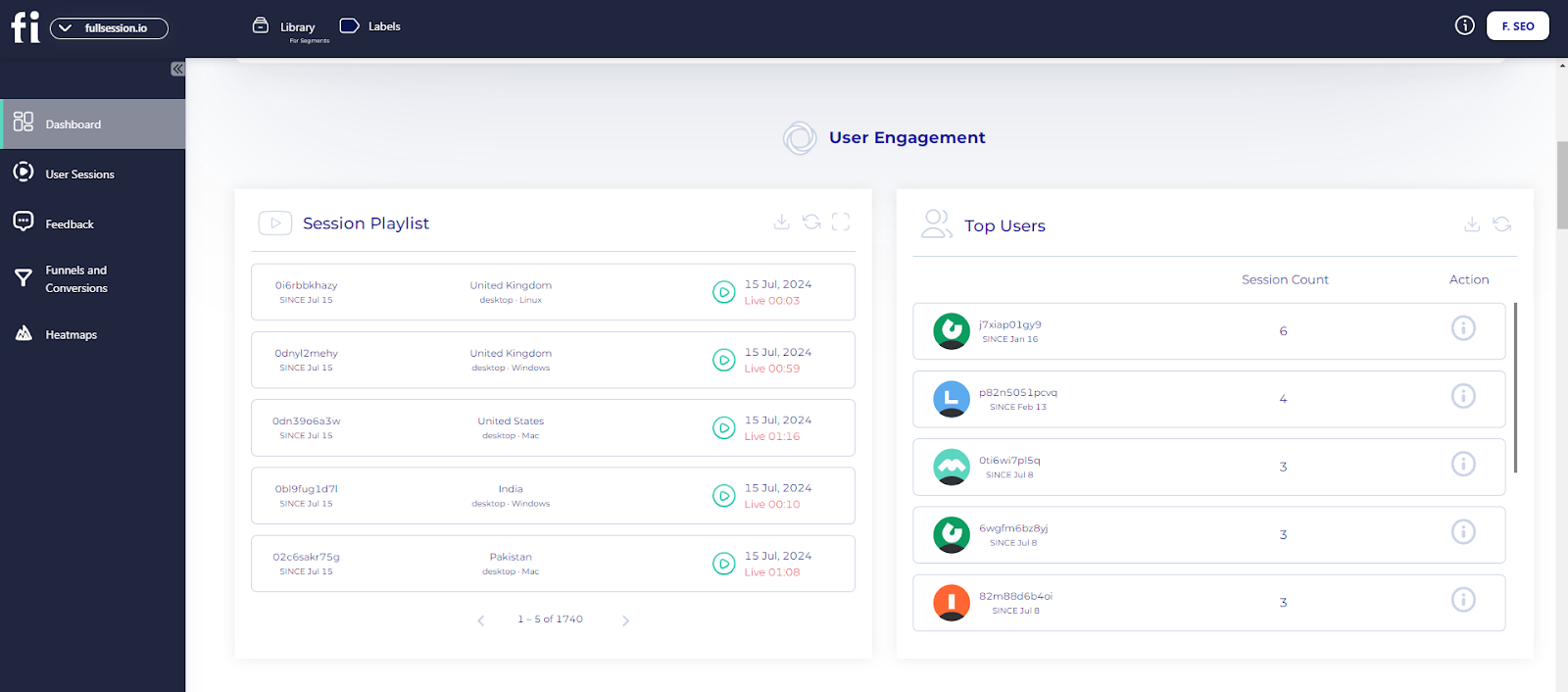
    FullSession session playlist

    Digital experience analytics helps you track users’ interactions with your digital platforms, websites and mobile apps.

    You can better understand user behavior by collecting and analyzing qualitative and quantitative data that offers objective insights through user session tracking.

    For example, tools like Google Analytics can be key in measuring conversion rates and tracking user progression through funnels, providing a detailed overview of user engagement metrics.

    Digital analytics tools will help you make your business more agile while giving customers a seamless and satisfying digital experience.

    Analyze User Behavior With FullSession

    Capture all user interactions, spot trends and patterns and drive improvements without compromising your website performance.

    Why Digital Experience Analytics Matters for Businesses

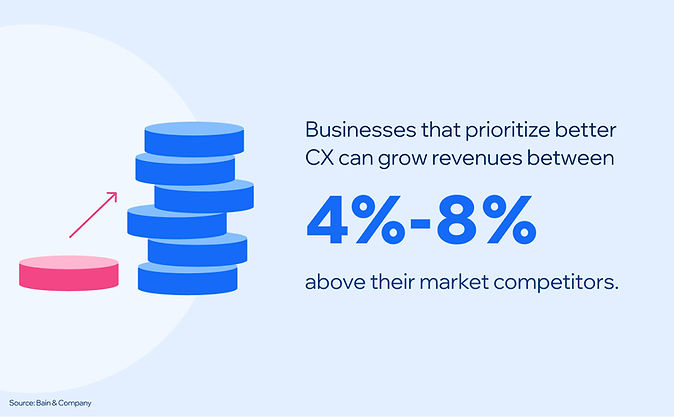
    customer experience stats

    Image source: WiserNotify

    Digital experience analytics is key for understanding your customers and driving business success. Here’s why:

    1. Insight into user behavior and preferences: By analyzing user behavior on your website and apps, you can gain insights into their preferences and tailor user experiences to meet your customers’ needs.
    2. Optimized marketing strategies: Marketing strategies are built on data. Advanced analytics lets you see which marketing campaigns drive traffic and engagement. It will allow you to optimize your strategy and improve conversion rates.
    3. Increased Customer Lifetime Value (CLV): When you understand and meet customer needs, they are more likely to come back and increase their lifetime value for your business. Happy customers become loyal customers.
    4. Competitive advantage: The insights from the data can inform decisions, improve digital interactions and drive sales and customer retention. A better user experience will differentiate your brand from the competition.

    Customer understanding is key to your business strategy. When you know what your customers want, you can serve them better and drive growth for your business.

    How to Use FullSession for Digital Experience Analytics

    FullSession user behavior analytics

    Imagine enjoying all these benefits with a single, comprehensive user behavior analytics software.

    What if you could seamlessly capture all user interactions, visualize trends and patterns, analyze user behavior, and optimize site performance from one intuitive platform?

    Using FullSession for digital experience analytics makes this possible. FullSession offers a robust feature set and provides accurate insights to help you improve user experience and increase conversions.

    You can start a free trial or get a demo to learn more.

    Let’s explore the key components.

    Session recordings and replays

    session recordings and replays

    Session recordings and replays allow you to watch real-time user interactions with your website. You can see mouse movements, clicks and navigation patterns by analyzing these recordings.

    Session recording and replay tools let you revisit these interactions to the smallest detail to fully understand user experience and behavior. You can identify where users get stuck or confused. 

    Observing what happens during these sessions helps you pinpoint the exact problem areas affecting conversions so you can fix them and improve your results.

    Interactive website heatmaps

    ux heatmap tools

    Website heatmap tools visually show user interactions on your web pages. They highlight where users are clicking, hovering and scrolling the most.

    By using FullSession’s click, scroll and mouse heatmaps, you can see dead zones where interaction is lacking. It helps you test new page elements or validate design changes to improve user engagement and experience.

    FullSession mouse heatmaps

    UX heatmap tools show you which parts of a page are getting the most attention and which are being ignored. They help you optimize your site’s visual hierarchy and focus user attention where you want it the most.

    Visualize, Analyze, and Optimize with FullSession

    See how to transform user data into actionable insights for peak website performance.

    Conversion funnel analysis

    conversion funnel analysis

    Conversion funnel analysis is key to understanding how users move through your sales process. FullSession allows you to track each step in your funnels. By seeing where users drop off, you can remove conversion blockers preventing users from taking desired actions.

    It helps you optimize key touchpoints and the entire journey from initial interest to final purchase. You can make specific changes to increase conversion rates and user satisfaction along the funnel by identifying and optimizing problem areas.

    Website feedback tools

    website feedback tools

    Website feedback tools allow you to reach your users directly to get feedback on their experience. You can learn what users expect and where to improve. Customer feedback tools give practical insights to increase user satisfaction and engagement.

    FullSession customer feedback

    FullSession’s feedback mechanisms allow you to act on user input, improve the site interface, usability and performance, and ensure it meets user needs.

    With customer feedback collection tools, you can make strategic changes to increase user retention and develop a more engaging online presence.

    Error tracking

    website error tracking

    Error tracking is key to a smooth user experience. FullSession has tools to monitor and track website issues users are encountering on your site. By knowing these cases, you can fix them quickly to prevent a negative impact on user experience.

    Tracking errors will show you technical glitches and areas that need improvement so users can interact seamlessly. Fixing errors fast can reduce frustration and improve overall satisfaction, leading to better retention and conversion rates.

    Turn User Behavior into Growth Opportunities

    Learn how to visualize, analyze, and optimize your site with FullSession.

    Key Components of Digital Experience Analytics

    Image source: Freepik

    Digital experience analytics has several key components that give you total visibility into user behavior and interactions on digital channels. Here are the main ones.

    Real-time data

    Real-time analytics lets you observe and analyze user behavior as it happens. It helps you spot and respond to issues, understand user behavior in the moment and make changes to the user experience on the fly.

    User segmentation

    User segmentation involves grouping users into segments based on demographics, behavior or purchase history. It lets you conduct a deeper analysis and create personalized marketing strategies to ensure different user segments get the right experience.

    Cohort analysis

    Cohort analysis looks at the behavior and performance of specific user groups over time. This component helps you understand how different cohorts behave, find trends and measure the impact of changes or updates on user retention and engagement.

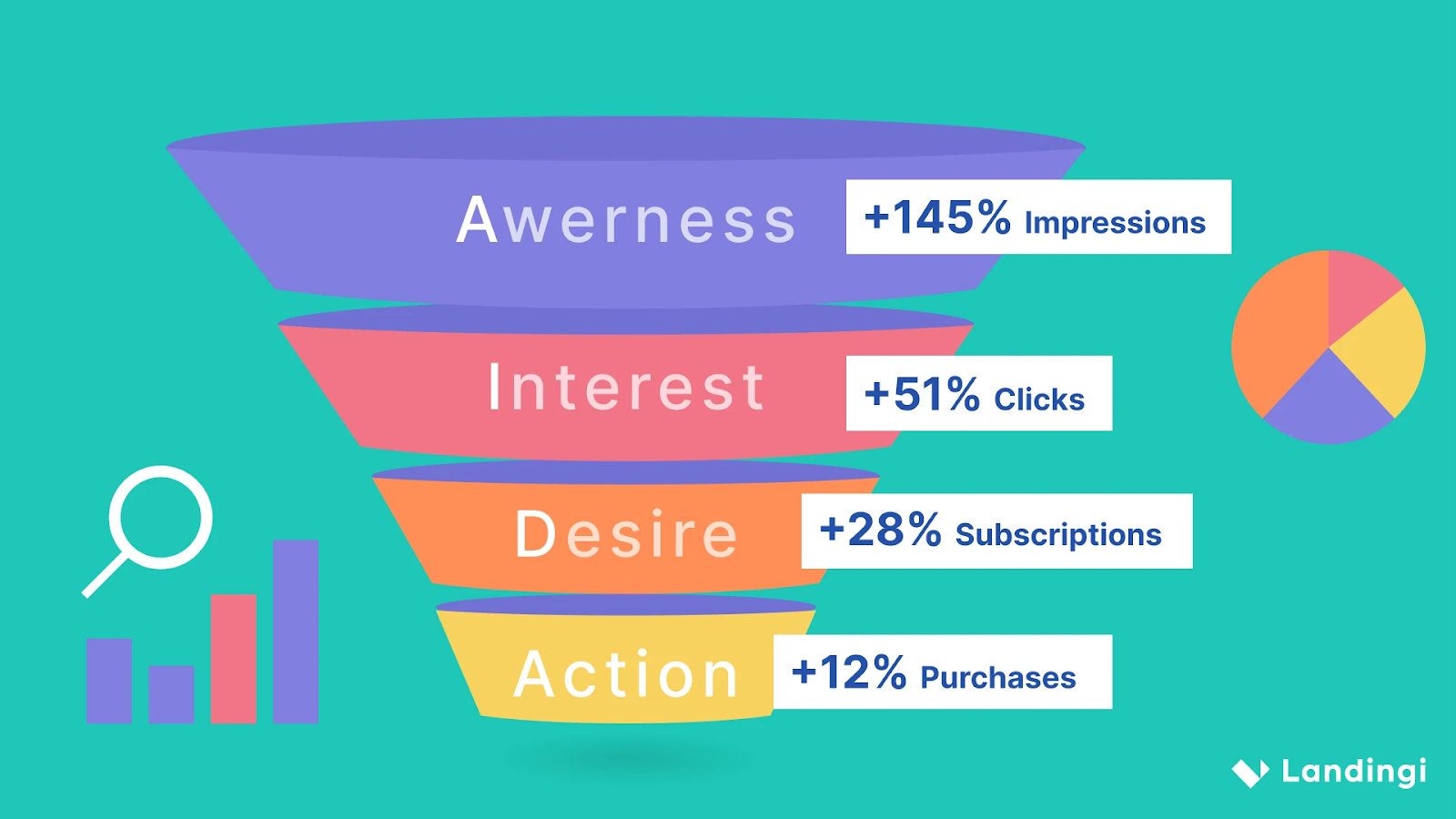
    Funnel analysis

    Image source: Landingi

    Funnel analysis follows users’ steps to complete a specific goal, like making a purchase or signing up for a service. By examining each step of the conversion funnel, you can see where users drop off and implement changes to reduce friction and increase conversion rates.

    A/B testing and experimentation

    A/B testing and experimentation involve comparing two web pages or app feature versions to see which performs better. It lets you test hypotheses and make data-driven decisions to improve the user experience and get better outcomes.

    Feedback and surveys

    Getting direct feedback from users through surveys and website feedback forms gives you qualitative insights into their experience and satisfaction. It adds to the quantitative data and helps you better understand user needs and wants.

    Performance metrics and KPIs

    Performance metrics and KPIs measure the results of your digital assets. Metrics like page load time, bounce rate and user retention rate give you a snapshot of your platform and show you where to improve.

    With these components of digital experience analytics tools, you can get total visibility of your user experience, make decisions, and continuously optimize your digital platforms for better user engagement and satisfaction.

    Digital Experience Analytics for User Behavior Analysis

    digital experience analytics for user behavior analysis

    Image source: Freepik

    Digital experience analytics gathers extensive data points from different sources to inform understanding of user behavior. It is key for shaping digital experiences as it influences content and design decisions.

    Here are practical examples:

    • Identify navigation patterns: Analytics can reveal how users move through a site. If users frequently leave before reaching the checkout, this indicates a potential issue in the purchase process. Streamlining navigation or simplifying the checkout process can address this.
    • Detect content engagement: Tools like heatmaps show which parts of a page users interact with most. If a section consistently grabs attention, create more content around that topic. If users skip sections, consider revising or removing that content.
    • Monitor interactive elements: You can track interactions with forms, buttons, and sliders. If users abandon forms halfway, it might be too long or confusing. Test shorter forms or provide more precise instructions to improve completion rates.
    • Analyze scroll depth: Understand how far users scroll before leaving. If users don’t reach the bottom of important pages, reorganize content to ensure key information appears earlier.
    • Segment user behavior: Analyze behavior by different user groups. New visitors might need a guided tour, while returning visitors might appreciate quick access to frequently visited pages.
    • Track conversion funnels: Identify where users drop off in the conversion process. If many abandon at the payment stage, it could indicate issues with the payment gateway or lack of options.
    • Record sessions: Playback individual user sessions to reveal unexpected customer behavior, such as confusion over navigation. Use these insights to make targeted improvements.

    Qualitative data offers contextual insights into user experiences, including motivations and frustrations, complementing quantitative data to provide a comprehensive understanding of user behavior.

    This proactive approach improves user experience, boosts engagement, and drives business growth.

    Digital Experience Analytics for Customer Journey Mapping

    digital experience analytics for customer journey mapping

    Image source: Finances Online

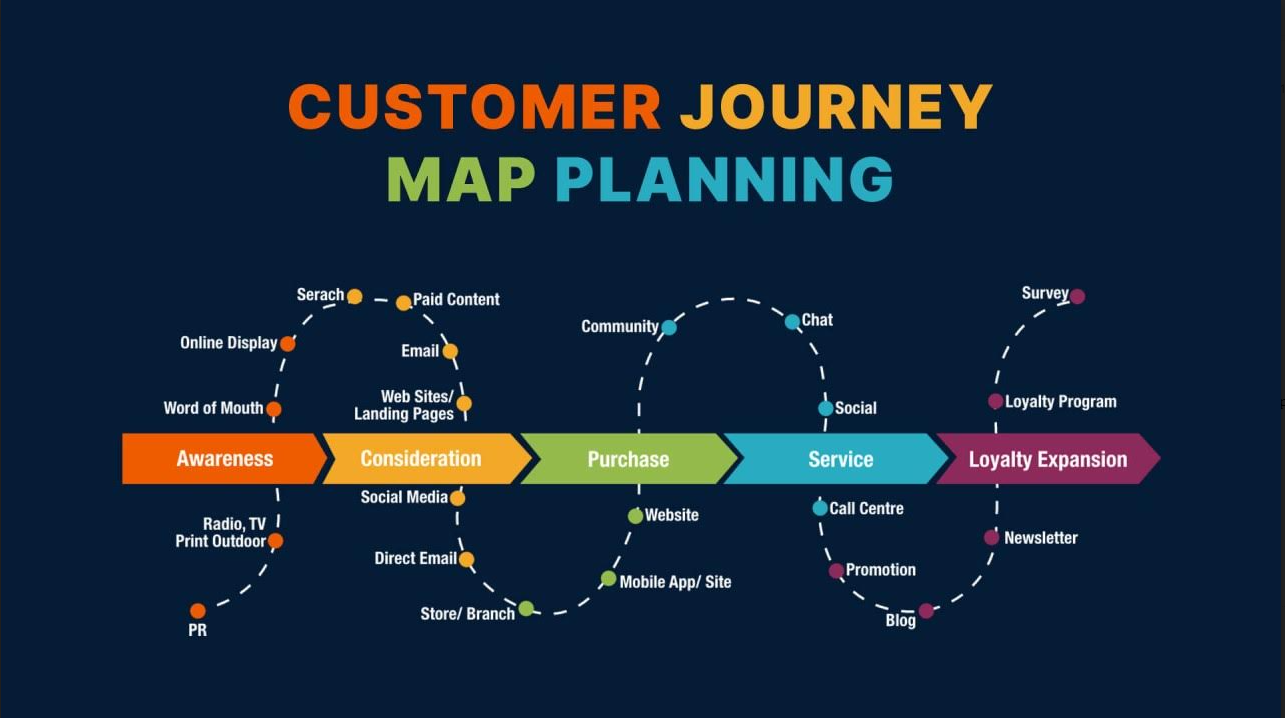
    Digital experience analytics is key for customer journey mapping. It shows the entire customer decision-making process so you can identify high-value touchpoints and digital weak points to optimize user interactions.

    Here are some use case examples:

    • Create detailed customer journey maps: Customer journey mapping tools cover stages such as Awareness, Consideration, Purchase, Retention and Advocacy. These maps give you a 360-degree view of the customer experience, capturing actions, thoughts and emotions at each stage.
    • Collect data from multiple sources: Getting insights from surveys, interviews and analytics is key to journey mapping. This data helps you understand user behavior, motivations, and pain points to create accurate and impactful journey maps.
    • Spot pain points and opportunities: The main goal of user journey mapping is to spot pain points and opportunities. Digital experience analytics helps you see where users hit friction or drop off so you can fix these problems and improve the overall experience.
    • Visualize the customer journey: Maps can include columns and rows for each stage. For example, the Awareness stage might include touchpoints like social media ads and blog posts, and the Purchase stage might cover the checkout process and payment options.
    • Break down each stage: Each stage of the customer journey map outlines the touchpoints, actions, thoughts, emotions, pain points and opportunities. For example, during the Consideration stage, users might compare products and read reviews and feel excitement and uncertainty. Knowing these emotions can help you tailor content and interactions to ease concerns and build trust.
    • Ensure cross-channel consistency: By mapping the customer journey, you can ensure consistency across all online and offline touchpoints, so your messaging and branding stay on track.

    With these aspects of digital experience analytics, you can create more effective and engaging customer journeys. It will improve user satisfaction and engagement and drive higher conversion rates and long-term loyalty.

    Digital Experience Analytics for Conversion Rate Optimization

    digital experience analytics for conversion rate optimization

    Image source: Shogun

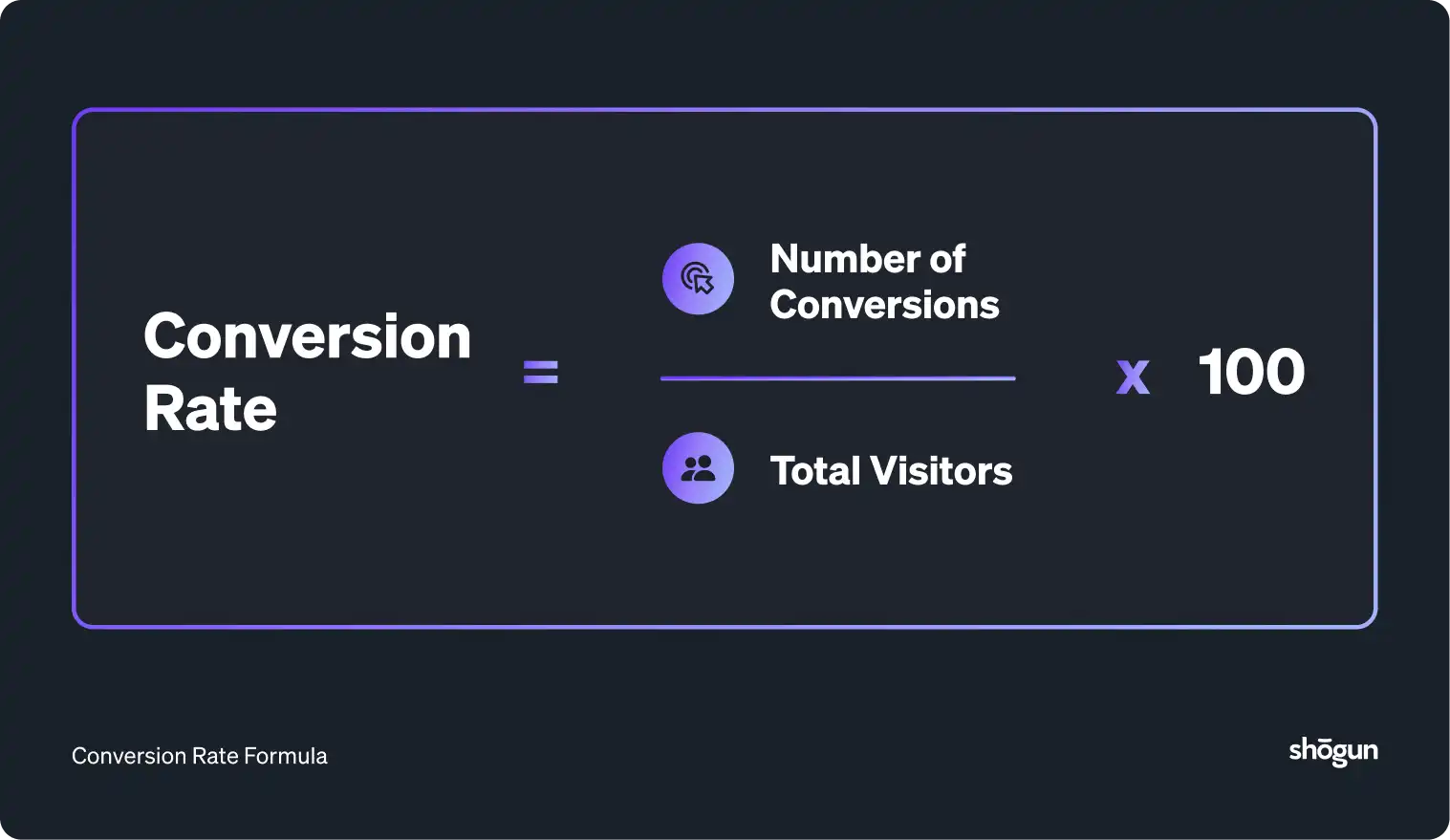
    Increasing conversion rates boosts immediate revenue and overall business performance. Here’s how to use digital experience analytics for conversion rate optimization:

    • Personalize user experiences: Personalised content based on user behavior increases conversion rates. For example, personalized product recommendations or targeted email campaigns can get users to take the desired action, like buying or signing up for a service.
    • Start A/B testing: Experiment with various elements of your website or app, such as headlines, images, CTAs and layouts. Clear call-to-action buttons increase the likelihood of conversions. Compare different versions and see which performs better to implement the winning variation to improve user experience and conversion.
    • Optimize landing pages: Analytics will show how users interact with your landing pages to spot areas for improvement. For example, if users are bailing out of the page quickly, it might be because the content isn’t engaging or the CTA is unclear. Optimizing landing page elements based on this data helps improve user engagement and drive higher conversion rates.
    • Simplify the checkout: See issues like complicated forms, limited payment options or slow page load times. Simplify the checkout and fix these points for a smoother user experience and higher conversion rates.
    • Improve mobile experience: With users accessing your website on mobile devices, mobile optimization is key to CRO. Optimize page load times, simplify navigation, and ensure forms and buttons are accessible on smaller screens.
    • Increase page load speed: Slow page load times can have a big impact on user experience and conversion rates. Monitor pages with high load times and what’s causing the delay. Optimize images, use browser caching and minimize JavaScript to keep users engaged and more likely to convert.

    This proactive approach will improve user satisfaction and engagement and drive overall business performance by turning more visitors into customers.

    Overcoming Challenges in Digital Experience Analytics

    Digital experience analytics is useful but challenging to implement. Here are the three biggest issues and how to overcome them.

    Data integration complexity

    Combining data from multiple sources is complex. Different platforms use different formats and metrics, so it takes much work to get a single view.

    To overcome this, invest in an analytics tool that supports data integration. FullSession, for example, combines data from multiple touchpoints to give you a single view of user behavior.

    Data overload

    With so much data, it’s hard to know what to focus on and what’s important. It can lead to analysis paralysis, blocking your actions.

    FullSession solves this by providing intuitive dashboards and customizable reports that highlight key metrics and trends so you can focus on actionable insights and drive meaningful change.

    Data accuracy

    Tracking errors, inconsistent data collection methods and technical glitches can compromise data integrity. Regular audits and trustworthy analytics software like FullSession can help maintain data accuracy.

    FullSession’s advanced tracking capabilities ensure precise data collection, minimize errors, and give reliable insights.

    Privacy and compliance

    Non-compliance can result in big fines and damage to your reputation. FullSession is designed with privacy and compliance in mind and respects PCI, GDPR and CCPA standards.

    You can be sure your data practices are secure and compliant and enjoy using the power of analytics for your website optimization efforts.

    By tackling these challenges, you can get the most out of digital experience analytics and improve user experiences and growth.

    Best Practices for Digital Experience Analytics

    Image source: Freepik

    To get the most out of digital experience analytics, focus on clear goals, whether improving customer satisfaction or increasing your Net Promoter Score.

    Use data to test hypotheses. It means testing your ideas with real user interaction and making decisions based on what you find. It will help you discover the biggest areas to improve.

    Consider setting up feedback loops with your users. Listen to their experiences to build trust. A trusted platform like FullSession will encourage users to share their thoughts and give you the most useful data to work with.

    Create dashboards that show key metrics. These will help you track changes over time and spot trends. Easy-to-read charts will help your team quickly understand the current state of user experience.

    Don’t forget about user journeys. Analyze user paths to see what’s working and what’s not on your site. It will help you improve customer experiences by fixing the pain points in their journey.

    Review your analytics tools and strategies regularly. Make sure they align with your business goals and user needs.

    Conclusion About Digital Experience Analytics

    Digital experience analytics is the key to managing and improving your website. 

    You can optimize the user journey, ensuring smoother navigation and better overall satisfaction. By addressing stumbling blocks, you can create a more seamless experience.

    You can identify trends and patterns in user behavior, leading to informed decisions about design and content updates and aligning them with user expectations.

    By reviewing your analytics regularly, you keep your strategies current. As user preferences change, analytics helps you stay ahead of the curve.

    Using digital experience analytics tools and insights, you keep your site user-centric and efficient. It means deeper engagement with your audience and more repeat visits and loyalty.

    Ready to upgrade your digital experience and boost your conversions? Discover the power of FullSession. Sign up today or request a demo to start transforming your website with actionable insights and seamless user interactions!

    FAQs About Digital Experience Analytics

    Let’s answer the most common questions about digital experience analytics.

    What is digital experience analytics?

    Digital experience analytics (DEA) refers to collecting, analyzing, and interpreting data on user interactions with digital platforms such as websites and mobile apps. The goal is to understand user behavior, optimize user experiences, and improve overall business performance.

    What does a digital experience analyst do?

    A digital experience analyst monitors and analyzes user interactions on digital platforms. They use platforms like FullSession to gather data, identify trends, and provide actionable insights. Their work helps improve user experience, drive conversions, and inform strategic decisions.

    What do you mean by digital analytics?

    Digital analytics involves measuring, collecting, analyzing, and reporting data from digital channels. It includes websites, social media, and mobile apps. The goal is to understand user behavior, optimize digital strategies, and achieve business objectives.

    What are the four types of digital analytics?

    The four types of digital analytics are:

    1. Descriptive analytics: Provides insights into what has happened by analyzing historical data.
    2. Diagnostic analytics: Explains why something happened by identifying patterns and correlations in the data.
    3. Predictive analytics: Uses statistical models and machine learning to forecast future outcomes based on historical data.
    4. Prescriptive analytics: Recommends actions to achieve desired outcomes by analyzing data and predicting future trends.


  • Why You Need a Mouse Heatmap for Website Optimization 

    Why You Need a Mouse Heatmap for Website Optimization 

    As a website owner, you’ve probably struggled to understand why visitors aren’t converting or why certain pages have high bounce rates. If traditional analytics leaves you confused, a mouse heatmap can solve these problems best. 

    Mouse heatmaps give you visual insights into user behavior so you can identify and fix website issues faster, increase user satisfaction and boost conversion rates.

    FullSession is an advanced user behavior analytics tool that lets you capture all user interactions, create mouse heatmaps and get heatmap data instantly without affecting your website performance. It helps you see exactly where users are struggling with your site.

    You can combine these insights with click and scroll heatmaps and other user behavior tools like session recordings and replays, website feedback forms, conversion funnel analysis and error tracking to get the complete picture of the customer journey.

    You can start a free trial or get a demo to learn more.

    In this article, we will explain the basics of mouse heatmaps and show you how to use FullSession to transform your website optimization strategy and drive better results.

    Key Takeaways

    • A mouse heatmap visualizes user interactions on a website, showing where users click, scroll and move their mouse to help you improve design and content placement.
    • Heatmap shows user engagement patterns and frustration points so you can make data-driven decisions to improve user experience and conversion rates.
    • Combining mouse heatmaps with other website analytics tools gives you a complete picture of the customer journey.
    • FullSession provides one of the leading website heatmap tools for creating and analyzing mouse heatmaps, delivering accurate user behavior data to help you optimize your website for peak performance.

    Improve Your Website UX and UI

    Learn how FullSession’s interactive heat maps help you find cold spots and dead zones on your site.

    What is a Mouse Heatmap?

    mouse heatmap

    A mouse tracking heatmap captures and visualizes user interactions by recording mouse movements and displaying them through color coding, a process called heatmap analysis. 

    Mouse movement heatmap helps you understand how users perceive your website content to optimize the site design and layout for fast and easy navigation. 

    How Mouse Tracking Heatmap Works

    Mouse heatmaps record detailed user interactions, including hovering, clicking, and pausing, giving you a complete view of user behavior.

    Servers process this heatmap data to analyze user behavior patterns and visualize it using color gradients. Diverse colors in a heatmap represent different levels of user engagement, with warmer colors indicating more activity on a web page.

    You can overlay the heatmap directly onto a screenshot or live webpage version. It allows you to see how users interact with your site in real time and spot areas that need improvement.

    Examining mouse cursor patterns helps you make a detailed user experience analysis to optimize your website, web app or landing page.

    Use Cases for Mouse Tracking Heatmap

    Mouse heatmaps are super useful for many scenarios. Let’s break it down.

    E-commerce product pages

    Mouse click heatmap is gold for e-commerce conversion optimization. It shows you what products grab users’ attention or get ignored. This info lets you strategically place products and promotions to increase sales.

    Landing pages

    For landing pages, mouse heatmaps reveal if visitors engage with CTA buttons or get distracted by other page elements. This info helps you optimize your landing page design to increase conversions.

    Blog posts and content pages

    This website heatmap type is useful for content creators. It shows how far down the page users scroll and what sections they spend the most time on. It helps create more attractive content that makes users reach the end of the page or strategically reposition key blog post sections.

    Navigation and interactive elements

    By looking at mouse tracking data, you can optimize navigation menus and other interactive elements for a better browsing experience. It can lead to higher user satisfaction and longer site visits.

    Use this info to make better decisions to improve user experience, engagement and business results.

    Visualize, Analyze, and Optimize with FullSession

    See how to transform heatmap data into actionable insights for peak website performance.

    10 Key Mouse Heatmap Benefits

    Mouse heatmaps are among the best digital analytics tools for creating user-centric, high-performing websites. Here are the key benefits:

    1. Visual data interpretation: UX heatmap tools convert complex user interaction data into easily digestible visual insights.
    2. Instant overview of user behavior: Heatmaps provide an immediate snapshot of how users interact with your website.
    3. Improved user experience: Heatmaps offer insights to UX/UI designers, allowing them to identify areas of interest and confusion for users.
    4. Conversion rate optimization: Heatmaps help identify potential barriers to conversion by showing where users get stuck or distracted.
    5. Content optimization: For content-heavy pages, heatmaps reveal how far users scroll and which sections they engage with most.
    6. A/B testing support: Mouse heatmaps are excellent tools for comparing different page versions.
    7. Identification of technical issues: Heatmaps can reveal if users repeatedly click on non-clickable elements or struggle to find important information.
    8. Mobile optimization: Mouse heatmaps (or touch heatmaps for mobile) help ensure your site is optimized for various devices and screen sizes.
    9. Reduced bounce rates: By identifying areas where users lose interest or struggle, you can make informed improvements to keep visitors engaged.
    10. Cost-effective research: Mouse heatmaps provide practical user behavior insights without the need for expensive and time-consuming user testing sessions.

    Let’s walk you through creating a mouse heatmap with FullSession and show how you can get the most out of heatmap analysis for your website optimization efforts.

    How to Create Mouse Heatmap With FullSession

    Adding mouse heatmaps to your site with FullSession is easy and will give you great insights. 

    Sign up and install FullSession

    First, start a free trial. Once you’re signed up, you’ll get a unique tracking code. Add this code to your website’s HTML just before the closing </body> tag. It will start collecting user interaction data.

    Configure data collection

    FullSession mouse heatmap configuration

    In your FullSession dashboard go to the heatmap section. Here, you can select which page you want to track, set the heatmap name, and see who created the heatmap and when. You can track specific user segments or time periods for more targeted insights.

    Collect data

    Let FullSession collect the data. If you are a new user, the time will depend on your website’s traffic, but one day should be enough to get meaningful data.

    View results

    FullSession will show you the heatmap at the top of your webpage. Warmer colors mean more mouse activity. Look at the movement patterns, where the cursor is lingering and where it’s not being used.

    Act on insights

    Use the heatmap data to inform your website optimization decisions. For example, if users are hovering over nonclickable elements, consider making them clickable. If they ignore important content, you might need to reposition it or make it more visible.

    Repeat and rinse

    Website optimization is a continuous process. Create new heatmaps to see how changes affect user behavior and improve your site based on those insights.

    How to Read Mouse Heatmap Data With FullSession

    FullSession mouse heatmap

    Reading a mouse heatmap with FullSession is straightforward, thanks to its user-friendly interface and extensive features. Here’s how to interpret the data effectively.

    Select a page or URL

    FullSession heatmap settings

    Start by choosing the specific page or URL you want to analyze. It allows you to focus on particular areas of your website that may need optimization.

    Choose device type

    FullSession lets you filter heatmap data by desktop or mobile devices. This feature is important as user behavior often differs significantly across different devices.

    Set time period

    FullSession heatmap settings

    Define the timeframe for your analysis. It could be the last day, week, month, or custom period. Comparing different periods can reveal trends or changes in user behavior.

    Select user segment

    user segmentation for heatmap analysis

    FullSession allows you to analyze specific user segments, which can provide more targeted insights. For example, you might want to focus on new visitors or users from a particular geographic region.

    Review key metrics

    Before diving into the heatmap itself, take note of important metrics FullSession provides:

    • Total views and total clicks
    • Average load time on the page
    • Average time on page
    • Total number of users who visited the page in the selected period

    Analyze click types

    heatmap analysis

    FullSession categorizes clicks into different types:

    • Regular clicks: Normal user interactions
    • Rage clicks: Repeated rapid clicks, often indicating user frustration
    • Error clicks: Clicks that result in error messages
    • Dead clicks: Clicks on non-interactive elements

    This segmentation helps identify potential usability issues or areas of user confusion.

    Interpret the heatmap

    FullSession heatmap tool

    Now, look at the heatmap overlay. Areas with warmer colors (red, orange) indicate higher mouse activity, while cooler colors (blue, green) show less activity.

    Pay attention to:

    1. Hot spots: Areas with high activity that might be working well
    2. Cold spots: Areas users are ignoring, which might need improvement
    3. Unexpected patterns: User behavior that doesn’t align with your expectations

    Compare and contrast

    Use FullSession’s features to compare heatmaps across devices, periods, or user segments. It can reveal how different users interact with your site and help you tailor your design accordingly.

    Remember, the goal is to use these insights to make informed decisions about design changes, content placement, and overall user experience improvements.

    Turn User Behavior into Growth Opportunities

    Learn how to visualize, analyze, and optimize your site with FullSession.

    Mouse Heatmap vs Click Heatmap vs Scroll Heatmap

    FullSession also has click maps and scroll heatmaps. Combined, these heatmaps give you a complete view of how visitors interact with your website.

    FullSession click maps

    Click heatmaps show where users click or tap on your website. They highlight the most interactive elements and show which CTAs are working. Click heatmaps help determine what’s being clicked most on your page and if users are clicking on non-clickable elements, which can help you optimize button and link placement.

    FullSession scroll maps

    Scroll heatmaps show how far down the page users scroll, where they lose interest and leave the page. These maps are key to determining the length of your pages and where to put important info for maximum visibility.

    Here’s a comparison table of the three heatmap types.

    FeatureMouse heatmapClick mapScroll map
    TracksCursor movementsClicks and tapsScroll depth
    Key insightUser attention and interestUser interaction and CTAsContent visibility and engagement
    Main benefitReveals areas attracting attentionIdentifies most clicked elementsShows how much content users see
    Use caseOptimizing layout and navigationImproving CTA placementDetermining optimal page length

    As you can see, combining these three heatmap types in FullSession lets you create a more intuitive, engaging and high-performing website that truly serves your users’ needs.

    Using Mouse Heatmaps With Other FullSession UBA Tools

    FullSession has a range of User Behavior Analytics (UBA) tools that complement and build on the insights from mouse heatmaps. By using these tools together, you can gain a deeper understanding of user behavior and make better decisions about website optimization.

    Session recordings and replays

    session recordings and replays

    Session recordings are video-like replays of individual user interactions on your website. When used with mouse tracking heatmaps, these recordings provide context for the aggregate data.

    For example, if your heatmap shows an area of high mouse activity but low clicks, you can watch session recordings to see why multiple users hesitate or what’s causing the confusion.

    This combination allows you to identify and eliminate pain points in the customer journey more effectively.

    Website feedback forms and reports

    website feedback forms

    You can strategically place website feedback forms based on mouse heat maps. For example, if your heatmap shows an area where users are pausing or showing signs of confusion, you can deploy a feedback form in that location to gather user input.

    This qualitative data adds to the quantitative data from heatmaps to give a fuller picture of user experience issues and potential solutions.

    Conversion funnel analysis

    conversion funnel analysis

    Mouse heatmaps can be powerful when applied to each step of your conversion funnel. You can identify potential roadblocks or distractions that prevent conversions by seeing how users interact with different elements on each funnel page.

    FullSession’s conversion funnel analysis tool allows you to track user progression through these stages. When combined with heatmap data, you get a clear picture of where and why users are dropping off and can target optimizations.

    Website error tracking

    Website error tracking

    FullSession’s error tracking feature can show correlations between user behavior and technical issues when used with mouse heatmaps.

    For example, if your heatmap shows repeated clicking in an area where errors occur frequently, it could be a frustrating user experience due to a technical problem. This combination of tools allows you to prioritize fixing errors that have the biggest impact on user behavior and satisfaction.

    FullSession gives you a complete toolkit to understand and optimize the user experience. This integrated approach allows you to make data-driven decisions that will improve not only individual page elements but also the overall customer journey on your website.

    Improve Your Website Performance

    Learn how to visualize, analyze, and optimize your site with FullSession.

    Conclusion About Mouse Heatmap

    Mouse heatmaps have changed how we see and optimize website user interaction. By using mouse heatmaps, you get to see your website through your users’ eyes. It is invaluable in spotting areas of interest, pain points, and improvement opportunities that would otherwise go unseen.

    When integrating them into a broader analytics strategy, mouse heatmaps deliver the most value.

    The role of mouse heatmaps in website optimization will only get bigger. With machine learning and AI advancements, we can expect more advanced analysis of heatmap data and potentially predictive insights and automated optimization suggestions.

    Remember, knowledge is power. Mouse heatmaps give you the knowledge to create websites users love interacting with.

    FAQs About Mouse Heatmap

    Let’s answer the most common questions about mouse heatmaps.

    What does a heatmap tell you?

    A heatmap visually represents user interactions on a webpage, showing areas of high and low engagement through color gradients.

    How do you track mouse movement?

    Mouse movement is typically tracked using JavaScript code embedded in the webpage that records cursor positions and movements.

    What is mouse mapping?

    Mouse mapping is the process of recording and analyzing cursor movements on a webpage to understand user behavior and interaction patterns.

    What is the significance of a heatmap?

    Heatmaps provide valuable insights into user behavior, helping identify popular content, optimize layouts, and improve user experience and conversion rates.

    How do I track mouse activity?

    You can track mouse activity using specialized analytics tools like FullSession, which offer heatmap functionality and cursor tracking features.

    What is the best mouse movement?

    There’s no “best” mouse movement, as it depends on the context and user intent. Efficient movements that achieve the user’s goal are generally optimal.

    How do you simulate mouse movement?

    Mouse movement can be simulated using automation tools or scripts that programmatically control cursor position and clicks, often used for testing or demonstration purposes.


  • 9 Best UX Heatmap Tools to Optimize Your Websites and Apps

    9 Best UX Heatmap Tools to Optimize Your Websites and Apps

    UX heatmap tools visually represent user activity on web pages or app interfaces through color-coded overlays. They highlight hot and cold areas where users click, scroll and move their cursor.

    By showing you user behavior patterns, heatmaps give you practical insights to inform design changes and improve the user experience. This visual approach to data analysis means you can spot areas for optimization and make your interfaces more user-friendly and engaging.

    For example, FullSession, as an all-in-one user behavior analytics tool, gives you three types of interactive heat maps to track customer engagement with dynamic elements and spot usability and performance issues on your site in real time.

    It combines instant heatmap data with other UX research tools like session recordings and replays, website feedback tools, conversion funnel analysis and error tracking to help you evaluate the whole user journey and the effectiveness of specific page elements.

    In this blog post, we will share the list of the best UX heatmap tools you can use to enable faster user interface adjustments, optimize user experience, increase customer satisfaction, and ultimately boost conversions.

    Key Takeaways

    • FullSession is an advanced user behavior analytics software that captures all user interactions and gives accurate visual insights to help you improve your website, web app or landing page performance. Key features include session recordings and replays, website heatmap tools, website feedback forms and reports, conversion funnel analysis and error tracking. FullSession is GDPR, CCPA and PCI compliant, making your data private and secure. Pricing starts at $39/month with a 20% discount for annual plans, so it’s suitable for all business sizes. Book a demo now.
    • Plerdy is a UX and SEO optimization tool that analyzes user behavior to help you boost conversion rates. It provides heatmaps, session recordings, conversion funnels and an SEO checker. Plerdy is a budget-friendly solution, but it lacks advanced reporting features. Pricing starts at $32/month. It suits SMBs that need UX and SEO features in one platform.
    • UXtweak is a UX research and usability testing tool for businesses that want to dive deep into user behavior. Features include heatmaps, session replays, usability testing and surveys. It’s for medium to large companies that need comprehensive UX analytics tools. Pricing starts at $99/month, but setup for usability testing can be time consuming and the free plan has limited features.
    • Sprig is a product experience platform that collects real-time user feedback through in-context surveys. It offers targeted feedback collection, text analysis and automated insights. Spring is for product teams and UX researchers. Its pricing starts at $175/month. Advanced features like text analysis are only available on higher-tier plans.
    • Microsoft Clarity is a free user behavior tool with heat maps, session recordings, and event tracking tools. It records unlimited traffic data but lacks advanced analytics features. Microsoft Clarity is for small to medium-sized businesses looking for a free solution to track user interaction data.
    • LiveSession is a product analytics tool that tracks user behavior with session recordings, heatmaps and detailed user segmentation. It’s for ecommerce businesses and digital marketers. Pricing starts at $65/month with a free trial.
    • Attention Insight is an AI-powered attention prediction tool that helps businesses optimize visual elements on their website. Features include AI-generated heatmaps, visual clarity scoring and design comparison. It integrates with popular design tools like Figma and Sketch, and the pricing starts at $31/month. It’s great for pre-launch testing but only predicts attention and doesn’t have advanced user behavior tracking features.
    • VWO Insights is a user behavior analytics tool that improves website usability through heatmaps, session recordings and funnel tracking. It integrates with various CRMs and has detailed segmentation. Pricing starts at $172/month, which may be higher for small businesses and has a steeper learning curve for beginners.
    • Matomo is an open-source website analytics tool focusing on data privacy and user control. It has heatmaps, session recordings, funnel tracking and A/B testing. Matomo’s self-hosting option gives you full data ownership and privacy compliance. The open-source version is free; the cloud version costs $26/month. The cloud version can be expensive for high-traffic sites, and self-hosting requires technical expertise.

    Improve Your Website UX and UI

    Learn how FullSession’s interactive heat maps help you find cold spots and dead zones on your site.

    Best 9 UX Heatmap Tools Right Now

    There are dozens of tools with core heatmap software functionality, but only a few that stand out. Here are the nine best UX heatmap tools of 2025:

    1. FullSession (Get a demo)
    2. Plerdy
    3. UXtweak
    4. Sprig
    5. Microsoft Clarity
    6. LiveSession
    7. Attention Insights
    8. VWO Insights
    9. Matomo

    Let’s start with our analysis.

    1. FullSession

    FullSession is an advanced user behavior analytics tool that helps you visualize all user engagement, analyze trends and patterns with laser precision and optimize your website, web app or landing page for peak performance.

    FullSession provides interactive heatmap functionality to help you conduct user experience analysis. It lets you capture and evaluate user interactions through click, scroll and mouse movement heatmaps.

    You can see cold spots and hot spots on your website. It helps you identify what’s causing user frustration or what’s driving engagement so you can make design changes.

    Unlike many traditional heatmap tools, FullSession provides real-time data visualization to see how users interact with your site as you make changes. It means you can optimize your user experience faster.

    These heatmaps can help you significantly increase conversion rates by guiding your team on where to place critical calls to action or how to structure content for better visibility.

    You can filter user actions and:

    • Preview the heatmap on different devices
    • See the URL the user visited
    • See the number of total views and total clicks
    • Evaluate the scroll depth
    • Watch how users navigate the page
    • Watch error clicks
    • Track rage clicks
    • Monitor dead clicks
    • See the average load time on page
    • See the average time on page
    • Track the number of users that visited the page

    You can combine visual heatmap data with session recordings and replay tools, customer feedback tools, CRO tools and error tracking.

    FullSession also takes user privacy and data security seriously and complies with GDPR, CCPA and PCI regulations.

    Visualize, Analyze, and Optimize with FullSession

    See how to transform user data into actionable insights for peak website performance.

    Best for

    FullSession is for:

    • E-commerce businesses to optimize checkout
    • SaaS companies to improve user onboarding
    • Digital marketers to analyze marketing campaigns
    • UX designers and data analysts to improve website usability
    • Quality assurance teams to find and fix site issues
    • Product development teams to optimize customer journeys
    • Customer experience teams to improve customer satisfaction

    Key features

    • Advanced data segmentation: Segment users and events based on different criteria to see trends and patterns and improve engagement and conversions.
    • Session recordings and replays: Replay user sessions to see exactly how visitors navigate your site. Sensitive data is excluded from recordings.
    • Interactive heatmaps: Toggle between click, scroll and movement heatmaps to find hot and cold spots. Test different web page elements to see what works best and get instant data without lag.
    • In-app feedback forms: Create feedback forms to collect insights directly from users. You can link these responses to session recordings to understand the full context of user feedback.
    • Conversion funnel analysis: Use conversion rate optimization tools to analyze conversion funnels to see where users drop off and improve your website to increase completion rates.
    • Error tracking: Automatically detect and fix issues like JavaScript errors or failed API calls so they don’t affect the user experience.

    Supported platforms

    FullSession tracks user behavior on websites, web apps and landing pages.

    Integrations

    FullSession integrates with many popular platforms including Shopify, WordPress, Wix and BigCommerce. You can connect it to your tech stack through open APIs, webhooks and Zapier.

    Customer support

    FullSession provides customer support via live chat and email and an in-depth help center with lots of resources.

    Pricing

    Fullsession Pricing

    FullSession offers a Free plan along with three paid plans: Growth, Pro, and Enterprise. The Free plan is available at $0/month and includes 500 monthly sessions, 30-day data retention, session replay, heatmaps, and frustration signals, perfect for teams just getting started.

    You can upgrade to higher plans with more features as your business grows. If you sign up for an annual subscription, you will get 20% off any plan.

    Visit the Pricing page to learn more.

    Pros

    • Real time tracking of dynamic website elements
    • Fast heatmap generation with zero impact on website performance
    • Privacy focused, doesn’t record sensitive data
    • Handles big data, shows you the important events quickly
    • Limits tracking to your own site, no data misuse
    • Cross team collaboration with one platform

    Cons

    • It doesn’t support native mobile app tracking

    Turn User Behavior into Growth Opportunities

    Learn how to visualize, analyze, and optimize your site with FullSession.

    2. Plerdy

    Plerdy is an all-in-one UX and SEO tool that helps you analyze user behavior and improve website performance.

    With heatmaps, session recordings and conversion funnels, Plerdy makes it easy to see how visitors interact with your site and find areas to improve—all on a budget for small to medium-sized businesses.

    User rating

    Plerdy review

    Image source: G2

    Plerdy has an average user rating of 4.7 out of 5 stars based on 290 reviews on G2.

    Best for

    Plerdy is for small to medium sized businesses looking for a budget-friendly solution to track user behavior and increase conversion rates. It suits digital marketers and UX designers who want to evaluate website performance without spending too much time on setup.

    Key features

    • Heatmaps for user interactions: Analyze click, scroll and hover heatmaps to see what parts of your website get the most attention.
    • Session recordings: Record and replay user sessions to see how visitors navigate your website and find issues or friction points.
    • Conversion funnels: See user behavior across different stages of the funnel to see where users drop off and where you can improve to increase conversions.
    • SEO checker: Plerdy has a built-in SEO tool to help you find on-page optimization opportunities to improve search rankings.
    • Pop-up forms: Create custom forms to collect feedback, generate leads or promote offers and track performance and engagement.

    Supported platforms

    Plerdy supports tracking on both desktop and mobile websites.

    Integrations

    Plerdy integrates with diverse tools like Google Analytics, HubSpot, and Trello and works with CRMs via API and Zapier.

    Customer support

    Plerdy offers email support and a knowledge base with tutorials and guides.

    Pricing

    Plerdy pricing

    Plerdy offers a free plan with limited features, while paid plans start at $32/month. Paid plans have advanced features like conversion funnels, more session recordings and extra heatmap features.

    Pros

    • Budget-friendly for small businesses
    • Heatmaps and SEO in one place
    • Easy setup with a simple dashboard
    • Free plan available
    • Integrates with many tools

    Cons

    • Limited features in the free plan
    • The steep learning curve for advanced features
    • No custom reporting

    3. UXtweak

    UXtweak is a UX research platform that helps you understand user behavior and improve website usability. It has heatmaps, session replays and usability testing features to give you insights to improve the overall user experience.

    User rating

    UXtweak review

    Image source: G2

    UXtweak has an average user rating of 4.7 out of 5 stars, based on 39 reviews on G2.

    Best for

    UXtweak is for UX researchers and product teams who need deep user behavior insights and want to do usability testing. It suits medium to large businesses looking for an all-in-one UX research tool.

    Key features

    • Heatmaps: Track user clicks, scrolls and mouse movements to see what parts of your website get the most attention.
    • Session replays: Capture real user sessions to see how visitors navigate your site, find pain points and improve their experience.
    • Usability testing: Do remote usability testing to get feedback from real users. Set up tasks and see how users interact with your site or prototype.
    • Conversion funnel analysis: See where users drop off in the conversion process and adjust your site’s design to reduce friction and increase conversions.
    • Surveys and user feedback: Create user surveys to get feedback on your site’s usability and performance and integrate feedback into your design process.

    Supported platforms

    UXtweak supports desktop and mobile websites.

    Integrations

    UXtweak integrates with Google Analytics, Slack and Jira.

    Customer support

    UXtweak offers live chat, email, a help center, and many resources and tutorials.

    Pricing

    UXtweak has a free plan with limited features. Its paid plans start at $99/month.

    Paid plans have advanced features like usability testing, session replays and unlimited heatmaps, which suit growing teams and larger businesses.

    Pros

    • Advanced UX research and behavior analytics toolset
    • Has usability testing, which is rare for heatmap tools
    • Easy to use with customizable features

    Cons

    • Pricing might be too high for small businesses
    • Usability testing setup can take time
    • The free plan has limited features 

    4. Sprig

    Sprig is an all-in-one product experience platform that helps you get real-time insights from your website visitors. Known for in-context surveys and user feedback collection, Sprig lets companies understand customer behavior, preferences and pain points directly from the source.

    User rating

    Sprig review

    Image source: G2

    Sprig has an average user rating of 4.6 out of 5 stars, based on 81 reviews on G2.

    Best for

    Sprig is for product teams and UX researchers who need user feedback to improve product design and functionality. It suits customer-centric companies.

    Key features

    • User interaction visualization: See where users click and scroll within a product and identify which areas are engaging or overlooked.
    • AI analysis: Leverage AI to analyze heatmap data, automatically uncovering trends in user behavior that can inform design and functionality improvements.
    • In-context surveys: Create short, non-intrusive surveys on your site to gather real-time feedback from visitors without disrupting their experience.
    • Targeted feedback: Segment users based on behavior or actions and trigger surveys at specific moments in their journey to get more relevant insights.
    • Product testing: Use Sprig to get feedback on new features, prototypes or updates and iterate on design based on real user input.
    • Text analysis: Automatically analyze open-ended survey responses to identify trends, pain points and opportunities.
    • Automated insights: Sprig uses machine learning to categorize and highlight key findings from survey data so you can see the most important feedback.

    Supported platforms

    Sprig supports both desktop and mobile websites.

    Integrations

    Sprig integrates with Slack, Jira, Figma, and Google Analytics.

    Customer support

    Sprig offers support via email, live chat and a help center with lots of resources to help you set up and optimize your feedback campaigns.

    Pricing

    Sprig has a free plan with basic features. Paid plans start at $175/month, which unlocks text analysis and more advanced targeting. Custom enterprise plans are available for larger teams with specific needs.

    Pros

    • Real-time user feedback collection without disrupting the user experience
    • Automated insights and text analysis save time on data interpretation
    • Targeted feedback collection based on user behavior

    Cons

    • Pricing might be too high for small businesses
    • Text analysis is only available on higher plans
    • Limited customization for survey design

    5. Microsoft Clarity

    Microsoft Clarity is a free user behavior analytics tool that lets you see how visitors behave on your website. With heatmaps, session recordings and strong analytics, Microsoft Clarity gives you valuable insights for free.

    User rating

    Microsoft Clarity review

    Microsoft Clarity has an average user rating of 4.5 out of 5 stars based on 36 reviews on G2.

    Best for

    Microsoft Clarity is for small to medium-sized businesses and website owners looking for a low-cost way to analyze user interactions.

    Key features

    • Heatmaps: Use click, scroll and movement heatmaps to see which parts of your site get the most engagement.
    • Session recordings: Watch real-time user sessions to see how users navigate your site and find pain points.
    • Engagement metrics: Track rage clicks, dead clicks and excessive scrolling to see where users are frustrated or confused.
    • Filters and segmentation: Segment users by behavior, device and geography to get more granular insights into specific user groups.
    • No traffic limits: Get unlimited traffic and analyze as many sessions as you need.

    Supported platforms

    Microsoft Clarity works on both desktop and mobile websites.

    Integrations

    Clarity integrates with Google Analytics. You can add it to your existing tech stack with custom APIs.

    Customer support

    Microsoft Clarity has online resources (docs and help center) but no dedicated support. It’s easy to get started.

    Pricing

    Clarity is free to use with no paid plans or traffic limits.

    Pros

    • Free to use with unlimited traffic
    • Easy setup with a simple interface
    • Heatmaps and session recordings
    • No impact on website performance

    Cons

    • Lacks advanced analytics features 
    • No live chat or email support 
    • Limited report customization

    6. LiveSession

    LiveSession is a product analytics tool that helps you track and analyze how visitors interact with your website. With session recordings, heatmaps and user segmentation, LiveSession gives you actionable insights to understand user behavior and improve user experience.

    User rating

    LiveSession has an average user rating of 4.6 out of 5 stars, based on 27 reviews on G2.

    LiveSession review

    Image source: G2

    Best for

    LiveSession is for businesses that want to get into user interactions and e-commerce sites, SaaS companies, and digital marketers who want to improve website usability and increase conversions.

    Key features

    • Session recordings: Record and replay user sessions to see how visitors navigate your website and find areas for improvement.
    • Heatmaps: See where users click, scroll and move their mouse to find out what parts of your site are most engaging and where users lose interest.
    • User segmentation: Segment users by behavior, location or device to get detailed insights into how different audiences interact with your website.
    • Custom event tracking: Set up and track specific events on your site, like form submissions or button clicks to see how well elements are performing.
    • Error tracking: Detect issues like JavaScript errors or failed interactions and fix them to deliver a smooth user experience.

    Supported platforms

    LiveSession supports both desktop and mobile websites.

    Integrations

    LiveSession integrates with Google Analytics, Slack and various CRM systems through APIs and Zapier.

    Customer support

    LiveSession has live chat and email support. The platform also has a help center with articles and tutorials to get you started.

    Pricing

    LiveSession has a free trial and paid plans starting at $65/month. Pricing scales are based on the number of sessions you need to analyze.

    Pros

    • Provides session replays and heatmaps for detailed insights
    • Easy to segment users and track specific events

    Cons

    • Higher pricing may not be suitable for smaller businesses
    • Some advanced features require a bit of a learning curve

    7. Attention Insight

    Attention Insight is an AI-powered attention prediction tool for businesses that want to know which parts of their website will grab users’ attention.

    Using machine learning and visual behavior prediction, Attention Insight gives you heat maps showing where users will focus their attention even before the design goes live.

    User rating

    Attention Insight review

    Attention Insight has an average user rating of 4.8 out of 5 stars, based on 29 reviews on G2.

    Best for

    Attention Insight is for UX designers and marketers who want to predict user behavior and optimize their designs before launching.

    Key features

    • AI attention heatmaps: Generate heatmaps that will show you where users will focus their attention based on design elements so you can optimize layouts before going live.
    • Visual clarity score: See how clear and visually appealing your design is with a score to improve readability and user engagement.
    • Pre-launch testing: Test your website or app design before it goes live to see what will grab the most attention and adjust accordingly.
    • Real-time attention analysis: Get insights into how users interact with your website’s visual elements to make sure key areas like call-to-action buttons stand out.
    • Design comparison: Compare different designs or layouts to see which one performs better in terms of attention focus so you can make data driven design decisions.

    Supported platforms

    Attention Insight works on desktop and mobile websites.

    Integrations

    Attention Insight integrates with Figma, Adobe XD and Sketch so you can analyze designs within your favorite workflow.

    Customer support

    Attention Insight has email and live chat support and a help center with tutorials and guides.

    Pricing

    Attention Insight has a 7-day free trial with limited features. Its paid plans start at $31/month. Paid plans have unlimited heatmap analysis and higher resolution for larger projects.

    Pros

    • AI-powered predictions save time on A/B testing
    • Integrates with Figma and Sketch
    • Real-time feedback on visual elements
    • Easy to use with quick setup

    Cons

    • Limited free trial with restricted features
    • Only predicts attention, doesn’t record sessions

    8. VWO Insights

    VWO Insights is a user behavior analytics tool that helps you understand how visitors engage with your website through heat maps, session recordings, and funnel analysis.

    It’s part of the VWO (Visual Website Optimizer) platform, which has a suite of CRO software tools.

    VWO Insights is all about giving you deep insights into user behavior so you can improve site usability, reduce bounce rates and increase conversions.

    User rating

    VWO Insights has an average user rating of 4.2 out of 5 stars, based on 59 reviews on G2.

    Best for

    VWO Insights is for mid-to-large businesses and digital marketers who want to improve website usability and increase conversion rates.

    Key features

    • Heatmaps: See where users click, scroll and move their mouse on your website. It will show you what’s getting attention and what’s being ignored.
    • Session recordings: Record and replay user sessions to see how visitors navigate your site and where they get stuck.
    • Funnels and form analytics: Track user behavior through your conversion funnels and see where drop-offs occur. Form analytics will show you where the friction is during form submissions.
    • On-page surveys: Collect user feedback with custom surveys on your webpage to understand their pain points and improve user experience.
    • Segmentation and filtering: Segment users by behavior, device, geography and more so you can target and analyze specific groups of visitors for more granular insights.

    Supported platforms

    VWO Insights supports tracking across both desktop and mobile websites.

    Integrations

    VWO Insights integrates with Google Analytics, Slack, WordPress, and various CRM systems via API.

    Customer support

    VWO Insights has a live chat, email, and knowledge base with extensive documentation and tutorials.

    Pricing

    VWO Insights has a free trial. Its paid plans start at $172/month. Pricing increases based on the number of user sessions you want to track.

    Pros

    • Heatmaps, session recordings and funnel tracking in one platform
    • Integrates with popular tools and CRMs
    • Customizable on-page surveys for user feedback
    • Detailed user segmentation for more granular insights

    Cons

    • Higher pricing than some competitors
    • Steeper learning curve for inexperienced users
    • Advanced features require extra setup

    9. Matomo

    Matomo is an open-source web analytics platform for businesses that want to track user behavior and have full control over their data. 

    Matomo emphasizes privacy and data ownership, so it’s a good choice for businesses prioritizing GDPR compliance and user privacy.

    User rating

    Image source: G2

    Matomo has an average user rating of 4.2 out of 5 stars, based on 91 reviews on G2.

    Best for

    Matomo is for businesses and organizations that prioritize data privacy and want full control over their analytics.

    Key features

    • Heatmaps: See user interactions like clicks, scrolls, and movements to see what’s getting attention and needs improvement.
    • Session recordings: Watch how users navigate your site, replay their sessions and see where the pain points are.
    • Conversion funnel tracking: See where users drop off in your sales or sign-up funnels and refine your process to increase conversions.
    • A/B testing: Test different versions of your pages to see which one performs better for user engagement and conversions.
    • Custom reports: Generate reports on the metrics that matter most to you.
    • Self-hosting: Matomo can be self-hosted on your servers so you have full data ownership and compliance.

    Supported platforms

    Matomo supports desktop and mobile websites and can be deployed on cloud or self-hosted servers, offering flexibility in managing your data.

    Integrations

    Matomo integrates with WordPress, Shopify, and Google Analytics with custom APIs and plugins.

    Customer support

    Matomo has email support and a knowledge base. Priority support is available with some paid plans and there’s a community forum for additional advice.
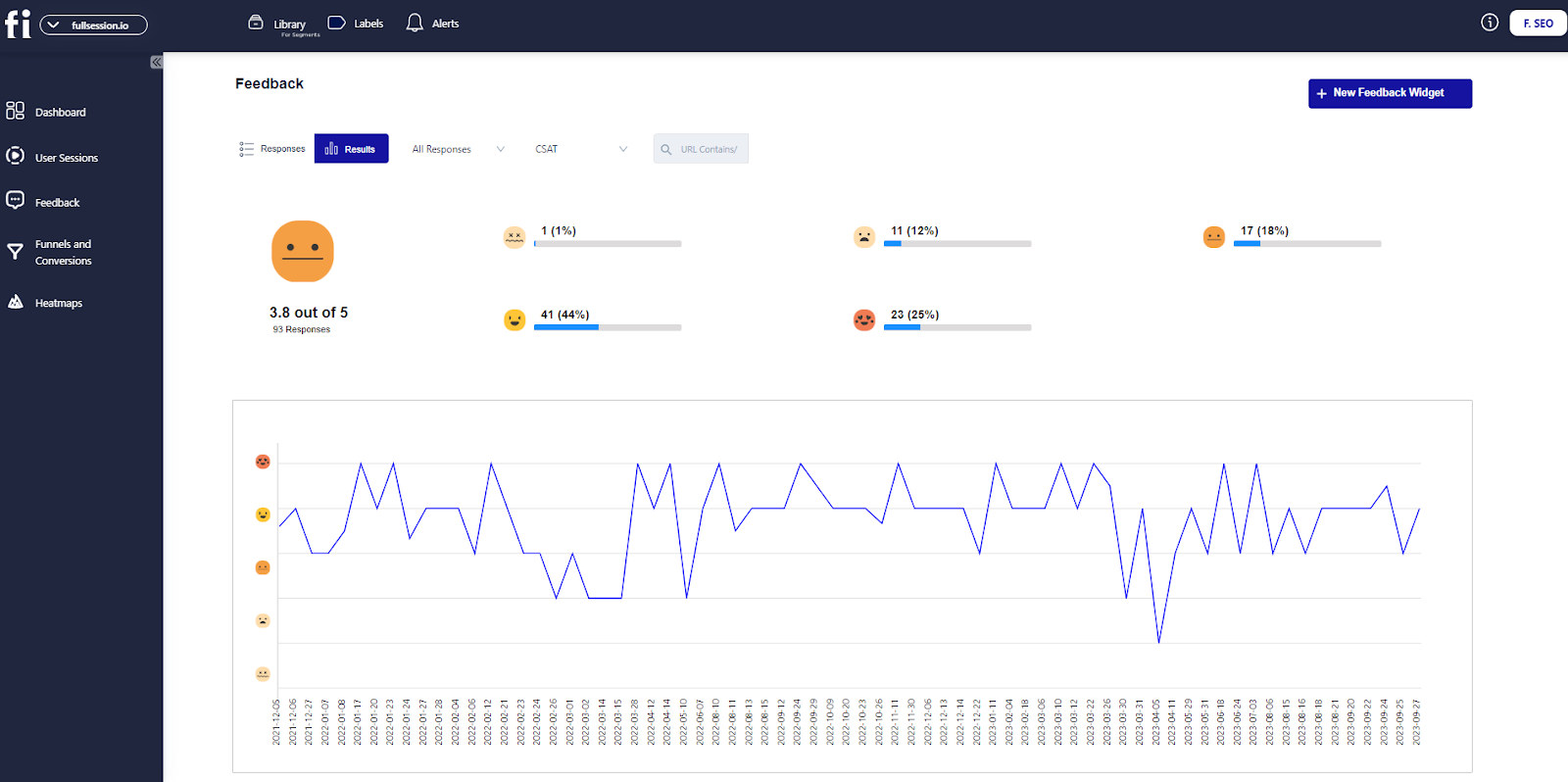
    Pricing

    Matomo offers a free open-source version for businesses that want to self-host. For those who prefer a cloud solution, paid plans start at $26 per month and scale based on traffic and features.

    Pros

    • Full data control with self-hosting option
    • Emphasis on privacy and GDPR compliance
    • Many analytics tools including heatmaps and session recordings
    • Free open source version for self-hosting
    • Customizable reports and dashboards

    Cons

    • Cloud version can become expensive for high-traffic sites
    • Setup for the self-hosted version requires technical expertise
    • Fewer third-party integrations compared to other analytics tools

    Best 9 UX Heatmap Tools Comparison Table

    Let’s compare heatmap software features for our top nine options.

    FullSessionPlerdyUXtweakSprigMicrosoft ClarityLiveSessionAttention InsightVWO InsightsMatomo
    Heatmaps
    Session recordings
    Conversion funnels
    Error tracking
    User feedback
    SEO tools
    Monthly pricing$39$32$99$175Free$65$31$172$26

    Best 9 UX Heatmap Tools: Our Verdict

    After testing the top UX heatmap tools, FullSession is the best for businesses that need complete user behavior insights.

    Its advanced features, privacy-first approach and ease of use suit all businesses, from startups to big enterprises.

    Here’s why FullSession is the best UX heatmap tool:

    • Real-time heatmap data processing for immediate user engagement tracking
    • No impact on website performance, maintaining optimal speed and responsiveness
    • Improved security and privacy measures, eliminating sensitive user information from recordings
    • Advanced data filtering and segmentation for large volumes of session data
    • Ethical, non-intrusive data collection without tracking users across the internet or using data for advertising
    • Faster user behavior analysis and decision-making capabilities
    • Improved customer experience due to maintained website performance
    • Increased user trust due to ethical data collection practices

    Ready to optimize your website performance and user experience with precision? 

    Book a demo today to see how FullSession can help you.

    Conclusion About Best 9 UX Heatmap Tools

    UX heatmap tools are a must-have for any online business that wants to improve user experience, engagement and conversions.

    They give you insights into how visitors interact with your site so you can make informed decisions to improve usability and performance.

    Whether tracking where users click, how they scroll or where they encounter friction, heatmap tools are invaluable for creating a fully optimized website.

    While all the tools have great features, FullSession is the most promising. Its ability to track dynamic elements in real-time, speed up data analysis, protect user privacy and improve team collaboration makes it the best for businesses that want to get into user behavior and drive real improvements.

    Book a demo today.

    FAQs About Best 9 UX Heatmap Tools

    Let’s answer the most common questions about UX heatmap software.

    What is a heatmap in UX design?

    A heatmap in UX design is a visual representation of user interactions on a webpage. It shows where users click, scroll or hover so designers can see what parts of the site get the most attention. 

    Heatmap software power users to see how users engage with their products and optimize web and mobile experiences.

    What is the best heat mapping tool?

    FullSession is one of the best heat mapping tools because of its real time tracking, privacy protection and ability to handle big data all in one intuitive interface.

    It also has multiple heatmaps: click, mouse movement and scroll maps.

    Does Google Analytics do heatmaps?

    No, Google Analytics doesn’t provide native heatmaps. It’s focused on website users and traffic, providing raw data.


  • 5 Best Click Tracking Software for Deep Customer Insights

    5 Best Click Tracking Software for Deep Customer Insights

    The best click tracking software monitors and logs how users interact with digital content. These apps record instances when visitors engage with interactive elements such as hyperlinks, call-to-action buttons, or other clickable web page components.

    Click tracking tools capture diverse information, including:

    • Timestamp data
    • Specific elements users clicked
    • User-related details

    For example, FullSession, an all-in-one user behavior analytics software, allows you to capture, reproduce, visualize and analyze entire user sessions, including mouse movements, clicks, scrolls, and all other interactions. 

    It goes beyond simple click tracking by providing a complete visual replay of user behavior on your site, web app or landing page.

    The real magic happens when you turn data into decisions, but choosing the right solution is hard. In this post, we’ll share the best click tracking software to help you optimize your online content and user experience.

    Key Takeaways

    • FullSession is a user behavior analytics software that helps you optimize website interface, experience and performance by offering session recordings and replays, interactive heatmaps, conversion funnel analysis, error tracking and customer feedback tools. It’s fully compliant with GDPR, CCPA, and PCI standards, ensuring user privacy and data security. Thepricing starts at $39/month, with a 20% discount for annual plans.Book a demo to explore its capabilities.
    • Voluum is a click tracking and ad management tool for performance marketers. It offers real-time analytics, A/B testing, multi-channel monitoring, and anti-fraud detection features. Its advanced tracking capabilities make it suitable for affiliate marketers and media buyers. Pricing starts at $149/month for the Profit plan, but the steep learning curve and higher cost compared to competitors can be limiting factors for beginners or small businesses.
    • Plerdy is a conversion rate optimization (CRO) tool that combines click tracking with SEO audits and session recordings. It includes features like heatmaps, pop-up forms, and conversion funnel analysis, making it versatile for improving user experience. While Plerdy is user-friendly, its free plan has limited features, and it can be overwhelming due to the extensive range of tools available. Pricing starts at $32/month, which scales with advanced features.
    • StatCounter is a straightforward web analytics tool focusing on real-time data, visitor journey tracking, and bounce rate analysis. It’s best for small to medium-sized businesses and bloggers looking for a simple way to monitor web traffic. Its ease of use is a plus, but it lacks some advanced features that competitors provide. StatCounter’s pricing starts at $18/month, and its free plan comes with ads and lower data limits.
    • Google Analytics is a web analytics tool that provides detailed reports on user behavior, traffic, and conversions. It supports event tracking, click path analysis and ecommerce insights. While it’s versatile and integrates well with other Google products, beginners may find it challenging to navigate, and the free version has data sampling limitations for high-traffic sites. The premium Google Analytics 360 version starts at $150,000/year, which can be cost-prohibitive for small businesses.

    Start a Free Trial to Experience FullSession

    Capture all user interactions, spot trends and patterns and drive improvements without compromising your website performance.

    5 Best Click Tracking Software Right Now

    Here are some of the best click tracking tools to help you optimize your website and improve your marketing strategies:

    1. FullSession (Get a demo)
    2. Voluum
    3. Plerdy
    4. StatCounter
    5. Google Analytics

    Let’s start with our evaluation.

    1. FullSession

    FullSession is an advanced user behavior software that doesn’t just track clicks – it captures all user interactions to provide you with a complete picture of user behavior.

    You can visualize and analyze all customer engagement to optimize your site interface, usability, experience and performance.

    FullSession can record and replay entire user sessions. You can see clicks in context, where users clicked, what led to that click and what happened next.

    FullSession creates visualizations of user interactions, including click maps. It helps you identify patterns and hotspots on your website.

    Unlike some basic click tracking tools, FullSession can track dynamic page elements. It is helpful for websites with content that changes based on user engagement or other factors.

    FullSession lets you track your conversion funnel, including click data to show how users move through each stage. It allows you to recognize bottlenecks and drop-off points.

    While click tracking provides quantitative data about user interactions, FullSession’s customer feedback tools also offer qualitative insights to give you a more holistic view of the user experience.

    FullSession enables you to detect, analyze, and resolve different types of error, rage and dead clicks that impact user experience.

    It also prioritizes user privacy and data security and complies with GDPR, CCPA, and PCI standards.

    Start a free trial or get a demo to learn more.

    Best for

    FullSession is ideal for:

    • E-commerce businesses looking to optimize their sales funnels
    • SaaS companies that want to improve their products
    • Digital marketers aiming to boost conversion rates
    • UX designers focused on improving user interface design
    • Data analysts who require in-depth insights into user behavior
    • Quality assurance teams to ensure smooth site performance
    • Product development teams working on feature upgrades
    • Customer support teams addressing user concerns
    • Customer experience professionals looking to improve satisfaction

    Key features

    • Advanced user and event segmentation: Segment website users based on diverse parameters. Recognize behavior trends, patterns and correlations to improve user journeys and boost engagement and conversion rates.
    • Session recordings and replays: Capture every user interaction on your website. Discover issues by replaying user sessions, examine user behavior based on specific criteria and anticipate future actions based on historical data. FullSession recordings protect your users’ privacy by excluding sensitive data recording.
    • Interactive heatmaps: Switch between mouse movement, click, and scroll maps. Identify hotspots, experiment with different page elements, find the top performers and estimate how long it takes users to complete key tasks. Get instant heatmap data with zero processing time and no influence on your website performance.
    • Website feedback forms and reports: Create branded in-app feedback forms to get data on user satisfaction, pain points, and feature requests. Watch a connected session recording to understand what occurred during the session and the motives behind the user feedback.
    • Conversion and funnel optimization tools: See user behavior patterns and determine why users abandon the process. Visualize user drop-offs at each step and test different designs and content to improve conversion rates.
    • Error analysis: Automatically detect website issues, such as JavaScript errors, network issues, and failed API calls. Examine error data to troubleshoot problems, pinpoint their root causes, and stop them from impacting user experience.

    Visualize, Analyze, and Optimize with FullSession

    See how to transform user data into actionable insights for peak website performance.

    Supported platforms

    FullSession supports user behavior tracking on websites, web apps and landing pages. It doesn’t work with mobile applications.

    Integrations

    FullSession integrates with Shopify, WordPress, Wix, and BigCommerce. It also connects with your tech stack through open APIs, webhooks, and Zapier. FullSession also provides native integrations.

    Customer support

    You can reach the support team through live chat and email. The help center also offers plenty of resources.

    Pricing

    Fullsession Pricing

    FullSession offers a Free plan along with three paid plans: Growth, Pro, and Enterprise. The Free plan is available at $0/month and includes 500 monthly sessions, 30-day data retention, session replay, heatmaps, and frustration signals, perfect for teams just getting started.

    If you opt for an annual subscription, you get a 20% discount on all plans, making it an affordable choice for companies looking to scale their analytics. 

    View the Pricing page to learn more.

    Pros

    • Tracks dynamic elements in real time, offering precise insights
    • Heatmap data is instantly processed without slowing down your site
    • User privacy is protected, sensitive data is removed from recordings
    • Handles large datasets efficiently, showing crucial insights quickly
    • Limits tracking to your website, preventing any misuse of data
    • Supports collaboration across teams, promoting unified efforts

    Cons

    • FullSession currently doesn’t support behavior tracking in native mobile apps

    Many top brands rely on our user behavior tools to fine-tune their user experiences. Explore how FullSession can transform your digital experience. 

    Improve Your Website Performance

    Learn how to use FullSession to detect and fix website issues before they affect your customer experience.

    2. Voluum

    Voluum is a click tracking and ad management platform for performance marketers. Its advanced analytics, robust tracking capabilities, and user-friendly interface stand out, making it a suitable choice for businesses and individuals who need to optimize their digital advertising efforts.

    User rating

    Voluum review

    Image source: G2

    Voluum has an average user rating of 4.7 out of 5 stars based on 146 reviews on G2.

    Best for

    Voluum is suited for performance marketers, media buyers, and affiliate marketers looking to manage multiple campaigns efficiently. It’s for those who require detailed tracking data to optimize ad performance and boost return on investment (ROI).

    Key features

    • Real-time reporting: Get instant access to campaign data with real-time analytics to track clicks, conversions, and traffic sources.
    • A/B testing: Test different variations of ads, landing pages, and offers to identify what performs best.
    • Automated rules: Set up automatic rules to optimize your campaigns based on performance metrics like cost-per-click (CPC) and conversion rates.
    • Multi-channel tracking: Track campaigns across various channels, including display ads, search engines, and social media.
    • Anti-fraud detection: Detect and block fraudulent clicks and traffic sources to ensure the integrity of your data.
    • Link tracking tool: Analyze every aspect of your link’s performance with the link tracking software, leveraging its strengths and identifying new opportunities.

    Supported platforms

    Voluum is a cloud-based platform accessible from all major web browsers, making it compatible with both desktop and mobile devices.

    Integrations

    Voluum integrates with major advertising platforms like Google Ads, Facebook Ads, and native ad networks. It also connects with other marketing tools like Zapier to automate workflow and data sharing.

    Customer support

    Voluum offers live chat, email support, and a comprehensive help center with tutorials and guides for troubleshooting common issues.

    Pricing

    Voluum’s pricing starts at $149 per month with its Profit plan, which includes essential tracking and analytics features. For marketers with more extensive needs, the Scale and Start-up plans provide enhanced capabilities, including higher tracking limits and more in-depth reporting tools.

    Pros

    • Real-time data tracking for precise campaign adjustments
    • Link tracking tools to optimize your affiliate marketing campaigns
    • A/B testing features to optimize ads
    • Built-in anti-fraud tools to protect campaign integrity

    Cons

    • Higher pricing compared to some competitors
    • Steeper learning curve for beginners
    • Limited customization options for lower-tier plans

    3. Plerdy

    Plerdy is a comprehensive conversion rate optimization (CRO) and click tracking tool designed to help businesses understand user behavior and improve their website’s performance.

    User rating

    Image source: G2

    Plerdy has an average user rating of 4.7 out of 5 stars based on 290 reviews on G2.

    Best for

    Plerdy is suited for digital marketers, UX/UI designers, and businesses that want to improve their website conversion rates. It’s useful for those who need a versatile tool combining user behavior analysis, CRO, and SEO functionalities in one platform.

    Key features

    • Heatmaps: Track clicks, scrolls, and cursor movements on your web pages to see which elements attract the most user interaction.
    • Session recordings: Replay user sessions to understand their actions, identify pain points, and improve the user experience.
    • Pop-up forms and banners: Create custom pop-ups and banners to capture leads, promote offers, or guide users to specific actions.
    • SEO checker: Perform on-page SEO audits to identify areas for optimization and ensure your content ranks higher in search results.
    • Conversion funnel analysis: Visualize where users drop off in your sales funnel and optimize the conversion process.

    Supported platforms

    Plerdy supports tracking on all major web browsers and is compatible with desktop and mobile devices.

    Integrations

    Plerdy integrates with popular tools such as Google Analytics, Zapier, HubSpot, CRM and marketing automation platforms, allowing seamless data management and campaign optimization.

    Customer support

    Plerdy provides customer support through email, live chat, and a comprehensive knowledge base that includes tutorials and guides for all levels of users.

    Pricing

    Plerdy offers a range of pricing plans, starting with a free tier that includes basic features for beginners. Paid plans begin at $32 per month, with higher tiers providing more advanced capabilities like unlimited session recordings, heatmaps, and enhanced CRO tools.

    Pros

    • Combines CRO, SEO, and click tracking in one platform
    • Easy-to-create pop-ups and banners for lead generation
    • User-friendly interface suitable for beginners

    Cons

    • The free plan has limited features
    • It can be overwhelming due to its wide range of tools
    • Slightly slower data processing for large websites

    4. StatCounter

    StatCounter is a web analytics tool that helps businesses, bloggers, and digital marketers gain valuable insights into their website’s performance.

    With its focus on simplicity and real-time data, StatCounter provides clear, actionable information about visitor behavior, making it easy to track and analyze web traffic without getting overwhelmed by data.

    User rating

    Image source: G2

    StatCounter has an average user rating of 4.3 out of 5 stars based on 114 reviews on G2.

    Best for

    StatCounter suits small to medium-sized businesses, individual website owners, and marketers who need a straightforward tool to track visitor activity and measure their site’s effectiveness.

    Key features

    • Real-time analytics: Instantly see who’s visiting your site, what they’re doing, and where they’re coming from, all in real-time.
    • Visitor journey tracking: Follow the exact paths visitors take through your website to understand their navigation patterns and interactions.
    • Bounce rate analysis: Monitor bounce rates to find out how many visitors leave your site without interacting, helping you identify content that needs improvement.
    • Keyword analysis: Discover which keywords are driving traffic to your site to optimize your content and boost search engine rankings.
    • Referral tracking: Identify the sources of your web traffic, including social media, search engines, and other referral websites.

    Supported platforms

    StatCounter is a web-based tool that works on all major browsers and is compatible with desktop and mobile devices.

    Integrations

    StatCounter integrates with popular analytics tools like Google Analytics, providing users with a more comprehensive view of their data and enhancing their ability to make data-driven decisions.

    Customer support

    StatCounter offers support through email and a detailed knowledge base that includes guides, FAQs, and video tutorials to help users troubleshoot and get the most out of the platform.

    Pricing

    StatCounter offers a free plan with basic tracking features for small websites and blogs. For users who need more advanced features and higher data limits, paid plans start at $18 per month, which include detailed visitor tracking and priority support.

    Pros

    • Easy-to-use interface suitable for beginners
    • Real-time tracking for immediate insights
    • Affordable pricing options with a free plan available

    Cons

    • Limited advanced features compared to other analytics tools
    • The free plan includes ads and lower data limits
    • Less comprehensive integrations with third-party platforms

    5. Google Analytics

    Google Analytics is a web analytics tool offering comprehensive features for tracking website performance, user behavior, and conversions. 

    While it’s best known for its in-depth traffic analysis and reporting, it also provides click tracking capabilities that help businesses understand how visitors interact with different site elements.

    Learn more:

    User rating

    Image source: G2

    Google Analytics has an average user rating of 4.5 out of 5 stars based on 6,404 reviews on G2.

    Best for

    Google Analytics is suitable for businesses of all sizes, digital marketers, and website owners who need a reliable tool for tracking user interactions. It’s beneficial for those who monitor click patterns and optimize website elements to increase engagement and drive conversions.

    Key features

    • Event tracking: Set up custom events to track specific user interactions like button clicks, form submissions, and video plays, giving you detailed insights into user engagement.
    • Click path analysis: Visualize the path users take through your website to see where they click and how they navigate from page to page.
    • Custom goals: Define goals that measure the effectiveness of clicks leading to conversions, such as purchases, sign-ups, or downloads.
    • Enhanced eCommerce tracking: Get deeper insights into the clicks and actions related to product listings, checkout processes, and sales funnels.
    • Behavior flow reports: Understand users’ journey through your site, including which clicks lead to further interactions and where they drop off.

    Supported platforms

    Google Analytics works on all major browsers and supports tracking on both desktop and mobile devices, making it a versatile solution for monitoring user behavior across multiple platforms.

    Integrations

    Google Analytics integrates with tools like Google Ads, Google Tag Manager, and third-party platforms like Shopify and WordPress.

    Customer support

    Support for Google Analytics primarily comes through its extensive help center, community forums, and a wealth of online resources, including guides, webinars, and training courses. 

    Users can also access one-on-one support for more specific technical issues through Google’s support team.

    Pricing

    Google Analytics offers a free plan that includes a broad range of features suitable for most small to medium-sized businesses. For large enterprises requiring more advanced data analysis, Google Analytics 360 is available with premium features, starting at $150,000 per year.

    Pros

    • Event and click tracking for detailed user insights
    • Integration with Google Ads and other marketing tools
    • Free plan available with extensive analytics capabilities

    Cons

    • Steep learning curve for beginners
    • Advanced features can be overwhelming without technical knowledge
    • Data sampling issues in the free version for high-traffic sites

    5 Best Click Tracking Software Comparison Table

    Choosing the best click tracking software can be challenging with so many available options. To help you make an informed decision, we’ve compiled a detailed comparison of the top five tools we evaluated in this article.

    FullSessionVoluumPlerdyStatCounterGoogle Analytics
    Session recordings
    Interactive heatmaps
    Conversion funnel analysis
    Real-time analytics
    Feedback forms
    Data integration
    Monthly pricing$39$149$32$18Free

    Best Click Tracking Software: Our Verdict

    After testing and comparing many click tracking solutions, FullSession is the best software for user behavior analysis, including click tracking. It has a unique set of features that sets it apart from other web analytics tools.

    FullSession is excellent at tracking dynamic elements in real time, giving you precise user insights. It captures user interactions with live-changing content so analysts and marketers always have the most up-to-date and accurate data. Real-time tracking is valuable for making quick decisions based on user behavior.

    One of FullSession’s best features is the ability to generate heatmaps with zero processing time and no impact on website performance. This superfast heatmap processing means you can analyze user interactions straight away and spot areas of high engagement or improvement.

    This speed and efficiency mean you can implement website optimization quickly without compromising user experience.

    FullSession is committed to protecting user privacy. It excludes sensitive data recording so you can get the insights you need without compromising your user’s privacy. It helps with data protection regulations and builds trust with your customers.

    FullSession’s data management is robust, so you can handle large data sets and get insights quickly. This is critical if you’re dealing with huge amounts of user data so you can find meaningful patterns and trends without getting overwhelmed.

    Another big plus of FullSession is site-specific tracking. By tracking user behavior on the client’s website only, FullSession prevents data misuse and ensures all insights generated are relevant to the business’s online presence.

    Finally, FullSession is a single platform for cross-team collaboration. It allows different departments to work together more effectively. This unified approach means all teams are working with the same data and insights, so you get more cohesive strategies and better results.

    FullSession is the best click tracking software because of its features, commitment to privacy, data processing and cross-team collaboration. If you want to get deep user insights without impacting website performance and user privacy, FullSession is the solution.

    Start a free trial or get a demo to learn more.

    Conclusion About Best Click Tracking Software

    Click tracking software is a must-have for any online business that wants to know how users behave, increase engagement and optimize their website.

    These tools give you priceless insights into how visitors interact with your site and what works and doesn’t. Using this data, you can make knowledgeable decisions to increase conversions, simplify user experiences and grow your online presence.

    Of the top tools out there, FullSession stands out for real-time tracking, advanced analytics and user privacy. It’s a complete solution that gives detailed insights and facilitates team collaboration. If you want to get the most out of your website, FullSession is the one to go for.

    Ready to see the difference FullSession can make for your online business?

    Book a demo today and experience its powerful features firsthand!

    FAQs About Best Click Tracking Software

    What is click tracking software, and how does it work?

    Click tracking software monitors user interactions on a website, explicitly tracking where visitors click, scroll, or hover. It collects data on these actions, helping companies understand user behavior patterns and optimize their site for a better user experience. Some tools also have features for tracking links.

    Why is click tracking important for my website?

    Click tracking provides insights into how visitors engage with your website. You can identify which elements drive conversions, detect areas where users lose interest, and make informed decisions to improve your site’s layout and content.

    Can click tracking software protect user privacy?

    Yes, many click tracking tools prioritize user privacy by ensuring sensitive information like passwords or personal data is not recorded. Look for software that complies with data protection standards like GDPR and CCPA to ensure your visitors’ privacy is respected.

    What should I look for when choosing click tracking software?

    When selecting click tracking software, consider features like real-time analytics, heatmaps, session replays, integration options, and data privacy. Choose a tool that fits your budget and offers a user-friendly interface for easy analysis and reporting.

    What are the best link tracking tools?

    The best link tracking tools offer a combination of robust features, including link shortening and branded links. Based on current market analysis and user reviews, some top contenders include:

    • ClickMagick, which offers versatile options and detailed analytics
    • Bitly, known for its simplicity and brand recognition,
    • ClickMeter, which provides comprehensive tracking capabilities

    For those seeking more advanced features, FullSession stands out with its real-time tracking of dynamic elements and privacy-focused approach.

    Other notable mentions include Voluum’s advanced tracking capabilities and Pretty Links for WordPress users. The best choice depends on specific business needs, budget, and desired features.


  • 5 Crazy Egg Competitors and Alternatives for Better UX Analysis

    5 Crazy Egg Competitors and Alternatives for Better UX Analysis

    Crazy Egg is a popular website analytics platform that helps businesses track visitor behavior, spot issues in the user session, and improve their user experience and website performance.

    However, users have reported some limitations and drawbacks.

    Crazy Egg:

    • Lacks usability testing features
    • Lacks features tailored for native app analytics
    • Only allows comparison of two snapshots in heatmaps
    • Exports provide only static “screenshots” of data
    • Offers strong visuals but lacks detailed analytical capabilities

    Some users are also frustrated by the automatic enrollment into an annual subscription, which can be unclear during sign-up. These issues have led many customers to search for Crazy Egg alternatives.

    FullSession is one of the best Crazy Egg competitors. Our comprehensive user behavior analytics tools allow you to visualize all user engagement, analyze trends and patterns with laser precision and optimize your website for peak performance.

    You can start a free trial or get a demo to learn more and experience the difference firsthand.

    In this post, we’ll review the top five Crazy Egg competitors, enabling you to evaluate these best website analytics tools and determine which best aligns with your requirements and business goals.

    The Top 5 Crazy Egg Competitors Right Now

    After in-depth research, we have selected the following user behavior tools as the top five Crazy Egg competitors:

    1. FullSession (Get a demo)
    2. Google Analytics
    3. Kissmetrics
    4. LogRocket
    5. SiteSpect

    We’ll evaluate all the tools based on features, integrations, customer support, pricing, pros, and cons.

    1. FullSession

    FullSession crazy egg competitors

    Get a 360-degree view of user behavior data with FullSession. Capture all website visitors’ interactions, analyze trends and patterns in their behavior and optimize your website experience, interface and performance.

    Move beyond stats and surveys and watch real-time user sessions. Analyze how users interact with your site and see every detail of their journey.

    Identify inactivity areas, test different page elements, and validate design modifications.

    Remove conversion barriers and optimize key touchpoints in your marketing and sales funnels.

    Get direct feedback from users to understand why they are frustrated and take action on recurring issues.

    Trust FullSession for behavior analytics. We prioritize user privacy and data security by complying with GDPR, CCPA and PCI standards.

    Start a Free Trial to Experience FullSession

    Capture all user interactions, spot trends and patterns and drive improvements without compromising your website performance.

    Best for

    FullSession is the best UX analytics tool for:

    1. E-commerce businesses
    2. SaaS companies
    3. Digital marketers
    4. UX designers
    5. Data analysts
    6. Quality assurance teams
    7. Product development teams
    8. Customer support teams
    9. Customer experience professionals

    Key features

    Supported platforms

    FullSession supports website tracking, progressive web applications (PWAs) and mobile websites.

    Integrations

    FullSession works with your entire tech stack. It integrates with open APIs, modern web hooks, and Zapier and also provides native integrations. It works best with Shopify, WordPress, Wix, and BigCommerce.

    Customer support

    FullSession provides live chat and email support. You can also visit the help center.

    Pricing

    FullSession pricing

    We offer a free trial and three pricing plans—Basic, Professional and Enterprise— to suit businesses of all sizes, from startups to large corporations.

    This flexible structure means you can start with a plan that fits your current needs and scale up as you grow, so you only pay for what you use.

    The entry-level paid plan includes all the essentials, unlimited heatmaps and session recording for up to 5,000 monthly visits for just $39 per month. You can use advanced analytics without breaking the bank.

    We also offer 20% off all plans for annual billing.

    Our platform integrates with popular e-commerce and content management systems like Shopify, WordPress, Wix and BigCommerce. You can get up and running without any extra setup costs.

    For more info, check out our Pricing page.

    Pros

    • Track dynamic elements in real time for precise user insights
    • Accelerate heatmap processing with zero impact on site speed
    • Protect user privacy by excluding sensitive data recording
    • Manage extensive data sets effectively and quickly reveal key insights
    • Limit user behavior tracking to your site, preventing data misuse 
    • Facilitate cross-team collaboration and unify team efforts on one platform

    Cons

    • FullSession doesn’t work with native mobile apps

    Visualize, Analyze, and Optimize with FullSession

    See how to transform user data into actionable insights for peak website performance.

    2. Google Analytics

    Google Analytics Crazy Egg Competitors

    Google Analytics is a free tool for web and app analytics offered by Google. It helps you track and report website traffic, user engagement, and app performance.

    The latest version, GA4, provides improved capabilities for understanding user interactions across platforms.

    Learn more:

    Best for

    Google Analytics is a good option for marketers, online businesses, developers and business intelligence professionals.

    Key features

    • Event tracking: GA4 uses an event-based model to track user interactions more flexibly than previous versions.
    • Cross-platform tracking: Enables businesses to analyze user journeys across web and mobile platforms.
    • Audience segmentation: Allows for creating custom audiences based on user behavior and demographics.
    • Predictive insights: Uses machine learning to forecast future user actions and trends.

    Supported platforms

    Google Analytics supports web and mobile platforms.

    Integrations

    You can integrate Google Analytics with Google Ads, BigQuery, Google Tag Manager and other Google marketing tools or third-party apps like WordPress, Marketo, Shopify, ZenDesk, and CallRail.

    Customer support

    Google Analytics provides support via email, knowledge base, FAQs, and chat.

    Pricing

    Google Analytics is free for most users. However, the premium version, Google Analytics 360, offers advanced enterprise features at a cost that differs based on specific business needs.

    It starts at $12,500/month or $150,000/year.

    This paid version provides advanced features like attribution modeling, augmented analytics, customizable reports, and more.

    Pros

    • The standard version is free to use
    • Provides detailed insights into user behavior
    • An intuitive dashboard makes data analysis accessible even for beginners.
    • Works seamlessly with other Google products and third-party tools

    Cons

    • Large datasets may result in sampled data, affecting accuracy
    • The wealth of features can be overwhelming for beginners
    • Increasing regulations around data privacy may limit tracking capabilities in the future

    3. Kissmetrics

    Kissmetrics Crazy Egg alternatives

    Kissmetrics is a web and mobile event tracking tool that helps you understand user behavior and optimize your marketing strategies. It tracks individual customer journeys across multiple touchpoints so you can find bottlenecks, reduce churn and increase revenue.

    Best for

    Kissmetrics is good for ecommerce businesses, SaaS companies and marketing teams.

    Key features 

    • Behavior tracking: Tracks individual user actions to show their journey.
    • Funnel analysis: Tracks the entire customer journey from discovery to conversion.
    • Cohort reports: Shows user behavior over time to find trends and engagement levels.
    • A/B testing: Tests different designs and flows for best performance.
    • Data privacy: Customer data is protected throughout the analytics process.

    Supported platforms

    Kissmetrics supports web and mobile applications.

    Integrations

    You can connect Kissmetrics with most email marketing tools, CRM systems and ecommerce platforms such as Shopify, Marketo, HubSpot, Salesforce, and MailChimp.

    Customer support

    Kissmetrics provides support via personalized onboarding for new customers, online documentation and guides, and live real-time chat.

    Pricing

    Kissmetrics pricing plans

    Kissmetrics has simple pricing based on monthly events, seats and features. The entry plan for small teams starts at $299/month and includes up to 2M monthly events, two seats and five populations.

    Kissmetrics limited plan pricing

    You can also create a limited plan by choosing the number of monthly events you want to track and selecting the monthly or annual billing.

    Pros

    • Focuses on individual user behavior, not aggregate data
    • Gives clear recommendations to improve marketing initiatives
    • Easy-to-read dashboard
    • The support team is responsive

    Cons

    • May offer shorter free trials than competitors
    • Advanced features can be complex to learn
    • Costs can skyrocket as event tracking increases

    4. LogRocket

    LogRocket Crazy Egg competitor

    LogRocket is an advanced analytics and session replay tool that helps improve user experience by identifying technical and UX issues within web and mobile applications.

    Using AI technology, LogRocket provides insights into user behavior, allowing you to understand your customers’ challenges and improve product performance.

    Learn more: LogRocket competitors.

    Best for

    LogRocket is suited for software development teams, product managers, UX/UI designers, and customer support teams.

    Key features

    • Session replay: Capture detailed replays of user sessions, including DOM playback, console logs, network logs, and performance data.
    • Product analytics: Track conversion funnels, path analysis, and time series trends to understand user engagement.
    • AI issues detection: Use Galileo AI to proactively identify high-impact technical and UX issues affecting conversion rates.
    • Error tracking: Monitor frequent errors, network failures, and crashes to prioritize fixes.
    • UX Analytics: Get heat maps, click maps, and scroll maps to analyze user interactions on key pages.

    Supported platforms

    LogRocket supports diverse web and mobile platforms, making it versatile for various development environments.

    Integrations

    LogRocket integrates with customer support, marketing and development tools like Slack, Intercom, Segment, Google Analytics, Drift, Trello, Optimizely, and ZenDesk.

    Customer support

    You can reach out for support via email and live chat or check the comprehensive guides and FAQs.

    Pricing

    LogRocket pricing

    LogRocket provides a free plan and a 14-day free trial for its premium pricing tiers. It offers three paid plans for web and mobile analytics. The Team plan starts at $69/month and lets you track up to 10,000 monthly sessions.

    Pros

    • Provides deep analytics that helps identify both technical issues and UX problems
    • An easy-to-navigate dashboard that displays critical metrics
    • Automates the detection of issues with AI, saving time for teams

    Cons

    • The pricing may be high for startups or small teams with limited budgets
    • New users may require some time to fully use all features effectively

    5. SiteSpect

    SiteSpect Crazy Egg competitor

    SiteSpect is an A/B testing and experimentation platform that helps you optimize digital experiences across various channels, including websites, mobile apps, and kiosks.

    With a focus on improving customer engagement and driving conversions, SiteSpect provides tools for testing, personalization, and performance optimization, helping you enhance your online presence.

    Best for

    SiteSpect is suited for product managers, marketing teams, ecommerce businesses and enterprise-level organizations that want to run AB tests and optimize a web or mobile app.

    Key features

    • A/B testing: Conduct experiments to compare different versions of web pages or app interfaces to determine which performs better
    • Personalization: Tailor user experiences based on behavior and preferences to increase engagement
    • API digital transformation engine: Optimize across complex application ecosystems, including IoT devices and OTT platforms
    • Visual editor: Make changes without needing extensive coding knowledge
    • Comprehensive analytics: Collect reliable data free from bots to inform decision-making

    Supported platforms

    SiteSpect supports different platforms, including web and mobile apps and kiosks and OTT devices.

    Integrations

    SiteSpect connects with third-party platforms like Azure, AWS, Segment, Tableau, and IBM analytics.

    Customer support

    You can get support via email, documentation and resources and training programs for new users.

    Pricing

    SiteSpect has no pricing information on its website, so you’d have to contact sales for a quote.

    Pros

    • Fast performance
    • Comprehensive testing capabilities
    • Strong focus on security and stability

    Cons

    • Lack of publicly available pricing information
    • A learning curve for new users unfamiliar with A/B testing methodologies

    Crazy Egg Competitors: A Short Overview 

    So far, we have explained the core features and characteristics of the top five Crazy Egg alternatives. In this section, we will provide a summary so you can quickly make your decision. Check our table below to compare Crazy Egg competitors.

    FeaturesFullSessionGoogle AnalyticsKissmetricsLogRocketSiteSpect
    Real-time Session recording
    Advanced funnel analysis
    Conversion tracking
    Behavioral analytics
    Customer segmentation
    A/B testing
    Customer journey mapping
    Dynamic heatmaps
    Customer feedback and forms
    Survey responsesUnlimitedLimitedLimitedLimitedLimited
    Free trial
    Free version
    PricingStarts at $39 per monthStarts at $12,500/monthStarts at $299/monthStarts at $69/monthNA

    Crazy Egg Competitors: The Verdict

    After reviewing all the options, FullSession is the top Crazy Egg competitor. Our conclusion is based on several key factors that make FullSession better in terms of functionality, performance, and user insights.

    1. Complete analytics: FullSession has a full suite of user behavior tools, including interactive heatmaps, session recordings and replays, website feedback forms, conversion and funnel analysis and error tracking. This gives a more complete picture of user interactions than Crazy Egg’s limited feature set.
    2. Real-time data processing: FullSession shows live heatmap tracking to see how users interact with dynamic page elements in real-time. This means faster data processing and faster user behavior analysis.
    3. Zero performance impact: Unlike many others, FullSession doesn’t slow down your website. It’s optimized for speed and responsiveness so your users have a smooth experience.
    4. Ethical data collection: FullSession is non-intrusive. We don’t track users across the internet or use data for behavioral advertising, so users trust us completely.
    5. Seamless integration: FullSession integrates seamlessly with popular platforms like Shopify, WordPress and BigCommerce so you can get up and running without any extra complexity.
    6. Competitive pricing: FullSession has a more competitive pricing model with the lowest-paid plan including all the features at an affordable price of $39 per month and 20% off all plans for annual billing.
    7. Advanced data filtering and segmentation: FullSession is excellent at data analysis, and it helps you quickly process large volumes of session data and make faster decisions.
    8. Advanced security and privacy measures: FullSession puts user security first by not capturing sensitive information, reducing the risk of unauthorized access or data misuse.

    Crazy Egg is good. But if you’re looking for a complete, user-friendly, privacy-focused solution that doesn’t compromise on features or performance, FullSession is the way to go.

    Start a free trial or get a demo to learn more.

    FAQs About Crazy Egg Alternatives

    Let’s answer the most common questions about the Crazy Egg alternatives.

    What is Crazy Egg? 

    Crazy Egg is a web analytics software that enables businesses to analyze user journey, traffic sources and customer behavior via a website heatmap tool, snapshots, A/B testing, and session recording among other tools used.

    This analytics solution tool helps organizations better understand the customer journey, spot errors impacting conversions, target audience, and get a more precise picture of how various marketing channels perform.

    How does Crazy Egg work?

    You can start using Crazy Egg to monitor your website performance by adding its code snippet to your website. After that, the software begins to track individual landing pages of your website, showing how customers interact with various elements on your web pages.

    For instance, you can use its heat map and snapshot tool to see where users click, the CTAs they don’t click and the elements that boost conversions. Crazy Egg also offers form analytics to analyze user interactions with forms, helping you understand how users engage with forms and identify areas where they drop off or struggle.

    Apart from that, Crazy Egg provides session recording tools that can help you visualize how web visitors navigate your site. You can identify where users are coming from and where they get stuck, so you can make changes to improve your site performance.

    Crazy Egg also lets you perform split testing with its AB testing tool.

    What are Crazy Egg pros?

    It is easy to set up and presents user actions in a simplified way. The software helps you spot where visitors and users experience issues on your site so you can improve the UX.

    What are Crazy Egg cons?

    While the software helps you spot various issues, it doesn’t provide a precise explanation of individual users’ actions. It comes with high pricing.

    What is Crazy Egg pricing?

    Crazy Egg provides three pricing plans. However, prices are not publicly available.

    Does Crazy Egg work on mobile apps? 

    No, Crazy Egg doesn’t work on mobile apps.

    What is a Crazy Egg snapshot? 

    A Crazy Egg snapshot helps you track individual pages on your website. It lets you visualize how people interact with your web content, so you can learn what’s working or where to make improvements. 

    Which is better: Optimizely or Crazy Egg?

    The choice between Optimizely and Crazy Egg depends on your needs, but here’s a general comparison.

    Optimizely is more robust for large-scale A/B testing and personalization. It offers more advanced features for experimentation and is often preferred by larger enterprises.

    Crazy Egg is more user-friendly and focuses on heat maps and visual analytics. It’s often favored by smaller businesses and those new to website optimization.

    Does Crazy Egg integrate with Google Analytics?

    Yes, Crazy Egg does integrate with Google Analytics. It allows users to combine Crazy Egg’s visual data with Google Analytics’ quantitative data for more comprehensive insights into website performance and user behavior.

    What is the point of Crazy Egg?

    Crazy Egg is a website optimisation tool that helps businesses understand and improve user behavior on their websites. 

    Its main purpose is to show you visual insights into how visitors interact with your web pages through heatmaps, scroll maps and click reports. 

    By visualizing user engagement, Crazy Egg allows website owners and marketers to find usability issues, optimize conversions, A/B tests and see user journeys. 

    This data-driven approach means businesses can make informed decisions about layout, content placement and overall user experience, ultimately increasing engagement and conversions. 

    In short, Crazy Egg is an analytics tool for businesses that want to improve their online presence and website performance based on real user behavior.


  • 11 Best UX Research Tools to Test in 2026

    11 Best UX Research Tools to Test in 2026

    Understanding how users interact with your website is key to creating a seamless experience, and that’s where the best UX research tools shine. These tools help you uncover hidden pain points, refine your design, and boost engagement. 

    Take FullSession, for example—it offers session recordings and replays, interactive heatmaps, conversion funnel optimization tools, error tracking and customer feedback tools to give you a complete picture of user behavior. 

    While UX tools provide valuable insights, choosing the right one can be tricky. Balancing powerful features with simplicity is often the biggest challenge. In this guide, we’ll help you find the perfect UX tool for your needs.

    Key Takeaways

    • FullSession is a user behavior analytics software designed to offer businesses visual insights into user activities on their websites. It features comprehensive session recording and replay, interactive heatmaps, customer feedback forms and analysis, conversion funnel analysis, error tracking, and seamless integration with popular platforms, making it ideal for optimizing website performance and digital experiences. It is also compliant with GDPR, CCPA, and PCI standards. The pricing starts at $39/month for 5,000 session recordings and unlimited heatmaps. Get a 20% discount with annual subscriptions. Book a demo now.
    • UXtweak is a UX research tool that focuses on helping teams conduct in-depth usability analysis. It allows for task-based testing and supports both low-fidelity and high-fidelity prototype testing, with customizable heatmaps offering detailed filtering options. The main drawback of UXtweak is its limited customer support hours. Pricing begins at $99/month.
    • Optimizely Web Experimentation is an experimentation platform for A/B testing and personalization, particularly for large-scale digital ecosystems. It enables businesses to run multiple variations of their websites or apps simultaneously, leveraging machine learning-driven personalization. Despite its features, Optimizely’s high pricing and steep learning curve can be challenging for beginners. Pricing is custom-tailored based on the specific needs of the business.
    • UserTesting is a human insight platform that provides real-time insights through high-quality video recordings or live sessions of user interactions. It captures detailed user feedback, including thoughts and facial expressions, making it an essential tool for diagnosing usability issues. The main drawback is the higher pricing, which can be prohibitive for smaller teams, with plans being custom-tailored to fit different needs.
    • Maze is a user research platform primarily focused on rapid prototype testing and gathering user feedback. It integrates with design tools like Figma, Sketch, and Adobe XD, generating detailed usability reports and linking survey responses directly to user interactions. However, advanced analytics features may require higher-tier plans. Pricing starts at $99/month, with limitations on more advanced features at lower pricing tiers.
    • Lyssna is a remote user research platform designed for quick and efficient tests, such as five-second tests to gauge user impressions. It’s particularly useful for measuring the initial impact of a design. The tool has limited testing options compared to more advanced platforms, with pricing starting at $89/month and a free plan available with basic features.
    • Mixpanel is a product analytics tool known for its event tracking and user segmentation capabilities. It allows businesses to analyze complex user funnels and understand long-term user retention trends. The platform supports real-time data tracking and integrates with tools like Salesforce and Google Analytics. However, it has a steeper learning curve for beginners. Pricing starts at $28/month, with more advanced features available in higher-tier plans.
    • VWO Insights is a user behavior analytics tool that provides deep insights through session recordings and comprehensive form analytics. It includes conversion funnel tracking to optimize conversion rates. The main drawbacks are its relatively high pricing and the need for more advanced knowledge to fully leverage its features. Pricing starts at $176/month, with scalability based on usage.
    • Userlytics is a user testing tool for task-based testing, where users complete specific tasks while being recorded. It also offers access to a global participant panel, allowing for diverse user feedback. However, the pricing can be high for extensive testing needs, and plans are custom-tailored based on the scope of the research.
    • Looppanel is an AI-powered research analysis and repository tool that specializes in usability and accessibility testing. It ensures that digital products are user-friendly and accessible to individuals with disabilities. It offers session recordings and task-based testing features but has limited advanced features compared to more specialized tools. Pricing starts at $30/month, with more advanced features available in higher-priced plans.
    • Optimal Workshop is a UX research and design testing platform focused on information architecture, offering features like Treejack for testing website navigation and card sorting to understand how users categorize information. While it provides comprehensive tools for improving site structure, its higher pricing, starting at $129/month, may be a barrier for smaller teams.

    Let’s dig deeper into each UX research platform on the list:

    Best 11 UX Research Tools Right Now

    Below is a list of the top 11 UX research tools you can test in 2024:

    1. FullSession (Get a demo)
    2. UXtweak
    3. Optimizely Web Experimentation
    4. UserTesting
    5. Maze
    6. Lyssna
    7. Mixpanel
    8. VWO Insights
    9. Userlytics
    10. Looppanel
    11. Optimal Workshop

    1. FullSession

    FullSession homepage

    FullSession is a user behavior analytics software that can significantly improve the work of UX researchers.

    It offers advanced features that directly benefit UX research processes and outcomes, helping you capture the entire user journey without affecting your website performance.

    From a single intuitive dashboard, you can observe user behavior in real-time, analyze trends and patterns accurately, and use visual insights to optimize your website and create relevant, user-friendly, and enjoyable experiences.

    You can also:

    • Identify usability issues and design flaws more efficiently
    • Validate or refute design hypotheses with real user data
    • Conduct more thorough and accurate user journey mapping
    • Prioritize design improvements based on actual user behavior
    • Measure the impact of design changes over time

    FullSession’s compliance with GDPR, CCPA, and PCI standards ensures that you can conduct your studies ethically without compromising user data.

    Book a demo to learn more.

    Best for

    FullSession benefits e-commerce businesses, SaaS companies, digital marketers, UX designers, and data analysts. 

    It’s ideal for optimizing websites, gaining insights into user behavior, improving product designs, and improving customer experience.

    Whether you’re in product development, quality assurance, or customer support, FullSession offers valuable tools to refine and optimize digital experiences.

    Key features

    • Advanced user and event segmentation: Effortlessly categorize website users based on multiple criteria. Spot behavior trends, patterns, and correlations, refine user journeys, improve engagement, and drive higher conversion rates.
    • Session recordings and replays: Capture and replay every interaction users have on your website. Diagnose issues, understand user behavior, and forecast future actions using historical data. Prioritize user privacy by excluding sensitive data from recordings.
    • Interactive heatmaps: Switch between maps that track mouse movements, clicks, and scrolls to pinpoint areas of high or low interaction. Test various page elements to determine which perform best, and track the time users take to complete key tasks. Get instant heatmap data with no delays or impact on your website’s performance and optimize layout and content placement.
    • Custom feedback forms and reports: Design branded feedback forms to collect insights on user satisfaction, challenges, and feature requests. Watch connected session recordings to understand the reasons behind the feedback and see what happened during the session.
    • Conversion and funnel optimization tools: Identify user behavior patterns and pinpoint the reasons for drop-offs during the conversion process. Visualize where users exit at each step and experiment with different designs and content to improve conversion rates.
    • Error analysis: Automatically detect website issues like JavaScript errors, network problems, and failed API calls. Analyze error data to troubleshoot issues, identify root causes, and prevent them from negatively impacting the user experience.
    FullSession session recordings

    Supported platforms

    FullSession supports tracking user behavior on web platforms and includes mobile user recordings.

    Integrations

    Whether you’re using APIs, webhooks, Zapier, or built-in integrations, FullSession connects seamlessly with your existing tools, automating tasks and maintaining smooth data flow across all your applications. 

    For instance, it integrates with popular platforms like BigCommerce, Wix, Shopify, and WordPress, enabling you to optimize your processes with minimal setup effort.

    Customer support

    FullSession provides live chat and email support, along with a comprehensive help center for self-service.

    Pricing

    You can select from three paid plans—Starter, Business, and Enterprise—tailored to suit businesses of all sizes, from small startups to large enterprises.

    FullSession pricing

    These scalable plans let you begin with the one that meets your current needs and upgrade as your business expands, so you only pay for the features you need.

    The entry-level plan offers all essential features, including unlimited heatmaps and up to 5,000 session recordings per month, for just $39/month. 

    This makes it easy to access advanced analytics without breaking the bank.

    Annual subscriptions offer a 20% discount on all plans.

    Check out the pricing page to learn more.

    Pros

    • Monitor dynamic elements in real time to gain precise insights from real users
    • Accelerate heatmap processing without impacting site performance
    • Safeguard user privacy by omitting sensitive data from recordings
    • Handle large datasets efficiently and swiftly reveal key insights
    • Restrict tracking to your site to maintain data security
    • Enhance cross-team collaboration by centralizing efforts on one platform
    • Improve multiple UI and UX simultaneously throughout the design process

    Cons

    • FullSession does not support mobile app tracking

    Book a demo to see how FullSession works.

    2. UXtweak

    UXtweak

    Image source: G2

    UXtweak is a UX research tool that provides a range of usability testing options tailored to enhance your website’s user experience. 

    With a focus on detailed analysis and user insights, UXtweak helps you make informed decisions to improve design, functionality, and overall user satisfaction.

    User rating

    UXtweak has a user rating of 4.7 out of 5 out of 39 reviews on G2.

    Uxtweak review

    Image source: G2

    Best for

    UXtweak is suitable for teams that heavily focus on usability testing and need a versatile tool that offers a variety of testing methods. 

    It’s suitable for UX designers, researchers, and product teams looking to gather detailed user feedback and optimize their UX design.

    Key features

    • Usability testing: Use diverse usability testing options, including task-based testing, and see exactly how users interact with your site. Track and analyze user behavior with precision and get actionable insights that go beyond surface-level data.
    • Prototype testing: Test low-fidelity wireframes and high-fidelity prototypes before going live and get insights for each design stage.
    • Heatmaps: Get highly customizable click, scroll, and move heatmaps.
    • Tree testing: Evaluate the effectiveness of your website’s navigation structure. Use  tree testing to get detailed reports, which highlight where users struggle to find information, helping you refine your site’s structure.

    Supported platforms

    UXtweak supports web-based platforms and is fully compatible with mobile devices.

    Integrations

    UXtweak integrates with popular project management and communication tools like Jira, Slack, and Trello, ensuring seamless workflow and easy collaboration among teams.

    Customer support

    UXtweak offers customer support via chat, email, and phone during business hours. They also provide an extensive knowledge base with tutorials and guides.

    Pricing

    UXtweak’s pricing starts at $99 per month, with a free version available that includes limited features. 

    The paid plans are designed to offer flexibility, allowing you to choose the one that fits your needs and budget. Each plan has limitations regarding own-sourced responses, data retention, the number of tasks per study, and the number of video recordings.

    If you need a plan for multiple users, choose the Business plan, which starts at $189 per month.

    UXtweak pricing

    Pros

    • Wide range of usability testing options
    • Customizable heatmaps with detailed filters
    • Free version available
    • Easy integration with popular tools
    • Separate profile for each participant
    • Easy setup for tests
    • Ability to recruit your own research participants in specific niches

    Cons

    • Limited customer support hours
    • The free version has restricted features
    • Reports and exports are only available in higher-tier plans

    3. Optimizely Web Experimentation

    Optimizely Web Experimentation

    Image source: G2

    Optimizely is an experimentation platform that specializes in A/B testing and personalization, making it a helpful tool for businesses looking to optimize their digital experiences.

    It’s designed to help teams experiment with different variations of their websites or apps to identify what works best, driving higher engagement and conversions.

    User rating

    Optimizely has a user rating of 4.2 out of 5 based on 357 reviews on G2.

    Optimizely review

    Image source: G2

    Best for

    Optimizely is suitable for businesses and teams that prioritize A/B testing and experimentation. 

    It helps digital marketers, product managers, and UX testing teams who need to test different versions of content or features to find the most effective solutions.

    Key features

    • A/B testing: Easily create and run experiments on their websites or apps. Test multiple variations simultaneously, providing detailed insights into which version performs best.
    • Personalization: Use advanced personalization features to tailor experiences to specific user segments. Its machine-learning capabilities automatically suggest personalized content based on user behavior.
    • Experimentation platform: Get a full experimentation platform that supports multivariate testing, feature flagging, and progressive rollouts. Iterate quickly and scale your testing efforts across large digital ecosystems.
    • Analytics: Get detailed analytics and reporting, giving you clear insights into the impact of your experiments. Integrate with third-party data sources for a holistic view of performance.

    Supported platforms

    Optimizely is compatible with both web and mobile platforms.

    Integrations

    Optimizely integrates with many tools, such as Salesforce, Google Analytics, and Marketo. 

    These integrations allow for seamless data flow and enhanced capabilities when analyzing experiment results.

    Customer support

    Optimizely offers customer support through chat, phone, and email. They also provide a comprehensive resource center with documentation, tutorials, and community forums.

    Pricing

    Optimizely’s pricing is custom-tailored based on your specific needs and the scale of your experiments. 

    You’ll need to contact Optimizely directly for a quote, as the platform is designed to accommodate a wide range of business sizes and requirements.

    Optimizely pricing

    Pros

    • A/B testing and personalization features
    • Supports large-scale experimentation
    • Integration with popular tools
    • Comprehensive analytics and reporting
    • Easy-to-implement customized tests
    • User-friendly interface

    Cons

    • Pricing can be high, particularly for smaller teams
    • Steeper learning curve for beginners
    • CX metrics can be hard to understand for some users

    4. UserTesting

    UserTesting

    Image source: Capterra

    UserTesting is a user research tool that allows teams to gather real-time feedback from users through video recordings and surveys.

    It’s designed to help businesses understand how users interact with their products, identify pain points, and improve the overall user experience analysis based on both qualitative and quantitative data.

    With UserTesting, you can see and hear how users engage with your website, app, or prototype, providing valuable insights that can drive design and development decisions.

    User rating

    UserTesting has a score of 4.5 out of 5 based on 706 reviews on G2.

    UserTesting review

    Image source: G2

    Best for

    UserTesting is suitable for teams that need immediate user feedback on prototypes, designs, or live products. 

    It’s useful for UX designers, product managers, and marketers who want to validate their designs and make data-driven improvements.

    Key features

    • Real-time user feedback: Collect real-time feedback through video recordings, where users share their thoughts as they interact with your product. It helps you capture authentic user reactions.
    • Video recordings: Watch users’ interactions with your product, capturing every click, scroll, and hesitation. Diagnose issues and make design decisions based on qualitative research.
    • User surveys: Ask targeted questions to gather specific insights from your audience. Pair surveys with video recordings to get the context for the responses.
    • Prototype testing: Test your prototypes before launch to identify usability issues early,  from simple wireframes to fully developed designs.

    Supported platforms

    UserTesting supports web, mobile, and desktop platforms.

    Integrations

    UserTesting integrates with tools like Slack, Jira, and Trello, enabling seamless collaboration and easy sharing of user feedback across teams.

    Customer support

    UserTesting offers customer support via chat, email, and phone. They also provide an extensive resource library with tutorials, case studies, and best practices to help you make the most of the platform.

    Pricing

    Pricing for UserTesting offers various plans to accommodate different business sizes and requirements. Contact their sales team for a direct quote.

    Pros

    • Provides quick, actionable user feedback
    • High-quality video recordings of user interactions
    • Flexible prototype testing options
    • Supports a wide range of platforms
    • Easy access to niche users
    • Ability to recruit participants quickly

    Cons

    • Pricing can be on the higher side, especially for smaller teams
    • Limited customization options in lower-tier plans

    5. Maze

    Maze

    Image source: G2

    Maze is a UX research tool designed for rapid prototype testing and user feedback collection.

    It allows teams to quickly validate design decisions and gather actionable insights without the need for in-person testing.

    With its intuitive interface and robust analytics, Maze helps product teams, designers, and researchers make informed decisions that improve user experience and product success.

    User rating

    Maze has a user rating of 4.5 out of 5 based on 97 reviews on G2.

    Maze review

    Image source: G2

    Best for

    Maze is for teams that need to validate prototypes and gather user feedback quickly. 

    It’s useful for UX designers, product managers, and researchers who want to conduct online usability testing and iterate rapidly without the need for coding or extensive setup.

    Key features

    • Prototype testing: Test interactive prototypes using tools like Figma, Sketch, and Adobe XD. Generate detailed usability reports to understand how users interact with your designs and where improvements are needed.
    • User surveys: Collect user feedback through customizable surveys you can integrate into your prototype tests. Link survey responses directly to user interactions, providing context-rich insights.
    • Heatmaps: The heatmap feature lets you visualize where existing users are clicking, scrolling, and focusing their attention on your prototypes. Identify high and low-engagement areas to refine your designs.
    • Usability reports: Get insights into user behavior with automatically generated reports and identify trends and areas for improvement. 

    Supported platforms

    Maze supports web-based platforms and integrates with leading design tools, ensuring that you can test and validate designs across various digital environments.

    Integrations

    Maze integrates with popular design tools like Figma, Sketch, and Adobe XD, allowing for a smooth workflow from design to testing. 

    Additionally, it supports integrations with project management tools like Jira and Trello.

    Customer support

    Maze provides customer support through chat and email, with a detailed knowledge base and tutorials available to help you get the most out of the platform.

    Pricing

    Maze offers a free plan with basic features, making it accessible for small teams and individual designers. 

    Paid plans start at $99 per month, offering more advanced features and capabilities, but there are specific limitations for seats and the number of studies per month. There’s also custom pricing available for larger teams with more extensive needs.

    Maze pricing

    Pros

    • Quick and easy prototype testing
    • Integrates with popular design tools
    • Affordable pricing with a free plan available
    • Detailed usability reports and heatmaps
    • Light onboarding process for participants

    Cons

    • Limited features in the free plan
    • Advanced analytics may require higher-tier plans
    • Some participants may experience slow loading times for prototype or usability tests

    6. Lyssna

    Lyssna

    Image source: G2

    Lyssna is a remote user research platform that provides quick and easy usability tests. It enables teams to gather valuable user feedback with minimal setup.

    User rating

    Lyssna has a user rating of 4.5 out of 5 based on 71 reviews on G2.

    Lyssna review

    Image source: G2

    Best for

    Lyssna is suited for teams that need a straightforward tool to run usability tests and collect feedback rapidly.

    It’s beneficial for designers, UX researchers, and marketers who want to validate design choices, improve user interfaces, and optimize user experiences without a steep learning curve.

    Key features

    • Five-Second Test: Use the five-second test to assess users’ first impressions by showing them an image for five seconds and then asking follow-up questions. Quickly measure the effectiveness of a design’s initial impact.
    • Preference tests: Present users with multiple design options and ask them to choose their preferences, helping you make data-driven decisions on design elements, colors, and layouts.
    • Click tests: Track where users click on a design and get insights into the intuitiveness of your interface. Identify navigation issues and optimize call-to-action placements.
    • Surveys: Gather qualitative feedback from users. Integrate surveys directly into your tests, providing immediate context to user responses.
    • Navigation tests: Evaluate the effectiveness of your website’s navigation structure, ensuring that users can easily find the information they need.

    Supported platforms

    Lyssna is web-based and accessible from any device with an internet connection. It supports remote usability testing for web and mobile designs.

    Integrations

    Lyssna integrates with popular tools like Slack and Trello, facilitating easy sharing of results and team collaboration. 

    It also supports CSV export, allowing for data analysis in platforms like Excel or Google Sheets.

    Customer support

    Lyssna offers customer support via email and live chat during business hours. 

    Additionally, they provide a comprehensive help center with tutorials and guides to help users maximize the platform’s potential.

    Pricing

    Pricing for Lyssna starts at $89 per month, with a free plan available that includes basic features. 

    The paid plans offer more advanced testing capabilities and allow for a higher number of responses, making it suitable for teams with more extensive testing needs. However, there’s a maximum number of seats and test lengths.

    Lyssna pricing

    Pros

    • Simple and intuitive interface
    • Quick setup and easy to use
    • Affordable pricing with a free plan available
    • Effective for gathering quick, actionable insights
    • Recruit participants easily
    • Valuable input from participants

    Cons

    • Limited testing options compared to more advanced tools
    • Basic features in the free plan might not meet all needs
    • There is no tool to send follow-up questions after remote user interviews

    7. Mixpanel

    Mixpanel

    Image source: G2

    Mixpanel is a product analytics platform designed to help businesses track user interactions across their websites and apps. 

    It’s known for its in-depth analytics capabilities, enabling teams to understand user behavior, track conversions, and make data-driven decisions.

    Whether you’re looking to optimize user flows, measure the effectiveness of marketing campaigns, or enhance product features, Mixpanel provides the insights you need to improve user engagement and retention.

    User rating

    Mixpanel has a user rating of 4.6 out of 5 based on 1,120 reviews on G2.

    Mixpanel review

    Image source: G2

    Best for

    This user testing platform is suited for businesses and teams that need advanced analytics to understand user behavior in depth.

    It’s valuable for product managers, data analysts, and marketers who require detailed tracking and reporting to optimize user experiences and drive business growth.

    Key features

    • Advanced analytics: Get comprehensive analytics that allow you to track user interactions in real time. Segment users based on various criteria and analyze behavior patterns and trends in detail.
    • User funnels: Create and analyze user funnels and identify drop-off points and optimize the user journey. Track complex multi-step processes and compare different user segments.
    • A/B testing: Test different variations of your product or marketing campaigns.See how changes impact user behavior in real time.
    • Retention analysis: Understand how well your product retains users over time. Identify long-term trends and determine which factors contribute to user retention.
    • Event tracking: Monitor specific actions users take on your site or app. Track the metrics that matter most to your business.

    Supported platforms

    Mixpanel supports both web and mobile platforms.

    Integrations

    Mixpanel integrates with apps like Salesforce, Google Analytics, and HubSpot. 

    These integrations allow you to combine Mixpanel’s analytics with other research data sources, providing a comprehensive view of your business metrics.

    Customer support

    Mixpanel offers customer support through chat, email, and phone. They also provide an extensive knowledge base with tutorials, guides, and community forums to help users get the most out of the platform.

    Pricing

    Mixpanel offers a free plan with basic features, making it accessible for startups and small businesses. 

    Paid plans start at $28 per month, offering more advanced features and higher data limits. Custom pricing is also available for larger enterprises with more extensive needs.

    Mixpanel pricing

    Pros

    • Comprehensive and detailed analytics
    • User segmentation and funnel analysis
    • Supports real-time data tracking
    • Integrates with a wide range of tools
    • Easy to implement
    • Good customer service

    Cons

    • The steeper learning curve for beginners
    • Advanced features may require higher-tier plans
    • Some report types may be difficult to use for some users

    8. VWO Insights

    VWO Insights

    Image source: G2

    VWO Insights is a specialized suite within the VWO platform designed to provide deep, actionable insights into user behavior on your website. 

    It complements VWO testing and optimization tools by offering a detailed understanding of how users interact with your digital properties.

    With VWO Insights, you can uncover hidden opportunities for improvement, identify friction points, and make informed decisions to enhance user experience and increase conversions.

    User rating

    VWO Insights has a rating of 4.2 out of 5 based on 59 reviews on G2.

    VWO Insights review

    Image source: G2

    Best for

    VWO Insights is suitable for teams that need to understand user behavior in detail before making design changes. 

    It’s useful for UX designers, product managers, and CRO specialists who want to identify pain points and opportunities for optimization based on real user data.

    Key features

    • Session recordings: Watch real user interactions on your site. Filter sessions based on specific user behaviors and focus on the most relevant data.
    • Heatmaps: Get heatmaps that visually represent where users click, scroll, and focus their attention. Understand which parts of your page are engaging users and which might need redesigning.
    • Clickmaps: See where users click on your site. Identify the effectiveness of links, buttons, and CTAs and understand if users are interacting with elements as intended.
    • Form analytics: Track how users interact with forms on your site and see where they might be abandoning the form. Improve conversion rates by optimizing form design and reducing friction.
    • On-page surveys: Gather insights directly from users. Trigger surveys based on specific user actions and get context-rich data that complements quantitative insights.
    • Conversion funnels: The conversion funnel analysis feature helps you track and visualize the steps users take before converting. Identify drop-off points in the funnel and test changes to improve completion rates.

    Supported platforms

    VWO Insights supports both web and mobile platforms.

    Integrations

    VWO Insights integrates with other tools within the VWO ecosystem as well as with external platforms like Google Analytics and HubSpot. 

    These integrations enable a holistic approach to understanding and optimizing user experience.

    Customer support

    VWO offers 24/7 customer support through chat, email, and phone. They also provide a robust resource library, including tutorials and case studies, to help users get the most out of VWO Insights.

    Pricing

    VWO Insights is available as part of VWO’s broader platform, with pricing starting at $176 per month. 

    The exact cost can vary depending on the specific features and volume of usage required, with custom pricing available for larger teams or enterprises.

    VWO Testing pricing

    Pros

    • Comprehensive suite for understanding user behavior
    • Session recordings and heatmaps provide detailed insights
    • Form analytics and conversion funnels help optimize conversion rates
    • Seamlessly integrates with other VWO tools and popular external platforms
    • Detailed segmentation of participants and focus groups
    • Detailed options for pop-up surveys

    Cons

    • Pricing may be on the higher side for smaller businesses
    • Advanced features may require some learning and expertise to fully leverage
    • Participants are unable to comment on specific elements or pages
    • No bug reporting to watch errors based on user feedback

    9. Userlytics

    Userlytics

    Image source: G2

    Userlytics is a user testing platform that allows businesses to conduct usability tests, gather user feedback, and analyze user interactions with websites, apps, and prototypes. 

    It’s designed to help teams understand the user experience from a real-world perspective, providing insights that can guide design decisions and improve product performance.

    With Userlytics, you can recruit your own participants from around the world and get detailed feedback on your digital products quickly and efficiently.

    User rating

    Userlytics has a user rating of 4.4 out of 5 based on 148 reviews.

    Userlytics review

    Image source: G2

    Best for

    Userlytics is suitable for teams that need to conduct remote usability testing and gather qualitative feedback from vetted research participants.

    It’s useful for UX researchers, product managers, and designers who want to validate their designs and identify areas for improvement based on actual user behavior and feedback.

    Key features

    • Remote usability testing: Observe research participants as they interact with your product from their own environment. Capture a wide range of user interactions and get a holistic view of the user experience.
    • Video feedback: Record video feedback from participants as they use your website or app. Capture users’ facial expressions, spoken thoughts, and on-screen interactions, giving you deep insights into their experiences.
    • Task-based testing: Set up task-based tests and give users specific tasks to complete. Identify usability issues and understand how users navigate through your product.
    • Surveys and questionnaires: Administer built-in surveys and questionnaires before, during, or after a test session. Gather both quantitative and qualitative data from participants.
    • Global participant panel: Get access to a global panel of participants, enabling you to test your product with users from different demographics and regions. Understand how different audiences interact with your product.

    Supported platforms

    Userlytics supports testing on web, mobile, and desktop platforms.

    Integrations

    Userlytics integrates with popular project management and collaboration tools like Slack, Trello, and Jira, allowing you to easily share insights and results with your team.

    Customer support

    Userlytics offers customer support through email and live chat, with additional resources such as tutorials, FAQs, and best practice guides available in their help center.

    Pricing

    Userlytics offers flexible pricing plans based on the number of sessions and features required. 

    While pricing details are typically custom-tailored, the platform provides competitive options for both small teams and large enterprises. Custom plans are available for those with specific needs.

    Userlytics custom pricing

    Pros

    • Suitable for remote usability testing
    • Captures detailed video feedback and user interactions
    • Access to a global participant pool
    • Flexible task-based testing and survey options
    • Good organization for tests

    Cons

    • Pricing can be higher for extensive testing needs
    • Some advanced features may require a learning curve to fully utilize
    • Transcription may have trouble with accents
    • Some users may be overwhelmed by the amount of data

    10. Looppanel

    Looppanel

    Image source: Product Hunt

    Looppanel is an AI-powered research analysis and repository tool that specializes in usability and accessibility testing. 

    It’s designed to help teams gather actionable insights on how users interact with their digital products, ensuring that both usability and accessibility standards are met.

    With Looppanel, you can conduct tests that not only improve the user experience but also make your products accessible to a broader audience, including those with disabilities.

    User rating

    Looppanel holds a user rating of 4.6 out of 5 based on 20 reviews on G2.

    Looppanel review

    Image source: G2

    Best for

    Looppanel is suitable for teams that need to focus on both usability and accessibility in their product development.

    It’s useful for UX designers, product managers, and accessibility specialists who want to ensure their products are easy to use and accessible to all users, including those with disabilities.

    Key features

    • Usability testing: Conduct comprehensive usability tests to identify how intuitive and user-friendly your product is. Highlight areas where users may struggle and refine your design for a better user experience.
    • Accessibility testing: Focus on accessibility testing. Make sure your product meets accessibility standards, making it easier for users with disabilities to navigate and interact with your digital products.
    • User surveys: Create customizable surveys you can administer during or after each UX research process. Get valuable qualitative data, helping you understand the “why” behind user behaviors.
    • Task-based testing: Create specific tasks for users to complete during testing sessions. Pinpoint usability issues that might not be obvious in regular use.
    • Session recordings: Record user sessions and review how users interact with your product in real time. Identify pain points and understand user behavior in detail.

    Supported platforms

    Looppanel supports web-based platforms. It also supports mobile web testing, ensuring your product is optimized across devices.

    Integrations

    Looppanel integrates with tools like Google Analytics, Slack, and Jira, enabling smooth data sharing and collaboration across your team.

    Customer support

    Looppanel provides customer support via email, with a help center that includes tutorials, guides, and FAQs to assist users in getting the most out of the platform.

    Pricing

    Looppanel offers competitive pricing starting at $30 per month for basic features like five transcription hours, AI-powered notes, and live note-taking. 

    The paid plans include more advanced features and higher data limits, catering to different business sizes and needs.

    Looppanel pricing

    Pros

    • Focus on both usability and accessibility testing
    • Affordable pricing for solo researchers
    • Comprehensive session recordings and task-based testing
    • Easy integration with popular tools
    • Advanced collaboration features
    • Significant time savings due to the transcribing tool

    Cons

    • Limited advanced features compared to more specialized tools
    • Expensive plan for more than one user researcher
    • Customer support is primarily through email, which may not be as immediate as live chat options
    • Some people may have trouble organizing notes
    • Does not allow users to make changes to uploaded interviews after a few days

    11. Optimal Workshop

    Optimal Workshop

    Image source: G2

    Optimal Workshop is a UX research and design testing platform that helps teams gain deep insights into user behavior, information architecture, and usability. 

    It offers a suite of tools that enable researchers, designers, and product managers to conduct tests that improve navigation, layout, and overall user experience.

    User rating

    Optimal Workshop has a user rating of 4.5 out of 5 based on 12 reviews on G2.

    Optimal Workshop review

    Image source: G2

    Best for

    Optimal Workshop is suited for UX researchers, information architects, and product teams who need to conduct detailed studies on how users interact with content and navigate websites.

    It’s valuable for teams focused on improving site structure, content organization, and overall usability.

    Key features

    • Treejack (Tree Testing): Evaluate and improve the structure of your website by testing how users navigate your site’s hierarchy. Reveal where users get lost or confused and refine your site’s structure for better usability.
    • Card sorting: Understand how users group and categorize information to design intuitive information architectures. Organize complex content in a way that makes sense to users.
    • Chalkmark (First Click Testing): Test where users click first when they land on a page and get insights into whether your call-to-action buttons and key elements are in the right place. Optimize the page layout to meet user expectations.
    • OptimalSort: Conduct open, closed, and hybrid card sorts to understand how users organize content. Design intuitive navigation and improve user experience on content-heavy sites.
    • Surveys: Integrate customizable surveys with your tests to get qualitative insights alongside quantitative data. Understand user motivations and preferences, complementing your usability studies.
    • Reframer: Capture and analyze user feedback during research sessions. Synthesize findings from interviews, usability tests, and surveys.

    Supported platforms

    Optimal Workshop is web-based, making it accessible from any device with an internet connection. It allows you to conduct usability testing for both desktop and mobile web environments.

    Integrations

    Optimal Workshop integrates with tools like Slack, Trello, and Jira, allowing for easy sharing of research findings and collaboration across teams.

    Customer support

    Optimal Workshop offers customer support through email and live chat. They also provide a comprehensive knowledge base, including tutorials, guides, and webinars to help users maximize the platform’s potential.

    Pricing

    Pricing for Optimal Workshop starts at $129 per month for the individual plan, which comes with core tools like tree testing and card sorting. There is an additional fee if you want to include surveys. 

    The paid plans provide access to more advanced tools and higher data limits, catering to various research needs and team sizes.

    Optimal Workshop pricing

    Pros

    • Comprehensive suite of remote research tools
    • Strong focus on information architecture and usability
    • Intuitive and easy-to-use interface
    • Flexible card sorting and tree testing options
    • Wide variety of UX research methods
    • Easy to organize and track data

    Cons

    • Higher pricing may be a barrier for smaller teams
    • Some advanced features are only available in higher-tier plans
    • Possible limitation on screening questions
    • Data can be skewed by users taking tests only for the participant incentives

    Best 11 UX Research Tools: Comparison Table

    When choosing the right UX research tool, it’s essential to find a solution that balances powerful features, ease of use, and affordability. 

    Below is a comparison table of some of the best UX research tools available in 2024.

    FullSessionUXtweakOptimizelyUserTestingMazeLyssnaMixpanelVWO InsightsUserlyticsLooppanelOptimal Workshop
    Session recordings
    Heatmaps
    Customer feedback tools
    Conversion funnel analysis
    Error tracking
    A/B testing
    User interviews
    Monthly pricing$39$99n/an/a$99$89$28$176n/a$30$129

    Best 11 UX Research Tools: Our Verdict

    With all the UX research platforms available today, each tool brings something unique to the table, but FullSession emerges as the best overall option. Here’s why:

    • Real-time tracking of dynamic elements: FullSession allows you to monitor dynamic website elements as they happen, giving you precise insights into user behavior.
    • Fast heatmap processing: Experience accelerated heatmap data processing with FullSession, all without any impact on your site’s speed or performance.
    • Privacy protection: FullSession ensures user privacy by automatically excluding sensitive data from recordings so you can analyze user interactions without compromising security.
    • Efficient data management: Handle extensive data sets effortlessly and quickly uncover the insights that matter most to improve user experience.
    • Site-specific tracking: FullSession limits user behavior tracking strictly to your site, preventing any risk of data misuse.
    • Enhanced team collaboration: With FullSession, you can facilitate seamless collaboration across teams, bringing everyone together on a unified platform to drive better results.

    Whether you’re tracking user behavior, conducting in-depth analysis, or enhancing collaboration, FullSession is the tool that delivers on all fronts.

    Ready to see FullSession in action? Get a demo today!

    Conclusion About Best 11 UX Research Tools

    Investing in the right tools is crucial for any online business aiming to understand its users better and improve their overall experience. 

    These tools provide invaluable insights into user behavior, helping businesses optimize their websites, mobile apps, and digital products to drive engagement, increase conversions, and enhance customer satisfaction.

    Among the top options available, FullSession stands out as the most comprehensive and user-friendly solution. 

    With its advanced features, real-time tracking, and commitment to privacy, FullSession empowers businesses to make informed decisions that elevate the user experience.

    If you’re serious about optimizing your digital presence, FullSession is the best UX research tool that can help you achieve your goals. 

    Don’t miss out on the opportunity to see how it can transform your user research efforts.

    Book a demo with FullSession today and start unlocking the full potential of your website or app!

    If you want to learn more about other UX research tools, here are more comparison guides:

    FAQs About UX Research Tools

    What software do user researchers use?

    User researchers commonly use UX tools like FullSession for detailed user behavior analysis, UserTesting for real-time customer feedback and video recordings, and Optimal Workshop for organizing content through card sorting and tree testing. These are the best user research tools that help gather user insights to improve the user experience. You can also check out these Hotjar alternatives for more information.

    What are the research analysis tools for UX?

    For remote user research, tools such as FullSession, VWO Insights, Maze, and Mixpanel are widely used. These platforms allow researchers to track user interactions, analyze engagement patterns, and derive actionable insights to inform design decisions.

    How do I get better at UX research?

    To get better at UX research, it’s important to continuously learn, practice with research tools and various research projects, analyze results, and engage directly with users through a user interview tool and usability testing. Collaborating with other UX professionals also helps enhance your skills.

    How do UX designers do research?

    UX designers conduct research by interviewing users, distributing surveys, and observing user interactions through usability testing with tools like FullSession. They analyze this data to understand user needs and behaviors, guiding their design decisions to create user-friendly products.

    What other tools do I need?

    You might need other simple apps like video conferencing tools, note-taking tools, and participant recruitment platforms if they are not already built into the UX research tool you use. Determine your needs first so you can pinpoint the tools you need to meet all your research needs.

    What is UX research?

    UX research is the process of gathering and analyzing data about how users interact with a product or service. It helps designers and businesses understand user needs, behaviors, and pain points to create more effective and user-friendly experiences.


    Get Fullsession
  • 7 Best UX Testing Tools to Optimize Your Website

    7 Best UX Testing Tools to Optimize Your Website

    UX testing tools help you analyze user behavior and identify issues in your website or app, helping you improve the overall user experience.

    For example, FullSession offers session recordings and replays, interactive heatmaps, customer feedback tools, error tracking and conversion funnel optimization tools to give you a complete picture of the customer journey.

    You can quickly pinpoint the key issues hindering the user experience and optimize your website for maximum performance.

    Book a demo to see how it works.

    Many usability testing tools help increase customer engagement, streamline user journeys, and boost conversions. 

    However, finding the right tool can be tricky, as you need a balance of features, affordable pricing and ease of use. In this article, we’ll explore the best UX testing tools and guide you to the perfect solution.

    Key Takeaways

    • FullSession is a leading user behavior analytics software designed to help you visualize all user engagement, analyze trends and patterns, and optimize your website for peak performance. Key features include session recordings and replays, interactive heatmaps, customer feedback forms and reports, error analysis, and conversion and funnel optimization tools. It fully complies with GDPR, CCPA, and PCI standards. Pricing starts at $39/month, with a 20% discount on annual plans. Request a demo to see how it can benefit your business.
    • Maze is a user-testing tool that allows product teams to gather feedback without writing code. Its key features include prototype testing, user surveys, usability testing, and detailed reporting. Maze is best for fast feedback cycles and design validation but lacks advanced features like session recordings and heatmaps. Pricing starts at $99/month. 
    • UserTesting is a human insight platform that enables businesses to collect real-time feedback through video recordings and live interviews. Key features include moderated and unmoderated usability testing, video feedback, user segmentation, and customizable tasks. It’s suitable for enterprise teams needing in-depth, qualitative insights but can be costly for small businesses. Pricing is customized based on business needs, with no public pricing tiers available.
    • UXtweak is a UX research and usability testing platform designed to help businesses improve their digital products. Its features include session recordings, tree testing, first-click testing, heatmaps, and surveys. UXtweak is user-friendly and covers all aspects of UX research, though premium plans are more expensive, starting at $99/month.
    • Lookback is a cloud-based usability testing tool specializing in live and recorded user testing. Key features include live moderated sessions, unmoderated testing, session replays, collaboration tools, and user recruitment. It’s a good option for teams needing real-time feedback, though it has fewer integrations and has a learning curve for new users unfamiliar with UX research. Pricing starts at $25/month, and enterprise options are also available.
    • Userlytics is a user testing tool focused on both moderated and unmoderated testing for websites, apps, and digital products. Its key features include global user recruitment, session replays, surveys, and multi-device testing. It’s ideal for gathering large-scale qualitative feedback but can become expensive for larger testing needs and it offers limited customization in targeting specific demographics. They offer a pay-as-you-go pricing structure for maximum flexibility.
    • UXArmy is a cloud-based remote user research platform that helps businesses gather unmoderated feedback on websites and apps. Its key features include remote usability tests, surveys, task analysis, and a pool of testers for recruitment. UXArmy lacks advanced features like session replays or heatmaps. The platform is easy to use but offers fewer integrations and customization options compared to more established competitors. For pricing, you need to contact their sales team for a direct quote.

    Let’s take a closer look at each UX and usability testing tool.

    7 Best UX Testing Tools Right Now

    Below, we’ve highlighted the best UX testing tools available right now, each offering unique features to help you improve your platform’s user experience:

    1. FullSession (Get a demo)
    2. Maze
    3. UserTesting
    4. UXtweak
    5. Lookback
    6. Userlytics
    7. UXArmy

    We have evaluated these tools based on user ratings, key features, supported platforms, integrations, customer support, pricing, pros and cons.

    1. FullSession

    FullSession homepage

    FullSession is a comprehensive user behavior analytics software that gives you a complete overview of user interactions with your website, web app, or landing page. 

    With FullSession, you don’t have to conduct user interviews, spend time gathering focus groups, or rely solely on subjective feedback. 

    Instead, you can use real-time data and advanced analytics to observe genuine user interactions and behaviors, allowing for more accurate and actionable insights into how users engage with your website or app.

    It goes beyond basic metrics and raw data. With FullSession, you can capture user engagement, watch real-time sessions, and analyze the entire user journey—all within an intuitive dashboard.

    Session recording and replay

    It allows you to spot problem areas on your site, test different page elements, and refine your design to boost usability and performance. 

    You can identify conversion barriers, fine-tune critical touchpoints, and reduce drop-offs in your sales or marketing funnels.

    By gathering direct feedback from users, FullSession also helps you understand the causes behind frustrations and allows you to respond swiftly and address recurring issues.

    What sets FullSession apart is its commitment to security and privacy. The platform complies with GDPR, CCPA, and PCI standards, ensuring that all user data is handled responsibly and safely.

    Book a demo today and discover how FullSession can help you improve the user experience analysis.

    Best for

    FullSession is ideal for a wide range of professionals, including:

    • Digital marketers
    • UX designers
    • Data analysts
    • Quality assurance teams
    • Product development teams
    • Customer support teams
    • Customer experience professionals

    FullSession is perfect for e-commerce businesses as it helps them track user behavior, optimize conversion funnels, and quickly identify friction points that could impact sales. 

    For SaaS companies, it offers in-depth insights into user interactions, allowing them to improve product experiences and increase user retention.

    Key features

    • Advanced user and event segmentation: Use diverse criteria to categorize your website users, identify behavior patterns, and optimize their experience. Understand trends and improve engagement, leading to higher conversion rates.
    • Session recording and replay: You can observe how users interact with your site in real time. Identify and address user experience issues while excluding sensitive data recording.
    • Interactive heatmaps: FullSession’s heatmaps provide immediate data on how users navigate your site, including where they click, move their cursor, and scroll. This feature has zero impact on site performance and helps you identify elements causing user frustrations and poor UX. 
    • Customer feedback tools: Collect user insights through customizable feedback forms. Combine customer responses with session replays to fully understand user behavior and why they may have given specific feedback.
    • Conversion optimization tools: Understand why users drop off during key processes, such as filling out forms or checking out. You can visualize where people abandon funnels and experiment with different designs and page elements to improve results.
    • Error detection: FullSession automatically flags website errors like JavaScript issues and failed API calls, allowing you to fix them quickly and prevent disruptions in user experience.

    Get a demo today to see how the platform works.

    Click map

    Supported platforms

    FullSession tracks user behavior on websites, web apps, and landing pages and can display recordings of mobile website interactions.

    Integrations

    FullSession offers multiple integration options to make it easy to manage workflows and keep data in sync. With support for APIs, webhooks, Zapier, and built-in integrations, you can automate tasks and ensure smooth data transfers between your apps.

    For example, FullSession works effortlessly with third-party platforms such as BigCommerce, Wix, Shopify, and WordPress, allowing you to simplify your processes without the need for complex setups.

    Customer support

    FullSession offers reliable customer support through live chat and email. You can also access helpful resources in the comprehensive help center.

    Pricing

    FullSession offers three pricing tiers—Starter, Business, and Enterprise—catering to businesses of all sizes. The Starter plan begins at $39 per month and includes unlimited heatmaps and recordings for up to 5,000 monthly sessions, making advanced analytics accessible without a heavy investment.

    FullSession pricing

    For those looking to save more, an annual subscription provides a 20% discount on all plans. Enjoy the Starter plan at only $32 per month.

    To see the full range of pricing options, check out the Pricing page.

    Pros

    • Real-time tracking of dynamic site elements
    • Instant heatmap data with no performance lag
    • Strong privacy controls that exclude sensitive data from session recordings
    • Easy-to-use platform with advanced analytics for actionable insights
    • Compatible with leading platforms for seamless integration
    • Ideal for cross-team collaboration, making it easier for teams to work together using shared data

    Cons

    • No support for mobile app data collection

    2. Maze

    Maze

    Image source: G2

    Maze is a user research tool designed for product teams, UX designers, and marketers. It focuses on rapid testing and feedback collection, allowing teams to validate their design ideas and prototypes without needing to write any code.

    User rating

    Maze has an average user rating of 4.5 out of 5 stars based on 97 reviews on G2.

    Maze review

    Image source: G2

    Best for

    Maze suits product teams, UX designers, and marketers who need fast feedback on design decisions and want to streamline the validation process.

    Key features

    • Prototype testing: Test designs from tools like Figma, Sketch, Adobe XD, and InVision.
    • User surveys: Gather insights directly from users to understand their needs and preferences.
    • Usability testing: Run remote, unmoderated tests to get real-world data on how users interact with your designs.
    • Detailed reports: Receive comprehensive data and insights on user behavior and interaction through a detailed usability report.

    Supported platforms

    Maze supports testing on any platform where you can create prototypes and wireframes, and it works seamlessly across desktop and mobile devices.

    Integrations

    Maze integrates easily with popular design tools like Figma, Sketch, and Adobe XD, allowing for quick and easy prototype testing without needing to export or code anything.

    Customer support

    Maze offers email support, along with a knowledge base filled with helpful articles and tutorials for troubleshooting and learning how to get the most out of the platform.

    Pricing

    Maze has a free plan for smaller teams and individuals, with paid plans starting at $99 per month. The higher-tier plans offer more advanced features, larger testing capacities, and enhanced reporting options.

    Maze pricing

    Pros

    • Easy to use for non-technical teams
    • Integrates well with major design tools
    • Affordable pricing for small to medium teams
    • Provides quick feedback for rapid iterations

    Cons

    • Lacks advanced features like session recordings and heatmaps
    • Reporting options are less customizable compared to other tools
    • Limited for teams needing deeper user behavior insights beyond prototype testing.

    3. UserTesting

    UserTesting

    Image source: Capterra

    UserTesting is a human insight platform that enables businesses to gather direct feedback from real users. 

    It allows you to observe how users interact with your website, app, or product through non-live video recordings, helping you understand their behavior and identify areas for improvement.

    User rating

    UserTesting has an average user rating of 4.5 out of 5 stars based on 706 reviews on G2.

    UserTesting review

    Image source: G2

    Best for

    UserTesting is suitable for enterprise teams, UX researchers, product managers, and marketers who need in-depth, qualitative feedback from real users to refine their products and user experiences.

    Key features

    • Live interviews: Conduct real-time, moderated interviews with users to ask questions and get instant feedback.
    • Unmoderated usability testing: Run tests without live moderators and gather feedback at scale with video recordings of users’ interactions.
    • Video feedback: Collect videos of users navigating your product, with commentary on their experience for more user-focused feedback.
    • User segmentation: Target specific user groups based on demographics, behavior, and other criteria to ensure your tests reflect your audience.
    • Customizable tasks: Design custom tasks for users to complete, tailored to your specific product goals.

    Supported platforms

    UserTesting supports testing across websites, mobile apps, and digital products, working on both desktop and mobile devices.

    Integrations

    UserTesting integrates with a variety of collaboration and product management tools like Slack, Trello, and Jira, making it easy to share user feedback across teams.

    Customer support

    UserTesting offers customer support through live chat, email assistance, and a detailed help center filled with resources to guide users through the platform.

    Pricing

    UserTesting’s pricing is customized based on the specific needs and scale of the business. They offer tailored enterprise solutions with access to advanced features, making them suitable for large teams and companies that require in-depth user feedback. 

    However, you need to contact their sales team for a direct quote.

    Pros

    • Real-time video feedback provides deep insights into user behavior
    • Unmoderated and moderated usability testing options for flexibility
    • Targeted user groups ensure feedback from relevant audiences
    • Highly customizable tests to meet specific research needs

    Cons

    • Pricing can be high for smaller businesses or startups
    • It requires more time investment than simpler UX tools
    • It’s not ideal for quick, high-volume feedback needs

    4. UXtweak

    UXtweak

    Image source: G2

    UXtweak is a UX research and usability testing platform designed to help businesses improve their digital products by understanding how users interact with them. 

    It offers a variety of tools to test usability, optimize user experience, and gather valuable insights.

    User rating

    UXtweak has an average user rating of 4.7 out of 5 stars based on 39 reviews on G2.

    UXtweak review

    Image source: G2

    Best for

    UXtweak suits for UX designers, product teams, digital marketers, and eCommerce businesses looking for a full-featured platform that covers everything from usability testing to analytics and feedback collection.

    Key features

    • Session recordings: Capture and replay user sessions to see how visitors interact with your site, identifying potential pain points.
    • Tree testing: Evaluate the effectiveness of your website’s structure and navigation by testing how easily users can find information.
    • First-click user testing: Test the effectiveness of your design by seeing where users click first on your pages, helping you gauge whether your CTAs and key elements are clear.
    • Heatmaps: Get visual insights into user behavior with heatmaps showing where users click, move, and scroll on your site.
    • Surveys and feedback: You can collect user feedback from your audience to understand their preferences and pain points.

    Supported platforms

    UXtweak works across various platforms, including websites and mobile-friendly environments.

    Integrations

    You can integrate UXtweak with Figma, allowing you to test your design prototypes and gather valuable insights.

    Customer support

    UXtweak provides support through email, chat, and a rich library of articles and tutorials in their help center.

    Pricing

    UXtweak offers a free plan for small teams and individuals, with paid plans starting at $99 per month. 

    The higher-tier plans include more advanced features and higher test limits, catering to businesses of all sizes.

    UXtweak pricing

    Pros

    • Wide range of testing tools, from tree testing to session replays
    • Highly customizable tests that cater to various UX research needs
    • User-friendly interface that makes it easy to get started
    • Free plan available for smaller teams

    Cons

    • Higher pricing for premium plans compared to some competitors
    • Limited integrations compared to more established tools
    • Advanced features may require a learning curve for beginners

    5. Lookback

    Lookback

    Image source: Capterra

    Lookback is a UX research platform that focuses on live and recorded user testing. It makes it easy for teams to conduct usability testing through moderated and unmoderated research. 

    It’s well-suited for UX professionals and product teams that need detailed feedback on user interactions.

    User rating

    Lookback has an average user rating of 4.3 out of 5 stars based on 21 reviews on G2.

    Image source: G2

    Best for

    Lookback suits UX researchers, product managers, and designers who need real-time user feedback through live testing or want to analyze user sessions at their own pace.

    Key features

    • Live moderated sessions: Conduct real-time user tests where you can ask participants questions and guide them through tasks.
    • Unmoderated usability tests: Run usability tests and record user sessions without the need for live interaction, allowing you to gather feedback at scale.
    • Session replays: Watch recordings of user interactions to identify pain points and areas for improvement.
    • Collaboration tools: Invite team members to observe live sessions or review session replays together for a collaborative research experience.
    • User recruitment: Easily recruit participants from Lookback’s user pool or invite your own users to take part in testing.

    Supported platforms

    Lookback supports testing across websites, mobile apps, and desktop applications.

    Integrations

    Lookback integrates with prototypes like Adobe XD, Figma, and InVision, allowing teams to conduct usability tests and gather user insights.

    Customer support

    Lookback offers responsive customer support through email and live chat. They also provide a range of resources, including tutorials and documentation, to help users get started and maximize the platform’s capabilities.

    Pricing

    Lookback offers flexible pricing options based on the size and needs of your team. Paid plans start at $25 per month for up to 10 sessions a year. Enterprise pricing is available for larger organizations that require advanced features and more remote usability testing.

    Lookback pricing

    Pros

    • Real-time moderated and unmoderated user testing options
    • Seamless collaboration features for team participation
    • Easy-to-use interface for both researchers and participants
    • Flexibility to test on websites, apps, and desktop products

    Cons

    • Higher pricing for advanced features, which may be prohibitive for smaller teams
    • Limited integrations compared to some competitors
    • The learning curve for new users unfamiliar with UX testing methods

    6. Userlytics

    Userlytics

    Image source: G2

    Userlytics is a user research platform that focuses on delivering in-depth insights into how real users interact with websites, apps, and other digital products. 

    It allows teams to run both moderated and unmoderated tests, making it easy to gather qualitative feedback at scale.

    User rating

    Userlytics has an average user rating of 4.4 out of 5 stars based on 148 reviews on G2.

    Userlytics review

    Image source: G2

    Best for

    Userlytics is suitable for UX designers, product managers, marketers, and researchers who need user insights to optimize websites, mobile apps, or other digital platforms.

    Key features

    • Global user recruitment: Access a diverse pool of participants from around the world, or invite your own users to test your product.
    • Moderated and unmoderated testing: Conduct live sessions with users or let them complete tasks on their own for unmoderated feedback.
    • Session replays: Watch recordings of user interactions to see how they navigate and interact with your product.
    • Surveys and questionnaires: Combine usability testing with custom surveys to gather detailed insights on user satisfaction and pain points.
    • Multi-device testing: Test across multiple platforms, including websites, mobile apps, and desktop applications, to ensure consistency in user experience.

    Supported platforms

    Userlytics supports testing on websites, mobile apps, and desktop applications.

    Integrations

    Userlytics is compatible with prototypes built on Adobe XD, Axure, Figma, Framer, and InVision, allowing teams to conduct usability tests, gather user insights, and make data-driven design decisions across various platforms.

    Customer support

    Userlytics provides customer support via email and live chat. Their support team is known for being responsive, and they also offer helpful guides and tutorials for getting started with the platform.

    Pricing

    Userlytics offers a pay-as-you-go model, which makes it flexible for teams of all sizes.

    Userlytics pricing model

    Pros

    • Access to a global pool of test participants for more diverse insights
    • Moderated and unmoderated testing options for flexible research
    • Multi-device testing for websites, mobile apps, and desktops
    • Simple, intuitive interface that’s easy to navigate

    Cons

    • Pricing can add up quickly with larger testing needs
    • Limited customization in participant recruitment options for specific demographics
    • Some users report occasional delays in session recordings

    7. UXArmy

    UXArmy

    Image source: G2

    UXArmy is a user research platform that helps businesses and product teams improve the usability of their websites, apps, and other digital products. 

    It offers a range of tools for gathering user feedback through unmoderated testing, surveys, and usability tests.

    User rating

    UXArmy has an average user rating of 4.6 out of 5 stars based on 87 reviews on G2.

    UXArmy review

    Image source: G2

    Best for

    UXArmy is suitable for UX designers, product managers, and digital marketers who want to conduct rapid usability testing and gain insights into user behavior.

    Key features

    • Unmoderated testing: Set up tests that users can complete on their own time, providing feedback on website or app usability without the need for live interaction.
    • Remote user testing: Conduct tests with users from different locations to gather feedback from a diverse audience.
    • Surveys and questionnaires: Collect additional insights through targeted surveys and questionnaires, helping you understand user preferences and pain points.
    • Task analysis: Evaluate how well users can complete specific tasks on your site or app, helping you identify bottlenecks and areas for improvement.
    • User recruitment: Access UXArmy’s pool of testers or invite your own users to participate in testing.

    Supported platforms

    UXArmy supports testing on websites and mobile apps.

    Integrations

    UXArmy integrates with collaborative design tools like Figma, making it easy for teams to test prototypes, gather user feedback, and collaborate effectively throughout the product development process.

    Customer support

    UXArmy offers customer support via email and live chat. They also provide a resource library with tutorials and guides to help users get the most out of the platform.

    Pricing

    UXArmy offers flexible pricing plans with custom plans available for larger organizations. The platform also provides a free trial, allowing teams to explore its testing features before committing to a paid plan. You have to contact their sales team for a direct quote.

    Pros

    • Affordable pricing with pay-as-you-go options
    • Access to a diverse pool of remote testers
    • Simple, easy-to-use interface for creating and managing tests
    • Supports both websites and mobile apps for comprehensive testing

    Cons

    • Lacks some advanced features like session replays or heatmaps
    • Limited customization options for targeting specific user demographics
    • Fewer integrations compared to other more established platforms

    Best UX Testing Tools Comparison Table

    Choosing the right UX testing tool can make a big difference in improving your website’s user experience. To help you make an informed decision, we’ve created a comparison table that highlights the key features of the top UX testing tools.

    FullSessionMazeUserTestingUXtweakLookbackUserlyticsUXArmy
    Session replays
    Heatmaps
    User feedback collection
    Unmoderated user testing
    Conversion funnel analysis
    Error tracking
    Live user testing
    Monthly pricing$39$99n/a$99$25n/an/a

    Best UX Testing Tools: Our Verdict

    Now that we’ve gone over our usability testing tools shortlist, FullSession proves to be the top option for businesses focused on improving user experience and optimizing website performance. Here’s what makes it stand out:

    • Track dynamic elements in real time: FullSession allows you to capture interactions with dynamic site elements, offering detailed insights into user behavior.
    • Instant heatmap generation: Get heatmap data instantly without affecting your site’s performance.
    • Safeguard user privacy: FullSession excludes sensitive data from recordings, ensuring compliance with GDPR, CCPA, and PCI regulations.
    • Streamlined data management: Handle large volumes of data effortlessly, quickly surfacing important insights.
    • Keep tracking focused on your site: User behavior tracking is limited to your platform, ensuring data security and preventing misuse.
    • Better team collaboration: FullSession makes it simple for teams to share insights and collaborate effectively on a single platform.

    Ready to optimize your user experience? Book a demo with FullSession today and discover how it can transform your business.

    Conclusion About Best UX Testing Tools

    UX testing tools are a must-have for any online business that wants to improve user experience and maximize conversions.

    They help you understand how users interact with your site, spot problem areas, and make the necessary improvements. Whether you run a SaaS platform, eCommerce store, or any digital business, using the right UX tool can make a huge difference.

    Out of all the options, FullSession stands out. It lets you track user interactions in real time, process heatmaps instantly, and manage data efficiently. Plus, it keeps user privacy safe and makes collaboration across teams easy.

    If you’re ready to optimize your user experience through a no-frills usability testing process, give FullSession a try. Book a demo today and discover how it can transform your website!

    FAQs About Best UX Testing Tools

    What are UX testing tools, and why are they important?

    UX testing tools offer a deeper look into how users interact with their websites or apps. The best UX testing tools provide valuable insights into user behavior, allowing companies to identify areas for improvement, fix poor user interfaces, and enhance the overall user experience. Tools like Pendo are crucial for optimizing conversion rates and customer satisfaction.

    Can usability testing platforms help increase conversions?

    Yes, by identifying problem areas in the user journey, such as confusing navigation or slow-loading pages, UX testing tools help you make data-driven changes that can improve user experience. This leads to fewer drop-offs and more conversions as users find your platform easier to use.

    Is FullSession suitable for small businesses?

    Yes! FullSession offers flexible pricing plans, starting at $39/month (or $32 with an annual plan). Its easy-to-use platform, combined with powerful features like real-time tracking and instant heatmap generation, makes it a great choice for businesses of any size looking to improve their user experience.


    Get Fullsession
  • Top 5 Contentsquare Competitors to Check Out Today

    Top 5 Contentsquare Competitors to Check Out Today

    Selecting the best analytics tool for your company isn’t always easy. Without the right information, you could end up with a tool that doesn’t fit your needs, which can really affect your website’s success.

    Contentsquare is a web analytics tool that helps businesses better understand the customer journey and spot funnel drop-outs and user frustrations via session replay and zone-based heatmap tools.  

    Despite these benefits, it still has shortcomings, such as a high learning curve and a limiting pricing plan, that motivate users to evaluate other alternatives.   

    FullSession, our user experience analytics solution, helps you monitor user behavior, learn more about customers’ needs, and optimize your website accordingly. It provides valuable features such as session recordings and replays, interactive heatmaps, customer feedback forms and reports, funnel and conversion optimization tools, and error analysis. 

    These features help you capture the entire user journey, visualize trends and patterns in their behavior, and optimize your website, web app, or landing page.

    Start a Free Trial to Experience FullSession

    Capture all user interactions, spot trends and patterns and drive improvements without compromising your website performance.

    In today’s article, we will compare the top five Contentsquare competitors so you can quickly evaluate them and choose the one that suits your business needs. You will learn more about their features and benefits and how to use each to increase conversion rates. 

    Key Takeaways

    • Contentsquare is a digital experience analytics platform that allows organizations to gain insights into customer behavior using tools like session replay and zone-based heatmaps. Despite its broad feature set, Contentsquare has some limitations, such as a steep learning curve, lack of transparent pricing, and potential difficulties for users without technical expertise.
    • FullSession offers a robust suite of features such as session recordings, interactive heatmaps, error analysis, funnels and conversions, and customer feedback forms. These tools help you track user behavior, identify pain points, and optimize your websites to boost conversions—all without compromising site performance. FullSession starts at only $39 a month or only $32 a month if you sign up for the annual plan. Check out the pricing page to learn more or book a demo.
    • LiveSession captures detailed customer interactions through session replays, using engagement scoring to prioritize key interactions. This makes it ideal for improving user experience and engagement. However, its analytics beyond session replays are limited, potentially requiring additional tools. Its unique strength is its focus on engagement scoring. Paid plans start at $65/month.
    • LeadFeeder excels in lead generation by monitoring website visitors and identifying high-intent prospects, making it valuable for B2B companies. Its standout feature is its ability to pinpoint high-intent leads. It integrates seamlessly with CRM tools for efficient lead management. However, its narrow focus on lead generation may not suit businesses needing broader analytics. Its paid plan starts at $99 per month.
    • Dreamdata is tailored for B2B companies, offering specialized marketing attribution tools to analyze customer journeys and optimize marketing efforts. It excels in understanding which channels drive conversions, though it may be less comprehensive for broader marketing needs. Premium plans start at $999/month.
    • AB Tasty provides AI-powered A/B testing and customer segmentation tools to improve user experiences and boost conversions. It’s ideal for businesses focused on data-driven experimentation, but its specialized focus may require additional tools for broader analytics.

    Let’s take a closer look at each Contentsquare competitor.

    The Top 5 Contentsquare Competitors in 2024

    After conducting in-depth research, we have created a list with the following tools as the top five Contentsquare alternatives. Continue reading to learn more about each solution and evaluate whether it fits your business needs.

    1. FullSession

    FullSession homepage

    FullSession is an advanced user behavior analytics software that allows you to capture and visualize how customers engage with your website, web apps, or landing pages

    You can analyze trends and patterns in their behavior and optimize your website for peak performance.

    It provides features like session recordings and replays, customer feedback forms, real-time website heatmap tools, error tracking, and conversion funnel analysis. 

    FullSession session recordings

    With FullSession, you can gain a bird’s eye view of your customer behavioral data points in a single, intuitive dashboard, identify bottlenecks in the customer journey, and use these insights to improve your website conversion rates

    Book a demo today.

    Who uses it

    The FullSession platform is built primarily for product managers, marketing teams, web designers, UX researchers, and UX designers. Our web analytics tool is also the most popular in the e-commerce industry. 

    Deployment

    FullSession is a cloud, software as a service (SaaS), web-based software, and you can deploy it by adding its code snippet to your website.

    Features list

    FullSession provides powerful analytics features that let you gather data on users’ actions and behaviors. The features include:

    1. Session recordings and replays help you understand user frustration and observe customer actions such as clicks, scrolls, hovers, taps, and mouse movements in real-time
    2. Interactive heatmaps let you visualize data and help you analyze how users interact with website elements like form fields, drop-down menus, headers, and call-to-action buttons so you can easily optimize your site and increase conversions
    3. Customer feedback enables you to create website forms, ask customers about their overall digital experience on your website, and get detailed reports about their feedback
    4. Advanced analytics helps you gather and analyze customer behavioral data to spot funnel drop-outs and user struggles that affect conversion rates easily. You can find this feature in the FullSession dashboard
    5. Conversion funnel analysis allows you to monitor, understand, and refine every conversion funnel stage. This tool is built to help you identify crucial actions that lead to conversions, detect issues causing drop-offs, and assess user interactions to improve your conversion funnels and the overall user experience.
    6. Error analysis helps you identify, analyze, and address website errors. With detailed data on error clicks, network issues, console errors, error logs, and uncaught exceptions, FullSession provides valuable insights to boost the reliability and user satisfaction of your digital products.
    Click maps

    What makes this tool unique

    FullSession lets you track dynamic elements in real time with instant heatmaps. This means you don’t have to wait to track and analyze user behavior; you can get data and make changes immediately.

    FullSession provides advanced user analytics and a session replay feature that helps you skip user inactivity and spot specific events inside a session. You can even replay sessions connected to negative customer feedback and watch what happened. This way, you can save time and better understand your customers. 

    FullSession protects user privacy by not capturing sensitive information. It also doesn’t track user activity across the Internet or use data for targeted advertising.

    This tool also comes with advanced filtering and segmentation to group data by user demographics, events, geographical location, and other key points. This allows you to make data-driven decisions for each group based on user behavior.

    FullSession dashboard

    While other real-time analytics tools like Hotjar might affect website performance, our web analytics solution enables you to analyze visitor behavior without slowing down your website.

    Start a free trial now.

    Integrations

    The platform’s integration capabilities allow it to connect with open APIs, modern webhooks, native integrations, and Zapier. FullSession integrates easily with Shopify, BigCommerce, Wix, and WordPress.

    Customer support

    You can contact our support team via email and live chat. You can also visit our help center

    Pricing

    The FullSession platform offers a 14-day free trial. It provides three paid plans with more advanced features—Starter, Business, and Enterprise. A yearly subscription can save you up to 20%.

    FullSession pricing

    Here are more details on each plan.

    1. The Starter plan costs $39/month or $32/year and allows you to monitor up to 5,000 monthly sessions.
    2. The Business plan costs $75/month or $60/year and helps you to track and analyze up to 100,000 monthly sessions.
    3. The Enterprise plan has custom pricing and offers customizable sessions plus full access to all features.

    Book a demo today.

    Pros

    • With FullSession, you can track dynamic elements in real time for precise user insights and data-driven decision-making
    • FullSession accelerates heatmap processing without impacting your site speed or app performance
    • It ensures user privacy by excluding sensitive data from being recorded
    • FullSession allows you to manage extensive datasets efficiently, quickly revealing in-depth insights
    • It limits user behavior tracking to your site, preventing any potential data misuse
    • FullSession facilitates cross-team collaboration, unifying efforts on one platform
    • It organizes customer behavioral data and provides advanced filtering options that help you find real user sessions faster and segment users by your interests
    • FullSession boasts a user-friendly interface to help make sure it’s easy to use for everyone

    Cons

    • FullSession does not work for mobile apps, but you can monitor key metrics for mobile users like engagement, frequency of use, dead clicks, etc. 

    FullSession: The Best Alternative to Contentsquare

    See how to transform user data into actionable insights for peak website performance.

    2. LiveSession

    contentsquare competitors-livesession

    Image source: G2

    LiveSession is a digital analytics software that enables businesses to understand how site visitors interact with web pages via session replays, event tracking, and click and heatmap tools.

    With LiveSession, you can identify JavaScript errors and bottlenecks that affect conversions and use the insight to improve the overall customer experience across multiple digital environments.

    User rating

    Capterra shows that LiveSession scores 4.6 out of 5 based on 28 customer reviews.

    Who uses it

    LiveSession is primarily intended for product managers, UX designers, e-commerce brands, development, and customer service teams.

    Deployment

    LiveSession is a cloud, SaaS, and web-based platform you can deploy by adding its code snippet to your website.

    Features list

    LiveSession provides extensive features that enable companies to understand visitor behavior and identify customer pain points on their website. These features include:

    • Session replay
    • Funnels
    • Click and heatmap
    • Dev tools

    What makes this tool unique

    LiveSession provides an engagement score that lets you skip unnecessary user activity to save time and focus only on the recordings with the most valuable user actions.

    It provides a funnel feature that lets you analyze customer behavior that leads to increased or decreased conversions. This way, you can figure out what works and replicate it to improve the customer experience.

    Integrations

    With LiveSession, you can connect with popular tools like Google Analytics, Segment, Drift, WordPress, Wix, and more. LiveSession also integrates with Shopify and BigCommerce.

    Customer support

    You can email the customer support team or access the platform’s knowledge base for additional support.

    Pricing

    LiveSession provides a free plan to watch up to 1,000 session recordings per month. It offers three pricing plans, each with a 14-day free trial.

    LiveSession pricing
    • Basic plan costs $65/month and gives you access to 5,000 sessions/month
    • Pro plan costs $99/month and gives you access to 10,000 sessions/month
    • Enterprise plan offers a custom plan that starts from 100,000 sessions/month

    Pros

    • LiveSession is easy to set up and provides an intuitive UI
    • It provides conversion funnels that let you identify user actions that lead to conversions

    Cons

    • The software lacks some advanced filtering options that let you filter recordings by user actions

    3. Leadfeeder (Now Dealfront)

    Leadfeeder (Now Dealfront)

    Image source: G2

    Leadfeeder is a lead generation software that helps businesses track website visitors and identify web pages they visit and the sources they come from. It is now part of Dealfront, a combination of Echobot and Leadfeeder.

    This analytics platform helps you identify leads with high buying intent who visit your site. You can use the insight to improve your lead generation efforts. 

    User rating

    According to Capterra, LeadFeeder scores 4.3 out of 5 based on 132 customer reviews.

    Who uses it

    LeadFeeder is primarily intended for B2B sales and marketing teams. 

    Deployment

    LeadFeeder is a cloud, SaaS, web-based software, and you can deploy it by installing the LeadFeeder tracker script on your site. 

    Features list

    LeadFeeder provides numerous features that can help you to identify leads that engage with your website. Some of its core features include:

    • Website visitor tracking
    • Sales prospecting
    • Lead segmentation 
    • Lead database integration 
    • Alerts/notifications 
    • Campaign analytics 
    • Contact database 

    What makes this tool unique

    LeadFeeder is quite different from the other Contentsquare competitors mentioned in the list. While the platform provides technical data on your app or site’s digital performance, it serves more lead generation purposes. 

    The platform provides web analytics data that you can use to uncover the companies that engage with your website. You get to see the type of web content they engage with, the traffic source that referred them, and their stage in the user journey. 

    Integrations

    LeadFeeder integrates with marketing tools such as PipeDrive, MailChimp, HubSpot, Zapier, Slack, Google Analytics, and Active Campaign. 

    Customer support

    LeadFeeder provides support  24/7 via a live rep, email, chat, and a knowledge base.
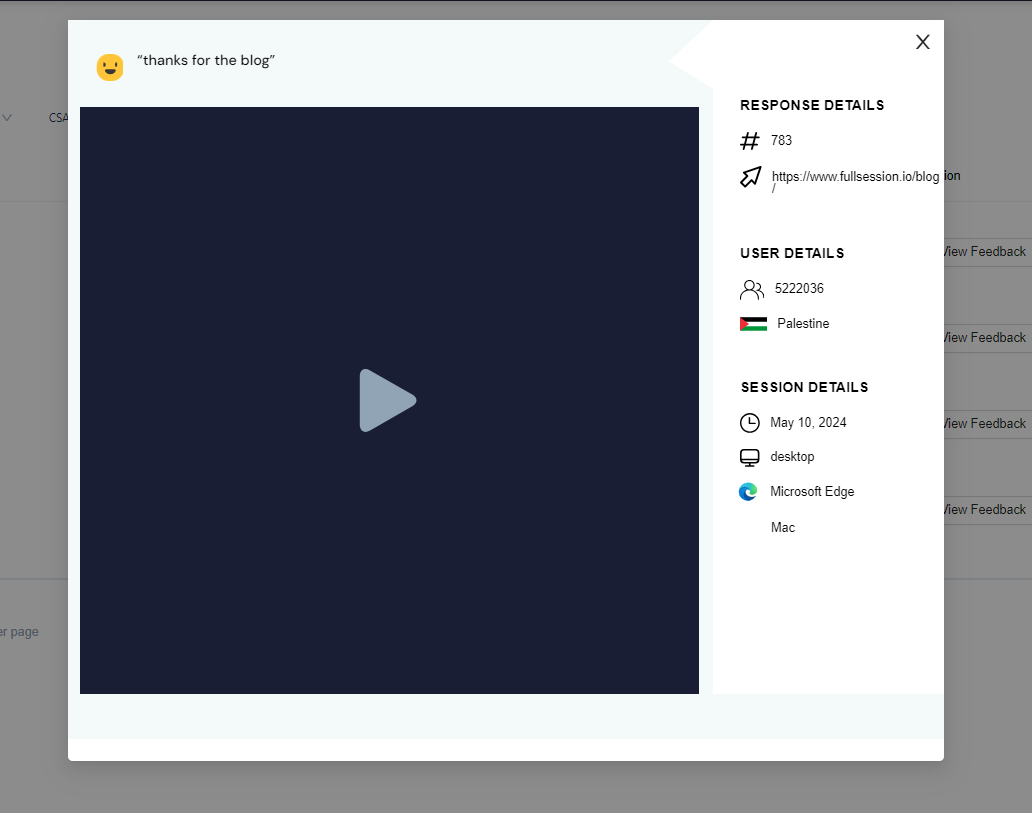
    Pricing

    LeadFeeder provides a free plan that lets you view up to 100 leads that have visited your site in the last seven days. Its premium plan starts at €99 a month. It offers a 14-day free trial and enables you to track an unlimited number of leads for an unlimited period. 

    Leadfeeder pricing

    Pros

    • LeadFeeder helps marketing and sales teams track leads at different stages in the buying journey as they navigate through your site
    • The platform is intuitive and easy to set up 

    Cons

    • It can be challenging to find a qualified lead in an enterprise company that has as many as 10,000 employees 
    • Pricing can be expensive because the pricing model is based on the number of leads that you track
    • You may end up paying for unqualified leads that don’t suit your buyer personas 
    • LeadFeeder doesn’t provide session recordings, heatmaps, and customer feedback forms

    4. Dreamdata

    Dreamdata

    Image source: G2

    Dreamdata is a marketing attribution software that helps users track and analyze marketing channels’ performance and critical user activities that impact revenue. 

    With Dreamdata, you can gain insight into every stage of the customer journey and analyze crucial performance metrics such as paid performance, return on ad spend, revenue attribution per channel, and more. 

    User rating

    According to Capterra, Dreamdata scores 4.8 out of 5 based on 51 customer reviews.

    Who uses it

    The Dreamdata platform is built for B2B companies with a long sales cycle and multiple stakeholders involved in the buying decisions. 

    Deployment

    Dreamdata is a SaaS, cloud, and web-based platform that you can deploy by adding its code snippet to your website. 

    Features list

    Dreamdata provides an extensive list of features. Some of them include:

    • Customer journey mapping
    • Conversion tracking
    • Campaign analytics
    • Dashboard
    • Campaign management
    • Form analysis

    What makes this tool unique

    Dreamdata cleans and gathers revenue data points you can analyze, offering deep insights into the metrics behind your marketing campaigns and customer segments.

    You can use the Dreamdata platform to track every step of the customer journey and aspect of marketing channels to drive ROI.

    Integrations

    The Dreamdata software integrates with numerous marketing, CRM, website tracking, and sales tools, such as HubSpot, SalesForce, Zoho, Marketo, Zapier, and Segment.

    Customer support

    Dreamdata provides support via emails, phone, chat, a knowledge base, and a Slack community.

    Pricing

    The Dreamdata has three pricing tiers—Free, Team, and Business.

    Dreamdata pricing
    1. The Free plan includes two months of user activity history and is suitable for B2B companies that want to start their revenue attribution journey and run experiments on the Dreamdata platform.
    2. The Team plan suits small to medium-sized companies with advanced attribution modeling. It costs $999/month and includes two years of user activity history.
    3. The Business plan is perfect for medium-sized businesses that want to measure their go-to-market performance. It costs $2,499/month and includes three years of user activity history plus a dedicated customer success manager.
    4. The Enterprise plan is more suitable for large enterprises that need unlimited access to tools designed to understand user behavior. You need to contact their sales team for pricing.

    Pros

    • Dreamdata provides a visual report and dashboard that lets you understand key performance metrics better
    • The software is quick and easy to set up

    Cons

    • It can get overwhelming and confusing to implement the software due to the extensive list of features it provides
    • You might find it hard to understand some of the tool’s technical terminologies if you don’t have technical knowledge
    • Dreamdata is significantly more expensive than other tools on this list, starting at $999 a month for the Team plan

    5. AB Tasty

    AB Tasty

    Image source: G2

    AB Tasty is customer experience software that uses artificial intelligence to help organizations run experiments and learn which specific features drive the most engagement and conversions.

    User rating

    According to Capterra, AB Tasty scores 4.6 out of 5 based on 11 customer reviews.

    Who uses it

    The customer experience analytics tool is built for marketing, product, and engineering teams.

    Deployment

    AB Tasty is a SaaS, cloud, web-based platform, and you can deploy it by adding its code snippet to your site.

    Features list

    AB Tasty provides numerous features that include:

    • Customer segmentation and targeting
    • Conversion rate optimization
    • Heatmaps
    • Behavioral targeting
    • Campaign segmentation
    • Real-time results

    What makes this tool unique

    AB Tasty helps users create a better customer experience by testing specific customer segments and gaining insights from user feedback.

    The software also provides a personalization feature that allows you to use artificial intelligence to build customer segments, creating a more personalized customer experience.

    Integrations

    AB Tasty integrates with popular martech tools like SalesForce, Tealium, Heap, Oracle, etc.

    Customer support

    You can contact the AB Tasty customer support team via email, chat, FAQs, phone, and a knowledge base.
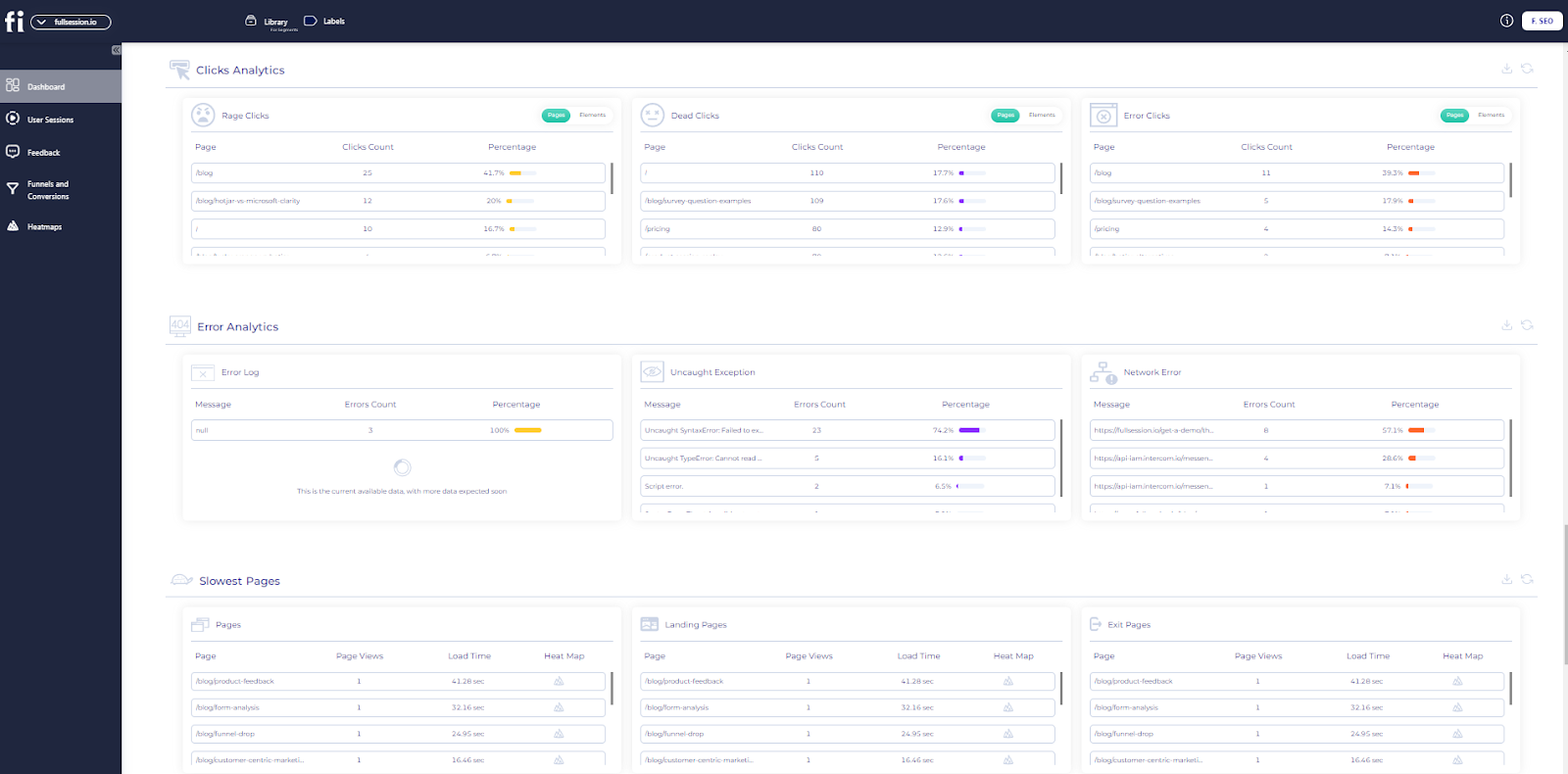
    Pricing

    A/B Tasty doesn’t provide a transparent pricing tier on its website. You’d need to contact the sales team for a free demo and custom quote.

    Pros

    • A/B Tasty provides an intuitive interface where you can drag and drop web elements to run an A/B test
    • The software is easy to set up and deploy

    Cons

    • Some web pages can take time to load after installing the JavaScript snippet
    • There is a learning curve when it comes to implementing the visual editor

    Contentsquare Competitors: A Short Overview 

    So far, we’ve explained the key features of the top five Contentsquare competitors. Here’s a short overview so you can easily visualize the most important features of each software:

    FeaturesFullSessionLiveSessionLeadFeederDreamdataAB Tasty
    Conversion tracking
    Real-time session recordings
    Customer feedback
    Live heatmaps
    Funnels and conversions
    A/B testing
    Dynamic heatmaps
    User segmentation
    Campaign analytics
    Engagement score
    Free trial
    Activity dashboard
    Error tracking
    Pricing$39/month$65/month€99/month$999/monthn/a

    Contentsquare Competitors: The Verdict

    In this comparison article, FullSession stands out as the best Contentsquare competitor. Our customer experience software provides a central analytics hub where cross-functional teams can collaborate to optimize the customer journey and improve products seamlessly.

    With FullSession, you can go beyond traditional analytics tools by tracking dynamic elements in real time, offering precise user insights that are crucial for understanding and improving website performance. 

    Our platform accelerates heatmap processing without impacting site speed, providing immediate data. We also prioritize user privacy by excluding sensitive data from session recordings, allowing you to analyze behavior while protecting your customers.

    FullSession is designed to manage extensive datasets efficiently, quickly revealing key insights that help you identify factors impacting conversions and make informed changes. Additionally, FullSession limits user behavior tracking to your site, preventing data misuse and ensuring compliance with privacy standards.

    Skip the guesswork and gain actionable insights with features like session recordings, interactive heatmaps, error analysis, conversion funnel analysis, and customer feedback tools.

    Book a demo today to learn more!

    FullSession Pricing Plans

    The FullSession platform offers a 14-day free trial. It provides three paid plans—Starter, Business, and Enterprise. A yearly subscription can save you up to 20%.
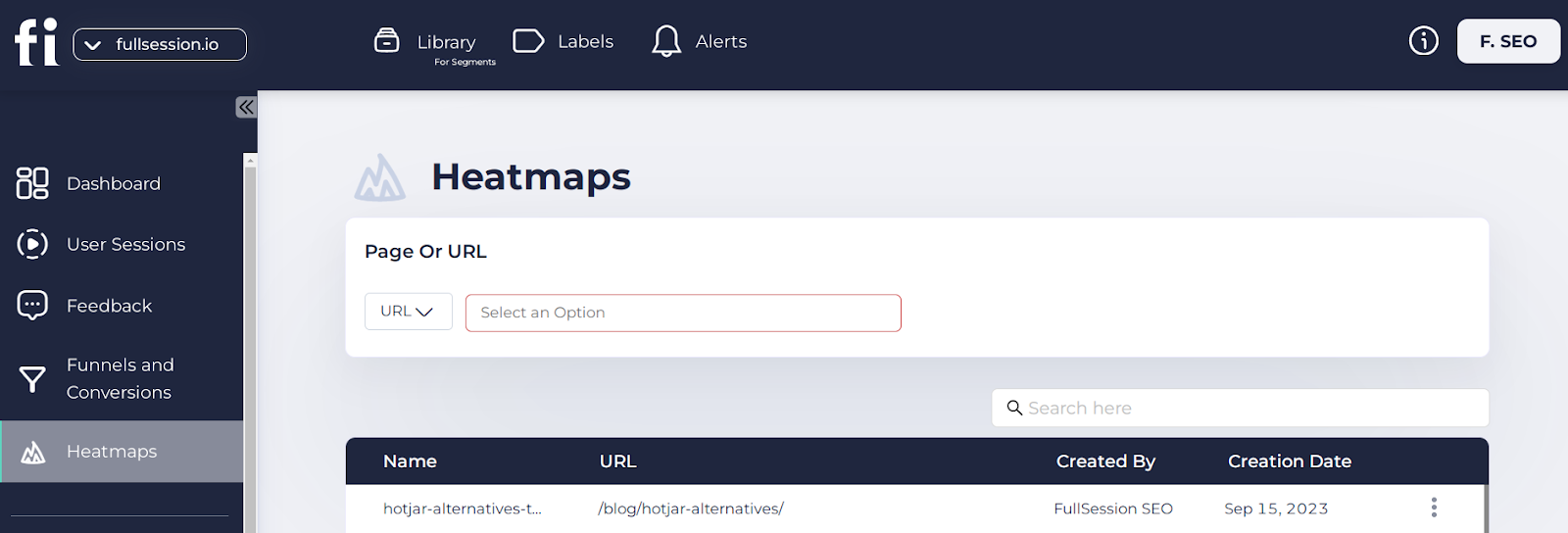
    Here are more details on each plan.

    1. The Starter plan costs $39/month or $32/year and allows you to monitor up to 5,000 monthly sessions.
    2. The Business plan costs $75/month or $60/year and helps you to track and analyze up to 100,000 monthly sessions.
    3. The Enterprise plan has custom pricing and offers customizable sessions plus full access to all features.

    Book a demo today.

    As we conclude this comparison article, we hope it has provided the answers you need to choose the right web analytics solution for your business. If you want to learn about other user behavior tools, you’re free to check out some of our comparison articles:

    FAQs About Contentsquare Competitors

    What is Contentsquare?

    Contentsquare is a digital experience analytics platform that helps organizations understand the how and why behind customer behavior via session replay, struggle analysis, and zone-based heatmaps tools.

    Contentsquare helps product managers, UX teams, and marketers gain complete visibility into hidden customer actions, better understand the customer journey, and optimize the sales funnel.

    How does Contentsquare work?

    Contentsquare gathers user interaction data with a code snippet. This snippet logs user interactions, such as page views, mouse movements, app installs, button clicks, scrolls, and more.
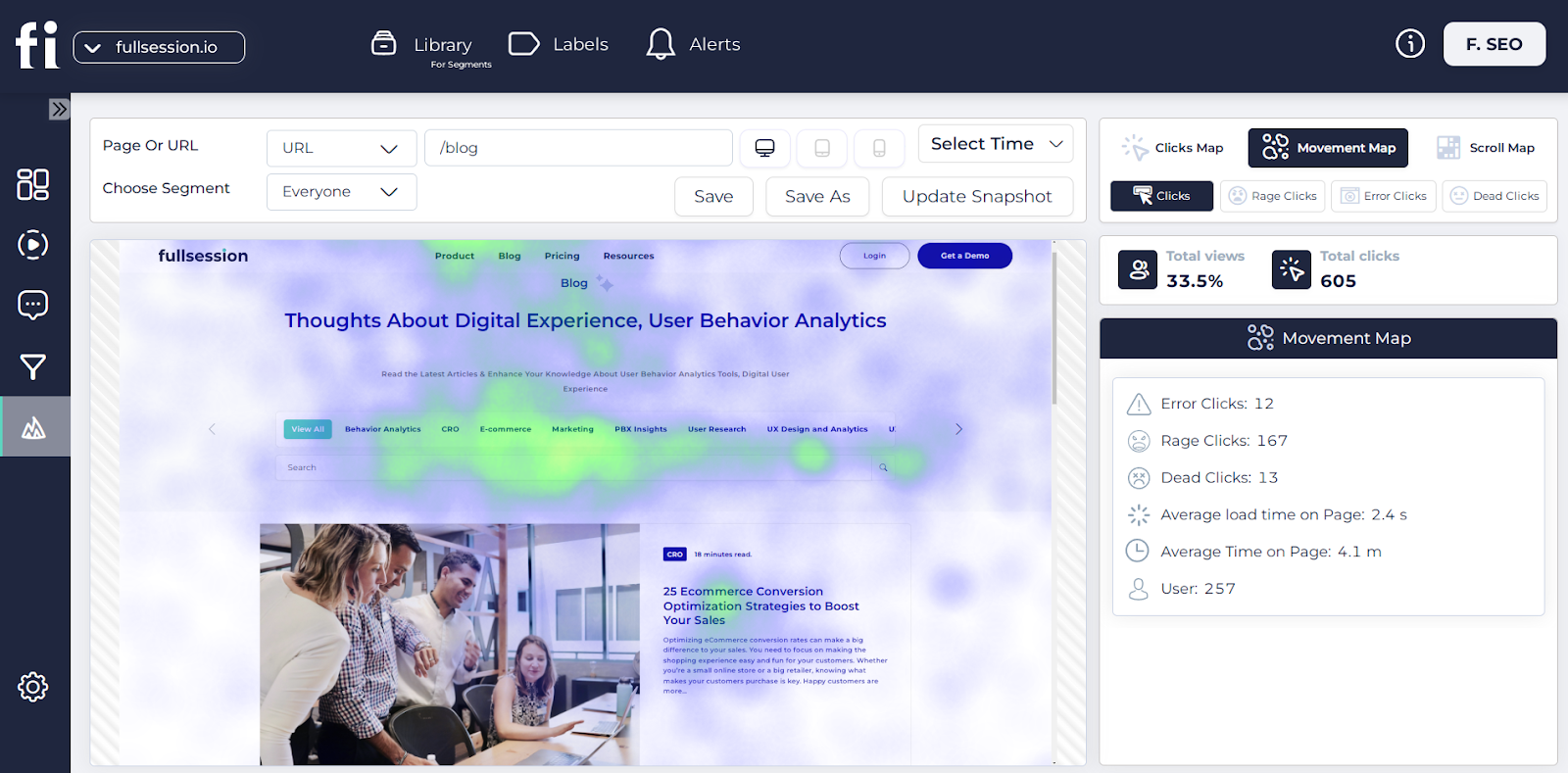
    The web analytics software identifies events in customer journeys to help you make improvements, detects recurring friction points that affect conversions, and shows you the most visited web pages and where funnel drop-offs occur.

    If you have a mobile app, you can use the platform’s detailed analysis feature to gain insight into how customers navigate your app. You can understand why they uninstall the app or become customers and use the insights to customize the customer journey.

    What are Contentsquare pros?

    Contentsquare has some advantages that include the following:

    • It provides a wide range of features that spans almost every aspect of user behavior
    • Contentsquare provides real-time customer behavioral data that helps you understand page engagement and customer friction points
    • The analytics platform presents valuable data in the form of scores and reports that are easy to understand
    • Contentsquare has AI and machine learning capabilities that can automate web and mobile app analytics

    What are Contentsquare cons?

    Some of the disadvantages of Contentsquare include the following:

    • Using the web analytics platform requires more training and a longer time to understand due to its extensive features
    • Contentsquare provides some pricing plans that limit how long you access behavioral data on your digital platforms
    • The product can be challenging to use if you don’t have any technical knowledge

    Contentsquare Pricing

    Contentsquare doesn’t provide a transparent pricing package on its website. You must contact the sales team to schedule a demo and evaluate your web analytics needs.
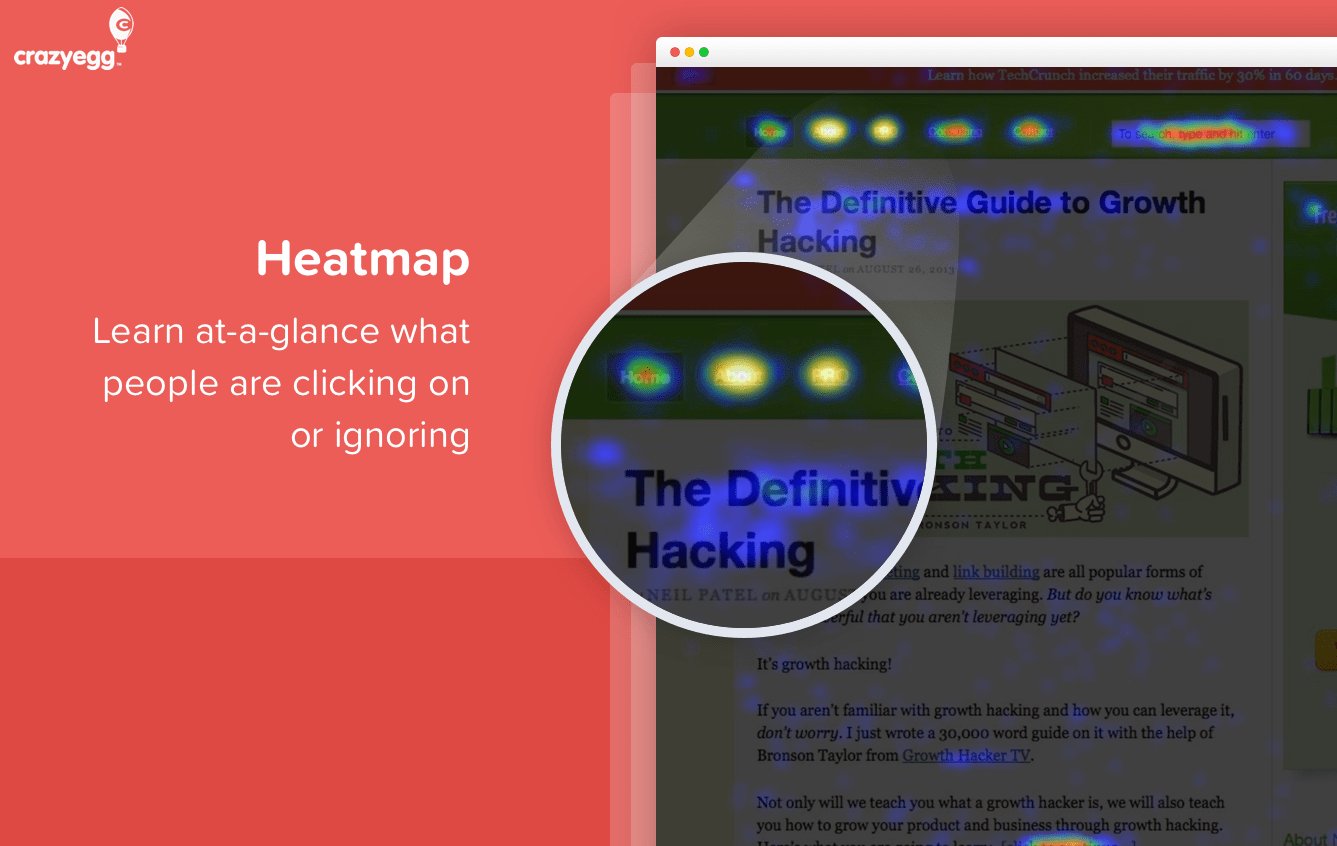
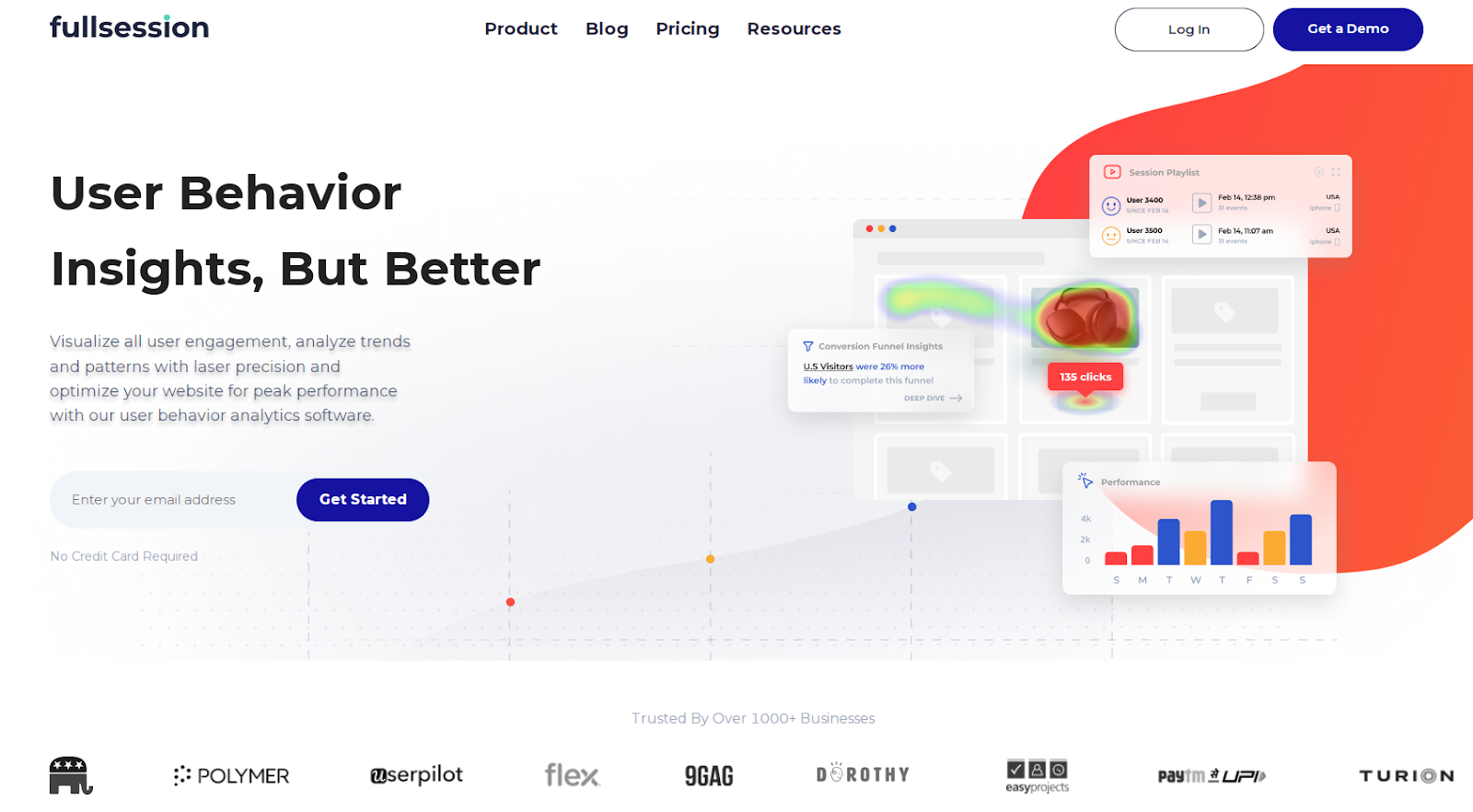
    Who are the competitors of Contentsquare?

    Main competitors include companies like FullSession, FullStory, Quantum Metric, Lucky Orange alternatives, Hotjar alternatives, LogRocket and Dreamdata. These companies also offer digital experience analytics, session replay, heatmaps, usability testing, retention analysis, and other tools to help businesses understand user behavior and optimize their websites and apps.

    What kind of company is Contentsquare?

    Contentsquare is a digital experience analytics company that helps businesses understand how users interact with their websites and mobile apps. The company provides insights into user behavior through features like heatmaps, session replays, and conversion analytics, enabling businesses to optimize their digital experiences and improve user engagement.

    Who is the owner of Contentsquare?

    Contentsquare was founded by Jonathan Cherki, who currently serves as the company’s CEO. While the company has received substantial investment from various venture capital firms, it remains under the leadership of Cherki and the management team.

    What can you do with Contentsquare?

    Contentsquare allows analyzing user behavior on your website or mobile app, gaining insights through heatmaps and user sessions, for analytics, and identifying areas for optimization. The platform helps you understand what drives user engagement, discover friction points, and improve conversion rates, ultimately enhancing the overall digital experience for your users.