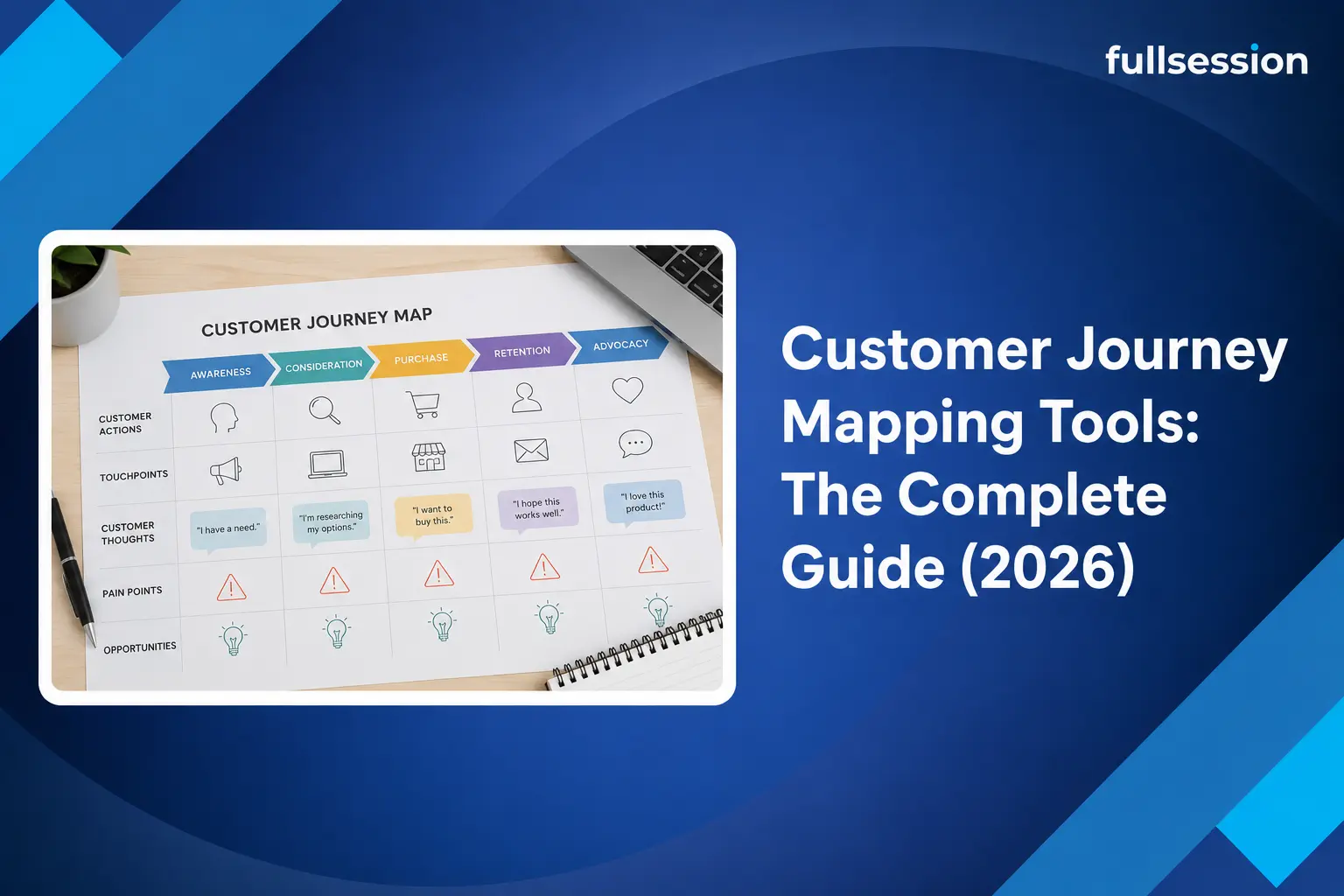
Most customer journey maps get built once, presented in a meeting, and then quietly go stale. Customer journey mapping tools exist to stop that cycle by giving teams a shared, updatable view of how people actually move through a product or service.
Some teams call the output customer journey maps; others call them user journey maps. Either way, the goal is the same: a visual representation of the customer’s perspective that everyone can work from.
This guide covers what these tools do, the types available, and how to pick one. It also walks through how to build a map step by step and how behavioral data turns a static diagram into something your team can act on.
If you’re comparing this category to customer journey analytics software, the two overlap but aren’t identical.
Mapping tools help you plan and visualize the journey. Analytics tools show you what’s actually happening inside it. This guide focuses on the former, with a clear look at how the two work together.
Key Takeaway
- Customer journey mapping tools fall into three types: design and visualization tools, behavioral analytics tools, and all-in-one platforms that combine both.
- The strongest customer journey maps are built on seven steps: define personas, identify touchpoints, gather data, map stages, identify pain points, validate with real behavior, and share for ongoing iteration.
- Design tools are best for planning and stakeholder alignment, while behavioral analytics tools are best for confirming what customers actually do.
- Core features to prioritize include touchpoint mapping, persona support, collaboration, data integrations, and session-level evidence.
- Behavioral data, like heatmaps, session replay, and funnel tracking, turns assumptions about customer friction into confirmed, fixable findings.
- The strongest tool stacks pair a visualization tool with a behavioral analytics tool instead of relying on just one.
- A journey map only stays useful if your team keeps validating it against real data instead of treating it as a one-time deliverable.
FullSession closes the gap between planning a journey and proving it. You get heatmaps, session replay, funnel tracking, and integrated feedback in one place, so every stage of your map is backed by real behavior instead of guesswork.
What Are Customer Journey Mapping Tools?
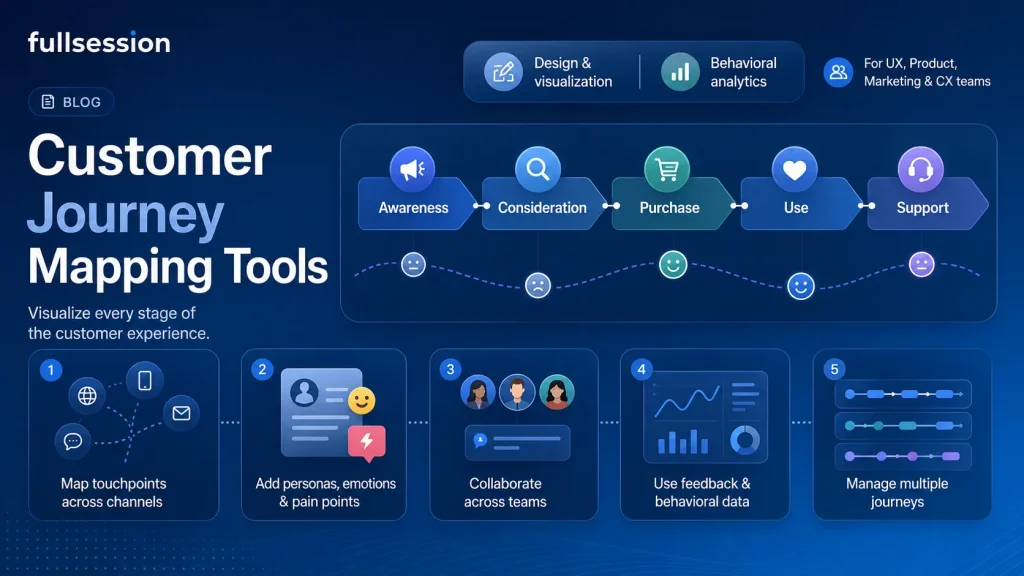
Customer journey mapping tools are software platforms that let teams visualize, document, and update the stages a customer moves through when interacting with a business. They turn scattered touchpoints, channels, and handoffs into one shared reference point, sometimes called customer experience journey mapping when it’s tied directly to CX strategy.
These tools are built for UX researchers, product teams, marketing teams, and customer experience leads who need everyone looking at the same picture.
Most fall into two camps: design and visualization platforms that focus on layout and collaboration, and behavioral analytics platforms that ground the map in real user data.
This category sits alongside the broader set of digital tools teams use to understand how customers interact with a brand across web, mobile, and support channels.
A good customer journey mapping tool typically lets you:
- Map customer touchpoints, stages, and customer actions across channels
- Attach personas, emotions, and pain points to each stage
- Collaborate with cross-functional teams in real time
- Pull in customer feedback, survey results, or behavioral data as evidence
- Support teams managing multiple customer journeys across different products or segments
Why Customer Journey Mapping Matters for Customer Experience
Customer journey mapping replaces guesswork with a shared, evidence-backed view of the customer experience. Teams that make a habit of mapping customer journeys make faster decisions because they’re arguing from the same data instead of competing assumptions.
According to Salesforce, 88% of customers now consider their experience with a company to be as important as its products. That’s not a minor shift. It means a confusing signup flow or an unclear pricing page can cost you the sale just as easily as a weak product can.
The stakes are rising too. Salesforce reports that 71% of consumers switched brands at least once over the past year, and 73% expect brands to understand their needs and preferences without being told twice.
According to Zendesk’s CX Trends 2026 report, 83% of consumers believe the customer journey needs real improvement.
Mapping the journey helps in a few concrete ways:
- It helps identify pain points before they show up in churn numbers, and makes it easier to spot patterns in customer issues across different segments
- It gives cross-functional teams a single reference for prioritizing fixes and generates insights that would otherwise stay buried in separate tools. That makes it easier to identify opportunities for improvement before a competitor does
- It turns customer feedback and customer research into something visual and practical
- It gives leadership a holistic view of internal processes that shape the front-end experience, not just the customer-facing surface
- It supports customer experience analysis instead of a one-off audit, and helps teams create personalized experiences that build long-term loyalty
How to Create a Customer Journey Map Step by Step
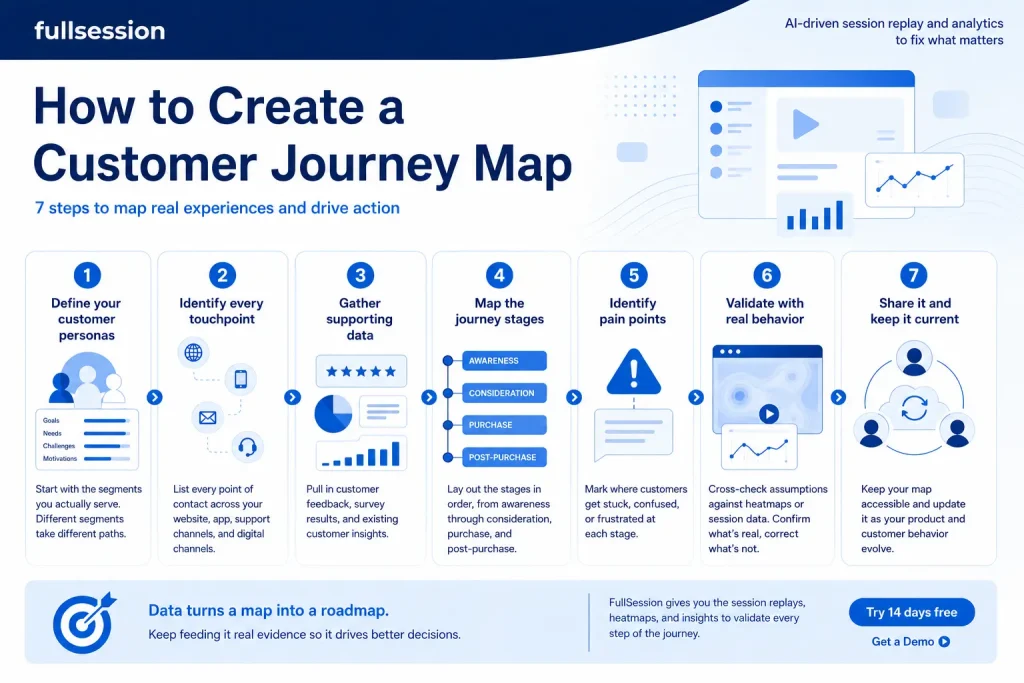
Creating a customer journey map takes seven steps. Each step builds on the one before it.
- Define your customer personas. Start with the segments you actually serve, not a generic buyer persona. Different customer segments often take different paths to the same outcome.
- Identify every touchpoint. List every point of contact, including your website, app, support channels, and any digital channels customers use to reach you.
- Gather supporting data. Pull in customer feedback, survey results, and existing customer insights so the map reflects reality instead of internal opinion.
- Map the journey stages. Lay out the stages in order, from initial awareness through consideration, purchase, and post-purchase support.
- Identify pain points. Mark where customers get stuck, confused, or frustrated at each stage. This is where the map earns its keep.
- Validate with real behavior. Cross-check your assumptions against actual heatmaps or session data wherever you can. Assumptions that hold up become confirmed insights. The ones that don’t get corrected before they waste a sprint.
- Share it and keep it current. A journey map that lives in a slide deck goes stale fast. Put it somewhere your team can reference and update as the product or customer behavior changes.
None of these steps require guesswork if you have the right data behind them. The map only stays useful as long as your team keeps feeding it real evidence instead of letting it calcify into a one-time deliverable.
Types of Customer Journey Mapping Tools and Software
Customer journey mapping tools are split into three broad types: design and visualization tools, behavioral analytics tools, and all-in-one platforms that combine both. The right pick depends on whether you need to plan the ideal journey, measure the real one, or do both without juggling two subscriptions.
Design and visualization tools
Design and visualization tools, like Miro and Figma, are built for sketching the intended user journey. Teams use sticky notes, drag-and-drop cards, and templates to align on stages, touchpoints, and customer personas before a product even exists.
This category leans heavily on design thinking and borrows techniques from service design, including stakeholder maps and service blueprints that document internal processes alongside the customer-facing journey.
These tools are strong on collaborative features but don’t tell you what customers are actually doing on your site.
Behavioral analytics tools
Behavioral analytics tools, like FullSession, flip that approach. Instead of planning the ideal path, they capture user behavior directly, things like clicks, scrolls, and drop-off points. That data turns into journey insights grounded in real user flows and customer pain points rather than internal opinion.
This is where session replay and funnel data have the most impact, with contextual factors such as device type, referral source, or time of day.
You can sign up for the free plan to see how it works.
All-in-one platforms
All-in-one platforms try to close that gap by pairing visual mapping with real behavioral data in a single workspace, so a map isn’t just a guess dressed up nicely.
Many of these platforms offer features such as heatmaps, product analytics, and session-level insights alongside the visual canvas itself. That turns raw behavioral logs into data visualization your whole team can read at a glance.
| Tool Type | What It Does Best | Example Use Case |
| Design and visualization | Plan the ideal journey and align teams on stages, personas, and touchpoints | Workshops, early-stage journey design, stakeholder alignment |
| Behavioral analytics | Capture what customers actually do, including drop-offs and friction points | Diagnosing where a checkout flow breaks down |
| All-in-one platforms | Combine planning and real user data in one place | Ongoing journey management that stays current as behavior changes |
Core Features to Look for in Customer Journey Mapping Software
The features that matter most in customer journey mapping software are touchpoint mapping, persona support, collaboration, and direct integration with real user behavior. Skipping any one of these turns the map into a static slide instead of a working tool.
Not every platform will collect data the same way, so it helps to know exactly which features the tools offer before you sign a contract.
Here’s what to check for before you commit to a platform:
- Touchpoint and journey stage mapping. The tool should let you lay out every stage of the journey, from initial awareness through post-purchase support, without forcing a rigid template.
- Persona and segment support. Look for the ability to create personas and apply different customer segments to the same journey, since a single map rarely fits every customer.
- Collaborative features. Cross-functional teams need to comment, edit, and vote on priorities inside the same workspace, not in a separate slide deck or scattered project management tool.
- Data integrations. The tool should connect to the other tools in your stack instead of requiring manual data entry every time something changes.
- Session-level evidence. Some platforms let you validate a mapped stage with actual session replay footage, which turns an assumption into a confirmed pain point.
- Funnel and drop-off visibility. Funnel tracking shows exactly where customers abandon a flow, which tells you which journey stage needs attention first.
- Export and sharing options. You’ll want to get the finished map in front of stakeholders who don’t use the tool day-to-day.
Ready to See How Real Behavioral Data Looks?
Connect your site with FullSession in a few minutes and start mapping journeys with real data. No credit card required.
How to Choose the Right Customer Journey Mapping Tool
Choosing the right customer journey mapping tool comes down to matching the tool to your data sources, team size, and budget, not picking whatever ranks highest on a review site.
Answer these questions before you sit through a single demo.
| Question to Ask | Why It Matters |
| What data will inform the map? | If you’re relying on customer research and interviews, a design tool may be enough. If you want the map grounded in real behavior, you need analytics capability. |
| How many people need to collaborate, and how often? | A five-person team can get by with a lighter tool. A cross-functional group spanning product, marketing, and support needs stronger collaborative features. |
| Does the tool integrate with your existing tech stack? | Check for data integrations with your CRM, analytics platform, or feedback tools before you commit. |
| What’s the pricing model? | Some tools charge per seat, others per map or per journey, and pricing can escalate fast at scale. |
| Does it meet your security and compliance requirements? | This matters more once you start piping in real customer data. |
Your answers will usually point you toward one of the three tool types covered above, and that narrows the field considerably.
How to Use FullSession as Customer Journey Mapping Software
Use FullSession to map customer journeys by combining visual user path tracking, behavior analytics, and direct feedback to replace guesswork with real data.
By analyzing how users navigate your website, you can identify areas of friction and optimize the overall digital experience.
Here’s how to put FullSession, an all-in-one user behavior analytics platform, to work as your customer journey mapping software.
1. Reconstruct the user path
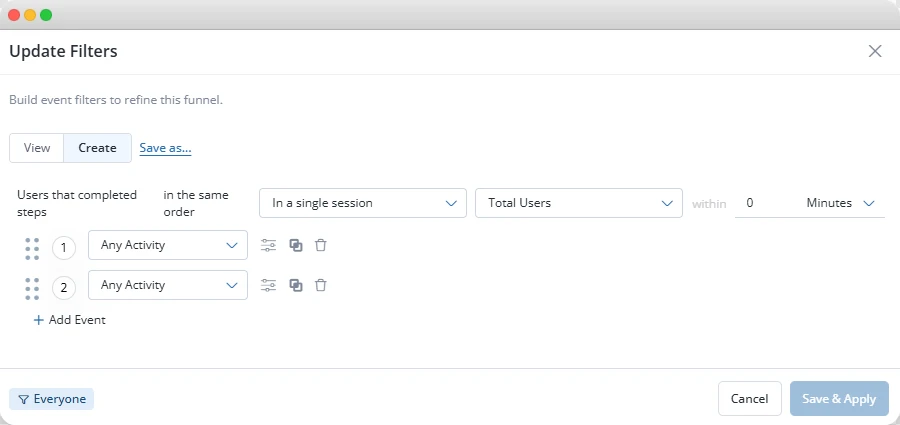
Map the actual sequence of pages customers visit as they move through your website, for example Landing Page to Pricing to Checkout.
Use funnel tracking to see which user paths lead to conversions and where users abandon the funnel.
2. Track behavior with heatmaps
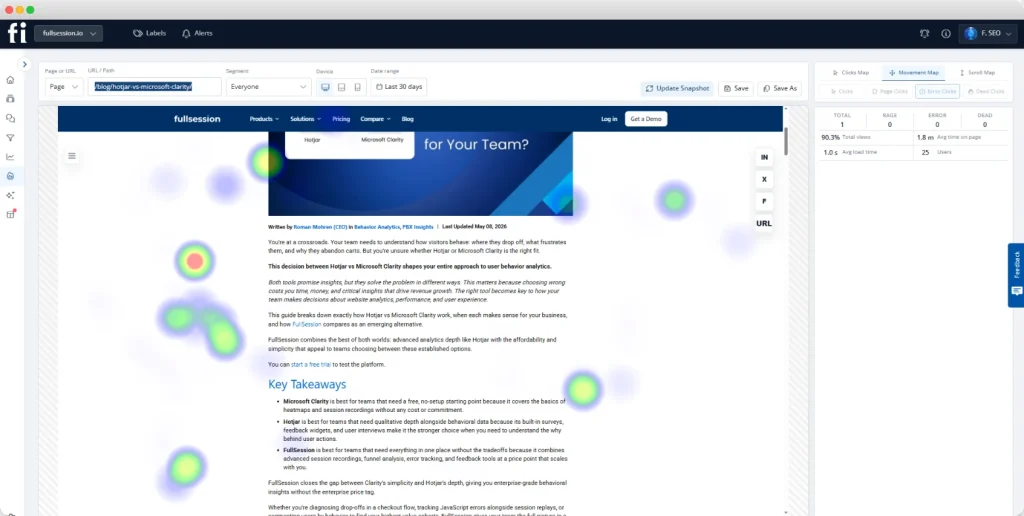
Analyze aggregate user behavior across different touchpoints to see if customers are engaging with your content or getting distracted.
Heatmaps break this down into scroll maps, which confirm key information is actually visible on the page, and click maps and movement maps, which show where users are clicking and hovering.
If users are clicking on non-interactive elements, you’ve found a design friction point worth fixing.
3. Identify friction using session replays
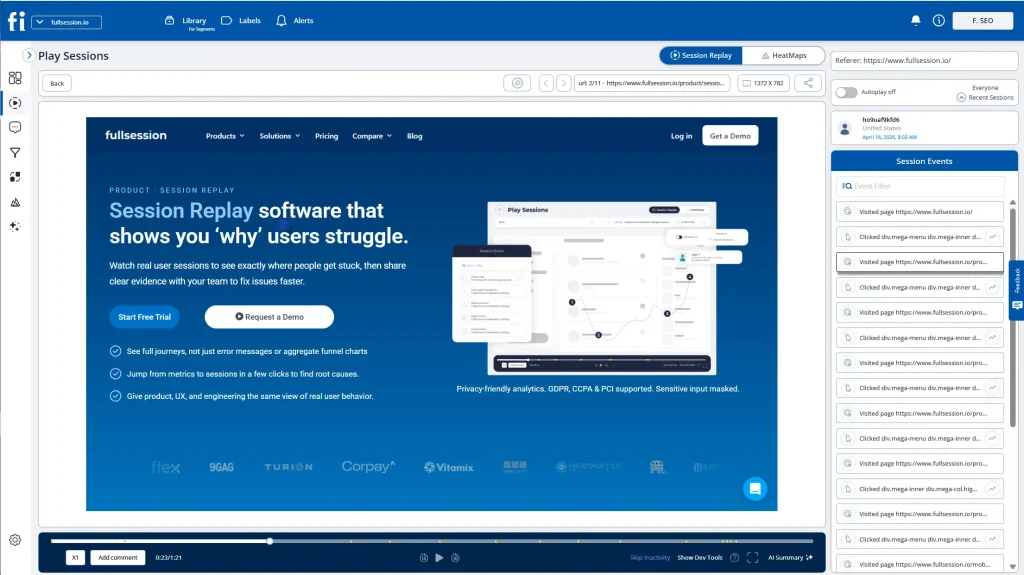
Supplement your journey map with qualitative data by watching individual session replays. Pay attention to the “U-turns” metric to see where users abruptly change course or get confused mid-journey.
Use error tracking to see exactly what technical bugs disrupt the user journey, such as failed form submissions that quietly kill conversions.
4. Gather context with integrated surveys
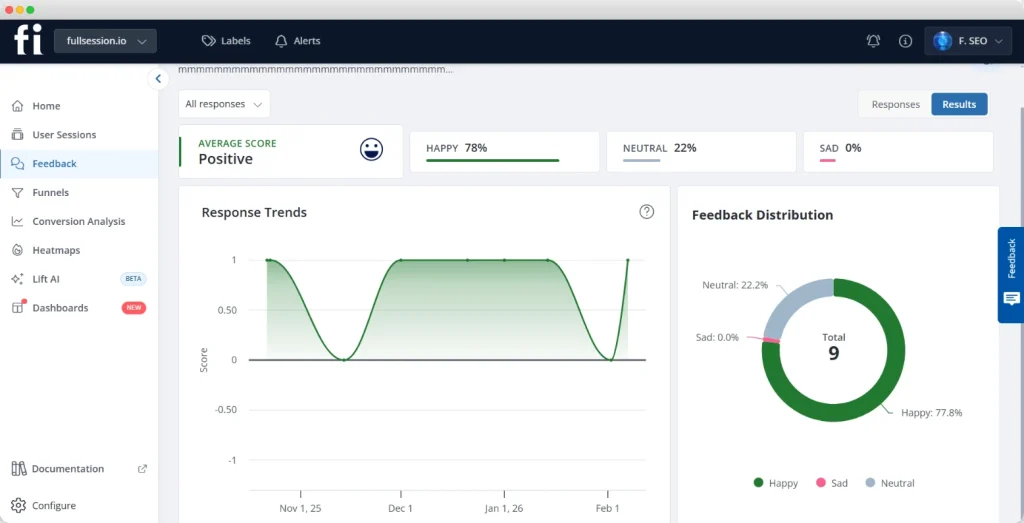
Build a complete picture of customer needs and motivations by capturing in-the-moment feedback. Set up feedback surveys at key touchpoints, like the checkout page, to ask users direct questions about their experience or roadblocks.
5. Synthesize and optimize
Combine your path tracking, behavior analytics, and user feedback into a single visual map. Highlight areas of the journey with high drop-off rates and use these valuable insights to inform your redesigns, A/B tests, and content updates.
Mobile session replay extends this same visibility to app users, not just desktop visitors. Lift AI scans behavioral data automatically to show the friction points most likely hurting conversion, so your team isn’t reviewing every session by hand.
The MCP Server connects this journey data into AI-assisted workflows, letting teams query behavioral insights the way they’d query any other connected data source.
See How It Works
Get a live walkthrough of how FullSession tracks real behavioral data.
How to Use Behavioral Data to Improve Customer Journeys
A few practical tips for putting behavioral data to work:
- Start with your highest-traffic stage first. It affects the most customers, so it delivers the fastest return on the time you spend investigating it.
- Watch session replays in batches of five to 10 instead of one at a time. Patterns across multiple customers are more reliable than a single anecdote.
- Cross-reference heatmap data with funnel data before making a change. A confusing element and a drop-off point that line up on the same page confirm each other.
- Save time by tagging recurring friction points, like a specific error message or a slow-loading step, so future data collection is easier to filter.
- Revisit the map every quarter. Complex journeys shift as products change, and a map built on old behavioral data quickly loses accuracy.
- Break high-traffic stages into smaller micro journeys when a single stage covers too much ground to analyze cleanly, like a multi-step checkout treated as one block.
This is the same behavioral thinking covered in more depth in our customer journey analytics guide, which focuses on tracking the journey rather than mapping it.
How to Build a Customer Journey Mapping Tool Stack
The strongest approach to customer journey mapping usually pairs a visualization tool with a behavioral analytics tool instead of relying on just one.
Design tools are great for planning and alignment. Analytics tools confirm whether that plan matches reality.
Follow these steps to build a stack that covers both sides:
- Start with your primary data source. Decide whether your team leans more on customer research and workshops or on live behavioral data, and pick the stronger tool for that need first.
- Add a complementary tool for the gap. If you started with a design tool, layer in a behavioral analytics platform for validation, and vice versa.
- Check for data integrations between the two. A stack that shares data automatically saves time compared to manually exporting and re-importing findings.
- Assign ownership across product teams. Journey work tends to stall when no one owns keeping the map current, so name a clear owner for updates.
- Set a recurring review cadence. Revisit the stack every few months to confirm it still fits your team size, budget, and the complexity of your customer journeys.
Whichever combination you choose, the goal stays the same: keep the map connected to real customer data so it doesn’t drift away from what’s actually happening on your site.
Conclusion About Customer Journey Mapping Tools
Picking a customer journey mapping tool isn’t really about finding the “best” one. It’s about matching a tool, or a small stack of tools, to how your team plans, collaborates, and validates the customer experience.
Start with your data sources and team structure, then layer in behavioral evidence so the map stays accurate as your product and customers change.
Ground Your Journey Map in Real Behavior
Use FullSession to see exactly how customers move through your site, from day one.
FAQs About Customer Journey Mapping Tools
What is a customer journey mapping tool?
A customer journey mapping tool is software that lets teams visualize and document the stages a customer moves through when interacting with a business. It typically supports touchpoint mapping, persona creation, and team collaboration in a single shared workspace.
What are customer journey mapping tools?
Customer journey mapping tools are a category of software that includes design and visualization platforms, behavioral analytics platforms, and all-in-one tools that combine both. They help teams plan, document, and validate the customer experience across every channel a business uses.
How do you create a customer journey mapping?
Creating a customer journey mapping practice means treating the map as a living document rather than a one-time project. Update it as customer behavior changes, validate it regularly against real data, and keep it accessible to every team that touches the customer experience.
What is the most popular journey mapping tool?
There’s no single tool that dominates every use case. Design-focused teams often gravitate toward Miro or Figma for visualization. Teams that want the map grounded in real user behavior tend to choose an all-in-one platform like FullSession, which combines mapping with session replay and funnel data.
What are the 7 steps to map the customer journey?
The seven steps are: define your customer personas, identify every touchpoint, gather supporting data, and map the journey stages. From there, identify pain points, validate with real behavior, and share the map for ongoing iteration.
How do I create a customer journey map?
Start by defining your customer personas and listing every touchpoint they use to interact with your business. Then map the journey stages in order and mark pain points at each stage. Validate your assumptions against real behavioral data, like session replay or heatmaps, before sharing the finished map with stakeholders.

Roman Mohren is CEO of FullSession, a privacy-first UX analytics platform offering session replay, interactive heatmaps, conversion funnels, error insights, and in-app feedback. He directly leads Product, Sales, and Customer Success, owning the full customer journey from first touch to long-term outcomes. With 25+ years in B2B SaaS, spanning venture- and PE-backed startups, public software companies, and his own ventures, Roman has built and scaled revenue teams, designed go-to-market systems, and led organizations through every growth stage from first dollar to eight-figure ARR. He writes from hands-on operator experience about UX diagnosis, conversion optimization, user onboarding, and turning behavioral data into measurable business impact.