Category: Behavior Analytics

  • Click Maps 101: How to Make the Most of Your User Data

    Click Maps 101: How to Make the Most of Your User Data

    The first step in optimizing your web presence is understanding website visitors’ click patterns.

    You can view click maps to learn how many people clicked on each section of your website and if they found what they were looking for. Click map data will help you understand your audience and allow your company to make further improvements.

    There are different types of customer behavior tools. A click map is one of the most effective forms of data visualization, as it breaks down user actions into easily digestible chunks. It helps you uncover details about user behavior that you might otherwise miss.

    But what click map software should you use? With dozens of options available, it can be difficult to find one that’s worth every penny.

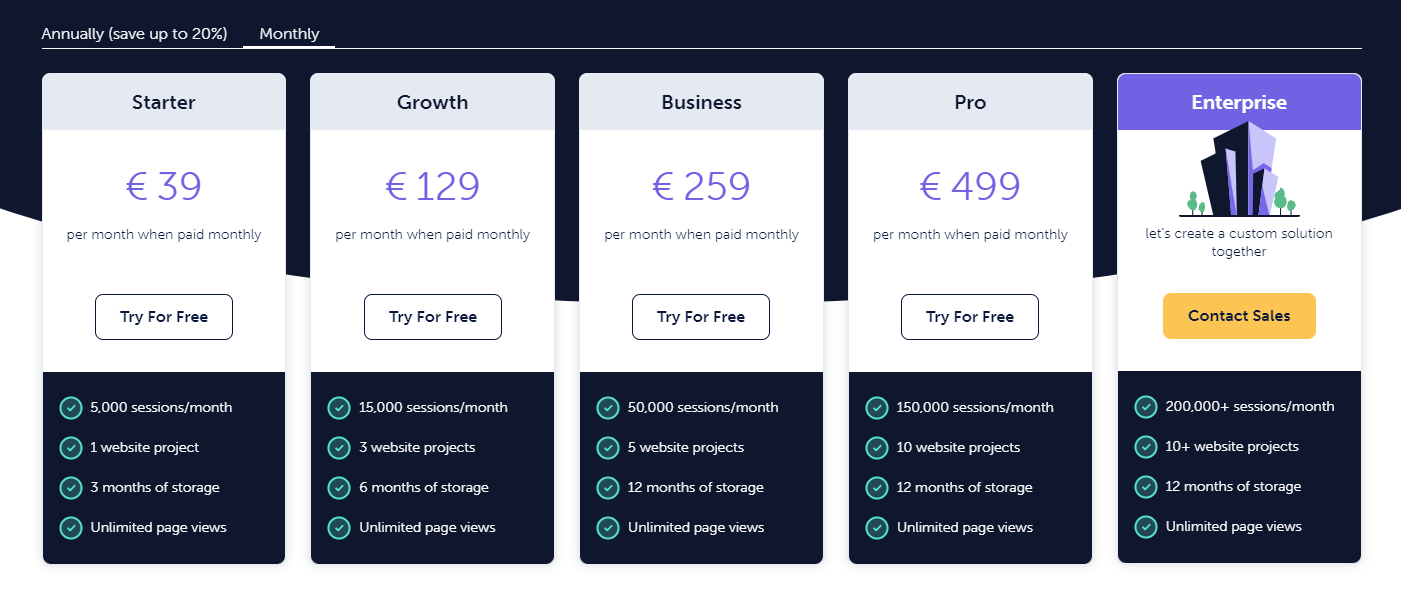
    You’re in luck. With FullSession, you can visualize user behavior and track dynamic elements on your website via click maps, scroll maps, and mouse movements at an affordable price, starting at $39 per month. An annual subscription includes a 20% discount on all plans

    Want to see how these features work?

    In this article, we’ll show you how to use FullSession to create click maps and analyze user behavior data to optimize your website and boost traffic, leads, and conversions.

    Before that, let’s explain what click maps are, how they work and which benefits they offer. 

    What Are Click Maps?

    It’s not enough to have beautiful websites or landing pages. You must create a meaningful and memorable experience for the customer that includes quick loading times, error-free page elements, and flawless navigation.

    You need to listen to your users and focus on their satisfaction. Click maps are a great way to do this—they’re easy to create, and they’re invaluable for uncovering opportunities to improve your customers’ experience.

    Click maps show user behavior trends and patterns and provide visual insights into how your website works in real time, which page elements perform the best, and where you need to improve your UI or UX.

    You can use this quantitative data to improve your site content or layout, marketing, sales, or development efforts, increasing your conversion rate. You can also aggregate click behavior data with other heat maps for further conversion rate optimization.

    How Do Click Maps Work?

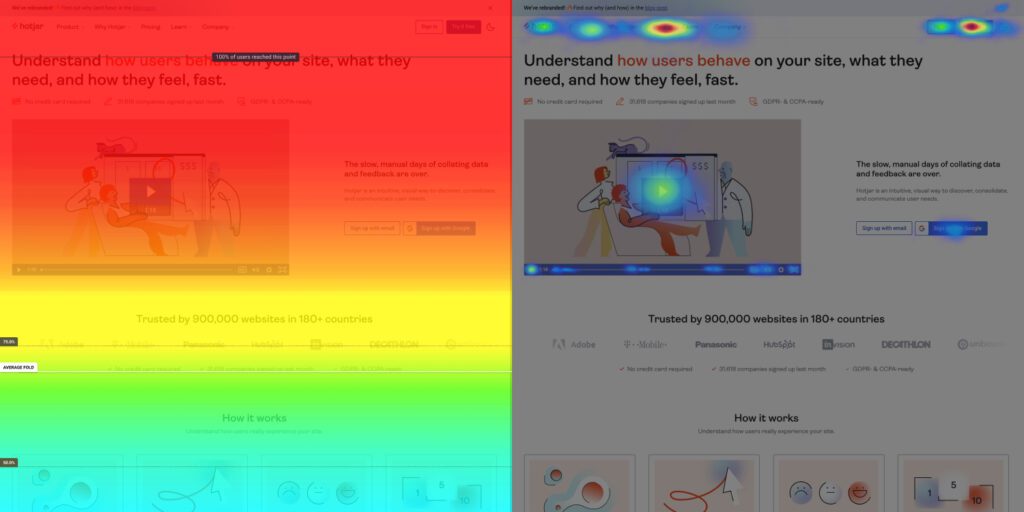
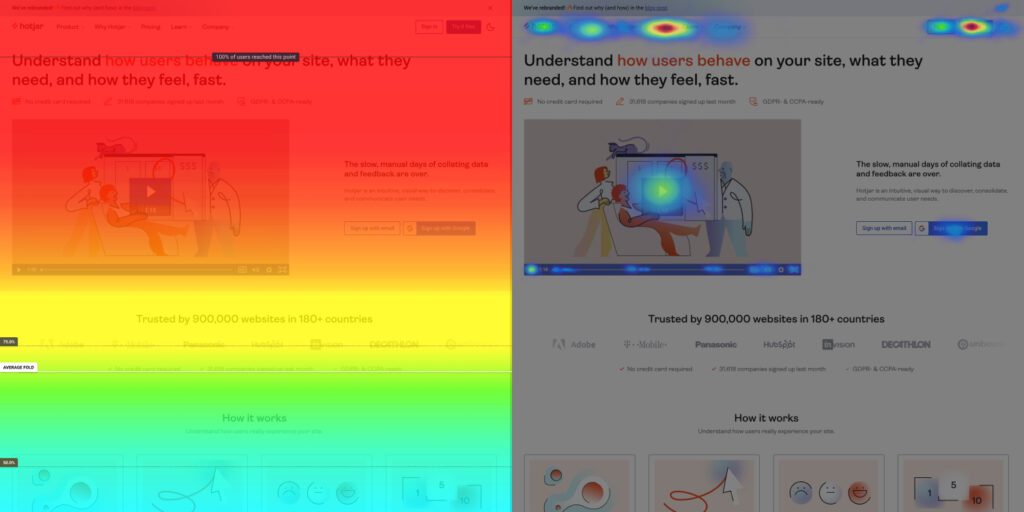
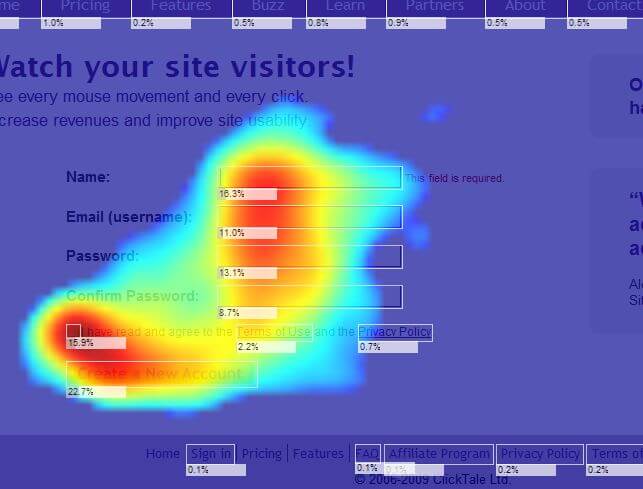
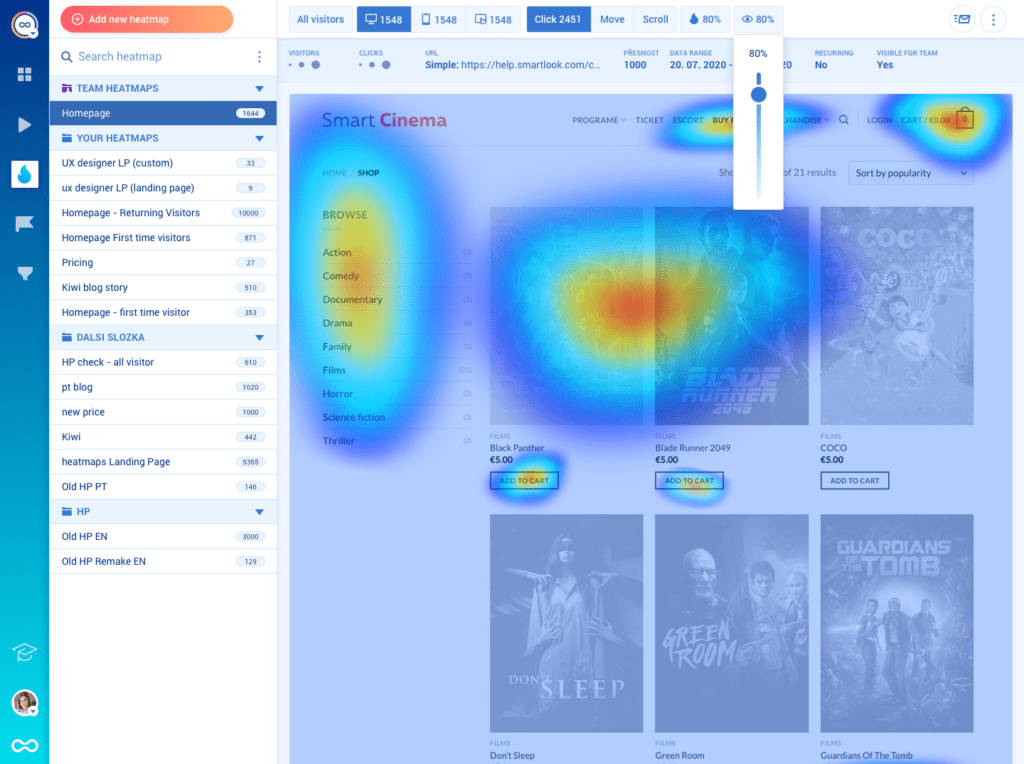
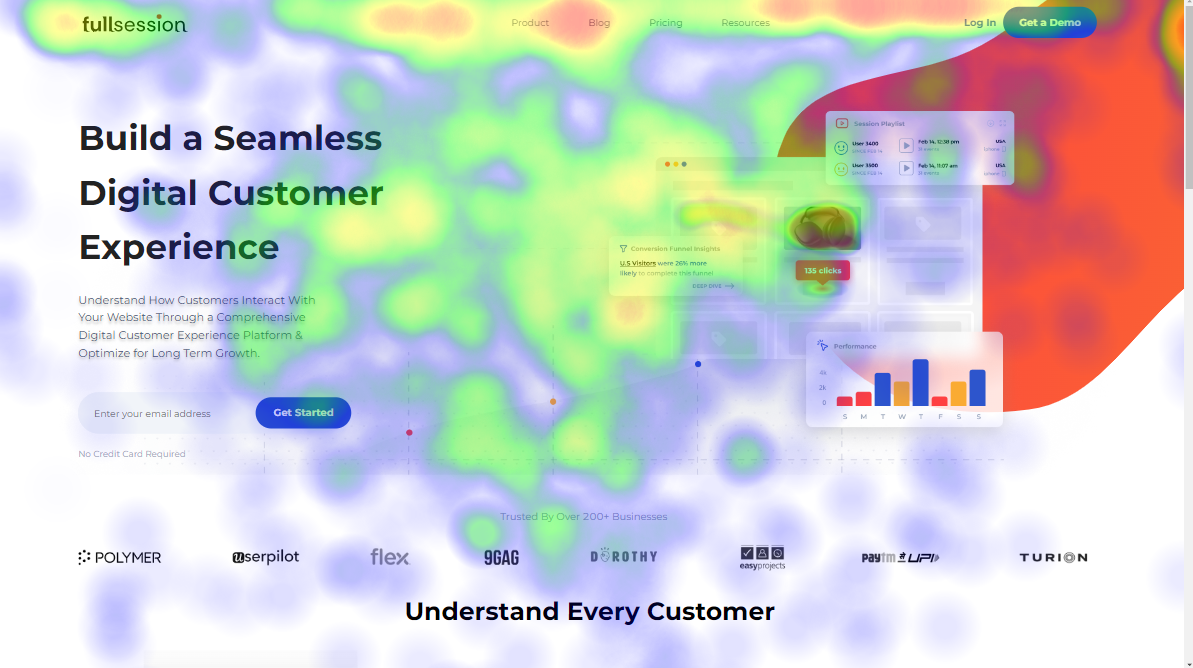
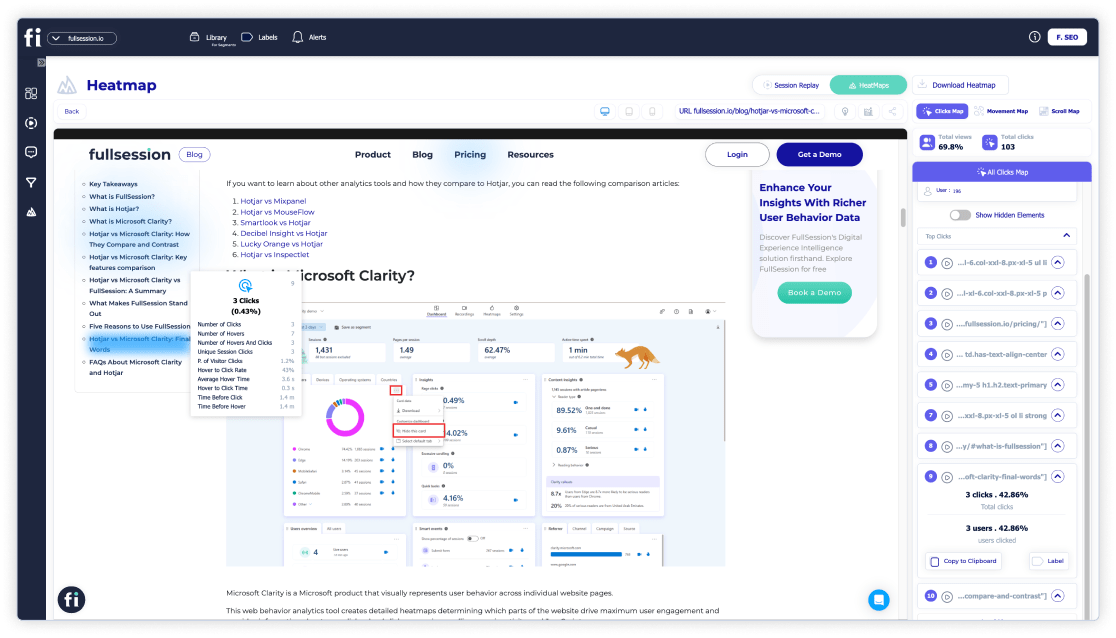
    The basic principle behind click heatmaps is simple: Every time someone clicks on an element on your website, web app, or landing page, the click tracking tool records that action and assigns it a unique identifier. It then displays user data in a graphic report, using a color scale to help you visualize user interactions.

    The most popular web page elements have the highest color intensity, while elements that receive little or no attention are at the darker end of the color spectrum, usually blue.

    This way, you can quickly identify which content is well-received by customers and make adjustments to either replicate that content on other pages or optimize it for higher customer engagement.
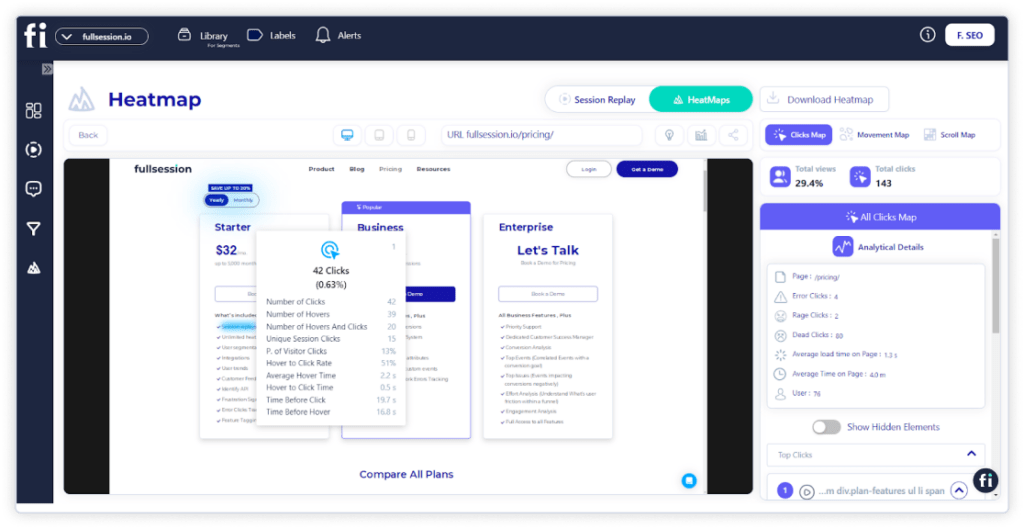
    Some click maps also allow you to filter results by specific pages or sources, such as organic search or inbound links, which helps you pinpoint specific areas for improvement, increase website traffic, or decrease bounce rate.

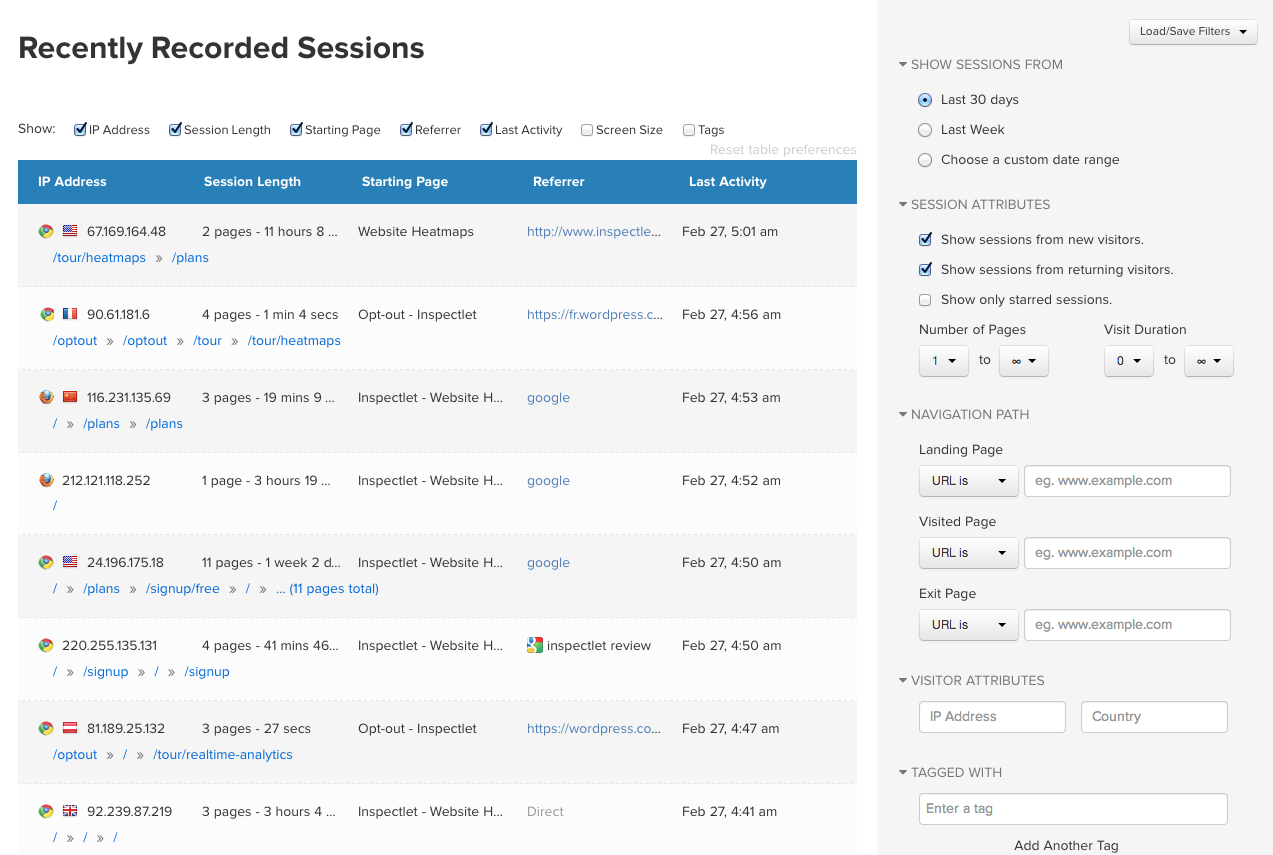
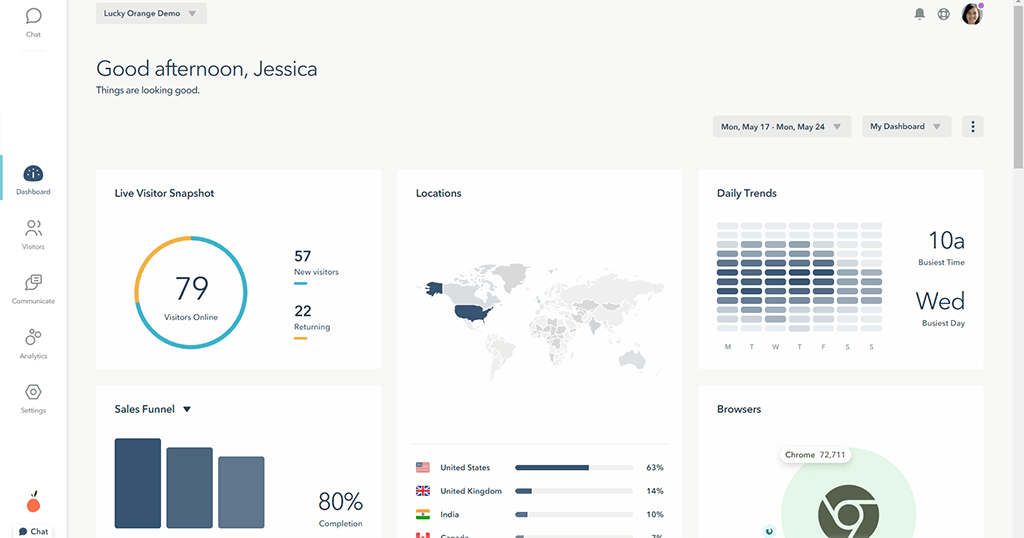
    There are many different click map tools available online, so it’s important to choose one that meets your specific needs. Some of the most popular options include FullSession, Hotjar, Crazy Egg, Smartlook and Inspectlet.

    What Are the Benefits of Click Maps?

    Counting the number of website visits as a measure of success is not enough. Combining the number of unique visitors to your website with click maps and other user behavior tools, you can gain a holistic view of how people interact with your brand.

    By using click data to learn how customers navigate through your website, you can personalize their experience across different digital touchpoints. If you’re not yet convinced click maps are worth your time, here are some benefits to consider.
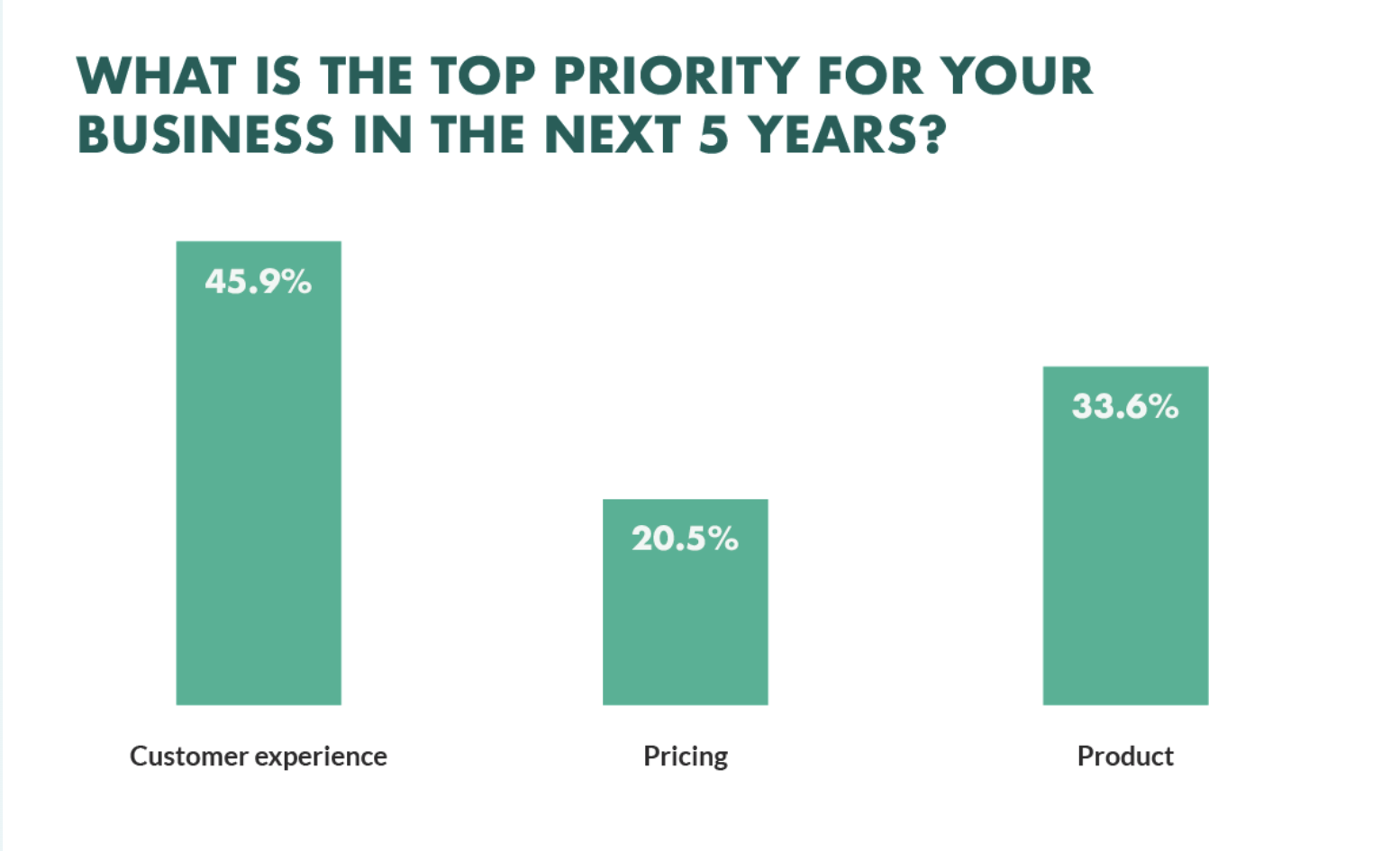
    business priorities charts

    Image source: superoffice.com

    Click maps help you:

    1. Increase your site traffic
    2. Attract more user interaction
    3. Test your site’s usability and functionality
    4. Understand user wants and needs
    5. Decrease the bounce rate
    6. Generate more leads and close more sales
    7. Create an optimal customer journey
    8. Improve your conversion or sales funnel
    9. Understand what page elements or website areas are underperforming
    10. Update your marketing, sales, or development strategy
    11. Get ideas on how to redesign your website or improve your content
    12. Reorder your links to achieve higher CTR
    13. Optimize your website for both web and mobile users
    14. Detect points of frustration like JavaScript errors, misleading elements, broken elements, etc.
    15. See if your image links are gaining clicks

    A major benefit of click maps is return on investment (ROI) tracking. You will always know the exact percentage of return you receive for every dollar invested in your advertising campaigns. 

    Also, click maps are easy to implement into your existing digital infrastructure.

    What Are the Drawbacks of Click Maps?

    Click map is a great way to see how users interact with your website or web app, but there are some drawbacks you should be aware of.

    Click maps can be misleading. They show you what areas of your website or web app are most popular, but they may not reflect the user’s interest.

    For example, if your website shows video ads, the click map might mark the ads users click the most, like the top right corner of an ad where the close button is. 

    You will not know if the ads are intrusive or irrelevant to the users’ experience just by watching click tracking reports. This is where session replays come in handy, allowing you to view the entire visitor experience accurately.

    Also, click maps can slow your website down. Depending on the software you use, click maps can be time-consuming to generate, so if you have a large amount of data, you may not be able to use click map reports right away.

    Finally, click maps can sometimes be inaccurate. They can show you areas where a user clicks or interacts with a specific page, but this might not reflect how many of them have actually paid attention to your page elements.

    This is not the case with FullSession because there is no waiting time for heatmap processing–you get instant data with high accuracy–and it doesn’t slow down your website.

    Get a demo and see how it works.

    Are Click Maps Worth the Investment?

    Yes, click maps are definitely worth the investment and can lead to increased revenue. As a business owner, having a visual representation of where users are clicking lets you view your website in new ways.

    By tracking users’ navigation, you can build a more effective site based on their actual needs rather than your best guesses and improve performance by making changes to your product pages, calls-to-action, or site structure.

    Also, click maps will help you determine why some people leave your eCommerce shop without buying anything so you can take appropriate actions to boost conversions.

    How to Track Website Visitors’ Clicks With FullSession

    We developed FullSession, our user behavior analytics software, to help you capture all website visitor interactions accurately. You can monitor your users’ experience across devices, analyze their behavior with real-time visual insights, and identify issues in the customer journey for targeted optimization efforts.
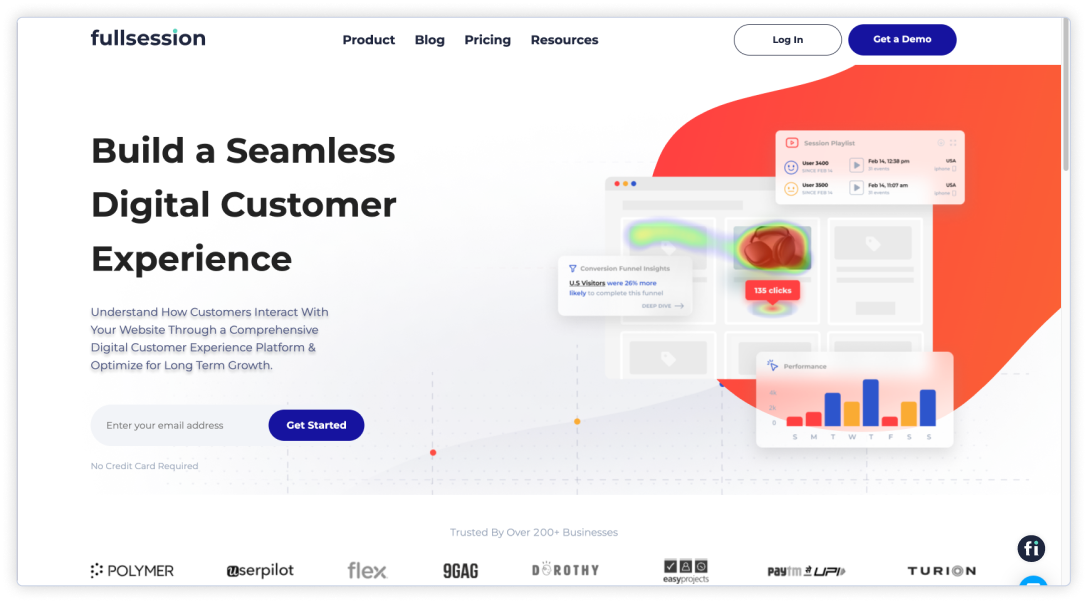
    FullSession homepage

    With features such as interactive heatmaps, session recordings and replays, customer feedback forms and reports, and conversion, funnel, and form optimization tools, FullSession is a single solution for growing website traffic, boosting engagement, and converting more visitors into active, returning customers.

    Start a free trial.

    FullSession heatmaps

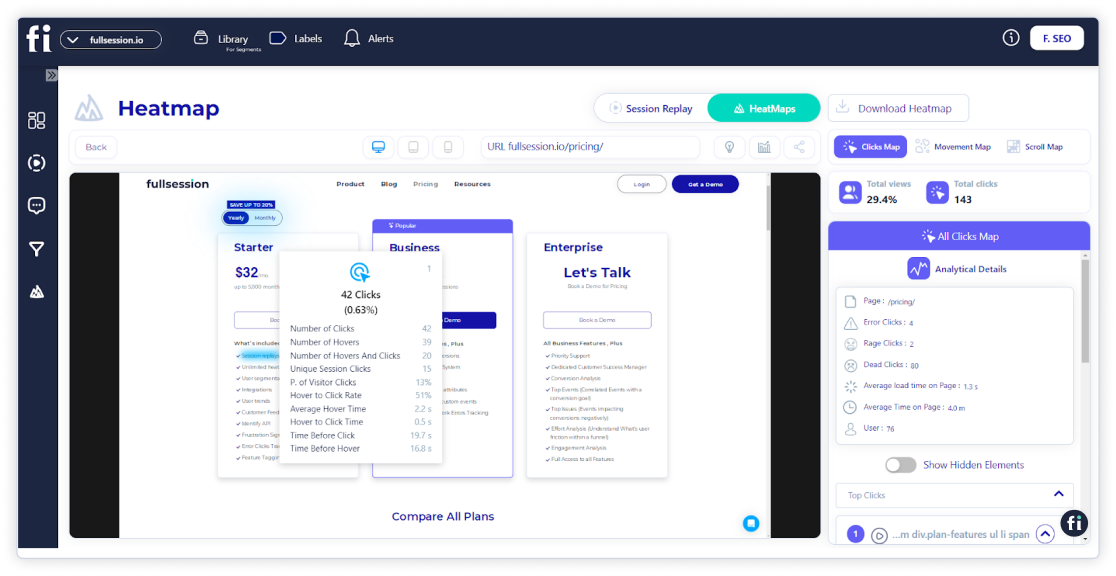
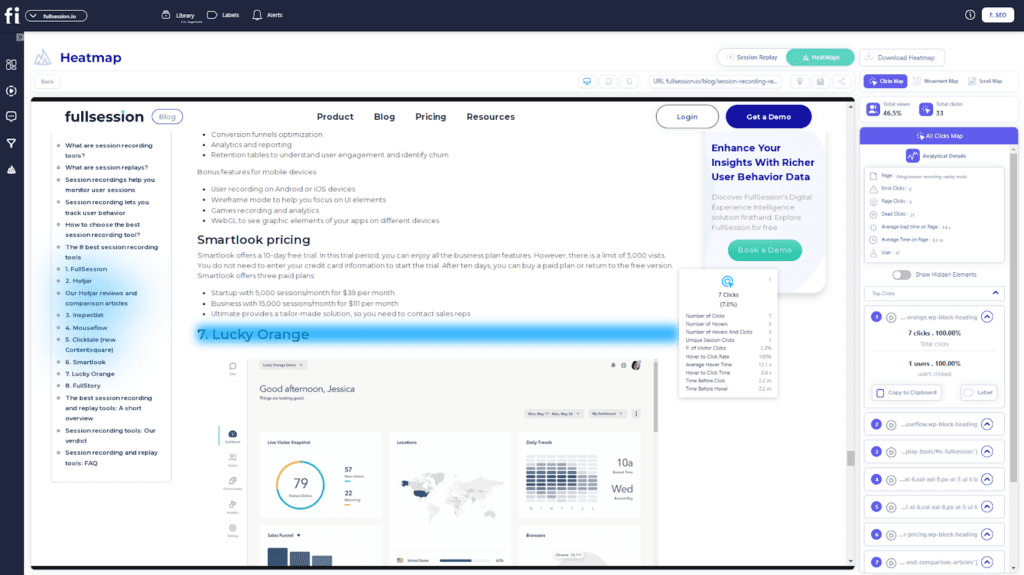
    FullSession real-time interactive heat maps help you visualize customer behavior and discover growth opportunities. With FullSession, you can track dynamic page elements and analyze every click, scroll, hover, or mouse movement to create an excellent digital experience.

    This feature helps you detect dead zones, test different UI elements, validate design changes, and improve your website’s visual hierarchy. It enables you to optimize website interface, usability, and performance.

    FullSession heat maps display colorful, easy-to-interpret graphic charts that show how visitors navigate your entire website and engage with your brand.

    FullSession heatmap types

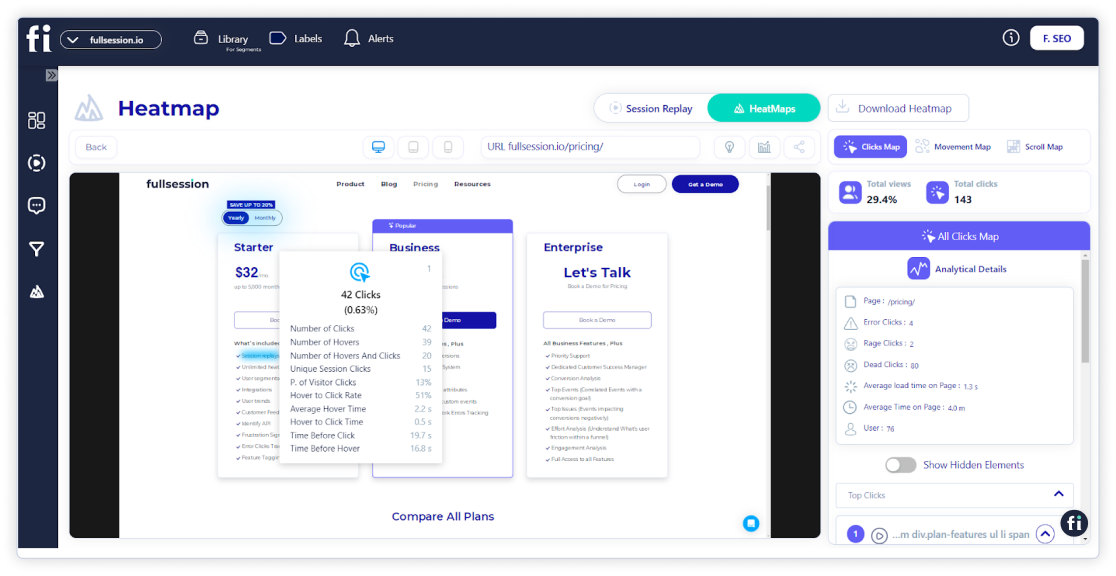
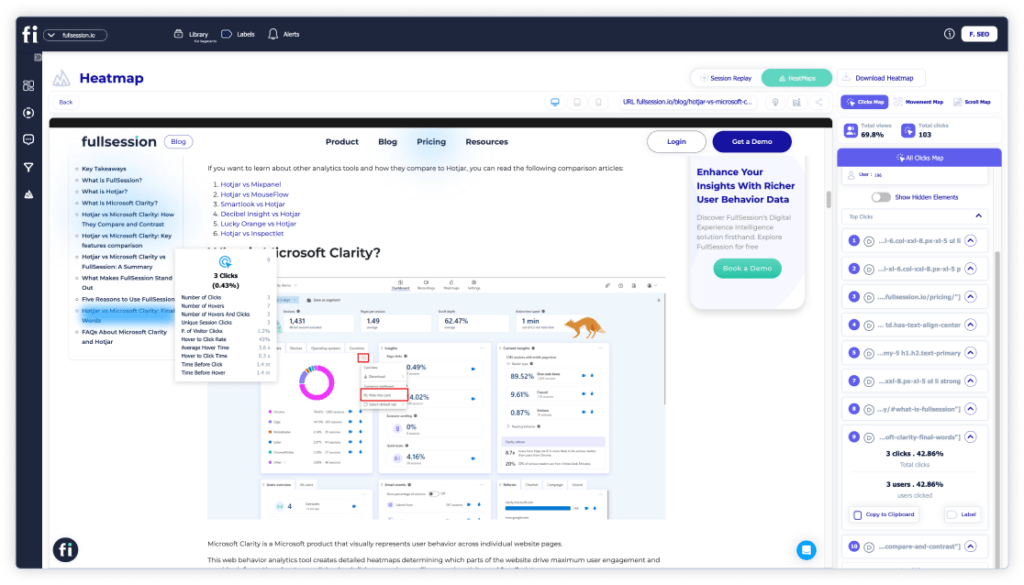
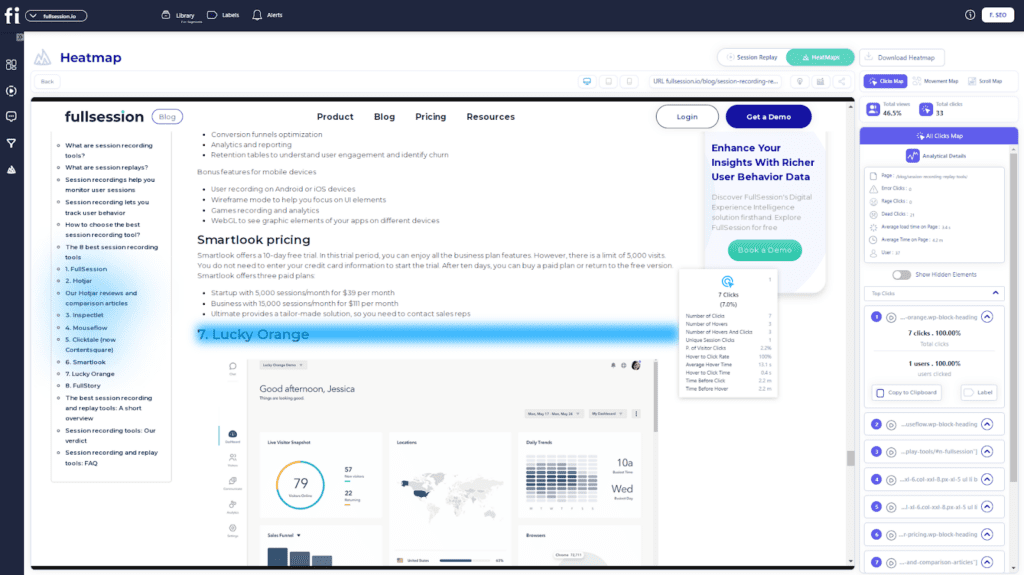
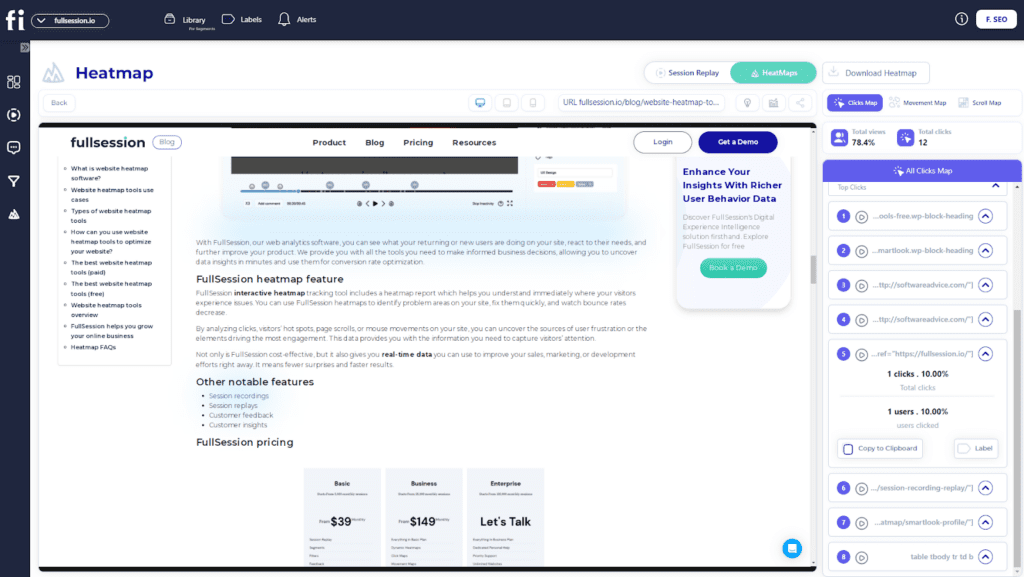
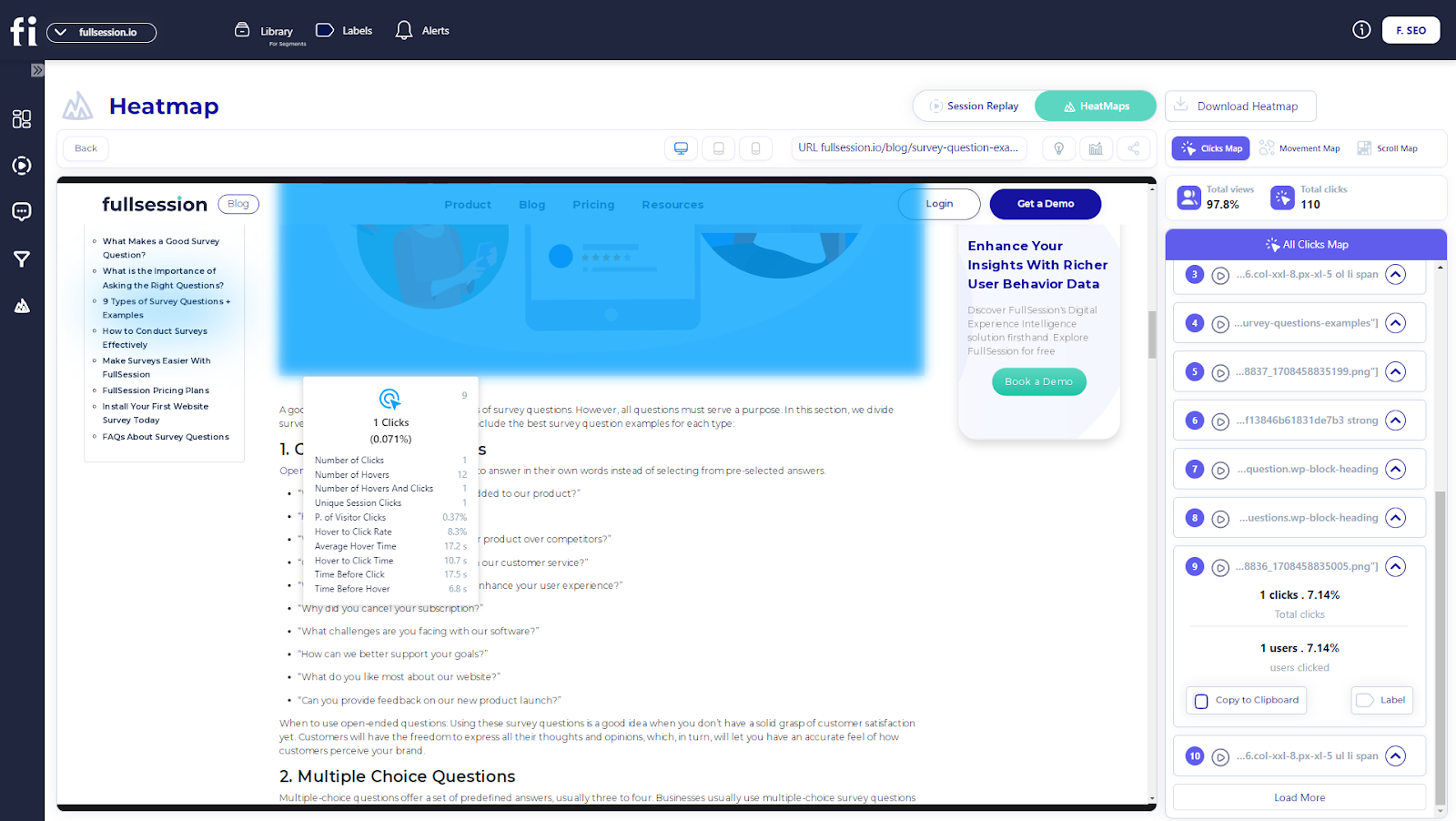
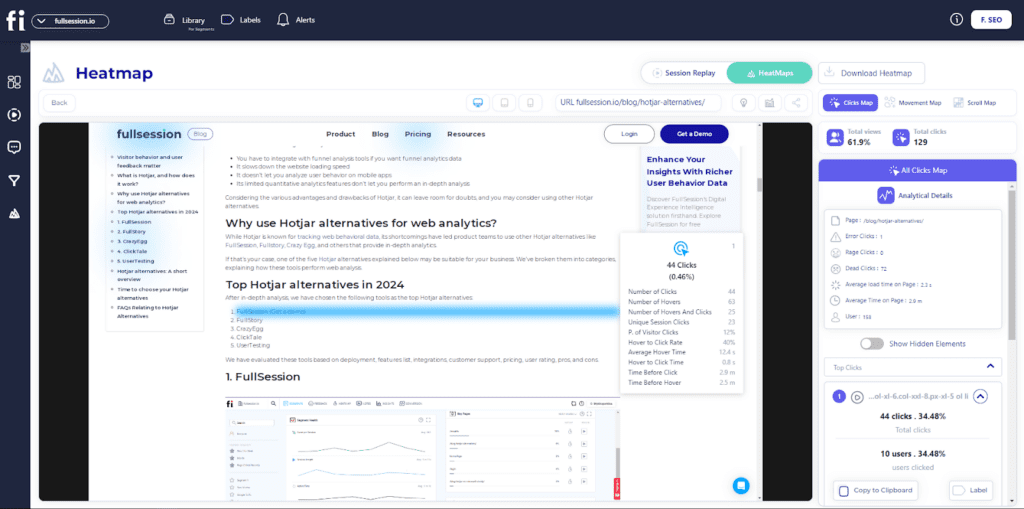
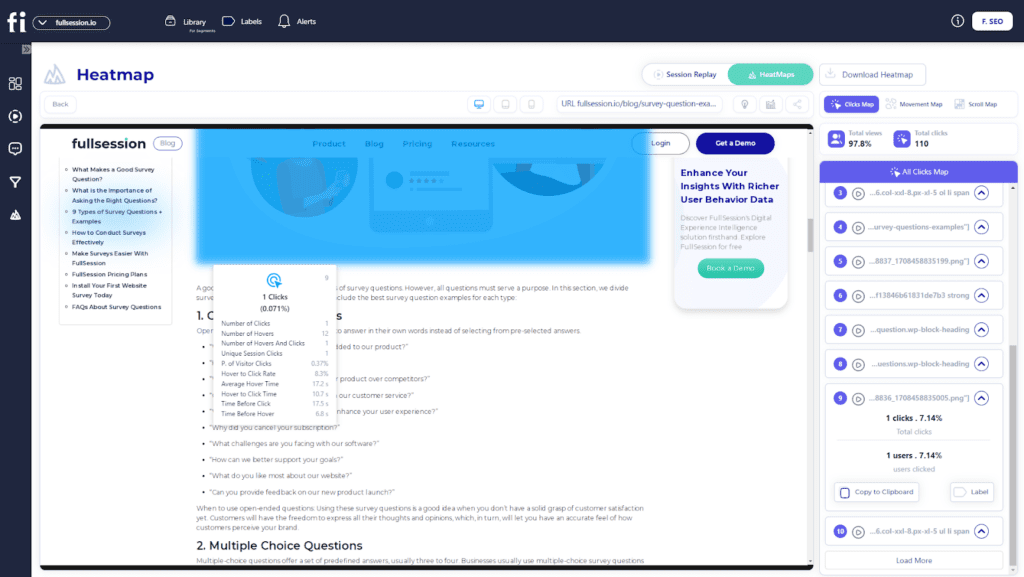
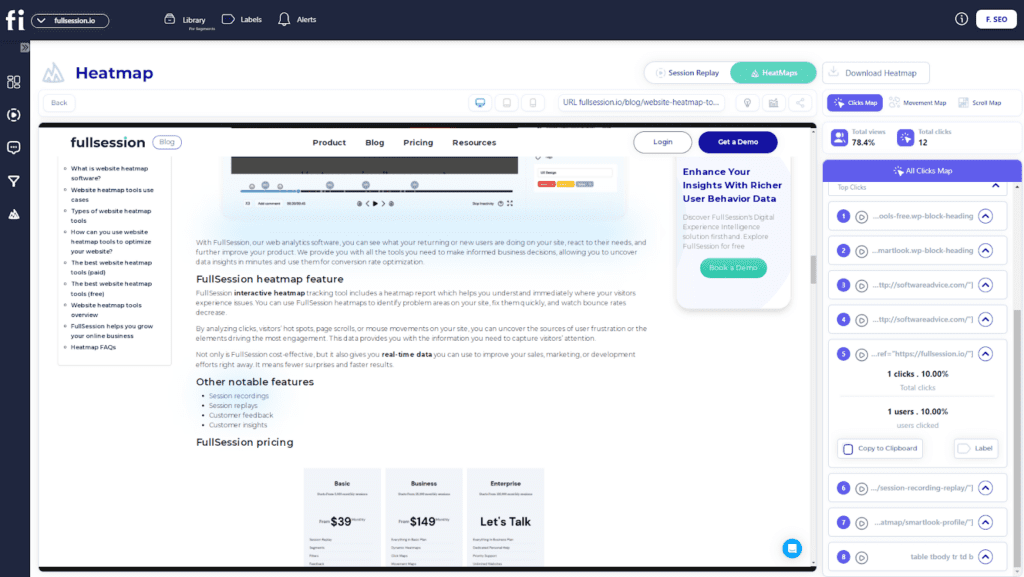
    Click maps provide insights into user engagement by showing which elements on a webpage receive the most clicks. This helps you understand what attracts attention and optimize calls-to-action for better conversions. 

    Analyzing click patterns can also reveal navigation issues and areas that may need design improvements.
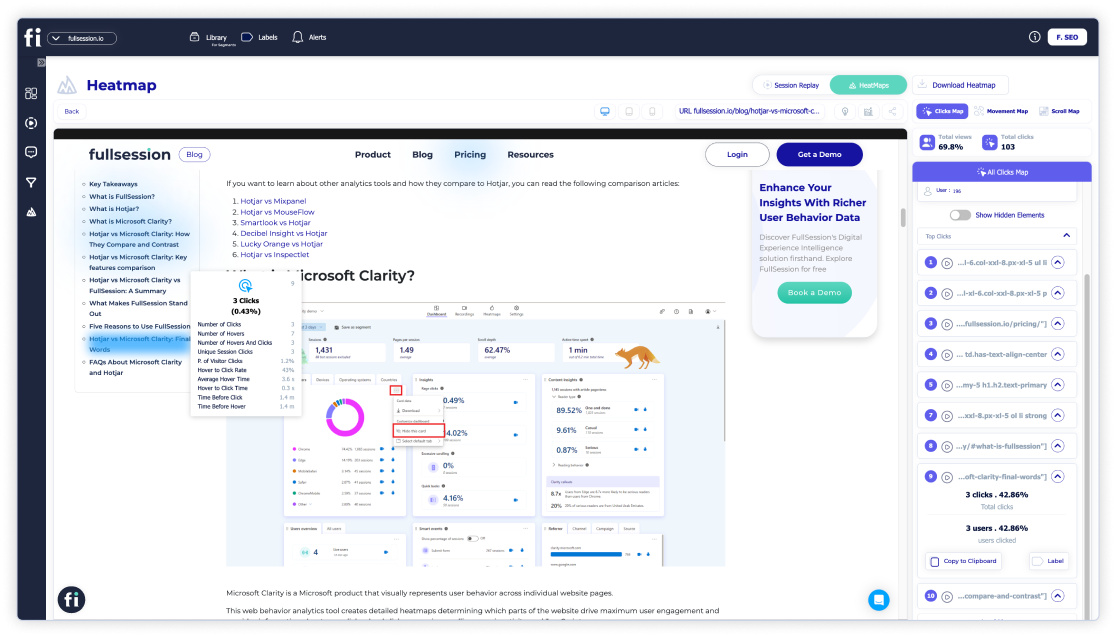
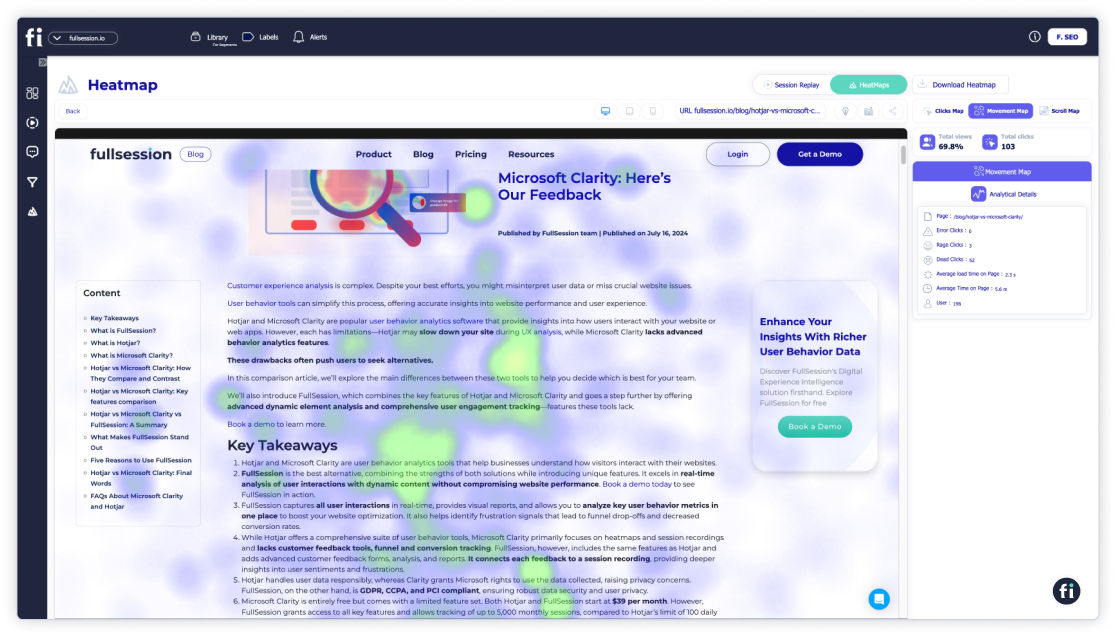
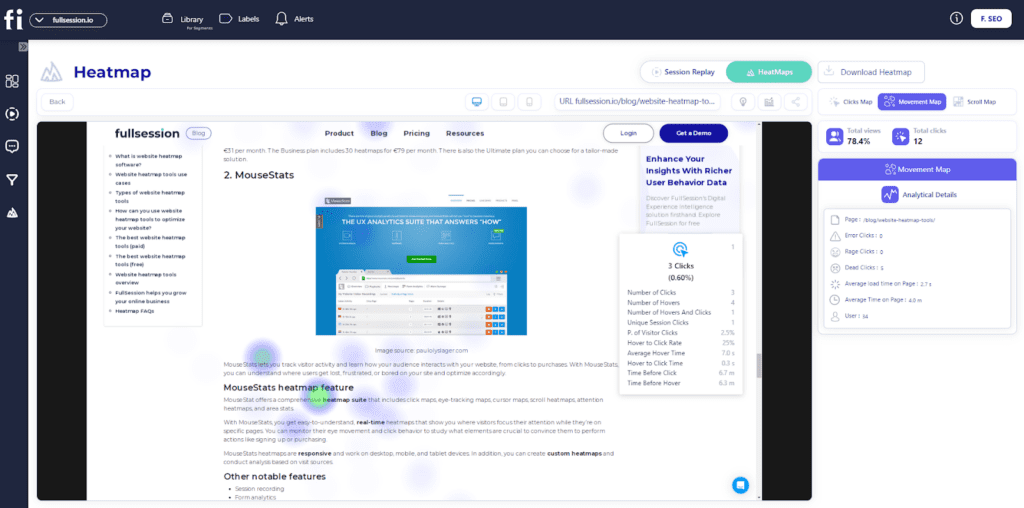
    Click map

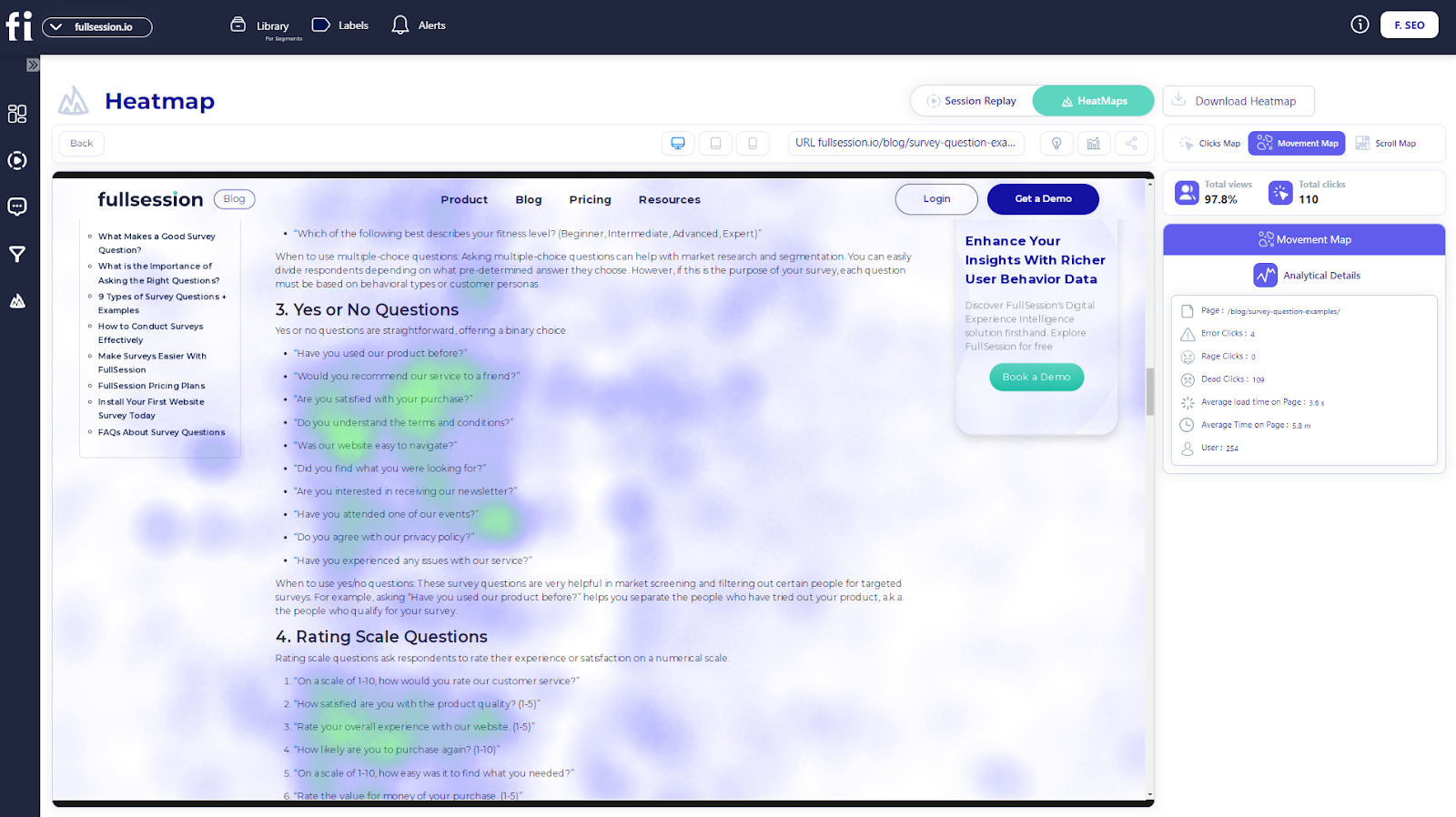
    Mouse movement maps, or move maps, track where users move their mouse cursor on a webpage. Since there’s a strong link between where people look and where they move their mouse, these maps highlight which parts of a page catch the most attention. 

    Once you see where users hover and pause, you can determine which content interests visitors and which parts are ignored. This helps you refine design and content strategies, especially for non-clickable elements.
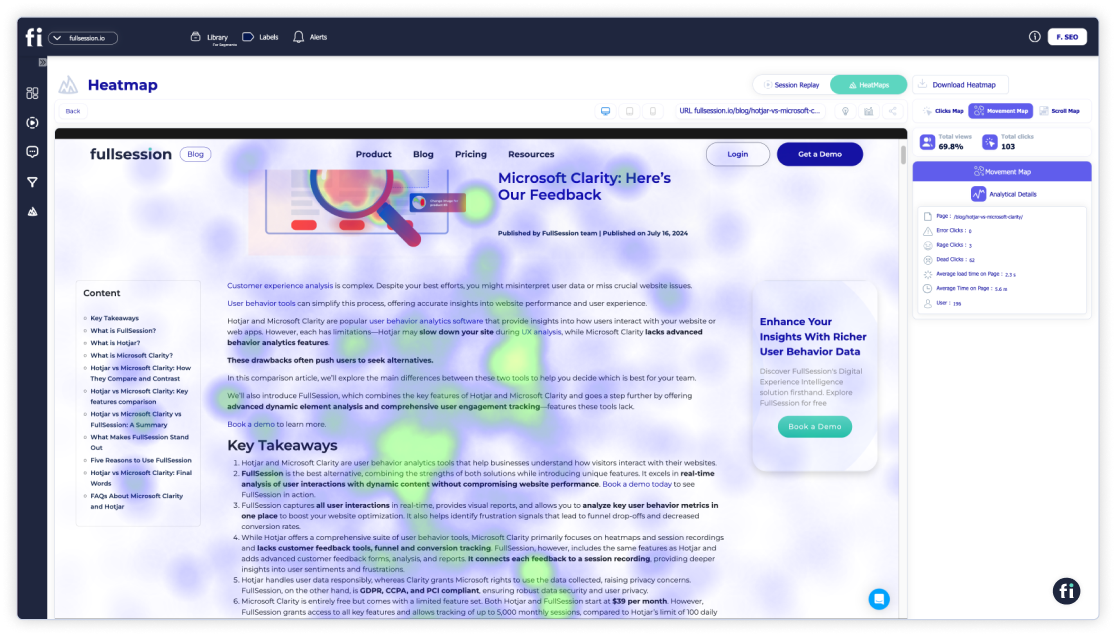
    Mouse movement map

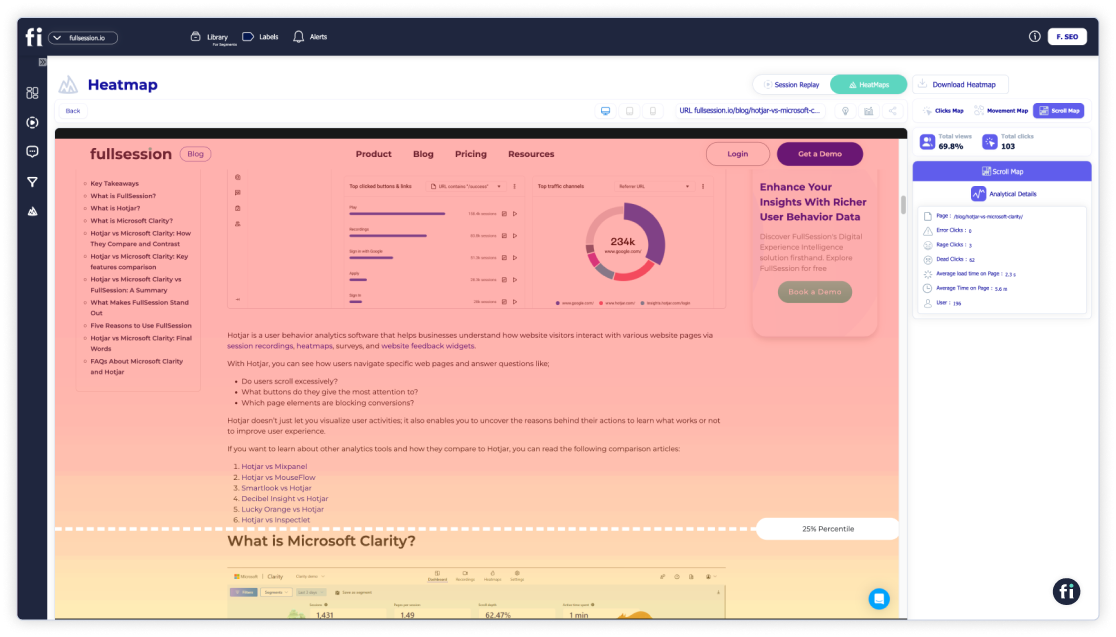
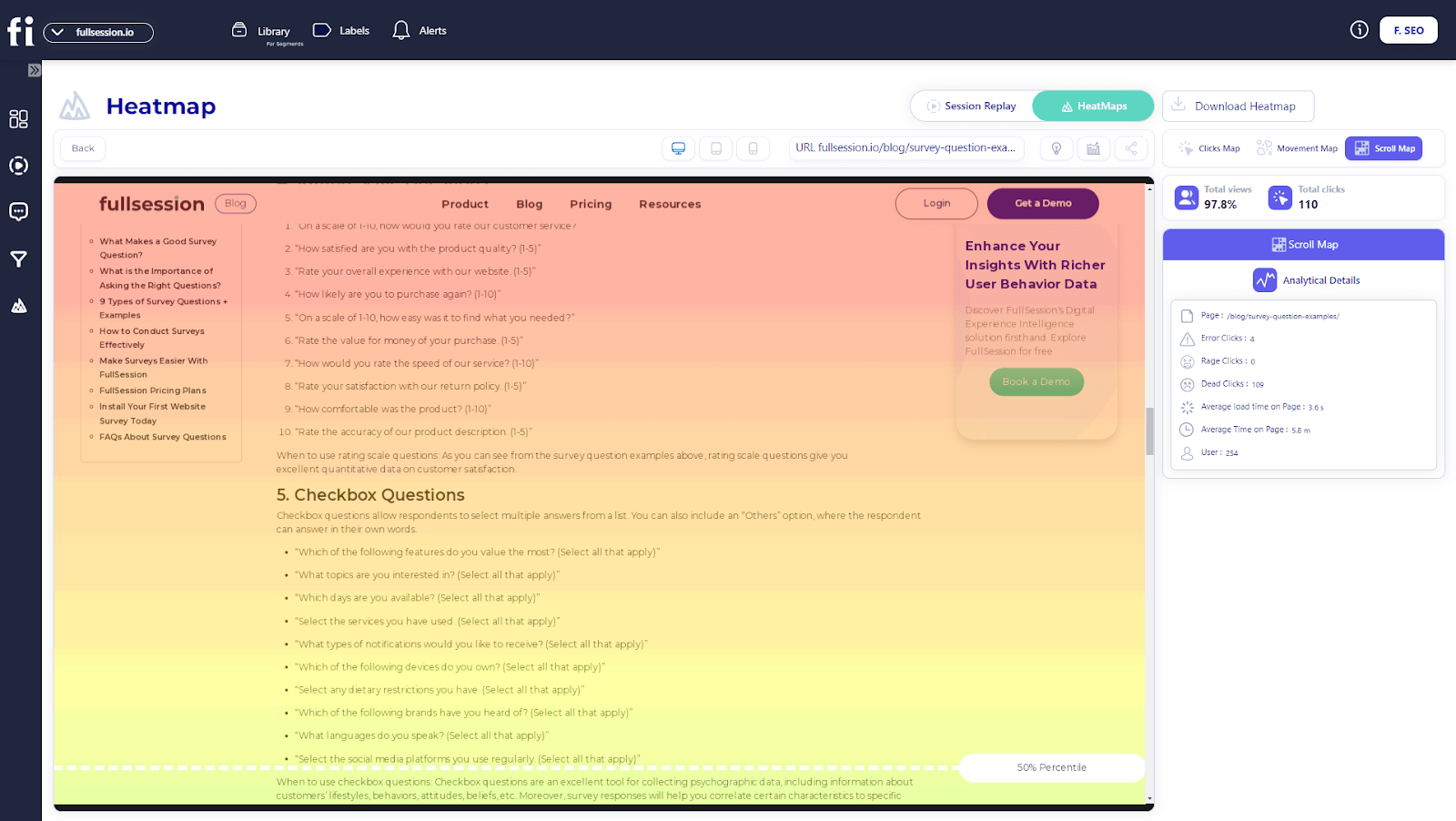
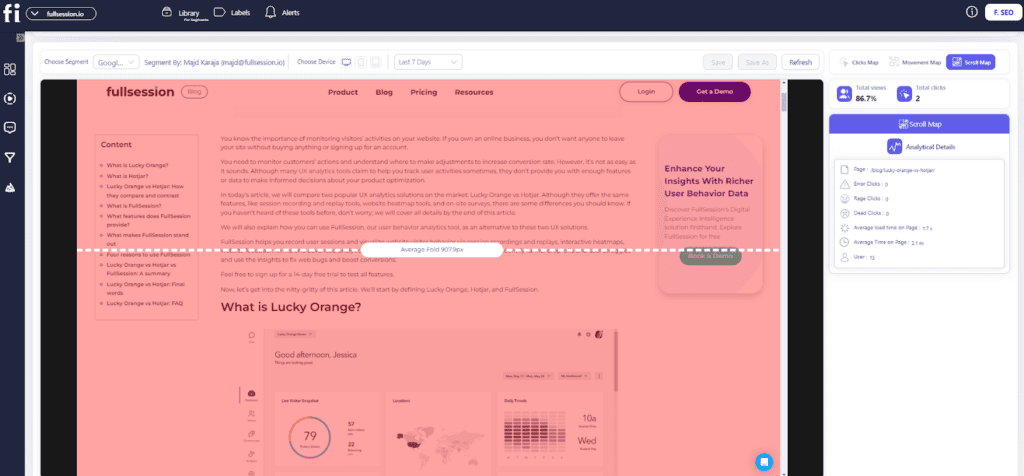
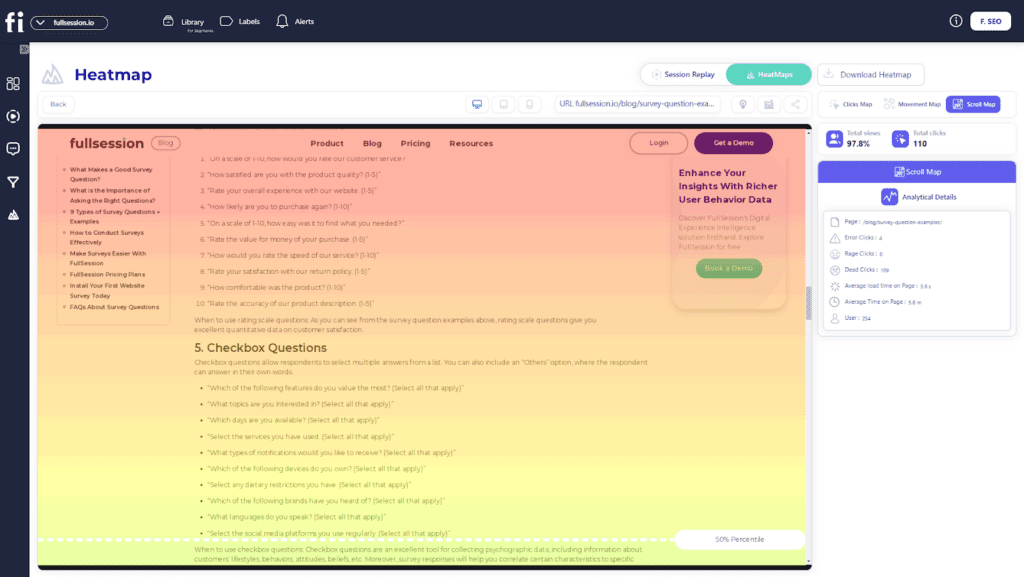
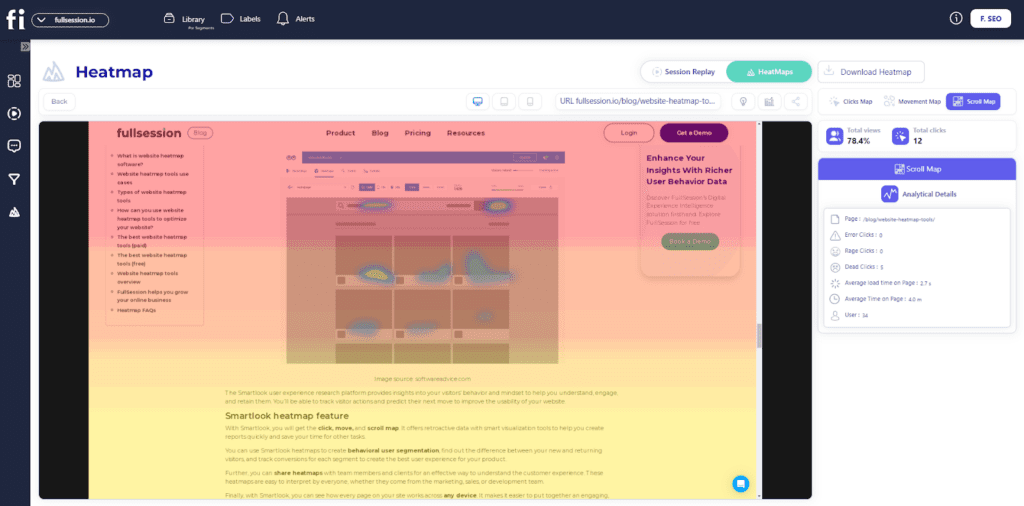
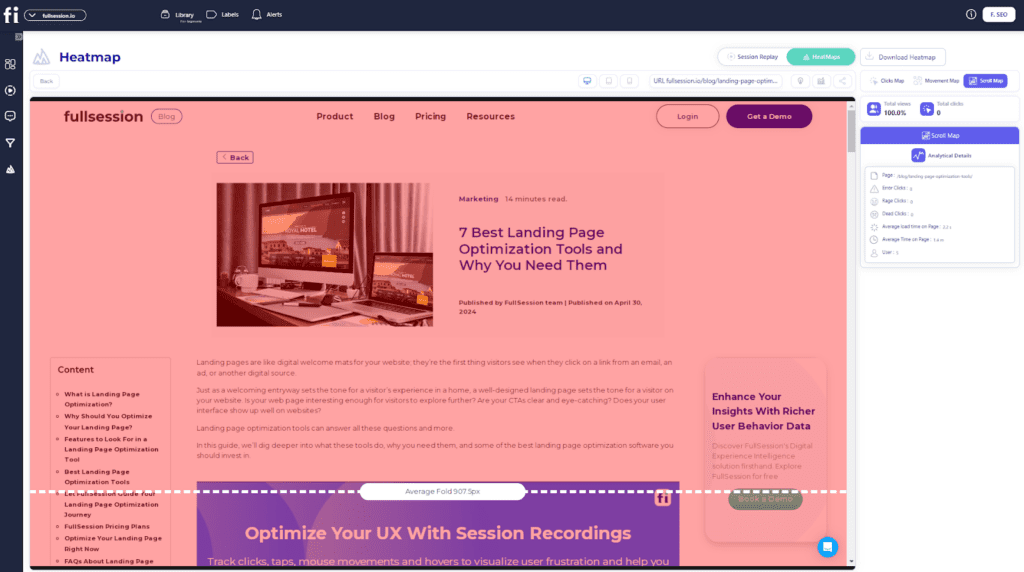
    Scroll maps show how far users scroll on your web pages, indicating which sections are viewed and which are skipped. This helps identify “dead zones” where user engagement drops. 

    When you understand scroll depth, you can adjust content placement and design to ensure important information is seen without requiring excessive scrolling. This optimization improves user engagement and retention.
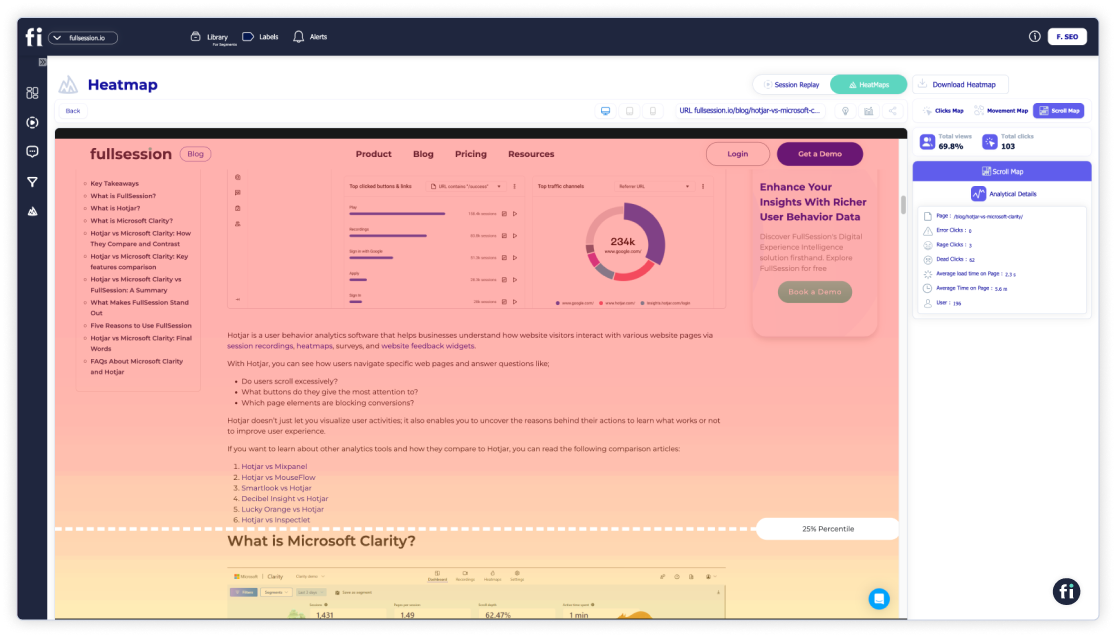
    Scroll map

    Using interactive visualizations and advanced filtering options, you can get all the data you need without having to work with complicated reports or raw data in spreadsheets.

    Start a free trial.

    Why use FullSession click maps

    No matter what kind of data you’re looking for, from improving your SEO to better understanding your customers, FullSession heatmaps can provide you with the answers.

    FullSession has an advanced heatmap tool that gives you access to instant insights and actionable data without affecting your website performance. It helps you identify issues, measure their impact on your site, and pinpoint what you need to do to solve them quickly rather than waiting for a problem to manifest itself.

    Use FullSession heatmaps to understand the sources of user frustration or the on-page elements driving the most user engagement to improve your sales, marketing, or development efforts.

    Get a demo now.

    FullSession session recordings and replay tools

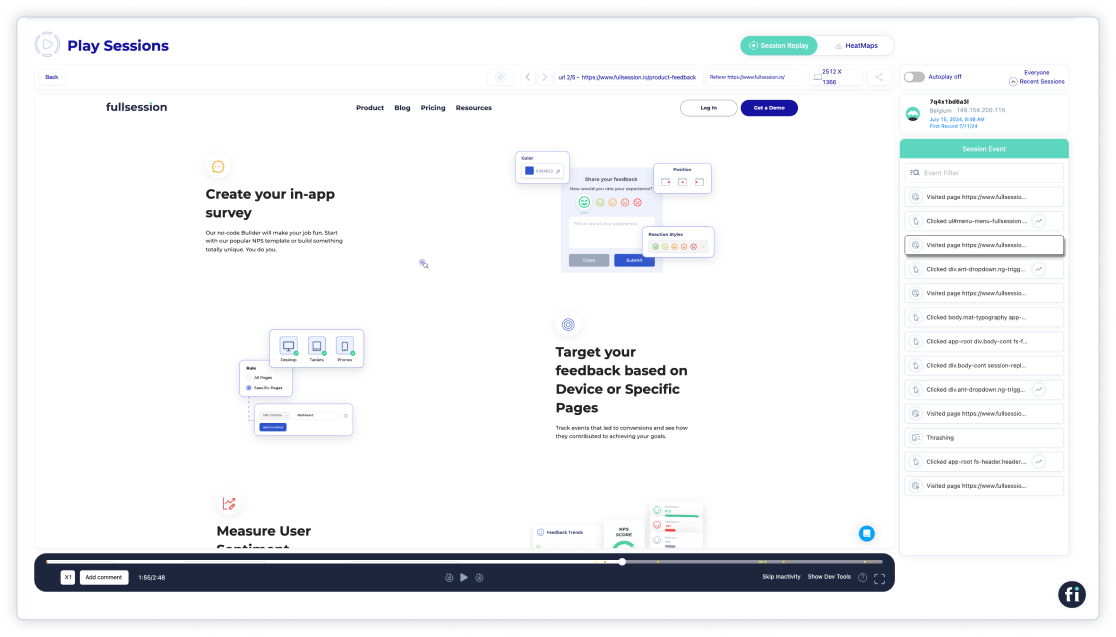
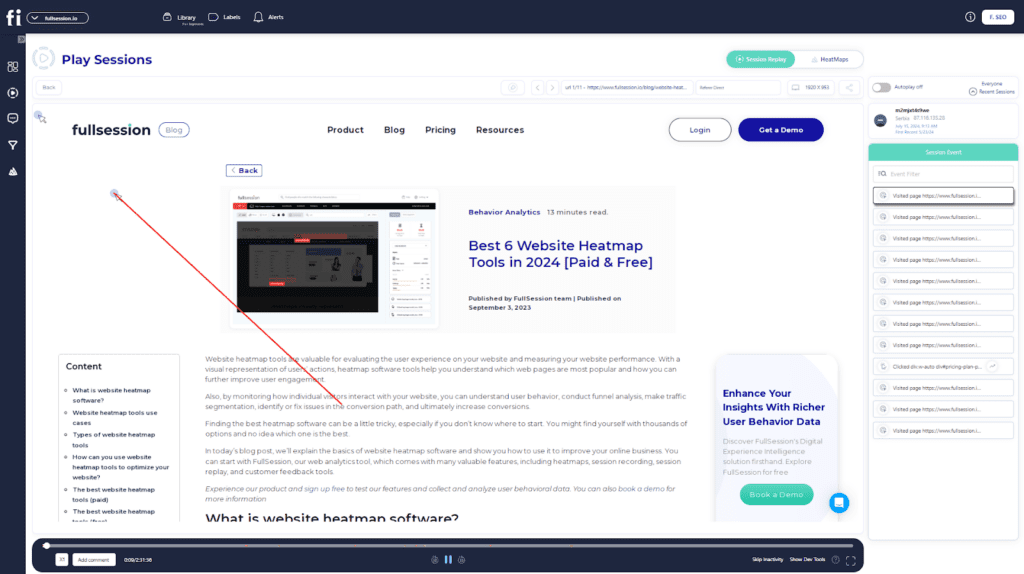
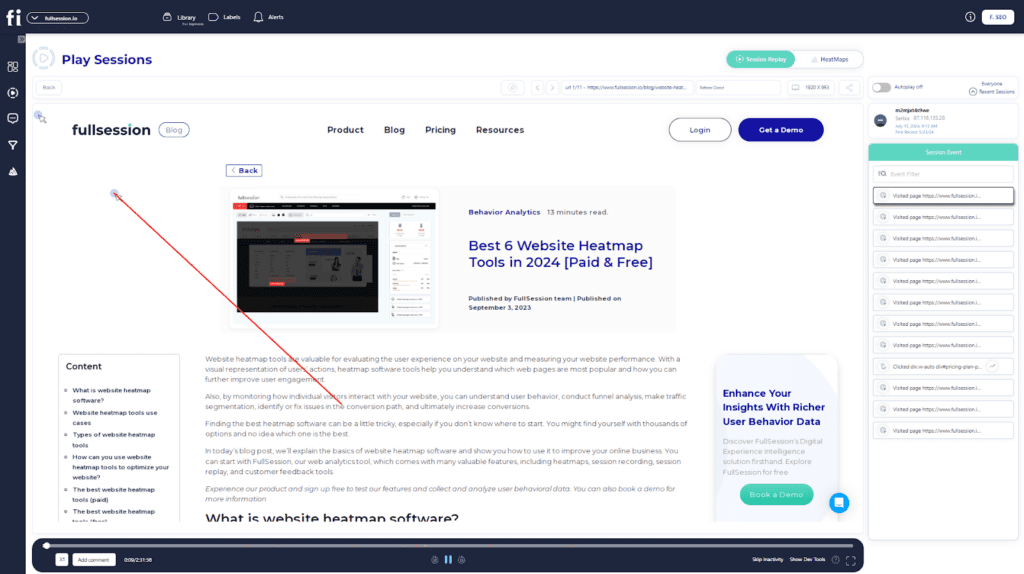
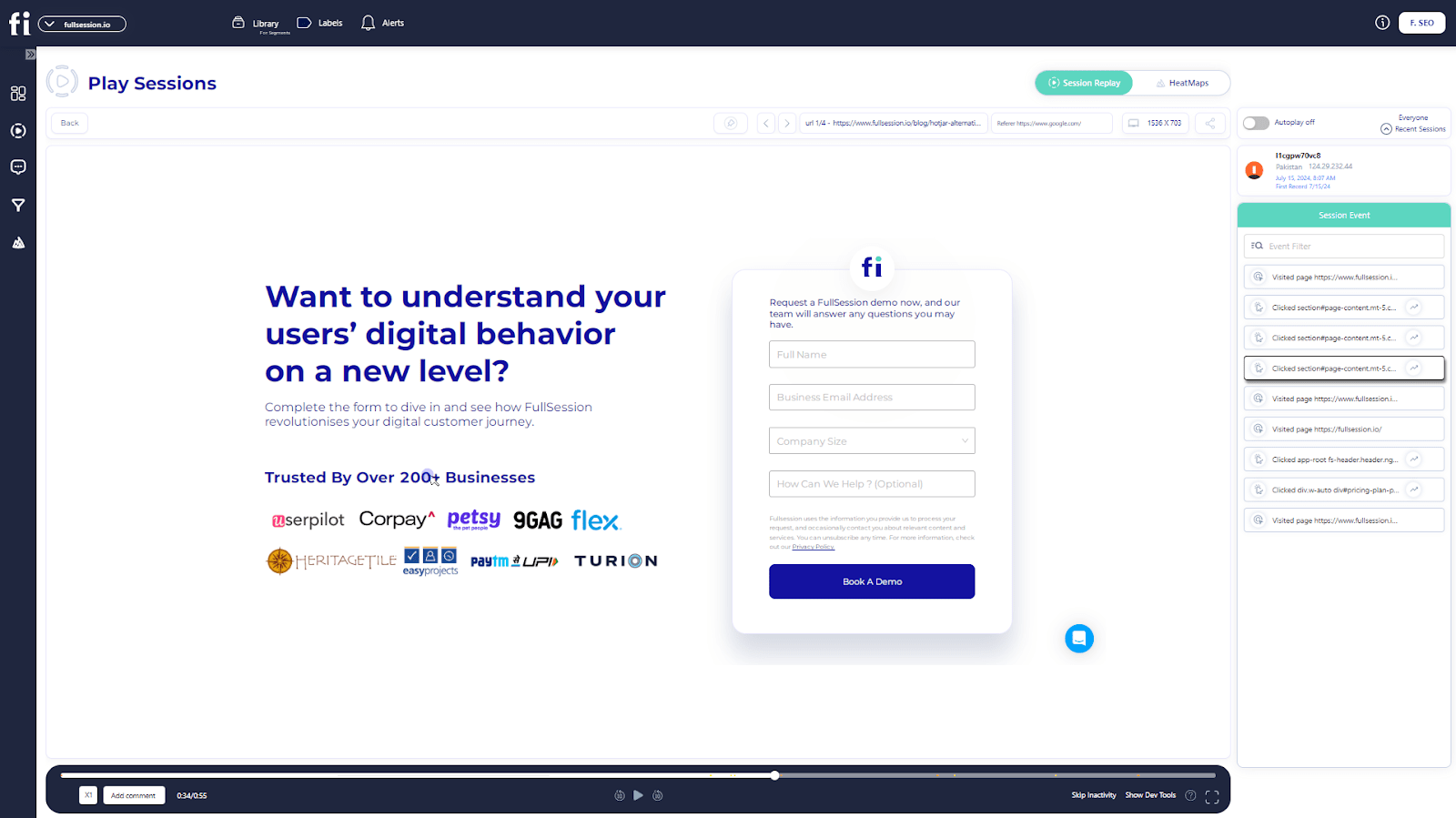
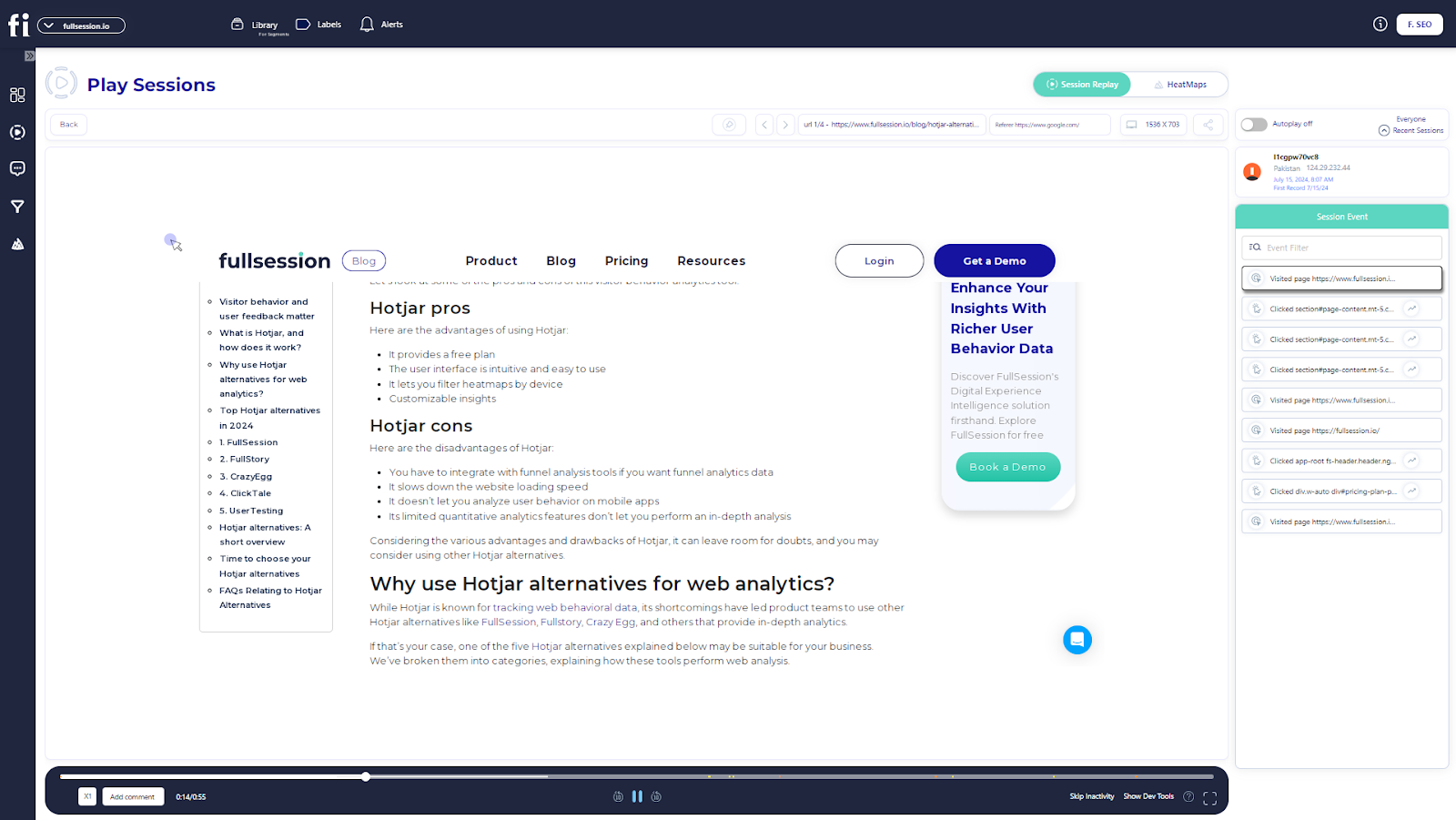
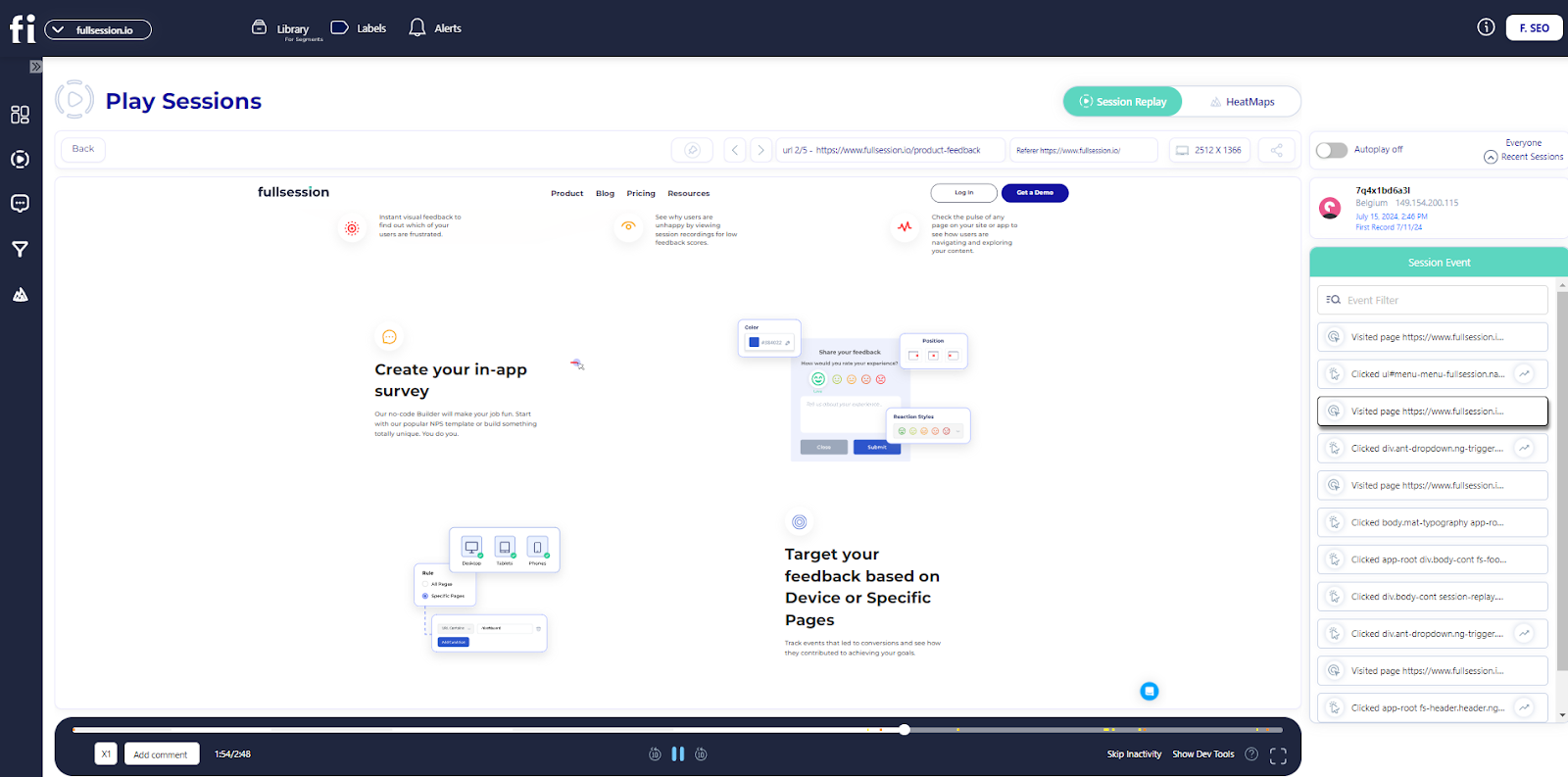
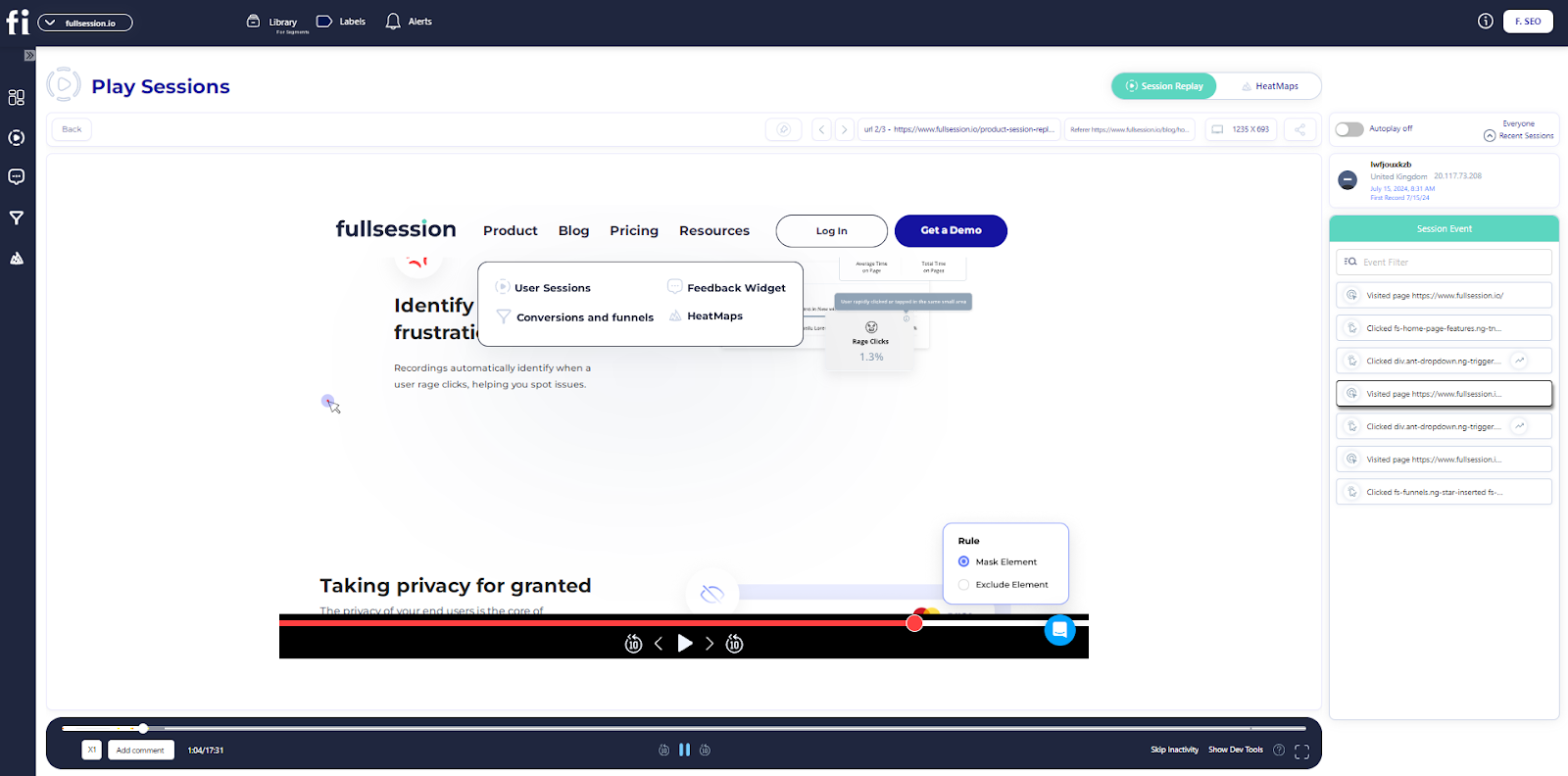
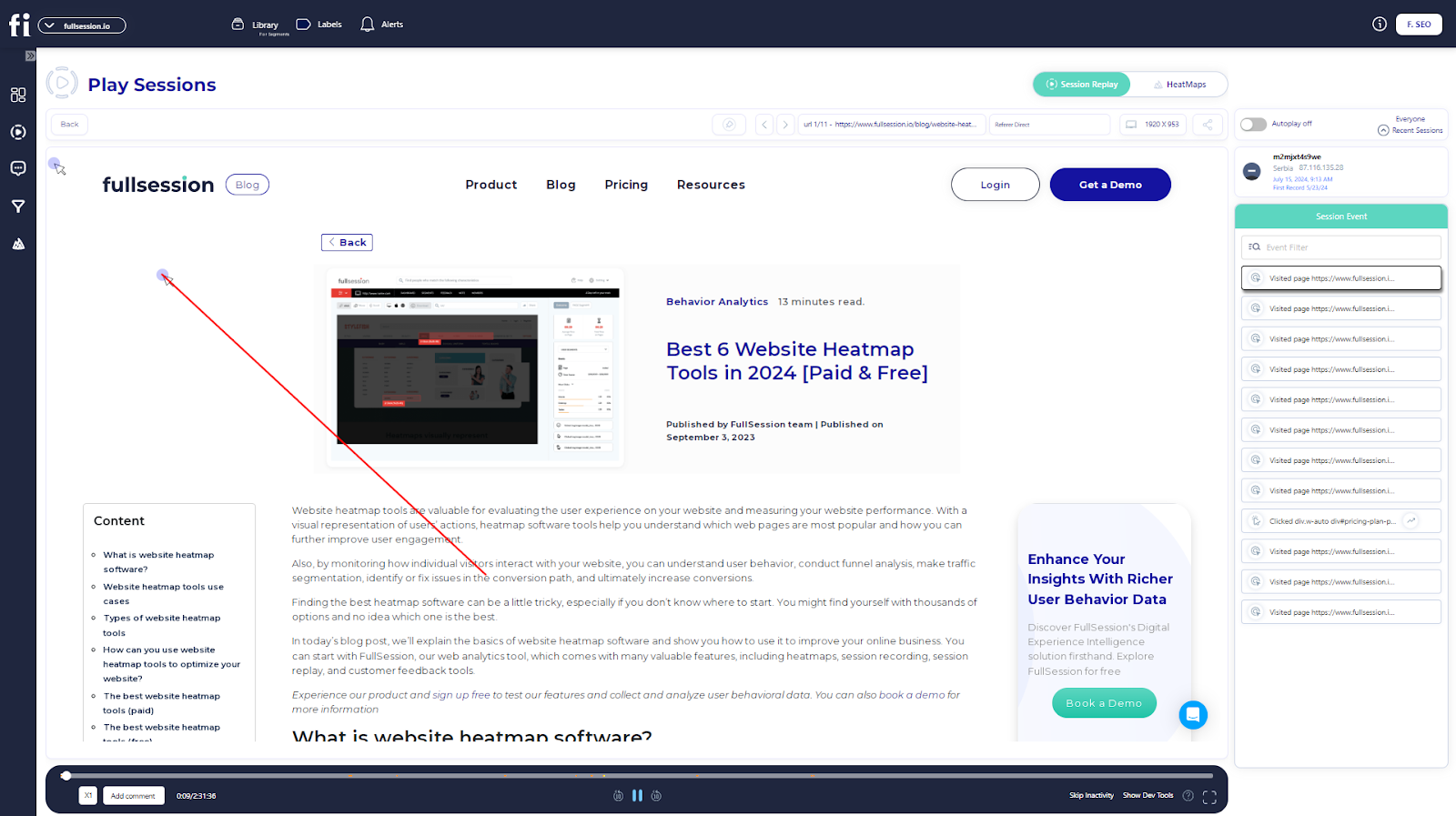
    For best results, you should combine session recordings with heatmaps. FullSession logs and shows every visitor action in a session recording, for desktop and mobile sessions.
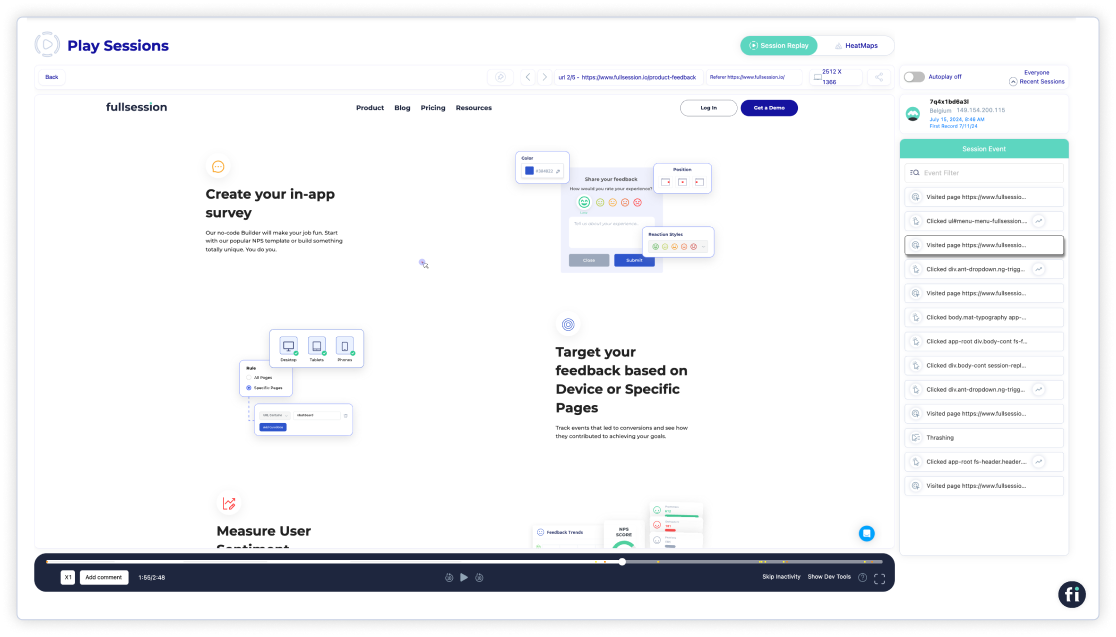
    FullSession session recording

    It’s a faster way to analyze users’ behavior on your webpage and find opportunities to improve the user experience. For detailed information, read our guide on session recordings and replay.

    What customer data do you get with FullSession session recordings?

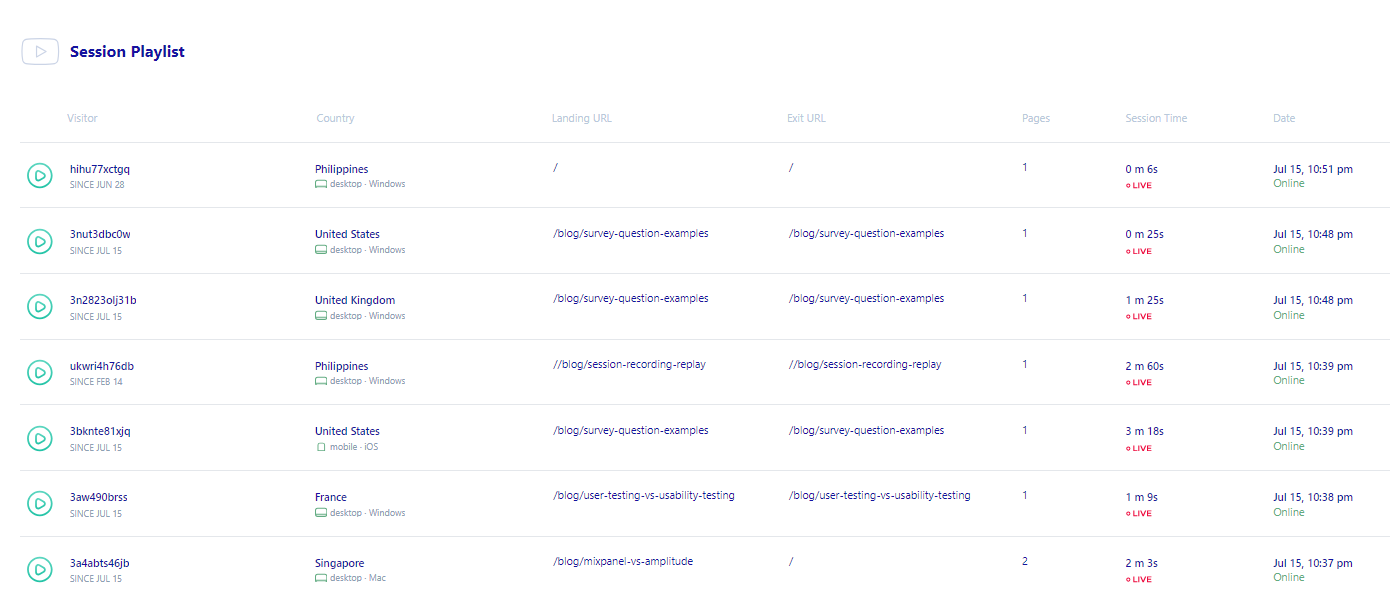
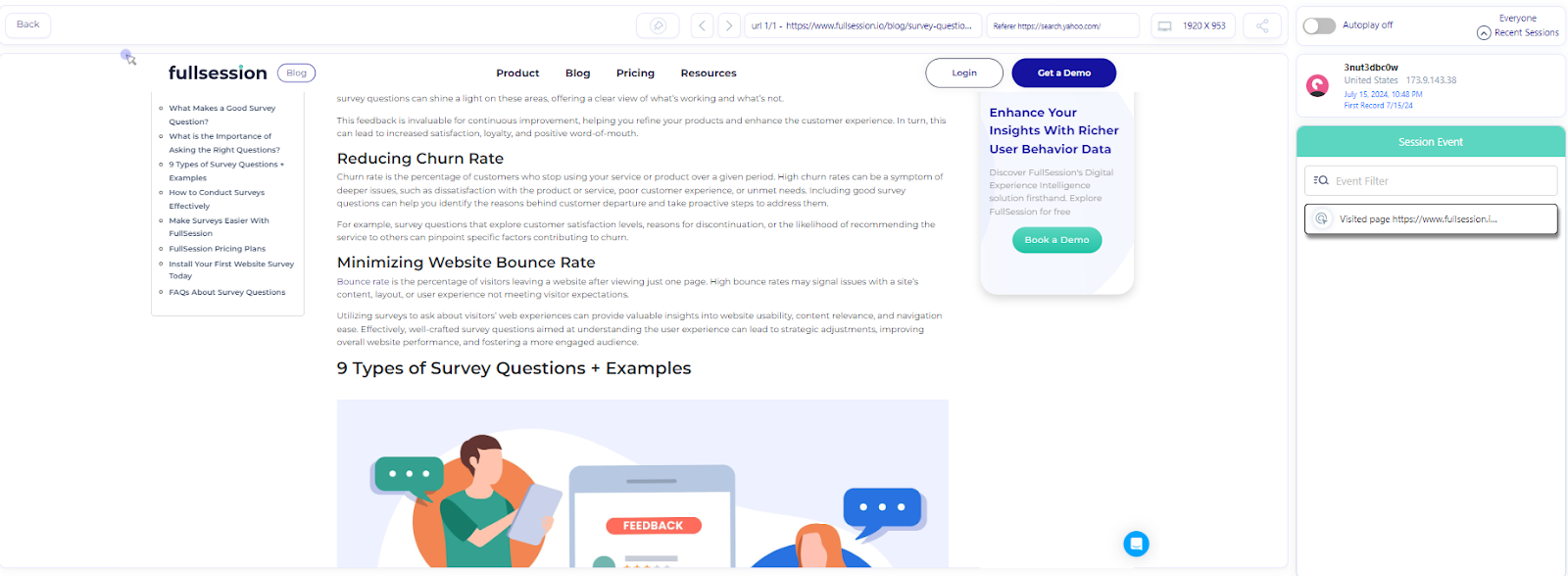
    You can easily watch session recordings using the FullSession replay feature that shows:

    1. Your visit sources
    2. The IP address of each visitor
    3. The date of the first session recording
    4. The average time spent on the page
    5. The total time spent on pages

    With a session list and session events, you can analyze and inspect users’ actions on each page, from how many times they click on an element to how long it takes them to complete a purchase.

    It will show you how often they clicked on buttons and links, visited certain pages, or had any unexpected issues. Whether you want to design better experiences for your customers or reduce your bounce rate, FullSession can help.

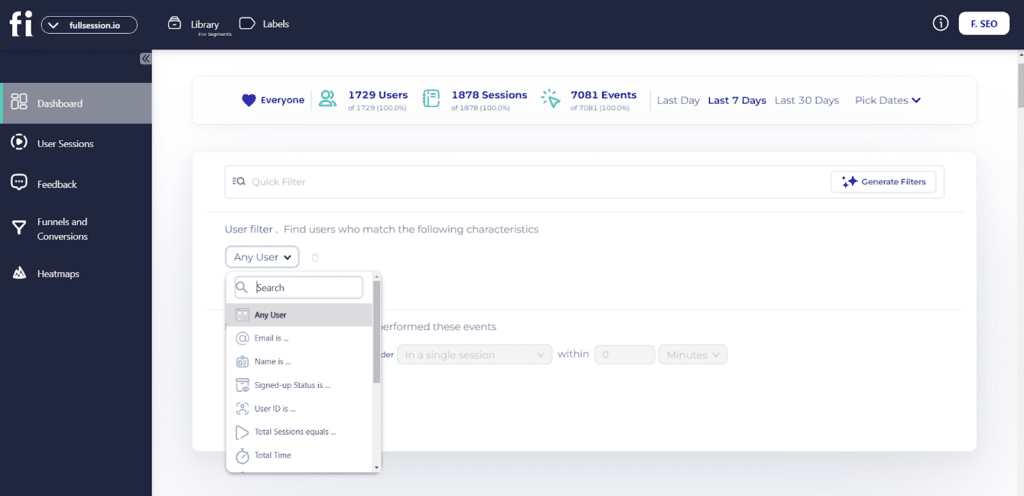
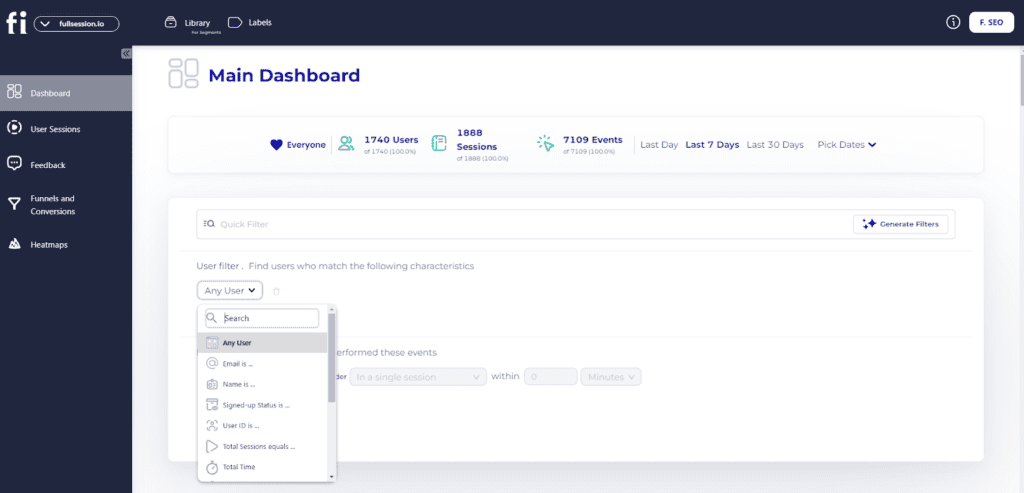
    FullSession user insights and events filtering 

    With advanced filtering options based on many parameters, you’ll be able to save time and quickly find the session replay details you need. 

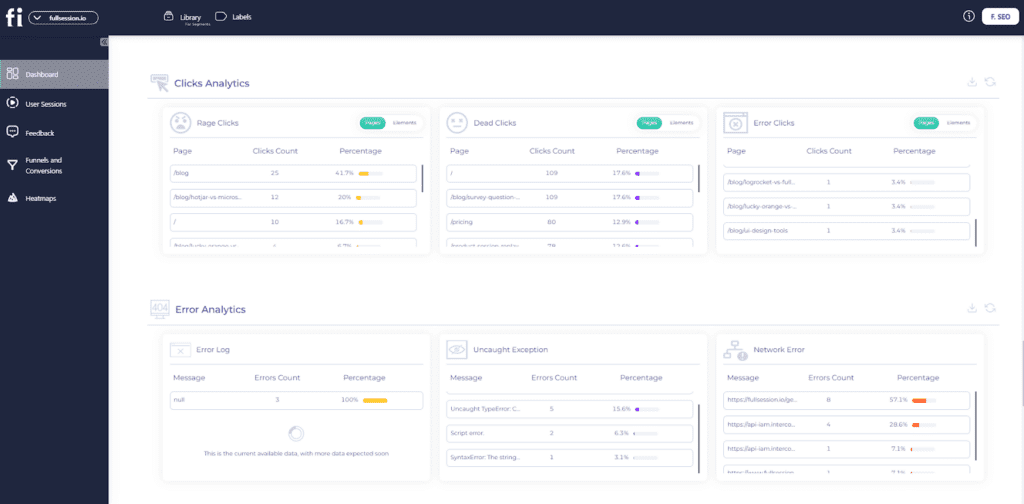
    FullSession ensures you only receive relevant search results and includes insights on rage clicks, dead clicks, error clicks, or trashed cursors, among other data.
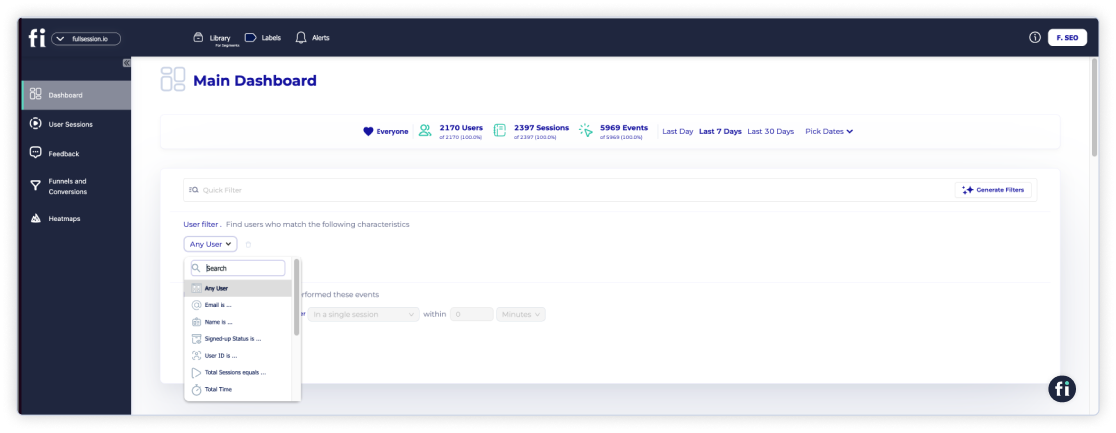
    FullSession Filters

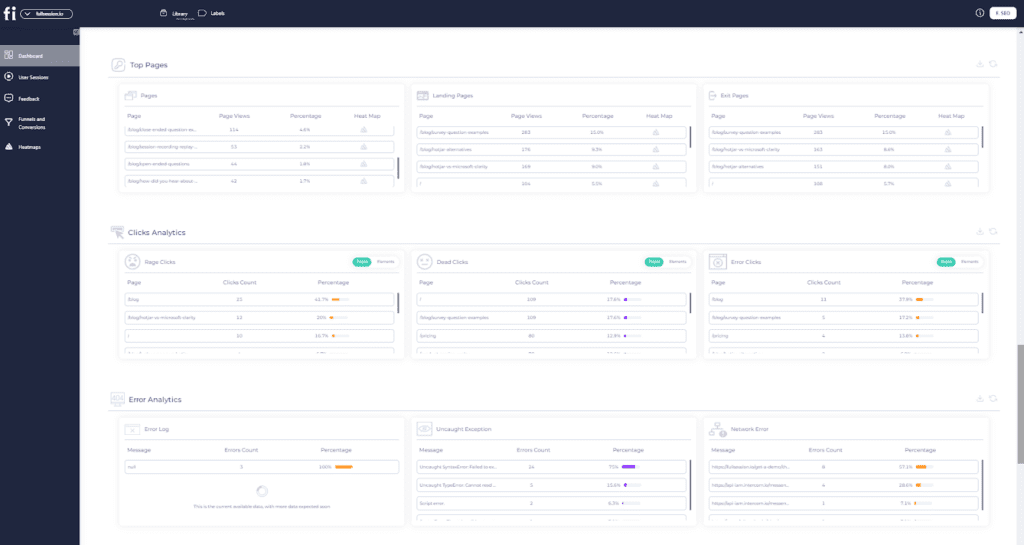
    The new FullSession metrics tab allows you to view all your data in one place. It divides reports into three sections and helps you to see insights for up to one year:

    User engagement

    • Median scroll depth by device
    • Page load speed by browser
    • Session playlist
    • Top users
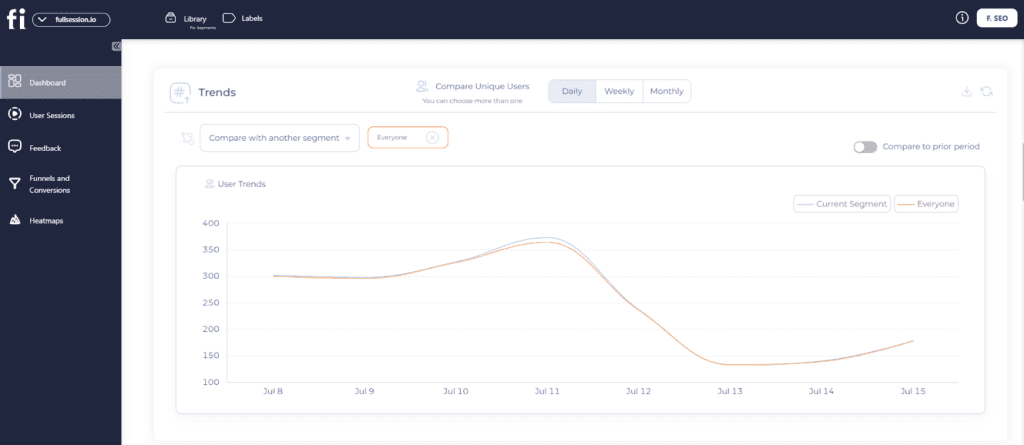
    • User trends
    • Breakdowns (based on device, browser, and screen)

    User experience

    • Event per session
    • Session length
    • Active time
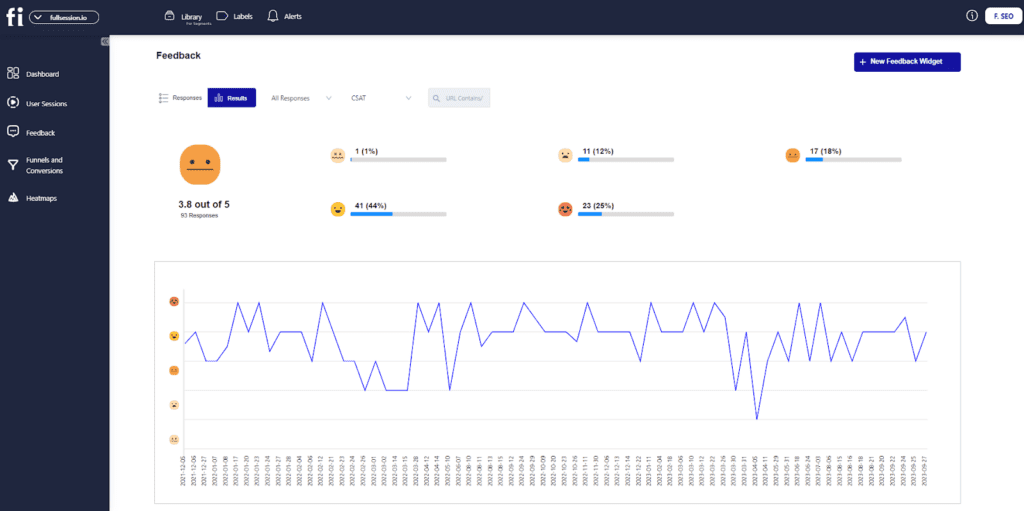
    • Feedback data
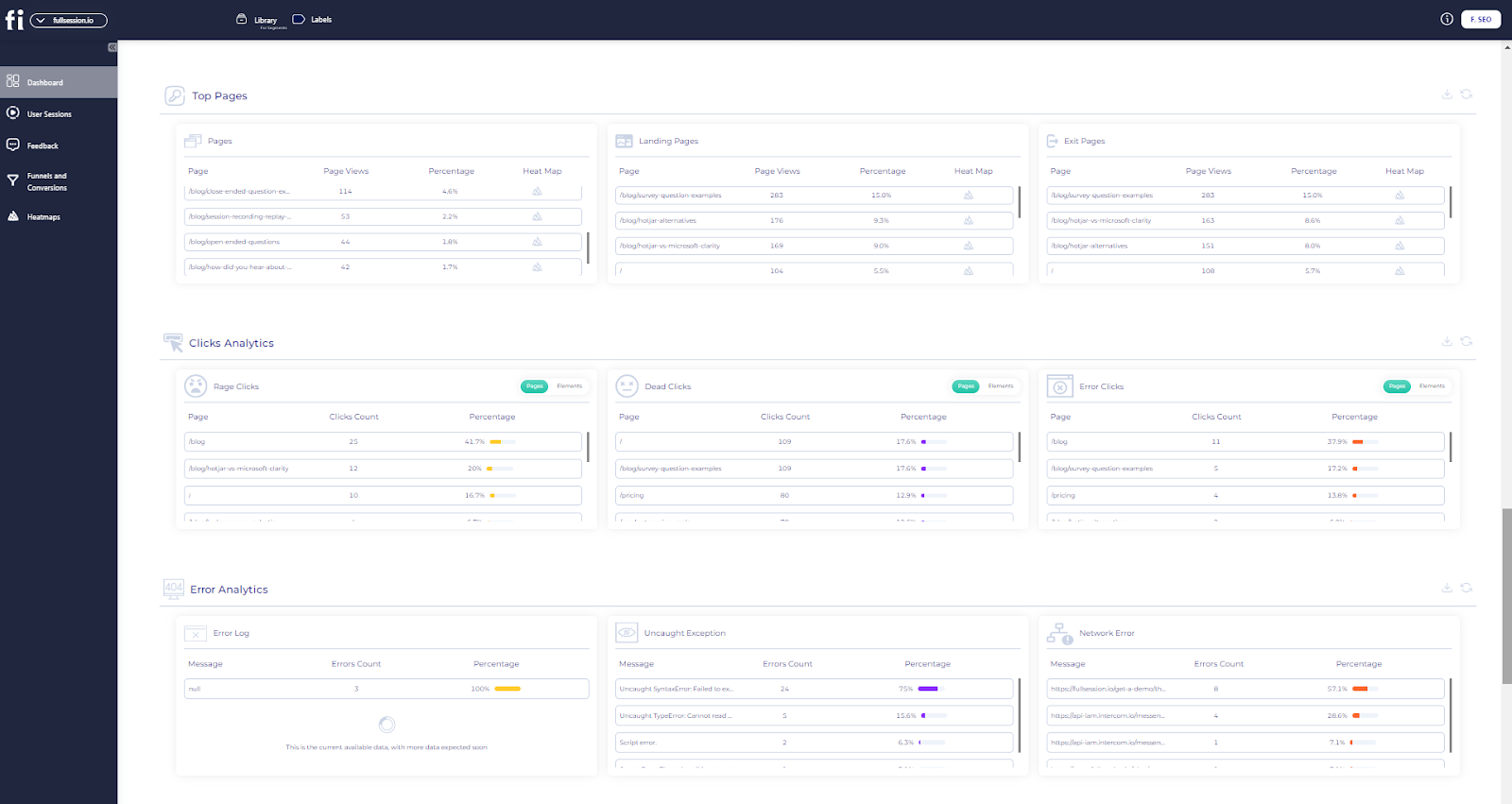
    • Top pages
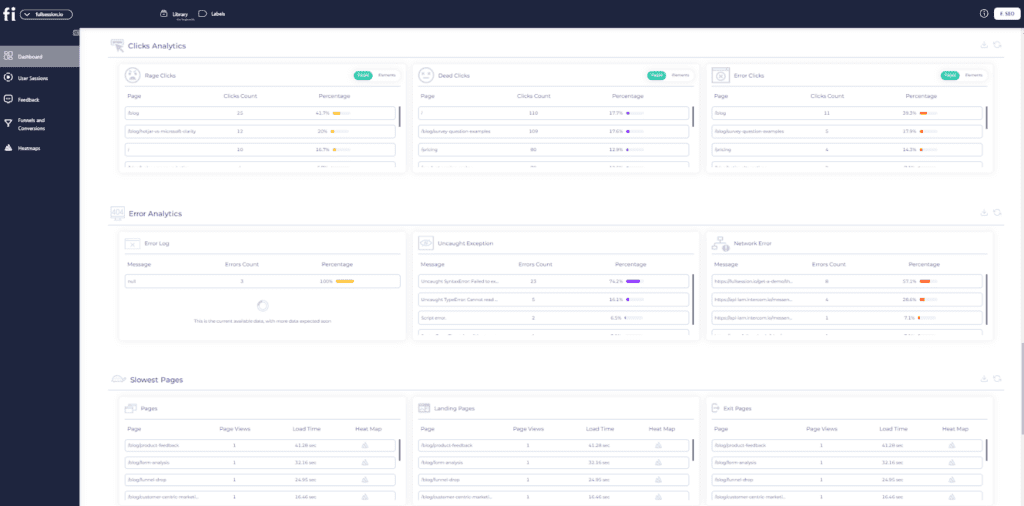
    • Clicks analytics
    • Error analytics
    • Slowest pages (pages, landing pages, and exit pages)

    Marketing channels

    • UTM analytics
    • Top referrers

    With FullSession, you can examine every metric and understand exactly what it means for your business. With data-supported insights, you’ll maintain healthy revenue growth and make smarter business decisions.

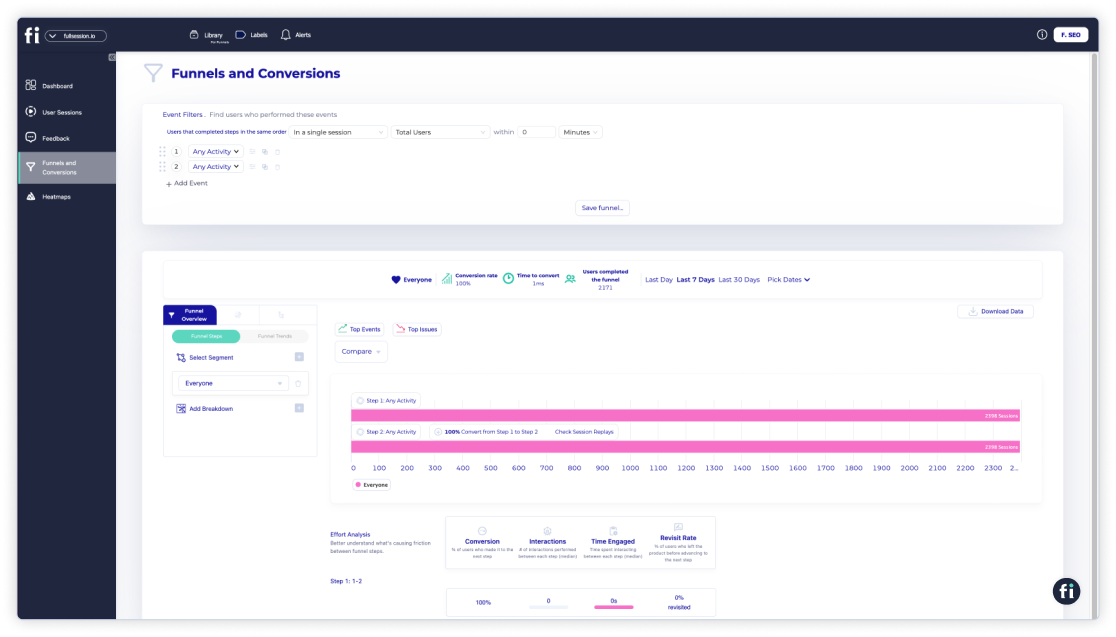
    FullSession funnels and conversions

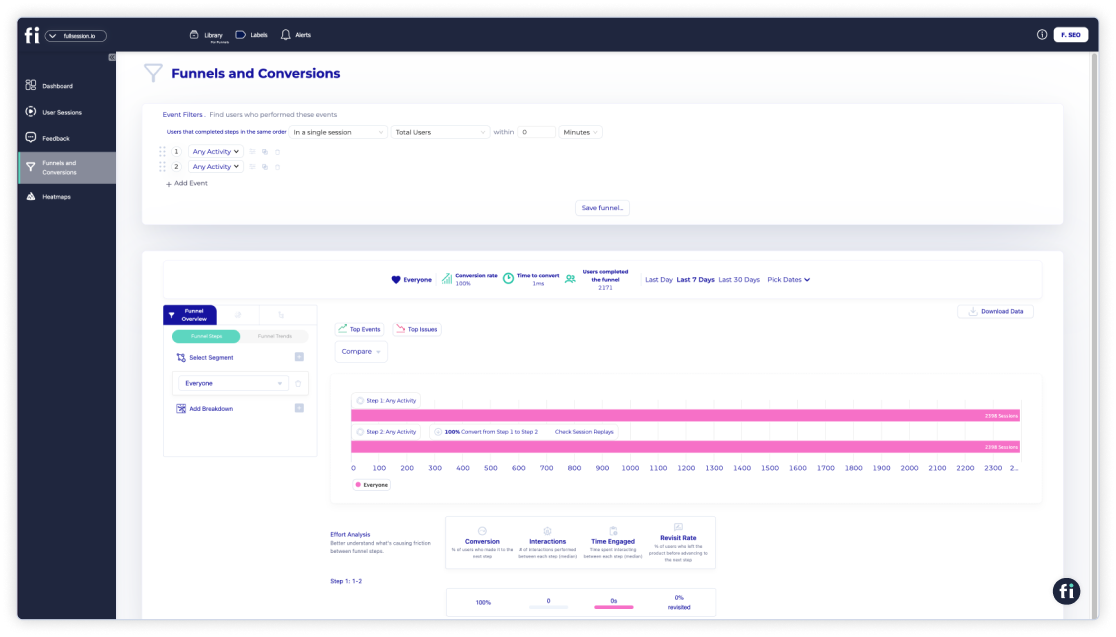
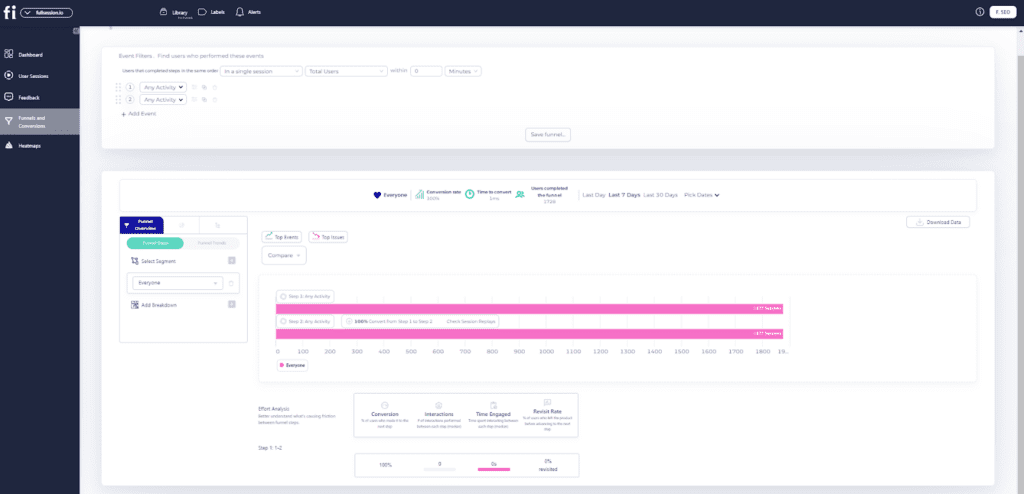
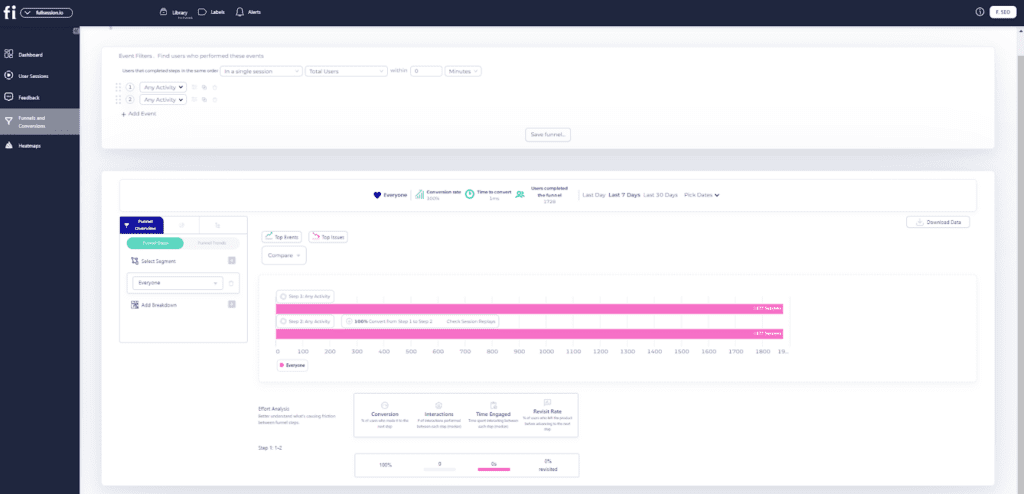
    The FullSession funnels and conversions feature provides detailed insights into user journeys, helping track and optimize each step of your conversion funnel. It visualizes user progression, monitors conversion trends, identifies key actions and obstacles, and analyzes user effort.
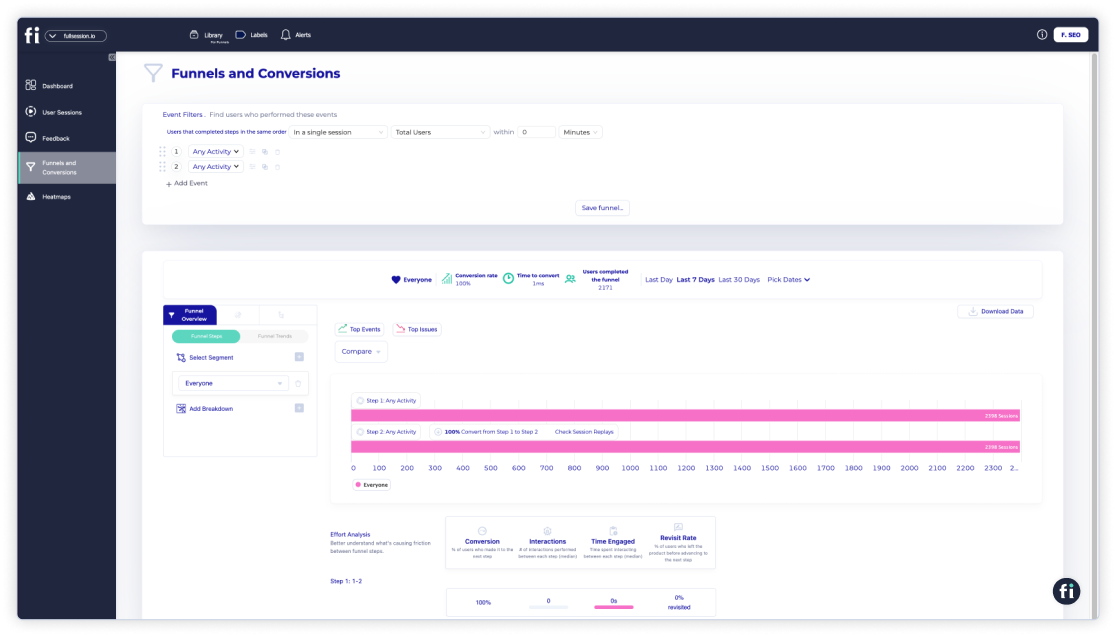
    FullSession funnels and conversions

    Segmenting user data and comparing time periods helps tailor experiences and enhance overall performance. Key components include:

    • Funnel steps
    • Funnel trends
    • Top events
    • Top issues
    • Time engaged
    • Top engaged
    • Revisit rate
    • Segment analysis
    • Time period comparison

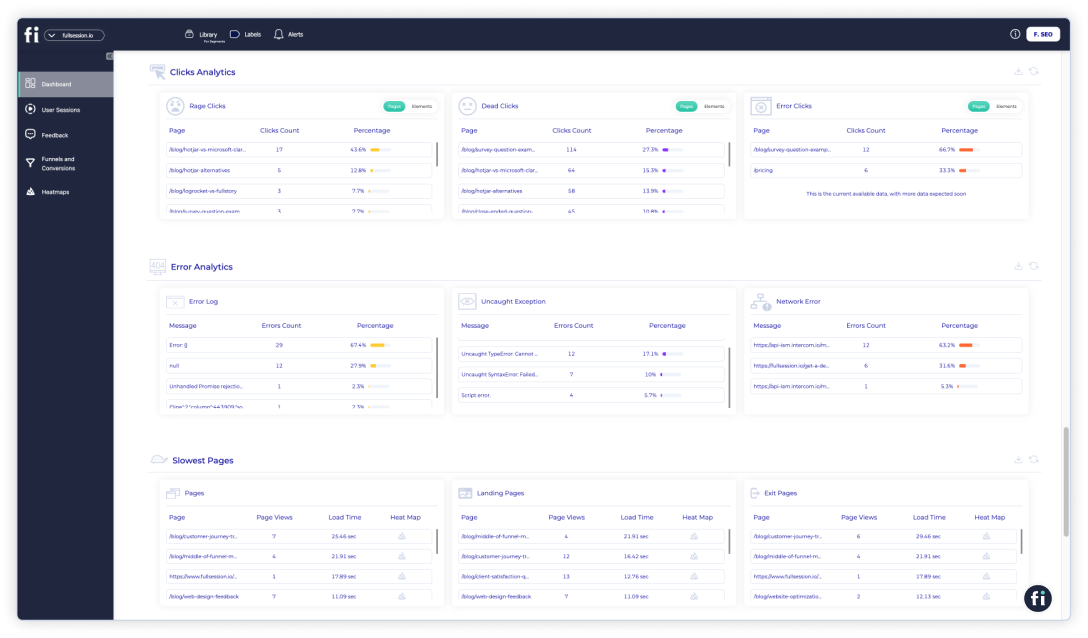
    FullSession error tracking and analysis

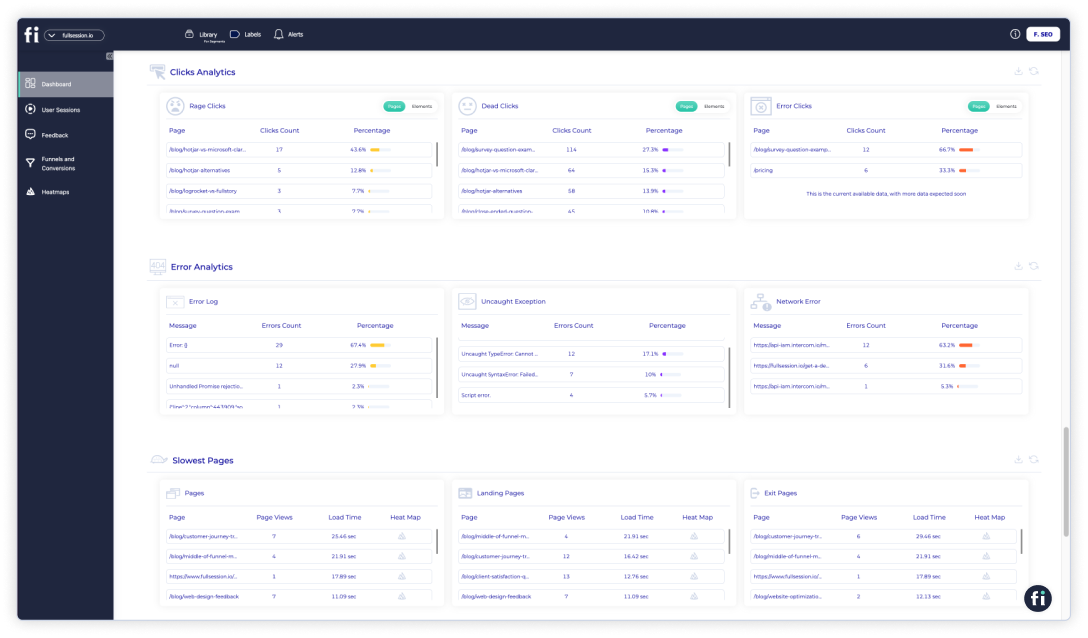
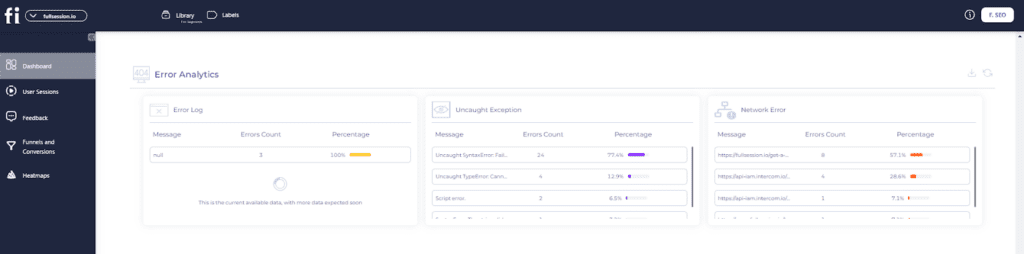
    The FullSession error analysis feature helps you identify, analyze, and resolve errors impacting user experience. By leveraging data on error clicks, network errors, console errors, error logs, and uncaught exceptions, it provides actionable insights to improve the reliability and user satisfaction of your digital products.
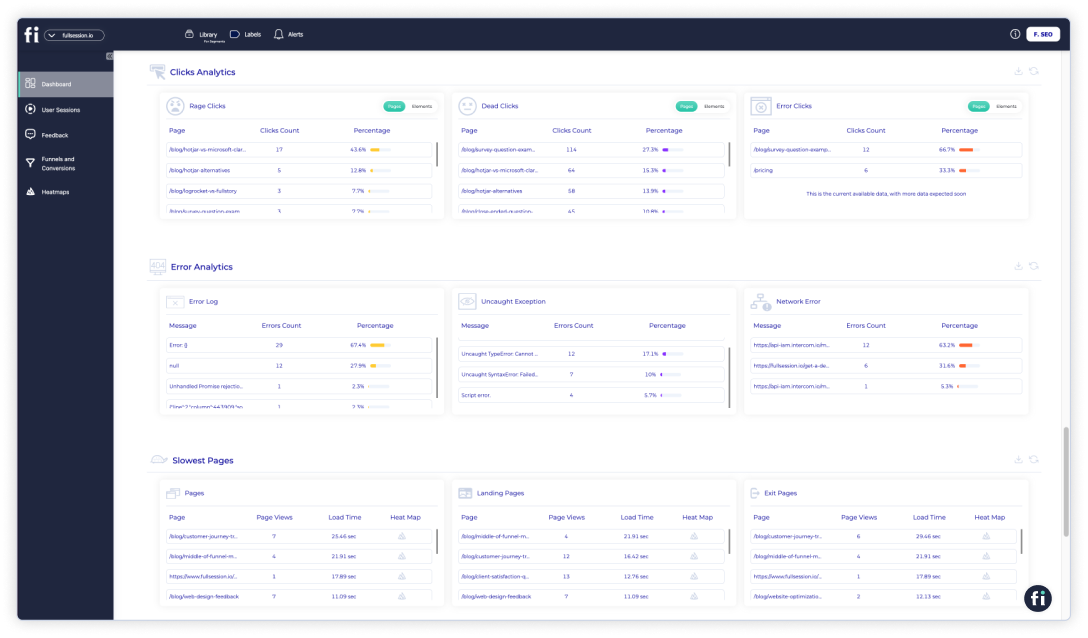
    FullSession error analysis

    This feature monitors error trends, offers segmentation and filtering, integrates with session replays for context, and provides real-time alerts via Slack, ensuring your team can swiftly address issues and enhance the overall user experience

    Start Collecting Heatmap Data With FullSession Today

    Understanding how visitors click around your website is the first step to upgrading your online presence and optimizing your user journey.

    Click maps are your secret weapon. They offer clear insights into user behavior, allowing you to make smarter decisions for your online business. 

    By analyzing click map data, you’ll uncover details that help you tweak and optimize for a smoother, more engaging user experience and better conversion rates.

    Curious to see how click maps can transform your user flow and website? Give FullSession a try! With our powerful click maps, scroll maps, and other advanced tools, you’ll get a clear picture of user behavior.

    FullSession allows you to:

    • Capture real-time interactions with dynamic elements for accurate user insights
    • Process heatmaps quickly without compromising website performance
    • Ensure user privacy by not recording sensitive information
    • Handle large volumes of data efficiently to uncover crucial insights swiftly
    • Limit behavior tracking to your own site to avoid data misuse
    • Promote seamless team collaboration by centralizing efforts on a single platform

    Book a demo today and see why FullSession is the right tool to enhance your digital experience.

    If you found this article helpful, check out our other guides on session recordings and customer feedback tools. You can also find our reviews and comparisons of Mouseflow vs VWO, LogRocket vs FullStory, LogRocket competitors and more.

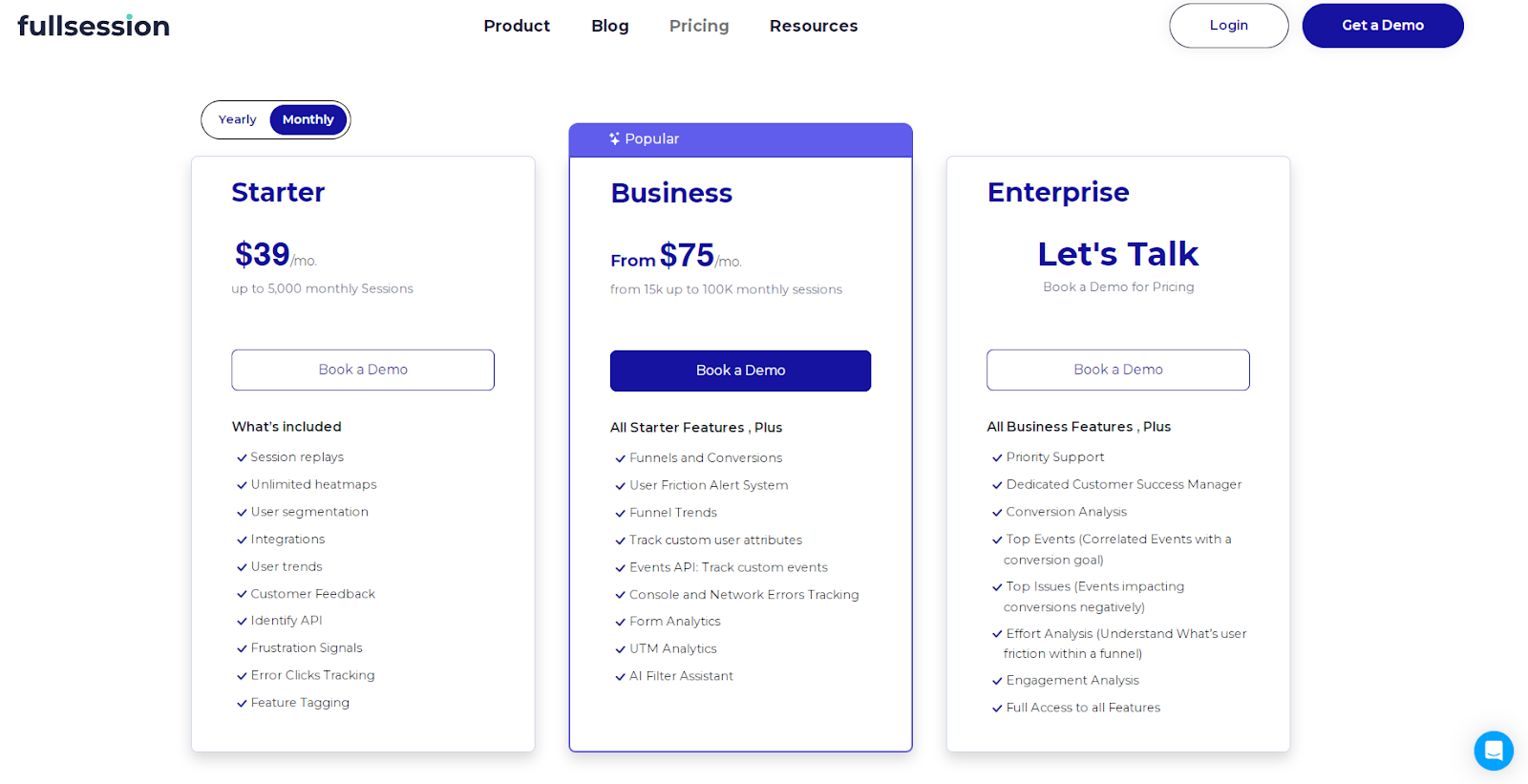
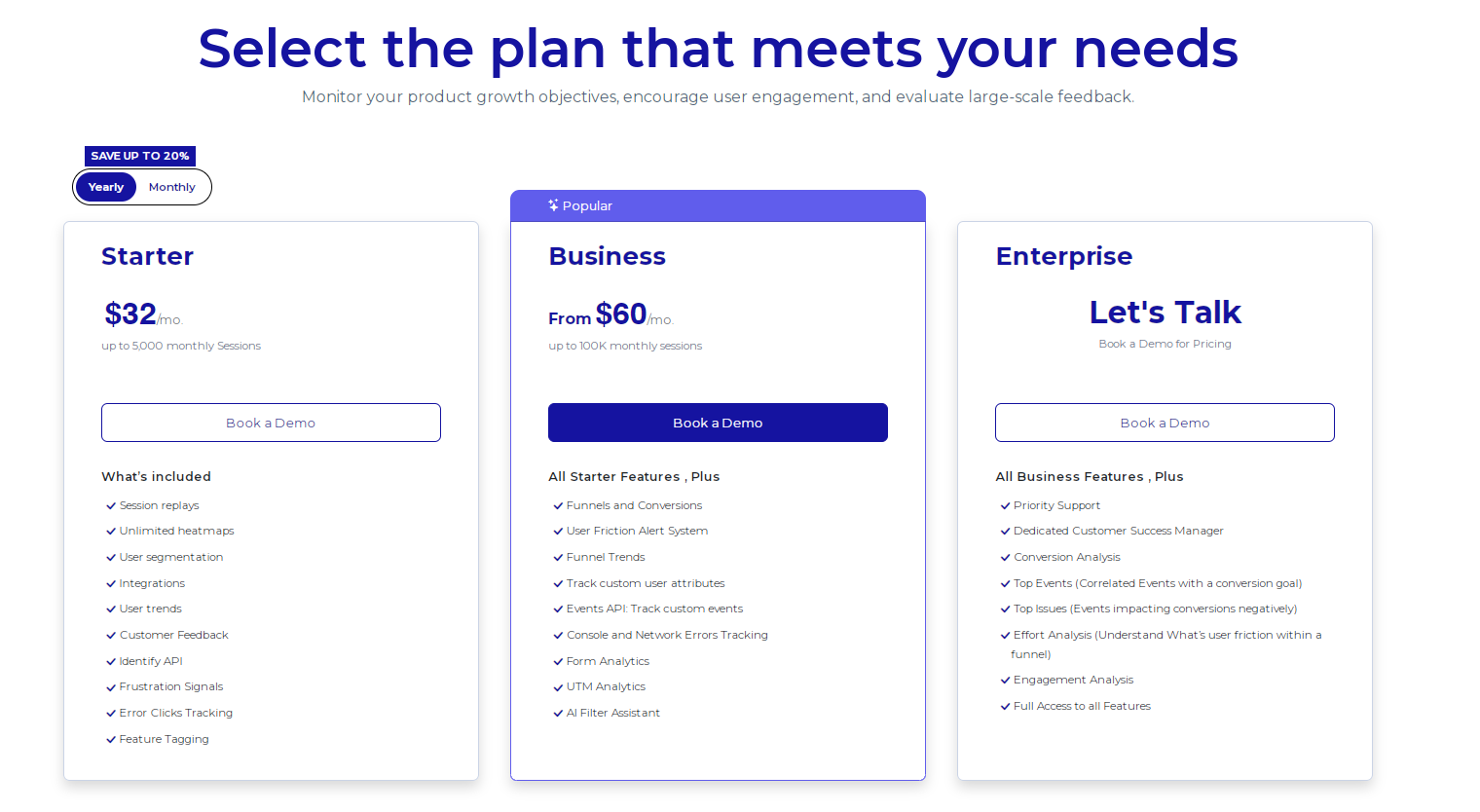
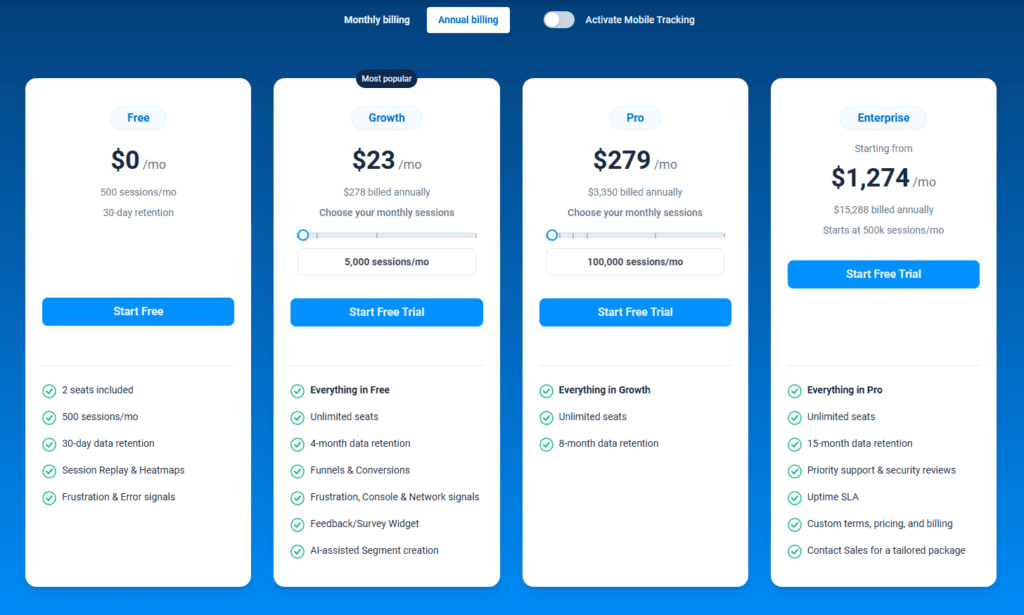
    FullSession Pricing Plans

    FullSession offers a free trial so you can test all features before subscription. The annual plan can save you up to 20%!
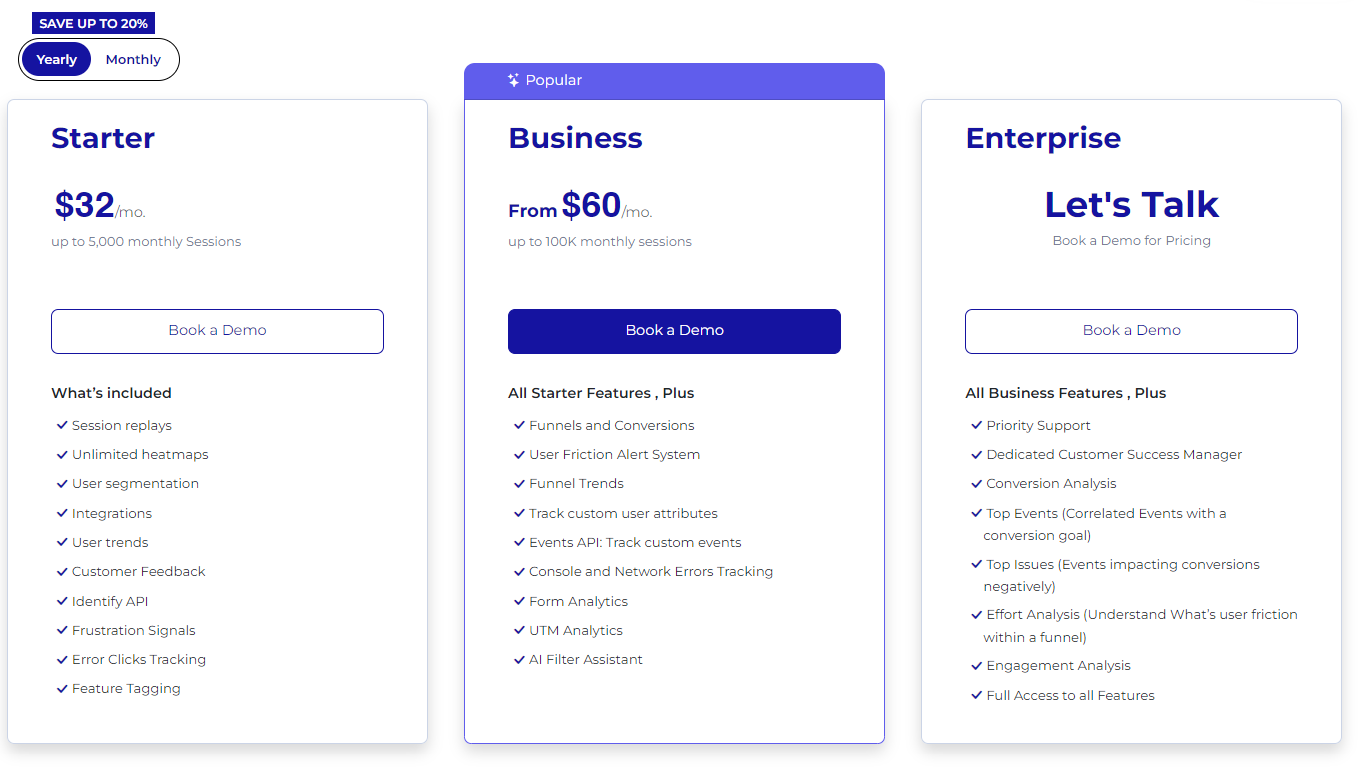
    FullSession pricing
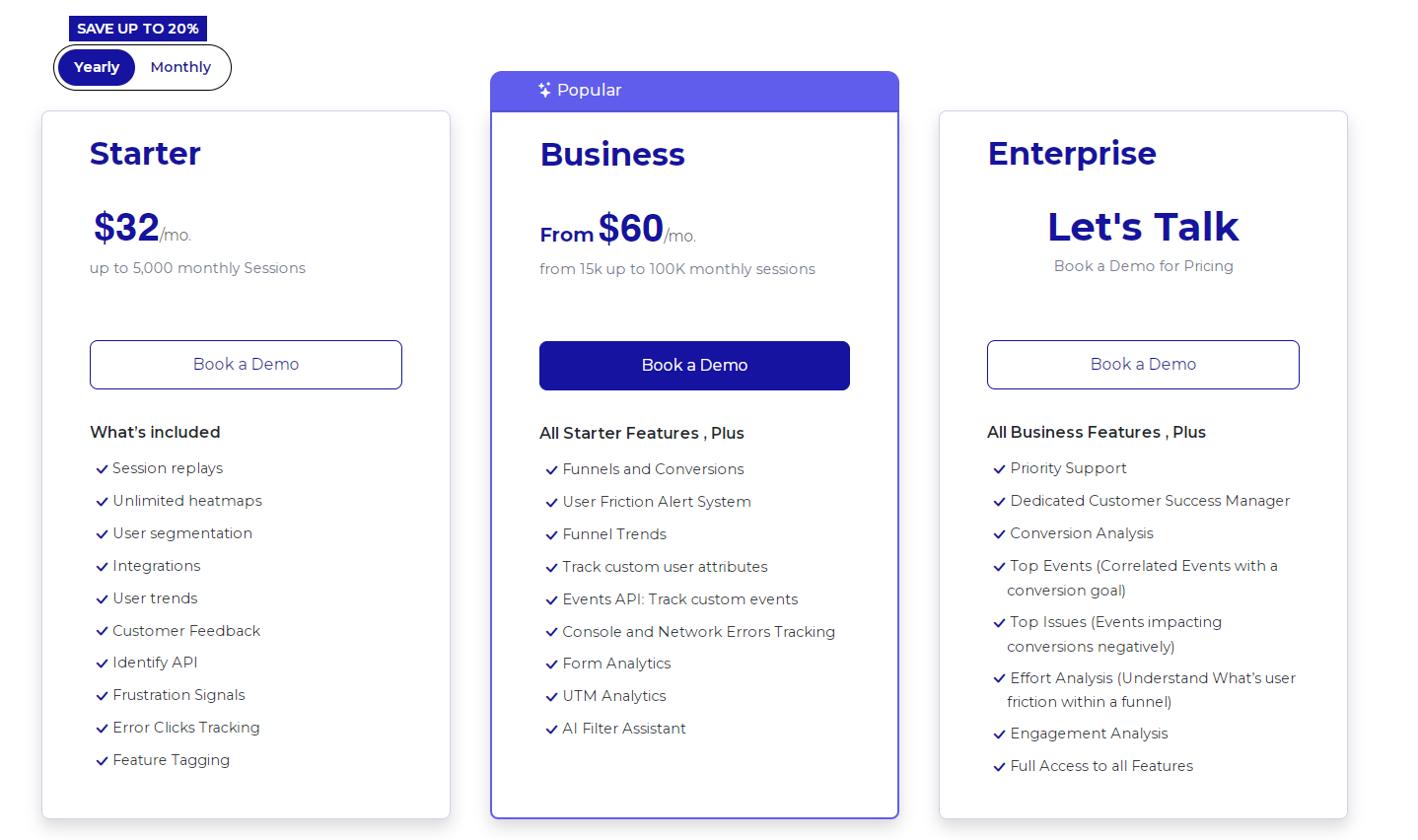
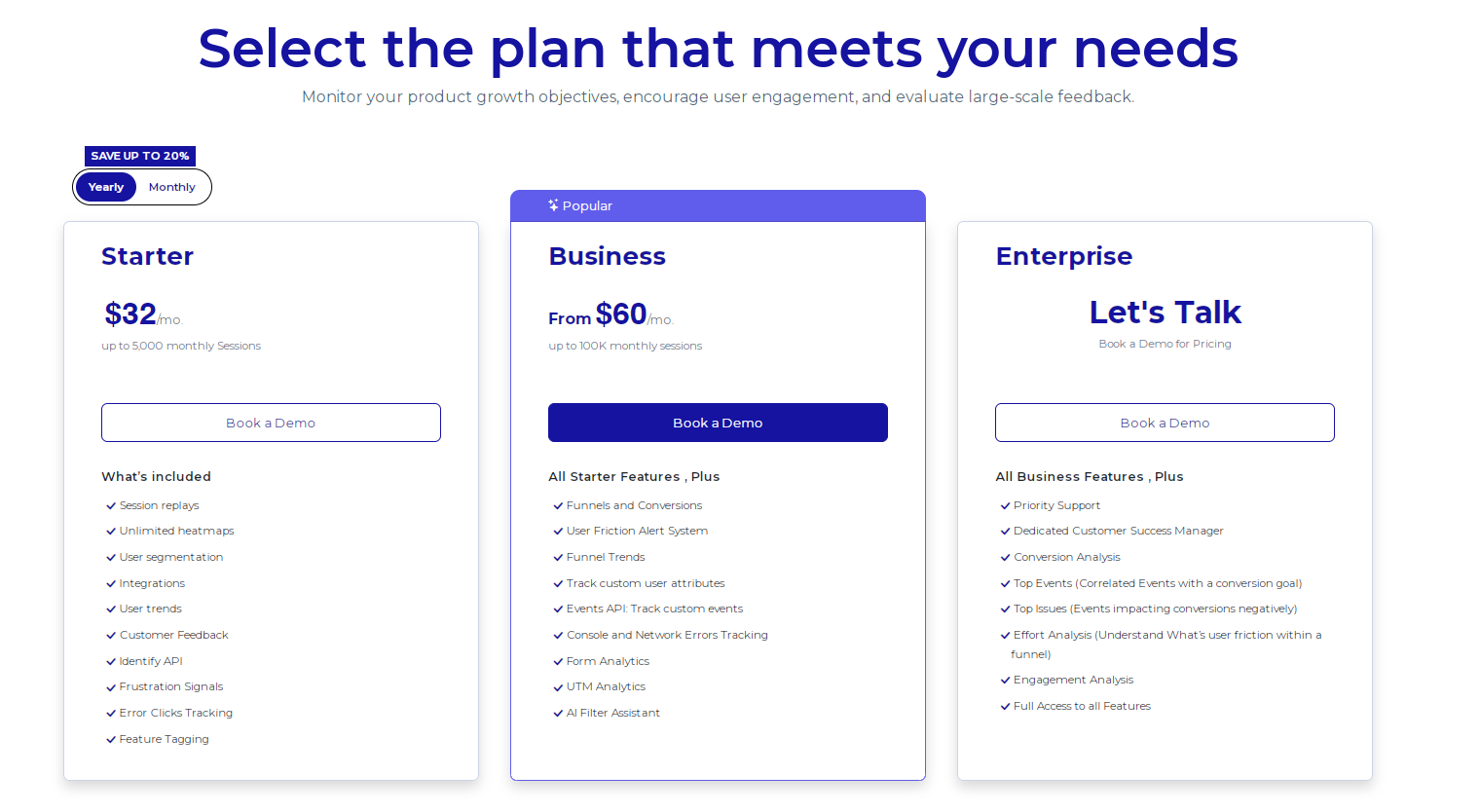
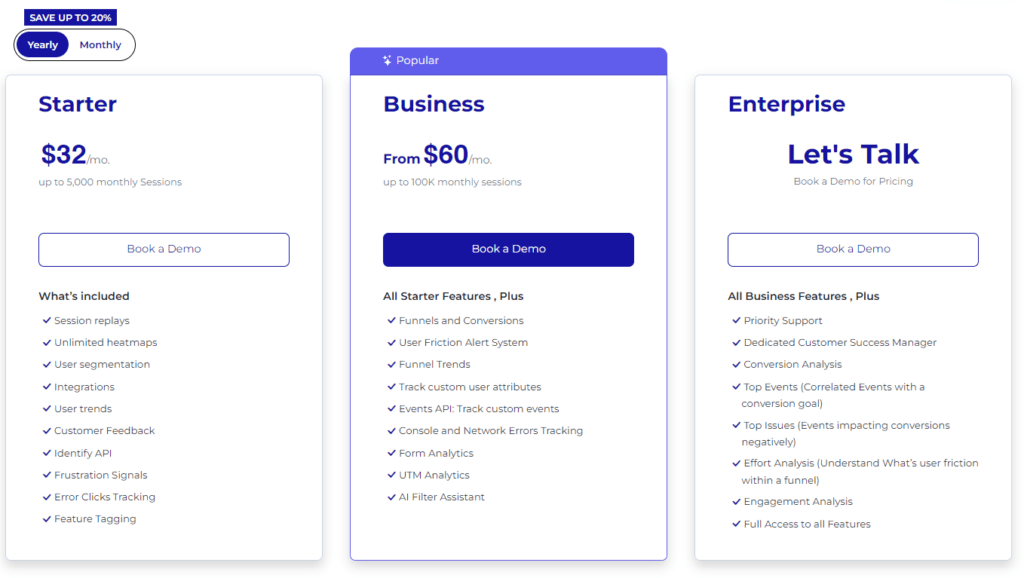
    1. The Starter plan costs $39/month or $32/year and lets you track up to 5,000 monthly sessions. 
    2. The Business plan starts at $75/month or $60/year and lets you track up to 100,000 monthly sessions.
    3. The Enterprise plan gives you full access to all features. You can book a demo for more details. 

    We also provide a customized pricing package if your business has specific website analytics needs. Check out our Pricing page.

    FAQs About Click Maps

    What are click maps?

    Click maps are visual tools that show where users click on a webpage. They highlight the most and least clicked areas, providing insights into user behavior and helping identify which elements are engaging or causing issues. They also help you track signs of frustration, such as rage clicks, a specific link that leads nowhere, or some other element that’s broken.

    How to make a click map?

    To create a click map, use a tool like Hotjar or FullSession. Integrate the website heatmap tool with your website, and it will start tracking user clicks automatically. The tool will then generate visual representations of click data, highlighting hotspots and areas with little to no interaction.

    How much is a click on a map?

    The cost of using click maps depends on the analytics tool you choose. Tools like FullSession typically offer tiered pricing plans based on the volume of tracked sessions or features included. Prices can range from free for basic plans to several hundred dollars per month for advanced features and higher usage limits.

    How are clicks tracked?

    You can track clicks by embedding a tracking code or script from an analytics tool like FullSession into your website. This code captures user interactions, including clicks, and sends the data to the tool’s servers, where it is processed and visualized in the form of click maps and other analytics reports.
  • Mouseflow vs VWO: Decide the Best for Your Needs

    Mouseflow vs VWO: Decide the Best for Your Needs

    Choosing the right website optimization tools can make or break your digital success. Mouseflow vs VWO are two popular business tools that promise to boost your website’s performance, but they approach the task from different angles.

    Mouseflow provides session replays and heatmaps, allowing you to watch how visitors interact with your site, while VWO focuses on A/B and multivariate testing to help you increase conversions by trying out various user interface elements.

    However, as you weigh your options, consider FullSession as a potential alternative.

    FullSession combines the best features of Mouseflow and VWO, offering a comprehensive suite of user behavior tools designed to help you optimize your website performance. 

    With FullSession, you can use session recordings and replays, interactive heatmaps, customer feedback forms and reports, conversion and funnel optimization tools, and error tracking, all in one platform.

    Start a free trial to see how it works. We’ll show you each step of the process.

    This Mouseflow vs WVO comparison will showcase the strengths and weaknesses of these products and explain how FullSession powers exponential business results. 

    Let’s begin.

    What Is FullSession?

    FullSession user behavior software

    FullSession is user behavior analytics software that captures all customer interactions on your website. It helps you precisely analyze trends and patterns in user behavior and optimize your site for peak performance.

    With FullSession, you can forget about sifting through numbers. Our platform provides real-time visual insights that simplify the analysis and interpretation of complex user behavior data, supporting more effective and informed decision-making.

    Get a demo now.

    What features does FullSession provide?

    Real-time session recordings and replays

    Real-time session recordings and replays to capture every aspect of the user journey.

    It provides you with the following data:

    • User location and IP address
    • Clicked URL
    • Referrals
    • Visited pages
    • Average time on page
    • Total active time on pages
    • Session list
    • Session event

    Read our article to learn more about session recording and replay tools.

    Interactive click, scroll and mouse movement heatmaps

    Interactive click, scroll and mouse movement heatmaps to track dynamic elements and optimize website interface, usability and performance.

    You can: 

    • Preview the heatmap on different devices
    • See the URL the user visited
    • Track clicks and see the number of total views and total clicks
    • See the error, rage, and dead clicks
    • Get the average load time on page
    • Get the average time on page
    • See the number of users that visited the page

    Read our article to learn more about website heatmap tools.

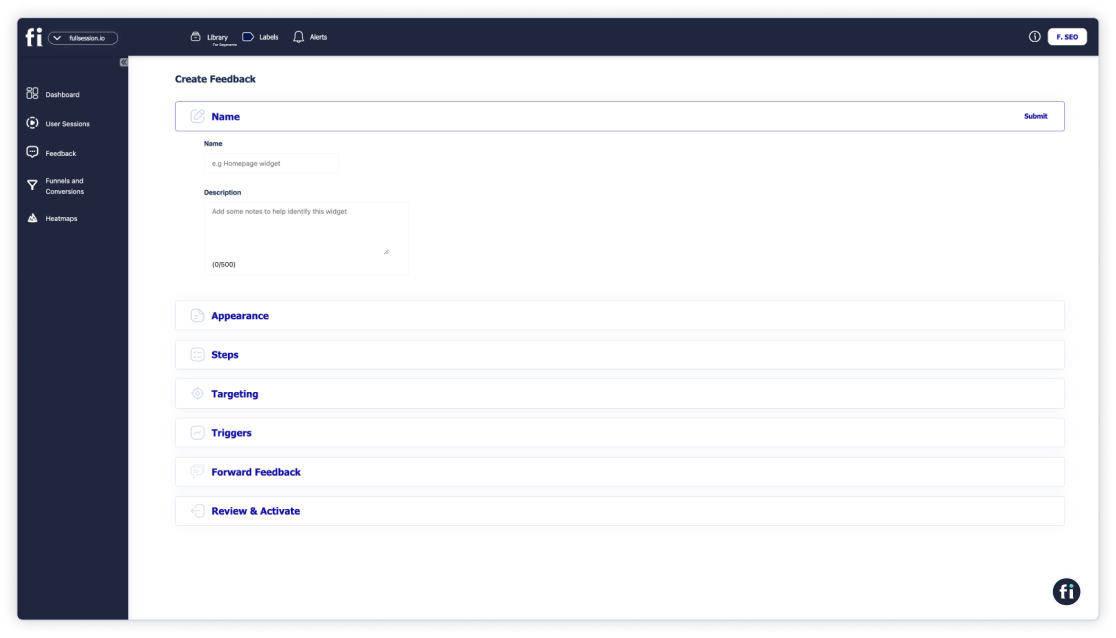
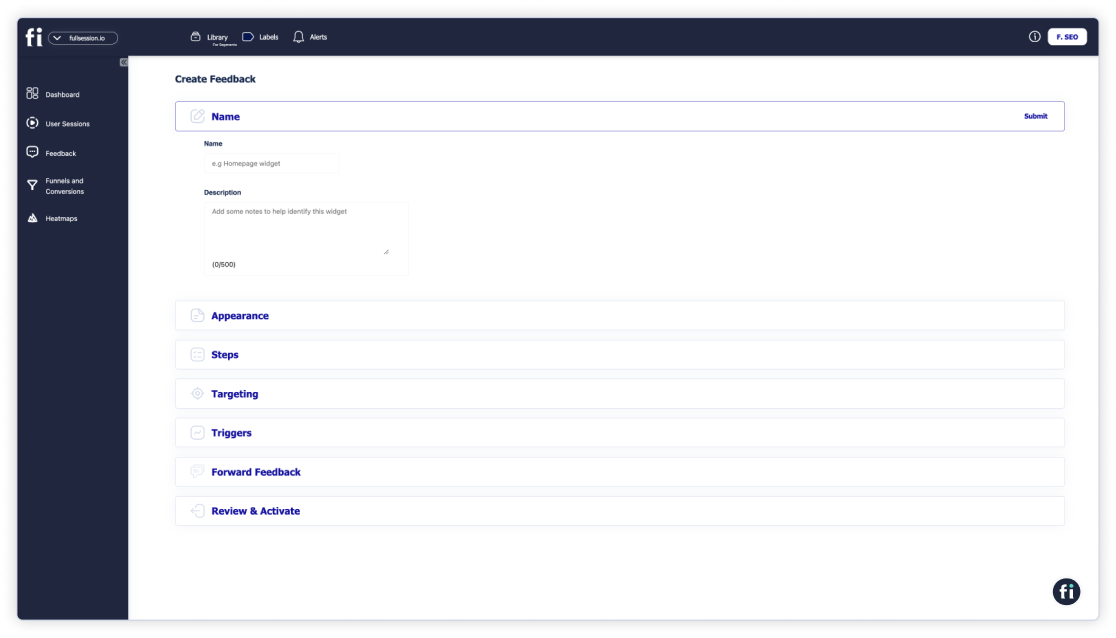
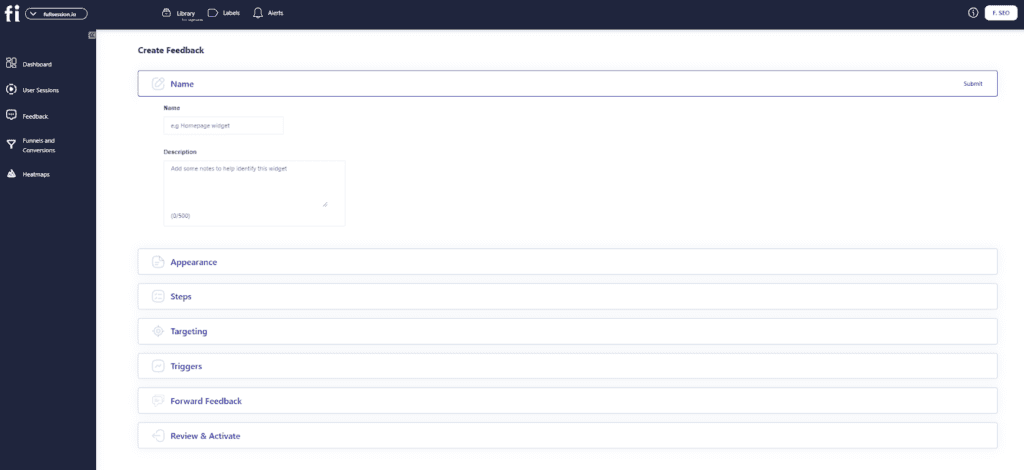
    Customer feedback forms and reports

    Customer feedback forms and reports to understand the reasons behind user issues and frustrations.

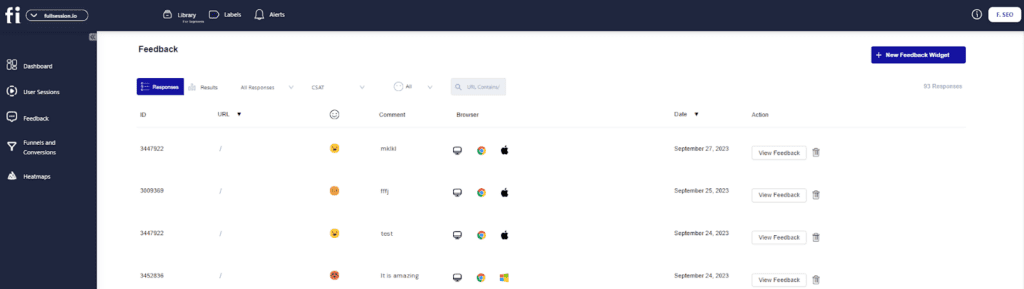
    The website feedback form lets you ask users what they feel and think about their digital experience in real time. You also get access to the customer feedback report, which shows the user ID, URL, comment the user left, device type, and feedback date.

    FullSession also goes one step further – each feedback is connected to the user’s session recording, so you can watch what happened to better understand their comments.

    Conversion and funnel optimization tools

    Conversion and funnel optimization tools to reduce drop-offs in your marketing and sales funnels.

    With this feature, you can track:

    • Funnel steps: Visualize user progression and conversion rates.
    • Funnel trends: Track changes in user flows and conversion rates over time.
    • Top events: Identify actions that boost conversions.
    • Top issues: Spot obstacles reducing conversions and fix them.
    • Time engaged: Measure interaction time to detect user frustration.
    • Top engaged: Improve the most engaging funnel steps.
    • Revisit rate: Track and reduce exits before advancing.
    • Segment analysis: Compare performance across user segments.
    • Time period comparison: Analyze performance trends over different periods.
    Website error tracking

    Website error tracking to find and fix issues that stop people from converting.

    It provides the following capabilities:

    1. Error clicks: Detects non-responsive elements and fixes JavaScript errors.
    2. Network errors: Monitors and resolves server request failures.
    3. Console errors: Logs and analyzes JavaScript errors for fixes.
    4. Error logs: Captures detailed error information for debugging.
    5. Uncaught exceptions: Handles critical errors to prevent crashes.
    6. Error trends and segmentation: Visualizes error data and trends.
    7. Alerts and notifications: Sends real-time error alerts via Slack.

    Get a demo to see how it works.

    What Makes FullSession Stand Out From Mouse and VWO

    FullSession consolidates all this data into a user-friendly dashboard and provides visual reports to streamline your analysis. It makes it easy to quickly identify and solve customer experience issues that block your website growth.

    It also helps you:

    1. Track dynamic elements in real time for precise user insights
    2. Accelerate heatmap processing with zero impact on site speed
    3. Protect user privacy by excluding sensitive data recording
    4. Manage extensive data sets effectively and quickly reveal key insights
    5. Limit user behavior tracking to your site, preventing data misuse 
    6. Facilitate cross-team collaboration and unify team efforts on one platform

    We prioritize your users’ privacy above all else and comply with GDPR, CCPA, and PCI standards.

    FullSession Pricing

    FullSession pricing

    The pricing starts at $39 per month for up to 5,000 monthly sessions, making it an affordable solution for businesses on a budget. What’s best, you can save up to 20% with annual plans.

    Feel free to schedule a demo! We’ll show you how everything works before you make your decision. 

    Mouseflow vs VWO: How They Compare and Contrast

    Since we explained how FullSession optimizes your website performance, let’s look closely at Mouseflow and VWO

    We’ll compare these tools, highlight their strengths and weaknesses, and explain why FullSession could be a more suitable software company for your needs, helping you make a well-informed choice.

    Mouseflow vs VWO: Primary purpose

    Mouseflow and VWO serve different purposes in website optimization.

    Mouseflow focuses on behavior analytics. It uses heatmaps and session replays to show how visitors interact with your website.

    VWO, on the other hand, is primarily an A/B testing platform. It allows you to create and run experiments on your website and test different versions of your pages to see which performs better.

    FullSession combines the best features of both tools.

    This all-in-one approach makes FullSession a versatile choice for businesses looking to improve their online presence with behavioral insights and advanced testing capabilities.

    Mouseflow vs VWO: User rating

    Mouseflow and VWO have received feedback from hundreds of users, providing a snapshot of their satisfaction.

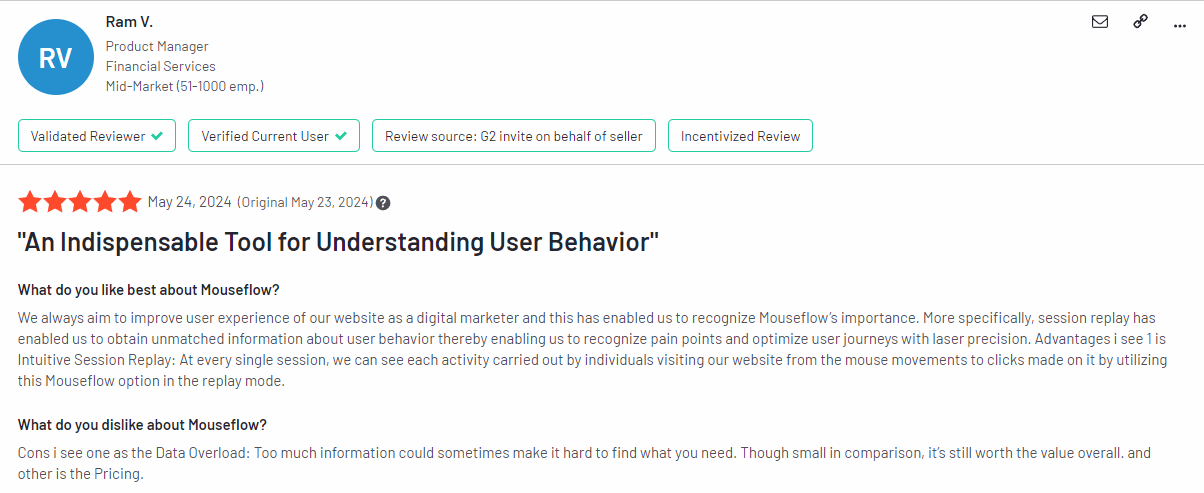
    Mouseflow vs VWO user reviews

    Image source: G2

    Mouseflow has a rating of 4.6 out of 5 on G2, based on 617 reviews. However, users have raised concerns about the pricing structure, credit usage, and data overload. 

    They also mention issues with the user interface and learning curve and note that behavioral data is not always 100% correct.

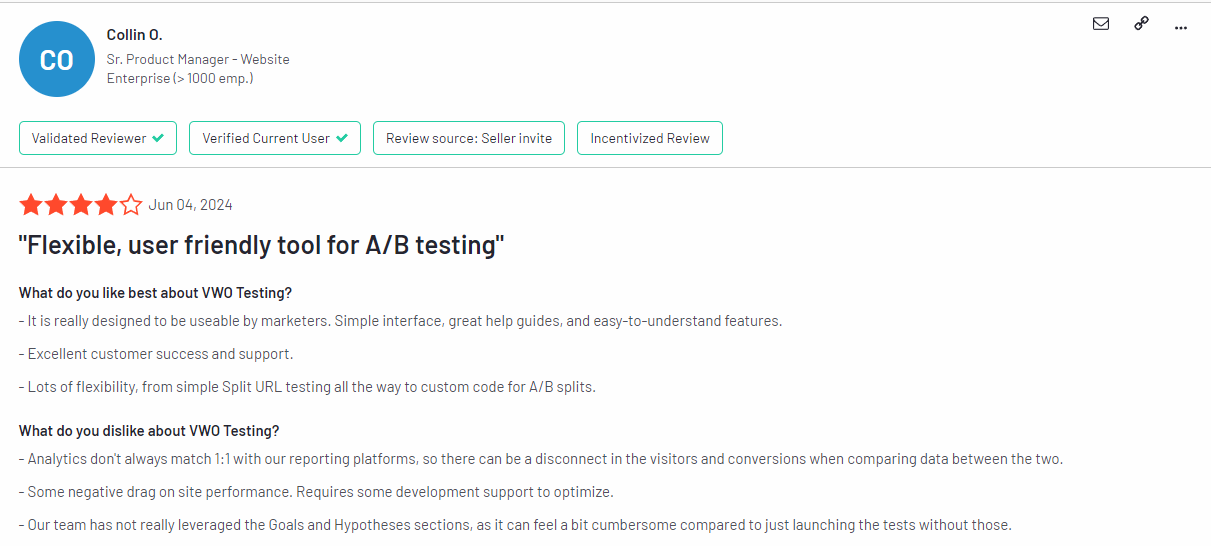
    Mouseflow vs VWO user reviews

    Image source: G2

    VWO rating is slightly lower, at 4.3 out of 5 from 630 reviews on G2. While still positive, this indicates that users may have found some areas for improvement.

    For example, users have reported that the visual editor can be unreliable, analytics may not always match data from other reporting tools, the dashboard looks outdated, and accessing all desired features may require purchasing several different products on this platform.

    Mouseflow vs VWO vs FullSession: Key features comparison

    FullSession, Mouseflow and VWO offer different strengths in web analytics and optimization. Let’s compare their key features.

    FeatureFullSessionMouseflowVWO
    Real-time trackingYesYesYes
    Custom eventsYesYesYes
    Session recordings and replaysYesYesYes
    Dynamic heatmapsYesYesYes
    A/B testingYesNoYes
    Conversion funnel analysisYesYesYes
    Customer feedback toolsYesYesYes
    Form analyticsYesYesYes
    Form popup triggersYesYesYes
    Error trackingYesYesNo
    API integrationsYesYesYes
    Privacy and securityGDPR, CCPA and PCIGDPR and CCPAGDPR and CCPA
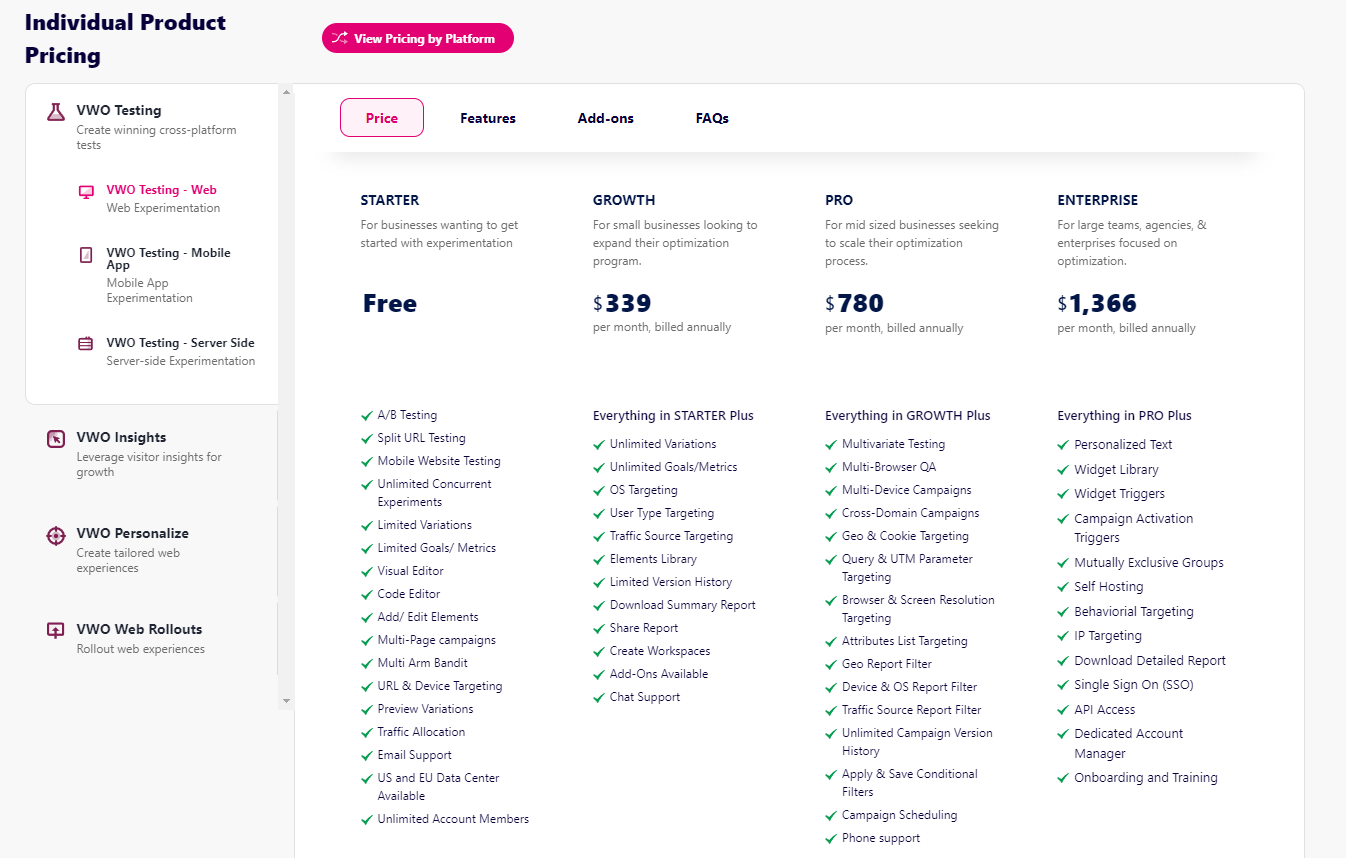
    PricingStarts at $39 per month for 5,000 sessionsStarts at $42 per month for 5,000 sessionsStarts at $339 per month for VWO Testing

    FullSession stands out with its modern interface and comprehensive feature set.

    It helps you track dynamic elements in real time, get instant heat map data, protect user privacy, manage extensive datasets efficiently, prevent data misuse and enjoy a robust remote collaboration tool all in one place.

    Want to learn more? Get a demo today!

    Mouseflow vs VWO: Best for

    Mouseflow is for small to medium-sized businesses looking for detailed user behavior insights. It helps with qualitative analysis by letting you observe real user sessions.

    VWO is suitable for larger enterprises focused on A/B testing and conversion optimization. It provides more quantitative analytics data, which is useful for statistical analysis of user behavior.

    FullSession is suitable for all types of businesses. It provides quantitative and qualitative data, combining the best features of Mouseflow and VWO to capture a holistic view of user behavior during the entire customer journey.

    Mouseflow vs VWO: Setup process

    Setting up Mouseflow and VWO is quite different.

    Mouseflow offers a simple setup. You just need to add a small piece of code to your website. This code starts tracking visitor behavior right away.

    VWO’s setup is more complex. It requires extra steps to get all features working properly, and you might need some technical know-how to set it up correctly. You’ll need to set up each feature individually. It gives you more control but requires more time and effort.

    FullSession’s setup is straightforward:

    • Register your account
    • Add website details
    • Add script to your site
    • Start recording visitor behavior

    No developer skills are required—setup takes just minutes, making our user behavior analytics solution accessible to everyone.

    Mouseflow vs VWO: Integrations

    Mouseflow integrates with many tools, including eCommerce platforms, analytics suites, and A/B testing tools. This flexibility allows you to easily connect Mouseflow with your existing tech stack.

    VWO also provides integrations, but its options may be more limited than those of Mouseflow. Both tools offer API access, enabling you to create custom integrations if needed.

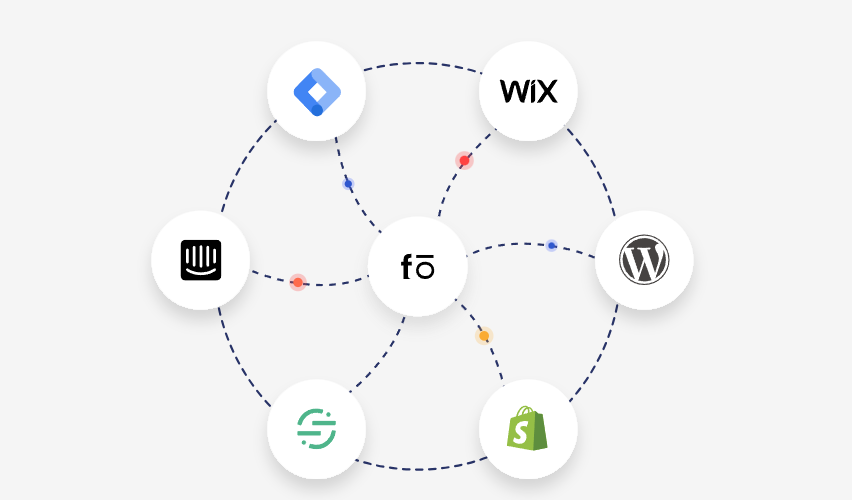
    Mouseflow vs VWO integrations

    FullSession works with all the go-to-market tools your team already uses, including Open APIs, native integrations, and modern webhooks.

    For mobile and desktop compatibility, all three platforms allow you to track user behavior on multiple devices simultaneously.

    Mouseflow vs VWO: Security and compliance

    Mouseflow uses encrypted connections to protect your information and offers options to mask sensitive data, keeping your users’ details safe.

    VWO also emphasizes security measures and provides SSL encryption and secure data storage. It allows you to control data retention periods, giving you more flexibility in managing user information.

    Data collection practices differ slightly between the two. Mouseflow offers continuous recording on all plans, while VWO may use sampling depending on your subscription level.

    Both tools comply with major data protection regulations, including GDPR and CCPA.

    However, FullSession is GDPR and CCPA-compliant and offers the benefit of PCI compliance. It ensures payment card data security, protecting critical business processes and customers from data breaches and fraud. 

    Mouseflow vs VWO: Support

    Mouseflow provides support through its dedicated 24/7 team. You can reach out via email or chat for assistance.

    VWO also offers customer support, but the availability may vary depending on your plan. They typically provide email support, with phone and chat options for higher-tier plans.

    Neither Mouseflow nor VWO currently offer community feedback tools. For quick help, both platforms have knowledge bases and documentation.

    FullSession offers support via email and chat. The team responds promptly to inquiries. It also gives you access to helpful guides.

    Mouseflow vs VWO: Pricing

    Mouseflow vs VWO pricing

    Mouseflow provides a free trial to test the tool before committing to one of four paid plans. Each plan differs by the number of monthly sessions, website projects and data storage. The lowest plan starts at $42 monthly for one project, three months of storage and 5,000 sessions per month.

    Mouseflow vs VWO pricing

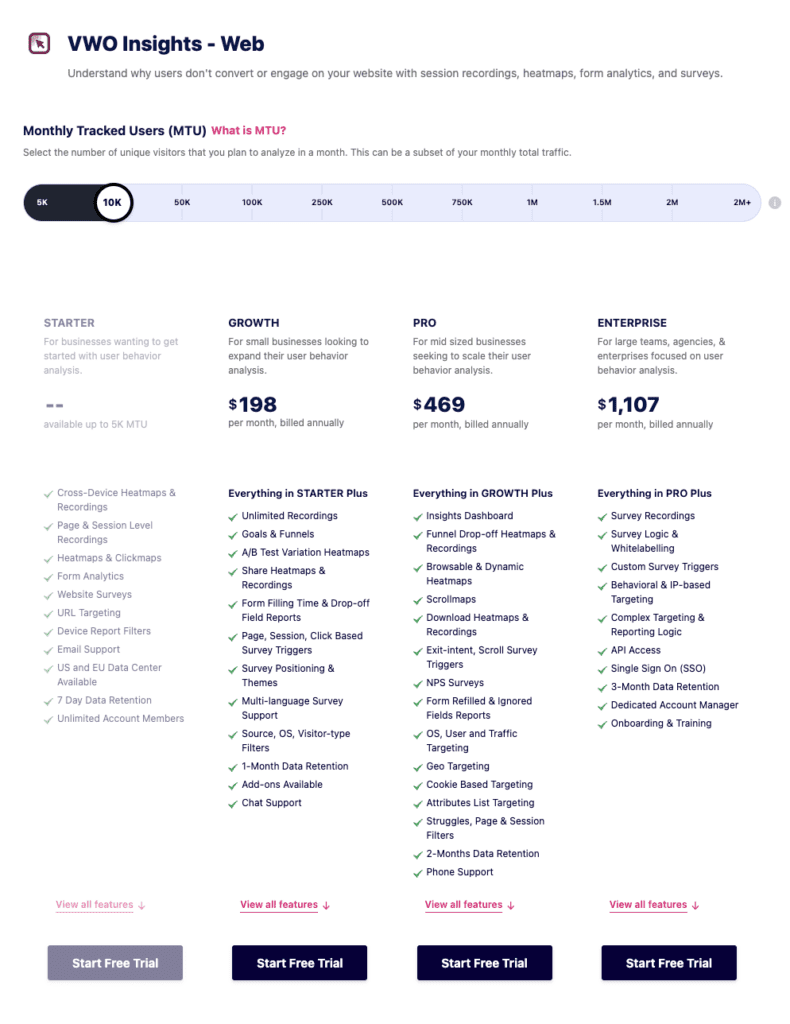
    VWO offers a free trial and modular pricing plans. This means you need to purchase each feature pack separately. The monthly pricing for the VWO Testing Web Package depends on the number of tracked users, starting at $190 per month and billed annually. Advanced features are available in the higher plans.

    Mouseflow’s plans are generally more budget-friendly for small businesses. VWO’s higher price point reflects its focus on enterprise-level features.

    FullSession, on the other hand, provides three paid plans based on the number of monthly sessions. If you pay annually, you get a 20% discount on all pricing plans.

    The Starter plan costs $39/month for up to 5,000 monthly sessions and includes all basic features such as session replays, unlimited heatmaps, customer feedback tools and error tracking.

    The Business plan, which costs $75/month and allows up to 100K monthly sessions, includes funnel, form and conversion optimization tools as well as UTM analytics. The last one helps your sales and marketing teams with marketing data management, supports campaign measurement and enables them to understand buyer intent data to optimize their efforts.

    The Enterprise plan includes priority support, a dedicated customer success manager and full access to all features.

    Book a demo to learn more.

    Why Choose FullSession

    FullSession provides a secure data foundation for website analytics, enabling you to track user interactions with dynamic elements on your site in real time.

    This real-time tracking offers more accurate insights into user behavior and supports incremental measurement disciplines, ensuring you gather valuable data without being overwhelmed.

    Additionally, our platform seamlessly processes large volumes of data, helping you uncover important insights from your analytics data.

    FullSession instantly processes heatmaps, so your website’s loading speeds remain fast and unaffected. It is crucial for maintaining visitor engagement and ensuring a smooth user experience.

    Privacy is paramount with FullSession. You can exclude recording sensitive data and safeguard your users’ personal information.

    FullSession collects user behavior data exclusively on your website. It prevents recording user activities elsewhere online, maintaining the integrity and security of your information.

    Our platform also facilitates team collaboration by bringing your whole team together in one place. Different departments can use our analytics tools collectively, leveraging the software development kits provided for improved functionality and integration.

    By choosing FullSession, you can access powerful tools that help you better understand your users, optimize your site and boost conversions through insightful, real-time data.

    Get a demo now.

    Final Words About Mouseflow vs VWO vs FullSession

    Mouseflow and VWO are both valuable tools for improving your website. They have different strengths to help your business grow.

    Mouseflow is great for watching how users interact with your site. It provides heatmaps and session replays that show exactly what visitors do on your pages.

    VWO provides A/B testing and conversion optimization features. It lets you try different versions of your site to see what works best. It can help you boost sales and sign-ups.

    Your choice depends on what you need most. 

    Some businesses use both tools together. It gives them a complete picture of their website’s performance and ways to improve it.

    However, FullSession provides an all-in-one user behavior analytics platform that combines key features of Mouseflow and VWO.

    Why pay for separate tools when you can get everything you need in one place?

    Start your journey with FullSession. Book a demo today.

    FAQs About Mouseflow vs VWO

    Let’s explore some key questions about these platforms to help you make an informed decision.

    What are the benefits of Mouseflow?

    Mouseflow, one of the first mobile measurement partners, continuously records user sessions without sampling, giving you a complete picture of visitor behavior. 

    The platform’s heat maps help you visualize where users click, move, and scroll on your pages to guide design decisions and improve user experience.

    Mouseflow’s funnel analysis tool lets you track user paths through your site. You can identify drop-off points and optimize conversion rates.

    You can create digital forms to see how users interact with them. It can streamline form design and reduce abandonment rates.

    Is Mouseflow any good?

    Mouseflow has received positive reviews from many users. It scores 4.6 out of 5 on G2 based on user ratings, indicating high satisfaction. You can check out Hotjar vs Microsoft Clarity or Hotjar alternatives to evaluate competitors.

    What is the difference between Mouseflow and Clarity?

    Mouseflow provides more detailed analytics tools, including funnel and form analysis.

    Clarity is a Microsoft product that integrates well with other Microsoft tools. It’s also free, which can be attractive for small businesses or those on a tight budget.

    How much is Mouseflow vs Hotjar?

    Mouseflow and Hotjar have different pricing structures.

    Mouseflow offers a free plan with limited features. Paid plans start from $42 per month for small websites. Hotjar also has a free basic plan. Its paid plans start at $39 per month.


  • Hotjar vs FullStory: Features, Price, & In-depth Comparison

    Hotjar vs FullStory: Features, Price, & In-depth Comparison

    Hotjar and FullStory are examples of behavior analytics tools that help you monitor user behavior, optimize your website, and increase conversions. While they share similar features, like session recordings and heat maps, key differences also set them apart.

    In this article, we’ll discuss these key differences and how they affect your user experience analysis. We’ll also highlight a great alternative – FullSession, our web analytics platform. 

    It provides you with session recordings and replays, interactive heatmaps, customer feedback forms, funnel and conversion tracking, error analysis, and advanced analytics. These features help you identify friction points and frustration signals, collect customer feedback, and improve product performance.

    Start a Free Trial to Experience FullSession

    Capture all user interactions, spot trends and patterns and drive improvements without compromising your website performance.

    Let’s begin this in-depth comparison article by explaining the basics of Hotjar, FullStory, and FullSession as an alternative to both.

    What is Hotjar?

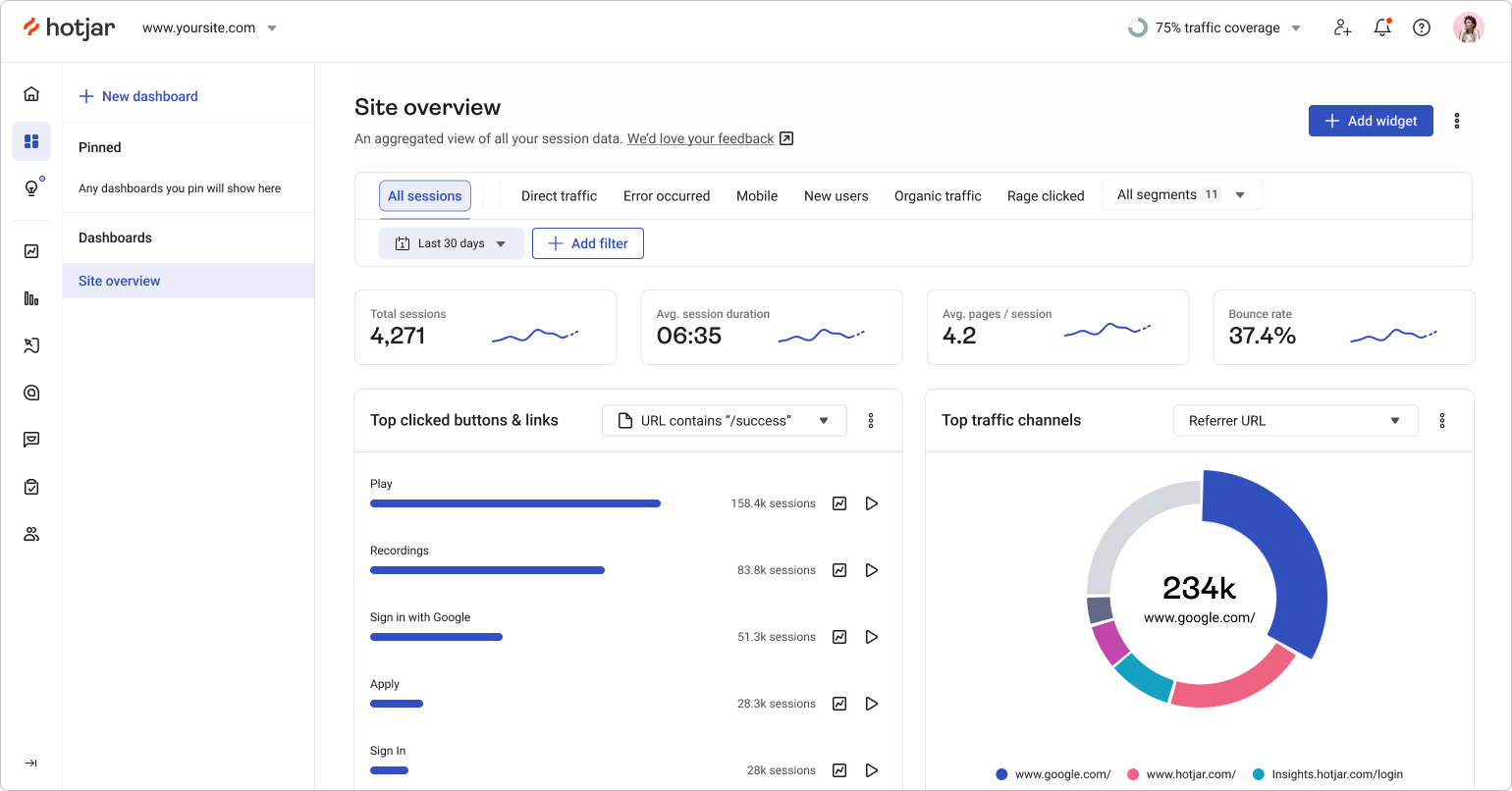
    Hotjar

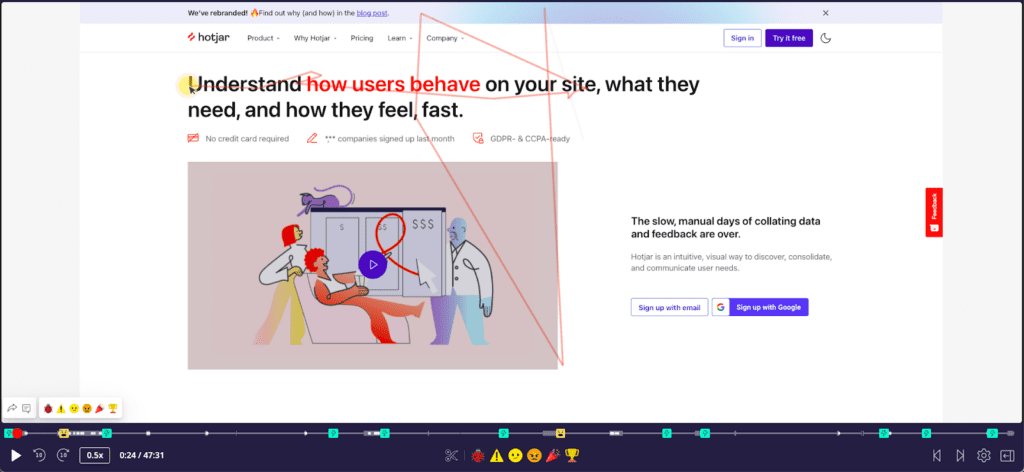
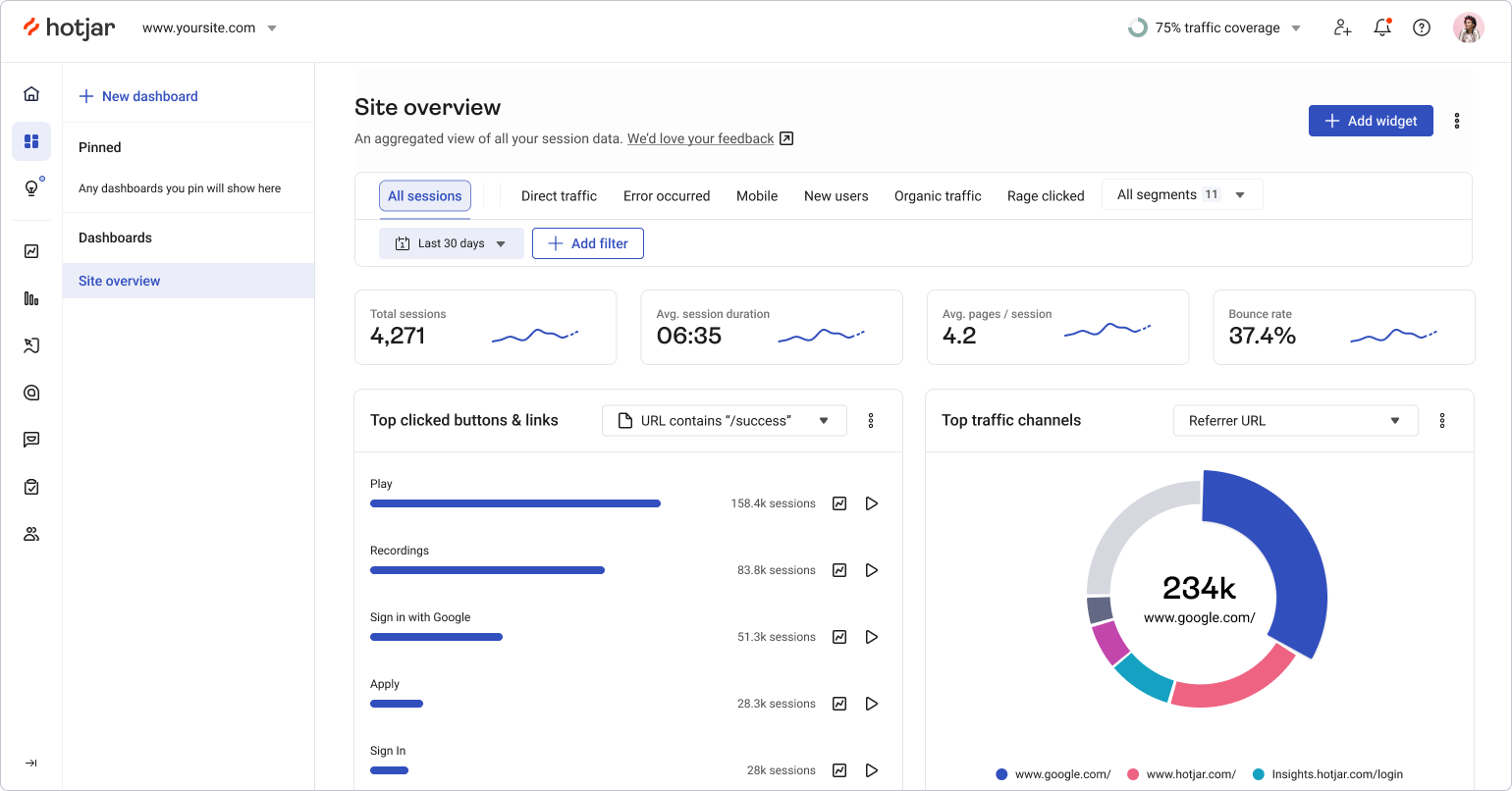
    Hotjar is a behavioral and product experience analytics software designed to help product teams and e-commerce brands understand user behavior via session recordings, heatmaps, and customer feedback tools.

    Hotjar also helps you eliminate guesswork by asking customers where they encounter issues and have objections to your website. With Hotjar, you can observe what website visitors do on your site and track actions like button clicks, scrolls, and mouse hovering. You can use these insights to improve the overall user experience. 

    To learn more about this tool, you can read our Hotjar review.

    What is FullStory?

    Image source: G2

    FullStory is website analytics software that helps businesses analyze how users interact with various web and mobile elements, such as drop-down menus, call-to-action buttons, form fields, and more.

    FullStory helps you identify website bugs and challenges that various user segments experience when using your website. You can use the data to provide support, improve your site, and optimize the customer experience.

    What is FullSession?

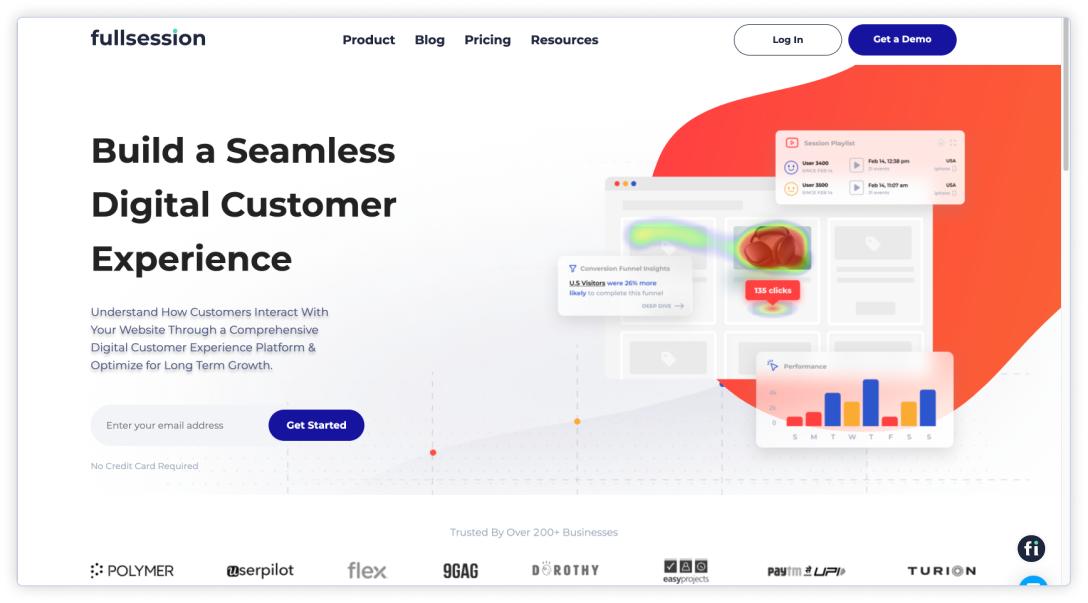
    FullSession

    FullSession is our customer experience analytics software that helps you collect user feedback and track and analyze user behavior while interacting with your website, web app, or landing page. 

    It allows you to identify areas where web visitors rage click, experience issues on your site, and fail to convert into paying customers. With this data, you can fix bugs, improve the user experience, and increase conversion rates.

    Our user behavioral analytics tool helps product managers, digital marketing teams, web designers, UX researchers, and UX designers visualize user events and track the customer journey

    They have session recordings and replay tools, click, mouse movement, and scroll heat maps, conversion and funnel tracking, error analysis, customer feedback tools, and advanced UX analytics at their disposal.

    Get a 360° View of User Behavior

    Learn how to visualize and analyze all user interactions with FullSession.

    Hotjar vs FullStory: How They Compare and Contrast

    At first glance, Hotjar and FullStory are pretty similar. They’re both web analytics tools that help you collect and interpret quantitative and qualitative data on website visitors’ user behavior.

    While both tools have similarities, they also have key differences that set them apart. In this section, we’ll explore how both solutions compare and contrast.

    Hotjar vs FullStory: Basic differences

    Here are the primary differences between Hotjar and FullStory:

    1. Hotjar combines user behavioral data with user feedback to help you understand how website visitors behave across various web pages and what they think about your site. FullStory, on the other hand, lets you analyze user behavior through funnel analysis to identify areas where users drop off the funnel.
    2. The Hotjar platform gives you an overview of user behavior and the insights you need to improve the user interface. FullStory provides search functionality, and it records each user interaction. You use its search functionality to find user events and support your customers.
    3. Hotjar doesn’t let you analyze user behavior on mobile apps, while FullStory helps you analyze user behavioral data on mobile apps and websites.
    4. Hotjar focuses on helping UX teams monitor user behavior and get customer feedback to improve website usability and lead generation. FullStory enables you to identify the user experiences of specific user segments and fix website bugs.

    Hotjar vs FullStory: User rating

    According to Capterra, Hotjar scores 4.7 out of 5 based on 515 user reviews, while FullStory scores 4.6 out of 5 based on 66 user reviews. 

    Hotjar vs FullStory: Use cases

    Hotjar and FullStory serve similar industries, starting from e-commerce, digital marketing, and product development. They are beneficial for marketing, product development, and customer support teams.

    Hotjar vs FullStory: Deployment

    You can deploy both Hotjar and Fullstory the same way. You need to copy their Javascript codes into your website source code. The code snippet logs user actions like scrolls, page views, button clicks, mouse movements, and other user interactions.

    Hotjar vs FullStory: Features

    Here, we’ll compare features feature by feature. First, we’ll examine the features both platforms share and then move on to those that differentiate them.

    Heatmaps

    Both Hotjar and FullStory provide the heatmap user behavioral tool. With Hotjar, you can use heatmaps to identify friction in the customer experience. You can see where users spend the most time and what impacts their customer journey. 

    Heatmaps also reveal how users interact with key elements on your web pages, including where users click and scroll. 

    When using heatmaps, you can visualize user behavioral data via colors. Red indicates the sections of your web pages with the highest engagement, while blue indicates those with the least interaction. A heatmap, in this context, is divided into other facets of on-site user interaction. 

          1. Scroll maps

    Scroll maps show how far users scroll on your website, including the specific percentage for each page section. This way, you can determine whether your pages are too long and why some web page elements don’t get attention.

          2. Click maps

    Click maps show you where users click on your website. You can use the data to know the buttons, links, and CTAs users click the most.

          3. Movement maps

    While both tools offer scroll and click maps, they differ in another case.

    Hotjar provides another type of heatmap that you won’t find on the FullStory platform: movement maps. This feature shows you user mouse movement patterns so you can see the web elements your users like to interact with the most. 

    For example, if customers keep navigating around your page’s header, it’s ideal to place CTAs or lead capture links there.

    Session recording

    While heatmaps are ideal for showing you the web elements that gain the most and least attention, you’ll still want to see how users act when navigating your web pages, and this is where session recordings come into play.

    Hotjar and FullStory provide this feature, but FullStory names it “Session Replay.” FullStory offers advanced functionality in its session recordings feature. For instance, you can link customer complaints to a session replay so that customer support can quickly understand the context and solve customer problems.

    Heatmaps vs session replays

    Unlike heatmaps, the session replay functionality does not provide aggregated statistical data. Instead, The FullStory session replay lets you see exactly how the user navigated your website, how they moved their mouse, and what they clicked. 

    This important feature lets you gain a bird’s eye view of the user experience. How do all of your customers navigate across various web pages? Do they get stuck hopelessly on the same page? Or do most of them gravitate toward the About Us section instead of your blog? 

    Analytics data from session recordings answer these questions, and you can use the information to tweak your site’s UI. For instance, if you notice that a particular button shows a dead click, you can quickly fix the issue, optimize your site accordingly, and increase conversion rates.

    While Hotjar and FullStory provide session recording features, FullStory is a winner due to the added usability of session recordings for supporting your customers. For instance, when a customer submits a ticket complaining about an issue, FullStory will provide a session replay showing what the user did before and after submitting a ticket.

    Feedback widget and survey

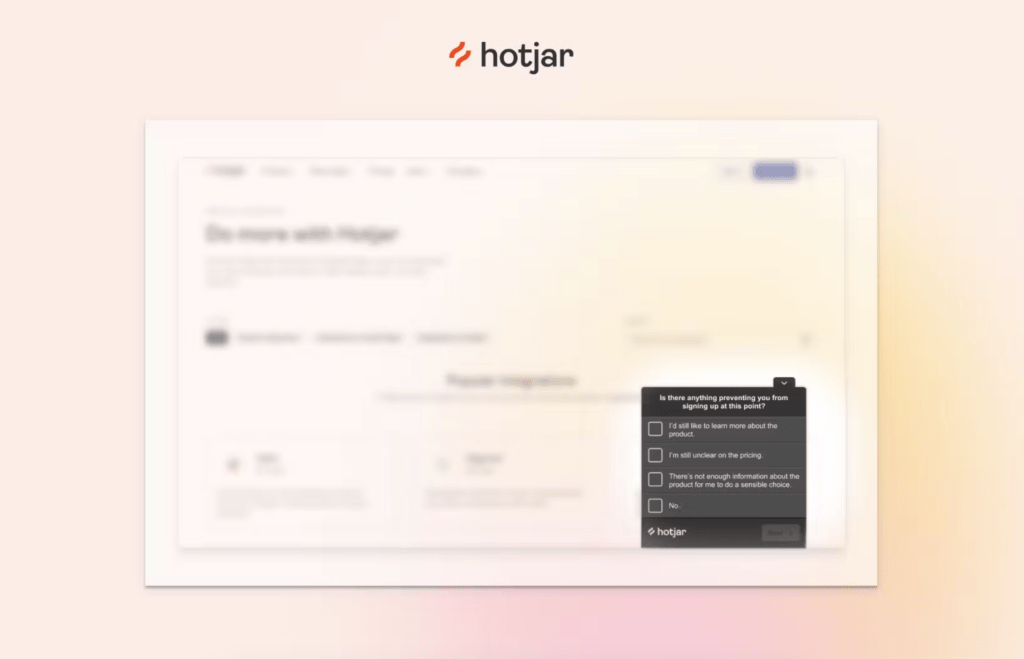
    You can use the Hotjar “ask” feature to insert surveys on specific web pages to know what users feel and think about your site’s functionality.

    FullStory doesn’t provide a native survey feature, but it offers integrations with other platforms, such as Survicate and Qualtrics, to connect your UX data with your targeted surveys.

    It also lets you build conversion funnels to map out each step of a user flow. This feature allows you to see where most customers drop off and fail to convert.

    Hotjar vs FullStory: Languages

    Hotjar’s interface is currently available only in English. However, user-facing features like Surveys and Feedback are supported in multiple languages. FullStory only supports English.

    Hotjar vs FullStory: Integrations

    When connecting with third-party tools, Hotjar and FullStory integrate with popular apps like Optimizely, Hubspot, Slack, Segment, Omniconvert, WordPress, Shopify, and more.

    In contrast, FullStory has a much larger base of integrations than Hotjar, which only has seven native integrations. You can connect with more apps via Zapier.

    Hotjar vs FullStory: Support

    Both tools differ greatly in their support approach. Hotjar provides support via a knowledge base and email, while FullStory provides support via LiveChat and email tickets.

    Hotjar vs FullStory: Pricing

    Now, let’s move on to how the pricing for each tool can affect your budget. Both products have the same pricing model—they offer a free plan and charge a monthly fee for their premium packages.

    Hotjar pricing

    Hotjar pricing

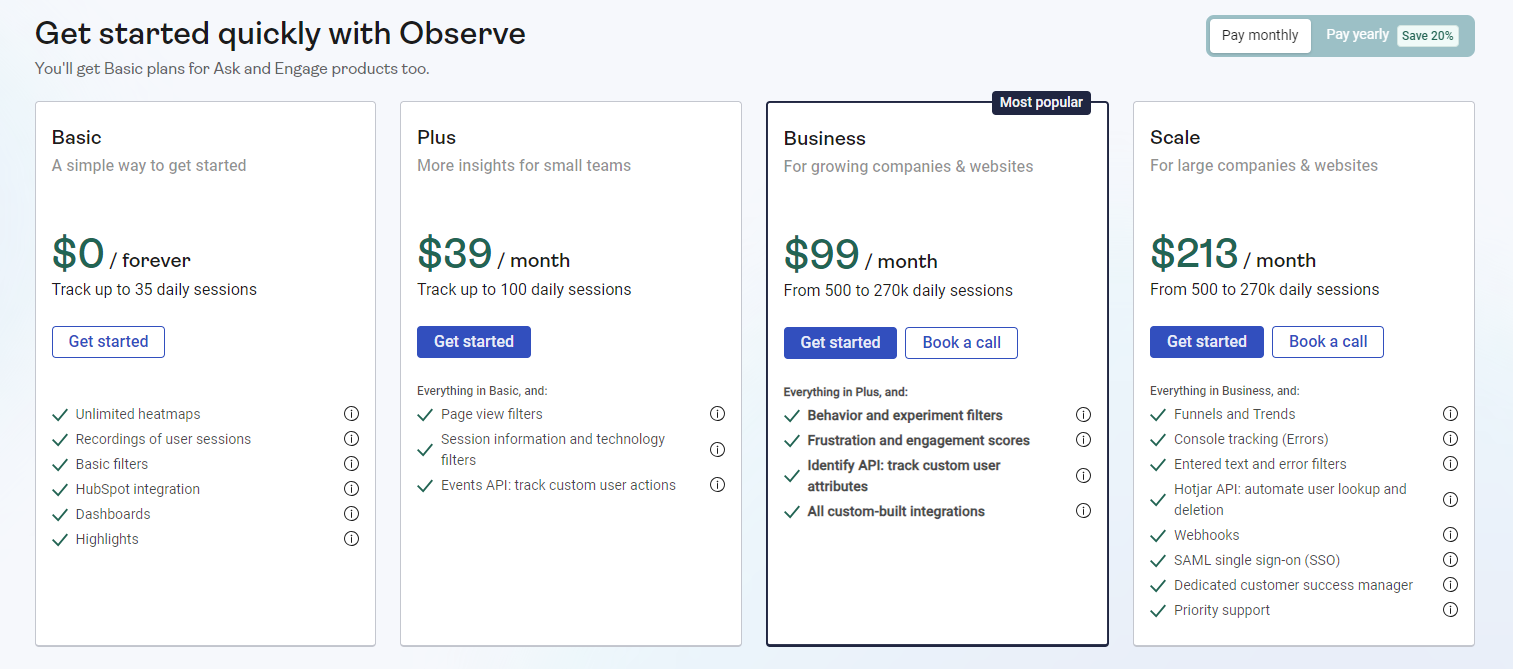
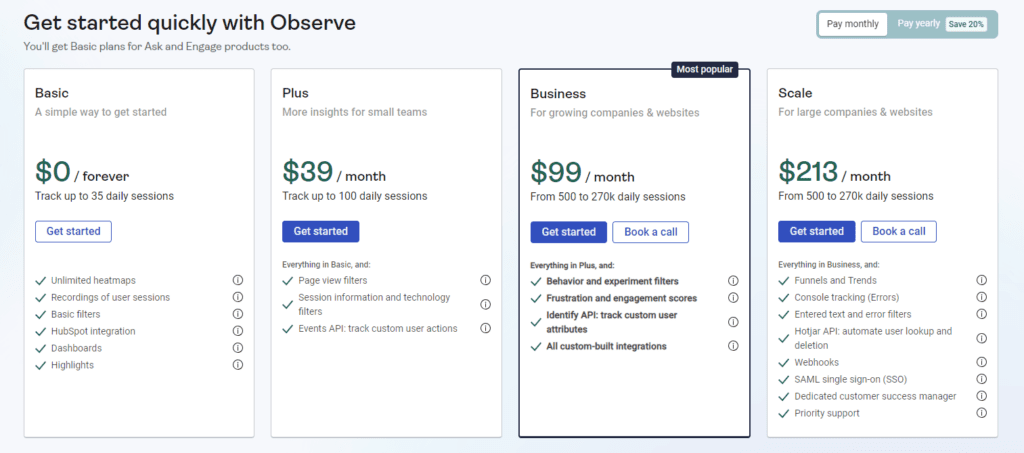
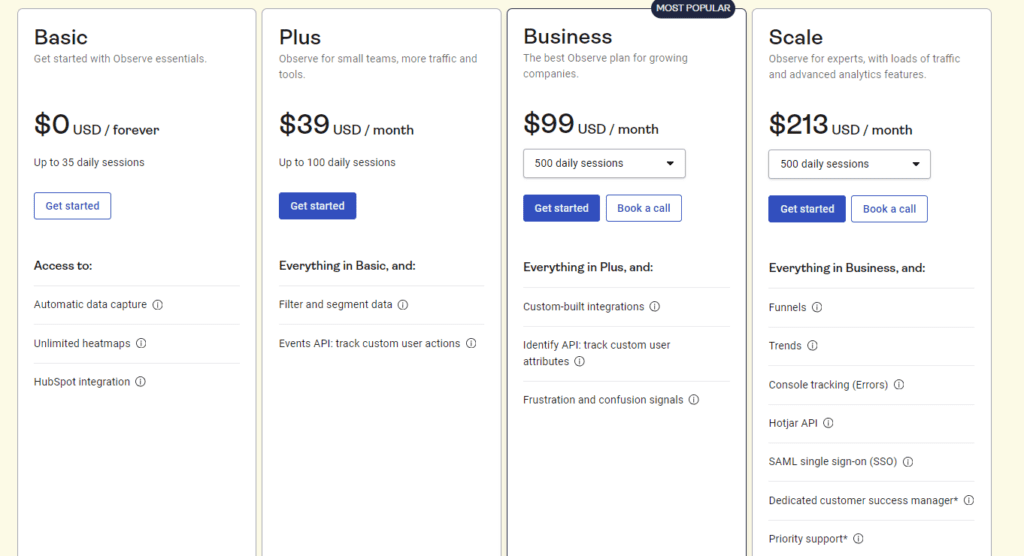
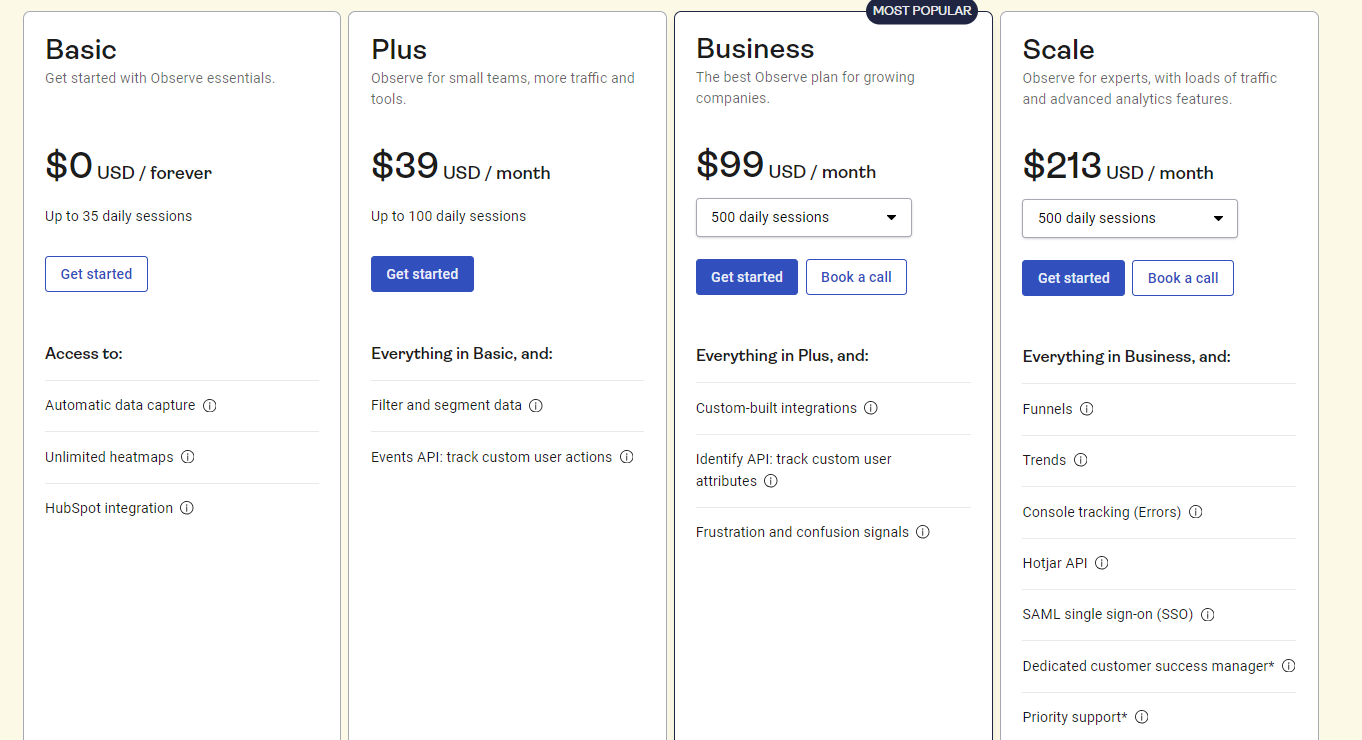
    Hotjar provides three paid plans—Observe, Ask, and Engage. The Observe plan helps you track customer events using web analytics features like heatmaps and session recording. It includes:

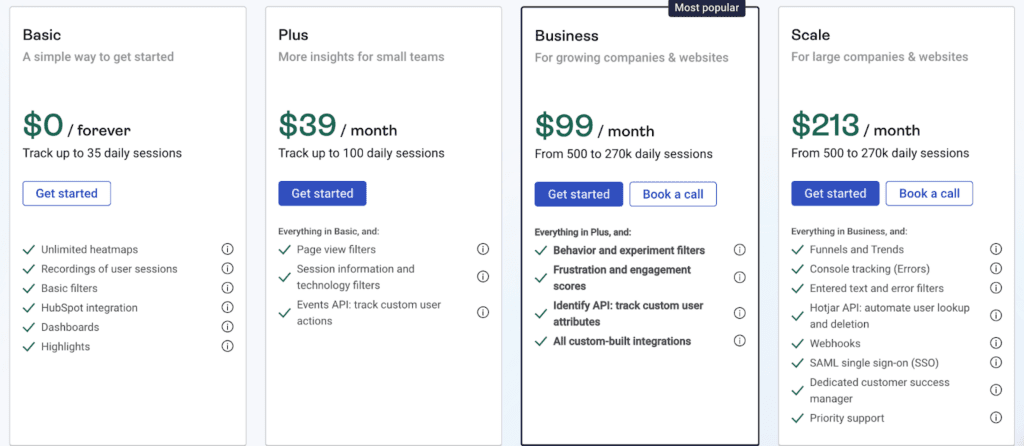
    • Basic—costs $0 and allows you to track up to 35 sessions/day
    • Plus—costs $39/month and lets you track up to 100 sessions/day
    • Business—starts from $99/month and lets you track 500 to 270,000 daily sessions
    • Scale—starts at $213/month and lets you track 500 to 270,000 daily session recordings

    The Ask plan lets you discover how your users feel and what they have to say via the feedback tool. It is divided into:

    • Basic—costs $0 with access to 20 monthly responses
    • Plus—costs $48/month with access to 250 monthly responses
    • Business—starts from $64/month and lets you receive 500 to 100,000 monthly responses
    • Scale—starts at $128/month and offers access to unlimited monthly responses

    Lastly, the Engage plan allows you to automate recruitment, scheduling, and hosting for moderated user interviews. It is divided into:

    • Basic—costs $0 with access to 3 interviews/month from your own network
    • Plus—costs $39.2/month with access to up to 3 interviews/month from the Hotjar participant pool and unlimited interviews from your own network
    • Business—starts from $440/month with access to 12 interviews/year from the Hotjar participant pool and unlimited interviews from your own network
    • Scale—offers customized pricing and access to 20 interviews/month from the Hotjar participant pool and unlimited interviews from your own network

    FullStory pricing

    FullStory pricing

    As for FullStory, it offers a free plan that provides basic behavioral analytics. The free plan enables you to track up to 1000 session replays per month.

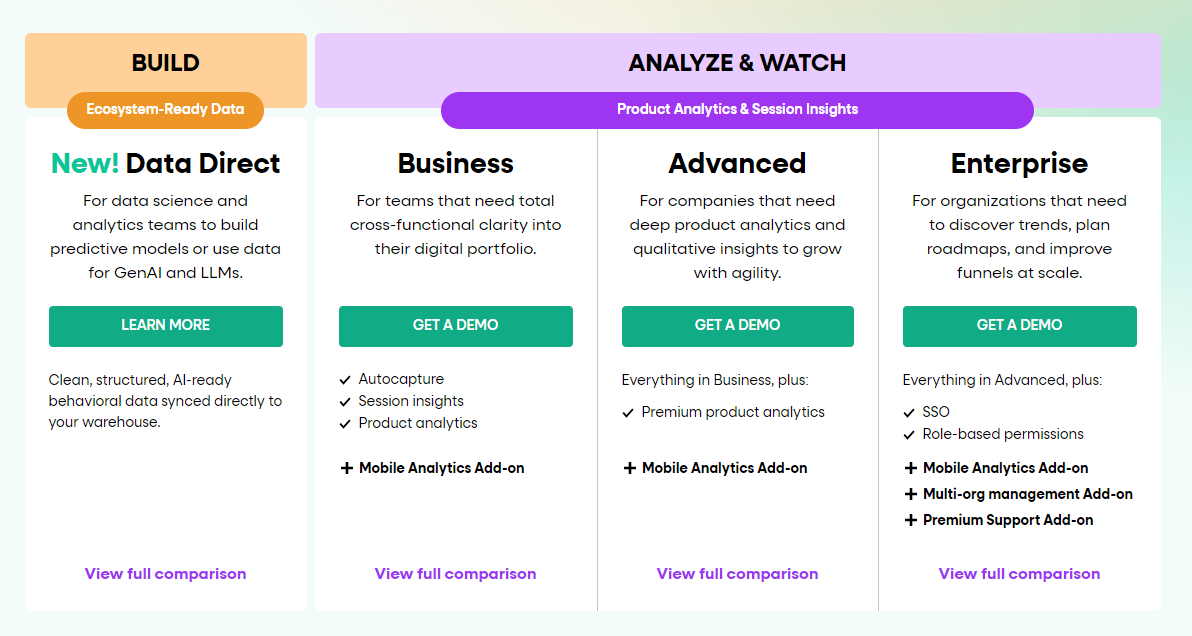
    The FullStory paid plans are divided into three—Business, Advanced, and Enterprise.

    1. The Business plan offers a 14-day trial and allows you to track up to 5,000 sessions 
    2. The Advanced plan offers premium product analytics tools and everything included in the Business plan
    3. The Enterprise plan offers a customized plan, so you’d have to contact sales or request a demo

    A downside is that the company does not provide transparent pricing, meaning you’ll have to contact their sales team to get a quote.

    So far, we’ve covered how Hotjar and FullStory compare and contrast. Let’s move on to an alternative web analytics solution – FullSession, which also helps analyze user behavior.  

    What is FullSession?

    FullSession, our web analytics software, helps you capture and analyze all customer behavioral data and visualize how users interact with your website, web applications, and landing pages. All this goes to one goal: understanding user behavior.

    This way, you can identify issues within the user journey, fix them accordingly, and help them convert to paying customers.

    Book a demo to see FullSession in action.

    What Features Does FullSession Provide?

    FullSession provides powerful behavioral analytics tools that show how web visitors and customers interact with your website elements like headers, call-to-action buttons, drop-down menus, and more.

    Let’s go deep into each feature.

    Session recordings and replays

    session recording

    This web analytics feature lets you see your users’ actions as they navigate your website pages. Session recording and replay go beyond quantitative data and provide specific behavioral data showing:

    • User scroll behavior
    • Mouse movements
    • Button clicks
    • Text inputs in real-time without showing sensitive information

    With our session recording and replay, you can gain access to data such as:

    • User location and IP address
    • The URL user visited
    • Referrals
    • Average time on page
    • Total active time on page
    • Session list
    • Session event

    You can skip periods of user inactivity, save time, and focus on what matters. You can also drop notes or share the user session recordings with your team for better collaboration.

    Interactive heatmaps

    heatmap

    Our website heatmap tool visually represents how individual users interact with your website elements. It highlights areas where users give the most attention and lets you see the most engaging buttons, links, form fields, call-to-actions, blog content, and website copy.

    This way, you can use the user insights to optimize your web pages to increase conversions.

    With FullSession interactive heatmaps, you can:

    • Preview the heatmap on different devices
    • See the URL the user visited
    • Track clicks and see the number of total views and total clicks
    • See the error, rage, and dead clicks
    • Get the average load time on page
    • Get the average time on page
    • See the number of users that visited the page

    Click map example

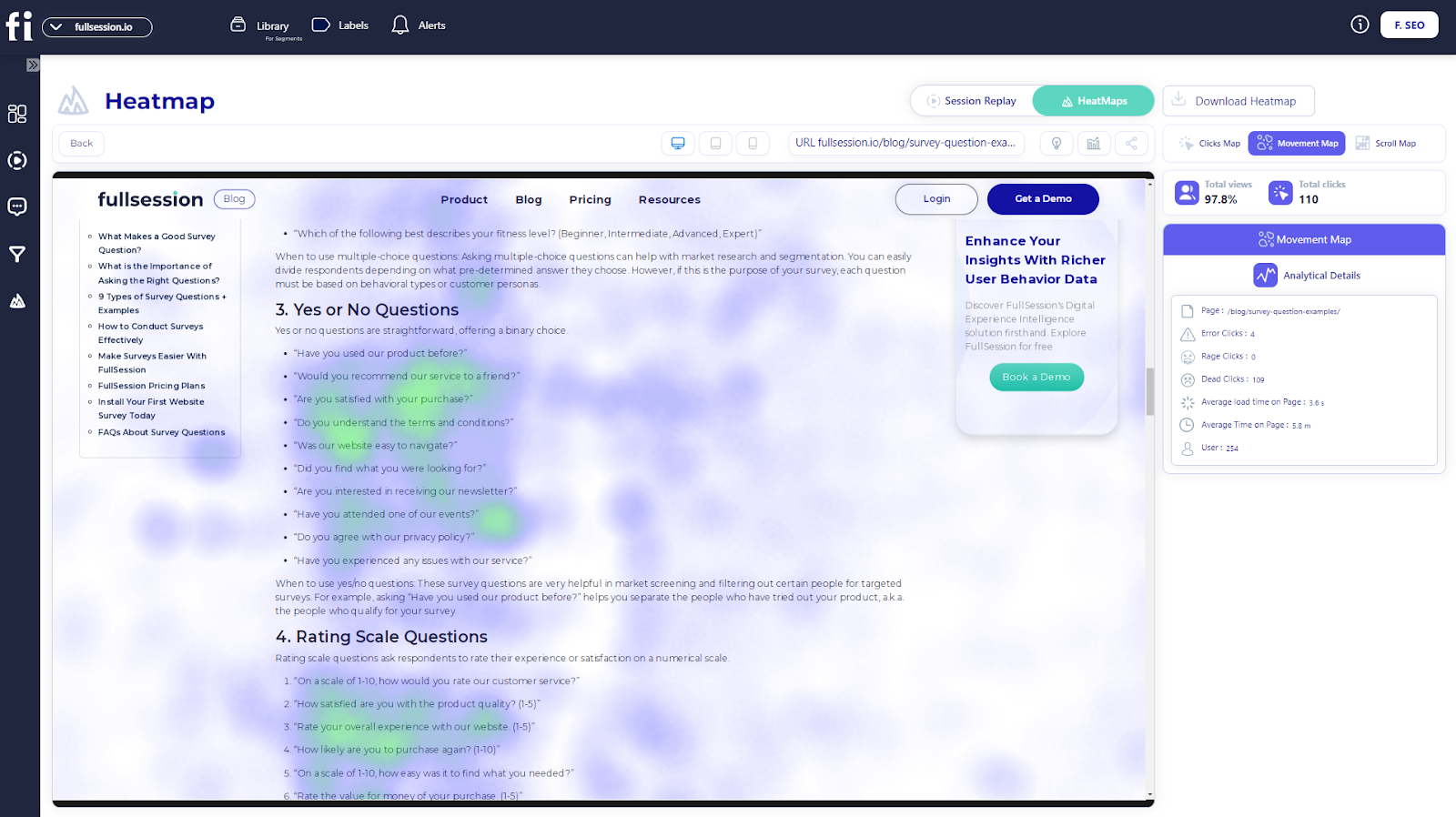
    click map example

    Mouse movement map example

    mouse movement map

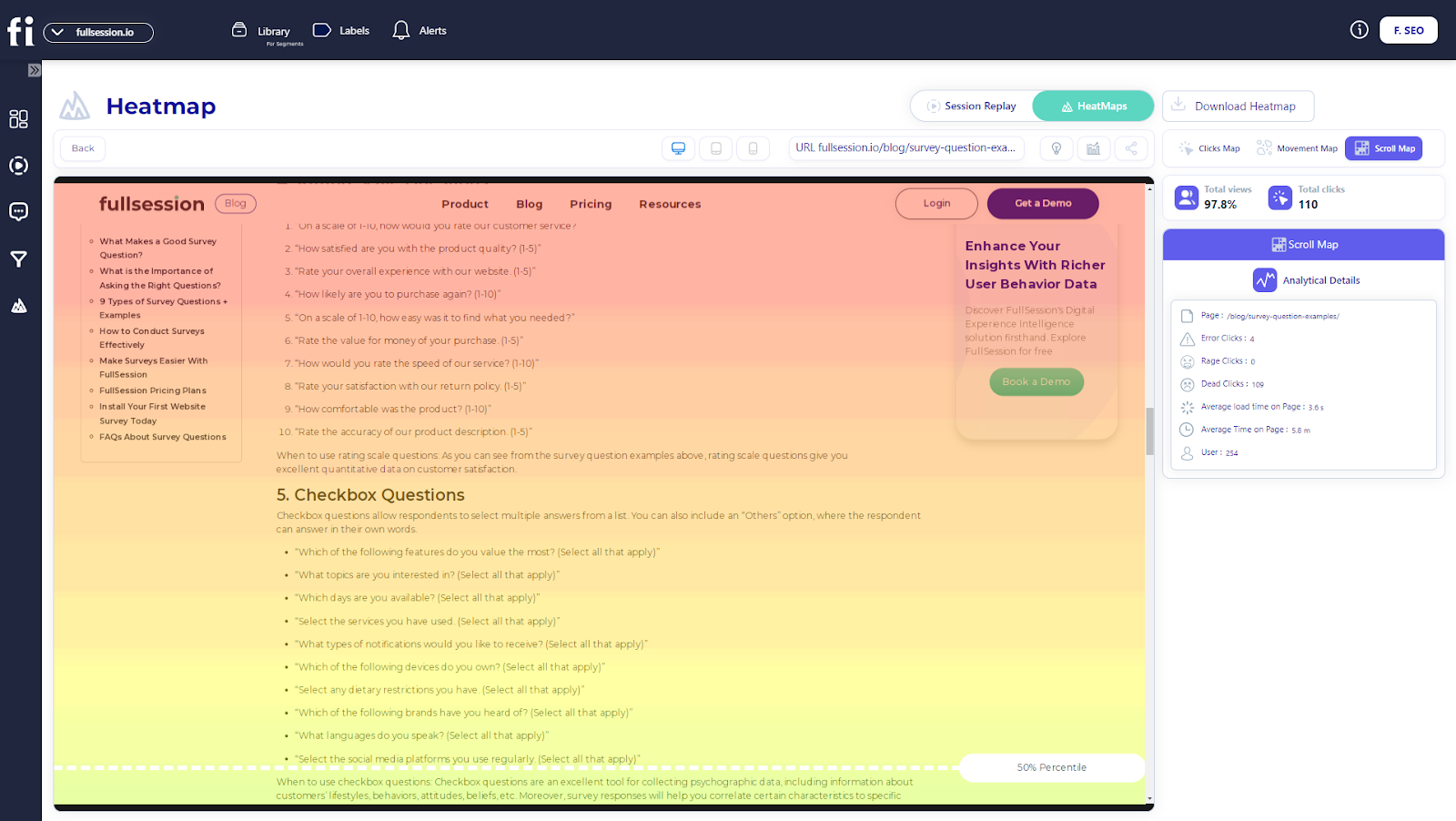
    Scroll map example

    scroll map

    Insights

    insights

    FullSession provides detailed insights and an easy-to-understand overview of customer behavior across your web pages to identify frustration signals that lead to funnel drop-offs and decreased conversion rates.

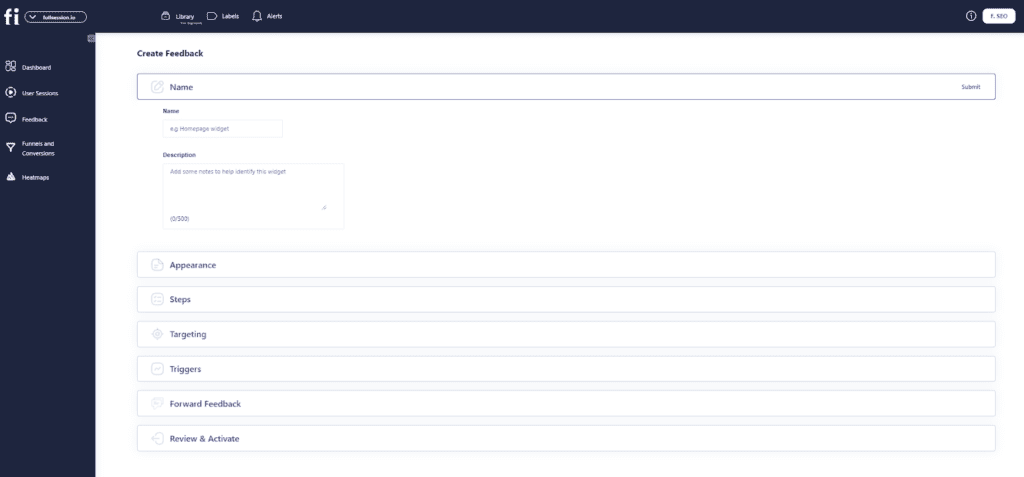
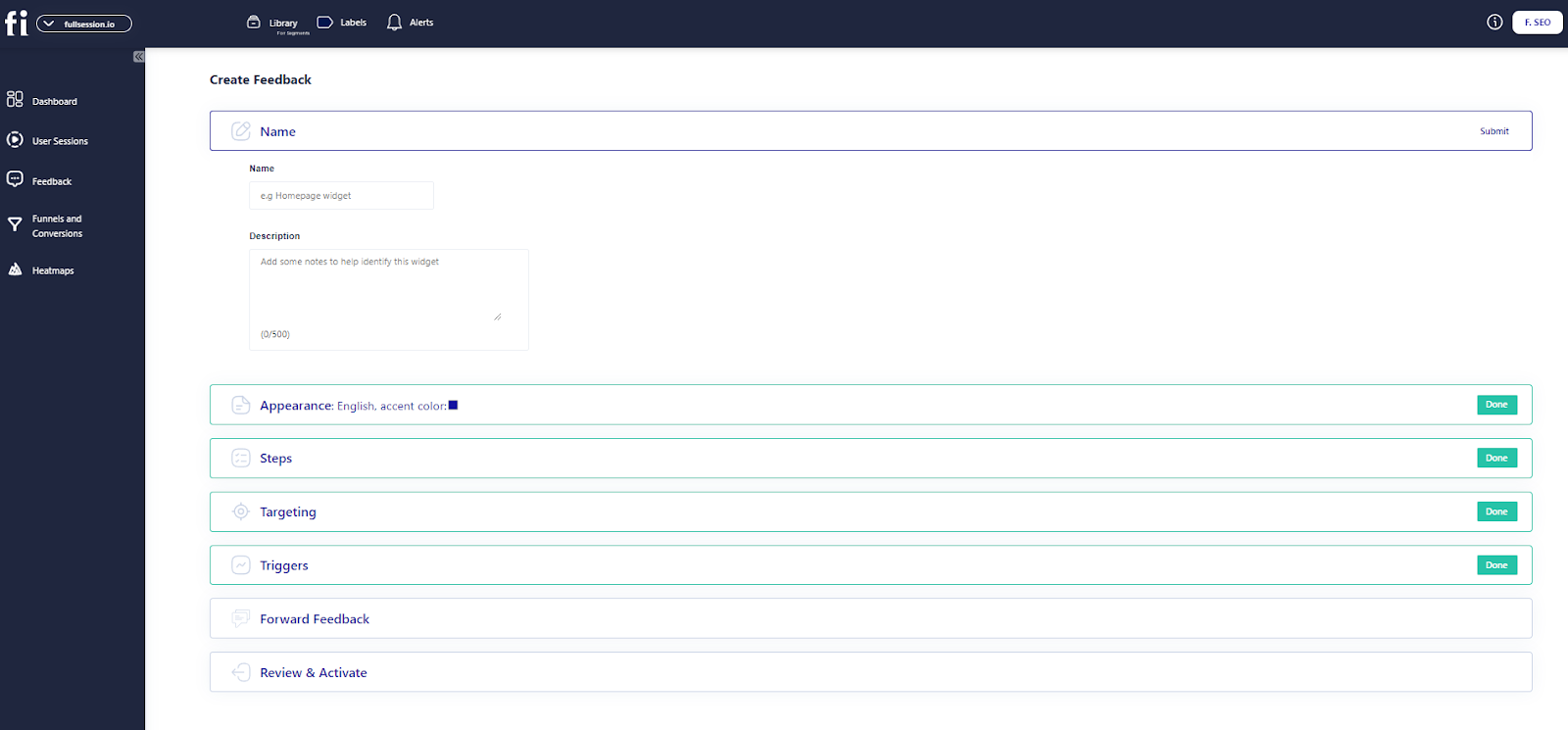
    Customer feedback widget

    customer feedback tool

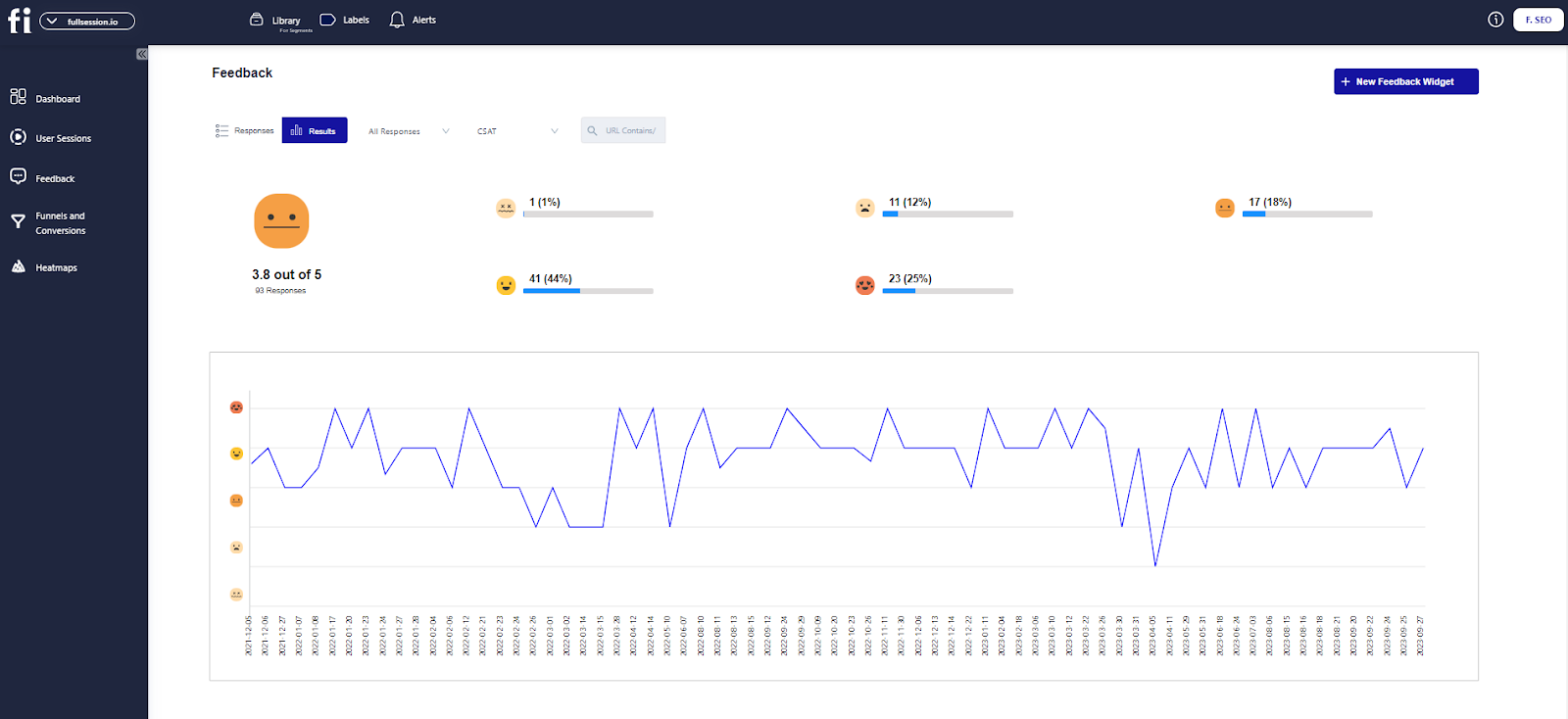
    The customer feedback form lets you ask users what they feel and think about their digital experience in real time. You also get access to the customer feedback report, which shows the user ID, URL, comment the user left, device type, and feedback date.

    customer feedback report

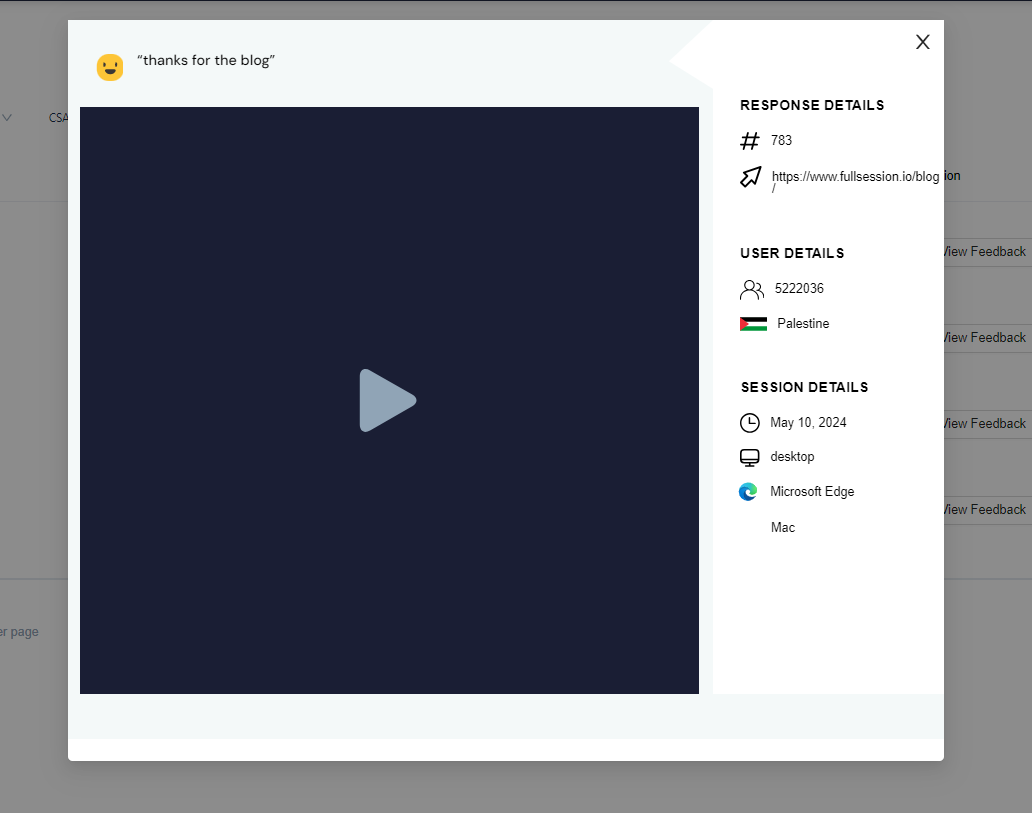
    Even better, you can watch a user session related to negative feedback to determine what caused a negative customer experience. This information can help you create a customer-centric strategy for your product.

    session recording with customer feedback

    Segments

    segments

    Our segments feature helps you build specific user segments and use them to filter major events in user sessions. This saves you time during analysis, as you can quickly find the necessary data.

    Notes

    The FullSession platform provides notes that enable you to leave comments about customer behavior and share them with your team. This allows you to assess challenging areas and improve your product performance.

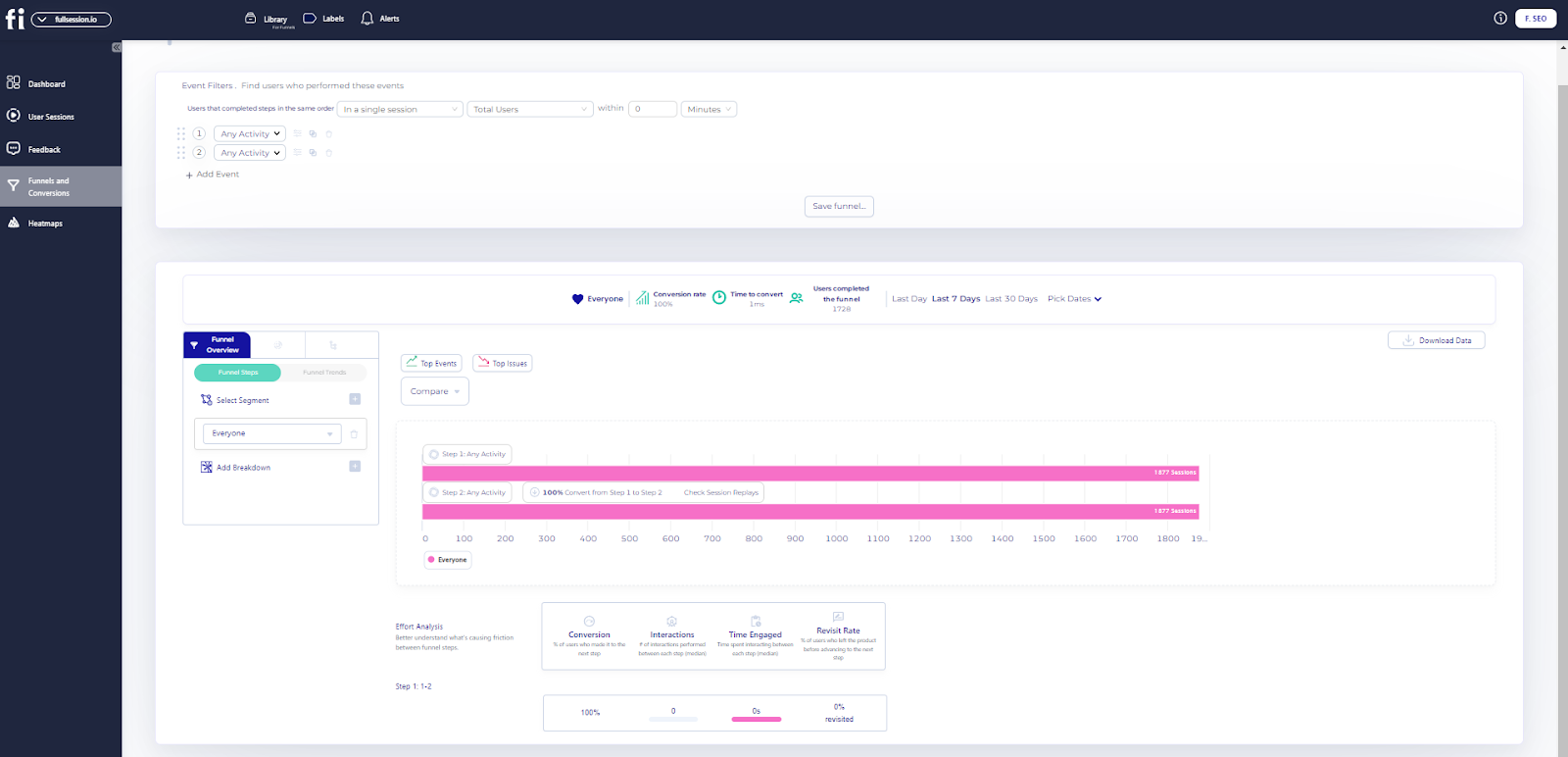
    Funnel and conversion tracking

    funnels and conversions

    This feature lets you track conversion goals using metrics like time to convert and user percentages, giving you powerful insights into your marketing strategy. By pinpointing successful campaigns and areas for improvement, you can maximize your strategy for the best budget value.

    The FullSession funnels and conversions feature dives deep into user journeys, allowing you to monitor and optimize every stage of your conversion funnel. With tools like Funnel Steps and Segmentation Analysis, you can:

    • Track conversion goals and user percentages to see what’s working
    • Gain actionable insights to refine your marketing strategy
    • Identify and amplify successful marketing campaigns
    • Visualize where users convert or drop off
    • Spot trends and seasonal changes in user behavior
    • Identify and replicate key actions that boost conversions
    • Detect and fix issues causing user drop-offs
    • Measure and address user frustration at each step
    • Enhance engaging features for better retention and conversions
    • Reduce exit points by tracking users leaving early
    • Compare and tailor experiences for different user segments
    • Analyze performance over time to adjust strategies 

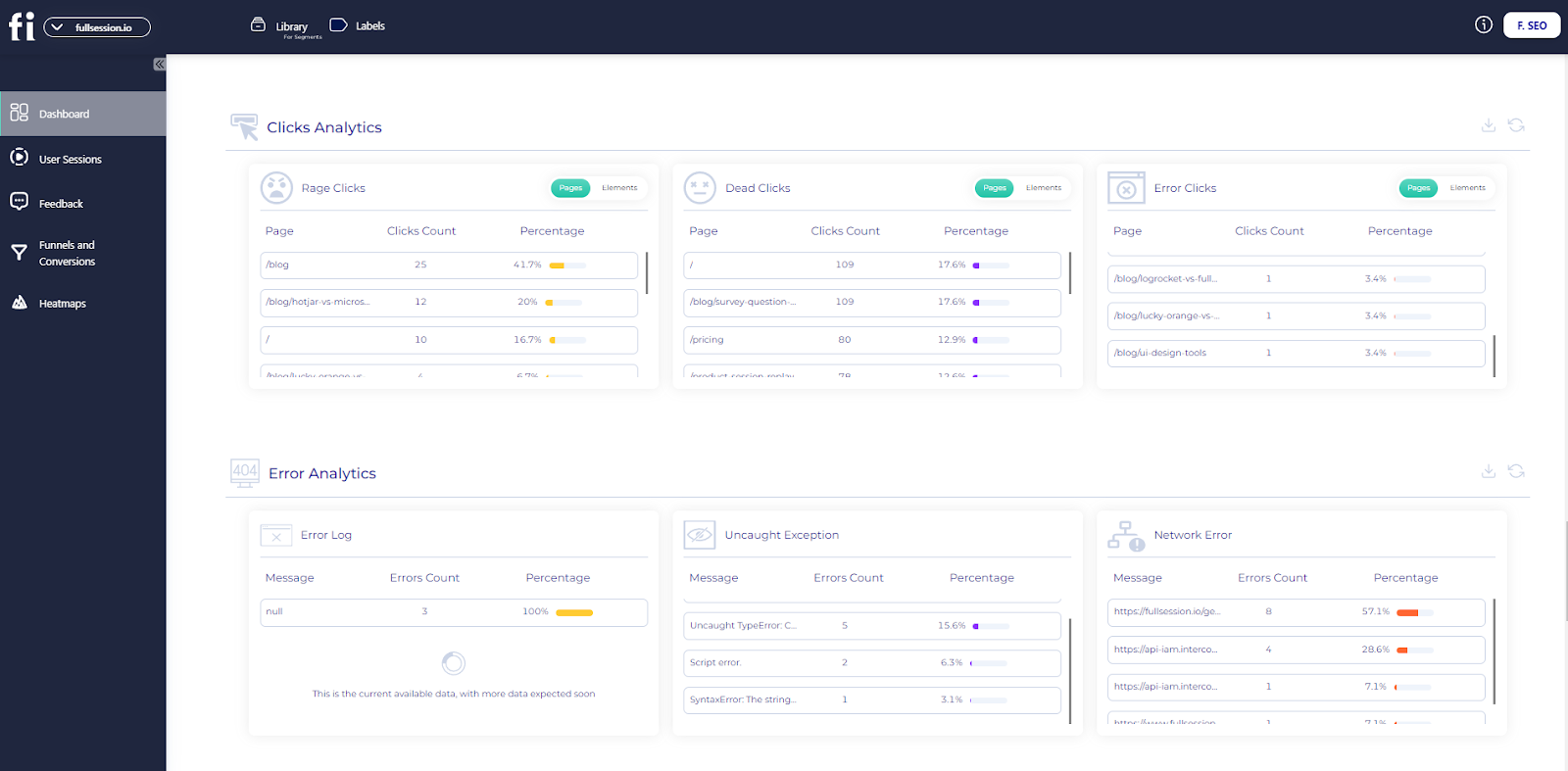
    Error analysis

    error analysis

    The FullSession feature allows you to detect, examine, and correct errors that affect user experience. 

    By gathering extensive data on various error types, such as error clicks, network failures, console errors, error logs, and unhandled exceptions, FullSession delivers practical insights to boost the reliability and user satisfaction of your digital products.

    With this feature, you can:

    • Identify and fix elements that cause client-side JavaScript errors
    • Monitor and resolve server request failures to ensure smooth connectivity
    • Analyze and address JavaScript error messages to improve your application’s codebase
    • Access detailed error logs to diagnose and fix issues accurately
    • Find and handle critical errors to prevent application crashes
    • Segment data and visualize trends to understand and address errors
    • Receive real-time alerts via Slack for immediate error response

    You can book a demo today to learn more.

    What Makes FullSession Stand Out

    While FullSession provides similar features to Hotjar and FullStory, many traits make it stand out. Here are some of the major ones:

    1. FullSession helps you quickly filter user sessions to identify significant events via user segments, user feedback, and more.
    2. While Hotjar will significantly slow your site’s loading speed, FullSession will enable you to analyze user behavioral data without affecting your site’s performance. 
    3. The FullSession insights provide a comprehensive analysis of user behavior and help you quickly identify friction points and funnel drop-offs that affect conversions.  
    4. Our web analytics solution helps you to gather customer feedback and run user surveys to know what users think and feel about their digital experience with your product.

    Now that you know some of the traits that make FullSession unique, let’s move on to why FullSession is ideal for your web analytics needs. 

    Four Reasons to Use FullSession

    Here are four key reasons why you should use FullSession for your web analytics needs.

    1. FullSession enables you to spot user pain points and bugs via its session replay feature.
    2. Our web analytics tool categorizes analytics data so you can thoroughly analyze performance issues across your web pages.
    3. FullSession provides advanced filtering options that help you better understand user events and spot Javascript errors during a session recording.
    4. The FullSession platform is easy to set up and use. You don’t need any advanced technical knowledge to get the insights you need.

    Before we conclude this in-depth piece, let’s briefly highlight the key features of each tool we mentioned in this article. 

    Hotjar vs FullStory vs FullSession: A Summary

    This table highlights a summary of the main points so that you can grasp the features of each tool.

    FeaturesHotjarFullStoryFullSession
    Real-time session recording
    Funnel analysis
    Customer segmentation
    Customer journey mapping
    Conversion tracking
    Interactive heatmaps
    Customer feedback
    Insights
    Free version
    Free trial
    Monthly pricing$39N/A$39

    Hotjar vs FullStory: Final Words

    Both Hotjar and FullStory are known for helping people analyze user behavior data. However, each tool has its strengths and weaknesses. 

    While FullStory offers more ways to support customers, it cannot collect customer feedback to uncover objections and struggles.

    On the other hand, Hotjar is a good option for collecting direct feedback that you can use to improve your site’s UI. Ultimately, you’ll need to choose the right affordable tool that can meet your business’s needs.

    However, don’t get stuck deciding between the two – you can consider other great alternatives.

    The Best User Behavior Analytics Tool

    FullSession is an excellent alternative that provides real-time session recordings and dynamic heatmaps that help you visualize your users’ actions on your site. 

    Even better, FullSession allows you to gather data and make the correct CX analysis without slowing down your site, unlike Hotjar, which slows down a site’s loading speed. You can also use our customer feedback forms to ask customers about their experience using your website. 

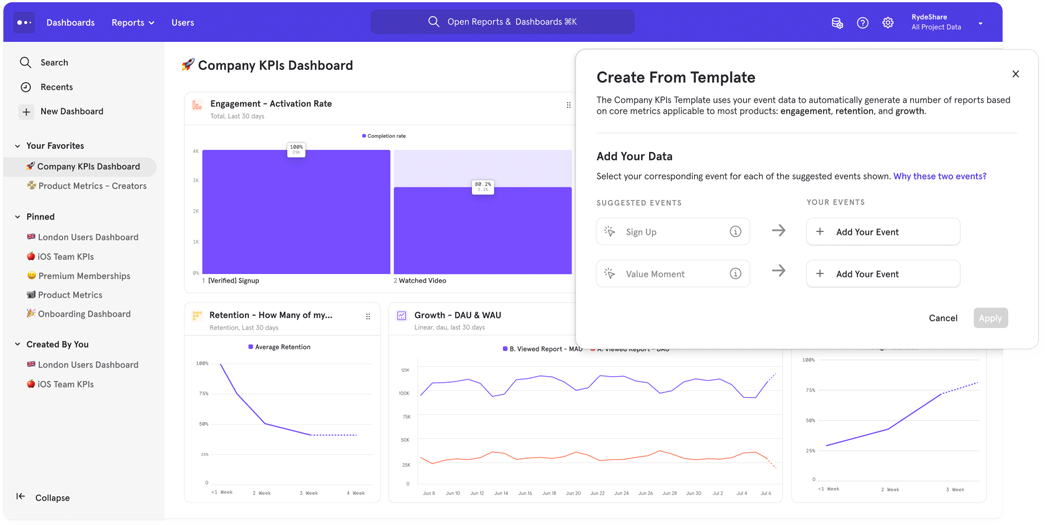
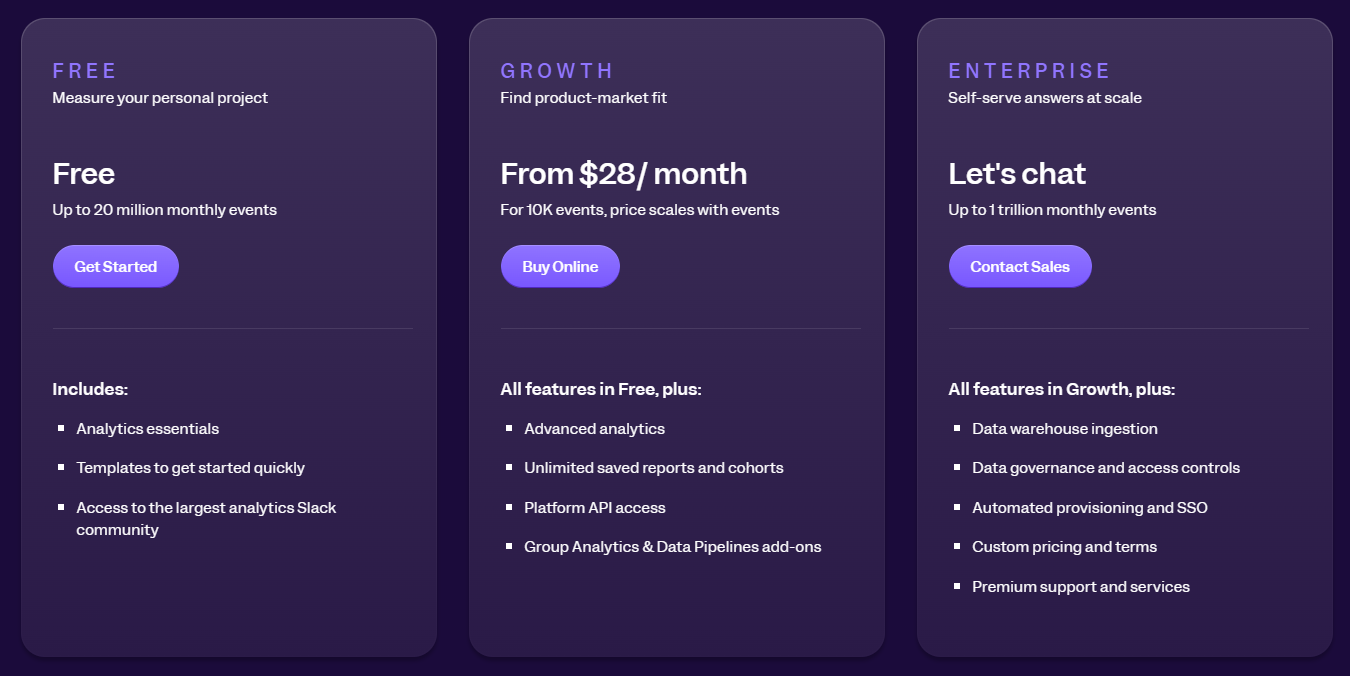
    We’ve written about other analytics tools and how they compare to Hotjar. Feel free to check some of our unbiased reviews, such as Hotjar vs Crazy Egg, Lucky Orange vs Hotjar, and Hotjar vs Mixpanel vs ClickTale.

    FullSession Pricing Plans

    FullSession pricing

    The FullSession platform offers a 14-day free trial and three paid plans: Starter, Business, and Enterprise. A yearly subscription can save you up to 20%!

    Here are more details on each plan.

    • The Starter plan costs $39/month or $32/year and allows you to monitor up to 5,000 monthly sessions with up to 6 months of data storage.
    • The Business plan costs $75/month or $60/year and helps you to track and analyze up to 100,000 monthly sessions with up to 12 months of data storage.
    • The Enterprise plan has custom pricing and offers customizable sessions plus full access to all features.

    Book a demo today.

    Track User Behavior the Easy Way With FullSession

    Setting up your web analytics dashboard with FullSession takes less than 5 minutes, and it’s completely free!

    Get a demo now.

    FAQs About Hotjar vs Fullstory

    What is the difference between Hotjar and FullStory?

    Hotjar focuses on heatmaps, user feedback, and session recordings, providing insights into what users are doing on your site. FullStory offers a more detailed, qualitative analysis with advanced session replay, error tracking, and in-depth user interaction insights.

    What is the disadvantage of Hotjar?

    One disadvantage of Hotjar is that its free and lower-tier plans have a data storage limit, which can restrict long-term analysis. Additionally, it may not offer as detailed session replays as some competitors like FullStory.

    Why is Hotjar better than Google Analytics?

    Hotjar is better for visualizing user behavior through heatmaps and session recordings, which Google Analytics doesn’t offer. It also provides direct user feedback tools like surveys and polls, giving a more qualitative understanding of user experience.

    What is Hotjar good for?

    Hotjar is excellent for understanding how users interact with your website. It visualizes user behavior with heatmaps, captures detailed session recordings, gathers user feedback through surveys and polls, and identifies areas for improvement to enhance user experience.


  • Hotjar vs Google Analytics: Do you Really Need Both?

    Hotjar vs Google Analytics: Do you Really Need Both?

    When planning the features of FullSession, our behavioral analytics software, we tested many other tools to learn more about their strengths and weaknesses because our goal was to build something even better with these lessons in mind.

    In this blog post, we will explain the differences between Google Analytics and Hotjar, as many businesses are stuck between these two solutions. We will also explain why FullSession can be a good alternative.

    FullSession helps you understand the reasons behind user actions via session recording and replay tools, website heatmap tools, funnel and conversion analysis, error tracking features and customer feedback tools.

    You can schedule a demo to learn how our software helps you gather user behavior analytics data you can use to improve your web app, landing page, or website.

    Start a Free Trial to Experience FullSession

    Capture all user interactions, spot trends and patterns and drive improvements without compromising your website performance.

    Let’s start with some basic information.

    The Importance of Web Analytics

    Google Analytics is one of the most important marketing tools. It helps you measure customer interaction with your website and tells you more about your customers’ needs, intentions, and goals.

    Aside from tracking users’ behavior, you can see where you are losing customers in your sales funnel. You can make segmentation by sales conversion, upsell or cross-sell activities, traffic, bounce rate, and more.

    By understanding what attracting your target audience is, how often they visit your site, and what they do on it, you can optimize your landing page or website and ultimately increase conversions. But is this enough to help you make informed decisions?

    Learn more about user behavior

    Data collected from analytics tools like Google Analytics let you know what’s working and what isn’t. Numbers can show you what people do on your site, but they can’t tell you why your users made the choices they did. 

    You need more information to understand what’s happening between events; in other words, between the lines.

    By seeing how your users behave while interacting with your website, you’ll be able to get answers to questions you might not have thought of by looking at metrics alone, and that’s where the behavior analytics tools perfectly blend in.

    Hotjar: The Behavior Analytics Solution

    Between Google Analytics and Hotjar, deciding which is right for your business can be challenging. 

    While both are excellent tools for measuring user behavior on your site, some differences between them might make one more suitable than the other. Additionally, there are other Hotjar alternatives you should consider.

    Hotjar is a behavior analytics platform that complements Google Analytics and other traditional analytics tools, providing in-depth analysis that you can’t derive from traditional data. With Google Analytics, you can see your metrics. With Hotjar, you can see why they’re happening.

    Hotjar has helpful features that let you track and analyze real-time website engagements. With heatmaps, user recordings, surveys, and user feedback services, you can make informed decisions about your website’s usability, navigation structure, content organization, and more.

    We’ll go step-by-step through Hotjar and show you how to get the most out of it.

    Keep an eye on customer interaction with heatmaps

    Hotjar is a unique heatmap software. Heat maps can take a visitor’s activity and translate it into a visual representation. This information is presented as a color: the warmer the color, the higher the activity.

    Hotjar offers three types of heatmaps:

    1. Click heatmaps that show you where your visitors click the most.
    2. Move heatmaps that track visitors’ mouse movements while browsing your website.
    3. Scroll heatmaps that are very useful for landing page analysis and optimization.

    What elements grab your potential customer’s attention? Heatmaps will help you clearly understand this question and create a website layout that keeps your potential customers engaged and entices them to come back.

    Hotjar heatmaps help you learn:

    • Where your users drop off in the conversion funnel
    • Which page areas confuse or fail to keep users’ attention
    • What they’re doing during A/B testing
    • What page elements decrease conversion and engagement rates
    • How users interact with website pages during real-time experiments

    When testing your website on different devices, you can use Hotjar to switch between desktop, tablet, and mobile views to pinpoint which issues are device-specific.

    Improve Your Website UX and UI

    Learn how FullSession interactive heatmaps help you find cold spots and dead zones on your site.

    See your site from a visitor’s point of view with session recordings

    With visitor recordings, you can watch real users interact with your product as they would in the real world. From clicking to scrolling to hovering, you can see everything a user does on your website’s pages.

    Hotjar helps you understand why your visitors are navigating away from the page so you can find frustration points driving them away. Spot problems, pause the recording to view it from any angle, or zoom in on the page to see what’s going on. It will help you improve your site with each video.

    You can also add tags or notes to your session recordings. These can be used to mark important events or gather feedback from your team.

    Hotjar also provides advanced segmentation options, letting you view data through many lenses. You can record user activity easily and filter your session recordings by specific visitor types.

    Know what your customers want with user surveys

    Image source: Capterra

    With Hotjar user surveys, you can easily create a list of questions and place it on your website. As your visitors take the survey, the software records users’ words, providing you with direct feedback.

    With this qualitative data, you will know what to improve next on your website. Depending on your needs, you can start from scratch or choose a template.

    If you ask users what they love the most about your website or app or what issues they might have, you will gain insight into customer experience and help your development team improve your product.

    Make your customers happy with user feedback

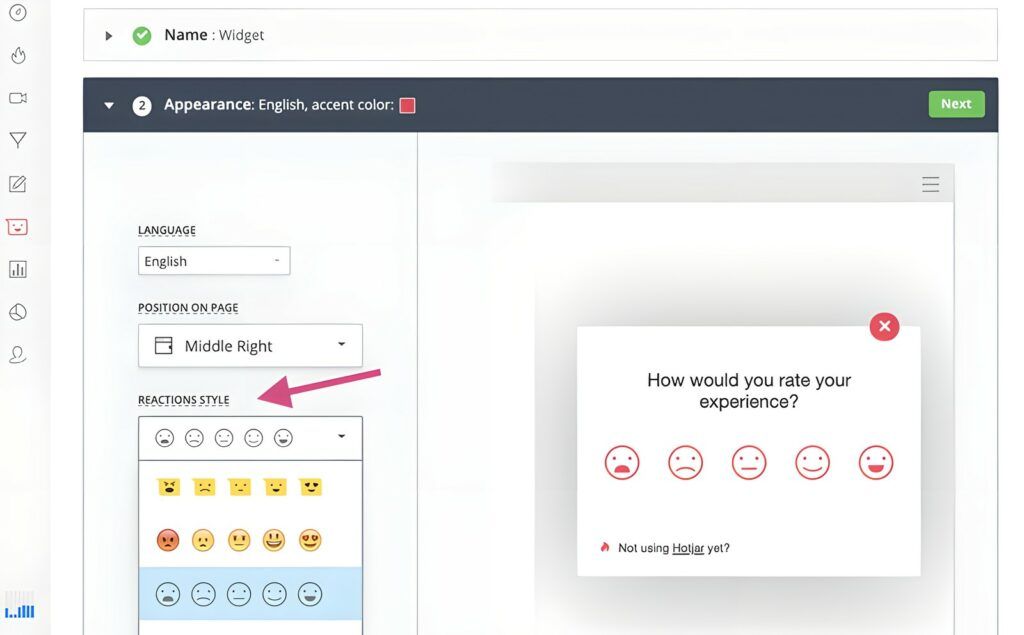
    With Incoming Feedback, you can engage with your users at a micro-level. Hotjar offers a real-time suggestion box that lets you follow individual visitors as they move across your website, pages, forms, or images.

    You’ll be able to record your users’ comments and complaints, know whether they’re thrilled or not quite satisfied, and capture any problems that might arise.

    This level of engagement brings your company and your users on the same page, building trust and loyalty in the process. If you want to improve your website for happier users, Hotjar’s Incoming Feedback will enable you to get there faster.

    Hotjar bonus features

    Hotjar is easy to set up and use – it doesn’t require additional software and comes with detailed instructions and video tutorials.

    The platform also has an intuitive dashboard. The interface is clean and well-organized, making it easy for users to get started and discover what Hotjar can do. There isn’t a large learning curve, and anyone can set it up.

    With Hotjar, you can:

    • Invite unlimited team members and clients to use the software free of charge
    • Target your users smarter
    • Collect feedback in more than 40 languages
    • Use all features on desktop devices or mobile devices
    • Protect your website users with privacy features
    • Export and share feedback in CSV or XLSX
    • Install and use the solution on all major platforms
    • Integrate the solution with major tag managers like Google Tag Manager
    • Optimize your ad campaigns
    • Have reliable customer support
    • Collect qualitative and quantitative data with ease
    • Customize an External Link survey, a Full Screen survey, etc.

    Whether you’re working on your first digital product or running a massive campaign, your company can track and access data points to implement design changes. And that data is fun to look at, too!

    Hotjar vs Google Analytics: What is the Difference?

    There is no need to abandon Google Analytics to start using Hotjar or vice versa. Hotjar is an alternative, not a replacement, for your Google Analytics account. You can use both tools, as they serve different purposes.

    While Google Analytics is an in-depth tool for tracking metrics, from a site’s traffic levels to shopping cart abandonment, Hotjar offers a more user-centric approach. 

    It helps you receive customer feedback and make necessary changes to your landing page or website based on their comments.

    FullSession: The Best Alternative

    Learn how to visualize, analyze, and optimize your site with FullSession.

    Hotjar vs Google Analytics: When to use each

    Google Analytics is an essential tool that every business should be using to collect data and access information. You can use Google Analytics to get details about user acquisition, demographics, traffic sources, website metrics, ad campaign results, and more.

    It is best suited for individuals or SME businesses that require basic data because it lacks many of Hotjar’s advanced features.

    On the other hand, Hotjar can help you analyze and optimize your landing pages, websites, or conversion funnels with features like Heatmaps and Recordings. It also specializes in improving user experience by gathering feedback with Polls, Surveys, and Form Analytics.

    It is best suited for large enterprises that need advanced functionalities or employees working as Product Managers, Product Designers, or Researchers.

    Google Analytics vs Hotjar: Learning curve

    Using Google Analytics requires preparation for a significant learning curve, which is one of its main disadvantages. While the data is straightforward to interpret, using it properly requires much time and effort. 

    The customization and depth it offers are extensive, but gathering and deciphering different metrics and optimizing your performance based on them is a process you must learn.

    Compared with other tools, Hotjar lets users add it to their websites with the click of a button.  The entire process takes just a few minutes, making it easy for businesses to add the code to their website and start surveying and tracking their customer behavior quickly and effectively.

    Hotjar vs Google Analytics: Integrations

    Hotjar offers more integrations than Google Analytics. With more ways to add real-time evaluation and deeper integration with other major platforms, you can see data from all sources in one place, eliminating the need for multiple tools. It will help you find the insights you need faster.

    With this software’s wealth of information, there’s almost no limit to what you can learn about your customers. It gives business owners who use multiple platforms more flexibility in everyday work.

    Google Analytics vs Hotjar: Pricing

    You can use Google Analytics free of charge as an offer you won’t find in many other places. There are no upgrades, no hidden fees, and no catch. You can set up a free account with no credit card information required after signing up for a free Google account.

    What is less known is that Google Analytics has a paid version called Google Analytics 360 that starts at $50,000/year. This enterprise version provides an advanced interface that allows large businesses to conduct more in-depth analyses.

    On the other hand, Hotjar offers a basic package that lets you capture up to 1,000 pageviews/heatmap free of charge. In case you are satisfied with the software, you can choose paid upgrades anytime:

    Hotjar provides three paid plans—Observe, Ask, and Engage. The Observe plan helps you track customer events using web analytics features like heatmaps and session recording. It includes:

    • Basic—costs $0 and allows you to track up to 35 sessions/day
    • Plus—costs $39/month and lets you track up to 100 sessions/day
    • Business—starts from $99/month and lets you track 500 to 270,000 daily sessions
    • Scale—starts at $213/month and lets you track 500 to 270,000 daily session recordings

    The Ask plan lets you discover how your users feel and what they have to say via the feedback tool. It is divided into:

    • Basic—costs $0 with access to 20 monthly responses
    • Plus—costs $48/month with access to 250 monthly responses
    • Business—starts from $64/month and lets you receive 500 to 100,000 monthly responses
    • Scale—starts at $128/month and offers access to unlimited monthly responses

    Lastly, the Engage plan allows you to automate recruitment, scheduling, and hosting for moderated user interviews. It is divided into:

    • Basic—costs $0 with access to 3 interviews/month from your own network
    • Plus—costs $39.2/month with access to up to 3 interviews/month from the Hotjar participant pool and unlimited interviews from your own network
    • Business—starts from $440/month with access to 12 interviews/year from the Hotjar participant pool and unlimited interviews from your own network
    • Scale—offers customized pricing and access to 20 interviews/month from the Hotjar participant pool and unlimited interviews from your own network

    Hotjar vs FullSession: What We Do Better

    FullSession is a user behavior analytics tool offering comprehensive features to capture and analyze all user interactions, enabling you to optimize your website.

    Some of the key components include:

    • Session recordings and replays
    • Website feedback forms and reports
    • Click, mouse movement, and scroll heatmaps
    • Funnel and conversion tracking
    • Error analysis
    • Advanced user and event filtering options

    You don’t need to download any additional plugins to use our service. Instead, you can start recording sessions immediately to track your users’ behavior.

    Start a free trial or book a demo to evaluate all features.

    How we compare

    We looked into Hotjar’s features, compared them with our solution, and researched its core competencies. Here is what we found out:

    1. FullSession uses broader analytics tools to analyze visitor behavior, allowing you to assess better where friction points occur and how to solve them.
    2. FullSession provides insights into the impact on conversion rates and dropouts in the sales funnel.
    3. With advanced filtering options, you can quickly find sessions that raise an eyebrow and dig deeper so you can create a better experience for your customers.
    4. FullSession will help you identify significant events in one session to save time and reduce the noise.
    5. FullSession funnels offer an in-depth analysis of user journeys, allowing you to monitor, comprehend, and optimize every stage of your conversion funnel.
    6. Error analysis will help you identify, analyze, and resolve errors impacting user experience by leveraging data on error clicks, network errors, console errors, error logs, and uncaught exceptions. 

    Also, we found one significant difference in website performance. If you use Hotjar, your website will slow down significantly, making the data gathered and analyzed unimportant because it will take forever to load.

    On the other hand, FullSession allows you to conduct the right customer experience analysis without affecting the site’s performance.

    Get a demo to learn more.

    Why FullSession is the Best Analytics Tool of 2024

    When optimizing your website and enhancing user experience, FullSession stands out as the best option.

    Unlike other behavioral analytics tools, FullSession provides a comprehensive suite of features that give you a complete picture of your user journeys without the huge learning curve.

    From detailed funnel analysis and real-time visitor tracking to robust heatmaps, website feedback forms, and session recordings, FullSession covers all bases to help you understand and improve every aspect of your site.

    FullSession’s unique advantage lies in its ability to offer actionable insights without compromising website performance. Its efficient design ensures your site remains fast and responsive while you gather invaluable data.

    The intuitive interface makes it easy to navigate and leverage these insights, whether you’re a seasoned analyst or just getting started!

    FullSession Pricing Plans

    Fullsession Pricing

    The FullSession platform offers a 14-day free trial and three paid plans: Starter, Business, and Enterprise. A yearly subscription can save you up to 20%!

    Here are more details on each plan.

    • The Free plan is available at $0/month and lets you track up to 500 sessions per month with 30 days of data retention, making it ideal for testing core features like session replay, heatmaps, and frustration signals.
    • The Growth Plan starts from $23/month (billed annually, $276/year) for 5,000 sessions/month – with flexible tiers up to 50,000 sessions/month. Includes 4 months of data retention plus advanced features like funnels & conversion analysis, feedback widgets, and AI-assisted segment creation.
    • The Pro Plan starts from $279/month (billed annually, $3,350/year) for 100,000 sessions/month – with flexible tiers up to 750,000 sessions/month. It includes everything in the Growth plan, plus unlimited seats and 8-month data retention for larger teams that need deeper historical insights.
    • The Enterprise plan starts from $1,274/month when billed annually ($15,288/year) and is designed for large-scale needs with 500,000+ sessions per month, 15 months of data retention, priority support, uptime SLA, security reviews, and fully customized pricing and terms.

    Book a demo today.

    Complete Your Analytics Stack With FullSession

    Setting up your web analytics dashboard with FullSession takes less than 5 minutes, and it’s completely free!

    Get a demo now.

    FAQs About Hotjar and Google Analytics

    Can Hotjar replace Google Analytics?

    Hotjar is not a complete Google Analytics replacement. Google Analytics provides comprehensive quantitative data on website traffic and performance, while Hotjar offers qualitative insights into user behavior through heatmaps, session recordings, and feedback tools. Using both tools together gives a complete picture of your website’s performance.

    Why is Hotjar better than Google Analytics?

    Hotjar is better for visualizing user behavior with heatmaps and session recordings, allowing you to see exactly how users interact with your site. It also provides direct user feedback tools like surveys and polls, which Google Analytics lacks, offering a deeper qualitative understanding of user experience.

    What is the disadvantage of Hotjar?

    One disadvantage of Hotjar is that it has a data storage limit on its free and lower-tier plans, restricting long-term analysis. Additionally, it may not offer as detailed session replays or advanced segmentation as some competitors like FullStory.

    What is Hotjar good for?

    Hotjar is excellent for understanding how users interact with your website. It’s ideal for visualizing user behavior with heatmaps, capturing detailed session recordings, gathering user feedback through surveys and polls, and identifying areas for improvement to enhance user experience.

    Does Google Analytics analyze Google ads?

    Yes, Google Analytics can analyze Google Ads. By linking your Google Ads account with Google Analytics, you can track the performance of your ads, see how users interact with your website after clicking on an ad, and gain insights into conversion rates and user behavior.


  • Hotjar Review: What We Like and Don’t Like

    Hotjar Review: What We Like and Don’t Like

    Understanding how your website visitors behave is essential to the success of your online business.

    The best way to measure your website’s performance is through the use of web analytics tools. These tools will help you improve your website and increase conversion by offering insights into how your users behave, where they click, and whether or not they’re satisfied with their experience.

    If you are looking for a seamless way to record your website visitors’ sessions, we encourage you to check out FullSession. We are passionately building our web analytics tool.

    We’ve analyzed dozens of tools that provide similar features to ensure that our customers’ experience with the product is top-notch.

    FullSession: The Best Alternative to Hotjar

    Capture all user interactions, spot trends and patterns and drive improvements without compromising your website performance.

    Hotjar is one of the tools we’ve analyzed. Today, we are happy to share our in-depth Hotjar review. Check it out, and feel free to share your thoughts with us!

    Track How Users Interact with Your Website

    Hotjar is a web analytics tool that helps you understand user behavior on your website and identify usability issues. It was created to remove the guesswork from creating a website or landing page.

    Hotjar captures all of the user actions and saves them in a database. It provides instant visual feedback that helps you see what your real users are doing, why they come to your website, and how they interact with it. 

    The goal is to help you make informed decisions to improve the customer experience and ultimately reach your business goals.

    For example, Hotjar might record the following user actions:

    • Clicking on a link to another page within your site
    • Clicking on the back button and moving backward through your website
    • Scrolling down or up on a long webpage, such as an article page
    • Moving the mouse over a link on your page
    • Clicking or tapping on images, buttons, and other interactive elements

    It complements traditional analytics tools such as Google Analytics (check out our review of Hotjar vs Google Analytics for more details), helps you track user sessions in real time, and gives you a full picture of the user journey.

    If you want to know how Hotjar compares with other web analytics tools, you can also read our Hotjar alternatives review.

    Understand Your Site Visitors with Hotjar

    Hotjar is a quick and easy-to-use tool. It is suitable for beginner-level users, but advanced digital marketers can use it as well as an addition to their marketing analytics software.

    Hotjar’s user-friendly interface and visual representation of the data it provides help you understand why your users behave as they do.

    The downside of this solution is that it can get pretty pricey once you upgrade to higher plans, and the basic plan is relatively limited. For most businesses, upgrading will become a must once your business scales up.

    Also, some users may find it difficult to use some of the features. Luckily, Hotjar provides guides, tips, and tutorials to help you overcome these challenges.

    Exactly What You Can Do with Hotjar

    Businesses that have implemented Hotjar use it to acquire, convert, retain, and grow their audience. It offers a set of features that allow you to know your audience better.

    Using Heatmaps, Forms, Visitor Recordings, Funnels, Polls, and Surveys, you can receive high-quality feedback regarding your website’s features, features that are trending, and overall user experience without having to worry about the technical side of things.

    Make good design decisions with Hotjar

    Hotjar is a good tool for speeding up and streamlining the usability testing process. It is a great option not only for small and medium-sized companies but also for startups!

    It is a good solution for your business if you have:

    • Product team
    • Design team
    • UX team
    • Digital marketing team
    • Support team

    What made Hotjar different

    While Hotjar’s competitors, such as Smartlook or Crazy Egg, have started to release similar features, Hotjar was the first to offer session recordings, combined with many feedback collection features from the CRO platform that allow you to see what you need to improve in your product or multiple sites.

    Hotjar also provides feedback regarding lead generation, user engagement, sales, and customer support. These are all actionable insights that are vital to an online business’s success.

    In summary, Hotjar is a web analytics tool with many features, an intuitive interface, and a fair pricing structure. Let’s discuss each feature to see how it can improve your web app.

    FullSession: The Best Alternative to Hotjar

    Learn how to detect and fix website issues before they affect your customer experience.

    1. Heatmaps

    Image source: G2

    By using Hotjar heatmaps, you can identify which page elements are catching your users’ attention. Hotjar heatmaps also track where your users scroll or click on the individual page and their mouse movements.

    The software gathers data based on the user’s interactions with your site on any device and presents it visually. Analyzing this data will show where you need to make page elements, layout, or content changes to improve the customer journey.

    You can also share this data with your team members for further analysis. By implementing corrective measures, you will improve your sales funnels and create high-converting landing pages or websites.

    Hotjar heatmap feature lets you know:

    • If a user is not able to find a specific feature
    • If key elements of your web page are not accessible
    • If users aren’t scrolling to key sections
    • If users click on your CTA
    • If a specific feature is confusing your users

    Hotjar tracks your users’ behavior anonymously. You can see how visitors move through your site and what they spend the most time on, but you will never find out their names or anything that could identify them.

    This way, Hotjar protects user privacy while still giving you the information you need to improve your web app.

    2. Visitor recordings

    Image source: G2

    How can you ensure that your site is working well? Visitor recordings will tell you. This feature allows you to see clicks, scrolls, and mouse movements during real user sessions. With user behavior analysis, you can identify usability issues and fix them to avoid future headaches.

    Video recordings help you see exactly what is happening during visitor sessions. You can use the replay sessions feature to pinpoint any specific problem on individual pages or multiple websites.

    Also, Hotjar makes it easy to share or download session recordings and their metadata as a CSV or XLSX file. In addition, you can also take notes on visitor recordings to provide feedback and share them with your team members to improve collaboration while working on the same project.

    Hotjar offers data retention for up to a year. It is a good option if you want to know what’s happening on your website for a long period.

    Visitor recordings are one feature that we’ve polished in FullSession. Unlike Hotjar, it doesn’t slow down your website, apart from advanced filtering options and in-depth analytics.

    As you may know, loading speed is a ranking factor for Google, so keeping your website fast and furious is one of our priorities. Book a demo and see it!

    3. Conversion funnels

    If you run an e-commerce site, funnel testing can help you determine how easily your users can complete the checkout process. 

    It can show you where your users drop off on your landing page or website and which page elements are more or less effective. Helping your users reach their goals, you are reaching your goals, too!

    One of the best ways to improve your conversion rate is to conduct A/B testing on your landing pages, websites, and conversion funnels. A/B testing can help you determine what elements work best for your product or service.

    Data will help you optimize your landing page or site to attract more visitors who will sign up for your email list, buy your product, use your service, or take any other action you want them to take.

    4. Form analytics

    The first step to fixing any problem is identifying the problem. Hotjar includes form analytics as part of its conversion rate optimization platform so you can see how your potential leads are interacting with your forms, how long they are taking to fill them out, and where they are having issues that lead to decreased conversion rates.

    With its form analysis feature, Hotjar will provide a basic visual report and give you data on successful or unsuccessful submissions.

    If you want to dig deeper into your user interaction data with forms, you can’t do that with Hotjar. One of the disadvantages of Hotjar is that it doesn’t provide in-depth form analysis, and it doesn’t let you split data by date ranges. 

    If you need this type of information, you’ll have to turn to more advanced analytics tools.

    5. User feedback polls

    Why do people take certain actions on your website? The best way to find out is by using feedback polls. 

    Feedback polls are a great way to generate feedback forms and let your users leave feedback directly on your website or landing page.

    When users scroll, click, or tap on your website, you can show them your feedback polls as pop-ups. This way, you can allow your users to give you feedback easily, and you can incorporate this feedback into the next iteration of your website or landing pages.

    6. Incoming feedback

    Image source: G2

    Feedback is a significant part of any project, but unfortunately, it can be hard to get sometimes. That’s why it’s vital to always make yourself accessible to your users. One way to do this is by adding the Incoming Feedback widget on any page of your website.

    You can place an incoming feedback widget on your website to allow users to share their opinions in real time. This will help you learn how they feel when they use your web app.

    Incoming feedback will help you collect actionable data about how they are engaging with your website, what they are responding to, and what elements they are ignoring. This information will help you improve your conversion funnels and increase your conversion rate.

    7. Surveys

    Hotjar Survey is a very helpful feature for SaaS companies. These surveys allow you to ask your site users any questions to get the information you need. You can also survey an unlimited number of respondents. Later, you can see the survey results in Form Analytics.

    Surveys can take many different forms: they can be part of your web page, appear in a pop-up, take over the whole screen, or even appear externally.

    You can ask multiple questions in one survey, allowing users to focus on one question at a time and give them enough time to type their responses. Also, if you are using Hotjar’s Business plan, you can customize the look and feel of your surveys.

    8. User testing recruitment

    Recruiting user testers is an easy and non intrusive way to get meaningful user feedback. Your customers will be pleasantly surprised to learn that you’re asking them to share their thoughts and opinions about your site, and the Hotjar widget allows them to sign up effortlessly. 

    They can also remove the widget if they want to.

    9. Other features

    Hotjar is more than just a heatmapping tool. It contains many features you can use to improve your website. Below are some of Hotjar’s other less-known features. You can:

    • Invite multiple team members or clients without additional fees
    • Use different options for targeting visitors
    • Collect feedback in more than 40 languages
    • Test your website across all device types
    • Feel safe because your privacy is secured
    • Export and share feedback in CSV or XLSX
    • Easily install the Hotjar script
    • Integrate Hotjar with other tools

    FullSession: The Best Alternative to Hotjar

    Learn how to visualize and analyze all user interactions in one intuitive dashboard.

    Compare and Contrast: Hotjar vs Google Analytics

    You can use both tools to measure website traffic and visitor engagement. They have some similarities; however, some differences between these two solutions may be important to consider. 

    Google Analytics collects raw data about your visitors, while Hotjar captures visitor behavior visually.

    Hotjar is a popular tool for tracking visitors on your website. It’s great for understanding which pages and areas of your site convert visitors into customers the most effectively.

    GA gives you detailed information about your website’s traffic. It shows you how many visitors came to your site, what pages they visited, and where they spent the most time.

    Both tools are good at giving you valuable information about your website’s visitors. However, if you want to understand the behavior of your website’s visitors in more detail, then Hotjar is probably a better choice for you.

    If you want to learn more about the differences between these two solutions, you can read our full Hotjar vs. Google Analytics review.

    Hotjar Pricing

    Hotjar costs can vary. Its pricing model is based on a monthly subscription. According to Hotjar reviews, it comes with a free version that is perfect for small businesses, startups, bloggers, and freelancers.

    Hotjar currently offers a free basic plan that allows you to track up to 1,050 sessions per month. To improve your conversion rates, you’ll need to upgrade to the paid plan—Observe, Ask, and Engage.

    The Observe plan lets you track and analyze user behavior data using heatmaps and session replay. It includes:

    • Basic plan: Costs $0 and enables you to track up to 35 daily sessions
    • Plus plan: Costs $39/month and gives you access to 100 daily sessions
    • Business plan: Starts from $99/month and allows you to track and analyze 500 to 270,000 daily sessions
    • Scale plan: Starts at $213 and enables you to track up to 270,000 daily sessions

    The Ask plan helps you understand how your users feel and what they have to say about your site performance via the user feedback tool. It includes:

    • Basic plan: Costs $0 and gives you access to 20 monthly responses
    • Plus plan: Costs $48/month and enables you to receive 250 monthly responses
    • Business plan: Starts from $64/month and allows you to collect 500 to 100,000 monthly responses
    • Scale plan: Starts at $128/month and gives you access to up to 1 million monthly responses

    The Engage plan helps you automate most of the processes that come with conducting moderated user interviews, including finding interviewees and scheduling. It includes:

    • Basic plan: Costs $0 and lets you automate up to 3 interviews from your own network
    • Plus plan: Costs $39.2/month and allows you to automate 3 interviews from the Hotjar participant pool and unlimited interviews from your own network
    • Business plan: Starts at $440/month and allows you to automate 12 interviews from the Hotjar participant pool and unlimited interviews from your own network
    • Scale plan: Customized pricing and includes up to 20 Hotjar pool interviews and unlimited interviews from your own network

    What We Liked

    We hope you like our review so far. We wanted to share this insight with you so you can see if Hotjar fits your needs. Now, we’ll talk about what we like most about Hotjar.

    1. Quick and easy installation

    Hotjar offers a simple, easy-to-use tool that you can integrate into your website or product in minutes. It takes no time to set up and does not require extensive time and effort to use.

    2. Integration options

    Hotjar integration with other tools will help you find the insights you need faster. It helps you see all your data in one place. It eliminates the need for multiple software, which will save time and resources for your business.

    You can integrate Hotjar with:

    • Slack
    • Segment
    • Hubspot
    • Google
    • Optimize
    • Omniconvert
    • Optimizely
    • Zapier

    3. Low learning curve

    The first and most important feature of Hotjar is its user-friendly interface. It has a low learning curve and enables you to understand and track user behavior fast.

    It provides guides and tutorials that can help you understand how to use Hotjar and good customer support that will answer any questions you might have about the tool.

    4. Visual reports

    Hotjar helps you analyze your website’s traffic with an interactive dashboard that shows you real-time user behavior.

    Visual data reporting shows you how people interact with your site and gives you a better idea of what they’re looking for. It provides insights on how to improve your user experience and keep the bounce rate low.

    5. Continuous improvements

    We like that the Hotjar team continues to improve their product. They add new features and improve the old ones, making sure that you’ll be able to use them in the future as well.

    What We Didn’t Like

    We like the idea behind Hotjar and think it has a lot of potential. However, it also has some downsides and features that it lacks. We think you need to know about them before making your sign-up decision.

    1. Hotjar is not compatible with mobile apps

    If you want to use Hotjar to collect user feedback for your mobile app, you’ll need to choose a different solution. You can use Hotjar primarily for websites or web apps, so it’s not compatible with mobile apps.

    2. Hotjar can get pricey as you grow

    Hotjar is a powerful way to collect feedback from your visitors. Its free version is a good option for smaller organizations, but as the number of website visitors grows, Hotjar can quickly become very expensive.

    3. You can’t create custom reports

    Hotjar’s reporting interface lacks some crucial features that can make your life easier. You can’t create custom reports that summarize data from multiple elements on the page or even create a custom report that focuses on one particular page element.

    4. Surveys have basic customization options

    Surveys can be a great way to get your customers’ feedback, but Hotjar doesn’t offer advanced customization options. Currently, you can only change the background color, button color, and font color or add your logo.

    5. It’s hard to tell if Hotjar measures all website traffic

    Hotjar can’t track every user, but it equips itself with the latest technology to capture as much data as possible. The company tries to improve its performance and provide you with the most accurate information.

    Some reviews also state that Hotjar can go overboard with protecting data privacy by hiding a lot of information that is part of the app but not the customer’s data.

    Reasons to Switch to FullSession Web Analytics Software

    FullSession enables you to measure, monitor, and analyze your website’s effectiveness. You can also identify what types of content perform best on your site and segment it for improved targeting strategies.

    FullSession lets you conduct a more in-depth analysis of your website visitors than HotJar. 

    Without affecting your site speed, it enables you to identify trends in user behavior and provides super-accurate data to help you make strategic business decisions regarding your product development.

    FullSession: The Best Alternative to Hotjar

    Learn how to get real-time user behavior data in one place, identify obstacles and improve customer experience.

    Create a Seamless Digital User Experience with FullSession

    Companies need to recognize that the customer is at the center of their business, and they need to make sure all aspects are in place for an exceptional user experience. In other words, the process from beginning to end of the user journey should feel natural and simple for your visitors.

    Seamless digital customer experience is the result of a full-stack approach to web analytics. FullSession has combined different parts of this process and gives businesses an omniscient view of their website’s performance.

    It allows companies to make informed decisions about their marketing strategies by having access to information from all angles and without missing any detail regarding how people are experiencing their products or services online.

    Learn from a Powerful Behavioral Analytics Tool

    FullSession lets you discover the data that drives your business. The idea of using behavioral analytics tools is to identify users’ behavior by analyzing their online interactions and pinpointing growth opportunities.

    You can gain insight into which pages users access most often, where they come from, what links they click on, and what they do when they get there. 

    You would be able to see the exact path they took on your website, how long it took them to make their decision, and what products or services caught their attention.

    Start a free trial now.

    FullSession Features

    It’s often said that usability testing is an “all-or-nothing” process, but in reality, it’s a process of revisions that includes many steps:

    • Conducting usability testing
    • Evaluating findings and working to address them
    • Studying the results
    • Repeating for as many rounds as necessary

    Making simple changes to your web app can make it more comfortable for your users with no major impact on your site performance. It is where FullSession comes in handy. We provide you with the tools to test the most challenging ideas with ease.

    Continue reading and learn more about our current features for understanding user behavior.

    1. Session recording and session replay

    Session recording and replay tools enable you to understand how customers navigate various web pages. In real time, you can identify funnel drop-offs and observe significant customer actions like button clicks, scrolls, hovers, and mouse movement.

    With our session recording and replays, you will get access to data such as:

    • User location and IP address
    • Clicked URL
    • Referrals
    • Visited pages
    • Average time on page
    • Total active time on pages
    • Session list
    • Session event

    What’s best is that you can skip inactivity, pause, or speed up the session replay to save time while conducting your analysis. You can leave your comments, watch a heatmap, or share the session recording with your team, improving collaboration on the project.

    2. Interactive heatmaps

    An interactive heatmap is a visual representation of user activity on your website. It shows areas of high concentration with colors or symbols that stand out, often to indicate areas of strong interest. It helps you determine where users click and spend the most time on your site.

    With FullSession interactive heatmaps, you can:

    • Visualize heatmap data on different devices
    • See the URL the user visited
    • Track the number of total views and total clicks
    • Watch error clicks
    • Visualize rage clicks
    • Monitor dead clicks
    • See the average load time on the page
    • See the average time on the page
    • Track the number of users that visited the page

    Also, you can switch between mouse movement, click, and scroll maps by clicking on the icons in the top right menu.

    3. Advanced filtering and segmentation

    FullSession’s advanced segmentation and filtering options allow you to create unique customer segments, filter important user events, and identify questionable user recordings and session replays.

    4. Insights

    FullSession presents detailed insights based on a comprehensive analysis of customer behavioral data. Our in-depth insights help you visualize friction points affecting conversion rates.  

    5. Customer feedback forms

    Customer feedback forms help you ask users about their digital experience in real time, allowing you to improve your product accordingly. 

    You can see the user ID, URL the user visited, comment they left, the browser they used, and the date of the feedback. 

    Also, you can watch a session recording that’s connected to the feedback to understand what happened and learn why the user had a negative experience.

    Start a free trial now.

    6. Notes

    Notes allow you to record key findings about customer behavior and share them with your team. This allows you to assess challenging areas and improve your product development and strategy.

    7. Funnels and conversions

    The FullSession feature is your key to achieving conversion goals. It provides precise tracking with metrics like conversion time and user percentages. This offers valuable insights into your marketing strategy, helping you identify successful campaigns and areas needing improvement.

    With the funnels and conversions feature, you can closely monitor and refine each stage of your conversion funnel, turning data into actionable insights. 

    You can track conversion goals and user percentages to see what’s effective, then refine your marketing strategy to enhance your best campaigns.

    Visualizing user behavior is straightforward. Understand exactly where users convert or drop off, spot trends and seasonal changes, and identify actions driving conversions. FullSession helps you address issues causing drop-offs and reduce user frustration.

    The advanced reporting tools provide a detailed overview of user interactions and engagement metrics, ensuring you have a comprehensive understanding of your audience.

    8. Error analysis

    The error analysis feature identifies, analyzes, and resolves various errors impacting user experience. By using data on error clicks, network errors, console errors, error logs, and uncaught exceptions, FullSession provides insights to improve reliability and user satisfaction. 

    It helps detect non-responsive elements, monitor connectivity issues, reveal underlying code problems, and capture detailed error logs for effective debugging. The integration with Slack for real-time alerts ensures swift issue resolution. 

    This comprehensive approach leads to a smoother user journey, higher conversion rates, and improved product reliability.

    Why Choose FullSession Over Hotjar?

    It’s really hard to get a sense of what you do and don’t do well just by looking at your product. Since we’re serious about improving our solution, we deep-dived into Hotjar and compared it with FullSession. 

    Here is what we do better:

    • FullSession uses more sophisticated analytics tools to help you identify and eliminate friction points. This will improve your conversion rate, increase revenue, save costs, and improve customer retention.
    • FullSession helps you understand which steps in the sales funnel are critical. You can see exactly how many leads you have converted and how many have dropped out.
    • FullSession has advanced filtering options, so you can find sessions that interest you and do more research. This will help you create a better experience for your customers.
    • FullSession will help you identify major events inside one session and save you time by getting to the essentials.
    • FullSession’s intuitive user interface is easy to use, even if your tech expertise is limited.

    Oh, this is interesting. We found that your website becomes significantly slower when you use Hotjar. It’s not worth it because the data you’re gathering would take forever to load. 

    In contrast, FullSession empowers you to determine the right customer experience without affecting the site’s performance.

    Turn User Behavior into Growth Opportunities

    Visualize, analyze, and optimize with FullSession. Ensure peak performance as you grow.

    FullSession Pricing Plans

    Fullsession Pricing

    The FullSession platform offers a 14-day free trial and three paid plans: Starter, Business, and Enterprise. A yearly subscription can save you up to 20%!

    Here are more details on each plan.

    • The Free plan is available at $0/month and lets you track up to 500 sessions per month with 30 days of data retention, making it ideal for testing core features like session replay, heatmaps, and frustration signals.
    • The Growth Plan starts from $23/month (billed annually, $276/year) for 5,000 sessions/month – with flexible tiers up to 50,000 sessions/month. Includes 4 months of data retention plus advanced features like funnels & conversion analysis, feedback widgets, and AI-assisted segment creation.
    • The Pro Plan starts from $279/month (billed annually, $3,350/year) for 100,000 sessions/month – with flexible tiers up to 750,000 sessions/month. It includes everything in the Growth plan, plus unlimited seats and 8-month data retention for larger teams that need deeper historical insights.
    • The Enterprise plan starts from $1,274/month when billed annually ($15,288/year) and is designed for large-scale needs with 500,000+ sessions per month, 15 months of data retention, priority support, uptime SLA, security reviews, and fully customized pricing and terms.

    Book a demo today.

    See What FullSession Can Do Today

    Setting up your analytics dashboard with FullSession takes less than 5 minutes, and it’s completely free!

    Get a demo now.

    FAQs About Hotjar

    What is the disadvantage of Hotjar?

    Hotjar’s disadvantages include limited features in its free plan, potential data privacy concerns that require careful configuration, possible performance impacts on your website, a complex setup process, and fewer third-party integrations compared to some other analytics tools.

    Is Hotjar better than Google Analytics?

    Hotjar and Google Analytics serve different purposes and can complement each other. Google Analytics excels in providing quantitative data on user behavior and website performance, while Hotjar offers qualitative insights through tools like heatmaps, session recordings, and user feedback. Using both tools together can provide a comprehensive view of your website’s user experience.

    What is Hotjar used for?

    Hotjar improves website user experience by providing insights through heatmaps that show where users click and scroll, session recordings that allow you to watch individual user interactions, feedback polls and surveys for direct user input, conversion funnel analysis to identify drop-off points, and form analysis to understand user interactions with site forms.

    Is Hotjar secure?

    Yes, Hotjar is secure. It uses data encryption, complies with GDPR, anonymizes personal data, enforces strict access controls, and undergoes regular security audits to ensure data protection. Proper configuration is essential to maintain security and compliance with local data regulations.

    Does Hotjar record all visits?

    It’s possible that some specific users will not be tracked. However, Hotjar should capture the majority of them in Heatmaps and Recordings.

    How do you use Hotjar effectively?

    You can use Hotjar for conversion rate optimization and conversion research. With it, you can measure and optimize conversion rates and sales funnels, and you can improve any type of website, from eCommerce websites to startup websites.

    Who uses Hotjar?

    It’s best for large enterprises that need advanced functionalities or employees working as Product Managers, Product Designers, or Researchers.


  • The Definitive Guide to Session Recording and Replay

    The Definitive Guide to Session Recording and Replay

    The user experience significantly impacts the success of your website, web app, or landing page. If users can’t find what they’re looking for or if the site feels clunky and slow, they won’t stay long.

    Session recording tools help you monitor and review user activity on multiple pages. Based on behavior analytics, you can tweak your site to provide future visitors with an even better experience.

    FullSession, our user behavior analytics platform, provides you with session recordings and replays to troubleshoot users’ issues with your site. It also gives you access towebsite heatmap tools, customer feedback tools, funnels and conversion, and error analysis to get a complete picture of your website performance.

    Start a Free Trial to Experience FullSession

    Discover how our session recordings and replays help you capture the entire user journey.

    In this guide, we will explain the essentials of recording sessions and provide a list of helpful tools that offer this feature. We will also explain why FullSession is the best solution for your business.

    Let’s introduce session recordings and replays.

    What is Session Recording?

    session recording tool

    A session recording tracks your website visitors’ behavior to help identify bottlenecks and pain points during the customer journey

    A session recording captures navigation, mouse movements, scrolling patterns, form fills, clicks, and more.

    What is Session Replay?

    Session replays are recordings of everything that happens during a website session. It includes all the clicks, scrolls, keystrokes your users make, and other interactions with your web pages.

    You can use this information to make your site more user-friendly and improve the overall experience for visitors.

    What Are the Benefits of Session Recording and Replay?

    Session recording and replays provide many benefits to your business. With these features, you can:

    • Understand user needs and preferences: See how users interact with your website or application, gaining insights into what they find valuable, confusing, or frustrating. It helps tailor your product to meet user expectations better and enhance satisfaction.
    • Improve customer support: Evaluate user behavior leading up to a reported issue. It allows for accurate diagnosis and quick solutions, reducing time spent on back-and-forth communications and enhancing the overall customer support experience.
    • Improve the user experience: Identify common pain points and obstacles users face, enabling informed decisions about design and functionality changes. Enhancing user experience increases satisfaction and loyalty and boosts conversion rates.
    • Troubleshoot product issues: Use session replays to identify and replicate bugs or issues, speeding up the troubleshooting process for your development team and ensuring a more stable and reliable product.
    • Test new features: Observe real-time user interactions with new features to assess whether they are intuitive and beneficial. It allows for refinement before fully rolling out the features.
    • Improve product design: Through session replays, highlight design flaws or navigation struggles, provide concrete evidence to guide design improvements, and make your product more user-friendly and efficient.
    • Identify areas for improvement: Reveal trends and patterns indicating broader issues, helping to pinpoint areas to focus efforts for maximum impact on user satisfaction and business outcomes.

    While valuable, session recordings and replays can’t record all user activities. Let’s explain.

    What Are the Limitations of Session Recording and Replay?

    When it comes to session recordings, there are a few drawbacks to be aware of:

    • Partial activity capture: It can’t capture all user activities, such as sensitive data or personal information, due to privacy reasons.
    • Excluded interactions: It excludes interactions that occur outside the recorded environment, like email communications or phone calls.
    • Time-consuming analysis: Analyzing session recordings can be time-consuming, requiring a dedicated team or advanced analytics tools to extract actionable insights effectively.

    Let’s discuss the sensitive data in the following section.

    Do Session Recordings and Replays Protect Users’ Privacy?

    session recording dashboard

    Data security has become more critical than ever due to security issues.

    People are more concerned about hackers and security breaches than ever before, so they’re paying more attention to how businesses handle their private information.

    Transparency regarding privacy disclosures is crucial to any business hoping to avoid legal consequences related to information compromise, security infringement, and cybercrime.

    FullSession gathers user data without invasive tracking

    FullSession, our session recording software, will help you stay on top of your customers’ activities while protecting them from identity theft and unauthorized access. We don’t capture user information typed in by hand.

    FullSession doesn’t have access to sensitive information, such as credit card details or login credentials. It doesn’t track users’ activity across the Internet, and you can’t use it for behavioral advertising purposes.

    Instead, FullSession provides a technical solution for understanding how users interact with your product.

    FullSession is GDPR, CCPA, and PCI compliant, which means your data practices meet strict privacy and security standards.

    Analyze User Behavior in Real-Time

    Discover how our session recordings and replays help you capture the entire user journey.

    What is Session Replay Software?

    Session recording tools are software applications that record the users’ browser activity as they navigate your website. The three main components of session recording tools are screen recording, bug tracking, and user experience analytics.

    You can use user behavior data to improve the website’s usability, performance, and security. You can also identify potential website issues before they affect your conversion rates.

    How to Record User Sessions with FullSession

    To start using FullSession and our session recording tool, get a demo. Complete the registration process, and add our site tracking code to your source code if you are installing FullSession for the first time.

    We will start gathering data without affecting your site performance and show them in easy-to-understand visual reports.
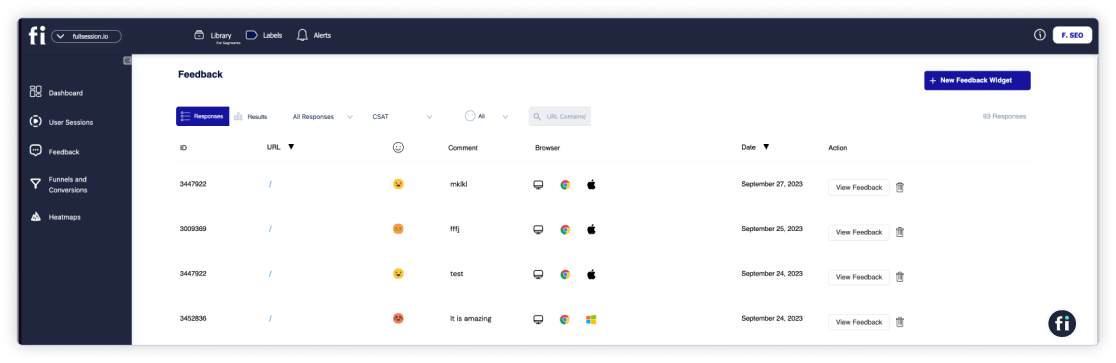
    Once you log in to your account, you will see our analytics dashboard, which includes the Session Playlist. It shows all recorded sessions with details such as user ID, date and time, location, device, and operating system.

    session playlist

    Select a session recording from the list and click the green Play button to watch a session replay. You will be redirected to the new panel, where you can see all essential information about the session.

    play button

    In the top menu, you can see the URL, referring page, heatmap tab, screen resolution, and an option to share the recording with your team.

    In the bottom menu, you can set up the replay speed up to eight times faster, add a comment, see the session duration, skip inactivity, or open developers’ tools.

    bottom menu bar

    What data can you get with session recording and replay?

    session recording and replay tool

    On the right side of the panel, you will see additional data related to the session recording:

    1. User location and IP address
    2. The URL user visited
    3. Referrals
    4. Average time on page
    5. Total active time on page
    6. Session list
    7. Session event
    8. Tags

    Improve Your Website Performance

    Learn how to detect and fix website issues before they affect your customer experience.

    How to Track User Behavior with FullSession

    Tracking user behavior with FullSession provides valuable insights into how visitors interact with your website. FullSession offers many tools to help you understand and optimize user experience, including heatmaps, conversion funnels, and error analysis. 

    With these features, you can identify areas for improvement, improve user engagement, and increase conversions.

    Let’s take a closer look at each feature.

    Heatmaps

    Clicking on the heatmaps tab in the session recording panel allows you to access additional features to evaluate user behavior during the session.

    You can select the device type and choose between the click map, cursor map, or scroll map. If you’re new to heatmaps, you can read our guide on how to read a heatmap. It’s an excellent feature for conducting a customer experience analysis.

    Here are some examples to help you understand how our heat maps work.

    Click map example

    click map

    Mouse movement map example

    mouse movement map

    Scroll map example

    scroll map

    What data can you get with interactive heatmaps?

    Our interactive heat maps boost your session recordings with the following:

    • Preview the heatmap on different devices
    • See the URL the user visited
    • See the number of total views and total clicks
    • Watch error clicks
    • Track rage clicks
    • Monitor dead clicks
    • See the average load time on the page
    • See the average time on the page
    • Track the number of users that visited the page

    You can use this data to filter essential customer actions and improve your website performance.

    Funnels and conversions

    funnels and conversions

    FullSession’s funnels and conversions feature allows you to visualize and analyze the steps users take to complete a desired action on your website. Once you identify where users drop off in the funnel, you can pinpoint areas for improvement and optimize your website to increase conversions. 

    This feature helps you understand user paths and make data-driven decisions to improve the overall user experience.

    Error analysis

    error analysis

    FullSession’s error analysis feature allows you to detect, analyze, and resolve different types of errors that impact user experience. 

    It leverages comprehensive data on error clicks, network errors, console errors, error logs, and uncaught exceptions to provide actionable insights to improve user satisfaction and reliability of your digital products. 

    How FullSession Connects User Feedback with Session Recordings

    FullSession helps you get customer feedback by creating and placing a website feedback form on your website. We provide a handy form creator you can use to set up your questions, align form appearance with your branding, and select devices and pages to show the form. 

    create feedback dashboard

    We present results in the customer feedback report.

    customer feedback report

    When a user leaves feedback on your site, you can watch a connected session recording and replay the video to understand better what happened during the session.

    session recording with user and session details

    If the user leaves negative feedback, you can assess the issue and improve your site layout, features, or content.

    9 Reasons to Start Using FullSession Today

    Our session recording software allows you to spot missing information and hidden user trends. Here are nine reasons to start using FullSession for your website tracking needs.

    1. Spot bugs faster

    FullSession lets you gather data on what’s happening behind the scenes. It allows you to see where errors happen, how often they happen, and what causes them. 

    You can solve issues by fixing code, testing features, or altering the design.

    2. Accelerate your website development

    You can use FullSession during the development phase to see if your navigation is complex, the checkout process isn’t smooth, the images aren’t loading, or a new feature doesn’t work as expected. 

    It helps you improve the overall product quality and ensure everything works harmoniously.

    3. Convert visitors into paying customers

    FullSession helps improve the user flow to increase conversions and create an optimized website or a landing page design tailored to your users’ needs.

    You can improve their engagement with the page’s content, help people find what they’re looking for faster, or provide the information they previously missed.

    4. Solve user interface issues

    Regarding the user interface, you need a tool to fix errors and identify what went wrong. FullSession lets you access recordings in real time, allowing you to view interactions at the time of the problem without disrupting the customer experience.

    You can then use your findings to create a solution that improves your UI for future customers.

    5. Identify and fix customer frustration points

    If your session replays show that many users drop off or don’t complete the desired steps on your website, it’s time to take action. 

    FullSession will help you identify user frustration points and create a solution to reduce these issues.

    6. Detect security threats and understand how they happen

    With FullSession, you can use automatic event tracking to identify any signs of suspicious user activity. It’s also helpful in validating that your security features work as expected. 

    You can analyze captured data, determine the nature of the threat, and take action.

    7. Improve customer experience and satisfaction

    FullSession can show you how customers interact with your website and provide valuable information that is difficult for humans to gather through conversation-based research methods like surveys or interviews.

    Watching a session replay can improve outcomes for both customer support staff and customers. It allows your reps to provide more efficient solutions since they can see what happened during each session.

    8. Gather data without slowing your website down

    Unlike other website session recording tools like Hotjar, FullSession allows you to capture analytics data and make accurate UX analyses without slowing down your site.

    9. Find critical events in session recordings quickly and easily

    FullSession provides a skip-inactivity feature that lets you quickly find important events in a session. 

    You can also use advanced filtering and segmentation to find necessary data in a blink of an eye.

    How to Sign Up for FullSession

    FullSession offers a 14-day free trial. If you need more information, you can book a demo.

    Other Session Recording Tools You Can Try

    You have come to the right place if you are looking for session replay tools for your website. We’ve researched instead of you and analyzed top vendors for session recording besides our FullSession solution. Continue reading to learn more.

    1. Microsoft Clarity

    Microsoft Clarity

    Microsoft Clarity helps you see how people use your site. It makes it easy to identify problems and opportunities and to test new ideas. It is GDPR-compliant and built on an open-source basis. It’s a good solution for online businesses, from bloggers to digital marketers and product teams.

    Features list

    Microsoft Clarity allows you to record visitor behavior on your site. It provides rich data for improving your site, like mouse tracking, click tracking and scroll monitoring.

    Recordings are available for most sessions and usually appear 30 minutes after the start of the session, but they may take up to 2 hours to process. Remove the Microsoft Clarity code for page URLs you don’t want to track.

    With Microsoft Clarity, you can:

    • See how your visitors use your product
    • Save recordings as favorites to watch later
    • Playback or pause recordings to dive into details
    • Search, filter, or segment recordings by specific attributes
    • Identify users’ pain points
    • Explore potential issues that damage the user experience
    • Share recordings with your team or clients
    • Connect your account with Google Analytics
    • Block internal traffic from recordings

    Pros

    Apart from free usage, Microsoft Clarity also has other benefits. Here are some of them:

    • It is easy to use and set up
    • It helps you track and analyze how visitors navigate your web pages using session recordings, heatmaps, and an advanced dashboard

    Cons

    Microsoft Clarity also has some drawbacks. Here are some of them:

    • Some users complain that the site takes time to load and analytics data doesn’t always load properly
    • It lacks user survey and feedback features

    To learn more about this product, read our Hotjar vs Microsoft Clarity comparison.

    2. Inspectlet

    Inspectlet

    Inspectlet offers automatic event tracking and reveals the exact steps people take on your site. You can set up conversion funnels to make personalized site experiences for your customers, gather data on mouse movement, scrolls, and clicks, and see how visitors move around your site.

    Features list

    With the help of Inspectlet, you can better understand your customers’ perspectives. With Inspectlet, you can:

    • Record users and monitor their behavior
    • Capture users’ actions with screenshots
    • Use targeted tracking
    • Filter recordings to find the ones that you’re most interested in
    • Tag users and sessions with specific labels
    • Run A/B testing
    • Get form analytics and track form metrics
    • Monitor your site or app for any issues, such as Javascript errors

    Pros

    Here are some of the pros of Inspectlet:

    • It removes the guesswork by showing you what your users see and do on your website
    • Inspectlet is easy to set up and implement

    Cons

    Here are some of the cons of Inspectlet

    • The pricing gets high as you scale
    • Some users complain of bad customer support

    To learn more about this product, read our Hotjar vs Inspectlet comparison.

    3. Hotjar

    Hotjar

    Hotjar helps you understand how visitors use your website. With Hotjar, you can improve the user experience and conversion rates and increase sales. With session recordings, surveys, polls, and visitor recording features, Hotjar helps you reach more customers and meet your business goals.

    Features list

    Hotjar helps you make data-driven decisions on how to improve your online presence. Here is the list of Hotjar features:

    • Heatmaps to track mouse movements, scrolls, and clicks
    • Session recording to identify usability issues
    • Session replay software that help you pinpoint specific issues during a user session
    • Conversion funnel optimization to improve conversion rate
    • Form analytics to see how your leads interact with your forms
    • User feedback polls
    • Incoming feedback to let users share their opinions in real-time
    • Surveys to ask questions and get the information you need
    • Usability testing recruitment

    Pros

    Here are some of the pros of Hotjar:

    • Hotjar provides advanced behavioral analytics features that provide a holistic view of your visitors’ actions and actual user journeys
    • It enables you to create custom tags to mark interesting user recordings for reference

    Cons

    Here are some of the cons of Hotjar:

    • It doesn’t provide a funnel analysis tool
    • Its heatmaps don’t track dynamic elements

    Our Hotjar Reviews and Comparison Articles

    Want to learn more about Hotjar and its alternatives? Feel free to check out our in-depth articles:

    4. Lucky Orange

    Lucky Orange

    Image source: G2

    Lucky Orange lets you capture user actions through screen recording or session replay. This allows you to quickly identify UX problems that appear on-screen and fix them before they affect your website’s performance.

    It’s a good solution for UX designers, product managers, market researchers, digital marketers, and anyone who wants to gather insights about their customer’s behavior.

    To learn how this tool compares to other UX analytics solutions, read our article on Lucky Orange alternatives.

    Features list

    Lucky Orange helps you improve your site performance by providing data to support decisions about creating more effective web performance strategies.

    Here is what you get with Lucky Orange:

    • Session recording and session replay
    • Live chat for customer support
    • Conversion funnel optimization
    • Detailed visitor profiles
    • Recordings history
    • Announcement sharing
    • Announcement placement options and intelligent triggers
    • Dynamic heatmaps
    • Unlimited and customizable dashboards
    • Form analytics
    • Fully customizable surveys with a pre-launch preview

    Pros

    Here are some of the pros of Lucky Orange:

    • It includes a wide range of analytics features that allow you to understand user behavior
    • It enables you to capture analytics data points and record user actions in real-time

    Cons

    Here are some of the cons of Lucky Orange:

    • Its load time can be slow
    • It can be challenging to learn its features

    5. Mixpanel

    Mixpanel

    Mixpanel is a valuable analytics tool everyone can use. It requires no coding skills, and you can easily integrate it with your website. Mixpanel allows you to track user activity and collect real-time data from your website or mobile app to optimize your product performance.

    Features list

    With MixPanel, you can measure how your visitors interact with your website based on over 70 metrics. It helps you optimize your online presence and make it more effective by constantly collecting and analyzing data.

    Here is the shortlist of Mixpanel features:

    • User behavioral analytics and interactive reports
    • Custom dashboards
    • Custom alerts for changes in metrics
    • Result sharing among teams
    • Advanced session recording and session replay segmentation options
    • Marketing and sales funnels monitoring
    • Data integration and management
    • Data privacy and transfer regulations

    Pros

    Here are some of the pros of Mixpanel:

    • It gives you a central analytics platform that provides valuable insights into user behavior
    • It is easy to set up and deploy

    Cons

    Here are some of the cons of Mixpanel:

    • Its customer segmentation feature lacks advanced functionalities
    • Mixpanel requires technical skills and knowledge to implement the tool

    To see how Mixpanel compares to other UX solutions, read our article on Mixpanel alternatives.

    6. FullStory

    FullStory

    FullStory captures both quantitative and qualitative data to let you drive digital transformation and growth. You can integrate FullStory with your existing tech stack.

    It allows you to record and replay sessions as they happen, dive into the deep details of each interaction, and discover moments that will transform your understanding of your customers’ needs.

    Features list

    With FullStory, you can see what people did while using your product. It records everything from clicks and mouse movements to scroll behavior.

    Here is the list of FullStory features:

    • Advanced record and session replay options
    • Skip inactivity feature
    • Users and sessions filtering
    • Developers’ tools and bug reports
    • Conversion funnel optimization
    • Click and scroll heatmaps
    • Team collaboration tools
    • Privacy control features
    • Out-of-the-box implementation with JavaScript frameworks

    Pros

    Here are some of the pros of FullStory:

    • It records every user interaction, including rage clicks, missed content, text inputs, and more
    • It is easy to set up and implement

    Cons

    Here are some of the cons of FullStory:

    • Its broad range of functionalities can be time-consuming and challenging to learn
    • The cost of the tool gets expensive as you scale

    You can check out our article on FullStory competitors to learn more about this solution. You can also read our LogRocket vs FullStory or LogRocket competitors comparison.

    Session Recording Tools: Our Verdict

    session recording and replay tool

    Session recording and replay allow you to use accurate data and make impactful changes to your product. However, you must choose the right tools to help you make the proper UX analysis without affecting your site performance.

    FullSession will help you during your session recording journey. Our web analytics platform doesn’t slow down your site while collecting data and provides advanced segmentation and filtering options to help you find questionable user sessions faster.

    It can also help you identify areas for improvement and focus your efforts where they will have the most significant impact.

    FullSession Pricing Plans

    FullSession pricing

    The FullSession platform offers a 14-day free trial. It provides three paid plans: Starter, Business, and Enterprise. A yearly subscription can save you up to 20%!

    Here are more details on each plan.

    • The Starter plan costs $39/month or $32/year and allows you to monitor up to 5,000 monthly sessions with up to 6 months of data storage.
    • The Business plan costs $75/month or $60/year and helps you to track and analyze up to 100,000 monthly sessions with up to 12 months of data storage.
    • The Enterprise plan has custom pricing and offers customizable sessions plus full access to all features.

    Book a demo today.

    Get a Better Understanding of User Behavior with FullSession

    It takes less than 5 minutes to set up your session replays, heatmaps, and other analytics tools with FullSession, and it’s completely free!

    Get a demo now.

    FAQs about Session Recordings and Replays

    What is a session recording?

    A session recording captures a user’s interactions with a website or application, including clicks, scrolls, and navigation paths. It allows businesses to replay user sessions to understand behavior, identify issues, and improve the user experience.

    What is session replay used for?

    Session replay is used to review and analyze user interactions with a website or application. Like other traditional web analytics tools, it helps businesses understand user behavior, identify usability issues, diagnose bugs, improve customer support, enhance the user experience, and test new features effectively.

    How do you analyze session recordings?

    Analyzing session recordings involves a qualitative research approach that includes many tasks, such as:

    • Creating unique customer segments and comparing them
    • Identifying user behavioral patterns
    • Identifying website bugs and glitches and more

    When you assess the data, you can start with website optimization.

    How do I record a web session?

    If you want to know what your users are doing on your website and see their clicks, scrolls, and mouse movements, you should consider installing session recording.

    FullSession currently offers a free trial to let you test all available features and see if our tool is a good fit for your business. Book a demo now.

    How does session replay capture user experience?

    Session replay captures user experience via a tracking code you install on your website. The session replay tool logs data from visitors’ interactions on your website once you’ve installed the code.

    What is the primary purpose of session replay?

    Session replay reconstructs a visitor’s entire journey on your website so you can track website issues and find ways to fix them quickly.


  • Scroll Maps: How to Use Them In 2025

    Scroll Maps: How to Use Them In 2025

    Understanding user behavior is key to evaluating how customers interact with your website, web app, or landing page. You can gain valuable insights by analyzing activities like cart abandonment, button clicks, page navigation, and scrolling.

    Scroll maps help uncover visitor interactions, especially on crucial landing pages designed to drive sign-ups and guide customers through the sales funnel. They track how users move through your pages, revealing opportunities for pixel-perfect user experiences.

    In this article, we’ll explore scroll maps, their importance, and how to use them to create perfect user journeys. Want to skip ahead and see scroll maps in action with FullSession?

    Scroll Your Way to Success With FullSession

    Discover how our interactive scroll maps help you visualize user engagement, identify drop-off points, and optimize your content placement for maximum impact.

    What is a Scroll Map?

    A scroll map is a tool that analyzes user behavior to help you better understand their actions and figure out what encourages them or prevents them from converting. You can capture scroll maps across different device types (tablet, computer, mobile) and use scroll data presented in visual reports to understand how far down the page your customers scroll.

    When reviewing your scroll map data, you will see different colors on each page. Red represents the most viewed sections, while cold colors represent the least viewed page sections.

    Scroll maps also provide numerical data to show the percentage of individuals who went all the way to the bottom of the page. You can also calculate average fold data showing the parts of pages that receive the most attention from users before they scroll. 

    Analyzing customers’ scrolling behavior can give you many insights into which pages need improvement to increase visitor engagement and achieve maximum conversions. 

    While many use the terms scroll maps and heatmaps interchangeably, it’s important to note that they are not the same – here’s why.

    Scroll Maps vs. Heatmaps

    Scroll maps are only one type of website heatmaps where warmer colors represent the most popular sections on a website, web app, or landing page, while colder colors represent the least engaging ones.

    “Heatmaps” act as an umbrella term for all user behavior tools that gather user data based on their activities on your website and visually present it to help you understand how users interact with your web pages.

    It helps your product team deduce which page elements work and which don’t. Let’s explore different types of heatmaps.

    Scroll mapsMaps that offer a visual representation of website visitors’ scroll behavior. You can see how many users scroll to or before the bottom and how many abandon the page.
    Click mapsMaps that show where users click on your page. You can see which elements and buttons are the most effective and which sections require improvement.
    Mouse movement mapsThese maps track general mouse movement. You can spot different patterns like which parts of pages users hesitate to click. Move maps can also help you optimize complex pages with dynamic elements.
    Eye-tracking heatmapsThese maps use sensor-based technology to track the user’s eye movement when they’re on your page. It monitors blinking, pupil dilation, and overall eye activity.
    Error click heatmapsThese maps help you visualize which elements trigger errors once the user clicks on them.
    Dead-click heatmapsDead-click maps show which unclickable elements visitors often mistake for clickable, such as a piece of text or image that resembles a button. 
    AI-generated heatmapsAI-generated heatmaps use artificial intelligence to suggest which elements the users will likely pay the most attention to. They use previously-aggregated data to make these assumptions.

    Make Every Scroll Count With FullSession

    Learn how to visualize, analyze and identify areas for improvement to create a website that users love to explore.

    What Is a Heatmap Used For?

    Heatmaps help you learn more about your site visitors’ behavior. Marketers and business owners most commonly use them to determine which website elements require some attention.

    They categorize information by color. Warm colors depict parts of pages that customers find the most interesting. In contrast, colder colors represent parts that users interact with the least. These categories are also known as heat zones.

    You can create heatmaps for every category, product, and landing page. These help you understand what users click on, how far visitors scroll down, and which parts of pages they completely ignore.

    How Are Heatmaps Generated?

    Third-party software makes it easy to generate heatmaps. When choosing the perfect heatmap tool to gather this type of data, opt for services offering different kinds of user experience analytics tools.

    FullSession is comprehensive web analytics software that helps you aggregate and analyze different data sets to make effective UX improvements, such as learning where to place important elements.

    It is one of the most effective ways to spot false bottoms, bring in more visitors, and have fewer people bounce before they become converting customers. Aside from interactive heatmaps, FullSession’s key features include:

    • Session recording and replay
    • User engagement analysis
    • Advanced user and event segmentation and filtering options
    • Customer feedback features
    • Conversion funnel tracking
    • Error analysis

    Start a free trial or book a demo and experience these powerful features firsthand.

    Create Data-Driven Scroll Maps with FullSession

    FullSession offers the most advanced user behavior analytics tools, including three types of heatmaps. Making a click, mouse movement, or scroll map with FullSession is very easy – our software does it automatically in seconds.

    Our heatmap data lets you track dynamic elements, unlike other companies that only offer static element tracking.

    Instead of waiting for your heatmap to process data every time you want to view it, FullSession lets you track it in real time, reducing the wait time to zero. 

    The interactive heatmap feature will help you perfect even the most complex pages to minimize user frustrations and reduce the bounce rate. 

    With advanced user and event filtering options that make the data analysis process more convenient, FullSession lets you take full control over all content on your website. It helps you gain valuable insights into optimizing the overall user experience.

    Here’s how you can use FullSession’s heatmap feature:

    • Visualize heatmap data on different devices
    • See the URL the user visited
    • Track the number of total views and total clicks
    • Watch error clicks
    • Visualize rage clicks
    • Monitor dead clicks
    • See the average load time on the page
    • See the average time on the page
    • Track the number of users that visited the page

    While most digital customer experience platforms slow down your website significantly when recording sessions, FullSession doesn’t affect its performance whatsoever – your customers will enjoy a glitch-free website. At the same time, you can gather data on their behavior and interests.

    Take Control of Your Website Performance

    Learn how our interactive scroll maps reveal how users interact with your content, enabling you to create engaging, high-converting pages.

    FullSession click map example

    FullSession mouse movement map example

    mouse movement map

    5 Ways Scroll Maps Can Help You Understand Your Customers Better

    Let’s have a quick rundown of the five ways how scroll maps can help you analyze and optimize different app pages, category pages, and all other elements on your website.

    Learn why visitors leave your website

    Scroll maps help determine where your visitors start losing attention during their on-page experience.

    When you notice the appearance of cold colors on your scroll map, you’ll know that section is where users lose interest. You can analyze and test different elements from these cold sections to see why they left the page.

    Pinpoint false bottoms

    “False bottom” refers to parts of a web page that give the impression of being the bottom of the page, even though there is more content beneath.

    Because these areas look like the bottom of the page, users often leave before they have a chance to view the content located further down. Pinpointing these issues helps you use the whole page better and learn where to place important elements.

    Analyze your page above the fold

    Your customers are the most exposed to parts of the page above the fold. A scroll map will calculate the average fold on your pages for desktop and mobile users. It shows you where to place calls to action and other important elements to capture users’ attention.

    See how easy it is for customers to find what they want

    Sometimes, you may notice raging scroll activity from your customers that results from struggling to find what they want. Understanding how long it takes for users to scroll to important sections will help you prioritize and arrange elements more effectively.

    Analyze cross-device experience

    Users don’t have the same behavior patterns when browsing their phones as when browsing on desktops.. Scroll maps can identify weak spots across different devices to show you how to optimize each of the layouts to create the best cross-device experience.

    Pros & Cons of Using Scroll Maps

    Scroll maps are a very effective method of analyzing user behavior. We’ve already discussed the benefits of including scroll maps in your strategy to detect various data patterns. However, they lack versatility and come with certain drawbacks.

    Here’s a quick rundown of all the pros and cons associated with using scroll map data.

    Pros:

    • Scroll maps are handy for optimizing pages above the fold
    • Watching how visitors scroll can show you how easy it is for them to find the desired page elements
    • You can analyze how users scroll and think of ways to make them scroll even further down the web page
    • It’s great for helping you design a high-quality, converting page
    • It allows you to understand how to prioritize content and elements on each page
    • They are very visual, easy to understand, and a great resource for gathering valuable quantitative and qualitative data

    Cons:

    • Scroll maps are not very useful for web pages that have dynamic elements
    • The data isn’t always 100% accurate

    Collect Your Own Scroll Map Data With FullSession

    Scroll maps are only one method for learning more about your customers’ behavior. This information is of great value if you want to provide your users with a great experience when they visit your website pages.

    Scroll maps can help you determine which pages must be fixed and optimized. They also help you spot patterns, like finding out which pages perform well, allowing you to apply that same principle to other pages to improve the retention and conversion rate.

    FullSession’s advanced user experience analytics can take your website from regular to above industry standard in weeks.

    Book a demo to boost your website’s performance and increase conversions.

    FullSession Pricing Plans

    Fullsession Pricing

    The FullSession platform offers a 14-day free trial. It provides three paid plans—Starter, Business, and Enterprise. You can save up to 20% with a yearly subscription!

    Here are more details on each plan.

    • The Free plan is available at $0/month and lets you track up to 500 sessions per month with 30 days of data retention, making it ideal for testing core features like session replay, heatmaps, and frustration signals.
    • The Growth Plan starts from $23/month (billed annually, $276/year) for 5,000 sessions/month – with flexible tiers up to 50,000 sessions/month. Includes 4 months of data retention plus advanced features like funnels & conversion analysis, feedback widgets, and AI-assisted segment creation.
    • The Pro Plan starts from $279/month (billed annually, $3,350/year) for 100,000 sessions/month – with flexible tiers up to 750,000 sessions/month. It includes everything in the Growth plan, plus unlimited seats and 8-month data retention for larger teams that need deeper historical insights.
    • The Enterprise plan starts from $1,274/month when billed annually ($15,288/year) and is designed for large-scale needs with 500,000+ sessions per month, 15 months of data retention, priority support, uptime SLA, security reviews, and fully customized pricing and terms.

    Book a demo today.

    FAQs About Scroll Maps

    What are scroll maps?

    Scroll maps visually display how far users scroll down your pages, highlighting which sections grab attention and which get missed. They’re perfect for optimizing content placement and improving user engagement, especially if you have a responsive website design where elements can collapse or drop under each other.

    What is the difference between a heatmap and a scroll map?

    A heatmap shows where users click, tap, or hover, revealing interaction hotspots. A scroll map, on the other hand, tracks how far down the page users scroll, showing the most and least-viewed parts of the page.

    What is an example of a heatmap?

    An example of a heatmap is a color-coded overlay on your webpage showing where users click the most. Red areas indicate high activity, while blue areas show less interaction.

    What does a heatmap show?

    A heatmap displays user interaction patterns, highlighting clicks, taps, and hovers. It visually represents which parts of your webpage are the most and least engaging, guiding you to optimize your layout.


  • Website Tracking: How to Do It + 5 Tools [Free & Paid]

    Website Tracking: How to Do It + 5 Tools [Free & Paid]

    Website visitor tracking is essential for optimizing your website and increasing conversions. It allows you to learn more about who visits your site, where they come from, what websites refer traffic to yours, and other important information.

    The best website visitor tracking software also helps you discover if people can find the information they need or get confused at any point in the process.

    Many tools are available on the market to help with website visitor tracking. However, not all of them are useful or affordable.

    We recommend you start using FullSession, our web analytics tool, which helps you build a seamless customer experience with features like session recording and replay tools, website heatmap, and customer feedback tools.

    In this guide, we will discuss the essentials of website visitor tracking and focus on free and paid tools to help you choose the right one for your needs. Let’s start with some elementary information.

    Visualize, Analyze, and Optimize with FullSession

    See how to transform user data into actionable insights for peak website performance.

    What Is Website Visitor Tracking?

    Website visitor tracking is the process of tracking and recording user behavior

    To track visitors, you need to install a tracking code on your website. It sends information about the site visitors to a third-party tool that collects statistical data and provides reporting.

    Why Is Website Visitor Tracking Important?

    Website tracking helps you improve your site functionality and boost the customer experience. Here are additional reasons why a website monitoring tool is vital for your business. It helps you:

    1. Analyze user traffic and identify your most profitable customers
    2. Reveal which aspects of your website are causing customers to convert
    3. Focus on the product or service pages that are most likely to sell

    Website visitor tracking also helps you identify any potential issues or areas you need to improve on your site.

    What Are the Benefits of Website Visitor Tracking?

    Since we explained user behavior analytics, it’s time we get to the main point – how web tracking can improve your online business. Here are some core benefits user behavioral analytics brings:

    1. It provides you with a deeper understanding of individuals visiting your website by tracking user activity.
    2. You can see the behavior of repeat visitors and identify their preferences.
    3. You can deliver a personalized shopping experience to individual visitors.

    Website visitor tracking can also help you identify potential security threats and fraudulent activity.

    What Features Should Visitor Tracking Software Include?

    Interactive heatmaps, session recordings and replays, and user feedback allow you to track user behavior, sentiment, and interests when visiting your website. Let’s explain each of these critical features.

    Mouse movement maps

    Heatmaps visually represent users’ interaction with your website, web app, or landing page. You can use them to make design and usability improvements.

    Scroll maps

    Scroll maps track how far visitors scroll down on a page or section of your website. You can identify page areas that cause users to leave without interacting with your content.

    Click maps

    Click maps let you track website visitors as they navigate your website. You can spot low-engagement areas, optimize them to draw more clicks, and help customers find what they need faster.

    Session recordings and replays

    Session recordings and replays help you watch user visits in real time and determine which website elements are popular or engaging or cause users’ frustration.

    User feedback

    Sometimes, you need to hear what users think about their experience. User feedback provides insightful, honest thoughts on your product features, tweaks you should implement or avoid, positive and negative points, and what you should do to improve your product.

    So far, we’ve explained the basics of website visitor tracking and the features to look out for in good visitor tracking software. In the following sections, we’ll highlight the evaluation parameters and list the top 10 visitor-tracking software you can start using today.

    Our Evaluation Parameters for Website Visitor Tracking Tools

    Image source: Freepik

    In this comparison article, we have evaluated ten website visitor-tracking tools using the following parameters:

    • Target audience
    • Deployment
    • Features list
    • Integrations
    • Customer support
    • Pricing
    • Pros
    • Cons

    By considering the evaluation parameters above, you can be sure to select a tool that will work well for your business.

    The Best Website Visitor Tracking Software in 2024

    Many website visitor tracking solutions are on the market, each with benefits and limitations.. Let’s start with our list to help you make your decision faster.

    1. FullSession

    FullSession is a website tracking solution that helps businesses monitor and analyze user interactions with websites, web apps, and landing pages.

    With FullSession, you can track visitor behavior and identify areas where they have issues to solve them and provide an exceptional digital customer experience.

    Who uses it?

    The FullSession analytics platform is ideal for cross-functional teams, including sales and marketing teams, product teams, and UX research teams. These teams can seamlessly collaborate and have a smooth and productive workflow. It is also popular in the e-commerce industry.

    Deployment

    FullSession is a web-based, cloud, and SaaS website tracking tool you can deploy by adding its code snippet to your website.

    Features

    FullSession allows you to make smarter business decisions. You can use it to monitor your website visits, identify strengths and weaknesses, and convert more visitors into paying customers with several analytics features. Let’s throw light on each of them.

    1. Session recording and session replay

    Session recording and session replay give you a clear picture of what users do on your website, including the pages they visit, the buttons they click, their text inputs, funnel drop-offs, and more.

    With our session recording and replays, you can access analytics data, such as:

    1. User location and IP address
    2. The URL user visited
    3. Referrals
    4. Average time on page
    5. Total active time on page
    6. Session list
    7. Session event

    You can quickly find the session recording you need or skip user inactivity while watching a session replay to save time.

    2. Interactive heatmaps

    Interactive heatmaps allow you to analyze user behavior to figure out the web elements they interact with and the pages they engage with the most on your site.

    Our heatmap feature uses a combination of colors – red, yellow, green, and blue – to depict the level of user engagement across various web pages and elements.

    You can also use the FullSession interactive heatmaps to filter user actions and perform the following activities:

    • Preview the heatmap on different devices
    • See the URL the user visited
    • See the number of total views and total clicks
    • Watch error clicks
    • Track rage clicks
    • Monitor dead clicks
    • See the average load time on the page
    • See the average time on the page
    • Track the number of users that visited the page

    You can use these analytics data to filter necessary customer actions and optimize your site functionality for better performance.

    FullSession provides three types of heatmaps:

    1. Click map
    2. Scroll map
    3. Mouse movement map

    Let’s show you examples of each interactive heatmap.

    Click map example
    Scroll map example
    Mouse movement map example
    3. Advanced data segmentation

    Our advanced segmentation feature allows you to build specific user segments to quickly identify essential user actions and session recordings of significant interest.

    4. Insights

    The FullSession insights give you a comprehensive overview of significant user activities to easily interpret user data. Its various categories help you evaluate your website performance.

    Here are the major ones:

    • Session playlists
    • Top users
    • Segment health
    • Key pages
    • User trends
    • Feedback trends
    • Device breakdown
    • General feedback
    • Browser breakdown
    • Top referrers
    • Screen resolution breakdown
    • Error clicks
    • Rage clicks

    With this feature, you can quickly uncover hidden patterns in user behavior.

    5. Customer feedback forms

    Our customer feedback forms help you receive real-time user feedback to understand users’ actions and sentiments about your site performance. Each customer feedback connects with a session recording, so you can watch what happened during the specific user session.

    You can also use our customer feedback report to analyze customer feedback and assess response details. You can see the user ID, the visited page, sentiment, comment, browser type, feedback date, and details.

    You can also see your overall results during a specific period.

    6. Notes

    FullSession notes feature helps you share comments about user activities and evaluate customer issues. You can share the analysis with your team to improve collaboration.

    7. Funnel and conversion tracking

    The FullSession funnels feature offers a detailed analysis of user journeys, enabling you to monitor and optimize each stage of your conversion funnel. 

    It helps identify key actions that drive conversions, detect issues causing drop-offs, and analyze user interactions to improve the user experience.

    With this feature, you can:

    • Visualize funnel steps
    • Monitor trends
    • Identify top events and actions
    • Detect and fix issues
    • Measure user interaction time
    • Analyze engagement
    • Track revisit rates
    • Compare segment performance
    • Analyze performance over different time periods
    8. Error analysis

    The error analysis feature helps you identify, analyze, and resolve various types of errors impacting user experience. 

    By leveraging data on error clicks, network errors, console errors, error logs, and uncaught exceptions, FullSession provides actionable insights to enhance reliability and user satisfaction.

    This feature allows you to:

    • Detect non-responsive elements causing errors
    • Monitor and analyze network errors
    • Log and filter console errors
    • Capture detailed error information for debugging
    • Monitor and resolve unhandled errors
    • Segment data for deeper insights
    • Receive real-time alerts and notifications

    What makes this tool unique

    FullSession provides behavior analytics to understand users’ behavior when navigating your site. It helps you run surveys and collect user feedback to skip the guesswork and understand the motivation behind user actions.

    Plus, it provides advanced data segmentation to find issues with laser precision. It also doesn’t slow down your website while collecting and analyzing data.

    Integrations

    The FullSession platform allows website owners to connect with third-party apps like WordPress, Shopify, BigCommerce, and Wix.

    Customer support

    If you have any issues with FullSession, you can start a live chat or send us an email. You can also check out the FullSession help center or read our guides for additional information.

    Pricing

    Fullsession Pricing

    FullSession offers a free trial for our two premium packages, Starter and Business. The annual plan can save you up to 20%.

    1. The Free plan is available at $0/month and lets you track up to 500 sessions per month with 30 days of data retention, making it ideal for testing core features like session replay, heatmaps, and frustration signals.
    2. The Growth Plan starts from $23/month (billed annually, $276/year) for 5,000 sessions/month – with flexible tiers up to 50,000 sessions/month. Includes 4 months of data retention plus advanced features like funnels & conversion analysis, feedback widgets, and AI-assisted segment creation.
    3. The Pro Plan starts from $279/month (billed annually, $3,350/year) for 100,000 sessions/month – with flexible tiers up to 750,000 sessions/month. It includes everything in the Growth plan, plus unlimited seats and 8-month data retention for larger teams that need deeper historical insights.
    4. The Enterprise plan starts from $1,274/month when billed annually ($15,288/year) and is designed for large-scale needs with 500,000+ sessions per month, 15 months of data retention, priority support, uptime SLA, security reviews, and fully customized pricing and terms.

    We also provide a customized pricing package if your business has specific website analytics needs. Check out our Pricing page.

    Pros

    • It allows you to make accurate CX analysis without slowing down your site loading speed
    • It provides advanced filtering options to identify critical events in a session faster
    • You don’t need advanced technical skills to use our analytics platform

    2. Hotjar

    Hotjar

    Hotjar is a user behavior tracking tool that helps businesses understand user behavior via session recordings, heatmaps, surveys, form analytics, and website feedback forms.

    It is a web-based analytics tool that helps you collect data about visitors’ engagement with your website and identify any usability issues.

    User rating

    According to Capterra, Hotjar scores 4.7 out of 5 based on 514 user reviews.

    Who uses it?

    Hotjar is primarily made for UX designers, UX researchers, data analysts, digital marketers, and product teams.

    Deployment

    Hotjar is a cloud, Saas, and web-based platform, and you can deploy it by installing its Javascript code into your site source code.

    Features

    With features like heatmaps and visitor recordings, Hotjar can be used by businesses of all sizes to track users, leverage data, generate leads, see how many visitors convert on their website, and boost sales.

    If you choose Hotjar, you will get the following features:

    • Heatmaps
    • Session recording and replay
    • Conversion funnels analytics
    • Form analytics
    • User feedback polls
    • Incoming feedback
    • Surveys
    • User testing recruitment

    What makes this tool unique

    Hotjar allows you to uncover hidden user actions and your users’ objections to your website functionality. It helps you skip the guesswork and see the product features your users engage with, including how they click, scroll, and tap across various web pages.

    Integrations

    Hotjar integrates with popular marketing tools like Slack, HubSpot, Zapier, and more.

    Customer support

    If you have questions about Hotjar, you can head to the help center for answers. If you need faster assistance, you can also fill out a ticket, read documentation, or find useful guides on their official website.

    Pricing

    Hotjar pricing

    Hotjar currently offers a free basic plan that allows you to track up to 1,050 sessions per month. To improve your conversion rates, you’ll need to upgrade to the paid plan—Observe, Ask, and Engage.

    The Observe plan lets you track and analyze user behavior data using heatmaps and session replay. It includes:

    • Basic plan: costs $0 and allows you to track up to 35 sessions/day
    • Plus plan: costs $39/month and lets you track up to 100 sessions/day
    • Business plan: starts from $99/month and lets you track 500 to 270,000 daily sessions
    • Scale plan: starts at $213/month and lets you track 500 to 270,000 daily session recordings

    The Ask plan helps you understand how your users feel and what they have to say about your site performance via the user feedback tool. It includes:

    • Basic plan: costs $0 with access to 20 monthly responses
    • Plus plan: costs $48/month with access to 250 monthly responses
    • Business plan: starts from $64/month and lets you receive 500 to 100,000 monthly responses
    • Scale plan: starts at $128/month and offers access to unlimited monthly responses

    The Engage plan helps you automate most of the processes that come with conducting moderated user interviews, including finding interviewees and scheduling. It includes:

    • Basic plan: costs $0 with access to 3 interviews/month from your own network
    • Plus plan: costs $39.2/month with access to up to 3 interviews/month from the Hotjar participant pool and unlimited interviews from your own network
    • Business plan: starts from $440/month with access to 12 interviews/year from the Hotjar participant pool and unlimited interviews from your own network
    • Scale plan: offers customized pricing and access to 20 interviews/month from the Hotjar participant pool and unlimited interviews from your own network

    Pros

    • It has a low learning curve
    • It provides real-time visitor tracking

    Cons

    • It doesn’t let you track visitor data on mobile apps
    • You have basic customization options for your surveys
    • It slows down your website while collecting data

    How other solutions compare to Hotjar

    Want to learn more about Hotjar and see how it compares to other user behavior tools? Check out our comparison articles

    1. Hotjar review
    2. Hotjar alternatives
    3. Hotjar vs Crazy Egg
    4. Lucky Orange vs Hotjar
    5. Hotjar vs FullStory
    6. Hotjar vs Crazy Egg vs Mouseflow vs FullStory
    7. Hotjar vs Google Analytics
    8. Hotjar vs Microsoft Clarity
    9. Hotjar vs Inspectlet
    10. Hotjar vs Mixpanel vs Clicktale
    11. Smartlook vs Hotjar
    12. Decibel Insight vs Hotjar

    3. Mixpanel

    Mixpanel

    Mixpanel is a product analytics platform that helps you monitor and analyze user engagement and conversion in real time. It lets you track conversions, build funnels, visualize user flows, and create cohorts.

    User rating

    According to Capterra, Mixpanel scores 4.5 out of 5 based on 138 user reviews.

    Who uses it?

    Mixpanel is primarily made for product and digital marketing teams.

    Deployment

    You can deploy Mixpanel by adding its code snippet to your website.

    Features

    Mixpanel provides various analytics features like:

    • Conversion tracking
    • Customer journey mapping
    • Funnel analysis
    • Multivariate testing
    • Predictive analysis

    What makes this tool unique

    With Mixpanel, you can identify the users that actively engage with your product and those that don’t. It helps you understand the product features that provide the most value and measure the right performance metrics.

    Integrations

    Mixpanel integrates with third-party apps like AB Tasty, Chameleon, AWS, and more.

    Customer support

    Mixpanel provides support via email and a knowledge base.

    Pricing

    Mixpanel pricing

    Mixpanel offers a free plan and two premium pricing packages – Growth and Enterprise.

    1. Free plan: allows you to track 20 million monthly events
    2. Growth: starts at $28/month and enables you to build a plan that suits your analytics needs
    3. Enterprise: offers a custom pricing structure and lets you track up to 1 trillion monthly events

    Pros

    • It provides a central analytics platform where you can track and analyze the actions of mobile and website users
    • It is easy to set up and deploy

    Cons

    • Customer segmentation lacks advanced functionalities
    • The UI is not ideal for a non-technical audience

    Read our article on Mixpanel alternatives to understand how it compares to other platforms.

    4. Smartlook

    Image source: G2

    Smartlook allows you to track and analyze user behavioral data on your website and mobile apps. It combines quantitative and qualitative analytics features to help you visualize user actions and how they interact with various product features and site elements.

    User rating

    According to Capterra, Smartlook scores 4.7 out of 5 based on 134 user reviews.

    Who uses it?

    The Smartlook platform is designed for SMBs, e-commerce brands, web design agencies, UX, marketers, and product teams.

    Deployment

    Smartlook is a cloud, SaaS, and web-based platform that you can deploy by installing its code snippet on your site.

    Features

    Smartlook provides various analytics features for tracking website visitors and users. Here are the major ones:

    • Heatmaps
    • Session recordings
    • Event tracking
    • Funnel analysis

    What makes this tool unique

    Smartlook provides a funnel feature that allows you to monitor user journeys and identify funnel drop-offs to optimize user flows and improve conversion rates. It can also track user activity, like button clicks, page visits, and more.

    Integrations

    The Smartlook platform integrates with popular platforms like Segment, Slack, Zapier, Hubspot, and more.

    Customer support

    Smartlook provides support via email and chat.

    Pricing

    Smartlook offers a 30-day free trial. During this trial period, you can enjoy all the features of the business plan. However, there is a limit of 3,000 monthly sessions. 

    You do not need to enter your credit card information to start the trial. After 30 days, you can buy a paid plan or return to the free version. Smartlook offers three paid plans:

    • Pro: 5,000 sessions/month for $55 per month
    • Enterprise: provides a tailor-made solution, so you need to contact sales reps

    Pros

    • It can automatically record user events on your site
    • You can use its session recording feature to analyze user behavior and quickly resolve bugs

    Cons

    • The price can get expensive as you scale
    • It lacks a feedback widget that you can use to collect user feedback

    Read our article on Smartlook alternatives to see how it compares to other platforms.

    5. Google Analytics

    Google Analytics

    Google Analytics is a free web analytics tool that lets you track where your visitors are coming from, how they interact with your website, and what content on your website is most popular.

    User rating

    According to Capterra, Google Analytics scores 4.7 out of 5 based on 8,070 user reviews.

    Who uses it?

    Google Analytics is a popular solution for retail, healthcare, hospitality, real estate, computer software, IT and services, automotive, marketing, and advertising.

    Deployment

    You can use Google Analytics by installing its code snippet on your website.

    Features

    You can use Google Analytics to track web page traffic and analyze demographic data, such as your audience’s location, device, and language.

    Google Analytics provides many features, but we’ll focus on the most important ones:

    • User and conversion modeling
    • Audience reports and demographics
    • Advertising reports
    • Acquisition reports
    • Behavior reports
    • Conversion reports
    • User flow reporting
    • Funnel analysis
    • Predictive analysis
    • Data access, filtering, manipulation, and segmentation
    • Visualization and monitoring

    What makes this tool unique

    Google Analytics provides a clear understanding of the results of your marketing activities. It offers many customization options for visualizing reports, changes in user behavior, and website content.

    Integrations

    Google Analytics integrates with popular marketing tools like WordPress, Facebook, Shopify, Zendesk, and more.

    Customer support

    Google Analytics offers a range of useful articles and guides to help you better understand how your visitors use your site. Also, if you have any issues with your Google Analytics account, you can start a live chat or send an email to customer support.

    Pricing

    Google Analytics is a free service. You need an email address and a password to start using it. However, you can also use an existing Google account if you already have one.

    Google Analytics 360 is a premium version of Google Analytics. Large businesses pay $150,000/year for it.

    Pros

    • You can create custom reports or see traffic data in real-time
    • It’s great for basic data tracking

    Cons

    • Google Analytics has a high learning curve
    • It lacks advanced features, such as user behavioral data

    Read our Google Analytics vs Amplitude comparison to see the differences between these platforms.

    Visitor Tracking Tools: A Short Overview

    This section summarizes the features of the tracking software we explained above.

    FeaturesFullSessionHotjarMixpanelSmartlookGoogle Analytics
    Real-time Session recording
    Funnel analysis
    Conversion tracking
    Behavioral analytics
    Customer segmentation
    A/B testing
    Customer journey mapping
    Dynamic heatmaps
    Free version
    Free trial
    User feedback
    Insights
    Monthly pricing$39$39$28$55Free

    Website Visitor Tracking Software: Our Verdict

    A positive customer experience is essential to the success of any business. How customers view your business, products, or services directly impacts their willingness to spend money with you.

    That is why you must choose suitable website analytics software to track how users interact with your site. This will help you improve the customer experience while following data privacy laws.

    We consider FullSession the best user tracking tool on this list. It provides a wealth of user data and behavior-tracking tools, such as session recordings and replays, three types of interactive heatmaps, website feedback forms, reports, error analysis, and more.

    What’s best is that it doesn’t slow your website down and protects the privacy of your users in the process.

    Get a 360° View of User Behavior

    Learn how to visualize and analyze all user interactions in one intuitive dashboard.

    FullSession Pricing Plans

    The FullSession platform offers a 14-day free trial. It provides three paid plans—Starter, Business, and Enterprise. Here are more details on each plan.

    1. The Starter plan costs $39/month or $32/year and allows you to monitor up to 5,000 monthly sessions.
    2. The Business plan costs $75/month or $60/year and helps you to track and analyze up to 100,000 monthly sessions.
    3. The Enterprise plan has custom pricing and offers customizable sessions plus full access to all features.

    Book a demo today.

    FAQs About Website Tracking Tools

    What is website tracking?

    Website tracking is the process of collecting and analyzing visitor interactions on a website. For example, Lucky Orange alternatives track page views, clicks, time spent on pages, and user behavior patterns.

    How can a website be tracked?

    Websites can be tracked using tools like cookies, pixel tags, and analytics software. These tools monitor visitor activities, collect data, and provide insights into user behavior, helping improve the site’s performance and user experience.

    Is website tracking legal?

    Yes, tracking user behavior is legal, but it must comply with privacy laws and regulations like the General Data Protection Regulation (GDPR) in the EU and the California Consumer Privacy Act (CCPA). Websites usually need to inform users about tracking and data collection and obtain their consent according to data privacy law, often through a cookie consent banner.

    How do I stop website tracking?

    You can stop website tracking by using browser settings to block cookies, enabling Do Not Track (DNT) in your browser, or using privacy-focused browsers and extensions that block tracking scripts. Additionally, regularly clearing your browser cookies can help reduce tracking.


  • 6 Best Website Heatmap Tools in 2025 [Comparison Guide]

    6 Best Website Heatmap Tools in 2025 [Comparison Guide]

    Website heatmap tools are valuable for evaluating the user experience on your website and measuring your website performance. With a visual representation of users’ actions, heatmap software tools help you understand which web pages are most popular and how to improve user engagement.

    Also, by monitoring how individual visitors interact with your website, you can understand user behavior, conduct funnel analysis, make traffic segmentation, identify or fix issues in the conversion path, and ultimately increase conversions and user satisfaction.

    Finding the best website heatmap software can be tricky, especially if you don’t know where to start. You might have thousands of options without knowing which one is the best.

    In today’s blog post, we’ll explain the basics of website heatmap software and how to use it to improve your online business. You can start with FullSession, our web analytics tool, with many valuable features, including heatmaps, session recording and replay tools, conversion funnel analysis, error analysis and customer feedback tools.

    Start a Free Trial to Experience FullSession

    Learn how our interactive heat maps help you find cold spots and dead zones on your site.

    The Best Website Heatmap Tools (Paid)

    Now that you know more about website heat map software, let’s see what tools you can use for heatmap tracking. We created a list of the best heatmap tools to save you time and help you choose the one most suitable for your needs.

    1. FullSession

    With FullSession, our web analytics software, you can see what your returning or new users are doing on your site, react to their needs, and further improve your product.

    We provide you with all the tools you need to make informed business decisions. These tools allow you to uncover data insights in minutes and use them to improve conversion rates and website optimization.

    Optimize Your Website Performance

    Learn how our interactive heat maps help you find cold spots and dead zones on your site.

    FullSession heatmap feature

    FullSession’s core heatmap software functionality includes a heatmap report, which helps you understand immediately where your visitors experience issues. You can use click, mouse movement and scroll heatmaps to identify problem areas on your site, fix them quickly, and watch bounce rates decrease.

    By analyzing where users click, visitors’ hot spots, page scrolls, or mouse movements on your site, you can uncover the sources of user frustration or the elements driving the most engagement. This data provides the information you need to capture visitors’ attention.

    Not only is FullSession cost-effective, but it also gives you real-time data you can use to improve your sales, marketing, or development efforts right away. It means fewer surprises and faster results.

    Other notable features

    • Session recordings
    • Session replays
    • User feedback tools
    • Customer insights
    • Funnel analysis
    • Error analysis

    With how comprehensive FullSession is, it’s also worth noting that it can replace multiple tools for analyzing your website’s user experience.

    FullSession pricing

    Fullsession Pricing

    FullSession doesn’t include a free plan, but we offer a free trial. You can save up to 20% with the annual subscription.

    Here are more details on each plan.

    • The Free plan is available at $0/month and lets you track up to 500 sessions per month with 30 days of data retention, making it ideal for testing core features like session replay, heatmaps, and frustration signals.
    • The Growth Plan starts from $23/month (billed annually, $276/year) for 5,000 sessions/month – with flexible tiers up to 50,000 sessions/month. Includes 4 months of data retention plus advanced features like funnels & conversion analysis, feedback widgets, and AI-assisted segment creation.
    • The Pro Plan starts from $279/month (billed annually, $3,350/year) for 100,000 sessions/month – with flexible tiers up to 750,000 sessions/month. It includes everything in the Growth plan, plus unlimited seats and 8-month data retention for larger teams that need deeper historical insights.
    • The Enterprise plan starts from $1,274/month when billed annually ($15,288/year) and is designed for large-scale needs with 500,000+ sessions per month, 15 months of data retention, priority support, uptime SLA, security reviews, and fully customized pricing and terms.

    Book a demo today.

    2. Hotjar

    Hotjar is a user experience analytics tool that provides instant visual reports. It allows you to gain data on where your customers drop off, where the traffic comes from, how your visitors find your site, and how your users interact with it.
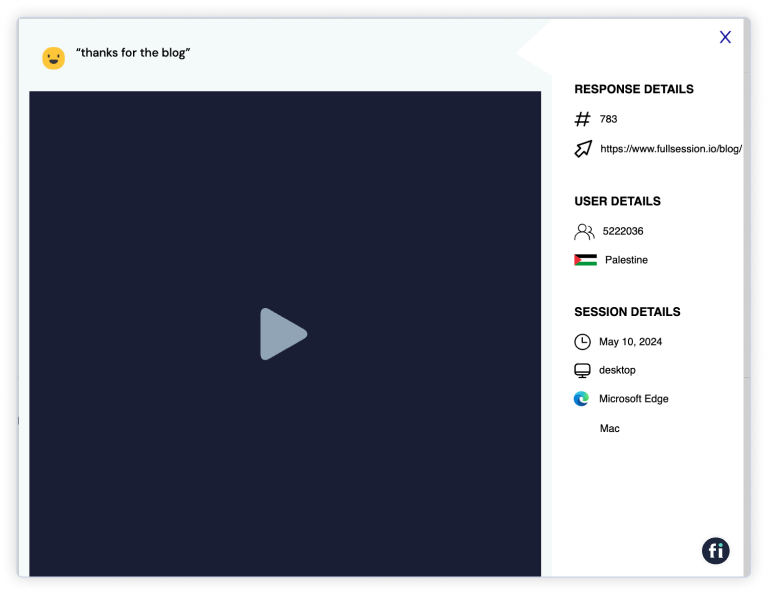
    With these actionable insights, you can build your online presence from scratch or improve your existing website to ensure you’re reaching the goals you’ve set for yourself.

    Hotjar heatmap feature

    Hotjar’s built-in heatmapping tools let you measure and optimize your site, get real-time feedback from individual users, and improve your bottom line.

    Hotjar’s heatmapping software provides a graphic representation of visitors’ interactions, displaying detailed click maps, scroll maps, and mouse movement maps that are clear, colorful, and easy to understand.

    For example, you can use Hotjar to see how users navigate your website, what elements they click or tap, how far they scroll on your web or product pages, or what links grab their attention on desktop, tablet, or mobile devices.

    Users are often scared of providing personal information, but with Hotjar anonymous visitor behavior tracking, you can find the important information you need without invading anyone’s privacy.

    Other notable features

    • Incoming feedback
    • Session recording and replay
    • Surveys with predefined templates
    • Conversion funnels
    • Form analytics
    • User testing recruitment

    Hotjar pricing

    Hotjar offers a free version that lets you create unlimited heatmaps but limits you to 35 daily session recordings or up to 1,050 session recordings per month.

    If this option doesn’t suit your needs, you need to upgrade to a paid plan for more data:

    • The Plus package for small teams costs $39/month and includes unlimited heatmaps with up to 100 daily recordings.
    • The Business package for growing companies starts at $99/month and includes unlimited heatmaps with 500 to 270,000 daily session recordings.
    • The Scale package for large companies starts at $213/month and includes unlimited heatmaps with up to 270,000 daily sessions and full access to every feature.

    3. Contentsquare

    Contentsquare (formerly Clicktale) provides the technology and analytics to help you understand how customers behave while browsing your website or mobile app. 

    Advanced tracking tools give you the information you need for rapid development, product optimization, and stakeholder reporting.

    Contentsquare heatmap feature

    Contentsquare zone-based heatmaps help you better understand your website visitors’ on-page behavior, such as clicks, hesitations, or scrolls, leading to more informed decisions about your site. It provides both aggregated and real-time data.

    Also, Contentsquare has a unique heatmap browser plugin that gives you immediate insights into how your users interact with specific sections of your web pages.

    With the revenue and conversion data for every element on your pages, you can quickly see which parts of your site meet your goals and which don’t and how changes to the layout affect each page.

    Finally, you can use Contentsquare heatmaps for A/B testing to identify what elements drive the most click-throughs, form submissions, and add-to-carts and use that information to improve your site’s conversion rates.

    Other notable features

    • Customer journey analysis
    • Session replay tool
    • AI insights
    • Mobile app analysis
    • Merchandising analysis
    • Friction, page error, and site error detection
    • Impact quantification
    • APIs and web analytics integration

    Contentsquare pricing

    Contentsquare doesn’t provide pricing information on its website, so you can contact sales representatives for more information about its pricing plans.

    The Best Website Heatmap Tools (Free)

    Now that we’ve covered the best heatmap software tools, let’s take a look at some of the top ones you can use for free!

    1. Smartlook

    The Smartlook user experience research platform provides insights into your visitors’ behavior and mindset to help you understand, engage, and retain them. 

    You can track visitor actions and predict their next move to improve your website’s usability.

    Learn more: Smartlook vs Hotjar

    Smartlook heatmap feature

    With Smartlook, you will get the click, move, and scroll map. It offers retroactive data with smart visualization tools to help you create reports quickly and save time for other tasks.

    You can use Smartlook heatmaps to create behavioral user segmentation, find out the difference between your new and returning visitors, and track conversions for each segment to create the best user experience for your product.

    Further, you can share heatmaps with team members and clients to effectively understand the customer experience. These heatmaps are easy for everyone to interpret, whether they come from the marketing, sales, or development team.

    Finally, with Smartlook, you can see how every page on your site works across any device. It makes it easier to put together an engaging, easy-to-use layout.

    Other notable features

    • Session recording and session replay
    • Automatic event tracking
    • Conversion funnels optimization
    • Analytics and reporting
    • Retention tables
    • User recording on Android or iOS devices

    Smartlook pricing

    Smartlook offers a 30-day free trial. During this trial period, you can enjoy all the features of the business plan. However, there is a limit of 3,000 monthly sessions. 

    You do not need to enter your credit card information to start the trial. After 30 days, you can buy a paid plan or return to the free version. Smartlook offers two paid plans:

    • Pro with 5,000 sessions/month for $55 per month
    • Enterprise provides a tailor-made solution, so you need to contact sales reps

    2. MouseStats

    MouseStats lets you track visitor activity and learn how your audience interacts with your website, from clicks to purchases. 

    With MouseStats, you can understand where users get lost, frustrated, or bored on your site and optimize accordingly.

    MouseStats heatmap feature

    MouseStat offers a comprehensive heatmap suite that includes click maps, eye-tracking maps, cursor maps, scroll heatmaps, attention heatmaps, and area stats.

    With MouseStats, you get easy-to-understand, real-time heatmaps that show you where visitors focus their attention while they’re on specific pages. You can monitor their eye movement and click behavior to study what elements are crucial to convince them to perform actions like signing up or purchasing.

    MouseStats heatmaps are responsive and work on desktop, mobile, and tablet devices. In addition, you can create custom heatmaps and conduct analysis based on visit sources.

    Other notable features

    • Session recording
    • Form analytics
    • Website surveys
    • Element analytics

    MouseStats pricing

    To test MouseStats, you can start with a free plan that includes 100 heatmap recordings. If it fits your needs, you can choose one of four paid plans:

    • The Bronze package costs $29/month and gives you access to 15,000 heatmap recordings per month
    • The Gold package costs $79/month and lets you record up to 50,000 heatmaps per month
    • The Platinum package costs $149/month and allows you to record up to 100,000 heatmaps per month
    • The Ultimate package costs $299 and gives you access to 250,000 monthly heatmap recordings.

    3. VWO

    VWO is a good platform for traffic and conversion experiments. With its easy-to-use dashboard, users can start collecting valuable data and measuring the impact of changes to their website on any device in real-time.

    The software focuses on the visitor experience and helps you generate more leads and sales through better conversion optimization.

    VWO heatmap feature

    VWO can help you see whether your visitors are actually paying attention to your website. You’ll be able to see clicks and scroll behavior so you can tweak your site accordingly. It provides dynamic heatmaps, click maps, scroll maps, click area reports, and click data for individual elements of your web page.

    Also, you can add views or create user segments, download your heatmaps, and share your website results with your team members. In addition, you can choose the device that suits your needs because heatmaps are displayed on desktop, mobile, and tablet devices.

    Finally, notes are a great way for you to share your observations with your team. You can add them and save them on your heatmaps for future reference.

    Other notable features

    • A/B testing
    • Funnel analytics
    • Session recordings
    • Form analytics
    • Mobile app testing

    VWO pricing

    If you want to see how VWO works, you can start a free trial. If you need more features, you can choose from their three paid plans:

    • The Growth plan starts at $198/month for unlimited recordings
    • The Pro plan starts at $469/month for unlimited recordings, scroll maps, downloadable heatmaps, and more features
    • The Enterprise plan costs from $1,107/month with full access to all features

    Website Heatmap Tools Overview

    Here’s a quick rundown of all the tools we discussed in this article.

    FullSessionHotjarContentsquareSmartlookMouseStatsVWO
    TrustRadius rating N/AScore 8.3 out of 10 based on 340 user reviewsScore 8.8 out of 10 based on 79 user reviewsScore 8.3 out of 10 based on 301 user reviewsN/AScore 8.8 out of 10 based on 195 user reviews
    Heatmap typeReal-time interactive heatmaps, including scroll maps, mouse movement maps, and click mapsClick maps, scroll maps, and mouse movement mapsZone-based heatmapsClick maps, scroll maps, and mouse movement mapsClick maps, eye-tracking maps, cursor maps, scroll heatmaps, attention heatmaps, and area stats.Dynamic heatmaps, click maps, scroll maps, click area reports, and click data for individual elements
    Unlimited heatmapsYesYesN/ANoNoNo
    SupportEmail and chat support, knowledge base, documentation, and guidesTutorials, installation guides, FAQ, email, and ticketing supportTraining and certification programs, FAQ, submit a request, and help centerEmail and live chat, help centerEmail, submit a ticket, and documentationKnowledge base, email, and phone support
    Free planYesYesNoYesYesYes
    Pricing

    Structure for each individual software (minimum pricing plans)
    Starts at $39/month Starts at $39/monthN/AStarts at $55/monthStarts at $29/monthStarts at $198/month

    Grow Your Online Business With FullSession

    A poor customer experience is bad news. If unsatisfied with your website, users won’t become repeat customers or recommend your products or services to their friends. 

    Without a website heatmap tool, you risk losing sales from frustrated users who have trouble finding items, can’t seem to navigate the checkout process or encounter other difficulties.

    Selecting heatmap software can be challenging, but lucky for you, you’re just in the right place.

    FullSession is a web analytics platform that allows you to track key metrics by providing you with comprehensive real-time data. FullSession gives you broad analytics tools, advanced filtering options, and behavior and activity tracking, which helps you focus and gain clarity to help you grow and expand your online business.

    It costs you nothing to test FullSession! You can sign up for a 14-day free trial without providing any payment info. This way, you get a hands-on look at our service and see if it’s right for you. 

    Plus, you don’t need to worry about canceling, as there are no hidden fees or penalties. Start today with your FullSession account.

    Maximize Your Conversion Rate With FullSession

    Learn how our interactive heat maps help you find cold spots and dead zones on your site.

    FullSession Pricing Plans

    The FullSession platform offers multiple pricing plans to suit different business needs, including a Free plan and three paid plans—Growth, Pro, and Enterprise. Below are the details for each plan.

    1. The Free plan is available at $0/month and lets you track up to 500 sessions per month with 30 days of data retention, making it ideal for testing core features like session replay, heatmaps, and frustration signals.
    2. The Growth Plan starts from $23/month (billed annually, $276/year) for 5,000 sessions/month – with flexible tiers up to 50,000 sessions/month. Includes 4 months of data retention plus advanced features like funnels & conversion analysis, feedback widgets, and AI-assisted segment creation.
    3. The Pro Plan starts from $279/month (billed annually, $3,350/year) for 100,000 sessions/month – with flexible tiers up to 750,000 sessions/month. It includes everything in the Growth plan, plus unlimited seats and 8-month data retention for larger teams that need deeper historical insights.
    4. The Enterprise plan starts from $1,274/month when billed annually ($15,288/year) and is designed for large-scale needs with 500,000+ sessions per month15 months of data retention, priority support, uptime SLA, security reviews, and fully customized pricing and terms.

    If you need more information, you can get a demo.

    Visualize Your User Interaction Patterns Today

    It takes less than 5 minutes to set up your first heatmap with FullSession, and it’s completely free!

    FAQs About Heatmap Software Solutions

    Let’s answer the most common questions about website heatmap tools.

    What is website heatmap software?

    Heatmap software enables users to track and visualize individual interactions on their website across different devices. It collects data on user clicks, scrolls, and mouse movements, presenting it in easy-to-understand visual reports. 
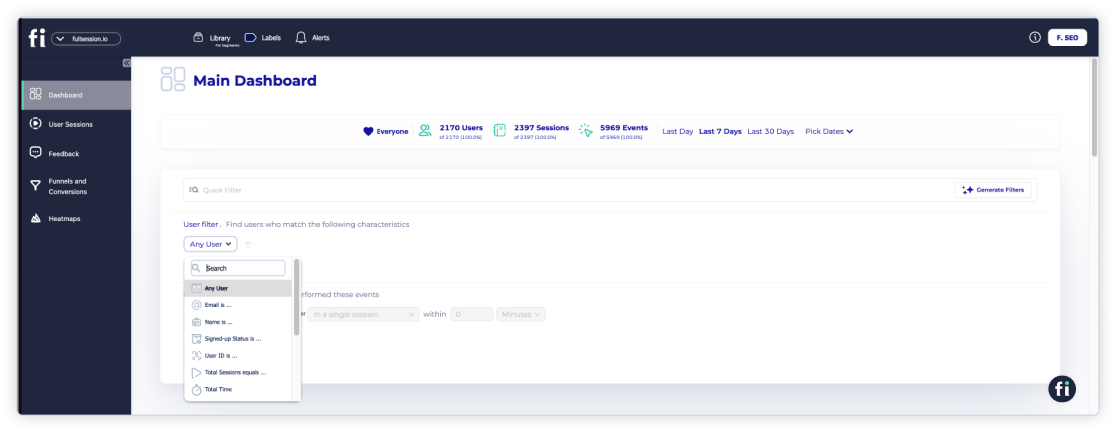
    Evaluating heatmap data will show where you need to make page elements, layout, or content changes to improve your customers’ journey.

    Visualized data will also help you optimize your sales and conversion funnels and create high-performing product pages, landing pages, websites, or mobile apps.

    The color palette and heatmap reports

    The color scheme is key in heatmap reporting, as colors represent the intensity of each visitor’s activity—the warmer the color, the higher the engagement.

    Heatmap software displays the higher-value data points in the brightest color and the lower-value data points on the darker end of the color spectrum.

    For example, green indicates that visitors fully engage with the page, yellow suggests moderate engagement with space for improvement, and red highlights low-engagement areas that need attention.

    Heatmaps can easily communicate large amounts of data to users quickly and intuitively.  By using color-coded, interactive visualizations, you can get all the information you need without spending hours working with spreadsheets.

    What are website heatmap tools use cases?

    With heatmap software tools, you can see which website or landing page areas visitors focus on the most. You will know what your users like or dislike while browsing your website.

    Heatmapping software provides you with heatmap reports and heatmap data to help you:

    1. Understand why and where your website visitors drop off in the conversion funnel
    2. See which elements and sections increase or decrease the engagement rate
    3. Monitor how your A/B tests perform
    4. Identify elements that confuse your users and affect their user experience
    5. See immediate results during real-time experiments

    For heatmap software power users, analyzing heatmap data allows for a complete understanding of user behavior, enabling data-driven decisions to improve overall website performance.

    What are the types of website heatmap tools?

    heatmap

    You can use different heatmap charts to analyze users’ behavior, as heatmaps provide valuable insights for conversion rate optimization.

    However, not all heatmap types are appropriate for every situation, as each has its use case. Let’s explore some specific examples.
    Click heatmaps

    Click heatmap shows you where your users click on the web page or tap on mobile devices so you can focus on those areas and improve the user experience. 
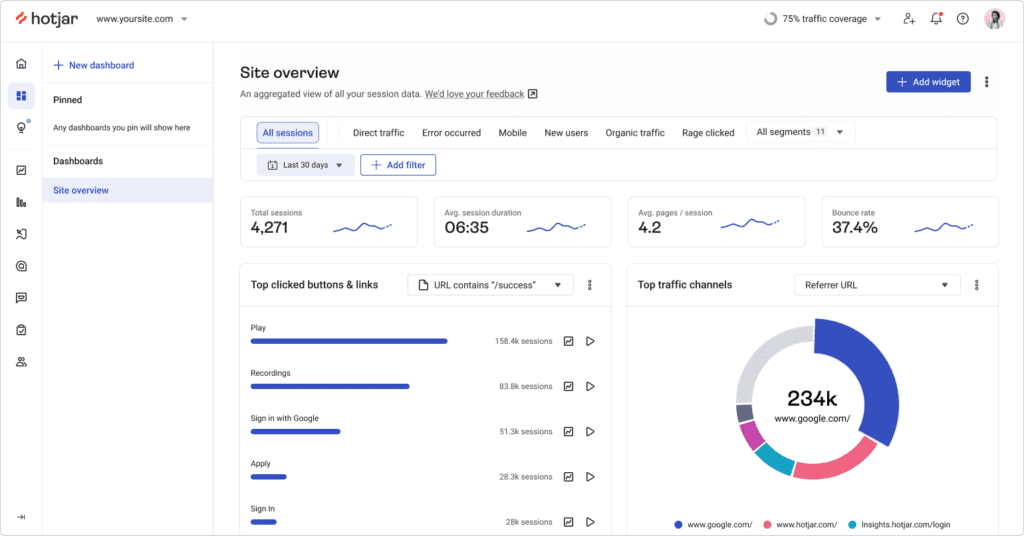
    You can also use this data for form analytics to understand what stops your users from converting.

    Mouse movement heatmaps

    Movement heatmaps track visitors’ navigation while browsing your website, their mouse movements, what catches their attention, and which elements they ignore.

    You can use these insights to optimize your navigation structure and increase conversions by identifying poor navigation flow and ineffective calls to action.

    Scroll heatmaps

    Scroll maps provide scroll data that helps you analyze the scroll depth on your web pages. By monitoring how far visitors scroll on your website, you will understand if they’ve seen the most important content or elements on your website page.

    You can turn users’ scroll data into an opportunity to define an optimal page length or reposition your CTAs, increasing conversions.

    Attention heatmaps

    Attention heatmaps will tell you where users focus their attention, regardless of the devices or browsers they use to visit your website, web app, or landing page.

    If you notice that a single area of your web page gets the most attention, you can further improve and use it for conversion rate optimization.

    Eye-tracking heatmaps

    An eye-tracking heatmap allows you to understand which elements attract or distract your website visitors. It gathers data on the frequency and duration and shows how many times and how long a visitor looks at a single element, such as a product image, sign-up field, or CTA button.

    It then transforms the metrics into a visual report to help you create more appealing content that is more likely to persuade and convert your visitors into paying customers.

    How can you use website heatmap tools to optimize your website?

    You’ll never truly understand a customer’s experience on your site until you use a heatmap tool. Using heat mapping tools lets you finally learn what it’s like to walk in your customer’s shoes.

    With heatmap software, you can:

    1. See visit sources
    2. Learn more about user behavior and interests
    3. See your most popular website pages
    4. Understand which parts of your website have a high conversion rate
    5. Identify which features on your site people don’t use
    6. See what parts of your website are difficult to navigate
    7. Learn if you have any content that is hard to find or easy to miss
    8. Understand what content resonates best with your visitors
    9. Learn what is working well for your marketing and sales strategies

    It might seem like a small task, but your website UX can significantly affect your business’s success. 

    Using heat maps is a great way to determine where to improve your site’s usability and functionality to help users navigate smoothly and keep them returning for mor

    What’s the main purpose of using heatmaps on a website?

    Heatmaps show you where people are clicking and scrolling on your site. They help you see which parts of your page get the most attention so you can make smarter decisions to improve the user experience and boost conversions.

    How do heatmaps help make a website better?

    Heatmaps give you a clear picture of how visitors interact with your site. By seeing where they click and how far they scroll, you can spot and fix trouble areas, make navigation smoother, and ensure important stuff gets noticed, leading to happier users and more conversions.

    Are heatmaps useful for mobile websites?

    Absolutely! Mobile heatmaps track where users tap and swipe. This info is crucial for optimizing the mobile experience, ensuring everything works well on smaller screens, and improving overall mobile site performance.

    How do you find the best heatmap software?

    First, compare heatmap software features to see which tool best meets your needs. Your tool needs to be able to capture user interaction data effectively so that visualizing it is easy. Look for a tool with integration capabilities for other digital platforms like Google Tag Manager, Google Analytics, Salesforce, etc.


  • How to Use Predictive Customer Analytics For Max Conversions

    How to Use Predictive Customer Analytics For Max Conversions

    Business gurus always talk about the importance of collecting customer data. But aside from addressing current issues with the information you gather, what do you do with all that historical data?

    If you haven’t already, it’s time to introduce a predictive analytics process to your business operations. With a good breadth of customer data to work with (and accurate predictive models), you can come up with better business decisions based on what future customer behavior is likely going to look like.

    However, there’s a lot more to this process than meets the eye. We’ll walk you through the essential concepts, benefits, and real-world applications so you can stop relying on intuition and start maximizing your data.

    What is Predictive Customer Analytics?

    Simply put, predictive customer analytics is all about using your customers’ past actions to guess what they might do next.

    Crunching the numbers on past interactions can yield surprising insights into customer motivations. You might just discover which products are on the cusp of becoming customer obsessions or which customers are wobbling on the fence. 

    Tailor-made marketing, exceptional customer service, and sound business decisions are all within reach when you get it right. 

    How Can Businesses Use Predictive Analytics?

    Once you have enough historical data to analyze, predictive analytics can help take your business to the next growth stage. Here are several ways you can put this powerful tool to work:

    Improve Marketing Strategies

    Analyzing customer data helps you understand what your customers like so you can tailor your marketing campaigns to really hit home. A deep dive into customer data brings patterns to the surface, plain as day. Consumer psychology is all about cracking the code of human behavior when it comes to buying and selling—what we say, do, and feel as customers.

    This means you’ll know what messages click best with different groups (all with varying customer behavior patterns). For example, some people might love getting emails, while others might be more into social media ads.

    Plus, predictive analytics can tell you the best times to reach out. When you know when your customers are most likely to pay attention, you can schedule your campaigns to hit at just the right moment. This increases the chances that your messages will be seen and acted on.

    You’ll also figure out which channels work best for your audience. If you’re feeling overwhelmed by the sheer number of marketing options, here’s a secret: you don’t need to do it all. By zeroing in on the right channels—think email, social media, or direct mail—you can simplify your strategy, save resources, and actually see some results.

    Upgrade Customer Service

    Predictive analytics can help you fix issues and meet customer needs before they even become apparent. You can anticipate what your customers might need help with and reach out with support or advice at just the right moment.

    For example, suppose the data suggests that a particular product tends to need support after a few months. In that case, you can proactively contact customers with maintenance tips or support options before they encounter any issues. 

    Anticipating customer needs pays off in spades: it eradicates frustration and replaces it with loyalty that genuinely sticks.

    Maximize Sales

    Ever wondered how you can know which customers are about to make a purchase or what products they’re interested in? What if you could put your sales team on the scent of the most eager buyers, guiding them toward the products that spark the most interest? 

    By doing so, you’ll be priming your sales engine to drive more conversions and realize bigger returns.

    Imagine being able to sift through your customer data and spot clear trends—like who’s been checking out certain products or who keeps coming back to the same item but hasn’t made a purchase yet. 

    Predictive analytics helps you understand these patterns and even pinpoints the optimal times to reach out to these customers, perhaps with a personalized offer or a timely nudge that might just close the sale.

    person holding a red arrow and analytics charts

    Reduce Customer Churn

    Predictive data analytics acts like an early warning system that flags customers who might be on the verge of leaving. Armed with this knowledge, you can take proactive steps to keep them on board and prevent churn before it happens.

    Think about it: predictive analytics can help you understand not just who might leave but why they might go. Maybe they’ve been experiencing service issues, or perhaps they haven’t engaged with your brand in a while. Whatever the reason, once you know, you can tailor your approach to address their specific concerns.

    However, it isn’t just about throwing discounts left and right. It’s about meaningful engagement. You could set up automated triggers for personalized emails that check in with your customers, ask for customer feedback, or offer them content that matches their interests. 

    Or, why not invite them to exclusive customer events or give them first dibs on new products? These gestures show that you value their business and are committed to keeping their experience fresh and exciting.

    Optimize Your Inventory Management

    Here’s a huge benefit for eCommerce businesses. Picture this: you’ve got a crystal ball that shows you what customers will crave next season. That’s basically what happens when you crunch sales data, seasonal ups and downs, and broader market vibes. The result? You can prep for the products that’ll fly off shelves.

    So, you can make sure your most popular items are always available while also preventing the buildup of unwanted stock that ties up capital.

    Go beyond simply tracking stock levels and use predictive analytics to stay one step ahead of the competition, fine-tuning your promotional strategies and pricing tactics to maximize impact. Identify your biggest sales opportunities with ease—and decide when to cut prices on sluggish items or launch a focused promo to get products flying off the shelves.

    Are There Downsides to Using Predictive Customer Analytics?

    Sure, predictive customer analytics can be super helpful, but it’s not perfect, especially when we talk about accuracy.

    Predictive analytics uses data to guess future behaviors, but these predictions are only as reliable as the data you feed into them. If your data is outdated, incomplete, or biased, your predictions won’t be spot on, which means you might end up making decisions based on faulty insights. Not ideal.

    There’s also the complexity of human behavior to think about. One of the big hurdles with predictive customer analytics is that it doesn’t always get human behavior right. The thing is, human actions are influenced by a whole mix of factors. Emotions, personal motivations, and current circumstances that predictive algorithms often can’t fully grasp. 

    It’s a tough reality: despite having access to highly advanced analytics tools, we still can’t always predict how customers will act when they’re faced with real-life situations.

    Another snag is the ongoing need for fresh, updated data. Predictive analytics isn’t a set-it-and-forget-it kind of tool; it needs a steady stream of current data to work well. Many SaaS businesses find keeping their data sets consistently updated to be a real chore. Without regular updates, the predictions you get from the tool can end up being way off base.

    Best Ways to Put Predictive Analytics into Practice

    Now that you know how predictive analytics can benefit your business, the next step is to find out how you can put it into practice.

    people looking at charts on papers

    Of course, using predictive customer analytics can look different, depending on the type of business operations you have, but there are several strategies that should apply to most businesses:

    1. Start with Solid Data

    The foundation of any effective predictive analytics strategy is high-quality data. Think of it like building a house—if the foundation isn’t solid, the whole structure is shaky. So, before you jump into forecasting and making predictions, take a serious look at the data you’re using.

    Data needs to be clean, which means free from errors and inconsistencies, comprehensive, covering all necessary aspects of the information you need, and up-to-date, reflecting the most current situations and trends.

    If your data is lacking in any of these areas, your predictions might be off and lead to decisions that could steer your efforts in the wrong direction.

    2. Set Specific Goals

    You need to know what you want to find out before you analyze historical data. Are you looking to cut down on customer churn, dial in your sales targeting, or maybe you want to take your customer service to the next level? With specific, measurable goals, you create a focused roadmap for your analytics projects.

    For example, instead of a broad goal like “improve customer satisfaction,” aim for something more tangible and quantifiable, such as “increase customer satisfaction scores by 10% within six months.” This approach directs your efforts more efficiently and provides a clear standard for measuring outcomes at the same time.

    3. Keep Refining Your Models

    Keeping your predictive analytics sharp means regularly updating them as things change in the business world. You’ve got to keep feeding them fresh data and tweaking them based on what’s happening right now.

    Whenever you roll out your models, you’ll see how they’re doing. Take this feedback and use it to make your models even better. Maybe tweak a few settings, throw in some new data, or even rethink a model if it’s not working. Keeping your analytics up-to-date like this helps ensure they stay on point and useful.

    4. Choose the Right Tool(s)

    Picking the right predictive analytics tools is key to getting the insights you need to optimize the customer experience.

    When you’re shopping around for tools, think about what fits your business just right. Consider things like the size of your business and what you actually need the tool to do. You’ll want something that can grow with you as your business expands.

    For instance, a tool like FullSession can be a great choice if you’re looking to understand how users interact with your website, which can help you modify things to improve their experience and up your conversions.

    Make sure whatever tool you pick is easy to use and meshes well with the systems you already have in place. It’s also a good idea to check out the kind of support and community the tool offers—having help available when you need it can be a real lifesaver.

    Dive Into Predictive Data Analysis With FullSession

    Leveraging predictive analytics can help you hit multiple goals at once, whether that be increasing customer loyalty, optimizing the customer journey, or tailoring your offerings based on customer preferences.

    But how do you accomplish that long list of objectives without stretching your resources too thinly? The solution is simple: FullSession. Here’s a sneak peek at how this powerful platform can help you collect the data you need to predict future outcomes:

    • Heatmaps: FullSession’s heatmaps give you a colorful visual map of where users click, scroll, and linger on your site. With these patterns, you can pinpoint potential trouble spots or discover the elements that really pull users in.
    • Session replays and recordings: Imagine being able to shadow your website visitors as they navigate through your site. Session replays and recordings let you do just that, offering a playback of real user interactions. You’ll see where users flourish and where they falter, which helps you get direct insights that help you tweak your site to make it more intuitive and user-friendly.
    • Customer feedback tools: FullSession also equips you with tools to snag direct feedback from your users and understand the why behind user actions, spot friction points, and collect user-improvement suggestions.

    FullSession Pricing Plans

    FullSession Pricing

    The FullSession platform offers a 14-day free trial. It provides two paid plans—Basic and Business. Here are more details on each plan.

    Here are more details on each plan.

    • The Starter plan costs $39/month or $32/year and allows you to monitor up to 5,000 monthly sessions with up to 6 months of data storage.
    • The Business plan costs $75/month or $60/year and helps you to track and analyze up to 100,000 monthly sessions with up to 12 months of data storage.
    • The Enterprise plan has custom pricing and offers customizable sessions plus full access to all features.

    Book a demo today.

    Install Your First Predictive Data Tools Right Now

    It takes less than 5 minutes to set up your first tools to collect the data and predict future outcomes, withFullSession, and it’s completely free!

    FAQs About Predictive Customer Analytics

    How accurate is predictive analytics?

    Predictive analytics can be incredibly accurate, but like anything dependent on data, its precision relies on the quality and breadth of existing customer data you feed into it. If your data is solid, your predictions will be too. However, it’s important to remember that no tool can predict the future with 100% accuracy—there’s always room for surprises!

    Can small businesses benefit from predictive analytics?

    Yes. You don’t need big data to make big moves. Even modest datasets can uncover trends and opportunities that might otherwise be missed. For small businesses, this can mean a sharper competitive edge and a better understanding of what your customers want.

    Is predictive analytics expensive to implement?

    It can be, but it doesn’t have to break the bank. The key is to start with what you need and scale up as you grow. There are plenty of cost-effective tools and technologies available that can match your business’s size and budget. Plus, the return on investment, in terms of insights and efficiency, often outweighs the initial costs.