You’re getting website traffic, but you don’t know which visitors are close to converting or why they’re leaving. That’s the gap the best website visitor tracking software is built to close.
Not all visitor tracking tools work the same way. Some record sessions and heatmaps so you can see where visitors engage with your pages. Others measure website analytics and traffic sources.
A third category identifies which companies are browsing your site and routes them to sales. Pick the wrong one and your most important questions stay unanswered.
This article reviews seven best website visitor tracking software tools across all three types, with a comparison table for fast scanning.
Key Takeaway
- FullSession: The strongest all-in-one option for teams that need session replay, heatmaps, funnels, error tracking, and mobile analytics without managing multiple tools.
- Hotjar: A solid entry point for SMBs that want visual behavior data and on-site surveys in a single, easy-to-use interface.
- FullStory: Built for enterprise teams that need auto-capture session data at scale with advanced search and a data export layer.
- LogRocket: The go-to for engineering teams that need to reproduce bugs by combining session replay with network logs and console data.
- Microsoft Clarity: The best free option for behavior analytics, with unlimited session recordings and heatmaps and no paid tier required.
- Google Analytics 4: The standard for marketing teams tracking website traffic, campaign attribution, and conversion events at scale.
- Leadfeeder: Purpose-built for B2B sales teams that want to identify anonymous company visitors and route them into CRM workflows.
Of the seven, FullSession is the most complete solution for teams that care about the full picture. It’s the only tool on this list that combines behavior analytics, error tracking, in-app feedback, and mobile session replay in one platform, with privacy compliance built in and no impact on website performance.
What Is Website Visitor Tracking Software?
Website visitor tracking software records, analyzes, and reports on how users interact with a website. A tracking code placed in the website’s header captures behavioral data: clicks, scrolls, navigation paths, form submissions and session duration.
That data feeds into the tool for analysis so teams can move beyond raw traffic counts and understand what’s actually happening on their site.
The category splits into three types.
| Type | What It Does | Examples |
| Behavior analytics | Session recordings, heatmaps, funnels: shows how individuals visiting your site engage with specific pages | FullSession, Hotjar, FullStory |
| Traffic analytics | Pageviews, unique visitors, traffic sources, conversion events: measures website traffic at scale | Google Analytics 4 |
| B2B identification | Reveals anonymous traffic by matching IPs to company records for sales follow-up | Leadfeeder |
Most tools in this article fall into the first or second category. Leadfeeder is the exception. It doesn’t offer session recordings or heatmaps but focuses entirely on identifying companies from anonymous traffic.
Knowing which type matches your primary question, whether that’s user behavior, traffic attribution, or lead identification, is the most important step before comparing features or pricing.
For a broader context on what web visitor tracking involves, check out the website tracking guide on the FullSession blog.
What to Look For in Website Visitor Tracking Tools
- Reliable tracking: Does the tool capture 100% of sessions or apply statistical sampling? Sampling reduces accuracy at lower traffic volumes. If you need granular click-level data alongside session data, check out click tracking tools that serve a complementary function.
- Depth of visitor data: Session recordings, heatmaps, and funnel tracking reveal what visitors do and where they get frustrated. Pageview counts don’t.
- Traffic sources and attribution: Does it show where visitors come from and connect that to on-site behavior? Attribution gaps create blind spots for your marketing efforts.
- Privacy and compliance: GDPR, CCPA, and PCI-DSS compliance are non-negotiable. Confirm that sensitive fields are automatically masked, not just available as an optional setting.
Scalability: Does pricing scale with visitor volume, seats, or the number of websites? First-party data ownership matters too.
Best Website Visitor Tracking Software: Quick Comparison Table
Ratings sourced from G2 as of May 2026. Pricing is also sourced as of May 2026. Check each tool’s official pricing page before purchasing, as prices may have changed.
| Tool | G2 Rating | Best For | Top Feature | Starting Price |
| FullSession | 5.0/5 | SaaS & ecommerce behavior analytics | Session Replay + Lift AI | $23/month billed annually |
| Hotjar | 4.3/5 | SMB UX research & feedback | Heatmaps + Surveys | $49/month |
| FullStory | 4.5/5 | Enterprise session intelligence | Auto-capture Session Replay | Custom pricing |
| LogRocket | 4.6/5 | Engineering & product debugging | Session Replay + Error Logs | $99/month |
| Microsoft Clarity | 4.5/5 | Small businesses & developers | Unlimited free session recordings | Free |
| Google Analytics 4 | 4.5/5 | Marketing & SEO attribution | Traffic source attribution | Free |
| Leadfeeder | 4.3/5 | B2B sales & lead identification | Company-level visitor identification | $79/month |
7 Best Website Visitor Tracking Software in 2026
The tools below cover the three main categories: behavior analytics, web traffic analytics, and B2B visitor identification. Each entry follows the same structure, so you can compare them on equal terms.
1. FullSession
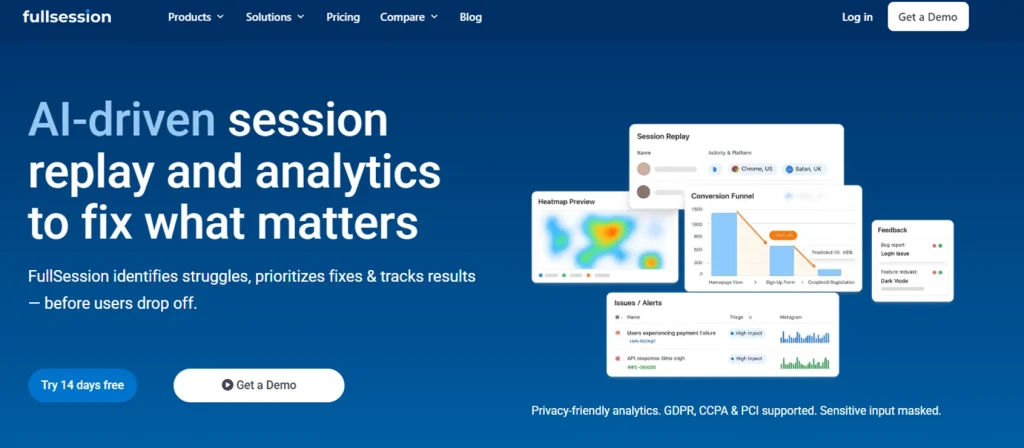
FullSession is a behavior analytics platform that combines session recordings, interactive heatmaps, conversion funnels, error tracking, and in-app feedback in a single tool.
It’s built for teams that need a clear view of the full customer journey, from traffic source through to specific page interactions, without stitching together data from multiple platforms.
GDPR, CCPA, and PCI-DSS compliance comes out of the box, with automatic masking of sensitive fields and zero website performance impact.
Start a 14-day free trial. No credit card required.
Best for
Product teams, marketing managers, and UX researchers at SaaS companies and ecommerce brands who need to understand why visitors drop off and which friction points are suppressing conversion rates.
Key features
- Session replay: Records every visitor session with full interaction details: clicks, scrolls, form inputs, and navigation path. How session recordings reveal friction points is key to how FullSession shows useful insights.
- Interactive heatmaps: Aggregates click, move, and scroll data to show which page elements attract attention and which get ignored.
- Funnel analysis: Tracks multi-step user journeys across specific pages and shows exactly where visitors exit before completing a goal.
- Error and alerts tracking: Automatically detects JavaScript errors and rage clicks, linking them to session recordings for fast debugging.
- Lift AI: Scans session data and shows which on-site issues are most likely suppressing conversion rates, giving your team actionable data to prioritize and validate fixes without manual analysis.
- In-app feedback: Embeds contextual feedback widgets in the session flow so user sentiment is captured alongside the behavior that caused it.
- Mobile session replay: Tracks visitor behavior on iOS and Android apps, not just web. It covers multiple websites and mobile surfaces in one platform.
Pricing
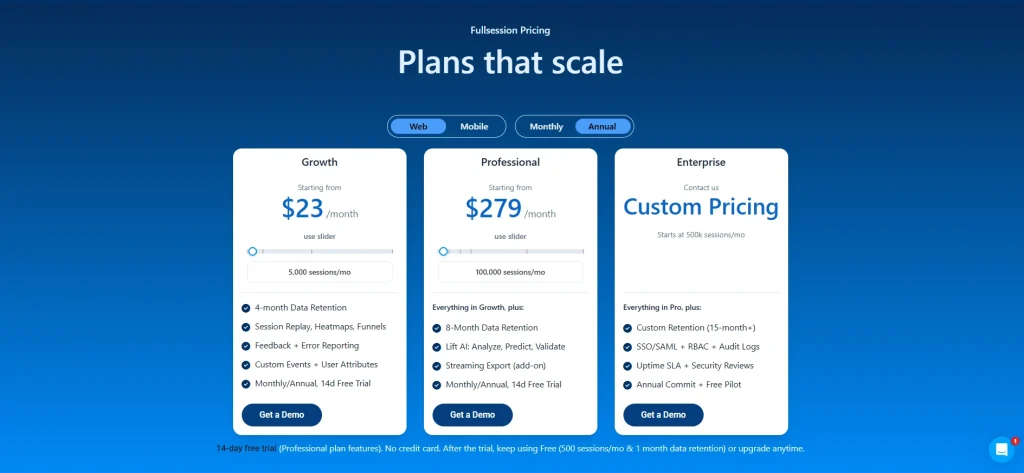
Subscription. Starter plan from $23/month (billed annually) for 5,000 sessions per month, with all key features included and 4-month data retention. Higher plans are available as your session volume grows.
See FullSession in Action With Your Own Website Data
No sales pressure. Just a live walkthrough tailored to your use case.
2. Hotjar
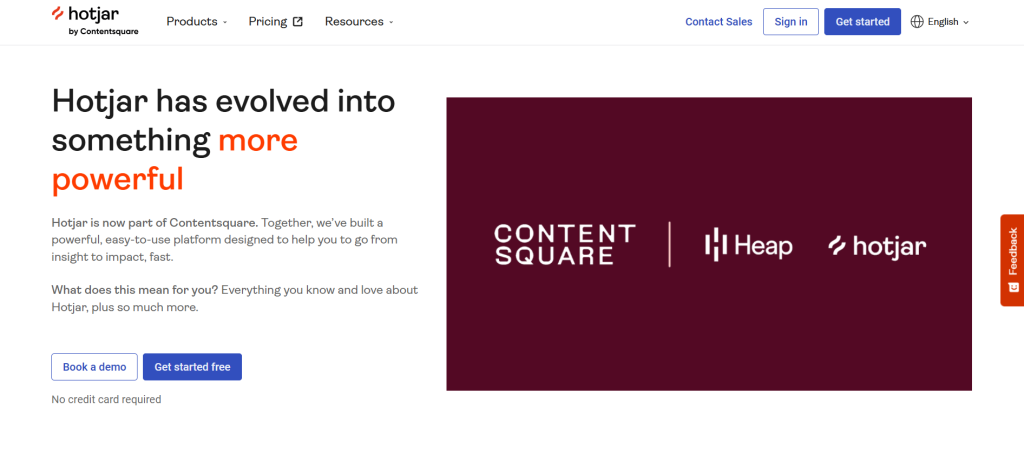
Hotjar, now part of Contentsquare, is a behavior analytics suite with simple analytics and an intuitive interface. It combines heatmaps, session recordings, surveys, and feedback widgets into a single tool.
Its strength is breadth: visual behavior data and user sentiment together. Its funnel and error tracking are less detailed than dedicated alternatives. See all details in our Hotjar review.
Read our guides to learn more:
- FullSession vs Hotjar
- Lucky Orange vs Hotjar
- Hotjar vs FullStory
- Hotjar vs Microsoft Clarity
- Hotjar alternatives
- Does Hotjar slow down your site?
Best for
Product managers and UX designers at small to mid-sized businesses who want visual behavior data and qualitative user feedback without managing multiple tools.
Key features
- Click heatmaps: Shows where visitors click most frequently, highlighting high-engagement and ignored areas.
- Session recordings: Captures individual visitor sessions with click and scroll playback.
- On-site surveys: Deploys targeted surveys triggered by behavior or exit intent to collect direct user feedback.
- Feedback widgets: Embeds persistent rating widgets on any page so visitors can flag issues without leaving the site.
- Funnel analysis: Tracks drop-off across multi-step flows and shows which step loses the most visitors.
Pricing
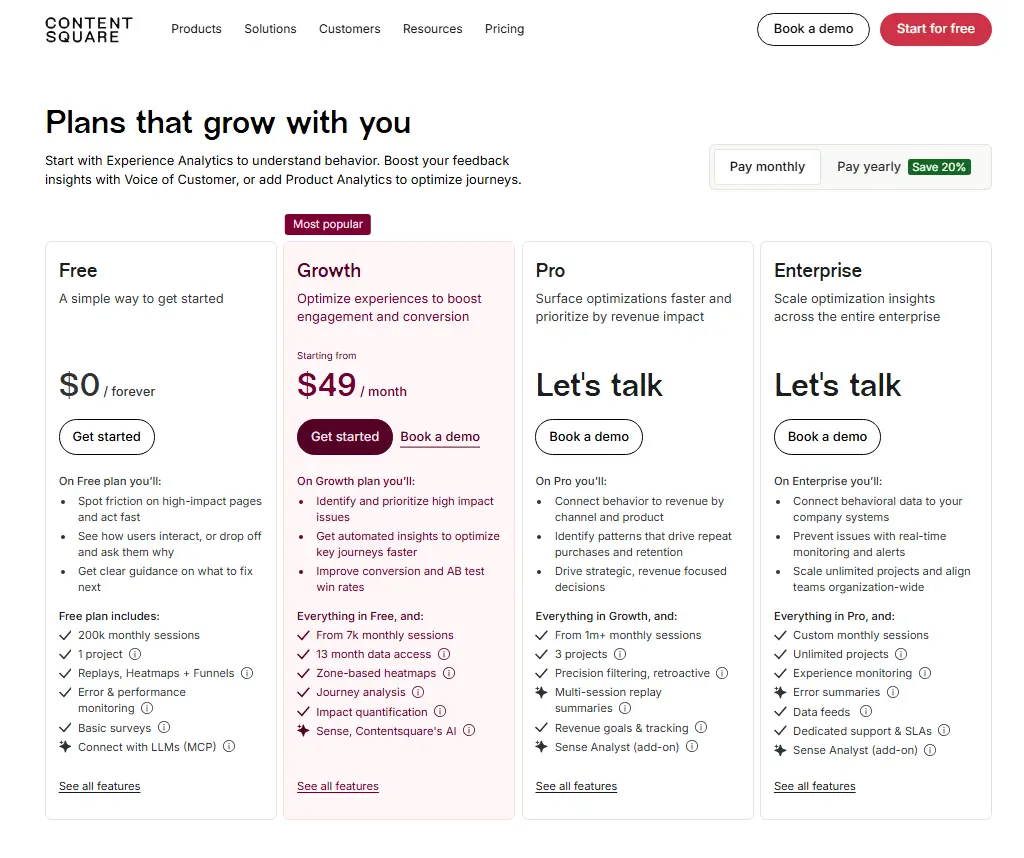
Freemium. Free plan available with limited monthly sessions. Paid plans from $49/month via Contentsquare.
3. FullStory
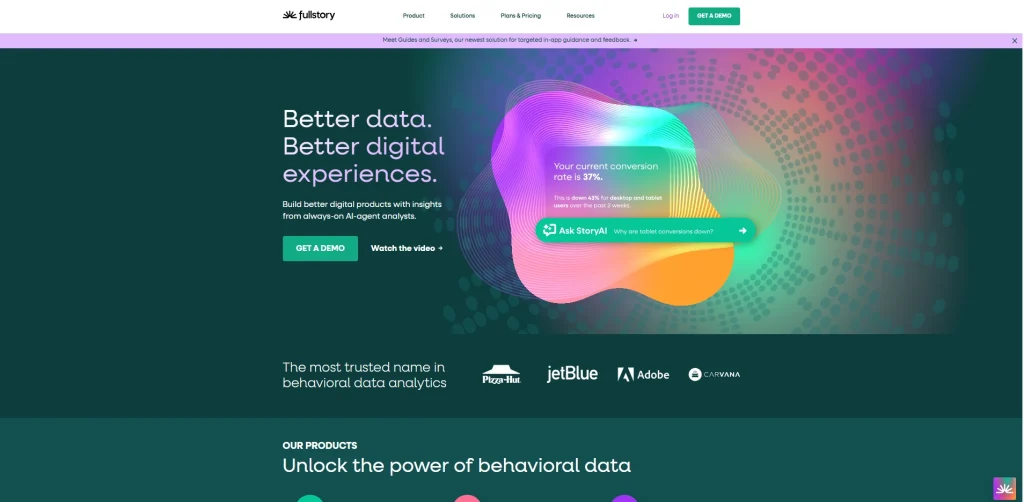
FullStory is a digital experience intelligence platform built for enterprise teams that need deep session data at scale. Its auto-capture architecture records every user interaction without manual event tagging, which is a real operational advantage for large sites. The DX Data API pipes session intelligence directly into data warehouses for cross-platform analysis.
Read our guides to learn more:
Best for
Enterprise product and engineering teams that need session data at scale with advanced search, segmentation, and a data export layer for business intelligence workflows.
Key features
- Auto-capture session replay: Records every interaction automatically. No manual tagging, no data gaps for new pages.
- Session search and segmentation: Queries all recorded sessions by URL, element, frustration signal, or custom event. No code required.
- Rage and error click detection: Automatically flags sessions where users hit broken or unresponsive interactions.
- Funnel analytics: Tracks conversion flows with retroactively definable funnels, which is possible because FullStory captures all data upfront.
- DX Data API: Exports structured session data to Snowflake, BigQuery, and Salesforce for enterprise analytics workflows.
Pricing
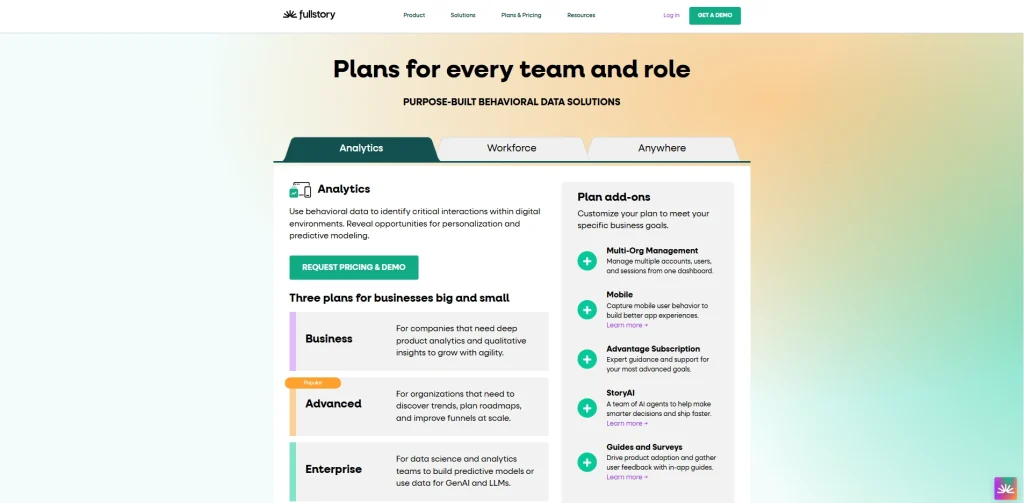
Free plan available for 30,000 monthly sessions and 12 months of analytics retention. Business and Enterprise plans are on custom pricing.
4. LogRocket
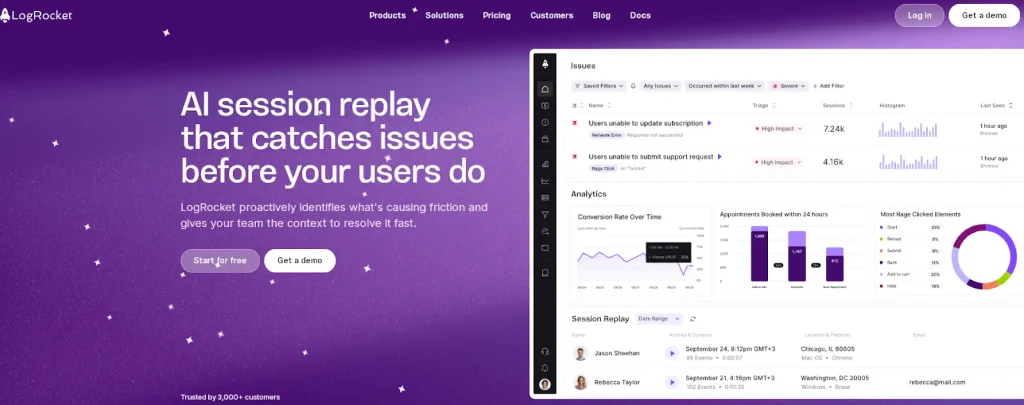
LogRocket is a session replay and product analytics platform with an engineering-first design. It captures network requests, console logs, and application state alongside session recordings, making it a diagnostic tool as much as a behavior analytics platform.
Learn more about:
Best for
Engineering and product teams at software companies that need to reproduce bugs in a full user session context, connecting front-end behavior with back-end errors.
Key features
- Session replay with network logs: Plays back user sessions alongside the full network request log so engineers can see exactly which API calls failed.
- Error tracking: Surfaces JavaScript errors linked to the sessions in which they occurred, cutting the time to reproduce and resolve defects.
- Performance monitoring: Tracks front-end performance metrics, including page load time and rendering delays, against visitor behavior to identify performance-driven drop-off.
- Product analytics: Provides funnel analysis, retention tracking, and feature adoption metrics for product roadmap decisions.
- Heatmaps: Aggregates click and scroll data across sessions for page-level behavior analysis.
Pricing
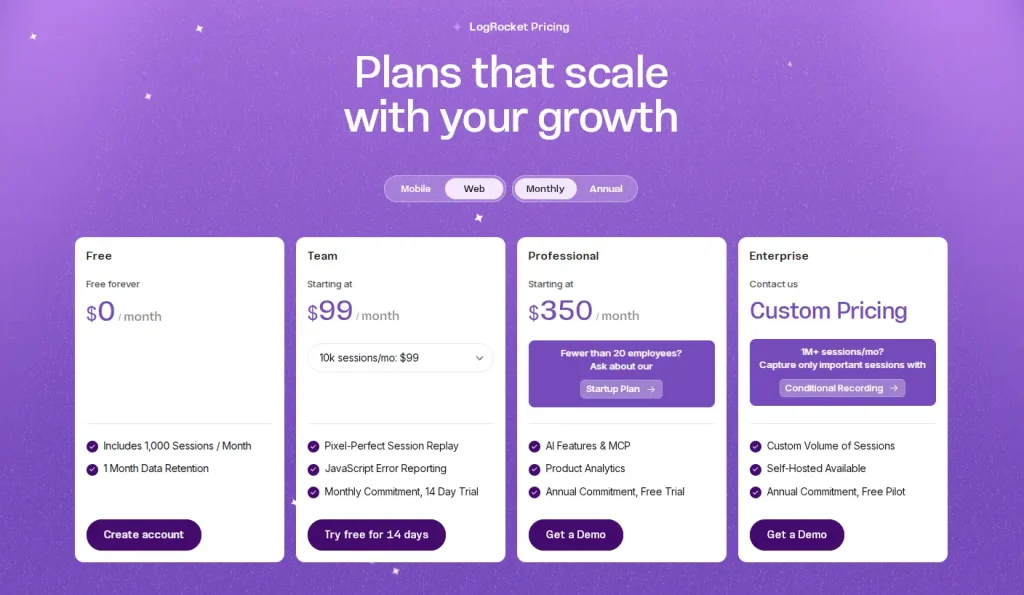
Freemium. Free plan available (1,000 sessions/month). Team plans from $99/month.Learn more about LogRocket pricing.
5. Microsoft Clarity
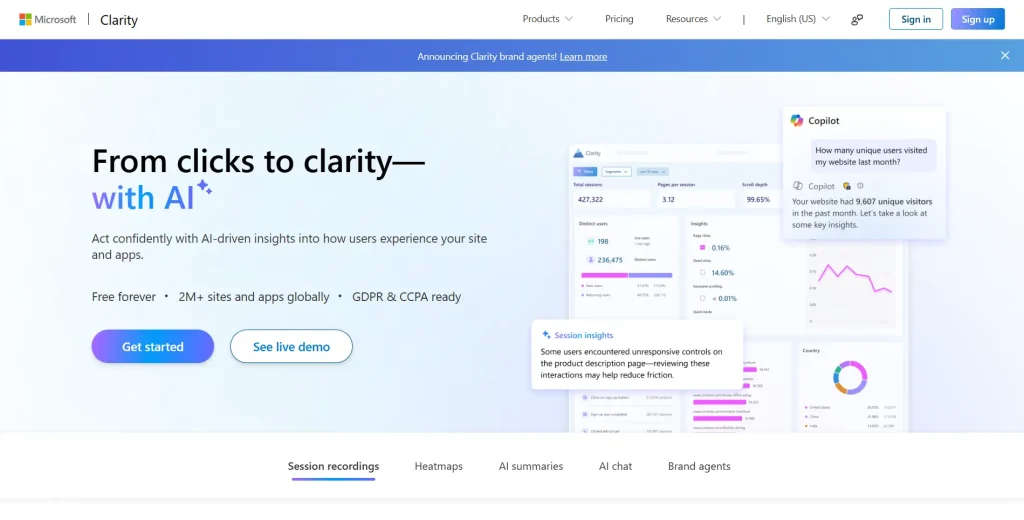
Microsoft Clarity is a free website tracking tool from Microsoft that covers the behavior analytics basics: session recordings, heatmaps, and simple analytics with no session limits, no data caps, and support for unlimited websites.
It integrates natively with Google Analytics 4, so you can view behavioral data alongside website traffic without switching platforms.
The FullSession vs Microsoft Clarity comparison covers where the two differ beyond price.
Best for
Small businesses, bloggers, and developers who need behavior analytics at zero cost and are comfortable with Microsoft’s data usage terms.
Key features
- Unlimited free session recordings: Captures every visitor session with no monthly cap.
- Click and scroll heatmaps: Aggregates interaction data to show engagement patterns at the page level.
- Dead click and rage click detection: Flags sessions with high-frustration signals without manual review.
- GA4 integration: Links Clarity behavioral data to Google Analytics 4 sessions for combined website analytics.
- Copilot AI summaries: Auto-generates natural-language summaries of session behavior, cutting manual review time.
Pricing
Free. No paid plan is currently available.
6. Google Analytics (GA4)
Google Analytics 4 is the industry-standard website analytics tool for web traffic. It measures website traffic volume, traffic sources, unique visitors, conversion events, and audience demographics at scale.
GA4 isn’t a behavior analytics tool: no session recordings, no heatmaps. But it’s the authoritative source for campaign attribution and tracking your marketing efforts.
For event tracking tools that complement GA4’s conversion data, several dedicated options exist.
Learn more about:
Best for
Marketing teams and SEOs who need to track users by traffic source, campaign attribution, and audience behavior at scale, especially when Google Ads is part of the media mix.
Key features
- Traffic source attribution: Tracks where every session originates: organic, paid, referral, email, direct. Connects source data to on-site conversion events.
- Conversion event tracking: Defines and measures form submissions, purchases, and signups across multi-touch user journeys.
- Audience segmentation: Builds custom segments based on behavior, demographics, and traffic source for cross-channel reporting.
- Real-time reporting: Displays active unique visitors, traffic sources, and events as they happen.
- BigQuery integration: Exports raw event-level data for custom analysis in enterprise data warehouse workflows.
Pricing
Freemium. Standard GA4 is free. GA4 360 (enterprise) starts at $50,000/year.
7. Leadfeeder
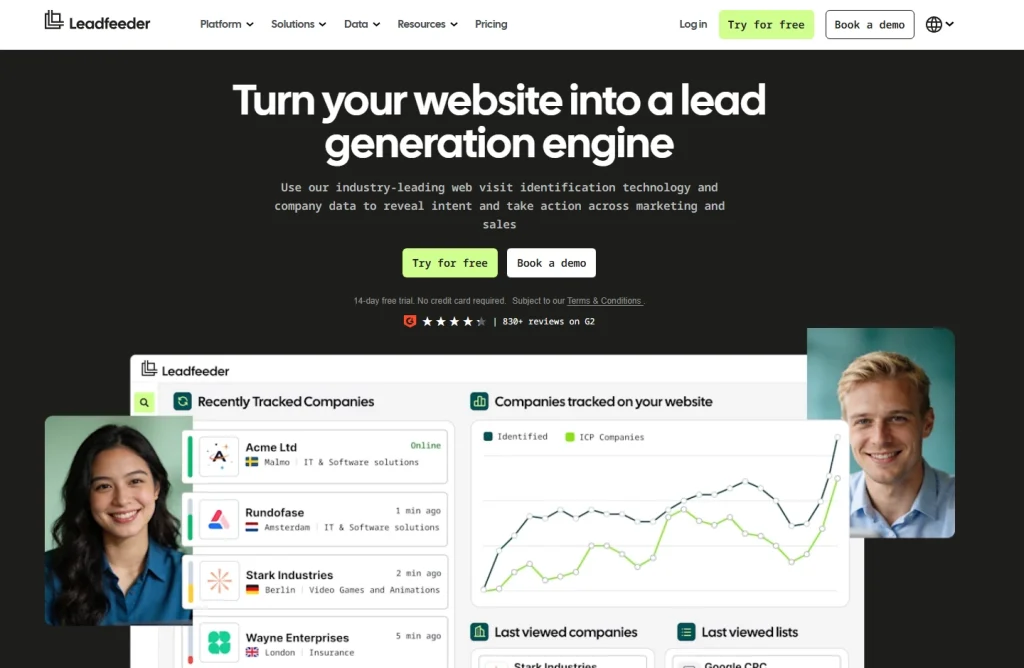
Leadfeeder is a B2B website visitor identification tool that reveals the companies visiting your site. It enriches those records with firmographic data, including company names, job titles, and phone numbers, plus intent data and contact details for sales follow-up.
Unlike the other tools in this list, Leadfeeder doesn’t offer session recordings or heatmaps. Its job is to identify leads from anonymous company traffic and route them into CRM and automated sequences.
Lead Forensics is a comparable alternative for teams evaluating B2B identification tools.
Best for
B2B sales and marketing teams that want to identify anonymous visitors at the company level, filter by firmographic criteria, and route high-potential prospects to sales reps via automated workflows.
Key features
- Company-level visitor identification: Uses IP matching to identify individuals visiting from specific companies, turning unknown traffic into named accounts with company name, industry, size, and location.
- CRM integration: Syncs identified accounts and contact data directly to HubSpot, Salesforce, and Pipedrive to support automated sequences and keep the pipeline current.
- Lead scoring and filtering: Applies intent signals and intent data from high-intent pages visited and visit frequency to score accounts and show actionable leads for sales reps.
- Email alerts for target accounts: Sends real-time notifications when a target company visits the site, so your team can identify leads before intent fades.
- Email marketing platforms integration: Connects with email marketing platforms, including HubSpot, to trigger automated workflows based on company-level visit data.
Pricing
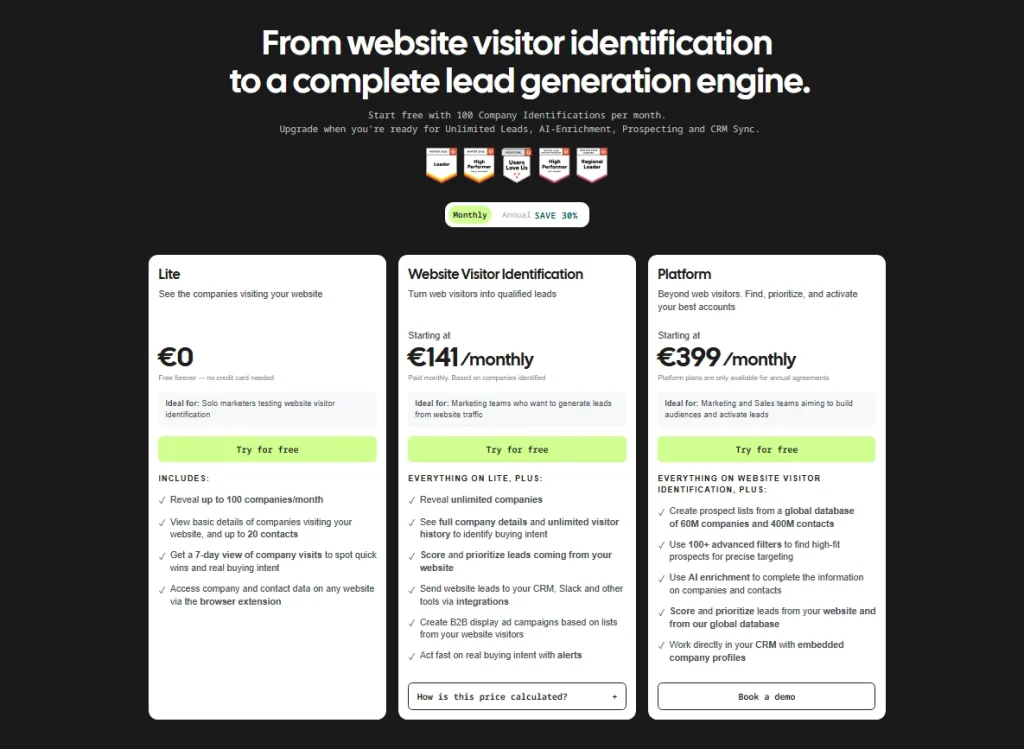
Freemium. Free plan covers up to 100 identified companies per week. Paid plans from $141/month.
How to Decide Between Visitor Tracking Tools for Your Team
One question drives the right choice: what do you most need to understand?
| Your Primary Question | Tool Type | Best Options |
| Why are visitors dropping off? What are they doing on specific pages? | Behavior analytics | FullSession, Hotjar, FullStory, LogRocket |
| Where is my website traffic coming from? Which campaigns convert? | Traffic analytics | Google Analytics 4 |
| Which companies are visiting my site? Who should sales contact? | B2B identification | Leadfeeder |
Using multiple tools is common. Behavior analytics and website analytics serve different purposes and aren’t substitutes for each other. For teams that also need website monitoring tools, mapping the overlap before purchasing avoids redundant spend.
Budget and team size are secondary factors. Microsoft Clarity removes cost as a barrier for behavior analytics. FullSession’s pricing scales with visitor volume rather than seats, which works well for growing teams running multiple websites.
Try FullSession Free, No Credit Card Required
Set up in minutes and start seeing exactly how visitors use your site.
Which Option Is Best for Your Use Case
| Your Situation | Recommended Tool(s) | Why |
| SaaS product team troubleshooting activation drop-off | FullSession or LogRocket | FullSession adds Lift AI for prioritized insights; LogRocket adds network log context for error-driven drop-off |
| Ecommerce team optimizing checkout conversion | FullSession or Hotjar | Funnel tracking plus session replay shows exactly where shoppers exit; Hotjar adds surveys for direct feedback. See best website analytics tools for the full ecommerce stack |
| Marketing team tracking campaign performance | GA4 plus Microsoft Clarity | GA4 handles attribution across all marketing efforts; Clarity adds behavioral context at no extra cost |
| B2B sales team identifying warm accounts | Leadfeeder | Purpose-built for turning anonymous company traffic into actionable leads with intent data. Breeze Intelligence is a comparable alternative for HubSpot-first teams |
Why Choose FullSession
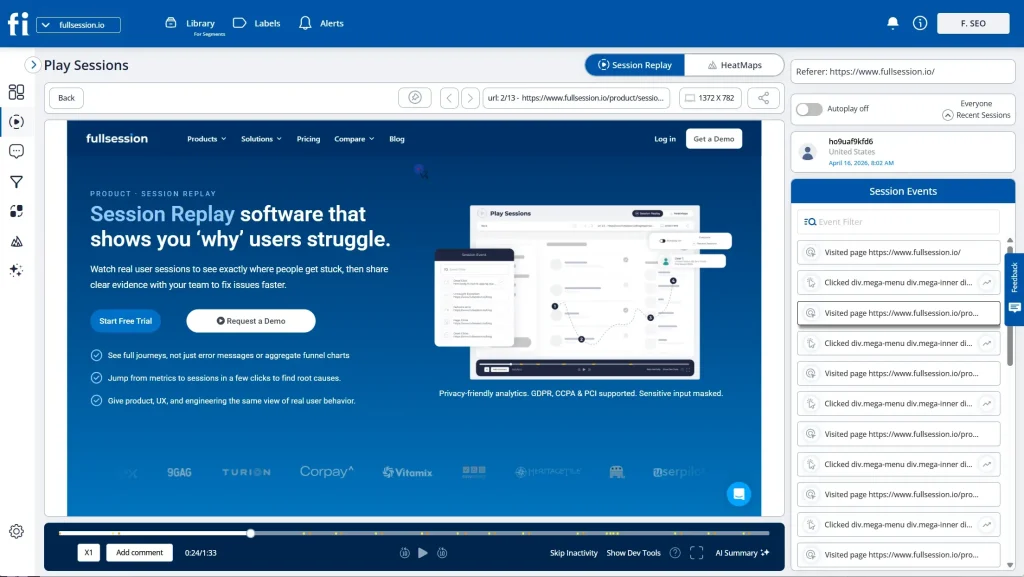
Most teams cobble together two or three tools to cover what FullSession handles in one: session recording, heatmaps, funnels, error monitoring, and mobile tracking.
That fragmented stack means more cost, more context-switching, and visitor data that never quite lines up. FullSession replaces it with a single platform, simple setup, an intuitive interface, and zero website performance overhead.
Here’s what you get
- Session replay, heatmaps, and funnels in one platform: You don’t need GA4 for traffic, Hotjar for behavior, and LogRocket for errors. The full customer journey from traffic source to funnel drop-off is visible in one place, with consistent data throughout.
- In-app feedback linked to session replays: User sentiment is captured directly alongside the behavior that caused it. No more disconnect between what users say and what they actually do.
- Mobile session replay: Tracks visitor behavior on iOS and Android apps alongside web. Most tools in this list are web-only.
- Error and alerts tracking: Shows JavaScript errors and rage clicks without needing a separate monitoring tool.
- Lift AI: Automatically identifies which on-site issues carry the highest impact on conversion rates, using the visitor data already captured, so your team prioritizes based on evidence rather than instinct.
How these features work together
Picture a visitor arriving from a paid campaign. Their traffic source is visible in FullSession’s dashboard.
They engage with the landing page, captured in the heatmap. They enter the checkout funnel and drop off at step two.
Error tracking flags a JavaScript error at that exact step. The session replay shows the moment it fires. Before leaving, they submit a feedback response. All of it lives in one session recording, linked by a single visitor ID.
That connected view cuts the time it takes to turn visitor data into valuable insights and decisions. No cross-referencing exports, no guesswork.
Privacy and compliance
FullSession is GDPR, CCPA, and PCI-DSS compliant out of the box, making it one of the best tools on the list. Sensitive input fields are automatically masked in session recordings with no custom configuration needed. Tracking is scoped strictly to your own site.
If your team is ready to stop guessing and start seeing exactly how visitors engage with your site, FullSession gives you everything you need in one place.
See FullSession in Action With Your Own Website Data.
No sales pressure, just a live walkthrough tailored to your use case.
Conclusion About Best Website Visitor Tracking Software
These seven tools serve three distinct purposes: understanding visitor behavior on your site, measuring website traffic and campaign performance, and identifying which companies are visiting. No single tool covers all three equally, which is why most teams use two or more together.
For teams that need behavior analytics, FullSession brings session recordings, heatmaps, funnel tracking, and error detection together in one platform without the compliance complexity of a multi-tool stack. Teams still comparing visual behavior tools can also review a Mouseflow alternative to understand how similar platforms differ on session limits, retention, and pricing.
The trial requires no credit card and takes minutes to set up.
Try FullSession Now, No Credit Card Required
Set up in minutes and start seeing exactly how visitors use your site.
FAQs About Best Website Visitor Tracking Software
What is website visitor tracking software?
The best website visitor tracking software records and analyzes how users interact with a site.
It captures session recordings, heatmaps, funnel drop-off, traffic sources, and conversion events. Depending on the tool type, it may also identify which companies are visiting.
The category covers behavior analytics tools, traffic analytics platforms like GA4, and B2B identification tools like Leadfeeder.
Is tracking website visitors legal?
Yes, when implemented with proper consent. GDPR requires explicit consent for non-essential tracking on sites targeting EU users.
CCPA gives California residents the right to opt out of data collection. Most visitor tracking tools include consent management integrations.
Full requirements are detailed by the GDPR authority and the California Attorney General.
What is the difference between Google Analytics and visitor tracking tools?
Google Analytics 4 measures website traffic volume, sources, and conversion events. It tells you how many people visited and whether they completed a goal.
Behavior analytics tools like FullSession show what individuals visiting your site actually did, including where they clicked, scrolled, and exited.
The two categories answer different questions and are typically used together.
How do I track visitors on my website for free?
Microsoft Clarity offers unlimited session recordings and heatmaps at no cost. Google Analytics 4 provides website analytics and conversion tracking free at standard volumes.
FullSession offers a 14-day free trial with full feature access, no credit card required. Clarity and GA4 together cover behavior and website traffic attribution at zero cost.
Can visitor tracking software identify individual users?
It depends on the tool. Behavior analytics tools like FullSession track anonymous sessions and show what a visitor does without revealing personal identity.
B2B identification tools like Leadfeeder identify the company a visitor comes from using IP matching, but do not identify specific individuals.
Person-level identification requires explicit consent or login-based tracking in most jurisdictions.

Roman Mohren is CEO of FullSession, a privacy-first UX analytics platform offering session replay, interactive heatmaps, conversion funnels, error insights, and in-app feedback. He directly leads Product, Sales, and Customer Success, owning the full customer journey from first touch to long-term outcomes. With 25+ years in B2B SaaS, spanning venture- and PE-backed startups, public software companies, and his own ventures, Roman has built and scaled revenue teams, designed go-to-market systems, and led organizations through every growth stage from first dollar to eight-figure ARR. He writes from hands-on operator experience about UX diagnosis, conversion optimization, user onboarding, and turning behavioral data into measurable business impact.