

How to reduce support tickets without hiding the problem
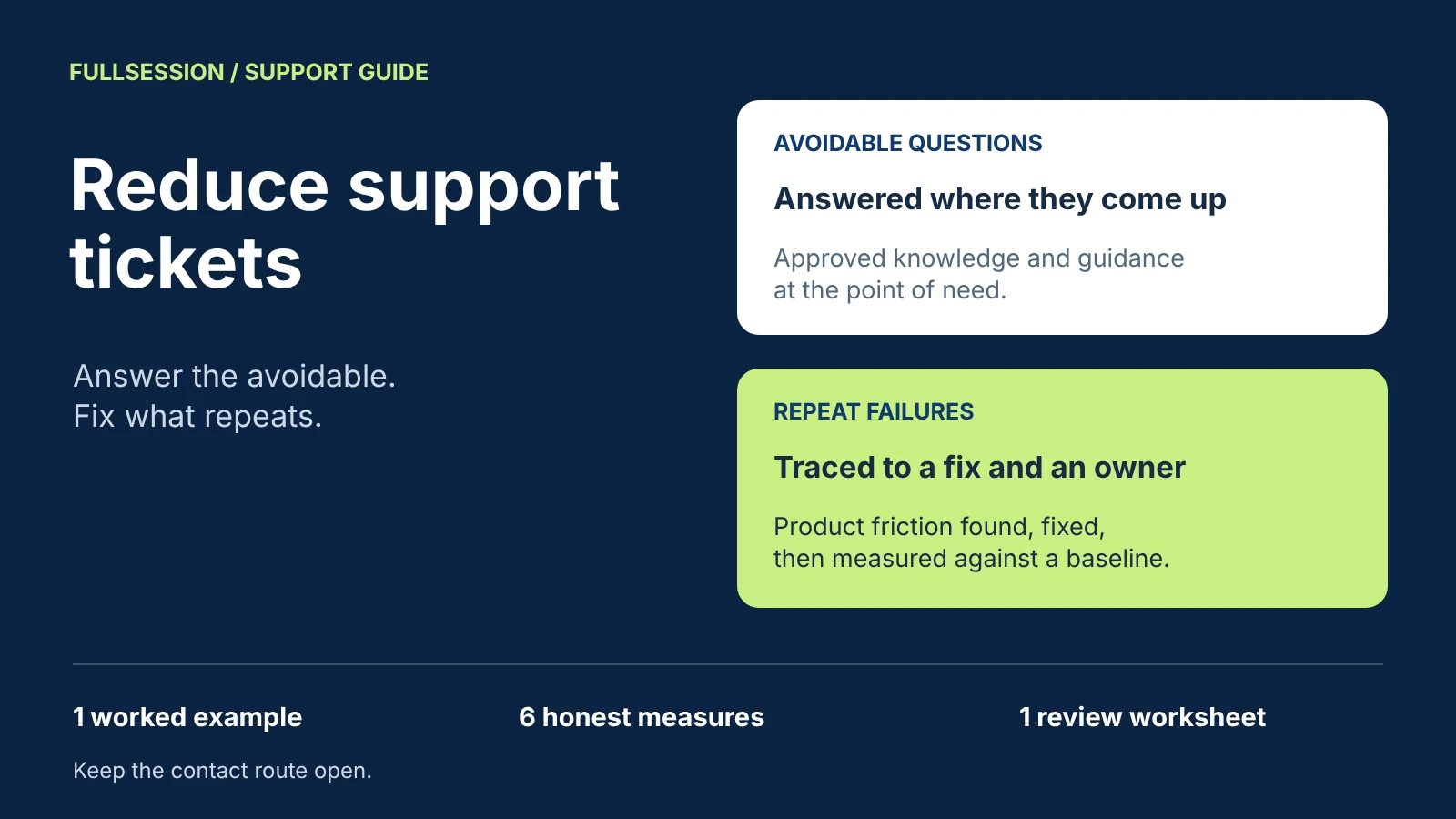

To reduce support tickets without hiding the problem, remove the reasons people ask, not the route they use to ask. Sort recent conversations into avoidable questions, which approved content can answer (how to do something, plan and pricing rules, status), and legitimate support needs, which a person should handle (account-specific changes, bugs, judgement calls, complaints). Answer the first kind where the question comes up, fix the content or product behind every repeat, keep the second kind one request away from a person, and measure repeat issues and successful help against your own baseline.
FullSession Support & Sales Desk is built for that loop. Max AI answers from your approved docs, help center, pricing page and support portal. In your web app it can answer from your docs or co-drive the fix while the customer watches, and personal next steps are remembered across visits. Customers always know when they are talking to Max and can ask for a person at any time, and your team takes over in the same thread from one shared inbox. The Desk app, shared inbox and human chat are included, with no seat fees, so keeping a person within reach adds no seat fee or chat charge. Add Core CX / UX when you need to see where the friction behind a repeat question happens. See the Desk's published capabilities.
The repeat-question review worksheet has blank fields for your own review. Desk capabilities and prices come from FullSession's published pages, checked 19 October 2026. The example and its numbers are illustrative, not a customer result or a test.
Which support questions are avoidable, and which should stay easy to reach
An avoidable question is one the customer would not have needed to ask if the right answer, or a clearer product, had been in front of them. A legitimate support need is one where the customer needs a person, or the business needs a judgement. Reducing the first kind is good operations. Reducing the second kind by making contact harder is a cost transfer: the problem stays, and you stop seeing it.
The line moves with evidence. A how-to question asked every day is often product friction with a how-to label, and the review below is how you tell. The same customer can also cross the line inside one conversation: a question about a cutoff time becomes a refund request once they have been charged.
Why hiding the contact route only moves the ticket
Hiding the contact form, burying the email address or forcing every visitor through several chatbot turns lowers the ticket count. It does not lower the number of people with a problem. Those people come back through another channel, ask for a refund, leave a review or cancel, and your support data stops showing you the cause. Customers notice: in a Gartner survey of 3,566 B2B and B2C customers, conducted in February and March 2026, 87% said it is essential for companies to provide an option to reach a human agent when using GenAI. Gartner also notes that customers forced through multiple unsuccessful AI interactions before reaching a person are less likely to use that tool again, and advises service leaders not to make GenAI a mandatory first step for every issue (Gartner, 4 August 2026).
Desk is built the other way round. Customers always know when they are talking to Max and can ask for a person at any time, and on your website you can let visitors choose Max or a person. A request for a person goes to your team in the same thread, so nobody restarts the story. For what that takeover should carry, see the chatbot-to-human handoff guide.
Count a drop as progress only when the problem behind the question was solved, or the answer was complete enough that nobody came back.
Answer avoidable questions where they come up
Most avoidable questions already have an answer somewhere. The customer cannot find it, or it is not where the question arose. Gartner's earlier self-service research found that the most common reason for self-service failure was that, in 43% of cases, customers could not find content relevant to their issue (survey of 5,728 customers, December 2023, Gartner, 19 August 2024). Two fixes follow: make the content complete, and put the answer in front of the customer at the moment they need it.
Complete content states the rule, the conditions, the steps and what to do if the steps fail, with one current source for each rule. Start with the questions that repeat, not with the whole help center. The chatbot knowledge base guide covers that preparation in depth: the source register, conflicting answers, restricted content and testing.
At the point of need, Max answers from your documentation, help center, pricing page, marketing site and support portal, and your MCP server supplies the account data you choose to expose, such as an order or plan status. In your web app, Max answers from your docs or co-drives the fix while the customer watches, instead of describing the steps. Inside your product, personal next steps are co-driven and remembered across visits, so a customer who stops halfway through setup picks up where they left off rather than asking again. On your website, Max answers pricing and product questions from your pricing and product pages. When the answer runs out, the customer asks for a person, and the teammate sees Max's labeled answers in the same thread.
Which tasks to automate first, and how to test and launch them, are covered in the customer support automation guide. This article picks up after launch, when the same questions keep arriving.
Investigate repeat failures instead of answering them forever
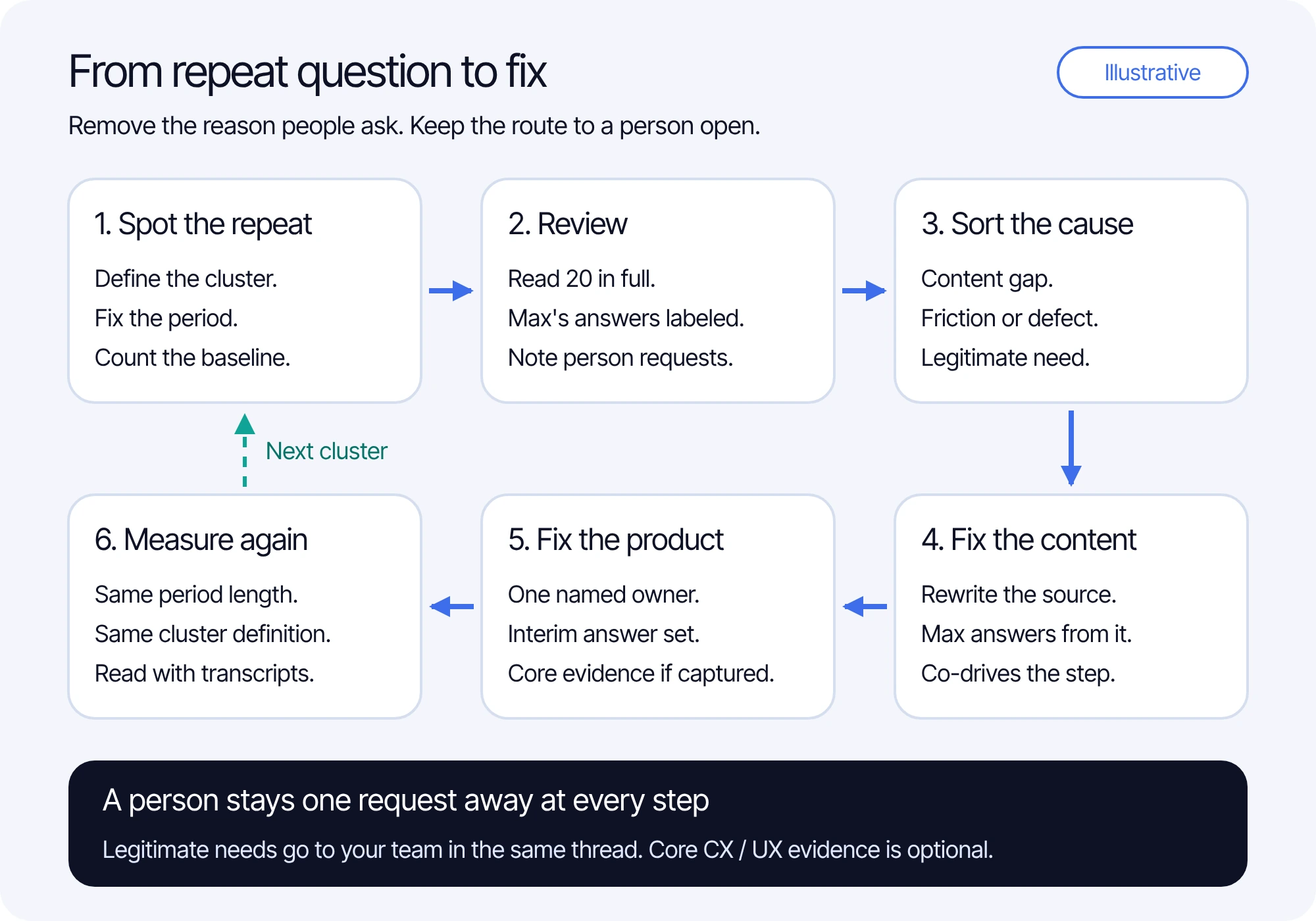
A repeat question answered well every time is still a signal. Answering “the button does nothing” fifty times is not good support; it is a defect that the support team is absorbing. The review that turns repeats into fixes has six steps, and the worksheet follows them in order.
- Spot the repeat and define it. Group conversations by what the customer was trying to do, not by keyword, over a fixed period, and count the baseline.
- Review a sample in full. Twenty conversations, or all of them if there are fewer. In the Desk shared inbox, Max's replies are labeled in the transcript, so you can see what Max answered and where the customer asked for a person.
- Sort each conversation by cause. Missing or unclear content, correct content in the wrong place, product friction (the flow works but people fail at it), a defect, or a policy customers did not know. Legitimate needs stay with a person.
- Fix the content. Correct the source, add it to Max's approved sources and check the answer after the change, so Max answers from it and can co-drive the step.
- Fix the product. Gather evidence, because the transcript tells you what the customer said, not what the page did. Name one owner per fix, and decide the interim answer and which conversations stay with a person until it ships.
- Measure the next period against the baseline, with the same period length and cluster definition, then move to the next cluster.
A person stays one request away at every step.
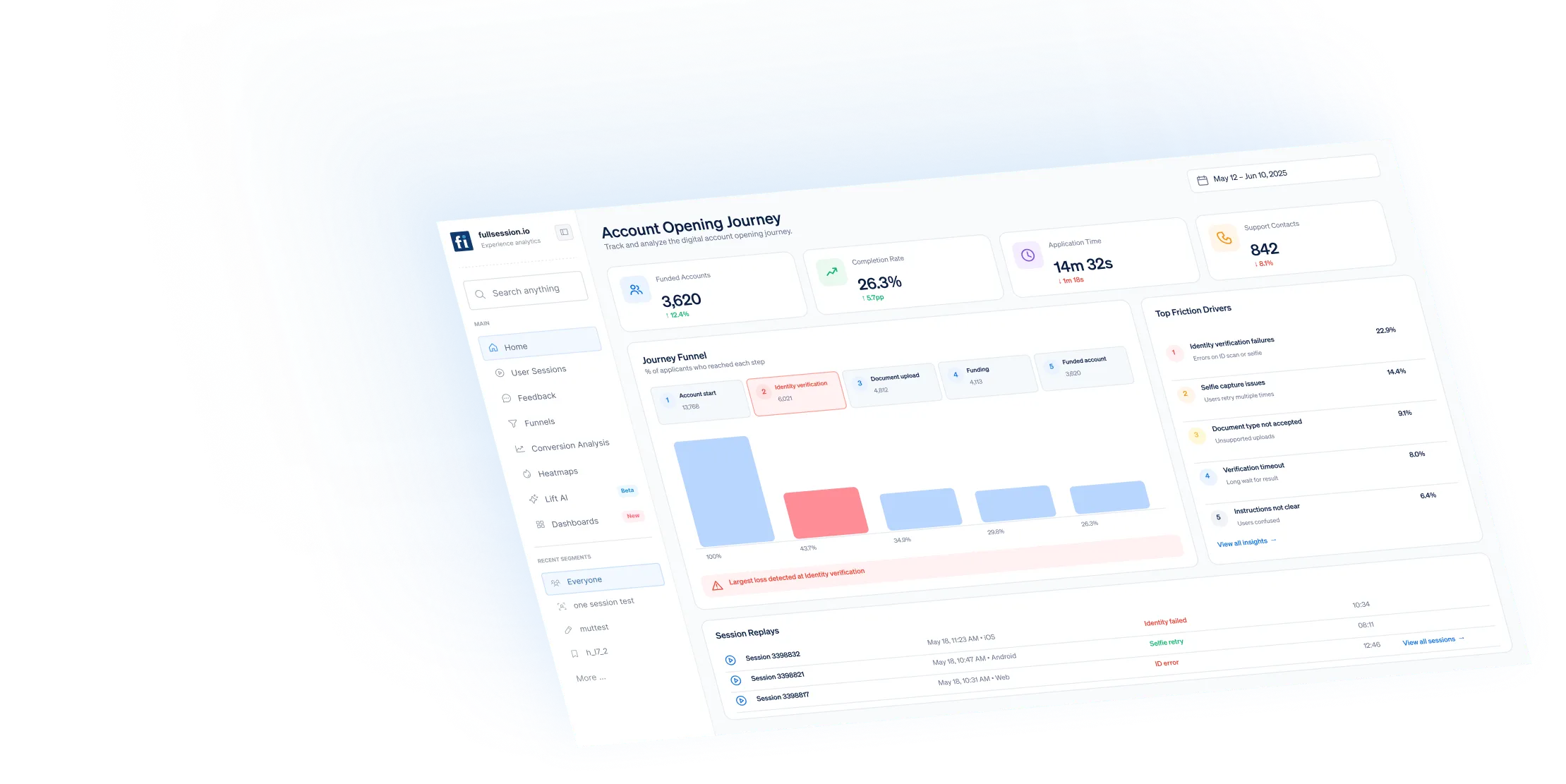
For step 5, optional Core CX / UX shows where the friction happens. Session replay shows the clicks and the page's response for a session that was captured, with console and network errors in the same timeline. Funnels show which step people drop at, split by device or segment, and open the sessions behind the drop. Error tracking connects JavaScript errors and failed requests to the session where they fired. Core CX / UX is a separate plan from $39.20/mo billed annually. Recordings depend on your Core plan, capture settings and retention, so a conversation links to a recording only when that session was captured. Without Core, ask one targeted question and reproduce the problem on a test account.
Keep the evidence inside your data rules. What customers type in the Desk chat follows the same masking rules as every other input FullSession records, and replay masking happens at capture, in the browser.
While a fix is pending, tell customers the truth instead of hiding the route. Add the known problem and its workaround to the relevant approved article so Max can answer from it, and check the answer after the change.
A worked question-to-fix example
The example uses a fictional coffee subscription store, Kettleby Coffee, with about 4,800 active subscriptions. Kettleby runs Max on its website and in the customer account area, and uses Core CX / UX on its store. Every name, rule and number below is invented to show the method as a filled-in worksheet: illustrative, not a result from FullSession or a customer.
Over four weeks, the support lead sees the same request again and again: customers want to skip or pause their next delivery. She defines the cluster, reads twenty conversations in full and sorts them by cause.
The method counts a fall in the cluster as progress only when repeat contacts and refund requests fall with it. Keeping failed-skip conversations with a person is Kettleby's own interim policy; customers can ask for a person at any time regardless.
Measure repeat issues and successful help against a baseline
Ticket count alone rewards the wrong behavior, because it falls when customers give up. Track a small set of measures over a fixed period, each read with the measure that keeps it honest.
Set targets from your own baseline; another company's rates do not predict yours. Compare periods of the same length, note releases, promotions and seasonal swings, and treat a before-and-after change as evidence to read, not proof that the fix caused it. Max includes behavioral analytics, dashboards and reporting; confirm in a walkthrough which of these measures you can read there and which you count from your own review.
What Max charges while you run this loop
Max is billed per AI-assisted conversation: $0.39 each, with a $99 monthly minimum credited toward conversations, not added on top. One conversation covers one user in one thread for a fixed 24 hours from Max's first substantive answer, guidance or supported action. Greetings, clarification-only exchanges, human-only chat and handoffs before substantive Max help are not billed, and human replies add no charges. The Desk app, shared inbox, human chat and supported integrations are included, with no seat fees, so keeping a person one request away adds no seat fee or chat charge. Repeat questions removed at their source also mean fewer AI-assisted conversations to pay for once you are above the minimum. Optional Core CX / UX, taxes and third-party subscriptions are separate. Sources checked 19 October 2026: Max pricing.
Bring a repeat support question to a Desk walkthrough
Bring one question your team answers every week. We will walk through how Max answers it from approved content, how the step is co-driven in your product, how a customer reaches a person in the same thread, and, if you use Core CX / UX, where the session evidence sits for a captured session.
Questions support leads ask about reducing tickets
No. Deflection counts contacts that did not reach a person. A reduction worth having means fewer people needed to ask, because the answer or the product got better. Read any deflection figure with repeat contact and successful help, because deflection can rise while customers give up.
No. Removing a contact route lowers the count without solving anything; the problems return as refunds, chargebacks, cancellations or contacts elsewhere. In Gartner's 2026 survey of 3,566 customers, 87% said it is essential for companies using GenAI to provide an option to reach a human agent. In FullSession Desk, customers always know when they are talking to Max and can ask for a person at any time.
After one full period that starts once the fix has shipped and matches the baseline's length, such as four weeks; low-volume clusters need longer. Compare cluster rate, repeat contact and successful help together, and read a sample of the new period's transcripts before you call the fix done.
A small set read together over a fixed period: the rate of each repeat question per 100 active customers, accounts or orders, repeat contact within seven days, successful help, requests for a person by reason, downstream signals such as refunds or cancellations that cite the same cause, and fix lead time per owner.
$0.39 per AI-assisted conversation, with a $99 monthly minimum credited toward conversations, not added on top. One conversation covers one user in one thread for a fixed 24 hours from Max's first substantive answer, guidance or supported action. Greetings, clarification-only exchanges, human-only chat and handoffs before substantive help are not billed.
See what’s costing you, and prove whats fixing it is worth
Watch the real journey, rank every issue by revenue impact, and validate the result against baseline.





212 E Stone Path St Derby, KS 67037 Phone: +1 415-649-4222


All systems operational.