.svg)

Top Five Digital Customer Experience Trends For E-commerce Websites

Quick takeaway
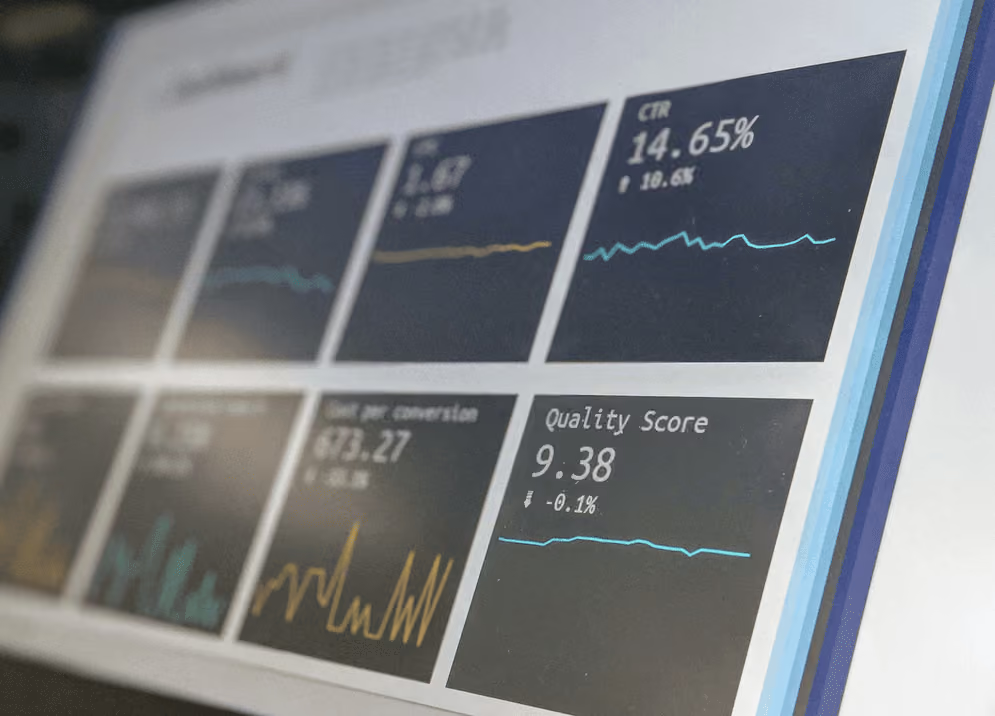
Digital customer experience in 2026 is largely about reducing uncertainty for shoppers. The trends below show where ecommerce teams are tightening clarity, trust, and speed, and how to spot friction with Session Replay, then prioritize fixes through Checkout Recovery.
If you only do one thing, choose one high-friction journey (usually cart or checkout), watch the sessions behind the drop-off with Session Replay, then ship the smallest change you can validate. That “tight loop” is what separates teams that improve CX from teams that just talk about it.
If you are responsible for ecommerce growth or CRO, you already know the frustration: you fix one thing, then three more break. The simplest behavioral move is to anchor your decisions in observable behavior. Watch a small sample in Session Replay, quantify the step where users hesitate, then change the one element that reduces confusion the most.
Trend 1: Speed-to-fix becomes the CX advantage
Most ecommerce teams do not have an insight problem, they have a pacing problem. A shopper hits friction today, the team debates it next week, and the fix ships later. That gap is where confidence drops and drop-off rises.
From a behavioral psychology lens, friction is often a prediction error: the shopper expects one thing, the UI delivers another. The teams that win reduce prediction error quickly, and they do it with shared definitions and shared evidence.
Three quick moves that keep momentum
- Agree on friction signals: rage clicks, dead clicks, repeated form errors, sudden exits.
- Run a weekly top-five review: five issues, one owner each, one decision each.
- Confirm the pattern: watch 10 to 20 sessions in Session Replay before changing the flow.
How to know it is working
Track time to diagnosis, time to fix, and reoccurrence rate (same issue returns within 14 days). These are “team learning speed” metrics, and they predict whether your CX improvements will compound.
Trend 2: One experience record across channels
Omnichannel is the baseline. The difference now is whether your team can connect what the shopper experienced on the site to what they later report in support, without asking them to become your QA team.
In ecommerce, the hardest moments are checkout and post-purchase. That is why many teams route this work through Checkout Recovery: the job is to reduce drop-off, reduce payment failures, and improve recovery when something goes wrong.
A simple “experience record” checklist
How to measure it
Use first-contact resolution rate, checkout completion rate by device, and ticket re-open rate for checkout or payment issues. If those improve, your team is seeing the same “experience record” the customer lived.
Trend 3: Analytics shifts from dashboards to decisions
Predictive analytics only helps when it changes what you ship. The useful shift is from “more charts” to a decision queue: a short list of problems you can validate quickly, fix safely, and measure cleanly.
Behaviorally, this matters because too many options creates decision fatigue. A small queue reduces choice overload for your team, and increases follow-through.
A four-step workflow that stays human
- Pick three diagnostic KPIs (one conversion, one friction, one speed) and keep them stable for a quarter.
- Segment realistically (new vs returning, paid vs organic, mobile vs desktop).
- Validate the why by watching sessions in Session Replay before redesigning anything.
- Ship the smallest fix you can measure, then re-check the queue next week.
How to measure it
Track drop-off by funnel step (cart, shipping, payment, confirmation), error rate by step and device, and fix validation rate (how often shipped fixes move the KPI). Consistency beats “perfect attribution.”
Trend 4: Trust and transparency become UX requirements
Digital customer experience is not just layout and copy. It is also how safe, fair, and predictable the journey feels. Shoppers abandon when costs show up late, policies feel unclear, or a problem happens and the recovery path is hidden.
Psychologically, trust is built through repeated small signals: clear expectations, consistent language, and an obvious next step when something goes wrong. If you focus on one thing this quarter, make checkout failure states calmer and more actionable. That work often starts in Checkout Recovery, where the goal is to reduce failure and improve recovery.
When shoppers do not trust what will happen next, they default to stopping. The fastest trust wins come from clear expectations and calm recovery paths, not from louder persuasion.
Citations: IBM Institute for Business Value; Edelman Trust Barometer Special Report.
What to change first
- Remove surprises: surface shipping, taxes, and delivery expectations earlier than the last step.
- Make recovery obvious: payment failures should explain what happened and offer one next step.
- Capture feedback after friction: ask after errors or stalls, not only after success.
How to measure it
Track payment failure rate and recovery rate, pre-purchase visits to returns or shipping policy pages (as a trust proxy), and support escalations per 1,000 checkouts.
Trend 5: Processing fluency wins on mobile
Discovery increasingly happens off-site, then your site has seconds to make the next step feel obvious. Content is not just marketing, it is part of the purchase journey, especially on mobile.
From a behavioral lens, the goal is processing fluency. If your page takes effort to understand, people bounce. If it feels obvious, they keep moving. That is why first-10-seconds clarity is a competitive advantage. For online stores, current ecommerce UX trends point toward simpler mobile journeys, clearer product information, fewer checkout surprises, and faster paths from interest to purchase.
A quick fluency test
Show your landing page to someone for 5 seconds. Then ask: what is this, who is it for, and what should you do next? If they hesitate, you have a fluency problem, not a traffic problem.
How to measure it
Track landing page bounce rate by device and channel, scroll depth and primary CTA click-through rate, and mobile checkout completion rate. If these move together, you are improving fluency.
Common follow-up questions
Digital customer experience is how shoppers perceive every online interaction across discovery, product evaluation, checkout, and support. In ecommerce, it shows up most clearly when friction blocks conversion, or when unclear expectations create avoidable tickets and refunds.
Fixes that reduce checkout friction often show impact fastest because measurement is immediate. Start where drop-off spikes, confirm why it happens in session evidence, then ship the smallest change that reduces failures.
You rarely need hundreds. Start with 15 to 30 sessions for a specific segment and failure mode, for example mobile users who saw a payment error. If patterns are inconsistent, tighten the segment or expand the sample.
Turn analytics into a queue: a small list of prioritized problems with an owner, a proposed fix, and a validation plan. If an insight does not lead to action, remove it or attach it to a recurring decision meeting.
Review the top friction signals once a week, pick five issues, assign one owner each, and decide fix versus measure versus ignore. Validate fixes with replay evidence, and update the list next week. Consistency beats big one-time audits.
Start with the journey that leaks the most revenue, usually checkout. Use Checkout Recovery to prioritize issues, and validate the failure mode with Session Replay before you redesign anything.
See what’s costing you, and prove whats fixing it is worth
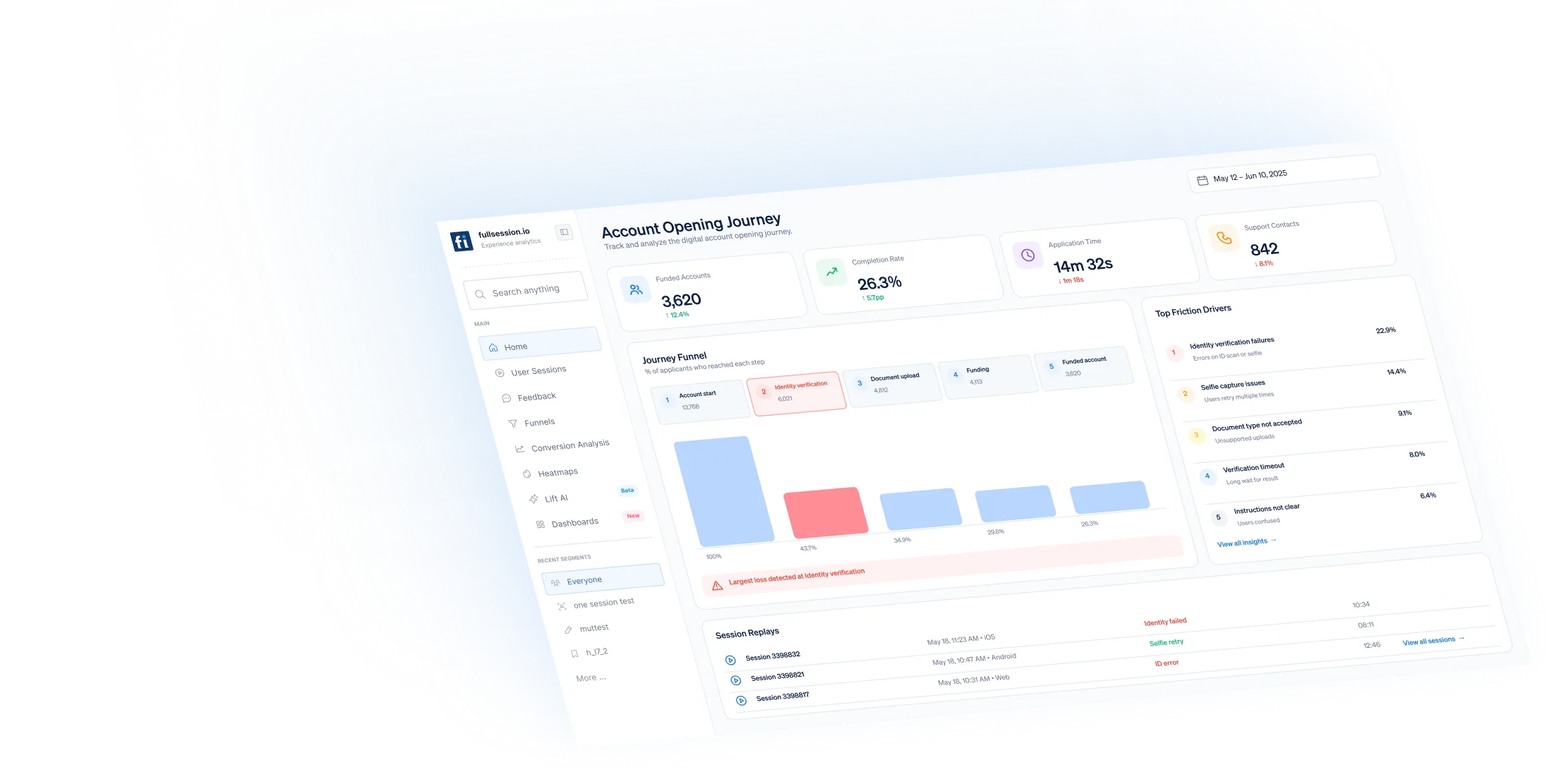
Watch the real journey, rank every issue by revenue impact, and validate the result against baseline.



.svg)
.svg)
212 E Stone Path St Derby, KS 67037 Phone: +1 415-649-4222



All systems operational.