Author: Mohamed Sehwail

  • We Tried 5 Mixpanel Alternatives: Here’s Our Feedback

    We Tried 5 Mixpanel Alternatives: Here’s Our Feedback

    With so much web analytics software available today, finding one that best suits your business needs can be challenging. 

    Mixpanel is a helpful tool for gaining actionable insights into your products and users. It offers various features for monitoring user activities, collecting customer data, and analyzing user behavior. However, flaws like a steep learning curve and limited integrations motivate customers to look for alternatives.

    One alternative you can test is FullSession, a user behavior analytics software that helps track user behavior on your website, web app, or landing page. It offers session recording and replay, interactive heatmaps, customer feedback forms and reports, funnel and conversion optimization tools, and error analysis to help you optimize your website performance.

    You can evaluate these features for free. All you need to do is book a demo today.

    In this blog post, we will explore five different Mixpanel alternatives to help you find the perfect fit for your unique needs. Each service offers useful features for monitoring user activity and analyzing behavioral data so you can understand how users interact with your site or app. 

    Key Takeaways

    1. Mixpanel is a behavioral analytics platform for tracking user actions and collecting real-time data and insights. However, some users report performance issues with large data sets, limited pre-sale phase tracking, and dashboards that can only accommodate up to 8 reports.
    2. FullSession is a user behavior analytics software that provides session recordings, interactive heatmaps, customer feedback forms, conversion funnel analysis, and error tracking. You can visualize all user engagement, analyze trends and patterns with laser precision, and optimize your website for peak performance. FullSession is GDPR, CCPA, and PCI compliant. It integrates with Open APIs, native integrations, and modern webhooks. Book a demo to learn more.
    3. Google Analytics is a web analytics platform popular for its comprehensive free version, but it has limitations, such as the presentation of raw data without any tools to track user behavior. This means users can’t completely understand the meaning behind the numbers.
    4. Amplitude Analytics is similar to Mixpanel but offers more flexibility with predictive analysis and behavior comparison features. However, setting up event tracking can be tedious.
    5. Adobe Analytics offers cross-channel attribution and real-time insights but is expensive and lacks a free trial.
    6. Quantum Metric is unique for automatic standard event tracking and custom tracking options, though it has a high learning curve.

    If you’re looking for a comprehensive web analytics tool that goes beyond basic data tracking, FullSession is the ideal choice for your business. FullSession offers session recordings, heatmaps, conversion funnel analysis, error tracking, and so much more, all in one platform.

    With all these capabilities, you can track data easily and gain a deep understanding of what it means.

    Plus, premium plans start at only $39 a month. All premium plans offer all key features and unlimited heatmaps. You can save 20% on an annual plan and pay only $32 a month for the Starter plan!

    Start a Free Trial to Experience FullSession

    Capture all user interactions, spot trends and patterns and drive improvements without compromising your website performance.

    The Top 5 Mixpanel Alternatives in 2024

    By now, you know how Mixpanel helps teams with customer journey mapping and product analytics. But what if its limitations are holding you back from attracting the most valuable users? It’s time to look for a Mixpanel alternative.

    We tried and tested the top 5 Mixpanel alternatives, and here is our feedback.

    1. FullSession

    FullSession is a user behavior analytics software that helps you get a 360-degree view of user behavior data in a single, intuitive dashboard. You can visualize all user engagement, analyze trends and patterns with laser precision, and optimize your website for peak performance.

    Watch real-time user sessions, see how users interact with your site, and capture every aspect of the user journey. Find and remove conversion blockers, optimize key touchpoints in the user journey, and minimize drop-offs in your marketing and sales funnels.

    Detect dead zones, test different page elements, validate design changes, and improve your website’s visual hierarchy. Capture specific details about user problems, understand the reasons behind their frustration, and act promptly to provide immediate solutions.

    Start a free trial today.

    FullSession users

    Web analytics experts, digital marketers, web developers, UX designers, eCommerce managers, and sales representatives primarily use FullSession. Many eCommerce companies use it to track and analyze data.

    Deployment

    FullSession is easy to use. By following a few instructions, you can set it up yourself without help from the technical team.

    The FullSession data capture snippet is asynchronous, minimal in performance impact, and captures all web interactions automatically once loaded.

    You can easily install it by pasting the snippet into the <head> section of your site or app via your CMS or code. 

    After installation, sessions will start appearing in FullSession within minutes. To protect sensitive data, you can use the “Excluded Elements” feature to block certain elements from being captured. Privacy settings allow you to manage these exclusions, ensuring customer data is secure. 

    Finally, you can invite your team members to collaborate in FullSession while waiting for session data to populate.

    You can also book a demo to try it out.

    What makes FullSession unique?

    FullSession doesn’t confuse you with too many features. It includes ones that help you get the job done–session recordings and replays, interactive, real-time heatmaps, customer feedback forms, conversion funnel analysis, and error analysis. 

    Our primary goal is to help you track user activity and analyze user behavior. With these tools, you can:

    • Keep an eye on dynamic elements in real time to get accurate insights into user behavior.
    • Speed up heatmap processing without slowing down your site.
    • Protect user privacy by making sure sensitive data isn’t recorded.
    • Easily manage large data sets and quickly find the insights that matter.
    • Limit tracking to your own site, so you’re in control of user data.
    • Bring your team together and streamline collaboration on one platform.

    Visualize, Analyze, and Optimize with FullSession

    See how to transform user data into actionable insights for peak website performance.

    Session recordings

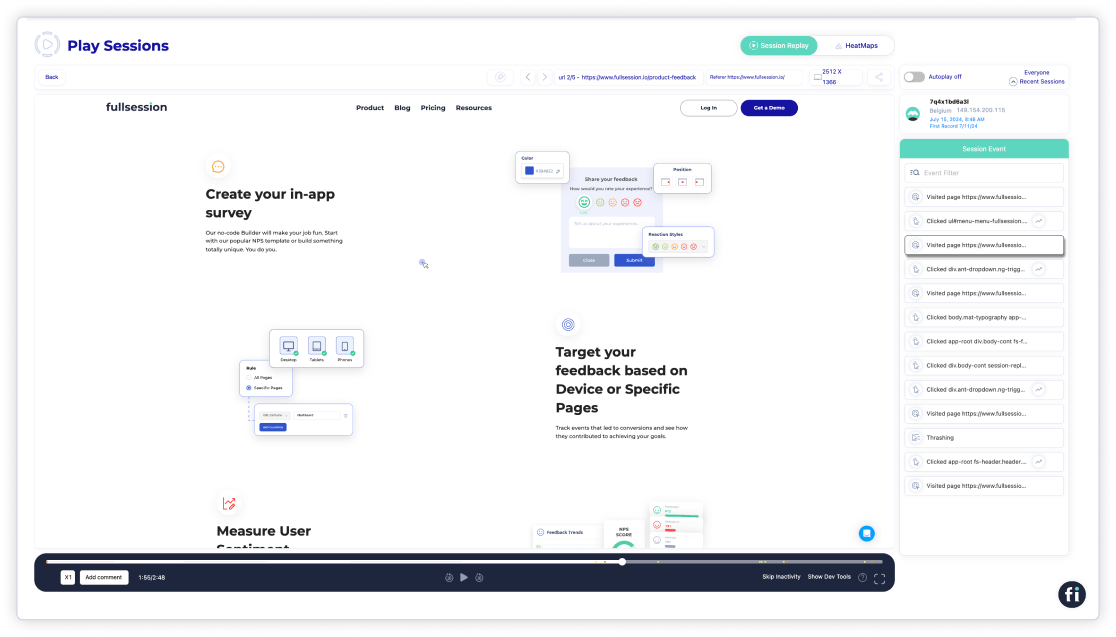
    FullSession lets you record user sessions to help you pinpoint any issues they may have while browsing your website. It doesn’t record sensitive information to keep user privacy safe.

    For example, you can view an entire user’s journey and watch how they interact with your website to get deeper insights into what interests them the most, which elements get ignored, and how you can improve the overall customer journey.

    You can also match user interaction data from session recordings with customer feedback. This feature helps you better understand that specific user’s experience and what led to their feedback. If it’s negative, you can see exactly what happened and pinpoint any potential issues.

    Heatmaps

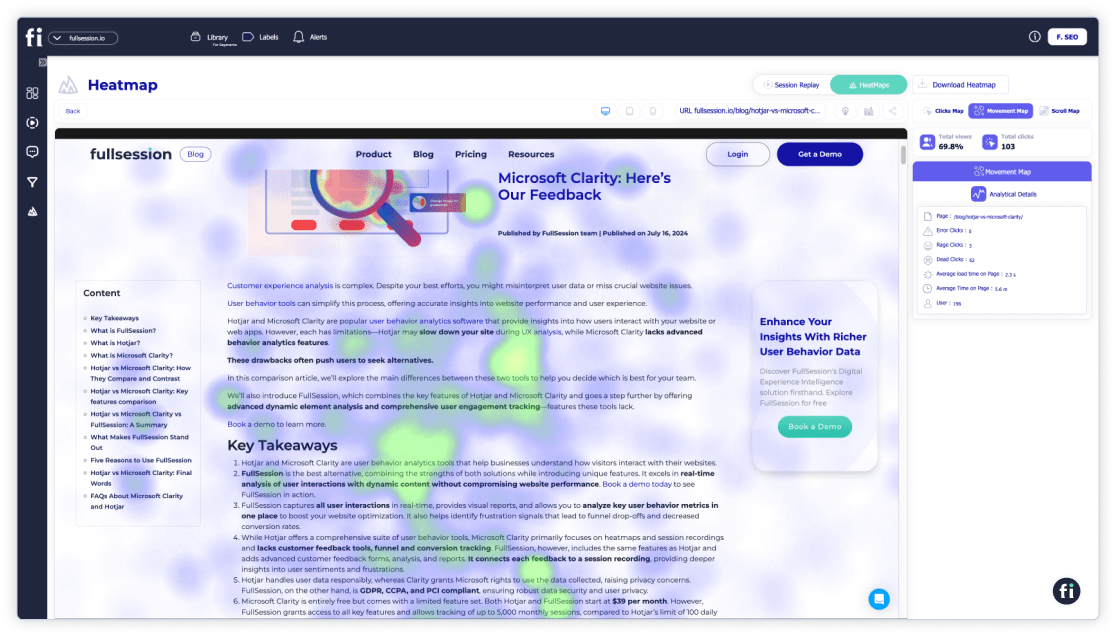
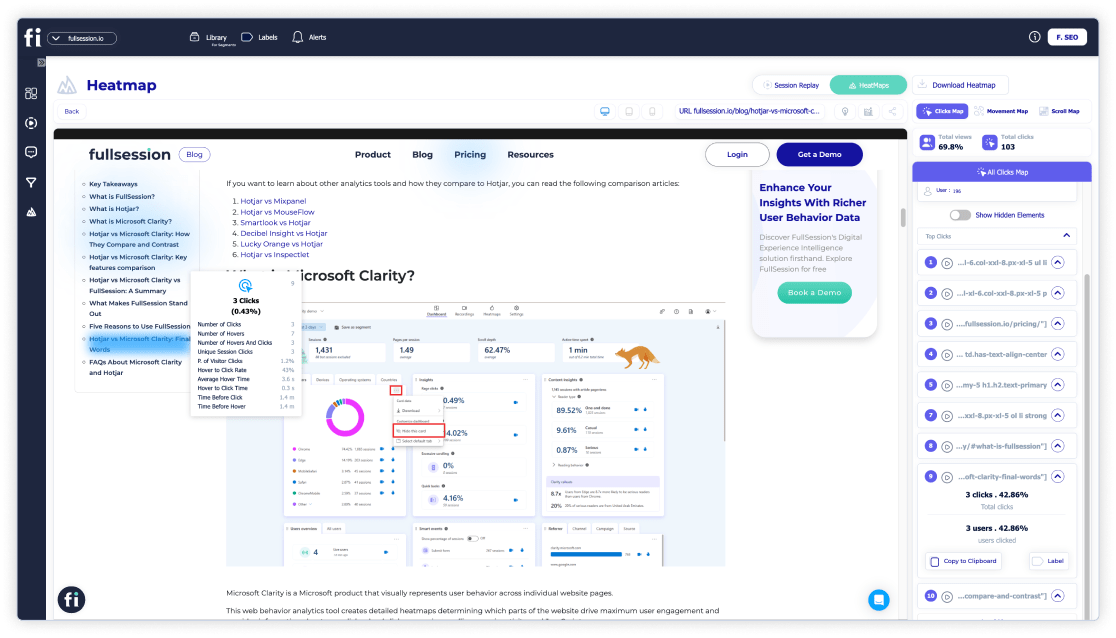
    To see what website elements attract or repel your visitors, interactive heatmaps provide real-time data about your users’ actions, such as clicks, scrolls, mouse movements, taps, form submissions, and other activity on your web and mobile platforms. FullSession heatmaps have zero waiting processing time so you can get immediate data.

    Customer feedback 

    Customer feedback forms help you gather user feedback and hear their honest opinions about your product’s experience.

    It’s also easy to create feedback widgets with FullSession. No coding is required, and you can customize each widget in terms of appearance, triggers, sequences, etc.

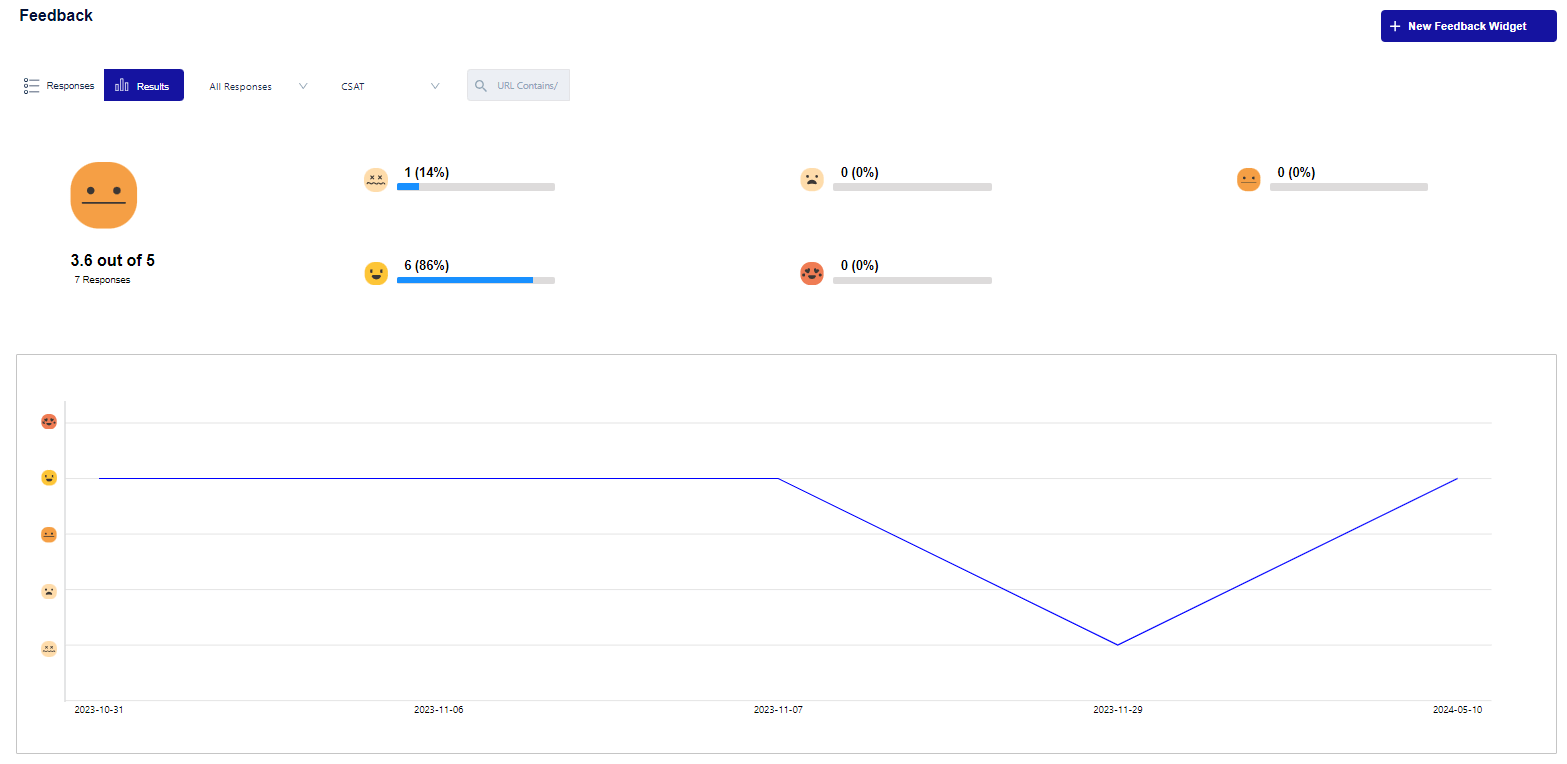
    FullSession also allows you to have a clear overview of the results of feedback collection. In this panel, you can immediately see the average score and distribution of ratings. Plus, you’ll get a graph that represents your feedback scores by date.

    Start a free trial now.

    Funnels and conversions

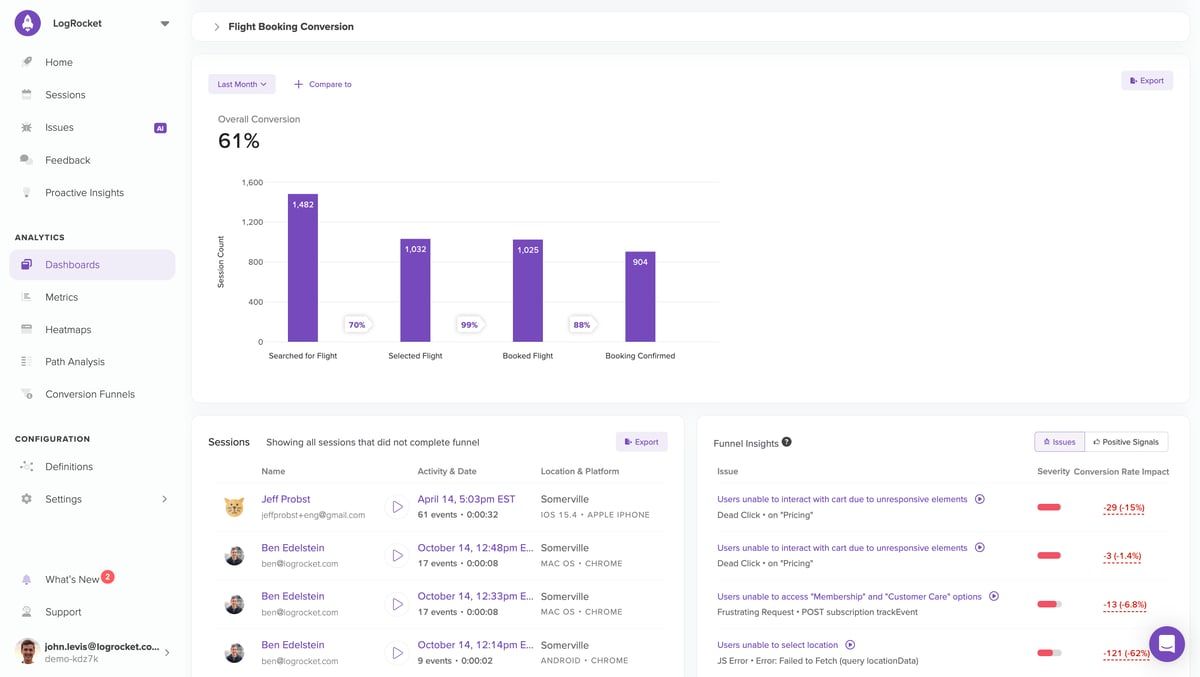
    The FullSession funnels and conversions feature gives you a clear view of how users navigate the website and move through your conversion funnel. It helps you spot where users drop off, track trends over time, and identify key actions that boost conversions.

    You can also analyze user effort, see which steps engage users the most, and compare performance across different segments.

    Error analysis

    The error analysis feature helps you quickly spot and fix issues affecting user experience. It tracks error clicks, network errors, console errors, and uncaught exceptions, offering insights through session replays and error logs.

    You can segment and filter data to understand how different users experience errors, monitor trends over time, and get real-time alerts through Slack.

    Raw data from these customer journey analytics tools will appear on your main dashboard, which will then show you insights on user engagement, user experience, and marketing channels. These include but are not limited to:

    • Session playlist
    • Top users
    • User trends
    • Event per session
    • Session length
    • Active time
    • Feedback data
    • UTM analytics
    • Top referrers
    • Slowest pages (pages, landing pages, and exit pages)
    Advanced user and event filtering

    FullSession filters also make tracking customer journeys much easier. You can filter customer interactions based on device type, events, and demographic data for a more granular view of user journeys.

    Customer segmentation is key because it helps you tailor your marketing and website content to specific groups, leading to more personalized experiences. This targeted approach can increase engagement and conversion rates by addressing the unique needs of different user segments.

    Integrations

    Thanks to open APIs, native integrations, and modern webhooks, FullSession easily integrates with BigCommerce, Wix, WordPress, Shopify and many other tools. Read our detailed guide for more information.

    Customer support

    If you need help, you can contact us via live chat, send us an email, read our guides, or visit our support center.

    Pricing

    Fullsession Pricing

    Here are more details on each plan.

    • The Free plan is available at $0/month and lets you track up to 500 sessions per month with 30 days of data retention, making it ideal for testing core features like session replay, heatmaps, and frustration signals.
    • The Growth Plan starts from $23/month (billed annually, $276/year) for 5,000 sessions/month – with flexible tiers up to 50,000 sessions/month. Includes 4 months of data retention plus advanced features like funnels & conversion analysis, feedback widgets, and AI-assisted segment creation.
    • The Pro Plan starts from $279/month (billed annually, $3,350/year) for 100,000 sessions/month – with flexible tiers up to 750,000 sessions/month. It includes everything in the Growth plan, plus unlimited seats and 8-month data retention for larger teams that need deeper historical insights.
    • The Enterprise plan starts from $1,274/month when billed annually ($15,288/year) and is designed for large-scale needs with 500,000+ sessions per month, 15 months of data retention, priority support, uptime SLA, security reviews, and fully customized pricing and terms.

    Book a demo today.

    Pros

    FullSession is very handy for businesses looking to better understand user behavior. Here are the major pros of FullSession:

    • It analyzes visitor behavior, interactions, and friction points through advanced data analytics tools
    • Insights identify visitor behavior and pain points that may cause funnel dropouts
    • Advanced filtering highlights key visitor experiences and flags suspicious sessions
    • It pinpoints major session events to save time and quickly identify issues
    • It tracks behavior and activity to improve conversion rates
    • FullSession enables proper CX analysis without impacting site performance
    • Tracks dynamic elements in real time to ensure all critical interactions are captured
    • FullSession processes heatmaps quickly without affecting site performance
    • The platform protects user privacy by excluding sensitive data automatically
    • It restricts behavior tracking to your website, preventing data misuse
    • FullSession unifies cross-team collaboration on a single platform
    • It provides extensive guidance through user onboarding, starter guides, a help center, live chat, email support, and more. 

    Turn User Behavior into Growth Opportunities

    Learn how to visualize, analyze, and optimize your site with FullSession.

    2. Google Analytics

    Mixpanel alternative - Google Analytics

    Image source: G2

    Google Analytics tracks and reports website traffic, site performance, and marketing effectiveness. It helps you understand how visitors interact with your site, so you can make data-driven decisions to improve your online presence.

    However, it doesn’t have user behavior tools that will help you understand raw data.

    User rating

    Google Analytics is rated 4.5/5 on G2 based on 6,387 user reviews. Most users are happy with its features, and some feel it is occasionally complex to use.

    Google Analytics users

    Everyone uses Google Analytics. Even a beginner who just created their website a few days ago uses It to understand the website’s performance and user journey. 

    A large company with hundreds of employees also uses Google Analytics to understand event tracking, customer journeys, usage data, customer engagement, customer behavior, and user sessions.

    Deployment

    Google Analytics is available on the web. You can deploy it on your website by pasting a code from Google Analytics. You can also use WordPress plugins to add the GA tracking code.

    What makes Google Analytics unique?

    Google Analytics is a by-product of Google. As most websites try to rank in the Google search engine, it helps website owners get an edge and better understand how to optimize their products.

    Integrations

    You can integrate Google Analytics with all Content Management Systems (CMS) since the code is flexible to use on any website.

    Customer support

    Google Analytics offers extensive documentation to help users understand and use the tool effectively. It also has email and chat support for any queries. However, support is provided exclusively to Sales Partners and customers who purchase Google Marketing Platform advertising or Analytics 360 products directly from Google.

    Pricing

    Google Analytics has an extensive free version that is used by most businesses and individuals. The premium version costs $150,000 per year.

    Pros

    • The accuracy of the key metrics 
    • The tool is free to use and gets the job done with its comprehensive details on user location, devices, and browser

    Cons

    • Though Google Analytics is a helpful tool, it cannot cover all tracking needs for a website 
    • Setting up tracking manually can be a challenge to non-technical users
    • There is no option to record and replay sessions to understand the key website issues

    3. Amplitude Analytics

    Mixpanel alternative - Amplitude Analytics

    Image source: G2

    Amplitude Analytics is a product analytics platform for tracking user behaviors. Amplitude provides a more in-depth solution for user behavioral analysis and product intelligence, whereas Mixpanel is known for its focus on event-driven analytics.

    It helps you make data-driven decisions to build better products, drive conversions, and increase engagement, growth, and revenue.

    Learn more: Amplitude alternatives.

    User rating

    It has a user rating of 4.5/5 on G2 based on 2,153 user reviews.

    Amplitude Analytics users

    It is used by digital marketers, product and web analytics experts, UX designers, and others. 

    Deployment

    Amplitude analytics is available on the web. The development team can help you set up event tracking.

    What makes Amplitude Analytics unique?

    Amplitude Analytics is unique for its deep user behavior analysis and product intelligence capabilities. 

    It goes beyond simple event tracking to offer insights into user journeys, retention, and engagement, helping product teams understand both what users are doing and why. 

    With features like behavioral cohorts and predictive analytics, Amplitude provides actionable insights that drive product growth and optimize user experiences.

    Customer support

    Amplitude Analytics has a comprehensive help center where you can get answers to most of your questions. You can also join their community for help.

    Pricing

    Amplitude pricing

    Amplitude offers three plans:

    • Free plan: Provides basic capabilities that are perfect for startups and individuals
    • Plus: Starts at $61 per month for advanced features like unlimited product analytics capabilities and custom dashboards
    • Growth: Offers customized pricing for everything in Plus, along with advanced behavior analytics

    Pros

    • It provides real-time user analytics that includes user retention analysis, revenue analysis, conversion funnels, and behavioral analytics with flexible user segmentation
    • The predictive analysis predicts growth opportunities, conversion ratios, and churn possibilities
    • It helps you analyze user behavior behind any data point and compare the behavior of engaged and churned users

    Cons

    • Funnels are not flexible enough. For example, a low-importance funnel does not allow for the addition of non-mandatory steps.
    • You need to manually implement all event tracking, making it time-consuming and tedious

    4. Adobe Analytics

    Mixpanel alternative - Adobe Analytics

    Image source: G2

    Adobe Analytics is a marketing analytics platform that gives business owners real-time insights and data history about how their audiences behave.

    User rating

    Adobe Analytics is rated 4.1/5 on G2 based on 1,013 user reviews.

    Adobe Analytics users

    It is commonly used across various industries, including retail and e-commerce, media and entertainment, travel and hospitality, finance, healthcare, and technology. About 75% of customers are small business owners.

    Deployment

    Adobe Analytics is available on the web, but you can also access the dashboards from the mobile app. Due to the platform’s complexity, you might need tech support to set up the event tracking.

    What makes Adobe Analytics unique?

    Adobe Analytics provides multi-channel monitoring. It can gather and track accurate data from devices such as websites, mobile apps, kiosks, screens, and third-party websites.

    Integrations

    Adobe Analytics integrates with Adobe Experience Cloud and Adobe Exchange, enabling businesses to visualize event tracking more effectively.

    API documentation makes it simple to integrate with third-party websites. The product team can use these documents to successfully integrate any tool with Adobe Analytics.

    Customer support

    Customer support provides relevant resources based on customer queries and ends with personalized guidance. The quickest way is to visit the Adobe Analytics customer support page.

    Pricing

    Adobe Analytics pricing

    Adobe Analytics pricing is custom. The feature enablement depends on your business’s requirements. There is no free trial. It is on the expensive side, and it can cost more than $100,000/ year.

    Pros

    • Adobe Analytics tracks unsampled data for highly accurate insights, eliminating noise from sampling
    • It monitors data from both online channels and physical stores, offering a complete business overview
    • Cross-channel attribution is simplified, tying together actions from different channels into a single customer journey
    • Reports are easy to share and accessible on the go with the mobile Dashboard app

    Cons

    • The lack of a free trial is a significant drawback in evaluating such an expensive product
    • Reports, though extensive and user-friendly, can be slow to load with large data sets

    5. Quantum Metric

    Mixpanel alternative - Quantum Metric

    Image source: G2

    Quantum Metric is an analytics tool that captures customers’ experience as they visit your website, maps the customer journey, and analyzes the page performance.

    User rating

    Quantum Metric is rated 4.6/5 on G2 based on 245 user reviews.

    Quantum Metric users

    It is used by product, analytics, and marketing teams across different industries such as retail, financial services, gaming, travel, insurance, and telecom.

    Deployment

    Quantum Metric is available on the web and is easy to deploy by setting up custom events.

    What makes Quantum Metric unique?

    Quantum Metric is unique because the software automatically tracks standard user actions and allows for the manual setup of custom event tracking.

    Customer support

    If you are a paid customer, you will have access to the customer success team, who will help you with all the queries. For non-customers, the chatbot is the only option for receiving customer support.

    Pricing

    Quantum Metric provides custom pricing based on your business requirements.

    Pros

    • Creates alerts that notify you of the issue right away. You can review it using session replays and assess the problem to find the solution.
    • The ability to search from a wide variety of fields helps narrow down the results.

    Cons

    • The tool does not include short training, and it is time-consuming to take full training each time from Quantum Metric University.

    Mixpanel Alternatives: A Short Overview

    Are you unsure which behavior analytics platform to choose? Here’s a comparison of all the Mixpanel alternatives we mentioned above.

    MixpanelFullSessionGoogle AnalyticsAmplitude AnalyticsAdobe AnalyticsQuantum Metric
    G2 Rating4.654.54.54.14.6
    Session Replay
    Heatmaps
    Customer feedback tools
    Conversion tracking
    Customer segmentation
    A/B testing
    Free trial
    Monthly pricing$32/month$39/monthFree$61/monthn/an/a

    You can also check out our in-depth comparative analysis on Hotjar vs Mixpanel vs Clicktale, Hotjar vs FullStory, Mouseflow vs VWO, Lucky Orange vs Hotjar, Lucky Orange alternatives, and more. 

    Mixpanel Alternatives: The Verdict

    Each of the tools we’ve reviewed offers unique strengths, depending on what you’re looking for in a web analytics platform. While Mixpanel excels at event tracking and detailed user analysis, it has its limitations, especially with large datasets and pre-sale phase tracking.

    For a more user-friendly, comprehensive solution, start with FullSession. It provides in-depth insights into user behavior, helps optimize sales funnels, and enhances customer experience, all with a straightforward setup and affordable pricing.

    Whether you’re a small business or an enterprise, FullSession offers the tools you need to boost conversions and improve your digital products.

    FullSession can help you:

    • Track dynamic elements in real time for accurate user insights
    • Speed up heatmap processing without slowing down your site
    • Protect user privacy by excluding sensitive data
    • Manage large data sets efficiently to uncover key insights
    • Keep user behavior tracking confined to your site, preventing data misuse
    • Enable cross-team collaboration and unify efforts on a single platform

    Book a demo today and see how it fits your needs.

    FullSession Pricing Plans

    The FullSession platform offers a 14-day free trial. It provides three paid plans—Starter, Business, and Enterprise. A yearly subscription can save you up to 20%.

    Here are more details on each plan.

    1. The Starter plan costs $39/month or $32/year and allows you to monitor up to 5,000 monthly sessions.
    2. The Business plan costs $75/month or $60/year and helps you to track and analyze up to 100,000 monthly sessions.
    3. The Enterprise plan has custom pricing and offers customizable sessions plus full access to all features.

    Book a demo today.

    FAQs About Mixpanel Alternatives

    What is Mixpanel?

    Mixpanel is a behavioral analytics platform that provides real-time audience engagement data. It allows you to track multiple events, including user actions on your website, what leads visitors to convert into customers, and how visitors interact with your app and campaigns.

    The platform also lets you segment your audience based on demographics, behavior, and location. It provides analytics to help identify which channels drive the most engagement, where you are performing best, what parts of your site or app produce the most traffic, and which audiences are the most engaged with your content. 

    With these insights, you can optimize your marketing efforts and improve conversions.

    How does Mixpanel work?

    Mixpanel focuses on event tracking rather than page-level tracking. It tracks events when users take a particular action, and you can customize these events according to your requirements.

    It is most useful for post-signup analysis when the lead becomes a customer. You can track how customers use your product and understand their behavior to build a better product.

    How can Mixpanel help product teams gather insights from user data? Here is what Mixpanel offers to all its customers. It differentiates features into three categories–analysis, dashboards, and reports.  

        1. Mixpanel analysis

    The first step is to set up events in Mixpanel. For example, ‘watched a video completely’ is an event. After setting up the event, the event data starts flowing in. You can look at the trends by using appropriate filters and conditions.

    Continuing with our previous example (watched a video completely), you might be curious to know how the user came to your website and started this event. 

    Mixpanel identifies the most used paths and marks them as the best-performing or the least-performing flows. You can also specify any issues in these user paths that prevent users from completing an action.

    You can set up funnels in Mixpanel to help product and marketing teams understand the user journey. The funnel analysis will provide insights into any bottleneck or distraction that reduces conversions.

    Mixpanel also provides predictive analytics. For example, suppose you want to understand how many users can convert to paid users during a free trial. In that case, Mixpanel analyzes product usage and other factors to predict the outcome.

        2. Mixpanel dashboards

    You can set up customized dashboards on Mixpanel, choosing what is essential to work on daily. For example, you can set up a customized dashboard on Mixpanel to track the adoption and usage patterns of a newly launched feature. 

    This will help you quickly identify how different user segments are engaging with the feature and where improvements may be needed. These dashboards are user-friendly and very easy to adjust to your needs.

        3. Mixpanel reports

    Mixpanel offers a wide range of reports. Here are some of them:

    • Experiment report for A/B testing analysis 
    • Impact report for product launches 
    • Signal Report for correlation between user actions and cohorts

    What are mixpanel pros?

    Now that you understand how Mixpanel works let us look at its advantages:

    • Mixpanel is event-centric and optimized for large data sets to make data exploration much faster and easier than manual tracking
    • All events are tracked at an individual level, which means you can see the user’s details (name, email address, etc.)
    • The interface is intuitive, so you don’t need specific tutorials to use the tool
    • The customer support is responsive and helps with immediate solutions
    • Mixpanel can help you with data governance to make sure data is accurate, available, secure, and compliant with relevant regulations

    What are Mixpanel cons?

    Here are a few shortcomings of Mixpanel:

    • According to G2 reviews from Mixpanel customers, users have experienced performance issues when working with massive data
    • Dashboards can accommodate up to 8 reports 
    • The product doesn’t focus on the pre-sale phase, where you need to set up a sales funnel and track marketing data

    What is better than Mixpanel?

    FullSession is a great alternative to Mixpanel. It offers user-friendly features like session recordings, interactive heatmaps, funnels and conversions, and error analysis. It’s easier to use, more affordable and provides comprehensive insights into user behavior and conversions.

    You can also check out these Hotjar alternatives.

    Why not use Mixpanel?

    Mixpanel can be challenging due to performance issues with large datasets, limited presale tracking, and a steep learning curve. FullSession, on the other hand, is a more straightforward and versatile solution to track user behavior.

    Is Mixpanel better than Google Analytics?

    Mixpanel is better for in-depth product analytics, while Google Analytics is more versatile for general website tracking. FullSession combines the best of both, offering detailed predictive insights with ease of use. 

    What is the disadvantage of Mixpanel?

    Mixpanel’s main drawbacks include performance issues, limited pre-sale capabilities, and restrictive dashboards. FullSession overcomes these limitations with a more user-friendly approach, flexible features, and an expansive data warehouse.


  • We Tried Hotjar vs Mixpanel vs Clicktale: Here’s Our Feedback

    We Tried Hotjar vs Mixpanel vs Clicktale: Here’s Our Feedback

    Selecting the right web analytics software can take time and effort, especially when comparing Hotjar vs Mixpanel vs Clicktale.

    At this point, you may wonder which of these web analytics tools provides the best features before you invest your hard-earned money.

    In this guide, we’ll compare these three solutions to help you make an informed decision.

    We will also introduce FullSession, our all-in-one user behavior analytics software that allows you to capture all user activity, spot trends and patterns in their behavior, and optimize your site to boost traffic, leads, and conversions.

    Short on time?

    Book a demo now, and let us show you how each feature works.

    Now, let’s start discussing the key differences between each analytics platform.

    Key Takeaways

    1. Hotjar is a website heatmap and behavior analytics tool that helps you reveal how your website visitors interact with your site and what users like or dislike to make improvements. It features heatmaps, session recordings, feedback polls, and conversion funnels while providing visual data and reporting. However, it lacks advanced event tracking and data granularity found in other tools. Its pricing structure includes a free plan with limited features and recording only 35 daily sessions, while paid plans range from $39 to $213/month. You need to subscribe to higher plans to use all advanced features.
    2. Mixpanel provides product analytics for mobile and web to optimize your website and drive growth. It offers heatmaps, funnel tracking and optimization, retention analysis, and advanced data segmentation. However, it has some drawbacks, such as a limited free plan with restricted features and data, the potential performance impact on your website due to the tracking code, and the complexity of setting up advanced features and integrations. Its pricing starts at $28/ month for tracking 10,000 events, and the price scales with the number of events. You need to contact the team for more details on the Enterprise plan.
    3. Contentsquare (Clicktale) is a digital experience platform that provides insights into user behavior across websites and mobile applications. It features time spent on site tracking, funnel analysis, session replay, and automated insights to help you improve CX. The platform is often criticized for its complex interface and steep learning curve, which can hinder usability for some customers. Contentsquare’s pricing structure is not publicly available on their website. However, some sources mention that their plans start around $10,000 monthly, making it less accessible for smaller teams.
    4. FullSession is an all-in-one user behavior analytics software that combines the best features of these tools into one comprehensive platform and enables you to get a 360-degree view of user behavior data. It features advanced analytics, session recordings and replays, interactive heatmaps, customer feedback forms, conversion optimization tools, and error tracking and analysis. It also complies with GDPR, CCPA, and PCI standards, protecting user privacy. The pricing starts at $39/month with all key features, unlimited heatmaps, and tracking up to 5,000 monthly sessions. You can also get a 20% discount on annual plans. You can also book a demo to learn more about the product.

    Since we covered the key points, let’s start with our detailed comparison.

    Visualize, Analyze, and Optimize with FullSession

    See how to transform user data into actionable insights for peak website performance.

    What is FullSession?

    FullSession is an advanced user behavior analytics software that helps you visualize all user interactions, evaluate trends and patterns with laser precision, and optimize your website for peak performance. An intuitive dashboard gives you a 360-degree view of user behavior data in one place.

    Let’s explore the key features and benefits of FullSession software.

    Session recordings

    The FullSession session recording and replay functionality gives you a clear view of how customers interact with your website. Product and marketing teams can detect JavaScript errors, user frustrations, usability challenges, and underperforming content, which can help improve your design and user experience.

    You can:

    • Examine user behavior patterns, including clicks, scrolling, and mouse movements, to better understand their interactions
    • Identify which pages are most engaging for users and observe how much time they spend on each page
    • Assess the impact of specific marketing campaigns by tracking how users interact with your web pages
    • Evaluate sessions using data points like user location, IP address, referral sources, pages visited, and session events
    • Skip inactive segments of user sessions to focus on the activities that provide the most valuable insights

    Plus, FullSession prioritizes privacy by not recording sensitive content such as passwords or credit card numbers, ensuring your users’ information is secure.

    Heatmaps

    FullSession offers three types of interactive heatmaps: click maps, mouse movement maps, and scroll maps. These maps clearly show where your visitors focus their attention and what they engage with most.

    What’s great about FullSession is that these heatmaps update in real time. This means you can spot issues and make changes immediately to improve the customer experience. You can customize heatmaps to focus on specific pages, events, or user segments to get insights that can help you optimize your website.

    Plus, FullSession’s heatmaps work hand-in-hand with other features like session recordings and user feedback. This way, you’re not just seeing where users click but also understanding the “why” behind their actions.

    Customer feedback tools

    Customer feedback tools make it easy to get answers directly from your users about their experience on your website. Instead of guessing what works or what needs fixing, you can ask them directly with real-time surveys, pop-up forms, or feedback widgets.

    Plus, FullSession offers flexible customization options for your feedback forms. Aside from the appearance, you can set which devices you want to target (mobile phones, tablets, desktops) and specific triggers that would lead users to your survey (e.g., rage clicks and dead clicks).

    Feedback is linked to a session recording. So, you can see exactly what a user did when they left their comment, giving you a clear picture of what’s working and where there might be issues.

    Advanced event and user filtering

    Segment your users for an in-depth view of their digital engagement with your product. Get granular insight into behavioral patterns and run more tests on these groups to boost your engagement, conversions, and other online metrics.

    Insights

    Instead of sifting through endless data, FullSession pulls out the most important trends and patterns so you can see what’s really driving user behavior.

    You can get easy-to-visualize data on the following.

    User engagement

    • Median scroll depth by device
    • Page load speed by browser
    • Session playlist
    • Top users
    • User trends
    • Breakdowns (based on device, browser, and screen)

    User experience

    • Event per session
    • Session length
    • Active time
    • Feedback data
    • Top pages
    • Clicks analytics
    • Error analytics
    • Slowest pages (pages, landing pages, and exit pages)

    Marketing channels

    • UTM analytics
    • Top referrers

    Conversion funnel analysis

    FullSession funnel and conversion optimization tools help you see how users move through your conversion funnel, making tracking, understanding, and optimizing each step easier.

    You can monitor trends over time, identify key events, and see exactly where users drop off and which actions drive conversions. This allows you to improve funnels and fine-tune the user journey for better conversions.

    Additionally, FullSession allows you to compare funnel performance across different user segments and time periods, which can help you tailor strategies to specific audiences and maintain strong performance year-round.

    Error tracking and analysis

    The error analysis feature makes it easy to spot and fix issues that might frustrate your users. It tracks everything from error clicks and network problems to console errors and uncaught exceptions, giving you the insights you need to keep your site running smoothly.

    For instance, you can quickly see where users are clicking on non-responsive elements or where server issues are causing disruptions.

    Visualize, Analyze, and Optimize with FullSession

    See how to transform user data into actionable insights for peak website performance.

    Why Use FullSession?

    Positive user experience is the key to your business’s growth. You will get data that can direct your company to reach its full potential and attract more visitors to your site or mobile app.

    FullSession helps you do just that with real-time session recordings and interactive heatmaps. Session recordings don’t capture sensitive information to safeguard your users’ privacy. On the other hand, heatmap processing is instant, so you don’t have to wait to analyze user behavior.

    The platform’s advanced user filtering and segmentation make it easy to analyze large amounts of data. Simply filter by user characteristics, location, event type, and more to make data-driven decisions for each customer segment.

    Plus, FullSession is built for cross-functional, more productive teams to help them communicate and work easily. It is tailored to the unique needs of web designers, marketers, UX/UI researchers, and product managers at hyper-growth technology companies.

    How to start

    FullSession is completely free for you to start. There are no time limitations, no credit card required, and no risk of chargebacks. See how easy it is to engage customers, improve your website, and give your audience the customer experience they expect.

    FullSession offers a 14-day free trial. The basic plan starts at just $39 a month! You can get a 20% discount when you sign up for the annual plan. 

    Book a demo today.

    What is Hotjar?

    Hotjar is a web analytics tool that helps you track customer journeys and understand customer behavior. It provides visual data and reporting to help you reveal what your site visitors like and don’t like and how you can optimize your website to achieve your business goals.

    By monitoring users’ behavior in real time, you can take quick actions and immediately observe the effect of your changes.

    Hotjar key features

    Compared with other alternatives, Hotjar has integrated analytics, Conversion Rate Optimization (CRO), and feedback tools in one platform. Here is a breakdown of the features you can expect from Hotjar:

    • Heatmaps: Visualize where users click, scroll, and hover on your website, understand audience behavior, and optimize page layout.
    • Session recordings: Watch recordings of individual user sessions to see exactly how they interact with your site, identifying pain points and areas for improvement.
    • Conversion funnels: Track user journeys through your site’s conversion funnel, pinpointing where users drop off and optimizing the steps to increase conversions.
    • Form analysis: Analyze how users interact with forms on your site, identifying fields and other factors that cause friction and improving form completion rates.
    • User feedback: Collect direct feedback from users through on-site surveys and feedback forms to gain insights into their experience and satisfaction.
    • Incoming feedback: Gather immediate user reactions with targeted feedback widgets, allowing users to share their thoughts in real time as they browse.
    • Surveys: Create and distribute surveys to your audience, collecting valuable data on user preferences, behaviors, and opinions.
    • Usability testing recruitment: Recruit participants for usability testing directly through your website. It allows you to gather in-depth insights from real users without making the process time-consuming.
    • A/B testing: Compare two different versions of your website to see which one performs the best.

    Hotjar vs Google Analytics

    Google Analytics reveals the raw data on your website visitors’ behavior, but it’s not a good option if you don’t have enough time or knowledge to dig through its complex reports.

    Compared with Google Analytics, Hotjar helps you understand the context of your users’ behavior, providing visual data that is easy to interpret. Combining these two tools gives you a holistic view of what’s driving your visitors to convert or what challenges they might have.

    Check these out if you want to read more about Hotjar alternatives:

    What is Mixpanel?

    Mixpanel is user analytics software that collects data from mobile devices and web browsers, making it one of the most popular analytics platforms on the market. It lets you link every event on your website with a single user, receiving data from the user’s device in real time.

    Mixpanel key features

    Mixpanel focuses on automatically analyzing information and creating accurate and relevant reports to help you improve the user experience. Here is an overview of its most important features.

    • Interactive reports: Mixpanel offers eight types of reports—Insights, Funnels, Flows, Retention, Impact, Users, Experiments, and Signal—providing detailed breakdowns over time.
    • Team dashboards and alerts: Customize dashboards, set up real-time alerts, and send weekly digests via email or Slack integration to keep your team informed.
    • Limitless segmentation: Segment data by any attribute, cohort, or action to uncover engagement drivers and quickly identify areas that need improvement.
    • Group analytics: Analyze data at the account or organization level to understand sales funnel friction points and create targeted retention strategies.
    • Data integrations: Centralize your business data by integrating various sources into one location.
    • Data management: Clean and manage your data to boost revenue and conversions, with options to add or sync data from other tools.
    • Security and privacy: Protect customer data with advanced encryption from end to end.
    • Scalable infrastructure: It supports high-volume data analysis with zero pre-computation, scaling easily with your needs.

    Hotjar vs. Mixpanel

    Hotjar and Mixpanel are often compared because they’re both web analytics platforms. What makes one platform better and which you choose depends on what you’re looking for in your analytics software.

    Hotjar vs Mixpanel: What is the difference?

    With Hotjar heatmaps and session recordings, you can see how visitors behave on your website. Also, it allows you to collect user feedback with forms and customer satisfaction surveys. It best suits web/UX designers, digital marketers, product managers, UX researchers, and data analysts.

    Mixpanel is an event-centric platform focused on users’ actions on a page, such as clicking a link or typing text into a form field. It uses custom events and engagement metrics to build detailed profiles of user interactions.

    Hotjar vs Mixpanel: Which is easier to set up?

    Hotjar is faster to set up than Mixpanel and does not require you to add tracking code to specific sections of your site. One of the biggest cons of Mixpanel is that it requires more technical knowledge, as you need to set up action logging and integrate with other tools.

    Hotjar vs Mixpanel: Platforms

    If you want to analyze and optimize your website, then Hotjar is your best option because it’s built specifically for web analysis. However, if you also have a mobile app, Mixpanel is the right choice because you can track metrics across all devices.

    Hotjar vs Mixpanel: Integrations

    One of the best pros of Mixpanel is that it integrates with more than 50 platforms, such as Google Analytics, Zoho, Meya, FullStory, and more. This makes Mixpanel more powerful overall and saves you time when building reports and dashboards.

    Hotjar vs Mixpanel: Data

    Mixpanel is a unique product that collects data through API or SDK. You can export data from your Mixpanel account and make it work with other services. Make sure you have a developer on standby to add Mixpanel’s tracking code.

    Hotjar vs Mixpanel: Pricing

    Hotjar offers a free plan that lets you track up to 35 daily sessions. For paid plans, you can choose from the following:

    • Plus: $39/month for 100 daily sessions, filtering, segmentation, and interaction tracking
    • Business: $99/month for 500 daily sessions, custom-built integrations, user attribute tracking, and frustration tracking
    • Scale: $213/month for a customizable number of daily sessions and access to all user journey analysis features

    Mixapanel also has a free plan that lets you track up to 20 million monthly events. Paid plans include:

    • Growth: $28/month for 10,000 monthly events and advanced analytics
    • Enterprise: Customizable pricing for advanced features

    What is Clicktale (Now Contentsquare)?

    Contentsquare (formerly Clicktale) is a cloud-based digital experience platform that allows businesses to gather and understand how their customers interact with their digital products. It allows businesses to record actual site visits and browsing patterns and gain insight into customer behaviors.

    Clicktale key features

    Traditional web analytics tools have a lot of graphs, charts, and numbers that nobody understands. Contentsquare gives you everything you need to know about your website or app with a user-friendly interface. Here’s a closer look at its key features:

    • Customer journey analysis: Monitor visitor interactions with journey mapping, segmentation, and reverse journey features to see how they engage with your website.
    • Zone-based heatmaps: Identify where users get confused or disengaged and see which site elements contribute most to conversion rates.
    • Session replay: Replay individual customer experiences to confirm ideas, spot bugs, and get a “bird’s-eye view” of user interactions.
    • AI insights: Turn raw data into actionable insights automatically to understand the source of customer satisfaction or dissatisfaction.
    • Mobile app analysis: Gain full insight into your customers’ mobile experiences and align your product with their needs.
    • Merchandising analysis: Improve your websites and online sales by gaining insights into product performance and competitor data.
    • Struggle analysis: Identify and address issues that impact revenue, bounce rates, and conversion rates, improving customer experience.
    • Impact quantification: Track trends and statistics on both macro and micro levels, such as browser usage and transaction completion, for predictive analysis.

    Hotjar vs Clicktale: Two rivals have joined forces

    In 2021, Clicktale, or now Contentsquare acquired Hotjar for an undisclosed amount. The acquisition comes as a part of a mission to expand its product offering and provide a complete solution for businesses worldwide.

    Both companies will work together to ensure the best possible results for their joint market strategies, but for now, they will continue to operate independently.

    Hotjar vs Clicktale: Basic differences

    Product and UX teams use Hotjar to build better products and meet more business needs. Data analytics teams use Hotjar to improve acquisition, engagement, and conversion. Hotjar is useful for small and medium-sized companies that might not have the budget for extensive usability testing.

    Clicktale has a complete set of enterprise-level features that allow you to unlock customer data in a way that your entire team can easily interpret. It is best suited for digital marketing, analytics, eCommerce, design and UX teams, operations and IT, and product teams.

    Hotjar vs Clicktale: Platforms

    Hotjar is designed for web-based apps, so it won’t work with mobile apps. On the other hand, Clicktale is a comprehensive analytics solution for both web and mobile apps that will give you in-depth insights into your customers’ journeys.

    Hotjar vs Clicktale: Data

    Clicktale has an advantage because it uses advanced technologies such as artificial intelligence and machine learning to provide information about customer behavior. Its unique features provide incredibly detailed data about how users navigate pages and interact with all key elements.

    Hotjar vs Clicktale: Integrations

    Hotjar primarily integrates with platforms like Google Analytics, Optimizely, and others, but it relies heavily on Zapier for additional integrations.

    On the other hand, Contentsquare offers a broader range of direct integrations with third-party services such as Heap, Google Analytics, LiveChat, Mailchimp, and more, making it more versatile.

    Hotjar vs Clicktale: Supported languages

    Clicktale and Hotjar differ in their features and multilingual support. Hotjar supports multiple languages for its user-facing features, such as surveys and user feedback, while Clicktale only supports English.

    Hotjar vs Clicktale: Pricing

    There is no information on Contentsquare pricing on its official site, so anyone who wants to learn more will have to contact sales representatives. It is known for its subscription-based pricing.

    On the other hand, Hotjar is not free. It does offer a free software version with some limitations, but for a fully-featured experience, you’ll need to upgrade the pricing plan.

    Comparison Summary

    Now that we’ve highlighted the features, pros, cons, and pricing of each page, let’s summarize our reviews:

    FeaturesFullSessionHotjarMixpanelContentsquare
    Real-time session recording
    Heatmaps
    Funnel analysis
    Behavioral analytics
    Customer segmentation
    A/B testing
    Surveys and customer feedback 
    Insights
    Free trial
    Monthly pricingStars at $39/monthStarts at $39monthStarts at $28/monthn/a

    Want to read about other tools? Here are other comparison guides:

    Visualize, Analyze, and Optimize with FullSession

    See how to transform user data into actionable insights for peak website performance.

    Hotjar vs Mixpanel vs Clicktale: Our Verdict

    When it comes to choosing between Hotjar, Mixpanel, and Clicktale, it really depends on your needs. Hotjar is suitable for visualizing user behavior with its heatmaps, session recordings, and feedback tools.

    Mixpanel is all about the details, focusing on event-driven analytics. It’s a good product analytics solution if you need to dive deep into user actions and track specific behaviors over time. It works for product teams that need granular insights.

    Contentsquare is more of an enterprise-level powerhouse, offering detailed customer journey analysis and strong integrations, but it’s mostly limited to English.

    What if you could combine the best of all three solutions? 

    That’s where FullSession comes in. It offers a blend of visual insights, detailed analytics, and real-time data, all in one easy-to-use platform. If you’re serious about optimizing your website, user experience and boosting conversions, FullSession is your top choice.

    FullSession can help you:

    • Monitor dynamic elements in real time for precise insights
    • Accelerate heatmap processing without affecting site performance
    • Ensure user privacy by excluding sensitive data from recordings
    • Handle large data sets efficiently to uncover key insights quickly
    • Limit user behavior tracking to your site to prevent misuse
    • Unify team efforts and enhance collaboration on a single platform

    Book a demo with FullSession today and see how it can help you take your website to the next level.

    FullSession Pricing Plans

    Fullsession Pricing

    The FullSession platform offers a 14-day free trial. It provides three paid plans—Starter, Business, and Enterprise. A yearly subscription can save you up to 20%.

    Here are more details on each plan.

    1. The Free plan is available at $0/month and lets you track up to 500 sessions per month with 30 days of data retention, making it ideal for testing core features like session replay software, website heatmap software, and frustration signals.
    2. The Growth Plan starts from $23/month (billed annually, $276/year) for 5,000 sessions/month – with flexible tiers up to 50,000 sessions/month. Includes 4 months of data retention plus advanced features like funnels & conversion analysis, feedback widgets, and AI-assisted segment creation.
    3. The Pro Plan starts from $279/month (billed annually, $3,350/year) for 100,000 sessions/month – with flexible tiers up to 750,000 sessions/month. It includes everything in the Growth plan, plus unlimited seats and 8-month data retention for larger teams that need deeper historical insights.
    4. The Enterprise plan starts from $1,274/month when billed annually ($15,288/year) and is designed for large-scale needs with 500,000+ sessions per month, 15 months of data retention, priority support, uptime SLA, security reviews, and fully customized pricing and terms.

    Book a demo today.

    FAQs About Hotjar vs Mixpanel vs Clicktale

    What’s the difference between Mixpanel and Hotjar?

    Mixpanel tracks specific user actions and events for detailed behavior analysis, while Hotjar focuses on visualizing user interactions with heatmaps and session recordings.

    Is Hotjar better than Google Analytics?

    They’re different tools—Hotjar is great for visual insights into user behavior, while Google Analytics is better for tracking overall traffic and conversion data. Together, they offer a complete picture.

    Why choose Mixpanel over Google Analytics?

    Go with Mixpanel if you need deep insights into specific user actions and easy-to-use segmentation tools. It’s ideal for product teams focused on user interaction.

    Why is Mixpanel better than Amplitude?

    Mixpanel is often preferred for its ease of use and powerful event tracking, which makes it easier to segment and analyze data without extensive technical knowledge.

    What other tools can I use?

    If Hotjar, Mixpanel, and Contentsquare don’t meet your conversion rate optimization needs, try FullSession instead. It offers all the analytics tools you need to turn visitors into customers on an all-in-one platform and at an affordable price. 


  • We Tried Hotjar vs Inspectlet: Here’s Our Feedback

    We Tried Hotjar vs Inspectlet: Here’s Our Feedback

    Choosing the right user behavior platform is crucial for understanding how your website visitors interact with your site and making improvements to boost your results.

    Today, we’ll explore two popular options: Hotjar vs Inspectlet. Product teams favor both solutions, but each has its advantages and drawbacks.

    For example, Hotjar can sometimes slow down your website and become costly as your needs grow. Inspectlet can experience instability during user session recording, which might affect the reliability of the data you collect.

    These are some reasons why users can’t decide which option offers a better balance of features, performance, and cost-effectiveness.

    In this comparison article, we’ll explore the main differences between Hotjar and Inspectlet to help you decide which is best for your team.

    We’ll also introduce FullSession, an all-in-one user behavior analytics software with features like session recordings and replays, interactive heatmaps, conversion optimization tools, funnel tracking, and error analysis.

    Start a Free Trial to Experience FullSession

    See how to transform user data into actionable insights for peak website performance.

    Key Takeaways

    • Hotjar is known for its comprehensive features, including heatmaps, session recordings with advanced filtering, user interviews, and website polling. These capabilities make it a robust choice for companies needing advanced analytics. It also integrates with third-party apps like HubSpot and Google Analytics and complies with privacy regulations like GDPR and CCPA.
    • Inspectlet provides detailed insights into user interactions through session recordings, dynamic heatmaps, error tracking, A/B testing, and form tracking. It is particularly beneficial for businesses looking to optimize user experiences and increase conversion rates. It integrates with solutions like HubSpot and Shopify and adheres to GDPR compliance. However, Inspectlet’s terms grant it rights to use the data collected, which may raise privacy concerns for some users.
    • FullSession is the best alternative, combining the strengths of both solutions while introducing unique features. It provides real-time analysis of user engagement with dynamic content without compromising website performance. It captures all user interactions with your site, offers visual reports, and allows you to analyze critical user behavior data in one place to boost your website optimization. FullSession also ensures strong data security and user privacy with GDPR, CCPA, and PCI compliance. Book a demo today to see how FullSession works.
    • Inspectlet’s pricing plans start at $39 monthly for 10,000 user sessions with limited data storage and basic features. Hotjar and FullSession also start at $39 per month. However, FullSession provides access to all essential features and supports tracking up to 5,000 sessions per month, whereas Hotjar limits you to 100 sessions daily. FullSession also offers a 20% discount on its annual plans, making it a more cost-effective choice for businesses with higher traffic. For more information, visit the Pricing page.

    FullSession is the top choice with its extensive feature set, advanced tracking for dynamic elements, robust data privacy compliance, and competitive pricing.

    Book a demo today to learn how FullSession boosts your website optimization efforts.

    Now, let’s start comparing the features and benefits of these analytics tools.

    What is FullSession?

    FullSession hompeage

    FullSession is advanced user behavior analytics software that helps you visualize all user engagement, analyze trends and patterns with laser precision, and optimize your website for peak performance.

    Here’s a closer look at its key features:

    • Real-time session recording: Capture customer interactions as they happen, gaining immediate insights into user behavior and engagement.
    • Advanced filtering options: Use sophisticated filters to effortlessly identify specific user actions and events during sessions, streamlining your analysis process.
    • Dynamic element tracking: Get insights into how users interact with dynamic elements on your site, improving your understanding of user engagement.
    • Heatmap analysis: Track clicks, mouse movements, and scrolls to visualize user activity. Our heatmaps process data quickly without compromising site speed.
    • Customer feedback tools: Implement user surveys, including NPS and CSAT, to gather valuable insights directly from your audience.
    • Integrated User Feedback: Connect user feedback to session recordings for a comprehensive view of user sentiments and pain points.
    • Funnels and conversions: Analyze each stage of your conversion funnel to identify strengths and weaknesses in your user journey.
    • Error analysis: Examine various errors affecting user experience, including error clicks and network issues, to improve site reliability.
    • Data privacy compliance: Comply with GDPR, CCPA, and PCI standards, ensuring robust data security while automatically excluding sensitive information from recordings.

    Book a demo today to see how our advanced user behavior analytics can transform your website.

    What is Hotjar?

    Hotjar heatmaps

    Image source: G2

    Hotjar is a web analytics software that helps your company streamline the user testing process. You can see the website visitors’ behavior, optimize conversion funnels, test landing pages, and get feedback through surveys. You can use it to:

    • Collect data without interrupting your users
    • Help users convert by understanding what they need
    • Track users’ behavior in real time

    With this tool, you can see your customers’ clicks, mouse movements, page scrolls, and keystroke patterns. This data lets you find out what your users do on each page of your website or web app so you can:

    • Improve conversions
    • Reduce drop-offs
    • Increase engagement
    • Make better business decisions
    • Improve your website performance

    Your website is important. It needs to be informative, useful, and user-friendly. You need to ensure that it lives up to its full potential by using the right tools and metrics.

    Hotjar features

    If you compare Hotjar with other tools, you will see that it allows you to get these metrics by capturing user actions, storing them in a database, and providing visual reports. It can improve your websites or landing pages with the following features:

    1. Heatmaps
    2. Session replay features
    3. Conversion funnels
    4. Form analysis
    5. User feedback
    6. Incoming feedback
    7. Surveys
    8. Usability testing recruitment

    To learn more about everything this tool can do for your business, read our in-depth Hotjar review.

    Hotjar session recording

    Image source: G2

    Check out the following comparison articles if you want to learn more about Hotjar and other analytics tools: 

    1. Hotjar vs Mixpanel
    2. Hotjar vs MouseFlow 
    3. Smartlook vs Hotjar
    4. Decibel Insight vs Hotjar
    5. Lucky Orange vs Hotjar
    6. Hotjar vs Microsoft Clarity

    Compare Hotjar and traditional web analytics tools

    Google Analytics dashboard

    Image source: Microsoft Learn

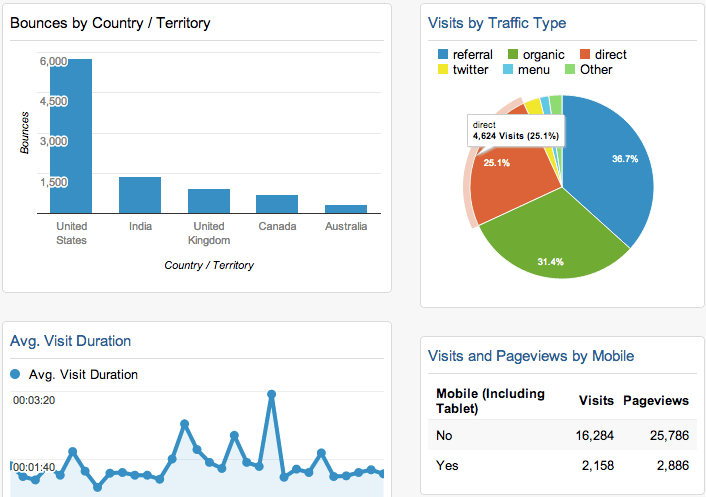
    Traditional web analytics tools, such as Google Analytics, help you gather data about your website’s performance. For example, you can see how many buyers come to your site and how long they stay. However, you can’t see what’s happening during their sessions.

    With Google Analytics, you can see the numbers. With Hotjar, you can see the reason behind those numbers.

    You can use Hotjar with Google Analytics for best results. It will help you better understand how users behave on your site and draw conclusions to make improvements.

    What is Inspectlet?

    Inspectlet dashboard

    Image source: Medium

    Inspectlet is advanced web analytics software that allows you to learn more about the user experience on your website or landing pages. It reveals the exact steps people take on your site so you can find new ways to increase your conversion rate and sales.

    Inspectlet features

    Inspectlet offers many useful features, such as:

    1. Session recording for watching videos of individual user behavior on your site
    2. Screenshots utility to capture user’s mouse movement, scroll, or click
    3. User-targeted tracking options such as visitor country
    4. Advanced filtering options to find videos of users or events you’re interested in
    5. Session and user tagging
    6. Eye-tracking, click, and scroll heatmaps
    7. A/B testing to make data-driven decisions for your company
    8. Feedback surveys to get answers from each person who uses your site
    9. Form analytics to track form metrics and improve your form’s performance
    10. Error logging to track all JavaScript errors, network requests, form issues, and other custom business logic

    It can be very helpful for businesses that want to know how their online customers feel about their website features, featured products, or services. So, if you need a better understanding of your customers’ perspectives, Inspectlet is a great place to start.

    Hotjar vs Inspectlet: Vendor Comparison

    Now that we’ve covered the basic features of these software solutions let’s see how these vendors compare in different categories.

    Hotjar vs Inspectlet: Basic differences

    Hotjar allows you to monitor your visitors in real time. Features such as heat maps, visitor recording, and website polling can help you improve your site in many ways.

    It is a good option for companies that need advanced analytics or for marketing and product teams, designers, customer support teams, UX designers, or researchers.

    Inspectlet is a great tool for freelancers, SMEs, large enterprises, non-profits, and public administrations. 

    Its well-known features, such as website recording, heatmaps, and A/B testing, enable brands to analyze user behavior, identify website errors, boost user conversions, and create better customer experiences.

    FullSession also offers features designed to optimize your website: session recordings, heatmaps, customer feedback tools and reports, funnel and conversion optimization tools, and error analysis. 

    To see how they work, book a demo today.

    Hotjar vs Inspectlet: Desktop platforms and mobile platforms

    There is a key difference between these vendors: Inspectlet offers mobile analytics, while Hotjar is limited to website and web app insights only.

    FullSession device breakdown

    FullSession, however, can record sessions on websites, landing pages, and web apps from desktop and mobile devices. For example, you can use FullSession to view session replays on cellphones, tablets, or any other mobile device to learn if your website is optimized for mobile.

    Hotjar vs Inspectlet: Languages and integration

    Currently, Inspectlet is only available in English. Hotjar supports multiple languages for features such as Surveys and Incoming Feedback, and its dashboard is only available in English.

    Hotjar offers more integrations than Inspectlet and shows you the data you need in one place. It integrates with other solutions such as Hubspot, Google Optimize, Omniconvert, Optimizely, and Zapier.

    On the other hand, if you decide to use Inspectlet, you can integrate it with Hubspot, Squarespace, Shopify, and Google Tag Manager.

    FullSession is available in English, French, and Arabic. It integrates with major third-party tools thanks to open APIs and modern webhooks, including but not limited to:

    • Shopify
    • Big Commerce
    • Wix
    • WordPress

    Hotjar vs Inspectlet: Training and support

    Both tools offer training programs and different support types.

    Hotjar’s site offers a lot of useful information, including tutorials to get started, installation guides, and frequently asked questions. It also offers helpful articles that can help you maximize the benefits of this tool. Support is available through email and tickets.

    Inspectlet has a documentation section on its website with answers to all questions you might have about its features. You can contact the support team by email or phone if you can’t find what you’re looking for.

    FullSession has a dedicated support team available via email and live chat. You can access a comprehensive knowledge base with detailed guides and tutorials and personalized onboarding assistance so you can focus on optimizing your user experiences.

    Hotjar vs Inspectlet: Pricing

    Since both tools have free plans, you can try them out to see which one you like better. However, you’ll get more features with Inspectlet’s free plan. 

    There are some limitations to keep in mind, though. Inspectlet offers limited data storage unless you upgrade to more expensive plans. On the other hand, Hotjar can get very expensive as your traffic increases.

    Hotjar pricing

    Hotjar pricing

    Hotjar has three paid plans:

    • Observe Plan: Heatmaps and recordings range from $39/month for up to 100 daily sessions to $213/month for tracking 500 to 270k daily sessions
    • Ask Plan: Surveys and feedback features range from $48/month for 250 monthly responses to $128/month for unlimited responses
    • Engage Plan: The cost of user interviews ranges from $39.2/month for three monthly interviews to $440/month for 12 interviews

    Inspectlet pricing

    Inspectlet pricing

    On the other hand, Inspectlet has five pricing plans that include different sets of features beyond their free service:

    • Micro: $39 per month for 2,500 recorded sessions per month on one website
    • Startup: $79 per month for 25,000 sessions a month on up to three websites
    • Growth: $149 per month for 50,000 sessions a month on ten websites
    • Accelerate: $299 per month for 125,000 monthly sessions on up to 20 websites
    • Enterprise: $499 per month for 250,000 sessions per month on 40 websites

    FullSession pricing

    FullSession pricing

    Unlike Hotjar and Inspectlet, FullSession provides all essential features—unlimited heatmaps, session recordings, surveys, conversion and funnel tracking, error tracking, and user feedback—into one seamless platform to simplify user experience management and conversion rate optimization.

    FullSession provides a free trial and a 20% discount on annual plans.

    The Starter Plan, at $32/month, includes all core features and supports tracking up to 5,000 monthly sessions. The Business Plan, at $60/month, encompasses all advanced features and allows tracking up to 100,000 monthly sessions, offering exceptional value for money.

    We also offer a customizable Enterprise plan tailored to your specific needs.

    Book a demo today.

    Which Vendor to Choose?

    So, which software is better? It depends on what you’re trying to achieve. Both software have pros and cons, but based on user reviews, Hotjar wins when it comes to analyzing how visitors interact with your site.

    Hotjar, with a score of 8.3 out of 10 based on TrustRadius reviews, has much to offer in customer experience analytics, feedback, and insight features. It gives you a holistic view of your user’s behavior and is more straightforward to use.

    But if you want a web analytics platform that offers all of Hotjar’s features plus more without breaking the bank, FullSession might just be the perfect tool for you. 

    Aside from standard features like session recordings, heatmaps, and customer feedback tools, FullSession takes it a step further with conversion funnel analysis, error tracking, advanced user and event segmentation, as well as the ability to capture all user behavior without slowing down your website.

    Capture All User Interactions With FullSession

    What makes FullSession the web analytics platform out of all the options out there? 

    Session recording and replay

    FullSession is a web analytics software that provides all the insights you need to make informed business decisions. Here’s what differentiates FullSession from its competitors:

    1. Broader analytics tools for visitor behavior and friction points analysis for precise user insights
    2. Comprehensive analysis of issues that may lead to funnel dropouts and affect conversion rates
    3. Faster heatmap processing without slowing down your website
    4. Advanced filtering options to better understand visitors’ digital experience
    5. Identification of major events inside a session that saves time and gives you focus
    6. No-code customer feedback tools to gather valuable insights through NPS surveys, pop-ups, and more
    7. Advanced error analysis to avoid error events that lead to certain users making U-turns on your website after only viewing one page
    8. In-depth conversion funnel analysis to further optimize every step in your funnel
    9. User privacy protection by excluding sensitive data from recordings
    10. Better cross-collaboration features to let your team work seamlessly on a single platform
    FullSession heatmap

    Hotjar is a powerful tool for gathering data and making insightful analyses, but it comes at a price. It will significantly decrease your website’s load time, making FullSession a better option. 

    You can get the data and insights you need faster because FullSession will not affect your website performance.

    Both Inspectlet and Hotjar offer visitor recording features, but Inspectlet is not always smooth, according to some user reviews. FullSession, meanwhile, is. 

    Book a demo today and try out all available features!

    Hotjar vs Inspectlet: The Verdict

    Both Hotjar and Inspectlet are solid choices for analyzing user behavior and fine-tuning your website, but each has its own set of pros and cons. 

    Hotjar is great for its wide range of analytics and user feedback tools, though it can slow your site down and get pricey as your needs grow. Inspectlet, on the other hand, shines with its session recordings and error tracking but might struggle with stability, which could affect the accuracy of your data.

    That’s where FullSession steps in. It’s like getting the best of both worlds without the drawbacks. FullSession gives you deep insights into user behavior, tracks errors effectively, and processes heatmaps quickly—all without slowing down your site. 

    Plus, it’s priced competitively, fully compliant with data privacy regulations, and designed for smooth collaboration across your team.

    If you’re looking for a tool that offers everything you need to optimize your website, FullSession is definitely worth a look. 

    Book a demo and see how it can help boost your user experience and conversion rates. 

    Want to learn more about other web analytics tools? Check out other comparison guides:

    FAQs About Hotjar vs Inspectlet

    What is the downside of Hotjar?

    One thing many users complain about is the price. Hotjar can get pretty expensive as your needs grow, and you might not get all the features you want in a single bundle. Plus, depending on your plan, it stores data for a limited time only, which may not be ideal if you need long-term analysis or historical insights.

    What is the difference between User Testing and Hotjar?

    User testing involves observing real users completing tasks to gather qualitative insights. Hotjar collects quantitative data through visual heatmaps, session recordings, and feedback polls, providing broader behavior patterns across your site. You can also check out Lucky Orange alternatives.

    Is Inspectlet legal?

    Yes, Inspectlet is legal. It collects data in compliance with privacy laws, but website owners must inform their visitors about the use of such tracking tools. Typically, this is done through a privacy policy and obtaining user consent where necessary when installing their tracking code, especially in jurisdictions with stringent data protection regulations.

    What is Inspectlet used for?

    Inspectlet tracks and analyzes user behavior on websites via user recordings, heat maps, A/B testing, and form analytics. It helps businesses understand user interactions, identify issues, and improve conversion rates and website performance.


    Get Fullsession
  • 11 Best Ways To Use UX Analytics Tool For Your Website

    11 Best Ways To Use UX Analytics Tool For Your Website

    Providing a relevant and meaningful user experience is essential for any website, but defining what makes up a good user experience can be challenging.

    Luckily, UX analytics tools can help you better understand user behavior so you can know exactly what kind of UX to offer your users. 

    We created FullSession after thorough research of other UX testing tools on the market. It helps improve the user journey and overall product performance via interactive heatmaps, session recordings, customer feedback forms, conversion funnel analysis, and error tracking.

    If you want to see how FullSession works, book a demo today.

    With this article, we will help you learn more about UX analytics and show you 11 ways you can use UX analytics tools to reach your goals. First, let’s cover the basics.

    Learn how our interactive heat maps help you find cold spots and dead zones on your site.

    What Is a UX Analytics Tool?

    FullSession dashboard

    A UX analytics tool gathers data on user activity, analyzes that data, and provides reports to help you better understand the user experience. It enables you to optimize your products according to users’ evolving needs.

    It also helps product teams identify what works and doesn’t, providing clear indicators and benchmark results. These insights can be great for determining the effectiveness of a specific design or feature modification before the final implementation.

    A UX analytics tool will help you answer essential questions about product use, such as:

    1. What are the user motivations? 
    2. Can they achieve their desired goal? 
    3. Does it relate to their values?
    4. What can your product do? 
    5. What can users do with it?
    6. How accessible or intuitive is the product? 
    7. Can you improve it in the future?
    8. What are the most significant issues users encounter, and how can you solve them?

    What Are the Most Common UX Analytics Tools?

    There are many different types of UX analytics tools available. You can choose the one that best suits your needs and goals. 

    Combining different tools is the way to go for a comprehensive analysis. Integrations can also be pretty helpful. They allow you to centralize results and conduct data analysis from various sources.

    On the other hand, some solutions, such as FullSession, provide all the necessary features you can use for the UX analysis in one place. 

    Let’s explore the most common types of UX analytics tools.

    Real-time analytics

    Real-time analytics gathers and measures real-time user data. It provides insights into how users interact with your website, such as what they click on, what holds their interest longer, what elements they ignore, etc.

    For example, a real-time analytics tool lets designers and developers react on the spot and solve problems before or as they occur or recognize opportunities for further improvements.

    User flow maps

    User flow maps depict user journeys on websites or mobile apps. They illustrate the user’s path from start to finish and help you understand the quality of their individual experiences. 

    With these maps, you will see how users navigate your website and find out if they reach their goals. An example of such a goal is making a purchase. User flow maps are essential in creating the experience you want your users to have.

    They are also valuable for creating an intuitive user interface, as well as evaluating and modifying user interface elements.

    Funnel analytics

    Funnel analytics provides the information you need to analyze your conversion rates at any given point in your sales or marketing funnel. You can determine which steps in the flow are effective and cause users to drop off to decrease your conversion rates.

    Funnel analytics

    Conversion funnel analysis is a major strength of FullSession. The FullSession funnels and conversions feature is like having a smart guide for your user journeys. It tracks every step of your conversion funnel, helping you see where users are dropping off and what’s working to drive conversions.

    Imagine you’re running an e-commerce site and notice that a lot of users are abandoning their carts right before checkout. With FullSession funnels, you can visualize each step of the funnel and see exactly where these drop-offs are happening. 

    For example, you might discover that users are spending too much time on the payment page, indicating a potential frustration point. By analyzing trends over time, you can see if this issue worsens during certain periods, like a sale. 

    The tool also lets you compare how different segments, like mobile users versus desktop users, interact with the funnel. If mobile users are dropping off more frequently, you could identify and fix mobile-specific issues. 

    FullSession helps you pinpoint these problems and optimize each step to improve conversions, ultimately leading to a smoother user experience.

    Book a demo to see how it works.

    Website usage analytics

    Web analytics collects, measures, and analyzes data from website users’ actions. It compiles data into reports that help you understand how visitors interact with your website. You can monitor web traffic or conduct more complex analyses for market research and website optimization.

    Web analytics tools, such as FullSession, provide resources for understanding user behavior and helping you make informed decisions. With web analytics, you can increase customer retention, attract new prospects, improve your sales funnel, and increase your ROI.

    Heatmap analytics

    Heatmap tools, which you can use with FullSession, show you pages with the highest user activity on your website. You see what parts of your site users are interacting with the most, usually by a heat gradient that shows click, scroll, or mouse movement activity.

    Heatmap analytics can help you conduct funnel analysis and monitor user behavior. It also provides insights on increasing user engagement. You can observe your A/B test performance, group your web traffic into segments, and evaluate your conversion paths to make necessary improvements.

    FullSession click map

    FullSession can collect quantitative data and present it into three different types of heatmaps:

    • Click maps: Show where users click on a page, highlighting the most popular areas and helping you understand what grabs their attention.
    • Scroll maps: Reveal how far users scroll down a page, indicating which content keeps their interest and where they tend to lose focus.
    • Mouse movement maps: Track the path of users’ mouse movements, giving insights into how they navigate and interact with your content and where they might be hesitating or focusing their attention.
    FullSession scroll map

    FullSession heatmaps are interactive and provide real-time insights. Real-time data allows for immediate action, and businesses can be proactive, preventing issues or seizing opportunities. On the other hand, aggregated data relies on reports, which could take longer to appear. FullSession eliminates this issue.

    Learn how our interactive heat maps help you find cold spots and dead zones on your site.

    Session recording tools

    With session recording tools, such as FullSession, you can record user sessions and play them back to observe users’ online behavior. 

    This feature enables you to log and monitor users’ actions, such as clicks, taps, or mouse movements, in real time. It gives insight into your users’ journey and helps you solve problems more quickly and effectively.

    FullSession session recording dashboard

    This qualitative analytics solution helps you understand:

    1. The user experience on different devices
    2. What parts of your site or web pages attract them the most
    3. Their mouse movement patterns
    4. Where they click the most or stop scrolling on your pages
    5. If there are page elements causing issues

    With this data, you can set up strategies that meet user needs and ultimately improve user experience.

    To watch user sessions with FullSession, click on any of the entries on the Session Playlist.

    FullSession session playlist

    The recordings will automatically play, and then you can observe your users’ activity.

    FullSession session recording

    When you replay a session, you’ll be able to see:

    • Visit source
    • Users’ locations (country and IP address)
    • Pages viewed, and URLs visited by your users
    • The average time a user spends on a page
    • The total time a user spends on pages
    • Session list
    • The session event data
    • Screen resolutions of your users’ devices

    Start a free trial to see how it works.

    Customer feedback tools

    FullSession customer feedback tool

    It is essential because it provides user feedback in real-time and helps you understand what they’re having trouble with, so you can provide solutions immediately. Also, it helps you optimize your marketing or sales efforts.

    Companies may use sentiment analysis to gain better insights into their customers’ opinions and feedback, based on data from reviews, social media, or surveys. With this data, they can identify trends, improve customer experience, and create better sales strategies over time, based on their sentiment.

    FullSession lets you customize your own feedback widgets to collect valuable user insights.

    FullSession create feedback

    You can also replay user sessions and view customer feedback attached to each session.

    Session recording for customer feedback

    Seven steps in gathering customer feedback with FullSession

    Find the ‘New Feedback’ widget at the top-right corner of the page.

    incoming feedback

    Add a name and description to the form. It makes it easier to find your form later.

    name adding step

    Next, choose how you want the form to look. You can adjust the language, reactions, colors, and form position. You can also preview the form before publishing.

    If you’re not satisfied with the form design, there is a reset button you can use to start redesigning your form.

    appearance step

    Now, set up the feedback form’s flow. You can ask how the user feels or request contact details. It’s all up to you.

    feedback steps

    Target the form’s audience by their devices. The FullSession tracking code lets you choose to collect feedback from all pages or a single one.

    feedback targeting

    FullSession also lets you select a trigger type for all user feedback widgets. You can choose when the widget will appear (e.g., after rage clicks, after the page loads), who it will appear to (all visitors or some specific segments only), and how persistent it will be.

    Triggers

    You can choose how you would like to receive the feedback. Choose your email inbox, but remember that you can only receive a certain number of responses daily.

    forward feedback

    After reviewing all your steps, you can activate the feedback form and start receiving customer feedback if you are satisfied.

    review feedback

    Error tracking and analysis

    FullSession can reduce your bounce rate via error tracking and analysis. This feature helps you detect, analyze, and fix issues that affect user experience. It covers error clicks, network errors, console errors, error logs, and uncaught exceptions on web and mobile apps.

    Error clicks highlight problematic elements in your application, while network errors reveal issues with server requests that disrupt user activities. Console errors point to underlying JavaScript issues, and error logs offer comprehensive details for effective debugging.

    Error tracking

    Uncaught exceptions are critical errors that need prompt handling to prevent crashes. The feature also includes trend analysis, segmentation, and session replay integration for deeper insights, along with real-time Slack alerts for immediate error resolution.

    Book a demo to see how it works.

    Using FullSession as a UX Analytics Tool

    FullSession is a web analytics software designed to assist you in monitoring, measuring, and analyzing the effectiveness of your website or landing pages.

    FullSession includes session recordings and replays, interactive heatmaps, customer feedback forms, error analysis, and conversion funnel analysis, which help you make better decisions by understanding behavior data and user insights.

    With FullSession, you can track engagement data and compare it across channels, devices, and periods to identify what type of content or website elements perform best or need further improvement. 

    FullSession homepage

    Plus, FullSession can help you:

    • Monitor dynamic elements in real time to gain accurate user insights
    • Speed up heatmap processing without affecting site performance
    • Safeguard user privacy by omitting the recording of sensitive data
    • Efficiently handle large data sets and swiftly uncover crucial insights
    • Restrict tracking of user behavior to your site, ensuring data is not misused
    • Enhance cross-team collaboration by centralizing efforts on a single platform

    Start a free trial now.

    Install FullSession on your website to monitor user behavior

    On the FullSession site, take a look at the right side of the primary menu. Log in or book a demo.

    fullsession menu

    To start with FullSession implementation, go to Settings, and select FullSession Setup, as seen below.

    fullsession setup

    On your setup page, you will see a FullSession code you can copy to add to your website. On each website page, you want FullSession to track, paste the code below the < head >. 

    That’s it. You can start capturing user behavior in minutes.

    Why Should You Choose FullSession?

    FullSession is your best solution for boosting conversions, increasing site value, and improving user experience and satisfaction. Easy to install and use, FullSession should be your top choice because:

    • FullSession comprehensively analyzes website visitor behavior and friction points through broader analytics tools.
    • FullSession insights let you know what issues might lead to funnel dropouts and affect conversion rates.
    • FullSession has advanced filtering options to understand visitor experience better and identify sessions that seem unusual.
    • FullSession lets you segment users based on specific criteria, such as demographics, location, behavior, and more, for a more in-depth analysis of user behavior insights.
    • FullSession helps identify significant events inside a session to save time and focus on the most critical issues. 
    • FulllSession helps you pinpoint usability issues that can turn away potential conversions via user recordings and heatmaps.
    • FullSession lets you monitor and analyze UX metrics, such as the number of users who return to your website, the number who leave after viewing only one page, the number who click on your CTA, etc.
    • FullSession is more affordable than other traditional analytics tools. 

    Book a demo to learn more.

    What Are the Benefits of Using a UX Analytics Tool?

    UX analytics is essential to any business because it provides quantitative and qualitative data on the overall user experience on your website, web app, landing page, or mobile app.

    Failure to recognize users’ changing needs and adapt to those needs will lead to poorly designed products and reduced user satisfaction. 

    Here are some other advantages of using UX analytics tools.

    UX analytics provides you with facts

    You can’t argue with data obtained from the UX analytics tool. There is very little room for errors or misinterpretations. UX analytics gathers quantitative data based on statistics and presents accurate information on user interactions.

    Analytics is the measurement of performance. For example, it’s easy to calculate differences and measure effectiveness if you implement a solution. Thus, the value of your work becomes more apparent. 

    Analytics generates faster results

    With various tools available to analyze data, questions about improving user experience are answered almost immediately. You can get real-time information when needed, from conversion rates to customer feedback. 

    Compared to other methods, UX analytics is a great way to discover what your visitors think without lengthy processes. With a few clicks in your UX analytics tool, you can get data and use it to improve your design, content, or layout so users don’t drop off your funnel

    It gives a unique insight into website performance

    With analytics, you can analyze user behavior to understand how well your website is performing. It includes your website usage, what aspects don’t provide results, where you need to make improvements, etc. 

    UX analytics gives you access to more website data than any other analysis method to ensure your website is at optimal performance.

    Analytics supports integration with other solutions

    When choosing a UX analytics tool, one factor you should always consider is integration. This aspect covers how well you can combine UX analytics tools with other solutions or if they are stand-alone tools.

    Thanks to these integrations, you can utilize gathered data at any step of the UX design process and use it for multiple use cases. For example, FullSession integrates with major platforms like Wix, Bigcommerce, and WordPress so it can fit into your existing tech stack seamlessly.

    UX analytics data is easily presentable

    Data can often be challenging to explain to laypersons. However, with UX analytics, presenting data on UX-related processes doesn’t require your audience to have expert knowledge. Instead, anyone can easily understand generated reports.

    This ease of presentation comes in handy when defending your work to higher-ups. UX tools provide visual reports that are easy to comprehend. UX researchers and designers can comfortably show the effect of implemented changes to a feature without worrying about any technical jargon. 

    After discussing how beneficial UX analytics can be, let’s cover how to use UX tools. 

    Learn how our interactive heat maps help you find cold spots and dead zones on your site.

    How to Use a UX Analytics Tool to Optimize Your Website

    We’ve covered the basics of UX analytics, so we can discuss the implementation further. To create a compelling user experience with the help of a UX analytics tool, it needs to have certain features–most of which we’ve already covered:

    • Heatmaps use data visualization to show user activity and engagement on your web pages. Recorded data typically includes clicks, scrolling, taps, and insights showing what users most enjoy on your site.
    • Session recordings and replays record user behavior on your website, letting you replay and observe their activity. By understanding what users spend time on, you can improve your site pages for better engagement.
    • Funnel analysis provides data on the areas of your site where users drop off the funnel, allowing you to identify patterns and improve the stages in your funnel with a lower conversion rate.
    • Polls and surveys collect user feedback based on questions you ask in polls and surveys. This information pinpoints what’s wrong with your website and what works well.
    • Detailed insights on user behavior show data on user engagement with your website and their individual preferences. You can use it to map out customer patterns and user segmentation.

    Now that you know everything about UX analytics tools, let’s explore the 11 best ways you can use them to optimize your website performance and increase user satisfaction.

    1. Collect data

    Your first step is to know your audience, and the best way to do this is by collecting data. The data collected with UX tools can help identify problems with usability and functionality, creating space for improvements.

    UX tools can be quantitative or qualitative. Qualitative tools provide opinion-based information that can be gathered in a survey or poll, while quantitative analytics tools provide fact-based, numerical data. For purposes involving user behavior, combining both is most effective.

    2. Get the big picture

    This follow-up step involves grasping the main idea behind the website and assessing your current results. You need to answer the questions of why you created it, who it is for, and how it will meet users’ needs.

    A UX analytics tool helps you get a bird’s eye view of your website performance and see the big picture for further improvements. 

    To assess your results, ask the following questions:

    • What steps have been taken before?
    • What is the team trying to achieve?
    • Which information do we need to collect?
    • What is the timeframe for accomplishing all goals?

    FullSession helps you find and fix problems on your site by collecting data on user and event properties. To review this data, click on the Insights tab in the menu.

    Insight data

    Now you’ll see a new panel with three sections on your dashboard. You can select a specific time range to get insights for up to one year.

    You get to see data on:

    User engagement

    • Median scroll depth by device
    • Page load speed by browser
    • Session playlist
    • Top users
    • User trends
    • Breakdowns (based on device, browser, and screen)

    User experience

    • Event per session
    • Session length
    • Active time
    • Feedback data
    • Top pages
    • Clicks analytics
    • Error analytics
    • Slowest pages (pages, landing pages, and exit pages)

    Marketing channels

    • UTM analytics
    • Top referrers

    You can use data to build a website tailored to your customers’ needs and create the best experiences. Historical data can also help feed predictive analytics, allowing you to make data-driven decisions based on future user behavior.

    3. Track website traffic

    Monitor website traffic to measure user experience. Web traffic tracking is essential because it reports your site’s overall performance.

    You can find out which parts of your website resonate with users the most and which ones repel them. You can also make modifications as necessary to achieve your goals.  

    4. Identify user groups

    FullSession filters

    The next important step is to segment users into specific groups based on demographic data, psychographic data, and other parameters. User groups help define your target audience. If you know who uses your product, you can create a user experience that satisfies their needs.

    With FullSession, you can segment user groups by different characteristics, such as the devices or browsers they use, location, language, and so on.

    5. Track your audience’s behavior 

    The next phase in this process is monitoring user behavior. You can identify what will most likely attract and appeal to them and what they will ignore completely. This is an effective way to boost conversion rates.

    For example, with insight into how users move through conversion funnels to reach checkout or form submission, you can figure out what puts them off or causes them to drop off the process. 

    Analyzing user behavior in relation to the user experience is the best way to see if your conversion funnel is working as well as it should. 

    funnels and conversions

    With FullSession funnels and conversions, you can:

    • Explore funnel steps: View how users progress from initial interaction to final conversion, including conversion rates and drop-off rates for each step. This helps identify where users drop off and which steps need optimization.
    • Analyze funnel trends: Monitor changes in user flows and conversion rates over time to spot trends and seasonal variations. Assess long-term performance and adjust your strategies based on these insights.
    • Review events correlations: Identify actions and events that increase conversion rates to highlight successful user behaviors and features. Use these event-tracking insights to replicate successful patterns and improve user journeys.
    • Detect top issues: Pinpoint actions or obstacles that hinder conversions, which helps address issues causing user drop-offs. Implement improvements to reduce friction and improve the user experience.
    • Conduct effort analysis: Measure the time users spend interacting between funnel steps to understand user effort and potential user frustration signals. Analyze the most engaging steps or features to highlight parts of the funnel that capture user interest. Promote and enhance these features to maximize customer retention and conversions.
    • Perform segmentation and comparison: Compare funnel performance across different user segments (e.g., device type, location) to understand interactions of various user groups. Tailor experiences and address segment-specific issues.
    • Do time period comparison: Analyze performance over different time periods to monitor changes in behavior and conversion rates. Based on these insights, adjust marketing strategies and product features.

    6. Optimize your calls-to-action

    The call-to-action button is your golden ticket to driving conversions, but only if it is well-designed. As the name implies, it encourages users to take action on your site, whether making a purchase or subscribing to an offer.

    The UX analytics tool can help identify two issues—why visitors can’t find what they’re looking for and why they leave the landing page without converting. In most cases, you will see that the reason behind a high bounce rate is poor CTA placement.

    7. Improve design, layout, or content

    Data will help you understand the user’s needs, behavior, and content requirements. Make sure your design is intuitive and that the layout allows easy navigation.

    Additionally, invest in your content design so it resonates with your target audience. The more conversational—the better!  

    8. Measure user engagement

    This step entails measuring the overall user activity on your website. Key metrics on user engagement to look out for include: 

    • Clicks
    • Taps
    • Scrolls
    • Screen views
    • Pageviews
    • Video views
    • Time spent on the website
    • Comments and shares on blog posts
    • Sign-ups
    • Form submissions

    9. Increase conversion rates

    You can improve your website’s conversion rates by improving its speed, eliminating friction points, and designing actionable CTAs.

    Alternatively, you can use conversion rate optimization tools to analyze details and make faster improvements. Another important step is to conduct user testing to ensure that your website is user-friendly and conducive to successful conversions.

    10. Reduce bounce rates

    UX analytics tools will provide data on your site performance. Using this information, you can take measures to reduce the number of people who leave your website without completing their user journeys. These measures include:

    • Monitoring your conversion rates
    • Constantly improving UI design to meet user needs and requirements
    • Optimizing site speed and CTAs

    11. Increase time spent on site

    Still drawing on reducing bounce rates, it would be vital if you could keep users on your website longer by eliminating negative experiences, such as slow load times, broken links, unresponsive layouts, and non-clickable items.

    Some of the practical techniques are a clean design, an interactive experience using videos and photos, high readability, and internal linking.

    How FullSession Compares to Other UX Analytics Tools

    How does FullSession fare against competitors? Here is a quick overview.

    Key FeaturesIntegrationsSupportFreeTrialPricing
    FullSessionSession recording and replay, interactive heatmaps, customer feedback tools, funnel analysis, error trackingShopify, Big Commerce, Wix, WordPress, Open APIs and modern webhooksEmail, knowledge base, live chat, user guides, documentationYesStarts at $39/month, provides 20% discount on annual plans 
    HotjarHeatmaps, session recordings, surveys and feedback pollsSlack, Segment, Hubspot, Google Optimize, Omniconvert, Optimizely, and ZapierUser guides, documentation, knowledge base, submit a complaint ticketYesStarts at $39/month
    Lucky OrangeLive chat and session recording, heatmaps, funnelsGoogle Analytics, Adobe DTM, and Hubspot CRMEmail, live chat, phone support, help centerYesStarts at$39/month
    MixpanelEvent tracking, cohort analysis, A/B testingGoogle Analytics, Zoho, Meya, FullStory, and many othersSubmit a request, help center, documentationYesStarts at$28/month
    FullStorySession replay, heatmaps, error monitoringMore than 50 integration optionsKnowledge base or emailYesN/A
    LogRocketSession replay, performance monitoring, error trackingZendesk, Jira, Intercom, Datadog, Pendo, Sentry, and StockpileDocumentation, email, or live chatYesStarts at$99/month

    We’ve also reviewed and compared some of these tools: Lucky Orange vs Hotjar, Mouseflow vs VWO, LogRocket vs FullStory, Smartlook vs Hotjar, Hotjar vs FullStory and more.

    The Best UX Analytics Tool: Final Words

    Improving your website performance has numerous benefits, such as generating more revenue for your business through higher conversion rates. You can also make your user experience more enjoyable. The most guaranteed way to achieve this is to use a UX analytics tool to see how users behave. 

    If you want a one-stop-shop platform, FullSession is the right UX analytics tool for you. With heatmaps, detailed reports, session recordings, error analysis, funnels and conversions, and customer feedback tools, you can optimize your website to improve customer satisfaction and create a website aligned with their needs.

    FullSession offers a 14-day free trial for its paid plans, so you can try all user experience analytics tools before committing.

    Book a demo today to learn more!

    FullSession Pricing Plans

    FullSession offers three premium packages. The annual plan can save you up to 20%.

    FullSession pricing
    1. The Starter plan costs $39/month or $32/year and lets you track up to 5,000 monthly sessions. 
    2. The Business plan starts at $75/month or $60/year and lets you track up to 100,000 monthly sessions.
    3. The Enterprise plan gives you full access to all features. You can book a demo for more details. 

    We also provide a customized pricing package if your business has specific website analytics needs. Check out our Pricing page.

    Let’s take a look at some FAQs for UX analytics tools.

    FAQs About UX Analytics

    What is UX analytics?

    UX analytics is all about understanding how users interact with your product. It tracks their behaviors and preferences to help you improve the overall user experience. Key features of UX analytics tools include session replays, heatmaps, usability testing, A/B testing, and customer feedback tools that collect qualitative and quantitative insights.

    What is the most used UX tool?

    The most comprehensive user behavior analytics tool is FullSession, and it’s affordable, too! It provides valuable insights into user behavior and helps you measure the effectiveness of your designs.

    What is the best tool for analytics?

    There isn’t a one-size-fits-all answer, but tools like FullSession, Hotjar, Pendo, LogRocket and Adobe Analytics are top choices for comprehensive analytics and user behavior tracking. You can also try Google Analytics, a popular UX analytics tool that lets you analyze user paths for free, or Mouseflow if you need form analytics and user interviews.

    Do UX designers use data analytics?

    Yup. UX designers use data analytics and conduct usability tests to inform their design decisions, understand user needs, and create better experiences based on real user data.

    Do UX tools work for mobile?

    The best UX analytics tools, like FullSession, measure customer behavior on both websites and mobile applications. Since 45% of North American web traffic comes from mobile devices, optimizing for mobile should be a priority.


  • How to Read a Heatmap and What You Can Learn From It

    How to Read a Heatmap and What You Can Learn From It

    It takes 0.05 seconds for a user to form an opinion about a web page. So, how do you make sure your visitors get the best user journey possible?

    You must stay ahead of your competitors and use all available tools to learn more about your customers and how they interact with your website. And there’s no better way to analyze their behavior than using interactive heatmaps.

    Heatmaps can help you understand how well your website navigation works. They can tell you how easily visitors find the information they want on your website and what content you can improve on your site. That’s why you need heatmap software.

    FullSession is an advanced user behavior analytics software that provides comprehensive behavior analytics tools, such as heatmaps, session replays, incoming feedback, conversion funnel analysis, and error analysis to capture user activity and obtain data to improve your website and online campaigns. 

    Book a demo today to learn more!

    In this article, we’ll go over what website heatmap tools are and how to use them on your website. We’ll also cover when you should use a heatmap and its benefits. You’ll learn what data it collects and how to interpret it. 

    Let’s start with the basics.

    What Is a Website Heatmap?

    A heatmap is a user behavior tool that shows how users interact with your web pages. It can provide valuable insights into user engagement, user experience, and the effectiveness of your user interface.

    Imagine working on an e-commerce website and wanting to know which sections of the site visitors spend the most time on. This is where a heatmap can help. 

    If you’re looking to improve your conversion rates, keep reading our tips on analyzing these charts and what information they can reveal about your site.

    When Should You Use a Heatmap?

    Customer experience teams usually use heat maps when they notice the poor performance of certain elements and campaigns or want to test new features. However, you don’t necessarily have to use them exclusively for these types of activities.

    Some other use cases include:

    • Diagnosing which elements and sections perform best
    • Checking which features and sections have average performance and need improvement
    • Deciding the best page length
    • Learning behavior patterns
    • Identifying the points where users exit the page or drop off the funnel
    • Identifying broken links, false bottoms, and non-clickable elements that lead to dead clicks

    Where Should You Use a Heatmap?

    Heat mapping your whole website seems ideal, but it’s not practical. Instead, we recommend analyzing pages that have the most impact on your conversion rates.

    Home pages

    Your homepage is your introduction to your brand. If you monitor where visitors are scrolling through and whether they’re hovering over key information and clicking on links, then you’ll know exactly where to place the most important elements. It will reduce your bounce rate and increase your conversion rate.

    Landing pages

    It’s also important to implement heat maps on landing pages and consider user behavior for the best conversion rate. Heat maps show you where your visitors are looking on your website to help you design the best landing page and acquire more leads ready to convert.

    The whole purpose of landing pages is direct conversions, so if you notice that conversions have been low recently, a graphical representation of where users click and scroll can help you diagnose any issues.

    High-traffic blog posts

    The copy placement on your blog can heavily influence its conversion rate. You can use heatmap data to test where to place your CTAs on your blog post.

    For example, you can place the same CTA in the middle of the post and after the conclusion. Heatmaps will show you which CTAs users interacted with the most. Then, you can apply that knowledge to other blog posts to maximize conversions.

    Importance of desktop and mobile heatmaps

    It’s important to use heatmaps on different devices to identify potential issues. Your audience is segmented into mobile and desktop users.

    To deliver the best results for your visitors, analyze both desktop and mobile versions of your websites carefully. This will improve conversions and ensure a positive experience for your customers on desktop and mobile devices.

    You can also use heatmaps to picture the importance of different features, where every column represents a feature, and the corresponding color signifies their level of importance.

    How Does a Heatmap Work?

    Heatmap tool track user interactions on a webpage. This can include user clicks, mouse movements, scrolling, and other forms of engagement. Then, a small JavaScript snippet is embedded in the web page’s code, which collects interaction data and sends it to the heatmap tool’s servers.

    Once it collects the information, heatmaps visualize individual values in grid cells. Generally, areas with higher interaction or larger values are shown in warmer colors (reds and oranges), while areas with less interaction or smaller values are shown in cooler colors (blues and greens).

    Cell value annotations display the numeric values directly on the heatmap, which helps provide a clear view of interaction density. 

    The average cell value provides insight into the typical number of clicks per area, while cell value annotations display these numbers directly on the heatmap.

    How Do I Create a Website Heatmap?

    Creating a website heatmap is very easy and only takes a couple of minutes if you’re using advanced website heatmap tools like FullSession.

    Book a demo today to see how easy it is.

    What sets FullSession apart from competitors is our heatmap feature, delivering real-time insights, without any waiting time for data processing.

    Even though heat maps are notorious for slowing down websites, FullSession’s interactive heat maps won’t impact your site performance. We also offer additional analysis tools you can combine with heat maps to look for various user behavior patterns and discover what users love and hate about your site:

    5 Different Types of Heatmaps

    There are many different types of heat maps, each analyzing a specific type of behavior. Let’s explore the five most common heat map types.

    1. Scroll maps

    FullSession offers scroll maps that show your website visitors’ scrolling activity.

    Scroll maps allow you to see exactly how your audience interacts with your site, helping you identify content gaps and optimize your website for greater success. The y-axis represents the scroll depth, while the x-axis might represent time or the percentage of users reaching a certain scroll depth.

    Dynamic scroll heatmaps also let you know which parts of the site your visitors are interested in. Scroll maps help you position the most important sections of your website in highly visible areas, ensuring customers engage with critical information on key pages, such as product pages.

    With a scroll heatmap, you can learn about your website’s heat zone from top to bottom. The hottest colors on the scroll map indicate which sections are most viewed. The scroll map consists of three main components: peaks, troughs, and layout grid.

    Peaks indicate where users stop scrolling. Troughs show where users stop due to poor user experience, such as excessive ads or navigational problems. A layout grid divides the page into columns to measure the scrolling activity within each column.

    2. Click maps

    With FullSession, you can also use click heatmaps to visualize your visitors’ clicking patterns. The vertical axis displays the horizontal position of clicks, while the horizontal axis shows the vertical position.

    The color intensity on the heatmap changes according to the frequency of clicks at specific coordinates. Each click is recorded as a data point with a numeric value that represents the number of clicks at a particular spot on the webpage.

    With a click sensor, heatmaps can detect where and how many times visitors click on the website. Click heatmaps reveal valuable information to website owners through data visualization.

    FullSession also lets you get deeper user insights on each click heatmap, such as error clicks, rage clicks, average time on page, and more.

    Click tracking allows you to analyze visitor behavior during a website visit to optimize the user experience. This simple tool helps you increase conversion rates, decrease bounce rates, and improve landing pages and content design.

    This type of data analysis ensures that visitors engage positively with your blog, website, app, or landing page. One of the best ways is to check for clicks and scrolls before bouncing. If you see a few clicks and scrolls, your visitor might have found an issue with the colors, layout, headline, images, or some other element of your content.

    3. Eye-tracking heat maps

    Image source: 90 Percent On Everything

    Eye-tracking heatmaps allow designers to identify which page elements visitors find most and least engaging. 

    They also help pinpoint redundant or confusing elements by showing where users focus their attention. You can use this data to optimize content and determine the most effective page layout. 

    Eye-tracking heatmaps significantly reduce the user’s cognitive load, enabling you to identify areas of your website that may need further review or redesign, with results visually represented in a heatmap color code.

    4. Mouse-tracking heat maps

    FullSession provides mouse heatmaps, a form of data visualization that captures where your visitors are clicking, scrolling, and hovering the most.

    Analyzing mouse heatmaps can help you pinpoint areas where visitors experience high levels of frustration or struggle, identify unique behavior patterns, and determine opportunities for web optimization.

    Mouse heatmap navigation enables designers and marketers to understand the preferred reading regions of your website visitors, highlighting areas where users either avoid clicking or spend the most time exploring content.

    Your team can assess which web pages perform well and decide which ones need optimization.

    A categorical axis variable, made up of discrete categories or labels, is used instead of continuous numerical values. Each category represents a distinct group or type, such as different products, user segments, or webpage elements. When tracking movement within various sections of a webpage (e.g., header, footer, sidebar), these sections can be categorized along the axes for more precise analysis.

    5. Correlation heatmap

    A correlation heatmap is a visual representation that shows the correlation between two variables in a dataset. It uses colors to indicate the strength and direction of the relationships between multiple variables, making it easier to identify patterns and relationships at a glance. 

    Typically, lighter colors indicate a positive correlation, while darker colors signify a negative correlation.

    Correlation heatmaps are created by collecting data for the axis variables you wish to analyze, including any measurable data, such as sales figures, temperatures, and user interactions.

    The Benefits of Heatmaps 

    Heatmaps measure user attention and help you design content that resonates with your audience. Using heatmap software, you can evaluate site layout, conduct A/B tests, optimize call-to-action placement, and more.

    Here are some additional benefits of website heatmaps.

    They help you determine key performance indicators

    Source: Freepik

    One of the best tools for understanding how users behave on your website is heat mapping, which can highlight significant issues with your site at a glance.

    It helps you identify which metrics are the most important for your website’s success:

    • Geo heatmaps will show you the different locations to focus your marketing efforts on
    • Attention heatmaps will show you where on your website to place the most important messages and CTAs
    • Movement heatmaps will show you which areas are overlooked
    • Scroll maps help you determine which elements you should put above the average fold

    They use visualization to help you interpret data

    A heatmap can be worth a thousand words. When observing visitors through heatmaps, you’ll see how people interact with different sections of your site.

    Using website heat mapping, you can analyze where people are clicking and understand why some actions increase bounce rate.

    Also, it’s much easier to visualize data than looking at numbers and tables. A simple, colorful layout will give you all the necessary information with a single glance—red means that customers look and interact with something more frequently, while yellow shows average interaction. At the same time, green represents the areas that they don’t interact with enough.

    They help you learn from users’ experience

    Image source: AovUp

    Heat maps help you understand how users engage with your site—what your audience does and how they react to your design.

    While surveys are another way for customers to learn more about their experience, they are usually time-consuming, so customers often skip them. Heatmaps don’t require any additional effort from your customers, yet they can show you precisely what they’re interested in.

    Site visitors can reveal a lot about what they respond to on your website. Use A/B testing with heatmaps to change the design before going live on any platform with a larger audience.

    They are great when combined with other analytics tools

    But what other tools should you use with website heat mapping? Heatmaps are a great analytics tool that could help you uncover the best designs for your website and better understand how people use your product, but their effectiveness is enhanced when combined with other software.

    Sessions replay provides you with a reel of what your users are doing on-site, which you can replay to see the big picture. Filters allow you to zero in on specific user types, like high-paying customers.

    FullSession session replay tool does just that—it records users’ activities and allows you to filter and segment them by key events. 

    Start a free trial to see how it works.

    They can point to some issues you overlooked in the past

    With website heat mapping, you can identify where people are clicking and what they are viewing, so you may make necessary changes to your webpage.

    UX design requires time and money to review. It’s much easier to retain customers by fixing any issues they might be dealing with on your website than to acquire new customers.

    Heatmaps provide an opportunity to uncover website content and design issues by mapping the user experience. For example, you might notice that a group of customers exits the website when they reach a certain point. It can help you diagnose whether it’s a broken button, misplaced CTA, or something else that’s causing the issue.

    They help you understand your customers’ behavior better

    Tools like heat mapping can help you identify pain points so that developers can optimize page designs better. These tools automatically track data points within a website, which gives you an idea of what interests new viewers and what deters them.

    Listening to specific feedback can help you tailor a better experience for users. Web heat mapping, for instance, shows how audiences react to a message.

    Take note of where you placed the message. Open your heat map, and you’ll get a clearer picture. Users aren’t showing enough interest if the message is painted with a cool color. If it’s warm and solid, they are interested in the message.

    They help increase conversions and profit

    Web heat maps help companies sell more products. They also allow website or product managers to make better decisions based on the information provided. It can lead to increased customer satisfaction, which helps your conversions.

    You don’t have to guess how visitors interact with your content with website heatmaps. Using accurate data and metrics, you can optimize conversion rates accordingly.

    Best Practices for Using a Heatmap

    Here’s a quick checklist of tips, tricks, and advice on how to use heatmaps to improve your business:

    1. Don’t use heatmaps for all pages on your website simultaneously
    2. Segment your website into smaller categories when using heatmap for testing
    3. Filter heatmap data by page type, performance, device type, and channel
    4. Combine heatmaps with other tools like session recordings, customer feedback, funnels and conversions, VoC data, and web analytics
    5. Use heatmaps to discover which content performs best and why and which doesn’t
    6. Use heatmaps to reduce the bounce rate by pinpointing the areas on your website where users usually exit the page
    7. Use tagging and data overlays to keep track of how recent changes on your website are performing
    8. Experiment and look for new ways to interpret heatmaps

    Create Insightful Heatmaps With FullSession

    Heatmaps are a great way to understand your customers’ needs and, ultimately, attract more visitors to your site. The way they interact with different elements and pages will give you a unique insight into what you need to improve and what’s already working.

    The FullSession customer experience suite allows you to track important user behavior metrics and gives you actionable advice on how to improve them. You can also watch users’ actions and replay sessions to diagnose why they didn’t buy your product or service.

    Plus, the interactive heat map feature provides a visual representation of which elements get the most attention.

    Book a demo today to discover how FullSession can help you provide your customers with an unforgettable experience.

    You can also find our reviews and comparisons of Mouseflow vs VWO, Lucky Orange vs Hotjar, Hotjar vs Microsoft Clarity, and more. 

    FullSession Pricing Plans

    Fullsession Pricing

    The FullSession platform offers a 14-day free trial and three paid plans: Starter, Business, and Enterprise. A yearly subscription can save you up to 20%!

    Here are more details on each plan.

    • The Free plan is available at $0/month and lets you track up to 500 sessions per month with 30 days of data retention, making it ideal for testing core features like session replay, heatmaps, and frustration signals.
    • The Growth Plan starts from $23/month (billed annually, $276/year) for 5,000 sessions/month – with flexible tiers up to 50,000 sessions/month. Includes 4 months of data retention plus advanced features like funnels & conversion analysis, feedback widgets, and AI-assisted segment creation.
    • The Pro Plan starts from $279/month (billed annually, $3,350/year) for 100,000 sessions/month – with flexible tiers up to 750,000 sessions/month. It includes everything in the Growth plan, plus unlimited seats and 8-month data retention for larger teams that need deeper historical insights.
    • The Enterprise plan starts from $1,274/month when billed annually ($15,288/year) and is designed for large-scale needs with 500,000+ sessions per month, 15 months of data retention, priority support, uptime SLA, security reviews, and fully customized pricing and terms.

    Book a demo today.

    FAQ About How to Read a Heatmap

    What is a heatmap?

    A heatmap is a data representation that uses color to represent the intensity of values in a dataset. The term heatmap describes graphical representations where data points are shown with colors indicating higher (warm colors like red and orange) or lower (cool colors like blue and green) values.

    What web analytics tools have heatmaps?

    Tools like FullSession, Smartlook, Mouseflow, Hotjar alternatives, and Google Analytics offer heatmaps along with other web analytics tools.

    How do you interpret heatmap data?

    To interpret a heat map, start by identifying what the x-axis and y-axis represent, which are typically the variables or categories being compared. Understand the color scale: warm colors like red and orange often indicate higher values, while cool colors like blue and green signify lower values. Each cell’s color represents a specific value, and some heatmaps include numeric annotations for exact values. Look for patterns, such as clusters of similar colors, to identify trends, anomalies, or areas of interest.

    How do you read a heat graph?

    Reading a heat graph involves identifying the axes, checking the color legend, examining individual cells, and looking for overall patterns. The x-axis might show time intervals, while the y-axis shows different metrics. Understand what the colors represent, and look for gradients, clusters, or outliers to gain insights into the data distribution.

    How do you read a heatmap correlation?

    Reading a heatmap correlation involves understanding that it visualizes a correlation matrix where each cell represents the correlation between two variables. The axes list the variables being compared. Colors close to 1 (dark red) indicate strong positive correlations, colors close to -1 (dark blue) indicate strong negative correlations, and colors near 0 indicate no correlation. Look at cell value annotations for exact correlation coefficients and identify significant correlations or patterns.

    How do you evaluate a heatmap?

    Evaluating a heatmap involves ensuring it accurately represents the data with clear colors and accurate annotations. Check if every single variable is relevant and provide insights. The color scale should be appropriate and intuitive. Look for clear patterns or insights that align with the data’s purpose. Consider the context of the data and assess whether the insights are actionable and can inform decisions or further analysis.


  • Top 9 User Behavior Tools in 2025

    Top 9 User Behavior Tools in 2025

    You’ve probably heard of user behavior tools before. You can use them to monitor user behavior, measure user engagement on websites and mobile apps, track user activity, monitor user flows, heat maps, scroll maps, and clickstreams on your web pages.

    These tools provide many benefits, such as improved conversion rates, increased sales, improved customer experience, reduced operational costs, and more. However, they also have drawbacks, such as user privacy concerns.

    There are many user behavior analytics tools on the market today. Some are free or low-cost, while others can be quite expensive.

    This blog post lists the top 9 user behavior analytics tools for 2024 to help you decide which are best for your business.

    You can start with FullSession, our user behavior analytics software. FullSession comes packed with features that can provide valuable insights into how users interact with your website, including session recordings, heatmaps, customer feedback tools, funnel and conversion optimization tools, and error analysis.

    Start a Free Trial to Experience FullSession

    Capture all user interactions, spot trends and patterns and drive improvements without compromising your website performance.

    9 Best User Behavior Tools in 2024

    User behavior analytics tools use many techniques, from session recordings, simple surveys, and log file analysis to sophisticated A/B testing and eye-tracking experiments. They generally fall into three categories: user experience measurement, user experience engineering, and user experience optimization.

    The user behavior analytics software market is growing fast, and there are many different traditional analytics tools to help you understand user behavior on your website. Therefore, it can be hard to decide which website analytics tool is right for your company.

    In the following section, we will review the top nine user behavioral analytics tools, discuss why you should use them, and discuss their benefits for your business.

    1. FullSession

    FullSession is user behavior analytics software that records and replays all user sessions and interactions with your site. It helps you understand how your visitors behave, navigate around the site, and experience your site’s content.

    FullSession runs in the background of your site without affecting its performance and automatically records all your visitors’ actions: what they did, where they clicked, what they typed, how long it took them to complete the desired action, and their mouse movements. It doesn’t record sensitive data, so you don’t have to worry about privacy complications.

    You can use data gathered from FullSession to adjust your site to your visitors’ needs, optimize your site performance, inform your product roadmap, improve your marketing campaigns, and so much more. 

    Best of all, you can rest assured that these are data-driven decisions based on current and future user behavior.

    Start a free trial now.

    Who is FullSession for

    FullSession is a good option for product teams, UX teams, marketing teams, sales teams, and data analysts. It is popular in the eCommerce industry.

    FullSession features overview

    Here is the list of FullSession key features that can help you achieve your business goals:

    FullSession integrations

    Currently, you can integrate FullSession with third-party tools such as Zapier, Shopify, Big Commerce, Wix, and WordPress. It also works with Open APIs and modern webhooks.

    FullSession support

    If you have any issues with FullSession, you can send an email, visit the knowledge base, or start a live chat with a customer service rep. You can also find useful guides and documentation on the website.

    Don’t worry about the learning curve when you sign up. FullSession offers in-depth user onboarding so you know exactly what to do.

    FullSession pricing

    Fullsession Pricing

    If you think FullSession is a good solution for your business, you can start a free trial to test all features. When it expires, choose one of three paid plans and get a 20% discount with an annual subscription:

    1. The Free plan is available at $0/month and lets you track up to 500 sessions per month with 30 days of data retention, making it ideal for testing core features like session replay, website heatmaps, and frustration signals.
    2. The Growth Plan starts from $23/month (billed annually, $276/year) for 5,000 sessions/month – with flexible tiers up to 50,000 sessions/month. Includes 4 months of data retention plus advanced features like funnels & conversion analysis, feedback widgets, and AI-assisted segment creation.
    3. The Pro Plan starts from $279/month (billed annually, $3,350/year) for 100,000 sessions/month – with flexible tiers up to 750,000 sessions/month. It includes everything in the Growth plan, plus unlimited seats and 8-month data retention for larger teams that need deeper historical insights.
    4. The Enterprise plan starts from $1,274/month when billed annually ($15,288/year) and is designed for large-scale needs with 500,000+ sessions per month, 15 months of data retention, priority support, uptime SLA, security reviews, and fully customized pricing and terms.

    We understand that every business has unique challenges, which is why we’ll work with you to create a customized plan that fits your needs. You can get a demo to get started.

    The customized plan includes all premium features and:

    • Custom number of sessions
    • Conversion analysis
    • Custom invoicing
    • Priority support
    • Effort analysis
    • Dedicated customer success manager
    • Engagement analysis

    FullSession offers numerous benefits, including real-time tracking of dynamic elements for precise user insights and accelerated heatmap processing without impacting site speed. 

    It prioritizes user privacy by excluding sensitive data from recordings and effectively manages extensive data sets to quickly reveal key insights. FullSession limits user behavior tracking to your site, prevents data misuse, and facilitates cross-team collaboration, unifying team efforts on a single platform.

    Analyze User Behavior in Real-Time

    Capture all user interactions, spot trends and patterns and drive improvements without compromising your website performance.

    2. Hotjar

    Image source: G2

    Hotjar offers several tools and a research mode that help you see what most of your users are doing online. You’ll get heatmaps of your customers’ clicks and recordings of them using your site.

    This way, you can find issues with the user journey, from entry pages to exit pages, so you can resolve problems quickly, improve your marketing efforts, save development time, and retain more customers.

    Hotjar user rating

    Hotjar has an 8.3 score out of 10 on TrustRadius, based on 339 user reviews.

    Who is Hotjar for

    Small businesses, bloggers, and freelancers are the most common users of Hotjar. Marketing and advertising agencies, technology companies, and the retail industry also widely use it.

    List of Hotjar features

    Hotjar is a set of website analytics and feedback tools that work in real time. It also comes with a variety of ready-made analysis and reporting options. Here is the list of Hotjar features:

    • Heatmaps
    • Session recording
    • Session replay tools
    • Conversion funnels and user journeys
    • Form analytics
    • User feedback widget
    • Incoming feedback
    • Surveys
    • Usability testing recruitment

    Hotjar integrations

    Currently, you can integrate Hotjar with Slack, Google Tag Manager, HubSpot, Google Optimize, Microsoft Teams, Optimizely, Zapier, and more.

    Hotjar support

    If you have any questions regarding this user behavior analytics tool, you can visit the knowledge base, read user guides and documentation, or submit a request.

    Hotjar pricing

    Hotjar offers three pricing plans to choose from–Observe, Ask, and Engage:

    1. Observe lets you record user sessions starting at $39 per month for up to 100 daily sessions.
    2. Ask allows you to create and manage surveys. It starts at $48/month for up to 250 monthly responses
    3. Engage automates most of your interview process. It starts at $39.2/month for up to 3 interviews a month from the Hotjar participant pool.

    If you want to learn more about Hotjar, you can read our comprehensive review. You can also go through our guide on Hotjar alternatives, find out how it compares to Microsoft Clarity or Inspectlet, or read our blog post on the differences between Hotjar and Google Analytics.

    3. Lucky Orange

    Image source: G2

    Lucky Orange makes it easier than ever to troubleshoot issues with your website or web app. You can capture all of your customers’ actions while they are on the virtual desktop, from mouse movements, clicks, and taps to scrolls and more.

    It helps you monitor customer behavior, learn about your users and their preferences, and find issues before they become serious problems.

    Learn more: Lucky Orange alternatives.

    Lucky Orange user rating

    Lucky Orange has a 6.9 score out of 10 on TrustRadius, based on 20 user reviews.

    Who is Lucky Orange for

    It is a good option for UX designers, product managers, market researchers, digital marketers, and software sales teams. Small businesses and marketing and advertising agencies use it the most.

    List of Lucky Orange features

    Lucky Orange helps you track and identify problems with your website’s performance. You can view backup data and future behavior predictions, which can help you make better business decisions.

    Here is the list of Lucky Orange features:

    • Session recording and session replay
    • Live Chat for customer support
    • Conversion funnel optimization
    • Detailed visitor profiles with recording history
    • Announcement sharing
    • Placement options
    • Intelligent triggers
    • Dynamic heatmaps
    • Unlimited and customizable dashboards
    • Form analytics
    • Fully customizable surveys with a pre-launch preview

    Lucky Orange integrations

    Currently, you can integrate Lucky Orange with Google Analytics, HubSpot, Optimizely, Zapier, WordPress, Shopify, and more.

    Lucky Orange support

    If you need help with Lucky Orange, you can send an email, contact support by phone, visit the help center, or start a live chat on the official website.

    Lucky Orange pricing

    If you have only one website, you can use a free plan that includes 100 page views per month. Lucky Orange offers five pricing packages you can also test with a free trial:

    1. The Build package includes 5,000 monthly sessions for $39/month
    2. The Grow package includes 15,000 monthly sessions for $79/month
    3. The Expand package includes 45,000 monthly sessions for $179/month
    4. The Scale package includes 300,000 monthly sessions for $749/month

    You can read our comprehensive review if you’re interested in learning how Lucky Orange compares to Hotjar.

    4. Crazy Egg

    Image source: G2

    Crazy Egg helps you create a more effective website by providing insight into popular areas, scroll depth, and click patterns. You can segment these by key elements (e.g., referral sources). Focusing on improving conversion rates, Crazy Egg will quickly show you what’s working and what isn’t.

    By using Crazy Egg, you will increase revenue per visitor, decrease bounce rates and shopping cart abandonment, and ultimately improve your customer experience.

    Crazy Egg user rating

    Crazy Egg has an 8.2 score out of 10 on TrustRadius, based on 126 user reviews.

    Who is Crazy Egg for

    Crazy Egg is a popular solution in education, eCommerce, marketing and advertising, computer software, automotive, banking, and consumer electronics industries.

    List of Crazy Egg features

    With real-time heatmaps and visitor recording, you can pinpoint and fix the usability issues affecting your customers’ experience–including poorly designed forms, broken links, unclear CTAs, and more.

    Here is the list of Crazy Egg features:

    • Session recordings and replays
    • Heatmaps, scroll maps, and click maps
    • A/B testing tool
    • Battle form abandonment
    • Engagement analysis
    • Confetti reports
    • Site launches
    • Visitor analysis
    • Audience segmentation
    • UX testing
    • Customer analysis
    • Variable testing
    • Insights

    Crazy Egg integrations

    Crazy Egg integrates with third-party tools such as Google Tag Manager, Wix, WordPress, Squarespace, and Shopify.

    Crazy Egg support

    If you want to learn more about Crazy Egg, you can visit their help center or submit a request on the official website.

    Crazy Egg pricing

    Crazy Egg’s pricing plans enable businesses to select the right plan for their needs. There are three plans to choose from, and each includes a free trial for customers to test it out. All plans are billed annually.

    1. The Plus plan starts at $99/month and includes 150,000 tracked pageviews, 75 snapshots, and 1,000 recordings.
    2. The Pro plan starts at $249/month and includes 500,000 tracked pageviews, 100 snapshots, and 5,000 recordings.
    3. The Enterprise plan starts at $499/month and includes one million tracked pageviews, 200 snapshots, and 10,000 recordings.

    If you want to find out how Crazy Egg compares to Hotjar, read our recent comparison of these two software solutions.

    5. Mixpanel

    Image source: G2

    Mixpanel is a user analytics platform that collects every event on your website and links it to a single user. It allows real-time data collection through API or SDK.

    It offers live site tools to help you collect data on customer behavior, develop valuable products, and track your product’s performance. With its assortment of intelligent reports that use aggregated data in real time, you can make informed product decisions based on specific scenarios.

    You can get insights on the most important customer experience metrics, such as engagement and conversion, or run A/B tests and measure advertising effectiveness.

    Mixpanel user rating

    Mixpanel has an 8.7 score out of 10 on TrustRadius, based on 215 user reviews.

    Who is Mixpanel for

    As for job functions, it is best suited for mobile or web developers. Companies in computer software, information technology and services, the internet, financial services, and health, wellness, and fitness industries use it the most.

    List of Mixpanel features

    Mixpanel is more than just a tool for analytics, it’s a data analytics platform. It takes the information users give you, analyzes it, and provides actionable insights. Here is the list of Mixpanel features:

    • Interactive Insights, Funnels, Flows, Retention, Impact, Users, Experiments, and Signal reports
    • Team dashboard and alerts
    • Advanced data segmentation
    • Group analytics on the account or organization level
    • Data integrations and management
    • Increased security and privacy

    Mixpanel integrations

    Mixpanel integrates with more than 50 platforms, such as Google Analytics, Zoho, Meya, and Hotjar, making it one of the most advanced solutions on the market.

    Mixpanel support

    It offers several ways to contact its customer support: submit a request, visit the help center, or read developers’ documentation.

    Mixpanel pricing

    Mixpanel offers three pricing plans, Free, Growth, and Enterprise.

    1. The Free plan lets you track up to 100,000 monthly users.
    2. The Growth plan lets you create your plan by choosing the number of users you want to track monthly. It starts at $28/month and doesn’t have a free trial.
    3. Contact sales to learn more about the Enterprise plan and to get your customized plan and pricing.

    If you want to learn how Mixpanel compares to Hotjar and Clicktale, you can read our blog post on this topic.

    6. Heap Analytics

    Image source: G2

    Friction is the word used to describe the negative reaction customers have when they run into problems while using a website or app. These problems are often hidden in the experience. They create inconvenience and dissatisfaction with your business. Heap finds these issues, helping you improve your digital performance.

    Heap is a tool that helps you make sense of your data by giving you a place to collect, analyze, and visualize. With Heap, you can easily record user behavior and then test out changes to see how they impact conversion rates and, ultimately, your profits.

    Heap user rating

    Heap has an 8.2 score out of 10 on TrustRadius, based on 379 user reviews.

    Who is Heap for

    Heap Analytics is very popular in eCommerce, retail, computer software, IT and services, marketing and advertising industries, and financial services.

    List of Heap features

    Heap lets you track your users’ behavior through their journey. Using its suite of analytics tools, you can look at all of your data in real time and react to customer feedback promptly. Here is the list of Heap features:

    • Complete data auto-capture
    • APIs
    • Sources
    • Event visualizer
    • Data dictionary and governance
    • Data protection and access control
    • Dashboards and insights
    • Ad-hoc analysis
    • Heap connect
    • Heap activate

    Heap integrations

    Heap integrates with other solutions such as SalesForce, Marketo, Optimizely, Shopify, HubSpot, and Intercom.

    Heap support

    If you have any issues with Heap, you can read their documentation and user guides or email customer support.

    Heap pricing

    Heap’s website doesn’t clearly indicate pricing, but it offers a free plan and three paid plans: Growth, Pro, and Premier. Contact the sales department for a quote.

    7. FullStory

    Image source: G2

    FullStory gives you a holistic view of your customer’s digital journey to help you deliver an improved customer experience. It combines both qualitative and quantitative data providing insights on what appeals to your customers visually and how they’re interacting with your site.

    FullStory provides your company with the insights it needs to identify, troubleshoot, and fix bugs more efficiently. It can also help you retain your customers by tracking down bugs in real time before it’s too late.

    FullStory user rating

    FullStory has an 8.6 score out of 10 on TrustRadius, based on 148 user reviews.

    Who is FullStory for

    SMBs, large enterprises, and nonprofits love FullStory. It is a very popular tool in eCommerce and retail, SaaS, finance and insurance, travel and hospitality, and the telecom and media industry.

    List of FullStory features

    FullStory gives you the power to identify issues and understand customer journeys. Its feature set includes session recording software, replaying, and analyzing user sessions, helping you quickly identify revenue-impacting issues. 

    Here is the list of FullStory features:

    • Advanced record and session replay
    • Skip inactivity feature
    • Action-based users and session filtering
    • Developers tools and bug reports
    • Conversion funnel optimization
    • Click and scroll heatmaps
    • Collaboration tools
    • Privacy control features
    • Implementation with JavaScript frameworks

    FullStory integrations

    FullStory provides over 50 integration options. It offers native integrations, APIs, and iPaaS integrations with tools such as Tray.io, Workato, and Zapier.

    FullStory support

    If you get stuck with FullStory, you can send an email or visit their knowledge base, which will probably provide answers to most of your questions.

    FullStory pricing

    FullStory offers free plans but doesn’t disclose its pricing publicly. Its official website provides some basic information about each plan.

    1. The free plan provides three seats, up to 1,000 sessions/month, and one month of data storage.
    2. The Business plan includes a 14-day free trial.
    3. For information on the Enterprise plan, you need to contact sales reps.

    We’ve recently reviewed how FullStory compares to Hotjar, Crazy Egg, and Mouseflow to help you find all the relevant information in this blog post.

    If you are interested in an in-depth comparison of Hotjar and FullStory, read this article

    8. Amplitude Analytics

    Image source: G2

    Amplitude is a customer intelligence and analytics platform that enables you to collect, aggregate, and analyze data about your audience’s behavior in real time.

    With Amplitude’s advanced real-time and historical data collection, visualization tools, and machine learning capabilities to make sense of it all, your entire team can gain valuable insight into the way customers interact with your brand across every touchpoint of their lifecycle.

    Learn more: Amplitude alternatives.

    Amplitude user rating

    Amplitude has an 8.2 score out of 10 on TrustRadius, based on 130 user reviews.

    Who is Amplitude for

    Amplitude is very popular and widely used in B2B, consumer tech, eCommerce, media, and financial services.

    List of Amplitude features

    Amplitude is an analytics platform for mobile and web apps that provides fast, precise answers to what’s driving your users’ behaviors. It helps companies design growth experiments, discover user behavior, build personalized experiences, and optimize their marketing strategies.

    Here is the list of Amplitude features:

    • Product analytics and experiments
    • Explore behavioral data
    • Measure key metrics
    • Monitor frictions
    • Analyze digital journeys
    • Identify retention and conversion drivers
    • Predict future outcomes

    Amplitude integrations

    Amplitude integrates with more than 14 third-party tools, such as Adobe Analytics, Facebook Ads, Google Ads, HubSpot, Amazon Redshift, and more.

    Amplitude support

    If you need help with Amplitude, you can visit their help center, send an email, or start a live chat.

    Amplitude pricing

    Amplitude Analytics offers three plans:

    1. The free plan lets you access standard features like starter templates and session replay.
    2. The Plus plan starts at $61 per month and comes with advanced features like unlimited product analytics tools.
    3. The Growth plan offers custom pricing for customized features

    9. LogRocket

    Image source: G2

    LogRocket gives you insight into your users’ behavior and lets you replay their sessions. It helps you understand what went wrong when something crashed or why your conversion rate needs improvement.

    With LogRocket’s flexible sharing options, you can easily share a replay with other team members and provide the details on any user interaction that may help fix issues faster.

    By watching how your users interact with your site, LogRocket will show you where users struggle, what they do right or wrong, and how you can improve your user interface. 

    It helps you understand individual users’ actions and identify user trends.

    Learn more: LogRocket competitors.

    LogRocket user rating

    LogRocket has an 8.9 out of 10 on TrustRadius, based on ten user reviews.

    Who is LogRocket for

    LogRocket is most popular in computer software, financial services, IT and services, marketing and advertising, and real estate industries.

    List of LogRocket features

    LogRocket lets you replay issues as they happen. Get stack traces and the full user session history, replay page interactions on any browser, device, or app, and use the visual debugger to understand what’s going on as bugs happen. Here is the list of LogRocket features:

    • Session recordings and session replays
    • Error tracking and management
    • Frontend performance monitoring
    • Product analytics
    • User experience analytics

    LogRocket integrations

    LogRocket integrates with many popular platforms, such as Zendesk, Jira, Intercom, Datadog, Pendo, Salesforce, and Segment.

    LogRocket support

    If you ever have any questions or issues with your LogRocket account, make sure to check out their documentation. You can also start a live chat or send an email to customer support.

    LogRocket pricing

    LogRocket offers four options to help you choose the right pricing plan based on your needs:

    1. The Developer plan is free to use and includes 1,000 sessions/month with 1-month data retention.
    2. The Team plan includes a 14-day free trial and starts at $99/month. It includes 10,000 sessions/month with 1-month data retention.
    3. The Professional plan includes 10,000 sessions per month and AI-powered struggle detection starting at $350/month.
    4. The Enterprise plan offers a custom volume of sessions and advanced analytics for custom pricing.

    If you’re considering FullStory and LogRocket but can’t decide which software to use, our comprehensive review can help.

    Short Overview of the User Behavior Analytics Tools

    There’s a lot of variety in what these tools offer, so if you are new to user behavior analytics, it may be hard for you to make a decision. To help you out, let’s give a short overview of these popular tools for analyzing websites.

    User ratingBest forIntegrationsSupportFree trialPricing
    FullSession5 score out of 5 on G2eCommerce industryShopify, Big Commerce, Wix, and WordPressEmail, knowledge base, live chat, user guides, documentationYesStarts at$32/month 
    Hotjar8.3 score out of 10 on TrustRadiusMarketing and advertising agencies, technology companies, and the retail industrySlack, Google Tag Manager, HubSpot, Google Optimize, Microsoft Teams, Optimizely, and ZapierUser guides, documentation, knowledge base, submit a requestYesStarts at$39/month
    Lucky Orange6.9 score out of 10 on TrustRadiusSmall businesses and marketing and advertising agenciesGoogle Analytics, HubSpot, Optimizely, Zapier, WordPress, and ShopifyEmail, live chat, phone support, help centerYesStarts at$39/month
    Crazy Egg8.2 score out of 10 on TrustRadiusEducation, eCommerce, marketing and advertising, computer software, automotive, banking, and consumer electronics industriesGoogle Tag Manager, Wix, WordPress, Squarespace, and ShopifyHelp center or submit a requestYesStarts at$99/month
    Mixpanel8.7 score out of 10 on TrustRadiusComputer software, information technology and services, the internet, financial services, and health, wellness, and fitness industriesMore than 50 platforms, such as Google Analytics, Zoho, Meya, and  HotjarSubmit a request, help center, documentationYesStarts at$28/month
    Heap8.2 score out of 10 on TrustRadiuseCommerce, retail, computer software, IT and services, marketing and advertising industries, and financial servicesSalesForce, Marketo, Optimizely, Shopify, HubSpot, and IntercomDocumentation, user guides, or emailYesN/A
    FullStory8.6 score out of 10 on TrustRadiuseCommerce and retail, SaaS, finance and insurance, travel and hospitality, and telecom and media industriesOver 50 integration options, such as Tray.io, Workato, and ZapierKnowledge base or emailYesN/A
    Amplitude Analytics8.2 score out of 10 on TrustRadiusB2B, consumer tech, eCommerce, media, and financial servicesAdobe Analytics, Facebook Ads, Google Ads, HubSpot, Amazon Redshift, and moreHelp center, email, or live chatYesStarts at $61/month
    LogRocket8.9 score out of 10 on TrustRadiusComputer software, financial services, IT and services, marketing and advertising, and real estate industriesZendesk, Jira, Intercom, Datadog, Pendo, Salesforce, and SegmentDocumentation, email, or live chatYesStarts at$99/month

    FullSession is the User Behavior Tool You Need

    FullSession heatmap

    With FullSession, you’ll have access to user behavior analytics tools that will enable your team members to work more productively. Here are some of the reasons why FullSession should be your first choice:

    • It tracks dynamic elements in real time for precise user insights
    • It gives you a holistic view of site performance
    • It lets you visualize user interactions via heatmaps
    • It accelerates heatmap processing with zero impact on site speed
    • It protects user privacy by excluding sensitive data recording
    • It limits user behavior tracking to your site, preventing data misuse
    • It manages extensive data sets effectively and quickly reveals key insights
    • It determines the optimal path for your marketing initiatives
    • It lets you gain actionable insights into how to improve conversion rates
    • It offers advanced filtering options to better understand the customer journey
    • It identifies major events inside a single session during remote user testing
    • It enables users to provide feedback on your website
    • It’s easy to use, even if you don’t have much technical expertise
    • It facilitates cross-team collaboration and unifies team efforts on one platform

    FullSession will help you track user behavior, saving you time and money. You can start a 14-day free trial to learn about our product and test all available features.

    If you like our service, you can choose one of two paid plans or contact us to create a customized plan based on your needs. We are super flexible and always willing to hear our customers!

    FullSession Pricing Plans

    The FullSession platform offers a 14-day free trial. It provides three paid plans—Starter, Business, and Enterprise. Here are more details on each plan.

    1. The Starter plan costs $39/month or $32/year and allows you to monitor up to 5,000 monthly sessions.
    2. The Business plan costs $75/month or $60/year and helps you to track and analyze up to 100,000 monthly sessions.
    3. The Enterprise plan has custom pricing and offers customizable sessions plus full access to all features.

    Save up to 20% by signing up for the annual plan!

    Book a demo today.

    Choosing the Right User Behavior Tool is a Must for Success

    If you’re looking to improve your conversion rates and generate more leads, user behavior analytics tools could be the answer.

    User behavior analytics tools reveal how users interact with your website and help drive better marketing or product decisions, ultimately increasing your product’s performance.

    The user behavior analytics tools we reviewed today should provide a good foundation for your decision-making process. But, no matter which one you choose, be sure to evaluate your needs, budget, and the features they offer before making any commitments.

    We recommend you start using FullSession for free and join our happy customers’ tribe today.

    Want to learn more about analyzing user interactions with FullSession? Book a demo today.

    FAQs About User Behavior Analytics Tools

    What are user behavior analytics tools?

    User behavior analytics tools (UBA) refer to the technology you can use to measure user behavior and identify trends or patterns that help you make better business decisions about your product development.

    User behavior analytics software works by collecting user behavior data from website visitors’ interactions with your website, web app, or landing page, typically through cookies or browser-based Javascript scripts.

    These interactions may include form submission, checkout process, mouse movements, page views, user inputs, or clicks. The goal of user behavior analysis is to help you measure the quality of these interactions, so you can improve your product by making changes to its design, layout, or content accordingly.

    Some tools also allow you to segment users based on demographics, device types, and other categories so you can gain a more nuanced understanding of user actions.

    Who should analyze user behavior?

    User behavior analytics tools, or UX tools, let user experience professionals analyze user behavior. These tools help them gain insight to improve customer satisfaction, increase conversions, and reduce customer churn.

    Here is the list of departments that benefit the most from behavioral analytics.

       1. Marketing teams

    User behavior analytics tools enable marketing teams to track real users’ activity and interests. 

    For example, they can use user behavior data to determine which user actions lead to customer conversions. They also enable marketing teams to understand user sentiment and user experience.

    Additionally, user behavior analytics helps them see the customer journey through a website or mobile app and predict where customers might get stuck when using products or services.

       2. Quality assurance teams

    Quality assurance teams are often the first to identify user issues upon product launch. User behavior analytics tools can assist these teams by providing analytics data that they can use to find and reproduce bugs in a web app.

    When quality assurance teams use user behavior analytics software for QA purposes, they can discover errors quickly and deploy new features before user adoption declines.

       3. Customer support teams

    A user behavior analytics solution helps customer support teams monitor and understand how users interact while using your product or service. It also allows them to increase user satisfaction and retention by better identifying and meeting user needs.

       4. Product development teams

    Product development teams use user behavior analytics tools to improve websites, web apps, mobile apps, or landing pages. They analyze data to discover why customers abandon your website.

    For example, analytics can measure and gather data on product accessibility, user behavior patterns, user navigation through the site, user click-through rates, shopping cart abandonment rates, content performance data, how different forms work, page views per user, and more.

    What are the benefits of user behavior analytics tools?

    User behavior analytics software offers in-depth insights for business owners who want more information about their customers. Businesses of all sizes, from multinational corporations to startups, use these solutions to improve their products or services.

    Here are some of the reasons for analyzing user behavior and user interactions:

    1. You can monitor user interactions in real time and see how users behave on your website.
    2. You can understand exactly what your customers want and need via quantitative and qualitative data.
    3. You can gain valuable insights to personalize customer product or service experiences.
    4. You will have more analytics data to make business decisions.
    5. You can collect raw data for statistical analysis more easily.
    6. You can gain deeper insights into user trends, preferences, and intentions.
    7. You will improve user engagement, user loyalty, and user satisfaction.
    8. You can detect what’s alienating site visitors.
    9. You can enhance customer support by understanding user feedback.
    10. You can collect data and use it for conversion rate optimization.
    11. You can optimize your marketing or development efforts.
    12. You can improve your content strategy.
    13. You can understand the path leading immediately to conversions.
    14. You can increase knowledge on website retention and customer lifetime value.
    15. You can launch new features and updates faster.

    User behavior analytics tools are becoming increasingly popular. These users’ behavior data analysis tools help you create more user-friendly products.

    But how do you know what is the right tool for your needs? Continue reading to find out.

    Which tool is used for tracking user behavior?

    FullSession is a key tool for tracking user behavior that captures detailed insights into user interactions on websites and apps. It’s the best behavior analytics tool out there if you want all the necessary features, like heatmaps and session recordings, without breaking the bank. Learn more about key features, session recordings, and pricing here.

    What are the behavioral tools?

    Behavioral tools like FullSession, Google Analytics, and Hotjar monitor and analyze user interactions to help businesses understand and optimize user experiences. These behavior analytics tools work by monitoring and analyzing how users engage with your website, which ultimately tells you how to enhance user experience.

    What is an example of user behavior?

    An example of user behavior is a visitor navigating an e-commerce site: landing on the homepage, searching for a product, clicking on an item, adding it to the cart, and making a purchase.

    How do you measure user behavior?

    User behavior is measured using tools like FullSession, which record sessions, create heatmaps, and track metrics such as page views, clicks, and conversion rates. Heatmaps, for example, track customer behavior by recording where users click, scroll, etc.


  • The Customer Feedback Report: What You Need to Know

    The Customer Feedback Report: What You Need to Know

    There are nearly two billion websites nowadays and around five billion active internet users around the globe. If you have an online business, people worldwide visit your website 24/7.

    It’s not easy to stand out from the crowd in such a vast ocean of easily accessible information. Anonymous raw data collection is no longer enough to understand how your website performs. You need to be aware of potential friction points throughout the customer journey to ensure customer satisfaction.

    To make improvements, you need to ask your customers what they struggle with. Combine this feedback with your data on user behavior, and you’ll get an excellent source of information to optimize your product or service.

    With FullSession user behavior analytics software, you can track customer engagement data, identify trends and bottlenecks in their journey, and spot page elements causing user frustration. It helps you resolve issues and boost user experience quickly. 

    Start a free trial or book a demo today to learn more.

    In this article, we’ll discuss how to use FullSession to collect customer feedback through website feedback forms and understand user sentiment with detailed feedback reports. 

    Before we discuss this in more detail, let’s explain the customer feedback report and how it can benefit your business.

    What Is a Customer Feedback Report?

    A customer feedback report presents the key findings of customer feedback analysis. It shows what your customers say or how they feel about your products or services.

    These reports allow you to set product development priorities.

    Stakeholders benefiting from a customer feedback report:

    1. Business leaders: Identify new priorities and set objectives.
    2. Product developers: Highlight valuable product features or the need for new ones.
    3. Designers (Product & UX): Spot obstacles in the customer journey.
    4. Developers (Front-end & Back-end): Identify bugs, instability, or security issues.
    5. Marketing team: Discover new market opportunities.

    You need proper customer feedback tools like FullSession and a good plan to gauge customer satisfaction and improve the customer experience.

    First, you must collect customer feedback. Second, you must conduct a feedback analysis. This requires combining the feedback with quantitative data on user behavior. Then, you must convert everything to numbers that point to valuable conclusions.

    Start a Free Trial to Experience FullSession

    Learn how our customer feedback tools help you identify recurring issues and user needs.

    Why Is It Important to Get Feedback From Customers?

    The universal answer sounds simple. Companies need to know what value their customers get from their products or services. We are talking about the customer perspective and not what the product managers think. 

    Customer feedback shows how much your product offering matches the clients’ needs and expectations.

    Digital channels eliminate personal interactions that would happen in an offline setting. That’s why you need multiple data sources to evaluate customer satisfaction.

    Here are the most common sources of customer feedback that digital product owners can use:

    • Customer feedback surveys
    • NPS surveys
    • Customer satisfaction surveys
    • Product reviews–on social media, on-site, app stores, etc.
    • Customer support tickets
    • Logs from the live chats
    • CRM data filled in by account managers

    Remember that this customer feedback data comes from various sources, so it’s important to consider the context to understand its significance. 

    For example, customer service teams gather real-time insights that show the problems customers face and how they feel in the moment. On the other hand, post-purchase surveys depend on customers remembering their experiences.

    While these details matter, the most important thing is to start by collecting feedback. First, get a good sample of data, and then measure customer satisfaction in your report.

    Why Is It Important to Measure Customer Satisfaction?

    Customer satisfaction is an excellent indicator of the customer experience (CX) you provide. In a survey by Gartner, 81% of respondents said they expected future competition to be based primarily on customer experience.

    Image source: PWC

    Another survey by PWC indicated that 73% of all people consider customer experience when making purchase decisions. More than half (59%) of US respondents said they would ignore a brand after several bad experiences. One bad experience is enough for 17% of the clients to walk away permanently.

    Measuring customer satisfaction will allow you to draw a clear picture and spot areas for improvement that can save you money in the long run. Here’s how improved customer satisfaction helps you stay ahead of the competition:

    • Improved brand loyalty and customer retention
    • High customer satisfaction means repeat business
    • Lower acquisition costs
    • Lower price pressure
    • A catalyst for product improvements
    • Word-of-mouth promotion

    Each point in this list is important enough by itself. That’s why all businesses should collect and analyze customer feedback and use data to measure customer satisfaction. Let’s discuss the advantages of high customer satisfaction.

    Improved customer retention

    It costs more to get new clients than to keep the current ones. That’s why you should consider all aspects of the customer experience carefully. Don’t stop sending feedback requests after the first customer feedback survey.

    For example, you can use confirmation emails to gather feedback after every online purchase. This will not be too much work because every purchase is a different experience, even for loyal customers.

    Remember that collecting and analyzing customer feedback are continuous processes. To ensure business growth, you must know what your clients think at all times. You can’t afford the assumption that the experience will stay the same if everything is fine now.

    Ensured long-term business success 

    A loyal core customer base is critical for future-proofing your business. Satisfied customers can be significant when a company is going through tough times. 

    They are cheaper to retain, and you can rely on their purchases when you can’t afford aggressive spending on new customer acquisition.

    Lower acquisition costs

    Acquiring new customers costs a lot, especially in industries with fierce competition based on product features and price. This is also true for mature markets with well-known competing brands, each with a solid customer base. That’s why you should always explore opportunities to improve customer satisfaction.

    Other costs would go down when your customers are satisfied. A great example is the cost of providing customer support. More support tickets mean you need more people to handle them.

    Also, when the customer contacts the support team, it’s too late, and the experience is already not optimal. Your clients end up dealing with issues instead of enjoying the experience. Why go down this spiral when you can ensure excellent customer satisfaction ahead of time?

    Lower price pressure

    Satisfied customers are less likely to venture into the unknown when they can rely on a familiar experience with your product or service. Your happy customers will always prefer to stay in this comfort zone unless something disrupts it.

    A slight price difference won’t be a deal-breaker for your loyal customers. It’s not worth the effort to go out there for just a few cents less.

    Keep in mind that this is valid for products and services with similar value. If your competition is constantly innovating and adding more value, they may be able to convert even people with positive customer sentiment about your brand.

    Continuous product improvements

    Customer satisfaction, or the lack of it, is a primary driver for innovation. When your clients look for specific features, you must consider them, especially when the competition is restless. 

    You can conduct keyword analysis to see what customers mention over and over in the feedback or perhaps manual analysis to look for clues on what to improve.

    Loyalty is good for customer retention, but it can’t compensate for value disparity. If you lag in product improvements for too long, someone will steal your customers. Industries with high innovation rates are a great example of how being first is always better.

    Word-of-mouth promotion

    Satisfied customers feel good about their purchases. Their positive experience makes them eager to promote the products and services they buy. They can enthusiastically explain what features and qualities they like and why.

    Word-of-mouth marketing is a priceless addition to your marketing effort. People will believe your happy customers because the feedback is genuine. That’s why word-of-mouth marketing is so influential. It raises the NPS and customer satisfaction score and turns your clients into a marketing force.

    The Benefits of a Customer Feedback Report

    The customer feedback report is an insightful study of customer feedback. It explains how and why your customers are satisfied or dissatisfied and helps you understand customer satisfaction in the context of consumer behavior.

    The customer feedback report is more than just numbers. You need to analyze the data you gather. It shows which steps and factors in the customer journey affect the experience.

    We identified five main benefits of the customer feedback report:

    1. Importance to all stakeholders
    2. Points out competitive advantages
    3. Points out areas for improvement
    4. Gives actionable insights
    5. Assists in goal setting and priorities

    A good customer feedback report is conclusive and shows facts and dependencies that you didn’t know before. It adds more knowledge about your customer behavior and allows you to better understand your clients’ needs.

    Here are some additional comments about each of the listed benefits.

    Importance to all stakeholders

    The customer feedback report can benefit various teams and individuals in a company. It’s not only for top-level executives but also for other managers and supervisors. The key findings can enable decision-making across all levels of the organization.

    Also, the customer feedback report can suggest actions in any aspect of the customer experience. Depending on the insights, it can aid marketing professionals, product designers, product owners, tech teams, or support teams.

    Points out competitive advantages

    Everyone loves and celebrates positive customer feedback.

    Businesses don’t collect feedback only to know what they are doing wrong. Your customers can also tell you what you are doing right. You gain valuable insights about your competitive advantages. This knowledge can guide your marketing, sales, or product development efforts.

    Points out weaknesses

    Customer responses in the customer feedback report can show weaknesses that require immediate attention. These could be product or service flaws that directly cause customer dissatisfaction.

    Disadvantages can also relate to how you promote and position your product. Setting unrealistic expectations can affect the experience of an otherwise good product of decent value.

    Gives actionable insights

    If the findings of the customer feedback report confirm what you already know, then the customer insights are non-actionable. If you are already doing what’s necessary for improvement, no further action is needed.

    An actionable customer insight points to meaningful positive change that you need to work for. A helpful customer feedback report shows what you don’t know and suggests how to apply this new knowledge.

    Assists in goal setting and priorities

    The key findings in a customer feedback report can motivate managers to rethink their priorities. It depends on how urgent the required action is and the dangers of not taking it. 

    Priorities can often move up or down the list because of new information.

    Boost Customer Satisfaction and Experience

    Learn how our customer feedback tools help you identify recurring issues and user needs.

    How to Collect Customer Feedback With FullSession

    FullSession is a user behavior analytics software that allows advanced tracking of user behavior. Our tracking code is lightweight and won’t slow down your site. It records website visitor sessions and highlights significant events and interactions you can watch during session replays.

    FullSession offers two main ways to collect feedback from your website visitors. The first one is the website feedback form. It allows you to ask directly how your customers feel while browsing, offers real-time feedback collection, and is easy to create from your FullSession account.

    You can customize the form’s appearance and define the questions your users must answer to complete the satisfaction survey. Set the form language (English, French, or Arabic), position the form on the page, and see the desktop or mobile preview. 

    You can install the customer feedback form on all website pages or only on selected ones. Targeting by device type is also available.

    The second way to collect customer feedback is to track user behavior in real time. With good observation and analysis, you will learn what your users do and where they struggle.

    If a negative comment raises a flag, replay the browsing session for this user. See what actually happened and how the visitor interacted with your content. Look for critical events like error clicks and anger clicks with interactive heatmaps. Anything that shows the source of the frustration will help you understand the reasons for negative feedback.

    Also, you can use FullSession heatmaps to learn where on the screen the users are looking at the most. It shows what content or feature grabs more attention and has more interactions. Then you can match this information with the user action events you get from the session replay.

    The two methods complement each other and work well together. Combine direct customer feedback with behavioral insights to make better conclusions and filter valuable data from the noise.

    FullSession Customer Feedback Report Example

    The FullSession customer feedback report has two main sections – the report results and the list of feedback submissions.

    FullSession can categorize feedback and summarize the results. You can see how many users are happy with the experience, neutral, or unhappy. You can click on any response type to see all submissions from your feedback channels.

    The list contains all answers and also shows additional user comments. Here, you can see the user’s device type, operating system, browser, and the page where the user submitted the form. Click on any line item to see more details and replay the recorded browsing session. 

    This will help you track the user’s interactions on the page and learn more about their behavior and experience right before the feedback submission.

    How to Analyze a Customer Feedback Report With FullSession

    To analyze customer feedback, we recommend starting with an overview and then going deeper into the response types you are interested in. It will allow you to get a sense of the overall customer sentiment. Then you can investigate the answers from each response category, e.g., like, dislike, or neutral.

    Pay attention to users who took the time to submit additional comments, especially if they are longer than one sentence. Replay the browsing sessions to analyze customer feedback manually. See what happened and spot any friction points or mishaps that affected the experience. Use the event tracker to speed up the replay and focus on the events that matter.

    Also, match this knowledge with the info from the FullSession heatmap tool. It will show what content and features grab the users’ attention and what they ignore.

    Then you can adjust your layout so critical content and elements are within the user’s line of sight. It should eliminate frustration and contribute to a better overall experience.

    Get a demo to see how it works.

    14 Ways to Use a Customer Feedback Report

    Customers appreciate it when their opinion is valued, but they don’t want to spend too much time filling out feedback forms. Businesses are responsible for conducting balanced surveys that gather valuable information without asking for too much customer effort.

    You can collect feedback on various topics for various reasons. It all depends on what you need to know right now. For example, you can launch a survey about a new feature of your web app.

    Source: Freepik

    The possibilities are endless, but here are 14 practical examples of how you can use customer feedback to your advantage.

          1. Analyze your customers’ needs

    It should be pretty straightforward. Just ask your customers what they need. It could be a product feature, a website feature, or a preference for the shopping process.

    Let’s say, for example, that you sell shoes online and nothing else. You don’t have a massive platform that’s a one-stop shop for everything. End users don’t buy batches of shoes regularly and don’t need to track multiple orders. In this case, you can assume the users might prefer to skip creating an account and just enter their payment information at checkout.

    It may sound logical at first, but it’s not necessarily true. It may be accurate, but only for a small number of your customers. There’s one way to find out: just ask. This will allow you to direct your effort based on customers’ pain points and spend your budget on things that matter.

          2. Improve customer satisfaction

    Ask your customers how satisfied they are and what improvements they want to see. Again, don’t change anything that works well.

    Also, perform sentiment analysis carefully. Compare positive to negative responses. Try to figure out if there are groups of customers who want opposite things. Find a balanced solution that improves overall satisfaction and customer perception across all customer segments.

    Source: Freepik 

    Be aware of the difference between the product and the overall experience. Let’s go back to the example of online shoe purchase. 

    A customer could be delighted with his new pair of shoes and still say he wouldn’t shop from your website again. Keep asking until you figure it out. Then you can start planning improvements.

          3. Increase customer loyalty and advocacy

    People feel more valued when they know their voice is being heard. The very act of requesting feedback can tip the scales in your favor.

    Use customer feedback to power decision-making. Customers will see the results and know they contributed to your improvements, making them feel like stakeholders. This kind of involvement will increase loyalty, and loyal customers will be more likely to engage in word-of-mouth promotion.

          4. Improve customer experience

    Most customer satisfaction surveys ask users to evaluate aspects of their experience and put them on a scale. It can limit the feedback to the questions you listed for the survey.  Keep in mind that something else may be more critical to the customer.

    Source: Freepik

    Use an open-ended customer feedback form to allow users to express what matters most to them. Keep in mind that open-ended questions require more effort to answer. Don’t include too many of them, and keep the survey short and easy to complete.

    Last, make sure you go through all answers and label them correctly. It will allow you to turn this qualitative data into numeric data. Then you can quickly summarize the numbers into crucial findings.

          5. Identify new opportunities

    Customer feedback can be positive and show what things you excel at. If customers see different aspects of your service as your advantage, you can use that insight to stay ahead of the competition. Also, your respondents can help you arrive at conclusions few others have thought about. If acted upon, it will help you stay on the cutting edge. 

    Source: Freepik

    The feedback may show surprising new opportunities that you never explored before.

          6. Enhance your product and service offerings

    The data from your satisfaction survey will help you find out what is important to your customers. If we retake the retail example, you can use the findings to add new product groups to your online store.

    You can also start a premium service with more customer benefits. It would ensure that you cover more market segments and expand your client base.

          7. Improve SEO and site performance

    We mentioned product reviews as one of the sources of customer feedback. It’s a special one because reviews are public. They allow future users to research and form opinions about your product or service before buying.

    Customer reviews have the power to set expectations. They can also boost your search engine rankings. Positive reviews can qualify you for rich snippets that display your star rating.

    Image source: Google Search Central

    If your customer feedback report shows high satisfaction, it’s wise to encourage your users to rate your product or service or leave a review online. This is another form of word-of-mouth promotion. In this case, it’s not just other clients who pick it up—search engines do this, too.

          8. Improve marketing efforts

    There are two areas to explore here. The first one is how to promote and position your product or brand based on current customer opinions and sentiments. The second is how to use word-of-mouth promotion by satisfied customers.

    You need to know who your customers are and what’s important to them. The best way to learn is to gather feedback, whether that be through quick satisfaction surveys or in-depth interviews.

          9. Improve sales efforts

    How many times have you seen websites that show reviews or client testimonials?

    Source: Freepik

    Customers are likely to trust genuine feedback from other people. You can use feedback analysis to make data-driven decisions. You can also publish feedback from current buyers to recruit future customers and drive customer loyalty.

          10. Increase conversion rates

    Conversion rate is one of the most used KPIs in e-commerce. It is simple to calculate but very difficult to link to other business factors.

    The conversion rate could be low for many reasons. Bad design, poorly selected market segments, and an intimidating checkout process are just a few examples of why your visitors don’t become buyers.

    Use feedback surveys to ask customers why they visit your website and their intentions. They could be researching a product online but not sure if they would buy it. It is one of many possibilities. 

    The more users participate in your survey, the greater the significance of the feedback. Gather as many opinions as possible to ensure small data samples do not mislead you.

          11. Obtain insights for innovation and change

    Insight implies deep understanding, which is essential for making informed decisions. Innovation can be costly, and you must be sure you are going in the right direction. Nowadays, data is the most important factor that motivates strategic decisions.

          12. Identifying inefficiencies

    When your customers tell you what they need and value, match this against what you do in your daily operations. Clients are sensitive to the amount of effort they must put in to get what they need.

    Use customer feedback to optimize your service and create a frictionless experience. Ideally, every interaction with your customers should be effortless for them and as easy and cost-effective as possible for you.

          13. Gain knowledge of customer trends

    Overall, mobile devices drive more traffic and sales in e-commerce. However, the picture may be different when you break it down by industry. According to the Statista survey on retail website visits in the first quarter of 2024, mobile traffic in retail was 77% globally.

    Source: Freepik

    It is just one example of a consumer trend native to a given industry that doesn’t match the global overalls. That’s why it’s important to work with data relevant to your business case.

    Use customer feedback together with behavior analytics to define your customer trends. Record user browsing sessions and replay them to see what your customers look at, what they struggle with, or when they abandon the cart. It will enable you to propose changes based on the findings in your unique situation.

          14. Optimize future customer acquisition

    Here again, you can complement customer feedback with advanced web analytics. Use tools like FullSession to see which pages your visitors were referred from and how many customers came from each platform.

    Watch the time on site, the bounce rate, and the conversion rate. This will help you identify the most efficient lead-generation channels.

    Feedback also helps you to know your customers better. Thanks to customer satisfaction surveys, you can grow your knowledge of customer segments and their value to the business. It will allow an acquisition effort that targets prospects who behave like your best customers.

    Customer Feedback Report: The Key Takeaway

    Customer feedback is a valuable source of information, and that value is likely to increase in the digital future. A good understanding of the client’s needs and struggles helps businesses to make the right decisions, keep their customers, and recruit new ones.

    A customer feedback report is a practical way to summarize and present key insights from user feedback, both positive and negative reviews. However, you need the right tools to collect and analyze feedback data to prepare the report. This is where FullSession helps a lot.

    With FullSession, you can run online surveys while getting advanced user behavior analytics. You can record and replay browsing sessions to find out how visitors use your website and outline friction points and areas for improvement.

    It also offers heatmaps to see how users interact with your site, funnels and conversion tracking to dive deep into user journeys, and error analysis to track, examine, and correct issues affecting user experience.

    FullSession lets you:

    • Track dynamic elements in real time for precise insights
    • Accelerate heatmap processing with no impact on site speed
    • Protect user privacy by excluding sensitive data
    • Manage data sets effectively and quickly reveal insights
    • Limit tracking to your site to prevent data misuse
    • Facilitate cross-team collaboration on one platform

    Learn more on FullSession and book a demo today!

    We’ve also recently reviewed and compared other user behavior tools, such as Mouseflow vs VWO, Lucky Orange vs Hotjar, and LogRocket vs FullStory.

    FullSession Pricing Plans

    The FullSession platform offers a 14-day free trial and three paid plans: Starter, Business, and Enterprise. A yearly subscription can save you up to 20%!

    Fullsession Pricing

    Here are more details on each plan.

    • The Free plan is available at $0/month and lets you track up to 500 sessions per month with 30 days of data retention, making it ideal for testing core features like session replay, heatmaps, and frustration signals.
    • The Growth Plan starts from $23/month (billed annually, $276/year) for 5,000 sessions/month – with flexible tiers up to 50,000 sessions/month. Includes 4 months of data retention plus advanced features like funnels & conversion analysis, feedback widgets, and AI-assisted segment creation.
    • The Pro Plan starts from $279/month (billed annually, $3,350/year) for 100,000 sessions/month – with flexible tiers up to 750,000 sessions/month. It includes everything in the Growth plan, plus unlimited seats and 8-month data retention for larger teams that need deeper historical insights.
    • The Enterprise plan starts from $1,274/month when billed annually ($15,288/year) and is designed for large-scale needs with 500,000+ sessions per month, 15 months of data retention, priority support, uptime SLA, security reviews, and fully customized pricing and terms.

    Book a demo today.

    Install Your First Website Feedback Form Right Now

    It takes less than 5 minutes to set up your first website or app feedback form with FullSession, and it’s completely free!

    FAQs About Customer Feedback Reports

    How do you write a customer feedback report?

    To write a customer feedback report, collect feedback via customer surveys and other tools, organize data points, analyze key trends, and present findings with actionable insights. Use clear headings and visuals to enhance understanding.

    What should be included in a feedback report?

    A feedback report should include an introduction, data collection methods, key findings, trends analysis, actionable recommendations (e.g., new marketing strategies), and supporting visuals like charts or graphs for survey data. You can use a feedback analysis template to start.

    How do you summarize customer feedback?

    Summarize customer feedback by identifying common themes, highlighting positive and negative trends, and condensing the information into key points and actionable quantitative or qualitative insights.

    What is an example of good customer feedback?

    Good customer feedback is specific, actionable, and balanced. For example, “The checkout process was quick and easy, but adding a guest checkout option would improve the experience further.”


  • Click Maps 101: How to Make the Most of Your User Data

    Click Maps 101: How to Make the Most of Your User Data

    The first step in optimizing your web presence is understanding website visitors’ click patterns.

    You can view click maps to learn how many people clicked on each section of your website and if they found what they were looking for. Click map data will help you understand your audience and allow your company to make further improvements.

    There are different types of customer behavior tools. A click map is one of the most effective forms of data visualization, as it breaks down user actions into easily digestible chunks. It helps you uncover details about user behavior that you might otherwise miss.

    But what click map software should you use? With dozens of options available, it can be difficult to find one that’s worth every penny.

    You’re in luck. With FullSession, you can visualize user behavior and track dynamic elements on your website via click maps, scroll maps, and mouse movements at an affordable price, starting at $39 per month. An annual subscription includes a 20% discount on all plans

    Want to see how these features work?

    In this article, we’ll show you how to use FullSession to create click maps and analyze user behavior data to optimize your website and boost traffic, leads, and conversions.

    Before that, let’s explain what click maps are, how they work and which benefits they offer. 

    What Are Click Maps?

    It’s not enough to have beautiful websites or landing pages. You must create a meaningful and memorable experience for the customer that includes quick loading times, error-free page elements, and flawless navigation.

    You need to listen to your users and focus on their satisfaction. Click maps are a great way to do this—they’re easy to create, and they’re invaluable for uncovering opportunities to improve your customers’ experience.

    Click maps show user behavior trends and patterns and provide visual insights into how your website works in real time, which page elements perform the best, and where you need to improve your UI or UX.

    You can use this quantitative data to improve your site content or layout, marketing, sales, or development efforts, increasing your conversion rate. You can also aggregate click behavior data with other heat maps for further conversion rate optimization.

    How Do Click Maps Work?

    The basic principle behind click heatmaps is simple: Every time someone clicks on an element on your website, web app, or landing page, the click tracking tool records that action and assigns it a unique identifier. It then displays user data in a graphic report, using a color scale to help you visualize user interactions.

    The most popular web page elements have the highest color intensity, while elements that receive little or no attention are at the darker end of the color spectrum, usually blue.

    This way, you can quickly identify which content is well-received by customers and make adjustments to either replicate that content on other pages or optimize it for higher customer engagement.

    Some click maps also allow you to filter results by specific pages or sources, such as organic search or inbound links, which helps you pinpoint specific areas for improvement, increase website traffic, or decrease bounce rate.

    There are many different click map tools available online, so it’s important to choose one that meets your specific needs. Some of the most popular options include FullSession, Hotjar, Crazy Egg, Smartlook and Inspectlet.

    What Are the Benefits of Click Maps?

    Counting the number of website visits as a measure of success is not enough. Combining the number of unique visitors to your website with click maps and other user behavior tools, you can gain a holistic view of how people interact with your brand.

    By using click data to learn how customers navigate through your website, you can personalize their experience across different digital touchpoints. If you’re not yet convinced click maps are worth your time, here are some benefits to consider.

    business priorities charts

    Image source: superoffice.com

    Click maps help you:

    1. Increase your site traffic
    2. Attract more user interaction
    3. Test your site’s usability and functionality
    4. Understand user wants and needs
    5. Decrease the bounce rate
    6. Generate more leads and close more sales
    7. Create an optimal customer journey
    8. Improve your conversion or sales funnel
    9. Understand what page elements or website areas are underperforming
    10. Update your marketing, sales, or development strategy
    11. Get ideas on how to redesign your website or improve your content
    12. Reorder your links to achieve higher CTR
    13. Optimize your website for both web and mobile users
    14. Detect points of frustration like JavaScript errors, misleading elements, broken elements, etc.
    15. See if your image links are gaining clicks

    A major benefit of click maps is return on investment (ROI) tracking. You will always know the exact percentage of return you receive for every dollar invested in your advertising campaigns. 

    Also, click maps are easy to implement into your existing digital infrastructure.

    What Are the Drawbacks of Click Maps?

    Click map is a great way to see how users interact with your website or web app, but there are some drawbacks you should be aware of.

    Click maps can be misleading. They show you what areas of your website or web app are most popular, but they may not reflect the user’s interest.

    For example, if your website shows video ads, the click map might mark the ads users click the most, like the top right corner of an ad where the close button is. 

    You will not know if the ads are intrusive or irrelevant to the users’ experience just by watching click tracking reports. This is where session replays come in handy, allowing you to view the entire visitor experience accurately.

    Also, click maps can slow your website down. Depending on the software you use, click maps can be time-consuming to generate, so if you have a large amount of data, you may not be able to use click map reports right away.

    Finally, click maps can sometimes be inaccurate. They can show you areas where a user clicks or interacts with a specific page, but this might not reflect how many of them have actually paid attention to your page elements.

    This is not the case with FullSession because there is no waiting time for heatmap processing–you get instant data with high accuracy–and it doesn’t slow down your website.

    Get a demo and see how it works.

    Are Click Maps Worth the Investment?

    Yes, click maps are definitely worth the investment and can lead to increased revenue. As a business owner, having a visual representation of where users are clicking lets you view your website in new ways.

    By tracking users’ navigation, you can build a more effective site based on their actual needs rather than your best guesses and improve performance by making changes to your product pages, calls-to-action, or site structure.

    Also, click maps will help you determine why some people leave your eCommerce shop without buying anything so you can take appropriate actions to boost conversions.

    How to Track Website Visitors’ Clicks With FullSession

    We developed FullSession, our user behavior analytics software, to help you capture all website visitor interactions accurately. You can monitor your users’ experience across devices, analyze their behavior with real-time visual insights, and identify issues in the customer journey for targeted optimization efforts.

    FullSession homepage

    With features such as interactive heatmaps, session recordings and replays, customer feedback forms and reports, and conversion, funnel, and form optimization tools, FullSession is a single solution for growing website traffic, boosting engagement, and converting more visitors into active, returning customers.

    Start a free trial.

    FullSession heatmaps

    FullSession real-time interactive heat maps help you visualize customer behavior and discover growth opportunities. With FullSession, you can track dynamic page elements and analyze every click, scroll, hover, or mouse movement to create an excellent digital experience.

    This feature helps you detect dead zones, test different UI elements, validate design changes, and improve your website’s visual hierarchy. It enables you to optimize website interface, usability, and performance.

    FullSession heat maps display colorful, easy-to-interpret graphic charts that show how visitors navigate your entire website and engage with your brand.

    FullSession heatmap types

    Click maps provide insights into user engagement by showing which elements on a webpage receive the most clicks. This helps you understand what attracts attention and optimize calls-to-action for better conversions. 

    Analyzing click patterns can also reveal navigation issues and areas that may need design improvements.

    Click map

    Mouse movement maps, or move maps, track where users move their mouse cursor on a webpage. Since there’s a strong link between where people look and where they move their mouse, these maps highlight which parts of a page catch the most attention. 

    Once you see where users hover and pause, you can determine which content interests visitors and which parts are ignored. This helps you refine design and content strategies, especially for non-clickable elements.

    Mouse movement map

    Scroll maps show how far users scroll on your web pages, indicating which sections are viewed and which are skipped. This helps identify “dead zones” where user engagement drops. 

    When you understand scroll depth, you can adjust content placement and design to ensure important information is seen without requiring excessive scrolling. This optimization improves user engagement and retention.

    Scroll map

    Using interactive visualizations and advanced filtering options, you can get all the data you need without having to work with complicated reports or raw data in spreadsheets.

    Start a free trial.

    Why use FullSession click maps

    No matter what kind of data you’re looking for, from improving your SEO to better understanding your customers, FullSession heatmaps can provide you with the answers.

    FullSession has an advanced heatmap tool that gives you access to instant insights and actionable data without affecting your website performance. It helps you identify issues, measure their impact on your site, and pinpoint what you need to do to solve them quickly rather than waiting for a problem to manifest itself.

    Use FullSession heatmaps to understand the sources of user frustration or the on-page elements driving the most user engagement to improve your sales, marketing, or development efforts.

    Get a demo now.

    FullSession session recordings and replay tools

    For best results, you should combine session recordings with heatmaps. FullSession logs and shows every visitor action in a session recording, for desktop and mobile sessions.

    FullSession session recording

    It’s a faster way to analyze users’ behavior on your webpage and find opportunities to improve the user experience. For detailed information, read our guide on session recordings and replay.

    What customer data do you get with FullSession session recordings?

    You can easily watch session recordings using the FullSession replay feature that shows:

    1. Your visit sources
    2. The IP address of each visitor
    3. The date of the first session recording
    4. The average time spent on the page
    5. The total time spent on pages

    With a session list and session events, you can analyze and inspect users’ actions on each page, from how many times they click on an element to how long it takes them to complete a purchase.

    It will show you how often they clicked on buttons and links, visited certain pages, or had any unexpected issues. Whether you want to design better experiences for your customers or reduce your bounce rate, FullSession can help.

    FullSession user insights and events filtering 

    With advanced filtering options based on many parameters, you’ll be able to save time and quickly find the session replay details you need. 

    FullSession ensures you only receive relevant search results and includes insights on rage clicks, dead clicks, error clicks, or trashed cursors, among other data.

    FullSession Filters

    The new FullSession metrics tab allows you to view all your data in one place. It divides reports into three sections and helps you to see insights for up to one year:

    User engagement

    • Median scroll depth by device
    • Page load speed by browser
    • Session playlist
    • Top users
    • User trends
    • Breakdowns (based on device, browser, and screen)

    User experience

    • Event per session
    • Session length
    • Active time
    • Feedback data
    • Top pages
    • Clicks analytics
    • Error analytics
    • Slowest pages (pages, landing pages, and exit pages)

    Marketing channels

    • UTM analytics
    • Top referrers

    With FullSession, you can examine every metric and understand exactly what it means for your business. With data-supported insights, you’ll maintain healthy revenue growth and make smarter business decisions.

    FullSession funnels and conversions

    The FullSession funnels and conversions feature provides detailed insights into user journeys, helping track and optimize each step of your conversion funnel. It visualizes user progression, monitors conversion trends, identifies key actions and obstacles, and analyzes user effort.

    FullSession funnels and conversions

    Segmenting user data and comparing time periods helps tailor experiences and enhance overall performance. Key components include:

    • Funnel steps
    • Funnel trends
    • Top events
    • Top issues
    • Time engaged
    • Top engaged
    • Revisit rate
    • Segment analysis
    • Time period comparison

    FullSession error tracking and analysis

    The FullSession error analysis feature helps you identify, analyze, and resolve errors impacting user experience. By leveraging data on error clicks, network errors, console errors, error logs, and uncaught exceptions, it provides actionable insights to improve the reliability and user satisfaction of your digital products.

    FullSession error analysis

    This feature monitors error trends, offers segmentation and filtering, integrates with session replays for context, and provides real-time alerts via Slack, ensuring your team can swiftly address issues and enhance the overall user experience

    Start Collecting Heatmap Data With FullSession Today

    Understanding how visitors click around your website is the first step to upgrading your online presence and optimizing your user journey.

    Click maps are your secret weapon. They offer clear insights into user behavior, allowing you to make smarter decisions for your online business. 

    By analyzing click map data, you’ll uncover details that help you tweak and optimize for a smoother, more engaging user experience and better conversion rates.

    Curious to see how click maps can transform your user flow and website? Give FullSession a try! With our powerful click maps, scroll maps, and other advanced tools, you’ll get a clear picture of user behavior.

    FullSession allows you to:

    • Capture real-time interactions with dynamic elements for accurate user insights
    • Process heatmaps quickly without compromising website performance
    • Ensure user privacy by not recording sensitive information
    • Handle large volumes of data efficiently to uncover crucial insights swiftly
    • Limit behavior tracking to your own site to avoid data misuse
    • Promote seamless team collaboration by centralizing efforts on a single platform

    Book a demo today and see why FullSession is the right tool to enhance your digital experience.

    If you found this article helpful, check out our other guides on session recordings and customer feedback tools. You can also find our reviews and comparisons of Mouseflow vs VWO, LogRocket vs FullStory, LogRocket competitors and more.

    FullSession Pricing Plans

    FullSession offers a free trial so you can test all features before subscription. The annual plan can save you up to 20%!

    FullSession pricing
    1. The Starter plan costs $39/month or $32/year and lets you track up to 5,000 monthly sessions. 
    2. The Business plan starts at $75/month or $60/year and lets you track up to 100,000 monthly sessions.
    3. The Enterprise plan gives you full access to all features. You can book a demo for more details. 

    We also provide a customized pricing package if your business has specific website analytics needs. Check out our Pricing page.

    FAQs About Click Maps

    What are click maps?

    Click maps are visual tools that show where users click on a webpage. They highlight the most and least clicked areas, providing insights into user behavior and helping identify which elements are engaging or causing issues. They also help you track signs of frustration, such as rage clicks, a specific link that leads nowhere, or some other element that’s broken.

    How to make a click map?

    To create a click map, use a tool like Hotjar or FullSession. Integrate the website heatmap tool with your website, and it will start tracking user clicks automatically. The tool will then generate visual representations of click data, highlighting hotspots and areas with little to no interaction.

    How much is a click on a map?

    The cost of using click maps depends on the analytics tool you choose. Tools like FullSession typically offer tiered pricing plans based on the volume of tracked sessions or features included. Prices can range from free for basic plans to several hundred dollars per month for advanced features and higher usage limits.

    How are clicks tracked?

    You can track clicks by embedding a tracking code or script from an analytics tool like FullSession into your website. This code captures user interactions, including clicks, and sends the data to the tool’s servers, where it is processed and visualized in the form of click maps and other analytics reports.


  • 23 Best CRO Tools of 2025

    23 Best CRO Tools of 2025

    Success in conversion optimization isn’t guaranteed, regardless of your experience. Since every user has unique needs, testing various CRO strategies is crucial for addressing your target audience’s preferences.

    CRO tools offer valuable insights to improve your conversion rates. To help you find the right solution, we’ve created this list that reviews top options and their value for money.

    Among these, FullSession stands out by focusing on user behavior and experience. It provides detailed heatmaps, session recordings, and user feedback forms, giving you a deeper understanding of user interactions with your site.

    FullSession also offers conversion, funnel, and form optimization tools to remove bottlenecks in the user journey and accelerate their path to paying customers.

    Start a Free Trial to Experience FullSession

    See how our CRO tools help you improve website performance to drive conversions.

    Best CRO Tools: Qualitative Data Analysis Tools and Software

    The best web analytics tools are essential for learning more about user behavior. These are our top picks for conversion rate optimization software, which will help you gather critical qualitative data to improve your website.

    1. FullSession

    FullSession is an all-in-one user behavior analytics software. It collects data, analyzes visitor behavior, and measures user interactions with your website, web app, or landing page. It helps you make better business decisions regarding website development, UX testing, and marketing activities to boost sales, improve customer retention rates, and increase profit.

    In terms of qualitative data, it comes with a helpful customer feedback feature that allows you to design and place feedback forms and track customer satisfaction.

    We also offer session recordings that keep track of every single interaction the customer makes so you can optimize your marketing or sales funnel more easily. FullSesssion also has an interactive heatmap feature to let you track user engagement on landing pages and other parts of the website.

    With the funnels and conversions feature, you can gain detailed insights into user journeys so you can track and optimize each step of your conversion funnel. 

    The error analysis feature lets you detect, analyze, and resolve issues impacting user experience.

    FullSession stands out for its ease of use. The setup takes less than 5 minutes.

    You can view all data in real time and replay all recorded user sessions to measure key performance indicators and find issues that block conversions on your site.

    FullSession currently integrates with Shopify, Big Commerce, Wix, Zapier, and WordPress. It also works with modern webhooks and Open APIs. 

    Start a free trial to see how FullSession boosts your conversion rates.

    Features

    Pricing

    Fullsession Pricing

    Here are more details on each plan.

    • The Starter plan costs $39/month or $32/year and allows you to monitor up to 5,000 monthly sessions with up to 6 months of data storage.
    • The Business plan costs $75/month or $60/year and helps you to track and analyze up to 100,000 monthly sessions with up to 12 months of data storage.
    • The Enterprise plan has custom pricing and offers customizable sessions plus full access to all features.

    Book a demo today.

    2. Mixpanel

    Mixpanel CRO

    Image source: G2

    Mixpanel is another conversion optimization tool that analyzes different aspects of user behavior through a convenient dashboard. 

    The interactive report feature lets you inspect your data with a couple of clicks and shows visual reports that help you build funnels and filter results through different categories. The behavior analytics option for groups allows you to extract different metrics, such as product adoption, active usage, and patterns.

    It’s a good option for businesses that want to convert, engage, and retain customers. It integrates with Adjust, Airship, Amazon Web Services, ChurnZero, Google Cloud, Google Ads, and HubSpot.

    Features

    • Interactive reports
    • Team dashboards and alerts
    • Segmentation
    • Group analytics
    • Data integrations
    • Data management
    • Security and privacy

    Pricing

    Mixpanel pricing

    Mixpanel offers a free plan and two premium pricing packages – Growth and Enterprise.

    1. Free: Allows you to track 20 million monthly events
    2. Growth: Starts at $28/month and lets you build a plan that suits your analytics needs
    3. Enterprise: Offers a custom pricing structure and lets you track up to 1 trillion monthly events

    3. Heap Analytics

    Heap CRO

    Image source: G2

    The Heap Analytics platform is a CRO tool that lets you capture user data in real time and access it retroactively. It also has a convenient page performance dashboard to check user behavior, such as form submissions, field changes, and clicks.

    It captures all data automatically, so you don’t have to worry about starting sessions. You can customize session recording options and filter data according to your needs. Overall, it’s a good tool if you’re not looking for advanced features to track user behavior.

    Some integrations include Salesforce Marketing Cloud, Optimizely, Zapier, Zendesk, Stripe, and Shopify, among others.

    Features

    • Sessions – digital analytics
    • Engagement
    • Entry and exit pages
    • Standard event tracking
    • Custom event tracking
    • Customer retention
    • Conversions
    • Funnels
    • Real-time reporting
    • Retroactive reporting
    • Segmentation
    • Custom reports and dashboards

    Pricing

    Heap pricing

    Heap’s website doesn’t have transparent pricing, but it offers a free plan and three paid plans: Growth, Pro, and Premier. You can contact them for a quote.

    4. Mouseflow

    Mouseflow CRO

    Image source: G2

    Mouseflow helps you optimize your website experience with their session replay tools. They offer replays that you can filter by user frustration, compatibility issues, and errors to get a complete view of what happened during each visit to the site. You can use this information to make improvements so that future visitors don’t encounter the same issues.

    In addition, they provide heatmaps that show where people clicked or looked while browsing. Heatmaps also indicate an accidental click, meaning the users weren’t interested in any element listed on the page. That is vital information to know when designing apps or websites to improve customer experience.

    It integrates with WordPress, Blogger, Weebly, Wix, Magento, Shopify, KissMetrics, Google Analytics, and Hubspot, among others.

    See how we compared Mouseflow vs VWO.

    Features

    • Session recordings and replay
    • Heatmaps
    • Click and activity tracking
    • Form analytics
    • Custom interactive surveys
    • User segmentation

    Pricing

    Mouseflow offers five paid plan options, which you can try for free, except for Enterprise. Here are the details:

    • Starter: $39 per month for 5,000 sessions a month and one website project
    • Growth: $129 per month for 15,000 sessions a month and three website projects
    • Business: $259 per month for 50,000 sessions a month and five website projects
    • Pro: $499 per month for 150,000 sessions a month and ten website projects
    • Enterprise: Offers custom pricing for more than 200,000 sessions a month and over ten website projects

    5. Google Analytics

    Image source: G2

    Google Analytics is probably the most popular web analytics tool globally. This free tool allows you to collect tons of data and examine user flow to help you understand how users interact with your site. You might wonder whether they’re clicking or if the time spent on a single page is enough for them to convert.

    Thanks to this comprehensive analytics suite (which includes metrics such as bounce rate and average session duration), all those questions are answered! From there, it’s just a matter of finding out where campaigns may fall short by getting insight into important metrics such as the ones we mentioned above.

    It integrates with CRMs CallRail, DoubleClick DCM, Shopify, Zendesk, Facebook, Marketo, WordPress, VWO, and Hootsuite.

    Features

    • Custom reports
    • Audience reports
    • User flow visualization
    • Conversion and goal tracking
    • Channel grouping
    • Real-time reporting
    • Custom dimensions
    • Site search
    • Content grouping

    Pricing

    Google Analytics is free.

    6. Hotjar

    Hotjar CRO

    Image source: G2

    Hotjar shows how people interact with your website, including where they click or move their mouse around.

    These customer interactions help you determine if your website, web app, or landing pages need improvement. You can also access information about website visitors through feedback from surveys. While it’s not as advanced as some competitors, it’s still a valuable tool for CRO experts.

    Some key integrations include Slack, Segment, HubSpot, Google Optimize, Optimizely, Omniconvert, WordPress, ClickFunnel, Shopify, Trello, Zendesk, and Zapier.

    Learn more about Hotjar alternatives.

    Features

    • Heatmaps
    • Incoming feedback tools
    • User sessions recording
    • Surveys
    • Survey templates
    • Various integrations

    Pricing

    Hotjar pricing

    Hotjar currently offers a free basic plan that allows you to track up to 1,050 sessions per month. If you want to significantly improve your conversion rates, you’ll need to upgrade to a paid plan.

    The Observe plan allows you to track and analyze user behavior data via heat maps and session replay.

    • Basic plan: costs $0 and allows you to track up to 35 sessions/day
    • Plus plan: costs $39/month and lets you track up to 100 sessions/day
    • Business plan: starts from $99/month and lets you track 500 to 270,000 daily sessions
    • Scale plan: starts at $213/month and lets you track 500 to 270,000 daily session recordings

    Best CRO Tools: SEO Tools and software

    SEO is another big part of conversion rate optimization. Search engine optimization focuses on attracting more customers through Google and other search engines. You then use CRO tools to convert the website traffic you receive through SEO.

    7. Google Pagespeed Insights

    Google Pagespeed Insights CRO

    Image source: Capterra

    You can use Google Pagespeed Insights to analyze and optimize landing pages and any other part of your website. It’s probably the most convenient tool you can use to measure the Core Web Vitals metrics such as:

    • Largest Contentful Paint (LCP): measures how fast your loading performance is. LCP should happen no longer than 2.5 seconds from when the page starts loading.
    • First Input Delay (FID): measures how interactive your website is. Ideally, pages should have an FID of 100 milliseconds or less.
    • Cumulative Layout Shift (CLS) measures your website’s visual stability. Ideally, pages should maintain a CLS of 0.1 or less.

    This tool is entirely free, and it’s a must-have if you want to stay on top of all Google algorithm updates. It integrates with other Google products.

    Features

    • Real-user experience data
    • Assessing the quality of experiences
    • Distribution and selected metric values
    • Core Web Vitals
    • Performance diagnostics
    • Performance score
    • Audits

    Pricing

    Google Pagespeed Insights is free.

    8. Ahrefs

    Ahrefs CRO

    Image source: G2

    Ahrefs is your one-stop tool for all search engine optimization activities. It’s one of the favorite tools within the SEO community because it offers a spotless dashboard and updates data in real time.

    With this tool, you can find important keywords and content ideas to improve your ranking on Google and other search engines. Connect your websites to Ahrefs, and it will automatically analyze key metrics that you can use to optimize campaigns and content.

    Search engine visibility is essential for generating more conversions, which is why tools like Ahrefs are a must-have.

    You can integrate Ahrefs with a wide variety of tools and services, such as Klipfolio, Databox, Agency Analytics, Whatagraph, Reportz, Dibz, and Clearlogin.

    Features

    • Site explorer
    • Content gap
    • Keywords explorer
    • Rank tracker
    • Content explorer
    • Domain comparison
    • Batch analysis tool
    • Link intersect
    • SEO toolbar

    Pricing

    Ahrefs pricing

    Ahrefs currently offers four paid plans. Here’s a breakdown:

    • Lite: $129 per month for six months of history and five projects
    • Standard: $249 per month for two years of history and 20 projects
    • Advanced: $449 per month for five years of history and 50 projects
    • Enterprise: $14,990 per year for unlimited history and 100 projects

    9. SurferSEO

    SurferSEO CRO

    Image source: G2

    SurferSEO is an SEO tool that focuses on content optimization. It allows you to analyze different blog pages and receive immediate feedback on improving their content.

    You can also create AI-powered content briefs, which your writers can use to insert relevant keywords and content ideas. All you need to do is enter the main keyword, and the tool will do the rest of the work for you.

    Once it generates the content editor, you can tweak the settings to optimize it further, or you can immediately send it to your writers so that they can optimize the existing content.

    This cloud-based on-page optimization tool thoroughly analyzes your competitors in the SERP, compares it to your page, and devises feedback that shows what your page is lacking.

    You can integrate SurferSEO with Jarvis, an AI-based content creation tool.

    Features

    • Content planner
    • AI briefs
    • Content editor
    • Auditing
    • Browser extension
    • AI outline generator

    Pricing

    SurferSEO pricing

    SurferSEO has three paid plans. The details are as follows:

    • Essential: $89 per month for up to 30 articles
    • Scale: $129 per month for up to 100 articles
    • Scale AI: $219 per month for up to 100 articles and 10 AI articles
    • Enterprise: Offers custom pricing for the number of articles you need

    10. Screaming Frog Services

    Screaming Frog CRO

    Screaming Frog is a helpful tool for conducting a search engine optimization audit on any website. It makes on-page optimization easier for people with little technical knowledge because it directly points out what needs fixing.

    It can diagnose issues like broken links and images, wrong meta tags, duplicate content, 404 errors, and incorrect redirects, among others.

    With the help of Screaming Frog SEO Spider Tool, you can quickly audit your website’s structure and find any discrepancies to optimize it.

    You can also integrate it with Google PageSpeed Insights and other Google Suite tools.

    Features

    • Find broken links, errors & redirects
    • Analyze page titles & metadata
    • Review meta robots & directives
    • Audit attributes
    • Discover exact duplicate pages
    • Generate XML sitemaps
    • Site visualizations
    • Crawl limit
    • Scheduling
    • Crawl configuration

    Pricing

    Screaming Frog pricing

    Screaming Frog offers a free version for up to 500 URL crawls. The paid version is $259 per year for unlimited crawls and full access to all features.

    11. Google Search Console

    Google Search Console is the ultimate tool for monitoring your website’s performance and stability. It can ensure that any changes you make, like adding new content or adjusting SEO settings, happen smoothly while keeping an eye on search engine rankings.

    It also has tools to monitor server errors, security issues like hacking or malware attacks, and any other problem affecting your website’s performance on search engine results pages (SERP).

    Google Search Console is not to be confused with Google Analytics. Google Analytics is user-oriented and focuses on insights to improve user experience. Google Search Console is SEO-focused, meaning that you’re supposed to use it to increase your visibility on search engines.

    You can easily integrate Google Search Console with tools and services such as Semrush, Databox, ContentKing, SiteGuru, and Reports.

    Features

    • Diagnose server errors and unindexable pages
    • Keyword research
    • Page insights
    • User interaction assessment
    • Site coverage
    • Mobile-first indexing
    • Penalty reviews
    • Sitemap submission

    Pricing

    Google Search Console is free.

    12. Yoast SEO

    Yoast SEO is another handy CRO tool you can add to your arsenal. The most convenient part about it is the WordPress extension that analyzes content in real time and provides actionable insights into what requires immediate improvement.

    The analysis section contains helpful comments, such as how many times a keyword has appeared in this article, whether you should increase or decrease the word count, and tips for optimizing headings and meta descriptions.

    It integrates with WordPress, Wincher, Semrush, Zapier, Elementor, Ryte, and Algolia.

    Features

    • Paragraph structure
    • Keyword density
    • Flesch-Kincaid reading ease scoring system
    • Meta descriptions
    • Link support
    • Prior keyword usage
    • Permalink cleanups

    Pricing

    Yoast pricing

    Yoast costs $229 per year for all plugins for one website and training courses. You’ll also get access to premium content and 24/7 support.

    Best CRO Tools: A/B and User Testing Tools

    A/B testing is the most important part of any CRO effort. You can gather user feedback and usability information as much as you’d like, and you can avoid wasting time on non-significant test variations.

    However, if you don’t test any of the theories you develop during the research process, you won’t know what works and what doesn’t. Find the right CRO tool for A/B testing here.

    13. Lyssna

    Lyssna CRO

    Image source: G2

    Lyssna, formerly UsabilityHub, is a remote user research platform that helps you make smart decisions about your site by validating with real users. With the Lyssna platform, you can efficiently perform remote user research and feedback collection on your site.

    It saves time not having to guess what is working or which areas on your website you need to improve! It’s great for designing surveys where users comment directly on their experience while browsing your website, which also makes it a great alternative to Survey Monkey. Lastly, Preference Testing helps optimize visual assets like imagery, branding, and marketing copies.

    Usability Hub integrates with Unbounce.

    Features

    • Multi-user plans
    • Unlimited seats
    • Unlimited tests
    • Custom variables
    • Cap response numbers
    • Post-test redirects
    • Granular permissions
    • Custom test branding
    • Conditional logic
    • Collect demographic data

    Pricing

    Lyssna pricing

    Lyssna offers a free plan for a max of three seats and two minutes of tests and surveys. The paid plans are:

    • Basic: $89 per month for ten seats and five minutes of tests and surveys
    • Pro: $199 per month for 15 seats and no time limit
    • Enterprise: Offers custom pricing for unlimited tests, seats, and length

    14. UserPeek

    UserPeek CRO

    Image source: G2

    With UserPeek, you can run A/B testing with minimal effort in the blink of an eye. The tool will help you form data-backed hypotheses about where your website needs improvement or what direction it should take next. 

    Unfortunately, UserPeek doesn’t offer any integrations at the moment.

    Features

    • Real user video feedback
    • Targeted tester audience
    • Tagging and annotations
    • Speech-to-text transcription
    • Full-screen recording
    • Audio commentary
    • Natural environments
    • Highlight reels
    • Design linking

    Pricing

    UserPeek pricing

    UserPeek doesn’t offer a free plan, but there are two paid plans to choose from:

    • Flex: $55 per tester; a pay-as-you-go plan for beginners
    • Grow: $245 per month for five testers a month

    15. VWO Testing

    VWO Testing CRO

    Image source: G2

    VWO Testing offers unique experimentation possibilities. With its simple design dashboard, you can efficiently conduct A/B tests and multivariate analyses with statistical significance to maximize conversions.

    For example, you can use it to change the position of various CTAs on your landing pages or experiment with different page elements. Another perk of this CRO software is a simple yet effective design dashboard.

    VWO integrates with WordPress, Google Analytics, Shopify, Adobe Commerce, Joomla, Drupal, BigCommerce, GetResponse, Mixpanel, Heap, and Kissmetrics.

    Features

    • A/B testing
    • Split URL testing
    • Mobile website testing
    • Visual editor
    • Code editor
    • Report customization
    • Preview Mode
    • Traffic allocation
    • Email and chat support

    Pricing

    VWO Testing pricing

    If you want to try VWO Testing, you can choose from the following plans:

    • Free: Basic testing features for companies who want to experiment
    • Growth: $314 per month for unlimited goals and metrics
    • Pro: $722 per month for more advanced features like multivariate testing and multi-device campaigns
    • Enterprise: $1,265 per month for large teams and enterprises who want to optimize through advanced testing

    16. Google Optimize

    Google Optimize CRO

    Image source: Capterra

    If you want to get technical, Google Optimize is an A/B testing tool designed for online marketers. It helps you boost conversion rates and visitor satisfaction by allowing different combinations of content on various pages.

    You can measure your experiments while leveraging different analytics goals. For example, you can specify which audience members will participate in split tests. Instead of picking users randomly, this method ensures that the data you receive is more accurate.

    Google Optimize integrates with Google Analytics.

    Features

    • Easy editing
    • Helpful diagnostics
    • Responsive visual editor
    • Sophisticated code editing
    • A/ B or a/ B/ N testing
    • Multivariate testing
    • Split URL testing
    • Server-side experiments
    • Additional simultaneous experiments

    Pricing

    Google Optimize is free.

    17. Crazy Egg

    Crazy Egg CRO

    Image source: G2

    Crazy Egg is a good tool for conversion optimization. It lets you track how website visitors interact with your site and identify any problems causing frustration, like unclear calls-to-action or information overload on different web pages.

    You can also use different filters to drill down into specific customer segments, which helps you not miss out on valuable prospects coming from these areas of interest. 

    It integrates with Magento, Shopify, WordPress, Wix, Squarespace, Joomla, and Google Tag Manager.

    Features

    • Heatmaps
    • Confetti maps
    • Scroll maps
    • Overlays
    • Session recording
    • A/B testing
    • Various integrations

    Pricing

    Crazy Egg pricing

    All Crazy Egg plans come with a 30-day free trial. These are the paid plans:

    • Plus: $99 per month for unlimited A/B tests, surveys, and websites, plus 150,000 tracked pageviews.
    • Pro: $249 per month for all features that come with Plus and 500,000 tracked pageviews.
    • Enterprise: It starts at $499 per month for all the features of Pro and one million tracked pageviews.

    18. FullStory

    FullStory CRO

    Image source: G2

    FullStory is an analytics tool that provides vital site data and offers in-depth insights into your customers and their interactions on the web. You can track their behavior in real time to identify potential issues.

    This information is gathered together via one dashboard that gives clear visibility across every aspect related to digital experience design. From keyword research to campaign conversion rates and even form analytics, you can access everything with a couple of clicks.

    FullStory integrates with Slack, Trello, WordPress, Salesforce Sales Cloud, Google Analytics, JIRA, Shopify, Squarespace, Zendesk, and ActiveCampaign.

    Features

    • Defined events
    • Funnels
    • Metrics
    • Session recordings
    • Performance
    • Error and bug tracking

    Pricing

    FullStory pricing

    FullStory’s website doesn’t clearly provide pricing, so you will need to contact their sales team for a quote.

    19. Optimizely

    Optimizely CRO

    Image source: G2

    Optimizely offers different A/B testing tools that give marketers access to all their customer data in one place to optimize content strategy more efficiently than ever before or experiment with new marketing tactics on demand. Its cutting-edge AI technology enables custom recommendations based on each user’s profile.

    You can integrate Optimizely with WordPress, Google Analytics, Rippling, Hotjar, Livestorm, Marketo Engage, Pendo, and Bubble, among other services.

    Features

    • Content management system (CMS)
    • Authoring & layout
    • Headless API
    • Approval workflows
    • Visitor targeting
    • Project collaboration
    • Inventory & order management
    • A/B testing & experimentation
    • Advanced visitor personalization
    • Content & product recommendations

    Pricing

    You need to contact their sales team for pricing on all their packages.

    Best CRO Tools: Website and Landing Page Builders

    Your website and, consequently, landing pages are the most important to consider when improving conversions. They’re what your customers see and interact with, which is why you should use the correct tools to gather actionable insights. These are our top picks.

    20. Unbounce Landing Pages

    Unbounce CRO

    Image source: G2

    Unbounce lets you create optimized landing pages that will drive conversions quickly. Its drag-and-drop page builder doesn’t require coding, and you can easily customize your landing pages with hundreds of custom templates.

    The tool also offers built-in AI called Conversion Intelligence which helps test various elements such as text size and color palette while split testing results against each other. It gives marketers and business owners more significant insights into what works best when converting visitors into buyers.

    Unbounce integrates with Slack, Google Sheets, WordPress, MailChimp, Google Analytics, Shopify, Hubspot, Rippling, Zoho, Zapier, and ActiveCampaign, among others,

    Features

    • Smart builder
    • Smart copy
    • Smart traffic
    • Conversion intelligence
    • Landing page templates

    Pricing

    Unbounce pricing

    If you want to try Unbounce, you can choose from the following paid plans:

    • Build: $99 per month for the landing page builder and other basic features.
    • Experiment: $149 per month for all Build features plus testing unlimited page variants.
    • Optimize: $249 per month for all Build features plus AI optimization and audience insights.
    • Concierge: $649 per month for all Optimize features plus a dedicated customer success manager and access to implementation services.

    21. LeadPages

    LeadPages CRO

    Image source: G2

    Leadpages is an easy-to-use landing page tool that allows you to build websites, pop-ups, and alert bars in just minutes. You can also check out your performance with real-time analytics because the conversion rate of each test will be recorded for later viewing.

    In terms of integrations, you can expect Paypal, WordPress, Mailchimp, Salesforce, Google Analytics, Wix, Shopify, Hubspot, Stripe, Zapier, and Squarespace, among others.

    Features

    • Intuitive drag-and-drop editor
    • HTML, CSS, and custom code editor
    • Rich content library
    • SEO features
    • Quick web analytics options
    • Various integrations

    Pricing

    LeadPages pricing

    LeadPages currently offers three paid plans:

    • Standard: $49 per month for five landing pages
    • Pro: $99 per month for unlimited landing pages
    • Conversion: $697 per unlimited landing pages and full marketing funnel audit

    22. Lander

    Lander’s tools are more limited than LeadPages’, but they offer a free plan for beginners to experiment with. Upgrading will be necessary if you need more features or want to analyze more users on your site.

    However, it has everything you need and more for small businesses and blogs. It can help you take care of lead generation and conversion optimization.

    Lander integrates with ActiveCampaign, Zapier, and Wufoo.

    Features

    • Dynamic text replacement
    • A/B testing
    • Facebook landing pages
    • Templates
    • Landing page editor
    • Lead capture tools

    Pricing

    Lander pricing

    The Lander app has two paid plans:

    • Basic: $49 per month for 3,000 visitors a month and one custom domain
    • Professional: $99 per month for 25,000 visitors a month plus ten custom domains

    23. BrowserStack

    BrowserStack CRO

    Image source: G2

    BrowserStack is a dedicated tool for developers to diagnose and fix issues, improve general usability, and create a better experience for website visitors. This tool makes it easy to ensure your web pages render as intended.

    BrowserStack integrates with Slack, Trello, WordPress, JIRA< Github, Microsoft Visual Studio, Zapier, bitbucket, Jenkins, and Espresso.

    Features

    • Geolocation testing
    • Push notifications
    • Pre-loaded images
    • Network simulation
    • Test dependent apps
    • Google Pay

    Pricing

    BrowserStack pricing

    There are several BrowserStack plans to choose from. Here’s a breakdown:

    • Desktop: $39 per month for testing on 3,000 desktop browsers
    • Desktop & Mobile: $49 per month for testing on 3,500 mobile and desktop browsers
    • Team or Team Pro: Starts at $175 per month for testing on 3,500 mobile and desktop browsers with five users
    • Enterprise: Offers custom pricing

    Maximize Your Conversion Rate With FullSession

    See how our CRO tools help you improve website performance to drive conversions.

    Top CRO Tools on the Market: The Verdict

    FullSession

    Investing in the correct website conversion optimization tools should be a no-brainer for companies who want to scale their business, attract more customers, improve the effectiveness rate of their campaigns, and increase conversion rates.

    FullSession is the best user behavior analysis tool on the market. It lets you create beautiful feedback forms in minutes, which you can post on your website to learn more about user experience.

    If you notice a high bounce rate, our session replay tool will help you understand what went wrong. FullSession also lets you create and set up interactive heatmaps in under 5 minutes, which you can use to analyze problem areas on your website. 

    The key benefits of incorporating the best conversion rate optimization tool into your CRO strategy are: 

    • Intuitive feedback editor
    • Interactive behavior analysis tools
    • Advanced analytics and filtering
    • Visual data through heat mapping
    • Different design and customization options
    • Improved customer satisfaction
    • Increased site conversions
    • Net promoter score surveys
    • User-friendly interface
    • Useful user insights

    FullSession can also:

    • Monitor dynamic elements as they occur to gain accurate insights into user behavior
    • Speed up heatmap processing without affecting your site’s performance
    • Ensure user privacy by omitting sensitive data from recordings
    • Handle large volumes of data efficiently to swiftly uncover important insights
    • Limit user behavior tracking to your website to prevent misuse of data
    • Enhance team collaboration by centralizing efforts on a single platform

    To learn more, book a demo today.

    FullSession Pricing Plans

    FullSession pricing

    The FullSession platform offers a 14-day free trial. It provides three paid plans—Starter, Business, and Enterprise. A yearly subscription can save you up to 20%.

    Here are more details on each plan.

    1. The Starter plan costs $39/month or $32/year and allows you to monitor up to 5,000 monthly sessions.
    2. The Business plan costs $75/month or $60/year and helps you to track and analyze up to 100,000 monthly sessions.
    3. The Enterprise plan has custom pricing and offers customizable sessions plus full access to all features.

    Book a demo today.

    FAQs About CRO Tools

    What are CRO tools?

    Conversion rate optimization (CRO) tools collect data on user behavior on your site and identify issues that decrease your conversion rate.

    User research is essential for any conversion optimization strategy, making these tools a must-have for every successful business.

    How does CRO work?

    CRO tools work by establishing conversion metrics and identifying website areas and page elements that decrease your results.

    For example, if you run an e-commerce store, your conversion metrics might include the number of purchases. If you sell products, you can track lead generation or free trial sign-ups..

    For media businesses, key metrics are page views, ad performance, newsletter subscriptions, and user engagement. In the travel and hospitality sector, you’d focus on booking conversions, ancillary purchases, and social shares.

    How can you use CRO to improve websites?

    CRO is a complex process involving various tools and methods to increase conversions. CRO tools offer additional insights into user activity, conversion paths, and the customer journey, helping you identify what works and what doesn’t.

    With this information, you can optimize your website’s content and usability, creating a better user experience and encouraging visitors to become paying customers.

    How to choose the right CRO tools

    Choosing the right conversion rate optimization tools can be challenging due to the vast number of options available. The CRO field covers broad areas, so to achieve optimal results, you’ll need to evaluate different types of software that address various aspects of the conversion process.

    For these reasons, we’ve divided our best CRO tools list into the following categories:

    1. Qualitative data analysis tools and software
    2. SEO tools and software
    3. A/B and user testing tools
    4. Website and landing page tools

    What is a CRO tool?

    A CRO (Conversion Rate Optimization) tool helps businesses improve their website’s conversion rates by analyzing user behavior, conducting A/B tests, and optimizing site elements to increase actions like purchases or sign-ups.

    What is CRO?

    CRO (Conversion Rate Optimization) is the process of increasing the percentage of website visitors who complete a desired action, such as making a purchase or signing up. It involves understanding user behavior and testing different strategies with quantitative and qualitative tools to boost conversions.

    Is Google Analytics a CRO tool?

    Google Analytics is not a CRO tool but is essential in the CRO process. It provides insights into user behavior and traffic, helping identify areas for improvement. When used with paid or free tools for CRO, such as quantitative data tools, it aids in tracking and analyzing optimization efforts.

    What is CRO programming?

    CRO programming involves the technical implementation of changes and tests to optimize a website’s conversion rate. This includes coding for A/B tests, personalizing user experiences, and integrating CRO tools, ensuring smooth experimentation and data collection for better conversions.


  • We Tried LogRocket Competitors: Here’s Our Feedback

    We Tried LogRocket Competitors: Here’s Our Feedback

    Usability testing is critical for online businesses. If your website is complex, poorly structured, or malfunctioning, users may leave before engaging with your products or services.

    Studies reveal that 61% of users will abandon a site if they can’t find what they need within about five seconds. You must use web analytics tools to evaluate your website’s performance and conduct usability testing studies to find areas for improvement.

    LogRocket is a popular tool for monitoring user sessions and debugging issues. However, its high learning curve, limited data retention, and unclear pricing often drive users to seek alternatives.

    FullSession stands out as an excellent alternative to LogRocket. It provides user behavior analytics features, including session recordings, replays, interactive heatmaps, website feedback forms, advanced analytics, error analysis, and funnel and conversion optimization tools. 

    With FullSession, you can visualize all user engagement, analyze trends and patterns with laser precision, and optimize your website for peak performance.

    Short on time?

    Book a demo to see FullSession in action.

    If you want to learn more about LogRocket competitors, continue reading our article. We will share feedback on the best alternatives to LogRocket to help you find the optimal solution for your business.

    Key Takeaways

    1. LogRocket is a well-known frontend monitoring and analytics tool, but it comes with drawbacks like a steep learning curve, limited data retention, and complex pricing, prompting users to explore alternative options.
    2. FullSession provides a 360-degree view of user behavior data in a single, intuitive dashboard. You can capture all user interactions, analyze trends and patterns with laser precision and optimize your website for peak performance. FullSession allows for dynamic elements tracking, speeds up heatmap processing and helps you efficiently manage extensive data without affecting your site performance. It protects user privacy and limits monitoring to your site to prevent data misuse. It also facilitates cross-team collaboration. Book a demo to see how it works.
    3. Dynatrace provides infrastructure monitoring, security management, and business analytics. It offers a wide range of features, including real user monitoring, synthetic monitoring, and cloud automation, ideal for large enterprises with complex needs.
    4. Datadog combines application performance monitoring, log management, and real-user monitoring. It’s suitable for developers, cybersecurity specialists, and IT operations teams that need a unified platform.
    5. Lucky Orange focuses on tracking user behavior and optimizing conversion funnels. It includes features like session recordings, dynamic heatmaps, form analytics, and live chats, which makes it a good choice for marketers and user experience researchers.
    6. FullStory provides tools for analyzing user behavior, including session replays, heatmaps, and journey mapping. It’s designed for product managers, marketers, and UX researchers who need in-depth insights into user interactions and conversion rates.

    Start a Free Trial to Experience FullSession

    Capture all user interactions, spot trends and patterns and drive improvements without compromising your website performance.

    5 Best LogRocket Alternatives in 2024

    If you’re looking for the right web analytics tool, here are some of the most popular LogRocket competitors you can use to uncover hidden customer behaviors and visitor motivation

    1. FullSession

    FullSession is user behavior analytics software that provides a 360-degree view of user behavior data in a single, intuitive dashboard.

    It allows you to capture all user interactions in the customer journey, get visual insights instead of raw data, analyze trends and patterns in visitor behavior data, solve issues affecting user experience, and improve the performance of your website, landing page, or web app.

    You can seamlessly share these insights across teams and departments.

    Our user behavior analytics also complies with GDPR, CCPA, and PCI standards, protecting your data.

    Start a free trial today.

    User rating

    FullSession has a 5 out of 5 rating on G2.

    Who uses it?

    FullSession is an excellent tool for web analysts, web designers, product teams, marketers, UX/UI researchers, analytics teams, and product managers. It can be valuable for most business owners in the SaaS (Software As A Service) and eCommerce sectors.

    Deployment

    To use FullSession, you just need to start your 14-day free trial and install a code snippet on your website.

    We offer detailed guides to show you how to integrate FullSession with popular platforms such as WordPress, BigCommerce, Wix, and Shopify. You can also request a demo to see how it works.

    Features list

    Let’s explain the key features and benefits of FullSession.

    1. Session recordings and replays

    Session recording and replay allow you to track website visitors in real time, see how they interact with your site, and identify issues in their journey. You can also analyze user trends and see top users and referrers. 

    FullSession allows you to automatically record user activity, including error and rage clicks, and get data regarding user location, IP address, the visited URL, console logs, referrals, time spent on the page, session list, and session events. 

    With real user sessions, you can identify funnel drop-offs and observe customer actions, such as button clicks, hovers, scrolls, and mouse movement. You can skip the inactivity or speed up the session replay to focus on the critical user behavior

    2. Interactive heatmaps

    Interactive heatmaps let you track mouse movements, see how far users scroll your web pages, and which page elements they engage the most or completely ignore.

    When you sign up for the Basic plan, you can create unlimited heatmaps to observe how real users interact with your website.

    Click map example

    A click map is a heatmap visually representing users’ clicks on a web page. It helps you pinpoint where visitors are clicking the most, where they might be having trouble finding what they are looking for, and their overall engagement with your page elements.

    You can see the URL of the visited page, the number of total visitors, views, and clicks, as well as errors, rage, and dead clicks. You can also see information regarding load time and average time on the page.

    Improve Your Website UX and UI

    Learn how our interactive heat maps help you find cold spots and dead zones on your site.

    Mouse movement map example

    Using a mouse movement map, you can track users and visualize how they interact with your website, how interesting certain page sections are, and whether or not they find what they are looking for before exiting.

    Scroll map example

    A scroll heatmap visually represents the user’s scroll behavior. It shows which parts of the page users view most often, which parts get the least attention, and where users spend the most time on each particular page.

    3. User and event segmentation

    Customer segmentation helps you find critical events during a session. You can filter session recordings by various parameters and share your findings with the rest of your team. You can filter data for web browsers and mobile apps.

    4. Customer feedback 

    You can create customer feedback forms with a custom design and specific questions you want to ask your users. You can also choose which devices to collect user feedback on. You will get a detailed overview of each feedback, and you can send the results directly to your mailbox. 

    With these qualitative insights, you know exactly what you need to do to upgrade your key flows and conduct conversion rate optimization effectively.

    Each user feedback is connected to a session recording, which you can watch to learn what happened and better understand your users.

    5. Funnel analysis

    This feature allows you to track important conversion metrics such as the percentage of converted users, conversion rates, time to convert, etc. You can use this information to analyze the effectiveness of your marketing or sales funnels and optimize your strategy.

    6. Error analysis

    The bug tracking and error monitoring feature lets you analyze technical data that may affect digital experiences, such as:

    • Error clicks
    • Network activity errors
    • Console errors
    • Error logs
    • Uncaught exception

    With this comprehensive view of various types of errors, you can identify bugs and generate bug reports to improve the reliability of your digital products. Plus, you can formulate data-based actions that will help improve user satisfaction and get you more conversions.

    What makes this tool unique

    FullSession is a comprehensive web analytics platform that can help you:

    • Track dynamic elements in real time for detailed insights
    • Speed up heatmap processing without impacting site performance
    • Prioritize user privacy by excluding sensitive data from recordings
    • Efficiently manage large data sets to quickly discover essential insights
    • Restrict user behavior tracking to your site to avoid data misuse
    • Centralize team efforts and boost collaboration on one platform

    It also allows you to provide the best customer experience and use valuable data to make continuous product improvements. 

    Integrations

    You can integrate FullSession with third-party tools such as WordPress, Shopify, Wix, and BigCommerce, Open APIs and modern webhooks.

    Customer support

    FullSession provides detailed guides. You can also contact our team using the live chat or visit our help center.

    Pricing

    Fullsession Pricing

    Here are more details on each plan.

    • The Free plan is available at $0/month and lets you track up to 500 sessions per month with 30 days of data retention, making it ideal for testing core features like session replay, heatmaps, and frustration signals.
    • The Growth Plan starts from $23/month (billed annually, $276/year) for 5,000 sessions/month – with flexible tiers up to 50,000 sessions/month. Includes 4 months of data retention plus advanced features like funnels & conversion analysis, feedback widgets, and AI-assisted segment creation.
    • The Pro Plan starts from $279/month (billed annually, $3,350/year) for 100,000 sessions/month – with flexible tiers up to 750,000 sessions/month. It includes everything in the Growth plan, plus unlimited seats and 8-month data retention for larger teams that need deeper historical insights.
    • The Enterprise plan starts from $1,274/month when billed annually ($15,288/year) and is designed for large-scale needs with 500,000+ sessions per month, 15 months of data retention, priority support, uptime SLA, security reviews, and fully customized pricing and terms.

    Book a demo today.

    Pros

    • Captures and shows real-time user interactions
    • Includes all user behavior tools to analyze and optimize user journeys
    • It’s intuitive and easy to use
    • It provides a 14-day free trial
    • Offers detailed data regarding user behavior and engagement
    • Advanced filtering options help you find what you’re looking for faster
    • It doesn’t affect website performance or site speed negatively 
    • It can help you conduct A/B testing

    Visualize, Analyze, and Optimize with FullSession

    See how to transform user data into actionable insights for peak website performance.

    2. Dynatrace

    Dynatrace review

    Image source: G2

    Dynatrace is a software observability platform for infrastructure monitoring, security management, and business analytics. It offers many different features in one package, and you can use it to track various performance metrics, user experience, and behavioral data, among other things.

    User rating

    Dynatrace has a 4.5 rating on Capterra and a 4.5 score on G2.

    Who uses it?

    Different teams can use Dynatrace. It’s a good solution for financial markets, retail businesses, transportation companies, emergency services, and government.

    Deployment

    Dynatrace requires you to set up an account and install a client on the system you will use it on. This process is more complex than that of other platforms.

    Features list

    • Real user monitoring: You can view session replays to see how users interact with a page
    • Synthetic monitoring: It helps you automatically find problems with your solution before users notice them
    • Mobile app monitoring: You can use Dynatrace with mobile apps
    • Business Analytics: You can track various business metrics, evaluate conversion rates, etc.
    • Cloud automation: It helps accelerate software delivery 

    What makes this tool unique

    Dynatrace offers many different features in one package and gives access to all the acquired data through a single dashboard. It can be beneficial for big companies that focus on cross-team collaboration.

    Integrations

    Dynatrace’s list of integrations is long. It mentions over 650 technologies, including AWS, GCP, Microsoft Azure, Kubernetes, and many others.

    Customer support

    Dynatrace offers a detailed help page. You can contact the company via phone or email.

    Pricing

    The pricing depends on the features and services you want to use. Here’s the hourly and per-item pricing breakdown:

    1. Full-stack monitoring: $0.08 per hour for 8GB host
    2. Infrastructure monitoring: $0.04 per hour on any size host
    3. Kubernetes monitoring: $0.002 per hour for any size pod
    4. Application security: $0.018 per hour for 8GB host
    5. Real user monitoring: $0.00255 per session
    6. Synthetic monitoring: $0.001 per synthetic request
    7. Log management and analytics: Starts at $0.20 per GiB

    Pros

    • Dynatrace offers many different features in one place
    • You can use the platform as a SaaS or deploy it in your cloud environment

    Cons

    • User experience isn’t the focus here, and some companies won’t need so many features
    • Compared to other tools, deployment is more complex 
    • It has a high learning curve
    • Confusing pricing

    3. Datadog

    Image source: G2

    Datadog provides cloud monitoring as a service. It allows businesses to monitor their websites and apps and manage security concerns. It offers multiple components and features in one product, including application performance monitoring, performance management, and real user monitoring.

    User rating

    Datadog has a 4.6 rating on Capterra. The tool’s score on G2 is lower – 4.4.

    Who uses it?

    Developers, cybersecurity specialists, IT operations teams, and business users can use Datadog in their workflow.

    Deployment

    You must set up an account and install a client. It’s not a complicated process, but it’s not as easy as installing the FullSession code snippet.

    Features list

    • Log management and interactive dashboards: Datadog unifies logs and metrics and shows everything in one place
    • Session replay and real user monitoring: You can see what users do on the page
    • Synthetic monitoring: End-to-end testing during the entire development process
    • Error tracking: Datadog automatically flags problematic sessions
    • Privacy controls: Privacy options to anonymize sensitive information

    What makes this tool unique

    Datadog offers many features under one umbrella. You can track many applications and pages simultaneously and access data regarding performance, security, user experience, etc. It can be a good option for corporations that prefer one system to deal with various issues.

    Integrations

    You can integrate Datadog with over 750 technologies, including AWS, Apache, Microsoft Azure, GitHub, GCP, and Jenkins.

    Customer support

    Datadog offers a help page and documentation. You can contact the company via phone, e-mail, or live chat.

    Pricing

    Datadog pricing

    Datadog offers different pricing options with several plans for each service. For example, infrastructure monitoring has a Pro plan and an Enterprise plan. The first one costs $15/host/month, and the second one costs $23/host/month. 

    Real user monitoring and session replay cost $1.50 per 1,000 sessions per month on browsers and mobile devices. The Browser Premium Plan with additional features is priced at $1.80 per 1,000 sessions per month.

    Pros

    • A complex platform that lets you monitor various metrics at the same time
    • You can use it in many different systems and environments
    • It takes privacy into account

    Cons

    • The platform offers much more than just user experience monitoring, but many companies won’t need such an extensive feature set
    • Deployment is more complex than in the LogRocket case
    • Confusing pricing

    4. Lucky Orange

    Lucky Orange review

    Image source: G2

    Lucky Orange provides a comprehensive suite of conversion optimization tools. It lets you track user behavior, watch how users interact with your website, and optimize their experiences to improve conversion rates.

    It also allows you to analyze incoming traffic and identify what causes funnel drop-offs.

    User rating

    Lucky Orange has a 4.7 rating on Capterra and a slightly lower 4.6 score on G2.

    Who uses it?

    Lucky Orange was designed for user experience researchers, marketers, and members of support teams.

    Deployment

    To use Lucky Orange, you must install a code snippet on your website. It’s relatively easy – you don’t need any actual coding knowledge.

    Features list

    • Session recordings: Help you watch users interacting with your website
    • Dynamic heatmaps: See which parts of the page people click on and what they avoid
    • Dashboard insights: Lucky Orange offers a range of useful insights, including information on funnel behavior, event completions, and traffic
    • Form analytics: You can find out why people leave your forms
    • Conversion funnels: See at what points and moments users abandon your site
    • Visitor profiles: Each profile serves as a log that shows the interactions of a user with the solution
    • Surveys: Ask your users questions with customizable survey questions
    • Announcements: Share important news with your audience
    • Live chats: Use them to provide customer support

    What makes this tool unique

    Lucky Orange is a real-time UX analysis tool that focuses on optimizing conversion funnels. Depending on the subscription plan, data retention is 30-60 days. Thanks to a flexible pricing system, you can easily scale the service as your business grows.

    Integrations

    You can integrate Lucky Orange with WordPress, Google Tag Manager, Shopify Plus, BigCommerce, Magento, etc.

    Customer support

    Lucky Orange has a dedicated support site. You can also contact the company via chat. 

    Pricing

    Lucky Orange pricing

    Lucky Orange offers five pricing plans:

    1. Free: Lets you record up to 100 monthly sessions.
    2. Build: $39 per month for up to 5,000 monthly sessions.
    3. Grow: $79 per month for up to 15,000 monthly sessions
    4. Expand: $179 per month for up to 45,000 monthly sessions
    5. Scale: $749 per month for up to 300,000 monthly sessions

    Pros

    • It’s easy to install
    • It offers plenty of data
    • Good for optimizing conversion funnels

    Cons

    • Some users complain of sites’ slow load times
    • It has a high learning curve
    • There are reports of missing or inaccurate data

    5. FullStory

    FullStory review

    Image source: G2

    FullStory is a behavioral data platform that gives teams plenty of tools to analyze user behavior. It tracks mouse movement, scrolling, and clicking, as well as form filling. It also provides access to heatmaps and session replays, which you can use to optimize funnels and conversion rates.

    Learn more: Hotjar vs FullStory.

    User rating

    FullStory has a 4.7 rating on Capterra. The score on G2 is a bit lower – 4.6.

    Who uses it?

    FullStory is a platform for product managers, marketers, and UX/CX researchers. 

    Deployment

    To use FullStory, you must install a code snippet on your website. The company provides tutorials to make the process easier.

    Features list

    • Privacy protection: The solution doesn’t collect sensitive data
    • Heatmaps: They help you track user behavior
    • Session replays: Record user sessions and see what your users are doing
    • Tagless auto-capture: It allows you to retroactively capture what your users see and get an insight into their experience
    • Frustration signals: Automatic alerts that help you identify problems, causes for rage clicks, etc.
    • Funnels and conversions: You can check how users use your website and whether it works as intended
    • Journey maps: This feature shows how users navigate your website
    • Dashboard: Easy access to key data and metrics

    What makes this tool unique

    FullStory is a comprehensive UX intelligence platform that offers access to in-depth data regarding customer behavior, funnels, and conversion rates.

    You can access all the critical information through a detailed dashboard, and the company ensures that users’ privacy is not disturbed. However, the tool is complex and can be challenging to learn.

    Integrations

    You can integrate FullStory with BigCommerce, Magento, Shopify, Squarespace, WooCommerce, Google Tag Manager, and Segment.

    Customer support

    FullStory has a dedicated help page. You can also contact the company via email.

    Pricing

    FullStory pricing

    FullStory has a free plan that should cover the basic needs of smaller businesses. There are also two paid plans – Business and Enterprise – with some differences in terms of offered features. However, the exact pricing isn’t specified on the website.

    Pros

    • Easy to install
    • Allows accurate tracking of the user’s journey on your website and helps you identify potential problems with UX
    • You can share session recordings
    • Focus on privacy

    Cons

    • Basic pricing information isn’t available on the website, and some users don’t like the way subscription plans are set up – charging is per session, not unique users
    • It’s not the easiest of solutions to use – learning it and getting to the data you need may require a time investment

    LogRocket Competitors: A Short Overview

    Here’s a short overview with some details regarding all of the five compared platforms in the form of a handy table.

    Key featuresBest forLanguagesSupportPricingFree trial or version
    FullSessionSession recordings, heatmaps, feedback tools, funnels and conversions, error analysiseCommerce and SaaS businessesEnglish, French and ArabicHelp center, e-mailStarting at $32/month for 5,000 monthly sessionsYes
    DynatraceReal-time user monitoring, synthetic monitoring, cloud automationLarge enterprisesEnglishHelp center, e-mail, phone$0.08 per hour for 8GB hostYes, trial
    DatadogAPM, log management and analytics, session replayBusinesses that want to prioritize security and UX across multiple systemsEnglish, Spanish, Italian, French, Japanese, KoreanHelp page, e-mail, phone, chat$15/monthYes, trial
    Lucky OrangeSession recordings, heatmaps, conversion funnelsMarketers and UX researchersEnglishSupport site, chatStarting at $39/month Yes – both trial and version
    FullStorySession replays, tagless auto-capture, frustration signal detectionProduct managers and UX researchersEnglishHelp page, e-mailUnknownYes – both trial and version

    You can also read our comparisons of Mouseflow vs VWO, Hotjar vs Microsoft Clarity, LogRocket vs FullStory, and more.

    LogRocket Competitors: The Verdict

    If a product offers a bad experience, people won’t use or pay for it. For this reason, you must ensure your solution provides the best user experience and test it extensively. It’s pretty much the only way to find and fix usability problems.

    To do this effectively, regularly, and on a large enough scale, you must invest in specialized web analytics tools, such as FullSession. 

    This powerful tool offers a range of valuable features, such as session recordings, interactive heatmaps, customer feedback forms, funnels and conversions, and error analysis. 

    Whatever features you may need to find issues with your product – we have it!

    With FullSession, you can:

    • Monitor dynamic elements in real time for accurate user insights
    • Speed up heatmap processing without affecting site performance
    • Ensure user privacy by not recording sensitive data
    • Efficiently handle large data sets to uncover essential insights quickly
    • Restrict user behavior tracking on your website to prevent data misuse
    • Enhance cross-team collaboration and centralize efforts on a single platform

    However, you don’t have to take us at our word – you can book a demo today and see it for yourself!

    FullSession Pricing Plans

    The FullSession platform offers a 14-day free trial. It provides three paid plans—Starter, Business, and Enterprise. Here are more details on each plan.

    1. The Starter plan costs $39/month or $32/year and allows you to monitor up to 5,000 monthly sessions.
    2. The Business plan costs $75/month or $60/year and helps you to track and analyze up to 100,000 monthly sessions.
    3. The Enterprise plan has custom pricing and offers customizable sessions plus full access to all features.

    Book a demo today to learn more!

    FAQs about LogRocket Competitors

    Let’s answer the most common questions about LogRocket competitors.

    What is LogRocket?

    LogRocket is a frontend monitoring and analytics tool that provides session replay, error tracking, and performance monitoring features. 

    This platform is suitable for development, product, design, and support teams, and you can use it to improve web and mobile applications. It helps you optimize conversion rates and boost customer engagement.

    How does LogRocket work?

    LogRocket requires you to install a code snippet or a plugin on your website. It allows you to watch session replays,  monitor front-end performance in real time, track errors and various UX metrics, and analyze the acquired data.

    What are LogRocket pros?

    • It’s a solid session recording tool
    • It’s GDPR- and CCPA-compliant
    • There’s a hosted solution, but you can also use LogRocket in your cloud environment

    What are LogRocket cons?

    • The user interface isn’t top-notch 
    • A high learning curve can be time-consuming
    • It can be difficult to use for some users
    • Paid plans can get expensive as your business grows

    What is LogRocket pricing?

    LogRocket pricing

    LogRocket has four pricing plans with different numbers of sessions and features. Here’s the pricing breakdown for web analytics features:

    • Free: Up to 1,000 sessions per month and one-month data retention
    • Team: $99 per month for 10,000 sessions per month and up to one-month data retention
    • Professional: $350 per month for 10,000 sessions per month, advanced filters and issues, and detailed product analytics
    • Enterprise: Customizable plan for large enterprises

    There’s also a 14-day free trial for all plans.

    What are some common alternatives to LogRocket?

    Popular alternatives to LogRocket include FullSession, Mouseflow, FullStory, Hotjar alternatives, Mixpanel, Dynatrace, and Lucky Orange. These tools offer various features for web analytics, session replay, user behavior tracking, and more.

    How do LogRocket competitors differ in terms of pricing?

    Pricing varies significantly among LogRocket competitors. For instance, FullSession offers a free trial and affordable premium plans, starting at $39/month for the Starter plan.

    What unique features do some LogRocket competitors offer?

    Each competitor offers unique features. FullSession stands out with its intuitive interface, session recordings, interactive heatmaps, and advanced analytics. It also provides user feedback forms and detailed error analysis.