According to Artisan Strategies, which analyzed data from more than 500 SaaS companies, 60 to 70% of SaaS churn happens during the first 90 days of a customer’s journey. Most of that churn is preventable, but only if your team can see exactly where users stall.
A SaaS customer journey is the complete path a user takes from first discovering your product to becoming a loyal, recurring customer or churning out. For SaaS product managers, growth marketers, and CS teams working to improve customer retention, mapping that journey is the most direct path to protecting customer lifetime value.
In this guide, you’ll find the six core stages, a practical journey map template, a step-by-step framework for collecting behavioral data, and a walkthrough of how FullSession turns that data into retention improvements.
Key Takeaway
- The SaaS customer journey spans six stages: Awareness, Consideration, Onboarding, Adoption, Retention and Renewal, and Expansion and Advocacy.
- Journey mapping identifies which stage is leaking users and revenue so teams can prioritize fixes with evidence.
- Most churn signals appear weeks before cancellation: drops in product usage, repeated friction, and stalled feature adoption are all detectable with behavioral analytics, but only if your team is watching.
- Accurate maps need both quantitative funnel data and qualitative behavioral evidence like session replays and customer feedback.
FullSession, a privacy-first UX analytics platform offering session replay, heatmaps, conversion funnels, error tracking, and Lift AI, is purpose-built for tracking and improving the SaaS customer journey at every stage. See it in action today.
What Is a SaaS Customer Journey?
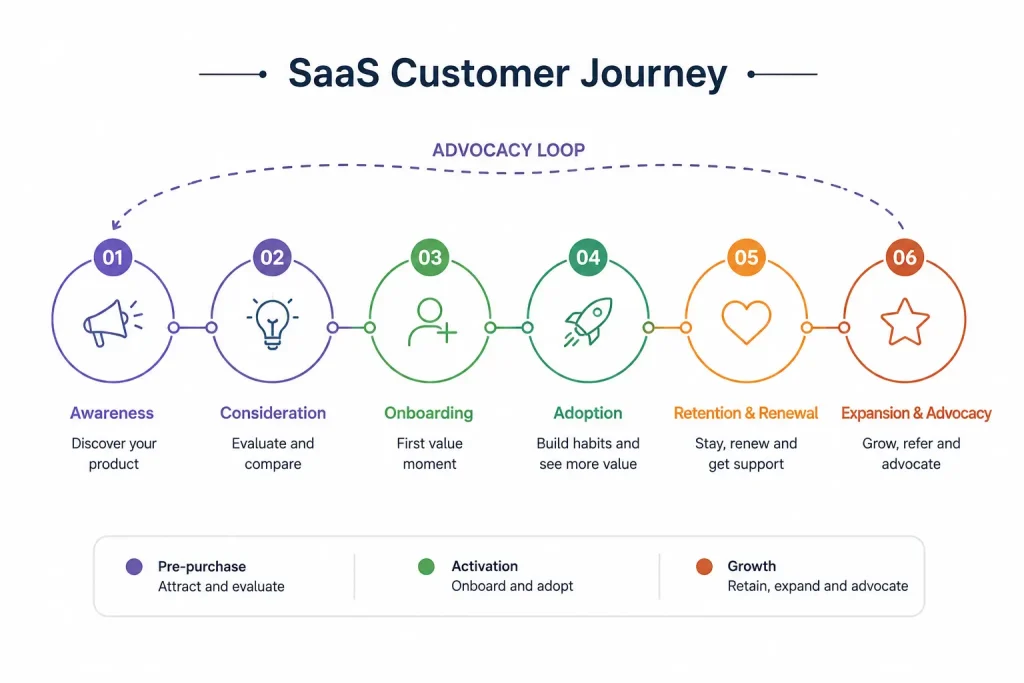
A SaaS customer journey maps every way customers interact with your product, from first awareness through renewal, expansion, or churn. It covers customer touchpoints across the full customer lifecycle, making the experience visible to every team.
Understanding how customers move through your product in real time is the foundation of effective journey mapping.
Key characteristics that define a SaaS customer journey:
- Ongoing, not one-time: The journey doesn’t end at purchase. Customers re-evaluate value at every renewal.
- Customer-centered, not brand-centered: It maps customer needs, emotions, and friction at every stage, not just your team’s conversion actions.
- Post-sale stages carry equal weight: Onboarding, adoption, and retention drive the recurring revenue that keeps a SaaS business growing.
- Distinct from a marketing funnel: A funnel measures your conversion rate. A journey map captures why customers behave the way they do across the full lifecycle.
That’s what makes it one of the most powerful alignment tools a SaaS team can have.
Six Core Stages of SaaS Customer Journeys
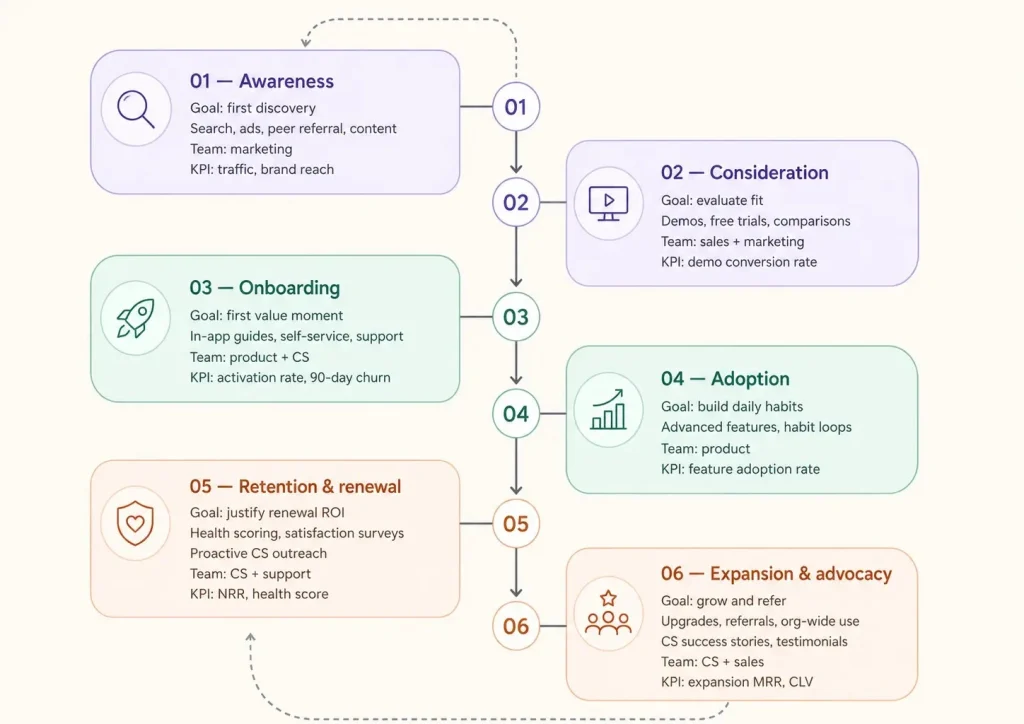
The SaaS customer journey consists of six stages. Each has distinct customer goals, touchpoints, and team priorities.
Awareness
Potential customers first learn your product exists through search, ads, peer referral, or marketing campaigns. Focus on educational content that reaches your target audience at the initial awareness stage, before customers engage with competing solutions.
Consideration
During the initial consideration phase, customers compare options, watch demos, and sign up for free trials. The sales team often coordinates across multiple decision makers, each with different business goals, to simplify the buying process for complex B2B accounts.
Onboarding
New customers sign up and attempt to reach their first meaningful product outcome. This is the most critical stage for activation and early retention. A guided onboarding process combining self service plays, in-app prompts, and timely support dramatically reduces first-90-day churn.
See how to analyze activation patterns in your onboarding flow to find exactly where users stall.
Adoption
Existing customers build daily habits and begin exploring advanced features, allowing users to discover value at their own pace. User adoption depth at this stage predicts renewal more reliably than any satisfaction survey.
Retention and renewal
Customers evaluate whether the product still meets their needs and delivers renewal-worthy ROI. Health scoring, customer satisfaction surveys, and continuous support from CS reduce drop-off points before they become cancellations.
Review how conversion funnel drops at every step to benchmark healthy retention patterns for your stage.
Expansion and advocacy
Satisfied customers upgrade, refer colleagues, and grow usage across the entire organization. Ongoing support from CS at this stage drives expansion revenue and builds long term loyalty that compounds customer lifetime value.
Get Real Behavioral Data With FullSession
See exactly where users stall, drop off, and convert at every stage of the journey. Capture your first 500 sessions at no cost.
Collect Customer Data and Feedback Across Touchpoints
Accurate journey maps are built on real data, not assumptions. Before you build customer personas or define each stage, gather data on customer behavior from two categories: quantitative, which tells you what’s happening, and qualitative, which tells you why.
Quantitative data sources
- Product analytics: Funnel completion rates, activation milestone progress, and product usage frequency by stage
- CRM and billing data: Purchase history, upgrade and downgrade patterns, and demographic data by segment
- Website analytics: Traffic source, bounce rate, and session depth on key pages
Qualitative data sources
- Session replay: Understanding what session recordings reveal about what users actually experience shows friction that no aggregate metric captures
- Customer interviews and sales calls: Direct conversations with CS and sales uncover customer expectations that never appear in dashboards
- In-app feedback: Collect contextual feedback at key lifecycle moments such as post-onboarding and pre-renewal
- Customer satisfaction surveys: Structured surveys at renewal moments generate consistent, comparable data across cohorts
For a broader comparison of these tools that show friction patterns across these data types, see FullSession’s behavior analysis software comparison.
Design Practical Customer Journey Map Templates
A journey map template provides a visual representation of every stage, organized across six components: customer goals, key touchpoints, customer emotions, pain points, team owner, and a trackable metric per stage.
Fill each cell with real data, not assumptions.
| Awareness | Consideration | Onboarding | Adoption | Retention | Expansion | |
| Customer Goals | Find a solution | Evaluate fit | Reach first value | Build product habits | Justify renewal ROI | Grow or refer others |
| Key Touchpoints | Blog, ads, G2 | Demo, pricing page | Welcome email, in-app guide | Feature emails, help docs | CS check-in, renewal notice | Upsell prompt, referral |
| Customer Emotions | Curious, uncertain | Cautious | Anxious for value | Building confidence | Satisfied or at risk | Loyal or expanding |
| Pain Points | Too many options | Unclear ROI | Setup complexity | Feature discovery gaps | Slow support | No clear upgrade path |
| Team Owner | Marketing | Sales + Marketing | Product + CS | Product | CS + Support | CS + Sales |
| Key Metrics | Bounce rate | Demo conversion | Onboarding completion | Feature adoption rate | NPS, health score | Expansion MRR |
Start the journey mapping process with a current-state map. Use a future-state map to design the target experience, then treat the gap between the two as your actionable roadmap.For deeper methodology, see the customer journey analytics platforms comparison and the complete guide to customer journey analytics.
Turn Maps Into Action: From Insights to Customer Success
A journey map sitting in a slide deck doesn’t reduce churn. These five steps move a map from documentation into ongoing work.
- Assign team ownership per stage. Every stage needs a named owner: marketing owns awareness, product and CS own onboarding, the customer success team owns retention. Without named ownership, actionable insights become nobody’s problem.
- Define one KPI for each stage. Activation rate for onboarding, feature adoption rate for adoption, net revenue retention for renewal.
- Prioritize your highest drop-off points. Use funnel data to find where customers disengage most, then watch session replays from users who exited at those steps to understand why.
- Run a monthly cross-functional journey review. Bring product, marketing, sales, and CS into one fixed meeting to review the map against live data.
- Build a library of customer success stories and customer testimonials. Real outcomes from real customers anchor the map to business results and give every team a shared definition of success.
Consistency is what keeps the map alive.
Measure, Iterate, and Scale Customer Journey Mapping with FullSession
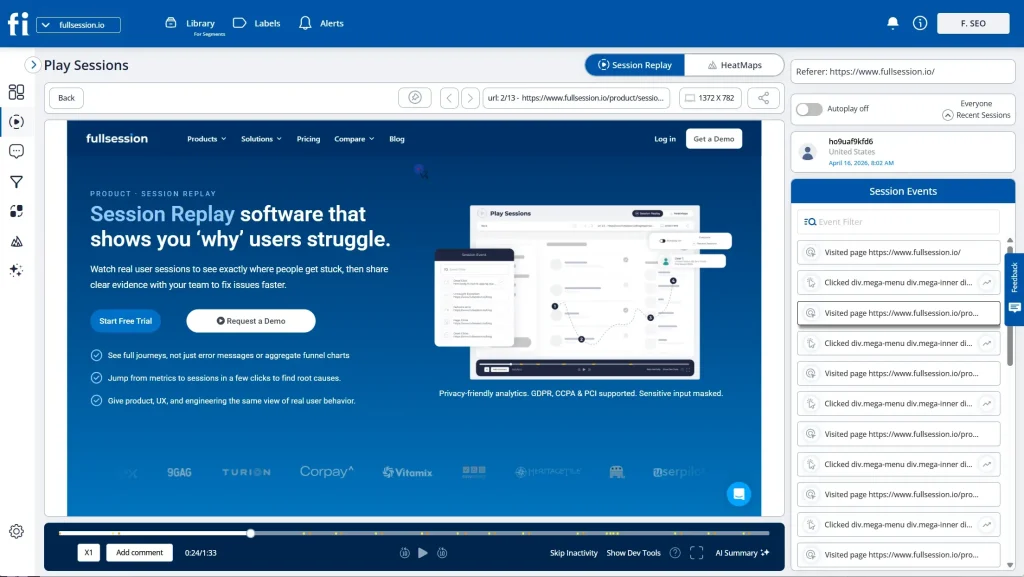
FullSession, a privacy-first UX analytics platform, captures customer interactions at every stage of the SaaS customer journey so teams can identify friction, prioritize fixes, and validate improvements.
Acquisition and conversion (sign-up funnels)
- Funnel analytics: Tracks the path users take to sign up, highlighting which step causes potential customers to drop off before completing registration.
- Form optimization: Analyzes how users interact with trial registration forms so you can eliminate fields that create hesitation and reduce completion rates.
- Landing page assessment: Couples heatmaps with session data to reveal whether users miss primary CTA buttons, enabling faster page improvements.
Onboarding and activation (the “Aha!” moment)
- Session replays: Lets product teams watch video-like replays of new users navigating the platform for the first time, making invisible friction visible.
- Friction identification: Shows UX bugs, dead clicks, and confusing navigation that prevent users from realizing the product’s value during critical first sessions.
- Drop-off analysis: Pinpoints the exact feature setup step where new sign-ups abandon the interactive walkthrough so CS can intervene early.
Adoption and value realization (daily active use)
- Interactive heatmaps: Visualizes which product modules, menus, and tabs receive the most engagement, guiding feature placement and UI decisions.
- Feature adoption tracking: Monitors whether users find and adopt newly released tools, supporting continuous user testing and iteration cycles.
- Error analysis: Isolates technical errors, broken links, and UI glitches before they damage customer experience and generate support tickets.
Retention and churn prevention (the renewal phase)
- Pre-churn signal detection: Uncovers disengagement patterns such as drops in session frequency or repetitive rage clicks on non-responsive elements.
- In-app feedback forms: Collects real-time, contextual customer satisfaction metrics directly inside the platform, tied to the exact session where feedback was given.
- Lift AI prioritization: Uses algorithmic scoring to rank issue severity by predicted revenue impact, helping teams fix high-impact friction points before users abandon the platform.
FullSession works across web and mobile and connects to your existing tools through native integrations including HubSpot, Intercom, and Zapier.
It supports an MCP server that lets AI assistants and coding agents query your FullSession data directly, so your team can get behavioral insights without leaving the tools they already work in.
Everything runs on a security-first infrastructure that keeps your customer data protected by default.
See Every Stage of Your SaaS Customer Journey in One Place
FullSession connects funnel drop-offs, session replays, heatmaps, and AI prioritization in real-time, so your team always knows what to fix next.
Governance, Privacy, and Responsible Customer Data Use

Image source: Pexels
Collecting behavioral data across the SaaS customer journey creates real legal and ethical obligations.
- GDPR: Capture behavioral data only from users who have opted in. Confirm your vendor offers EU data residency if you serve EU customers.
- CCPA: California residents who opt out must be excluded from behavioral tracking automatically.
- PCI DSS: Payment card inputs must be masked at the tracking script level and never transmitted inside session recordings.
- Data minimization: Collect only the data necessary to improve the journey. Your vendor should proactively update compliance tooling as privacy regulations evolve.
FullSession is GDPR, CCPA, and PCI compliant by default, with masking, consent controls, and data residency options built into the platform.
Advanced: AI for Customer Journey Analytics and Prioritization
AI-assisted journey analytics identifies patterns across thousands of sessions that no human review team could surface manually, delivering earlier churn signals and faster prioritization decisions.
What AI detects
- Behavioral patterns that historically precede churn: short sessions, low feature engagement, or repeated error encounters
- Sudden drops in product usage frequency that signal disengagement before a customer contacts support
- Friction clusters across specific devices, browsers, or user segments that aggregate data misses entirely
How Lift AI turns signals into priorities
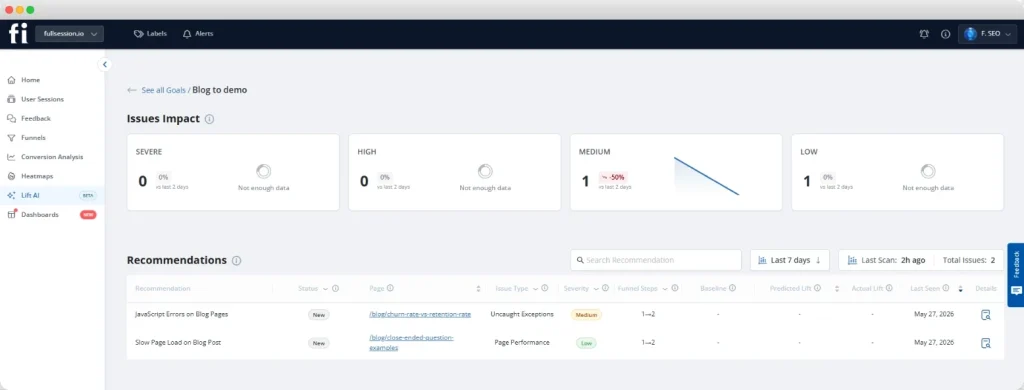
Lift AI, FullSession’s AI-powered prioritization feature, assigns a predicted revenue impact to each identified friction point. Instead of debating which issue to fix first, teams see a ranked list sorted by expected effect on retention and activation.
Fewer decisions driven by guesswork means faster progress.
Lift AI shows the pattern, sets the priority, and automatically validates the revenue impact after a fix ships. No manual review required.
Stop Guessing What to Fix Next
Lift AI ranks every friction point by revenue impact so your team always works on what matters most.
Quick Checklist: SaaS Customer Journey Mapping
Use this step by step guide before, during, and after building your journey map.
- Define your ideal customer profile and create 1-2 buyer profiles before mapping any stages
- Map all the touchpoints across all six stages, from awareness through advocacy
- Assign a named team owner for each journey stage
- Set up funnel tracking across your onboarding and activation flows
- Collect user behavior data using session replay and heatmaps
- Gather customer feedback at key lifecycle moments such as post-onboarding and pre-renewal
- Identify your highest drop-off points from funnel data
- Watch session replays of users who churned or stalled at critical stages
- Hold a monthly cross-functional journey review using live data
- Iterate: ship one fix per cycle, re-measure the funnel, and update the map
Conclusion About SaaS Customer Journey
A SaaS customer journey map isn’t a one-time deliverable. It’s a living system that connects your team’s understanding of the customer lifecycle to real behavioral data, so every decision is grounded in evidence rather than assumptions.
FullSession gives SaaS teams the funnels, session replay, heatmaps, and Lift AI prioritization to keep that data current and actionable at every stage.
Book a demo to see how FullSession maps your SaaS customer journey in real time. Or start your free trial and capture your first 500 sessions today.
FAQs About SaaS Customer Journey
What are the 5 stages of a customer journey?
The five stages of a customer journey are Awareness, Consideration, Purchase or Decision, Retention, and Advocacy.
In SaaS, these stages extend beyond the purchase because customers pay recurring fees and must continuously see value to renew. Retention and advocacy are just as important as acquisition, especially given the high cost of acquiring new customers.
What is the SaaS customer lifecycle?
The SaaS customer lifecycle is the complete relationship between a customer and a SaaS product, from first awareness through renewal, expansion, or churn.
Unlike a one-time purchase, the lifecycle is ongoing. It is commonly divided into six stages: Awareness, Consideration, Onboarding, Adoption, Retention and Renewal, and Expansion and Advocacy.
What are the 4 stages of the customer journey?
The traditional four-stage customer journey model includes Awareness, Consideration, Decision, and Retention.
Customers identify a problem, evaluate possible solutions, commit to one, and either stay or leave. In SaaS, most teams expand this model to five or six stages because onboarding and advocacy directly impact recurring revenue.
What are the 5 A’s of the customer journey?
The 5 A’s of the customer journey, defined by Philip Kotler, marketing professor and author of Marketing 4.0, are Aware, Appeal, Ask, Act, and Advocate.
A customer learns about a brand, is drawn in by its message, researches it, makes a purchase, and then recommends it to others. SaaS teams adapt this model with an ongoing adoption and renewal loop tailored to their specific target market and subscription structure.

Roman Mohren is CEO of FullSession, a privacy-first UX analytics platform offering session replay, interactive heatmaps, conversion funnels, error insights, and in-app feedback. He directly leads Product, Sales, and Customer Success, owning the full customer journey from first touch to long-term outcomes. With 25+ years in B2B SaaS, spanning venture- and PE-backed startups, public software companies, and his own ventures, Roman has built and scaled revenue teams, designed go-to-market systems, and led organizations through every growth stage from first dollar to eight-figure ARR. He writes from hands-on operator experience about UX diagnosis, conversion optimization, user onboarding, and turning behavioral data into measurable business impact.