Author: Mohamed Sehwail

  • 5 Best Website Monitoring Tools for Real-Time Performance Insights

    5 Best Website Monitoring Tools for Real-Time Performance Insights

    Want to improve your website’s performance and user experience?

    Website monitoring tools are the answer. These tools track your site’s uptime, performance, and user interactions, helping you identify and resolve issues promptly.

    FullSession is one such solution, offering error analysis to help you detect website problems, identify their root causes, and prevent them from impacting user experience.

    FullSession also includes advanced user behavior tools, providing you with an all-in-one platform to visualize all user engagement, analyze trends and patterns with laser precision, and optimize your website for peak performance.

    Book a demo to explore its features.

    Selecting the best website visitor tracking software can be challenging, as it needs to align with your specific requirements and grow with your business.

    This article will outline the best website monitoring tools and their key features and benefits to help you make an informed decision.

    Visualize, Analyze, and Optimize with FullSession

    See how to transform user data into actionable insights for peak website performance.

    Key Takeaways

    • FullSession is a user behavior analytics software that provides laser-precise visual insights to help you optimize websites for better performance. It includes intuitive features like session recordings and replays, interactive website heatmap tools, customer feedback tools, conversion funnel analysis, and error tracking. FullSession helps businesses capture the entire customer journey and get actionable user behavior data while maintaining privacy compliance with GDPR, CCPA, and PCI standards. Pricing starts at $39/month, with a 20% discount for annual plans. Book a demo today to see how it works!
    • Datadog is a cloud-based monitoring and analytics platform that offers full-stack monitoring for businesses. It includes features like customizable dashboards, real-time alerts, application performance monitoring (APM), log management, and server monitoring. Suitable for businesses with complex infrastructures, Datadog offers extensive integrations with over 500 services. Drawbacks include its complexity for beginners and potentially high costs as more features or hosts are added. Pricing starts at $15 per host per month.
    • Site24x7 is AI-powered monitoring software designed for websites, servers, networks, and applications. It offers advanced features like website performance tracking, application monitoring, real-time alerts, and cloud monitoring. However, its advanced features may require a learning curve, and integrations with third-party services could be more extensive. Pricing starts at $1 per resource per month, with a free tier for basic monitoring.
    • Uptime is a website monitoring tool focused on uptime and performance tracking. Key features include uptime monitoring, performance tracking, multi-location checks, and SSL/domain expiration alerts. It’s simple to use and affordable, making it a good option for businesses of all sizes. However, Uptime.com lacks deeper user behavior analytics compared to more advanced tools. Pricing starts at $24 per month with flexible plans based on website monitoring needs.
    • Middleware is a full-stack cloud observability platform for developers and IT teams. It provides application performance monitoring (APM), API performance tracking, database monitoring, and customizable dashboards. Middleware supports cloud and web applications with real-time alerts and detailed integrations with developer tools like AWS and Docker. Its pay-as-you-go pricing is flexible but can be overwhelming for smaller businesses due to unpredictable costs and difficulty predicting usage. Pricing starts at $0.3 per GB of data, making it scalable but potentially costly as monitoring needs grow.

    Here are more detailed reviews on each of these web performance monitoring tools.

    Best 5 Website Monitoring Tools Right Now

    Here’s a roundup of the best website monitoring tools of 2024:

    1. FullSession (Get a demo)
    2. Datadog
    3. Site24x7
    4. Uptime
    5. Middleware

    1. FullSession

    FullSession homepage

    FullSession is a user behavior analytics software designed to give you a complete view of how users engage with your website. 

    It offers powerful tools that help you dig deeper into user interactions, making it easy to identify problem areas and improve overall site performance.

    With FullSession, you can automatically detect JavaScript errors, network problems, and failed API calls. This feature helps you quickly pinpoint and troubleshoot errors that might disrupt user engagement or hinder site performance.

    Whether you’re running a small business website or managing a large platform, keeping users engaged and fixing any friction points quickly is crucial for success. FullSession lets you do just that, offering real-time session tracking and actionable insights.

    The tool goes beyond simply tracking numbers. It allows you to watch how users navigate your site, pinpoint what might be causing them to leave, and address performance issues promptly. 

    Book a demo to learn more.

    Session recording and replay

    Best for

    FullSession is the best website monitoring tool for a wide range of professionals, including:

    Key features

    • Advanced user and event segmentation: FullSession allows you to categorize users based on specific behaviors and patterns. This helps you visualize how different user groups interact with your site and gain insights on what to improve to maximize engagement and conversions. 
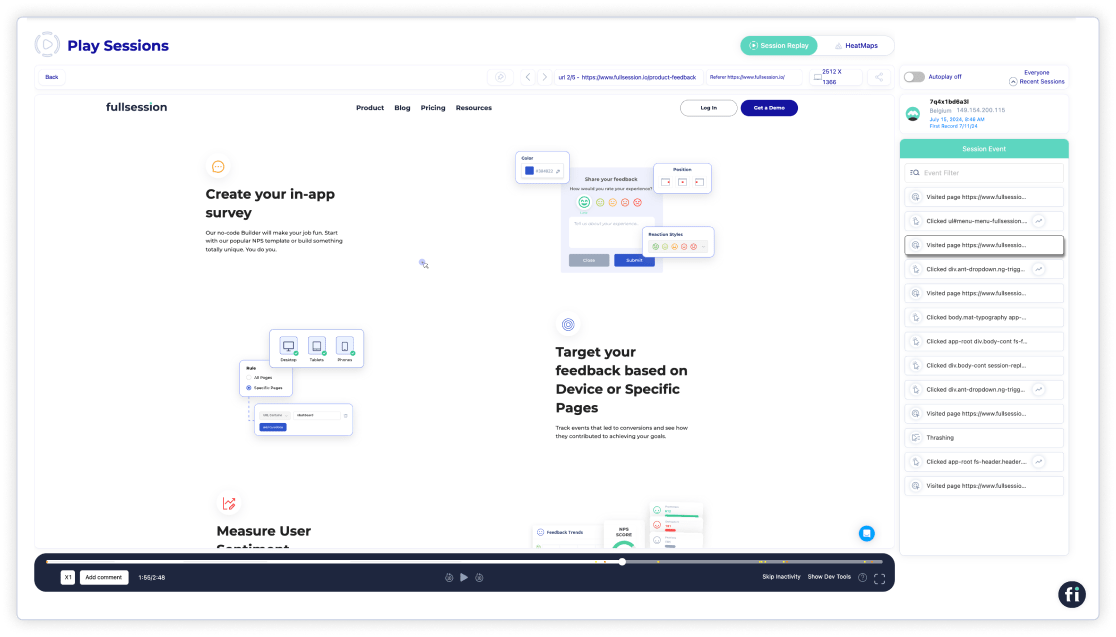
    • Session recordings and replays: Use real user session recording to capture every interaction users make on your website and replay these sessions to understand their behavior. FullSession’s recordings exclude sensitive information to protect user privacy.
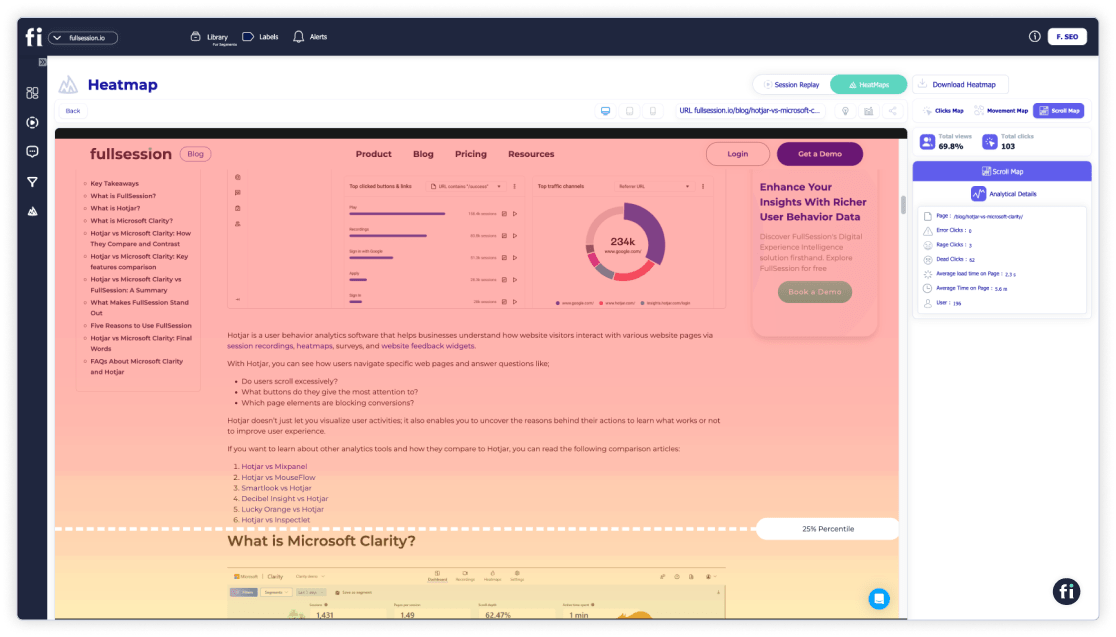
    • Interactive heatmaps: See how users interact with your site in real time. Track mouse movements, clicks, and scroll behavior to determine which areas of your site perform best or need improvement.
    • Feedback forms and reports: Collect direct feedback from users with customizable forms. Combine feedback with session recordings to understand the full context of any issues.
    • Conversion optimization tools: Visualize where users drop off in your funnel and experiment with different page elements to increase conversion rates.
    • Error tracking: Automatically detect and fix issues like JavaScript errors, failed API calls, or network failures that could affect the user experience.

    Supported platforms

    FullSession works with websites on desktop and mobile browsers.

    Integrations

    With FullSession, you can streamline your workflows and keep data in sync. 

    Whether you prefer using APIs, webhooks, Zapier, or built-in integrations, FullSession connects effortlessly with your existing tools, automating tasks and maintaining a smooth data flow across your systems.

    For instance, it integrates seamlessly with popular platforms like BigCommerce, Wix, Shopify, and WordPress, allowing you to optimize your processes with minimal setup effort.

    Customer support

    You can get help via live chat or email. There’s also a detailed help center if you prefer to find answers on your own.

    Pricing

    FullSession offers three pricing plans: Starter, Business, and Enterprise. The Starter plan begins at $39 per month and includes unlimited heatmaps and session recordings for up to 5,000 user sessions. Save up to 20% with the annual plan and pay only $32/month for Starter.

    FullSession pricing

    Check out the Pricing page to learn more.

    Pros

    • Comprehensive error tracking to spot website issues immediately
    • Real-time tracking of dynamic website elements
    • Fast heatmap processing without affecting page speed
    • Privacy protections that exclude sensitive data from recordings
    • Easy to manage large data sets
    • Built for collaboration across teams
    • Intuitive dashboard where you can see all your web performance data in one place
    • Affordable starting price
    • User-friendly interface to accommodate users of all tech knowledge levels

    Cons

    • No support for native mobile app tracking

    Book a demo today.

    2. Datadog

    Datadog

    Image source: G2

    Datadog is a cloud-based monitoring and analytics platform designed for businesses looking to track their entire tech stack in one place. 

    It provides real-time data and complete visibility into your website’s performance, infrastructure, and applications.

    User rating

    Datadog has an average user rating of 4.4 out of 5 stars based on 530 reviews on G2.

    Datadog review

    Image source: G2

    Best for

    Datadog is suitable for large enterprises, developers, IT operations teams, cloud-based businesses, and companies with complex infrastructure.

    Key features

    • Full-stack monitoring: Monitor servers, databases, web applications, and websites all in one place.
    • Customizable dashboards: Create tailored dashboards for tracking the key metrics that matter most to your business.
    • Real-time alerts: Get instant notifications about performance issues, downtime, or unusual activity.
    • Log management: Collect and analyze logs from your entire stack for quick identification of issues.
    • Application performance monitoring: Track the performance of applications and get insights into bottlenecks or slow processes.

    Supported platforms

    Datadog works across a variety of platforms, making it suitable for web, mobile, and cloud environments.

    Integrations

    Datadog offers seamless connections with over 500 services, including popular platforms like AWS, Azure, Kubernetes, and Docker.

    Customer support

    Datadog offers customer support via live chat and email. It also has extensive documentation and a community forum for additional assistance.

    Pricing

    Datadog’s pricing starts at $15 per host per month. It offers a range of plans based on the level of monitoring needed, from infrastructure monitoring to full-stack monitoring with APM. A free trial is available for those looking to test the platform.

    Datadog pricing

    Pros

    • Comprehensive monitoring across multiple platforms
    • Customizable dashboards and reports
    • Large selection of integrations
    • Scalable to suit small and large businesses alike
    • Intuitive interface to help you monitor your website’s availability easily

    Cons

    • It can be complex to set up for beginners
    • Pricing may increase quickly with additional features or hosts

    3. Site24x7

    Site24x7

    Image source: G2

    Site24x7 is a full-stack monitoring solution designed to cover every aspect of your digital infrastructure. 

    Unlike other tools that focus solely on website performance or server health, Site24x7 offers a broader scope, including website, server, application, network, and cloud monitoring, all from a single platform.

    User rating

    Site24x7 holds an average rating of 4.6 out of 5 stars based on 266 reviews on G2.

    Site24x7 review

    Image source: G2

    Best for

    Site24x7 is suited for small to medium-sized businesses, IT teams, and enterprises that need to monitor their websites, servers, applications, and networks from a single dashboard.

    Key features

    • Website and server monitoring: Track uptime, page load speeds, and server health with real-time insights.
    • Application performance monitoring: Monitor the performance of your apps and identify bottlenecks or slow transactions.
    • Network monitoring: Get a complete view of your network performance, including devices, traffic, and availability.
    • Real-time alerts: Receive notifications via email, SMS, or app when issues are detected.
    • Cloud monitoring: Monitor services in cloud environments like AWS, Azure, and Google Cloud.

    Supported platforms

    Site24x7 is versatile and works across web, mobile, cloud, and server environments.

    Integrations

    Site24x7 integrates with a variety of tools and platforms, including ServiceNow, Zoho Desk, Slack, and Webhooks. These integrations help teams stay connected, collaborate efficiently, and make sure that all critical systems are monitored in real time.

    Customer support

    Site24x7 provides customer support through live chat and email. It also offers an extensive knowledge base, tutorials, and community forums for users seeking self-service solutions.

    Pricing

    Site24x7 is a free website monitoring tool that lets you do server availability and uptime monitoring at no cost. However, the free plan may have limited features for some users.

    Paid plans start at $1 per month per resource per month. Pricing scales are based on the level of monitoring needed, with advanced features and higher volume plans available for larger enterprises.

    Site24x7 pricing

    Pros

    • Comprehensive monitoring across websites, servers, apps, and networks
    • Affordable pricing for small businesses
    • Easy-to-use interface with customizable dashboards
    • Real-time alerts for issues and downtime
    • Supports monitoring in both on-premises and cloud environments

    Cons

    • Advanced features may require a steep learning curve
    • Integration with third-party tools could be more extensive

    4. Uptime

    Uptime

    Image source: G2

    Uptime is a website monitoring service that focuses on uptime and performance tracking. 

    Its primary goal is to help businesses ensure their websites are always available and performing well, providing real-time insights into downtime, response times, and overall website health.

    Businesses with worldwide locations often find Uptime an option, thanks to its global presence and cloud-native scalability.

    User rating

    Uptime has an average rating of 4.5 out of 5 stars based on 170 reviews on G2.

    Uptime review

    Image source: G2

    Best for

    Uptime is for businesses of all sizes that prioritize uptime and performance monitoring without needing a complex or all-in-one solution.

    Key features

    • Uptime monitoring: Track your website’s uptime and receive instant alerts when downtime occurs.
    • Performance tracking: Monitor your site’s speed and overall performance to ensure fast load times.
    • Global monitoring locations: Check your site’s performance from multiple locations worldwide to ensure it’s accessible across different regions.
    • Real-time alerts: Get immediate notifications via email, SMS, or integrated tools like Slack when issues arise.
    • SSL certificate monitoring: Keep an eye on your SSL certificates and domain registrations to avoid unexpected expirations.

    Supported platforms

    Uptime allows for monitoring mobile and desktop versions to ensure optimal performance across devices.

    Integrations

    Uptime integrates with a variety of tools to streamline your monitoring efforts, including Slack, PagerDuty, and Zapier. These integrations allow you to receive alerts and manage incidents in your preferred tools so your team stays on the same page.

    Customer support

    Uptime offers 24/7 customer support through email. It also provides a knowledge base with articles, tutorials, and troubleshooting guides for users who want to solve problems independently.

    Pricing

    Pricing for Uptime starts at $24 per month, making it an affordable choice for businesses focused primarily on uptime and performance tracking. 

    The platform offers scalable plans based on the number of monitored websites and the frequency of checks, ensuring flexibility for businesses of all sizes.

    Uptime pricing

    Pros

    • Simple, easy-to-use interface
    • Reliable uptime and performance tracking
    • Global monitoring locations for a complete performance view
    • Affordable pricing with flexible plans
    • Instant real-time alerts via multiple channels
    • Comes with SSL monitoring, so you don’t lose users because of expired certificates

    Cons

    • Focuses primarily on uptime and performance; lacks deeper analytics for user behavior
    • Fewer advanced features compared to more comprehensive monitoring tools

    5. Middleware

    Middleware

    Image source: G2

    Middleware is a real-time cloud observability platform for developers and IT teams to track website and application performance. 

    It bridges the gap between the frontend user experience and backend systems, providing in-depth insights into how various components of your infrastructure interact.

    User rating

    Middleware has an average rating of 4.5 out of 5 stars based on 12 reviews on G2.

    Middleware review

    Image source: G2

    Best for

    Middleware provides comprehensive visibility for developers, IT operations teams, and companies with intricate systems that need to be closely monitored.

    Key features

    • Application performance monitoring: Track and optimize the performance of web applications by analyzing response times, errors, and throughput.
    • API performance and availability monitoring: Monitor the availability and performance of your APIs to ensure they function smoothly across various services.
    • Database monitoring: Gain insights into your database performance, track query efficiency, and resolve bottlenecks affecting overall system speed.
    • Custom metrics dashboard: Create dashboards tailored to your specific needs, allowing for easy tracking of the metrics most important to your business.
    • Real-time alerting capabilities: Receive notifications the moment performance issues or outages occur, enabling quick response and resolution.

    Supported platforms

    Middleware supports web, mobile, and cloud-based applications.

    Integrations

    Middleware integrates with various development and communication tools, such as AWS, Vercel, Java, Docker, Redis, Microsoft Teams, and more. These integrations allow for smoother workflows and help ensure that your team can report and address issues in real time.

    Customer support

    Middleware offers customer support via email, plus detailed documentation, tutorials, and a community forum for users seeking help with troubleshooting and best practices.

    Pricing

    Middleware offers flexible pricing plans starting at $0.3 per GB of metrics, logs, and traces, with pricing scaling based on the number of monitored applications and the depth of monitoring needed.

    Middleware pricing

    Pros

    • Detailed monitoring of applications, databases, and APIs
    • Customizable dashboards for tracking key metrics
    • Real-time alerts for quick issue resolution
    • Works well across various infrastructures, including cloud environments
    • Integrates with popular developer tools for seamless workflows
    • Pay-as-you-go pricing model

    Cons

    • It may be overwhelming for smaller businesses with simpler monitoring needs
    • Setup can be complex for those unfamiliar with advanced monitoring tools

    Best 5 Website Monitoring Tools Comparison Table

    While there are several options available, FullSession stands out for its comprehensive features that go beyond just performance monitoring, making it the best choice for businesses serious about optimizing their website.

    Here’s a comparison of the top 5 website monitoring tools:

    FullSessionDatadogSite24x7UptimeMiddleware
    Real-time user tracking
    Heatmaps
    Session recording and replay
    Dynamic element tracking
    Feedback forms
    Conversion funnel analysis
    Error tracking
    Uptime monitoring
    Cross-team collaboration
    Monthly pricing$39$15 per host$1 per resource$24$0.3 per GB

    Best 5 Website Monitoring Tools: Our Verdict

    FullSession is your go-to choice, offering everything you need to monitor website errors, track user behavior, and analyze website performance in real time.

    It allows you to monitor dynamic elements with precision, ensuring you capture the full picture of how visitors interact with your site. Its error analysis capabilities allow you to automatically detect and diagnose issues such as JavaScript errors, network failures, and API problems, which leads to swift resolution and minimal disruption to user experience.

    Heatmaps are processed quickly without slowing down your website, and FullSession’s privacy protections automatically exclude sensitive data from recordings.

    Managing large volumes of data is also a breeze, helping you uncover key insights quickly. You can rest easy knowing user behavior tracking is limited to your site, preventing any data misuse. 

    Plus, its collaborative features make it easy for teams to work together seamlessly on one platform.

    Want to see how it works? Book a demo today.

    Conclusion About Best 5 Website Monitoring Tools

    Website monitoring tools are crucial for any online business that wants to stay ahead, improve user experience, and quickly catch and fix issues. These tools give you the insights you need to keep your site running smoothly, whether you’re tracking performance, monitoring uptime, or understanding how visitors interact with your site.

    While each of the tools we’ve covered has its strengths, FullSession really stands out. It offers real-time user tracking, strong privacy features, and easy team collaboration—all designed to help you optimize your site’s performance and user experience.

    If you’re ready to take your website to the next level, check out FullSession. 

    Book a demo today and see how it can make a difference for your business!

    FAQs About Best Website Monitoring Tools

    What is the best website monitoring service or tool?

    If error analysis is your primary focus, FullSession stands out as an excellent choice. Its specialized error-tracking features allow you to automatically detect and diagnose issues such as JavaScript errors, network failures, and failed API calls. This capability helps you quickly identify and address problems that could disrupt user experience or impact site performance. Datadog is another strong option for all-around infrastructure and app monitoring. If uptime monitoring is your main goal, Uptime does a great job with simple, reliable tracking.

    What is the best tool for monitoring?

    If you’re looking to optimize your website’s user experience, FullSession stands out. It lets you see exactly how users are navigating your site and where they’re running into trouble. 

    What is a website monitoring tool?

    A website monitoring tool checks your site’s performance, uptime, and user activity. Tools like FullSession can show you errors and other issues that could be driving your audience away, while others focus on making sure your site is always available and loading fast. They send alerts when things go wrong, so you can fix issues quickly.

    How do I monitor if a website is up?

    To monitor if your website is up, you can use tools like FullSession or Uptime. These tools check your site regularly and notify you if there’s any downtime. They make sure you’re the first to know when something goes wrong so you can fix it right away.

    What is real user monitoring vs. synthetic monitoring?

    Real User Monitoring (RUM) tracks actual user interactions on your site, giving you insights into real-world performance, like load times and errors users encounter. It’s great for understanding how your site performs under real conditions but can only catch issues after users experience them. Synthetic Monitoring, on the other hand, uses automated tests to simulate transaction monitoring and user behavior and identify potential problems before they affect anyone. It’s proactive and runs 24/7 but doesn’t reflect actual user behavior. Both monitoring solutions have their strengths, and using a combination of both provides the best coverage.


  • 11 Best UX Research Tools to Test in 2025

    11 Best UX Research Tools to Test in 2025

    Understanding how users interact with your website is key to creating a seamless experience, and that’s where the best UX research tools shine. These tools help you uncover hidden pain points, refine your design, and boost engagement. 

    Take FullSession, for example—it offers session recordings and replays, interactive heatmaps, conversion funnel optimization tools, error tracking and customer feedback tools to give you a complete picture of user behavior. 

    Get a demo today!

    While UX tools provide valuable insights, choosing the right one can be tricky. Balancing powerful features with simplicity is often the biggest challenge. In this guide, we’ll help you find the perfect UX tool for your needs.

    Key Takeaways

    • FullSession is a user behavior analytics software designed to offer businesses visual insights into user activities on their websites. It features comprehensive session recording and replay, interactive heatmaps, customer feedback forms and analysis, conversion funnel analysis, error tracking, and seamless integration with popular platforms, making it ideal for optimizing website performance and digital experiences. It is also compliant with GDPR, CCPA, and PCI standards. The pricing starts at $39/month for 5,000 session recordings and unlimited heatmaps. Get a 20% discount with annual subscriptions. Book a demo now.
    • UXtweak is a UX research tool that focuses on helping teams conduct in-depth usability analysis. It allows for task-based testing and supports both low-fidelity and high-fidelity prototype testing, with customizable heatmaps offering detailed filtering options. The main drawback of UXtweak is its limited customer support hours. Pricing begins at $99/month.
    • Optimizely Web Experimentation is an experimentation platform for A/B testing and personalization, particularly for large-scale digital ecosystems. It enables businesses to run multiple variations of their websites or apps simultaneously, leveraging machine learning-driven personalization. Despite its features, Optimizely’s high pricing and steep learning curve can be challenging for beginners. Pricing is custom-tailored based on the specific needs of the business.
    • UserTesting is a human insight platform that provides real-time insights through high-quality video recordings or live sessions of user interactions. It captures detailed user feedback, including thoughts and facial expressions, making it an essential tool for diagnosing usability issues. The main drawback is the higher pricing, which can be prohibitive for smaller teams, with plans being custom-tailored to fit different needs.
    • Maze is a user research platform primarily focused on rapid prototype testing and gathering user feedback. It integrates with design tools like Figma, Sketch, and Adobe XD, generating detailed usability reports and linking survey responses directly to user interactions. However, advanced analytics features may require higher-tier plans. Pricing starts at $99/month, with limitations on more advanced features at lower pricing tiers.
    • Lyssna is a remote user research platform designed for quick and efficient tests, such as five-second tests to gauge user impressions. It’s particularly useful for measuring the initial impact of a design. The tool has limited testing options compared to more advanced platforms, with pricing starting at $89/month and a free plan available with basic features.
    • Mixpanel is a product analytics tool known for its event tracking and user segmentation capabilities. It allows businesses to analyze complex user funnels and understand long-term user retention trends. The platform supports real-time data tracking and integrates with tools like Salesforce and Google Analytics. However, it has a steeper learning curve for beginners. Pricing starts at $28/month, with more advanced features available in higher-tier plans.
    • VWO Insights is a user behavior analytics tool that provides deep insights through session recordings and comprehensive form analytics. It includes conversion funnel tracking to optimize conversion rates. The main drawbacks are its relatively high pricing and the need for more advanced knowledge to fully leverage its features. Pricing starts at $176/month, with scalability based on usage.
    • Userlytics is a user testing tool for task-based testing, where users complete specific tasks while being recorded. It also offers access to a global participant panel, allowing for diverse user feedback. However, the pricing can be high for extensive testing needs, and plans are custom-tailored based on the scope of the research.
    • Looppanel is an AI-powered research analysis and repository tool that specializes in usability and accessibility testing. It ensures that digital products are user-friendly and accessible to individuals with disabilities. It offers session recordings and task-based testing features but has limited advanced features compared to more specialized tools. Pricing starts at $30/month, with more advanced features available in higher-priced plans.
    • Optimal Workshop is a UX research and design testing platform focused on information architecture, offering features like Treejack for testing website navigation and card sorting to understand how users categorize information. While it provides comprehensive tools for improving site structure, its higher pricing, starting at $129/month, may be a barrier for smaller teams.

    Let’s dig deeper into each UX research platform on the list:

    Best 11 UX Research Tools Right Now

    Below is a list of the top 11 UX research tools you can test in 2024:

    1. FullSession (Get a demo)
    2. UXtweak
    3. Optimizely Web Experimentation
    4. UserTesting
    5. Maze
    6. Lyssna
    7. Mixpanel
    8. VWO Insights
    9. Userlytics
    10. Looppanel
    11. Optimal Workshop

    1. FullSession

    FullSession homepage

    FullSession is a user behavior analytics software that can significantly improve the work of UX researchers.

    It offers advanced features that directly benefit UX research processes and outcomes, helping you capture the entire user journey without affecting your website performance.

    From a single intuitive dashboard, you can observe user behavior in real-time, analyze trends and patterns accurately, and use visual insights to optimize your website and create relevant, user-friendly, and enjoyable experiences.

    You can also:

    • Identify usability issues and design flaws more efficiently
    • Validate or refute design hypotheses with real user data
    • Conduct more thorough and accurate user journey mapping
    • Prioritize design improvements based on actual user behavior
    • Measure the impact of design changes over time

    FullSession’s compliance with GDPR, CCPA, and PCI standards ensures that you can conduct your studies ethically without compromising user data.

    Book a demo to learn more.

    Best for

    FullSession benefits e-commerce businesses, SaaS companies, digital marketers, UX designers, and data analysts. 

    It’s ideal for optimizing websites, gaining insights into user behavior, improving product designs, and improving customer experience.

    Whether you’re in product development, quality assurance, or customer support, FullSession offers valuable tools to refine and optimize digital experiences.

    Key features

    • Advanced user and event segmentation: Effortlessly categorize website users based on multiple criteria. Spot behavior trends, patterns, and correlations, refine user journeys, improve engagement, and drive higher conversion rates.
    • Session recordings and replays: Capture and replay every interaction users have on your website. Diagnose issues, understand user behavior, and forecast future actions using historical data. Prioritize user privacy by excluding sensitive data from recordings.
    • Interactive heatmaps: Switch between maps that track mouse movements, clicks, and scrolls to pinpoint areas of high or low interaction. Test various page elements to determine which perform best, and track the time users take to complete key tasks. Get instant heatmap data with no delays or impact on your website’s performance and optimize layout and content placement.
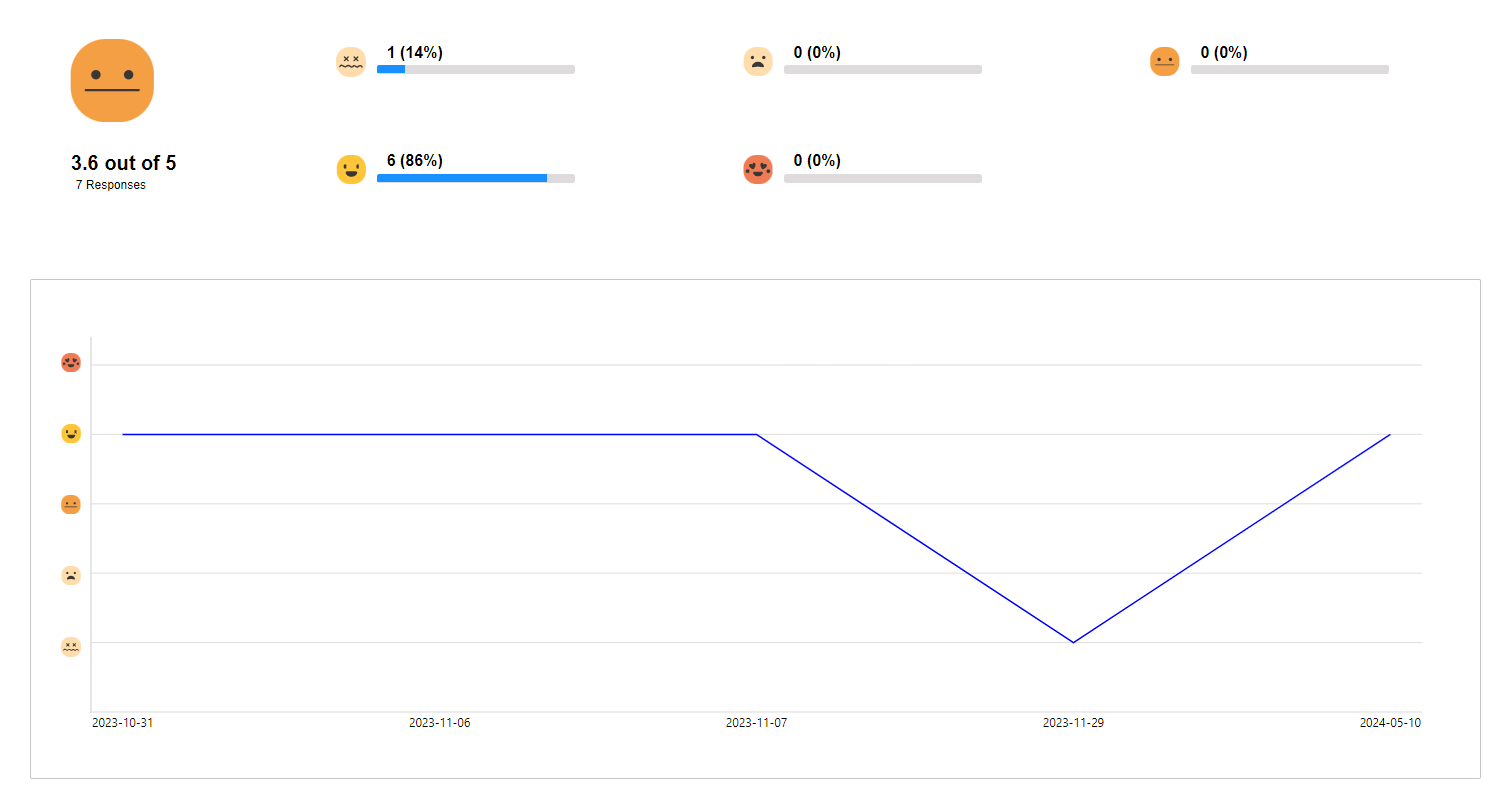
    • Custom feedback forms and reports: Design branded feedback forms to collect insights on user satisfaction, challenges, and feature requests. Watch connected session recordings to understand the reasons behind the feedback and see what happened during the session.
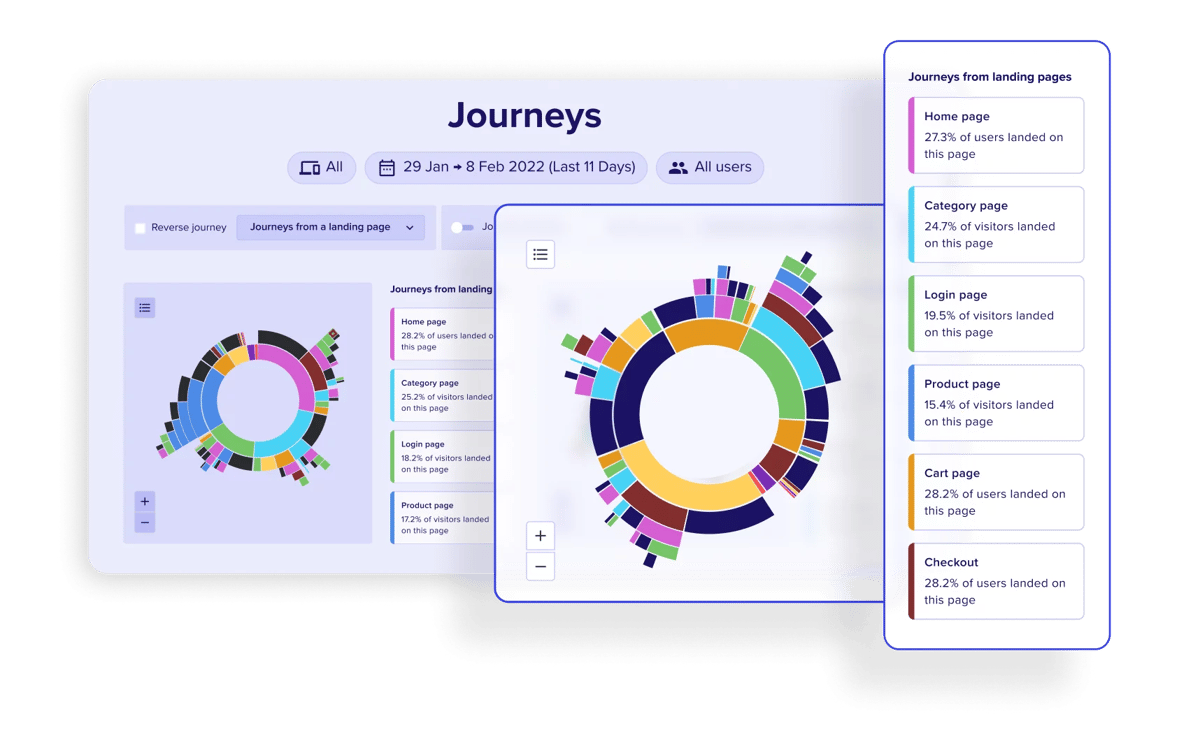
    • Conversion and funnel optimization tools: Identify user behavior patterns and pinpoint the reasons for drop-offs during the conversion process. Visualize where users exit at each step and experiment with different designs and content to improve conversion rates.
    • Error analysis: Automatically detect website issues like JavaScript errors, network problems, and failed API calls. Analyze error data to troubleshoot issues, identify root causes, and prevent them from negatively impacting the user experience.
    FullSession session recordings

    Supported platforms

    FullSession supports tracking user behavior on web platforms and includes mobile user recordings.

    Integrations

    Whether you’re using APIs, webhooks, Zapier, or built-in integrations, FullSession connects seamlessly with your existing tools, automating tasks and maintaining smooth data flow across all your applications. 

    For instance, it integrates with popular platforms like BigCommerce, Wix, Shopify, and WordPress, enabling you to optimize your processes with minimal setup effort.

    Customer support

    FullSession provides live chat and email support, along with a comprehensive help center for self-service.

    Pricing

    You can select from three paid plans—Starter, Business, and Enterprise—tailored to suit businesses of all sizes, from small startups to large enterprises.

    FullSession pricing

    These scalable plans let you begin with the one that meets your current needs and upgrade as your business expands, so you only pay for the features you need.

    The entry-level plan offers all essential features, including unlimited heatmaps and up to 5,000 session recordings per month, for just $39/month. 

    This makes it easy to access advanced analytics without breaking the bank.

    Annual subscriptions offer a 20% discount on all plans.

    Check out the pricing page to learn more.

    Pros

    • Monitor dynamic elements in real time to gain precise insights from real users
    • Accelerate heatmap processing without impacting site performance
    • Safeguard user privacy by omitting sensitive data from recordings
    • Handle large datasets efficiently and swiftly reveal key insights
    • Restrict tracking to your site to maintain data security
    • Enhance cross-team collaboration by centralizing efforts on one platform
    • Improve multiple UI and UX simultaneously throughout the design process

    Cons

    • FullSession does not support mobile app tracking

    Book a demo to see how FullSession works.

    2. UXtweak

    UXtweak

    Image source: G2

    UXtweak is a UX research tool that provides a range of usability testing options tailored to enhance your website’s user experience. 

    With a focus on detailed analysis and user insights, UXtweak helps you make informed decisions to improve design, functionality, and overall user satisfaction.

    User rating

    UXtweak has a user rating of 4.7 out of 5 out of 39 reviews on G2.

    Uxtweak review

    Image source: G2

    Best for

    UXtweak is suitable for teams that heavily focus on usability testing and need a versatile tool that offers a variety of testing methods. 

    It’s suitable for UX designers, researchers, and product teams looking to gather detailed user feedback and optimize their UX design.

    Key features

    • Usability testing: Use diverse usability testing options, including task-based testing, and see exactly how users interact with your site. Track and analyze user behavior with precision and get actionable insights that go beyond surface-level data.
    • Prototype testing: Test low-fidelity wireframes and high-fidelity prototypes before going live and get insights for each design stage.
    • Heatmaps: Get highly customizable click, scroll, and move heatmaps.
    • Tree testing: Evaluate the effectiveness of your website’s navigation structure. Use  tree testing to get detailed reports, which highlight where users struggle to find information, helping you refine your site’s structure.

    Supported platforms

    UXtweak supports web-based platforms and is fully compatible with mobile devices.

    Integrations

    UXtweak integrates with popular project management and communication tools like Jira, Slack, and Trello, ensuring seamless workflow and easy collaboration among teams.

    Customer support

    UXtweak offers customer support via chat, email, and phone during business hours. They also provide an extensive knowledge base with tutorials and guides.

    Pricing

    UXtweak’s pricing starts at $99 per month, with a free version available that includes limited features. 

    The paid plans are designed to offer flexibility, allowing you to choose the one that fits your needs and budget. Each plan has limitations regarding own-sourced responses, data retention, the number of tasks per study, and the number of video recordings.

    If you need a plan for multiple users, choose the Business plan, which starts at $189 per month.

    UXtweak pricing

    Pros

    • Wide range of usability testing options
    • Customizable heatmaps with detailed filters
    • Free version available
    • Easy integration with popular tools
    • Separate profile for each participant
    • Easy setup for tests
    • Ability to recruit your own research participants in specific niches

    Cons

    • Limited customer support hours
    • The free version has restricted features
    • Reports and exports are only available in higher-tier plans

    3. Optimizely Web Experimentation

    Optimizely Web Experimentation

    Image source: G2

    Optimizely is an experimentation platform that specializes in A/B testing and personalization, making it a helpful tool for businesses looking to optimize their digital experiences.

    It’s designed to help teams experiment with different variations of their websites or apps to identify what works best, driving higher engagement and conversions.

    User rating

    Optimizely has a user rating of 4.2 out of 5 based on 357 reviews on G2.

    Optimizely review

    Image source: G2

    Best for

    Optimizely is suitable for businesses and teams that prioritize A/B testing and experimentation. 

    It helps digital marketers, product managers, and UX testing teams who need to test different versions of content or features to find the most effective solutions.

    Key features

    • A/B testing: Easily create and run experiments on their websites or apps. Test multiple variations simultaneously, providing detailed insights into which version performs best.
    • Personalization: Use advanced personalization features to tailor experiences to specific user segments. Its machine-learning capabilities automatically suggest personalized content based on user behavior.
    • Experimentation platform: Get a full experimentation platform that supports multivariate testing, feature flagging, and progressive rollouts. Iterate quickly and scale your testing efforts across large digital ecosystems.
    • Analytics: Get detailed analytics and reporting, giving you clear insights into the impact of your experiments. Integrate with third-party data sources for a holistic view of performance.

    Supported platforms

    Optimizely is compatible with both web and mobile platforms.

    Integrations

    Optimizely integrates with many tools, such as Salesforce, Google Analytics, and Marketo. 

    These integrations allow for seamless data flow and enhanced capabilities when analyzing experiment results.

    Customer support

    Optimizely offers customer support through chat, phone, and email. They also provide a comprehensive resource center with documentation, tutorials, and community forums.

    Pricing

    Optimizely’s pricing is custom-tailored based on your specific needs and the scale of your experiments. 

    You’ll need to contact Optimizely directly for a quote, as the platform is designed to accommodate a wide range of business sizes and requirements.

    Optimizely pricing

    Pros

    • A/B testing and personalization features
    • Supports large-scale experimentation
    • Integration with popular tools
    • Comprehensive analytics and reporting
    • Easy-to-implement customized tests
    • User-friendly interface

    Cons

    • Pricing can be high, particularly for smaller teams
    • Steeper learning curve for beginners
    • CX metrics can be hard to understand for some users

    4. UserTesting

    UserTesting

    Image source: Capterra

    UserTesting is a user research tool that allows teams to gather real-time feedback from users through video recordings and surveys.

    It’s designed to help businesses understand how users interact with their products, identify pain points, and improve the overall user experience analysis based on both qualitative and quantitative data.

    With UserTesting, you can see and hear how users engage with your website, app, or prototype, providing valuable insights that can drive design and development decisions.

    User rating

    UserTesting has a score of 4.5 out of 5 based on 706 reviews on G2.

    UserTesting review

    Image source: G2

    Best for

    UserTesting is suitable for teams that need immediate user feedback on prototypes, designs, or live products. 

    It’s useful for UX designers, product managers, and marketers who want to validate their designs and make data-driven improvements.

    Key features

    • Real-time user feedback: Collect real-time feedback through video recordings, where users share their thoughts as they interact with your product. It helps you capture authentic user reactions.
    • Video recordings: Watch users’ interactions with your product, capturing every click, scroll, and hesitation. Diagnose issues and make design decisions based on qualitative research.
    • User surveys: Ask targeted questions to gather specific insights from your audience. Pair surveys with video recordings to get the context for the responses.
    • Prototype testing: Test your prototypes before launch to identify usability issues early,  from simple wireframes to fully developed designs.

    Supported platforms

    UserTesting supports web, mobile, and desktop platforms.

    Integrations

    UserTesting integrates with tools like Slack, Jira, and Trello, enabling seamless collaboration and easy sharing of user feedback across teams.

    Customer support

    UserTesting offers customer support via chat, email, and phone. They also provide an extensive resource library with tutorials, case studies, and best practices to help you make the most of the platform.

    Pricing

    Pricing for UserTesting offers various plans to accommodate different business sizes and requirements. Contact their sales team for a direct quote.

    Pros

    • Provides quick, actionable user feedback
    • High-quality video recordings of user interactions
    • Flexible prototype testing options
    • Supports a wide range of platforms
    • Easy access to niche users
    • Ability to recruit participants quickly

    Cons

    • Pricing can be on the higher side, especially for smaller teams
    • Limited customization options in lower-tier plans

    5. Maze

    Maze

    Image source: G2

    Maze is a UX research tool designed for rapid prototype testing and user feedback collection.

    It allows teams to quickly validate design decisions and gather actionable insights without the need for in-person testing.

    With its intuitive interface and robust analytics, Maze helps product teams, designers, and researchers make informed decisions that improve user experience and product success.

    User rating

    Maze has a user rating of 4.5 out of 5 based on 97 reviews on G2.

    Maze review

    Image source: G2

    Best for

    Maze is for teams that need to validate prototypes and gather user feedback quickly. 

    It’s useful for UX designers, product managers, and researchers who want to conduct online usability testing and iterate rapidly without the need for coding or extensive setup.

    Key features

    • Prototype testing: Test interactive prototypes using tools like Figma, Sketch, and Adobe XD. Generate detailed usability reports to understand how users interact with your designs and where improvements are needed.
    • User surveys: Collect user feedback through customizable surveys you can integrate into your prototype tests. Link survey responses directly to user interactions, providing context-rich insights.
    • Heatmaps: The heatmap feature lets you visualize where existing users are clicking, scrolling, and focusing their attention on your prototypes. Identify high and low-engagement areas to refine your designs.
    • Usability reports: Get insights into user behavior with automatically generated reports and identify trends and areas for improvement. 

    Supported platforms

    Maze supports web-based platforms and integrates with leading design tools, ensuring that you can test and validate designs across various digital environments.

    Integrations

    Maze integrates with popular design tools like Figma, Sketch, and Adobe XD, allowing for a smooth workflow from design to testing. 

    Additionally, it supports integrations with project management tools like Jira and Trello.

    Customer support

    Maze provides customer support through chat and email, with a detailed knowledge base and tutorials available to help you get the most out of the platform.

    Pricing

    Maze offers a free plan with basic features, making it accessible for small teams and individual designers. 

    Paid plans start at $99 per month, offering more advanced features and capabilities, but there are specific limitations for seats and the number of studies per month. There’s also custom pricing available for larger teams with more extensive needs.

    Maze pricing

    Pros

    • Quick and easy prototype testing
    • Integrates with popular design tools
    • Affordable pricing with a free plan available
    • Detailed usability reports and heatmaps
    • Light onboarding process for participants

    Cons

    • Limited features in the free plan
    • Advanced analytics may require higher-tier plans
    • Some participants may experience slow loading times for prototype or usability tests

    6. Lyssna

    Lyssna

    Image source: G2

    Lyssna is a remote user research platform that provides quick and easy usability tests. It enables teams to gather valuable user feedback with minimal setup.

    User rating

    Lyssna has a user rating of 4.5 out of 5 based on 71 reviews on G2.

    Lyssna review

    Image source: G2

    Best for

    Lyssna is suited for teams that need a straightforward tool to run usability tests and collect feedback rapidly.

    It’s beneficial for designers, UX researchers, and marketers who want to validate design choices, improve user interfaces, and optimize user experiences without a steep learning curve.

    Key features

    • Five-Second Test: Use the five-second test to assess users’ first impressions by showing them an image for five seconds and then asking follow-up questions. Quickly measure the effectiveness of a design’s initial impact.
    • Preference tests: Present users with multiple design options and ask them to choose their preferences, helping you make data-driven decisions on design elements, colors, and layouts.
    • Click tests: Track where users click on a design and get insights into the intuitiveness of your interface. Identify navigation issues and optimize call-to-action placements.
    • Surveys: Gather qualitative feedback from users. Integrate surveys directly into your tests, providing immediate context to user responses.
    • Navigation tests: Evaluate the effectiveness of your website’s navigation structure, ensuring that users can easily find the information they need.

    Supported platforms

    Lyssna is web-based and accessible from any device with an internet connection. It supports remote usability testing for web and mobile designs.

    Integrations

    Lyssna integrates with popular tools like Slack and Trello, facilitating easy sharing of results and team collaboration. 

    It also supports CSV export, allowing for data analysis in platforms like Excel or Google Sheets.

    Customer support

    Lyssna offers customer support via email and live chat during business hours. 

    Additionally, they provide a comprehensive help center with tutorials and guides to help users maximize the platform’s potential.

    Pricing

    Pricing for Lyssna starts at $89 per month, with a free plan available that includes basic features. 

    The paid plans offer more advanced testing capabilities and allow for a higher number of responses, making it suitable for teams with more extensive testing needs. However, there’s a maximum number of seats and test lengths.

    Lyssna pricing

    Pros

    • Simple and intuitive interface
    • Quick setup and easy to use
    • Affordable pricing with a free plan available
    • Effective for gathering quick, actionable insights
    • Recruit participants easily
    • Valuable input from participants

    Cons

    • Limited testing options compared to more advanced tools
    • Basic features in the free plan might not meet all needs
    • There is no tool to send follow-up questions after remote user interviews

    7. Mixpanel

    Mixpanel

    Image source: G2

    Mixpanel is a product analytics platform designed to help businesses track user interactions across their websites and apps. 

    It’s known for its in-depth analytics capabilities, enabling teams to understand user behavior, track conversions, and make data-driven decisions.

    Whether you’re looking to optimize user flows, measure the effectiveness of marketing campaigns, or enhance product features, Mixpanel provides the insights you need to improve user engagement and retention.

    User rating

    Mixpanel has a user rating of 4.6 out of 5 based on 1,120 reviews on G2.

    Mixpanel review

    Image source: G2

    Best for

    This user testing platform is suited for businesses and teams that need advanced analytics to understand user behavior in depth.

    It’s valuable for product managers, data analysts, and marketers who require detailed tracking and reporting to optimize user experiences and drive business growth.

    Key features

    • Advanced analytics: Get comprehensive analytics that allow you to track user interactions in real time. Segment users based on various criteria and analyze behavior patterns and trends in detail.
    • User funnels: Create and analyze user funnels and identify drop-off points and optimize the user journey. Track complex multi-step processes and compare different user segments.
    • A/B testing: Test different variations of your product or marketing campaigns.See how changes impact user behavior in real time.
    • Retention analysis: Understand how well your product retains users over time. Identify long-term trends and determine which factors contribute to user retention.
    • Event tracking: Monitor specific actions users take on your site or app. Track the metrics that matter most to your business.

    Supported platforms

    Mixpanel supports both web and mobile platforms.

    Integrations

    Mixpanel integrates with apps like Salesforce, Google Analytics, and HubSpot. 

    These integrations allow you to combine Mixpanel’s analytics with other research data sources, providing a comprehensive view of your business metrics.

    Customer support

    Mixpanel offers customer support through chat, email, and phone. They also provide an extensive knowledge base with tutorials, guides, and community forums to help users get the most out of the platform.

    Pricing

    Mixpanel offers a free plan with basic features, making it accessible for startups and small businesses. 

    Paid plans start at $28 per month, offering more advanced features and higher data limits. Custom pricing is also available for larger enterprises with more extensive needs.

    Mixpanel pricing

    Pros

    • Comprehensive and detailed analytics
    • User segmentation and funnel analysis
    • Supports real-time data tracking
    • Integrates with a wide range of tools
    • Easy to implement
    • Good customer service

    Cons

    • The steeper learning curve for beginners
    • Advanced features may require higher-tier plans
    • Some report types may be difficult to use for some users

    8. VWO Insights

    VWO Insights

    Image source: G2

    VWO Insights is a specialized suite within the VWO platform designed to provide deep, actionable insights into user behavior on your website. 

    It complements VWO testing and optimization tools by offering a detailed understanding of how users interact with your digital properties.

    With VWO Insights, you can uncover hidden opportunities for improvement, identify friction points, and make informed decisions to enhance user experience and increase conversions.

    User rating

    VWO Insights has a rating of 4.2 out of 5 based on 59 reviews on G2.

    VWO Insights review

    Image source: G2

    Best for

    VWO Insights is suitable for teams that need to understand user behavior in detail before making design changes. 

    It’s useful for UX designers, product managers, and CRO specialists who want to identify pain points and opportunities for optimization based on real user data.

    Key features

    • Session recordings: Watch real user interactions on your site. Filter sessions based on specific user behaviors and focus on the most relevant data.
    • Heatmaps: Get heatmaps that visually represent where users click, scroll, and focus their attention. Understand which parts of your page are engaging users and which might need redesigning.
    • Clickmaps: See where users click on your site. Identify the effectiveness of links, buttons, and CTAs and understand if users are interacting with elements as intended.
    • Form analytics: Track how users interact with forms on your site and see where they might be abandoning the form. Improve conversion rates by optimizing form design and reducing friction.
    • On-page surveys: Gather insights directly from users. Trigger surveys based on specific user actions and get context-rich data that complements quantitative insights.
    • Conversion funnels: The conversion funnel analysis feature helps you track and visualize the steps users take before converting. Identify drop-off points in the funnel and test changes to improve completion rates.

    Supported platforms

    VWO Insights supports both web and mobile platforms.

    Integrations

    VWO Insights integrates with other tools within the VWO ecosystem as well as with external platforms like Google Analytics and HubSpot. 

    These integrations enable a holistic approach to understanding and optimizing user experience.

    Customer support

    VWO offers 24/7 customer support through chat, email, and phone. They also provide a robust resource library, including tutorials and case studies, to help users get the most out of VWO Insights.

    Pricing

    VWO Insights is available as part of VWO’s broader platform, with pricing starting at $176 per month. 

    The exact cost can vary depending on the specific features and volume of usage required, with custom pricing available for larger teams or enterprises.

    VWO Testing pricing

    Pros

    • Comprehensive suite for understanding user behavior
    • Session recordings and heatmaps provide detailed insights
    • Form analytics and conversion funnels help optimize conversion rates
    • Seamlessly integrates with other VWO tools and popular external platforms
    • Detailed segmentation of participants and focus groups
    • Detailed options for pop-up surveys

    Cons

    • Pricing may be on the higher side for smaller businesses
    • Advanced features may require some learning and expertise to fully leverage
    • Participants are unable to comment on specific elements or pages
    • No bug reporting to watch errors based on user feedback

    9. Userlytics

    Userlytics

    Image source: G2

    Userlytics is a user testing platform that allows businesses to conduct usability tests, gather user feedback, and analyze user interactions with websites, apps, and prototypes. 

    It’s designed to help teams understand the user experience from a real-world perspective, providing insights that can guide design decisions and improve product performance.

    With Userlytics, you can recruit your own participants from around the world and get detailed feedback on your digital products quickly and efficiently.

    User rating

    Userlytics has a user rating of 4.4 out of 5 based on 148 reviews.

    Userlytics review

    Image source: G2

    Best for

    Userlytics is suitable for teams that need to conduct remote usability testing and gather qualitative feedback from vetted research participants.

    It’s useful for UX researchers, product managers, and designers who want to validate their designs and identify areas for improvement based on actual user behavior and feedback.

    Key features

    • Remote usability testing: Observe research participants as they interact with your product from their own environment. Capture a wide range of user interactions and get a holistic view of the user experience.
    • Video feedback: Record video feedback from participants as they use your website or app. Capture users’ facial expressions, spoken thoughts, and on-screen interactions, giving you deep insights into their experiences.
    • Task-based testing: Set up task-based tests and give users specific tasks to complete. Identify usability issues and understand how users navigate through your product.
    • Surveys and questionnaires: Administer built-in surveys and questionnaires before, during, or after a test session. Gather both quantitative and qualitative data from participants.
    • Global participant panel: Get access to a global panel of participants, enabling you to test your product with users from different demographics and regions. Understand how different audiences interact with your product.

    Supported platforms

    Userlytics supports testing on web, mobile, and desktop platforms.

    Integrations

    Userlytics integrates with popular project management and collaboration tools like Slack, Trello, and Jira, allowing you to easily share insights and results with your team.

    Customer support

    Userlytics offers customer support through email and live chat, with additional resources such as tutorials, FAQs, and best practice guides available in their help center.

    Pricing

    Userlytics offers flexible pricing plans based on the number of sessions and features required. 

    While pricing details are typically custom-tailored, the platform provides competitive options for both small teams and large enterprises. Custom plans are available for those with specific needs.

    Userlytics custom pricing

    Pros

    • Suitable for remote usability testing
    • Captures detailed video feedback and user interactions
    • Access to a global participant pool
    • Flexible task-based testing and survey options
    • Good organization for tests

    Cons

    • Pricing can be higher for extensive testing needs
    • Some advanced features may require a learning curve to fully utilize
    • Transcription may have trouble with accents
    • Some users may be overwhelmed by the amount of data

    10. Looppanel

    Looppanel

    Image source: Product Hunt

    Looppanel is an AI-powered research analysis and repository tool that specializes in usability and accessibility testing. 

    It’s designed to help teams gather actionable insights on how users interact with their digital products, ensuring that both usability and accessibility standards are met.

    With Looppanel, you can conduct tests that not only improve the user experience but also make your products accessible to a broader audience, including those with disabilities.

    User rating

    Looppanel holds a user rating of 4.6 out of 5 based on 20 reviews on G2.

    Looppanel review

    Image source: G2

    Best for

    Looppanel is suitable for teams that need to focus on both usability and accessibility in their product development.

    It’s useful for UX designers, product managers, and accessibility specialists who want to ensure their products are easy to use and accessible to all users, including those with disabilities.

    Key features

    • Usability testing: Conduct comprehensive usability tests to identify how intuitive and user-friendly your product is. Highlight areas where users may struggle and refine your design for a better user experience.
    • Accessibility testing: Focus on accessibility testing. Make sure your product meets accessibility standards, making it easier for users with disabilities to navigate and interact with your digital products.
    • User surveys: Create customizable surveys you can administer during or after each UX research process. Get valuable qualitative data, helping you understand the “why” behind user behaviors.
    • Task-based testing: Create specific tasks for users to complete during testing sessions. Pinpoint usability issues that might not be obvious in regular use.
    • Session recordings: Record user sessions and review how users interact with your product in real time. Identify pain points and understand user behavior in detail.

    Supported platforms

    Looppanel supports web-based platforms. It also supports mobile web testing, ensuring your product is optimized across devices.

    Integrations

    Looppanel integrates with tools like Google Analytics, Slack, and Jira, enabling smooth data sharing and collaboration across your team.

    Customer support

    Looppanel provides customer support via email, with a help center that includes tutorials, guides, and FAQs to assist users in getting the most out of the platform.

    Pricing

    Looppanel offers competitive pricing starting at $30 per month for basic features like five transcription hours, AI-powered notes, and live note-taking. 

    The paid plans include more advanced features and higher data limits, catering to different business sizes and needs.

    Looppanel pricing

    Pros

    • Focus on both usability and accessibility testing
    • Affordable pricing for solo researchers
    • Comprehensive session recordings and task-based testing
    • Easy integration with popular tools
    • Advanced collaboration features
    • Significant time savings due to the transcribing tool

    Cons

    • Limited advanced features compared to more specialized tools
    • Expensive plan for more than one user researcher
    • Customer support is primarily through email, which may not be as immediate as live chat options
    • Some people may have trouble organizing notes
    • Does not allow users to make changes to uploaded interviews after a few days

    11. Optimal Workshop

    Optimal Workshop

    Image source: G2

    Optimal Workshop is a UX research and design testing platform that helps teams gain deep insights into user behavior, information architecture, and usability. 

    It offers a suite of tools that enable researchers, designers, and product managers to conduct tests that improve navigation, layout, and overall user experience.

    User rating

    Optimal Workshop has a user rating of 4.5 out of 5 based on 12 reviews on G2.

    Optimal Workshop review

    Image source: G2

    Best for

    Optimal Workshop is suited for UX researchers, information architects, and product teams who need to conduct detailed studies on how users interact with content and navigate websites.

    It’s valuable for teams focused on improving site structure, content organization, and overall usability.

    Key features

    • Treejack (Tree Testing): Evaluate and improve the structure of your website by testing how users navigate your site’s hierarchy. Reveal where users get lost or confused and refine your site’s structure for better usability.
    • Card sorting: Understand how users group and categorize information to design intuitive information architectures. Organize complex content in a way that makes sense to users.
    • Chalkmark (First Click Testing): Test where users click first when they land on a page and get insights into whether your call-to-action buttons and key elements are in the right place. Optimize the page layout to meet user expectations.
    • OptimalSort: Conduct open, closed, and hybrid card sorts to understand how users organize content. Design intuitive navigation and improve user experience on content-heavy sites.
    • Surveys: Integrate customizable surveys with your tests to get qualitative insights alongside quantitative data. Understand user motivations and preferences, complementing your usability studies.
    • Reframer: Capture and analyze user feedback during research sessions. Synthesize findings from interviews, usability tests, and surveys.

    Supported platforms

    Optimal Workshop is web-based, making it accessible from any device with an internet connection. It allows you to conduct usability testing for both desktop and mobile web environments.

    Integrations

    Optimal Workshop integrates with tools like Slack, Trello, and Jira, allowing for easy sharing of research findings and collaboration across teams.

    Customer support

    Optimal Workshop offers customer support through email and live chat. They also provide a comprehensive knowledge base, including tutorials, guides, and webinars to help users maximize the platform’s potential.

    Pricing

    Pricing for Optimal Workshop starts at $129 per month for the individual plan, which comes with core tools like tree testing and card sorting. There is an additional fee if you want to include surveys. 

    The paid plans provide access to more advanced tools and higher data limits, catering to various research needs and team sizes.

    Optimal Workshop pricing

    Pros

    • Comprehensive suite of remote research tools
    • Strong focus on information architecture and usability
    • Intuitive and easy-to-use interface
    • Flexible card sorting and tree testing options
    • Wide variety of UX research methods
    • Easy to organize and track data

    Cons

    • Higher pricing may be a barrier for smaller teams
    • Some advanced features are only available in higher-tier plans
    • Possible limitation on screening questions
    • Data can be skewed by users taking tests only for the participant incentives

    Best 11 UX Research Tools: Comparison Table

    When choosing the right UX research tool, it’s essential to find a solution that balances powerful features, ease of use, and affordability. 

    Below is a comparison table of some of the best UX research tools available in 2024.

    FullSessionUXtweakOptimizelyUserTestingMazeLyssnaMixpanelVWO InsightsUserlyticsLooppanelOptimal Workshop
    Session recordings
    Heatmaps
    Customer feedback tools
    Conversion funnel analysis
    Error tracking
    A/B testing
    User interviews
    Monthly pricing$39$99n/an/a$99$89$28$176n/a$30$129

    Best 11 UX Research Tools: Our Verdict

    With all the UX research platforms available today, each tool brings something unique to the table, but FullSession emerges as the best overall option. Here’s why:

    • Real-time tracking of dynamic elements: FullSession allows you to monitor dynamic website elements as they happen, giving you precise insights into user behavior.
    • Fast heatmap processing: Experience accelerated heatmap data processing with FullSession, all without any impact on your site’s speed or performance.
    • Privacy protection: FullSession ensures user privacy by automatically excluding sensitive data from recordings so you can analyze user interactions without compromising security.
    • Efficient data management: Handle extensive data sets effortlessly and quickly uncover the insights that matter most to improve user experience.
    • Site-specific tracking: FullSession limits user behavior tracking strictly to your site, preventing any risk of data misuse.
    • Enhanced team collaboration: With FullSession, you can facilitate seamless collaboration across teams, bringing everyone together on a unified platform to drive better results.

    Whether you’re tracking user behavior, conducting in-depth analysis, or enhancing collaboration, FullSession is the tool that delivers on all fronts.

    Ready to see FullSession in action? Get a demo today!

    Conclusion About Best 11 UX Research Tools

    Investing in the right tools is crucial for any online business aiming to understand its users better and improve their overall experience. 

    These tools provide invaluable insights into user behavior, helping businesses optimize their websites, mobile apps, and digital products to drive engagement, increase conversions, and enhance customer satisfaction.

    Among the top options available, FullSession stands out as the most comprehensive and user-friendly solution. 

    With its advanced features, real-time tracking, and commitment to privacy, FullSession empowers businesses to make informed decisions that elevate the user experience.

    If you’re serious about optimizing your digital presence, FullSession is the best UX research tool that can help you achieve your goals. 

    Don’t miss out on the opportunity to see how it can transform your user research efforts.

    Book a demo with FullSession today and start unlocking the full potential of your website or app!

    If you want to learn more about other UX research tools, here are more comparison guides:

    FAQs About UX Research Tools

    What software do user researchers use?

    User researchers commonly use UX tools like FullSession for detailed user behavior analysis, UserTesting for real-time customer feedback and video recordings, and Optimal Workshop for organizing content through card sorting and tree testing. These are the best user research tools that help gather user insights to improve the user experience. You can also check out these Hotjar alternatives for more information.

    What are the research analysis tools for UX?

    For remote user research, tools such as FullSession, VWO Insights, Maze, and Mixpanel are widely used. These platforms allow researchers to track user interactions, analyze engagement patterns, and derive actionable insights to inform design decisions.

    How do I get better at UX research?

    To get better at UX research, it’s important to continuously learn, practice with research tools and various research projects, analyze results, and engage directly with users through a user interview tool and usability testing. Collaborating with other UX professionals also helps enhance your skills.

    How do UX designers do research?

    UX designers conduct research by interviewing users, distributing surveys, and observing user interactions through usability testing with tools like FullSession. They analyze this data to understand user needs and behaviors, guiding their design decisions to create user-friendly products.

    What other tools do I need?

    You might need other simple apps like video conferencing tools, note-taking tools, and participant recruitment platforms if they are not already built into the UX research tool you use. Determine your needs first so you can pinpoint the tools you need to meet all your research needs.

    What is UX research?

    UX research is the process of gathering and analyzing data about how users interact with a product or service. It helps designers and businesses understand user needs, behaviors, and pain points to create more effective and user-friendly experiences.


    Get Fullsession
  • Top 5 SaaS Analytics Tools to Boost Your Business Growth

    Top 5 SaaS Analytics Tools to Boost Your Business Growth

    SaaS analytics tools help you collect user behavior data, understand customer journeys, identify churn reasons, and optimize user engagement.

    For example, FullSession provides a 360-degree view of user behavior data in a single, intuitive dashboard.

    With its robust user behavior analytics tools, you can capture every aspect of the user journey and improve your website’s interface, usability, and performance.

    Book a demo to learn more.

    However, finding the best solution can be difficult, considering features, data consistency, privacy, security, cross-team alignment, scalability, and support.

    This article explores the best SaaS analytics tools and how they can benefit your business, helping you make an informed decision.

    Visualize, Analyze, and Optimize with FullSession

    Capture all user interactions, spot trends and patterns and drive improvements without compromising your website performance.

    Key Takeaways

    • FullSession is a user behavior analytics software that helps you capture, visualize, and analyze all user interactions to optimize your website for better performance. It includes features like session recordings and replays, interactive heatmaps, customer feedback tools, conversion funnel analysis, and error tracking to help you get actionable insights without affecting your site. FullSession is also fully compliant with GDPR, CCPA, and PCI standards. Pricing starts at $39/month, and you can get a 20% discount by signing up for the annual plan. Book a demo today.
    • Google Analytics is a web analytics tool designed to give businesses a comprehensive overview of website traffic. It offers features like traffic analysis, conversion tracking, and custom reports. However, some users complain about a steep learning curve and limited support for free users. While it provides raw data on website traffic, it lacks detailed user behavior tracking and built-in data visualization. Google Analytics is free for most users, with the premium Google Analytics 360 starting at around $50,000 per year.
    • ProfitWell is a subscription revenue optimization tool focused on boosting profitability and reducing churn for subscription-based businesses. It offers features like revenue metrics, churn reduction tools, and pricing optimization. The primary drawbacks include limited customization options for data visualizations and the need for a paid plan to access advanced features. ProfitWell operates on a freemium model, with custom pricing for additional features.
    • Mixpanel is a product analytics tool aimed at tracking and analyzing user behavior in digital products, particularly web and mobile apps. Key features include event tracking, funnel analysis, and cohort analysis. Its main drawbacks are the complexity of setup and configuration, and the learning curve for new customers. Pricing starts at $28/month.
    • Baremetrics is a subscription analytics tool specifically designed for any subscription business looking for insights into key SaaS metrics like MRR, churn, and LTV. Features include cash flow forecasting, churn analysis, and dunning management. The main drawbacks are its higher pricing and limited applicability to non-subscription businesses. Pricing starts at $129/month for the Metrics plan.

    Let’s take a closer look at each SaaS analytics platform and how they can help you meet your key performance indicators.

    Best SaaS Analytics Tools Right Now

    Choosing the right SaaS analytics tool is crucial for driving growth and improving user experience. Here’s our selection:

    1. FullSession (Get a demo)
    2. Google Analytics
    3. ProfitWell
    4. Mixpanel
    5. Baremetrics

    We have evaluated these tools based on user rating, features list, supported platforms, integrations, customer support, pricing, pros and cons.

    1. FullSession

    FullSession home page

    FullSession is a top-tier user behavior analytics software that helps you visualize all user engagement, analyze trends and patterns, and optimize your website for peak performance and higher conversion rates.

    It helps you capture every aspect of the user journey, find and remove conversion blockers, get direct user feedback, fix website issues, and improve your website’s interface, usability, and experience.

    FullSession also prioritizes user privacy and data security to ensure compliance with GDPR, CCPA, and PCI standards. This focus on data protection is significant for SaaS businesses handling sensitive customer information.

    Book a demo now.

    Best for

    FullSession is ideal for SaaS companies, particularly those focused on improving user experience, increasing customer retention, boosting conversion rates, and maximizing overall platform performance.

    It’s especially beneficial for teams in product development, UX/UI design, customer support, and marketing who need more actionable insights to refine their strategies and achieve business success.

    Key features

    • Advanced user and event segmentation: Segment users based on specific criteria to identify patterns and trends that can inform product improvements and marketing strategies.
    • Session recordings: Watch real user sessions to track user behavior and see how they navigate your platform, helping you quickly identify and resolve any friction points.
    • Interactive heatmaps: Analyze user interactions through data visualization. Track clicks, scrolls, and mouse movements to understand which parts of your platform are most engaging and where you might need to make changes.
    • Custom feedback tools: Collect direct user feedback through branded website forms.   Watch connected session recordings to get context for user comments and suggestions.
    • Conversion funnel optimization: Analyze user behavior at each stage of the conversion funnel to identify drop-offs and opportunities to improve the entire customer journey.
    • Error analysis: Detect and troubleshoot issues like JavaScript errors or failed API calls that negatively impact the user experience.
    Session recording and replay

    Supported platforms

    FullSession supports user behavior tracking on web platforms and includes mobile user recordings.

    Integrations

    FullSession simplifies your workflows and guarantees smooth data synchronization by providing multiple integration options. Whether you rely on APIs, webhooks, Zapier, or native integrations, FullSession effortlessly connects with your current tools, automating processes and ensuring consistent data flow across all your systems.

    For example, it seamlessly integrates with widely-used platforms like BigCommerce, Wix, Shopify, and WordPress so you can streamline your operations with minimal setup time.

    Customer support

    FullSession offers support through live chat and email, along with a comprehensive help center. This ensures that SaaS businesses can get help whenever they need it, minimizing downtime and keeping operations running smoothly.

    Pricing

    FullSession offers flexible pricing plans to fit the needs of different SaaS businesses, from startups to large enterprises. The Starter plan begins at $39 per month, providing access to essential features like unlimited heatmaps and up to 5,000 session recordings per month.

    FullSession pricing

    You can also save up to 20% with an annual subscription. Sign up for a yearly plan and get a Starter plan for only $32 per month. Check out the Pricing page to learn more.

    Pros

    • Helps SaaS businesses gain precise and actionable insights into user behavior
    • Accelerates heatmap data processing without impacting platform performance
    • Protects user privacy by excluding sensitive information from recordings
    • Efficiently handles large datasets to reveal key insights quickly
    • Enhances collaboration across teams by centralizing data and efforts
    • Improves UX/UI design processes with detailed user interaction data
    • Easy to use, even for users without advanced technical expertise
    • Has an intuitive dashboard where you can view all relevant data points

    Cons

    • It does not support tracking for mobile apps

    2. Google Analytics

    Google Analytics

    Image source: Microsoft

    Google Analytics is a general analytics platform and business intelligence tool. It provides businesses with comprehensive raw data on their website traffic and user behavior but without data visualization.

    It’s known for its comprehensive features, easy integration with other Google services, and its ability to deliver deep insights that help businesses optimize their digital strategies.

    User rating

    Google Analytics has an average user rating of 4.5 out of 5 stars based on 6,390 reviews on G2.

    Google Analytics review

    Image source: G2

    Best for

    Google Analytics is suitable for businesses of any size that want to gain insights into their website traffic, user demographics, and online behavior.

    It’s particularly effective for digital marketers, e-commerce sites, and content creators who need to track and improve their online performance.

    Key features

    • Traffic analysis: Provides detailed reports on website traffic, including sources, demographics, and user behavior.
    • Conversion tracking: Tracks goals and conversions, helping businesses understand which strategies are driving success.
    • Real-time data: Offers real-time insights into website activity, allowing businesses to monitor performance as it happens.
    • Audience segmentation: Allows businesses to segment their audience based on various criteria to tailor marketing strategies.
    • Custom reports: Enables the creation of tailored reports that focus on key SaaS metrics important to the business.

    Supported platforms

    Google Analytics supports tracking on all major web platforms, including desktop and mobile versions of websites.

    Integrations

    Google Analytics integrates with other Google services like Google Ads, Google Tag Manager, and Google Data Studio. It also connects with a wide range of third-party tools like CRM and sales tools.

    Customer support

    Google Analytics offers a comprehensive help center with guides and tutorials. However, direct customer support can be limited, especially for free users. Paid users of Google Analytics 360 have access to more dedicated support options.

    Pricing

    Google Analytics is free for most users, offering a wide range of features at no cost. For larger enterprises needing more advanced features and support, Google Analytics 360 is available with a custom pricing plan, typically starting at $50,000 per year.

    Pros

    • Provides deep insights into website traffic and user behavior
    • Offers real-time data for immediate performance monitoring
    • Integrates well with other Google services and third-party tools
    • Free to use with extensive features available at no cost

    Cons

    • It can have a steep learning curve for beginners
    • Limited direct support for free users
    • Google Analytics 360 can be expensive for small to medium-sized businesses

    3. ProfitWell

    ProfitWell Metrics

    Image source: G2

    ProfitWell is a specialized SaaS analytics tool designed to help subscription-based businesses optimize their revenue and pricing strategies. 

    It provides clear insights into key metrics like customer churn, lifetime value, and subscription growth.

    User rating

    ProfitWell has an average user rating of 4.9 out of 5 stars based on over 126 reviews on G2.

    ProfitWell review

    Image source: G2

    Best for

    ProfitWell is suited for subscription-based SaaS businesses that need to track financial metrics, reduce churn, and optimize pricing strategies.

    Key features

    • Revenue metrics: Provides detailed insights into monthly recurring revenue (MRR), customer lifetime value (CLV), churn rates, and other SaaS metrics to help businesses understand their financial health.
    • Churn reduction tools: Identifies patterns and causes of churn, allowing businesses to implement strategies to retain more customers.
    • Pricing optimization: Analyzes pricing models and suggests adjustments to maximize revenue without sacrificing customer satisfaction.
    • Revenue recognition: Automates revenue recognition to ensure compliance with accounting standards to make financial reporting easier.
    • Benchmarks and market data: Offers access to industry benchmarks and market data, helping businesses compare their performance against others in the same space.

    Supported platforms

    ProfitWell is a web-based platform you can access from any major web browser.

    Integrations

    ProfitWell integrates seamlessly with popular billing systems like Stripe, Braintree, and Zuora. It also connects with various CRM and financial tools so data flows smoothly across all your business systems.

    Customer support

    ProfitWell offers robust customer support through email and chat. Additionally, ProfitWell provides a wealth of resources, including guides, webinars, and a comprehensive help center.

    Pricing

    ProfitWell operates on a freemium model, offering core analytics features at no cost. Custom pricing plans are available based on your business needs for advanced features like Revenue Recognition and Retention (churn reduction).

    Pros

    • Provides deep insights into subscription data like revenue and customer behavior
    • Offers powerful churn reduction tools to retain customers
    • Integrates well with major billing systems and CRMs
    • Free core features with no upfront costs

    Cons

    • Advanced features require a paid plan, which can be costly for small businesses
    • Limited to subscription-based business models, which may not suit all SaaS companies
    • Some users may find the platform’s data visualizations less customizable than other tools

    4. Mixpanel

    Mixpanel

    Image source: G2

    Mixpanel is a product analytics tool focused on tracking and analyzing user behavior within digital products, especially web and mobile apps. 

    It provides detailed insights that help businesses understand how users interact with their products, which can lead to data-driven decisions to improve user engagement, retention, and overall product experience.

    User rating

    Mixpanel has an average user rating of 4.6 out of 5 stars based on 1,123 reviews G2.

    Mixpanel review

    Image source: G2

    Best for

    Mixpanel suits product teams, growth marketers, and UX designers at SaaS companies that need to understand user behavior on a granular level.

    Key features

    • Event tracking: Allows businesses to track specific user actions, such as clicks, page views, and form submissions, giving detailed insights into how users interact with their products.
    • Funnels: Visualizes user journeys and identifies where users drop off in the conversion process, helping businesses optimize their funnels for better conversion rates.
    • Cohort analysis: Groups users based on shared behaviors or characteristics, allowing businesses to track how these cohorts engage over time and measure the impact of changes.
    • A/B testing: Enables businesses to test different versions of features or content to see which performs better, driving continuous product improvement.
    • Retention reports: Tracks how often users return to the product over time, providing insights into user loyalty and product stickiness.

    Supported platforms

    Mixpanel supports tracking across web and mobile platforms, including iOS and Android apps.

    Integrations

    Mixpanel integrates with a variety of third-party tools, including popular CRMs like Salesforce, data warehousing solutions like Snowflake, and marketing platforms like HubSpot.

    Customer support

    Mixpanel offers customer support through email, chat, and a help center filled with tutorials, documentation, and community forums. For enterprise customers, dedicated account managers and priority support options are available.

    Pricing

    Mixpanel offers a flexible pricing model, starting with a free plan that includes basic features and up to 20 million monthly events.

    Paid plans start at $28 per month, offering advanced features like behavioral segmentation, custom reports, and increased data limits. Enterprise pricing is available for larger organizations with more complex needs.

    Mixpanel pricing

    Pros

    • Provides deep insights into user behavior through detailed event tracking
    • Offers tools for analyzing user retention and conversion funnels
    • Supports multi-channel tracking across web and mobile platforms
    • Flexible pricing model with a free plan for small businesses

    Cons

    • It can be complex to set up and configure, especially for beginners
    • Some advanced features are locked behind higher-priced plans
    • It may require a learning curve for users unfamiliar with event-based analytics

    5. Baremetrics

    Baremetrics

    Image source: G2

    Baremetrics is a SaaS analytics tool designed specifically for subscription-based businesses, offering in-depth insights into key financial metrics like MRR (Monthly Recurring Revenue), churn, LTV (Lifetime Value), and more.

    It provides clear, real-time data that helps businesses understand their financial health and make informed decisions to drive growth.

    User rating

    Baremetrics holds an average user rating of 4.6 out of 5 stars based on 86 reviews on G2.

    Baremetrics review

    Image source: G2

    Best for

    Baremetrics works for any SaaS business that operates on a subscription model and needs to track detailed financial metrics.

    Key features

    • MRR and ARR tracking: Provides detailed insights into monthly and annual recurring revenue, helping businesses track growth and forecast future earnings.
    • Churn analysis: Monitors customer churn rates and identifies trends, which allows businesses to take action to reduce churn and retain more customers.
    • LTV calculation: Calculates customer lifetime value, giving businesses a clear picture of the long-term value of their customer base.
    • Cash flow forecasting: Offers tools to forecast future cash flow based on current data, helping businesses plan ahead and manage their finances effectively.
    • Recover and dunning management: It includes tools to help recover failed payments and manage dunning processes, reduce involuntary churn, and maintain steady revenue.

    Supported platforms

    Baremetrics is a web-based platform accessible from any major web browser.

    Integrations

    Baremetrics integrates seamlessly with popular payment processors like Stripe, Braintree, and Recurly. It also connects with various accounting tools, CRMs, and marketing platforms, ensuring that all financial data flows smoothly between different systems.

    Customer support

    Baremetrics offers customer support through email and live chat, as well as a comprehensive knowledge base with guides and tutorials.

    Pricing

    Baremetrics offers tiered pricing plans starting at $129 per month for the Metrics plan, which includes all core features and up to $9,000 in MRR.

    Higher-tier plans are available for larger businesses, offering additional features and support options.

    Baremetrics pricing

    Pros

    • Provides clear, real-time insights into key financial metrics
    • Offers powerful tools for reducing churn and managing revenue
    • Integrates easily with major payment processors and other tools
    • User-friendly interface that makes complex data easy to understand

    Cons

    • Pricing may be high for small startups with lower MRR
    • Limited to subscription-based business models
    • Some advanced features might require a higher-tier plan

    Best 5 SaaS Analytics Tools Comparison Table

    Below is a comparison of the top five tools, highlighting which key features are available in each solution. This table will help you quickly see which tool might be the best fit for your business needs.

    FullSessionGoogle AnalyticsProfitWellMixpanelBaremetrics
    Real-time tracking
    Heatmaps
    Session recording and replay
    Custom reports
    Conversion tracking
    Revenue metrics
    Error tracking
    User and event segmentation
    Churn analysis
    Monthly pricing$39Freen/a$28$129

    Best 5 SaaS Analytics Tools: Our Verdict

    After diving into the top SaaS analytics tools, FullSession clearly emerges as the top contender for businesses that want more than just surface-level insights. 

    Here’s why FullSession is the best choice:

    • Tailored insights for SaaS companies: Optimize your subscription model, reduce churn, increase the average revenue per user, and maximize customer retention by understanding user behavior at every stage of the customer lifecycle.
    • Real-time tracking of dynamic elements: Gain precise insights into how users engage with even the most complex elements on your site so you never miss any interaction.
    • Lightning-fast heatmap processing: Get the data you need instantly without compromising your site’s performance so you can make quick, informed decisions.
    • Unmatched privacy protection: Rest easy knowing that sensitive data is automatically excluded from recordings, keeping your user information safe and secure. FullSession is fully compliant with GDPR, CCPA, and PCI standards.
    • Efficient management of massive data sets: Quickly uncover key insights, even from extensive data, so you can focus on what really matters—growing your business.
    • Focused tracking limited to your site: Avoid the noise by ensuring that all user behavior data is relevant and actionable, safeguarding against data misuse.
    • Seamless cross-team collaboration: Bring your teams together on one powerful platform, which makes it easier to align your efforts for better results.

    FullSession isn’t just another user behavior analytics tool—it’s the partner your business needs to truly understand and improve the user experience.

    Book a demo today and take the first step toward unlocking your site’s full potential.

    Conclusion About Best 5 SaaS Analytics Tools

    SaaS analytics tools are essential for any online business looking to understand user behavior, optimize performance, and drive growth. 

    These tools provide valuable insights that help you make informed decisions, improve customer experience, and stay ahead in a competitive market.

    Among the top five tools, FullSession is the clear winner thanks to its comprehensive features, accurate data collection, and tailored benefits, especially for SaaS businesses. 

    This user behavior analytics software offers deep insights, real-time user behavior tracking, robust data privacy, and so much more, which make it an invaluable asset for companies focused on optimizing their platforms and boosting user engagement.

    Book a demo today and see how FullSession can help you unlock your site’s full potential.

    FAQs About Best 5 SaaS Analytics Tools

    What is SaaS in data analytics?

    SaaS in data analytics refers to cloud-based platforms that allow businesses to collect, analyze, and visualize data without needing on-premise installations. These tools are accessed via a subscription model, enabling users to track metrics, understand user behavior, and make data-driven decisions from anywhere.

    What are the 4 types of data analytics tools?

    The four main types of data analytics tools are:

    1. Descriptive analytics: These tools focus on summarizing historical data to answer “what happened.” They provide insights into trends and patterns, often using dashboards and reports. 
    2. Diagnostic analytics: These tools help understand why something happened by drilling down into data and identifying root causes or correlations. 
    3. Predictive analytics: These tools use historical data and algorithms to predict future outcomes, helping businesses anticipate trends. 
    4. Prescriptive analytics: These tools recommend actions based on data analysis, suggesting the best course of action to achieve a desired outcome. 

    What are SaaS management tools?

    SaaS management tools help organizations monitor, manage, and optimize their use of cloud-based software applications. They provide insights into usage, costs, and compliance, enabling better control over subscriptions and ensuring efficient use across the organization.

    How do you analyze a SaaS company?

    To analyze a SaaS company, evaluate key metrics like Monthly Recurring Revenue, Customer Acquisition Cost (CAC), and churn rate. Additionally, assess customer Lifetime Value (LTV), growth rate, and product usage patterns. These customer metrics provide a comprehensive view of the company’s financial health, customer retention, and growth potential.

    Why is SaaS analytics important?

    SaaS analytics play an important role in understanding user behavior, product performance, and overall business health. Businesses can make data-driven decisions that drive growth, improve user experience, and optimize monthly revenue by analyzing important metrics such as customer acquisition costs, churn rates, and lifetime value. 


  • 7 Best UX Testing Tools to Optimize Your Website

    7 Best UX Testing Tools to Optimize Your Website

    UX testing tools help you analyze user behavior and identify issues in your website or app, helping you improve the overall user experience.

    For example, FullSession offers session recordings and replays, interactive heatmaps, customer feedback tools, error tracking and conversion funnel optimization tools to give you a complete picture of the customer journey.

    You can quickly pinpoint the key issues hindering the user experience and optimize your website for maximum performance.

    Book a demo to see how it works.

    Many usability testing tools help increase customer engagement, streamline user journeys, and boost conversions. 

    However, finding the right tool can be tricky, as you need a balance of features, affordable pricing and ease of use. In this article, we’ll explore the best UX testing tools and guide you to the perfect solution.

    Key Takeaways

    • FullSession is a leading user behavior analytics software designed to help you visualize all user engagement, analyze trends and patterns, and optimize your website for peak performance. Key features include session recordings and replays, interactive heatmaps, customer feedback forms and reports, error analysis, and conversion and funnel optimization tools. It fully complies with GDPR, CCPA, and PCI standards. Pricing starts at $39/month, with a 20% discount on annual plans. Request a demo to see how it can benefit your business.
    • Maze is a user-testing tool that allows product teams to gather feedback without writing code. Its key features include prototype testing, user surveys, usability testing, and detailed reporting. Maze is best for fast feedback cycles and design validation but lacks advanced features like session recordings and heatmaps. Pricing starts at $99/month. 
    • UserTesting is a human insight platform that enables businesses to collect real-time feedback through video recordings and live interviews. Key features include moderated and unmoderated usability testing, video feedback, user segmentation, and customizable tasks. It’s suitable for enterprise teams needing in-depth, qualitative insights but can be costly for small businesses. Pricing is customized based on business needs, with no public pricing tiers available.
    • UXtweak is a UX research and usability testing platform designed to help businesses improve their digital products. Its features include session recordings, tree testing, first-click testing, heatmaps, and surveys. UXtweak is user-friendly and covers all aspects of UX research, though premium plans are more expensive, starting at $99/month.
    • Lookback is a cloud-based usability testing tool specializing in live and recorded user testing. Key features include live moderated sessions, unmoderated testing, session replays, collaboration tools, and user recruitment. It’s a good option for teams needing real-time feedback, though it has fewer integrations and has a learning curve for new users unfamiliar with UX research. Pricing starts at $25/month, and enterprise options are also available.
    • Userlytics is a user testing tool focused on both moderated and unmoderated testing for websites, apps, and digital products. Its key features include global user recruitment, session replays, surveys, and multi-device testing. It’s ideal for gathering large-scale qualitative feedback but can become expensive for larger testing needs and it offers limited customization in targeting specific demographics. They offer a pay-as-you-go pricing structure for maximum flexibility.
    • UXArmy is a cloud-based remote user research platform that helps businesses gather unmoderated feedback on websites and apps. Its key features include remote usability tests, surveys, task analysis, and a pool of testers for recruitment. UXArmy lacks advanced features like session replays or heatmaps. The platform is easy to use but offers fewer integrations and customization options compared to more established competitors. For pricing, you need to contact their sales team for a direct quote.

    Let’s take a closer look at each UX and usability testing tool.

    7 Best UX Testing Tools Right Now

    Below, we’ve highlighted the best UX testing tools available right now, each offering unique features to help you improve your platform’s user experience:

    1. FullSession (Get a demo)
    2. Maze
    3. UserTesting
    4. UXtweak
    5. Lookback
    6. Userlytics
    7. UXArmy

    We have evaluated these tools based on user ratings, key features, supported platforms, integrations, customer support, pricing, pros and cons.

    1. FullSession

    FullSession homepage

    FullSession is a comprehensive user behavior analytics software that gives you a complete overview of user interactions with your website, web app, or landing page. 

    With FullSession, you don’t have to conduct user interviews, spend time gathering focus groups, or rely solely on subjective feedback. 

    Instead, you can use real-time data and advanced analytics to observe genuine user interactions and behaviors, allowing for more accurate and actionable insights into how users engage with your website or app.

    It goes beyond basic metrics and raw data. With FullSession, you can capture user engagement, watch real-time sessions, and analyze the entire user journey—all within an intuitive dashboard.

    Session recording and replay

    It allows you to spot problem areas on your site, test different page elements, and refine your design to boost usability and performance. 

    You can identify conversion barriers, fine-tune critical touchpoints, and reduce drop-offs in your sales or marketing funnels.

    By gathering direct feedback from users, FullSession also helps you understand the causes behind frustrations and allows you to respond swiftly and address recurring issues.

    What sets FullSession apart is its commitment to security and privacy. The platform complies with GDPR, CCPA, and PCI standards, ensuring that all user data is handled responsibly and safely.

    Book a demo today and discover how FullSession can help you improve the user experience analysis.

    Best for

    FullSession is ideal for a wide range of professionals, including:

    • Digital marketers
    • UX designers
    • Data analysts
    • Quality assurance teams
    • Product development teams
    • Customer support teams
    • Customer experience professionals

    FullSession is perfect for e-commerce businesses as it helps them track user behavior, optimize conversion funnels, and quickly identify friction points that could impact sales. 

    For SaaS companies, it offers in-depth insights into user interactions, allowing them to improve product experiences and increase user retention.

    Key features

    • Advanced user and event segmentation: Use diverse criteria to categorize your website users, identify behavior patterns, and optimize their experience. Understand trends and improve engagement, leading to higher conversion rates.
    • Session recording and replay: You can observe how users interact with your site in real time. Identify and address user experience issues while excluding sensitive data recording.
    • Interactive heatmaps: FullSession’s heatmaps provide immediate data on how users navigate your site, including where they click, move their cursor, and scroll. This feature has zero impact on site performance and helps you identify elements causing user frustrations and poor UX. 
    • Customer feedback tools: Collect user insights through customizable feedback forms. Combine customer responses with session replays to fully understand user behavior and why they may have given specific feedback.
    • Conversion optimization tools: Understand why users drop off during key processes, such as filling out forms or checking out. You can visualize where people abandon funnels and experiment with different designs and page elements to improve results.
    • Error detection: FullSession automatically flags website errors like JavaScript issues and failed API calls, allowing you to fix them quickly and prevent disruptions in user experience.

    Get a demo today to see how the platform works.

    Click map

    Supported platforms

    FullSession tracks user behavior on websites, web apps, and landing pages and can display recordings of mobile website interactions.

    Integrations

    FullSession offers multiple integration options to make it easy to manage workflows and keep data in sync. With support for APIs, webhooks, Zapier, and built-in integrations, you can automate tasks and ensure smooth data transfers between your apps.

    For example, FullSession works effortlessly with third-party platforms such as BigCommerce, Wix, Shopify, and WordPress, allowing you to simplify your processes without the need for complex setups.

    Customer support

    FullSession offers reliable customer support through live chat and email. You can also access helpful resources in the comprehensive help center.

    Pricing

    FullSession offers three pricing tiers—Starter, Business, and Enterprise—catering to businesses of all sizes. The Starter plan begins at $39 per month and includes unlimited heatmaps and recordings for up to 5,000 monthly sessions, making advanced analytics accessible without a heavy investment.

    FullSession pricing

    For those looking to save more, an annual subscription provides a 20% discount on all plans. Enjoy the Starter plan at only $32 per month.

    To see the full range of pricing options, check out the Pricing page.

    Pros

    • Real-time tracking of dynamic site elements
    • Instant heatmap data with no performance lag
    • Strong privacy controls that exclude sensitive data from session recordings
    • Easy-to-use platform with advanced analytics for actionable insights
    • Compatible with leading platforms for seamless integration
    • Ideal for cross-team collaboration, making it easier for teams to work together using shared data

    Cons

    • No support for mobile app data collection

    2. Maze

    Maze

    Image source: G2

    Maze is a user research tool designed for product teams, UX designers, and marketers. It focuses on rapid testing and feedback collection, allowing teams to validate their design ideas and prototypes without needing to write any code.

    User rating

    Maze has an average user rating of 4.5 out of 5 stars based on 97 reviews on G2.

    Maze review

    Image source: G2

    Best for

    Maze suits product teams, UX designers, and marketers who need fast feedback on design decisions and want to streamline the validation process.

    Key features

    • Prototype testing: Test designs from tools like Figma, Sketch, Adobe XD, and InVision.
    • User surveys: Gather insights directly from users to understand their needs and preferences.
    • Usability testing: Run remote, unmoderated tests to get real-world data on how users interact with your designs.
    • Detailed reports: Receive comprehensive data and insights on user behavior and interaction through a detailed usability report.

    Supported platforms

    Maze supports testing on any platform where you can create prototypes and wireframes, and it works seamlessly across desktop and mobile devices.

    Integrations

    Maze integrates easily with popular design tools like Figma, Sketch, and Adobe XD, allowing for quick and easy prototype testing without needing to export or code anything.

    Customer support

    Maze offers email support, along with a knowledge base filled with helpful articles and tutorials for troubleshooting and learning how to get the most out of the platform.

    Pricing

    Maze has a free plan for smaller teams and individuals, with paid plans starting at $99 per month. The higher-tier plans offer more advanced features, larger testing capacities, and enhanced reporting options.

    Maze pricing

    Pros

    • Easy to use for non-technical teams
    • Integrates well with major design tools
    • Affordable pricing for small to medium teams
    • Provides quick feedback for rapid iterations

    Cons

    • Lacks advanced features like session recordings and heatmaps
    • Reporting options are less customizable compared to other tools
    • Limited for teams needing deeper user behavior insights beyond prototype testing.

    3. UserTesting

    UserTesting

    Image source: Capterra

    UserTesting is a human insight platform that enables businesses to gather direct feedback from real users. 

    It allows you to observe how users interact with your website, app, or product through non-live video recordings, helping you understand their behavior and identify areas for improvement.

    User rating

    UserTesting has an average user rating of 4.5 out of 5 stars based on 706 reviews on G2.

    UserTesting review

    Image source: G2

    Best for

    UserTesting is suitable for enterprise teams, UX researchers, product managers, and marketers who need in-depth, qualitative feedback from real users to refine their products and user experiences.

    Key features

    • Live interviews: Conduct real-time, moderated interviews with users to ask questions and get instant feedback.
    • Unmoderated usability testing: Run tests without live moderators and gather feedback at scale with video recordings of users’ interactions.
    • Video feedback: Collect videos of users navigating your product, with commentary on their experience for more user-focused feedback.
    • User segmentation: Target specific user groups based on demographics, behavior, and other criteria to ensure your tests reflect your audience.
    • Customizable tasks: Design custom tasks for users to complete, tailored to your specific product goals.

    Supported platforms

    UserTesting supports testing across websites, mobile apps, and digital products, working on both desktop and mobile devices.

    Integrations

    UserTesting integrates with a variety of collaboration and product management tools like Slack, Trello, and Jira, making it easy to share user feedback across teams.

    Customer support

    UserTesting offers customer support through live chat, email assistance, and a detailed help center filled with resources to guide users through the platform.

    Pricing

    UserTesting’s pricing is customized based on the specific needs and scale of the business. They offer tailored enterprise solutions with access to advanced features, making them suitable for large teams and companies that require in-depth user feedback. 

    However, you need to contact their sales team for a direct quote.

    Pros

    • Real-time video feedback provides deep insights into user behavior
    • Unmoderated and moderated usability testing options for flexibility
    • Targeted user groups ensure feedback from relevant audiences
    • Highly customizable tests to meet specific research needs

    Cons

    • Pricing can be high for smaller businesses or startups
    • It requires more time investment than simpler UX tools
    • It’s not ideal for quick, high-volume feedback needs

    4. UXtweak

    UXtweak

    Image source: G2

    UXtweak is a UX research and usability testing platform designed to help businesses improve their digital products by understanding how users interact with them. 

    It offers a variety of tools to test usability, optimize user experience, and gather valuable insights.

    User rating

    UXtweak has an average user rating of 4.7 out of 5 stars based on 39 reviews on G2.

    UXtweak review

    Image source: G2

    Best for

    UXtweak suits for UX designers, product teams, digital marketers, and eCommerce businesses looking for a full-featured platform that covers everything from usability testing to analytics and feedback collection.

    Key features

    • Session recordings: Capture and replay user sessions to see how visitors interact with your site, identifying potential pain points.
    • Tree testing: Evaluate the effectiveness of your website’s structure and navigation by testing how easily users can find information.
    • First-click user testing: Test the effectiveness of your design by seeing where users click first on your pages, helping you gauge whether your CTAs and key elements are clear.
    • Heatmaps: Get visual insights into user behavior with heatmaps showing where users click, move, and scroll on your site.
    • Surveys and feedback: You can collect user feedback from your audience to understand their preferences and pain points.

    Supported platforms

    UXtweak works across various platforms, including websites and mobile-friendly environments.

    Integrations

    You can integrate UXtweak with Figma, allowing you to test your design prototypes and gather valuable insights.

    Customer support

    UXtweak provides support through email, chat, and a rich library of articles and tutorials in their help center.

    Pricing

    UXtweak offers a free plan for small teams and individuals, with paid plans starting at $99 per month. 

    The higher-tier plans include more advanced features and higher test limits, catering to businesses of all sizes.

    UXtweak pricing

    Pros

    • Wide range of testing tools, from tree testing to session replays
    • Highly customizable tests that cater to various UX research needs
    • User-friendly interface that makes it easy to get started
    • Free plan available for smaller teams

    Cons

    • Higher pricing for premium plans compared to some competitors
    • Limited integrations compared to more established tools
    • Advanced features may require a learning curve for beginners

    5. Lookback

    Lookback

    Image source: Capterra

    Lookback is a UX research platform that focuses on live and recorded user testing. It makes it easy for teams to conduct usability testing through moderated and unmoderated research. 

    It’s well-suited for UX professionals and product teams that need detailed feedback on user interactions.

    User rating

    Lookback has an average user rating of 4.3 out of 5 stars based on 21 reviews on G2.

    Image source: G2

    Best for

    Lookback suits UX researchers, product managers, and designers who need real-time user feedback through live testing or want to analyze user sessions at their own pace.

    Key features

    • Live moderated sessions: Conduct real-time user tests where you can ask participants questions and guide them through tasks.
    • Unmoderated usability tests: Run usability tests and record user sessions without the need for live interaction, allowing you to gather feedback at scale.
    • Session replays: Watch recordings of user interactions to identify pain points and areas for improvement.
    • Collaboration tools: Invite team members to observe live sessions or review session replays together for a collaborative research experience.
    • User recruitment: Easily recruit participants from Lookback’s user pool or invite your own users to take part in testing.

    Supported platforms

    Lookback supports testing across websites, mobile apps, and desktop applications.

    Integrations

    Lookback integrates with prototypes like Adobe XD, Figma, and InVision, allowing teams to conduct usability tests and gather user insights.

    Customer support

    Lookback offers responsive customer support through email and live chat. They also provide a range of resources, including tutorials and documentation, to help users get started and maximize the platform’s capabilities.

    Pricing

    Lookback offers flexible pricing options based on the size and needs of your team. Paid plans start at $25 per month for up to 10 sessions a year. Enterprise pricing is available for larger organizations that require advanced features and more remote usability testing.

    Lookback pricing

    Pros

    • Real-time moderated and unmoderated user testing options
    • Seamless collaboration features for team participation
    • Easy-to-use interface for both researchers and participants
    • Flexibility to test on websites, apps, and desktop products

    Cons

    • Higher pricing for advanced features, which may be prohibitive for smaller teams
    • Limited integrations compared to some competitors
    • The learning curve for new users unfamiliar with UX testing methods

    6. Userlytics

    Userlytics

    Image source: G2

    Userlytics is a user research platform that focuses on delivering in-depth insights into how real users interact with websites, apps, and other digital products. 

    It allows teams to run both moderated and unmoderated tests, making it easy to gather qualitative feedback at scale.

    User rating

    Userlytics has an average user rating of 4.4 out of 5 stars based on 148 reviews on G2.

    Userlytics review

    Image source: G2

    Best for

    Userlytics is suitable for UX designers, product managers, marketers, and researchers who need user insights to optimize websites, mobile apps, or other digital platforms.

    Key features

    • Global user recruitment: Access a diverse pool of participants from around the world, or invite your own users to test your product.
    • Moderated and unmoderated testing: Conduct live sessions with users or let them complete tasks on their own for unmoderated feedback.
    • Session replays: Watch recordings of user interactions to see how they navigate and interact with your product.
    • Surveys and questionnaires: Combine usability testing with custom surveys to gather detailed insights on user satisfaction and pain points.
    • Multi-device testing: Test across multiple platforms, including websites, mobile apps, and desktop applications, to ensure consistency in user experience.

    Supported platforms

    Userlytics supports testing on websites, mobile apps, and desktop applications.

    Integrations

    Userlytics is compatible with prototypes built on Adobe XD, Axure, Figma, Framer, and InVision, allowing teams to conduct usability tests, gather user insights, and make data-driven design decisions across various platforms.

    Customer support

    Userlytics provides customer support via email and live chat. Their support team is known for being responsive, and they also offer helpful guides and tutorials for getting started with the platform.

    Pricing

    Userlytics offers a pay-as-you-go model, which makes it flexible for teams of all sizes.

    Userlytics pricing model

    Pros

    • Access to a global pool of test participants for more diverse insights
    • Moderated and unmoderated testing options for flexible research
    • Multi-device testing for websites, mobile apps, and desktops
    • Simple, intuitive interface that’s easy to navigate

    Cons

    • Pricing can add up quickly with larger testing needs
    • Limited customization in participant recruitment options for specific demographics
    • Some users report occasional delays in session recordings

    7. UXArmy

    UXArmy

    Image source: G2

    UXArmy is a user research platform that helps businesses and product teams improve the usability of their websites, apps, and other digital products. 

    It offers a range of tools for gathering user feedback through unmoderated testing, surveys, and usability tests.

    User rating

    UXArmy has an average user rating of 4.6 out of 5 stars based on 87 reviews on G2.

    UXArmy review

    Image source: G2

    Best for

    UXArmy is suitable for UX designers, product managers, and digital marketers who want to conduct rapid usability testing and gain insights into user behavior.

    Key features

    • Unmoderated testing: Set up tests that users can complete on their own time, providing feedback on website or app usability without the need for live interaction.
    • Remote user testing: Conduct tests with users from different locations to gather feedback from a diverse audience.
    • Surveys and questionnaires: Collect additional insights through targeted surveys and questionnaires, helping you understand user preferences and pain points.
    • Task analysis: Evaluate how well users can complete specific tasks on your site or app, helping you identify bottlenecks and areas for improvement.
    • User recruitment: Access UXArmy’s pool of testers or invite your own users to participate in testing.

    Supported platforms

    UXArmy supports testing on websites and mobile apps.

    Integrations

    UXArmy integrates with collaborative design tools like Figma, making it easy for teams to test prototypes, gather user feedback, and collaborate effectively throughout the product development process.

    Customer support

    UXArmy offers customer support via email and live chat. They also provide a resource library with tutorials and guides to help users get the most out of the platform.

    Pricing

    UXArmy offers flexible pricing plans with custom plans available for larger organizations. The platform also provides a free trial, allowing teams to explore its testing features before committing to a paid plan. You have to contact their sales team for a direct quote.

    Pros

    • Affordable pricing with pay-as-you-go options
    • Access to a diverse pool of remote testers
    • Simple, easy-to-use interface for creating and managing tests
    • Supports both websites and mobile apps for comprehensive testing

    Cons

    • Lacks some advanced features like session replays or heatmaps
    • Limited customization options for targeting specific user demographics
    • Fewer integrations compared to other more established platforms

    Best UX Testing Tools Comparison Table

    Choosing the right UX testing tool can make a big difference in improving your website’s user experience. To help you make an informed decision, we’ve created a comparison table that highlights the key features of the top UX testing tools.

    FullSessionMazeUserTestingUXtweakLookbackUserlyticsUXArmy
    Session replays
    Heatmaps
    User feedback collection
    Unmoderated user testing
    Conversion funnel analysis
    Error tracking
    Live user testing
    Monthly pricing$39$99n/a$99$25n/an/a

    Best UX Testing Tools: Our Verdict

    Now that we’ve gone over our usability testing tools shortlist, FullSession proves to be the top option for businesses focused on improving user experience and optimizing website performance. Here’s what makes it stand out:

    • Track dynamic elements in real time: FullSession allows you to capture interactions with dynamic site elements, offering detailed insights into user behavior.
    • Instant heatmap generation: Get heatmap data instantly without affecting your site’s performance.
    • Safeguard user privacy: FullSession excludes sensitive data from recordings, ensuring compliance with GDPR, CCPA, and PCI regulations.
    • Streamlined data management: Handle large volumes of data effortlessly, quickly surfacing important insights.
    • Keep tracking focused on your site: User behavior tracking is limited to your platform, ensuring data security and preventing misuse.
    • Better team collaboration: FullSession makes it simple for teams to share insights and collaborate effectively on a single platform.

    Ready to optimize your user experience? Book a demo with FullSession today and discover how it can transform your business.

    Conclusion About Best UX Testing Tools

    UX testing tools are a must-have for any online business that wants to improve user experience and maximize conversions.

    They help you understand how users interact with your site, spot problem areas, and make the necessary improvements. Whether you run a SaaS platform, eCommerce store, or any digital business, using the right UX tool can make a huge difference.

    Out of all the options, FullSession stands out. It lets you track user interactions in real time, process heatmaps instantly, and manage data efficiently. Plus, it keeps user privacy safe and makes collaboration across teams easy.

    If you’re ready to optimize your user experience through a no-frills usability testing process, give FullSession a try. Book a demo today and discover how it can transform your website!

    FAQs About Best UX Testing Tools

    What are UX testing tools, and why are they important?

    UX testing tools offer a deeper look into how users interact with their websites or apps. The best UX testing tools provide valuable insights into user behavior, allowing companies to identify areas for improvement, fix poor user interfaces, and enhance the overall user experience. Tools like Pendo are crucial for optimizing conversion rates and customer satisfaction.

    Can usability testing platforms help increase conversions?

    Yes, by identifying problem areas in the user journey, such as confusing navigation or slow-loading pages, UX testing tools help you make data-driven changes that can improve user experience. This leads to fewer drop-offs and more conversions as users find your platform easier to use.

    Is FullSession suitable for small businesses?

    Yes! FullSession offers flexible pricing plans, starting at $39/month (or $32 with an annual plan). Its easy-to-use platform, combined with powerful features like real-time tracking and instant heatmap generation, makes it a great choice for businesses of any size looking to improve their user experience.


    Get Fullsession
  • 7 Best Digital Analytics Tools to Optimize Your Conversion Rates

    7 Best Digital Analytics Tools to Optimize Your Conversion Rates

    The best digital analytics tools collect, track, and analyze user behavior data to help you optimize your online presence and improve the customer experience.

    FullSession is a prime example, offering an all-in-one user behavior analytics software. Imagine seeing exactly how your users navigate your site, where they get stuck, and what’s causing them to bounce. 

    Book a demo to learn more.

    While the benefits of digital analytics tools are clear, choosing the right one can be challenging. With so many options out there, it’s like navigating a maze. You must carefully evaluate features, usability, and pricing to find the perfect fit for your business.

    This article will guide you through the best digital analytics tools to help you make an informed decision.

    Key Takeaways

    • FullSession is a leading user behavior analytics software designed to visualize all user engagement, analyze trends and patterns, and optimize your website for peak performance. Key features include session recordings and replays, website heatmap tools, customer feedback forms and reports, error analysis, and conversion and funnel optimization tools. With FullSession, you can capture every aspect of the user journey without affecting site performance. It fully complies with GDPR, CCPA, and PCI standards. Pricing starts at $39/month and you can get a 20% discount on the annual plans. Request a demo to see how it can benefit your business.
    • Mixpanel is a product analytics platform that helps businesses understand user behavior through advanced analytics and segmentation. Features include event tracking, A/B testing, cohort analysis, and user funnels. It has a steeper learning curve, especially for beginners, and limited features in lower-tier plans, which might need extra customization. A free plan is available, with paid plans starting at $28/month.
    • LogRocket is an AI-first session replay and analytics tool that combines session recordings with error tracking to help developers and product teams improve user experiences. It offers session replays, error tracking, performance monitoring, and user feedback collection. While valuable, it can be pricey for smaller teams, with limited customization options and potentially requiring technical expertise for integrations. Pricing starts at $99/month.
    • Contentsquare is a digital experience analytics platform for large enterprises looking to optimize customer journeys through deep behavioral insights. It offers behavior analytics, AI-driven insights, zone-based heatmaps, and journey analysis. However, its high cost and complexity may overwhelm smaller teams, and custom pricing could be a barrier for some businesses.
    • Adobe Analytics is an enterprise-level platform offering highly customizable analytics solutions for large organizations. It features real-time analytics, customer journey mapping, predictive analytics, and data connectors. While powerful, it comes with a high cost and a steep learning curve, requiring a skilled team for setup. Pricing is custom and generally tailored to large enterprises.
    • Amplitude Analytics is a product and behavioral analytics platform for product teams looking to analyze user behavior and optimize digital products. It includes user behavior tracking, cohort analysis, retention analysis, and user path analysis. However, its higher pricing for advanced features might limit smaller businesses, and basic plans may lack the necessary capabilities. Pricing starts at $61 per month.
    • Sprout Social is a social media management platform that streamlines social media efforts for businesses of all sizes. It offers social media scheduling, detailed analytics, social listening, and customer engagement features. While user-friendly and powerful, it has a higher price point, starting at $249/month, which may be a barrier for smaller businesses. Advanced features are only available in higher-tier plans.

    Let’s explore each tool in detail.

    7 Best Digital Analytics Tools Right Now

    We’ve hand-picked the following products as the best digital analytics tools of 2024:

    1. FullSession (Get a demo)
    2. Mixpanel
    3. LogRocket
    4. Contentsquare
    5. Adobe Analytics
    6. Amplitude Analytics
    7. Sprout Social

    1. FullSession

    FullSession is a user behavior analytics software that helps you optimize website performance by providing detailed insights into user behavior and engagement. With an intuitive dashboard, you can visualize user interactions, analyze trends and patterns, and identify areas for improvement.

    Its key features include session recordings and replays, interactive heatmaps, user and event segmentation, and customizable feedback forms and reports. FullSession also helps you detect conversion blockers, optimize touchpoints, and minimize drop-offs. It provides error analysis to troubleshoot website issues efficiently.

    Compliant with GDPR, CCPA, and PCI standards, FullSession prioritizes user privacy and data protection. 

    Book a demo to see how it works.

    Best for

    FullSession best suits ecommerce businesses, SaaS companies, digital marketers, UX designers, and data analysts. 

    Whether you’re in product development, quality assurance, or customer support, FullSession provides valuable tools to help you improve digital experiences.

    Key features

    • Advanced user and event segmentation: Easily group website users based on different criteria. Identify behavior patterns, improve user journeys, and increase engagement and conversion rates.
    • Session recordings and replays: Record and replay every user interaction on your website. Identify issues, understand user behavior, and predict future actions. FullSession ensures user privacy by excluding sensitive data from recordings.
    • Interactive heatmaps: View heatmaps showing where users click, scroll, and move their mouse. See which parts of your site get the most attention. Test different elements to see what works best, all without slowing down your site.
    • Custom feedback forms and reports: Create branded feedback forms to gather insights on user pain points. Watch session recordings to better understand the feedback in context.
    • Conversion and funnel tools: Spot where users drop off during the conversion process and experiment with different designs or content to improve results.
    • Error analysis: Automatically find and fix issues like JavaScript errors, network problems, and failed API calls to keep the user experience smooth.
    FullSession click map

    Supported platforms

    FullSession tracks user behavior on websites, web apps and landing pages and also records mobile user sessions.

    Integrations

    FullSession simplifies your workflows and data syncing with multiple integration options. It connects smoothly through APIs, webhooks, Zapier, and native integrations, allowing you to automate tasks and keep data flowing seamlessly across your apps. 

    For example, FullSession integrates easily with third-party platforms like BigCommerce, Wix, Shopify, and WordPress, helping you streamline operations without extra setup hassle.

    Customer support

    FullSession offers live chat and email support, along with a detailed help center for self-service.

    Pricing

    FullSession pricing

    FullSession provides three paid plans—Starter, Business, and Enterprise—designed to fit businesses of all sizes, from small startups to large enterprises.

    These plans are scalable, so you can start with the basics and upgrade as your business grows. The entry-level plan includes essential features, like unlimited heatmaps and up to 5,000 session recordings per month, for just $39/month. 

    Annual subscriptions also come with a 20% discount on all plans. Paid yearly plans start at $32/month. There are no additional costs for integrations with other apps. 

    Check out the Pricing page to learn more.

    Pros

    • Monitor dynamic website elements in real time
    • Speed up heatmap processing without affecting site performance
    • Protect user privacy by excluding sensitive data from recordings
    • Handle large datasets efficiently to quickly uncover key insights
    • Keep data secure by limiting tracking to your own site
    • Improve teamwork by centralizing efforts on one platform

    Cons

    • FullSession currently doesn’t support mobile app tracking

    Book a demo to learn more.

    2. Mixpanel

    Mixpanel

    Mixpanel is a product analytics tool designed to help businesses of all sizes understand user behavior, track events, and improve product experiences.

    Known for its advanced analytics capabilities, Mixpanel allows you to dive deep into user data, making it easier to identify trends, optimize user engagement, and drive growth.

    User rating

    Mixpanel has a user rating of 4.6 out of 5 based on 1,120 reviews on G2.

    Best for

    Mixpanel is particularly beneficial for product managers, data analysts, and marketers who require detailed tracking and reporting to optimize user experiences and fuel business growth.

    Key features

    • Advanced analytics: Mixpanel provides comprehensive analytics, enabling real-time tracking of user interactions, and allowing for detailed analysis of behavior patterns and trends.
    • User funnels: It lets you create and analyze user funnels, helping to identify drop-off points and improve the entire customer journey. Mixpanel’s funnel analysis offers the ability to track complex, multi-step processes and compare different user segments.
    • A/B testing: Mixpanel supports A/B testing, allowing you to experiment with different versions of your product or marketing campaigns. Its analytics makes it easy to see how changes impact user behavior in real time.
    • Retention analysis: Understand how well your product retains users over time with retention analysis. Identify long-term trends and determine which factors contribute to user retention.

    Supported platforms

    Mixpanel supports tracking on both web and mobile platforms.

    Integrations

    Mixpanel integrates with various tools, including Salesforce, Google Analytics, and HubSpot. These integrations allow you to combine Mixpanel’s analytics with multiple data sources, providing a comprehensive view of your business metrics.

    Customer support

    Mixpanel offers customer support via chat, email, and phone. They also provide a comprehensive knowledge base with tutorials, guides, and community forums to help users maximize the platform’s potential.

    Pricing

    Mixpanel pricing

    Mixpanel offers a free plan with basic features, making it accessible to startups and small businesses. Paid plans start at $28 per month and offer more advanced features and higher data limits. Custom pricing is available for larger enterprises with more extensive needs.

    Pros

    • Comprehensive and detailed analytics capabilities to gauge your marketing performance
    • Powerful user segmentation and funnel analysis
    • Supports real-time data tracking
    • Seamlessly integrates with a wide range of tools
    • Easy to implement
    • Responsive and helpful customer service

    Cons

    • Steeper learning curve for beginners
    • Advanced features are often reserved for higher-tier plans
    • Some report types might be challenging for certain users to use effectively

    3. LogRocket

    LogRocket

    LogRocket is an AI-first session replay and analytics tool designed to help businesses monitor and improve user experiences by providing session recordings, error tracking, and performance monitoring.

    LogRocket combines analytics with error tracking, offering a comprehensive solution for improving website and app performance.

    Learn more: LogRocket vs FullStory

    User rating

    LogRocket has a user rating of 4.6 out of 5 based on 1,577 reviews on G2.

    Best for

    LogRocket is suitable for developers, product teams, and UX designers who need a tool to monitor user experiences in real time, debug issues, and improve overall product performance. It’s particularly valuable for teams focused on identifying and resolving technical issues that impact user satisfaction.

    Key features

    • Session recordings: Record and replay user sessions, and get insights into how users interact with your site or app.
    • Error tracking: Automatically track and log errors, including JavaScript errors, network problems, broken links, and performance issues. 
    • Performance monitoring: Monitor the performance of your website or app, including page load times and other key metrics. 
    • User feedback: Collect data directly through the platform to understand user pain points and gather insights for improvement.

    Supported platforms

    LogRocket supports tracking on both web and mobile platforms.

    Integrations

    LogRocket integrates with tools like Jira for creating issues from session recordings, Trello for managing bugs and feature requests, and Slack for real-time issue notifications, streamlining your workflow and ensuring quick responses.

    Customer support

    LogRocket provides customer support through email and live chat. They also offer a detailed knowledge base with tutorials, guides, and community support to help individual users get the most out of the platform.

    Pricing

    LogRocket pricing

    LogRocket offers a free plan with basic features, making it suitable for small teams and startups. Paid plans start at $99 per month and offer more advanced features, higher data limits, and premium support options. Custom pricing is available for enterprises with more specific needs.

    Pros

    • Good at debugging and monitoring user experiences in real-time
    • Combines analytics with error tracking, providing a comprehensive toolset
    • Integrates well with popular developer tools
    • Easy to set up and use
    • Ability to reproduce bugs users encounter

    Cons

    • Can be expensive for smaller teams
    • Limited customization options compared to some other analytics tools
    • Some advanced features may require a learning curve to use fully
    • Possible playback issues with long videos

    3. Contentsquare

    Contentsquare

    Contentsquare is a digital experience analytics platform designed to help businesses understand and optimize user interactions on their websites and apps.

    Contentsquare helps teams make informed decisions that improve user experience and boost conversion rates by offering detailed behavior analytics, heatmaps, and AI-driven user insights.

    User rating

    Contentsquare has a user rating of 4.7 out of 5 based on 452 reviews on G2.

    Best for

    Contentsquare is suitable for large enterprises and organizations that require in-depth user behavior analytics. It’s particularly useful for UX designers, digital marketers, and product managers who want to improve user experiences and drive higher conversion rates.

    Key features

    • Behavior analytics: It shows how users interact with your site to identify areas of improvement and optimize user journeys.
    • Zone-based heatmaps: Contentsquare visualizes user interactions within specific page areas and provides detailed insights into which sections draw the most attention.
    • AI-driven insights: It uses artificial intelligence to uncover trends and patterns in user behavior, helping you make data-driven decisions and conduct predictive analytics.
    • Journey analysis: Contentsquare tracks and analyzes user paths across your website to identify obstacles and opportunities for optimization.
    • A/B testing: It supports A/B testing to help you determine which design or content variations perform best with your audience.

    Supported platforms

    Contentsquare supports web and mobile platforms, offering comprehensive tracking and analysis across devices.

    Integrations

    Contentsquare integrates with a range of tools and platforms, including Google Analytics, Adobe Analytics, and Salesforce, enabling seamless data synchronization and enhanced analytics capabilities.

    Customer support

    Contentsquare offers customer support with dedicated account managers, ensuring you have the help you need whenever you need it. They also provide extensive documentation and training resources.

    Pricing

    Contentsquare pricing

    Pricing for Contentsquare is customized based on your business’s specific needs, making it accessible to enterprises with varying requirements. Contact Contentsquare directly for more detailed pricing information.

    Pros

    • In-depth behavior analytics and AI-driven insights
    • Detailed heatmaps and user journey analysis
    • Strong integration capabilities with popular analytics tools
    • Excellent support with dedicated account managers
    • Extra support from the community

    Cons

    • Expensive, particularly for smaller businesses
    • Complexity might be overwhelming for teams without dedicated analytics expertise

    5. Adobe Analytics

    Adobe Analytics

    Adobe Analytics is a premier web analytics platform tailored for enterprises that demand comprehensive insights into user behavior across diverse channels.

    User rating

    Adobe Analytics has a user rating of 4.1 out of 5 stars based on 1,013 reviews on G2.

    Best for

    Adobe Analytics best suits large enterprises and organizations with complex digital ecosystems. It’s particularly valuable for digital marketers, data analysts, and IT professionals who need a comprehensive, customizable analytics solution to track and optimize user interactions across multiple channels.

    Key features

    • Real-time analytics: It provides instant access to user data, allowing for quick decision-making and immediate action.
    • Customer journey mapping: Adobe Analytics offers in-depth tracking of user journeys, helping businesses understand and optimize the entire customer experience.
    • Predictive analytics: It uses machine learning to forecast user behavior, enabling businesses to make proactive strategies to improve engagement and conversions.
    • Data connectors: Adobe Analytics integrates with a wide range of data sources, allowing businesses to combine and analyze data from multiple platforms for a complete view.

    Supported platforms

    Adobe Analytics supports web, mobile, and IoT platforms, making it a comprehensive solution for tracking user behavior across different devices and channels.

    Integrations

    Adobe Analytics integrates seamlessly with other Adobe Experience Cloud products and third-party tools like Microsoft Dynamics and Salesforce, providing a unified view of your digital marketing efforts.

    Customer support

    Adobe offers customer support with access to extensive documentation, tutorials, and a community forum. For enterprises, dedicated account managers and premium support options are available to ensure you get the most out of the platform. For bugs and technical issues, you can also contact Adobe Customer Care by phone.

    Pricing

    Pricing for Adobe Analytics is customized based on your specific business needs and scale. Due to its comprehensive feature set and enterprise focus, Adobe Analytics is generally on the higher end of the pricing spectrum.

    Pros

    • Highly customizable and scalable for large enterprises
    • Real-time data processing with robust analytics tools
    • Extensive integration options with Adobe and third-party platforms
    • Advanced predictive analytics for proactive decision-making
    • Helpful visualizations of large datasets

    Cons

    • High cost, making it less accessible for small to medium businesses
    • Steep learning curve that requires a skilled team to fully use
    • Complexity may overwhelm users without dedicated analytics resources
    • Running the platform may be resource-intensive for some

    6. Amplitude Analytics

    Amplitude Analytics

    Amplitude Analytics is a leading product analytics and event-tracking platform designed to help businesses deeply understand user behavior and optimize their digital products.

    Thanks to its intuitive interface and features, Amplitude enables teams to track user interactions, analyze trends, and make data-driven decisions that drive growth.

    User rating

    Amplitude Analytics holds a user rating of 4.5 out of 5 based on 2,163 reviews on G2.

    Best for

    Amplitude Analytics is suitable for product teams, growth marketers, and data analysts who need a robust tool for tracking and optimizing user behavior.

    Key features

    • User behavior tracking: Track every user interaction on your web page or app, and get a complete view of how users engage with your product.
    • Cohort analysis: Segment users based on their behavior over time to identify trends and patterns and understand what drives engagement and retention.
    • Retention analysis: Track how well your product retains users over specific periods and identify the factors contributing to long-term user loyalty.
    • User path analysis: Visualize the paths users take through your product to identify opportunities for optimization and remove friction points.
    • Product experimentation: Conduct A/B testing and other experimentation methods to understand the impact of changes and choose the best strategies.

    Supported platforms

    Amplitude Analytics supports both web and mobile platforms.

    Integrations

    Amplitude integrates seamlessly with tools such as Salesforce, Slack, Segment, and more, allowing for easy data synchronization and comprehensive analytics across your tech stack.

    Customer support

    Amplitude offers customer support through email, chat, and a detailed knowledge base with tutorials, guides, and community forums. Premium support options are also available for larger enterprises.

    Pricing

    Amplitude offers a free plan with basic features, suitable for startups and small teams. Paid plans start at $61 per month and provide more advanced features and higher data limits. Custom pricing is available for enterprises with more specific needs.

    Pros

    • Intuitive and user-friendly interface
    • Cohort and retention data analysis features
    • Best for product-focused teams
    • Comprehensive integrations with popular tools
    • Flexible pricing plans, including a free tier
    • Valuable insights for competitor analysis

    Cons

    • Some advanced features are locked behind higher-tier plans
    • Higher pricing may be a barrier for smaller businesses
    • Learning curve for users new to product analytics

    7. Sprout Social

    Sprout Social

    Sprout Social is a comprehensive social media management platform designed to help businesses and organizations streamline their social media efforts.

    It offers tools for scheduling, publishing, and analyzing social media content across multiple platforms so teams can effectively manage their social media presence.

    Known for its user-friendly interface and robust analytics capabilities, Sprout Social helps businesses engage with their audience, track performance, and improve their social media strategy.

    User rating

    Sprout Social has a user rating of 4.4 out of 5 based on 3,425 reviews on G2.

    Best for

    Social media analytics tools like Sprout Social are suitable for businesses of all sizes, from small startups to large enterprises, that need an all-in-one solution for managing their social media presence.

    It’s useful for social media managers, marketers, and customer support teams who require efficient tools for scheduling content, engaging with followers, and analyzing social media performance.

    Key features

    • Social media scheduling: Easily schedule and publish posts across multiple social media platforms, ensuring consistent and timely content delivery.
    • Advanced data analytics: Access detailed analytics to track the performance of your social media campaigns to understand what’s working and where improvements can be made.
    • Social listening: Monitor social conversations and brand mentions in real time, allowing you to quickly engage with your audience and respond to trends.
    • Customer engagement: Manage and respond to messages, comments, and reviews from multiple platforms in one centralized inbox, improving customer engagement and response times.

    Supported platforms

    Sprout Social supports all major social media channels, including:

    • Facebook
    • Twitter
    • Instagram
    • LinkedIn
    • Pinterest

    Integrations

    Sprout Social integrates with tools like Google Analytics, Bitly, and Zendesk, providing seamless data synchronization and improving your social media management capabilities.

    Customer support

    Sprout Social offers customer support through email, live chat, and phone. They also provide a comprehensive knowledge base, including tutorials, guides, and webinars, to help users get the most out of the platform.

    Pricing

    Sprout Social pricing

    Sprout Social offers a free trial to explore its features. Paid plans start at $249 per month and offer advanced features and higher limits on the number of social profiles and users. Custom pricing is available for larger organizations with more specific needs.

    Pros

    • User-friendly interface with powerful social media management tools
    • Detailed analytics and reporting for performance tracking
    • Excellent social listening and customer engagement features
    • Strong integration capabilities with popular tools
    • Robust team collaboration features
    • Tools to optimize your pages for search engines

    Cons

    • Higher pricing may be a barrier for smaller businesses
    • Limited customization options for reports
    • Some advanced features are only available in higher-tier plans

    Best 7 Digital Analytics Tools Comparison Table

    When it comes to choosing the right digital analytics tool, it’s important to compare the key features, pricing, and overall value each option offers. Below is a comparison of the top digital analytics tools on the market.

    FullSessionMixpanelLogRocketContentsquareAdobe AnalyticsAmplitudeSprout Social
    Real-time tracking
    Heatmaps
    Event tracking
    A/B testing
    User segmentation
    Cohort analysis
    Conversion funnel analysis
    Error tracking
    Free trial
    Pricing$39/month $28/month$99/monthn/an/a$61/month$249/month

    If you want to learn more about other digital analytics tools on the market, here are more comparison guides:

    Best 7 Digital Analytics Tools: Our Verdict

    After reviewing the top digital analytics tools, FullSession comes out as the best option for businesses looking to improve their digital experiences. Here’s why FullSession is the clear winner:

    • Real-time tracking of dynamic elements: FullSession lets you monitor dynamic website elements as they change in response to user interactions, so you can analyze trends and patterns with laser precision. 
    • Accelerated heatmap processing: Generate heatmaps quickly without slowing down your site so you can make informed decisions faster.
    • Enhanced privacy protection: FullSession excludes sensitive data from recordings, helping you maintain user privacy and data security.
    • Efficient data management: Easily handle large data sets and quickly gain insights to improve your digital strategy.
    • Targeted tracking: Limit tracking to your own site, ensuring customer data is secure and preventing misuse.
    • Unified team collaboration: FullSession makes it easy for teams to work together on one platform, keeping everyone aligned and focused on the same goals.

    FullSession’s powerful features and simple interface make it the top choice for businesses that want to improve user experience and digital performance.

    Book a demo today. We will show you how each feature works.

    Conclusion About Best 7 Digital Analytics Tools

    Digital analytics platforms are essential for any online business looking to understand user behavior, optimize conversion rates, and improve overall digital performance. These tools provide the insights to make informed decisions, enhance user experiences, and improve marketing strategies.

    Among the top options, FullSession stands out as the most comprehensive and user-friendly solution, offering real-time tracking, accelerated heatmap processing, and robust user privacy protection.

    Its powerful features and intuitive interface make it easy to gain valuable insights and drive meaningful improvements across your website or app.

    Don’t miss out on the opportunity to see how FullSession can transform your business—book a demo today and experience the difference firsthand.

    FAQs About Best 7 Digital Analytics Tools

    Which is the best data analytics tool?

    When it comes to choosing the best data analytics tool, FullSession stands out as the top choice. FullSession offers a comprehensive suite of features that include detailed session recordings, heatmaps, conversion funnel analysis, and user feedback tools. 

    What is a digital analytics tool?

    A digital analytics tool is a software application that tracks, collects, and analyzes data from various digital platforms, such as websites and mobile apps.

    What are 5 digital marketing analytics that actually matter?

    In market research, there are five key analytics that truly matter: conversion rate, customer acquisition cost (CAC), return on investment (ROI), customer lifetime value (CLV), and website traffic sources.

    What is the best website analytics tool?

    For website analytics, FullSession is the best tool available. It provides detailed insights into user interactions with features like session replays and heatmaps, allowing businesses to identify pain points, improve user journeys, and ultimately increase conversion rates.

    What other tools do you need to analyze marketing data?

    Aside from these traditional web analytics tools, you might need tools for search engine optimization, keyword research (Google Search Console and Ahrefs), customer relationship management, and digital advertising. If you run search engine ads, you may also need Google Ads alongside SEO tools.


    Get Fullsession
  • Top 5 Contentsquare Competitors to Check Out Today

    Top 5 Contentsquare Competitors to Check Out Today

    Selecting the best analytics tool for your company isn’t always easy. Without the right information, you could end up with a tool that doesn’t fit your needs, which can really affect your website’s success.

    Contentsquare is a web analytics tool that helps businesses better understand the customer journey and spot funnel drop-outs and user frustrations via session replay and zone-based heatmap tools.  

    Despite these benefits, it still has shortcomings, such as a high learning curve and a limiting pricing plan, that motivate users to evaluate other alternatives.   

    FullSession, our user experience analytics solution, helps you monitor user behavior, learn more about customers’ needs, and optimize your website accordingly. It provides valuable features such as session recordings and replays, interactive heatmaps, customer feedback forms and reports, funnel and conversion optimization tools, and error analysis. 

    These features help you capture the entire user journey, visualize trends and patterns in their behavior, and optimize your website, web app, or landing page.

    Start a Free Trial to Experience FullSession

    Capture all user interactions, spot trends and patterns and drive improvements without compromising your website performance.

    In today’s article, we will compare the top five Contentsquare competitors so you can quickly evaluate them and choose the one that suits your business needs. You will learn more about their features and benefits and how to use each to increase conversion rates. 

    Key Takeaways

    • Contentsquare is a digital experience analytics platform that allows organizations to gain insights into customer behavior using tools like session replay and zone-based heatmaps. Despite its broad feature set, Contentsquare has some limitations, such as a steep learning curve, lack of transparent pricing, and potential difficulties for users without technical expertise.
    • FullSession offers a robust suite of features such as session recordings, interactive heatmaps, error analysis, funnels and conversions, and customer feedback forms. These tools help you track user behavior, identify pain points, and optimize your websites to boost conversions—all without compromising site performance. FullSession starts at only $39 a month or only $32 a month if you sign up for the annual plan. Check out the pricing page to learn more or book a demo.
    • LiveSession captures detailed customer interactions through session replays, using engagement scoring to prioritize key interactions. This makes it ideal for improving user experience and engagement. However, its analytics beyond session replays are limited, potentially requiring additional tools. Its unique strength is its focus on engagement scoring. Paid plans start at $65/month.
    • LeadFeeder excels in lead generation by monitoring website visitors and identifying high-intent prospects, making it valuable for B2B companies. Its standout feature is its ability to pinpoint high-intent leads. It integrates seamlessly with CRM tools for efficient lead management. However, its narrow focus on lead generation may not suit businesses needing broader analytics. Its paid plan starts at $99 per month.
    • Dreamdata is tailored for B2B companies, offering specialized marketing attribution tools to analyze customer journeys and optimize marketing efforts. It excels in understanding which channels drive conversions, though it may be less comprehensive for broader marketing needs. Premium plans start at $999/month.
    • AB Tasty provides AI-powered A/B testing and customer segmentation tools to improve user experiences and boost conversions. It’s ideal for businesses focused on data-driven experimentation, but its specialized focus may require additional tools for broader analytics.

    Let’s take a closer look at each Contentsquare competitor.

    The Top 5 Contentsquare Competitors in 2024

    After conducting in-depth research, we have created a list with the following tools as the top five Contentsquare alternatives. Continue reading to learn more about each solution and evaluate whether it fits your business needs.

    1. FullSession

    FullSession homepage

    FullSession is an advanced user behavior analytics software that allows you to capture and visualize how customers engage with your website, web apps, or landing pages

    You can analyze trends and patterns in their behavior and optimize your website for peak performance.

    It provides features like session recordings and replays, customer feedback forms, real-time website heatmap tools, error tracking, and conversion funnel analysis. 

    FullSession session recordings

    With FullSession, you can gain a bird’s eye view of your customer behavioral data points in a single, intuitive dashboard, identify bottlenecks in the customer journey, and use these insights to improve your website conversion rates

    Book a demo today.

    Who uses it

    The FullSession platform is built primarily for product managers, marketing teams, web designers, UX researchers, and UX designers. Our web analytics tool is also the most popular in the e-commerce industry. 

    Deployment

    FullSession is a cloud, software as a service (SaaS), web-based software, and you can deploy it by adding its code snippet to your website.

    Features list

    FullSession provides powerful analytics features that let you gather data on users’ actions and behaviors. The features include:

    1. Session recordings and replays help you understand user frustration and observe customer actions such as clicks, scrolls, hovers, taps, and mouse movements in real-time
    2. Interactive heatmaps let you visualize data and help you analyze how users interact with website elements like form fields, drop-down menus, headers, and call-to-action buttons so you can easily optimize your site and increase conversions
    3. Customer feedback enables you to create website forms, ask customers about their overall digital experience on your website, and get detailed reports about their feedback
    4. Advanced analytics helps you gather and analyze customer behavioral data to spot funnel drop-outs and user struggles that affect conversion rates easily. You can find this feature in the FullSession dashboard
    5. Conversion funnel analysis allows you to monitor, understand, and refine every conversion funnel stage. This tool is built to help you identify crucial actions that lead to conversions, detect issues causing drop-offs, and assess user interactions to improve your conversion funnels and the overall user experience.
    6. Error analysis helps you identify, analyze, and address website errors. With detailed data on error clicks, network issues, console errors, error logs, and uncaught exceptions, FullSession provides valuable insights to boost the reliability and user satisfaction of your digital products.
    Click maps

    What makes this tool unique

    FullSession lets you track dynamic elements in real time with instant heatmaps. This means you don’t have to wait to track and analyze user behavior; you can get data and make changes immediately.

    FullSession provides advanced user analytics and a session replay feature that helps you skip user inactivity and spot specific events inside a session. You can even replay sessions connected to negative customer feedback and watch what happened. This way, you can save time and better understand your customers. 

    FullSession protects user privacy by not capturing sensitive information. It also doesn’t track user activity across the Internet or use data for targeted advertising.

    This tool also comes with advanced filtering and segmentation to group data by user demographics, events, geographical location, and other key points. This allows you to make data-driven decisions for each group based on user behavior.

    FullSession dashboard

    While other real-time analytics tools like Hotjar might affect website performance, our web analytics solution enables you to analyze visitor behavior without slowing down your website.

    Start a free trial now.

    Integrations

    The platform’s integration capabilities allow it to connect with open APIs, modern webhooks, native integrations, and Zapier. FullSession integrates easily with Shopify, BigCommerce, Wix, and WordPress.

    Customer support

    You can contact our support team via email and live chat. You can also visit our help center

    Pricing

    The FullSession platform offers a 14-day free trial. It provides three paid plans with more advanced features—Starter, Business, and Enterprise. A yearly subscription can save you up to 20%.

    FullSession pricing

    Here are more details on each plan.

    1. The Starter plan costs $39/month or $32/year and allows you to monitor up to 5,000 monthly sessions.
    2. The Business plan costs $75/month or $60/year and helps you to track and analyze up to 100,000 monthly sessions.
    3. The Enterprise plan has custom pricing and offers customizable sessions plus full access to all features.

    Book a demo today.

    Pros

    • With FullSession, you can track dynamic elements in real time for precise user insights and data-driven decision-making
    • FullSession accelerates heatmap processing without impacting your site speed or app performance
    • It ensures user privacy by excluding sensitive data from being recorded
    • FullSession allows you to manage extensive datasets efficiently, quickly revealing in-depth insights
    • It limits user behavior tracking to your site, preventing any potential data misuse
    • FullSession facilitates cross-team collaboration, unifying efforts on one platform
    • It organizes customer behavioral data and provides advanced filtering options that help you find real user sessions faster and segment users by your interests
    • FullSession boasts a user-friendly interface to help make sure it’s easy to use for everyone

    Cons

    • FullSession does not work for mobile apps, but you can monitor key metrics for mobile users like engagement, frequency of use, dead clicks, etc. 

    FullSession: The Best Alternative to Contentsquare

    See how to transform user data into actionable insights for peak website performance.

    2. LiveSession

    contentsquare competitors-livesession

    Image source: G2

    LiveSession is a digital analytics software that enables businesses to understand how site visitors interact with web pages via session replays, event tracking, and click and heatmap tools.

    With LiveSession, you can identify JavaScript errors and bottlenecks that affect conversions and use the insight to improve the overall customer experience across multiple digital environments.

    User rating

    Capterra shows that LiveSession scores 4.6 out of 5 based on 28 customer reviews.

    Who uses it

    LiveSession is primarily intended for product managers, UX designers, e-commerce brands, development, and customer service teams.

    Deployment

    LiveSession is a cloud, SaaS, and web-based platform you can deploy by adding its code snippet to your website.

    Features list

    LiveSession provides extensive features that enable companies to understand visitor behavior and identify customer pain points on their website. These features include:

    • Session replay
    • Funnels
    • Click and heatmap
    • Dev tools

    What makes this tool unique

    LiveSession provides an engagement score that lets you skip unnecessary user activity to save time and focus only on the recordings with the most valuable user actions.

    It provides a funnel feature that lets you analyze customer behavior that leads to increased or decreased conversions. This way, you can figure out what works and replicate it to improve the customer experience.

    Integrations

    With LiveSession, you can connect with popular tools like Google Analytics, Segment, Drift, WordPress, Wix, and more. LiveSession also integrates with Shopify and BigCommerce.

    Customer support

    You can email the customer support team or access the platform’s knowledge base for additional support.

    Pricing

    LiveSession provides a free plan to watch up to 1,000 session recordings per month. It offers three pricing plans, each with a 14-day free trial.

    LiveSession pricing
    • Basic plan costs $65/month and gives you access to 5,000 sessions/month
    • Pro plan costs $99/month and gives you access to 10,000 sessions/month
    • Enterprise plan offers a custom plan that starts from 100,000 sessions/month

    Pros

    • LiveSession is easy to set up and provides an intuitive UI
    • It provides conversion funnels that let you identify user actions that lead to conversions

    Cons

    • The software lacks some advanced filtering options that let you filter recordings by user actions

    3. Leadfeeder (Now Dealfront)

    Leadfeeder (Now Dealfront)

    Image source: G2

    Leadfeeder is a lead generation software that helps businesses track website visitors and identify web pages they visit and the sources they come from. It is now part of Dealfront, a combination of Echobot and Leadfeeder.

    This analytics platform helps you identify leads with high buying intent who visit your site. You can use the insight to improve your lead generation efforts. 

    User rating

    According to Capterra, LeadFeeder scores 4.3 out of 5 based on 132 customer reviews.

    Who uses it

    LeadFeeder is primarily intended for B2B sales and marketing teams. 

    Deployment

    LeadFeeder is a cloud, SaaS, web-based software, and you can deploy it by installing the LeadFeeder tracker script on your site. 

    Features list

    LeadFeeder provides numerous features that can help you to identify leads that engage with your website. Some of its core features include:

    • Website visitor tracking
    • Sales prospecting
    • Lead segmentation 
    • Lead database integration 
    • Alerts/notifications 
    • Campaign analytics 
    • Contact database 

    What makes this tool unique

    LeadFeeder is quite different from the other Contentsquare competitors mentioned in the list. While the platform provides technical data on your app or site’s digital performance, it serves more lead generation purposes. 

    The platform provides web analytics data that you can use to uncover the companies that engage with your website. You get to see the type of web content they engage with, the traffic source that referred them, and their stage in the user journey. 

    Integrations

    LeadFeeder integrates with marketing tools such as PipeDrive, MailChimp, HubSpot, Zapier, Slack, Google Analytics, and Active Campaign. 

    Customer support

    LeadFeeder provides support  24/7 via a live rep, email, chat, and a knowledge base.

    Pricing

    LeadFeeder provides a free plan that lets you view up to 100 leads that have visited your site in the last seven days. Its premium plan starts at €99 a month. It offers a 14-day free trial and enables you to track an unlimited number of leads for an unlimited period. 

    Leadfeeder pricing

    Pros

    • LeadFeeder helps marketing and sales teams track leads at different stages in the buying journey as they navigate through your site
    • The platform is intuitive and easy to set up 

    Cons

    • It can be challenging to find a qualified lead in an enterprise company that has as many as 10,000 employees 
    • Pricing can be expensive because the pricing model is based on the number of leads that you track
    • You may end up paying for unqualified leads that don’t suit your buyer personas 
    • LeadFeeder doesn’t provide session recordings, heatmaps, and customer feedback forms

    4. Dreamdata

    Dreamdata

    Image source: G2

    Dreamdata is a marketing attribution software that helps users track and analyze marketing channels’ performance and critical user activities that impact revenue. 

    With Dreamdata, you can gain insight into every stage of the customer journey and analyze crucial performance metrics such as paid performance, return on ad spend, revenue attribution per channel, and more. 

    User rating

    According to Capterra, Dreamdata scores 4.8 out of 5 based on 51 customer reviews.

    Who uses it

    The Dreamdata platform is built for B2B companies with a long sales cycle and multiple stakeholders involved in the buying decisions. 

    Deployment

    Dreamdata is a SaaS, cloud, and web-based platform that you can deploy by adding its code snippet to your website. 

    Features list

    Dreamdata provides an extensive list of features. Some of them include:

    • Customer journey mapping
    • Conversion tracking
    • Campaign analytics
    • Dashboard
    • Campaign management
    • Form analysis

    What makes this tool unique

    Dreamdata cleans and gathers revenue data points you can analyze, offering deep insights into the metrics behind your marketing campaigns and customer segments.

    You can use the Dreamdata platform to track every step of the customer journey and aspect of marketing channels to drive ROI.

    Integrations

    The Dreamdata software integrates with numerous marketing, CRM, website tracking, and sales tools, such as HubSpot, SalesForce, Zoho, Marketo, Zapier, and Segment.

    Customer support

    Dreamdata provides support via emails, phone, chat, a knowledge base, and a Slack community.

    Pricing

    The Dreamdata has three pricing tiers—Free, Team, and Business.

    Dreamdata pricing
    1. The Free plan includes two months of user activity history and is suitable for B2B companies that want to start their revenue attribution journey and run experiments on the Dreamdata platform.
    2. The Team plan suits small to medium-sized companies with advanced attribution modeling. It costs $999/month and includes two years of user activity history.
    3. The Business plan is perfect for medium-sized businesses that want to measure their go-to-market performance. It costs $2,499/month and includes three years of user activity history plus a dedicated customer success manager.
    4. The Enterprise plan is more suitable for large enterprises that need unlimited access to tools designed to understand user behavior. You need to contact their sales team for pricing.

    Pros

    • Dreamdata provides a visual report and dashboard that lets you understand key performance metrics better
    • The software is quick and easy to set up

    Cons

    • It can get overwhelming and confusing to implement the software due to the extensive list of features it provides
    • You might find it hard to understand some of the tool’s technical terminologies if you don’t have technical knowledge
    • Dreamdata is significantly more expensive than other tools on this list, starting at $999 a month for the Team plan

    5. AB Tasty

    AB Tasty

    Image source: G2

    AB Tasty is customer experience software that uses artificial intelligence to help organizations run experiments and learn which specific features drive the most engagement and conversions.

    User rating

    According to Capterra, AB Tasty scores 4.6 out of 5 based on 11 customer reviews.

    Who uses it

    The customer experience analytics tool is built for marketing, product, and engineering teams.

    Deployment

    AB Tasty is a SaaS, cloud, web-based platform, and you can deploy it by adding its code snippet to your site.

    Features list

    AB Tasty provides numerous features that include:

    • Customer segmentation and targeting
    • Conversion rate optimization
    • Heatmaps
    • Behavioral targeting
    • Campaign segmentation
    • Real-time results

    What makes this tool unique

    AB Tasty helps users create a better customer experience by testing specific customer segments and gaining insights from user feedback.

    The software also provides a personalization feature that allows you to use artificial intelligence to build customer segments, creating a more personalized customer experience.

    Integrations

    AB Tasty integrates with popular martech tools like SalesForce, Tealium, Heap, Oracle, etc.

    Customer support

    You can contact the AB Tasty customer support team via email, chat, FAQs, phone, and a knowledge base.

    Pricing

    A/B Tasty doesn’t provide a transparent pricing tier on its website. You’d need to contact the sales team for a free demo and custom quote.

    Pros

    • A/B Tasty provides an intuitive interface where you can drag and drop web elements to run an A/B test
    • The software is easy to set up and deploy

    Cons

    • Some web pages can take time to load after installing the JavaScript snippet
    • There is a learning curve when it comes to implementing the visual editor

    Contentsquare Competitors: A Short Overview 

    So far, we’ve explained the key features of the top five Contentsquare competitors. Here’s a short overview so you can easily visualize the most important features of each software:

    FeaturesFullSessionLiveSessionLeadFeederDreamdataAB Tasty
    Conversion tracking
    Real-time session recordings
    Customer feedback
    Live heatmaps
    Funnels and conversions
    A/B testing
    Dynamic heatmaps
    User segmentation
    Campaign analytics
    Engagement score
    Free trial
    Activity dashboard
    Error tracking
    Pricing$39/month$65/month€99/month$999/monthn/a

    Contentsquare Competitors: The Verdict

    In this comparison article, FullSession stands out as the best Contentsquare competitor. Our customer experience software provides a central analytics hub where cross-functional teams can collaborate to optimize the customer journey and improve products seamlessly.

    With FullSession, you can go beyond traditional analytics tools by tracking dynamic elements in real time, offering precise user insights that are crucial for understanding and improving website performance. 

    Our platform accelerates heatmap processing without impacting site speed, providing immediate data. We also prioritize user privacy by excluding sensitive data from session recordings, allowing you to analyze behavior while protecting your customers.

    FullSession is designed to manage extensive datasets efficiently, quickly revealing key insights that help you identify factors impacting conversions and make informed changes. Additionally, FullSession limits user behavior tracking to your site, preventing data misuse and ensuring compliance with privacy standards.

    Skip the guesswork and gain actionable insights with features like session recordings, interactive heatmaps, error analysis, conversion funnel analysis, and customer feedback tools.

    Book a demo today to learn more!

    FullSession Pricing Plans

    The FullSession platform offers a 14-day free trial. It provides three paid plans—Starter, Business, and Enterprise. A yearly subscription can save you up to 20%.

    Here are more details on each plan.

    1. The Starter plan costs $39/month or $32/year and allows you to monitor up to 5,000 monthly sessions.
    2. The Business plan costs $75/month or $60/year and helps you to track and analyze up to 100,000 monthly sessions.
    3. The Enterprise plan has custom pricing and offers customizable sessions plus full access to all features.

    Book a demo today.

    As we conclude this comparison article, we hope it has provided the answers you need to choose the right web analytics solution for your business. If you want to learn about other user behavior tools, you’re free to check out some of our comparison articles:

    FAQs About Contentsquare Competitors

    What is Contentsquare?

    Contentsquare is a digital experience analytics platform that helps organizations understand the how and why behind customer behavior via session replay, struggle analysis, and zone-based heatmaps tools.

    Contentsquare helps product managers, UX teams, and marketers gain complete visibility into hidden customer actions, better understand the customer journey, and optimize the sales funnel.

    How does Contentsquare work?

    Contentsquare gathers user interaction data with a code snippet. This snippet logs user interactions, such as page views, mouse movements, app installs, button clicks, scrolls, and more.

    The web analytics software identifies events in customer journeys to help you make improvements, detects recurring friction points that affect conversions, and shows you the most visited web pages and where funnel drop-offs occur.

    If you have a mobile app, you can use the platform’s detailed analysis feature to gain insight into how customers navigate your app. You can understand why they uninstall the app or become customers and use the insights to customize the customer journey.

    What are Contentsquare pros?

    Contentsquare has some advantages that include the following:

    • It provides a wide range of features that spans almost every aspect of user behavior
    • Contentsquare provides real-time customer behavioral data that helps you understand page engagement and customer friction points
    • The analytics platform presents valuable data in the form of scores and reports that are easy to understand
    • Contentsquare has AI and machine learning capabilities that can automate web and mobile app analytics

    What are Contentsquare cons?

    Some of the disadvantages of Contentsquare include the following:

    • Using the web analytics platform requires more training and a longer time to understand due to its extensive features
    • Contentsquare provides some pricing plans that limit how long you access behavioral data on your digital platforms
    • The product can be challenging to use if you don’t have any technical knowledge

    Contentsquare Pricing

    Contentsquare doesn’t provide a transparent pricing package on its website. You must contact the sales team to schedule a demo and evaluate your web analytics needs.

    Who are the competitors of Contentsquare?

    Main competitors include companies like FullSession, FullStory, Quantum Metric, Lucky Orange alternatives, Hotjar alternatives, LogRocket and Dreamdata. These companies also offer digital experience analytics, session replay, heatmaps, usability testing, retention analysis, and other tools to help businesses understand user behavior and optimize their websites and apps.

    What kind of company is Contentsquare?

    Contentsquare is a digital experience analytics company that helps businesses understand how users interact with their websites and mobile apps. The company provides insights into user behavior through features like heatmaps, session replays, and conversion analytics, enabling businesses to optimize their digital experiences and improve user engagement.

    Who is the owner of Contentsquare?

    Contentsquare was founded by Jonathan Cherki, who currently serves as the company’s CEO. While the company has received substantial investment from various venture capital firms, it remains under the leadership of Cherki and the management team.

    What can you do with Contentsquare?

    Contentsquare allows analyzing user behavior on your website or mobile app, gaining insights through heatmaps and user sessions, for analytics, and identifying areas for optimization. The platform helps you understand what drives user engagement, discover friction points, and improve conversion rates, ultimately enhancing the overall digital experience for your users.


  • The Best Customer Feedback Tools for Your Website Growth in 2025

    The Best Customer Feedback Tools for Your Website Growth in 2025

    Customer feedback is vital for creating an excellent customer experience and keeping users happy with your brand.

    The best customer feedback tools can help you gather these insights to reveal and solve user issues, make smarter business decisions, improve your products and services, and measure customer loyalty.

    However, many small businesses struggle to find the time and resources to implement effective feedback systems.

    To help you overcome this challenge, today, we’ll explore some of the top customer feedback tools that can help you collect, organize, and analyze feedback to learn more about your users and their challenges and prepare proper resolutions.

    Short on time? Start with FullSession.

    Our user behavior analytics software includes customizable website feedback forms and detailed customer feedback reports to capture specific details about user problems, understand the reasons behind their frustration, and act promptly to provide immediate solutions.

    Start a Free Trial to Experience FullSession

    Learn how our customer feedback tools help you identify recurring issues and user needs.

    Key Takeaways

    • FullSession is one of the best user behavior analytics software that helps you visualize all user engagement, analyze trends and patterns with laser precision and optimize your website for peak performance. It combines session recordings, heatmaps, and customer feedback collection tools, helping you capture every aspect of the user journey. FullSession also includes advanced features like user and event segmentation, conversion funnel analysis, and error tracking, making it a robust platform for optimizing your website performance and the user experience. The pricing starts at $39 per month with a 20% discount on annual plans. Book a demo to see how it works, or visit the Pricing page for more details.
    • Hotjar offers heatmaps, session recordings, and feedback polls, enabling businesses to gather real-time insights into user behavior. It’s suitable for small to medium-sized businesses looking to enhance their website UX based on direct user feedback. Hotjar’s pricing starts at $39 per month for basic features, with higher tiers available for advanced capabilities. However, customization options for feedback widgets are limited. Check out these Hotjar alternatives.
    • Mopinion is an all-in-one feedback management solution, offering highly customizable forms for websites, mobile apps, and email. With advanced analytics and real-time issue management, it’s suitable for companies that require deep customization of their feedback processes and analytical tools. Mopinion’s pricing starts at $259 per month, though the interface might be complex for those without technical expertise.
    • UserReport focuses on simple and easy-to-integrate feedback solutions, allowing companies to gather user opinions through surveys and feedback forms. It also provides user profiling and analytics to segment responses, making it a good choice for businesses looking for straightforward feedback collection. It has limited advanced analytics compared to more feature-rich tools. You can contact their sales team for pricing.
    • ProProfs Survey Maker is designed for easy feedback collection, offering a wide range of pre-made templates and customizable surveys. It’s suitable for small businesses that need to create surveys quickly and without technical skills. The pricing starts at $19.99 per month, providing an affordable option for basic feedback collection, though it lacks in-depth analytics and more advanced features found in other tools.

    Turn User Behavior into Growth Opportunities

    Visualize, analyze, and optimize with FullSession.

    What Are the Best Customer Feedback Tools in 2024?

    There are many customer feedback tools available for your business. Some offer limited features free of charge, while others provide full-featured services for a monthly fee.

    We’ve done extensive research to help you speed up your decision-making process. Continue reading to find out the best customer feedback tools in 2024.

    1. FullSession

    Customer feedback report

    FullSession is a user behavior analytics software that helps you collect behavioral data faster than ever before. 

    It helps you capture and analyze user behavior trends and patterns, identify problem areas and potential website usability issues, improve the user experience, and optimize your web pages to boost conversions.

    FullSession makes digital experience analytics accessible to everyone so you can focus on building your business without wasting time trying to understand the numbers.

    We make user behavior analytics simple by combining and showing visual data in one place to help you find the insights you need faster and optimize your website for peak performance in days, not months.

    Start a free trial now.

    FullSession customer feedback tool

    FullSession automatically captures, stores, and shows customer responses during website visits. Our interactive feedback widget helps you evaluate negative experiences in real time and provide immediate solutions for any issues as they happen. With FullSession, you can track customer satisfaction levels and get in-depth feedback about customer experience. 

    Incoming Feedback tool

    With FullSession Incoming Feedback, you can create unlimited feedback polls, surveys, or feedback forms. Your customers can leave comments about your products and services without leaving your site. You can also include open-ended questions to measure customer satisfaction with qualitative data.

    Feedback form builder

    Our feedback tool is customizable and fits any website, web app, or landing page. You can add it to a highly visible place on your web page and ask users for their honest opinions as they browse your website.

    You can customize each feedback widget with these options:

    • Appearance: Customize the survey type, display mode, language, position on page, reaction style, accent color, and alternate color.
    • Steps: Input your question text, feedback placeholder, email request, and thank you message.
    • Target: Choose which users you would like to target (people on desktops, tablets, and/or phones).
    • Trigger type: Select the trigger type for your survey, e.g. upon page load, when a user rage clicks, or when a user scrolls to a specific point.
    • Forward feedback: Decide if you want responses forwarded to your email.

    Track customer responses directly on the dashboard and use the reports to improve your website. FullSession will organize feedback for you.

    Customer feedback overview

    With our session recordings, you can watch sessions to understand how users behave while browsing your website. If customers leave negative feedback, you can use session recordings to quickly pinpoint the issue and fix it, improving customer experience in the process.

    Session recording for customer feedback
    Net promoter score (NPS)

    NPS is an effective tool that gathers actionable survey data and helps you improve customer loyalty and retention. It measures how likely a customer is to promote your brand based on their overall experience with your business.

    Use FullSession to poll your customers and see what they have to say. You will know whether or not they would recommend your brand to others. This information gives you insight into how well your site is performing. If something needs fixing, you will know. It will help you bring in more customers to increase repeat purchases and lifetime value.

    An increase in the NPS score means that there’s been an increase in customer satisfaction, which you can attribute to the level of service you provide. Excellent customer experience is one of the key points that customers value above all else.

    Also, you can use our intuitive experience management solution to measure Customer Satisfaction Score (CSAT) to ensure customers are happy with the products and services you provide.

    Other key features

    FullSession customer support

    If you have any issues with FullSession, you can send us an email, start a live chat, or visit the knowledge base.

    FullSession pricing

    The FullSession platform provides three paid plans—Starter, Business, and Enterprise. A yearly subscription can save you up to 20%.

    FullSession pricing

    Here are more details on each plan.

    1. The Starter plan costs $39/month or $32/year and allows you to monitor up to 5,000 monthly sessions.
    2. The Business plan costs $75/month or $60/year and helps you to track and analyze up to 100,000 monthly sessions.
    3. The Enterprise plan has custom pricing and offers customizable sessions plus full access to all features.

    Visualize the Complete Customer Journey

    Capture every user interaction in real-time with FullSession.

    2. Hotjar

    Hotjar

    Image source: G2

    Hotjar is a customer engagement platform that provides real-time visual feedback on your website visitors’ behavior. If users can’t find what they want on your website or are frustrated with the checkout process, you’ll know immediately.

    Hotjar helps you gain actionable insights into key elements of your site to identify issues you may otherwise overlook. It improves your website development process, helps you build a new online business from scratch, or ensures your current website reaches your business goals.

    Hotjar customer feedback tool

    Hotjar provides valuable insights into your site’s performance and usability. With in-depth reporting, you can easily improve the customer experience.

    As a result, you’ll increase conversion rates, grow new audiences, and build deeper relationships with existing customers. Here is a breakdown of Hotjar customer feedback tools.

    Hotjar
    Image source: Capterra
    Incoming feedback

    Customers want to know their feedback is valuable. When browsing your website, users can highlight web page elements they like or dislike, providing constructive feedback you can use to improve your website performance. 

    Based on users’ responses, you can see which pages have high or low feedback scores. You can see why customers are less engaged in specific website areas using visual feedback tools, such as session recordings. The more you know about your customers and their experience on your site, the easier it will be to tailor it to their needs.

    With Hotjar, you get unlimited feedback widgets, unlimited storage, and localization in more than 40 languages. Hotjar allows for easy setup and sharing of customer feedback with team members. 

    Customer survey tools

    A customer survey helps you hear the voice of the customer and gain insight into their needs, goals, and concerns. With Hotjar, you can run targeted surveys during each step of the user journey and get instant feedback to improve your user experience.

    Using Hotjar, you can create a survey from scratch or use a professional-looking template from the Hotjar template base. Also, Hotjar lets you create engaging surveys using drag & drop builder. You don’t need any design, coding, or scripting skills to change your surveys. Also, you can change the appearance of your surveys to match your company’s branding.

    It lets you create unlimited surveys to gather actionable insights from your site visitors. You can keep the survey results as long as you want or automatically send them to your team members.

    Other features

    • Heatmaps
    • Session recording and replay
    • Conversion funnels
    • Form analytics
    • User testing recruitment

    Hotjar support

    If you have issues with Hotjar, you can read tutorials, installation guides, and FAQs, send an email, or submit a ticket.

    Hotjar pricing

    Hotjar currently offers a free basic plan that allows you to track up to 20 responses per month. If you want to significantly improve your conversion rates, you’ll need to upgrade to a paid plan.

    Hotjar pricing

    The Ask plan allows you to capture valuable insights via surveys. You can choose from one of the following:

    • Plus plan: costs $48/month and lets you collect 350 monthly responses
    • Business plan: starts from $64/month and lets you collect 500 to 100,000 monthly responses
    • Scale plan: starts at $128/month and lets you collect unlimited monthly responses

    3. Mopinion

    Mopinion

    Image source: G2

    Mopinion is a customer feedback tool for distributing customer surveys on your website, mobile app, or email. Surveys are easy to customize, and no coding is required.

    Customizable dashboards give you insights into the customer experience to make better decisions and improve the customer journey.

    Mopinion lets you get customers’ responses in real time and provides you with results with visual feedback. You can set up form triggers based on user actions so they only appear when users have issues with your site. That way, you can track customer sentiment and get a big picture of what’s working and what isn’t. 

    Stay on top of your website feedback data as it comes in, create alerts, assign tasks integrating Mopinion with project management solutions such as Asana, and discuss results with your digital team. Mopinion takes away all the hassle so you can focus on what you do best.

    Mopinion customer feedback tool

    Mopinion is the only software that allows you to get actionable user feedback across all digital channels. It’s an add-on for your existing marketing tools that gives you deeper insights into what your customers think and how they behave.

    You can use all your survey data to improve your development strategy, which will lead to happier customers and more revenue for your business.

    mopinion

    Image source: G2

    Mopinion for websites, apps, and email

    Mopinion makes it easy to create responsive, branded surveys with drag-and-drop functionality or by choosing a predefined template. Each survey is fully customizable, and you can integrate it with your site, app, or email design.

    You can combine many question types and metrics such as Customer Effort Score, Net Promoter Score, and similar. Also, depending on your target audience, you can translate survey questions into multiple languages.

    You can combine user feedback with rich website data to understand hidden issues and decide based on user actions. You can show or hide feedback forms, set your favorite form position, and receive quantitative and qualitative data by integrating your web analytics tools with Mopinion.

    With Mopinion’s visual feedback tool, users can capture their screens and submit screenshots with a short description of the problem they’re facing. This allows for real-time conversations about specific issues and saves time by avoiding lengthy emails.

    Also, to send surveys by email, paste the HTML embed code into the body of your email. This will allow you to get answers faster and gain customer insight.

    Other features

    • Unlimited feedback forms
    • Unlimited feedback responses
    • In-page feedback
    • Full API access
    • Multi-language surveys
    • Feedback translations

    Mopinion support

    If you need any help with Mopinion, you can send an email, start a live chat, watch webinars, visit the knowledge base, or read the documentation on the official website.

    Mopinion pricing

    Mopinion offers two premium plans. The Standard plan costs $329 monthly for up to 500,000 pageviews on one domain. The Enterprise plan offers customized pricing for unlimited domains and pageviews.

    Mopinion pricing

    4. UserReport

    UserReport

    Image source: G2

    UserReport is an insightful tool for collecting feedback from your users. It helps you extract valuable and actionable user insights to improve your website, products, or services.

    With UserReport, customers can tell you what they think about your business, their favorite products, or what challenges they’ve encountered during the checkout process. This information can help you make data-driven decisions about which parts of your site could use some improvement.

    UserReport customer feedback tool

    With UserReport, you can use two interactive widgets: a survey widget and a product feedback widget. The first one helps you ask your users about their experience and what they want to accomplish.

    The second one gathers more detailed experiences with your web app or website. Both parts work together to help you get the information you need to increase your conversion rates.

    UserReport dashboard

    Image source: getapp

    Survey widget

    You can use a survey to hear the voice of the customer, do sentiment analysis, and get data about users’ demographics like age and gender. You will understand behavior patterns, distribute customer satisfaction surveys, or calculate NPS to learn if users are pleased with your products or services.

    Visitors can also opt not to participate in a survey. The tool will not be shown to them again after their initial refusal.

    It can be difficult to design a survey that is appealing to your target audience. To reach a wider audience, you can brand it with colors and logos, ask personalized questions, and translate it into 60 languages.

    It works on desktop, mobile, and tablet devices. You can export the survey results as PDF, XCEL, CSV, or SPSS for later use or choose to receive an overview of your monthly progress straight to your inbox.

    Feedback widget

    UserReport focuses on building productive relationships between customers and businesses. Its real-time feedback widget has an engaging visual interface.

    UserReport lets users give you development ideas in many ways — from desktop, tablet, and mobile devices. Users can post ideas, vote on others’ ideas, discuss updates, and prioritize the list of things you should focus on, helping you follow trends in their feedback submissions.

    With the UserReport dashboard, you can easily manage user-submitted ideas by letting them know which you plan to implement or not.

    You can place the feedback widget on any area of your website and customize it to match your website’s design. You can add your text, choose colors, or add your logo. You can also set it as active or inactive.

    Other features

    • Demographics
    • Device comparison
    • Newsletter signup
    • Google Analytics integration
    • Kits

    UserReport support

    If you have questions about UserReport, you can visit the support center, read FAQs, report a bug, submit an idea, start a live chat, or submit a request.

    UserReport pricing

    UserReport doesn’t publicly disclose its pricing. You can contact their sales department for more information. You can start with a free account, and no credit card is required to sign up.

    5. ProProfs Survey Maker

    ProProfs Survey Maker

    Image source: G2

    ProProfs Survey Maker lets you create and deploy fun and easy surveys to fill out, look great on any device, and engage your new or loyal customers. 

    Adding a professional look, feel, and sentiment to your surveys will help you instantly collect data from your customers, reducing bounce rates and customer frustration in the process. You don’t need any coding or design skills.

    ProProfs survey is a customer feedback platform that offers 100+ customizable templates and 1,000,000+ questions that you can choose from to create a survey that fits your brand.

    It lets you collect honest responses on many topics and gain insights into customers’ satisfaction with your products, services, processes, and more. You can share your surveys with a link, on social media or embed them on your website.

    ProProfs customer feedback tool

    ProProfs provides many different ways to run your surveys. With its 20 question types, ratings and buttons, scoring, and branching, you have more than enough ways to get your questions answered.

    Each survey is fully customizable, and you can add your brand’s colors and style to match your website or web app.

    ProProfs

    Image source: G2

    ProProfs allows you to schedule surveys or run them automatically without any extra effort. ProProfs also saves your time by automatically scoring the results of your surveys. You can evaluate results in the intelligent reporting dashboard and take further action based on customer insights.

    You can choose how you want your questions to flow: on a single page, with breaks, or in a conversational format. You can also randomize the order of your questions and shuffle the answer options to keep the user interested and provide a more engaging experience.

    Other features

    • Customizable surveys
    • NPS surveys
    • In-app surveys
    • Popup surveys
    • Forms
    • Sidebar forms
    • Assessments
    • Quizzes
    • Tests
    • Polls
    • Integration with Google Analytics, Salesforce, and Zendesk

    ProProfs support

    If you have any issues with ProProfs, you can visit the help center, start a live chat, send an email, submit a ticket, or call phone support.

    ProProfs pricing

    The ProProfs free plan lets you create unlimited surveys but limits the number of respondents to 10 people per month.

    ProProfs pricing

    The paid plan costs $19.99 and lets you create unlimited surveys.

    Customer Feedback Tools: A Short Overview

    Let’s overview the best customer feedback tools and their most important features.

    FullSessionHotjarMopinionUserReportProProfs
    Unlimited surveysYesYes, in paid plansYesYesYes
    TemplatesNoYesYesYesYes
    Customization and brandingYesYesYesYesYes
    LocalizationYesYesYesYesYes
    Session recordingsYesYesYesNoNo
    HeatmapsYesYesNoNoNo
    Free trialYesYesNoYesYes
    Paid plansStarts at $39/monthStarts at $48/monthStarts at $329/monthN/AStarts at $19.99/month

    You can narrow down your decision by comparing other feedback tools. Here are a few comparison guides to help you get started:

    Take Control of Business Metrics That Matter With FullSession

    If customers aren’t happy, they’ll do whatever they can to get what they want — whether it’s finding a competitor with better prices, navigating elsewhere to find an answer to their problem, or abandoning purchase entirely.

    The result is the same: You’ve lost sales and money. More importantly, you’ve lost customers.

    When you use FullSession to track key metrics, you can see everything from broad overviews to the smallest details in real time. It gives you maximum insight and allows you to grow your online business.

    With broad analytics tools, advanced filtering options, behavior analysis tools, and a user-friendly interface, FullSession gives you clarity on your business results to help you grow. 

    With complete access to these advanced tools, you can:

    • Customize feedback widgets for more targeted surveys
    • Connect customer feedback with session recordings to see more context
    • Observe dynamic elements in real time to gain precise user insights
    • Boost heatmap processing speed with no impact on site performance
    • Ensure user privacy by omitting sensitive data from recordings
    • Efficiently manage large data sets to quickly uncover key insights
    • Confine user behavior tracking to your site so you can prevent data misuse
    • Streamline cross-team collaboration by centralizing efforts on one platform

    We don’t lock you in with a long-term contract or any hidden fees, and you can cancel your account anytime. Book a demo today to see why FullSession is the best customer feedback tool for your business.

    FullSession Pricing Plans

    FullSession offers a 14-day free trial and three paid plans: Starter, Business, and Enterprise. A yearly subscription can save you up to 20%.

    Here are more details on each plan.

    1. The Starter plan costs $39/month or $32/year and allows you to monitor up to 5,000 monthly sessions.
    2. The Business plan costs $75/month or $60/year and helps you to track and analyze up to 100,000 monthly sessions.
    3. The Enterprise plan has custom pricing and offers customizable sessions plus full access to all features.

    Book a demo today.

    FAQs About Customer Feedback Tools

    What is customer feedback software?

    Customers want to talk about their experiences. When customers can leave honest reviews, they are more inclined to put in the time and effort to share the details that matter.

    It is an excellent way to learn what customers have to say about your business and creates an opportunity for more word-of-mouth advertising.

    Customer feedback overview

    Product or service reviews are a valuable asset to your brand because they bring trust and authenticity to your business. Customers can rate products, leave comments on product pages, or submit suggestions for future improvements, but they can also use multiple channels to rate their experience.

    For example, they can rate their experience on social media, through surveys or in-person feedback, using online review tools, in their blog posts or video recordings. Customer feedback software lets you collect, analyze, and manage user feedback and cultivate customer relationships.

    With the right customer feedback tool, you can:

    • Receive feedback from customers promptly
    • Identify problems early on and fix them before they become significant issues
    • Build a relationship with your customers, which can lead to more sales
    • Collect feedback about products and services after the purchase
    • Improve the quality of products and services
    • Track results of marketing and sales campaigns

    Your customers know your business the best

    Ignoring customer feedback is a big mistake. These days, if customers feel ignored or unvalued, they may not return to your business. If you want to make customers feel appreciated and reward their loyalty, you need to take their opinions seriously and improve your business accordingly.

    If you want to know how satisfied customers are, you need to capture customer feedback regularly. It helps you understand customer pain points and optimize your website performance to suit their needs. Let’s explore all available options for collecting customer feedback.

    Customer feedback tools types

    Feedback collection tools come in many forms, and each has its purpose. You can use them to monitor and enhance customer satisfaction while getting insights to improve your products, services, website, web app, or landing page.

    Here are some of the top customer feedback tools you can try.

    Measure customer happiness with Net Promoter Score (NPS)

    Net Promoter Score (NPS) is a simple but effective customer survey tool for customer sentiment analysis. It is a two-step process that lets survey takers answer a simple question: How likely would you recommend our company/product/service to a friend or colleague?

    In the first part of the survey, customers respond to your question by choosing a number between 0-10, indicating whether they would recommend your company or not.

    It’s easy to break down what customers loved and didn’t love about your product or service. The second part of the survey lets users explain why they feel that way.

    There’s no ambiguity, no confusion, and no difficulty in answering. According to the responses your customers provided, they can be:

    1. Detractors (6 or below) — These are the people who do not provide any value to your brand or business. They’ll bring it down with every negative review or complaint they can.
    2. Passives (7/8)— These are people who may give you a chance but don’t love your company.
    3. Promoters (9/10) – These are your core customers who not only love your brand but love to spread the word.

    The results of Net Promoter Score surveys are easy to interpret. You can use them to identify your brand advocates and detractors and identify the gaps to target retention and growth strategies.

    Improve your marketing strategy with social feedback tools

    The community feedback tools mine social media to reveal hidden trends within micro-communities. You can gather customer data to improve your marketing strategy and create a more personalized experience for your audience.

    These tools help you collect customer feedback on your brand in real time — whether on Facebook, Twitter, Instagram, or TikTok.

    When choosing a community feedback tool, look for one with an easy survey template. This way, you can deliver feedback surveys on social media that gather your customers’ feedback in no time.

    Get crystal clear insights with online surveys

    Online surveys provide relevant answers to burning questions. Which traffic sources are driving online conversions? What are users’ primary motivations for visiting your website? Are customers satisfied with your product or service offerings? The results reveal insights into visitor intentions and user behavior on your website.

    The pop-up survey is the most common form of an online survey that collects customer responses with minimal impact on their browsing sessions. You can use it to collect contact information from visitors who want to learn more about your products or services. You will get clear, actionable insights that can help with site optimization.

    Get customers’ trust with online reviews

    Online reviews build trust with potential customers, answer questions about your product or service, and encourage users to engage with your business.

    It lets you share your brand story and company history, boost your reputation, and increase sales. You can use online review software to collect feedback on all aspects of your business, including products, services, websites, or customer service.

    Online reviews can impact your conversion rates. For example, when users want to decide what products or services to use, they can visit review sites to learn what other users said about their experience with your brand.

    Additionally, online reviews boost search engine rankings — making them an even more effective tool for online marketers. Online reviews are the new word-of-mouth and the best way to increase exposure and boost search results.

    Get rid of the guesswork with user testing tools

    Before developing a website or web app, your product team needs to ensure that it has everything your customers want. You can conduct user testing with your target audience before investing time and money in product development.

    By watching how your potential customers use product mockups and listening to how they describe their experience, you will get enough information to steer the design phase in the right direction.

    User testing isn’t just about asking a few questions. The best testing includes multiple feedback forms and data, including task-based testing, session recording and replay, and collection of written or spoken responses. This will help you determine your users’ issues and resolve them faster.

    What are the benefits of using customer feedback tools?

    Customer feedback is significant for any online business because it allows you to gather qualitative and quantitative feedback on your products and services, make necessary improvements, and stay ahead of the curve.

    Here are some other reasons why you should start collecting customer feedback data. It helps you:

    • Identify and address issues quickly and efficiently
    • Improve the quality of customer interactions
    • Identify new opportunities and trends in the market
    • Make decisions about which products or services to develop
    • Determine whether you are meeting customer needs
    • Measure the impact of marketing efforts on customer behavior
    • Learn more about customer satisfaction with your products or services
    • Build relationships with customers based on mutual trust and respect
    • Collect feature requests for product improvement

    Whether asking for advice or simply hearing customers’ thoughts on a new product, listening to customer feedback is essential to stay competitive.

    Are there any drawbacks to using customer feedback tools?

    There are a few potential drawbacks to using customer feedback tools you should know about.

    • Sometimes, customers don’t want to provide feedback
    • Some feedback can be false or misleading to get a reaction from your business
    • Sometimes, user feedback can be difficult to interpret
    • Feedback processing can sometimes be too difficult or time-consuming
    • Negative feedback can lead to poor morale among employees or decreased productivity
    • Without proper feedback management, it can be difficult to respond to all the feedback you received
    • You might need a separate project management tool to manage all your surveys

    Nevertheless, it’s crucial to gather customer feedback and analyze customer insights regularly. The sooner you can address concerns and questions, the better your brand will look in your customers’ eyes.

    What are some customer feedback tools?

    Some popular customer feedback tools include FullSession, Mopinion, and ProProfs Survey Maker. These feedback management tools allow businesses to create surveys, collect feedback, and analyze responses to gain insights into customer satisfaction and preferences. Some also connect to project management tools to make feedback management easier.

    What are the five methods of obtaining feedback from customers?

    There are different methods for measuring customer satisfaction via feedback:

    1. Surveys: Use online or in-person surveys to ask customers directly about their experiences.
    2. Interviews: Conduct one-on-one interviews to gather in-depth insights.
    3. Feedback Forms: Implement feedback forms on your website or app to collect ongoing feedback.
    4. Social Media: Monitor and engage with customers on social media platforms to gather informal feedback.
    5. Focus Groups: Organize focus groups to discuss products or services and obtain detailed opinions.

    Which tool is used for feedback?

    Tools like FullSession, SurveyMonkey, Typeform, Lucky Orange alternatives, and Google Forms are commonly used for collecting customer feedback. These platforms offer customizable survey options and analytics to help you understand customer opinions and boost customer satisfaction.

    What is the free tool to collect feedback?

    Google Forms is a popular free tool for collecting feedback. It allows you to create surveys, distribute them to your audience, and analyze the responses, all at no cost. It’s an excellent option for businesses and individuals looking for a budget-friendly solution to gather feedback. However, the best customer feedback platforms often come at a price.

    What is customer feedback management?

    Customer feedback management involves systematically collecting, analyzing, and acting on customer feedback to improve products, services, and customer experiences. By using tools like surveys and reviews, businesses can identify areas for improvement, resolve issues, and improve customer satisfaction, ultimately fostering stronger customer relationships and loyalty.


  • Hotjar vs Crazy Egg vs Mouseflow vs FullStory [Ultimate Comparison]

    Hotjar vs Crazy Egg vs Mouseflow vs FullStory [Ultimate Comparison]

    Web analytics are essential for anyone facing customer loss or missed opportunities due to issues on their website. Visitors can be frustrated by broken links or slow-loading pages, and potential customers might slip through gaps in your conversion process.

    Web analytics tools help you avoid these situations by providing precise customer behavior data. Currently, Hotjar, Crazy Egg, Mouseflow, and FullStory are some of the most popular web analytics tools. 

    To help you out, we decided to run a Hotjar vs. Crazy Egg vs. Mouseflow vs. FullStory comparison. We’ll compare these website analytics solutions based on their features, capabilities, and pricing to showcase each platform’s strengths and weaknesses.

    If the four popular options don’t work, we’ll also spotlight FullSession, one of the best user behavior analytics software.

    FullSession has everything you need: user session recordings and replays, website heatmap tools, customer feedback tools, funnels and conversion optimization tools, and error analysis.

    Book a demo today to discover the full list of features!

    Key Takeaways

    1. Hotjar, Crazy Egg, Mouseflow, and FullStory are web analytics tools that provide insights into user behavior to optimize website performance and user experience.
    2. Hotjar is a tool designed to visualize user behavior with heatmaps and session recordings so businesses better understand visitor interactions. Key features include heatmaps, session recordings, and feedback polls. It integrates with tools like Google Analytics, Jira, and Zapier to ensure strong privacy controls. Paid plans start at $39/month. Check out these Hotjar alternatives.
    3. Crazy Egg focuses on optimizing website performance through A/B testing, heatmaps, and scrollmaps. It improves the user experience by identifying what works on your site. Crazy Egg integrates with WordPress, Shopify, and Wix, with a strong emphasis on privacy. Pricing starts at $99/month.
    4. Mouseflow provides insights into user interactions via session replays, heatmaps, and form analytics, helping improve conversion rates. It integrates with platforms like HubSpot, Optimizely, and Google Analytics. Mouseflow is GDPR compliant and offers pricing options starting at $39/month.
    5. FullStory is a digital experience analytics tool that offers session replays, heatmaps, and conversion analysis to optimize user experiences. It integrates with platforms like Google Analytics, Slack, and Jira, emphasizing user privacy with features like IP anonymization and GDPR compliance. FullStory provides flexible pricing, but you must contact their sales team for a quote.
    6. FullSession combines the strengths of these four options while introducing unique features: session recordings, heatmaps, customer feedback, conversion funnel analysis, and error tracking. It excels in real-time analysis of user interactions with dynamic content without compromising website performance. FullSession integrates with Open APIs, native integrations, and modern webhooks. It is GDPR, CCPA, and PCI compliant. Plus, FullSession does not record sensitive information to keep customer data safe. Book a demo to see it in action.
    7. Crazy Egg’s pricing starts at $99 per month. Mouseflow and Hotjar start at $39 per month. FullSession also starts at $39 per month but allows you to track up to 5,000 monthly sessions and offers a 20% discount on the annual plan. See more at the pricing page.

    Now, let’s dive into the detailed comparison of these analytics tools.

    What Do These Tools Have in Common?

    Each tool mentioned here is web analytics software. Their main purpose is to give you a deeper understanding of what happens in your customers’ heads when they visit your site.

    Based on the data these tools provide, website owners and product managers can optimize their digital offers to drive more sales, conversions, and engagement.

    While all four of these tools have a similar purpose and partially share toolkits, they still have significant differences, with each one specializing in a certain aspect of user experience.

    The type of analytics offered here represents a huge leap from traditional approaches that focus more on things like CTR and bounce rates. A website analytics tool not only tells you what exactly visitors do when they interact with websites but also gives you insight into what part of your website drove them toward those actions.

    Before we compare and contrast these four tools, let’s consider why FullSession is the best platform for gaining in-depth user insights.

    What is FullSession?

    FullSession

    FullSession is designed to give you a deep dive into how users interact with your website. 

    This website optimization tool is packed with features like real-time interaction capture, session recordings and replays, interactive heatmaps, funnels and conversions, error analysis, and advanced customer feedback forms, which is what makes it a powerhouse for understanding user behavior.

    If you want to see how these features work, start a free trial or book a demo today.

    Features Rundown And Comparison

    Now, let’s move on to comparing the features of these pieces of software. You’ll find that they are similar in many ways, but as usual, the devil’s in the details. Let’s take a look.

    Session replays

    All these services share a feature, which is arguably one of the most important tools in web analytics: session replay. Session recordings capture and aggregate exact user behavior on the site, which is then presented to the user in the form of a video replay. 

    These are not actual recordings, as this would be privacy-intrusive, but rather reconstructions of how users group use and move around your site.

    When you analyze the given data, you can adapt your UX to improve sections where people drop off and lose interest, stamp out any glitches or performance issues such as slow loading times or JavaScript errors, and optimize landing pages and funnels to maximize sales.

    All the platforms we examined in this article have the session replay feature (sometimes called recordings). User data gathered through replays can be segmented by device used, OS, browser, country, site load time, etc.

    Session recordings and A/B testing

    When we compare the session recordings feature in Hotjar and Mouseflow to Fullstory and Crazy Egg, the first two tools have one distinct advantage—the ability to use them in conjunction with A/B testing. 

    Hotjar and Mouseflow allow you to capture data on website visitors from split traffic, helping you create separate assessments for each version of your pages to demonstrate which one is more effective.

    Hotjar does not offer A/B testing but lets you record visitor interactions on multiple variants of your website. CrazyEgg does not seem to have that specific filter for its session recordings, although it does boast a proprietary A/B testing tool.

    FullStory: Session replay and customer support

    One of the areas where FullStory truly shines is in its customer support-oriented features. The tool lets you integrate user session replays with customer support tickets and complaints.

    FullStory does this by providing you with session recordings for specific users when they write in a ticket. You’ll also receive recordings of website visitors’ behavior before and after they ask for help.

    Replays allow you to see exactly what they were doing on a page when they ran into trouble. This removes the need for dragged-out communication with the customer, as you can just look at what they did through replays instead of asking them to recall their actions.

    FullSession: Session recordings and replay

    Imagine being able to watch how users navigate your site instead of making assumptions based on raw numbers. With user recordings, FullSession lets you see exactly where users click, scroll, and get stuck.

    FullSession session recordings

    This feature creates a video replay of user sessions, allowing you to observe their journey through your site as if you were right there with them. You can identify exactly what captures their attention, where they experience frustration, and where they abandon the process—all from an easy-to-use interface.

    It helps you spot and fix issues quickly, whether it’s a confusing navigation menu, a broken link, or a slow-loading page. By understanding these pain points, you can make targeted improvements to improve the user experience and boost conversions.

    Heatmaps

    Besides recordings, all of these services give you access to user heatmaps (called Snapshots in Crazy Egg). Heatmaps are aggregated, visual user behavior data that show you how users behave on your pages.

    Mouseflow heatmaps

    Image source: G2

    Heatmaps present a great way for you to see which parts of your page visitors gravitate to the most. Do they keep clicking the banner that actually doesn’t take them anywhere? Is your sign-up button unresponsive? Do users just ignore whole sections of your website? These are just some of the many questions heatmaps help answer.

    Now, we’ll go over the heatmap sub-types and compare which ones are found with each tool.

    Scroll maps and click maps

    Scroll maps show you how far down a visitor tends to scroll on your page. Naturally, the top portion of your page will be the most looked at, but the user’s interest tends to fall off as you move downwards.

    They are extremely useful for assessing whether your online content is too long. They prompt you to reorganize page elements and place important CTAs on portions of your page that users actually interact with. 

    If the buttons you want a visitor to interact with are stuck in sections they don’t even look at, you probably won’t see much success.

    Crazy egg scrollmap

    Image source: G2

    Conversely, click maps allow you to track which parts of your site are clicked the most. Armed with this information, you can adjust your strategy to improve your conversion funnels and boost sales.

    Each of the services reviewed here offers click-and-scroll maps, which function similarly on each platform.

    Mouse movement maps

    UX designers would want nothing more than to sit behind a person and watch how they move across your website. Since this is not really feasible and would be a little bit awkward, they rely on the next best thing: moving maps.

    This type of heatmap shows you how a user moves their mouse while on your pages, which can serve as a strong indicator of which UX element seems to draw their attention the most. If their attention goes to a page segment that won’t lead them to become a customer or lead, it’s probably a good idea to rethink the page’s looks.

    Hotjar and Mouseflow bring move maps to the table, while Crazy Egg and FullStory lack this type of insight. Hence, a business that wants to focus on glowing up its website would probably want to stick to Hotjar or Mouseflow.

    Crazy Egg: Confetti reports

    Confetti reports are Crazy Egg’s unique features, as no other tool showcased here has them. These reports are upgraded click maps that tell you not only what is clicked but who is clicking as well.

    Confetti reports let you segment the visitor clicks by referring source, allowing you to determine whether customers who, for example, came from Google act differently than those who come by following a link on an affiliate site. Other ways to group user clicks are by country of origin, time of day, device and browser used, and much more.

    Crazy egg confetti reports

    Mouseflow: Geographical and attention maps

    Mouseflow’s not short on standout features either. Mouseflow offers two specialized heatmaps- geographical and attention maps.

    Geographical maps tell you where most of your users are coming from, visualized through a heatmap of the world. This is one of the best features for assessing which regions to target more through marketing and to discover more potential for growth. 

    If American users seem particularly interested in your offer, you might want to run a dedicated marketing campaign for the region.

    Mouseflow geo heatmaps

    Attention map analytics are very similar to scroll maps, but they reveal how much time users spend looking at your content instead of showing scrolling patterns. They represent a window into what on your website holds people’s attention and what bores them or drives them away.

    Read our Mouseflow vs VWO comparison to learn more.

    FullSession: Click, scroll, and mouse movement maps

    These visual tools show you where users are clicking, scrolling, and hovering, giving you a clear picture of how visitors interact with your site. Heatmaps highlight the most popular areas of your page in warm colors, while cooler colors indicate less interaction.

    FullSession click map

    It helps you understand what draws your users’ attention. Are they clicking on a banner that doesn’t lead anywhere? Is your call-to-action button in a spot that’s frequently overlooked?

    You can optimize your page layout and design for maximum engagement, which helps make sure that key elements like buttons, links, and important content are placed where they will be most effective.

    Customer surveys

    While statistical data and replays are a great way to understand how and why your customers interact with your websites in a certain way, sometimes the best option is to ask visitors directly.

    A customer feedback tool adds a layer of certainty to your interpretation of collected data and helps you get feedback for things you couldn’t divulge through analytics alone.

    Hotjar feedback and surveys

    Hotjar and Mouseflow both let you run surveys and form analyses. You can target specific groups, such as those who made a purchase or customers who abandoned a shopping cart. 

    They are useful not only for getting direct feedback but can also serve as lead capture forms. However, not all plans will give you unlimited responses.

    FullSession: Customer feedback with session recordings

    Sometimes, the best way to understand your users is to ask them directly. Customer feedback forms allow you to gather insights straight from the source. 

    These forms can be customized to target specific user groups, such as those who made a purchase or those who abandoned a shopping cart. You can ask direct questions about their experience, preferences, and any issues they encounter.

    FullSession customer feedback overview

    What’s more, FullSession links this feedback to specific user sessions to give you a complete picture of the context behind their responses. This combination of direct user feedback and observed behavior helps you understand not just what users are doing but why they are doing it.

    FullSession session recording for feedback data

    Conversion funnels optimization

    Conversion funnels represent your customer’s journey from first accessing your website to (hopefully) making a purchase or leaving information. However, that journey is often fraught with danger, and there are many points at which a person might disengage. 

    This can result from lost interest, a link that leads away from the road you want them to travel to, and so forth.

    Every site that dabbles in online sales has a funnel in place, but you need to optimize it to minimize customer drop-off. This is where a traffic analysis tool can come in, helping you identify pages or parts of your pages where people leave the funnel. 

    While practically all data collected through web analytics software can help you improve your funnels, some platforms have dedicated tools for this.

    Mouseflow, Crazy Egg, and FullStory have integrated funnel analysis capabilities. They can give you crucial funnel effectiveness data gained through session replays, while Mouseflow and Crazy Egg add A/B testing to the mix.

    FullSession: Conversion funnel tracking and analysis

    The FullSession funnels and conversions feature offers an in-depth analysis of user journeys, which allows you to track, understand, and optimize each step of your conversion funnel.

    FullSession funnels and conversions

    This tool is designed to identify key actions that drive conversions, pinpoint issues that cause drop-offs, and improve the overall user or customer experience. It’s also a great way to collect data on your conversion funnels without the hassle of manual tracking.

    Here are the key components available on FullSession:

    • Funnel steps: Picture the user progression throughout all funnel steps to better understand user behavior and gain actionable insights on how to improve user experience
    • Funnel trends: Track user flow and conversion rate changes over time
    • Event tracking and correlations: Pinpoint actions that increase conversions
    • Effort analysis: Measure interaction time between funnel steps, improve the most engaging steps and optimize steps where users exit
    • Segmentation and comparison: Compare performance across different user groups and analyze trends over various time periods

    Error analysis

    FullSession error analysis

    Not all web analytics tools have error tracking, but FullSession makes it a main feature.

    The FullSession error analysis feature helps you identify, analyze, and resolve various errors that impact the user experience. You can leverage data on error clicks, network errors, console errors, error logs, and uncaught exceptions.

    Thanks to this feature, FullSession provides actionable insights to upgrade the reliability and satisfaction of your web pages or mobile apps.

    Hotjar vs Crazy Egg vs Mouseflow vs FullStory: Pricing

    Of course, nearly every business has to factor in the pricing of these analytics tools when deciding which one to pick. Sure, every website owner wants the features that best suit them, but if that specific solution doesn’t fit your budget, you won’t be able to do much. 

    Let’s see how much of a dent these tools will make in your wallet.

    All of these tools have similar pricing plans. You’re charged monthly, and your pricing tier determines the number of page views or replays you can capture.

    Crazy Egg pricing

    Crazy Egg’s pricing starts at $99/month and goes up to $499/month for the priciest plan. Each subsequent plan brings more session replays, snapshots (heatmaps), and page views.

    Crazy Egg is the only tool here without a free plan. Hence, if you’re comparing Crazy Egg to the other software, this may be a deciding factor.

    Crazy Egg pricing

    FullStory pricing

    FullStory offers four paid plans with varying features. Their website doesn’t provide transparent pricing, so you will have to contact their sales team.

    FullStory pricing

    Mouseflow pricing

    The software’s price starts at $39, while the biggest plan costs $499.

    Mouseflow pricing

    Hotjar pricing

    Hotjar offers three paid plans, starting at $39 per month, which gives you about 100 daily sessions. The most expensive plan starts at $213 per month for a custom number of sessions.

    Hotjar pricing

    Comparison Summary

    At the beginning of the article, we compared the four solutions based on their pricing and capabilities. Now, after conducting our reviews, let’s see the key differences.

    FeaturesFullSessionHotjarCrazy EggMouseflowFullStory
    Real-time session recording
    Heatmaps
    Funnel analysis
    Behavioral analytics
    Customer segmentation
    A/B testing
    Surveys and customer feedback 
    Insights
    Free trial
    Monthly pricingStars at $39/monthStarts at $39monthStarts at $99/monthn/an/a

    Hotjar vs Crazy Egg vs Mouseflow vs FullStory: Our Verdict

    When comparing Hotjar, Crazy Egg, Mouseflow, and FullStory, each shines in different areas.

    Hotjar is great for getting a clear picture of user behavior with heatmaps and session recordings, plus it’s easy to gather feedback through surveys. Crazy Egg is your go-to for A/B testing and detailed visual reports like heatmaps and scrollmaps. It’s best for fine-tuning specific elements of your website to see what works best.

    Mouseflow offers powerful session replays, heatmaps, and form analytics, making it ideal for spotting and fixing pain points in the user journey, especially around form drop-offs. Lastly, FullStory is all about real-time analysis, especially with dynamic content. If you need detailed session recordings and the ability to tie user feedback directly to those sessions for quick, actionable insights, it’s the tool you want.

    If the software above doesn’t fully meet your needs, you should check out FullSession. This web analytics tool combines incredible ease of use with session recording, heatmaps, customer feedback surveys, conversion funnel analysis, error tracking, and more.

    This combination of features makes it a great complement to all the other tools here, covering nearly all fronts when it comes to web analytics. The best thing about FullSession? You can access all the features we’ve mentioned above starting at only $32 a month—and all without a steep learning curve.

    Here’s a sneak peek at what you can do with FullSession:

    • Observe dynamic elements in real time for detailed user insights on your mobile or web apps
    • Boost heatmap processing speed without compromising site performance and website traffic
    • Safeguard user privacy by excluding sensitive data from recordings
    • Efficiently manage large data sets to uncover key insights quickly
    • Confine user behavior tracking to your site to prevent data misuse
    • Promote cross-team collaboration and streamline efforts on a unified platform
    • Identify trends in user events and behavior to optimize your marketing strategies
    • Collect unlimited feedback responses to maintain strengths and fix what users complain about
    • Conduct market segmentation based on user attributes with advanced filtering options

    Check out what FullSession has to offer by booking a demo today!

    FullSession Pricing Plans

    The FullSession platform offers a 14-day free trial. It provides three paid plans—Starter, Business, and Enterprise. A yearly subscription can save you up to 20%.

    FullSession pricing

    Here are more details on each plan.

    1. The Starter plan costs $39/month or $32/year and allows you to monitor up to 5,000 monthly sessions with up to 6 months of data storage.
    2. The Business plan costs $75/month or $60/year and helps you to track and analyze up to 100,000 monthly sessions with up to 12 months of data storage.
    3. The Enterprise plan has custom pricing and offers customizable sessions plus full access to all features.

    Book a demo today.

    FAQs About Hotjar vs Crazy Egg vs Mouseflow vs FullStory

    Which is better, Hotjar or Crazy Egg?

    Hotjar and Crazy Egg both offer valuable web analytics tools, but Hotjar excels in user feedback and heatmaps, while Crazy Egg is known for its A/B testing and unique Confetti reports. Choose Hotjar for comprehensive feedback and Crazy Egg for detailed user testing. If you want the best of both words and then some, opt for FullSession.

    What is the difference between Hotjar and FullStory?

    Hotjar focuses on heatmaps, session recordings, and user feedback, making it great for understanding user behavior and collecting feedback. FullStory offers detailed session replays and robust error tracking, making it ideal for in-depth user experience analysis and debugging.

    What is the best Hotjar equivalent?

    FullSession is a strong Hotjar equivalent, offering similar features like session recordings, heatmaps, and user feedback forms, with additional real-time interaction capture and advanced error analysis. It’s the best tool to analyze user behavior and optimize your user interface without affecting site performance.

    What makes FullSession unique?

    FullSession stands out with its real-time interaction capture, advanced error analysis, intuitive interface, and ability to link user feedback directly to session recordings, providing deeper insights into user behavioral data and frustrations. It’s also one of the most affordable web analytics options out there, starting at $32 per month if you sign up for the annual plan.

    Does FullSession offer real-time alerts?

    Yes, FullSession integrates with Slack to provide real-time alerts and notifications, which allows your team to respond quickly to significant errors and issues as they arise.

    Is there a free user behavior analysis tool?

    If you’re not committed to paying for these user research tools yet, you can try Google Analytics. However, you won’t have access to the advanced features that paid user interaction analytics tools offer. Google Analytics is a great place to start if you want a free introduction to web analytics.


    Get Fullsession
  • Smartlook vs Hotjar: Which Is the Better Tool for Your Website?

    Smartlook vs Hotjar: Which Is the Better Tool for Your Website?

    Web analytics tools, specifically user behavior analytics, are a must for understanding how visitors interact with your website—beyond just basic metrics like page traffic or churn rate. These tools help you gain valuable insights to improve user experience, but they each have their quirks.

    Hotjar provides website heatmap tools, session recordings, and surveys, but its pricing can be steep for websites with high traffic, and its analytics features may feel somewhat restricted. In contrast, Smartlook delivers comprehensive session recordings and heatmaps, although analyzing the vast amount of data can be time-consuming.

    FullSession stands out as the best alternative, offering a comprehensive suite of tools that includes real-time session recordings and replays, interactive heatmaps, feedback forms, funnel optimization, and error analysis. This all-encompassing approach allows you to capture, visualize, analyze and optimize the entire user journey without compromising website performance.

    In this article, we’ll compare Hotjar vs Smartlook, then introduce FullSession as the all-in-one solution that might just be the better fit for your needs. Stick around to find out which user behavior analytics tool is best for your team.

    Start a Free Trial to Experience FullSession

    Capture all user interactions, spot trends and patterns and drive improvements without compromising your website performance.

    Key Takeaways

    1. Hotjar is a go-to solution for visualizing how users interact with your site through heatmaps and session recordings, making it great for fine-tuning your website. However, it doesn’t dive deep into advanced analytics and can get pricey for bigger sites. Check out these Hotjar alternatives.
    2. Smartlook is suitable for digging into detailed session recordings and tracking customer journeys, especially for e-commerce and SaaS platforms. Still, it’s not as strong in advanced analytics, and going through all that data can take some time.
    3. FullSession combines the strengths of both Hotjar and Smartlook while introducing unique features. It excels in real-time analysis of user interactions with dynamic content without compromising website performance. It captures all user interactions in real time, provides visual reports, and allows you to analyze key user behavior metrics in one place to boost your website optimization. It helps identify frustration signals that lead to funnel drop-offs and decreased conversion rates. Book a demo today to see FullSession in action.
    4. Smartlook offers a free plan with limited sessions, while Hotjar and FullSession start at $39 per month. FullSession grants access to all key features and allows tracking of up to 5,000 monthly sessions, compared to Hotjar’s limit of 100 daily sessions. FullSession also offers a 20% discount on annual plans, providing more value for businesses with higher traffic. Visit the Pricing page for more details.

    Before we get into details of the Hotjar vs. Smartlook comparison, let’s discuss why FullSession might be the right behavior analytics tool for you.

    Why FullSession Is a Better Option

    FullSession

    While Smartlook and Hotjar seem like great options for tracking user behavior, could there be a better alternative?

    Let us highlight advanced FullSession features and explain why this platform may be a better alternative for capturing user interactions and gathering visual insights that help you optimize your website.

    What can you do with FullSession?

    FullSession isn’t just another analytics tool—it’s designed to give you a deeper, more complete understanding of your users. Here’s how FullSession makes a difference:

    • Session recordings: Watch real-time user sessions to see exactly how visitors interact with your site, which can help quickly identify and fix any issues.
    • Interactive heatmaps: Get a visual breakdown of where your users are clicking, scrolling, and hovering so you can see what’s working and what’s not.
    • Customer feedback: Collect feedback directly from your users with customizable forms, giving you valuable insights straight from the source.
    • Insights: FullSession automatically generates actionable insights, so you can make data-driven decisions without getting bogged down in details.
    • Conversion funnel analysis: Track your users’ journey through your site to see where they’re dropping off and help you fine-tune your funnel for better conversions.
    • Error tracking: Monitor any errors users encounter so you can address them before they impact more visitors.

    Now, why choose FullSession over Hotjar or Smartlook? While Hotjar can slow down your site and Smartlook’s session data can be time-consuming to review, FullSession offers a more streamlined and efficient experience. It provides deeper insights, better performance, and a more comprehensive set of tools to help you optimize your website effectively.

    Ready to see FullSession in action? Book a demo today and experience the difference for yourself!

    What is Hotjar?

    Hotjar

    Image source: G2

    Hotjar is a conversion optimization tool that tracks your web visitors’ behavior and provides you with insights to help you increase your website’s performance rate.

    With Hotjar, product managers, UX designers, and researchers can discover user pain points, analyze user behavior, understand user actions, and improve customer experience (CX).

    What is Smartlook?

    Smartlook

    Image source: G2

    Smartlook is analytics software for websites and mobile apps that lets businesses track customer behavior. 

    With Smartlook, product managers, developers, UX designers, and marketers can make informed decisions about optimizing product performance.

    Hotjar vs Smartlook: How They Compare and Contrast

    Below, you can compare Hotjar and Smartlook to spot where their features overlap and what unique features each solution provides. This insight can make a big difference in analyzing your website visitors’ actions. We’ll also highlight more information about FullSession to see how it compares to these products.

    Both Hotjar and Smartlook provide session recordings and heatmaps and have an easy set-up process. You’ll learn more about their differences, use cases, deployment, features, user ratings, language, and integrations as you read further. 

    Let’s start with the basics.

    Hotjar vs Smartlook: Basic Differences

    You can use Smartlook to track user interaction on websites and mobile apps, while Hotjar doesn’t track user behavior on mobile apps and doesn’t provide mobile analytics. 

    UX designers, product managers, customer support teams, and digital marketers use Hotjar in their everyday work. Smartlook targets small businesses, agencies, and digital marketers.

    One of the most significant differences between Hotjar and Smartlook lies in the filter options for session recordings and heatmaps. For example, with Hotjar, you can filter session recordings by user feedback, while Smartlook doesn’t provide this feature. However, Smartlook lets you filter session recordings by events.

    In another context, Smartlook includes funnel analysis to help you understand the user navigation, and you can use this feature as a filter for session recordings. In contrast, Hotjar has Hotjar funnels, which allow you to visualize funnel steps in each user session.

    What about FullSession? 

    Session recordings

    FullSession is perfect for businesses of all sizes, especially eCommerce sites, because it gives you clear, actionable insights into how customers interact with your site.

    With real-time session recordings, you can see exactly where shoppers get stuck or drop off, helping you fine-tune the user experience. The interactive heatmaps show you which products and pages grab the most attention so you can optimize for more conversions. 

    Plus, conversion funnel analysis helps you spot and fix any hurdles in the buying process, making it easier for customers to complete their purchases.

    It also provides data on web and mobile user sessions. Book a demo today to see it in action.

    Hotjar vs Smartlook: User Ratings

    Both Hotjar and Smartlook have shown promising results. We’ll highlight user ratings based on two popular review sites: TrustRadius and G2. 

    • TrustRadius: Hotjar’s average user rating is 8.3 out of 10 based on 339 user reviews. Smartlook’s average user rating is 8.3 out of 10 based on 301 user reviews.
    • G2: Both tools also have good ratings on this review platform. Hotjar has a 4.3 out of 5 user rating based on 304 user reviews, while Smartlook has a 4.6 out of 5 user rating based on 870 user reviews. 

    Hotjar vs Smartlook: Use Cases

    Since Hotjar and Smartlook have similar features, there’s also some overlap in their use cases.

    Some relevant use cases of Hotjar

    Hotjar recordings

    Image source: G2

    • Hotjar helps you collect instant visual feedback via a feedback widget to better understand your user behavior. With this feature, you can learn and act on your users’ thoughts while using your website.
    • The session recordings feature lets you watch what your users do while on your site. For example, you can spot specific user activity by using filters like user feedback, rage clicks, friction events, and more.
    • The survey feature lets you collect user feedback after users have visited your site. Here’s a typical scenario: if you’re in e-commerce, you can watch a session recording and spot where a user abandons your shopping cart.
    • Heatmaps let you uncover what distracts your users and test web copy and page elements to determine what works best for them.

    Some relevant use cases of Smartlook

    • With the heatmap feature, you can pinpoint what web visitors are doing on your site. Rather than watching all user actions simultaneously, you can use filters to sort new and returning users. You can also use heatmaps to get segmented data.
    • The funnel feature allows you to create a sequence of events before a visitor becomes a customer. This feature helps you understand visitor navigation and spot friction points leading to website abandonment.
    • Automatic session recordings let you monitor user behavior. This feature allows you to spot and fix specific user issues with your product.
    • You can create custom events to track data points outside typical events.

    Some relevant use cases of FullSession

    FullSession Interactive Heatmap
    • FullSession lets you make an accurate CX analysis without impacting your site performance. In contrast, the Hotjar script can slow down your page load speed, affecting your SEO performance. 
    • With the FullSession behavioral analytics tools, you can understand every user action and friction point so you can improve the customer journey.
    • FullSession lets you use advanced filtering options to identify specific events, such as cart abandonment, rage clicks, and failed payments, inside a session recording. With this feature, you can pinpoint and fix issues faster before they affect the customer experience any further. 
    • With FullSession, you don’t need to guess why customers perform a specific action on your website. You can collect real-time user feedback and ask customers about their overall experience on your site. Plus, each feedback is connected to a session recording, giving you more context about what the user said, whether negative or positive.
    • FullSession provides a central analytics and feedback platform where cross-functional teams can collaborate effectively to improve CX.
    • FullSession delivers insights into how customers interact with significant elements on your web pages, such as call-to-action buttons, images, and hamburger menus, to improve conversion rates
    • FullSession provides a clear visual of user behavior with click maps, scroll maps, and mouse movement maps.

    If you want to get a closer look at how these features work, schedule a demo today.

    Hotjar vs Smartlook: Deployment

    The deployment between Hotjar and Smartlook is quite different. With Smartlook, there are a few ways to install the software. 

    For instance, you can add the code snippet by copying and pasting it into your website’s source code. You can also implement Smartlook on your website via Google Tag Manager. You have to create a custom HTML tag with the tracking code.

    Hotjar offers several installation options. For instance, you can install the Hotjar JavaScript snippet by manually adding the code to your website.

    After installing, tracking user actions represents a crucial difference between these solutions. For example, with Hotjar, you need to describe specific events by creating custom JavaScript code and using events API to track user-specific actions. 

    It can be challenging if you don’t have enough technical knowledge. In contrast, once you install the code snippet, Smartlook automatically tracks user interactions. 

    FullSession deployment

    Deploying FullSession is quick and easy. First, go to Settings > Data Capture and Privacy > FullSession Setup to get the data capture snippet. 

    Paste it into the <HEAD> section of your website or app—via your CMS or directly in the code. The snippet works silently in the background, capturing all user interactions without requiring any manual setup.

    FullSession deployment code

    To protect sensitive data, you can use the “Excluded Elements” feature to block specific information by identifying CSS selectors, ensuring privacy. Manage these settings under Settings > Data Capture and Privacy > Privacy

    Finally, invite your team members to collaborate while you wait for sessions to populate.

    Start a free trial to see how it works.

    Hotjar vs Smartlook: Features

    As we mentioned earlier, Hotjar and Smartlook share similar features, but there are cases where these features differ.

    The main features of Hotjar:

    • Session recordings let you watch and track user activities on your site. You can spot where users rage click, make a U-turn, get stuck, and abandon a page.
    • Heatmaps provide insights into how users behave on individual site pages. This feature lets you spot the most critical elements on a web page and track where users click, scroll, and point their mouse.
    • Feedback widget, which you can use to ask customers about their overall experience while on your site.
    • Surveys help you ask customers about their experience after stopping interaction with your site. Hotjar also provides form analytics to let you see where users get stuck.

    The main features of Smartlook:

    • Session recordings tools allow you to watch user events and behaviors. Both Hotjar and Smartlook have basic dev tools for session recordings.
    • Heatmaps provide insights into how users interact with specific web elements based on historical data.
    • Events let you see all the actions users perform on your mobile app or website.
    • Funnels help you understand user behavior throughout the customer journey. You can spot when users take the path you don’t want them to take and fix glitches to increase the conversion rate.

    The main features of FullSession:

    FullSession main dashboard
    • Real-time session recordings let you track user interactions on your website as they happen so you can monitor and respond to issues instantly.
    • Session replays offer recordings of individual user sessions to see exactly how visitors navigate your site, helping you identify pain points and optimize the user experience.
    • Interactive heatmaps allow you to see where users click, scroll, and move on your website, highlighting your pages’ most and least engaging areas.
    • Customer feedback forms let you collect direct feedback from users while they’re on your site, providing valuable insights into their experiences and expectations.
    • Conversion funnel analysis allows you to track user progress through your site’s conversion funnels, identify where users drop off, and optimize for higher conversion rates.
    • Error tracking lets you monitor and analyze errors such as error clicks, network errors, console errors, error logs, and uncaught exceptions.

    Hotjar vs Smartlook: Languages

    The language is where Hotjar and Smartlook contrast greatly. The Smartlook interface is only available in English.

    While the Hotjar interface is also available in English, the software’s user-facing features, such as surveys and feedback, are available in multiple languages, including Arabic, Dutch, French, Chinese, Italian, Bulgarian, Ukrainian, and more!

    FullSession is available in English, French, and Arabic.

    Hotjar vs Smartlook: Integrations

    Both Hotjar and Smartlook offer extensive integrations. They share similar integration options with A/B testing and conversion rate optimization tools. 

    Both software integrates well with tools used by digital marketing experts like Segment, Google Optimize, and Zapier. Another similarity in their integration is that both tools are compatible with WordPress, Shopify, and Joomla. 

    There are some integration options you can find in Hotjar and not Smartlook. For example, Hotjar integrates with popular project management tools like Basecamp, Asana, ClickUp, Notion, and Trello. In contrast, Smartlook doesn’t.

    Thanks to open APIs, native integrations, and modern webhooks, FullSession lets you integrate your entire stack. You can use it with major platforms like Wix, Shopify, BigCommerce and WordPress.

    Start a free trial now.

    Hotjar vs Smartlook: Support

    No tool is perfect, and issues can arise. For this reason, customers need efficient and reliable support. Hotjar and Smartlook customer support differ slightly.

    Hotjar includes email support, ticket submissions, and training in all pricing plans. However, the absence of live chat disadvantages Hotjar since most customers prefer to communicate via live support.

    In contrast, Smartlook provides email support, ticket submission, training, and live support. Only the Startup and Business plans include access to live support, so you need to upgrade your account.

    Meanwhile, FullSession offers a help center where you can find guides on how to set up and use the platform. You can also contact FullSession support via email and live chat.

    Hotjar vs Smartlook: Pricing

    Both Hotjar and Smartlook offer pricing plans suitable for startups, SMBs, and enterprises.

    Hotjar has three paid plans:

    Hotjar pricing
    • Observe Plan: Heatmaps and recordings range from $39/month for up to 100 daily sessions to $213/month for tracking 500 to 270k daily sessions
    • Ask Plan: Surveys and feedback features range from $48/month for 250 monthly responses to $128/month for unlimited responses
    • Engage Plan: The cost of user interviews ranges from $39.2/month for three monthly interviews to $440/month for 12 interviews

    If you want only the basic features, you can try their free version. However, you only get up to 35 sessions per day.

    The pricing plan for Smartlook includes four plans – Free, Pro, and Enterprise. Here are more details on each plan:

    Smartlook pricing
    • Free plan for personal use includes 3,000 monthly sessions
    • Pro starts at $55/month with 5,000 monthly sessions
    • Enterprise offers a customized plan you can tailor to your needs

    As you can see, Hotjar and Smartlook pricing plans also differ. For example, all Smartlook pricing plans include a 30-day free trial, while Hotjar offers a 15-day free trial for new accounts and a 30-day money-back guarantee.

    As for FullSession, you can choose from one of three premium plans:

    FullSession pricing
    1. The Starter plan costs $39/month or $32/year and allows you to monitor up to 5,000 monthly sessions
    2. The Business plan costs $75/month or $60/year and helps you to track and analyze up to 100,000 monthly sessions
    3. The Enterprise plan has custom pricing and offers customizable sessions plus full access to all features

    Take note of a 20% discount when you sign up for an annual plan. For more information, you check out the Pricing page.

    Hotjar vs Smartlook vs FullSession: A Summary 

    So far, we have highlighted key features of FullSession and where it overlaps with Hotjar and Smartlook. If you need more details on how Hotjar tracks user activity, check out this article on our unbiased Hotjar feedback.

    To keep things simple and easy to grasp, here’s a detailed table that summarizes FullSession features compared to Hotjar and Smartlook.

    FullSessionSmartlookHotjar
    Session recordings
    Engagement score
    Session replay
    Advanced user filtering
    Recording timeline with pages and average time on each page
    Real-time session recording
    Sharing option
    Heatmaps
    Click/tap heatmaps
    Scroll heatmaps
    Live heatmaps
    Feedback collection
    NPS
    Visual feedback
    Customer surveys
    API
    Live support
    Click rage detection
    Insights
    Free trial
    Analysis of dynamic elements

    If you want to learn more about how FullSession compares to other session recording software like Crazyegg, Mouseflow, and FullStory, check out our CrazyEgg vs Mouseflow vs FullStory, Mouseflow vs VWO, and Hotjar vs Mixpanel comparisons.

    Hotjar vs Smartlook: Final Words

    So far, we’ve compared Hotjar and Smartlook based on their features, integration, deployment, pricing, support, use cases, and language. While each software shares similar features like visitor recordings, and heatmaps, there are other cases where their features contrast.

    For example, Smartlook relies on features like funnels, events, and retention tables to understand the why behind customer behavior. In contrast, Hotjar relies on customer feedback forms and surveys to ask customers about their experience. 

    Both software lacks certain features, such as tracking user behavior in real time. In this case, FullSession is a better alternative. It also provides interactive heatmaps that let you track user interaction with dynamic web elements like hamburger menus, hidden items, and pop-ups. 

    FullSession Insights helps you gain a bird’s eye view of user behavior and pain points that may lead to funnel dropout and impact conversion rates. 

    With FullSession, you can:

    • Monitor dynamic elements in real time for accurate user insights
    • Speed up heatmap processing without affecting site performance
    • Ensure user privacy by not recording sensitive data
    • Handle large data sets efficiently to uncover key insights quickly
    • Restrict user behavior tracking on your site to prevent data misuse
    • Foster cross-team collaboration and align efforts on a single platform
    • Combine quantitative and qualitative data to better understand user behavior
    • Analyze user behavior on both mobile and web apps
    • Use automatic event tracking across multiple platforms
    • Optimize your user interface and user experience based on data-driven insights

    FullSession Pricing Plans

    The FullSession platform offers a 14-day free trial and three paid plans: Starter, Business, and Enterprise. A yearly subscription can save you up to 20%!

    Here are more details on each plan.

    1. The Starter plan costs $39/month or $32/year and allows you to monitor up to 5,000 monthly sessions
    2. The Business plan costs $75/month or $60/year and helps you to track and analyze up to 100,000 monthly sessions
    3. The Enterprise plan has custom pricing and offers customizable sessions plus full access to all features

    If you need more information, you can get a demo.

    FAQs About Smartlook vs Hotjar

    What are the key differences between Smartlook and Hotjar?

    Smartlook offers more detailed user recordings and event tracking, while Hotjar is known for its user-friendly interface and features like surveys. For a comprehensive tool with advanced error tracking, consider FullSession.

    Which tool is better for small businesses, Smartlook or Hotjar?

    Hotjar is easier to set up and use, and it is ideal for beginners. Smartlook offers deeper insights with detailed recordings. FullSession provides a balance of ease of use and detailed analytics. It all boils down to your budget, web analytics needs, and personal preference.

    Which tool provides better integration options, Smartlook or Hotjar?

    Hotjar offers seamless integration with many popular tools, such as WordPress and HubSpot. Smartlook also integrates well with various platforms, especially for detailed session analysis. FullSession enhances these capabilities with robust integration options, making it easy to unify your analytics across different tools.

    How do Smartlook and Hotjar handle user privacy, and are there better alternatives?

    Both prioritize user privacy and comply with GDPR. FullSession offers enhanced privacy features, excluding sensitive data and providing real-time alerts for improved user trust.

    How do Smartlook and Hotjar handle data visualization?

    Hotjar excels with intuitive heatmaps and visual feedback tools. Smartlook provides detailed session replays and event-based analytics. FullSession combines the strengths of both with advanced data visualization and real-time insights to offer a more comprehensive view of user behavior.

    Is there a free web analytics tool I can use?

    Both Smartlook and Hotjar offer a free version but with limited features. You can also opt for Google Analytics if you want to try some basic website analytics tools, especially if you run Google ads. However, FullSession offers better value than these three tools at only $39 a month (or $32 if you sign up for the annual plan!)

  • UserZoom vs UserTesting: Which Website Testing Tool to Choose?

    UserZoom vs UserTesting: Which Website Testing Tool to Choose?

    The hardest part of creating a website is making it user-friendly and including relevant content that resonates with your customers’ needs. Statistics show that 88% of online consumers won’t return to a website after only one bad experience.

    Web analytics tools can help you better understand user behavior when browsing your website and provide actionable insights you can use to improve your product’s performance. Two popular user testing tools are UserZoom and UserTesting.

    UserZoom gathers in-depth user feedback through surveys, usability testing, and interviews. However, setting up and analyzing is complex and time-consuming. UserTesting provides real-time user feedback via video recordings but can be costly for small businesses.

    In this article, we’ll explore the key features, strengths, and limitations of these two tools to help you understand which one might best fit your needs.

    We will also present a more comprehensive alternative–FullSession. It offers session recordings and replays, interactive heatmaps, customer feedback forms, funnels and conversions, and error analysis to help you pinpoint customer issues, solve them, and create a product that provides an exceptional user experience. 

    To see how it works, book a demo today.

    Get a 360° View of User Behavior 

    Learn how to visualize and analyze all user interactions in one intuitive dashboard.

    Key Takeaways

    1. UserZoom is suitable for comprehensive quantitative testing. Its features, such as live interviews, usability testing, and surveys, make it ideal for product design and development.
    2. UserTesting focuses on qualitative data with video recordings and real-time user insights. It’s beneficial for identifying usability problems and understanding user perceptions.
    3. FullSession is a better option overall because you get access to all the tools you need to understand user behavior and test your website’s effectiveness. It offers session recordings, interactive heatmaps, customer feedback, error tracking, and funnel and conversion optimization tools to analyze and improve user experience efficiently. Book a demo to see it firsthand. 
    4. FullSession offers transparent pricing starting at $39/month for tracking up to 5,000 sessions, with all key features and unlimited heatmaps. Plus, you’ll get a 20% discount on annual plans. UserZoom and UserTesting require direct contact for pricing information.

    Before we compare UserZoom and UserTesting, let’s discuss FullSession and how it can help you optimize your website’s features.

    What is FullSession?

    FullSession

    FullSession is a user behavior analytics software for measuring, monitoring, analyzing and optimizing the effectiveness of your website, web app, or landing page.

    Thanks to its features, you can better understand how the users interact with your product and make business decisions based on qualitative and quantitative data.

    Here’s a closer look at how FullSession can benefit your business:

    • Real-time session recording: See customer interactions as they happen, giving you immediate insights into how users engage with your site.
    • Advanced filtering options: Quickly find specific user actions and events with smart filters, making your analysis a breeze.
    • Dynamic element tracking: Improve engagement by better understanding how users interact with dynamic elements on your site.
    • Heatmap analysis: Track clicks, mouse movements, and scrolls to see where users are most active—all without slowing down your site.
    • Customer feedback tools: Collect direct insights from your audience with surveys like NPS and CSAT, right on your site.
    • Integrated user feedback: Connect user feedback directly to session recordings for a complete picture of what’s working and what’s not.
    • Funnels and conversions: Dive into your conversion funnel to see what’s driving success and where you can make improvements in the user journey.
    • Error analysis: Spot and fix issues that impact user experience, from error clicks to network problems, to keep your site running smoothly.
    • Data privacy compliance: Keep user data secure and meet GDPR, CCPA, and PCI standards while automatically excluding sensitive information from recordings.

    Want to see it in action? Book a demo today and discover how FullSession can help transform your website’s performance.

    What is UserZoom?

    UserZoom, the platform previously known as Validately and is now part of UserTesting, is a well-known brand in the user testing market.

    UserZoom

    Image source: G2

    You can use the solution to test applications, websites, prototypes, and wireframes. You can carry out interviews, conduct surveys, and usability tests. You can also do card sorting, tree testing, and click testing, among other things.

    UserTesting acquired UserZoom in 2023, but you can use both platforms separately.

    What is UserTesting?

    UserTesting is a platform for testing website or app functionality. It focuses on video recordings and human insights to help you understand users’ authentic experiences when interacting with your product.

    UserTesting

    Image source: G2

    The researchers can observe user reactions to your website or app in real time. They can study facial expressions, emotions, body language, and tone of voice.

    UserTesting allows a good deal of customization. You can create specific questions and tasks and define test groups. You can carry out the tests with members of the UserTesting Contributor Network or invite your test participants. 

    With UserTesting, you can gather, analyze, and draw conclusions from data—it provides transcripts, metrics, and visualizations.

    UserZoom vs UserTesting: How They Compare And Contrast

    We’ve introduced you to the tools outlined in this article. Now, let’s see how they compare. We’ll consider available features, user ratings on popular review platforms, deployment, integrations, languages, pricing, and customer support. We will also examine typical use cases.

    We’ll also highlight how FullSession compares to these tools.

    UserZoom vs UserTesting: Basic differences

    The main difference between these tools is that they serve different purposes or, at the very least, have different focus. 

    UserZoom helps you conduct full-scale user research and detect issues with the user experience. UserTesting, on the other hand, concentrates on website functionality. 

    UserZoom focuses on quantitative testing, which evaluates website usability and customer experience. It’s a complex platform that offers different research methodologies and test types. The downside is that some businesses probably won’t need such a comprehensive tool, and learning to use it might take some time. 

    UserTesting is a more straightforward solution. It’s a good option for product teams that need qualitative data. You can collect video-based human insight, conduct tests, assign specific tasks, and watch how users complete them. This helps you evaluate how users perceive your product.

    If you’re looking for a balanced solution that combines ease of use with powerful insights, FullSession could be the perfect fit. It offers a comprehensive set of tools, including real-time session recordings, heatmaps, funnels and conversions, error analysis, and customer feedback integration, allowing you to analyze both quantitative and qualitative data. 

    FullSession is designed to be user-friendly while providing the depth needed to optimize your website and enhance the user experience.

    Session recordings

    For instance, FullSession allows you to watch recordings of real users interacting with your product—not just test participants who look like your target audience.

    Session Replay

    Thanks to this feature, FullSession provides more value than the competition. It’s also easier to use because you don’t have to waste time finding participants and carrying out tests. You can conduct research at your own pace and have all user data in one place.  

    FullSession helps you spot issues on your website quickly. If users have a negative experience with your product, they can leave feedback, and you can watch session recordings to identify user frustrations and fix them quickly.

    UserZoom vs UserTesting: User ratings

    UserZoom has a 4.2 score on G2 based on 140 reviews. It has a 4.4 rating on Capterra, but there are only ten reviews in this case. 

    UserTesting’s rating on G2 is slightly higher—4.5, based on 685 reviews. Its score on Capterra is slightly lower, at 4.5, based on 127 reviews.

    UserZoom vs UserTesting: Use cases

    Both UserZoom and UserTesting are used by UX researchers, UX designers, marketers, and product managers for UX testing. UserTesting also lists executives and product teams. 

    UserZoom is used in technology, finances, retail, travel, healthcare, gaming, and gambling. Some government entities also employ it.

    UserTesting is also popular in many industries mentioned above but adds others to the list, such as communications, non-profit, media and entertainment, automotive, manufacturing, and education. 

    However, FullSession stands out as the best option if you’re in the eCommerce sector. It’s specifically designed to enhance eCommerce websites by providing deep insights into user behavior through session recordings, heatmaps, conversion funnel analysis, error tracking, and integrated customer feedback. 

    FullSession helps you optimize the shopping experience, boost conversions, and ensure your site meets customer expectations.

    Heatmaps

    Heatmaps

    Take this feature for example. Instead of identifying general issues in session recordings, you can use our advanced filtering feature to segment them and pinpoint specific problems your users have. 

    The recordings show how users navigate the website and track where they click. You can also check how much time they spend on the website overall and compare it to the average time. FullSessions offers you the option to speed up the recordings and skip periods of inactivity.

    Heatmaps allow you to see which website elements get the most attention from your users and which don’t. Thanks to this, you’ll be able to address areas that need improvements. With FullSession, you can do all that in real time—you don’t need to wait for the data to be processed.

    FullSession has three different maps to choose from:

    • Click map: Visualizes where users click on your website, highlighting popular and underutilized areas.
    • Mouse movement map: Tracks mouse movements to show how users navigate and interact with different elements.
    • Scroll map: Displays how far users scroll down a page, helping identify if critical content is being seen or ignored.

    UserZoom vs UserTesting: Deployment

    Both UserZoom and UserTesting are web applications. To use them, you have to register on their websites and log in to your account.

    FullSession deployment

    On the other hand, deploying FullSession is easy. Simply go to Settings > Data Capture and Privacy > FullSession Setup to get the snippet, then paste it into the <HEAD> section of your website’s code or CMS. The snippet automatically captures all user interactions without slowing down your site. 

    For privacy, you can exclude sensitive data by setting up exclusions under Settings > Data Capture and Privacy > Privacy. Once set up, sessions will appear in your dashboard and be ready for analysis.

    UserZoom vs UserTesting: Features

    What makes these research tools tick? Let’s take a look at the key features of each user testing tool.

    FullSessionUserZoomUserTesting
    Session recordingsYesYesYes
    SurveysYesYesYes
    HeatmapsYesYesNo
    Funnel analysisYesYesYes
    Website and mobile apps comparisonYesYesYes
    Key insightsYesYesYes
    Error analysisYesNoNo
    Free trialYesYesYes
    LanguagesEnglish, Arabic, FrenchEnglish, German, and SpanishEnglish and German

    As you can see, UserZoom and UserTesting are more focused on gathering detailed insights through testing. FullSession, on the other hand, gives you all the tools you need to understand user behavior from a more holistic perspective. Here are other notable features:

    Customer feedback

    You can use our software to ask your participants what problems they have and what frustrates them. 

    FullSession offers on-page surveys. You can customize branding elements and add questions such as open-ended, multiple-choice questions, etc. The FullSession interactive feedback widget also includes a scoring scale.

    customer feedback

    Our customer feedback widget allows you to gather data and analyze individual feedback by replaying user sessions to see how users’ words relate to their actions.

    Session recording for customer feedback

    Thanks to the FullSession search options, you can always jump to a specific session recording to get more details. This allows you to fix these issues and improve the customer experience. 

    Insights

    FullSession will give you insights that provide a comprehensive analysis of the visitors’ behavior on your website. This feature will allow you to detect any friction points that may cause problems. As a result, you’ll be able to reduce unnecessary funnel dropouts and positively affect conversion rates.

    insights

    You can access the essential data directly from the dashboard. Customer insights are divided into three categories:

    User engagement

    • Median scroll depth by device
    • Page load speed by browser
    • Session playlist
    • Top users
    • User trends
    • Breakdowns (based on device, browser, and screen)

    User experience

    • Event per session
    • Session length
    • Active time
    • Feedback data
    • Top pages
    • Clicks analytics
    • Error analytics
    • Slowest pages (pages, landing pages, and exit pages)

    Marketing channels

    • UTM analytics
    • Top referrers

    Conversion funnel analysis

    The FullSession funnels and conversions feature is like having a magnifying glass on your user journey. It helps you see how users move through your funnel, where they’re dropping off, and which steps drive conversions.

    Fullsession funnels

    You can dive into trends over time, spot what’s working, and fix what’s not. Plus, it breaks down performance by user segments so you can tailor your strategies. Whether you’re tracking engagement or comparing time periods, this tool helps you fine-tune the user experience and maximize conversions.

    Let’s say you’re analyzing your purchase process using the FullSession conversion funnel feature. You set up the funnel to track key steps: Product View, Add to Cart, Checkout, and Purchase Confirmation. The funnel shows how many users complete each step and where they drop off.

    For instance, if many users drop off at the Checkout step, you can use session replays and error analysis to see what’s going wrong—maybe a complicated form or a payment issue. Identifying and fixing these problems can reduce drop-offs and increase conversions in one test.

    Error tracking and analysis

    This feature is like your digital safety net, tracking everything from error clicks, network hiccups, and console errors to uncaught exceptions and error logs. With tools like session replays and error click maps, you can see exactly what went wrong and where.

    FullSession error tracking

    Plus, you can monitor trends over time, segment errors by user group, and get real-time alerts via Slack, keeping your app reliable and your users happy.  

    Get a 360° View of User Behavior 

    Learn how to visualize and analyze all user interactions in one intuitive dashboard.

    UserZoom vs UserTesting: Languages

    UserZoom is available in English, German, and Spanish languages. UserTesting supports the same languages, but it doesn’t include Spanish.

    FullSession is available in English, Arabic, and French.

    UserZoom vs UserTesting: Integrations

    You can integrate UserZoom and UserTesting with Slack, Jira, Trello, and more. Recent integrations also include Microsoft Entra for SSO (Single Sign-On), which facilitates secure and seamless user access.

    UserTesting additionally offers integrations with Adobe XD, Google Calendar, Outlook Calendar, Qualtrics, and more.

    Thanks to open APIs and modern webhooks, FullSession integrates with major third-party tools, including Wix, WordPress, BigCommerce, and Shopify.

    UserZoom vs UserTesting: Support

    The UserZoom website has a help center. The company also offers a UserZoom Academy, a collection of helpful articles about UX testing. You can contact UserZoom via phone or email. 

    UserTesting offers a customer help section. You can contact the company via phone, e-mail, Twitter, Facebook, LinkedIn, and Instagram. They also provide extensive support resources, including a knowledge base, community forums, and UserTesting University for training and development.

    FullSession offers top-notch customer support to help you get the most out of the platform. Whether you’re just starting or need help with advanced features, their team is available via live chat, email, and a detailed knowledge base

    UserZoom vs UserTesting: Pricing

    UserZoom offers two basic plans: Quick Start and Enterprise. The first one is best for individuals and small teams. Features include qualitative research methods, automated transcription, video analysis tools, and self-service knowledge base.

    The second option is designed for cross-collaborative teams. It includes all Quick Start features plus quantitative methods (card sorting, tree testing, click testing, surveys), global participant recruitment, a dedicated research partner, and advanced security options.

    UserZoom pricing

    UserTesting offers three subscription tiers:

    1. Essentials: Provides access to basic features suitable for collecting user feedback.
    2. Advanced: Includes more tools for comprehensive test creation and research, such as mobile testing and advanced demographic targeting.
    3. Ultimate: Geared towards large companies, offering high security and advanced analysis features.
    UserTesting pricing

    Unfortunately, you’ll need to contact the companies directly to get pricing information, as it isn’t available on their websites.

    FullSession offers a 14-day free trial and three paid plans: Starter, Business, and Enterprise. A yearly subscription can save you up to 20%!

    FullSession pricing

    Here are more details on each plan.

    1. The Starter plan costs $39/month or $32/year and allows you to monitor up to 5,000 monthly sessions
    2. The Business plan costs $75/month or $60/year and helps you to track and analyze up to 100,000 monthly sessions
    3. The Enterprise plan has custom pricing and offers customizable sessions plus full access to all features.

    If you need more information, you can get a demo.

    Why Choose FullSession Over UserZoom and UserTesting?

    FullSession is a comprehensive yet user-friendly behavioral analytics platform packed with valuable features designed to optimize your website’s performance. Thanks to our advanced filtering options and broad analytic tools, you can easily watch session recordings of real users and quickly filter through data—all on a single, intuitive platform.

    With FullSession, you can track dynamic elements in real time, giving you precise insights into user behavior. Our real-time, interactive heatmaps offer up-to-date data without slowing down your site, and the customer feedback feature provides instant visual insights into the elements that frustrate your users.

    We prioritize user privacy by allowing you to exclude sensitive data from recordings, ensuring GDPR, CCPA, and PCI compliance and high security. Plus, FullSession is designed to manage extensive datasets efficiently, quickly revealing key insights to help you optimize conversion rates. You can also limit tracking to your site, preventing any misuse of data.

    FullSession facilitates cross-team collaboration, unifying efforts on one platform and providing pricing transparency with customizable plans that scale with your business. 

    Ready to see how FullSession can enhance user satisfaction on your website? Book a demo today.

    FullSession Pricing Plans

    The FullSession platform offers a 14-day free trial and three paid plans: Starter, Business, and Enterprise. A yearly subscription can save you up to 20%!

    Here are more details on each plan.

    1. The Starter plan costs $39/month or $32/year and allows you to monitor up to 5,000 monthly sessions
    2. The Business plan costs $75/month or $60/year and helps you to track and analyze up to 100,000 monthly sessions
    3. The Enterprise plan has custom pricing and offers customizable sessions plus full access to all features.

    If you need more information, you can get a demo.

    UserZoom vs UserTesting: Final Words

    The simple truth is that people aren’t going to use products—even potentially groundbreaking ones—that they find challenging and cumbersome. You need to test websites or apps to ensure they are easy to use. They need to provide valuable features to solve users’ issues.

    The only effective way is through specialized tools such as FullSession. This cost-effective solution offers the best mix of features—great session recordings, powerful analytical tools, insights, real-time, interactive heatmaps, and new features like conversion funnel and error analysis.

    We have whatever you need to identify potential issues with your product and make your customers happy. 

    If you want to evaluate FullSession yourself, book a demo today!

    FAQs About UserTesting vs UserZoom

    What is user testing?

    User testing helps businesses understand how real users interact with their digital products, such as websites and apps. It involves observing your own users as they complete tasks, gathering feedback, and identifying pain points to improve usability and overall user experience.

    Is UserZoom the same as UserTesting?

    No, UserZoom and UserTesting are distinct platforms, but they have merged under the UserTesting brand to offer comprehensive UX research and usability testing tools.

    Is UserZoom any good?

    Yes, UserZoom is highly regarded for its robust UX research capabilities, offering both qualitative and quantitative testing methods.

    Did UserTesting buy UserZoom?

    Yes, UserTesting acquired UserZoom, and they now operate as a combined entity under the UserTesting brand.

    What’s better than UserTesting and UserZoom?

    UserTesting helps market research teams make data-driven decisions to improve the customer experience, but it’s not perfect for everyone. Alternatives or complementary apps to UserTesting include platforms like FullSession, Optimal Workshop, and Lookback. You can find more alternatives in our comparisons of Mouseflow vs VWO, Hotjar vs FullStory, and Lucky Orange vs Hotjar or Hotjar alternatives.

    Who should use FullSession?

    FulSession offers an intuitive platform for project management teams, product managers, prototype testing teams, customer service teams, marketing professionals, and more.