Your product is your sales team in a self-serve model. But that only works if you can see exactly what it’s doing. Web analytics for product-led growth companies tracks the behavioral signals that determine whether a free user converts, stays, or disappears without filing a single complaint.
Unlike traditional SaaS companies that rely on sales-assisted funnels, product-led growth companies need a different measurement stack.
This article covers the key PLG metrics, a complete seven-part analytics framework, and the tools that connect quantitative funnel data to qualitative user behavior so your growth strategy is built on evidence.
Key Takeaway
- Web analytics for product-led growth companies is not about tracking traffic. It is about tracking in-product behavior signals that predict whether a free user will convert, stay, or churn silently without ever contacting support.
- The seven PLG analytics categories (acquisition, activation, retention, UX reliability, funnel analysis, experimentation, and PQL scoring) must work as a connected system, not in isolation. Tracking one metric without the others produces noise, not decisions.
- Time-to-value is the single highest-leverage metric in a PLG model. Users who don’t reach their Aha moment within minutes rarely convert, making onboarding optimization the fastest path to improving free trial conversion rate.
- Product qualified leads change the economics of conversion entirely. Instead of chasing every free user with outreach, your sales team focuses only on accounts that have already demonstrated intent through in-product behavior. It means fewer wasted sales calls, shorter deal cycles, and a pipeline that’s filtered by evidence rather than gut feeling.
- Silent bugs and UX friction are invisible revenue killers in self-serve models. Because users leave without filing tickets, only real-time error tracking paired with session replay can catch and fix conversion-blocking issues before they suppress an entire cohort.
FullSession brings all seven PLG analytics categories into a single workspace, connecting the funnel drop-off numbers you can see to the actual user behavior behind them.
Session replay, heatmaps, feedback widgets, funnel tracking, error alerts, mobile replay, and Lift AI work together rather than as disconnected point solutions.
That means your product and growth teams spend less time switching tools and more time shipping fixes that move conversion.
What Is Web Analytics for Product-LED Growth?
Web analytics for product-led growth measures in-product user behavior, not just traffic, to drive customer acquisition, activation, retention, and expansion without a traditional sales-led growth strategy.
In a sales-led growth model, a sales rep qualifies potential customers, runs sales calls, and closes deals. In a product-led growth model, the product does that work. New users sign up, explore the product on a free plan or free trial, and convert to paying customers based on the value they experience, with minimal human intervention.
That shift in business model creates a measurement problem. Standard analytics tools track pageviews, sessions, and bounce rate. They don’t tell you whether a new user understood your core feature, reached their first value moment, or hit an error that quietly broke the upgrade flow.
Most businesses running a PLG strategy discover this gap too late, after churn has already happened.
The self-serve signal problem
Without a sales rep in the loop, every user action is either a conversion signal or a churn signal. Existing users who don’t reach their “Aha moment” abandon the app forever. Most PLG companies never find out why, because self-serve users don’t open support tickets. They simply leave.
The goal of web analytics for product led growth companies is to make every one of those signals visible, interpretable, and actionable before the user is gone.
Key PLG Metrics You Must Track
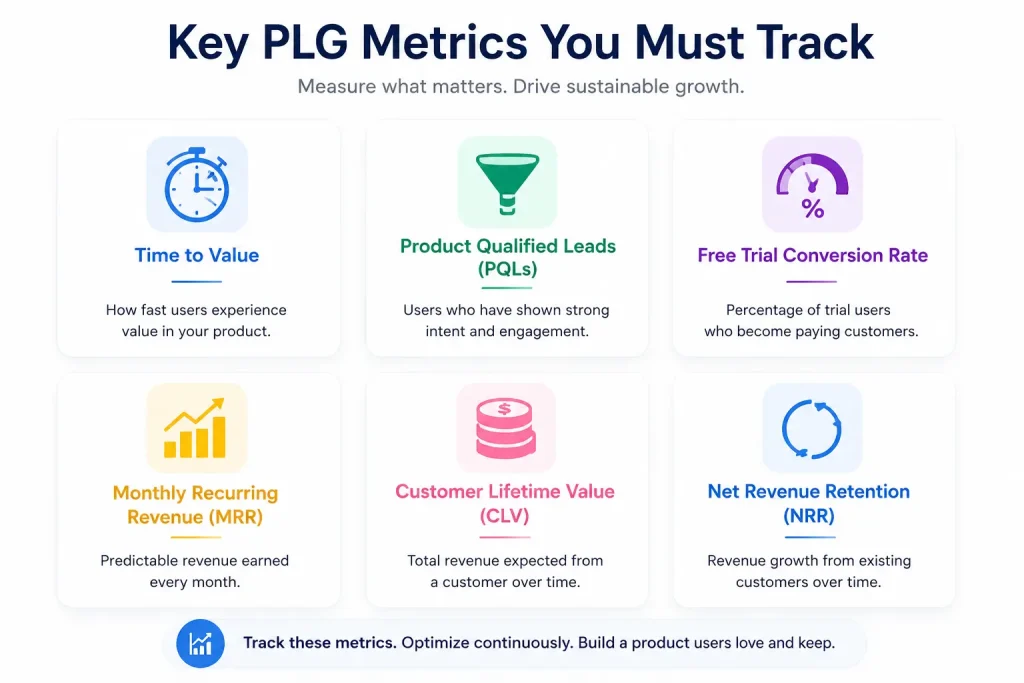
Onboarding completion and activation are not the same thing. These are leading indicators of revenue, not vanity metrics. Tracking metrics in isolation produces noise. Tracking them as a connected system within your product led growth strategy produces decisions.
Acquisition and activation metrics
Time to value (also called Time-to-First-Value) measures how quickly a new user reaches their first meaningful outcome. In a freemium model or free trial, users who don’t hit that moment within minutes are unlikely to convert. Faster time to value is the most direct lever a PLG team controls.
Product qualified leads (PQLs) are free users who’ve demonstrated enough in-product behavior to signal purchase intent. Examples include:
- Hitting a usage threshold
- Inviting a teammate
- Returning repeatedly to a premium feature
Free trial conversion rate measures the percentage of free users who become paying customers. The overall benchmark is 9% across all PLG model types, according to ProductLed’s 2025 PLG Benchmark covering 600+ SaaS companies. If you’re sitting well below that, the gap is almost always in onboarding, not the product itself.
Retention and expansion metrics
Monthly recurring revenue (MRR) and expansion revenue are the compound growth engine of the PLG model. The pirate metrics framework (Acquisition, Activation, Retention, Referral, Revenue) maps directly to the PLG customer lifecycle. In a healthy PLG motion, expansion MRR from existing customers eventually exceeds new MRR from customer acquisition alone.
Customer lifetime value relative to customer acquisition cost (LTV:CAC) determines whether the product led growth model is economically sustainable. In a sales-led model, acquiring each customer requires significant investment in sales rep time, outbound outreach, and demo cycles before a deal closes.
PLG short-circuits that process by letting the product qualify, educate, and convert users on its own, which means the cost of acquiring each paying customer shrinks as the self-serve motion matures. That’s one of the clearest paths to lower customer acquisition costs at scale.
Net Revenue Retention (NRR) above 120% signals that existing customers are expanding faster than churning (SaaSMag). That’s the defining characteristic of sustainable revenue growth in successful PLG strategies.
The Complete PLG Analytics Framework
Knowing what to measure is only half the job. Understanding how each analytics category connects to revenue is what separates PLG companies that achieve growth from those that stall. This framework covers the full customer lifecycle from acquisition to expansion.
1. Acquisition
Acquisition analytics tracks self-serve traffic sources, signup volumes, and attribution models to answer one question: which channels bring in users who actually convert?
Unlike a sales-led growth strategy where the marketing team hands leads to sales teams, PLG acquisition lives entirely in product signals. Key things to track:
- Signup source by channel
- Organic growth rates
- Word of mouth referrals as measurable events, not as soft brand sentiment
2. Activation and conversion
Activation is where most product-led growth companies win or lose. This category covers time to value, Aha moment identification, and onboarding completion rates.
Active users who complete onboarding within their first session convert at dramatically higher rates. The user journey from signup to first value is the single highest-leverage area for product management to optimize.
Faster time to value directly lowers customer acquisition cost by reducing the trial length needed before conversion.
3. Retention and expansion
Retention analytics tracks cohort behavior over time: which users return, which features drive long-term product usage, and how expansion revenue and average revenue per account build from the existing customer base.
Customer success teams use product led growth metrics like feature adoption rate and cohort retention curves to identify accounts at risk before churn occurs.
When users discover and regularly use multiple features, churn probability drops and expansion revenue potential increases. Satisfied customers who embed the product into their workflow become the primary driver of word of mouth referrals and viral growth in a product-led strategy.
4. Product UX and reliability
In a self-service model, friction points and bugs are silent revenue killers. A broken onboarding step, a UI element users can’t find, or a JavaScript error on the upgrade page will cause a free user to leave without ever filing a complaint.
This category covers:
- Friction identification through session replay and heatmaps
- Frontend error monitoring
- Performance impact on churn
For software companies running PLG, a single recurring bug on a conversion-critical page can suppress free trial conversion rate across an entire cohort, often without appearing in any dashboard.
5. Funnel and behavioral analysis
Funnel analytics measures drop-off at every step of the PLG conversion path, from website visit through signup, onboarding, paywall click, and payment. Behavioral analysis adds the user journey context that explains why each drop-off happened.
The most actionable PLG funnel work happens when quantitative drop-off data is paired directly with session replays of the users who exited at that step. Drop-off percentages identify the problem. User behavior recordings diagnose it.
6. Experimentation and growth strategy
Product-led growth examples from companies like Slack, Figma, and Notion share one characteristic: continuous experimentation. A functioning PLG strategy involves constant testing across:
- Onboarding flow variations
- Feature release sequences
- Pricing tests
- Free plan scope adjustments
The discipline is validating experiments against behavioral outcomes, not just conversion rate lifts. A test that improves paid conversion rates in week one but reduces user satisfaction by week four is a negative result, even if the headline number looks positive.
7. PQLs, scoring, and routing
Product qualified leads represent the bridge between product analytics and revenue. PQL scoring assigns a conversion likelihood to free users based on in-product behavior signals:
- Feature usage frequency
- Session depth
- Team invitations sent
- Paywall interactions
When a free user crosses the PQL threshold, they can be routed to sales teams for targeted outreach, or triggered into an automated upgrade prompt.
Most PLG companies running a hybrid go to market strategy use PQL scoring to determine when to involve a sales rep and when to let the product close the deal. This model dramatically reduces the volume of sales calls required to retain users and convert potential customers.
Tracking all seven of these analytics categories in practice requires tooling that connects behavioral data, session-level evidence, and automated prioritization in one place. Most PLG teams struggle not because they lack data, but because that data lives across separate tools that don’t talk to each other.
FullSession is built specifically to close that gap, giving product teams and growth teams a single workspace where funnel numbers, user behavior recordings, and AI-assisted prioritization all point to the same answer: what to fix next, and why it matters for revenue.
Using FullSession for PLG Analytics and UX Insights
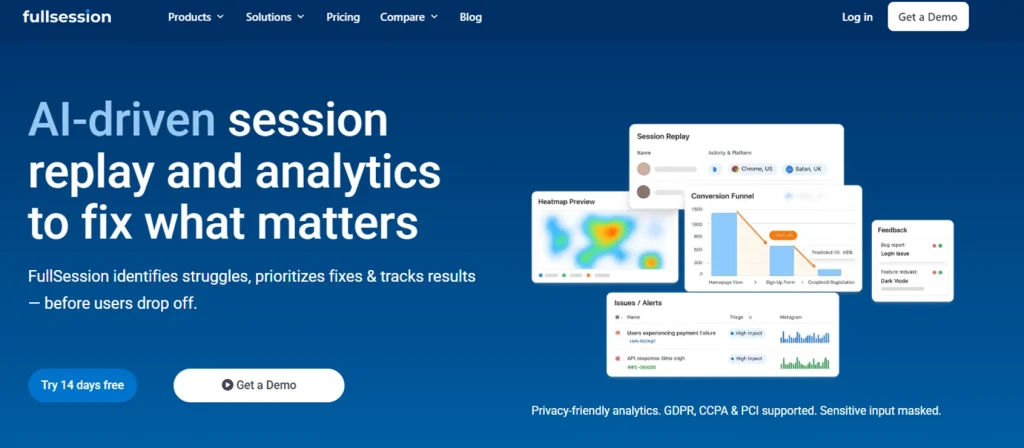
FullSession is a behavior analytics platform built for product led companies that need to connect funnel data, qualitative user behavior, and automated prioritization in one place. Here’s how each feature maps to a specific PLG growth function.
1. Session replay: validating time to value
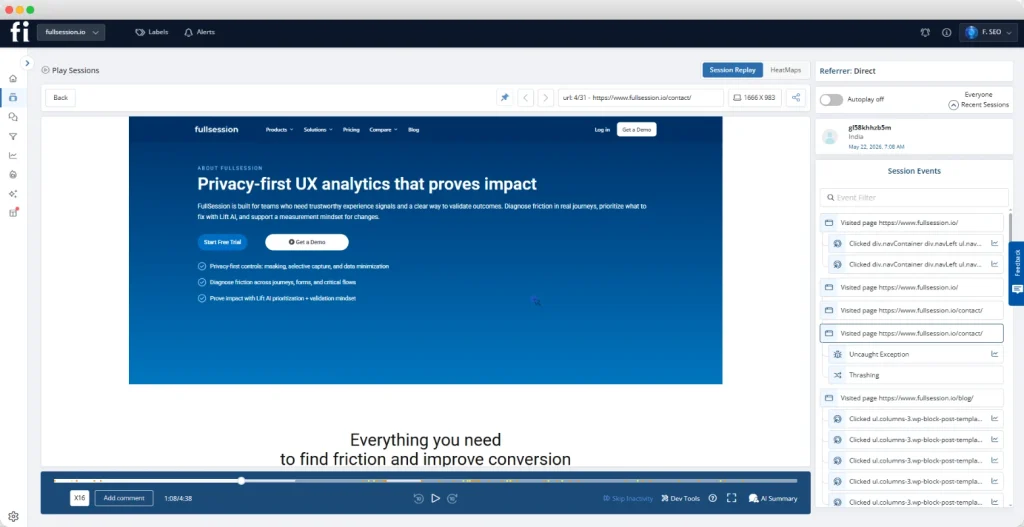
Session replay in a PLG context isn’t about watching random users browse. It’s about watching the onboarding sessions of free users who signed up but never completed their first key action.
FullSession’s session replay captures pixel-perfect playbacks of individual user journeys. Growth teams filter by cohort (for example: “signed up in the last 7 days, never completed first action”) and watch exactly where those users hesitated, misread a UI prompt, or gave up.
Instead of guessing why activation stalled, product teams see visual proof and fix the onboarding friction immediately.
2. Interactive heatmaps: auditing feature discovery
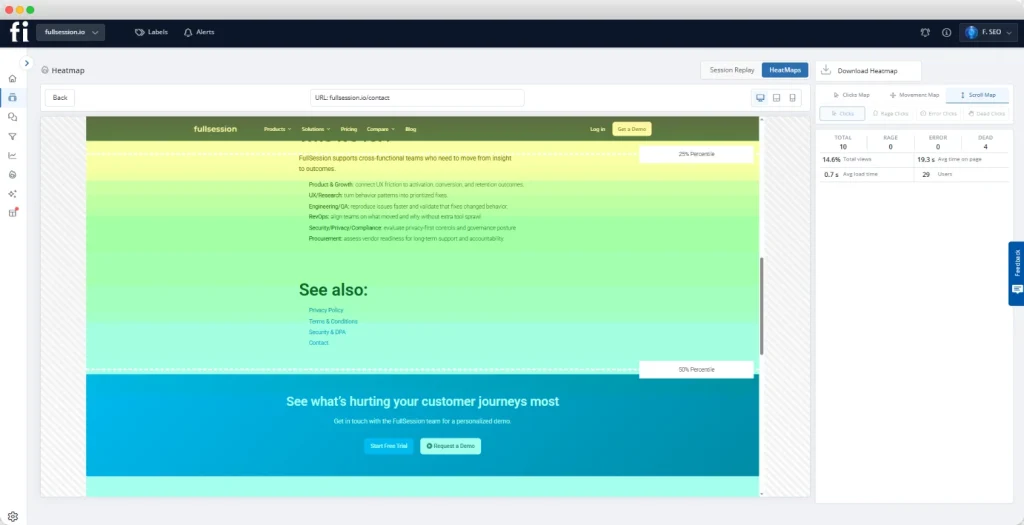
PLG companies rely on users discovering premium features naturally to trigger upgrades. If a high-value feature sits in a visual dead zone on the dashboard, most trial users will never find it.
FullSession’s interactive heatmaps visualize clicks, scroll depth, and engagement overlays across sessions.
Segmenting heatmaps by trial-user cohort versus paying-user cohort reveals the feature discovery gap: where free users stop versus where paying users engage most.
UX designers use that data to restructure layouts and drive feature adoption.
3. Feedback widgets and surveys: capturing qualitative feedback
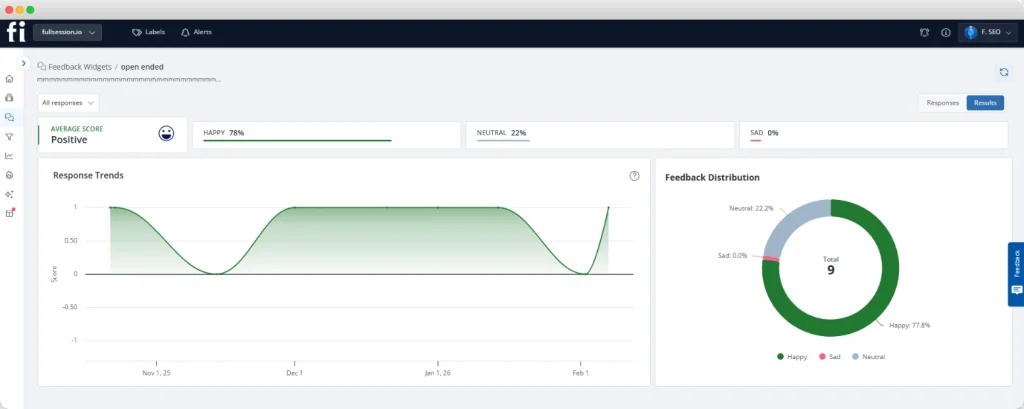
PLG minimizes human touchpoints, so growth teams rarely get to ask users directly why they’re leaving. FullSession’s in-app feedback captures user sentiment at the exact moment of friction.
Every piece of qualitative feedback is linked directly to that user’s session replay. When someone submits “This doesn’t work,” the product team watches the exact playback of what happened.
No back-and-forth. No guesswork. Just the visual proof behind the complaint.
4. Funnel tracking: finding the trial-to-paid leak
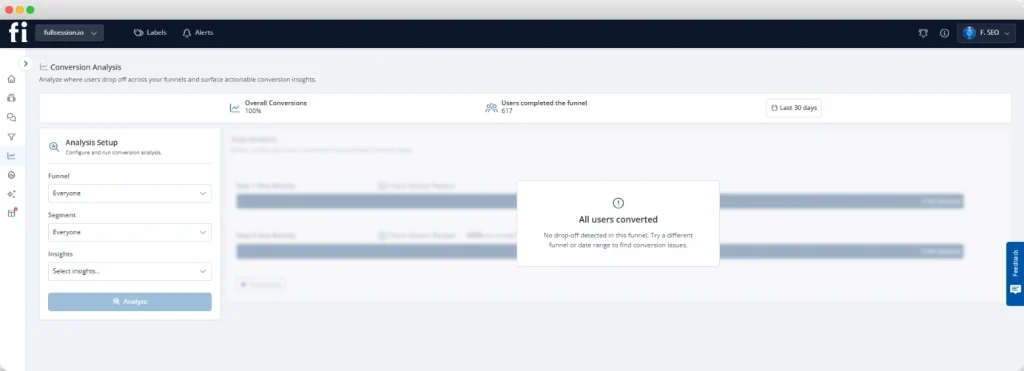
PLG teams live and die by conversion funnels. Funnel analysis in FullSession highlights which step in the free-to-paid journey has the steepest drop-off: Signup, Onboarding, First Key Action, Paywall, or Payment.
Teams can click directly into a leaking funnel step and instantly watch session replays of the users who dropped off at that exact point. Quantitative data identifies the leak. Session replay diagnoses it.
5. Error tracking: protecting revenue from silent bugs

If a JavaScript error breaks the “Upgrade Plan” button, a self-serve user won’t file a ticket. They’ll leave.
FullSession’s errors and alerts track frontend and backend issues in real time, alerting engineering before a bug causes mass trial churn. It pairs the code stack trace with the session replay of the affected user, so QA teams can reproduce and patch conversion-blocking bugs in minutes.
6. Mobile session replay: closing the cross-device gap
Many B2B and B2C SaaS users sign up on desktop but manage tasks on mobile. A broken mobile experience causes drop-off during multi-device usage cycles that most product-led companies never detect in standard funnel data.
FullSession’s mobile session replay captures taps, pinches, swipes, and responsive layout breakage, closing the visibility gap between what works in a desktop demo and what users actually experience on the go.
7. Lift AI: eliminating analysis paralysis
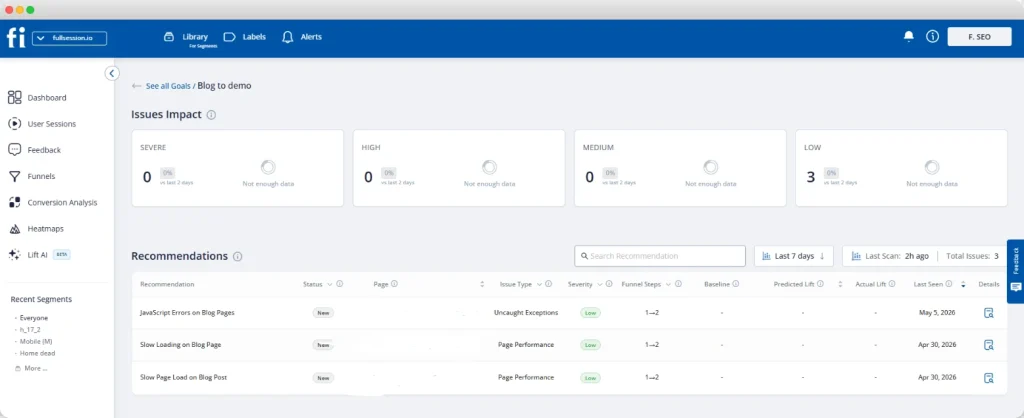
PLG platforms generate thousands of user sessions daily. No team can watch them all. Analysis paralysis is one of the most common failure modes in PLG analytics programs.
Lift AI scans those sessions based on a stated growth goal (for example: “Visitor-to-Signup” or “Paywall Completion”) and outputs a ranked list of friction opportunities sorted by estimated revenue impact.
Product managers know exactly what to fix next to yield the highest upgrade conversion, without manually triaging replays.
See Where Your Trial Users Are Dropping Off
FullSession shows you exactly where trial users abandon your product, so you can fix friction points and boost conversions without any setup calls.
Attribution, Experimentation & Growth Loops
- Multi-touch attribution shows which channels drive real outcomes, not just signups. Track how users move from first touch to activation, PQL, and paid conversion.
- Avoid last-click bias. A blog post, ad, and referral may all contribute to one conversion. Measure the full path.
- A/B test onboarding first. Small changes in onboarding steps, UI prompts, or feature order can significantly improve time to value and conversion rates.
- Measure long-term impact. A test is only successful if it improves retention and expansion, not just short-term upgrades.
- Track growth loops. Monitor invite flows, referrals, and collaboration features that bring in new users. Focus on loop completion rate and speed.
Governance, Privacy & Cross-Functional Alignment
- PLG analytics must comply with GDPR, CCPA, and PCI DSS where relevant. This includes proper consent handling and secure data storage.
- Use data masking to protect sensitive information. Automatically hide PII, passwords, and payment details in session replays.
- Keep one source of truth. Product, marketing, growth, and engineering teams should work from the same data and definitions.
- Align teams around shared metrics like activation, retention, and PQLs to avoid conflicting priorities.
FullSession includes built-in privacy and security features such as data masking, consent controls, secure data handling, and compliance-ready infrastructure to help you stay compliant while analyzing user behavior.
Turn Product Insights Into Growth
Analyze user behavior, find friction, and align your teams with privacy-first session replay and product analytics built for PLG companies.
PLG Analytics Roadmap to Reduce CAC and Increase LTV
Turning product analytics into lower customer acquisition costs and higher customer lifetime value requires a sequenced approach, not a wishlist of tracking metrics. Follow these four steps in order.
- Automate prioritization and iterate weekly. Use AI-assisted scoring to rank friction opportunities by estimated revenue impact. Ship the highest-ranked fix, measure before/after, and repeat. Rapid growth in a product-led strategy is a weekly iteration loop, not a quarterly planning event.
- Instrument your PLG funnel. Define every funnel step, set conversion events, and baseline your current time to value and drop-off rate per step. Without a baseline, improvement is invisible.
- Connect quantitative drop-off to qualitative behavior. For each leaking funnel step, watch session replays from users who exited there. Identify the specific friction pattern (confusion, error, dead end) before designing any fix.
- Score and route PQLs. Define your PQL threshold based on in-product behavior signals and route high-scoring free users into upgrade prompts or sales team outreach automatically.
Conclusion About Web Analytics for Product LED Growth Companies
Your analytics stack needs to answer questions standard web analytics tools weren’t built for. Where do free users stall before reaching value? Which onboarding step is leaking the most revenue? Which bug is quietly suppressing upgrades this week?
The PLG analytics framework spanning acquisition, activation, retention, UX reliability, funnel analysis, experimentation, and PQL scoring gives product teams and growth teams a complete view of the customer lifecycle. Acting on it consistently is what turns a product led strategy into sustainable, compounding revenue.
FullSession brings these signals together in one place, so teams can move from guessing to seeing the exact friction points behind drop-offs, low activation, and missed upgrades. That makes it easier to fix the right issue faster and keep growth decisions grounded in real user behavior.
See Where Trial Users Drop Off and Fix It Faster
FullSession shows you exactly where trial users abandon your product, so you can fix friction points and boost conversions.
FAQs About Web Analytics for Product LED Growth Companies
What is the difference between product analytics and growth analytics?
Product analytics measures in-product user behavior: how active users interact with features, where they activate, and where they churn. Growth analytics broadens the lens to include customer acquisition channels, referral loops, and the full customer journey from first touch to expansion revenue. In PLG companies, both disciplines overlap because the product is the primary driver of acquisition and growth.
What is the PLG methodology?
The product-led growth (PLG) methodology is a go-to-market strategy where the product itself drives customer acquisition, activation, retention, and expansion without a sales team handling early-stage conversion. Users discover the product, experience its value through a free trial or freemium model, and convert to paying customers based on that value alone. Sales teams get involved only for high-value accounts.
What are examples of web analytics?
Web analytics examples for product-led growth companies include:
- Funnel conversion tracking (measuring drop-off from signup to first key action)
- Session replay (recording user journeys to identify UX friction)
- Heatmaps (visualizing clicks and scroll depth)
- Error tracking (detecting bugs that block conversions)
- In-app surveys that capture user feedback at friction points
FullSession provides all these features in one, user-friendly platform.
What is product-led SEO?
Product-led SEO is a growth strategy where a product’s core functionality generates indexable, user-created pages at scale, turning the product into an organic growth engine. Figma’s shareable design files and Notion’s public page templates are widely cited product led growth examples. It differs from traditional sales or content-led approaches by making user generated content the acquisition mechanism.
How do PLG companies measure success?
PLG companies measure success through activation rate, time to value, free trial conversion rate, expansion revenue from existing customers upgrading, and net revenue retention above 120%. That NRR threshold signals organic growth from the existing customer base, which is the foundation of a self service business model that lowers customer acquisition cost over time.

Roman Mohren is CEO of FullSession, a privacy-first UX analytics platform offering session replay, interactive heatmaps, conversion funnels, error insights, and in-app feedback. He directly leads Product, Sales, and Customer Success, owning the full customer journey from first touch to long-term outcomes. With 25+ years in B2B SaaS, spanning venture- and PE-backed startups, public software companies, and his own ventures, Roman has built and scaled revenue teams, designed go-to-market systems, and led organizations through every growth stage from first dollar to eight-figure ARR. He writes from hands-on operator experience about UX diagnosis, conversion optimization, user onboarding, and turning behavioral data into measurable business impact.