.svg)

Introducing Lift AI: Stop Guessing What to Fix Next

Every product team has the same dirty secret: they collect more behavioral data than they can act on.
Session replays pile up unwatched. Heatmaps confirm what everyone already suspected. Funnels show where users drop off, but not why, and definitely not what to do about it. The real bottleneck was never data collection. It’s prioritization.
That’s why we built Lift AI.
The prioritization gap in UX analytics
Most analytics tools are excellent at telling you what happened. A smaller number can tell you why. Almost none can tell you what to do next, ranked by business impact, with evidence attached.
This is the gap where teams lose weeks. The PM pulls data one way. The designer interprets it another. Engineering asks for clearer requirements. Growth wants revenue attribution. Alignment meetings multiply. Meanwhile, users keep dropping off at the same checkout step.
We’ve heard this pattern from dozens of teams. It’s not a data problem. It’s a decision problem.
How Lift AI works
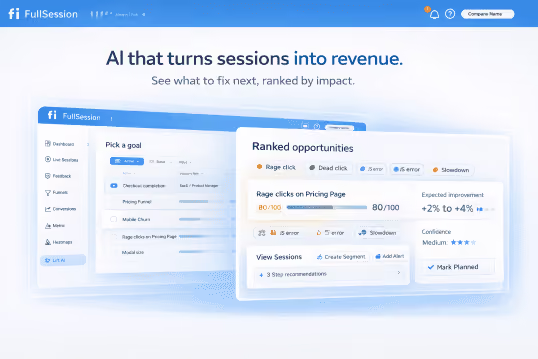
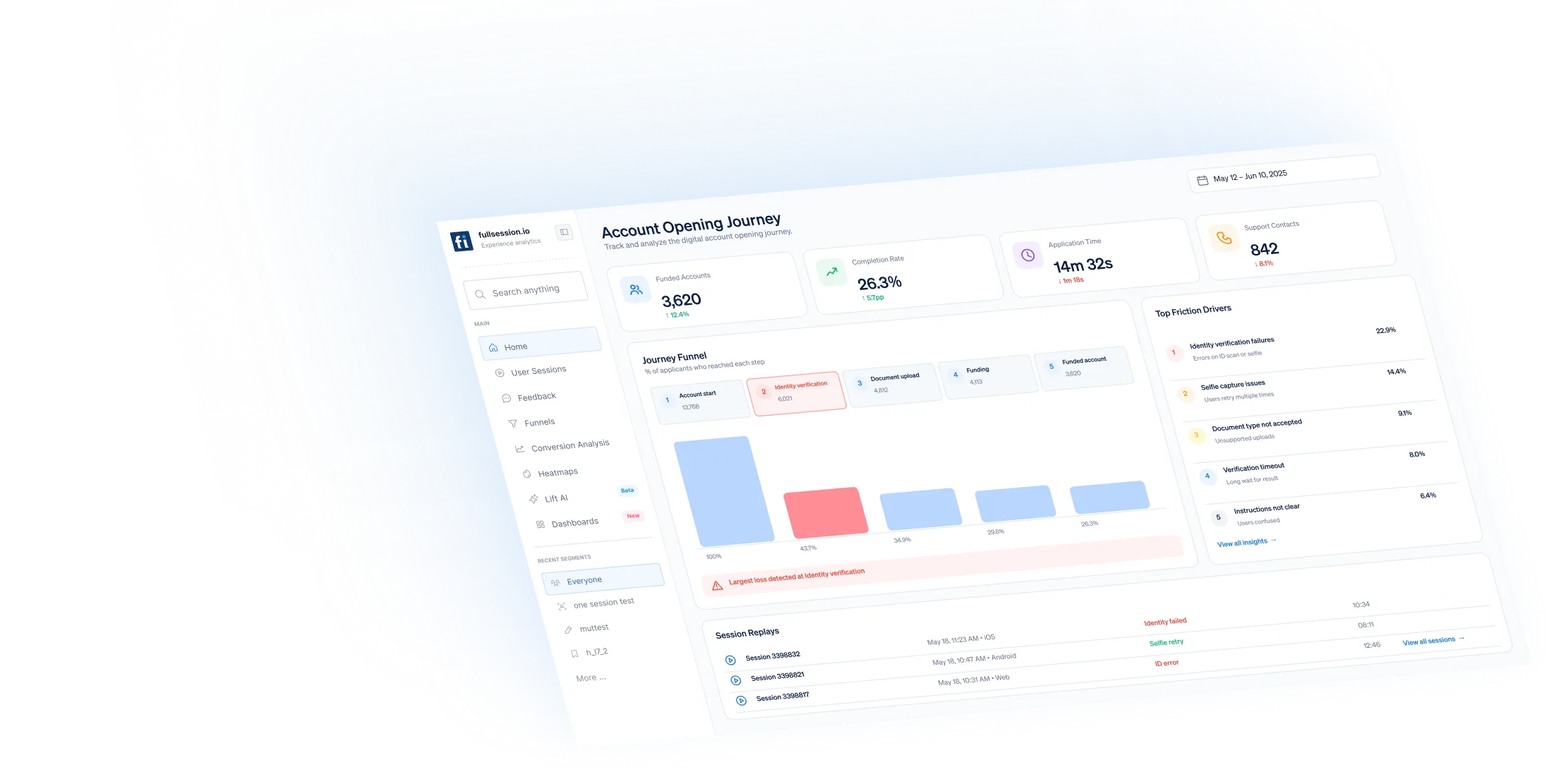
Lift AI sits on top of FullSession’s behavioral data layer (session replays, heatmaps, funnels, error tracking) and transforms raw signals into a prioritized action plan.
Here’s the workflow:
1. Set a goal
Choose the business outcome you’re optimizing for: Checkout completion, Revenue per visitor, Visitor-to-Signup, or any custom funnel goal. This anchors every recommendation to revenue.
2. Lift AI determines the attribution window
The system automatically selects the optimal lookback and forward analysis window based on your funnel metrics. No manual configuration required.
3. Get ranked opportunities
Lift AI analyzes friction, failures, and slowdowns across real sessions. It surfaces a ranked list of opportunities, each with an expected improvement estimate, confidence score, the specific funnel step it impacts, affected pages, and links to example sessions as proof.
That’s it. No dashboards to configure. No segments to build first. No analyst required to interpret the output.
What makes this different from AI summaries
A lot of analytics tools have started bolting on AI features that generate text summaries of your data. These read well but rarely change behavior. They describe what you’re already looking at in slightly different words.
Lift AI is different in three ways:
1. Goal-anchored, not dashboard-anchored
Every recommendation ties back to the specific business outcome you selected. Lift AI doesn’t summarize your heatmap. It tells you which friction point, if resolved, would have the largest estimated effect on your chosen goal.
2. Evidence-backed, not vibes-based
Each opportunity includes the funnel step it affects, the pages involved, and direct links to session replays where the problem manifests. Your team can verify the recommendation before committing engineering time.
3. Confidence-scored, not binary
Not all opportunities are created equal. Lift AI provides a predicated lift impact and when you implemented a recommendation and the post window is complete, it also provides the actual lift. Just be careful not to do lots of changes within the testing timeframe, or the actual lift calculation will be flawed.
Who Lift AI is for
Lift AI is designed for teams responsible for revenue-critical user journeys:
- Ecommerce and DTC teams focused on checkout completion and basket value.
- PLG SaaS teams optimizing signup-to-paid conversion and onboarding activation.
- Growth and Product teams who need a shared, goal-based opportunity list instead of scattered insights across tools.
- UX, Engineering, and Analytics teams who want to see exactly where technical and experience issues hurt revenue, with sessions attached.
How to validate a Lift AI recommendation
We’re transparent about what Lift AI is and isn’t. It provides estimates, not guarantees. The recommended workflow is straightforward:
- Review the recommendation and its linked evidence (sessions, impacted steps, affected pages).
- Ship the fix (UX, copy, flow, or technical) and let Lift AI know you completed the recommended action.
- Measure impact using a pre/post comparison.
Your measurement is always the source of truth.
Try Lift AI in beta
Lift AI is available now as a beta feature for all FullSession users. Start a free trial to see it in action, or book a demo if you want a guided walkthrough of how it applies to your specific funnels.
We built this because we believe the next generation of analytics isn’t about more data. It’s about better decisions. Lift AI is our first step toward that.
See what’s costing you, and prove whats fixing it is worth
Watch the real journey, rank every issue by revenue impact, and validate the result against baseline.



.svg)
.svg)
212 E Stone Path St Derby, KS 67037 Phone: +1 415-649-4222



All systems operational.