.svg)

How to Choose Session Replay Software for Web Performance Analysis (Performance-First Framework)


What session replay is (and why performance teams use it differently)
Session replay records a user’s experience so teams can review what happened in a real session: clicks, scrolls, navigation, UI states, and often DOM changes. Many guides position replay for UX research and conversion optimization. Performance teams typically care about a different outcome: faster root cause analysis for slow interactions, regressions, and “can’t reproduce” performance bugs. Ecommerce teams can use the same evaluation mindset when comparing ecommerce session recording tools for checkout friction, product page behavior, cart abandonment, and conversion optimization.
A replay tool can be strong for UX and still be a poor fit for performance work if it adds meaningful overhead, cannot be correlated with performance telemetry, or makes it hard to isolate slow sessions.
The evaluation framework: requirements to tests to rollout
To avoid feature-checklist fatigue, evaluate tools in this order:
- Requirements: what you need to reduce MTTR in your real workflow.
- Tests: prove overhead and correlation under real settings.
- Rollout: deploy safely with sampling and governance that preserve diagnostic value.
Before building your shortlist, compare different Session Recording Replay Tools against these same requirements so you are not choosing based on generic feature lists alone.
Step 1: Set a performance overhead budget before you demo tools
If you do not define a budget, every demo will look “fine,” and you will only learn about overhead after rollout. Create a simple budget across three buckets: (1) user experience metrics, (2) main-thread work, and (3) network and memory. Your budget can be expressed as “no meaningful regression” or as a numeric threshold if your org uses strict performance gates.
Step 2: Scorecard criteria that matter for performance investigations
Step 3: How to test replay overhead in a repeatable way
Do not rely on a single Lighthouse run. Make the test repeatable. Pick 3–5 representative routes, run a baseline build without replay, then add the replay script and repeat at multiple capture settings. Compare user experience metrics, main-thread work, and network payload. Validate on heavy routes and on mid or low-end devices where regressions often show up first.
Step 4: Correlation depth: define what must connect
“Integrates with” is not enough. For performance work, define correlation requirements: shared session and user identifiers with your telemetry, consistent timestamps, and a reliable pivot from outlier metrics to replay to network and error evidence. If a tool cannot support those pivots, it will be interesting but not consistently MTTR-improving.
Step 5: Sampling, retention, and governance that do not sabotage MTTR
Performance investigations need coverage in the right places, not maximum coverage everywhere. Start with targeted capture on critical routes and known regression areas, then temporarily increase sampling during incidents. Pair this with retention that supports before vs after comparisons and governance controls that preserve diagnostic value: configurable masking, do-not-record rules for sensitive flows, RBAC, and auditability.
Step 6: Run a one-week pilot with a success rubric (tied to MTTR)
After you shortlist 2–3 tools, run a one-week pilot that answers two questions: does it solve real performance investigations faster, and does it stay within overhead and governance constraints? Use 3–5 investigation drills based on real recent issues and track time-to-reproduce, quality of evidence, fewer dead ends, overhead impact, and operational confidence.
Related answers
Common follow-up questions
RUM tells you what happened at scale. Replay helps you understand why a specific session went wrong. MTTR improves most when you can pivot from an outlier to the exact session moment and supporting evidence quickly.
It can, depending on capture method and configuration. Set an overhead budget, test on heavy routes, and validate at multiple sampling and fidelity settings before rollout.
For performance investigations, aim for enough fidelity to explain the bottleneck while staying within budget. Use targeted capture and increase fidelity during incidents if needed.
Correlation between replay and performance telemetry via shared identifiers, timestamps, and reliable pivots from metrics to replay to evidence.
Start with targeted sampling on critical routes and outlier sessions, then temporarily increase capture during incidents. The goal is coverage where it matters, not blanket recording.
Use configurable masking, do-not-record rules for sensitive flows, and RBAC. Protect users while keeping the technical context needed for debugging.
See what’s costing you, and prove whats fixing it is worth
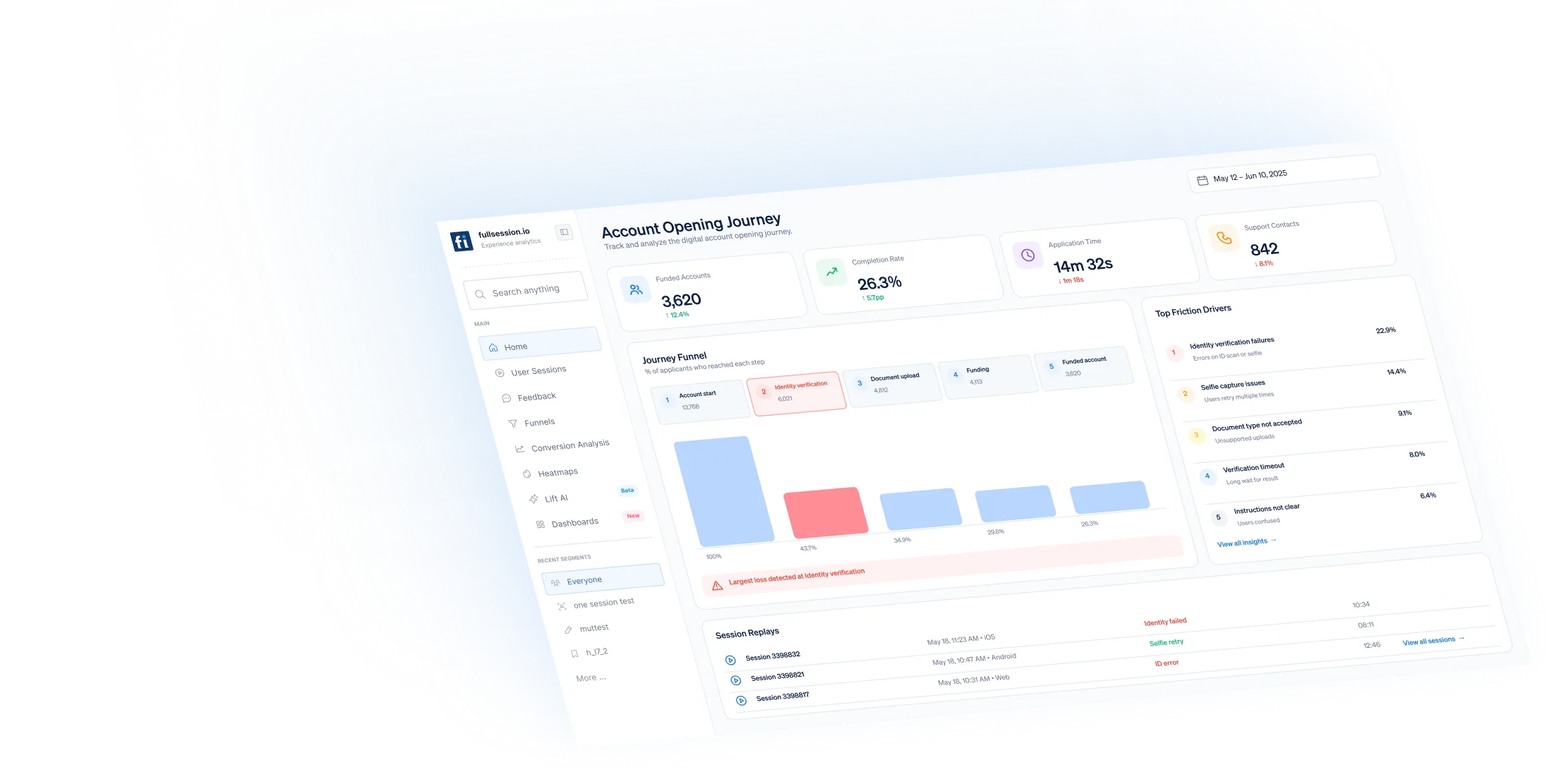
Watch the real journey, rank every issue by revenue impact, and validate the result against baseline.



.svg)
.svg)
212 E Stone Path St Derby, KS 67037 Phone: +1 415-649-4222



All systems operational.