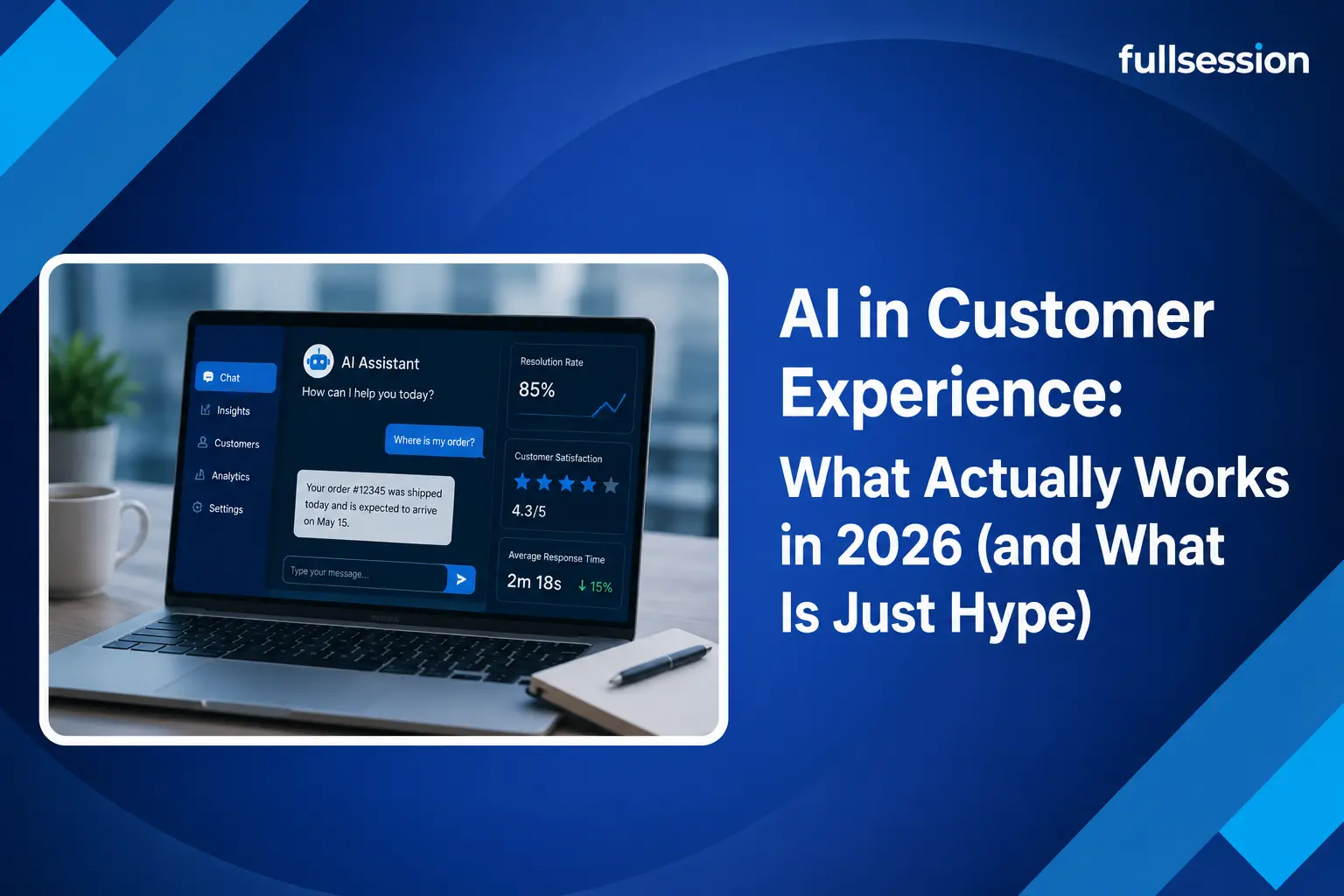

The mandate arrives from above: add AI to the customer experience. So the stack grows another tool, a new dashboard lights up, and a model starts scoring things. A quarter later the reports are prettier, the demos went well, and customers are still rage-clicking through the same checkout step they were stuck on before. The AI got added. The experience did not get better.
That gap is the real story of AI in customer experience right now. The technology is genuinely useful, but most of the spend goes to features that sound impressive and change nothing, while the parts that move the needle get ignored because they are less glamorous. This guide separates the two. It covers what AI in CX actually means, where it earns its keep today, where it wastes money, and the one thing every useful application depends on: knowing what your customers are really doing.
QUICK TAKEAWAY
AI does not create a good customer experience. It scales your understanding of one. Point it at real behavior (sessions, heatmaps, funnels, feedback) and it will surface friction, personalize, and summarize sentiment faster than any team could by hand. Point it at thin data or a broken journey, and it just produces confident noise. The data foundation is the whole game.
What AI in customer experience actually means
Strip away the marketing and AI in customer experience does three jobs. It helps you understand behavior at scale, it personalizes what each customer sees, and it automates parts of service. Everything sold under the CX and AI banner is some combination of those three.
Understanding is the foundation. Models read the raw signals of a session, the clicks, scrolls, hesitations, errors, and open-text feedback, and turn millions of them into patterns a human could never sort by hand. Personalization acts on that understanding, adjusting the next message, offer, or screen to fit the person. Automation handles the repetitive front line: answering the common question, routing the ticket, drafting the reply.
The important part is what AI is not. It is not a strategy, and it is not a substitute for knowing your customer. It is a layer that sits on top of your behavioral data and makes that data faster to act on. If the data underneath is incomplete or wrong, the AI inherits every blind spot and states them with confidence. That single fact explains most of the difference between AI CX projects that work and the ones that quietly get shelved.
Why so much AI CX spend underdelivers
Start with the customers themselves. PwC’s 2025 Customer Experience Survey found that 58 percent of consumers are only somewhat or not at all comfortable using AI tools to engage with brands, and that 70 percent of executives say customer expectations are evolving faster than their company can adapt. People are wary, and the teams serving them are already behind. Dropping an AI chatbot in front of a frustrated customer does not close that gap. It can widen it.
The second failure is more common and more expensive: using AI to automate a journey that is broken. If users cannot find the feature, if the form rejects valid input, if the mobile checkout hides the payment button, then a faster, AI-powered version of that flow just delivers the same failure more efficiently. Automation multiplies whatever it is pointed at, including the friction.
The third is the quiet one. Most AI CX tools run on whatever data they can reach, which is often event counts and survey scores. That tells you what happened and how people rated it, but not why. A model trained on outcomes without the behavior behind them will confidently recommend fixes for the wrong problem. Garbage in, confident garbage out. The way past all three is not more AI. It is better ground truth for the AI to stand on.

Where AI genuinely improves CX today
Set the hype aside and four applications hold up. Each one earns its place because it does something people cannot do fast enough by hand, and each one only works when it sits on accurate behavioral data.
1. Detecting and ranking friction automatically
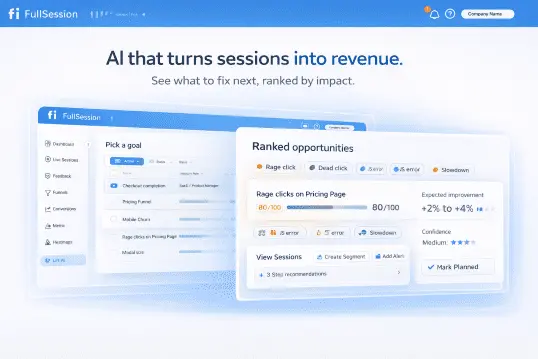
The most valuable thing AI does in CX is unglamorous: it finds where users are struggling and tells you which struggle costs the most, in seconds instead of days. A team can watch recordings and read heatmaps, but not across every page and segment at once. A model can. It flags the spike in rage clicks on a checkout button, the error cluster on one browser, the step where a whole segment stalls, and it ranks them so you fix the expensive problem before the annoying one. FullSession’s Lift AI does exactly this, scoring friction so the fix queue is ordered by impact rather than by whoever complained loudest.
2. Personalization earned from real behavior
Personalization is where AI pays off in revenue, but only when it is based on what people actually do rather than a crude demographic guess. McKinsey’s research found that 71 percent of consumers expect personalized interactions and 76 percent get frustrated when they do not get them, and that faster-growing companies drive 40 percent more of their revenue from personalization than slower-growing peers. The gap between good and bad personalization is the data behind it: behavioral signals from real customer journey analytics beat a segment built on age and postcode every time.
3. Understanding sentiment at scale
Open-text feedback is a goldmine that most teams cannot mine, because reading ten thousand survey responses by hand is not realistic. This is a natural fit for language models: they cluster the comments, surface the recurring complaint, and tie sentiment to the moment it happened. Paired with in-page feedback, that turns a wall of text into a ranked list of what is bothering people and where. It is one of the few AI CX features that is both easy to trust and easy to act on, because you can go straight from the summarized complaint to the session where it occurred.
4. Predicting churn and intent
Behavioral signals are leading indicators. A drop in feature use, a stalled onboarding step, a rise in errors for one account: these predict churn well before the renewal date, and AI is good at spotting the pattern across a whole base. The catch is the same as everywhere else. A churn model is only as good as the behavioral inputs it reads, which is why teams that take prediction seriously invest in real-time customer analytics first and the model second.
GROUND YOUR AI IN REAL BEHAVIOR
Give your AI something true to stand on
FullSession pairs session replay, heatmaps, and conversion funnels with Lift AI, so the model ranks friction from behavior you can actually watch.
The data foundation every AI CX feature depends on
Here is the point the glossy platform launches skip. None of the four applications above works without ground truth about what users actually do, and most stacks do not have it. They have page views, event counts, and NPS. That is the shadow of behavior, not the behavior itself.
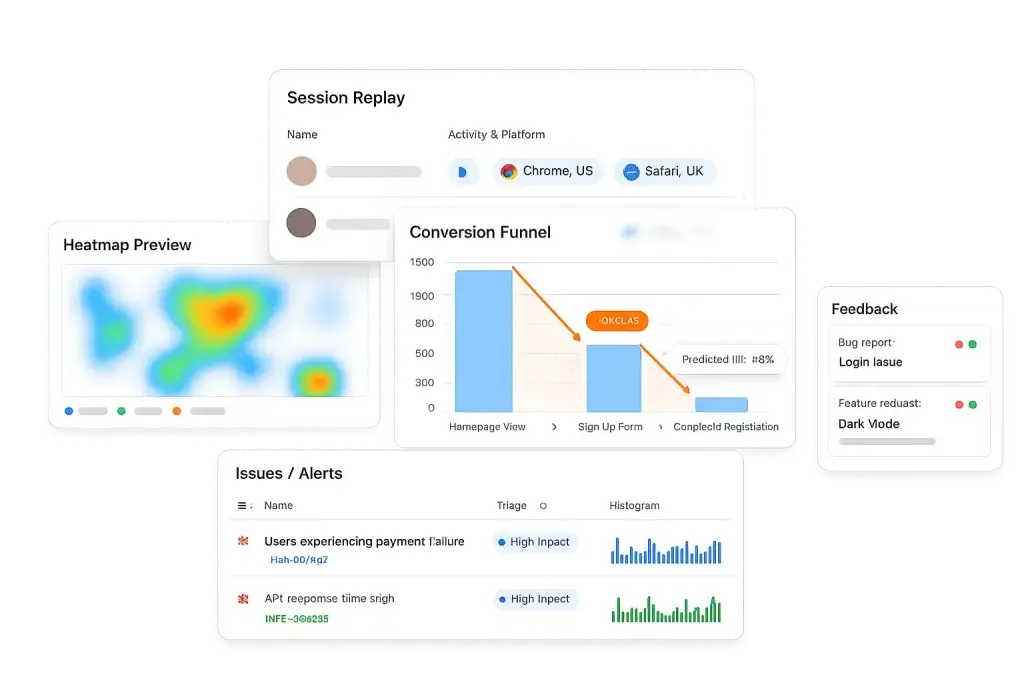
Ground truth has four parts. Session replay shows how a real person moved through a page, where they hesitated, and what they abandoned. Heatmaps show what the whole population saw and ignored, so you can tell a discovery problem from a value problem. Funnel data shows exactly where people drop between steps. And error and alert signals show where the experience broke while nobody was watching. Feed those into a model and its outputs get sharp. Withhold them and it guesses.
This is also the honest answer to the tool-sprawl problem that vendors love to describe. The fix is not one more platform that promises to unify everything. It is making sure the behavioral layer, the raw record of what customers do, is complete and trustworthy before you put any AI on top of it. Our take on the AI interpretation layer goes deeper on why that ordering matters.
Keep the humans where judgment matters
AI is good at the excavating. It reads the thousand sessions, ranks the friction, and drafts the summary so a person does not spend a week doing it. What it should not own is the judgment: which trade-off to make, how to word the apology, whether a fix is worth the engineering time. That belongs to people, and the PwC finding that most consumers are still uneasy with AI-led interactions is a reminder to keep a human in the loop where it counts.
The pattern that works is simple. Let AI hand your team a short, evidence-backed list of what is hurting the experience and why, then let people decide and act. That keeps the speed of automation and the trust of human judgment. For teams organizing this work, the customer success and product management workflows show how the prioritized list turns into shipped fixes, and our roundup of CX tools covers where these pieces fit together.

How to roll out AI in CX without the hype
A practical sequence beats a big platform bet. Start by fixing the behavioral data: make sure you are actually capturing sessions, heatmaps, funnels, and feedback across web and app, because that is the fuel for everything else. Then pick one narrow, painful problem, a checkout drop, a stalled onboarding step, a support queue clogged with one repeated question, and apply AI to that alone.
Measure it against a real baseline. If the AI-driven change lifts completion or cuts resolution time, expand it. If it does not, you learned that cheaply instead of after a year-long rollout. Watch the behavior after every change, not just the score, because a metric can improve for the wrong reason while the underlying experience gets worse. Our guide to measuring customer experience covers how to set those baselines, and NPS detractor analysis shows how to tie a score back to the sessions behind it.
Do this and AI stops being a line item you have to justify and becomes what it should be: a way to understand your customers faster than you could alone. The teams getting real value from AI in CX are not the ones with the most models. They are the ones whose models can see what their customers are actually doing.
Turn AI ambition into experiences you can prove
Visualize, analyze, and act on real user behavior with FullSession, then let Lift AI rank what to fix first. No credit card needed to start.
AI in customer experience: FAQ
What is AI in customer experience?
AI in customer experience is the use of machine learning and generative models to understand customer behavior at scale, personalize what each person sees, and automate parts of service. It is not one feature. It is a layer that reads signals like clicks, journeys, errors, and feedback, then predicts intent, flags friction, or tailors the next step. Its usefulness depends entirely on the quality of the behavioral data underneath it.
Does AI actually improve customer experience?
It can, when it is pointed at a real problem and fed good data. AI is strong at surfacing friction fast, personalizing from real behavior, and summarizing feedback at scale. It underdelivers when it automates a broken journey or runs on thin data. PwC’s 2025 survey also found 58 percent of consumers are only somewhat or not at all comfortable using AI to engage with brands, so where you apply it matters as much as whether you use it.
Where does AI help most in CX today?
Four areas are reliable right now: automatically detecting and ranking friction so teams fix the costliest issues first, personalizing content and offers based on observed behavior, analyzing open-text feedback and sentiment at scale, and predicting churn or intent from behavioral signals. Each one improves the experience only when it sits on top of accurate session, heatmap, funnel, and feedback data.
What data does AI need to improve CX?
AI needs ground truth about what users actually do, not just what they say or buy. That means session replays that show how people move through a page, heatmaps that show what they see and miss, funnel data that shows where they drop, and error and feedback signals that show where they struggle. Without that behavioral foundation, an AI model is confidently guessing.
Can AI replace human customer experience teams?
No. AI removes grunt work: it excavates issues, drafts summaries, and ranks problems so people do not have to. The judgment about what to fix, how to word an apology, and which trade-off to make still belongs to humans. The best results come from AI that hands a team a prioritized, evidence-backed shortlist, then lets people decide and act.

Roman Mohren is CEO of FullSession, a privacy-first UX analytics platform offering session replay, interactive heatmaps, conversion funnels, error insights, and in-app feedback. He directly leads Product, Sales, and Customer Success, owning the full customer journey from first touch to long-term outcomes. With 25+ years in B2B SaaS, spanning venture- and PE-backed startups, public software companies, and his own ventures, Roman has built and scaled revenue teams, designed go-to-market systems, and led organizations through every growth stage from first dollar to eight-figure ARR. He writes from hands-on operator experience about UX diagnosis, conversion optimization, user onboarding, and turning behavioral data into measurable business impact.