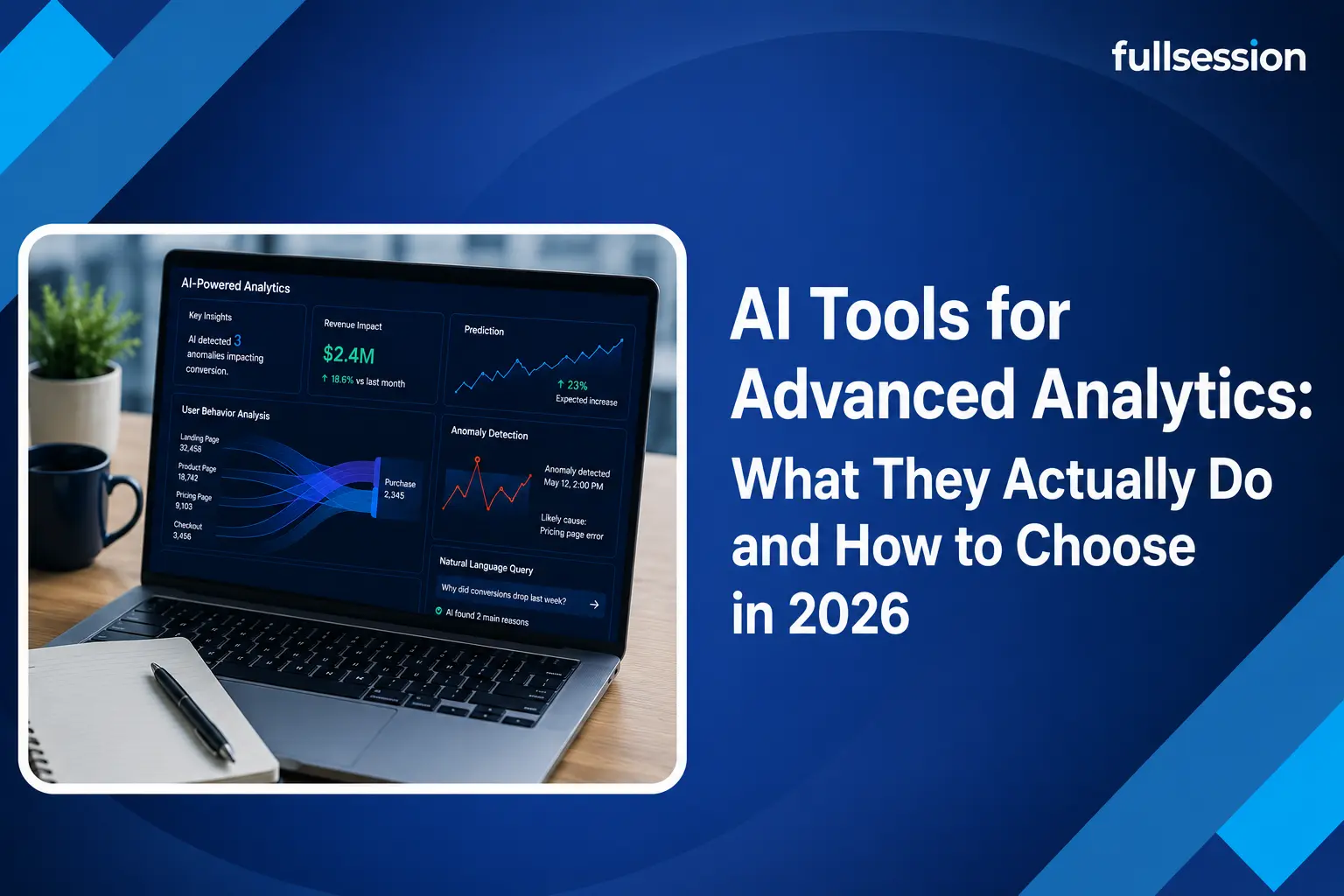

Search for AI analytics tools and you get the same thing every time: a list of seven products that have nothing to do with each other. A social listening tool sits next to a business intelligence suite, next to an A/B testing platform, next to a behavior analytics product. Each one is fine. Together they answer the question “what tools exist?” and completely dodge the one you actually have, which is “which of these solves my problem?”
This guide takes a different route. Instead of ranking unrelated tools, it explains what AI genuinely does in analytics, sorts the tools into the jobs they are built for, and gives you a way to choose based on the decision in front of you. The goal is not a longer list. It is a shorter shortlist.
QUICK TAKEAWAY
AI does five useful things in analytics: prepares data, finds patterns, predicts, reads language at scale, and ranks issues by impact. Tools cluster into categories (behavior analytics, product analytics, BI, voice of customer, testing, competitive intel), and the right pick starts from the question you need answered. For understanding what users do on your site, behavior analytics with AI prioritization is the place to begin.
What AI actually does in analytics
Before comparing tools, it helps to be precise about what the AI inside them is really doing. Strip the marketing and it comes down to five jobs, each one a task a skilled analyst could do given unlimited time, done faster and at larger scale.
The first is data preparation: cleaning, joining, and shaping raw data so it can be analyzed at all. This is the unglamorous majority of analytics work, and automating it is where AI quietly saves the most hours. The second is pattern and anomaly detection, finding correlations and outliers across datasets too large to scan by eye. The third is prediction, using historical data to estimate what happens next, such as which accounts are likely to churn. The fourth is language at scale, reading thousands of open-text comments, reviews, or survey responses and turning them into themes and sentiment. The fifth, and the most underrated, is prioritization: ranking a pile of issues by their impact so a team fixes the expensive problem before the trivial one.
Notice what is not on that list. AI does not decide what matters to your business, it does not know your strategy, and it does not supply the judgment to act. McKinsey’s 2025 survey found that 88 percent of organizations now use AI in at least one function, up from 78 percent a year earlier, yet the same research notes that scaled, measurable impact is still rare. The gap is almost always human: the value shows up when people apply judgment on top of the automation, not when they buy the tool.

How to choose: start from the question, not the tool
The reason those seven-tool listicles fail is that they compare products across categories that are not substitutes. A business intelligence suite and a session replay tool are not competitors any more than a spreadsheet and a microscope are. So the first move is to name the decision you are trying to make, because that decision points to a category, and the category shortlists the tools.
If you need to know why users hesitate, abandon, or rage-click on your site, you want behavior analytics. If you need retention curves and journey trends across many sessions, that is product analytics. If you need to blend and visualize data from a warehouse, that is business intelligence. If you need to understand what customers are saying in their own words, that is voice of customer. If you need to prove a change works, that is experimentation. If you need to see how you stack up against rivals, that is competitive intelligence. Pick the category, shortlist two tools inside it, and test them on one real question you already care about. Comparing AI feature lists comes last, not first.
The categories of AI analytics tools
Here is the same universe of tools the listicles cover, organized by the job each one is actually for. The representative names are examples, not endorsements, and most teams end up using one tool from two or three of these rows rather than one tool that claims to do everything.
| Category | The question it answers | What the AI adds | Representative tools |
|---|---|---|---|
| Behavior analytics | Why do users struggle on our site? | Auto friction scoring, anomaly alerts, replay search | FullSession, Hotjar, Contentsquare |
| Product analytics | How do users retain and progress over time? | Predictive churn, natural-language queries | Amplitude, Mixpanel |
| Business intelligence | What do our warehouse numbers say? | Auto-generated narratives, ask-a-question queries | Power BI, Tableau |
| Voice of customer | What are customers telling us in words? | Sentiment analysis, theme clustering, summaries | Survey and feedback tools |
| Experimentation | Does this change actually work? | Variant and copy generation, result analysis | Optimizely, VWO |
| Competitive intelligence | How do we compare to rivals? | Traffic estimation, AI query assistants | Similarweb, Semrush |
Two rows deserve a closer look because they are where most teams get the fastest return. Product analytics answers the “what happened over time” question and is strong for retention and cohort work; our guide to product metrics covers how to read those trends. Behavior analytics answers the “why did it happen” question, and for a lot of teams that is the one blocking real improvement, because a chart can tell you conversion dropped without ever telling you what went wrong on the page. That is the category we will go deeper on, both because it is our field and because it is the one the source listicles treated as an afterthought.

Where AI earns its keep in behavior analytics
Behavior analytics is a natural home for AI, because the raw material is enormous and the signal is buried. A busy site produces more sessions than any team could ever watch, and the moment that explains a conversion drop might be hiding in one recording out of fifty thousand. This is exactly the kind of needle-in-a-haystack problem machine learning is built for.
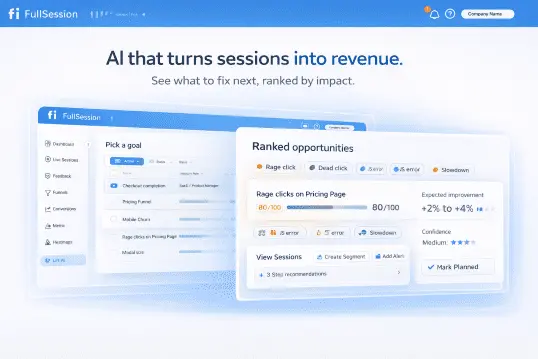
The highest-value application is prioritization. Instead of watching recordings at random, you want the tool to tell you where users are struggling and which struggle costs the most in lost conversions. FullSession’s Lift AI does this by scoring friction across sessions and ranking it by impact, so your fix queue is ordered by money rather than by whoever complained loudest. That turns a wall of data into a short, ranked list of pages to look at first.
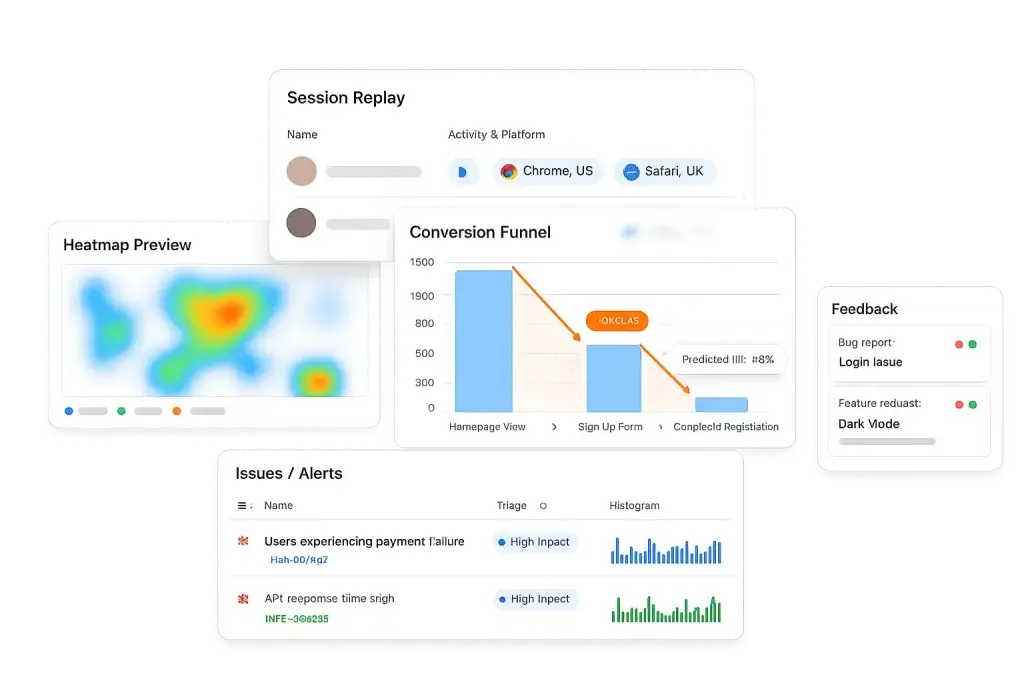
Once the tool points you to the right moments, the human work is fast. A session replay shows what actually happened, a heatmap confirms how many people hit the same wall, and a funnel quantifies the drop. The AI does the searching and ranking; you do the diagnosing and deciding. For the language side of behavior, pairing this with in-page feedback lets a model summarize what users say at the exact moment they struggle, which is the sentiment analysis job from the table applied where it is most useful.
AI ANALYTICS, GROUNDED IN REAL BEHAVIOR
Let AI rank the friction, then watch the proof
FullSession pairs session replay, heatmaps, and funnels with Lift AI, so advanced analytics starts with the sessions that explain your numbers.
A quick hype check: where AI analytics still falls short
An honest guide has to name the limits, because most AI analytics disappointment comes from expecting the wrong thing. AI is good at correlation and bad at causation: it will tell you two things move together, not which one caused the other. It is confident even when wrong, so an unverified model output can send a team chasing a fix for a problem that does not exist. And it inherits every flaw in its inputs, which means a model running on thin or dirty data produces clean-looking nonsense.
The practical guardrail is to treat AI output as a lead, not a verdict. When a tool flags an anomaly or ranks a friction point, confirm it against the actual behavior before you act: watch the sessions, read the feedback, check the funnel. That is why grounding matters so much. An AI layer sitting on real customer analytics can be verified in seconds; one sitting on event counts alone cannot. Our take on the AI interpretation layer goes deeper on why the data underneath decides whether the AI helps or misleads.
Where most teams should start
If you are choosing one place to begin, begin with the question that is actually blocking you. For the majority of teams trying to improve a website or app, that question is “why are users dropping here,” and the answer lives in behavior analytics with AI prioritization on top. It gives you the fastest path from a number that moved to the reason it moved, and it is quick to stand up: you can watch the behavior behind your first ranked friction point the same day you install it.
From there, add categories as new questions appear. Reach for product analytics when retention becomes the focus, business intelligence when you need to blend warehouse data, and competitive intelligence when the market context matters. For teams weighing the options, our roundups of marketing analytics tools, UX analytics tools, and CX tools break down the specific choices, and the product management workflow shows how the pieces fit together in practice. The best AI analytics stack is not the one with the most tools. It is the smallest set that answers your real questions with data you can trust.
Turn advanced analytics into fixes you can prove
Visualize, analyze, and act on real user behavior with FullSession, then let Lift AI rank what to fix first. No credit card needed to start.
AI tools for advanced analytics: FAQ
What are AI tools for advanced analytics?
They are analytics platforms that use machine learning and language models to do work a human analyst would otherwise do by hand: cleaning and joining data, spotting patterns and anomalies, predicting outcomes, summarizing text feedback, and ranking what matters most. They span several categories, from behavior analytics and product analytics to business intelligence, voice of customer, testing, and competitive intelligence. The right one depends on the question you are trying to answer, not on which has the most AI features.
What does AI actually do in analytics?
Five things reliably. It automates data preparation, the cleaning and joining that eats most of an analyst’s day. It finds patterns and anomalies across data too large to eyeball. It predicts, using history to flag likely churn or demand. It reads language at scale, turning thousands of open-text comments into themes. And it prioritizes, ranking issues by impact so teams fix the costly problem first. It does not supply judgment or business context, which is still human work.
How do I choose an AI analytics tool?
Start from the decision you need to make, then match it to a category. If you need to know why users struggle on your site, that is behavior analytics. If you need retention and journey trends across sessions, that is product analytics. If you need to model warehouse data, that is business intelligence. Pick the category first, shortlist two tools in it, and test them on a real question before comparing AI feature lists.
Do AI analytics tools replace data analysts?
No. They remove the grunt work and speed up the first pass, but the analyst still frames the question, checks the model’s assumptions, and decides what the finding means for the business. McKinsey’s 2025 survey found 88 percent of organizations use AI in at least one function, yet scaled impact is still rare, largely because value comes from human judgment applied on top of the automation, not from the tool alone.
What is the best AI tool for understanding user behavior?
For understanding what people actually do on your site, a behavior analytics platform that pairs session replay, heatmaps, and funnels with AI prioritization is the strongest fit. FullSession uses Lift AI to score and rank friction by impact, so the tool points you straight to the sessions that explain a drop, rather than leaving you to search recordings by hand. The best choice is the one whose AI is grounded in real behavioral data, not just event counts.

Roman Mohren is CEO of FullSession, a privacy-first UX analytics platform offering session replay, interactive heatmaps, conversion funnels, error insights, and in-app feedback. He directly leads Product, Sales, and Customer Success, owning the full customer journey from first touch to long-term outcomes. With 25+ years in B2B SaaS, spanning venture- and PE-backed startups, public software companies, and his own ventures, Roman has built and scaled revenue teams, designed go-to-market systems, and led organizations through every growth stage from first dollar to eight-figure ARR. He writes from hands-on operator experience about UX diagnosis, conversion optimization, user onboarding, and turning behavioral data into measurable business impact.