
Contentsquare is the global leader in digital experience analytics. Hotjar was the leading product experience insights platform for small and growing businesses around the world.
Contentsquare acquired Hotjar in 2021, and the two platforms fully merged on July 1, 2025. Together, they now serve the global market end-to-end, from solo entrepreneurs to large enterprises.
If you use Hotjar, you’ve probably noticed changes to your account, pricing, or dashboard over the past year. This guide explains what happened and how to decide your next move.
Key Takeaway
- Contentsquare acquired Hotjar in 2021, and the two platforms fully merged into one unified experience in 2025, with migration continuing through 2026.
- New Hotjar sign-ups now create a Contentsquare account directly, and existing customers are migrating from legacy pricing to Contentsquare’s unified structure gradually.
- Contentsquare’s free plan now includes 200,000 sessions per month, far more than Hotjar’s old free tier, plus added capabilities like Attention Maps and Error Monitoring.
- The migration brings real tradeoffs: more platform to learn, potential billing overlap during the transition, and packaging that spans several modules instead of one simple plan.
- The merger is a natural moment to re-evaluate your setup, whether that means staying, migrating, or testing an alternative like FullSession in parallel.
FullSession is worth a look precisely because it skips the tradeoffs this transition introduces. There’s no multi-module pricing to puzzle through, no sampling caps that quietly drop your most critical sessions, and no separate sales process just to understand your bill.
You get session replay, heatmaps, error tracking tied directly to the replay where it happened, and funnel analysis that takes you straight from a drop-off point to the exact session behind it, all on transparent, session-based pricing.
It’s a way to see what a simpler, fully-included setup actually looks like before you commit to anything on the Contentsquare side.
Why The Acquisition Happened

The Model Context Protocol is an open standard from Anthropic (November 2024) that lets AI assistants connect to Contentsquare and Hotjar solved the same problem for two different customers. Contentsquare served large enterprises that needed deep digital experience analytics. Hotjar served entrepreneurs, small teams, and mid-market companies that needed something simpler and faster to set up.
Buying Hotjar let Contentsquare close that gap in one move. Instead of building a lightweight product from scratch, it acquired a company that already had one.
The funding behind the deal
The timing matters too. Contentsquare had just closed a $500 million Series E funding round in May 2021, pushing its valuation to $2.8 billion. According to Contentsquare’s own press release announcing the deal, this was the company’s sixth acquisition in two years.
That’s not a coincidence. Contentsquare was building out its platform through acquisitions, and Hotjar filled a specific gap: reach into the SMB and mid-market segment.
What each company gained
The two companies pointed to a few clear reasons for joining forces:
- Combined technology and resources, so Hotjar could move faster on product development
- Hotjar’s product-led growth approach, giving Contentsquare a path into smaller accounts
- A shared vision around better experiences and customer experiences for businesses of every size
- A bigger pool of customer insights, since each company understood a different segment of the market
Jonathan Cherki, Contentsquare’s CEO and founder, said the deal would “broaden our reach to bring business-critical insights to every type of business across all industries.”
David Darmanin, Hotjar founder, said he was excited about the deal, calling it a chance to “double-down on our investments in innovation.” That excitement carried through into how both companies described their shared mission afterward.
Hotjar had pledged 1% of its revenue to climate justice since 2017, and Contentsquare had recently launched its own accessibility nonprofit, giving both companies a competitive advantage built on trust.
Why This Acquisition Matters Now
The 2021 deal is old news. What’s actually driving searches for this topic in 2026 is a bigger shift: Hotjar’s platform fully merged into Contentsquare in 2025.
If you’re a current Hotjar customer, this is probably why you’re reading this. Your account, pricing structure, or dashboard has changed, and you want to know why.
The short version
- New sign-ups no longer create a standalone Hotjar account
- They land directly on Contentsquare’s unified platform instead
- Existing Hotjar customers are migrating from the old setup to the new one gradually, with that transition running through 2026
This is a meaningfully different moment than 2021. Back then, Hotjar and Contentsquare promised to operate independently for the foreseeable future, and they did, for years.
The 2025 merger changed that. The two products are now one product.
If your renewal date or pricing notice landed in your inbox recently, that’s the trigger. Plenty of Hotjar customers are asking the same question right now: what do I actually do next?
Importantly, none of this means you’re stuck. Organizations of every size are working through the same transition, and you have time to decide deliberately instead of feeling unable to act.
What Contentsquare Acquired
Contentsquare acquired a tool built around one idea: make user behavior easy to see without an enterprise budget. Hotjar’s heatmaps, session replay, surveys, and feedback widgets gave product teams a fast, intuitive set of tools to watch real visitors use a website.
Hotjar was founded in Malta in 2014. By the time of the acquisition, it served small and mid-market businesses, helping product teams build empathy with end users instead of guessing what they wanted.
Hotjar’s reach before the deal
- A fast, self-serve setup that didn’t require a sales call
- Behavior data that helped businesses understand customers through quantitative and qualitative insights side by side
- A reputation for intuitive tools that needed little setup or training
- A privacy-conscious approach designed to protect users while still surfacing how people were interacting with a page and where engagement dropped off
According to Contentsquare’s official press release, the combined companies provided insights to close to 1 million websites across more than 180 countries at the time of the deal.
Contentsquare’s platform at the time
Contentsquare itself operated at a different altitude. Founded in Paris in 2012, it built a digital experience analytics platform aimed at enterprises that needed a holistic view of the entire customer journey, not just one piece of it.
Its customer roster already included recognizable names. Contentsquare’s own materials note that brands such as Microsoft, BMW, and Sephora used the platform to optimize digital experiences across web and mobile apps. Contentsquare had also launched a nonprofit focused on digital accessibility around the same period.
For a closer look at Hotjar versus Mixpanel and Contentsquare by use case, the differences in audience and depth become clear fast.
| Hotjar (2021, standalone) | Contentsquare (broader platform) | |
| Primary audience | Entrepreneurs, SMBs, mid-market teams | Enterprises and large brands |
| Core tools | Heatmaps, session replay, surveys, feedback | Journey analytics, AI insights, error monitoring, performance monitoring |
| Setup speed | Fast, self-serve, minimal onboarding | Deeper, often sales-assisted onboarding |
The acquisition didn’t replace one product with another. It combined a fast, accessible tool with a deeper analytical platform, aiming to deliver coverage across the full market.wn site? Our guide on measuring and shortening time to value breaks down the activation metric in more detail.
What Changes For Existing Hotjar Users

If you’ve been using Hotjar, several specific things are different now.
New sign-ups now land on Contentsquare’s unified plan structure instead of the old standalone Hotjar pricing. You won’t find a separate Hotjar checkout anymore. Everything routes through Contentsquare’s account flow.
The main changes to expect
- Pricing migration. Existing customers are moving from the legacy Hotjar setup to Contentsquare’s unified structure gradually, with the transition running through 2026. For the full breakdown, see our Hotjar review covering pricing and limits.
- Familiar tools, new home. Your heatmaps, session replay, and surveys still work the same way. They’re just part of Contentsquare’s broader feature set now instead of a standalone Hotjar product.
- More included on the free tier. Contentsquare’s free plan includes 200,000 sessions per month, compared to 35 sessions per day on Hotjar’s old free plan, according to Contentsquare’s official pricing page.
- A bigger platform to learn. Attention Maps, Error Monitoring, Performance Monitoring, and Funnels are now bundled in, including signals around page loading speed. That’s more capability, but it’s also more surface area to understand if you only ever needed simple heatmaps.
That last point is worth sitting with. More features sound great until you’re hunting for the three you actually use inside a much bigger product.
Full journey analytics or deeper behavioral analysis may now require additional Contentsquare products beyond what Hotjar offered on its own. That’s not a dealbreaker, but it matters if your workflow depended on Hotjar’s specific simplicity.
What Changes For Contentsquare Users
Most product managers have more friction signals than they have time to review. A funnel might show five separate If you were already a Contentsquare customer, the benefit runs the other way. You’ve gained access to the tools Hotjar customers liked, built into the platform you already use.
Heatmaps, session replay, surveys, and feedback widgets sit inside your existing Contentsquare account. There’s no separate login, no second vendor relationship, and no extra contract to manage.
New capabilities bundled in
- Sense AI, which summarizes heatmaps and session recordings automatically
- LLM Connect through MCP, letting you query your Contentsquare data from tools like ChatGPT or Claude
- 10 or more native integrations, including Slack, Jira, and Unbounce, included on the free plan
For product teams that wanted Hotjar’s lightweight feel without adding a second vendor, this merger removed that friction. You get both sets of tools under one roof.
Risks And Considerations
Finding a drop-off and fixing it are two different skills, and the gap between them is where most funnel work stalls Every platform migration carries some friction, and this one is no exception. Here’s what to watch for, stated plainly and without spin.
Where teams run into friction
- Migration timing uncertainty. Customers on legacy plans may see a transition period where old and new account structures temporarily coexist.
- Packaging complexity. Full coverage across experience analytics, voice of customer, and product analytics may mean evaluating several modules instead of one plan.
- Decision fatigue during the changeover. If you only wanted simple session replay, you might now be working through a broader, enterprise-oriented platform while the migration runs.
None of these risks are dealbreakers alone. They’re the normal cost of two products becoming one, and most teams adjust within a billing cycle or two.
Still, if your team runs lean and just needs reliable heatmaps and replay without a learning curve, factor migration friction into your decision, not just the feature list.
You shouldn’t have to sell yourself on a bigger platform than the one you actually need. This is exactly the moment when teams researching Hotjar alternatives tend to start looking around.
How To Evaluate Your Next Step
You have three real options right now: stay and ride out the migration, switch products, or test alternatives before deciding either way.
A simple checklist before you commit
- Confirm your migration timeline. Log into your account and check whether you’re still on the legacy structure or already moved to the unified plan. This tells you how much change is still ahead.
- Map your must-have features. List the specific tools your team actually uses weekly, not everything available. For example, daily heatmap checks matter more than a feature you opened once. Then check whether they’re still accessible at the same tier you’re paying for.
- Estimate cost at your real traffic volume. Pricing models built around session counts can shift sharply as your site grows. Run the numbers at your actual monthly sessions, not a rough guess.
- Test an alternative in parallel. You don’t have to decide blind. Most behavior analytics platforms, including FullSession, let you set up tracking alongside your current tool and compare real data side by side.
That fourth step matters most. Watching the same week of traffic through two dashboards tells you more in an afternoon than a week of reading competitor comparison pages.
Why Switch To FullSession
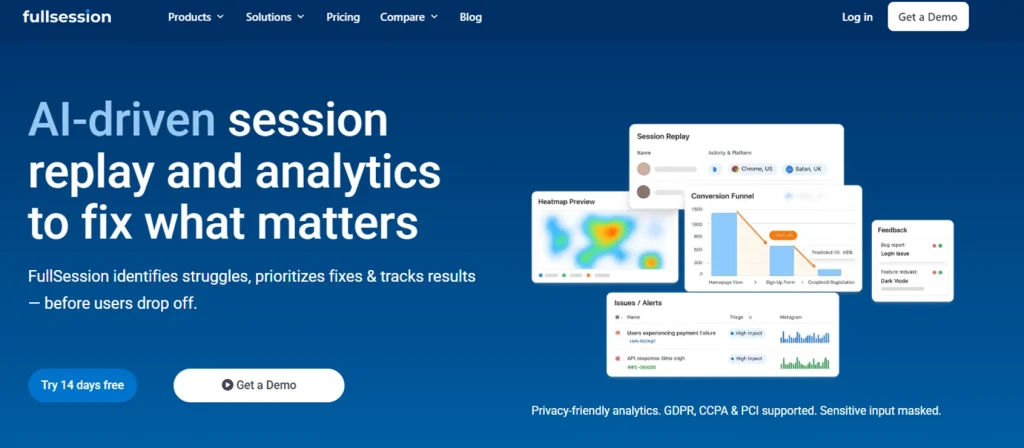
FullSession is a behavior analytics platform built for teams that want to see exactly what’s happening on their site and fix it fast, without learning a new platform from scratch.
It combines session replay, heatmaps, error tracking, and funnel analysis in one place, so you’re not stitching together separate tools to understand a single user journey.
Pricing you can actually predict
Pricing is usually the first thing teams question. As Hotjar’s standalone plans fold into Contentsquare’s broader structure, cost predictability gets harder to pin down, especially for teams that don’t want a sales call just to understand their next invoice.
- FullSession’s pricing stays session-based and transparent at every tier
- You can model your actual cost at your real traffic level without waiting on a quote
- No separate sales process just to understand what you’ll pay next month
Debugging depth Hotjar wasn’t built for
If your team needs to know exactly which JavaScript error or network failure caused a session to go sideways, that gap shows up fast.
- Lift AI ranks friction points by likely impact instead of leaving you to guess
- Error tracking ties every alert directly to the session replay where it happened
- Engineers debug from the real moment instead of a vague support ticket
No blind spots from sampling
Lower tiers in a merged, larger platform often cap how much you can record, which means the one session where a critical checkout error happened might fall outside the sample and simply never get captured.
- FullSession doesn’t ask you to choose which users are worth recording
- Every session is available, not just a sampled slice of traffic
- The session that matters most is often the one you’d least expect to need
Performance that doesn’t impact your site
Performance matters too, particularly for teams already nervous about adding enterprise-grade tags to a page that’s already heavy.
- A single lightweight script avoids dragging down load times
- You’re not adding weight to the exact pages you’re trying to optimize
Funnel analysis without the extra steps
Finally, the actual workflow of finding where users drop off shouldn’t require stitching together page-by-page reports.
- Structured funnel analysis goes straight from a drop-off point to the exact session behind it
- See precisely where someone abandoned a cart or stalled on a form
- No manual cross-referencing between separate reports
See It for Yourself
We’ll walk through one journey that matters to your team, whether that’s onboarding, checkout, or a critical form.
Conclusion About Contentsquare Acquiring Hotjar
Contentsquare acquired Hotjar in 2021, and the two platforms fully merged into one unified experience by 2025, with migration continuing through 2026. That’s the entire story in two sentences.
What you do with that information depends on your team, your budget, and how much complexity you want to manage. There’s no universally right answer, only the one that fits how your team works.
The smartest move is testing your options before your renewal forces a decision under pressure. Book a demo for a guided walkthrough, or start a free trial to explore on your own first.
FAQs About Contentsquare Acquiring Hotjar
When did Contentsquare acquire Hotjar?
Contentsquare announced its acquisition of Hotjar on September 1, 2021, with the deal closing the following month. The combined companies served close to 1 million websites across more than 180 countries at the time. In 2025, the two platforms fully merged into one unified Contentsquare experience, with existing Hotjar customers migrating through 2026.
Are Contentsquare and Hotjar the same?
They’re now part of the same company and platform. Hotjar’s tools, including heatmaps, session replay, and surveys, are available inside Contentsquare alongside additional capabilities like Attention Maps and Error Monitoring. New sign-ups create a Contentsquare account directly instead of a separate Hotjar account.
What happened to Hotjar?
Hotjar was founded in Malta in 2014 and acquired by Contentsquare in 2021, continuing to operate as its own brand for several years afterward. In 2025, the two platforms merged fully, and Hotjar’s core features now live inside Contentsquare’s broader experience intelligence platform, with migration ongoing through 2026.
Who is the owner of Contentsquare?
Contentsquare is privately held and led by founder and CEO Jonathan Cherki, who started the company in Paris in 2012. It’s backed by institutional investors and it isn’t publicly traded. Cherki continues to lead the company as CEO.

Roman Mohren is CEO of FullSession, a privacy-first UX analytics platform offering session replay, interactive heatmaps, conversion funnels, error insights, and in-app feedback. He directly leads Product, Sales, and Customer Success, owning the full customer journey from first touch to long-term outcomes. With 25+ years in B2B SaaS, spanning venture- and PE-backed startups, public software companies, and his own ventures, Roman has built and scaled revenue teams, designed go-to-market systems, and led organizations through every growth stage from first dollar to eight-figure ARR. He writes from hands-on operator experience about UX diagnosis, conversion optimization, user onboarding, and turning behavioral data into measurable business impact.