.svg)

What Is Session Replay? How It Works & Why CRO Teams Rely on It


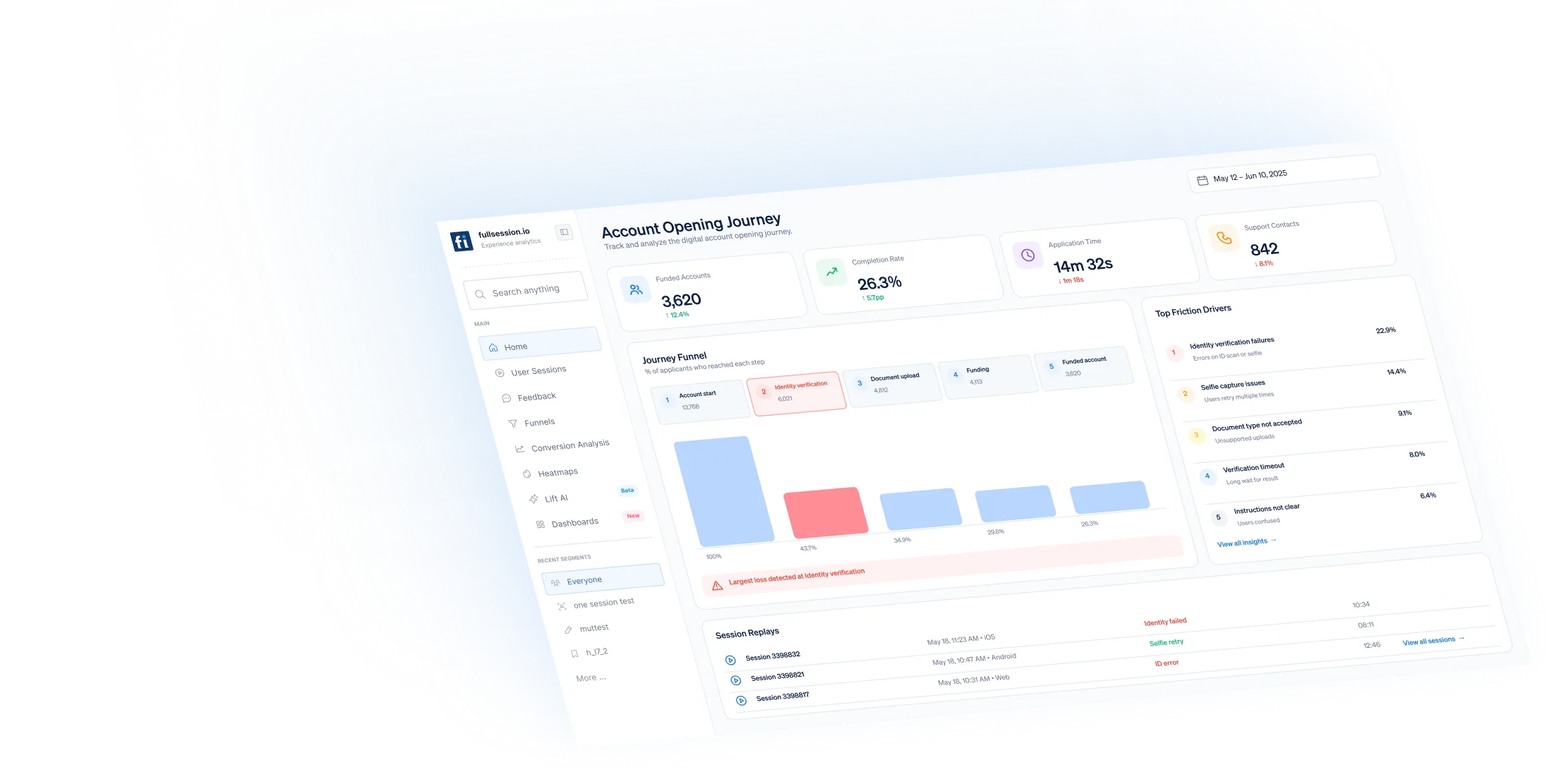
Session replay has become one of the most important tools in modern conversion optimisation and product analytics. While traditional analytics tells you what users clicked, scrolled, bounced, dropped off session replay reveals why those behaviours happened.
Rather than relying purely on charts and funnels, session replay reconstructs real user sessions from your website or application, showing every interaction in a video-like experience. This gives teams a layer of qualitative context that numbers alone can never provide.
With session replay, you can watch how users interact with forms, navigate complex journeys, hesitate before converting, or stumble into friction points. Whether a user clicked an element they assumed was interactive, struggled with a form field, or encountered a silent error, replay makes that friction visible.
In many cases, CRO and product teams uncover conversion leaks within minutes that would never surface through dashboards alone.
In this guide, we’ll explore:
- What session replay is and how it works
- Why it plays a critical role in CRO, UX, and product optimisation
- Where it delivers the most value across teams
- What to look for when selecting a session replay tool
- Key benefits, limitations & comparisons
What Is Session Replay?
Session replay (also called session recording software) is a type of behavioral analytics tool that recreates individual user sessions on a website or application. It allows teams to observe how users interact with real interfaces in real time or after the session ends.
Unlike traditional product analytics, which focuses on aggregated metrics and reports, session replay provides:
- Individual user journeys
- Visual playback of interactions
- Full behavioral context behind every conversion or drop-off
This makes it one of the most powerful tools for:
- Conversion rate optimization (CRO)
- UX research
- Product optimization
- Support diagnostics
- Technical debugging
How Session Replay Actually Works
Although session replay looks like a screen recording, the underlying technology is very different and far more secure.
Session replay tools capture changes to the Document Object Model (DOM), which is the structured representation of your web page. Every interaction a user performs clicking a button, opening a dropdown, typing into a field, scrolling a page, or navigating between views generates events and DOM mutations.
Instead of storing raw video footage, the tool logs these changes as structured data.
During playback, the platform reconstructs the page using these DOM updates and event streams, recreating the session with high visual accuracy. This method allows replay to feel like a video while remaining:
- Lightweight
- Highly performant
- Privacy-safe
Sensitive inputs such as passwords, payment data, and personal identifiers can be masked or excluded before capture. Most modern tools also support:
- Cursor movement tracking
- Scroll depth
- Click hesitation
- Rage clicks
- Hover behaviour
This ensures replay remains accurate even within dynamic, JavaScript-heavy, and single-page applications.
Why Session Replay Matters for CRO & Product Teams
Before session replay, understanding user behaviour relied heavily on guesswork. Teams depended on:
- Bounce rates
- Funnel drop-offs
- Heatmaps
- Support tickets
- User complaints
When something broke, developers had to rely on vague user explanations. When conversions dropped, marketers speculated. When friction occurred, teams debated root causes without visual proof.
Session replay removes this uncertainty.
It allows teams to observe real users in real environments, not staged usability tests, not theoretical journeys, but actual behaviour. When friction appears, you can see exactly what happened. When errors occur, you can trace the precise steps that triggered them. When users convert smoothly, replay shows why the flow worked.
Replay shifts optimisation from:
- Opinions → visual evidence
- Assumptions → behavioural proof
- Lagging signals → real-time clarity
Examples of high-impact issues replay routinely uncovers:
- A form drop-off caused by a validation error hidden below the fold
- A mobile CTA obstructed by a sticky element
- A checkout bug appearing only on a specific browser version
- A rage-click loop caused by a disabled button that still appears clickable
In practice, the most damaging conversion leaks are rarely strategic failures. They are small, invisible friction points that session replay exposes instantly.
Benefits of Session Replay
1. Faster Debugging & Error Resolution
Developers can jump directly into the moment an error occurred, observe the exact steps leading up to it, and identify the root cause without relying on second-hand user reports. This dramatically reduces mean-time-to-repair (MTTR).
2. Rich Behavioural Insights for CRO
CRO specialists gain full visibility into:
- Hesitation patterns
- Form abandonment behaviour
- Rage clicks
- Scroll depth mismatches
- Unexpected navigation paths
These insights make experimentation more strategic and dramatically reduce wasted A/B testing cycles. For ecommerce brands, this becomes especially valuable when teams need to understand checkout friction, product page hesitation, cart abandonment, and the tools that support those workflows. A comparison of the best session replay tools for ecommerce can help teams evaluate which platforms support conversion-focused online store analysis.
3. Better Customer Support Experiences
Support teams no longer need long diagnostic conversations. They can replay exactly what the user experienced, identify the issue instantly, and resolve tickets faster improving both CSAT and retention.
4. Real UX Research Without Bias
Replay data comes from real-world sessions, not lab environments. This eliminates artificial behaviour, reduces survey bias, and gives UX teams authentic behavioural evidence at scale.
Challenges to Be Aware Of
Privacy & Data Protection
Strict masking, RBAC, encryption, and consent controls are required to prevent exposure of sensitive personal or financial data.
Tool Sprawl & Integration Complexity
Replay works best when connected with analytics, funnel tracking, A/B testing, and error monitoring tools. Without integration, insights remain siloed.
Data Volume & Cost Management
High-traffic platforms generate large replay datasets, making intelligent filtering and session sampling essential for cost control.
Design Version Mismatches
If the UI changes frequently, older replays can lose visual accuracy unless historical snapshot support exists.
Global Compliance
Modern session replay platforms are built to meet international data protection standards, including:
- 🇪🇺 GDPR (European Union)
- 🇺🇸 CCPA & CPRA (United States)
- 🇬🇧 UK Data Protection Act
- HIPAA (Healthcare Apps)
- SOC 2 & ISO 27001 (Enterprise Security)
This allows session replay to be safely deployed across:
North America, Europe, the UK, the Middle East, and Asia-Pacific.
Who Uses Session Replay
Developers
Developers rely on replay to reproduce bugs in seconds and trace failures directly to the responsible code or component.
Customer Support
Support teams can instantly identify UI confusion, product misuse, or technical errors — accelerating resolution and improving trust.
Product Managers & Growth Marketers
Replay reveals where users lose momentum, skip steps, or abandon high-intent flows. Combined with funnel data, it highlights what truly drives conversion.
UX Designers & Researchers
UX teams analyse thousands of authentic user sessions to validate usability improvements using real behavioural patterns.
Session Replay vs Heatmaps vs Traditional Analytics
What to Look For in a Session Replay Tool
A strong session replay tool should offer:
- High-fidelity visual playback
- Error tracking and stack trace integration
- APM and performance monitoring linkage
- Privacy, masking, and GDPR compliance
- Advanced filters, segmentation, and replay controls
Final Thoughts
Session replay bridges the gap between behavioural data and real human experience. It allows teams to see the product exactly as users experience it, not as dashboards interpret it.
Whether your goal is to:
- Improve conversions
- Reduce support workload
- Debug product issues
- Validate UX decisions
- Increase activation and retention
Session replay delivers a level of clarity that no other analytics category can match.
If you’d like to see how these insights work in practice, FullSession provides privacy-safe session replay combined with behavioral analytics, funnels, and performance monitoring giving growth, product, and engineering teams a complete view of the user journey in one platform.
FullSession Pricing Plans
The FullSession platform offers multiple pricing plans to suit different business needs, including a Free plan and three paid plans Growth, Pro, and Enterprise. Below are the details for each plan of FullSession Pricing.
- The Free plan is available at $0/month and lets you track up to 500 sessions per month with 30 days of data retention, making it ideal for testing core features like session replay, website heatmap, and frustration signals.
- The Growth Plan starts from $23/month (billed annually, $276/year) for 5,000 sessions/month – with flexible tiers up to 50,000 sessions/month. Includes 4 months of data retention plus advanced features like funnels & conversion analysis, feedback widgets, and AI-assisted segment creation.
- The Pro Plan starts from $279/month (billed annually, $3,350/year) for 100,000 sessions/month – with flexible tiers up to 750,000 sessions/month. It includes everything in the Growth plan, plus unlimited seats and 8-month data retention for larger teams that need deeper historical insights.
- The Enterprise plan starts from $1,274/month when billed annually ($15,288/year) and is designed for large-scale needs with 500,000+ sessions per month, 15 months of data retention, priority support, uptime SLA, security reviews, and fully customized pricing and terms.
If you need more information, you can get a demo.
Session Replay FAQs
What is session replay in simple terms?
Session replay lets you visually watch how users interact with your website or app, showing where they click, scroll, hesitate, or abandon.
How does session replay work?
It records DOM changes and user events, then reconstructs the session visually without storing raw video.
Is session replay safe and legal?
Yes. When configured with masking, consent, encryption, and access controls, it complies with GDPR, CCPA, and enterprise security standards.
What is session replay used for?
It’s used for CRO optimization, UX research, debugging errors, reducing support tickets, and improving product adoption.
Does session replay slow down a website?
No. Modern tools run asynchronously and have near-zero performance impact.
What’s the difference between session replay and heatmaps?
Heatmaps show aggregated behavior. Session replay shows individual user journeys in full detail.
Session Replay FAQs
Session replay lets you visually watch how users interact with your website or app, showing where they click, scroll, hesitate, or abandon.
It records DOM changes and user events, then reconstructs the session visually without storing raw video.
Yes. When configured with masking, consent, encryption, and access controls, it complies with GDPR, CCPA, and enterprise security standards.
It’s used for CRO optimization, UX research, debugging errors, reducing support tickets, and improving product adoption.
No. Modern tools run asynchronously and have near-zero performance impact.
Heatmaps show aggregated behavior. Session replay shows individual user journeys in full detail.
See what’s costing you, and prove whats fixing it is worth
Watch the real journey, rank every issue by revenue impact, and validate the result against baseline.



.svg)
.svg)
212 E Stone Path St Derby, KS 67037 Phone: +1 415-649-4222



All systems operational.