Both — and the assistant should be judged on one property: whether every answer links to the documentation page it came from. An assistant grounded in a product’s own documentation changes what a user can ask, from keyword-shaped queries to situation-shaped ones, and citation is what keeps the answer checkable.
FullSession’s AI assistant shipped 2026-07-20. It is backed by FullSession’s product documentation at docs.fullsession.io, opens from Documentation in the sidebar, and links every answer to the related documentation pages.
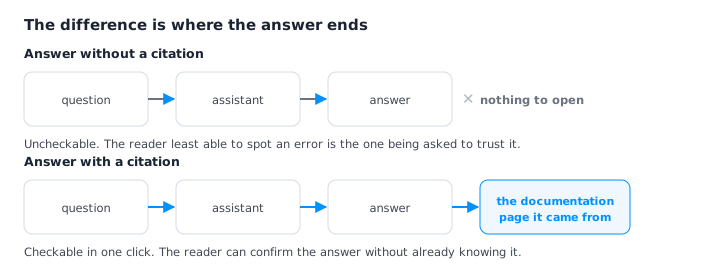
A search box terminates in a page. That is its whole design and its integrity: it cannot be confidently wrong, because it never asserts anything. An assistant asserts — it composes a sentence that existed nowhere in the corpus, in the product’s voice, for a reader with no way to grade it. That is a gain in usability and a loss in auditability.
What can a documentation search box not do?
A documentation search box matches the words the user typed against the words the writer chose. Four failure modes from FullSession’s documentation, none fixable by ranking:
Symptom vocabulary versus feature vocabulary. A user wanting the sessions behind a dashboard chart types “click chart to see users.” FullSession’s documentation files that under drill-down and states the limit plainly: drill-down is limited to table-based cards, where Breakdown and Pages support “Add to Filter” and “View Sessions,” and clicking a point on a line or bar chart does not drill. The answer is written down; the query never reaches it. The user described what they were doing; the page describes what it is called.
Questions whose answer is an absence. FullSession funnels have no conversion window — no setting requires a visitor to finish within a fixed time, and median time-to-convert is reported rather than enforced. A user wondering why someone who converted a week later still counted cannot search their way there. Nobody searches for a setting they do not know is missing.
Absences the user reads as a bug. FullSession funnels have no branching: steps run in one ordered sequence, and distinct routes need separate funnels. A user who built a single funnel for two checkout paths searches “funnel not counting all users” — “branching” is a word they do not have yet.
Behaviour that looks like a rendering fault. FullSession heatmaps render on a real DOM snapshot rather than a screenshot, so click data sits on one representative version of the page. A user with a personalised page types “heatmap showing the wrong page”; the documentation files that under how heatmaps render.
Why is citation the property that matters in a docs AI assistant?
Because the person asking a product documentation assistant a question is the person least equipped to detect a wrong answer — day two, no model of the product, no sense of what is plausible. A fluent, confident, wrong paragraph about your own product is indistinguishable from a correct one until they act on it. An expert would catch it; the expert was not the one asking.
Ten minutes tests any documentation assistant, FullSession’s included:
- Ask something the documentation covers, then open the cited link. Does that page contain the answer, or only relate to the topic? An adjacent page is a failure that is easy to miss.
- Ask about something that shipped recently and was never written up. Does it say so, or invent something plausible?
What can and cannot FullSession’s AI assistant answer?
FullSession’s AI assistant answers questions about the product: it explains features and concepts, guides users step by step through workflows, troubleshoots installation and tracking issues, and recommends best practices. Three boundaries:
- It covers a web product. FullSession captures web sessions through its JavaScript snippet and Chrome extension, and the documentation behind the assistant describes that product. Native mobile questions have no page to cite.
- It opens from Documentation in the sidebar. That is the entry point the documentation names.
- It does not answer questions about your own account data. “Why did my conversion rate drop on Tuesday,” “which sessions had rage clicks on my checkout page” — documentation describes the product, not the account.
Account data is a different FullSession surface. The FullSession MCP server is documented as “a read-only query layer over your FullSession account,” connecting to “Claude Desktop, Cursor, or any MCP-compatible client.” It exposes 18 tools, caps the time window at 90 days, and returns up to 50 sessions per search page. Verbatim: “Every MCP tool is read-only. There is no tool that creates, edits, or deletes anything.”
Both boundaries are written down: the documentation assistant explains what a funnel step is; the MCP server reads your funnel and cannot change it.
What does grounding an assistant in your documentation expose?
Grounding an assistant in your documentation converts every documentation gap into a visible failure. That is an inference about what grounding does to a team’s information, not a product claim.
Before the assistant exists, an undocumented feature is silent. A capability ships, the changelog records it, its page is updated later or not at all. The missing page shows up as no traffic — and no traffic reads like no demand.
After the assistant exists, the gap has a shape: a user asks a situation-shaped question, no page can be cited, and that decline carries a date and a phrasing. A month of those is a documentation backlog ranked by real demand, in users’ own words — if someone logs and reads them.
An assistant that says “the documentation does not cover that” is telling you it is bounded by its corpus.
How do you measure whether a documentation AI assistant is working?
Measure adoption, and decide how each number is produced before you read it. Message counts and thumbs-up ratings show use, not usefulness. Three instruments:
- Time to first value. Pick one qualifying action and freeze the definition — for a session analytics product, the first replayed session or the first funnel created. Fire a custom event on it, then report the median — not mean — gap from account creation per weekly signup cohort.
- Onboarding completion rate. Define completion as one event you can fire — tracking verified, first session recorded — then measure the share of each weekly cohort reaching it within 14 days. In FullSession that path models as a funnel:
FUS.event(...)custom events as steps, drop-off splitting into replayable Dropped off and Converted lists. - The rate of unanswerable questions. Log the question text and date each time the assistant reports that no documentation covers something, then compute the weekly share of questions asked. A rising rate is not automatically decay — it can mean the assistant is being asked harder things — so read the phrasings, not the number.
Read all three as direction, not attribution: a cohort that got the assistant also got whatever else shipped that quarter.
See what your analytics cannot tell you
FullSession pairs session replay, heatmaps, funnels, and error tracking with Lift AI, so you can find the friction costing you revenue and prove the fix worked. No credit card needed to start.
Frequently asked questions
Should product documentation be a search box or an AI assistant?
Both, and the assistant should be judged on citation. A search box terminates in a page and never asserts anything; an assistant composes a sentence that existed nowhere in the corpus. Ship both, and require every assistant answer to link the documentation page it came from, so the reader can check it.
What can an AI assistant trained on product documentation actually do?
FullSession’s AI assistant, shipped 2026-07-20, explains features and concepts, guides users step by step through workflows, troubleshoots installation and tracking issues, and recommends best practices. It is backed by FullSession’s product documentation, opens from Documentation in the sidebar, and links every answer to the related documentation pages.
Can a documentation AI assistant answer questions about my own account data?
No. FullSession’s documentation assistant answers questions about the product, not about your account, so it cannot tell you which sessions had rage clicks on your checkout page. Your own data is a different surface: the FullSession MCP server, a read-only query layer over your FullSession account, connecting to Claude Desktop, Cursor, or any MCP-compatible client.
How do I know if an AI docs assistant is making things up?
Test it in ten minutes. Ask something the documentation covers, open the cited link, and check whether that page contains the answer or merely relates to it — citing an adjacent page is a failure that is easy to miss. Then ask about a feature that shipped recently and was never written up.
How do you measure whether a documentation AI assistant is working?
Three instrumented signals: time to first value, measured as the median gap from account creation to one frozen qualifying action per weekly cohort; onboarding completion, modelled as a funnel of custom events; and the rate of questions the assistant declines, logged with their wording and read weekly as a documentation backlog.

Roman Mohren is CEO of FullSession, a privacy-first UX analytics platform offering session replay, interactive heatmaps, conversion funnels, error insights, and in-app feedback. He directly leads Product, Sales, and Customer Success, owning the full customer journey from first touch to long-term outcomes. With 25+ years in B2B SaaS, spanning venture- and PE-backed startups, public software companies, and his own ventures, Roman has built and scaled revenue teams, designed go-to-market systems, and led organizations through every growth stage from first dollar to eight-figure ARR. He writes from hands-on operator experience about UX diagnosis, conversion optimization, user onboarding, and turning behavioral data into measurable business impact.