Your backlog has 80 items in it. Sales wants three of them shipped yesterday. Engineering wants you to address technical debt before it causes an outage.
Knowing how to prioritize product roadmap decisions means ranking features, fixes, and initiatives against a fixed amount of engineering capacity. You need a repeatable method instead of relying on whoever argued loudest in the meeting. The problem is that most product prioritization frameworks ask you to score “Confidence,” and most teams just guess at that number.
This guide shows you what closes that gap. Real session, funnel, and revenue data turns a guess into evidence, so you can prioritize product features with something more solid than instinct.
FullSession, our privacy-first user behavior analytics platform, is built around exactly that problem. We’ll cover how it helps you see what’s actually slowing your roadmap down.
Key Takeaway
- Most prioritization frameworks ask for a “Confidence” score that’s usually just a guess. RICE, in particular, breaks down the moment that number isn’t backed by real data.
- Behavioral data (heatmaps, funnels, and session replay) turns that guess into evidence. Together they show what users actually do, not what they say they want, and reveal whether a feature is ignored or just badly placed.
- You can put a real revenue number on a friction point. Multiply sessions by friction rate by the conversion gap by conversion value, and you get a figure leadership will actually act on.
- Scoring is only half the job. Stakeholder alignment is the other half. Agree on criteria up front and attach a rationale to every roadmap item, so overrides become visible trade-offs instead of quiet reversals.
- Technical debt competes for the same engineering hours as new features. Protect a fixed share of every release, around 20%, so it doesn’t quietly disappear from the roadmap.
FullSession closes that gap with session replay, heatmaps, funnels, and Lift AI all connected in one place, so every score is backed by real data instead of opinion. That gives stakeholders a shared, evidence-based view of the roadmap that holds up when priorities get challenged later.
Why Feature Prioritization Matters in PLG
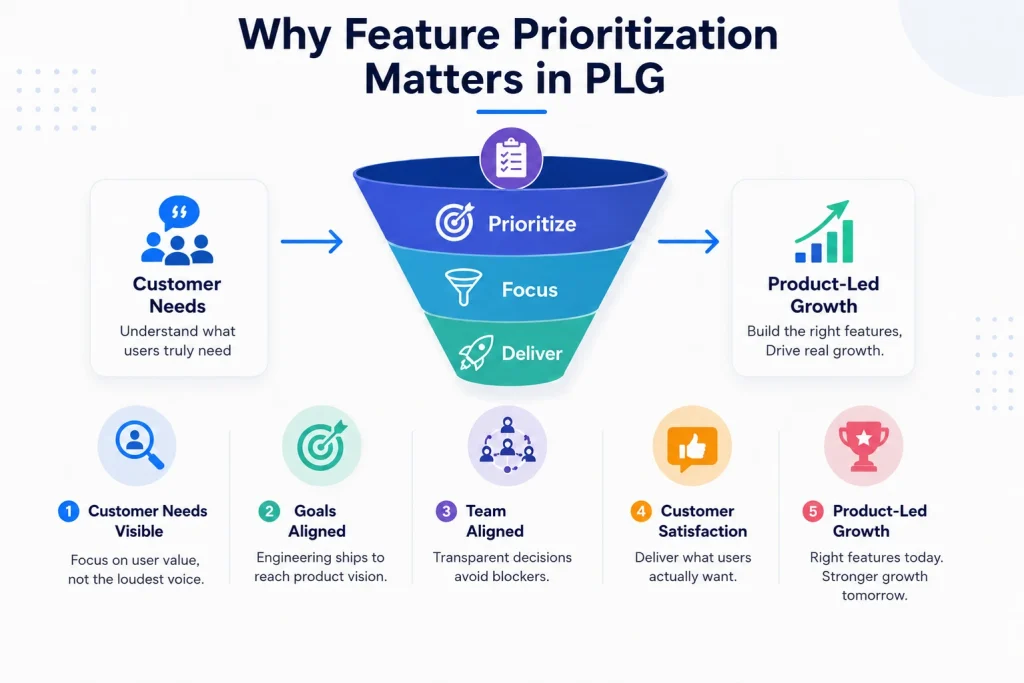
Feature prioritization is the discipline of ranking what to build next against the engineering capacity you actually have, not the capacity you wish you had. Get it wrong and you lose focus fast.
In a product-led growth (PLG) company, your product is your sales funnel. A poorly prioritized roadmap slows signups, activation, and expansion revenue all at once. That’s exactly why you need a clear way to prioritize your product roadmap before that happens.
A prioritization framework fixes this by giving everyone, including your product managers, a shared language for “why this and not that.” Here’s what it actually protects:
- Customer needs stay visible instead of getting buried under whoever’s loudest that week
- Strategic goals stay connected to what engineering actually ships, and product teams stop drifting from their product vision
- Team alignment improves because everyone can see the same decision-making process, which keeps cross-functional team’s workflows from stalling on second-guessed decisions
- Customer satisfaction rises because effort goes toward what users actually feel
A framework built to improve customer satisfaction beats one built to please the stakeholders. It’s a communication tool as much as a ranking method.
When you can point to a number instead of a feeling, fewer decisions get argued again in the next meeting.
Collecting Inputs: Feature Requests, Feedback, and Opportunities
Every roadmap starts with raw input. The quality of that input determines the quality of everything you build on top of it.
Treat customer feedback as informative, not prescriptive. Customers are experts in their own problems, not your solution.
Common sources worth pulling into one place before you score anything:
- Direct feature requests submitted through in-app forms or a user story backlog
- Sales team escalations, weighed against your broader business objectives
- Support requests, which often reveal specific features that are quietly broken or confusing
- Internal strategic bets nobody asked for, but the business needs anyway
Why context matters more than the request itself
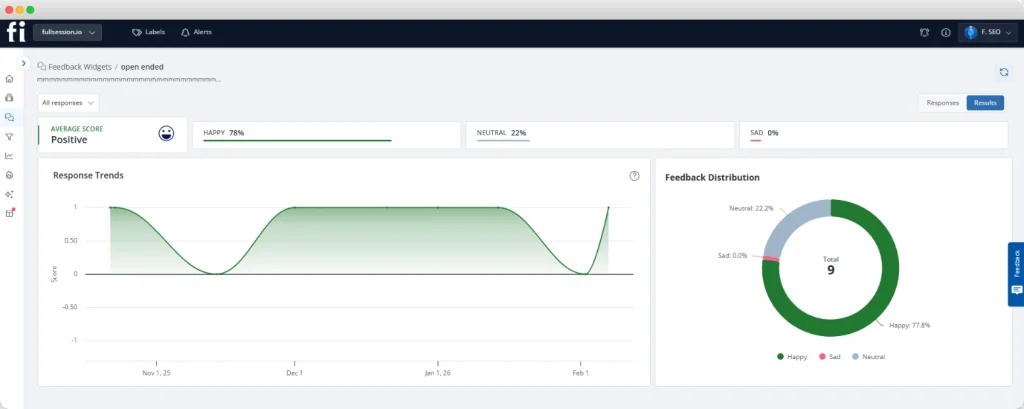
A feature request on its own only tells you what someone wants. It doesn’t tell you what they were doing, where they got stuck, or how many other users hit the same wall right before they asked.
FullSession’s in-app feedback feature closes that gap by capturing the request alongside the session it came from. You see the exact moment a user got frustrated enough to say something, not just the comment they left.
That context turns a vague request into something you can actually score. Instead of guessing how widespread a problem is, you can check.
Opportunity scoring is exactly where this earns its place. Ask users to rate how important potential features are to them, then how satisfied they are with your current solution.
A feature rated high on importance and low on satisfaction is your biggest opportunity, full stop. That gap is what separates relevant features from ones that just sound nice.
Without a consistent intake process, your backlog turns reactive. You end up firefighting whatever happened most recently instead of being able to prioritize initiatives that actually deliver customer value.
That’s just another way of failing to prioritize spending resources where they matter most, and it’s exactly what a healthy product backlog is supposed to prevent.
Using UX and Behavioral Data: Session Replays, Heatmaps, and Funnels
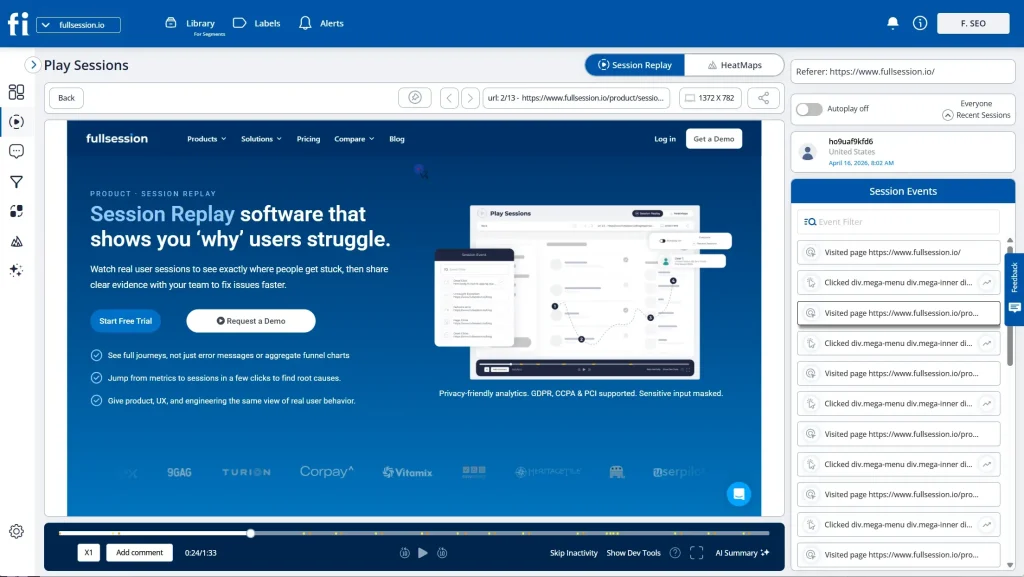
Behavioral data answers a question customer feedback alone cannot. It shows you what users are actually doing, not what they say they’re doing.
This is customer data in its most honest form. FullSession combines four signals in one place to deliver it:
- Interactive heatmaps show where attention concentrates on a page. FullSession’s click, scroll, and movement heatmaps reveal a core feature sitting in a dead zone, ignored because of bad placement, not because nobody wants it.
- Funnels and conversions show where users abandon a flow. FullSession maps the exact step losing the most user base, step by step.
- Session replay confirms the cause. FullSession’s session replay lets you watch the real session and see the rage click or confused scroll behind the drop, instead of session replay alone leaving you guessing.
- Errors and alerts catch what the other three signals can miss entirely. A broken checkout button doesn’t show up as “friction,” it shows up as a JavaScript error, and FullSession flags it before it quietly tanks a conversion rate you’re about to build a roadmap item around.
Most analytics tools make you stitch these three signals together yourself, across three different dashboards. FullSession keeps them connected.
The practical workflow takes minutes instead of days: spot the pattern in a heatmap, confirm the gap in funnel data, validate the cause in session replay, all without switching tools.
This same combination doubles as a feature-adoption check before you build anything new. If a heatmap shows a core feature sitting unclicked, and the funnel shows users dropping off right before they’d reach it, your next roadmap priority is fixing that existing workflow.
Don’t build something else on top of a broken one.
Turning friction into a revenue number
You can turn that confirmed problem into a number leadership will act on:
| Formula Component | What It Measures |
| Sessions | Users who reach the step |
| Friction rate | Share showing the friction pattern |
| Conversion gap | Difference vs. non-friction sessions |
| Conversion value | Revenue per converted action |
Multiply all four together and you get an estimated revenue figure tied to one specific step. That’s exactly how you’d quantify revenue loss from friction heatmaps in a pure conversion context.
It’s also what should feed the Confidence variable in a framework like the RICE scoring model, instead of a guess.
Querying your data without switching tools
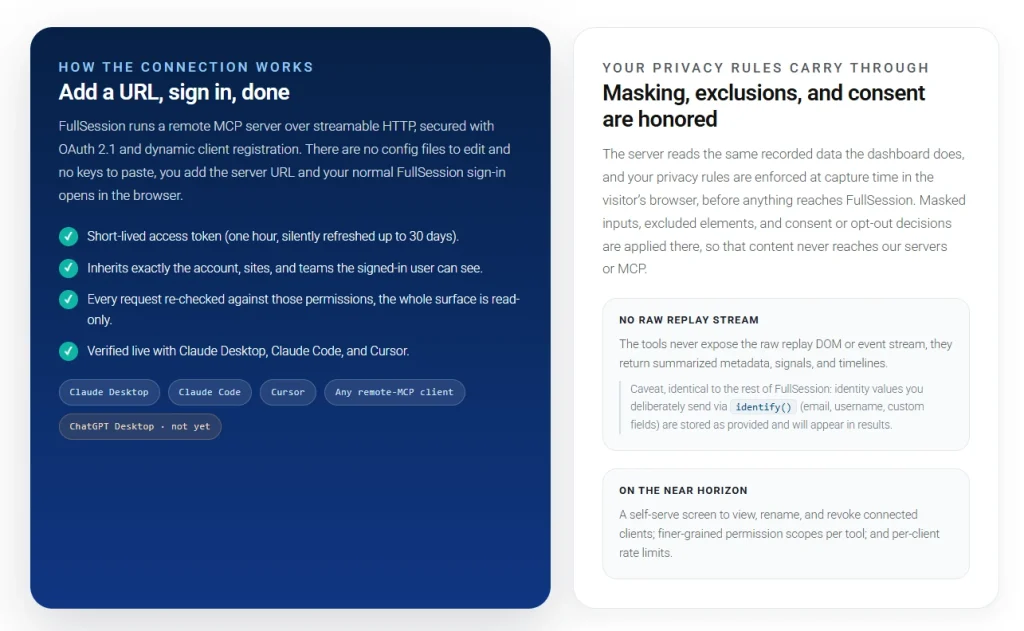
You don’t have to open a dashboard to get an answer out of this data. FullSession’s MCP Server connects your behavioral data directly to your AI assistant, so you can ask a question and get a straight answer instead of digging through heatmaps and funnels yourself.
That matters most when you’re mid-conversation with a stakeholder and need the number now, not after you’ve opened three separate tools.
Not Ready for a Demo? See Your Own Data First.
Start a free trial and watch how FullSession shows ranked opportunities from your own sessions and funnels.
Organizing and Scoring Features with a Prioritization Framework
MoA prioritization framework gives your team a repeatable process for comparing wildly different ideas on the same scale. Without one, you’re comparing a backend performance fix to a new onboarding flow using nothing but instinct.
RICE Scoring Model
RICE was developed at Intercom. It scores each idea on four variables:
- Reach: how many customers this touches in a given period
- Impact: how much it moves the needle for each one
- Confidence: how sure you are about the first two numbers
- Effort score: how many person-months it will take to build
Multiply Reach by Impact by Confidence, then divide by that last number. You get the highest business value item at the top of your list.
RICE works best for teams with at least some usage data to ground Reach and Impact in real numbers. Its core weakness is the confidence score: most teams set it from gut feel, which quietly poisons the whole score.
Kano Model
The Kano Model sorts features by how they affect customer satisfaction, not by how loudly customers ask for them:
- Essential features: the baseline. Skip them and customers stay dissatisfied no matter what else you build.
- Performance features: create a direct, linear bump in satisfaction the better you build them.
- Delight features: the unexpected ones that delight customers and build real loyalty, things nobody demanded but everyone loves once they see them.
Kano works best with direct customer input, usually a short survey. It says nothing about effort or cost, so pair it with something else before scheduling the work.
MoSCoW and the dynamic systems development method
MoSCoW sorts every initiative into one of four buckets: Must have, Should have, Could have, and Won’t have. It traces back to the dynamic systems development method, an agile delivery framework tied to a fixed release date.
It’s best for fast, defensible communication with stakeholders about what’s shipping next. Its limitation shows up the moment two items both land in “Must have”: MoSCoW won’t tell you which goes first.
Value vs. Effort
Value vs. Effort plots every initiative on two axes: value against the effort required to build it. Quick wins sit in the high-value, low-effort quadrant, and that’s where you start, since an item with high-value and low effort beats waiting on a bigger bet.
| Framework | Best For | Limitation |
| RICE | Teams with usage data | Confidence is often a guess |
| Kano | Customer satisfaction and delight | Ignores effort and cost |
| MoSCoW | Fast, fixed-release communication | No order within “Must have” |
| Value vs. Effort | Quick visual triage | Can sideline high-effort wins |
Pick whichever framework fits your team. None of them replace real evidence.
Closing the confidence gap with Lift AI
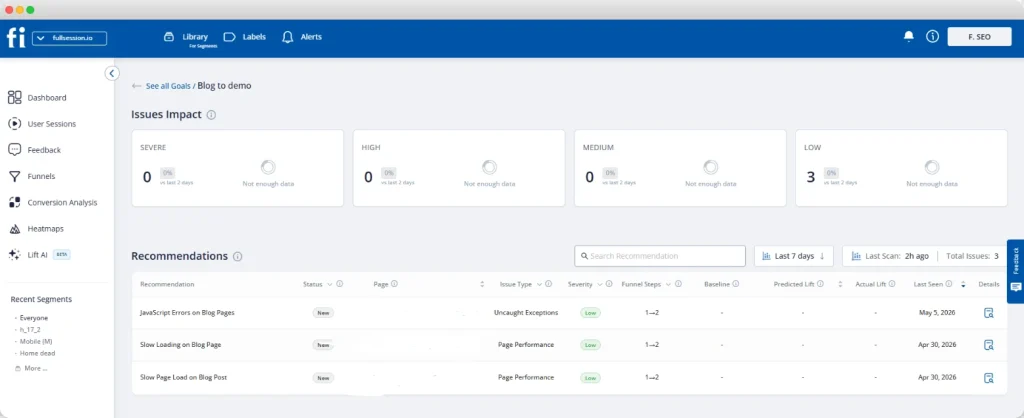
The right prioritization framework is only as good as the confidence score you feed it, and that’s exactly the gap FullSession is built to close.
FullSession’s Lift AI starts with a goal you set, like checkout completion or signup conversion, then scans your sessions, funnels, and frustration signals for friction tied to that goal. Instead of you guessing which fix matters most, Lift AI hands you a ranked list of opportunities, each with a confidence score and the actual sessions that back it up.
That’s the part most tools skip. You’re not assigning the confidence score by feel anymore, you’re reading one Lift AI already calculated from real behavior.
Lift AI doesn’t stop at the recommendation either. Once you ship a fix, you measure the result against a before-and-after window or a holdout experiment, so you know whether the prediction actually held up before you move on to the next item on your roadmap.
You can also skip the dashboard hunt with FullSession’s MCP Server. It connects directly to your AI assistant and answers plain questions like “what’s the top error causing mobile drop-off this week” using real session data.
See Your Own Confidence Gap, Not a Demo Script
Stop guessing which fix matters most. Get a ranked list built from your own sessions and funnels.
Aligning Stakeholders, Teams, and Product Roadmaps
Stakeholder alignment is what happens after scoring ends and the real arguing starts, especially across cross-functional teams who each see the roadmap differently. Treat your framework’s output as a strong starting position, not a verdict nobody can question, because priorities will shift no matter what.
A few habits keep teams on the same page instead of relitigating decisions every quarter:
- Agree on scoring criteria with key stakeholders before you score a single feature
- Attach a one-line rationale to every roadmap item so an override becomes a named trade-off, not a quiet reversal
- Use FullSession’s Feedback widgets to link a stakeholder’s “but a customer asked for this” directly to that customer’s actual session and behavioral history
- Trace every feature back to stated strategic objectives, so disconnected requests are easy to spot
When everyone can see the same rationale, setting priorities stops being personal. It becomes a process the whole product development organization trusts.
Planning Releases and Executing on Priorities
Releases turn a scored list into a shipped roadmap, grouped by theme, dependency, or stage in your product’s lifecycle. A ranked backlog isn’t a release plan yet. It’s an input to one.
Technical debt competes for the exact same engineering hours as new features. A few rules keep that competition from quietly losing the roadmap:
- Protect a fixed share of every release, around 20%, for debt and essential performance work so it never silently disappears
- Separate severity from noise using error tracking. FullSession’s errors and alerts engine ties JavaScript errors and broken flows directly to session replays, so a conversion blocker doesn’t get treated the same as a glitch
- Ship the smallest version first. Prove the assumption before expanding further, the same minimum viable product thinking that applies before launch still applies after it
- Watch the launch closely. Filter session replay to just the users touching your new feature and you’ll spot usability flaws within days, before more technical debt has a chance to pile up unnoticed
This same approach is exactly how a first-week activation playbook gets built for brand new SaaS users.
Tools, Templates, and Data Sources to Support Decisions
Most product managers run the entire process through a combination of a scoring template and the data sources covered above. That might be a shared spreadsheet or dedicated software.
The tool matters less than whether the team actually trusts it. A short checklist worth keeping visible:
- A shared scoring template everyone can see and edit, not one person’s private document
- Behavioral data feeding confidence scores instead of gut feel
- A documented rationale attached to every roadmap item before it ships
- Market research and competitive context alongside internal data, since matching a category standard for competitive differentiation sometimes matters as much as a RICE score
- Development efforts logged against a measurable key result, so agile teams can tell whether the work actually moved customer delight, not just shipped on time
- A regular cadence for revisiting priorities as new key performance indicators come in
A winning product roadmap isn’t built by chasing every request or by building products faster than you can validate them. It’s a repeatable process designed to eliminate wasteful practices, keep customers happy, and earn the whole team’s trust, sprint after sprint, instead of reinventing the argument every cycle.
Conclusion on How to Prioritize Product Roadmap
Prioritizing a product roadmap works best as one connected process. Gather real inputs and ground your scoring in behavioral and revenue data instead of gut feel.
Apply a framework everyone agrees on in advance. Align teams before priorities change without warning.
The confidence score in any framework you choose is only as honest as the data sitting behind it. FullSession closes that gap end to end: session replay, heatmaps, funnels, and errors and alerts surface the real friction, Lift AI ranks it by predicted revenue impact, and the MCP Server lets you query all of it without opening a single dashboard.
See Your Roadmap Decisions Backed by Real Data
Stop scoring confidence by guesswork. Get a ranked, evidence-backed view of what to fix next.
FAQs on How to Prioritize Product Roadmap
How do you prioritize features on a roadmap?
Collect inputs from customer feedback, behavioral data, and internal strategy, then score each item against a consistent framework like RICE or Kano. Ground your scores in real usage and funnel data instead of opinion. Align stakeholders around the ranked result before locking it into a release plan for informed decisions.
What is roadmap prioritization?
Roadmap prioritization is the process of ranking features, fixes, and initiatives against your available engineering capacity and business goals. It determines what gets built now, what waits, and what gets dropped entirely. Done well, target key results stay tied to what’s actually getting shipped.
How to decide product roadmap?
Decide your roadmap by combining customer value, business impact, and technical feasibility into one scoring framework. Validate the inputs with real usage or revenue data wherever possible. The goal isn’t a perfect score, just that the ranking is defensible and visible to everyone involved.
What is the rule of 3 prioritization?
The rule of 3 isn’t a formal product management framework like RICE or MoSCoW. It’s a general productivity habit: limit your active priorities to three at a time, in any given week or planning cycle, to force genuine focus instead of spreading effort across everything at once.

Roman Mohren is CEO of FullSession, a privacy-first UX analytics platform offering session replay, interactive heatmaps, conversion funnels, error insights, and in-app feedback. He directly leads Product, Sales, and Customer Success, owning the full customer journey from first touch to long-term outcomes. With 25+ years in B2B SaaS, spanning venture- and PE-backed startups, public software companies, and his own ventures, Roman has built and scaled revenue teams, designed go-to-market systems, and led organizations through every growth stage from first dollar to eight-figure ARR. He writes from hands-on operator experience about UX diagnosis, conversion optimization, user onboarding, and turning behavioral data into measurable business impact.