Author: Mohamed Sehwail

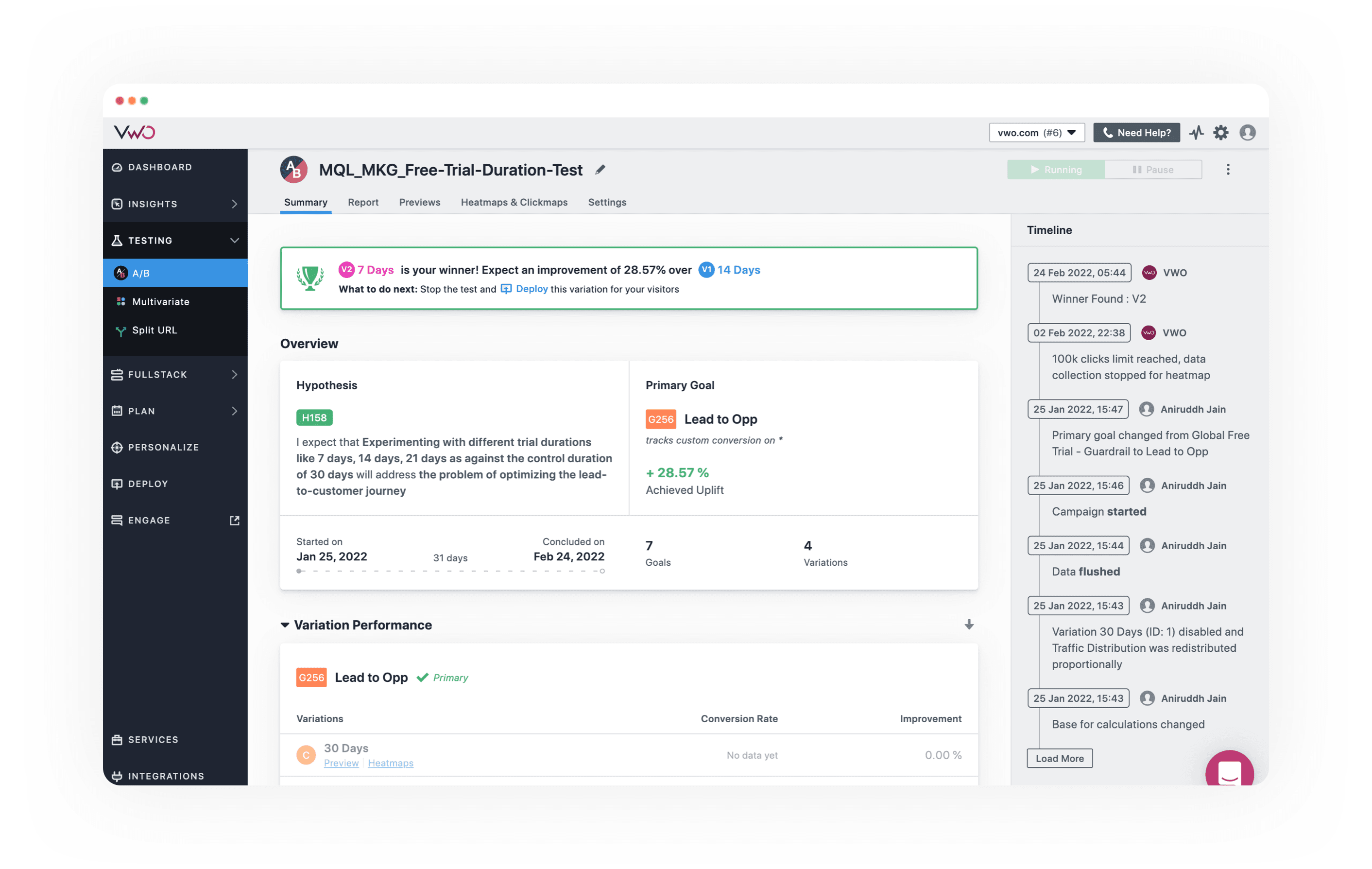
  • Top 10 VWO Competitors and Alternatives This Year 

    Top 10 VWO Competitors and Alternatives This Year 

    Are you looking to optimize your website’s performance but unsure if VWO is the right choice? You’re in luck! 

    We’ve compiled a list of this year’s top 10 VWO competitors that can help you improve your site’s user experience and conversion rates.

    We’ll break down their use cases, key features and pricing and explain how each alternative compares to VWO. 

    Whether you’re a startup or an enterprise, by the end of this article, you’ll have enough information to select the best platform for your business.

    10 Best VWO Alternatives Right Now

    If you’re looking for VWO alternatives, here are the best solutions to consider:

    1. FullSession: User behavior analytics software that offers session recordings and replays, dynamic heatmaps, website feedback forms, conversion funnel analysis and error tracking. Pricing starts at $39/month with a 20% discount on annual plans. Book a demo to learn more.
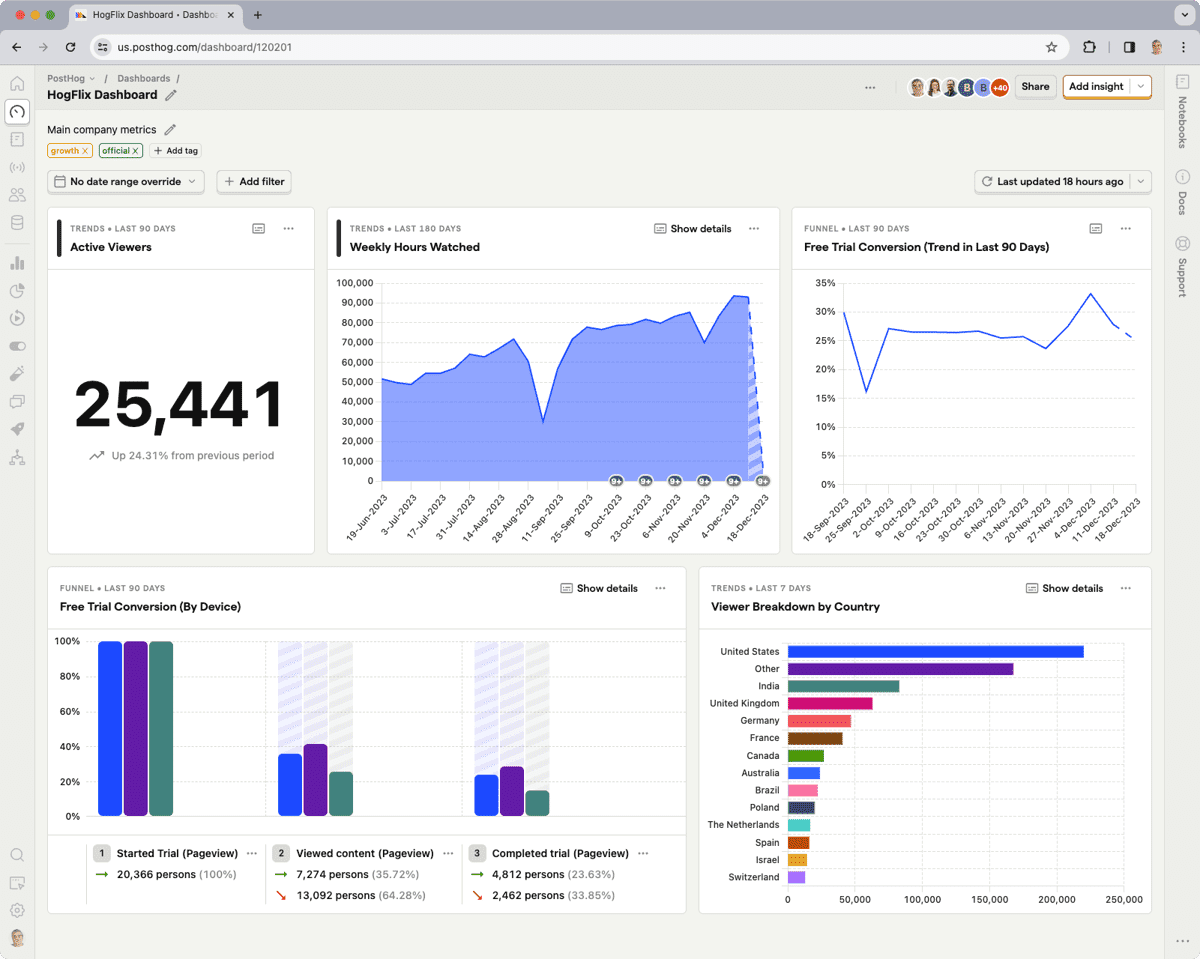
    2. PostHog: A self-hosted product analytics platform with customer data tracking, analysis, and extensive integrations. Pricing starts from $0.0000500/event.
    3. Optimizely: A digital experience analytics platform focusing on A/B testing, experimentation, and personalization with advanced targeting capabilities. It provides feature-based pricing not available publicly.
    4. Heap: A digital insights platform automatically capturing web and mobile app data, offering behavioral data visualization and funnel analysis. It has a tiered pricing structure that is available upon request.
    5. AB Tasty: A digital experience optimization platform for marketing teams, providing easy A/B testing and personalization features. Pricing is available upon request.
    6. Amplitude: Product intelligence and event tracking software, offering customer engagement and retention insights. Its scalable pricing starts from $61/month.
    7. LaunchDarkly: A feature management platform with real-time flagging and experimentation features. Its feature-based pricing starts at $12/month.
    8. Crazy Egg: A web analytics tool specializing in website optimization through visual reports like heatmaps. It offers simple pricing with multiple plans starting at $99/month.
    9. FullStory: A digital experience analytics platform providing in-depth insights into user interactions on websites and mobile applications with automatic data capture. Its custom pricing is available upon request.
    10. Adobe Target: Enterprise-level A/B testing and optimization platform with automated personalization and multivariate testing features. Pricing suits large companies and is available upon request.

    When choosing the best solution, consider the specific features and pricing that best align with your requirements.

    Let’s start with our review.

    1. FullSession

    FullSession VWO competitors

    Capture all user interactions, observe how users engage with your website, and improve its interface, usability, experience, and performance with FullSession, an advanced user behavior analytics platform.

    Our intuitive dashboards make visualizing and analyzing all user behavior data easy, helping you spot trends and patterns effortlessly.

    Dive deeper with real-time session replays to see how visitors navigate your site. Our platform gives you a complete view of the customer journey, capturing every action for accurate insights.

    Pinpoint problem areas, test design updates, and improve usability with UX heatmap tools that show you where your site can perform better. Identify inactive zones, optimize page elements, and strengthen your interface based on real user monitoring.

    Use conversion funnel analysis to streamline your path to conversions. Remove barriers, improve key steps in the user journey, and reduce drop-offs to increase your success rates.

    Employ customer feedback collection tools to discover the “why” behind user frustrations and deliver immediate solutions to recurring problems, boosting user satisfaction and building loyalty.

    Stay secure and compliant with analytics that respect user privacy. We follow GDPR, CCPA, and PCI standards to ensure ethical and legal data collection practices.

    Visualize, Analyze, and Optimize with FullSession

    See how to transform user data into actionable insights for peak website performance.

    Use cases

    FullSession is best for:

    • E-commerce businesses to optimize sales funnels and boost conversions
    • SaaS companies to analyze user engagement and increase product adoption rates
    • Marketing teams to optimize campaigns based on real-time user behavior data
    • UX designers to improve interface design and functionality through user insights
    • Data analysts to get in-depth metrics on user interactions and trends
    • Quality assurance teams to identify and resolve website issues promptly
    • Product developers to understand user feedback for new feature implementation
    • Customer support teams to improve response times and issue resolution processes
    • Customer experience professionals to create seamless online user journeys
    • Conversion rate optimization specialists to fine-tune website performance

    Key features 

    FullSession customers
    • Advanced filters and tags: Identify behavior trends and patterns to optimize user journeys and improve engagement and conversion rates.
    • Session recordings and replays: Replay user interactions to diagnose issues, analyze user flows, and understand user behavior without compromising sensitive data.
    • Interactive heatmaps: Analyze click, scroll, and mouse heatmaps to identify areas of high or low user interaction and measure task completion times.
    • Website feedback forms and reports: Collect user feedback through branded forms and connect responses with session recordings for deeper insights.
    • Conversion funnel analysis: Detect patterns that lead to user drop-offs and test new ideas to optimize conversion rates.
    • Error analysis: Quickly detect and address website issues like JavaScript errors and network problems to prevent disruptions in the user experience.

    FullSession vs VWO

    FullSession goes beyond the traditional A/B testing capabilities offered by VWO by capturing, visualizing and analyzing data with its advanced user behavior tools.

    While VWO primarily focuses on optimizing website variations, FullSession provides granular insights into user engagement, making it a better choice for businesses that prioritize understanding user behavior rather than running extensive A/B tests.

    Turn User Behavior into Growth Opportunities

    Learn how to visualize, analyze, and optimize your site with FullSession.

    Integrations

    FullSession integrates with your entire tech stack. It connects with open APIs, modern webhooks, and Zapier and also provides native integrations. It works best with Shopify, WordPress, Wix, and BigCommerce.

    Support

    FullSession is known for responsive customer support. You can reach out by email or chat or visit the knowledge base with articles and tutorials that help you troubleshoot common issues yourself. 

    Pricing

    FullSession pricing

    FullSession offers multiple tools, a free trial and flexible pricing structure with three tiers—Starter, Business, and Enterprise—designed to accommodate businesses of all sizes, from emerging startups to large corporations.

    Our scalable plans allow you to begin with a package that suits your current needs and easily upgrade as your business expands, ensuring you only invest in the required features.

    The entry-level paid plan, priced at an accessible $39/month, includes all essential features with unlimited heatmaps and recording up to 5,000 monthly sessions. It allows you to leverage advanced analytics without a significant financial commitment.

    We offer a 20% discount on all plans for annual subscriptions, providing advanced features and additional value for long-term users.

    Drive Revenue Growth With FullSession

    Learn how to visualize and improve each step in your sales or marketing funnel.

    2. PostHog

    PostHog VWO alternatives

    PostHog is an open-source analytics platform for startups and scaleups. It has core product analytics, experimentation and user behavior tracking features. It’s self-hosted, so you have full control over your data.

    The platform is attractive to tech-savvy companies that prefer having direct access to and ownership of their analytics tools. PostHog is also popular in the tech sector for its flexibility and adaptability.

    Learn more: PostHog alternatives and competitors.

    Use cases

    PostHog helps you measure user engagement, find problem areas and run A/B tests to optimize user experience. Companies use it for feature flagging so they can roll out changes gradually and measure the impact.

    It’s good for teams focused on retaining users, reducing churn and increasing conversion rates. PostHog also helps product managers and developers looking to improve their products.

    Key features

    • Open-source: Gives you full access to modify and use the code.
    • Event tracking: Captures user interactions across your product.
    • Feature flags: Manage feature rollouts efficiently.
    • Heatmaps: Visualize user navigation patterns easily.
    • Session recording: Replay user sessions to understand behavior.
    • Integrations: Works seamlessly with other tools in your stack.
    • Scalability: Handles large volumes of data efficiently.
    • Privacy-focused: Keeps your user data secure and compliant with regulations.

    PostHog vs VWO

    PostHog is free and open-source, unlike VWO, a paid service. It makes it cost-effective for smaller companies or startups. While VWO focuses heavily on A/B testing with broad testing options, PostHog incorporates a wider set of analytics tools, appealing to technical teams.

    PostHog’s ability to host data on your servers offers greater privacy control than VWO’s cloud-based model. This setup benefits companies with strict data privacy requirements or those who want more control over their data.

    Integrations

    PostHog works well with Kafka, Slack, AWS, Google Cloud, GitHub, Tableau, and Looker. These integrations make it easy to plug PostHog into your existing tech stack and get more out of it.

    Support

    PostHog has a community and loads of documentation to support you. While it doesn’t have traditional support channels, it has paid support plans that give you direct access to the developers who can help you solve issues.

    Pricing

    PostHog pricing

    PostHog offers a tiered pricing structure with a free plan for startups and hobbyists, allowing up to 1 million monthly events with essential analytics features.

    After the free plan, you can switch to usage-based plans, starting at $0.00005/event.

    3. Optimizely

    Optimizely VWO competitors

    Optimizely is popular for companies looking for A/B testing and personalization features. It helps you improve your websites and apps through experimentation and integrations with other tools.

    The platform allows you to test different website versions for better conversion rates. Optimizely has a user-friendly interface, so it’s suitable for both technical and nontechnical users.

    Use cases

    Optimizely is used across e-commerce, healthcare and finance. You can use it to improve user engagement on websites and mobile apps. It’s good for testing different design layouts, content variations and marketing messages.

    You can also use it to personalize user experiences based on behavior or demographics. Your visitors can see content that resonates with them, improving conversion rates and customer satisfaction.

    Key features

    • A/B testing: Run experiments to find what works best for your audience.
    • Multivariate testing: Dive deeper into how users interact with different elements on your site.
    • Personalization: Show tailored content to specific audience segments.
    • Feature management: Control which features are released and when.
    • Experimentation platform: Conduct experiments on web, mobile, and full-stack applications.

    Optimizely vs VWO

    Optimizely has more advanced experimentation features than VWO. It’s particularly strong in multivariate testing and personalization. VWO is also a great tool but more geared towards ease of use with slightly fewer features.

    Optimizely might be better for larger companies or those with complex testing needs, and VWO might be better for smaller teams or companies just starting with optimization.

    Integrations

    Optimizely connects with Google Analytics, Adobe Analytics, WordPress and Salesforce. It allows you to gather data from multiple sources and use it to inform your experiments.

    Support

    Optimizely has good customer support, including a help center and community forum. You can access documentation and tutorials to get started with the platform.

    They also have 24/7 support via chat or email, so help is always available when needed.

    Pricing

    Optimizely pricing

    Optimizely doesn’t share its pricing details publicly. You need to contact their sales team directly for more information.

    4. Heap

    Heap VWO competitors

    Heap is a digital insights platform that auto-captures data on user interactions, providing comprehensive analytics features so you can see how people use your website or app. You can start analyzing without coding or tagging, which is suitable for fast-paced environments.

    Contentsquare acquired Heap and merged it with its other products, like Hotjar.

    Learn more: Heap alternatives.

    Use cases

    Heap is good for seeing user engagement trends and where users drop off. You can use it for A/B testing, conversion rate optimization and customer journey mapping.

    With its full data collection, Heap works for teams that want to see the complete picture of user behavior without manual tracking.

    Key features

    • Automatic data capture: Collects all user interactions automatically.
    • User segmentation: Helps you segment users based on their behavior.
    • Retroactive analysis: Allows analysis of past user interactions without prior tracking setup.
    • Journey analysis: Maps and analyzes user journeys on your site or app.
    • Event visualizer: Provides visual insights and patterns of user behavior.

    Heap vs VWO

    Heap gives you a complete view of user behavior with its auto-capture, which differs from VWO’s manual approach.

    VWO is suitable for A/B testing and personalization, while Heap is useful for deep behavioral analysis, so it’s a good choice for teams that want to see user engagement patterns.

    Integrations

    Heap connects to CRM systems, marketing platforms and data warehouses. Key integrations include Salesforce, Google Analytics and Slack so that you can have consistent data across all tools.

    Support

    Heap offers documentation, webinars and training sessions. You can get support via email and chat or check out the community forum for more help.

    Pricing

    Heap pricing

    Heap provides a free plan and three pricing tiers. You need to contact sales to get more information.

    5. AB Tasty

    AB Tasty VWO competitors

    AB Tasty is a digital optimization platform that focuses on user experience. It has a user-friendly interface for A/B testing and personalization experiments and also includes a customer data platform you can integrate with third-party applications.

    AB Tasty supports web and mobile platforms and has broad features for user engagement analysis.

    Use cases

    AB Tasty lets you launch and manage A/B tests and personalize user journeys. Marketers use it to improve website performance by testing different layouts, content and features.

    It’s good for e-commerce sites to optimize their checkout process and increase sales. Content creators can use it to tailor messaging and design to different audience segments to improve user engagement.

    Key features

    • A/B testing: Create and test different versions of your website content.
    • Personalization: Customize user experiences based on behavior and preferences.
    • Feature management: Control feature rollouts and optimize the user experience.
    • Widgets: Use pre-built options like banners and modals to engage visitors.
    • Reporting: Access data to track the performance of your tests and campaigns.

    AB Tasty vs VWO

    AB Tasty is easier to use for personalization tasks than VWO. It has more widgets so you can launch and manage experiments and engage users through different creative formats.

    But it doesn’t have all the advanced analytics tools that VWO has. So AB Tasty is good for companies seeking basic but effective experimentation tools. If you want to get projects up and running fast, AB Tasty is a quick and easy solution.

    Integrations

    AB Tasty integrates with Google Analytics, Shopify, Magento, and Salesforce. These integrations make it easier to link test results to business performance data. 

    Support

    AB Tasty has extensive online resources, including a knowledge base and tutorials to get you started. AB Tasty also provides personalized support through customer service representatives and offers consultation services to make the most of the platform’s features.

    Pricing

    AB Tasty pricing

    AB Tasty doesn’t share its pricing information publicly. You need to contact the team for more details.

    6. Amplitude

    Amplitude VWO alternatives

    Amplitude is a product analytics and event-tracking platform to understand user behavior and improve digital products.

    It helps you get insights into customer journeys, segment users and measure the impact of product decisions.

    It’s known for its user-friendly interface and in-depth analytics that integrate easily into your existing tech ecosystem.

    Learn more:

    Use cases

    Amplitude is for businesses that want to analyze user behavior. You can track engagement, measure conversion rates and understand user retention.

    It’s also for product teams that want to optimize their products based on user feedback and behavior data.

    Key features

    • User segmentation: Allows you to segment users based on behavior.
    • Behavioral cohorts: Create groups of users based on their actions.
    • Funnel analysis: Track conversion rates and identify drop-off points.
    • Retention analysis: Measure how often users return to your product.
    • Pathfinder: Visualize user journeys to understand how they interact with your product.

    Amplitude vs VWO

    Amplitude and VWO are different but can work together. Amplitude is for in-depth analytics and user behavior, while VWO is for A/B testing and conversion rate optimization.

    VWO helps you test changes on your site, while Amplitude gives you the data to understand the impact of those changes. Businesses often use both to cover all their optimization needs.

    Integrations

    Amplitude integrates with Slack, Segment and Google Analytics. It gives a single view of your data across all platforms and can make better decisions.

    Support

    You can get help through email, live chat and an extensive online help center. Amplitude also has webinars and training sessions to help you get the most out of the platform.

    Pricing

    Amplitude pricing

    Amplitude provides a free plan and three paid plans, starting at $61/month. The pricing depends on the monthly tracked users and available feature set. You need to contact the sales team for higher plans to get more information.

    7. LaunchDarkly

    LaunchDarkly VWO competitors

    LaunchDarkly is a feature management tool built for developers. It makes software releases easier and helps create better user experiences. It’s a platform where you can roll out features gradually with a kill switch to revert if needed.

    LaunchDarkly gives you control over feature distribution and monitoring and reduces risk when delivering new features. With the sunsetting of Google Optimize, LaunchDarkly offers a strong alternative for feature management and experimentation.

    Use cases

    Software teams get reduced risk during feature deployment, staged rollouts or beta testing. Marketing teams can test features or campaigns without affecting all users.

    It is also helpful for geographic targeting, enabling features in specific regions first. Developers working on large-scale software or apps use it for better experiment management and ease of use during updates.

    Features

    • Feature flags: Enable or disable features for different user groups.
    • Granular targeting: Select who sees specific features based on user attributes.
    • Real-time updates: Adjust settings quickly without redeploying code.
    • Kill switch: Instantly reverse a feature rollout when needed.
    • Detailed analytics: Gain insights into user interaction with new features.
    • Custom workflows: Create custom pathways for feature management teams.

    LaunchDarkly vs VWO

    LaunchDarkly is concentrated on feature management through feature flags, while VWO is focused on A/B testing and personalization. If you need feature control in complex environments, LaunchDarkly might be better for you.

    VWO has more specialized tools for conversion rate optimization and detailed user behavior insights. Both are good but serve different purposes in software development and marketing.

    Integrations

    LaunchDarkly connects with Jira and Slack as well as data platforms, analytics tools and cloud services.

    Support

    LaunchDarkly has email and chat for real-time support. They also include documentation and a community forum where you can ask questions and share tips.

    Pricing

    LaunchDarkly pricing

    LaunchDarkly offers a free plan and three paid plans. The pricing starts at $12 monthly with unlimited seats, projects and environments.

    8. Crazy Egg

    Crazy Egg VWO alternativesCrazy Egg is a website optimization tool that helps you visualize your website data. It shows you how visitors interact with your site through heatmaps, scroll maps and click reports.

    It suits businesses that want to improve user experience and conversion rate. Its simple interface makes it accessible even if you’re not tech-savvy.

    Learn more:

    Use cases

    If you’re a web designer, you can see how users interact with different elements. Marketers can use it to increase conversion rates by seeing which page parts get the most attention.

    Small business owners can use it to increase online sales by improving customer navigation and overall site engagement.

    Features

    • Heatmaps: Visualize where users are clicking and interacting.
    • Scroll maps: See how far down a page users are scrolling.
    • Overlay reports: Get detailed insights on each element on the page.
    • A/B testing: Test variations of pages to see which performs better.
    • Snapshot reports: Capture website activity over specific timeframes.
    • Confetti reports: Break down clicks based on referral sources or campaigns.
    • User recordings: Watch real user sessions to understand their path.

    Crazy Egg vs VWO

    Crazy Egg is known for its simplicity and focuses on heatmaps, click tracking and user session recordings, so it’s good for businesses looking for basic user insights.

    VWO has a full-featured suite of tools that includes advanced A/B testing, multivariate testing and extensive personalization options to run complex experiments and target specific audience segments.

    VWO also supports more integrations with marketing tools and has more customer support resources, whereas Crazy Egg has more straightforward pricing and fewer integrations.

    Integrations

    Crazy Egg integrates with WordPress, Shopify and Google Analytics. It also works with CRM systems and marketing automation platforms like HubSpot.

    Support

    You can access online resources, tutorials and webinars to learn more about using the platform. There’s also email support and one-on-one consultations.

    Pricing

    Crazy Egg pricing

    Crazy Egg offers three pricing plans, starting at $99/month. All plans are billed annually. The cost depends on the tracked pageviews per month. Each plan has unlimited surveys, websites and A/B tests.

    9. FullStory

    FullStory VWO competitors

    FullStory is a digital experience analytics platform that shows you everything your users do on your site. It records browsing sessions so you can see how people interact with your content.

    It gives you insights into user behavior to find areas for improvement. The platform is intuitive, making it easy to analyze user data immediately.

    Use cases

    For eCommerce, it’s good for figuring out why users are abandoning their shopping carts. For SaaS, it helps understand user engagement with the software.

    Also, it helps UX teams to test website navigation. Marketers can see how campaigns drive traffic to specific site parts.

    Key features

    • Session replay: Watch what users do on your site.
    • Heatmaps: Visualize user clicks and taps.
    • Funnel analysis: Track steps users take to achieve a goal.
    • User insights: Get detailed information on user behavior.
    • Custom events: Track specific user actions.

    FullStory vs VWO

    Compared to VWO, FullStory focuses more on qualitative data. While VWO is strong in A/B testing, FullStory stands out in session replay and heat mapping.

    It makes FullStory more helpful in determining complex user behavior. If your priority is experimentation, VWO may be the better choice, but for in-depth analysis of user paths, FullStory is a better solution.

    Integrations

    FullStory integrates with Google Analytics, Slack, Salesforce and Optimizely for experimentation.

    Support

    You can get access to a help center with guides and tutorials.

    Their support team is available by email for more complex questions. They also have live chat for instant help.

    Pricing

    FullStory pricing

    FullStory has four paid plans but doesn’t publicly share its pricing. Due to limited features, you need to pay for mobile analytics as a separate add-on.

    10. Adobe Target

    Adobe Target VWO alternatives

    Adobe Target is part of the Adobe Experience Cloud. It’s for businesses looking to optimize digital experiences. The platform allows you to personalize content across all digital channels so you can better connect with your audience.

    It provides beginner and advanced users with easy setups and detailed testing options. The interface is user-friendly, making it easier to create and analyze tests.

    Use cases

    Adobe Target is good for conversion rate optimization by testing different page layouts. It’s suitable for personalizing content for specific audience segments.

    Another use is delivering personalized product recommendations for e-commerce, improving user experiences. Adobe Target can personalize in-app content for mobile apps based on user behavior.

    Key features

    • A/B testing: Test different page versions to find what works best.
    • Multivariate testing: Test multiple elements together to optimize designs.
    • Automated personalization: Use AI to deliver personalized content in real-time.
    • Mobile app optimization: Improve app experiences with testing and personalization.
    • Geolocation targeting: Tailor content based on users’ locations.
    • Audience segmentation: Group users to deliver targeted experiences.
    • Recommendation engine: Suggest tailored products or content to users.
    • Visual experience composer: Create and test experiences without coding.

    Adobe Target vs VWO

    Adobe Target has deep integration with other Adobe products which can be a big plus if you’re already in the ecosystem. Compared to VWO, Adobe Target is more complex and has more advanced targeting and personalization options.

    VWO is simple, easy to use, and suitable for those new to testing. Adobe Target is robust, with more personalization options but less emphasis on testing.

    Integrations

    Adobe Target integrates with Adobe Experience Manager, Adobe Campaign, Adobe Experience Platform and Demandbase.

    Support

    Users can access documentation, tutorials, and community forums for self-help. Adobe provides dedicated customer support, including phone and email assistance. For complex issues, Adobe offers consulting services.

    Pricing

    Adobe Target pricing

    Adobe Target provides custom plans based on your needs. You need to contact their team for more information.

    VWO Alternatives: Comparison Table

    Here’s a quick overview of VWO alternatives to help you decide what you really need for your business.

    ToolKey featuresBest forPricing
    FullSessionUser behavior analytics, session recordings and replays, dynamic heatmaps, conversion funnel analysis and error trackingUX/UI analysis, customer journey mapping, website and conversion rate optimizationStarts at $39/month, includes a free trial
    PostHogA/B testing, feature flags, product analyticsProduct analytics and experimentation; For teams wanting an all-in-one open-source analytics platformFree plan available, paid plans start at $2,000/month
    OptimizelyA/B testing, personalization, full-stack experimentationEnterprise-level experimentation; For large companies needing comprehensive testing across web and mobileCustom pricing
    HeapAuto-capture analytics, retroactive analysisAutomatic event tracking and analysis; For teams wanting to capture all user interactions without manual setupCustom pricing
    AB TastyA/B testing, personalization, AI-powered recommendationsConversion rate optimization; For e-commerce and SaaS companies focusing on personalized user experiencesCustom pricing
    AmplitudeAdvanced analytics, cohort analysis, data analysisIn-depth product analytics; For data-driven teams needing advanced user behavior insightsFree plan available, pricing starts at $61/month
    LaunchDarklyFeature flags, experimentationFeature management and controlled rollouts; For development teams practicing continuous delivery and experimentationFree plan, pricing starts at $12/month
    Crazy EggHeatmaps, scroll maps, A/B testingVisual website optimization; For marketers and designers wanting to understand user interactions visuallyFree trial, pricing starts at $99/month with annual payment
    FullStorySession replay, funnel analysisDigital experience analytics; For teams needing detailed insights into individual user sessions and overall user flowsCustom pricing
    Adobe TargetA/B testing, AI-powered personalizationEnterprise marketing optimization; For large organizations needing advanced personalization and testing capabilities integrated with other Adobe productsCustom pricing

    VWO Competitors: The Best on the List

    FullSession behavioral analysis

    While all the VWO competitors offer valuable features for website optimization and user behavior analysis, FullSession stands out as the best solution.

    One of FullSession’s key strengths is that it can track dynamic elements in real-time, giving precise user insights. This feature lets you understand how users interact with your site’s most complex and changeable parts, giving you a competitive edge in optimizing user experience.

    FullSession accelerates heatmap processing without impacting your site’s speed. It means you get rapid insights into user behavior patterns without sacrificing your website’s performance – a critical factor for user experience and SEO.

    Since data privacy is a top priority, FullSession takes the lead by excluding sensitive data recording. It means you get the insights you need while respecting your users’ privacy, maintaining trust, and complying with data regulations.

    FullSession also excels in handling large data volumes. The platform gives you key insights from massive data sets in seconds so you can make data-driven decisions faster and more confidently.

    Unlike competitors that might track user behavior across multiple sites, FullSession limits tracking to your specific site. It prevents potential data misuse and ensures that the insights you receive are directly relevant to your website’s performance.

    FullSession is also a single platform for cross-team collaboration. Bringing all team efforts onto one platform enables better communication and coordination between different departments, from marketing to development to UX design.

    FullSession offers the tools and insights to drive your online success. Its comprehensive approach to website optimization, coupled with its commitment to user privacy and data management, makes it the standout choice among VWO competitors.

    Visualize, Analyze, and Optimize with FullSession

    See how to transform user data into actionable insights for peak website performance.

    FAQs About VWO Competitors 

    Let’s answer the most common questions about VWO.

    What is VWO?

    VWO (Visual Website Optimizer) is an A/B testing and conversion optimization platform. It helps businesses improve their website by testing different versions of a page to see which one performs better.

    What are VWO limitations?

    High cost and complex features that are overwhelming for small businesses. It’s less flexible than some open-source alternatives like PostHog, which also offers free and self-hosted solutions.

    What’s better than VWO?

    FullSession, Optimizely and UXtweak are often mentioned as better options for different user needs. FullSession is for e-commerce businesses, Optimizely is for big enterprises while UXtweak has comprehensive user research tools.

    Is VWO a long term investment?

    VWO is a good investment if your business needs advanced testing and optimization tools. However, it is not cost-effective for small businesses looking for simple solutions.

    Is VWO a SaaS company?

    Yes, VWO is a SaaS company. They provide web-based access to their testing and optimization tools.

    What is VWO used for?

    A/B testing, multivariate testing, conversion rate optimization. Test different versions of web pages to improve user experience and conversions.


  • 5 PostHog Alternatives and Competitors to Test This Year

    5 PostHog Alternatives and Competitors to Test This Year

    PostHog is a product analytics platform that helps developers and engineering teams enhance product development and user experience. Its key features include web analytics, feature flags, session replays, heatmaps and surveys. However, some users have experienced difficulties with data loading, limited data tracking, technical complexity and a high learning curve, leading them to seek PostHog alternatives.

    One such alternative is FullSession, which offers an all-in-one user behavior analytics software that helps you visualize all user interactions, analyze trends and patterns with laser precision and optimize your website for peak performance.

    You can start a free trial or get a demo to learn more.

    In this article, we’ll explore the top PostHog competitors, comparing features, pricing, and use cases to help you find the right tool for your business.

    Key Takeaways

    • FullSession is a user behavior analytics software that helps optimize website usability, interface, experience and performance. It offers session recordings and replays, dynamic heatmaps, website feedback tools, conversion funnel analysis, and error tracking. FullSession prioritizes user privacy and data security and complies with GDPR, CCPA, and PCI standards. It integrates easily with platforms like Shopify, WordPress, Wix, and BigCommerce. Pricing starts at $39 per month, with a 20% discount for annual subscriptions. Book a demo now.
    • Pendo is a product experience and digital adoption platform focusing on user behavior analytics and in-app guidance. It provides product usage insights, in-app guides, feedback collection, and user segmentation, making it useful for product teams and customer success managers. However, it can be expensive for smaller businesses, and the setup can be complex. Pendo integrates with tools like Salesforce, Slack, Jira, and HubSpot. Pricing suits mid-sized companies and enterprises.
    • Mixpanel is a product analytics tool centered around event tracking and behavioral analysis. Its key features include event tracking, cohort analysis, funnel analysis, A/B testing, and retention analysis. While it offers powerful insights, its interface can be overwhelming for non-technical users and advanced features are limited to higher pricing tiers. Mixpanel integrates with Salesforce, Slack, Segment, and Google Analytics. Mixpanel offers a free plan with up to 20 million data points, while more advanced plans start at $24 per month.
    • Kissmetrics is an event analytics tool that tracks user actions to improve conversions and retention. It offers funnel reporting, cohort analysis, behavioral segmentation, and revenue tracking. The platform is somewhat outdated and lacks modern data visualizations, and it can be expensive for startups. Kissmetrics integrates with tools like Google Ads, HubSpot, and Stripe. Pricing starts at $299 monthly, with higher-tier plans offering more features.
    • LogRocket is a product analytics tool focused on increasing conversions and improving product engagement on mobile and desktop apps. Its core features include session replays, error tracking, performance monitoring, heatmaps, and user feedback collection. LogRocket is useful for developers but may not work for teams focused on marketing or UX design. It integrates with Jira, Slack, Trello, and GitHub. Pricing starts at $99 monthly for larger teams, with a free plan available for smaller projects.

    Visualize, Analyze, and Optimize with FullSession

    See how to transform user data into actionable insights for peak website performance.

    5 Top PostHog Competitors Right Now

    If you’re looking for PostHog competitors to fully understand how users interact with your product, here are some of the most popular product analytics tools to consider:

    1. FullSession (Get a demo)
    2. Pendo
    3. Mixpanel
    4. Kissmetrics
    5. LogRocket

    Let’s move on to reviewing each tool and its product analytics features.

    1. FullSession

    FullSession is an all-in-one user behavior analytics platform that captures all customer interactions and provides extensive insights into how people engage with your website.

    Visualize and analyze user behavior data to identify trends and patterns with exceptional accuracy and improve your site’s performance and user experience.

    Get a complete overview of user behavior metrics in one place and track website issues with our easy-to-use dashboard.

    Move beyond basic statistics by observing real-time user interactions. Our session recordings and replays capture every step of the user journey, providing a detailed view of how visitors navigate your site.

    Find problem areas, assess page elements, confirm design changes, and make your site more functional, user-friendly, and efficient with UX heatmap tools.

    Identify and fix barriers to conversions, optimize key parts of the user journey, and reduce abandonment rates in your sales funnels with conversion funnel analysis.

    Use our customer feedback platform to collect direct user input and quickly understand and resolve common issues.

    FullSession offers one of the best website analytics tools while protecting user privacy. We comply with GDPR, CCPA, and PCI standards to increase data security.

    Turn User Behavior into Growth Opportunities

    Learn how to visualize, analyze, and optimize your site with FullSession.

    Use cases

    FullSession is best for a range of professionals and teams, including:

    • E-commerce businesses looking to improve customer journeys and boost sales.
    • SaaS companies that need to analyze user interactions and optimize their platforms.
    • Digital marketers aiming to reduce drop-offs in conversion funnels.
    • UX designers who want to track how users engage with different page elements.
    • Data analysts working on identifying behavior patterns to improve engagement.
    • Product development teams wanting to validate design changes.
    • Customer support teams aiming to resolve user frustrations.
    • Quality assurance teams for testing the user interface.

    Key features

    • Advanced filters: Create custom dashboards, spot trends, patterns, and correlations in customer behavior to optimize user journeys, boost engagement, and improve conversion rates.
    • Session recordings and replays: Record every user interaction on your website to troubleshoot issues and understand user behavior. Use session replay, filter recordings by specific criteria, and predict future actions based on past data. FullSession ensures privacy by excluding sensitive information from recordings.
    • Interactive heatmaps: Switch between mouse movement, click maps, and scroll maps to find areas with high or low user activity. Test page elements to discover top performers and measure task completion times. Get instant heatmap data with zero delays and no impact on website performance.
    • Website feedback forms and reports: Create branded forms to collect insights on user satisfaction, pain points, and feature requests. Link feedback to session recordings for deeper context and to understand what led to the comment.
    • Conversion funnel optimization: Discover why users drop off at specific stages. Visualize user behavior at each step, identify weak points, and test different designs or content to boost conversions.
    • Error analysis: Automatically detect JavaScript errors, network failures, or API problems. Use error data to troubleshoot, find root causes, and prevent these problems from affecting user experience.

    How FullSession compares to PostHog

    FullSession is primarily a user behavior analytics tool to visualize user engagement and analyze interaction patterns, while PostHog offers a broader range of product analytics features.  

    FullSession suits professionals and teams looking to improve user experience and website performance, while PostHog targets product and development teams looking for feature experimentation capabilities.

    FullSession has an intuitive dashboard and is easy to implement. PostHog may have a steeper learning curve due to its more complex feature set.

    FullSession also provides a flat monthly fee for all its pricing plans, with a 20% discount on annual plans. PostHog offers pricing per tracked event, recording, request and similar.

    Limitations

    FullSession doesn’t support collecting user behavior data in native mobile apps.

    Integrations

    FullSession connects with popular platforms like Shopify, WordPress, Wix, and BigCommerce. It also integrates with other apps through Zapier and Open APIs, making it easy to connect with your existing tech stack and automate workflows.

    Customer support

    FullSession provides excellent customer support via live chat and email. The support team is highly responsive, and they offer a detailed help center for users who prefer to troubleshoot issues on their own.

    Pricing

    FullSession offers a free trial and three paid plans – Starter, Business, and Enterprise.

    Our flexible pricing lets you choose a plan that matches your current needs, with the option to upgrade as your business grows. This way, you only pay for the features you truly need.

    The Free plan is available at $0/month and lets you track up to 500 sessions per month with 30 days of data retention, making it ideal for testing core features like session replay, heatmaps, and frustration signals. It’s an free way to access advanced analytics without stretching your budget.

    Opt for an annual subscription to save 20% on all plans if you want to:

    1. Track dynamic elements in real time for precise user insights
    2. Accelerate heatmap processing with zero impact on site speed
    3. Protect user privacy by excluding sensitive data recording
    4. Manage extensive data sets effectively and quickly reveal key insights
    5. Limit user behavior tracking to your site, preventing data misuse 
    6. Facilitate cross-team collaboration and unify team efforts on one platform

    Drive Revenue Growth With FullSession

    Learn how to visualize and improve each step in your sales or marketing funnel.

    2. Pendo

    Pendo is a product experience and digital adoption platform that helps businesses understand user behavior, onboard new customers, and provide in-app guidance.

    Learn more: Pendo competitors and alternatives.

    User rating

    Image source: G2

    Pendo has an average user rating of 4.4 out of 5 stars based on over 1,445 reviews on G2.

    Use cases

    Pendo is used by product teams, marketing departments, and customer success teams to:

    • Onboard new users with in-app guides and tooltips.
    • Track user behavior to improve product design and features.
    • Collect feedback directly from users with surveys.
    • Monitor product usage to identify areas for improvement.
    • Engage users with timely in-app messages and notifications.

    Key features

    • Product usage analytics: Get detailed insights into how users interact with your product, which features they use most, and where they drop off.
    • In-app guides: Create onboarding flows, product walkthroughs, and tooltips to help users understand your product better.
    • Feedback collection: Gather user feedback directly within your app through customizable user surveys.
    • Segmentation: Segment users based on behavior to provide personalized experiences.
    • Mobile app analytics: Track user interactions on both web and mobile apps.

    How Pendo compares to PostHog

    While Pendo and PostHog provide practical analytics tools, Pendo excels in its in-app guidance features. PostHog concentrates on event tracking and technical insights, whereas Pendo focuses on improving user engagement and providing direct user support.

    Pendo’s combination of product usage insights and user guidance tools makes it a good choice for product managers looking to boost onboarding and user satisfaction.

    Limitations

    One of the main drawbacks of Pendo is its pricing, which can be expensive for small businesses or startups. It also doesn’t have feature flags, which is one of the key features of PostHog. Additionally, it can be complex to set up and customize, especially for teams without technical expertise.

    Integrations

    Pendo offers native integrations with Salesforce, Slack, Jira, and HubSpot. It also supports open APIs, enabling you to connect Pendo with your existing tech stack for a smooth data flow between platforms.

    Customer support

    Pendo offers live chat, email, and an extensive help center with resources like webinars and documentation. Their customer success team is also available for more personalized guidance.

    Pricing

    Pendo’s pricing is designed for mid-sized and enterprise businesses. Although exact costs aren’t listed publicly, it’s considered a premium tool, with starting packages priced higher than some competitors.

    3. Mixpanel

    Mixpanel is a product analytics platform that allows businesses to track and analyze how users engage with their websites or mobile apps. It focuses on event tracking and user behavior, making it useful for teams that want to understand their users’ actions across different touchpoints.

    Learn more: 

    User rating

    Image source: G2

    Mixpanel has an average user rating of 4.6 out of 5 stars, based on 1,126 reviews on G2.

    Use cases

    Mixpanel is often used by product managers, data analysts, and marketers for:

    • Tracking user interactions across websites and mobile apps.
    • Analyzing customer journeys to find drop-off points and areas of improvement.
    • Monitoring feature adoption to determine which product features are most used.
    • Segmenting users based on their behavior to deliver personalized experiences.

    Key features

    • Event tracking: Track specific actions users take, like clicks, form submissions, and purchases, across your app or website.
    • Cohort analysis: Group users based on their behavior and analyze how different cohorts behave over time.
    • Funnel analysis: Identify where users drop off in key flows, such as onboarding or checkout processes.
    • A/B testing: Experiment with different versions of your app or website to determine which performs better with users.
    • Retention analysis: Understand how well your product retains users and what actions contribute to long-term engagement.

    How Mixpanel compares to PostHog

    Mixpanel focuses heavily on event-based tracking and analysis, making it suitable for teams that need in-depth insight into specific user actions.

    PostHog offers similar event tracking but includes session replays and self-hosting options, which may appeal to teams with stricter data privacy needs.

    Mixpanel’s emphasis on A/B testing and cohort analysis can provide value for businesses that prioritize continuous improvement based on user behavior.

    Limitations

    Mixpanel’s interface can be overwhelming for non-technical users, especially those unfamiliar with event-based tracking systems. Additionally, while Mixpanel offers a free plan, its more advanced features are locked behind higher-tier pricing, which can be expensive for smaller businesses.

    Integrations

    Mixpanel integrates with Figma, Slack, Segment, and HubSpot. It also supports open API, allowing for custom integrations with other tools in your tech stack.

    Customer support

    Mixpanel provides customer support through live chat, email, and extensive documentation.

    Pricing

    Mixpanel offers a free plan for up to 20M data points per month, but more advanced features, such as data pipelines and A/B testing, require a paid plan. Pricing starts at $24 per month for the Growth plan, with additional costs for enterprise-level features.

    4. Kissmetrics

    Kissmetrics is a person-based event analytics platform designed to track user behavior and provide insights into how customers interact with your website or app.

    Unlike traditional web analytics tools, Kissmetrics focuses on individual user actions, helping you understand customer journeys and improve retention, engagement, and conversion rates.

    User rating

    Image source: G2

    Kissmetrics holds an average user rating of 4.1 out of 5 stars, according to 168 G2 reviews.

    Use cases

    Kissmetrics is primarily used by marketing teams, product managers, and growth teams to:

    • Track individual user behavior across multiple sessions and devices.
    • Measure customer engagement with key product features.
    • Analyze customer journeys to identify where users drop off or lose interest.
    • Optimize marketing funnels for better conversions by analyzing campaign performance.
    • Track cohort retention to see how user engagement changes over time.

    Key features

    • User behavior tracking: Track user activity on your site or app to understand how visitors interact with your product.
    • Funnel reports: Analyze where users drop off in your funnels and optimize these stages to improve conversion rates.
    • Cohort analysis: View how groups of users behave over time and identify patterns in user retention and engagement.
    • Revenue reporting: Tie user behavior to revenue metrics, helping you understand which actions lead to purchases or other desired outcomes.
    • Email campaign tracking: Track the effectiveness of your email campaigns and how they contribute to user behavior.

    How Kissmetrics compares to PostHog

    Kissmetrics focuses more on marketing funnels and user retention, making it a better fit for teams that need product and marketing insights. 

    PostHog offers a more technical focus, including event tracking, session replays, and self-hosting options.

    Kissmetrics doesn’t offer session replays, so if you’re looking for visual representations of user behavior, FullSession might be a better PostHog alternative.

    Limitations

    Kissmetrics is often seen as less flexible and modern than newer analytics tools. Some users report that it can be harder to use and lacks competitors’ advanced visualizations.

    Its pricing model can also challenge smaller businesses, as many advanced features are only available on higher-tier plans.

    Integrations

    Kissmetrics integrates with popular marketing and sales platforms like Google Ads, HubSpot, Optimizely, and Stripe. It also supports custom integrations through its API, enabling you to sync Kissmetrics with other tools in your stack.

    Customer support

    Kissmetrics offers customer support through email and chat, with a dedicated help center for users who want to troubleshoot issues on their own.

    Pricing

    Kissmetrics offers several pricing plans depending on the size and needs of your business. Pricing starts at $299 per month, making it one of the more expensive options for businesses just starting out.

    For larger companies looking to track extensive data and integrate with multiple tools, enterprise pricing is available, though it requires direct consultation with Kissmetrics to get a custom quote.

    5. LogRocket

    LogRocket is a product analytics tool that focuses on session replays, error tracking, and performance monitoring. It allows teams to capture and replay user sessions, providing detailed insights into how users interact with websites and applications.

    Learn more:

    User rating

    Image source: G2

    LogRocket has an average user rating of 4.6 out of 5 stars based on 1,610 reviews on G2.

    Use cases

    LogRocket is commonly used by:

    • Development teams to debug and fix issues faster by reviewing session replays and logs.
    • Product managers to understand how users interact with specific features.
    • QA teams to reproduce bugs reported by users and ensure a smoother product experience.
    • Customer support teams to help troubleshoot user-reported problems by viewing what the user experienced.

    Key features

    • Session replays: Record and replay user sessions to see exactly how users interact with your site or app, helping you understand and resolve user issues.
    • Error tracking: Automatically capture JavaScript errors, network requests, and console logs, so you can identify and fix problems that may impact the user experience.
    • Performance monitoring: Track page load times, slow resources, and other performance metrics to optimize your site’s speed and responsiveness.
    • Heatmaps: Visualize where users click, scroll, and hover to better understand user behavior with website heatmap tools.
    • User feedback: Collect direct feedback from users and link it with session replays to get a complete picture of their experience.
    • Crash reporting: Get detailed crash reports to identify technical issues causing apps or pages to fail.

    How LogRocket compares to PostHog

    LogRocket focuses on session replays, error tracking, and performance monitoring. It makes it more developer-friendly than PostHog, which concentrates on event tracking and data analytics.

    If you want to understand user behavior in sessions and diagnose technical problems, LogRocket may provide more value than PostHog. 

    On the other hand, PostHog offers more advanced behavioral analytics features and customizable data tracking, which may better suit product and marketing teams.

    Limitations

    LogRocket targets developers and troubleshooting. While it does offer analytics features, teams looking for detailed behavioral data or event tracking may find FullSession or PostHog more suitable.

    Additionally, LogRocket may not be as beneficial for teams solely focused on user experience design or marketing analytics.

    Integrations

    LogRocket integrates with tools like Jira, Salesforce, Trello, and GitHub, allowing you to connect your error reports and session replays with your existing development and project management workflows. It also integrates with digital analytics tools such as Google Analytics and Segment for more comprehensive data reporting.

    Customer support

    LogRocket provides customer support via live chat, email, and an extensive knowledge base with articles, guides, and tutorials.

    Pricing

    LogRocket offers a free plan for small-scale projects. Its paid plans start at $99 per month for larger teams. The paid plans include additional session recordings and advanced features, such as performance monitoring and detailed error tracking.

    Enterprise pricing is also available for companies that need custom solutions and support.

    PostHog Alternatives: Comparison Table

    If you’re looking for alternatives to PostHog, it’s important to compare features that matter most for your business. Below is a quick overview of the top PostHog alternatives, highlighting key capabilities of each platform.

    FullSessionPendoMixpanelKissmetricsLogRocket
    Conversion funnel analysis
    Error tracking
    Session replays
    Heatmaps
    Feedback collection
    User segmentation
    Monthly pricing$39n/a$24$299$99

    PostHog Alternatives: The Best Solution On the List

    FullSession is the best alternative to PostHog for businesses that want in-depth user insights without compromising performance or privacy.

    FullSession’s real-time tracking of dynamic elements provides precise and accurate data, enabling faster decision-making and immediate website optimization—an area where it exceeds PostHog.

    Unlike PostHog, FullSession offers fast heatmap processing without affecting site speed. It ensures seamless access to user interaction data while maintaining website performance, vital for user engagement and SEO.

    FullSession prioritizes privacy by allowing you to exclude sensitive data from recordings. It ensures compliance with regulations like GDPR and builds user trust, giving it a clear advantage in privacy-conscious markets.

    FullSession is designed to handle large datasets so you can find important insights faster than PostHog’s broader analytics approach.

    FullSession restricts tracking to your website alone, preventing data misuse and offering a controlled, secure approach to analytics—perfect for businesses cautious about wider tracking methods.

    FullSession brings teams together on one platform. It simplifies workflows, improves communication, and provides a more cohesive user experience than PostHog’s multi-tool approach.

    Ready to see the difference? Schedule a demo today and discover how FullSession can transform your user behavior insights.

    Visualize, Analyze, and Optimize with FullSession

    See how to transform user data into actionable insights for peak website performance.


  • Looking for the Best Mouseflow Alternative? Check this out!

    Looking for the Best Mouseflow Alternative? Check this out!

    Are you tired of using Mouseflow for your website analytics? Do you need more advanced features or a fresh approach to understanding your users? 

    Don’t worry, you’re not alone! 

    In this article, we will help you find the best Mouseflow alternative that can help you dig deeper into user behavior, satisfaction, and retention. You’ll discover new ways to improve your website performance and keep visitors happy.

    Which Mouseflow Alternative Should You Pick?

    We’ve got a great list of choices for the Mouseflow alternative that might be just what you need. Let’s share the top options:

    1. FullSession: User behavior analytics software that offers session recordings and replays, dynamic heatmaps, website feedback forms, conversion funnel analysis and error tracking. Pricing starts at $39/month with a 20% discount on annual plans. Book a demo to learn more.
    2. ProProfs Qualaroo: Customer feedback collection and survey tool that provides targeted surveys, sentiment analysis, and A/B testing to gather user opinions and insights about your product. Pricing for this qualitative analytics solution starts at $39.99/month.
    3. LogRocket: Error tracking and session replay platform featuring JavaScript error tracking, performance monitoring, and session replay with console logs. Paid plans start at $69/month.
    4. Lucky Orange: Website optimization tool offering session recordings, dynamic heatmaps, form analytics, and conversion funnels to improve conversion rates. Pricing starts at $39/month.
    5. Pendo: Product experience and digital adoption software with in-app guides, feature usage tracking, and user feedback collection to improve product adoption. Pricing info is unavailable.

    Take some time to check out each option and see which one feels right for you!

    1. FullSession

    FullSession Mouseflow alternative

    Capture all user interactions, visualize trends and patterns, analyze user behavior, and optimize your site’s interface, usability, experience and performance with FullSession, our user behavior analytics software. 

    View all user behavior data in one clear, simple dashboard.

    Look beyond basic stats – watch live session recordings and see precisely how people engage with your site from start to finish.

    Find underperforming areas, try out different designs, confirm what works, and make your site easier and faster to use with UX heatmap tools.

    Spot and fix issues that stop sales, improve key user journey stages and keep more visitors moving through your funnel with conversion funnel analysis.

    Hear directly from users about their problems, understand why they get frustrated, and quickly solve common issues with customer feedback collection tools.

    Choose FullSession for safe, private analytics. We protect your users’ privacy through GDPR, CCPA, and PCI compliance.

    Start a free trial or get a demo to learn more.

    Key features

    FullSession customers
    1. Smart filters: Find trends, patterns and correlations in user behavior to improve user journeys and boost conversions.
    2. Session playback: Observe all interactions, spot issues, and predict future behavior while protecting users’ privacy.
    3. Dynamic heatmaps: See where users click, move, and scroll to find hot and cold spots on your site. Get heatmap data with zero impact on site speed.
    4. User feedback: Collect insights with branded website feedback forms and link them to session recordings for additional context.
    5. Conversion funnel analysis: Identify drop-off points and experiment with design, content or layout to improve conversion rates.
    6. Error tracking: Automatically detect and fix website issues by finding JavaScript errors, network problems and failed API calls to keep the user experience smooth.

    FullSession also integrates with Shopify, WordPress, Wix, and BigCommerce. It connects with open APIs, modern webhooks, and Zapier and also provides native integrations.

    Pros

    • Track dynamic elements in real time for precise user insights
    • Accelerate heatmap processing with zero impact on site speed
    • Protect user privacy by excluding sensitive data recording
    • Manage extensive data sets effectively and quickly reveal key insights
    • Limit user behavior tracking to your site, preventing data misuse 
    • Facilitate cross-team collaboration and unify team efforts on one platform

    Cons

    • Doesn’t work for mobile apps (just websites)

    Pricing

    FullSession pricing

    FullSession has three pricing plans to choose from:

    1. Starter: Perfect for small businesses
    2. Business: Great for growing companies
    3. Enterprise: For big businesses with lots of visitors

    The Starter plan costs $39 per month. It lets you track up to 5,000 visitors monthly and includes all the main features. 

    Want to save some money? With annual payment, you get 20% off

    Not sure which plan is right for you? No worries! You can start small and upgrade later if you need to. FullSession grows with your business, so you only pay for what you need.

    Ready to give it a try? 

    You can start a free trial or get a demo to learn more.

    2. ProProfs Qualaroo

    Qualaroo Mouseflow alternative

    ProProfs Qualaroo is a user feedback and survey tool that helps you gather actionable insights from your website visitors and customers.

    It offers broad features for creating and deploying targeted surveys, analyzing responses, and improving user experience.

    Whether you’re figuring out why customers abandon their carts or how they feel about your site navigation, ProProfs Qualaroo offers the user feedback tools to ask the right questions at the right time.

    Key features

    1. Targeted surveys: Create and deploy surveys based on user behavior and demographics.
    2. AI-powered insights: Automatically analyze open-ended responses using natural language processing.
    3. Skip logic: Customize survey flow based on user responses.
    4. Multiple question types: Choose from various question formats to suit your needs.
    5. Integration capabilities: Connect with popular analytics and CRM tools.

    Pros

    • Easy to set up and use
    • Flexible targeting options
    • Real-time reporting and analytics
    • Mobile-friendly surveys
    • A/B testing capabilities

    Cons

    • Limited customization options for survey design
    • Higher pricing compared to some competitors
    • Some advanced features are only available in higher-tier plans

    Pricing

    ProProfs Qualaroo pricing

    ProProfs Qualaroo provides a free plan with up to 50 responses and a Business plan starting at $79.99 monthly. You can also include a White Label Package for $30 per month.

    3. LogRocket

    LogRocket Mouseflow alternative

    LogRocket is a comprehensive product analytics and session replay platform that helps software teams improve user experience and troubleshoot issues.

    It combines session replay, product analytics, and error tracking to provide a holistic view of user interactions and application performance.

    Learn more:

    Key features

    1. Session replay: Capture and replay user sessions to visualize interactions and diagnose issues.
    2. Product analytics: Track user behavior and engagement across web and mobile apps.
    3. Error tracking: Automatically detect and report JavaScript errors and API failures.
    4. Performance monitoring: Measure and optimize application speed and responsiveness.
    5. User frustration detection: Identify pain points in user experience using AI-powered analysis.

    Pros

    • Comprehensive suite of tools in one platform
    • Detailed session replay with console logs and network requests
    • Advanced filtering and search capabilities
    • Integrations with popular development and analytics tools
    • Privacy-focused with data masking options

    Cons

    • Steeper learning curve due to extensive features
    • It can be resource-intensive on client-side
    • Pricing may be high for smaller teams or projects

    Pricing

    LogRocket pricing

    LogRocket provides a free plan to record up to 1,000 sessions/month with three available seats and one month of data retention.

    Paid plans start at $99/month for tracking 10,000 sessions/month with up to 10 seats and one-month data retention.

    4. Lucky Orange

    Lucky Orange Mouseflow alternative

    Lucky Orange is a comprehensive website optimization tool that helps you understand user behavior. It provides real-time insights into visitor interactions, helping you boost conversions and improve user experience.

    It includes features like real-time analytics, heatmaps, and session replay, and it even has interactive polls and a live chat option.

    It lets you chat with users directly as they browse, which can help you provide support and collect feedback on the fly.

    Learn more:

    Key features

    1. Dynamic heatmaps: Visualize user clicks, movements, and scrolls on your website.
    2. Session recordings: Replay visitor sessions to understand user behavior and pain points.
    3. Live chat: Engage with visitors in real-time to provide support and collect feedback.
    4. Form analytics: Track form submissions and identify where users abandon forms.
    5. Conversion funnels: Analyze user journeys and identify drop-off points in your conversion process.

    Pros

    • User-friendly interface with an intuitive dashboard
    • Real-time data updates for immediate insights
    • Extensive suite of tools in one platform
    • Affordable pricing options 
    • Integration with popular platforms like HubSpot

    Cons

    • Limited customization options for some features
    • Can be resource-intensive on websites with high traffic
    • Some advanced features only available in higher-tier plans

    Pricing

    Lucky Orange pricing

    Lucky Orange provides a free plan with up to 100 monthly sessions and four paid plans, starting at $39/month for recording up to 5,000 sessions with 60 days of data storage.

    5. Pendo

    Pendo Mouseflow alternative

    Pendo is a product experience platform that helps software teams understand and guide their users.

    It combines product analytics, user feedback, and in-app guidance to improve user onboarding, feature adoption, and overall product experience.

    Pendo is helpful for SaaS companies and enterprise software providers.

    Learn more: Pendo competitors and alternatives.

    Key features

    1. Product analytics: Track user behavior, feature usage, and engagement metrics.
    2. In-app guides: Create and deploy targeted in-app messages, tooltips, and walkthroughs.
    3. Feedback collection: Gather user insights through in-app surveys and polls.
    4. User segmentation: Create custom segments based on user behavior and attributes.
    5. Roadmapping: Prioritize product development based on user data and feedback.

    Pros

    • A comprehensive suite of product experience tools
    • Advanced analytics with custom event tracking
    • No-code guide builder for easy in-app messaging
    • Integrations with popular tools and platforms
    • Strong data visualization capabilities

    Cons

    • Steeper learning curve due to extensive features
    • It can be resource-intensive for smaller applications
    • Higher pricing compared to some competitors
    • Some users report occasional performance issues

    Pricing

    Pendo pricing

    Pendo’s pricing is custom-based, and specific rates are not publicly disclosed. Prospective customers are encouraged to contact Pendo for a personalized quote.

    Mouseflow Alternatives: How They Stack Up

    Let’s look at how some popular Mouseflow alternatives compare.

    ToolKey FeaturesBest ForPricing
    FullSessionUser behavior analytics, session recordings and replays, dynamic heatmaps, conversion funnel analysis and error trackingUX/UI analysis, customer journey mapping, website and conversion rate optimizationStarts at $39/month, includes a free trial
    ProProfs QualarooOn-site surveys, user feedbackCompanies focused on user researchStarts at $80/month
    LogRocketSession replays, error tracking, performance monitoringDevelopers and tech teamsStarts at $99/month
    Lucky OrangeHeatmaps, form analytics, chatE-commerce sitesStarts at $39/month
    PendoIn-app guides, product analytics, user feedbackProduct teams in larger companiesCustom pricing

    Each alternative to Mouseflow has its strengths, so think about what matters most for your business. Do you need detailed user behavior data? Are you more interested in gathering feedback? Your choice will depend on your specific needs and budget.

    What is the Best Mouseflow Alternative? Our Verdict

    Mouseflow alternative

    Among the many Mouseflow alternatives for website optimization and user behavior analysis, FullSession is the top choice because of its advanced features and functionality.

    FullSession’s real-time tracking of dynamic elements gives you exceptional insights into user interactions with complex, changeable website components.

    The platform’s fast heatmap processing doesn’t slow down your website, which is important for user experience and SEO.

    FullSession prioritizes user privacy and security by excluding sensitive data from recordings so you comply with data regulations, building customer trust.

    The software gives you key insights from large datasets in seconds so you can make fast and confident data-driven decisions.

    Unlike some competitors, FullSession limits tracking to your site, so you prevent data misuse and get super relevant insights.

    As a single platform for cross-team collaboration, FullSession helps improve communication and coordination across marketing, development and UX design teams.

    Ready for advanced website optimization?

    Start a free trial or book a demo now.

    FAQs About Mouseflow Alternatives

    Let’s answer the most common questions about Mouseflow.

    What is Mouseflow?

    Mouseflow is a website analytics and user behavior tracking tool that offers features like session replay, heatmaps, funnels, and form analytics to help businesses understand and optimize their users’ experiences.

    Learn more:

    What are Mouseflow’s features?

    Mouseflow’s key features include session recordings, heatmaps (click, move, and scroll), conversion funnels, form analytics, user feedback tools, and website analytics.

    What is better than Mouseflow?

    While “better” is subjective, FullSession offers advantages over Mouseflow, such as real-time tracking of dynamic elements, faster heatmap processing, superior data privacy measures, and efficient handling of large data volumes. Google Analytics is another free alternative to Mouseflow for website owners looking for raw data.

    Why do you need a Mouseflow alternative?

    You might consider a Mouseflow alternative if you need more advanced features, better performance, improved privacy controls, enhanced data handling capabilities, or a more cost-effective solution for your specific use case.

    Is Mouseflow legal?

    Yes, Mouseflow is legal when used in compliance with data protection regulations like GDPR and CCPA. However, it’s crucial to implement it correctly and inform users about data collection practices.

    Why use Mouseflow?

    Mouseflow can help businesses understand user behavior, identify user interface issues, optimize conversion rates, and improve website performance through its analytics and visualization tools.

    How do I set up Mouseflow?

    To set up Mouseflow:

    1. Create a Mouseflow account
    2. Add your website
    3. Install the Mouseflow tracking code on your site (either manually or via a plugin)
    4. Configure your settings and preferences
    5. Start collecting and analyzing data

    Review and adjust your privacy settings and ensure compliance with relevant data protection laws.


    Get Fullsession
  • UX Audit: The Ultimate Guide for Website Owners

    UX Audit: The Ultimate Guide for Website Owners

    A UX audit can make or break your website. It’s a deep dive into how users are using your site so you can find the problems and solutions. A UX audit looks at your whole website experience, from how people use it to how your site looks.

    You can see what’s working and what’s not. It leads to happier users, more people staying on your site and more sales. It’s like giving your website a health check-up to ensure it’s in top shape for visitors.

    UX audits aren’t just for big companies. If you have a website, you can benefit from one. You’ll be surprised at what you learn about how people are using your site and where they get stuck.

    However, to conduct a UX audit, you need to take proper steps and use an advanced UX analytics tool like FullSession. It helps you systematically evaluate your website’s user experience, identify pain points, and develop actionable insights to improve overall usability.

    You can start a free trial or get a demo to learn more.

    This article will explain how UX audit helps you create a more user-friendly, engaging, and effective website and show how to use FullSession for this purpose.

    Let’s begin.

    What Is A UX Audit?

    UX audit

    Image source: Ecommerce Bonsai

    A UX audit is a health check for your website or app looking for user pain points. You can supplement Google Analytics data and see where users get stuck or confused. The goal is to make your site easier and more fun to use.

    Successful UX audit helps you:

    • Find parts that aren’t working well
    • See what users like and don’t like
    • Come up with ideas to fix issues

    You might do a user experience audit when:

    1. Your website isn’t getting the results you want
    2. You’re making big changes
    3. You want to stay ahead of the competition

    A good UX audit process looks at:

    • How easy it is to use your site
    • Can people find what they need
    • Whether your design looks good
    • If your site performs well on mobile devices

    UX testing can make your digital product work better for your visitors. It leads to happier users and better business results.

    Improve Your Website UX and UI

    Learn how to visualize, analyze, and optimize your site with FullSession.

    Key Components Of A Comprehensive UX Audit

    A good UX audit looks at many areas of your website or app to help you identify usability issues. Here are the main bits:

    1. User research and analysis: Learn about your users’ needs, goals and pain points. It helps you see your site from the user’s perspective.
    2. Usability testing: Watch how real people use your site. It shows you where they get stuck or confused.
    3. Information architecture review: Look at your content structure. Make sure users can quickly find what they need.
    4. Visual design review: Check if your site looks good and is on brand. Good design helps users trust and enjoy your site.
    5. Performance testing: Test how fast your site loads and works. Slow sites will frustrate users and make them leave.

    A UX audit looks at both the user interface and the overall experience. These steps will help you find ways to make your site better for users.

    Benefits Of Conducting UX Audits

    user experience audit

    Image source: AovUp

    UX audits can really boost your website’s performance. They help you find and fix problems that might be bugging your users. Let’s look at some key ways UX audits can make your site better.

    Improved user satisfaction and retention

    UX audits help you create a positive user experience. When you fix usability issues, your visitors will be happier. They’ll find what they need more easily and enjoy using your site.

    Happy users are more likely to come back. They might even tell their friends about your great site. This word-of-mouth can bring in new visitors.

    UX audits can also help you spot trends in user behavior. You can use this info to make your site even better. For example, you might find that users love a certain feature. You could then make that feature more prominent.

    Increased conversion rates and ROI

    A good user experience can lead to more sales or sign-ups. When your site is easy to use, visitors are more likely to become customers.

    UX audits can help you find and fix issues in your sales funnel. Maybe there’s a confusing step that’s causing people to leave. Or perhaps your call-to-action buttons aren’t clear enough.

    By fixing these issues, you can boost your conversion rates. It means more bang for your buck from your website. Your marketing efforts will be more effective, too.

    Remember, even minor fixes can make a big difference. A tiny boost in conversions can mean a lot more revenue over time.

    Improved brand reputation and credibility

    A well-designed site shows you care about your users. It makes your brand look professional and trustworthy. UX audits help you create a site that’s appealing and works well. It can set you apart from competitors with clunky or outdated sites.

    A good user experience can also lead to better search engine rankings. Search engines like Google pay attention to how users interact with your site. If people stick around and engage, your site might rank higher.

    Higher rankings mean greater visibility for your business. It can lead to more traffic and more potential customers finding you online.

    Turn User Behavior into Growth Opportunities

    Learn how to visualize and analyze all user interactions in one intuitive dashboard.

    Preparing For a UX Audit

    UX audit

    Image source: Intechnic

    Preparation is key to a successful UX audit. You’ll need to set clear goals, gather the right team and collect important data. This groundwork will make your audit more valuable.

    Define the audit scope and objectives

    Start by setting clear goals for your UX audit. Ask yourself what you want to learn about your site. Do you want to increase sales, get more signups or make your site easier to use?

    Write down your business objectives. It will help you stay on track during the audit.

    Think about your target audience. Who are they? What do they need from your site? Knowing this will help you focus on the right areas.

    Set a time frame for your audit. Decide which parts of your site you’ll look at. It could be the whole site or just key pages.

    Gathering your UX audit team

    Get a team with different skills. You might need designers, developers and marketing people. Each brings a different perspective to the audit.

    Choose a team leader. This person will keep everyone on track and make sure the audit runs smoothly. Think about bringing in outside help, too. A fresh pair of eyes will spot things you might miss.

    Make sure everyone knows their role. Clear tasks will help the audit run smoothly. Set up regular check-ins. It will keep everyone in the loop and solve problems fast.

    Collecting data and resources

    Gather data from various sources. Use Google Analytics to see how people use your site. Look at page views and bounce rates.

    • Do user surveys to get feedback. Ask people what they like and dislike about your site.
    • Set up user interviews. It will give you deep insights into how people use your site.
    • Look at customer support logs. They will show you common issues people have on your site.
    • Get information on your competitors. See what they do well and where they fail.

    Make sure you have access to all areas of your website. It includes backend systems and design files.

    Understanding User Needs

    creating user persona for ux audit

    Image source: Justinmind

    Knowing your users is key to a great website. You need to know who they are and how they use your site. It will help you make informed design and feature decisions.

    Creating user personas

    User personas are like characters that represent your typical users. They help you see your site through your users’ eyes. To create good personas:

    1. Collect real data from surveys and interviews
    2. Look for common patterns and behaviors
    3. Give each persona a name and backstory

    Your personas should include details like age, job, goals and frustrations. It will make them feel real. With solid personas and a thorough UX audit, you can make better design decisions that fit your actual users.

    Mapping user journeys

    Customer journey analytics captures the steps users take on your site. To map a journey:

    1. Choose a common task (like buying a product)
    2. List each step the user takes
    3. Note what they’re thinking and feeling at each point

    Look for parts of the journey that are frustrating or take too long. These are areas you can improve. A smooth journey keeps users happy and gets them to their goals faster.

    Implementing User Behavior Analytics With FullSession

    FullSession user behavior analytics software

    If you want to improve your website’s user experience, user behavior analytics can help you significantly.

    FullSession provides the user behavior tools to observe how people use your site, visualize and analyze their interactions and optimize your UX, UI and website performance based on the insights.

    With FullSession user experience analysis, you can see what visitors do on your pages and all the issues they encounter in the journey. It includes how they navigate your site, where they click, how far they scroll and what they ignore.

    FullSession’s key features include:

    These real user monitoring tools will help you spot problems you might have missed using traditional analytics tools that provide only raw data.

    The dashboard will give you a complete view of user behavior data. You’ll see trends and patterns over time and use these findings to make informed changes to your site.

    Remember, your site is for your visitors. With FullSession’s behavioral analysis software, you can make it better for them while protecting their privacy and data security, thanks to our GDPR, CCPA, and PCI compliance.

    Analyze User Behavior in Real-Time

    Learn how to detect and fix website issues before they affect your customer experience.

    FullSession’s Features And Benefits For UX Audits

    FullSession customers

    FullSession has the tools to help you do a proper UX audit. Its features will show how users use your site and how to improve it.

    Session recordings and replays

    session recordings for ux audit

    FullSession’s session recordings will give you a front-row seat to user engagement. You can watch how people use your site in real time. It will help you spot issues faster.

    • Observe real-time user behavior with individual web pages
    • Identify scrolling patterns, rage clicks, and popular content areas
    • Detect broken links, bugs, and usability issues
    • Track time spent on pages and overall user trends
    • Monitor marketing campaign performance

    Session recordings will capture all interactions. But don’t worry – they will keep sensitive data private. You can search for specific actions or user types to focus on what matters most.

    By replaying sessions, you can see exactly where users get stuck. It will help you find and fix issues quickly. You’ll also see patterns in how people use your site, which will give you ideas for improvements.

    Dynamic heatmaps

    dynamic heatmap for ux audit

    FullSession’s dynamic heatmaps provide real-time data. You can switch between different types of heatmaps:

    These UX research tools will help you see your site’s popular areas and ignored parts. You can use this analysis to place important content where users will see it most.

    The best part is that FullSession’s heatmaps won’t slow down your site. You get fast insights without hurting your page speed.

    Website feedback forms

    website feedback forms for ux audit

    Want to know what users really think? FullSession’s feedback forms let you ask them.

    You can create custom forms to match your brand’s look, define questions, choose devices for collecting user input and set up triggers to activate these forms.

    These website feedback tools will help you:

    • Get opinions on new features
    • Find out why users leave your site
    • Get ideas for improvements

    You can see the user information, such as: 

    • Email address
    • Location
    • The feedback customers submitted
    • Device type
    • Date of feedback
    • URL they engaged with

    The best part? You can watch the user’s session recording along with their feedback. It will give you context for their comments and help you understand their experience better.

    Use this to guide your UX changes. When users feel heard, they’ll stick around longer.

    Conversion funnel analysis

    FullSession conversion funnel analysis for ux audit

    FullSession will track users through your sales funnels. You can see where they drop off and why.

    It will show you:

    • Funnel steps: Visualize user progression and drop-off rates.
    • Funnel trends: Monitor changes in user flows over time.
    • Top events: Identify key actions boosting conversions.
    • Top issues: Detect and fix conversion obstacles.
    • Time engaged: Measure interaction time to spot frustration points.
    • Revisit rate: Track exits before advancement.
    • Segment analysis: Compare performance across user groups.
    • Time period comparison: Analyze trends over different periods.

    You can test different designs to see what works best. You’ll see hard data on what helps users complete key actions.

    Error tracking

    FullSession error analysis for ux audit

    Nothing kills user experience like errors. FullSession will automatically detect issues on your site, such as:

    • JavaScript errors
    • Network problems
    • Console errors
    • Failed API calls
    • Uncaught exceptions
    • Error logs and trends

    You’ll see which errors happen most often and how they affect users. The tool will show you the user’s journey before and after an error occurs.

    It will help you fix issues fast. You’ll know exactly what went wrong and can prevent it from happening again. You’ll keep users happy and your site running smoothly by catching and eliminating errors quickly.

    Maximize Your Conversion Rate With FullSession

    See how our CRO tools help you improve website performance to drive conversions.

    Conducting a UX Audit: Step-By-Step Process

    A UX audit looks at how easy your site is to use, how it’s organized and if it meets user needs. Let’s go through the key steps to do a UX audit.

    Heuristic evaluation and usability testing

    heuristic evaluation

    Image source: Adam Fard UX Studio

    Start your UX audit with a heuristic evaluation. It means checking your site against a set of usability guidelines. These guidelines will help you spot common problems.

    You can use Jakob Nielsen’s 10 usability heuristics. They cover:

    • Is your site’s status clear?
    • Does it match the real world?
    • Do users have control?
    • Is it consistent?

    Then, do some usability testing. Watch real users try your site. Ask them to do common tasks. Note where they get stuck or confused.

    Usability testing will show you real problems users face. They’ll often find issues you’d miss. Try to test with 5-8 users for best results.

    Analyzing site information architecture and navigation

    site information architecture

    Image source: UX Planet

    Next, look at how your site is structured. This is information architecture. A good structure helps users find what they need fast.

    Look at your site’s main sections. Are they clear? Do they make sense to users? Look at your menus and links. Are they easy to use?

    Draw out your site’s structure. It will help you see if it’s too complex. You might find areas to simplify.

    Also, look at your search. Does it work? Can users find what they need?

    User flows are important, too. Map out common journeys users take. Are there any blockers? Look for ways to smooth these flows.

    Assessing visual design and branding consistency

    Image source: LocalIQ

    Your site’s look is a big part of the user experience. Check if your visual design is clear and user-friendly. Look at your colour scheme. Does it match your brand? Is there enough contrast for readability?

    Check your fonts. Are they readable? Do they fit your brand style? Look at images and icons. Do they help explain things? Are they high-resolution?

    Make sure your design is consistent across all pages. It will help users feel comfortable as they move through your site.

    Don’t forget responsive design. Does your site look good on phones and tablets? It is key for user experience.

    Evaluating content quality and relevance

    content quality and relevance

    Image source: Visme

    Good content is a big part of user experience. It’s what users come to your site for. Check if your content is clear and easy to understand. Is it jargon-free? 

    Look at your headings and subheadings. Do they help users scan the page? Are they descriptive?

    Check for outdated info. Old or inaccurate content will frustrate users. Make sure everything is up to date.

    See if your content matches user needs. Does it answer common questions? Is it useful?

    Also, check your calls to action. Are they clear? Do they guide users to the next step?

    Checking for accessibility and inclusivity

    Image source: AudioEye

    An accessible site is suitable for all users. It’s also required by law in many places.

    Check your colour contrast. Is text readable against backgrounds? Tools like WebAIM can help with this. Look at your alt text for images. Does it describe images well for screen readers?

    Check if your site works only with a keyboard. Can users navigate without a mouse? Test with screen readers. How well does your site work for visually impaired users?

    Look at your forms. Are they clearly labelled? Do error messages make sense?

    Remember, an accessible site is a better site for everyone. It’s worth the effort to get it right.

    Identifying Common UX Issues

    common ux issues

    Image source: GeeksforGeeks

    A UX audit will help find problems that frustrate your site’s users. Let’s look at some of the common areas where issues arise.

    Navigation and wayfinding

    Is your site easy to navigate? Users should be able to find what they need without getting lost. Check if your menu makes sense and if the links are clear.

    Look for:

    • Confusing menu labels
    • Too many options that overwhelm visitors
    • No search function
    • Broken links that go nowhere

    Use a site map to see how pages connect. It will help you see where users might get stuck.

    Content readability and clarity issues

    Your words matter! Hard-to-read text will repel users. Look out for:

    • Long blocks of text without breaks
    • Tiny font sizes
    • Poor contrast between text and background
    • Jargon or complex language

    Try reading your content out loud. If you stumble, so will your users. Use short paragraphs and bullet points to make it easy to scan.

    Mobile responsiveness issues

    More people are browsing on phones than ever. Your site needs to work on small screens. Look for:

    • Text that’s too small to read
    • Buttons that are hard to tap
    • Images that don’t fit the screen
    • Forms that are hard to fill out on mobile

    Test your site on different devices. What looks good on a computer might not work on a phone.

    Page load speed and performance issues

    Slow sites are user pain points that will drive users away. Look for:

    • Large image files that take ages to load
    • Too many ads slowing things down
    • Clunky code that slows the site down
    • Plugins that add unnecessary weight

    Use speed test tools to see how fast your pages load. Aim for under 3 seconds to keep users happy.

    Creating a UX Audit Report

    UX audit report

    Image source: Freepik

    A UX audit report helps you collate your findings and plan changes. You’ll learn how to structure your report, prioritize issues and present data visually.

    Structuring your findings and recommendations

    Start by grouping your results into sections. It will make your UX audit report easier to read. Use sections like navigation, content and design.

    For each issue, add:

    • A clear description of the problem
    • Why it’s a problem for users
    • How to fix it

    Use bullet points or numbered lists to break up complex information. It will help readers quickly get the key points.

    Add screenshots or screen recordings to show exactly where the problems are. Visuals make your report more compelling.

    Prioritizing issues and suggested fixes

    Not all issues are created equal. Rank problems by:

    • How much do they affect users
    • How easy they are to fix
    • How they impact business goals

    You can use a simple scale:

    • High priority: Fix now
    • Medium priority: Fix soon
    • Low priority: Nice to have

    Create a table to show priorities clearly:

    IssuePriorityEffortImpact
    Slow load timeHighMediumHigh
    Confusing menuMediumLowMedium

    It  helps decision-makers focus on what matters most.

    Presenting data visually for maximum impact

    Graphs and charts make data easy to read at a glance. Use them to show:

    • User test results
    • Survey responses
    • Website analytics

    Pie charts are good for percentages. Bar graphs are good for comparisons. Actionable recommendations become clearer with before-and-after mockups. Show how your suggested changes will look.

    Make sure to explain each visual. A short caption will provide context and key points.

    Implementing UX Audit Recommendations

    Turning your UX audit findings into actual changes is key. You’ll need a plan, a team and a way to measure results. 

    Creating an action plan

    Start by listing all the issues from your audit. Group them by priority and how easy they are to fix. It will help you focus on what matters most.

    Set specific goals for each change. Maybe you want to increase sign ups or reduce customer service calls. Having goals will help you measure success later.

    Make a timeline for each task. Be realistic about how long it will take. Don’t forget to include testing time.

    Use a simple table to track progress. It will keep everyone on the same page and motivated.

    Collaborating with stakeholders and developers

    Get everyone involved early. Share your audit findings and action plan with the team. This will help build buy-in for the changes.

    Meet with developers to discuss technical requirements. They may find issues you didn’t or have ideas to make fixes easier. Work with designers to create mockups of UX improvements. Visuals help everyone understand the goal.

    Set up regular check-ins. This keeps the project moving and lets you solve problems fast.

    Don’t forget to loop in customer service and sales teams. They talk to users daily and have valuable insights.

    Measuring the impact of changes

    Choose your key metrics before you start making changes. These might be page views, time on site or conversion rates.

    Use tools like FullSession to track these numbers. Set up dashboards so you can see changes at a glance. Do user testing after each big change. It will give you direct feedback on how your fixes are working.

    Compare your metrics before and after the changes. Look for trends over time, not just spikes. Be prepared to adjust if the results aren’t what you expected. UX is a never-ending process.

    Don’t forget to celebrate with your team. Seeing results will keep everyone motivated to keep improving.

    UX Audit Best Practices to Follow

    To get the most out of your UX audit, follow these tips:

    • Don’t be personal: Look at your site with new eyes. Try to see it as a new user would.
    • Use data to back it up: Support your findings with numbers. It will make your recommendations stronger.
    • Get multiple perspectives: Ask others for their opinion. It will give you a broader view of how users see your site.
    • Combine analytics with user feedback: Look at what users do and what they say. It will give you the full picture.
    • Use metrics and observations: Track numbers and watch how people use your site. It will help you understand the why behind the data.
    • Triangulate data sources: Use multiple ways to gather info. It will make your findings more robust.
    • Schedule audits regularly: Don’t just do one audit. Make it a habit to keep your site in shape.
    • Track changes over time: See how your site is improving. It will show the value of your work.
    • Adapt to changing user needs: User requirements change, and so should your site. Be flexible and ready to adjust.

    By following these best practices, you’ll get more out of your UX audits. It will mean a better site for users to visit.

    Nurturing A Culture Of User-Centric Design

    user-centric design

    Image: GovNet

    A user-centric workplace requires everyone’s effort. It means putting users first in every decision and always trying to improve their experience.

    Educating teams on the importance of UX

    Start by teaching your teams why UX matters. Show them how good UX can increase conversion rates and brand reputation. Use real examples of how UX has helped other companies.

    Set up training sessions to cover UX 101. Get experts to talk about user research and design thinking. Make these sessions fun and hands-on.

    Create a UX library with books and online resources. Encourage team members to share UX articles and case studies. It will keep everyone learning and growing.

    Integrating UX principles into product development

    Make UX part of your product process. Start each project with user research to understand needs and pain points. Create user personas to guide decisions.

    Use tools like wireframes and prototypes to test ideas early. It will save time and money by catching issues before full development.

    Do UX reviews of your products regularly. Look for ways to improve based on user feedback and data. Make small changes often rather than big overhauls.

    Encouraging ongoing user feedback and iteration

    Set up ways to get constant user input. Use surveys, feedback forms, and user testing sessions. Pay attention to customer support issues as they often reveal UX problems.

    Create a system to track and act on user feedback. Share insights with all teams so everyone knows what users need.

    Test new features with real users before the full launch. Be ready to change based on what you learn. Celebrate when user feedback leads to changes.

    Remember, building a user-centric culture takes time. Stay patient and keep working at it. Your users will reward you with loyalty and positive reviews.

    Conclusion About UX Audit

    A UX audit is a great way to evaluate and improve the user experience of a digital product or service. It’s a systematic look at the user interface, interaction design and overall usability. By doing a UX audit, you can find pain points, usability issues and areas for improvement in your digital offerings.

    The methods and depth of a UX audit will differ depending on the project scope and resources but common elements include heuristic evaluation, user testing, analytics review and competitive analysis. The findings from a UX audit will give you actionable recommendations to improve the user experience.

    When it comes to doing a proper UX audit, you need the right tools. FullSession is the best user behavior analytics software for UX professionals and teams to streamline their audits and get valuable insights.

    Get a 360° View of User Behavior

    Discover why top brands trust our user behavior analytics software.

    FAQs About UX Audit 

    Let’s answer the most common questions about user experience audit.

    What is a UX audit?

    A UX audit is a deep dive into your website or app. It looks at how easy it is to use. It finds problems and makes things better. A UX audit will improve user experience and make your site work.

    What is a UX content audit?

    A UX content audit looks at the words and information on your site. It checks if your content is clear, helpful and findable. It makes sure your text matches what users need and want.

    How much to charge for a UX audit?

    The cost of a UX audit can vary greatly. It depends on the size of your site and how deep you want to go. Small audits will cost a few hundred dollars. Big, detailed audits will cost thousands. Talk to a few experts to get an idea of the cost of your project.

    What is the difference between UX audit and UX research?

    UX audits and UX research are related but different. An audit looks at your existing site to find problems. UX research is wider. It can include talking to users, watching them use your site and testing new ideas. Research will help you know your users better.


  • User Experience Optimization: Explore the Latest Techniques for 2025

    User Experience Optimization: Explore the Latest Techniques for 2025

    Picture this: It’s 2025, and your digital product is a seamless extension of your users’ lives. Frustration? Gone. Confusion? A thing of the past. Engagement? Through the roof.

    It isn’t a far-fetched dream—it’s the potential reality of user experience optimization done right.

    But let’s be real: Users are flooded with options, their attention spans are shrinking, and their expectations are high.

    You’re probably asking yourself: How do I cut through the noise? How do I not just meet but exceed user expectations? And most importantly, how do I turn casual browsers into loyal customers?

    To help you answer these questions, in this post, we’ll explore the latest user experience optimization strategies to help you make your site user-friendly and engaging, increase user interaction with your digital products and prevent users from bouncing off before conversion.

    Improve Your Website UX and UI

    Learn how to visualize, analyze, and optimize your site with FullSession.

    Understanding User Experience Optimization

    user experience optimization

    Image source: Freepik

    User experience optimization means creating a smooth interaction between users and digital products. It’s about optimizing website interfaces and digital content to improve usability and customer satisfaction.

    Key aspects of user experience optimization

    User experience optimization involves several key areas. By focusing on design, usability, and accessibility, you ensure that your digital product meets user needs. 

    It’s an ongoing process that involves regular testing and updates to keep the user interaction smooth and the website user experience optimal.

    Principles of UX design

    UX design principles are about usability, intuitiveness and engagement.

    A usable design means users can achieve their goals quickly. Intuitive interfaces make navigation instinctive and reduce cognitive load.

    Engagement happens when users find the site enjoyable and value-adding. These principles inform creating a customer experience that feels natural and rewarding.

    Keeping these principles in mind helps to improve user experience across all touchpoints, making the site functional and entertaining.

    Lean UX vs Agile UX

    Lean UX and Agile UX are the two design methodologies that stand out.

    Lean UX is about minimal deliverables and rapid iteration based on real-time user feedback. It’s about getting ideas out quickly to see what sticks with users.

    Agile UX, on the other hand, integrates the flexibility of agile development. It requires cross-functional collaboration to enable continuous testing and adaptation.

    By combining design work with agile practices, you can align the development process with user needs and improve the overall user experience.

    The Role of User Behavior in User Experience Optimization

    user behavior for user experience optimization

    Image source: CloudSystems

    User experience optimization starts with understanding how users interact with products or services. Focusing on user psychology and cognitive load helps you improve how users perceive and interact with your offerings.

    User psychology and behavior

    Understanding how users think and behave is key to creating intuitive designs. You need to find patterns in user behavior and preferences. That means studying how the target audience feels when using a product. Get insights by observing real users to see what they like and avoid.

    Surveys and interviews can give you feedback. These tools help you to understand what users care about. Pay attention to how users perceive visual elements like colors and layouts. It can have a big impact on how users interact with your platform.

    Analyzing user behavior also means tracking how users move through your site or app. It will show you the most common paths and obstacles they hit before conversion. When you know the customer journey, you can optimize it to make it smoother.

    The cognitive load in UX

    Cognitive load refers to the mental effort required by users to complete tasks. Reducing this load is key to improving user experience. When your interface is too complex, users will get frustrated.

    Simplifying navigation is a good starting point. Users can find what they need with clear labels and logical structure without extra effort. Use familiar icons and terminology to put users at ease and not overwhelm them.

    A good way to manage cognitive load is to make information visually digestible. Break down content into small chunks and use formats like bullet points or tables. It makes it easier for users to process information. Observe real users to see where the load is too high and adjust accordingly.

    Identifying UX Issues

    UX testing is key to user happiness. You can test site usability and use user behavior analytics software like FullSession to find and fix user experience problems.

    Conducting usability testing

    Live usability testing is a practical way to see how real users interact with your design. You ask participants to complete tasks while you observe and take notes on any pain points.

    During these tests, you’ll see if users struggle with navigation, forms or other elements. By noting where users get stuck or confused, you can find UX issues. It reveals problems and suggests fixes to make the product more user-friendly.

    Use direct feedback from participants to understand user expectations and design shortcomings. This real-world insight is gold for creating an intuitive user experience.

    Finding UX Issues with FullSession

    FullSession user experience analytics

    FullSession is an advanced user behavior analytics platform that captures all visitor interactions and helps you visualize and analyze trends and patterns in their actions. It enables you to optimize your website’s interface, usability, experience and performance.

    Our user-friendly dashboard lets you get a unified view of user behavior data. Go beyond basic statistics by observing live user interactions and mapping complete customer journeys.

    Identify underperforming areas, experiment with various page components, confirm design improvements and improve your site’s overall user experience and efficiency.

    Eliminate obstacles to conversion, optimize crucial stages in the user path, and reduce abandonment rates in your marketing and sales processes. Collect real-time user feedback, find the root causes of user dissatisfaction, and swiftly manage recurring problems with targeted solutions.

    FullSession customers

    Our platform adheres to GDPR, CCPA, and PCI standards, protecting your users’ privacy and data security.

    Implementing FullSession improves your ability to address poor user experience by providing concrete evidence of user struggles and successes.

    Turn User Behavior into Growth Opportunities

    Learn how to visualize and analyze all user interactions in one intuitive dashboard.

    Analyzing User Behavior Data

    When you’re working on improving user experience, understanding user behavior is key. Two ways to do this are using quantitative data for insights and combining qualitative feedback.

    Using quantitative data for UX insights

    Quantitative data gives you clear metrics and patterns of user behavior. By tracking user actions, you can gather insights into click, bounce, and conversion rates. This data will show you where to improve your website.

    Set specific goals and metrics so your data is actionable and relevant. Take note of user journey patterns, such as how long they stay on certain pages or the path they take through your site.

    The best digital analytics tools can track behavioral data from multiple sources and give you a complete view of user engagement. It will inform changes to improve the user experience by addressing specific issues found through quantitative analysis.

    Combining qualitative feedback with FullSession 

    website feedback forms for user experience optimization

    While quantitative data is important, combining qualitative feedback adds more depth to your analysis. FullSession lets you add feedback forms directly to your website and capture user opinions and preferences in real time.

    FullSession’s customer feedback tools allow you to ask users direct questions about their experience and gather insights into how users feel about your design and functionality.

    website feedback report

    This feedback, combined with session recordings and replays for additional context, will show you areas not visible in numbers, like navigation issues or content clarity.

    Combining both data sources will give you a complete view of user behavior. This balanced perspective will help you make informed decisions to improve user experience.

    Ask users to share their thoughts and make collecting feedback a continuous process.

    Key User Experience Optimization Techniques

    User experience analysis often involves multiple approaches to improve users’ interaction with a website or app. By simplifying user journeys, improving UI design and optimizing content accessibility, you can increase user engagement and conversion rates.

    Simplifying user journeys

    Simplifying user journeys makes it easy for visitors to get to your site and achieve their goals. Start by looking at your site’s current navigation paths with FullSession.

    Use session recording tools to see where users spend time and what frustrates them. This user research allows you to:

    • Observe real-time user interactions with individual web pages
    • Identify scrolling patterns, rage clicks, and popular content areas
    • Detect broken links, bugs, and usability issues
    • Track time spent on pages and overall user trends
    • Monitor marketing campaign performance

    With session recordings, you can analyze key user data such as:

    • User location and IP address
    • Time spent on each page
    • Clicked URLs and session events
    • Visited web pages and referrals

    Advanced filters help you pinpoint critical events in user sessions, eliminating guesswork and providing actionable insights.

    Consider a clear and simple menu and reduce the number of steps to complete a task.

    Improving user interface (UI) design

    The user interface design must be beautiful and functional. A good UI is about meeting user needs with clarity and style. Look at page layout, colour schemes and typography. These elements should all work together to create a user-friendly experience.

    Website heatmap tools can help by showing you where users click most so you can focus on the most important bits. The goal is to remove obstacles and improve the path from entry to conversion.

    FullSession movement map for user experience optimization

    FullSession’s UX heatmap tools offer visual reports of low and high-engagement areas on your web pages. These include:

    • Scroll maps: Analyze scroll depth across your site.
    • Click maps: Identify areas with the highest click rates.
    • Mouse maps: Observe user navigation behavior.

    These interactive heatmaps allow you to:

    • Preview heatmaps on different devices
    • Track error clicks, rage clicks, and dead clicks
    • Monitor average load and time on page
    • Analyze user visits and engagement metrics
    FullSession scroll map for user experience optimization

    You should be testing usability as part of your user experience optimization. Get real user interaction and improve based on feedback.

    A tidy interface means better engagement and can directly impact conversion rates by making the site navigable and enjoyable.

    Optimizing the path to conversions

    FullSession conversion funnel analysis

    Conversion funnel analysis is key when trying to improve the path to conversion. It means looking at the steps users take and their experience, from landing on your page to completing an action. Break each step down and see where users drop off.

    analysis of conversion funnel

    FullSession can help you with this. Our advanced conversion funnel tracking features let you review the following:

    • Funnel steps: Visualize user progression and drop-off rates
    • Funnel trends: Monitor changes in user flows over time
    • Top events: Identify key actions boosting conversions
    • Top issues: Detect and fix conversion obstacles
    • Time engaged: Measure interaction time to spot frustration points
    • Revisit rate: Track exits before advancement
    • Segment analysis: Compare performance across user groups
    • Time period comparison: Analyze trends over different periods

    Focus on the page elements that support user decisions, like strong CTAs and easy checkout. Make these steps clear and quick and you’ll increase your conversion rates and improve UX.

    Removing website issues

    FullSession error analysis

    Website errors can significantly impact user experience, often leading to frustration, decreased engagement, and potential loss of customers. FullSession’s error analysis feature lets you identify, analyze, and resolve issues that impact user experience. You can see:

    • Error clicks: Detect and fix non-responsive elements using session replays, improving interactivity.
    • Network errors: Monitor and analyze server request failures to ensure smooth data flow.
    • Console errors: Log and analyze JavaScript errors with session replays for quick debugging.
    • Error logs: Capture detailed error information to facilitate efficient troubleshooting.
    • Uncaught exceptions: Monitor and handle critical errors to prevent crashes and maintain app stability.
    • Error trends: Segment data and visualize error patterns over time for proactive problem-solving.
    • Alerts: Receive real-time notifications via Slack and customize alerts to stay informed of critical issues.

    This feature helps you to:

    • Quickly identify and resolve user-facing issues
    • Improve website reliability and performance
    • Improve overall user satisfaction by minimizing disruptions
    • Prioritize fixes based on error frequency and impact
    • Streamline the debugging process with comprehensive error data

    Using FullSession’s advanced dynamic element analysis ensures a reliable, error-free experience. 

    Analyze User Behavior in Real-Time

    Learn how to detect and fix website issues before they affect your customer experience.

    Improving content accessibility

    Making your content accessible means it can be consumed by all users, including those with disabilities. It means using a readable font size, providing text alternatives for images and making your site keyboard navigable.

    When you make content accessible, you meet the law and expand your audience by ensuring everyone can interact with your site.

    Using Engaging Content for Better UX

    Create a positive user experience maintaining high-quality content. Dynamic and personalized content helps you keep users on your site longer and improve satisfaction and engagement.

    Dynamic content for personalization

    Dynamic content makes your site feel more responsive and tailored to each visitor. By using cross-platform compatibility, you ensure a frictionless experience on any device. Facial recognition or login info can customize what users see and make it more relevant.

    Interactive elements like videos, quizzes or personalized product recommendations keep users engaged. This content adapts based on user interaction and creates a more interactive experience. 

    When users feel seen and valued through personalization, they will spend more time on your site and come back in the future.

    Creating content that resonates

    Creating content that connects with your audience starts with knowing what your users need and want. Survey your audience to find out what they’re interested in and what they like. 

    Like a clear content strategy, aligning your content to user expectations and needs is key to engagement.

    Think about language and visual elements that speak to your audience’s sensibilities. For example, regional slang or local cultural references can make the content more relatable. 

    The balance between informative and entertaining content is key. Providing value while keeping it fun will keep users engaged and coming back for more.

    Implementing and Testing UX Changes

    When improving user experience, you need to make thoughtful changes and test them. By using iterative design and A/B testing, you can refine your product to meet user needs. These methods will help you create a better and more enjoyable customer experience.

    Why iterative UX optimization works

    Iterative design is a flexible approach that lets you adapt your product based on user feedback and testing. You make small changes, test and then adjust. 

    By iterating the UX optimization process, you can quickly find out what works and what doesn’t. It speeds up the user experience optimization process because you’re continually improving based on real user behaviour.

    It’s like modelling clay – each tweak makes your design a little better. You learn and improve without making big, risky changes all at once.

    A/B testing for user experience optimization success

    A/B testing means comparing two versions of a page or app to see which one performs better. It’s a great way to test user response before making a big change.

    Let’s say you have two versions of a page, A and B. You show version A to some users and version B to others. You then measure which version performs better: higher engagement, easier navigation, or more conversions.

    A/B testing lets you make informed decisions to increase user satisfaction and engagement on your site or app.

    Measuring User Experience Optimization Results

    Knowing how your users interact with your digital product is key to a good user experience. You can measure success and improve where required by focusing on key performance indicators (KPIs) and user engagement metrics.

    Defining UX key performance indicators (KPIs)

    First, you need to define your KPIs. These are the metrics that directly relate to user satisfaction and engagement.

    They often include task completion rates, which show how well users can complete actions on your site or app. When task completion rates are high, users find it intuitive.

    Another KPI is the bounce rate. It measures how quickly users leave your site after arriving. A low bounce rate indicates a smooth user experience, which means your content or functionality is engaging.

    Finally, consider user retention rates. High retention means users are returning often, which shows user loyalty. Review these KPIs regularly to see how your product is doing.

    Tracking user engagement metrics

    Tracking user engagement metrics gives you more insight into how users interact with your platform. User engagement covers a range of activities, including frequency of visits, interactions with certain features and time spent on your site.

    Some of the key metrics include:

    1. Active users: Track daily, weekly, and monthly active users to measure overall engagement trends.
    2. Session duration: Measure users’ average time on your site per visit, pointing to content relevance and user interest.
    3. Pages per session: Analyze how many pages users visit in a single session, showing navigation efficiency and content engagement.
    4. User flow: Visualize common paths users take through your site, highlighting popular content and potential roadblocks.
    5. Interaction rate: Track how often users engage with specific elements like buttons, forms, or menus.
    6. Scroll depth: Measure how far users scroll down your pages, indicating content engagement and optimal placement of key information.
    7. Return visitor rate: Assess how many users return to your site, a key indicator of overall user satisfaction and loyalty.

    With detailed analytics, you can spot trends, see where users are struggling and where they’re succeeding, and improve your product’s user experience.

    Optimizing User Experience Across Platforms

    To have a seamless user experience you need to focus on designing responsive elements and improving performance across devices and platforms. This means different screen sizes, faster loading times and best practices.

    Responsive design for mobile and web design

    Responsive design is key when optimizing user experience for different devices. A flexible layout means your website can adapt to various screen sizes, so your content is always accessible and readable.

    A mobile-friendly design improves usability so users can navigate their mobile devices easily. Follow Web Content Accessibility Guidelines to ensure your site is accessible to everyone. 

    A mobile-first approach is often effective as it prioritizes the most important features and simplifies interactions for a smoother experience.

    Improving performance for multi-platform UX

    When optimizing UX across platforms, speed is key. Use a Content Delivery Network (CDN) to cache content in different locations and reduce latency and load times. Fast pages keep users engaged and lower bounce rates.

    Ensuring your digital platform performs across all devices also means optimizing images, compressing files and minimizing server requests.

    Each improvement makes the mobile experience better, navigation quicker and more enjoyable. Prioritize these to improve overall user satisfaction regardless of device.

    Maintaining a Positive User Experience

    For a good user experience, focus on user-centric design, clear communication and ongoing guidance. These elements will lead to user satisfaction, trust, and more engagement with your product.

    Prioritizing user-centric design

    User-centric design is about empathy. It means you have to put yourself in your user’s shoes and understand their motivations, pain points and goals. It is the foundation for designing solutions that meet real user needs, not assumptions or preconceptions. 

    User research, including interviews, surveys, and usability testing teams, can inform every aspect of the design process.

    Products designed for users have higher adoption rates, higher user satisfaction and better customer loyalty. It means lower support costs, positive word-of-mouth marketing and ultimately, better business outcomes. 

    Using clear and simple communication

    Use plain language so your users can understand your content. Avoid jargon and complicated words. Simple instructions and labels on buttons will prevent confusion.

    Organize information in a way that’s easy to consume. Breaking content into small sections with headings and bullet points makes it more readable. This clarity will build user trust and satisfaction. 

    If your product or service is complicated, it can be helpful to have FAQs or glossaries.

    Providing ongoing user guidance

    Ongoing guidance helps users through their interaction journey. Don’t overwhelm them with hints or tips. Pop-up tips, tooltips or a help section can be useful.

    Onboarding is important for new users. Provide tutorials to guide them through the basics. It sets the tone for good UX so they know how to use your product effectively.

    Feedback options allow users to share their experience. It could be as simple as a short survey. Listening and responding to feedback shows you value their input and will increase user trust.

    Conclusion About User Experience Optimization

    When it comes to user experience optimization, remember that even small changes can make a big difference for your users. Whether it’s load times or navigation, every little step helps.

    Understand your user’s needs. Gather feedback and make changes to make your site feel intuitive and engaging. User expectations change over time. Stay with the trends, and your site will remain relevant and user-friendly.

    Never stop testing. It will show you what works and doesn’t and help you improve the experience. You’ll find that focusing on these user experience optimization areas will not only please your users but also support your goals.

    To streamline your UX optimization efforts, consider FullSession. It offers an all-in-one user behavior analytics software, allowing you to make data-driven decisions to improve user experience and boost conversion rates.

    Ready to transform your UX approach? 

    Book a demo with FullSession today.

    FAQs About User Experience Optimization

    Let’s answer the most common questions about the user experience optimization process.

    What is user experience optimization?

    User experience (UX) optimization means improving users’ overall experience interacting with a website, application, or product. 

    It involves analyzing user behavior, identifying pain points, and making data-driven changes to improve usability, accessibility, and satisfaction. 

    The goal is to create intuitive, efficient, and enjoyable experiences that meet user needs and business objectives.

    What are the 7 key factors of user experience?

    The seven key factors of user experience, often referred to as Peter Morville’s User Experience Honeycomb, are:

    • Useful: The product should fulfill a need
    • Usable: It should be easy to use and navigate
    • Findable: Content should be easy to find and locate
    • Credible: Users should trust and believe in it
    • Desirable: It should be visually appealing and emotionally engaging
    • Accessible: It should be usable by people with diverse abilities
    • Valuable: It should deliver value to both users and the business

    What are the 4 C’s of user experience?

    The 4 C’s of user experience are:

    • Comfort: Ensuring users feel at ease when using the product
    • Convenience: Making the product easy to use and access
    • Customization: Allowing users to tailor their experience
    • Communication: Providing clear, consistent messaging throughout the user journey

    What are the 7 pillars of user experience?

    The seven pillars of user experience are:

    • Usability: Ease of use and learnability
    • Accessibility: Inclusive design for all users
    • Credibility: Building trust and reliability
    • Desirability: Creating an appealing and engaging experience
    • Findability: Easy navigation and content discovery
    • Value: Providing meaningful benefits to users
    • Usefulness: Meeting user needs and solving problems

    These pillars form a comprehensive framework for creating effective and satisfying user experiences across various digital platforms and products.


  • 25 Website Optimization Tools to Boost Site Performance by 100% 

    25 Website Optimization Tools to Boost Site Performance by 100% 

    If you own a website, you know how important it is to make it stand out. The best website optimization tools can help you do just that.

    They improve your site’s performance, enhance the user experience, and increase your search engine rankings, making your website more effective.

    However, with countless tools on the market, selecting the best one can be stressful.

    In this article, we’ll break it down for you. We’ll share some of the top website optimization software, explain their differences, and help you figure out which is best for your needs. 

    Key Takeaways

    • Website optimization tools improve site performance, search engine rankings and user experience
    • Different tools focus on UX testing, site speed, SEO, CRO and accessibility
    • Choosing the right tools depends on your site’s specific needs and goals
    • FullSession is an all-in-one website optimization solution that helps you capture and visualize all user engagement, analyze trends and patterns with laser precision and improve your site for peak performance.

    Visualize, Analyze, and Optimize with FullSession

    See how to transform user data into actionable insights for peak website performance.

    Website Optimization Tools: An Overview

    website optimization tools

    Image source: Freepik

    Website optimization tools support you in improving your site. They collect data, analyze key metrics and give you actionable advice based on your results.

    For example, you can check usability issues and page speed, fix broken links, or improve SEO performance.

    Some tools focus on specific areas like image compression or code minification. Others offer a more comprehensive approach, tackling multiple aspects of website optimization at once.

    From simple plugins to advanced software, there’s something for everyone.

    Types of website optimization tools available

    Most website optimization tools fall into several main categories:

    1. UX optimization tools
    2. SEO analysis tools
    3. Page speed optimization tools
    4. Conversion rate optimization tools
    5. Website accessibility tools

    Many of these tools have free and paid versions. Free tools often provide basic features, while paid versions offer more advanced features.

    How to choose the best website optimization tools

    Choosing the right optimization tools depends on your specific needs. Start by identifying the areas where your website needs improvement.

    Consider your budget. While there are many useful free tools, paid options often offer more features and support. Look for platforms that provide a free trial to test them before committing.

    Check if the solution is compatible with your website platform. Some tools work better with specific content management systems.

    Read user reviews and compare features of different software. Look for solutions that provide visual reports and actionable optimization suggestions.

    Consider your technical skills. Some tools are user-friendly, while others require more technical knowledge.

    Since we covered the basics, let’s start with our list of the best website optimization tools.

    User Experience (UX) Tools: Create Intuitive User Journeys

    Good UX is key to your website’s success. It affects how users navigate and engage with your content on desktop and mobile devices. A user-friendly interface leads to higher satisfaction and better conversion rates.

    User experience impacts:

    • Time spent on site
    • Bounce rates
    • Conversion rates
    • Brand perception

    The best UX testing tools help you create a more satisfying experience for your website visitors, leading to increased user engagement and loyalty.

    Top UX tools for website owners

    Several UX tools can help you get valuable user insights. These platforms have features like heatmaps, session recordings, and customer feedback tools to help you gather direct user feedback.

    FullSession

    FullSession user behavior analytics software

    FullSession is a comprehensive user behavior analytics platform that captures all user interactions, helping you visualize and analyze trends and patterns to optimize your website’s usability, interface, and performance for increased conversions.

    FullSession provides a complete overview of user behavior data in a single interface.

    session recordings and replays

    Forget about spending hours analyzing numbers. Instead, view real-time session recordings and replays to identify what drives or hinders your user experience, affecting the conversion rate. FullSession highlights the crucial stages of each user’s journey, delivering actionable insights instantly.

    website heatmaps

    Employ website heatmap tools to identify effective and ineffective web page elements. Discover which areas of your website users overlook, evaluate page components, and verify if your changes cause better outcomes.

    Identify and remove obstacles preventing visitors from becoming customers. Use conversion rate optimization tools to improve critical stages in your user’s journey and create a streamlined path to conversion through your sales funnel.

    website feedback forms

    Gather user feedback in real-time using website feedback forms. Get a clear understanding of their frustrations and swiftly address their pain points. Rather than guessing, you’ll have precise knowledge of what’s causing issues and why.

    website error analysis

    Identify, analyze, and fix errors that affect user experience with advanced error analysis. Get visual data on error clicks, network issues, console errors, error logs, and uncaught exceptions. Improve the site reliability and user satisfaction of your digital products.

    Rely on FullSession to safeguard your data and protect your users’ privacy. We prioritize security, allowing you to concentrate on improving your site without worrying about data risks.

    Our behavioral analysis software adheres to the most stringent privacy regulations, including GDPR, CCPA, and PCI standards. It means we’re not just tracking website visitor behavior; we’re doing it responsibly.

    Turn User Behavior into Growth Opportunities

    Learn how to visualize, analyze, and optimize your site with FullSession.

    Hotjar

    Hotjar website heatmap and behavior analysis tool

    Hotjar is a full user behavior analytics tool showing how visitors use your website. It helps you understand user behavior to improve their experience.

    Key features include heatmaps showing where users click and scroll and session recordings, which playback individual user interactions. Hotjar also has feedback polls and surveys to collect user input directly.

    Combining insights from surveys and recordings provides a complete understanding of user experience. It helps you make data-driven decisions to optimize your site and potentially increase engagement and conversions.

    Learn more:

    Crazy Egg

    Crazy Egg website analytics platform

    Crazy Egg is all about visualizing user behavior with a big focus on heatmaps and A/B testing.

    Features include click heatmaps, scroll maps and user recordings. The platform also has strong A/B testing features so you can compare different versions of your pages.

    It helps you optimize page layout and content placement based on real user behavior and potentially increase user experience and conversion rates.

    Learn more:

    FullStory

    FullStory digital intelligence platform

    FullStory is a digital intelligence platform that shows detailed session replays and makes customer journey analysis.

    Features include high-fidelity session recordings, conversion funnel analysis and error tracking. The platform uses machine learning to identify and categorize user frustrations automatically.

    You can quickly spot and fix usability issues, understand drop-off points and optimize the overall user experience. It can lead to higher customer satisfaction and potentially higher retention rates.

    Learn more:

    UserTesting

    UserTesting human insight platform

    UserTesting allows for live usability testing with real users for direct feedback. It gathers qualitative insights into user experience and preferences.

    Features include video feedback of users completing tasks on your website or app and written answers to specific questions. You can define your target audience and set up custom test scenarios.

    You can get in-depth qualitative feedback on your site’s usability, design and overall user experience to inform more user-centric design decisions and improvements.

    Learn more: UserZoom vs UserTesting.

    Best practices for improving user experience

    To improve your website’s UX, consider these best practices:

    1. Simplify navigation: Make it easy for users to find what they need.
    2. Optimize page load times: Fast-loading pages improve user satisfaction.
    3. Use clear calls-to-action: Guide users towards desired actions.
    4. Ensure mobile responsiveness: Your site should work well on all devices.
    5. Implement user feedback: Regularly collect and act on user suggestions.
    6. Conduct A/B testing: Compare different design elements to see what works best.

    With UX tools, you can create a more effective website for your visitors leading to increased user engagement, higher conversion rates, and improved overall performance.

    SEO Tools: Boost Rankings and Drive Organic Traffic

    Search Engine Optimization (SEO) helps your site rank higher in search engine results pages. It impacts your site visibility and traffic.

    Higher rankings increase impressions and clicks, attracting potential customers. It also builds authority, credibility and trust with your audience.

    Effective SEO requires ongoing effort. You need to stay updated on search engine changes and best practices. It is where SEO tools come in handy.

    Top SEO tools for website owners

    Many SEO tools are available to help improve your website’s performance in Google search results. Here are some popular options:

    1. WooRank
    2. GrowthBar
    3. Ahrefs
    4. SEMrush
    5. Moz Pro

    These tools offer features like keyword research, site audits, and competitor analysis. They help you track rankings, find link building opportunities, and optimize content.

    WooRank

    WooRank website optimization

    WooRank is an SEO audit and website review tool that helps you boost your search rankings. It gives you actionable insights to optimize your website. 

    On-page SEO analysis, keyword tracking and competitor analysis are the main features. WooRank also has a site crawl feature that finds technical SEO issues. 

    You can quickly identify and fix SEO weaknesses and get more search visibility and traffic.

    GrowthBar

    GrowthBar AI writing tool

    GrowthBar is an SEO tool for content creators and marketers. It simplifies keyword research and content optimization. AI content outlines, keyword suggestions and backlink analysis are the main features. 

    GrowthBar also integrates with Google Search Console for real-time data. You can streamline your content creation process, ensure you follow the best SEO practices, and get higher-ranking content and more traffic.

    Ahrefs

    Ahrefs marketing intelligence platform

    Ahrefs is a full SEO toolset known for its massive backlink database and competitor analysis. It gives you SEO insights and competitor intelligence. 

    The main features are site audits, keyword research, content explorer and rank tracking. Ahrefs also has a unique “Content Gap” feature that shows you the keywords your competitors rank for but you don’t. 

    You can develop data-driven SEO strategies based on competitor insights and complete link analysis.

    SEMrush

    SEMrush seo toolkit

    SEMrush is an all-in-one marketing toolkit with a strong SEO and content marketing focus. 

    It includes a full digital marketing suite. Keyword research, site audit, backlink analysis and position tracking are the main features. 

    SEMrush also has tools for PPC, social media and content marketing. You can manage multiple aspects of your digital marketing from one place.

    Moz Pro

    Moz Pro SEO software suite

    Moz Pro is a complete SEO software suite that boosts search rankings and traffic. It gives you actionable SEO insights and recommendations. 

    The main features are site crawl, keyword research, link research, and rank tracking. Moz Pro has a unique “Page Optimization” feature that gives you specific on-page SEO recommendations. 

    It includes trusted SEO metrics like Domain Authority and gives detailed insights to guide your SEO efforts and increase search visibility and traffic.

    How to use SEO tools effectively

    To get the most out of SEO tools, follow these tips:

    1. Set clear goals for your SEO efforts.
    2. Use multiple tools to get a complete picture.
    3. Focus on actionable data and insights.
    4. Regularly monitor your progress.
    5. Keep learning about SEO best practices.

    Start by auditing your site to find quick wins. Use keyword research to guide your content strategy. Track your rankings and adjust your approach as needed.

    Prioritize fixing technical issues that may hurt your rankings. Pay attention to your competitors’ strategies and learn from their successes.

    Remember, SEO is an ongoing process. Use these tools consistently to stay on top of changes and opportunities in your niche.

    Page Speed Optimization Tools: Accelerate Your Website

    Page speed affects how people use your website. Slow sites make visitors leave quickly. Fast sites keep people around longer. Google looks at page speed when ranking sites. Faster sites often rank higher in search results.

    Slow load times can decrease your conversion rates. People don’t like waiting. They might go to a faster site instead of yours. It means you could lose customers and sales.

    Mobile users expect quick loading. With more people using phones to browse, speed matters even more. A fast mobile site can give you an edge over slower competitors.

    Key metrics for measuring page speed

    To improve speed, you need to measure it. Here are important metrics to track:

    • Time to First Byte (TTFB): How fast your server responds
    • First Contentful Paint (FCP): When the first content appears
    • Largest Contentful Paint (LCP): When the main content loads
    • First Input Delay (FID): How fast your site reacts to user input
    • Cumulative Layout Shift (CLS): How stable your page elements are

    These metrics help you understand different aspects of your site’s performance. They show where you need to focus your optimization efforts.

    Top page speed optimization tools

    Several tools can help you check and improve your website speed. Here are some of the best:

    1. Google PageSpeed Insights
    2. GTmetrix
    3. Pingdom
    4. WebPageTest
    5. Dareboost

    Each tool offers unique features to analyze your site’s performance.

    Google PageSpeed Insights

    Google PageSpeed Insights

    Image source: Google for Developers

    Google PageSpeed Insights is a free tool from Google. It checks both mobile and desktop versions of your site. It gives you a score out of 100 for your page speed.

    It offers detailed suggestions to fix issues. These tips cover things like image optimization and code minification. Google PageSpeed Insights uses real-world data from Chrome users to show how your site performs.

    It is great for beginners and experts alike. It’s easy to use and gives actionable advice.

    GTmetrix

    GTmetrix

    GTmetrix is a popular tool for checking website performance. It gives you grades for your site’s speed and structure. The tool shows you how long it takes for your page to load fully.

    You get a breakdown of what’s slowing your site down. GTmetrix suggests ways to fix these issues. It can also compare your site to others in your industry.

    The free version is useful, but paid plans offer more features. These include monitoring and alerts for your site’s performance.

    Pingdom

    Pingdom

    Pingdom offers a simple interface for checking your site’s speed. It shows you how fast your site loads from different locations around the world. It helps you see how your site performs for users in various countries.

    The tool breaks down each element of your page. You can see which parts take the longest to load. Pingdom gives you a performance grade and suggests improvements.

    It’s good for getting a quick overview of your site’s speed. The paid version offers more detailed monitoring and reporting.

    WebPageTest

    WebPageTest is a free tool for advanced users. It lets you test your site from many locations and browsers. You can also set up custom test scenarios.

    The tool provides detailed waterfall charts. These show you exactly how your page loads over time. WebPageTest also offers video capture of your page loading.

    It gives you in-depth data about your site’s performance. This includes information on server response times and content delivery.

    Dareboost

    Dareboost combines speed testing with monitoring features. It checks your site’s speed and gives you a detailed report. The tool suggests ways to improve your performance.

    One unique feature is its ability to compare two versions of your site. It helps you see if the changes you make actually improve speed. Dareboost also offers privacy and security checks.

    The tool is good for both technical and non-technical users. It explains issues in plain language and offers clear fixes.

    Tips for improving website speed using these tools

    Use these tools to find and fix speed issues on your site:

    1. Optimize images: Compress and resize large images.
    2. Minify code: Remove unnecessary characters from your HTML, CSS, and JavaScript.
    3. Use browser caching: Let browsers store static files to load pages faster.
    4. Reduce server response time: Upgrade your hosting or optimize your database.
    5. Enable compression: Use Gzip to reduce the size of your files.
    6. Minimize redirects: Too many redirects slow down your page load time.
    7. Remove render-blocking JavaScript: Load critical JS first and defer the rest.
    8. Use a content delivery network (CDN): Serve your content from servers closer to your users.

    Test your site regularly with these tools. Make small changes and measure the impact. Keep working on your site’s speed to stay competitive and keep visitors happy.

    CRO Tools: Turn Visitors into Customers

    CRO tools offer valuable insights and testing capabilities to optimize websites effectively. It helps you improve user experience and boost conversions.

    With CRO tools, you can:

    • Identify areas of improvement on your website
    • Test different design elements and content
    • Understand user preferences and pain points
    • Increase sales and revenue without more traffic

    CRO tools let you analyze user behavior and make data-driven decisions. It leads to higher conversion rates and better ROI.

    Top CRO tools for website owners

    CRO tools come in various types, each serving different purposes. Here are some top picks:

    1. FullSession
    2. Kissmetrics
    3. VWO (Visual Website Optimizer)
    4. Unbounce
    5. Heap

    Let’s review each one.

    FullSession

    FullSession funnels

    Besides all the user behavior tools we mentioned previously, FullSession also provides conversion funnel analysis. It lets you track, understand and optimize every step of the user journey so you can make data-driven decisions to improve user experience and conversion rates.

    funnel steps visualization

    The Funnel Steps Visualization is a key part of this feature. You can see users’ flow through each step of your funnel. It helps you identify drop-off points and conversion rates between steps to pinpoint where to improve.

    funnel trends

    The Funnel Trends feature monitors how user flow and conversion rates change over time. This time series analysis helps you identify trends and seasonality in user behavior so you can plan and optimize better.

    The Events Correlations feature shows you the top events that are driving conversions and the top events that are causing drop-offs. It allows you to replicate the good and fix the bad so you can streamline the user journey and improve conversion rates.

    effort analysis

    The Effort Analysis part gives you a deeper understanding of user engagement in the funnel. It includes metrics like Time Engaged, Top Engaged steps and Revisit Rate. It helps you identify friction points in the funnel, where users struggle, and which steps are most engaging. You can make informed decisions to optimize the user experience and reduce exits from the funnel.

    Finally, FullSession’s Segmentation and Comparison feature lets you dive deeper into funnel performance. You can compare performance across different user segments, device type, geographic location or referral source. You can create tailored strategies for specific user groups and compare funnel performance across periods to identify long-term trends and seasonality.

    This full-funnel analysis can lead to higher conversion rates and, ultimately, more revenue, so FullSession is a must-have tool for any business looking to optimize its online presence.

    Maximize Your Conversion Rate With FullSession

    See how our CRO tools help you improve website performance to drive conversions.

    Kissmetrics

    Kissmetrics event analytics for web

    Kissmetrics is a customer analytics and engagement platform that tracks and analyzes user behavior across the customer lifecycle. Key features include customer journey mapping, cohort analysis, and A/B testing. 

    It helps you understand user interactions, optimize conversion funnels, and personalize marketing efforts. The main benefit is its ability to provide actionable insights for improving customer retention and lifetime value.

    VWO (Visual Website Optimizer)

    vwo digital experience optimization

    VWO is a conversion rate optimization platform. It provides tools to test, analyze and improve website conversions. Features include A/B testing, multivariate testing, heatmaps and advanced targeting options for personalization.

    You can create and run complex optimization experiments and see big conversion rate improvements across user segments.

    Learn more: Mouseflow vs VWO.

    Unbounce

    unbounce cro platform

    Unbounce is a landing page builder and a platform for conversion optimization. It helps you create and test high-converting landing pages without needing developer resources. 

    Features include a drag-and-drop landing page builder, A/B testing and dynamic text replacement for PPC campaigns. Unbounce also has AI powered optimization suggestions. 

    You can create and optimize landing pages for specific campaigns and potentially see higher conversion rates and better ROI on marketing spend.

    Heap

    digital insights platform

    Heap is an automated digital insights platform for user behavior analysis and conversion optimization. It captures all user interactions automatically without manual tagging. Features include retroactive analysis, funnel analysis and user segmentation. 

    Heap also integrates with other business tools. You can analyze any user behavior or conversion path and find unexpected insights that can lead to a better user experience and conversion rate improvements.

    Learn more: Heap alternatives.

    Strategies for effective A/B testing and conversion optimization

    To get the most out of CRO tools, follow these strategies:

    1. Set clear goals for each test
    2. Test one element at a time for best results
    3. Run tests for at least two weeks or until statistical significance
    4. Use both qualitative and quantitative data

    Gather direct user feedback through surveys and interviews. This helps you understand the “why” behind user actions.

    Use session recordings to spot usability issues and user frustrations. This visual data complements your analytics.

    Always base your tests on data and user insights. Avoid making changes based on assumptions or personal preferences.

    Remember to test your entire funnel, not just landing pages. Look for optimization opportunities at every stage of the user journey.

    Regularly review and update your CRO strategy. User preferences and market trends change, so your website should evolve too.

    Website Accessibility Tools: Ensure Inclusivity and Compliance

    Web accessibility makes your site usable for everyone, including those with disabilities. It’s not just good practice – it’s often a legal requirement.

    By making your site accessible, you reach a wider audience and improve user experience for all visitors. Accessible websites are easier to use on mobile devices and often rank better in search results.

    Key accessibility standards (WCAG 2.1)

    WCAG 2.1 (Web Content Accessibility Guidelines) sets the standard for web accessibility. 

    These guidelines focus on four main principles:

    1. Perceivable: Users must be able to see the information presented.
    2. Operable: Users must be able to use the interface.
    3. Understandable: Users need to understand the information and interface.
    4. Robust: Content must be robust enough to work with various technologies.

    Following these guidelines helps you create a site that works for everyone.

    Top accessibility tools for website owners

    Several tools can help you check and improve your site’s accessibility. Here are some top picks:

    1. BrowserStack
    2. WAVE
    3. Tanaguru
    4. Rocket Validator
    5. accessScan

    These tools scan your site for issues and offer suggestions for fixes.

    BrowserStack

    BrowserStack

    BrowserStack’s Accessibility Testing Tool helps developers and website owners ensure their websites are accessible to everyone. It automates the process of checking web pages against WCAG guidelines. 

    Features include real-time testing across multiple browsers and devices, detailed reports of accessibility issues and integration with popular development workflows. Y

    You can identify and fix accessibility barriers quickly and potentially improve user experience and accessibility compliance.

    WAVE

    WAVE Web Accessibility Evaluation Tools

    WAVE (Web Accessibility Evaluation Tool) is a suite of tools that help authors make their web content more accessible to people with disabilities. Its main purpose is to provide visual feedback about the accessibility of web content by injecting icons and indicators into the page. 

    Features include detailed error and alert reporting, contrast checking and structure/order view. The benefit for website owners is its simplicity and the ability to see accessibility errors and good practice.

    Tanaguru

    Tanaguru

    Tanaguru is an open source automated accessibility testing tool for web developers and quality assurance teams. Its main purpose is to automate accessibility checks against WCAG guidelines and other standards. 

    Features include full website scanning, detailed reporting with prioritized issues and ability to run tests via API or command line. You can integrate accessibility testing into your development process and catch issues early to reduce the cost of fixes.

    Rocket Validator

    Rocket Validator is an accessibility and HTML validation tool. Its main purpose is to scan entire websites for accessibility issues and HTML errors. 

    Features include bulk URL checking, detailed reports referencing WCAG success criteria and the ability to schedule regular scans. You can maintain accessibility compliance across large websites with minimal manual effort.

    accessScan

    accessScan is an AI-powered web accessibility testing tool. Its main purpose is to provide fast and accurate accessibility audits using machine learning algorithms. 

    Features include WCAG 2.1 compliance checking, prioritized issue reporting and recommendations for fixes. You can identify and fix accessibility issues quickly, improve user experience, and reduce legal risk of noncompliance.

    How to use these tools to improve website accessibility

    To improve your site’s accessibility:

    1. Run a scan using one or more of the tools mentioned.
    2. Review the results and prioritize issues.
    3. Fix high-priority issues first, such as broken links or missing alt text.
    4. Test your site on different browsers and devices.
    5. Use Google’s Mobile-Friendly Test to ensure your site works well on mobile.
    6. Regularly re-scan your site to catch new issues.

    Remember, accessibility is an ongoing process. Keep checking and improving your site over time.

    Benefits of making your website more accessible

    Making your website accessible offers many benefits:

    1. Wider audience reach: You’ll be able to serve users with disabilities.
    2. Improved user experience: Accessible sites are often easier for everyone to use.
    3. Better SEO: Many accessibility features also improve search engine rankings.
    4. Legal compliance: You’ll meet legal requirements for web accessibility.
    5. Enhanced brand image: Shows you care about all users.

    By using these tools and focusing on accessibility, you create a better website for all users.

    Implementing Website Optimization Tools: Best Practices

    Pick a few key tools to focus on to get the most out of website optimization tools. Don’t try to use every tool at once. Instead, choose tools that address your site’s main issues.

    Set up regular site audits. This will help you spot problems early. Aim for weekly or daily checks to stay on top of issues.

    Use A/B testing tools to try out different versions of your web pages. It lets you see what works best with your visitors. Pick one element to test at a time for clear results.

    Pay attention to user experience (UX) when optimizing. Tools that provide heatmaps and session recordings can show you how people use your site. Use this data to make smart changes.

    Don’t forget about web accessibility. Use tools that check your site against WCAG 2.1 guidelines. This helps make sure everyone can use your site.

    After making changes, always measure their impact. Use analytics tools to track key metrics like page load times and conversion rates. This helps you see if your efforts are paying off.

    Why Choose FullSession for Website Optimization

    FullSession is the top choice for website optimization, offering a range of strong features that can truly transform your approach. Here’s why FullSession should be your go-to tool:

    • Real-time insights on dynamic elements: We track how users interact with your site’s dynamic content as it happens, giving you the most up-to-date and accurate view of user behavior.
    • Lightning-fast heatmaps without slowing you down: Our heatmaps process quickly without putting any drag on your site speed. This means you get valuable data without sacrificing performance.
    • We take privacy seriously: We automatically exclude sensitive information from our recordings, keeping your users’ data safe and your business compliant with privacy regulations.
    • Make sense of big data, fast: Even with tons of data, FullSession helps you zero in on what matters. Our tools sift through the noise to reveal key insights quickly, so you can make informed decisions without delay.
    • Keep data where it belongs: We only track user behavior on your site, preventing any misuse of data and ensuring the insights you get are 100% relevant to your business.
    • Get everyone on the same page: FullSession brings all your teams together on one platform. Whether it’s marketing, design, or development, everyone can access and analyze the same data, making collaboration a breeze.

    By choosing FullSession, you’re not just getting a tool – you’re getting a partner in optimization.

    We combine comprehensive features with a focus on privacy, performance, and teamwork, giving you everything you need to boost your site’s user experience and conversion rates.

    Visualize, Analyze, and Optimize with FullSession

    See how to transform user data into actionable insights for peak website performance.

    Future Trends in Website Optimization Tools

    Website optimization is changing fast. AI will play a bigger role in improving websites. More companies will use AI for content creation and optimization. It could help make your site better and faster.

    Mobile optimization will become even more important. As more people use phones to browse, your site needs to work well on small screens.

    Voice search optimization will grow. You’ll need to adjust your content for how people talk, not just how they type.

    Page speed will remain crucial. Fast-loading pages will be key for a good user experience and higher conversions.

    User experience (UX) will be a top priority. Search engines will favor sites that are easy to use and navigate.

    Video content will become more important for SEO. You might need to add more videos to your site to stay competitive.

    Privacy and security will be big concerns. You’ll need to make sure your site protects user data and follows regulations.

    These trends show that website optimization is about more than just keywords. It’s about creating a fast, user-friendly site that works well on all devices.

    Conclusion About Website Optimization Tools

    Website optimization tools help you analyze and improve various aspects of your website.

    These tools can boost your site’s speed, user experience, and search engine visibility. By using them, you can identify areas that need improvement and make data-driven decisions.

    Each tool offers unique features to help you optimize your website. You can track metrics, perform A/B tests, or generate heatmaps to understand user behavior.

    Remember, website optimization is an ongoing process. Regularly using these tools will help you stay competitive and provide a better experience for your visitors.

    By investing time in website optimization, you can:

    • Increase conversion rates
    • Improve search engine rankings
    • Enhance user satisfaction
    • Reduce bounce rates

    Choose the tools that best fit your needs and budget. With the right combination, you’ll be well-equipped to boost your web performance and achieve your online goals.

    FAQs About Website Optimization Tools

    Let’s answer the most common questions about website optimization tools.

    Which tool helps to optimize the website?

    Many tools can help optimize websites. Google PageSpeed Insights is a popular choice. It analyzes your site’s speed and gives tips to make it faster.

    Other useful tools include GTmetrix and Pingdom. These check your site’s performance and suggest improvements.

    How do I optimize my website?

    To optimize your website, focus on these key areas:

    1. Improve loading speed
    2. Make your site mobile-friendly
    3. Use relevant keywords
    4. Create quality content
    5. Optimize images

    Use tools like FullSession to see how visitors use your site. This can help you make it better.

    What is web optimization?

    Web optimization is the process of making your website better. It aims to improve:

    • Site speed
    • User experience
    • Search engine rankings

    It involves tweaking different parts of your site. This can include code, content, and design.

    What is the best tool to measure website performance?

    There’s no single “best” tool, as needs vary. However, some popular options are:

    • Google Analytics
    • WebPageTest
    • Fullsession

    These tools give you data about your site’s speed and performance. They also offer tips to make your site better.

    Remember, the best solution depends on your specific needs and goals.


  • Web Analytics Tools Comparison: Top 9 Options in 2025

    Web Analytics Tools Comparison: Top 9 Options in 2025

    Web analytics tools are essential for understanding how visitors interact with your website, helping you boost performance, fine-tune the user experience, and increase conversions.

    Take FullSession as an example—it lets you capture all interactions, visualize all user engagement, analyze trends and patterns with laser precision and optimize your website for peak performance. 

    You can start a free trial or get a demo to learn more.

    The best website analytics tools offer powerful insights that drive engagement and growth, but picking the right one can be hard. 

    Each solution has unique features, and it’s easy to feel overwhelmed. This article provides the best web analytics tools comparison to help you make the right choice for your business.

    Key Takeaways

    • FullSession is a user behavior analytics software that helps you optimize website interface, usability and performance. It includes session recordings and replays, website heatmap tools, customer feedback tools, conversion funnel analysis, and error tracking. FullSession is fully compliant with GDPR, CCPA, and PCI standards. Pricing starts at $39/month, with a 20% discount for annual plans. Book a demo today.
    • Mixpanel is a product analytics tool designed to track user interactions and optimize engagement. Its features include event-based tracking, cohort analysis, funnel reports, and A/B testing. Mixpanel is scalable but can get expensive for large teams or heavy data users. The pricing starts at $28/month.
    • Google Analytics is a web analytics tool that provides comprehensive reports on traffic, user behavior, and conversions. It includes real-time reporting, audience insights, and ecommerce tracking. While it’s versatile, the platform can be overwhelming for beginners, and the free version offers limited customization. Google Analytics 360, the premium version, starts at $150,000/year.
    • Amplitude is a product analytics software that helps businesses understand user behavior and improve retention. Its key features include behavioral cohorts, customer journey software, and real-time analytics. Amplitude excels in advanced segmentation, but it can be costly for businesses with high usage needs. The free plan supports up to 10 million events, with paid plans starting at $61/month.
    • Woopra is a customer journey analytics tool designed to track user behavior across multiple touchpoints. It offers real-time analytics, customer profiles, and journey reports. Woopra’s main drawback is its limited customization options in some reports, and the free plan has usage limits that may not suit growing businesses. Paid plans start at $49/month.
    • Heap is an automatic event tracking software for product analytics. It captures every user interaction without manual setup and provides tools like funnel analysis, user journey mapping, and retention tracking. Heap’s complexity in report customization and its steep pricing for high-volume data users are notable drawbacks. The free plan includes 10,000 sessions/month, with custom pricing available for advanced needs.
    • Adobe Analytics is an enterprise-level web analytics platform offering advanced segmentation, real-time reporting, and attribution modeling. It integrates with other Adobe products but can be difficult to navigate and requires significant customization. Pricing is tailored to large companies, making it inaccessible for smaller companies.
    • Matomo is an open-source web analytics software focused on data privacy and ownership. It offers features like real-time analytics, heatmaps, and customizable dashboards. While Matomo gives full control over data, the self-hosted version requires technical resources, and some advanced features require paid plans. Pricing for Matomo Cloud starts at $26/month.
    • Kissmetrics is a customer analytics tool for SaaS and eCommerce businesses, focusing on customer journey tracking, funnel reports, and behavioral segmentation. While it offers strong revenue tracking, its interface can be challenging for beginners, and it lacks real-time tracking features. Pricing starts at $299/month, making it costly for small businesses.

    Visualize, Analyze, and Optimize with FullSession

    See how to transform user data into actionable insights for peak website performance.

    9 Best Web Analytics Tools Right Now

    Our web analytics tools comparison includes the following solutions:

    1. FullSession (Start a free trial or get a demo)
    2. Mixpanel
    3. Google Analytics
    4. Amplitude
    5. Woopra
    6. Heap
    7. Adobe Analytics
    8. Matomo
    9. Kissmetrics

    Let’s start with our review.

    1. FullSession

    Session recording and replay

    FullSession is an all-in-one user behavior analytics software that helps you capture all user interactions, visualize and analyze trends and patterns and optimize your website usability, interface and performance to boost conversions.

    With FullSession, you get a 360-degree view of user behavior data in one place.

    Say goodbye to hours of number-crunching. Instead, watch real-time session recordings and replays to see what helps or hurts your conversion rate. FullSession shows you the key parts of each user’s journey, giving you instant insights you can actually use.

    Use UX heatmap tools to spot what’s working or not. See which website areas users ignore, test page elements, and confirm if your changes improve results.

    Find and eliminate the roadblocks that stop visitors from becoming customers. Use conversion rate optimization tools to improve critical points in your user’s journey and make a clear path to conversion through your sales funnel. 

    Capture user feedback in real-time with website feedback forms. Get a clear picture of what’s frustrating them and quickly solve their pain points. Instead of guessing, you’ll know exactly what’s causing issues and why.

    Trust FullSession to keep your data safe and protect your users’ privacy. We take security seriously so you can focus on improving your site without worrying about data risks.

    Our behavioral analysis software follows the strictest privacy rules, including GDPR, CCPA, and PCI standards. It means we’re not just tracking behavior; we’re doing it the right way.

    Turn User Behavior into Growth Opportunities

    Learn how to visualize, analyze, and optimize your site with FullSession.

    Best for

    FullSession is for:

    • E-commerce businesses
    • SaaS companies
    • Digital marketers
    • UX designers
    • Data analysts
    • Quality assurance teams
    • Product development teams
    • Customer support teams
    • Customer experience professionals

    Key features

    • User and event segmentation: Analyze data based on behavior patterns, trends and correlations to improve user journeys, engagement and conversions.
    • Session recordings and replays: Capture user interactions, identify usability issues, and predict future actions without recording sensitive data.
    • Interactive heatmaps: Analyze mouse movements, clicks, and scrolls to identify high and low interaction areas in real-time.
    • Customer feedback forms: Create customized feedback forms to get user input and watch session recordings for additional context.
    • Conversion funnel optimization: Visualize user drop-offs at each step and improve your site to boost conversion rates.
    • Error analysis: Detect and resolve website errors like JavaScript and network issues to ensure a smooth user experience.

    Supported platforms

    FullSession captures user behavior on web platforms and can show mobile user recordings.

    Integrations

    FullSession integrates with platforms like Shopify, WordPress, Wix, and BigCommerce. It also provides native integrations and connects with open APIs, webhooks, and Zapier.

    Customer support

    You can reach FullSession’s support team via live chat and email, or visit the help center.

    Pricing

    FullSession pricing

    FullSession offers a free trial and three paid plans—Starter, Business, and Enterprise—making it accessible to businesses of all sizes. 

    The entry-level plan starts at $39/month, with unlimited heatmaps and up to 5,000 session recordings. 

    Annual subscriptions come with a 20% discount. View the Pricing page for more info.

    Pros

    • Track dynamic elements in real time for precise user insights
    • Accelerate heatmap processing with zero impact on site speed
    • Protect user privacy by excluding sensitive data recording
    • Manage extensive data sets effectively and quickly reveal key insights
    • Limit user behavior tracking to your site, preventing data misuse 
    • Facilitate cross-team collaboration and unify team efforts on one platform

    Cons

    • FullSession doesn’t work with mobile apps

    Turn User Behavior into Growth Opportunities

    Learn how to visualize, analyze, and optimize your site with FullSession.

    2. Mixpanel

    Mixpanel

    Image source: G2

    Mixpanel is a product analytics tool designed to help businesses understand user behavior across their digital products. 

    With a focus on providing actionable insights, Mixpanel allows teams to track specific events, measure user engagement, and make data-driven decisions to improve product experiences.

    Learn more:

    User rating

    Mixpanel review

    Image source: G2

    According to the 1,125 G2 reviews, Mixpanel has an average rating of 4.6 out of 5 stars.

    Best for

    Mixpanel is for product managers, SaaS companies, mobile app developers, data-driven marketers, and UX/UI designers who need detailed insights into how users interact with their products.

    Key features

    • Event-based tracking: Track user interactions at a granular level to understand how users navigate your product and what features drive engagement.
    • Cohort analysis: Group users based on shared behaviors and analyze their interactions over time to improve user retention and personalize experiences.
    • Funnels and conversions: Visualize the user journey, identify drop-offs, and optimize funnels to boost conversion rates.
    • A/B testing: Experiment with different design elements and content variations to see which performs better and improve your product incrementally.
    • Retention reports: Measure how well your product retains users over time and gain insights into how to increase long-term engagement.
    • Segmentation tools: Break down your audience by specific attributes or behaviors to uncover valuable trends and insights.

    Supported platforms

    Mixpanel supports web and mobile platforms, with specialized tools for tracking user behavior across websites, iOS, and Android apps.

    Integrations

    Mixpanel integrates with Salesforce, HubSpot, Slack, Segment, and Zapier, making it easier to incorporate data from different sources and automate workflows.

    Customer support

    Mixpanel offers several support channels, including email, live chat, and a detailed knowledge base. For Enterprise customers, there are dedicated account managers and priority support options available.

    Pricing

    Mixpanel pricing

    Mixpanel offers a free plan with basic features for small teams, including up to 20 million monthly events. 

    Paid plans start at $28/month, which unlocks additional features like advanced segmentation, platform API access, and priority support. 

    Enterprise-level pricing is available on request, providing scalable solutions for larger teams.

    Pros

    • Customizable event tracking for granular data insights
    • Cohort analysis to boost user retention
    • Easy-to-navigate interface for beginners and advanced users alike
    • Integration with major third-party tools
    • Scalable pricing options for businesses of all sizes

    Cons

    • It can become expensive for larger businesses with high traffic
    • Advanced features may have a steep learning curve for new users

    3. Google Analytics

    Google Analytics

    Image source: G2

    Google Analytics is free web analytics software that helps businesses track website traffic, user behavior, and conversions. It provides detailed reports on audience demographics, acquisition channels, and engagement.

    Learn more:

    User rating

    Google Analytics review

    Image source: G2

    According to the 6,401 G2 reviews, Google Analytics has an average rating of 4.5 out of 5 stars.

    Best for

    Google Analytics is a good solution for many businesses, from startups to large enterprises, that need detailed insights into website performance. Since it’s free and highly versatile, it’s also a go-to tool for companies just starting with web analytics.

    Key features

    • Real-time reporting: View live website activity to monitor current user behavior and traffic spikes.
    • Audience insights: Gain detailed information on user demographics, interests, and behaviors to tailor your content and marketing efforts.
    • Traffic acquisition tracking: Understand where your website traffic is coming from (organic search, social media, paid ads, etc.).
    • Conversion tracking: Set up goals and track user actions, such as form submissions, downloads, and purchases.
    • Ecommerce tracking: Measure transaction details, revenue, and product performance for online stores.
    • Custom reports and dashboards: Create tailored reports that fit your specific KPIs and metrics.

    Supported platforms

    Google Analytics supports tracking across websites, mobile apps (through Google Analytics for Firebase), and various digital products.

    Integrations

    Google Analytics integrates with the broader Google ecosystem, including Google Ads, Google Tag Manager, Google Search Console, and more. It also connects with third-party platforms like Shopify, WordPress, and other CMS systems, offering robust flexibility for data analysis.

    Customer support

    Google Analytics provides documentation and a help center. Premium users of Google Analytics 360 have access to priority support, including dedicated account managers.

    Pricing

    Google Analytics is free for most users, offering all essential features at no cost. For larger businesses, Google Analytics 360 is available with advanced features and enhanced support, starting at $150,000 per year.

    Pros

    • Free to use with extensive features for tracking and analyzing website data
    • Integrates with other Google products and services
    • Offers a set of reports for tracking audience, acquisition, and conversion
    • Customizable dashboards and reports for tracking specific business metrics
    • Scalable for businesses of all sizes

    Cons

    • Limited customization options in the free version
    • Steep learning curve for beginners due to the complexity of the platform
    • Only provides raw data, not user behavior analytics tools

    4. Amplitude

    Amplitude

    Image source: G2

    Amplitude is a product analytics platform that helps teams better understand how users interact with their digital products. Known for its focus on real-time behavioral data and advanced segmentation, Amplitude empowers businesses to optimize user engagement, retention, and overall product experience.

    Learn more: Amplitude alternatives.

    User rating

    Amplitude review

    Image source: G2

    According to the 2,179 G2 reviews, Amplitude has an average user rating of 4.5 out of 5 stars.

    Best for

    Amplitude is for product teams, growth marketers, data analysts, and SaaS businesses focused on improving user engagement and retention.

    Key features

    • Behavioral cohorts: Create dynamic user groups based on behaviors and actions to understand patterns and target specific audiences.
    • Pathfinder and user journeys: Visualize how users navigate your product, identifying common paths and friction points to optimize user flow.
    • Real-time analytics: Get instant insights on user activity to understand how users interact with your product at any given moment.
    • Retention analysis: Measure how well your product retains users and track the long-term impact of product changes on user loyalty.
    • A/B testing: Run experiments on new features or design changes to assess their impact on user behavior and conversion rates.
    • Cross-platform tracking: Monitor user interactions across web, mobile, and other platforms for a complete picture of the user journey.

    Supported platforms

    Amplitude supports web, iOS, Android, and other digital platforms.

    Integrations

    Amplitude integrates with tools such as Salesforce, Segment, Slack, and Mixpanel. It also offers open APIs for custom integrations.

    Customer support

    Amplitude offers support through live chat, email, and an extensive knowledge base. Enterprise users have access to dedicated account managers and priority support options.

    Pricing

    Amplitude pricing

    Amplitude provides a free plan for up to 10 million tracked actions per month, which works for startups and small businesses. 

    Paid plans start at $61/month, offering advanced features like unlimited product analytics and custom dashboards. Custom enterprise pricing is available for larger organizations.

    Pros

    • Detailed behavioral analytics for in-depth insights
    • Segmentation and cohort tools for user analysis
    • Real-time data for quick decision-making
    • Cross-platform tracking for a comprehensive view of user journeys
    • Integration options with other marketing and product tools

    Cons

    • It can be expensive for smaller businesses with high usage needs
    • The complexity of advanced features may require dedicated data analysts
    • Customization options can feel overwhelming without technical expertise
    • The free plan may not provide enough flexibility for growing businesses needing deeper insights

    5. Woopra

    Appier AIRIS (formerly Woopra)

    Image source: G2

    Woopra (now Appier AIRIS) is a customer journey analytics platform designed to provide businesses with deep insights into user behavior across multiple touchpoints. By integrating data from various sources, Woopra helps teams understand how users interact with their products and services.

    User rating

    Woopra review

    Image source: G2

    Woopra has an average rating of 4.5 out of 5 stars, according to 205 reviews on the G2 platform.

    Best for

    Woopra is for businesses that want to track and analyze the entire customer journey across various channels. It benefits eCommerce businesses, SaaS companies, product managers, digital marketers, and customer support teams who want a unified view of customer interactions.

    Key features

    • Customer journey tracking: Visualize the entire customer journey across web, mobile, and offline channels to get a complete understanding of user behavior.
    • Real-time analytics: Monitor user activity in real-time to gain instant insights into how customers interact with your product or website.
    • Segmentation and cohort analysis: Group users based on shared behaviors and analyze how specific segments engage with your product over time.
    • Customer profiles: Create detailed profiles that consolidate data from various sources, offering a 360-degree view of each user.
    • Journey reports: Analyze key touchpoints in the customer journey to identify areas for improvement and optimize conversion funnels.

    Supported platforms

    Woopra supports web, iOS, Android, and desktop platforms, allowing businesses to track user behavior across multiple devices and channels.

    Integrations

    Woopra offers broad integrations, including marketing, customer support, and CRM tools. Some of its notable integrations include Salesforce, HubSpot, Zendesk, Segment, and Google Ads, allowing for comprehensive data collection and analysis.

    Customer support

    Woopra provides support through live chat, email, and an extensive knowledge base. For larger teams, dedicated account managers are available to offer personalized assistance and guidance.

    Pricing

    Woopra pricing

    Woopra offers a free plan with basic features for tracking up to 500,000 actions per month. 

    Paid plans start at $49/month and include advanced features like customer journey reports, retention analysis, and integrations with popular platforms. 

    Custom enterprise pricing is available for large organizations with more extensive needs.

    Pros

    • Customer journey tracking with real-time insights
    • Detailed user profiles that combine data from multiple sources
    • Integration with a variety of marketing and sales tools
    • Intuitive interface that simplifies user behavior analysis
    • Scalable pricing plans to suit different business needs

    Cons

    • It may require technical expertise to set up and configure advanced features
    • Limited customization options for some reports
    • The free plan has usage limits that may not be sufficient for growing businesses
    • Tracking across multiple channels can lead to data complexity, which might overwhelm new users

    6. Heap

    Heap

    Image source: G2

    Heap is a product analytics tool designed to automatically capture every user interaction across websites and apps. Known for its ability to collect and analyze data without the need for manual tracking, Heap allows businesses to gain comprehensive insights into how users engage with their digital products.

    Learn more: Heap alternatives.

    User rating

    Heap review

    Image source: G2

    According to the 1,087 G2 reviews, Heap has an average rating of 4.4 out of 5 stars.

    Best for

    Heap is for product teams, marketers, and UX designers who need to quickly gather in-depth data on user interactions without setting up individual tracking events.

    Key features

    • Automatic event tracking: Automatically capture every user interaction—clicks, swipes, form submissions—without manually setting up event tracking.
    • User journey mapping: Visualize user flows and identify where users drop off, allowing for targeted optimizations in the customer journey.
    • Funnel analysis: Monitor key funnel steps and track where users abandon the process, helping to improve conversion rates.
    • Cohort analysis: Group users based on behavior and track how specific cohorts interact with your product over time.
    • Advanced segmentation: Break down user data based on attributes such as location, device, or behavior to uncover deeper insights.
    • Retention analysis: Track user retention and understand what actions drive repeat engagement, helping you reduce churn.

    Supported platforms

    Heap supports web, iOS, and Android platforms.

    Integrations

    Heap integrates with Salesforce, Marketo, Slack, Segment, and HubSpot. It also offers APIs for custom integrations, allowing businesses to sync Heap data with their existing workflows.

    Customer support

    Heap provides email support and access to a knowledge base for users needing assistance. For Enterprise customers, Heap offers dedicated account managers and premium support options.

    Pricing

    Heap pricing

    Heap offers a free plan that includes core analytics features, supporting up to 10,000 sessions per month.

    Paid plans provide for more advanced analytics, custom events, and larger session volumes. 

    Enterprise pricing is available for businesses requiring more extensive data capabilities and additional support. However, pricing is available only upon request.

    Pros

    • Automatic event tracking eliminates the need for manual setup
    • Data collection with minimal configuration required
    • Visualization tools for mapping user journeys and funnels
    • Flexible segmentation options for in-depth user behavior analysis
    • Integrates well with major third-party platforms

    Cons

    • Pricing can be steep for smaller businesses, especially as data volume increases
    • The interface can feel overwhelming for new users unfamiliar with data analytics
    • Some users report limitations with customizing reports beyond standard templates
    • Lacks some of the real-time analysis capabilities offered by competitors

    7. Adobe Analytics

    Adobe Analytics

    Image source: G2

    Adobe Analytics is a web analytics platform that offers advanced data collection, analysis, and reporting capabilities. 

    Designed for enterprises, Adobe Analytics helps businesses gain deep insights into user behavior across digital platforms, providing actionable data to optimize customer experiences and improve overall performance.

    User rating

    Adobe Analytics review

    Image source: G2

    Adobe Analytics has an average rating of 4.1 out of 5 stars according to 1,013 reviews on the G2 platform.

    Best for

    Adobe Analytics is for large enterprises, digital marketers, and product teams that need detailed, customizable insights into user behavior across websites, apps, and other digital channels.

    Key features

    • Advanced segmentation: Create highly customizable segments based on user behavior, demographics, and more to better understand different audience groups.
    • Real-time data reporting: Access real-time data on user behavior, allowing teams to make quick decisions based on current user activity.
    • Attribution modeling: Track how different channels and touchpoints contribute to conversions, helping businesses optimize their marketing strategies.
    • Cross-channel analytics: Analyze user interactions across multiple platforms, from websites and mobile apps to offline data sources, for a complete view of the customer journey.
    • Predictive analytics: Use machine learning-powered predictions to forecast trends, behaviors, and potential outcomes.
    • Custom dashboards and reports: Tailor analytics reports to focus on key business metrics, allowing for better decision-making and performance tracking.

    Supported platforms

    Adobe Analytics supports data collection and analysis across web platforms, mobile apps, and various digital touchpoints, including social media and offline data sources.

    Integrations

    Adobe Analytics integrates with the Adobe Experience Cloud, which includes tools like Adobe Target, Adobe Campaign, and Adobe Audience Manager. 

    It also connects with external systems, such as CRM platforms and data warehouses, providing a robust ecosystem for data analysis and marketing.

    Customer support

    Adobe provides customer support for enterprise users, including dedicated account managers, phone support, and access to an extensive knowledge base and online community.

    Pricing

    Adobe Analytics offers customized pricing based on the specific needs and scale of each business. It is generally priced at the enterprise level, making it suitable for large organizations with substantial data and analytics requirements. Businesses must contact Adobe directly for a quote.

    Pros

    • Customization options for tracking and reporting
    • Advanced attribution modeling for detailed marketing insights
    • Integrates with other Adobe Experience Cloud products
    • Real-time analytics for immediate insights
    • Machine learning capabilities for predictive analysis

    Cons

    • Steep pricing makes it inaccessible for smaller businesses
    • The interface can be complex and requires training for new users
    • High customization capabilities can lead to longer implementation times
    • Lacks the simplicity of some other analytics platforms, which could slow down setup for smaller teams

    8. Matomo

    Matomo

    Image source: G2

    Matomo is an open-source web analytics platform designed to give businesses full control over their data while providing powerful insights into user behavior. Unlike other analytics tools, Matomo emphasizes privacy and data ownership, offering users the option to self-host their analytics data.

    User rating

    Matomo review

    Image source: G2

    Matomo has an average rating of 4.2 out of 5 stars, according to 91 reviews on the G2 platform.

    Best for

    Matomo is for businesses and organizations that prioritize data privacy and control. It’s particularly useful for companies that need to comply with strict privacy regulations like GDPR or for those looking to own their data outright.

    Key features

    • Self-hosting option: Matomo allows users to host their analytics data on their own servers, giving them full control and ownership over the data.
    • Privacy-focused analytics: Matomo is designed to comply with privacy regulations such as GDPR and CCPA, making it a great choice for businesses that handle sensitive user information.
    • Conversion optimization: Track user journeys, measure conversions, and identify areas for improvement across your website.
    • Real-time analytics: Get real-time data on user activity, including page views, events, and eCommerce transactions.
    • Heatmaps and session recordings: Visualize how users interact with your website through heatmaps and session replays, helping to identify areas for optimization.
    • Customizable dashboards: Create tailored dashboards that display the most important KPIs and metrics for your business.
    • A/B testing: Experiment with different variations of your website to determine what works best for improving user engagement and conversions.

    Supported platforms

    Matomo supports web platforms and can track user behavior across websites and mobile apps.

    Integrations

    Matomo integrates with content management systems (CMS) and marketing tools, including WordPress, WooCommerce, Magento, and Shopify. It also offers APIs for custom integrations, enabling businesses to connect Matomo with their existing software stack.

    Customer support

    Matomo offers support through a comprehensive online knowledge base, community forums, and email support, for businesses using Matomo Cloud, premium support options are available, including priority support and access to a dedicated customer success manager.

    Pricing

    Matomo pricing

    Matomo is free for users who opt for the self-hosted version, allowing businesses to host and manage their own analytics data.

    Matomo Cloud offers a managed hosting service starting at $26/month, which includes all features without the need for in-house server management. Custom enterprise pricing is available for larger organizations with advanced needs.

    Pros

    • Offers complete control and ownership of your data with a self-hosting option
    • Privacy-focused, making it ideal for businesses needing GDPR and CCPA compliance
    • Heatmaps and session recordings for visual insights into user behavior
    • Customizable dashboards and reports for tailored analytics
    • The free self-hosted version provides a cost-effective analytics solution

    Cons

    • Initial setup can be more complex than cloud-based alternatives
    • Some advanced features require paid plans or additional plugins
    • Self-hosting requires technical resources and server management
    • Limited customer support for free users compared to other platforms
    • Real-time reporting can be slower compared to other analytics tools

    9. Kissmetrics

    Kissmetrics

    Image source: G2

    Kissmetrics is a customer analytics and engagement platform designed to help businesses track user behavior, understand customer journeys, and optimize for conversions. 

    Focusing on SaaS and eCommerce businesses, Kissmetrics enables teams to make data-driven decisions by providing actionable insights into user behavior, funnel performance, and retention.

    User rating

    Kissmetrics review

    Image source: G2

    Based on 168 reviews on the G2 platform, Kissmetrics has an average user rating of 4.1 out of 5 stars.

    Best for

    Kissmetrics is suited for SaaS companies and eCommerce businesses looking to track and improve user engagement and retention. 

    It’s useful for product managers, marketers, and growth teams who want detailed insights into how users interact with their products and where improvements can be made to increase conversion rates and lifetime customer value.

    Key features

    • Customer journey tracking: Track users across multiple touchpoints to understand how they interact with your product from acquisition to retention.
    • Funnel reports: Analyze your funnels in detail to see where users are dropping off and identify opportunities to improve conversion rates.
    • Cohort analysis: Measures and compares how different groups of users (cohorts) behave over time, helping you optimize retention and understand long-term trends.
    • Behavioral segmentation: Segment users based on their actions and behaviors, allowing for targeted marketing and personalization strategies.
    • Revenue tracking: Track revenue at a granular level, helping you understand which behaviors lead to higher customer value.
    • A/B testing integration: Integrate with A/B testing tools to optimize the customer experience and measure the impact of product changes on user behavior.

    Supported platforms

    Kissmetrics supports tracking across websites and mobile apps.

    Integrations

    Kissmetrics integrates with several popular tools, including Shopify, WordPress, Segment, and Zapier. These integrations make it easy to sync user data across platforms and incorporate Kissmetrics insights into your existing workflows.

    Customer support

    Kissmetrics offers support via email and a detailed knowledge base for all users. For higher-tier plans, users can access additional support options, including dedicated account management and onboarding assistance.

    Pricing

    Kissmetrics pricing

    Kissmetrics offers pricing plans tailored to the needs of SaaS and eCommerce businesses. The starting plan is $299/month, which includes core analytics features, funnel reports, and cohort analysis. 

    More advanced plans are available for larger businesses, with custom pricing based on specific needs and data volumes.

    Pros

    • Tracking of customer journeys from acquisition to retention
    • Funnel and cohort reports for in-depth analysis of user behavior
    • Revenue tracking capabilities, making it ideal for eCommerce
    • Behavioral segmentation allows for personalized marketing and engagement
    • Integrates with popular tools to enhance data collection and analysis

    Cons

    • Pricing may be prohibitive for small businesses or startups
    • The interface can be challenging to navigate for beginners
    • Limited real-time tracking compared to some competitors
    • Requires a learning curve to fully utilize its advanced features

    Best 9 Web Analytics Tools Comparison Table

    Below is a comparison of the top 9 web analytics tools, highlighting key features to help you decide.

    FullSessionMixpanelGoogle AnalyticsAmplitudeWoopraHeapAdobe AnalyticsMatomoKissmetrics
    Real-time tracking
    Heatmaps
    Session recordings
    Conversion funnel analysis
    Error tracking
    Customer feedback tools
    Monthly pricing$39$28Free$61$49FreeCustom pricing$26$299

    Best 9 Web Analytics Tools: Our Verdict

     FullSession web analytics tool

    Out of all the tools, FullSession takes the top spot for delivering powerful insights while keeping user privacy front and center. It’s perfect for businesses looking to boost user experience and drive results.

    Here’s why FullSession stands out:

    • Real-time tracking of dynamic elements for better user insights.
    • Fast heatmap processing without slowing down your site.
    • Privacy-first approach that excludes sensitive data from recordings.
    • Efficient data management to quickly uncover key insights.
    • Site-specific tracking to avoid data misuse.
    • Easy collaboration across teams, all on one platform.

    Ready to level up your analytics? Book a demo today to see FullSession in action!

    Conclusion About Best 9 Web Analytics Tools

    Web analytics tools are essential for any online business looking to optimize user experience, boost engagement, and drive conversions. 

    These tools provide valuable insights into how users interact with your site, helping you make data-driven decisions that can significantly impact your business’s growth and success.

    While all of these popular web analytics tools have their own strengths, FullSession offers the most comprehensive solution with real-time tracking, privacy protection, and seamless team collaboration.

    If you’re serious about improving your website’s performance and understanding your users better, FullSession is the tool for you.

    Book a demo today and discover how FullSession can transform your web analytics strategy!

    FAQs About Best 9 Web Analytics Tools

    Let’s answer the most common questions about web analytics tools.

    What is the most used web analytics tool?

    Google Analytics is the most widely used web analytics tool, offering a free and robust solution for tracking website traffic and user behavior.

    What are the two main types of web analytics tools?

    The two main types are on-site analytics (tracking user behavior directly on your website) and off-site analytics (measuring your site’s performance on the broader web, like search engines or social media).

    What is the best tool for analytics?

    The best tool depends on your needs, but FullSession is ideal for businesses focused on detailed user behavior tracking and privacy, while Google Analytics is great for general traffic monitoring.

    How do web analytics tools work?

    Web analytics tools track and collect data on user behavior by embedding tracking code into your website. This code monitors user actions like page views, clicks, and time spent on-site. The tool then processes this data into reports and insights, helping you understand user engagement, optimize performance, and improve conversions.


  • Conversion Funnel Analysis: How to Get More Sales With FullSession

    Conversion Funnel Analysis: How to Get More Sales With FullSession

    The ideal customer moves through the conversion funnel with little friction–they view your website, click on your CTAs, and dive head-first into your desired action. Done!

    Unfortunately, real-world customers aren’t like that. Sure, some may convert into repeat customers without much pushing, but most will need convincing that you are the #1 solution to their problem.

    Conversion funnel analysis is all about identifying the strengths and weaknesses of your conversion funnel. It’s the backbone of optimization, which is what you need to do to turn every lead into the ideal customer.

    You also need the right tools for conversion funnel optimization.

    Take FullSession as an example. It provides you with advanced CRO tools that help you conduct a detailed analysis of user journeys, enabling you to track, understand, and optimize each step of your conversion funnel.

    You can start a free trial or get a demo to learn more.

    In this guide, we’ll go over everything you need to know about conversion funnel analysis, the steps involved, key metrics to track, and best practices to follow.

    We will also show you how to use FullSession to capture all user interactions, visualize user behavior, analyze trends and patterns with laser precision and optimize your conversion funnel for peak performance.

    What is a Conversion Funnel?

    Conversion funnels, also known as sales funnels, map the customer journey by breaking it down into key stages, from the first point of contact to completing the desired action, such as making a purchase.

    These funnels typically include stages like awareness, interest, consideration, and action, helping you visualize how potential customers move through decision-making.

    Unlike a marketing funnel, which covers the broader process of building awareness and nurturing relationships, a conversion funnel zeroes in on the specific steps that lead to a desired action, focusing entirely on driving conversions.

    Maximize Your Conversion Rate With FullSession

    See how our CRO tools help you improve website performance to drive conversions.

    Why Are Conversion Funnels Important?

    Conversion funnels guide potential customers through the buying process, from first learning about your product to purchasing. By mapping this journey, you can see where people might drop off and how to improve their experience.

    Using conversion funnels makes your marketing efforts more efficient. Instead of guessing what’s working, you can focus on specific steps that lead to conversions. It means you can allocate resources where they need to be and get the most out of your budget.

    One of the biggest benefits of an effective conversion funnel is it improves the customer experience. By knowing each stage of their journey, you can address their needs and concerns better. It leads to higher satisfaction and loyalty as customers feel heard and valued.

    Including conversion funnels in your strategy supports your ultimate goal: more conversions. By analyzing funnel data, you can find opportunities to get more sales and increase ROI.

    Conversion funnels play a big role in how your business connects with potential customers. Focusing on each journey step can build better relationships, improve customer experiences, and help your brand grow.

    The Key Conversion Funnel Stages

    conversion funnel stages

    Image source: BotPenguin

    Knowing the conversion funnel stages helps you guide potential customers through their journey so they move from awareness to advocacy. Each stage has its focus and strategy to engage and convert visitors.

    Stage 1: Awareness – Grab initial attention

    conversion funnel analysis awareness stage

    Image source: Cieden

    At the awareness stage you need to grab the attention of potential customers. It is where you introduce your brand and your product. You can do this through advertising, social media or content marketing.

    Focusing on the problems your product solves is a good approach. Content marketing is particularly effective here. Blog posts, videos and infographics that address common pain points will make customers notice your brand. Remember, it’s not just to inform but to intrigue.

    Make sure your branding is consistent and memorable. A good first impression will lead to more engagement in the next stages.

    Stage 2: Interest – Engage with your brand

    Once you’ve grabbed attention, it’s time to engage your audience more. At this stage, focus on building relationships. Provide content that shows the value of your product or service, like webinars, tutorials or newsletters.

    Use email marketing to keep your brand top of mind for potential buyers. Exclusive content or offers will increase interest. Social proof, like testimonials and reviews, plays a big part in providing credibility.

    Track the data to see what content or campaigns are performing. It will help you tailor future efforts to maintain and increase engagement and reduce drop-off points.

    Stage 3: Consideration – Nurturing customers

    At the consideration stage, users evaluate whether your offering meets their needs. Providing detailed comparisons, case studies, and success stories can be valuable here. These resources will help potential customers see real-life applications of your product.

    Webinars and demos are great for showing features and benefits. Invite prospects to ask questions and respond promptly. It builds trust and confidence in your brand.

    Listen to feedback and be prepared to address objections. It will nurture trust and bring you one step closer to converting leads into buyers.

    Stage 4: Intent – Encourage decision

    Image source: UserMotion

    At the intent stage, prospects are nearly ready to buy. They need a final push to make a decision. Incentives like discounts, free trials or limited-time offers can be effective.

    Make the buying process simple. Complications here will lose sales. A smooth checkout process is key to reducing drop-off.

    Showcase the unique selling points of your product that differentiate you from the competition. Provide clear calls to action (CTAs) to guide prospects to the final step of conversion.

    Stage 5: Purchase – Convert prospects into customers

    It is the stage where prospects become customers. Make the purchase experience seamless and enjoyable. Offer multiple payment options and confirm the transaction with clear communication.

    Follow up with a thank you email or note to make the customer feel special. It can include reassurance, like support info, in case they run into issues.

    Meet deadlines and deliver quality products, and your brand reputation will grow. Happy customers will come back and move further along the journey.

    Stage 6: Retention – Keep customers coming back

    Retention is about keeping customer satisfaction and encouraging repeat business. Communicate regularly via newsletters or updates about new products and features.

    Consider creating loyalty programs to reward repeat customers. A personal experience will deepen the connection with your brand. Use customer feedback to continually improve and meet evolving needs.

    Respond to inquiries and complaints so customers always feel heard and valued. This proactive approach will turn a one-time customer into a lifelong fan.

    Stage 7: Advocacy – Convert customers into promoters

    Advocacy is the final conversion stage, where happy customers become brand advocates. Ask customers to share their experiences by providing easy ways to leave reviews.

    Consider a referral program that incentivizes them to recommend your product. Engage with customers on social media to increase visibility and spread the word.

    Having a community of customers who actively promote your brand is priceless. Their testimonials and recommendations carry more weight than traditional advertising and will generate new leads at the top of the funnel.

    What is Conversion Funnel Analysis?

    conversion funnel analysis

    Image source: mParticle documentation

    Conversion funnel analysis shows how visitors move through different stages of your website or app. The journey starts wide with many users in the awareness stage and narrows down to the action stage, where some convert into customers.

    It looks at the whole funnel from start to finish and identifies drop-off points where users leave. You can improve weak points and convert prospects by finding these areas.

    Funnel analysis is not a one-time task; it requires continuous monitoring and optimization. Product and marketing teams rely on these insights to adjust strategies and ensure effectiveness.

    Choosing the best funnel analysis tool, like FullSession, will help you track each stage and increase your revenue. You can create data-driven strategies that deliver measurable results by tracking key events and understanding how users move through the funnel.

    It is especially important for ecommerce conversion optimization. FullSession helps you visualize and analyze customer behavior to optimize the ecommerce conversion funnel for better results.

    Drive Revenue Growth With FullSession

    Learn how to visualize and improve each step in your sales or marketing funnel.

    What is your conversion funnel analysis telling you?

    Your conversion funnel reveals:

    • Where users are dropping off: Pinpointing the exact stage where most visitors exit helps you identify friction points that need attention.
    • Which stages perform well: Knowing which parts of your funnel retain users helps you replicate successful strategies elsewhere.
    • What your audience wants: Patterns in user actions can show what resonates most, guiding content, product, or campaign adjustments.

    For example, a high drop-off rate on a checkout page might suggest usability issues or unclear pricing, while a strong engagement rate in the awareness stage indicates your campaigns are driving quality traffic.

    By decoding these signals, you can improve your approach and effectively guide users toward conversion.

    Conversion funnel analysis example

    Imagine you run an e-commerce site and notice the following through your company’s conversion funnel analysis:

    1. Awareness stage: You attract 10,000 target audience monthly through ads and SEO.
    2. Consideration stage: Out of these, 5,000 browse product pages.
    3. Intent stage: From there, 2,000 people add items to their cart.
    4. Action stage: Only 500 complete the purchase.

    This data spotlights a critical drop-off point: 1,500 users abandon their carts. Digging deeper reveals that most users leave due to high shipping costs. With this insight, you could introduce free shipping for orders over a certain amount or simplify the checkout process.

    The result? Data-backed marketing strategy drives higher sales conversion rates and more revenue.

    Key Conversion Funnel Metrics And KPIs

    conversion funnel metrics and KPIs

    Image source: Userflow

    When looking at your conversion funnel, consider the following metrics and KPIs:

    • Conversion Rate: This key number shows how well you convert site visitors into paying customers.
    • Click-Through Rate (CTR): This shows how often people click on your ads or emails. A high CTR means your message is resonating with your audience.
    • Bounce Rate: If many people are leaving after just one page, your bounce rate will be high. It means your content isn’t engaging for potential buyers.
    • Average Order Value (AOV): For e-commerce businesses, knowing the average amount customers spend per order is key. Improving this metric will increase revenue per sale.
    • Customer Lifetime Value (CLV): It estimates the total revenue a customer will generate during their relationship with your brand. It will help you prioritize efforts to retain and attract the right customers.
    • Lead-to-Customer Ratio: This shows how well you convert leads into actual customers. If this ratio is low, review your strategies for nurturing potential customers.
    • Cart Abandonment Rate: If many people leave items in their cart without buying, it means there’s an issue with the checkout process.
    • Cost Per Acquisition (CPA): Know the cost of getting a new customer. It is key to understanding the return on investment of your marketing.
    • Pageviews Per Visit and Time on Site: These metrics show users’ engagement with your site. More pages viewed and longer visits mean more interest in your product or service.

    Monitor these metrics, and you’ll see where your funnel works or needs to be improved.

    How to Conduct Conversion Funnel Analysis with FullSession

    FullSession conversion funnel analysis

    FullSession is a user behavior analytics software that allows you to visualize all user engagement, analyze trends and patterns with laser precision, and optimize your website for peak performance.

    With tools like session recordings and replays, interactive heatmaps, feedback widgets, conversion funnel analysis and error tracking, FullSession helps you discover actionable insights and improve the user experience.

    FullSession provides a detailed breakdown of user journeys, allowing you to track, understand, and optimize each step of your conversion funnel. Here’s how to leverage its key features.

    Funnel steps

    Start by looking at the funnel steps. It will show you how users move through each stage of the process—from their first touch to conversion. You can track the conversion rate and see where most users drop off. Focus on steps with high drop-off rates to find areas to improve.

    Funnel trends

    Monitor funnel trends. It will show you how user flows and conversion rates change over time. Knowing these trends will help you make better decisions based on factors such as seasonal variations, campaign performance, or shifts in user preferences.

    Event correlations

    With top events, you can see what actions are driving conversion rates. Use this data to replicate successful patterns and promote them strategically throughout your site to drive similar results.

    With top issues, you can see what actions are causing users to abandon the funnel. Remove these obstacles to improve the user journey, whether it’s a confusing form, broken links, or complex navigation.

    Effort analysis

    With time engaged, you can see how much time users spend at each funnel stage. Long times may signal confusion or frustration. By reducing unnecessary complexities or delays, you can create a smoother experience.

    With the revisit rate, you can track how often users leave a step before returning to try again. High revisit rates mean there are bottlenecks in the process you need to streamline.

    Segment analysis

    Compare funnel performance across different user segments and break down performance by factors like device type, geographic location, or referral source to uncover significant trends in user behavior.

    Identify high-performing segments and tailor their experiences to improve user satisfaction and conversion rates.

    Time period

    Monitor your funnel across different time periods to identify long-term trends and seasonal variations. Track the impact of marketing campaigns, product launches, or external factors such as market conditions to evaluate performance.

    Visualize, Analyze, and Optimize with FullSession

    See how to transform user data into actionable insights for peak website performance.

    Other FullSession Features for Conversion Funnel Analysis

    FullSession has several other features that will give you additional insight into user behavior and help you with conversion funnel analysis. Let’s explain each of them.

    Session recordings and replays

    session recordings and replays

    With session recordings and replays, you can see how users navigate your site. These recordings let you watch real user sessions, so you know where users are clicking, how they’re scrolling and where they’re getting stuck.

    Session recording and replay tools help you find problems or friction points preventing conversions. Knowing how people use your site will lead to design and functionality improvements and make it easier to convert visitors into customers.

    Interactive heatmaps

    website heatmap tools

    Website heatmap tools show where users are clicking, hovering and scrolling. They use colors to show you which elements on your web pages are getting the most attention and which are being ignored.

    Website heatmap tools help you understand how users engage with your site. These visual representations of user interactions use color gradients to indicate high and low engagement areas.

    FullSession click, scroll and mouse heatmaps help you see which elements of your pages attract attention and which users ignore.

    These UX heatmap tools let you adjust your layout and content to guide users’ focus toward key conversion points.

    Website feedback forms

    Website feedback forms

    Website feedback forms let users tell you directly what they think about your website or app. These customer feedback collection tools provide qualitative data and help you understand user concerns or ideas.

    With easy-to-set-up forms, you can collect feedback at key points in the user journey and prioritize areas to improve.

    Error tracking

    Error tracking will help you find and fix network errors, console errors, error logs, JavaScript errors and uncaught exceptions on your site.

    It will capture what went wrong and the context of the issue, like which browser was used or what action led to the error.

    Fixing these errors will reduce disruptions in the conversion process and keep users on your site.

    Get a 360° View of User Behavior

    Learn how to visualize and analyze all user interactions in one intuitive dashboard.

    10 Conversion Funnel Optimization Strategies

    conversion funnel optimization strategies

    Image source: Freepik

    Let’s explore ten proven strategies to streamline your funnel, address potential pain points, and improve your website’s ability to convert traffic into meaningful actions.

    Mobile experience for seamless conversions

    Focus on responsive design so your site adapts to different screens. Speed is everything—fast-loading pages keep customers engaged.

    Test your site’s mobile usability to find areas to improve. Simplify the mobile checkout to remove barriers and increase conversions.

    Simplify your site navigation to reduce friction

    Clear navigation makes it easier for users to find what they want. Use simple menus and categories to avoid confusion. Limit the number of clicks to get to key pages.

    Make your calls to action stand out. By reducing friction, you’ll guide visitors to the action you want them to take.

    Use exit-intent popups to keep leaving visitors

    Exit-intent popups are the last chance to engage with users about to leave your site. Offer a special discount or a useful guide to grab their attention.

    Keep the message short and relevant to keep them around. Testing different offers will help you find what gets the most engagement.

    Simplify your checkout to minimize abandonment

    A long checkout process can cause cart abandonment. Reduce the number of steps to complete a purchase. Offer guest checkout to avoid long account creation.

    Suggest multiple payment options to cater to different preferences. It will help conversion rate optimization by making it easier and faster.

    Use behavioral triggers for timing

    Understanding user behavior will help you engage with customers at the right time. Set up triggers for actions like browsing a specific product or time on a page.

    Send personalized emails or messages to encourage the next step. This timely engagement will build a connection with potential buyers and convert effectively.

    Use dynamic content for personalization

    Content tailored to individual user behavior will improve the user experience. Use data to show relevant products or offers based on browsing history.

    Show content that matches user interests and increases conversions. Dynamic content will make visitors feel understood and valued and give a more personal experience.

    Set up retargeting campaigns for lost leads

    Not all visitors will convert on the first visit. Retargeting campaigns will remind them of what they left behind. Use ads with products they viewed or related items.

    It will keep your brand top of mind and get potential customers to come back and complete the purchase and optimize your conversion funnel.

    A/B test key funnel elements

    A/B testing helps identify the most effective versions of web pages. It also allows you to optimize key elements of your conversion funnel, such as headlines, images and calls to action.

    Running an A/B test involves comparing user actions between the different variants. You can identify which variations drive higher engagement and conversions by testing different versions.

    A/B tests can directly measure the impact on key metrics like activation, retention, and revenue.

    To run an effective A/B test, create multiple variants of a specific element and use analytics tools to track performance against key metrics like activation, retention, and revenue.

    Segmenting users properly for valid results and ensuring the test runs long enough to achieve statistical significance is important.

    Analytics tool integration is crucial for tracking A/B test performance.

    By regularly testing and refining based on data, you can make informed decisions to improve your conversion funnel and website performance.

    Use multi-step forms for better engagement

    Breaking forms into multiple steps makes them feel more manageable. Show one question or field at a time to guide the user through the process.

    It often results in higher completion rates, encouraging the user to continue. You can get the information you need without scaring the user with long forms up front.

    Conclusion About Conversion Funnel Analysis 

    Conversion funnel analysis is like having a map for your business. It will show you how customers go from being curious to being buyers. It will give you valuable insights to improve your strategies and succeed.

    Every step of the funnel, from awareness to purchase, needs attention. Focusing on these steps lets you see where customers drop off and make changes to improve the journey. Modifying these areas will increase conversion rates and customer satisfaction.

    Key metrics like conversion rate and click-through rate will guide your decisions. These numbers will tell you what’s working and needs to be tweaked.

    Reviewing your conversion funnel regularly will grow your business. It’s an ongoing process that requires patience and observation. With persistence, your efforts will pay off.

    For effective funnel analysis and optimization, FullSession is the perfect solution. Its advanced features, like session recordings and replays, dynamic heatmaps, feedback widgets, detailed conversion funnel tracking and error analysis, give you the insights to make data-driven decisions and continuously optimize your website’s performance.

    Ready to optimize your conversion funnel? Start using FullSession today and take your website’s performance to the next level!

    FAQs About Conversion Funnel Analysis

    Let’s answer the most common questions about conversion funnel analysis.

    What are the stages of the conversion funnel?

    The conversion funnel consists of:

    1. Awareness: Potential customers find your product or service.
    2. Interest: They show interest by browsing more.
    3. Consideration: They consider the benefits and features.
    4. Intent: They express buying intent.
    5. Purchase: They complete the purchase.

    How do you calculate the conversion funnel?

    Use the formula:

    Funnel Conversion Rate = (Conversions / Leads) x 100

    It will show you how many leads turn into actual customers. Depending on many factors, you may find the conversion rate is between 3% and 7%.

    What is the conversion funnel framework?

    This framework shows the customer journey in a funnel shape. It’s used to identify where users drop off. The framework helps optimize your marketing strategy to better convert customers. 

    What are the key characteristics of a conversion funnel?

    Some of the key characteristics are:

    • Stages: Defined stages that reflect customer behaviour.
    • Narrowing path: Fewer users at each stage.
    • Optimization opportunities: Helps you pinpoint areas to improve.
    • User experience focus: Understanding and improving each step from first touch to purchase.


  • Digital Experience Analytics: The Ultimate Guide For 2025

    Digital Experience Analytics: The Ultimate Guide For 2025

    Digital experience analytics gives you the tools to track, measure and improve users’ engagement with your digital platforms.

    It lets you collect and analyze user data from websites or apps, combining behavioral data with technical metrics to give you a complete view of the customer journey across various digital touchpoints.

    The best digital analytics tools help you change the user experience, retain more customers and drive business results. Take FullSession as an example.

    It lets you visualize all user engagement, analyze trends and patterns with laser precision and optimize your website for peak performance.

    You can start a free trial or get a demo to learn more.

    Whether new to digital experience analytics or looking to improve your approach, this article will cover the basics and give you a blueprint to create an optimal user journey and increase customer satisfaction.

    What is Digital Experience Analytics?

    FullSession session playlist

    Digital experience analytics helps you track users’ interactions with your digital platforms, websites and mobile apps.

    You can better understand user behavior by collecting and analyzing qualitative and quantitative data that offers objective insights through user session tracking.

    For example, tools like Google Analytics can be key in measuring conversion rates and tracking user progression through funnels, providing a detailed overview of user engagement metrics.

    Digital analytics tools will help you make your business more agile while giving customers a seamless and satisfying digital experience.

    Analyze User Behavior With FullSession

    Capture all user interactions, spot trends and patterns and drive improvements without compromising your website performance.

    Why Digital Experience Analytics Matters for Businesses

    customer experience stats

    Image source: WiserNotify

    Digital experience analytics is key for understanding your customers and driving business success. Here’s why:

    1. Insight into user behavior and preferences: By analyzing user behavior on your website and apps, you can gain insights into their preferences and tailor user experiences to meet your customers’ needs.
    2. Optimized marketing strategies: Marketing strategies are built on data. Advanced analytics lets you see which marketing campaigns drive traffic and engagement. It will allow you to optimize your strategy and improve conversion rates.
    3. Increased Customer Lifetime Value (CLV): When you understand and meet customer needs, they are more likely to come back and increase their lifetime value for your business. Happy customers become loyal customers.
    4. Competitive advantage: The insights from the data can inform decisions, improve digital interactions and drive sales and customer retention. A better user experience will differentiate your brand from the competition.

    Customer understanding is key to your business strategy. When you know what your customers want, you can serve them better and drive growth for your business.

    How to Use FullSession for Digital Experience Analytics

    FullSession user behavior analytics

    Imagine enjoying all these benefits with a single, comprehensive user behavior analytics software.

    What if you could seamlessly capture all user interactions, visualize trends and patterns, analyze user behavior, and optimize site performance from one intuitive platform?

    Using FullSession for digital experience analytics makes this possible. FullSession offers a robust feature set and provides accurate insights to help you improve user experience and increase conversions.

    You can start a free trial or get a demo to learn more.

    Let’s explore the key components.

    Session recordings and replays

    session recordings and replays

    Session recordings and replays allow you to watch real-time user interactions with your website. You can see mouse movements, clicks and navigation patterns by analyzing these recordings.

    Session recording and replay tools let you revisit these interactions to the smallest detail to fully understand user experience and behavior. You can identify where users get stuck or confused. 

    Observing what happens during these sessions helps you pinpoint the exact problem areas affecting conversions so you can fix them and improve your results.

    Interactive website heatmaps

    ux heatmap tools

    Website heatmap tools visually show user interactions on your web pages. They highlight where users are clicking, hovering and scrolling the most.

    By using FullSession’s click, scroll and mouse heatmaps, you can see dead zones where interaction is lacking. It helps you test new page elements or validate design changes to improve user engagement and experience.

    FullSession mouse heatmaps

    UX heatmap tools show you which parts of a page are getting the most attention and which are being ignored. They help you optimize your site’s visual hierarchy and focus user attention where you want it the most.

    Visualize, Analyze, and Optimize with FullSession

    See how to transform user data into actionable insights for peak website performance.

    Conversion funnel analysis

    conversion funnel analysis

    Conversion funnel analysis is key to understanding how users move through your sales process. FullSession allows you to track each step in your funnels. By seeing where users drop off, you can remove conversion blockers preventing users from taking desired actions.

    It helps you optimize key touchpoints and the entire journey from initial interest to final purchase. You can make specific changes to increase conversion rates and user satisfaction along the funnel by identifying and optimizing problem areas.

    Website feedback tools

    website feedback tools

    Website feedback tools allow you to reach your users directly to get feedback on their experience. You can learn what users expect and where to improve. Customer feedback tools give practical insights to increase user satisfaction and engagement.

    FullSession customer feedback

    FullSession’s feedback mechanisms allow you to act on user input, improve the site interface, usability and performance, and ensure it meets user needs.

    With customer feedback collection tools, you can make strategic changes to increase user retention and develop a more engaging online presence.

    Error tracking

    website error tracking

    Error tracking is key to a smooth user experience. FullSession has tools to monitor and track website issues users are encountering on your site. By knowing these cases, you can fix them quickly to prevent a negative impact on user experience.

    Tracking errors will show you technical glitches and areas that need improvement so users can interact seamlessly. Fixing errors fast can reduce frustration and improve overall satisfaction, leading to better retention and conversion rates.

    Turn User Behavior into Growth Opportunities

    Learn how to visualize, analyze, and optimize your site with FullSession.

    Key Components of Digital Experience Analytics

    Image source: Freepik

    Digital experience analytics has several key components that give you total visibility into user behavior and interactions on digital channels. Here are the main ones.

    Real-time data

    Real-time analytics lets you observe and analyze user behavior as it happens. It helps you spot and respond to issues, understand user behavior in the moment and make changes to the user experience on the fly.

    User segmentation

    User segmentation involves grouping users into segments based on demographics, behavior or purchase history. It lets you conduct a deeper analysis and create personalized marketing strategies to ensure different user segments get the right experience.

    Cohort analysis

    Cohort analysis looks at the behavior and performance of specific user groups over time. This component helps you understand how different cohorts behave, find trends and measure the impact of changes or updates on user retention and engagement.

    Funnel analysis

    Image source: Landingi

    Funnel analysis follows users’ steps to complete a specific goal, like making a purchase or signing up for a service. By examining each step of the conversion funnel, you can see where users drop off and implement changes to reduce friction and increase conversion rates.

    A/B testing and experimentation

    A/B testing and experimentation involve comparing two web pages or app feature versions to see which performs better. It lets you test hypotheses and make data-driven decisions to improve the user experience and get better outcomes.

    Feedback and surveys

    Getting direct feedback from users through surveys and website feedback forms gives you qualitative insights into their experience and satisfaction. It adds to the quantitative data and helps you better understand user needs and wants.

    Performance metrics and KPIs

    Performance metrics and KPIs measure the results of your digital assets. Metrics like page load time, bounce rate and user retention rate give you a snapshot of your platform and show you where to improve.

    With these components of digital experience analytics tools, you can get total visibility of your user experience, make decisions, and continuously optimize your digital platforms for better user engagement and satisfaction.

    Digital Experience Analytics for User Behavior Analysis

    digital experience analytics for user behavior analysis

    Image source: Freepik

    Digital experience analytics gathers extensive data points from different sources to inform understanding of user behavior. It is key for shaping digital experiences as it influences content and design decisions.

    Here are practical examples:

    • Identify navigation patterns: Analytics can reveal how users move through a site. If users frequently leave before reaching the checkout, this indicates a potential issue in the purchase process. Streamlining navigation or simplifying the checkout process can address this.
    • Detect content engagement: Tools like heatmaps show which parts of a page users interact with most. If a section consistently grabs attention, create more content around that topic. If users skip sections, consider revising or removing that content.
    • Monitor interactive elements: You can track interactions with forms, buttons, and sliders. If users abandon forms halfway, it might be too long or confusing. Test shorter forms or provide more precise instructions to improve completion rates.
    • Analyze scroll depth: Understand how far users scroll before leaving. If users don’t reach the bottom of important pages, reorganize content to ensure key information appears earlier.
    • Segment user behavior: Analyze behavior by different user groups. New visitors might need a guided tour, while returning visitors might appreciate quick access to frequently visited pages.
    • Track conversion funnels: Identify where users drop off in the conversion process. If many abandon at the payment stage, it could indicate issues with the payment gateway or lack of options.
    • Record sessions: Playback individual user sessions to reveal unexpected customer behavior, such as confusion over navigation. Use these insights to make targeted improvements.

    Qualitative data offers contextual insights into user experiences, including motivations and frustrations, complementing quantitative data to provide a comprehensive understanding of user behavior.

    This proactive approach improves user experience, boosts engagement, and drives business growth.

    Digital Experience Analytics for Customer Journey Mapping

    digital experience analytics for customer journey mapping

    Image source: Finances Online

    Digital experience analytics is key for customer journey mapping. It shows the entire customer decision-making process so you can identify high-value touchpoints and digital weak points to optimize user interactions.

    Here are some use case examples:

    • Create detailed customer journey maps: Customer journey mapping tools cover stages such as Awareness, Consideration, Purchase, Retention and Advocacy. These maps give you a 360-degree view of the customer experience, capturing actions, thoughts and emotions at each stage.
    • Collect data from multiple sources: Getting insights from surveys, interviews and analytics is key to journey mapping. This data helps you understand user behavior, motivations, and pain points to create accurate and impactful journey maps.
    • Spot pain points and opportunities: The main goal of user journey mapping is to spot pain points and opportunities. Digital experience analytics helps you see where users hit friction or drop off so you can fix these problems and improve the overall experience.
    • Visualize the customer journey: Maps can include columns and rows for each stage. For example, the Awareness stage might include touchpoints like social media ads and blog posts, and the Purchase stage might cover the checkout process and payment options.
    • Break down each stage: Each stage of the customer journey map outlines the touchpoints, actions, thoughts, emotions, pain points and opportunities. For example, during the Consideration stage, users might compare products and read reviews and feel excitement and uncertainty. Knowing these emotions can help you tailor content and interactions to ease concerns and build trust.
    • Ensure cross-channel consistency: By mapping the customer journey, you can ensure consistency across all online and offline touchpoints, so your messaging and branding stay on track.

    With these aspects of digital experience analytics, you can create more effective and engaging customer journeys. It will improve user satisfaction and engagement and drive higher conversion rates and long-term loyalty.

    Digital Experience Analytics for Conversion Rate Optimization

    digital experience analytics for conversion rate optimization

    Image source: Shogun

    Increasing conversion rates boosts immediate revenue and overall business performance. Here’s how to use digital experience analytics for conversion rate optimization:

    • Personalize user experiences: Personalised content based on user behavior increases conversion rates. For example, personalized product recommendations or targeted email campaigns can get users to take the desired action, like buying or signing up for a service.
    • Start A/B testing: Experiment with various elements of your website or app, such as headlines, images, CTAs and layouts. Clear call-to-action buttons increase the likelihood of conversions. Compare different versions and see which performs better to implement the winning variation to improve user experience and conversion.
    • Optimize landing pages: Analytics will show how users interact with your landing pages to spot areas for improvement. For example, if users are bailing out of the page quickly, it might be because the content isn’t engaging or the CTA is unclear. Optimizing landing page elements based on this data helps improve user engagement and drive higher conversion rates.
    • Simplify the checkout: See issues like complicated forms, limited payment options or slow page load times. Simplify the checkout and fix these points for a smoother user experience and higher conversion rates.
    • Improve mobile experience: With users accessing your website on mobile devices, mobile optimization is key to CRO. Optimize page load times, simplify navigation, and ensure forms and buttons are accessible on smaller screens.
    • Increase page load speed: Slow page load times can have a big impact on user experience and conversion rates. Monitor pages with high load times and what’s causing the delay. Optimize images, use browser caching and minimize JavaScript to keep users engaged and more likely to convert.

    This proactive approach will improve user satisfaction and engagement and drive overall business performance by turning more visitors into customers.

    Overcoming Challenges in Digital Experience Analytics

    Digital experience analytics is useful but challenging to implement. Here are the three biggest issues and how to overcome them.

    Data integration complexity

    Combining data from multiple sources is complex. Different platforms use different formats and metrics, so it takes much work to get a single view.

    To overcome this, invest in an analytics tool that supports data integration. FullSession, for example, combines data from multiple touchpoints to give you a single view of user behavior.

    Data overload

    With so much data, it’s hard to know what to focus on and what’s important. It can lead to analysis paralysis, blocking your actions.

    FullSession solves this by providing intuitive dashboards and customizable reports that highlight key metrics and trends so you can focus on actionable insights and drive meaningful change.

    Data accuracy

    Tracking errors, inconsistent data collection methods and technical glitches can compromise data integrity. Regular audits and trustworthy analytics software like FullSession can help maintain data accuracy.

    FullSession’s advanced tracking capabilities ensure precise data collection, minimize errors, and give reliable insights.

    Privacy and compliance

    Non-compliance can result in big fines and damage to your reputation. FullSession is designed with privacy and compliance in mind and respects PCI, GDPR and CCPA standards.

    You can be sure your data practices are secure and compliant and enjoy using the power of analytics for your website optimization efforts.

    By tackling these challenges, you can get the most out of digital experience analytics and improve user experiences and growth.

    Best Practices for Digital Experience Analytics

    Image source: Freepik

    To get the most out of digital experience analytics, focus on clear goals, whether improving customer satisfaction or increasing your Net Promoter Score.

    Use data to test hypotheses. It means testing your ideas with real user interaction and making decisions based on what you find. It will help you discover the biggest areas to improve.

    Consider setting up feedback loops with your users. Listen to their experiences to build trust. A trusted platform like FullSession will encourage users to share their thoughts and give you the most useful data to work with.

    Create dashboards that show key metrics. These will help you track changes over time and spot trends. Easy-to-read charts will help your team quickly understand the current state of user experience.

    Don’t forget about user journeys. Analyze user paths to see what’s working and what’s not on your site. It will help you improve customer experiences by fixing the pain points in their journey.

    Review your analytics tools and strategies regularly. Make sure they align with your business goals and user needs.

    Conclusion About Digital Experience Analytics

    Digital experience analytics is the key to managing and improving your website. 

    You can optimize the user journey, ensuring smoother navigation and better overall satisfaction. By addressing stumbling blocks, you can create a more seamless experience.

    You can identify trends and patterns in user behavior, leading to informed decisions about design and content updates and aligning them with user expectations.

    By reviewing your analytics regularly, you keep your strategies current. As user preferences change, analytics helps you stay ahead of the curve.

    Using digital experience analytics tools and insights, you keep your site user-centric and efficient. It means deeper engagement with your audience and more repeat visits and loyalty.

    Ready to upgrade your digital experience and boost your conversions? Discover the power of FullSession. Sign up today or request a demo to start transforming your website with actionable insights and seamless user interactions!

    FAQs About Digital Experience Analytics

    Let’s answer the most common questions about digital experience analytics.

    What is digital experience analytics?

    Digital experience analytics (DEA) refers to collecting, analyzing, and interpreting data on user interactions with digital platforms such as websites and mobile apps. The goal is to understand user behavior, optimize user experiences, and improve overall business performance.

    What does a digital experience analyst do?

    A digital experience analyst monitors and analyzes user interactions on digital platforms. They use platforms like FullSession to gather data, identify trends, and provide actionable insights. Their work helps improve user experience, drive conversions, and inform strategic decisions.

    What do you mean by digital analytics?

    Digital analytics involves measuring, collecting, analyzing, and reporting data from digital channels. It includes websites, social media, and mobile apps. The goal is to understand user behavior, optimize digital strategies, and achieve business objectives.

    What are the four types of digital analytics?

    The four types of digital analytics are:

    1. Descriptive analytics: Provides insights into what has happened by analyzing historical data.
    2. Diagnostic analytics: Explains why something happened by identifying patterns and correlations in the data.
    3. Predictive analytics: Uses statistical models and machine learning to forecast future outcomes based on historical data.
    4. Prescriptive analytics: Recommends actions to achieve desired outcomes by analyzing data and predicting future trends.


  • We Tried Hotjar vs Microsoft Clarity: Here’s Our Feedback

    We Tried Hotjar vs Microsoft Clarity: Here’s Our Feedback

    Customer experience analysis is complex. Despite your best efforts, you might misinterpret user data or miss crucial website usability issues.

    User behavior tools can simplify this process, offering accurate and relevant insights into website performance and user experience.

    Hotjar and Microsoft Clarity are popular user behavior analytics software that provide insights into how users interact with your website or web apps. However, each has limitations—Hotjar may slow down your site during UX analysis, while Microsoft Clarity lacks advanced behavior analytics tools and features.

    These drawbacks often push users to seek alternatives.

    In this comparison article, we’ll explore the main differences between these two tools to help you decide which is best for your team.

    We’ll also introduce FullSession, which combines the key features of Hotjar and Microsoft Clarity and goes a step further by offering advanced dynamic element analysis and comprehensive user engagement tracking—features these tools lack.

    Start a free trial or book a demo to learn more.

    Key Takeaways

    1. Hotjar and Microsoft Clarity are user behavior analytics tools that help businesses understand how visitors interact with their websites.
    2. FullSession is the best alternative, combining the strengths of both solutions while introducing unique features. It excels in real-time analysis of user interactions with dynamic content without compromising website performance. Book a demo today to see FullSession in action.
    3. FullSession captures all user interactions in real-time, provides visual reports, and allows you to analyze key user behavior metrics in one place to boost your website optimization. It also helps identify frustration signals that lead to funnel drop-offs and decreased conversion rates. 
    4. While Hotjar offers a comprehensive suite of user behavior tools, Microsoft Clarity primarily focuses on heatmaps and session recordings and lacks customer feedback tools, funnel and conversion tracking. FullSession, however, includes the same features as Hotjar and adds advanced customer feedback forms, analysis, and reports. It connects each feedback to a session recording, providing deeper insights into user sentiments and frustrations.
    5. Hotjar handles user data responsibly, whereas Clarity grants Microsoft rights to use the data collected, raising privacy concerns. FullSession, on the other hand, is GDPR, CCPA, and PCI compliant, ensuring robust data security and user privacy.
    6. Microsoft Clarity is entirely free but comes with a limited feature set. Both Hotjar and FullSession start at $39 per month. However, FullSession grants access to all key features and allows tracking of up to 5,000 monthly sessions, compared to Hotjar’s limit of 100 daily sessions. FullSession also offers a 20% discount on the annual plan, providing more value for businesses with higher traffic. Visit the Pricing page for more details.

    While Hotjar and Microsoft Clarity each offer valuable features, FullSession stands out as the best option due to its comprehensive feature set, superior tracking capabilities for dynamic elements, strong data privacy compliance, and competitive pricing.

    Its ability to provide real-time insights and connect the user feedback data directly to session recordings makes it invaluable for businesses looking to improve user experience and optimize their websites.

    What is FullSession?

    FullSession is a web analytics software that helps e-commerce businesses, product teams, and digital marketing teams track and analyze user engagement data to understand better how web visitors engage with various site features.

    With FullSession, you can identify funnel drop-offs and areas where users experience setbacks when navigating your site so you can fix website issues and boost conversions.

    Start a free trial or book a demo today.

    What is Hotjar?

    Hotjar is a user behavior analytics software that helps businesses understand how website visitors interact with various website pages via session recordings, heatmaps, surveys, and website feedback widgets.

    With Hotjar, you can see how users navigate specific web pages and answer questions like; 

    • Do users scroll excessively? 
    • What buttons do they give the most attention to? 
    • Which page elements are blocking conversions?

    Hotjar doesn’t just let you visualize user activities; it also enables you to uncover the reasons behind their actions to learn what works or not to improve user experience.

    If you want to learn about other analytics tools and how they compare to Hotjar, you can read the following comparison articles: 

    1. Hotjar vs Mixpanel
    2. Hotjar vs MouseFlow 
    3. Smartlook vs Hotjar
    4. Decibel Insight vs Hotjar
    5. Lucky Orange vs Hotjar
    6. Hotjar vs Inspectlet

    What is Microsoft Clarity?

    Microsoft Clarity is a Microsoft product that visually represents user behavior across individual website pages.

    This web behavior analytics tool creates detailed heatmaps determining which parts of the website drive maximum user engagement and provides information about rage clicks, dead clicks, excessive scrolling, user inactivity, and JavaScript errors. 

    It also allows you to record individual user behavior sessions, too.

    Hotjar vs Microsoft Clarity: How They Compare and Contrast

    Hotjar and Microsoft Clarity are behavior analytics tools that help you analyze user engagement data. In this section, we’ll evaluate their strengths and weaknesses to help you choose the right tool for your business. 

    Additionally, we’ll highlight the benefits of FullSession and how you can use them to your advantage.

    Hotjar vs Microsoft Clarity: Basic differences

    When comparing Hotjar and Microsoft Clarity, it’s essential to understand their key differences. Here are four fundamental distinctions:

    1. Integrations: Hotjar integrates with numerous third-party tools, such as Slack, Segment, HubSpot, and Google Optimize, and offers over 1,000 integrations via Zapier. In contrast, Microsoft Clarity integrates only with Google Analytics.
    2. Feedback collection: Both tools provide session recordings and heatmaps, but Hotjar also offers surveys and a feedback widget to capture user sentiments. Microsoft Clarity does not support user feedback collection.
    3. Behavioral insights: Microsoft Clarity provides an overview of user behavior and experience on your website. Hotjar, however, does not offer an overview of user behavioral trends.
    4. Target audience: Hotjar includes advanced behavior analytics tools designed for team collaboration, while Microsoft Clarity is more suited for individuals who do not require team-based features.

    Having introduced Hotjar and Microsoft Clarity and highlighted their differences, let’s explore their user ratings, deployment, use cases, pricing, integrations, and features.

    Hotjar vs Microsoft Clarity: User rating

    To understand user feedback on both tools, we checked G2 reviews. Hotjar has been recognized positively by users on platforms like G2.

    It has 4.3 out of 5 stars from 260 reviews, while Microsoft Clarity got 4.4 out of 5 from 15 reviews.

    Hotjar vs Microsoft Clarity: Use cases

    Hotjar suits e-commerce, digital marketing, product development, and research analysis teams.

    Microsoft Clarity is a good option for site owners with differing traffic levels, from bloggers to enterprises. However, it has some drawbacks; due to diverse analytics needs across industries, Microsoft Clarity may not effectively meet all requirements.

    FullSession best suits e-commerce, SaaS/web apps and general websites. It helps individuals and teams in quality assurance, customer support, product development, marketing, sales, UX design and data analytics.

    Hotjar vs Microsoft Clarity: Deployment

    Microsoft Clarity, Hotjar and FullSession allow you to use their web analytics features similarly. To deploy each solution, you must install its code snippet into your site’s source code. 

    The code snippet logs analytics data like mouse trails, button clicks, scroll depth, browser information, and text inputs.

    Hotjar vs Microsoft Clarity: Key features comparison

    In this section, we’ll explore the key features of Microsoft Clarity, Hotjar, and FullSession, and discuss what distinguishes each of these user behavior analytics solutions.

    1. Session recordings

    While both Microsoft Clarity and Hotjar offer session recordings to observe user navigation, Hotjar provides additional collaboration features. 

    It allows you to skip user inactivity in sessions, making it easier to find relevant activities quickly. Hotjar also enables the use of custom tags to mark challenging recording sessions.

    How FullSession session recordings and replays work

    Our session recordings and replay tool help you see every user activity on your website. 

    With this feature, you can see how users interact with individual web pages, including how they scroll, areas they rage click, and the web content they find most useful. Here is what you can accomplish with our session recordings:

    1. Identify broken links, website bugs, or usability problems 
    2. Track the total time users spend on your web pages
    3. Evaluate overall user trends 
    4. Monitor the total pages that users visit 
    5. Measure the performance of specific marketing campaigns to maximize advertising ROI

    Session recordings and replays are important analytics features that help you skip the guesswork and use real-time user engagement data to understand how people interact with your site.

    Our session recording and replay also allows you to analyze user behavioral data such as

    • User location and IP address 
    • Total time on page
    • Clicked URLs
    • Session events 
    • Session list
    • Visited web pages 
    • Referrals 

    In addition to providing a complete picture of users’ activities, you can apply advanced filters to identify critical events in a user session.

    2. Heatmaps

    Hotjar and Microsoft Clarity provide website heatmap tools, but Hotjar offers unlimited heatmaps and comes with additional functionality. While both provide scroll and click maps, Hotjar also includes move maps that are unavailable in Microsoft Clarity. 

    FullSession provides interactive and data-driven heatmaps

    Our website heatmap tools provide visual reports of web pages with the highest user engagement. This feature allows you to visualize the user journey on your website. 

    For instance, if you own an e-commerce site, you can answer questions like: 

    1. Which product images do users give the most attention to? 
    2. Are users paying any attention to the CTA button or ignoring it? 
    3. Do users have any issues with web forms?

    Even more, we provide three types of heatmaps 

    • Scroll maps to analyze the scroll depth of your site
    • Click maps to gather data and identify the areas where users click the most
    • Move maps to see how users behave while navigating your site

    These essential features serve as pointers for detecting potential usability issues, low engagement data, or dead links.

    You can also use the FullSession interactive heatmaps to filter user actions and perform the following activities:

    • Preview the heatmap on different devices
    • See the URL the user visited
    • See the number of total views and total clicks
    • Watch error clicks
    • Track rage clicks
    • Monitor dead clicks
    • See the average load time on page
    • See the average time on page
    • Track the number of users that visited the page

    You can use these analytics data to filter necessary customer actions across multiple pages and optimize your site’s functionality for better performance.

    Click map example

    Scroll map example

     Mouse movement map example

    3. Survey and user feedback tools

    Hotjar enables you to gather feedback from web visitors, helping you understand their thoughts on your website’s functionality and online experience. 

    In contrast, Microsoft Clarity lacks survey and user feedback tools, limiting your ability to collect crucial information about user issues.

    FullSession provides customer feedback widget to collect user feedback

    With our customer feedback widget, you can collect customer feedback in real-time to understand how users feel about your website’s performance.

    Using several classifications, you can analyze our customer feedback report to evaluate the feedback you receive from customers. For instance, you can see the user information, such as 

    • Email address
    • Location
    • The feedback customers submitted
    • Device type
    • Date of feedback
    • URL they engaged with

    You can also watch a session recording connected to the feedback to understand better what happened during the session.

    Additional features of FullSession user behavior software

    Now, let’s explain some additional FullSession features that make it a smarter choice than Hotjar and Microsoft Clarity.

    Advanced user analytics to gain actionable insights

    With FullSession advanced analytics, you can capture and collect data on every aspect of your users’ sessions to gain valuable insight into their behavior. Here are some of the metrics you can evaluate in our analytical dashboard:

    • User trends
    • Segment health
    • Feedback trends
    • Device breakdown
    • Browser breakdown
    • User feedback trends
    • Top referrers
    • Screen resolution breakdown
    • Error clicks and rage click

    Advanced user segmentation and filtering options

    With advanced user and event segmentation and filtering options, you can create unique user segments to filter important user events and identify questionable sessions.

    Funnels and conversion tracking

    The FullSession web analytics tool provides conversion and funnel tracking features and offers a detailed analysis of user journeys to help you optimize conversion funnels. It includes:

    • Funnel steps: Visualize user progression, conversion, and drop-off rates.
    • Funnel trends: Monitor changes in user flows and conversion rates over time.
    • Top events: Identify key actions that boost conversions.
    • Top issues: Detect obstacles that reduce conversions and implement fixes.
    • Time engaged: Measure interaction time to identify frustration points.
    • Top engaged: Highlight the most engaging steps or features.
    • Revisit rate: Track exits before advancement to identify issues.
    • Segment analysis: Compare performance across user segments.
    • Time period comparison: Analyze trends over different periods.

    Error analysis

    FullSession error analysis identifies, analyzes, and resolves errors impacting user experience using data on error clicks, network errors, console errors, error logs, JavaScript errors and uncaught exceptions.

    This feature provides actionable insights to enhance reliability and user satisfaction.

    • Error clicks: Detect and fix non-responsive elements with session replays.
    • Network errors: Monitor and analyze server request failures.
    • Console errors: Log and analyze JavaScript errors with session replays.
    • Error logs: Capture detailed error information for debugging.
    • Uncaught exceptions: Monitor and handle critical errors to prevent crashes.
    • Error trends: Segment data and visualize error trends over time.
    • Alerts: Get real-time alerts via Slack and customize notifications.

    Experience the power of advanced dynamic element analysis and comprehensive user engagement tracking to optimize your website’s performance.

    Hotjar vs Microsoft Clarity: Languages

    Microsoft Clarity offers analytical web services in multiple languages, including English, Spanish, French, and German. 

    Hotjar’s primary interface and documentation are in English, but its surveys and feedback tools support other languages. 

    FullSession fully supports English, French, and Arabic.

    Hotjar vs Microsoft Clarity: Integrations

    Regarding integrations, both analytics tools offer different options. 

    Hotjar integrates with many third-party apps, such as Slack, Segment, WordPress, HubSpot, Shopify, and Google Optimize and offers over 1,000 integrations via Zapier. 

    Microsoft Clarity integrates with Google Analytics and various AB testing, CRO, marketing, and e-commerce tools.

    FullSession integrates with Zapier and platforms like Shopify, Wix, BigCommerce, and WordPress.

    Hotjar vs Microsoft Clarity: Support

    Hotjar has a dedicated support team and provides more personalized customer support than Microsoft Clarity.

    It offers diverse support options, responds to email tickets within 48 hours, and has a free learning hub for all users, including product tours and video demos. 

    Microsoft Clarity provides support through FAQs, documentation, and email contact.
     
    FullSession supports users via live chat and a knowledge base.
    Now, let’s move on to the pricing structure for each software.

    Hotjar vs Microsoft Clarity: Pricing

    Both Hotjar and Microsoft Clarity allow unlimited users on their free plans.

    Microsoft Clarity offers free access to all its web analytics features without requiring an upgrade to a premium plan.

    Hotjar has a free forever plan. It comes with limited features, so you need to upgrade for more data. It charges monthly and yearly fees for its modular paid plans—Observe, Ask, and Engage:

    • Observe Plan: Heatmaps and recordings range from $39/month for up to 100 daily sessions to $213/month for tracking 500 to 270k daily sessions.
    • Ask Plan: Surveys and feedback features range from $48/month for 250 monthly responses to $128/month for unlimited responses.
    • Engage Plan: The cost of user interviews ranges from $39/month for three monthly interviews to $440/month for 12 interviews.

    FullSession offers a 14-day free trial and a 20% discount on yearly plans.

    Unlike Hotjar’s modular approach, FullSession combines all necessary features—heatmaps, session recordings, surveys, conversion and funnel tracking, error tracking and user feedback—into one cohesive platform, simplifying user experience and management.

    The Starter Plan, at $32/month, includes all essential features and allows tracking up to 5,000 monthly sessions. The Business Plan consists of all advanced features at $60/month and allows tracking up to 100,000 monthly sessions, providing more value for money.

    We also offer an Enterprise plan we can customize to your needs.

    For more details, visit the Pricing page or book a demo today.

    Hotjar vs Microsoft Clarity vs FullSession: A Summary

    Here is a brief comparison table highlighting the features of Hotjar, Microsoft Clarity, and FullSession.

    Features/similarities and differencesHotjarMicrosoft ClarityFullSession
    Real-time session recording
    Funnel analysis
    Customer segmentation
    Customer journey mapping
    Conversion tracking
    Interactive heatmaps
    Surveys and customer feedback
    Insights
    Free version
    Free trial
    Analysis of dynamic elements
    Customer Support

    What Makes FullSession Stand Out

    When you examine the FullSession platform closely, you’ll notice some similarities to Hotjar and Microsoft Clarity. However, numerous aspects make it unique. 

    Here are the most important ones:

    1. Using FullSession, you can track and analyze how your site users interact with website elements like headers, hamburger menus, product images, and forms. You can use the insights to improve site performance and increase conversions.
    2. FullSession visualizes your best-performing web content and pages with the least engagement.
    3. With FullSession, you can conduct UX analysis without slowing your website performance, unlike Hotjar, which can significantly slow down your site’s loading speed.
    4. FullSession helps you run surveys and collect customer feedback to understand the “why” behind visitor behavior and user actions.
    5. Our insights feature provides an analytical overview of various user events so you can quickly grasp user behavior and website performance.

    Now that we’ve highlighted the traits that make FullSession stand out, let’s explore why FullSession is an excellent tool for monitoring visitor behavior and user actions.

    Five Reasons to Use FullSession

    Here are five reasons why FullSession is ideal for tracking user events and behavior:

    1. FullSession helps you save time and improve web user experience by identifying key events within a session.
    2. Our website optimization software provides a 14-day free trial so that you can test our analytics features.
    3. With FullSession, you can quickly identify your web pages with broken links, low engagement, rage clicks, and areas blocking conversions.
    4. FullSession provides advanced audience segmentation and filtering options. These options allow you to create specific user attributes that can be used to filter critical events in a session.
    5. You can dig deeper into customer insights by collecting feedback through a user and form system.

    Hotjar vs Microsoft Clarity: Final Words

    Hotjar and Microsoft Clarity are analytics-tracking applications that help you identify and fix website bugs to improve your web performance.  

    A significant difference between the two software programs is that Hotjar is designed for cross-functional team collaboration and provides more advanced behavior analytics features than Microsoft Clarity.

    Microsoft Clarity is suitable if you have a site with less traffic and need basic web tracking features.

    Also, if you want to learn more about other analytics tools, you can check out our in-depth review of Hotjar alternatives. You can also read our Hotjar vs Crazy Egg and Hotjar vs FullStory comparison articles.

    FullSession, our user behavior analytics platform, helps you perform accurate UX analysis without affecting your site’s performance. It enables you to understand user behavior and track mouse movements, scroll patterns, and text inputs to improve the user experience.

    FullSession also doesn’t require advanced technical skills. It offers real-time user session recordings, interactive heatmaps, conversion and funnel analysis, error tracking tools and customer feedback to help you make better product development and optimization decisions.

    See your website through your users’ eyes. Discover advanced insights and optimize your user experience!

    Book a demo today

    FAQs About Microsoft Clarity and Hotjar

    Who uses Microsoft Clarity?

    Microsoft Clarity is used by website owners, digital marketers, UX/UI designers, and developers. It’s beneficial for anyone looking to understand user behavior, improve website performance, and enhance user experience through detailed analytics.

    What is the difference between Hotjar and Google Analytics?

    Hotjar focuses on user behavior insights with tools like heatmaps, session recordings, and feedback polls. Google Analytics provides comprehensive website traffic data, including visitor demographics, traffic sources, and conversion tracking.

    While Hotjar offers qualitative data about user interactions, Google Analytics provides quantitative data on overall site performance. To learn more about the difference between Hotjar and Google Analytics, you can check out our Hotjar vs Google Analytics comparison article.

    Is Microsoft Clarity better than Hotjar?

    It depends. Clarity is free and integrates with Microsoft products. Hotjar offers more features like surveys and conversion funnels but requires a subscription for advanced features.

    What are the disadvantages of Hotjar?

    Hotjar’s advanced features are costly, data retention is limited on free plans, scripts can slow down websites, and the free plan has restricted features. Some advanced tools can be complex to set up.

    Is Microsoft Clarity really free?

    Yes, Microsoft Clarity is completely free with no hidden costs or premium plans.

    What is the point of Microsoft Clarity?

    Microsoft Clarity provides insights into user behavior with heatmaps and session recordings, helping improve website performance and user experience, all for free.