Giving people AI was the easy part. Redesigning the company so that faster individuals actually produce a faster organization is the work almost nobody does.
Key takeaways
- Individual AI gains do not become organizational gains on their own. In a randomized trial across 66 firms and 7,137 workers, AI users saved two hours a week on email. Meeting time and document time did not move at all.
- The bottleneck moves, it does not disappear. When AI accelerated our upstream work, engineering started receiving specifications faster than anyone could agree on priorities. We called this review debt: production capacity rose in one function, review capacity stayed fixed in another.
- The operating model that fixed it has three layers: AI recommends, deterministic systems enforce, humans own. Most failed AI deployments are a violation of one of those boundaries.
- Classify AI risk by reversibility, not by department. Four tiers, published in advance. Most daily AI use belongs in the tier that requires no governance at all.
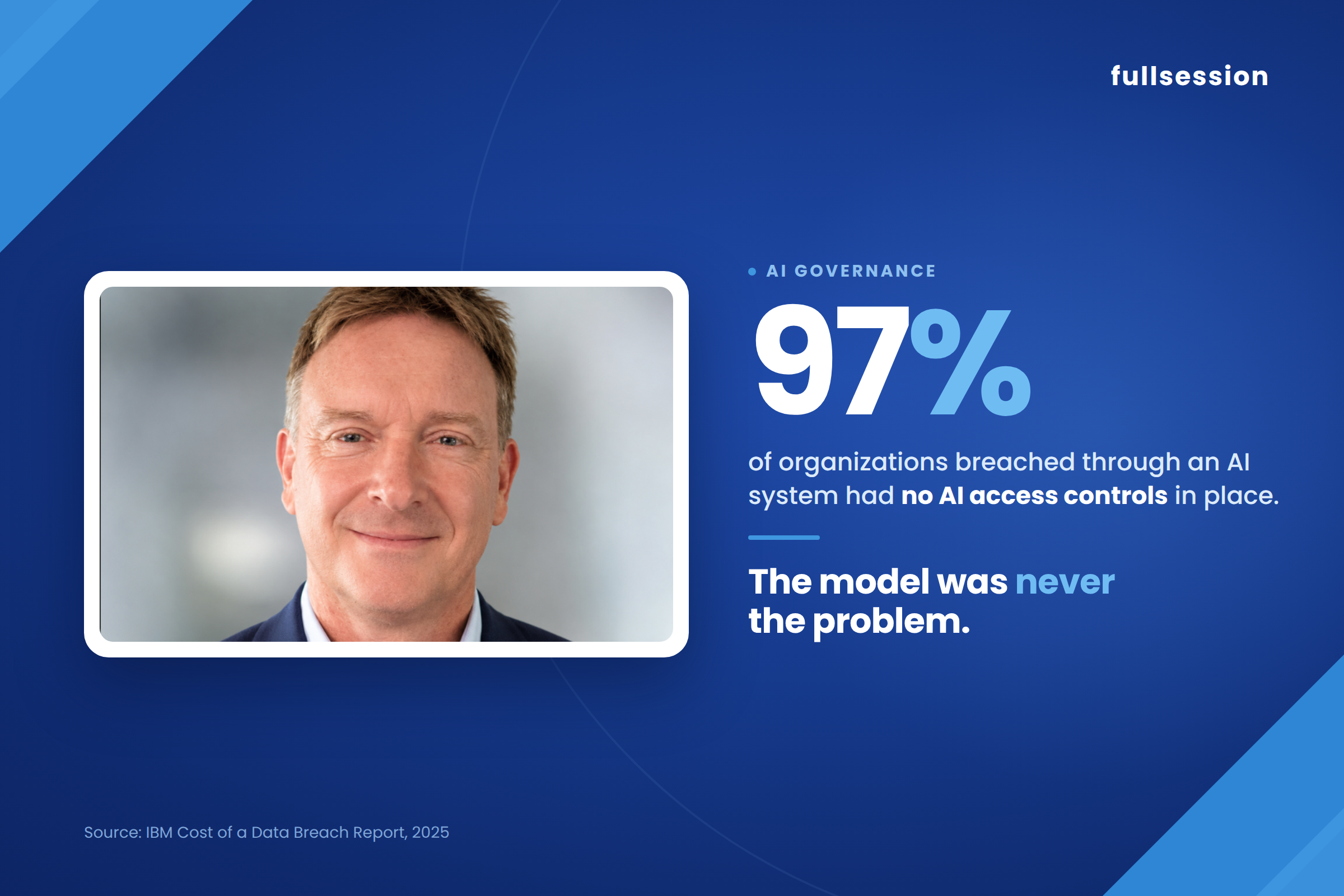
- Governance failures are access-control failures. IBM found that 97% of organizations breached through an AI model or application had no AI access controls, and only 34% of organizations with a governance policy ever audit for unsanctioned AI.
- Measure workflow outcomes, not AI activity. Prompts submitted and agents deployed are the AI-era equivalent of counting lines of code.
In 2025, four researchers ran the study most companies should have run before buying seats.
They gave a generative AI assistant to 7,137 knowledge workers across 66 firms, randomized, integrated directly into the email, meeting and writing tools those people already used. Six months. Real work.
The people who used it saved two hours a week on email and stopped working as late into the evening. Real, measurable, individual gains.
And then nothing else moved. Meeting time did not change. Time spent writing documents did not change. The authors put it plainly: “the co-creation of work and process restructuring that the literature identifies as a pre-condition for effective technology adoption did not seem to take place under the individual-level rollout.” (Dillon, Jaffe, Immorlica and Stanton, NBER Working Paper 33795, 2025)
That sentence is the whole problem, and I recognized it immediately, because we had lived it.
Everything an individual could change on their own, AI changed. Everything that required two people to agree on a new way of working stayed exactly where it was.
We hit this at FullSession as we pushed AI into software development and go-to-market. The technology was almost never the constraint. The constraint was that we had made individuals faster at producing work without changing who reviews it, who owns it, or how it moves.
Enterprise AI governance is not a compliance document. It is the design of how work moves through a company that can now produce far more of it. That is the definition this article defends, and everything below is how we implemented it.
The evidence at a glance
| Source | Sample | What it found |
|---|---|---|
| NBER 33795 (2025) | 7,137 workers, 66 firms, randomized, 6 months | Two fewer hours per week on email. No change in meeting time or document time. Process restructuring did not occur. |
| Quarterly Journal of Economics (2025) | 5,172 customer support agents | +15% issues resolved per hour on average, ~30% for less-skilled workers. Highest-skilled workers saw small speed gains and small declines in quality. |
| IBM Cost of a Data Breach (2025) | Global breach study | 13% reported an AI model or app breach. 97% of those had no AI access controls. Shadow AI added $670K to average breach cost. |
| MIT NANDA, The GenAI Divide (2025) | 52 interviews, 153 survey responses | 95% of organizations reported zero return. Root cause identified as learning and workflow integration, not models. Treat the headline number as directional. |
What the research actually says about AI productivity
AI helps your least experienced people the most, and may cost you slightly on your best. That is the finding almost every summary leaves out.
The study is Brynjolfsson, Li and Raymond in the Quarterly Journal of Economics, covering 5,172 customer support agents.
Access to AI assistance raised issues resolved per hour by 15% on average. Less experienced and lower-skilled agents improved by roughly 30%. Agents with two months of tenure using AI performed about as well as unassisted agents with more than six months.
Most write-ups stop there. The next sentence is the interesting one.
“The most experienced and highest-skilled workers see small gains in speed and small declines in quality.”
Read that again if you lead a team of senior people. Your average went up. Your ceiling came down slightly.
The mechanism the authors propose is that these systems capture and redistribute the behavior of your best performers. Useful, and useful in a specific way: AI is good at moving your organization’s tacit knowledge from the people who have it to the people who do not. It is much weaker at extending the frontier for the people who were already at it.
That has a direct operating consequence. If you deploy AI as a uniform productivity mandate, you are optimizing for the middle of your distribution while quietly taxing the top of it. Your governance model has to be able to tell those two situations apart.
About that 95% statistic
Use it carefully. The GenAI Divide: State of AI in Business 2025 reported that 95% of organizations are getting zero return on GenAI investment, and the number has been repeated everywhere since.
That figure rests on 52 structured interviews, 153 survey responses and a review of publicly disclosed initiatives. Treat it as directional, not as a measurement. I would not put it in a board deck as a fact.
The finding underneath it is more useful, and it survives the methodology complaint. The authors write: “The core barrier to scaling is not infrastructure, regulation, or talent. It is learning.” Systems fail because they “do not retain feedback, adapt to context, or improve over time,” and because of “brittle workflows, lack of contextual learning, and misalignment with day-to-day operations.”
The 66-firm randomized trial reached the same conclusion from the opposite direction. One study says individual gains do not propagate without process redesign. The other says deployments die when they cannot learn from the work they are embedded in. Both are describing an organizational failure, not a model failure.
Why our engineers were the most skeptical, and why they were right
It would seem logical that developers would adopt AI first. Ours were among the most cautious, and their objection was better than the enthusiasm it was competing with.
AI-generated code can look correct while being wrong in ways that only surface later. It misreads an existing architecture. It duplicates something that already exists three directories over. It produces a plausible answer without any understanding of why the system was built the way it was.
The deeper objection had nothing to do with code quality. Writing code is a small part of software development. The actual workflow is understanding the problem, defining requirements, making architectural decisions, respecting the data model, handling edge cases, testing, reviewing, deploying safely, monitoring and maintaining it while the product changes underneath.
A tool that writes code faster does not replace that system. It loads it.
That is exactly what happened to us. AI accelerated the upstream work first and most dramatically. Product research, competitive analysis, interface concepts, technical specifications. We could produce all of it far faster than before.
More artifacts did not produce more clarity. Engineering started receiving several documents, ideas and implementation suggestions before anyone had agreed on the underlying priority. We had multiplied the inputs without touching the handoff.
I want to be precise about the failure, because it is the one I now see everywhere.
We created review debt. We increased production capacity in one function and left review capacity fixed in another. The bottleneck did not disappear. It moved downstream to the people least able to absorb it.
It looked like an engineering problem. It was a design problem I owned.
The operating model: recommend, enforce, own
Three layers, and the boundaries between them are the discipline.
AI recommends. It researches, classifies, interprets, drafts and proposes. It is allowed to be probabilistic because nothing it produces takes effect on its own.
Systems enforce. Deterministic code holds permissions, state, eligibility rules, required checks and audit trails. This layer is not allowed to be probabilistic. If a model is deciding whether a send is permitted, you have put the wrong thing in the wrong layer.
Humans own. A named person is accountable for consequential decisions and final outcomes. Not the model, not the committee, not the tool vendor.
Most failed AI deployments I have looked at are a layer violation. Someone let the recommending layer touch state, or let the enforcing layer make judgment calls it had no context for, or let ownership dissolve into “the system did it.”
Everything below is an application of those three lines.
How we redesigned our software development workflow
We stopped treating AI as an independent contributor and started treating it as a capability embedded inside a process that already had controls. Five changes.
1. One authoritative requirements package
AI helps us analyze the customer problem, the market evidence, the product behavior and the technical options, and helps turn that into a problem definition, a specification, user flows, functional requirements, edge cases and acceptance criteria.
All of it consolidates into a single handoff. The product owner still owns the business problem and the priority. Engineering still owns architecture, feasibility and technical quality. AI gets both sides to a better starting point. It does not resolve disagreements and it does not silently make product decisions.
2. Recommendations are not decisions
AI can propose a workflow, a data structure or an implementation approach. That proposal gets reviewed on its merits: does it solve the right problem, does it fit the architecture, does it fit the data model, what is it assuming, and what happens when those assumptions are wrong.
Our specifications now explicitly state what should be built, what should not be built yet, and which decisions still need validation. Constraining scope turned out to be more valuable than generating options, because options had become free.
3. A deterministic development and deployment spine
AI may assist with code, queries, documentation, tests and investigation. A developer still owns the change. It still passes automated tests, build checks, code review, security controls, staging validation, performance monitoring, and defined deployment and rollback procedures.
We do not treat “the model produced working code” as equivalent to “this change is production-ready.” AI operates inside the process. It does not route around it.
4. Errors become tests
When an AI suggestion fails, or a developer has to correct an implementation, or monitoring catches a regression, that information cannot end its life in a Slack thread. It becomes a regression test, a documented edge case, a clarified requirement, an architectural constraint, a monitoring rule, or a better example for future AI-assisted work.
This is the part I would defend hardest, because it is the direct answer to the MIT finding. Their diagnosis was that these systems “do not retain feedback, adapt to context, or improve over time.”
That is true of the model. It does not have to be true of the system around the model. We do not let it learn invisibly in production. We improve the controlled context, the tests and the instructions through which it is used, and we do it deliberately, as work, with someone assigned.
5. Accountability stays human
A developer reviewing AI-generated code is not approving the model’s work. They are taking ownership of the implementation. Same for product decisions: AI can widen the option set and expose gaps in our thinking, but the person responsible for the product is accountable for what ships.
That last point is what actually built trust with our engineers, and it is worth being blunt about how it happened. Trust did not come from telling them AI was reliable. It came from not asking them to lower a single standard they already held.
How we redesigned our go-to-market workflow
GTM had the opposite risk profile. It is full of research, segmentation, enrichment, content production, campaign analysis and repetitive data handling, which makes it an excellent candidate for AI. It also produces reputational damage in public.
A weak internal analysis gets corrected in a meeting. An inaccurate claim in a prospect’s inbox becomes a company problem.
Same architecture, different weighting.
Deterministic systems hold state. Our GTM workflows run on structured records for accounts, people, targeting, campaign status, message variants and results. Rule-based automation handles matching and deduplication, field validation, workflow state, eligibility, routing, variant tracking and prevention of duplicate or unauthorized sends. AI is used where judgment adds value: developing a pain hypothesis, selecting a value proposition, analyzing objections, recommending the next test. AI should never be asked to improvise database state, sending permissions or campaign history.
Messaging constraints are explicit. Our systems do not ask a model to “write a persuasive email.” They specify which claims can be made, which positioning fits which audience, which language and tactics are out of bounds, when supporting evidence is required, how competitors may be referenced, when a message requires human review, and what AI may prepare versus what it may send. The goal is not to remove creativity but to keep it inside a boundary that is both true and strategically consistent.
Prioritization is separated from publishing. In our content and AI-visibility work, AI classifies opportunities, recommends whether to improve an existing page or create a new one, and turns that into a prioritized queue with structured briefs. It does not rewrite and publish our website. The publishing layer is separate and has human oversight. We get the analysis without handing our positioning to an opaque agent.
Recommendations have to be auditable. “Create this page” or “target this account” is not a recommendation, it is an assertion. A usable recommendation shows what evidence was evaluated, which audience problem it addresses, which rule or threshold was applied, what outcome is expected, what source supports the claim, and what the next step is. When the underlying evidence changes, we revisit the decision instead of trying to reconstruct what a model might have been weighing four months ago.
Human identity is not for rent. There is a real difference between using AI to improve someone’s work and using AI to impersonate them. Our team uses AI to research, analyze, draft and improve. They remain responsible for what they communicate. AI does not make commitments, invent knowledge, or misrepresent who is contacting a prospect. Automation should raise a person’s capability, not erase their accountability.
What does control actually mean when the model is probabilistic?
You cannot control the output. You can control the system around the output. Anyone selling you deterministic control over a probabilistic model is selling you something.
What you can control: which data the model can reach, which tools it can use, which actions it can take, which outputs require review, what acceptance criteria apply, how results are logged, how failures are detected, when the automation stops, and how the organization falls back to a human process.
The evidence that this is where failures actually occur is now reasonably hard. In IBM’s 2025 Cost of a Data Breach Report, 13% of organizations reported a breach of an AI model or application. Of those:
- 97% reported not having AI access controls in place.
- 63% either had no AI governance policy or were still writing one.
Access controls. Not model alignment, not prompt engineering, not a better foundation model. The boring layer.
One more number from that report, and it is the one I keep coming back to. Among organizations that did have an AI governance policy, only 34% performed regular audits for unsanctioned AI. Two thirds had written the document and skipped the part where you check whether it describes reality.
A policy that does not change how work moves has not governed anything. It has only created a record of intent.
Why shadow AI is a symptom, not the disease
The same IBM report found that organizations with high levels of unauthorized AI use averaged $670,000 in higher breach costs than those with little or none.
The instinct is to respond with a ban. That reliably makes it worse, because people do not use unsanctioned tools out of defiance. They use them because the sanctioned path is slower than the deadline they have been given.
Shadow AI measures the gap between your governance model and your actual work. If approval takes two weeks and the task takes an afternoon, you have designed the workaround yourself.
Enforcement does not fix it. Making the low-risk path free enough that nobody needs a workaround does, so that the controls concentrate where a mistake is expensive. Which requires knowing where that is.
How to classify AI risk: by reversibility, not by department
Most published risk frameworks classify by regulatory category, because most of them are derived from the EU AI Act. Fine, if your primary question is compliance exposure. Wrong, if your primary question is how fast your team can move.
We classify by how hard a mistake is to undo, and by how many people see it.
| Tier | Test | What it requires |
|---|---|---|
| 1. Personal | Output affects only the person who produced it. Fully reversible. | Approved tools and data rules. Nothing else. No approval, no review, no ticket. |
| 2. Internal | Affects a team’s work. Reversible within a day. | A named owner, a documented purpose, peer review before it becomes load-bearing. |
| 3. External | Reaches a customer, publishes externally, or changes shared data. Reversible with effort, and visible to others while it is wrong. | Human in the loop before it takes effect. Acceptance tests, audit log, rollback path. |
| 4. Consequential | Changes financial data, contractual commitments or production systems. Reversible slowly or not at all. | Everything in Tier 3, plus a second reviewer, monitoring with alerts, a defined shutdown mechanism and a scheduled review. |
Two things this gets right that a compliance taxonomy does not.
It puts the overwhelming majority of daily AI use in Tier 1, where the correct amount of governance is none. And it makes the tier a property of the action, not of the department, so the same person operates at different tiers during the same afternoon without needing a different policy for each.
Publish the thresholds before anyone needs them. A tier system loses its point the moment it gets negotiated under deadline pressure.
How governance should scale: by reach, not by enthusiasm
The clearest large-scale implementation of this principle I have found is HEINEKEN.
Their model tiers by blast radius, not by approval committee:
- 1 to 20 users: personal productivity environment.
- More than 20 users: graduates into a shared production environment with formal DevOps process.
- 100+ users, enterprise-wide: dedicated environment with additional oversight.
- Regional teams layer local governance on top.
The result: more than 7,500 internal makers have built over 10,000 applications and 42,000 automated flows, and a product team of five people manages over 8,000 environments. (Microsoft customer story)
Nobody should copy those specific thresholds. The transferable idea is that governance is a function of reach, that the threshold is defined in advance, and that graduation is automatic rather than requested.
That is what lets five people supervise 7,500 builders. Not control. Graduated control.
Where NIST, ISO 42001 and the EU AI Act fit
They tell you what to document. They do not tell you how to work.
You will be told to adopt the NIST AI Risk Management Framework, ISO/IEC 42001 or the EU AI Act’s risk categories. All three are worth reading and none of them will solve the problem in this article.
They are documentation and risk-classification standards. They tell you what to write down, what to assess, and what to be able to prove. Useful work, and if you sell into regulated industries or operate in the EU, some of it is not optional.
But none of them tell you who reviews the fourteen specifications your product team can now produce in a week. None of them tell you where your bottleneck moved. Compliance and operating model are different problems, and companies routinely solve the first while telling themselves they have solved the second.
A complete ISO 42001 audit trail is fully compatible with an organization that has quietly ground to a halt.
Do the standards work because you have to. Do the workflow redesign because it is the thing that actually determines whether any of this pays.
What to centralize and what to decentralize
We did not centralize AI work into a single team, and we did not let everyone automate whatever they wanted. Both fail, in opposite and predictable ways.
A fully centralized AI function becomes a queue and lacks the domain context to be right. A fully decentralized environment produces duplicated tools, inconsistent data, unmanaged risk, and automations that go orphaned the moment their creator changes roles.
| Centralize (the foundation) | Decentralize (value creation) |
|---|---|
| Approved models and tools | The business problem |
| Security and permissions | The intended outcome |
| Shared data and integration standards | Process definitions |
| Logging and traceability | Authoritative domain knowledge |
| Evaluation infrastructure | Relevant exceptions |
| Deployment requirements | Ground-truth examples |
| Risk classification | Day-to-day performance |
| Incident response | Adoption inside the workflow |
| Training and certification |
Centralize the standards, infrastructure, security and controls. Decentralize problem discovery and workflow ownership to the people closest to the work.
I will say the unpopular part directly: for most companies under a few hundred people, an AI center of excellence is a way to look organized while slowing down. The capability you actually need centralized is a small group that owns the rails. The judgment about which problems are worth automating belongs to whoever owns the problem.
Who should own AI governance?
In a large regulated enterprise, a named executive sponsor. Below a few hundred people, the CEO, and I do not think that is delegable.
The standard answer is that you name a sponsor, usually the CISO, the Chief Risk Officer or the Chief Data Officer, and stand up a cross-functional committee underneath them. In a large enterprise that is correct, and the choice among the three tends to follow whichever risk frame dominates: security, regulatory exposure, or data integrity.
At our size, I think that answer is wrong, and I think a lot of founders adopt it because delegation feels like maturity.
What this article describes is not a risk program. It is a set of decisions about how work moves between functions: what product hands to engineering, what a recommendation is allowed to trigger, whose review is load-bearing, and which bottleneck we are willing to live with.
Those are org design decisions. A committee cannot make them, because a committee has no authority to change how two departments hand work to each other.
So the CEO owns the operating model. Someone technical owns the rails: approved tools, permissions, logging, evaluation, incident response. Every automation in production has a named business owner and a named technical owner. There is no more structure than that. Adding a governance board on top of it at fifty people would produce documents, not decisions.
The one thing I would not delegate under any circumstances is the tier thresholds. Where the line sits between “go ahead” and “someone reviews this first” is a statement about how much risk the company is willing to carry, and that is not a working-group question.
Why every automation must be managed as a product
Processes change. Data changes. Products change. Models change. People find new ways to do the work. No important automation is ever finished, and the reason most of them decay is that they were shipped as projects and then abandoned.
Every production automation at FullSession has:
- A named business owner
- A named technical owner
- A stated purpose
- Known data sources
- Defined permissions
- A risk classification
- Acceptance tests
- Business and quality metrics
- A human escalation path
- Monitoring and alerts
- A rollback or shutdown mechanism
- A review cadence
Four kinds of drift are worth watching separately, because they fail differently:
- Process drift. People or customers start doing the process differently.
- Data drift. Formats, schemas, values or definitions change.
- Knowledge drift. Products, policies, prices or business rules change.
- Model drift. A model, prompt or retrieval change alters output quality.
The correct response is not to let an agent continuously rewrite itself. It is to detect the change, evaluate the effect, update the controlled system, and redeploy through an approval path that matches the tier.
How to measure AI governance: outcomes, not activity
Prompts submitted, agents created and workflows launched tell you almost nothing. They are the AI-era equivalent of counting lines of code.
For each workflow that matters, measure:
- Cycle time
- Throughput
- First-pass success rate
- Human intervention rate
- Rework and overrides
- Accuracy against reviewed examples
- Customer or employee satisfaction
- Cost per completed transaction
- Incidents and near misses
- Performance after process or data changes
- Time to detect and recover from failures
“Hours saved” is only useful if you know what happened to the hours. Capacity does not convert into value on its own. Someone has to decide what the freed hours are for, and that decision does not make itself.
The most credible enterprise number I have found is DBS Bank. In its 2025 annual report, DBS reported more than 2,000 AI models across 430-plus use cases and approximately SGD 1 billion in economic value from data analytics and AI/ML. Its agentic coding assistant reduced data scientists’ coding time by up to 20% on certain tasks, a far more modest and far more believable figure than most vendor claims. (DBS 2025 Annual Report)
The scale of that outcome came from an operating model, not from a model.
Where to start on Monday
Five moves, in order. None of them require a platform purchase.
- Find where your bottleneck moved. It moved. Ask each function what they are now waiting on that they were not waiting on a year ago. The answer is usually review capacity in a function that got no new headcount.
- Publish the tiers. Four of them, defined by reversibility, written down before anyone is under pressure. This single artifact does more than a policy document ten times its length.
- Make Tier 1 free. Approved tools, clear data rules, no approval step. If you skip this, everything else you do gets routed around.
- Put a name on every production automation. Business owner and technical owner. If you cannot name both, it is not in production, it is in someone’s browser tab.
- Change one handoff. Not all of them. Pick the worst one, redesign it end to end, and see whether the cycle time actually moves. That measurement is what tells you whether any of this is working.
What I would tell another CEO
Our original question was whether AI could help us work faster. That question was too small, and answering it produced a mess before it produced value.
The better question: how should work move through this company now that individuals can produce several times more of it?
AI recommends. Systems enforce. Humans own.
Our engineers’ skepticism got us there faster than enthusiasm would have. We did not build trust by mandating adoption. We built it by keeping every engineering standard intact and proving AI could be useful inside them.
The companies that get the most out of AI will not be the ones running the most agents. They will be the ones that redesigned the work.
If you are two months into a rollout and the only thing that has changed is that individuals are faster, you have not finished. You have finished step one, and the evidence says step two does not happen on its own.
Frequently asked questions
What is enterprise AI governance?
Enterprise AI governance is the set of decisions that determine which data AI can access, which tools it can use, which actions it can take, which outputs require human review, how results are logged, and who is accountable for the outcome. In practice it is an operating model, not a policy document. IBM’s 2025 breach report found that among organizations that had an AI governance policy, only 34% audited for unsanctioned AI. A policy that does not change how work moves has not governed anything.
What is the difference between AI governance and data governance?
Data governance is about the inputs: quality, lineage, access, retention, privacy. AI governance covers all of that and adds the behavior of a system that produces non-deterministic output and can take actions. Data governance asks whether the data is trustworthy. AI governance asks what the system is permitted to do with it, who reviews the result, and who is accountable when it is wrong. You cannot do the second without the first.
What is the difference between human in the loop and human on the loop?
Human in the loop means a person reviews or approves before the action takes effect. Human on the loop means the system acts and a person supervises, with the ability to intervene or stop it. Choose based on reversibility. If the action reaches a customer, changes financial data or publishes externally, put the human in the loop. If it is reversible and internal, on the loop is usually enough.
Should we centralize AI governance or let teams own it?
Both, on different things. Centralize approved models and tools, security and permissions, data standards, logging, evaluation infrastructure, deployment requirements, risk classification and incident response. Decentralize the business problem, the process definition, domain knowledge, exceptions and day-to-day performance. Full centralization creates a bottleneck without domain context. Full decentralization creates duplicate tools, inconsistent data and orphaned automations.
Who should own AI governance?
In a large regulated enterprise, a named executive sponsor, typically the CISO, CRO or CDO depending on the dominant risk frame, supported by a cross-functional committee. Below a few hundred people, the CEO should own the operating model directly, because the decisions involved are org design decisions about how work moves between functions, and a committee has no authority to make those. Someone technical owns the rails. Every production automation gets a named business owner and a named technical owner.
Do small companies need AI governance?
Yes, and less of it than they are usually sold. At fifty people you need four things: a published risk tier system, a frictionless path for low-risk work, a named owner on every production automation, and a deterministic layer that holds permissions and state. You do not need a governance board, a maturity assessment or a platform.
What does a realistic AI governance maturity model look like?
Tier by reach and reversibility, not by ambition. Personal-scope tools stay in individual environments with light controls. Anything serving a team graduates into a shared environment with formal process. Anything external or consequential gets defined acceptance tests, monitoring and a rollback path. Publish the thresholds in advance so nobody negotiates them under deadline pressure. Graduation should be automatic based on reach, not requested.
How do you measure whether AI governance is working?
By workflow outcomes, not AI activity. Cycle time, first-pass success rate, human intervention rate, rework and overrides, accuracy against reviewed examples, incidents and near misses, and time to detect and recover from failure. If your reporting is counting prompts and agents, you are measuring effort.
Does AI governance slow innovation down?
Only when it is applied uniformly. A single approval gate on all AI use is what produces shadow AI, which IBM measured at $670,000 in additional average breach cost for organizations with high unauthorized use. Tiering by reversibility means most daily work carries no governance overhead at all, and the controls concentrate where a mistake is expensive to undo.
Roman Mohren is CEO of FullSession, where he also leads product and go-to-market. He has spent about 25 years in software across GTM, product, sales, leadership and company-building. He writes about where AI creates real leverage and where it mostly creates noise.

Roman Mohren is CEO of FullSession, a privacy-first UX analytics platform offering session replay, interactive heatmaps, conversion funnels, error insights, and in-app feedback. He directly leads Product, Sales, and Customer Success, owning the full customer journey from first touch to long-term outcomes. With 25+ years in B2B SaaS, spanning venture- and PE-backed startups, public software companies, and his own ventures, Roman has built and scaled revenue teams, designed go-to-market systems, and led organizations through every growth stage from first dollar to eight-figure ARR. He writes from hands-on operator experience about UX diagnosis, conversion optimization, user onboarding, and turning behavioral data into measurable business impact.