You run an ecommerce site. Cart abandonment sits at 71 percent. You install a session replay tool, watch 30 sessions, and notice users stalling at the shipping fee step. You have a hunch.
You ship a fix. Maybe a shipping fee calculator earlier in the flow. You wait a month. Abandonment is still 71 percent.
Was the fix wrong? Did something else mask the improvement? Was the original diagnosis off? You cannot tell. This is where most teams find themselves, stuck in a cycle of observation without clear impact.
The Industry Sells Insight When You Need Impact
The biggest misconception in UX analytics is treating insight as the deliverable. Almost the entire category sells “watch what your users did.” That is table stakes.
Watching sessions provides a window into user behavior, but customers do not buy session replay to spend their afternoons watching playback. They buy it because someone, somewhere, is supposed to figure out what is broken, fix it, and lift a key metric.
The actual job to be done is impact. Predict which fix will move the number, ship the change, prove the lift, and learn from what worked. Most tools stop at the first step and call themselves an insight platform.
This is exactly why teams using UX analytics for years still struggle to defend the ROI of their tools when finance asks.
Many in the industry also mistakenly treat session replay as the product itself, rather than just one input. Replay is a signal, but so are heatmaps, funnels, frustration signals, errors, and in-app feedback. These all matter equally.
The real product is what you do with these signals together. Over-indexing on replay, often because it is the most demo-friendly feature, leads customers to pay enterprise prices for a single feature wrapped in marketing.
Close the Predict, Act, Measure, Learn Loop
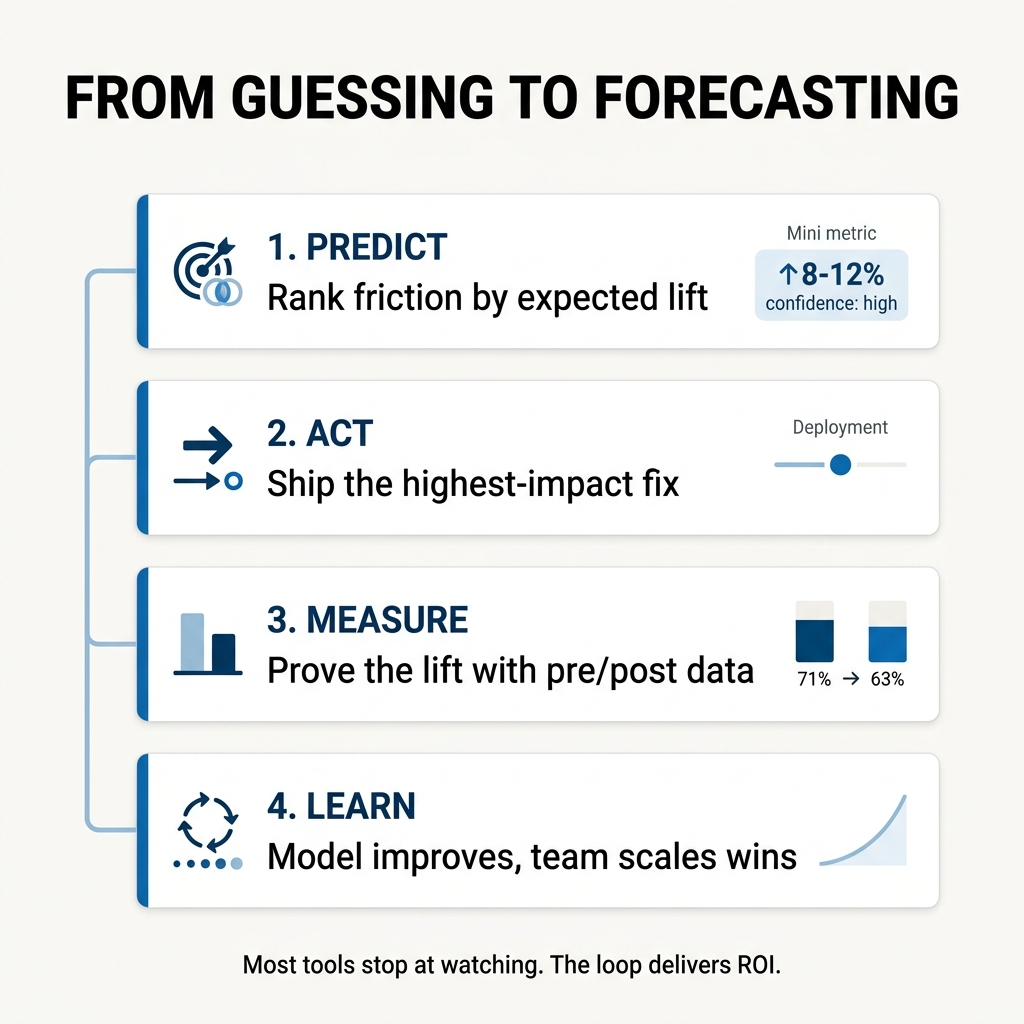
The solution lies in closing the predict, act, measure, learn loop. This framework converts UX work from a subjective vibe to a quantifiable forecast, a language every product manager, marketer, and executive already understands because it is how every other part of the business runs.
UX has been the holdout. It does not have to be.
Here is how the predict-and-prove loop functions:
1. Predict
Look at every friction signal across replay, heatmaps, funnels, and feedback. The goal is to identify the one with the most expected lift, not just the one that is most interesting to watch.
A robust system ranks these signals using a model that considers prevalence (how many users encounter it), funnel position (where in the user journey it occurs), and severity (how badly it blocks the user).
A confusing copy element on the homepage is annoying. The same confusion on the payment step costs revenue every single time. The further down the funnel, the higher the dollar-per-user cost of friction.
The tool should provide a predicted lift range and a confidence tier. Crucially, it should also factor in sample size, returning “insufficient data” rather than a misleading number if the data is too thin. This conservative approach builds credibility, prioritizing accuracy over over-confident guesses.
2. Act
Once you identify the most impactful fix and prioritize it, ship the change. This is the execution phase, where you implement the predicted solution.
3. Measure
Compare the pre-period and post-period for that specific signal, on the right user segment, with enough sample size to ensure statistical honesty. The tool should clearly indicate if the change cleared significance, providing objective validation of its impact.
4. Learn
Did the predicted lift show up? If yes, you have identified a successful pattern you can reuse and scale. If no, the model learns and becomes more conservative next time, and you gain a valuable artifact to discuss with your team or your CFO, understanding why a predicted outcome did not materialize.
Why Incumbents Struggle to Build This
The predict-and-prove loop is a structural differentiator, and it is precisely why many incumbent UX analytics providers struggle to offer this level of actionable intelligence. Their challenges are often deeply embedded in their corporate structure, pricing models, or foundational product philosophy.
Hotjar’s structural weakness is corporate.
Acquired by Contentsquare in 2021, the company now houses two distinct products chasing different buyers. Contentsquare targets enterprise zone-analytics, while Hotjar focuses on mid-market session replay and heatmaps.
This creates internal conflict. Roadmaps fight each other, pricing models clash, and messaging becomes diluted. Every time Contentsquare incorporates Hotjar features, it risks cannibalizing its own enterprise deals. Conversely, when Hotjar attempts to move up-market, it finds Contentsquare already established there.
This tension is evident in their public positioning, which has become less specific over time. The fix is corporate, requiring either a full merger of products with a single buyer focus or a complete split, neither of which is simple. Their content SEO moat also inadvertently locks them into the SMB market, as that is where their organic traffic converts.
FullStory faces a different structural challenge: its cost structure.
They built a sales motion around enterprise ACVs ranging from $25,000 to $150,000. Their narrative is “we surface behavioral data, you decide what to do with it.”
A predict-and-prove model would require them to become opinionated, recommend specific fixes, and stand behind a lift forecast. This directly contradicts their established positioning and pricing model.
Customers paying $100,000 expect a platform that provides data for their own analysis, not an opinionated recommendation engine. Furthermore, their organization would need to absorb the significant support load that comes with shipping a recommendation engine that, by its nature, can sometimes be wrong.
Implementing a predict-and-prove layer would necessitate shrinking down-market and adding an AI layer that takes positions, both of which represent existential moves for them, not mere roadmap items.
Even free tools like Microsoft Clarity lack the validation layer.
Their business model does not support the deep analytics, predictive modeling, and outcome measurement required to move beyond simply showing “what happened” to confidently asserting “what to fix and what impact to expect.”
What This Means for Your Team
For leaders across various industries, the predict-and-prove loop translates directly into tangible business outcomes.
SaaS companies can achieve significant activation lift, ensuring new users quickly find value in their product. When you predict which onboarding friction blocks the most users and prove the fix worked, you compress time-to-value and reduce early churn.
Ecommerce and DTC brands can dramatically improve cart-to-confirmation lift, turning more browsers into buyers. Identifying which friction point on the checkout flow costs the most revenue and validating the fix gives you a repeatable playbook for conversion improvement.
High-stakes customer portals in financial services, insurance, healthcare, and government can boost task completion and ensure compliance. Where a missed funnel step can cost real money or have serious regulatory consequences, predicting and proving impact becomes a risk management tool, not just an optimization exercise.
Stop Guessing, Start Forecasting
Moving beyond mere observation to a system that predicts, acts, measures, and learns is no longer a luxury. It is a necessity for any organization serious about driving measurable impact from their UX efforts.
The gap between “something is broken” and “it is fixed” determines how fast you can scale. The distance between “we think this will help” and “we proved this lifted conversion by 8 percent” determines whether your UX team gets budget next quarter or gets questioned.
You do not need more sessions to watch. You need a system that tells you what to fix, predicts the impact, and proves whether it worked.
To learn how FullSession’s Lift AI can transform your UX analytics from observation to predictable impact, visit FullSession and explore how the predict-and-prove loop works in practice.

Roman Mohren is CEO of FullSession, a privacy-first UX analytics platform offering session replay, interactive heatmaps, conversion funnels, error insights, and in-app feedback. He directly leads Product, Sales, and Customer Success, owning the full customer journey from first touch to long-term outcomes. With 25+ years in B2B SaaS, spanning venture- and PE-backed startups, public software companies, and his own ventures, Roman has built and scaled revenue teams, designed go-to-market systems, and led organizations through every growth stage from first dollar to eight-figure ARR. He writes from hands-on operator experience about UX diagnosis, conversion optimization, user onboarding, and turning behavioral data into measurable business impact.