.svg)

How to Choose a Session Replay Tool (And When to Pick FullSession)


How to Choose a Session Replay Tool (And When to Pick FullSession)
You already have session replay somewhere in your stack. The real question is whether it’s giving product and engineering what they need to cut MTTR and lift activation—or just generating a backlog of videos no one has time to watch. This guide walks through how to choose the right session replay tool for a SaaS product team and when it’s worth moving to a consolidated behavior analytics platform like FullSession session replay.
Why session replay choice matters for SaaS product teams
When onboarding stalls or a release quietly breaks a core flow, you see it in the metrics first: activation drops, support tickets spike, incidents linger longer than they should.
Funnels and dashboards tell you that something is broken. Session replay is how you see how it breaks:
- Where users hesitate or rage click.
- Which fields they abandon in signup or setup.
- What errors show up just before they give up.
For a Head of Product or Senior PM, the right session replay tool is one of the few levers that can impact both MTTR (mean time to resolution) and activation rate at the same time: it shortens debug loops for engineering and makes it obvious which friction to tackle next in key journeys.
The catch: “session replay” covers everything from simple browser plugins to full user behavior analytics platforms. Picking the wrong category is how teams end up with grainy, hard-to-search videos and no clear link to outcomes.
The main types of session replay tools you’ll encounter
Lightweight session replay plugins
These are often:
- Easy to install (copy-paste a snippet or add a plugin).
- Cheap or bundled with another tool.
- Fine for occasional UX reviews or early-stage products.
But they tend to fall down when:
- You need to filter by specific errors, user traits, or funnel steps.
- Your app is a modern SPA with complex navigation and dynamic modals.
- You’re debugging production incidents instead of just UI polish.
You end up “hunting” through replays to find one that matches the bug or metric you care about.
Legacy session replay tools
These tools were built when replay itself was novel. They can provide detailed timelines, but often:
- Live in a separate silo from your funnels, heatmaps, and feedback.
- Are heavy to implement and maintain.
- Aren’t optimized for the way product-led SaaS teams work today.
Teams keep them because “we’ve always had this tool,” but struggle to tie them to activation or engineering workflows.
Consolidated user behavior analytics platforms (like FullSession)
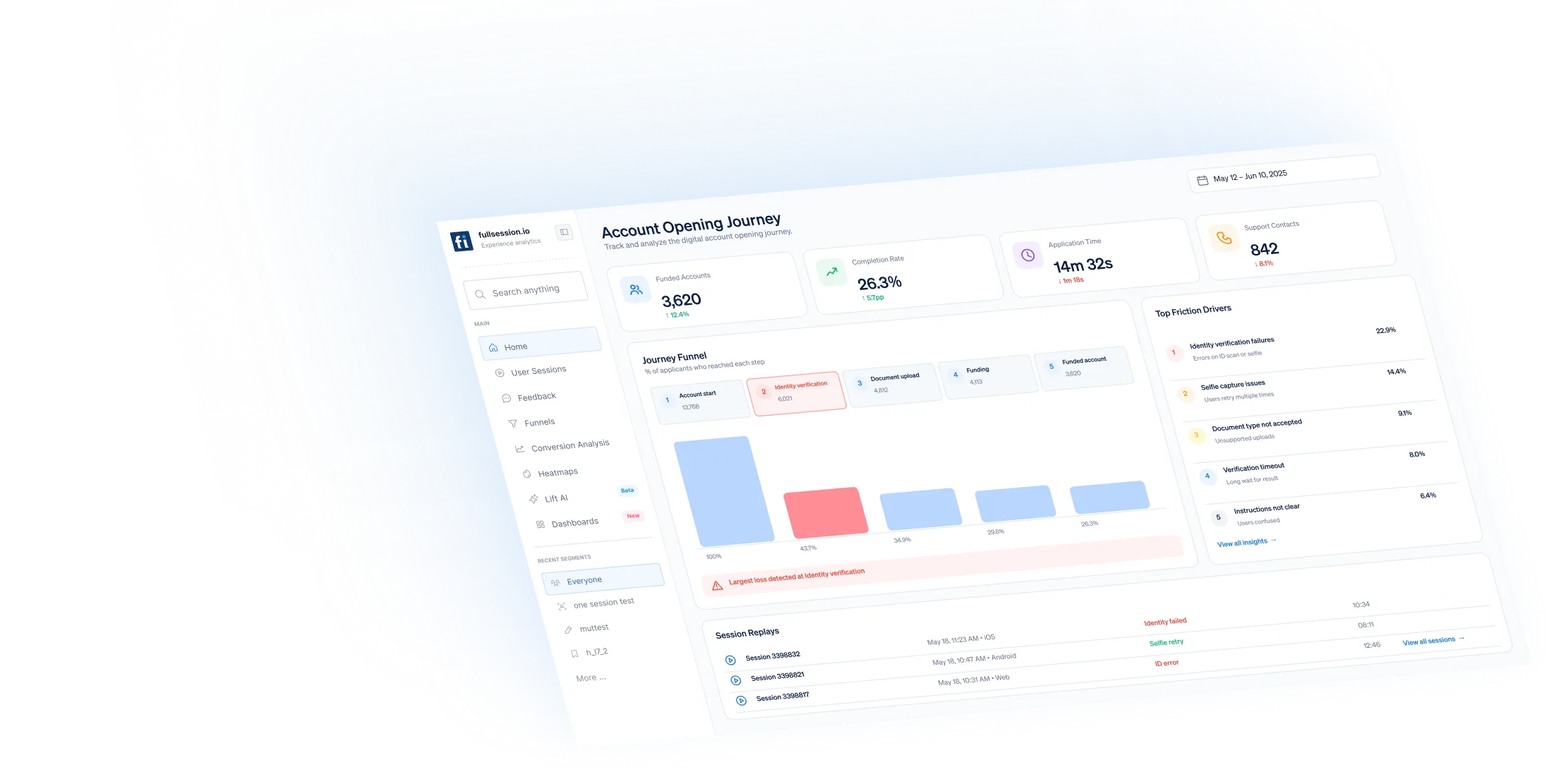
A consolidated platform combines session replay, interactive heatmaps, funnels, and often in-app feedback and error-linked replays in one place.
The goal isn’t just to watch sessions; it’s to:
- Jump from a KPI change (activation drop, error spike) directly into the affected sessions.
- See behavior patterns (scroll depth, clicks, hesitations) in context.
- Close the loop by validating whether a fix actually improved the journey.
For ecommerce teams, the same workflow applies to checkout drop-offs, product page hesitation, cart abandonment, and mobile buying friction. Comparing the best session replay tools for ecommerce can help teams choose platforms that connect replay data with conversion-focused workflows.
If you’re responsible for MTTR and activation across multiple journeys, this category is usually where you want to be.
Evaluation criteria: how to choose a session replay tool for SaaS
Here’s a practical checklist you can use in vendor conversations and internal debates.
Depth and quality of replay
Questions to ask:
- Does it accurately handle SPAs, virtual DOM updates, and client-side routing?
- Can you see user input, clicks, hovers, and page states without everything looking like a blurry video?
- How easy is it to search for a specific session (e.g., a user ID, account, or experiment variant)?
Why it matters: shallow or glitchy replays make it hard to diagnose subtle friction in onboarding or aha flows. You want enough detail to see layout shifts, field-level behavior, and timing—not just a screen recording.
Error-linked replays and technical signals
This is where the “session replay vs user behavior analytics” distinction shows up.
Look for tools that:
- Link frontend errors and performance issues directly to replays.
- Show console logs and network requests alongside the timeline.
- Make it easy for engineers to jump from an alert or error ID to the exact failing session.
In a platform like FullSession, error-linked replays mean MTTR drops because engineering isn’t trying to reproduce the bug from a vague Jira ticket—they can watch the failing session complete with technical context.
Performance impact and safeguards
Any session replay tool adds some overhead. You want to know:
- How it handles sampling (can you tune what you capture and at what volume?).
- What protections exist for CPU, memory, and bandwidth.
- How it behaves under load for high-traffic releases or spikes.
Practical test: have engineering review the SDK and run it in a staging environment under realistic load. A good tool makes it straightforward to tune capture and know what you’re paying for in performance terms.
Privacy controls and governance
Especially important if:
- You capture PII during signup or billing.
- You serve enterprise customers with strict data policies.
- You’re evolving towards more regulated use cases.
You should be able to:
- Mask or block sensitive fields by default (credit cards, passwords, notes).
- Configure rules per form, path, or app area.
- Control who can view what (role-based access) and have an audit trail of access and changes.
Platforms like FullSession session replay are designed to be governance-friendly: you see behavior where it matters without exposing data you shouldn’t.
Integration with funnels, heatmaps, and in-app feedback
You don’t want replay floating on its own island.
Check for:
- Funnels that link directly to sessions at each step.
- Heatmaps that show where users click or scroll before dropping.
- In-app feedback that anchors replays (“Something broke here”) to user comments.
This is often the biggest difference between a basic session replay tool and a user behavior analytics platform. With FullSession, for example, you can go from “activation dipped on step 3 of onboarding” in funnels, to a heatmap of that step, to specific replays that show what went wrong.
Team workflows and collaboration
Finally, think about how teams will actually use it:
- Can product managers and UX designers quickly bookmark, comment, or share sessions?
- Can support link directly to a user’s last session when escalating a ticket?
- Does engineering have the technical detail they need without jumping between tools?
If the tool doesn’t fit into your workflow, adoption will stall after the initial rollout.
Basic plugin vs consolidated platform: quick comparison
Basic session replay plugin vs consolidated behavior analytics platform
Use this as a sanity check: if you’re trying to own MTTR and activation, you’re usually in the right-hand column.
When a consolidated behavior analytics platform makes more sense
You’ve probably outgrown a basic session replay tool if:
- You’re regularly sharing replays in incident channels to debug production issues.
- Product and growth teams want to connect activation drops to specific behaviors, not just rewatch random sessions.
- You have multiple tools for funnels, heatmaps, NPS/feedback, and replay, and nobody trusts the full picture.
In those situations, a consolidated platform like FullSession does three things:
- Connects metrics to behavior
- You start from onboarding or activation KPIs and click directly into the sessions behind them.
- Shortens debug loops with error-linked replays
- Engineers can go from alert → error → replay with console/network logs in one place.
- Makes it easier to prove impact
- After you ship a fix, you can see whether activation, completion, or error rates actually changed, without exporting data across tools.
If your current tool only supports casual UX reviews, but the conversations in your org are about MTTR, uptime, and growth, you’re a better fit for a consolidated behavior analytics platform.
What switching session replay tools actually looks like
Switching tools sounds scary, but in practice it usually means changing instrumentation and workflows, not migrating mountains of historical UX data.
A realistic outline:
- Add the new SDK/snippet
- Install the FullSession snippet or SDK in your web app.
- Start in staging and one low-risk production segment (e.g., internal users or a subset of accounts).
- Configure masking and capture rules
- Work with security/compliance to define which fields to mask or block.
- Set up environment rules (staging vs production) and any path-specific policies.
- Run side-by-side for a short period
- Keep the existing replay tool running while you validate performance and coverage.
- Have engineering compare replays for the same journeys to build confidence.
- Roll out to product, engineering, and support
- Show PMs how to jump from funnels and activation metrics into sessions.
- Show engineers how to use error-linked replays and technical context.
- Give support a simple workflow for pulling a user’s last session on escalation.
- Turn down the old tool
- Once teams are consistently using the new platform and you’ve validated performance and privacy, you can reduce or remove the legacy tool.
At no point do you need to “migrate session replay data.” Old replays remain in the legacy tool for reference; new journeys are captured in FullSession.
Who should choose what: decision guide for product teams
If you’re making the call across multiple stakeholders, this framing helps:
- Stay on a basic session replay plugin if:
- Your app surface is small and relatively simple.
- You run occasional UX reviews but don’t rely on replay for incidents or activation work.
- You’re more constrained by budget than by MTTR or activation targets.
- Move to a consolidated behavior analytics platform like FullSession if:
- You own activation and retention targets for complex onboarding or core flows.
- Engineering needs faster context to troubleshoot production issues.
- You’re tired of juggling separate tools for funnels, heatmaps, and replay.
- You need better privacy controls than your current plugin provides.
For most mid-sized and enterprise SaaS teams with PLG or hybrid motions, the second description is closer to reality—which is why they standardize on a consolidated platform.
Risks of switching (and how to reduce them)
Any stack change carries risk. The good news: with session replay, most of those risks are manageable with a simple plan.
Risk: Temporary blind spots
- Mitigation: run tools in parallel for at least one full release cycle. Validate that key journeys and segments are properly captured before turning the old tool off.
Risk: Performance issues
- Mitigation: start with conservative capture rules in FullSession, test under load in staging, and gradually widen coverage after engineering sign-off.
Risk: Privacy or compliance gaps
- Mitigation: configure masking and blocking with security/compliance before full rollout. Use environment-specific settings and review them periodically as journeys change.
Risk: Team adoption stalls
- Mitigation: anchor training in real problems: a recent incident, a known onboarding drop-off, a noisy support issue. Show how FullSession session replay plus error-linked replays solved it faster than the old workflow.
Handled this way, switching is less “rip and replace” and more “standardize on the tool that actually fits how your teams work.”
Next steps: evaluate FullSession for your product stack
If your current session replay setup only gives you occasional UX insights, but your responsibilities include MTTR and activation across complex web journeys, it’s time to look at a consolidated platform.
Start by instrumenting one high-impact journey—usually onboarding or the first aha flow—with FullSession session replay and error-linked replays. Then run it side-by-side with your existing tool for a release cycle and ask a simple question: which tool actually helped you ship a fix faster or argue for a roadmap change?
If you want to see this on your own stack, get a FullSession demo and walk through a recent incident or activation drop with the team. If you’re ready to try it hands-on, head to the pricing page to start a free trial and instrument one key journey end to end.
FAQs: choosing a session replay tool
Session replay shows individual user journeys as recordings. A user behavior analytics platform combines replay with funnels, heatmaps, error-linking, and feedback so you can see both patterns and examples. FullSession is in the latter category: it’s designed to help you connect metrics like activation and MTTR to real behavior, not just watch videos.
Look for error-linked replays, console/network visibility, and tight integration with your alerting or error tracking. Engineers should be able to go from an incident to the failing sessions in one or two clicks. If that’s clunky or missing, MTTR will stay high no matter how nice the replay UI looks.
Any client-side capture adds some overhead, but good tools give you sampling and configuration controls to manage it. Test in staging with realistic load, and work with engineering to tune capture. Platforms like FullSession are built to be low-overhead and let you selectively capture the journeys that matter most.
Start by identifying sensitive fields and flows (e.g., billing, security answers, internal notes). Choose a tool that supports masking and blocking at the field and path level, then default to masking anything you don’t need to see. In FullSession, you can configure these rules so teams get behavioral insight without exposing raw PII.
If replay is a nice-to-have, a plugin may be fine. If you’re using it to debug incidents, argue for roadmap changes, or prove activation improvements, the cost of staying fragmented can be higher than the license fee. Consolidating into a platform like FullSession saves time across product, eng, and support—and that’s usually where the real ROI sits.
Practically, teams can add a new SDK, configure masking, and run side-by-side within days, then roll out more widely over a release or two. The slower part is shifting habits: making the new tool the default place product and engineering go for behavioral context. Anchoring adoption in real incidents and activation problems speeds that up.
See what’s costing you, and prove whats fixing it is worth
Watch the real journey, rank every issue by revenue impact, and validate the result against baseline.



.svg)
.svg)
212 E Stone Path St Derby, KS 67037 Phone: +1 415-649-4222



All systems operational.