.svg)

UX analytics: From metrics to meaningful product decisions


Most activation work fails for a simple reason: teams can see what happened, but not why it happened.
UX analytics is the bridge between your numbers and the experience that created them.
Definition box: What is UX analytics?
UX analytics is the practice of using behavioral signals (what people do and struggle with) to explain user outcomes and guide product decisions.
Unlike basic reporting, UX analytics ties experience evidence to a specific product question, then checks whether a change actually improved the outcome.
UX analytics is not “more metrics”
If you treat UX analytics as another dashboard, you will get more charts and the same debates.
Product analytics answers questions like “How many users completed onboarding?”
UX analytics helps you answer “Where did they get stuck, what did they try next, and what confusion did we introduce?”
A typical failure mode is when activation drops, and the team argues about copy, pricing, or user quality because nobody has shared evidence of what users actually experienced.
UX analytics reduces that ambiguity by adding behavioral context to your activation funnel.
If you cannot describe the friction in plain language, you are not ready to design the fix.
The UX analytics decision loop that prevents random acts of shipping
A tight loop keeps you honest. It also keeps scope under control.
Here is a workflow PMs can use for activation problems:
- Write the decision you need to make. Example: “Should we simplify step 2 or add guidance?”
- Define the activation moment. Example: “User successfully connects a data source and sees first value.”
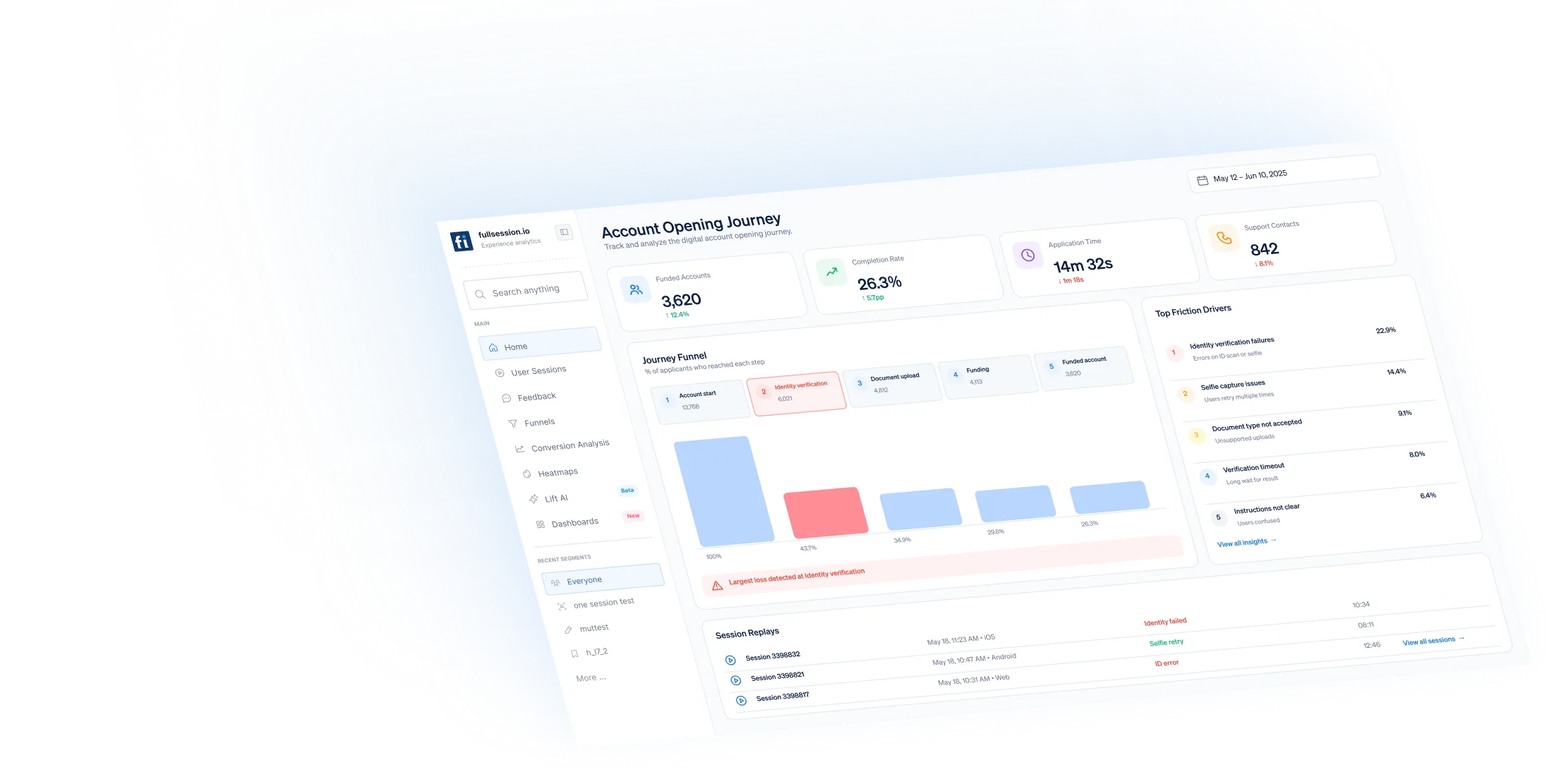
- Map the path and the drop-off. Use a funnel view to locate where activation fails.
- Pull experience evidence for that step. Session replays, heatmaps, and error signals show what the user tried and what blocked them.
- Generate 2 to 3 plausible causes. Keep them concrete: unclear affordance, hidden requirement, unexpected validation rule.
- Pick the smallest change that tests the cause. Avoid redesigning the entire onboarding unless the evidence demands it.
- Validate with the right measure. Do not only watch activation rate. Watch leading indicators tied to the change.
- Decide, document, and move on. Ship, revert, or iterate, but do not leave outcomes ambiguous.
One constraint to accept early: you will never have perfect certainty.
Your goal is to reduce the risk of shipping the wrong fix, not to prove a single “root cause” forever.
The UX signals that explain activation problems
Activation friction is usually local. One step, one screen, one interaction pattern.
UX analytics is strongest when it surfaces signals like these:
- Rage clicks and repeated attempts: users are trying to make something work, and failing.
- Backtracking and loop behavior: users bounce between two steps because the system did not clarify what to do next.
- Form abandonment and validation errors: users hit requirements late and give up.
- Dead clicks and mis-taps: users click elements that look interactive but are not.
- Latency and UI stalls: users wait, assume it failed, and retry or leave.
This is where “behavioral context over raw metrics” matters. A 12% drop in activation is not actionable by itself.
A pattern like “40% of users fail on step 2 after triggering a hidden error state” is actionable.
A prioritization framework PMs can use without getting stuck in debate
Teams often struggle because everything looks important. UX analytics helps you rank work by decision value.
Use this simple scoring approach for activation issues:
- Impact: how close is this step to the activation moment, and how many users hit it?
- Confidence: do you have consistent behavioral evidence, or just a hunch?
- Effort: can you test a narrow change in days, not weeks?
- Risk: will a change break expectations for existing users or partners?
Then pick the top one that is high-impact and testable.A realistic trade-off: the highest impact issue may not be the easiest fix, and the easiest fix may not matter.
If you cannot test the high-impact issue quickly, run a smaller test that improves clarity and reduces obvious failure behavior while you plan the larger change.
How to validate outcomes without fooling yourself
The SERP content often says “track before and after,” but that is not enough.
Here are validation patterns that hold up in real product teams:
Use leading indicators that match the friction you removed. If you changed copy on a permission step, track:
- Time to complete that step
- Error rate or retry rate on that step
- Completion rate of the next step (to catch downstream confusion)
Run a holdout or staged rollout when possible. If you cannot, at least compare cohorts with similar acquisition sources and intent.
Also watch for “false wins,” like increased step completion but higher support contacts or worse quality signals later.
A typical failure mode is measuring success only at the top KPI (activation) while the change simply shifts users to a different kind of failure.
Validation should prove that users experienced less friction, not just that the funnel number moved.
How UX insights get used across a SaaS org
UX analytics becomes more valuable when multiple teams can act on the same evidence.
PMs use it to decide what to fix first and how narrow a test should be.
Designers use it to see whether the interface communicates the intended action without extra explanation.
Growth teams use it to align onboarding messages with what users actually do in-product.
Support teams use it to identify recurring confusion patterns and close the loop back to the product.
Cross-functional alignment is not about inviting everyone to the dashboard.
It is about sharing the same few clips, step-level evidence, and a crisp statement of what you believe is happening.
When to use FullSession for activation work
Activation improvements need context, not just counts.
Use FullSession when you are trying to:
- Identify the exact step where activation breaks and what users do instead
- Connect funnel drop-off to real interaction evidence, like clicks, errors, and retries
- Validate whether an experience change reduced friction in the intended moment
- Give product, design, growth, and support a shared view of user struggle
If your immediate goal is PLG activation, start by exploring the PLG activation workflow and real-world examples to understand how users reach their first value moment.
When you’re ready to map the user journey and quantify drop-offs, move to the funnels and conversions hub to analyze behavior and optimize conversions.
Explore UX analytics as a decision tool, not a reporting task. If you want to see how teams apply this to onboarding, request a demo or start a trial based on your workflow.
FAQs
Product analytics focuses on events and outcomes. UX analytics adds experience evidence that explains those outcomes, especially friction and confusion patterns.
Not always, but you do need some behavioral context. Replays, heatmaps, and error signals are common ways teams get that context when activation issues are hard to diagnose.If you can only pick one, RPV is often the better north star because it captures both conversion and order value. Still track CVR and AOV to understand what is driving changes in RPV.
Track step-level completion, time-to-first-value, retry rates, validation errors, and leading indicators tied to the change you shipped.
Start with one product question, one funnel step, and one hypothesis you can test. Avoid turning the work into a “collect everything” exercise.
There is no universal number. Look for repeated patterns across different users and sources, then validate with step-level metrics and a controlled rollout if possible.
No. UX analytics shows what happened and where users struggled. Research explains motivations, expectations, and language. The strongest teams use both.
See what’s costing you, and prove whats fixing it is worth
Watch the real journey, rank every issue by revenue impact, and validate the result against baseline.




.svg)
.svg)
212 E Stone Path St Derby, KS 67037 Phone: +1 415-649-4222



All systems operational.