.svg)

How to Quantify Revenue at Risk from UX Bugs (and Validate the Estimate)


When a UX bug hits a high-traffic flow, stakeholders ask the same question: ‘How much revenue is this costing us?’ (here’s how to measure ROI of UX improvements). Most answers fall into “blog math” (single-number guesses with weak attribution). This guide shows a defensible, auditable method to estimate revenue at risk (RaR) from specific UX bugs-with ranges, segment breakdowns, and a validation plan you can use before reporting the number.
You’ll leave with:
- A step-by-step framework (exposure → counterfactual → delta → revenue at risk)
- A sensitivity model (ranges, not one number)
- A validation menu (A/B, holdouts, diff-in-diff, matched cohorts)
- Operational thresholds (SLA/triage rules)
What “revenue at risk” means for UX bugs
Revenue at risk is the revenue you likely failed to capture because users were exposed to a bug, compared to what would have happened if they weren’t exposed (your counterfactual).
This is different from the general “cost of poor UX.” Bugs are usually:
- Time-bounded (introduced at a known time, fixed/rolled back later)
- Segment-skewed (browser/device/geo specific)
- Measurable via exposure (error event, affected UI state, failing action)
That makes them ideal candidates for cohort-based impact measurement.
The 6-step measurement framework (snippet-friendly)
- Define bug exposure (who was affected and when)
- Choose one primary KPI for the impacted flow (e.g., RPV, purchase conversion)
- Build a counterfactual (unexposed cohort or control segment)
- Compute delta (exposed vs unexposed) and convert it to revenue at risk
- Add guardrails (ranges, segmentation, double-counting avoidance)
- Validate (A/B, holdout, diff-in-diff, controlled before/after)
Step 1 – Define the bug and measure exposure (not just occurrences)
Your model is only as credible as your exposure definition. A bug “happening” isn’t enough-you need to know who experienced it. For online stores, ecommerce error tracking software can help define exposure more accurately by connecting failed actions, error events, affected checkout steps, and session behavior.
Bug definition checklist (keep this in your incident doc)
- Flow impacted: PDP → Add to Cart, Cart → Checkout, Checkout → Payment, etc.
- User eligibility: who could have hit it? (e.g., only logged-in users, only COD, only iOS app vX)
- Platforms affected: device, browser, app version
- Severity: blocker (can’t proceed) vs degradation (friction)
- Time window: introduced (release time), detected, mitigated, fixed
Exposure definitions (pick one and stick to it)
Choose the closest measurable proxy to “experienced the friction.”
Good exposure signals
- “Saw error banner / error event fired”
- “Clicked failing CTA” (e.g., Add to Cart click with no cart update)
- “Entered affected state” (checkout step reached + JS exception)
Avoid
- Only using “pageviews” when the friction happens after interaction
- Only using “error logs” when users can fail silently
Minimum data you need
- Exposed eligible sessions/users (E)
- Total eligible sessions/users in the flow (T)
- Time window at risk (hours/days)
- KPI for exposed vs unexposed (RPV or conversion)
Exposure rate
- Exposure rate = E ÷ T
Step 2 – Pick one primary KPI (and one optional secondary)
Most impact estimates get messy because they mix outcomes and double-count.
For ecommerce, two reliable options:
Option A (recommended): RPV for the impacted flow
RPV (Revenue per Visit / Session) bakes in conversion and AOV without needing two separate deltas.
- RPV = revenue ÷ eligible sessions
Option B: Conversion rate + AOV
- Conversion rate = orders ÷ eligible sessions
- Revenue = orders × AOV
Rule: pick one primary KPI for the estimate.
Add a secondary KPI only if you can show it’s incremental and not already captured by the primary.
Step 3 – Build the counterfactual (how you attribute impact)
This is the difference between a credible estimate and a hand-wave.
Your job: estimate what exposed users would have done if they weren’t exposed.
Counterfactual methods (best → fastest)
- A/B test or feature-flag holdout (best causal proof)
- Diff-in-diff (strong when you have a clean control segment)
- Matched cohorts (fast when experiments aren’t possible)
What to control or match on (practitioner-grade)
To avoid “it was actually pricing/campaigns/seasonality,” control for:
- Time: day-of-week, hour-of-day, seasonality
- Traffic source: paid vs organic, specific campaigns
- Platform: device, browser, app version
- User type: new vs returning
- Value tier: top spenders behave differently
- Geo: shipping/payment differences change conversion
Quick win: If the bug only affects one browser/device, you often get a natural control group (e.g., iOS Safari exposed vs Chrome iOS unexposed).
Step 4 – Calculate revenue at risk (point estimate + range)
Below are two calculation paths. Use the one that matches your KPI choice.
Path A: RPV-based revenue at risk (cleanest)
- Compute RPV for exposed vs unexposed:
- RPV_exposed = revenue_exposed ÷ eligible_sessions_exposed
- RPV_unexposed = revenue_unexposed ÷ eligible_sessions_unexposed
- Delta:
- ΔRPV = RPV_unexposed − RPV_exposed
- Revenue at risk for the incident window:
- RaR_incident = ΔRPV × exposed eligible sessions (E)
Path B: Conversion-based revenue at risk (classic)
- Compute conversion:
- Conv_exposed = orders_exposed ÷ sessions_exposed
- Conv_unexposed = orders_unexposed ÷ sessions_unexposed
- Delta:
ΔConv = Conv_unexposed − Conv_exposed - Revenue at risk:
- RaR_incident = ΔConv × exposed sessions (E) × AOV
Add “time at risk” (so the number drives action)
Incident RaR is useful, but operations decisions need a rate.
- RaR_per_hour = RaR_incident ÷ hours_at_risk
- RaR_per_day = RaR_incident ÷ days_at_risk
This is what helps you decide whether to rollback now or hotfix later.
Step 4b – Sensitivity analysis: report a range, not a single number
Finance-minded readers expect uncertainty.
Instead of one Δ, estimate a plausible band (based on sampling error, historical variance, or validation method):
- ΔConv plausible range: 0.2pp–0.6pp
- ΔRPV plausible range: ₹a–₹b (or $a–$b)
Then:
- RaR_low = Δ_low × E
- RaR_high = Δ_high × E
In your report, list:
- Exposure definition
- Counterfactual method
- KPI and window
- Assumptions that move the number most
Step 5 – Segment where revenue concentrates (and where bugs hide)
Bugs rarely impact everyone equally. A credible estimate shows where the risk is. Use website heatmap to quickly spot friction in the impacted step.
Recommended segmentation order for ecommerce
- Device: mobile vs desktop
- Browser/app version: Safari vs Chrome, app vX vs vY
- Geo/market: payment/shipping differences
- New vs returning
- Value tier: high-LTV customers
Segment output template
Build a table like this and you’ve instantly upgraded from “blog math” to decision-grade:
Confidence is not vibes. Base it on:
- Sample size (enough exposed sessions?)
- Counterfactual quality (A/B > diff-in-diff > matched)
- Stability (does the effect persist across slices?)
Step 6 – Validate the estimate (pick a standard, then report)
Most “revenue at risk” content mentions validation but doesn’t tell you how. Here’s the practical menu.
Validation decision table
A simple validation standard (copy/paste)
We estimate revenue at risk at ₹X–₹Y over [time window] based on [exposure definition] and [counterfactual method]. We validated the estimate using [A/B/holdout/diff-in-diff], observed a consistent effect across [key segments], and the main residual risks are [seasonality/campaign mix/sample size].
Guardrails – Avoid double-counting across funnel, churn, and support
A common mistake is stacking multiple “cost buckets” that overlap.
Double-counting traps
- Counting lost purchases and future churn for the same users (without proving incremental churn beyond the lost purchase)
- Adding support costs that are simply correlated with fewer conversions
- Summing funnel stage drop-offs that are already captured by final purchase conversion
Guardrail rule
- Pick one top-line outcome (RPV or purchase conversion) as your primary estimate.
- Add secondary buckets only if you can show they’re incremental and non-overlapping (e.g., support contacts among users who still purchased).
Turn revenue at risk into triage: thresholds, SLAs, and what to do next
A number is only useful if it changes what happens next (turn UX metrics into product decisions).
Practical triage rubric (effort × impact × confidence)
Score each bug on:
- RaR rate: per hour/per day
- Exposure rate: how widespread
- Severity: blocker vs degradation
- Confidence: counterfactual strength + sample size
- Fix effort: XS/S/M/L
Example SLA framework (fill your own thresholds)
Worked example (with ranges + validation)
Bug: On mobile Safari, “Pay Now” button intermittently fails (no redirect).
Window: 12 hours (from release to mitigation).
Exposure definition: users who reached payment step and saw JS exception event.
Exposed sessions (E): 35,000
Counterfactual: diff-in-diff using mobile Chrome as control + pre-period baseline
Option 1: Conversion-based estimate
- Conv_unexposed (expected): 3.2%
- Conv_exposed (observed): 2.6%
- ΔConv: 0.6pp (0.3pp–0.8pp plausible range)
- AOV: ₹2,400
RaR_incident (range)
- Low: 0.003 × 35,000 × 2,400 = ₹252,000
- High: 0.008 × 35,000 × 2,400 = ₹672,000
RaR_per_hour (12 hours)
- ₹21,000–₹56,000 per hour
Validation plan
- Roll forward fix behind a feature flag for 24 hours
- Run a 5% holdout (unfixed) on Safari only
- Compare purchase conversion; report CI + segment consistency
Templates (copy/paste)
1) Revenue-at-risk worksheet
Bug:
Flow:
Start/End time:
Platforms affected:
Exposure definition:
Eligible population definition:
Exposed sessions/users (E):
Counterfactual method:
Primary KPI: RPV / Conv
Δ estimate (range):
RaR_incident (range):
RaR_rate (per hour/day):
Top segments driving RaR:
Confidence (H/M/L) + why:
Validation plan + timeline:
2) Instrumentation checklist (minimum viable)
- Event: entered impacted step/state
- Event: attempted key action (click/submit)
- Event: success signal (cart update, redirect, order placed)
- Event: failure signal (error code, exception, timeout)
- Dimensions: device, browser, app version, geo, traffic source, user type/value tier
Do the estimate, then validate before you share it
Use a simple revenue-at-risk model to prioritize the next bug fix, then validate it with a lightweight test or cohort comparison before you report it to stakeholders.
If you want, paste:
- the flow (e.g., checkout/payment),
- your exposure definition,
- exposed sessions,
- and either RPV or conversion+AOV,
…and I’ll turn it into a filled worksheet with a sensitivity range + a recommended validation method based on your constraints.
FAQ’s
Cost of poor UX is broad (design debt, friction, trust, churn over time). Revenue at risk from a bug is narrower and more measurable: a time-bounded incident with a clear exposure definition (who encountered the bug) and a counterfactual (what would’ve happened if they hadn’t).
Use an exposed vs unexposed comparison and one primary KPI: RPV method: • RaR = (RPV_unexposed − RPV_exposed) × exposed_session • Conversion method: RaR = (Conv_unexposed − Conv_exposed) × exposed_sessions × AOV
Use RPV when you can—it’s often cleaner because it captures conversion and basket effects without splitting the model. Use conversion + AOV when: • Your business reports primarily in conversion terms, or • You need to show the mechanics (e.g., checkout bug impacts conversion directly)
Good exposure definitions are close to user experience, not just technical logs. Examples: • Saw an error UI state • Clicked a CTA and did not receive a success signal • Reached a specific step + fired an exception code
You still have options: • Diff-in-diff: if only certain segments are affected (e.g., Safari only), use unaffected segments as control. • Controlled before/after: compare pre/post with seasonality controls (day-of-week, campaign mix). • Matched cohorts: match exposed users/sessions to similar unexposed ones on device, traffic source, user type, etc.
Control for the biggest confounders: • Time controls: day-of-week, hour, seasonality windows • Traffic controls: channel/campaign mix shifts • Platform controls: device/browser/app version • User mix controls: new vs returning, value tier
See what’s costing you, and prove whats fixing it is worth
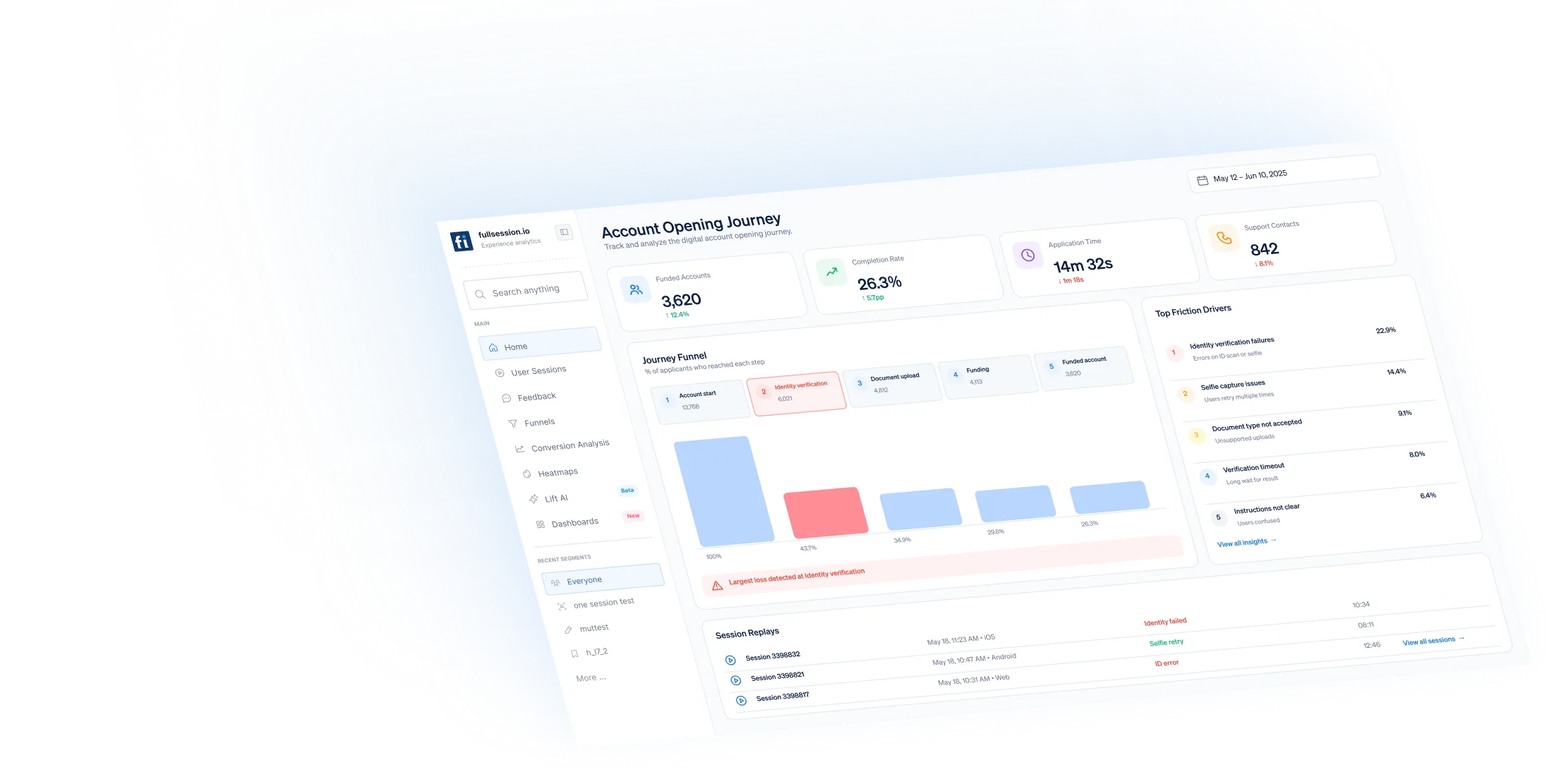
Watch the real journey, rank every issue by revenue impact, and validate the result against baseline.




.svg)
.svg)
212 E Stone Path St Derby, KS 67037 Phone: +1 415-649-4222



All systems operational.