.svg)

Product Analytics Tools With Strong Funnel Analysis (and How to Choose)

If you have ever looked at an activation funnel and thought, “That drop-off cannot be real,” you are not alone.
Most product analytics tools can draw a funnel. Fewer can produce funnel results you trust, answer the questions you actually have, and hold up when your instrumentation, identity, and data volume get messy.
This guide does two things:
- Gives you a practical definition of what “good funnel analysis” means in product analytics, with criteria you can test.
- Provides a shortlist-style comparison of tools, plus a 7-day validation plan you can run using a real activation journey.
You will leave with a way to shortlist tools quickly, then confirm you are not buying pretty charts powered by unreliable funnel math.
What “good funnel analysis” means in product analytics
A strong funnel feature is not just “step 1 → step 2 → step 3.”
A good funnel analysis capability is:
1) Correct by design (data trust)
If your funnel math is wrong, everything downstream is wasted. Evaluate whether the tool can handle:
- Identity resolution: Does it merge anonymous to known users reliably? Does it support cross-device? Can you audit merges?
- Out-of-order events: Real event streams arrive late or out of sequence. Does the funnel logic handle this cleanly?
- Deduping and retries: Mobile and server events can duplicate. Can you dedupe by event id or rules?
- Bot and internal traffic: Can you exclude known noise without breaking historical trends?
- Sampling transparency: If funnels are sampled, is it obvious, controllable, and explainable?
2) Flexible enough for real questions (analysis semantics)
The difference between “funnels exist” and “funnels are useful” shows up in semantics:
- Step flexibility: Can steps be reordered? Can you add optional steps? Can you do “any of these events counts as step 2”?
- Conversion windows: Can you define time windows per funnel or per step (for example, activation within 7 days)?
- Exclusion logic: Can you exclude users who hit a disqualifying event?
- Segmentation: Can you segment by plan, channel, persona, lifecycle stage, device, or feature flags?
- Breakdowns: Can you break down by properties to find which segment is actually failing?
3) Retroactive when you need it (migration and iteration)
Teams rarely instrument perfectly on day one. Ask:
- Can you build funnels retroactively from existing events?
- How painful is it to change event definitions, version events, or update taxonomy?
- If you migrate tools, can you keep continuity without “starting over”?
4) Built for collaboration and governance (adoption)
Funnel analysis often fails socially, not technically:
- Can you standardize definitions and prevent five versions of “Activation Funnel”?
- Are permissions, approvals, and naming conventions supported?
- Can you document what each step means and which events power it?
5) Actionable, not just measurable (the diagnosis loop)
A funnel should help you answer: Why did users drop off, and what should we do next? The best setups connect funnels to session replay, plus operational signals and validation.
- Qualitative context: session replay, logs, errors, rage clicks, dead clicks
- Operational signals: alerts, anomalies, monitoring
- Validation: experiments and guardrails so you can confirm causality
Funnel analysis evaluation checklist (copy and use)
Use this checklist to shortlist tools, then validate 1 to 2 finalists using a conversion funnel analysis framework
A) Funnel semantics and flexibility
- Can you define per-funnel conversion windows (example: activated within 7 days)?
- Can steps be grouped (any of multiple events counts) and reordered?
- Can you set exclusion steps (example: saw “error” event excludes from success)?
- Can you segment by user and account properties (B2B SaaS), not just user-level?
- Can you compare funnels across cohorts (new users vs returning, SMB vs mid-market)?
B) Identity and data correctness
- How does it stitch anonymous-to-known and cross-device identities?
- Can you audit identity merges and overrides?
- Does it handle out-of-order events and duplicates?
- Can you exclude internal and bot traffic, and confirm the impact?
- Is sampling used for funnels? If yes, is it visible and configurable?
C) Retroactivity and taxonomy reality
- Can you build funnels retroactively from existing events?
- Can you version events (v1, v2) and keep funnel continuity?
- Does it support a taxonomy workflow: naming conventions, ownership, documentation?
D) Governance and adoption
- Can you enforce consistent definitions and naming?
- Are there roles and permissions that match your org?
- Can teams annotate funnels and share reliable “source of truth” views?
E) Validation and action loop
- Can you connect funnel changes to experiments or feature flags?
- Can you set guardrails (example: activation up, but support tickets or errors also up)?
- Can you jump from funnel drop-off to diagnostic context (replay, errors, QA signals)?
Practical rule: If a vendor cannot answer these clearly in a demo, treat funnels as a checkbox, not a capability.
CTA: Use this checklist to shortlist tools, then validate with a sample activation journey before committing.
A quick scoring rubric (10-minute comparison)
Score each tool from 1 to 5 on these dimensions:
- Correctness and transparency (identity, dedupe, ordering, sampling)
- Funnel semantics (windows, exclusions, step logic, segmentation)
- Retroactive analysis and migration friendliness
- Workflow integration (diagnostics, alerts, experiments, QA)
- Governance and adoption (definitions, permissions, collaboration)
Total score is less important than your weakest category. For activation funnels, correctness + semantics usually dominate early, then workflow once you scale.
Best product analytics tools with strong funnel analysis
Below is a practical shortlist oriented around product funnels (in-app journeys), not marketing attribution. If you need a refresher on what a conversion funnel is, start here.
Note: Pricing and packaging change often. Use vendor pricing pages to confirm tiers and limits.
1) FullSession (best for: activation funnel diagnosis with quantitative plus qualitative context)
Why teams pick it: When you want funnels that do not stop at “what happened,” but help you see “why” via diagnostic context and QA-friendly workflows.
Strengths to confirm: how funnels connect to session context for drop-off investigation, plus workflow support for day-2 usage (shared definitions, collaboration, operational follow-through).
Watch for: align on your activation definition and required events before rolling out broadly.
2) Mixpanel (best for: fast funnel iteration for PMs and growth)
Why teams pick it: PM-friendly UX and strong event-based analysis workflows.
Strengths to confirm: segmentation depth, conversion windows, and transparency around data handling.
Watch for: how you will maintain taxonomy over time as events grow.
3) Heap (best for: teams who want lower instrumentation overhead)
Why teams pick it: Often positioned around easier capture and retroactive analysis depending on implementation choices.
Strengths to confirm: retroactive funnel building, event definition workflow, and governance controls.
Watch for: data volume and clarity of event definitions, especially once multiple teams define events.
4) PostHog (best for: engineering-led teams that want flexibility)
Why teams pick it: Commonly adopted by product and engineering teams that want control and extensibility, though teams comparing developer-first analytics stacks may also review PostHog alternatives before deciding.
Strengths to confirm: funnel semantics, identity handling, and how sampling is surfaced for analysis.
Watch for: governance and consistent definitions across teams if usage scales quickly.
5) Pendo (best for: product teams combining analytics with in-app guidance)
Why teams pick it: Often used when teams want product analytics plus engagement workflows in one place.
Strengths to confirm: how funnels behave for activation, and how you connect insights to guides.
Watch for: depth of funnel semantics versus dedicated analytics-first tools, depending on your needs.
If Pendo feels too focused on in-app guidance or does not give your team enough behavioral context, compare Pendo alternatives that offer stronger session replay, funnel analysis, feedback, and product behavior insights.
6) Amplitude (best for: mature product analytics programs)
Why teams pick it: Strong behavioral analytics with robust segmentation and funnel exploration capabilities.
Strengths to confirm in demo: funnel flexibility, cohorting, governance features, and how identity is managed.
Watch for: instrumentation discipline required to get clean answers; validate how your identity model maps
7) LogRocket (best for: pairing product funnels with debugging signals)
Why teams pick it: Useful when product drop-off correlates with frontend issues, errors, and performance.
Strengths to confirm: ability to pivot from funnel step drop to replay, errors, and diagnostics quickly.
Watch for: analytics depth versus analytics-first tools. Many teams pair it with a dedicated analytics platform.
8) FullStory (best for: experience analytics and qualitative root cause)
Why teams pick it: Strong for understanding user struggle and friction behind drop-off.
Strengths to confirm: how you quantify step-to-step drop-off and connect to sessions at scale.
Watch for: whether funnel analysis depth meets your product analytics needs, or if it is better as a complement.
9) Hotjar (best for: lightweight qualitative context for smaller teams)
Why teams pick it: Quick access to qualitative feedback loops like heatmaps and recordings.
Strengths to confirm: whether funnel capability is sufficient for product activation questions.
Watch for: teams often outgrow it for rigorous funnel semantics and governance.
10) Google Analytics 4 (GA4) (best for: combined web and product surface measurement)
Why teams use it: Helpful for broad measurement and acquisition-adjacent views.
Strengths to confirm: event setup, identity limitations, and how your in-app funnel questions map to GA4 concepts.
Watch for: drifting into marketing analytics and losing the product-funnel focus. Use it carefully for activation funnels.
How to use this list: Pick 3 tools that match your org shape (PM-led vs eng-led, governance needs, diagnostics needs). Then validate one with the plan below.
How to validate a funnel analysis tool in 7 days (activation-focused)
You do not need a month-long bake-off. You need one representative activation journey and a disciplined validation loop.
Day 1: Choose one activation funnel that matters
Pick a funnel that reflects your product’s “aha” moment, for example:
- Signup → Email verified → First key action → Second key action → Invited teammate
- Signup → Connected integration → Created first project → Published or shared
- Trial started → Completed onboarding checklist → Activated feature used twice in 7 days
Write down:
- Exact success definition (what is “activated”?)
- Window (within 1 day, 7 days, 14 days)
- Who counts (new users only, specific plans, exclude internal)
Day 2: Audit events and identity assumptions
Before building the funnel, confirm:
- Which event names and properties power each step
- How anonymous becomes known
- Whether account-level activation matters (common in B2B SaaS)
If your tool cannot clearly show you how identities merge, your funnel will lie.
Day 3: Build the funnel and try to break it
Attempt:
- Step grouping (any of these events counts)
- Exclusion logic (remove users who hit a disqualifying event)
- Segmentation (persona, plan, channel, role)
- Window changes (activation in 1 day vs 7 days)
If basic variations are hard, your day-2 usage will suffer.
Day 4: Validate correctness with spot checks
Pull a small sample of users:
- Confirm they truly completed the funnel steps
- Check timestamps for ordering issues
- Look for duplicates or retries that inflate steps
Day 5: Diagnose one real drop-off with context
Pick the biggest drop step and ask “why,” not “how big.” If that step is checkout or another revenue-critical ecommerce step, use an ecommerce CRO audit to review page friction, checkout UX issues, errors, and behavior patterns before prioritizing fixes.
Your tool should help you connect funnel insight to:
- session context or qualitative signals
- errors, performance issues, or friction
- user segments that behave differently
Day 6: Propose one change and define a validation plan
Define:
- Hypothesis (example: simplifying step 2 increases activation)
- Success metric (activation rate within window)
- Guardrails (errors, support tickets, retention)
- Experiment or phased rollout plan
Day 7: Decide with evidence
Choose the tool that:
- produced trustworthy numbers
- made segmentation and semantics easy
- helped you explain drop-off
- supported governance and repeatability
Instrumentation pitfalls that create fake drop-offs
Most funnel “insights” fail because event data is messy. Avoid these traps:
Pitfall 1: Event names that change without versioning
If “Completed Onboarding” means different things over time, your funnel becomes a historical fiction.
Fix: version events or use properties that allow stable definitions.
Pitfall 2: Mixing client and server events without dedupe
You can double-count steps, inflate conversion, or fabricate drop-off.
Fix: use event ids, dedupe rules, and clear source-of-truth events.
Pitfall 3: Ambiguous identity during signup flows
Anonymous browsing to authenticated usage can fragment journeys.
Fix: define your identity policy upfront and test it with real users.
Pitfall 4: Ignoring time windows
Activation is almost always time-bound. A funnel without a window can hide product problems.
Fix: define “activated within X days” and keep it consistent.
Pitfall 5: Sampling you do not notice
Sampled funnels can distort small-step conversion rates and small segments.
Fix: demand transparency, controls, and guidance on when sampling kicks in.
See what your analytics cannot tell you
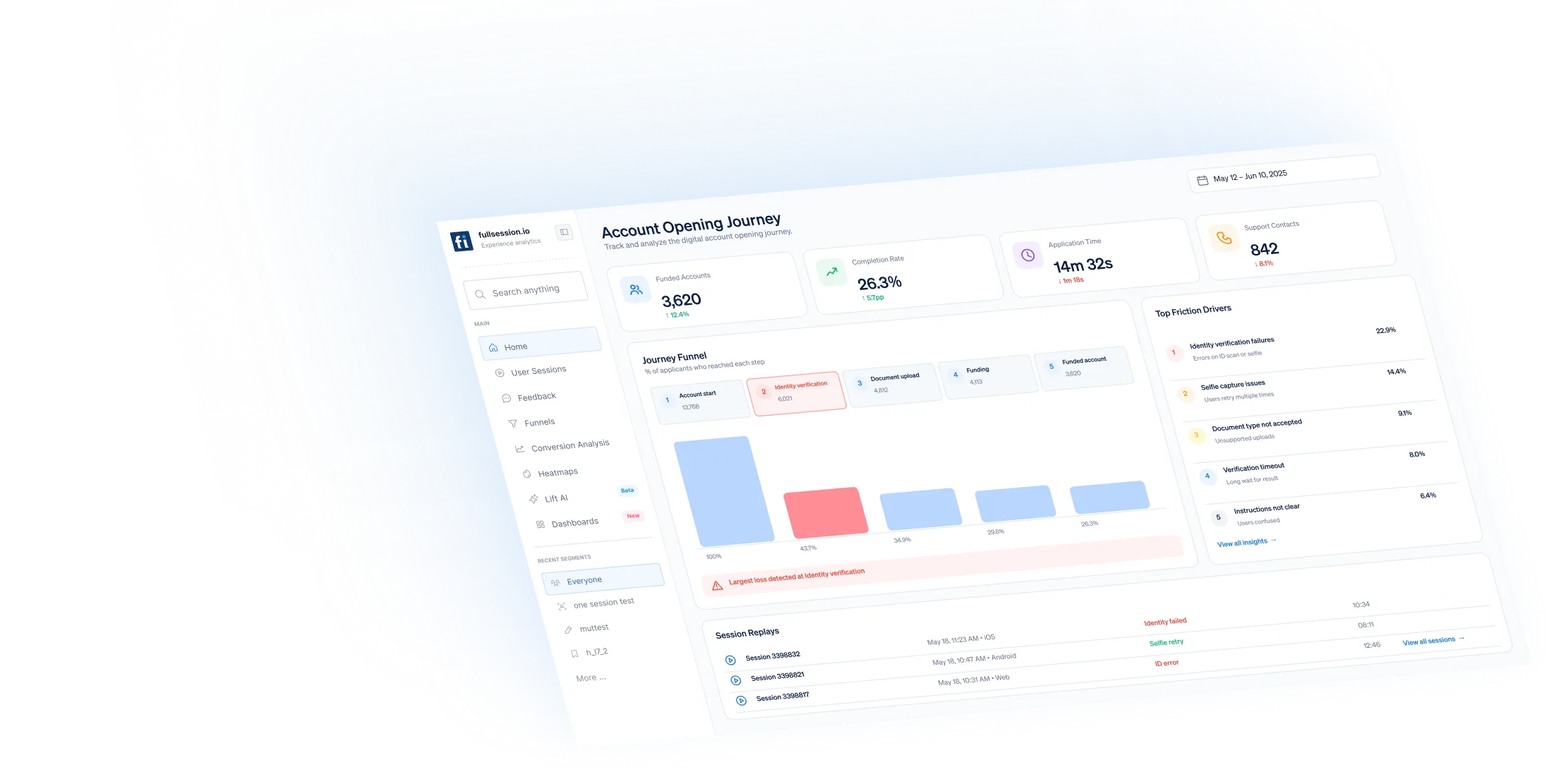
FullSession pairs session replay, heatmaps, funnels, and error tracking with Lift AI, so you can find the friction costing you revenue and prove the fix worked. No credit card needed to start.
FAQs
Retroactive funnels let you define or update funnel steps using historical event data you already captured. Forward-only funnels require definitions before data is captured in the right form. For migrations and evolving activation definitions, retroactivity reduces risk.
If identities are fragmented (same person appears as multiple users across devices or sessions), step-to-step conversion will look worse than reality. If identities are over-merged, you can inflate conversion. You want identity stitching that is auditable and aligned to your product model (user-level and, for B2B, account-level).
Sampling can change conversion rates, especially for small segments and multi-step funnels where each step reduces the population. The most important requirement is transparency: you should know when sampling is applied, how it works, and whether you can adjust it.
At minimum:
See what’s costing you, and prove whats fixing it is worth
Watch the real journey, rank every issue by revenue impact, and validate the result against baseline.



.svg)
.svg)
212 E Stone Path St Derby, KS 67037 Phone: +1 415-649-4222



All systems operational.