.svg)

Diagnosing onboarding funnel drop-off: where users quit, why it happens, and what to fix first
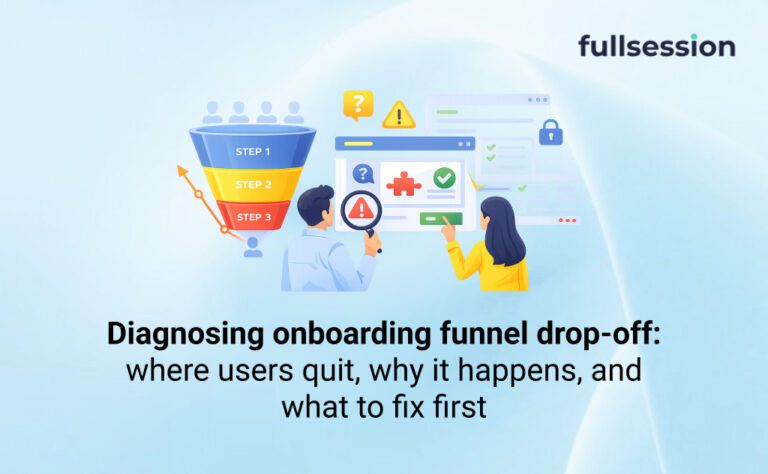

If feature adoption is flat, onboarding drop-off is often the quiet culprit. Users never reach the first value moment, so they never reach the features that matter.
The trap is treating every drop as a UX problem. Sometimes it is tracking. Sometimes it is an intentional qualification. Sometimes it is a technical issue that only shows up for a segment.
What is onboarding funnel drop-off?
Onboarding funnel drop-off is the share of users who start an onboarding step but do not reach the next step within a defined time window. In practice, it is a measurement of where users stop progressing, not why they stopped.
Why onboarding drop-off hurts feature adoption
Feature adoption depends on users reaching value early, then repeating it. Drop-off blocks both.
A typical failure mode is optimizing “completion” instead of optimizing “activation quality.” You push more people through onboarding, but they arrive confused, churn later, and support tickets spike.
So the job is not “reduce drop-off at any cost.” The job is: reduce the wrong drop-off, at the right step, for the right users, without harming downstream outcomes.
What most teams do today (and where it breaks)
Most teams rotate between three approaches. Each works, until it does not.
Dashboards-first funnels.
Great for spotting the leakiest step. Weak at explaining what users experienced in that step.
Ad hoc replay watching.
Great for empathy and spotting obvious friction. Weak at coverage and prioritization. You can watch 20 sessions and still be wrong about the top cause.
Multiple disconnected tools.
Funnels in one place, replays in another, errors in a third. It slows the loop, and it makes disagreements more likely because each tool tells a partial story.
The same issue appears in conversion optimization for ecommerce when teams track cart or checkout drop-off without connecting the numbers to session evidence, errors, hesitation, and real shopper behavior.
If you want a repeatable workflow, you need one shared source of truth for “where,” and a consistent method for “why.”
Before you optimize: make sure the drop-off is real
You can waste weeks fixing a drop-off that was created by instrumentation choices.
Common mistake: calling it “drop-off” when users are actually resuming later
Many onboarding flows are not single-session. Users verify email later, wait for an invite, or switch devices.
If your funnel window is too short, you will manufacture abandonment.
A quick integrity check you can run in one hour
Pick the leakiest step and answer three questions:
- Is the “next step” event firing reliably? Look for missing events, duplicate events, or events that only fire on success states.
- Is identity stitching correct? If users start logged out and finish logged in, you can split one user into two.
- Are there alternate paths? Users may skip a step (SSO, invite links, mobile deep links). Your funnel must reflect reality.
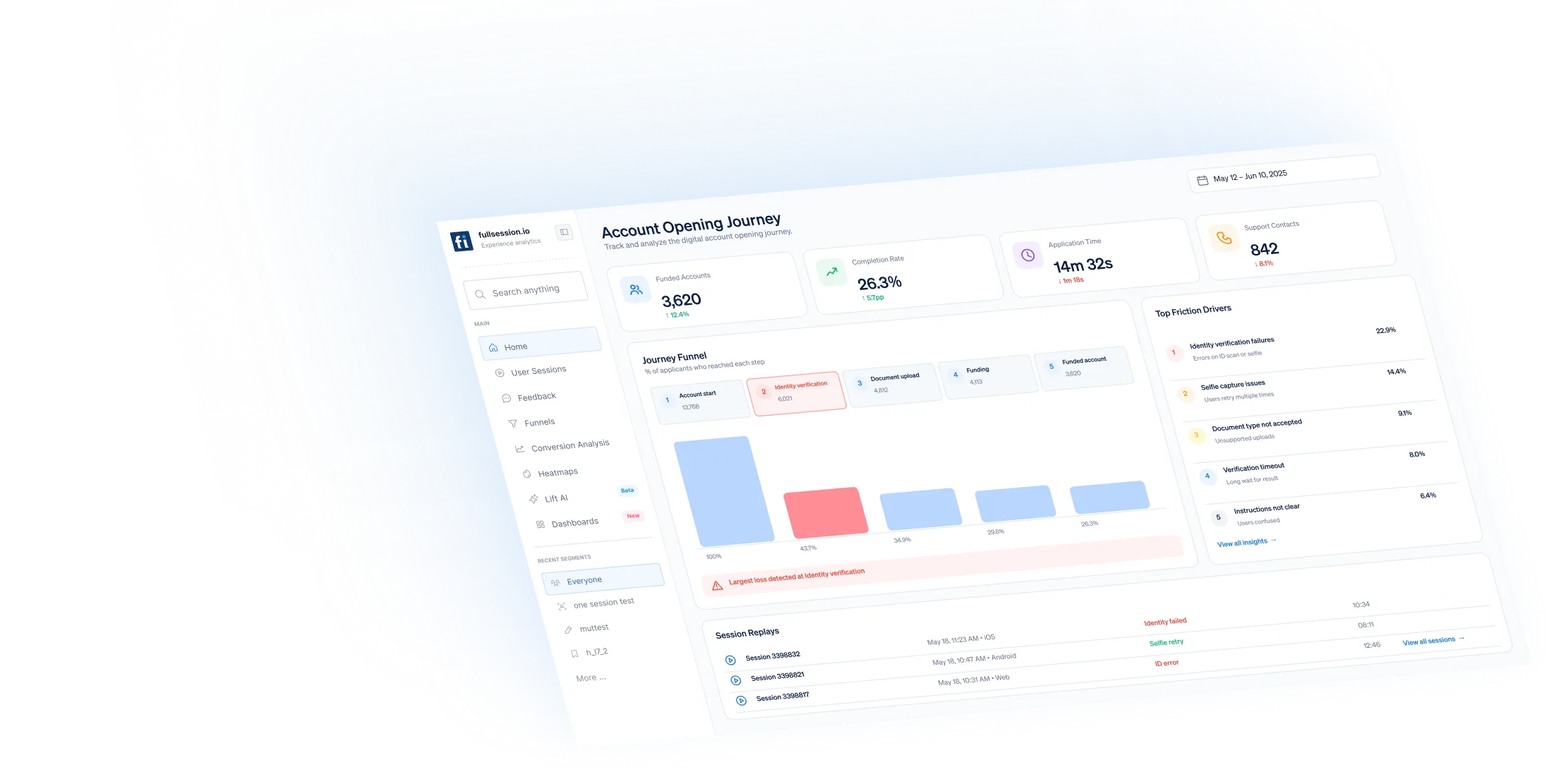
If you use FullSession funnels to quantify the drop, treat that as the “where” layer. Then use sessions to validate whether the “where” is truly a behavior problem or a measurement artifact.
A repeatable diagnose and fix workflow
You need a loop your team can run every sprint, not a one-time investigation.
Step 1: Define the funnel around the first value moment
Pick the moment that predicts feature adoption. Not a vanity milestone like “completed tour.”
Examples in PLG SaaS:
- Created the first project and invited a teammate
- Connected the first integration and saw data flow
- Shipped the first artifact (report, dashboard, deployment)
Write the funnel steps as observable events. Then add the time window that matches your product’s reality.
Step 2: Segment the drop so you do not average away the cause
The question is rarely “why do users drop?” It is “which users drop, under what conditions?”
Start with segments that frequently change onboarding outcomes:
- Device and platform (desktop vs mobile web, iOS vs Android)
- Acquisition channel (paid vs organic vs partner)
- Geo and language
- New vs returning
- Workspace context (solo vs team, invited vs self-serve)
- Plan tier or eligibility gates (trial vs free vs enterprise)
This step is where teams often discover they have multiple onboarding funnels, not one.
Step 3: Sample sessions with a plan, not randomly
Session replay is most useful when you treat it like research.
A simple sampling plan:
- 10 sessions that dropped at the step
- 10 sessions that successfully passed the step
- Same segment for both sets (same device, same channel)
Now you are comparing behaviors, not guessing.
If your workflow includes FullSession Session Replay, use it here to identify friction patterns that the funnel alone cannot explain.
Step 4: Classify friction into a short taxonomy you can act on
Avoid “users are confused” as a diagnosis. It is not specific enough to fix.
Use a practical taxonomy:
- Value clarity friction: users do not understand why this step matters
- Interaction friction: misclicks, hidden affordances, unclear form rules
- Performance friction: slow loads, spinners, timeouts
- Error friction: validation failures, API errors, dead states
- Trust friction: permission prompts, data access, security concerns
- Qualification friction: users realize the product is not for them
Attach evidence to each. A screenshot is not evidence by itself. A repeated pattern across sessions is.
Step 5: Validate with an experiment and guardrails
The minimum bar is: drop-off improves at the target step.
The better bar is: activation quality improves, and downstream outcomes do not degrade.
Guardrails to watch:
- Early retention or repeat activation events
- Support tickets and rage clicks on the same step
- Error volume for the same endpoint
Time to value, not just completion
What to fix first: a prioritization rule that beats “largest drop”
The biggest drop is a good starting signal. It is not a complete decision rule.
Here is a practical way to prioritize onboarding fixes for feature adoption:
Priority = Value moment proximity × Segment size × Fixability − Risk
Value moment proximity
Fixes closer to the first value moment tend to matter more. Removing friction from a tooltip step rarely beats removing friction from “connect your integration.”
Segment size
A 40% drop in a tiny segment may be less important than a 10% drop in your core acquisition channel.
Fixability
Some issues are fast to fix (copy, UI clarity). Others require cross-team work (permissions model, backend reliability). Put both on the board, but do not pretend they are equal effort.
Risk and when not to optimize
Some drop-off is intentional, and optimizing it can hurt you.
Decision rule: If a step protects product quality, security, or eligibility, optimize clarity and reliability first, not “conversion.”
Examples:
- Role-based access selection
- Security verification
- Data permissions for integrations
- Compliance gates
In these steps, your goal is fewer confused attempts, fewer errors, and faster completion for qualified users. Not maximum pass-through.
Quick patterns that usually produce a real win
These patterns show up across PLG onboarding because they map to common user constraints.
Pattern: drop-off spikes on mobile or slower devices
This is often performance, layout, or keyboard issues. Look for long waits, stuck states, and mis-taps.
Tie the funnel step to technical signals where you can. If you use FullSession Errors & Alerts, use it to connect the “where” to the failure mode. (/product/errors-alerts)
Pattern: drop-off happens right after a value promise
This is usually a mismatch between promise and required effort. Users expected “instant,” but got “set up.”
Fixes that work here are honest framing and progressive setup:
- State the time cost up front
- Show an immediate partial payoff
- Defer optional complexity until after first value
Pattern: users complete onboarding but do not adopt the key feature
Your onboarding may be teaching the wrong behavior.
Look at post-onboarding cohorts:
- Who reaches first value but never repeats it?
- Which roles adopt, and which do not?
Sometimes the correct “onboarding fix” is a post-onboarding nudge that drives the second meaningful action, not more onboarding steps.
When to use FullSession for onboarding drop-off
If your KPI is feature adoption, FullSession is most useful when you need to move from “we see a drop” to “we know what to ship” without weeks of debate.
Use FullSession when:
- You need funnels plus qualitative evidence in the same workflow, so your team aligns on the cause faster.
- You need to compare segments and cohorts to avoid averaging away the real problem.
- You suspect errors or performance issues are multiplying drop-off for specific users or devices. (/product/errors-alerts)
- You want a consistent diagnose-and-validate loop for onboarding improvements that protects activation quality.
If you are actively improving onboarding, the most direct next step is to map your real funnel steps and identify the single step where you are losing qualified users. Then connect that step to session evidence before you ship changes.
If your team is evaluating platforms, a FullSession demo is the fastest way to see how funnels, replay, and error signals fit into one diagnostic loop.
FAQs
Pick two consecutive steps and a time window. Drop-off is the share that completes step A but does not complete step B within that window. Keep the window consistent across comparisons.
Benchmarks are usually misleading because onboarding includes intentional gates, different value moments, and different user quality. Use benchmarks only as a rough prompt, then prioritize based on your own segments and goals.
As many as your first value moment requires, and no more. The right number is the minimum set of actions that create a meaningful outcome, not a checklist of UI screens.
If replays show users reaching the outcome but your events never fire, it is tracking. If users are stuck, retrying, or hitting errors, it is UX or technical friction. Validate identity stitching and alternate paths first.
Sometimes. But if a step qualifies users, sets permissions, or prevents bad data, removing it can reduce product quality and increase support load. Optimize clarity and reliability before removing gates.
Define the activation event that predicts adoption, then track repeat behavior after onboarding. Your success metric is not only “completed onboarding,” it is “reached first value and repeated it.
See what’s costing you, and prove whats fixing it is worth
Watch the real journey, rank every issue by revenue impact, and validate the result against baseline.



.svg)
.svg)
212 E Stone Path St Derby, KS 67037 Phone: +1 415-649-4222



All systems operational.