.svg)

Frontend Error Monitoring: How to Choose Tools and Run an Impact-Based Triage Workflow


Frontend error monitoring is easy to “install” and surprisingly hard to operate well. Most teams end up with one of two outcomes:
- an inbox full of noisy JavaScript errors no one trusts, or
- alerts so quiet you only learn about issues from angry users.
This guide is for SaaS frontend leads who want a practical way to choose the right tooling and run a workflow that prioritizes what actually hurts users.
What is frontend error monitoring?
Frontend error monitoring is the practice of capturing errors that happen in real browsers (exceptions, failed network calls, unhandled promise rejections, resource failures), enriching them with context (route, browser, user actions), and turning them into actionable issues your team can triage and fix.
It usually sits inside a broader “frontend monitoring” umbrella that can include:
- Error tracking (issues, grouping, alerts, stack traces)
- RUM / performance monitoring (page loads, LCP/INP/CLS, route timings)
- Session replay / UX signals (what happened before the error)
- Synthetics (scripted checks, uptime and journey tests)
You don’t need all of these on day one. The trick is choosing the smallest stack that supports your goals.
1) What are you optimizing for?
Before you compare vendors, decide what “success” means for your team this quarter. Common goals:
- Lower MTTR: detect faster, route to an owner faster, fix with confidence
- Release confidence: catch regressions caused by a deploy before users report them
- UX stability on critical routes: protect onboarding, billing, upgrade flows, key in-app actions
Your goal determines the minimum viable stack.
2) Error tracking vs RUM vs session replay: what you actually need
Here’s a pragmatic way to choose:
A) Start with error tracking only when…
- You primarily need stack traces + grouping + alerts
- Your biggest pain is “we don’t know what broke until support tells us”
- You can triage without deep UX context (yet)
Minimum viable: solid issue grouping, sourcemap support, release tagging, alerting.
B) Add RUM when…
- You need to prioritize by impact (affected users/sessions, route, environment)
- You care about performance + errors together (“the app didn’t crash, but became unusable”)
- You want to spot “slow + error-prone routes” and fix them systematically
Minimum viable: route-level metrics + segmentation (browser, device, geography) + correlation to errors.
C) Add session replay / UX signals when…
- Your top issues are hard to reproduce
- You need to see what happened before the error (rage clicks, dead clicks, unexpected navigation)
- You’re improving user journeys where context matters more than volume
Minimum viable: privacy-safe replay/UX context for high-impact sessions only (avoid “record everything”).
If your focus is operational reliability (alerts + workflow), start by tightening your errors + alerts foundation. If you want an operator-grade view of detection and workflow.
3) Tool evaluation: the operator criteria that matter (not the generic checklist)
Most comparison posts list the same features. Here are the criteria that actually change outcomes. Ecommerce teams comparing ecommerce error tracking tools should prioritize impact context, route-level visibility, session evidence, and checkout-specific error signals:
1) Grouping you can trust
- Does it dedupe meaningfully (same root cause) without hiding distinct regressions?
- Can you tune grouping rules without losing history?
2) Release tagging and “regression visibility”
- Can you tie issues to a deployment or version?
- Can you answer: “Did this spike start after release X?”
3) Sourcemap + deploy hygiene
- Is sourcemap upload straightforward and reliable?
- Can you prevent mismatches across deploys (the #1 reason debugging becomes guesswork)?
4) Impact context (not just error volume)
- Can you see affected users/sessions, route, device/browser, and whether it’s tied to a critical step?
5) Routing and ownership
- Can you assign issues to teams/services/components?
- Can you integrate with your existing workflow (alerts → ticket → owner)?
6) Privacy and controls
- Can you limit or redact sensitive data from breadcrumbs/session signals?
- Can you control sampling so you don’t “fix” an error by accidentally filtering it out?
4) The impact-based triage workflow (step-by-step)
This is the missing playbook in most SERP content: not “collect errors,” but operate them.
Step 1: Normalize incoming signals
You want a triage view that separates:
- New issues (especially after a release)
- Regressions (known issue spiking again)
- Chronic noise (extensions, bots, flaky third-party scripts)
Rule of thumb: treat “new after release” as higher priority than “high volume forever.”
Step 2: Score by impact (simple rubric)
Use an impact score that combines who it affects and where it happens:
Impact score = Affected sessions/users × Journey criticality × Regression risk
- Affected sessions/users: how many real users hit it?
- Journey criticality: does it occur on signup, checkout/billing, upgrade, key workflow steps?
- Regression risk: did it appear/spike after a deploy or config change?
This prevents the classic failure mode: chasing the loudest error instead of the most damaging one.
Step 3: Classify the issue type (to choose the fastest fix path)
- Code defect: reproducible, tied to a route/component/release
- Environment-specific: browser/device-specific, flaky network, low-memory devices
- Third-party/script: analytics/chat widgets, payment SDKs, tag managers
- Noise: extensions, bots, pre-render crawlers, devtools artifacts
Each class should have a default owner and playbook:
- code defects → feature team
- third-party → platform + vendor escalation path
- noise → monitoring owner to tune filters/grouping (without hiding real user pain)
Step 4: Route to an owner with a definition of “done”
“Done” is not “merged a fix.” It’s:
- fix shipped with release tag
- error rate reduced on impacted route/cohort
- recurrence monitored for reintroduction
5) Validation loop: how to prove a fix worked
Most teams stop at “we deployed a patch.” That’s how regressions sneak back in.
The three checks to make “fixed” real
- Before/after by release
- Did the issue drop after the release that contained the fix?
- Did the issue drop after the release that contained the fix?
- Cohort + route confirmation
- Did it drop specifically for the affected browsers/routes (not just overall)?
- Did it drop specifically for the affected browsers/routes (not just overall)?
- Recurrence watch
- Monitor for reintroductions over the next N deploys (especially if the root cause is easy to re-trigger).
- Monitor for reintroductions over the next N deploys (especially if the root cause is easy to re-trigger).
Guardrail: don’t let sampling or filtering fake success
Errors “disappearing” can be a sign of:
- increased sampling
- new filters
- broken sourcemaps/release mapping
- ingestion failures
Build a habit: if the chart suddenly goes to zero, confirm your pipeline—not just your code.
6) The pitfalls: sourcemaps, noise, privacy (and how teams handle them)
Sourcemaps across deploys (the silent workflow killer)
Common failure patterns:
- sourcemaps uploaded late (after the error spike)
- wrong version mapping (release tags missing or inconsistent)
- hashed asset mismatch (CDN caching edge cases)
Fix with discipline:
- automate sourcemap upload in CI/CD
- enforce release tagging conventions
- validate a canary error event per release (so you know mappings work)
Noise: extensions, bots, and “unknown unknowns”
Treat noise like a production hygiene problem:
- tag known noisy sources (extensions, headless browsers)
- group and suppress only after confirming no user-impact signal is being lost
- keep a small “noise budget” and revisit monthly (noise evolves)
Privacy constraints for breadcrumbs/session data
You can get context without collecting sensitive content:
- redact inputs by default
- whitelist safe metadata (route, component, event types)
- only retain deeper context for high-impact issues
7) The impact-based checklist (use this today)
Use this checklist to find the first 2–3 workflow upgrades that will reduce time-to-detect and time-to-fix:
Tooling foundation
- Errors are grouped into issues you trust (dedupe without losing regressions)
- Sourcemaps are reliably mapped for every deploy
- Releases/versions are consistently tagged
Impact prioritization
- You can see affected users/sessions per issue
- You can break down impact by route/journey step
- You have a simple impact score (users × criticality × regression risk)
Operational workflow
- New issues after release are reviewed within a defined window
- Each issue type has a default owner (code vs 3p vs noise)
- Alerts are tuned to catch regressions without paging on chronic noise
Validation loop
- Fixes are verified with before/after by release
- The affected cohort/route is explicitly checked
- Recurrence is monitored for reintroductions
CTA
Each issue type should have a default owner and playbook especially when Engineering and QA share triage responsibilities
FAQ
Error monitoring focuses on capturing and grouping errors into actionable issues. RUM adds performance and experience context (route timings, UX stability, segmentation) so you can prioritize by impact and identify problematic journeys.
Not always. Teams typically add replay when issues are hard to reproduce or when context (what the user did before the error) materially speeds up debugging—especially for high-impact journeys.
Use an impact rubric: affected users/sessions × journey criticality × regression risk. This prevents chronic low-impact noise from outranking a new regression on a critical flow.
Without reliable sourcemaps and release tagging, stack traces are harder to interpret, regressions are harder to attribute to deploys, and MTTR increases because engineers spend more time reconstructing what happened.
See what’s costing you, and prove whats fixing it is worth
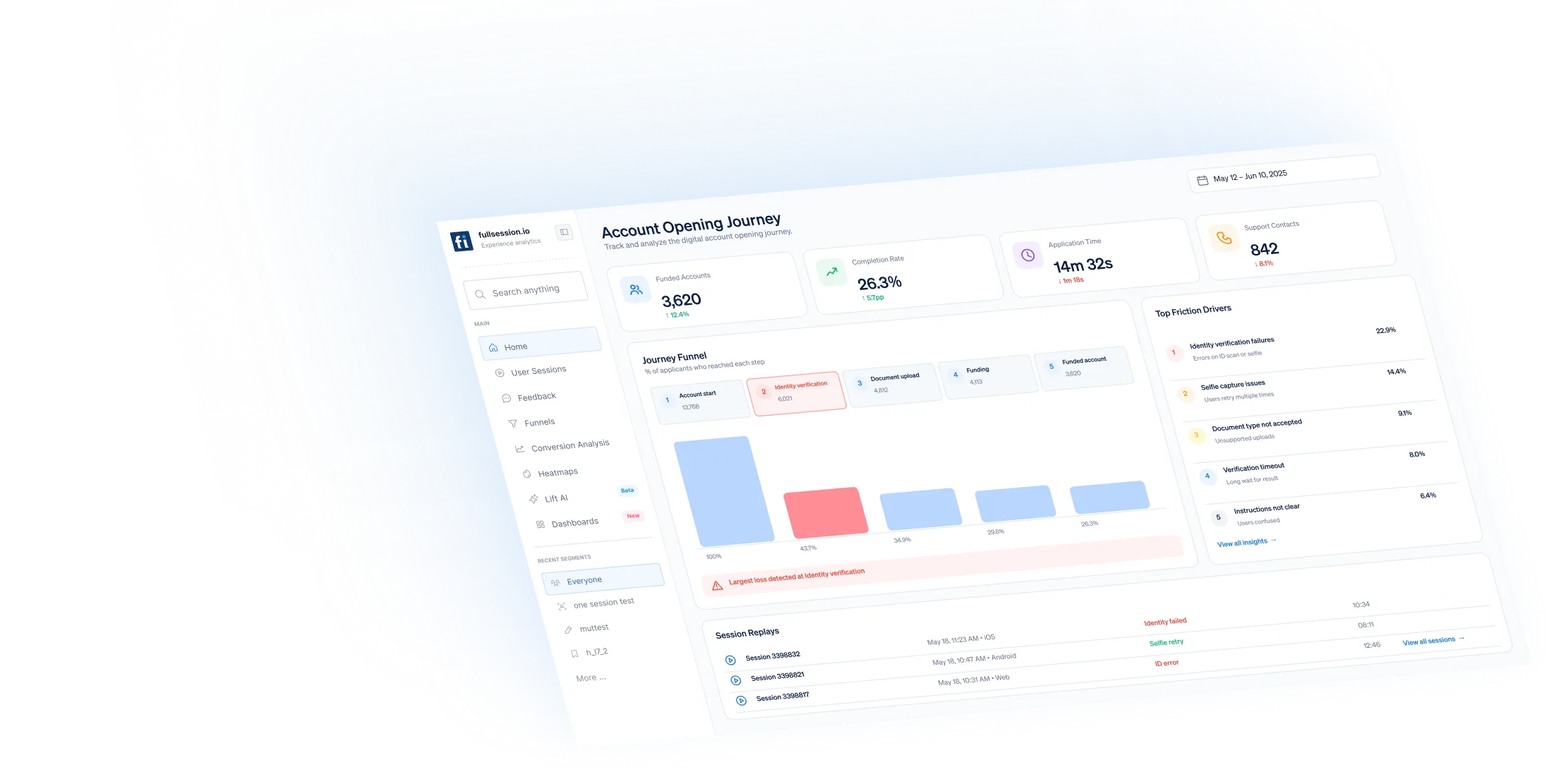
Watch the real journey, rank every issue by revenue impact, and validate the result against baseline.




.svg)
.svg)
212 E Stone Path St Derby, KS 67037 Phone: +1 415-649-4222



All systems operational.