.svg)
.svg)

Form Abandonment Analysis: How Teams Identify and Validate Drop-Off Causes

You already know how to calculate abandonment rate. The harder part is deciding what to investigate first, then proving what actually caused the drop-off.
This guide is for practitioners working on high-stakes journeys where “just reduce fields” is not enough. You will learn a sequencing workflow, the segmentation cuts that change the story, and a validation framework that ties back to activation.
What is form abandonment analysis?
Form abandonment analysis is the process of locating where users exit a form, generating testable hypotheses for why they exit, and validating the cause using behavior evidence (not just conversion deltas). It is different from reporting abandonment rate, because it includes diagnosis (field, step, or system), segmentation (who is affected), and confirmation (did the suspected issue actually trigger exit).
What to analyze first when you have too many drop-off signals
You need a sequence that prevents rabbit holes and gets you to a fixable cause faster.
Most teams jump straight to “which field is worst” and miss the higher-signal checks that explain multiple symptoms at once.
Start by answering one question: is the drop-off concentrated in a step, a field interaction, or a technical failure?
A quick map of symptoms to likely causes
Common mistake: treating every drop-off as a field problem
A typical failure mode is spending a week rewriting labels when the real issue is a silent error or a blocked submit state. If abandonment moved suddenly and across multiple steps, validate the system layer first.
Symptoms vs root causes: what abandonment can actually mean
If you do not separate symptoms from causes, you will ship fixes that feel reasonable and do nothing.
Form abandonment is usually one of three buckets, and each bucket needs different evidence.
Bucket 1 is “can’t proceed” (technical or validation failure). Bucket 2 is “won’t proceed” (trust, risk, or effort feels too high). Bucket 3 is “no longer needs to proceed” (intent changed, got the answer elsewhere, or price shock happened earlier).
The trade-off is simple: behavioral tools show you what happened, but you still need a hypothesis that is falsifiable. “The form is too long” is not falsifiable. “Users on iOS cannot pass phone validation because of formatting” is falsifiable.
For high-stakes journeys, also treat privacy and masking constraints as part of the reality. You may not be able to see raw PII, so your workflow needs to lean on interaction patterns, error states, and step timing, not the actual values entered.
The validation workflow: prove the cause before you ship a fix
This is how you avoid shipping “best practices” that do not move activation.
If you cannot state what evidence would disprove your hypothesis, you do not have a hypothesis yet.
- Locate the abandonment surface. Pinpoint the step and the last meaningful interaction before exit.
- Classify the drop-off type. Decide if it is field friction, step friction, or a technical failure pattern.
- Segment before you interpret. At minimum split by device class, new vs returning, and traffic source intent.
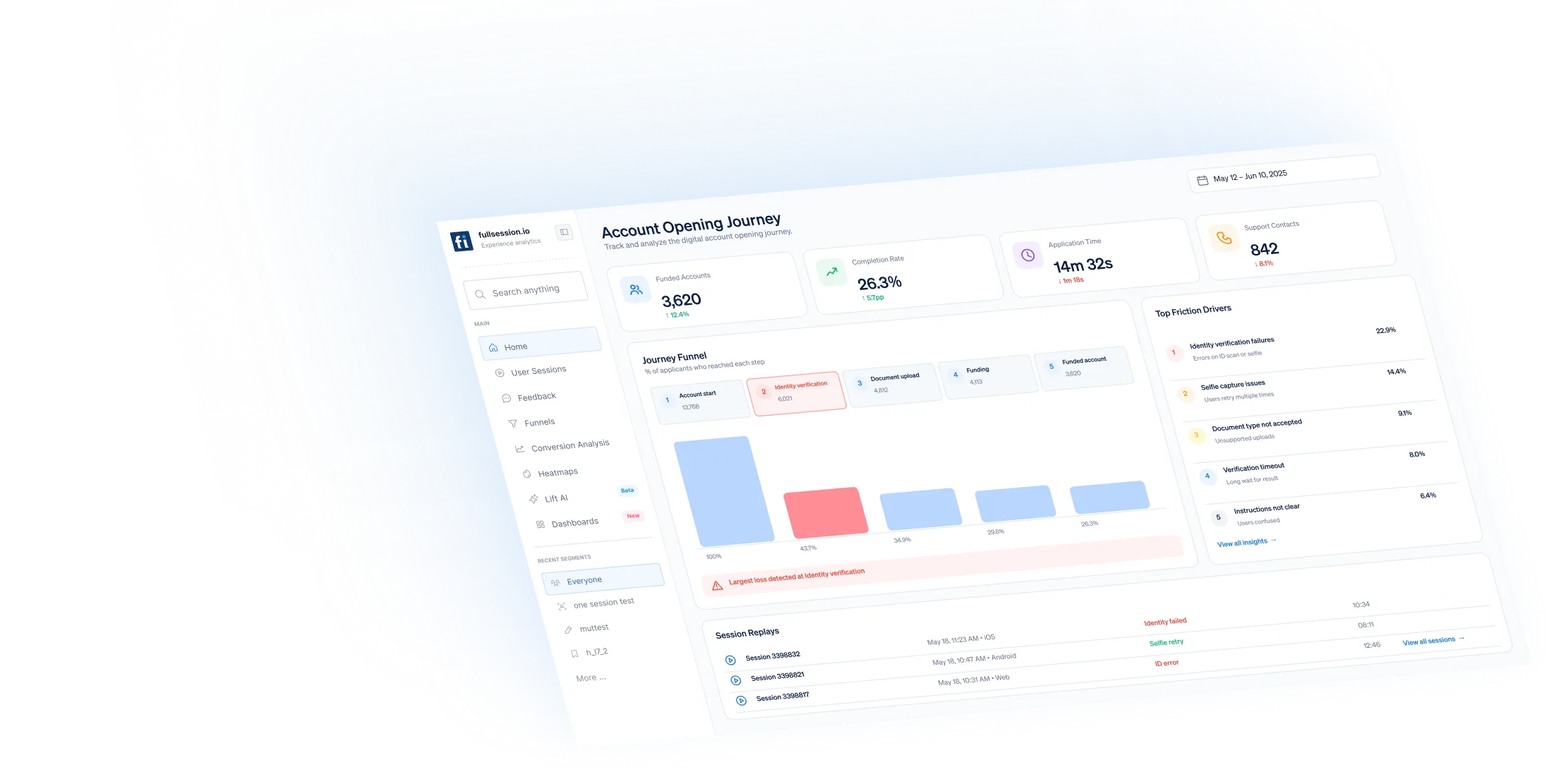
- Collect behavior evidence. Use session replay, heatmaps, and funnels to see the sequence, not just the count.
- Check for technical corroboration. Look for error spikes, validation loops, dead clicks, and stuck submit states.
- Form a falsifiable hypothesis. Write it as “When X happens, users do Y, because Z,” and define disproof.
- Validate with a targeted change. Ship the smallest change that should affect the mechanism, not the whole form.
- Measure downstream impact. Tie results to activation, not just form completion.
Quick example: You see abandonment on step 2 rise on mobile. Replays show repeated taps on “Continue” with no response, and errors show a spike in a blocked request. The fix is not copy. It is removing a failing dependency or handling the error state.
Segmentation cuts that actually change the diagnosis
Segmentation is what turns “we saw drop-off” into “we know who is blocked and why.”
The practical constraint is that you cannot segment everything. Pick cuts that change the root cause, not just the rate.
Start with three cuts because they often flip the interpretation: device class, first-time vs returning, and high-stakes vs low-stakes intent.
Device class matters because mobile friction often looks like “too many fields,” but the cause is frequently keyboard type, autofill mismatch, or a sticky element covering a button.
First-time vs returning matters because returning users abandon for different reasons, like credential issues, prefilled data conflicts, or “I already tried and it failed.”
Intent tier matters because an account creation form behaves differently from a claim submission or compliance portal. In high-stakes flows, trust and risk signals matter earlier, and errors are costlier.
Then add one context cut that matches your journey, like paid vs non-paid intent, logged-in state, or form length tier.
Do not treat segmentation as a reporting exercise. The goal is to isolate a consistent mechanism you can change.
Prioritize fixes by activation linkage, not completion vanity metrics
The fix that improves completion is not always the fix that improves activation.
If your KPI is activation, ask: which abandonment causes remove blockers for the users most likely to activate?
A useful prioritization lens is Impact x Certainty x Cost:
- Impact: expected influence on activation events, not just submissions
- Certainty: strength of evidence that the cause is real
Cost: engineering time and risk of side effects
Decision rule: when to fix copy, and when to fix mechanics
If users exit after hesitation with no errors and no repeated attempts, test trust and clarity. If users repeat actions, hit errors, or click dead UI, fix mechanics first.
One more trade-off: “big redesign” changes too many variables to validate. For diagnosis work, smaller, mechanism-focused changes are usually faster and safer.
When to use FullSession in a form abandonment workflow
If you want activation lift, connect drop-off behavior to what happens after the form.
FullSession is a fit when you need a consolidated workflow across funnels, replay, heatmaps, and error signals, especially in high-stakes journeys with privacy requirements.
Here is how teams typically map the workflow:
- Use Funnels & Conversions (/product/funnels-conversions) to spot the step where abandonment concentrates.
- Use Session Replay (/product/session-replay) to watch what users did right before they exited.
- Use Heatmaps (/product/heatmaps) to see if critical controls are missed, ignored, or blocked on mobile.
- Use Errors & Alerts (/product/errors-alerts) to confirm regressions and stuck states that analytics alone cannot explain.
If your org is evaluating approaches for CRO and activation work, the Growth Marketing solutions page (/solutions/growth-marketing) is the most direct starting point.
If you want to move from “we saw drop-off” to “we proved the cause,” explore the funnels hub first (/product/funnels-conversions), then validate the mechanism with replay and errors.
FAQs
Abandonment rate is typically 1 minus completion rate, measured for users who started the form. The key is to define “start” consistently, especially for multi-step forms.
Step abandonment is where users exit a step in a multi-step form. Field abandonment is when a specific field interaction (errors, retries, hesitation) correlates with exit.
Sometimes, but it is a blunt instrument. Remove fields when evidence shows effort is the driver. If you see validation loops, dead clicks, or errors, removing fields may not change the cause.
Enough to see repeated patterns across a segment. Stop when you can clearly describe the mechanism and what would disprove it.
Ship a small, targeted change that should affect the mechanism, then check whether the behavior pattern disappears and activation improves.
Device class, first-time vs returning, and intent source are usually the highest impact. Add one journey-specific cut, like logged-in state.
See what’s costing you, and prove whats fixing it is worth
Watch the real journey, rank every issue by revenue impact, and validate the result against baseline.


.svg)



All systems operational.