.svg)

Customer Experience Analytics Software: How to Evaluate Platforms by Data Sources, Use Cases, and Measurable Outcomes


If you own CX Ops in SaaS, you’ve probably got the same problem wearing different masks: churn risk shows up as “NPS dipped,” “ticket volume spiked,” “activation stalled,” and “renewal is shaky,” but your tooling can’t connect those dots fast enough to act.
You do not need more dashboards. You need a platform that can tell you which customers are experiencing what friction, where it happens in the journey, and which fixes actually move NRR and churn.
Quick Takeaway / Answer Summary (verbatim)
Customer experience analytics software helps SaaS teams connect customer feedback, behavioral signals, and operational data to find churn drivers and validate fixes. Evaluate platforms by data sources first, then by identity stitching, workflow automation, and measurement support. In a 60 to 90 day pilot, prove impact with baselines, cohorts, and guardrails against vanity metrics.
What CX analytics software is (and what it is not)
Customer experience analytics software is a system that combines signals across the customer journey, like feedback, product behavior, and support operations, so you can (1) identify experience friction and (2) operationalize fixes with measurable outcomes.
A quick boundary check, because category drift is real:
- CX analytics answers: What is the experience friction, who is affected, where does it happen, and what changed after we fixed it?
- Customer analytics often leans commercial: segmentation, LTV, pipeline, usage scoring. Useful, but not always “experience-first.”
- CX management / VoC suites excel at collecting feedback, but can struggle to tie it to behavioral root causes unless integrated well.
- BI is a layer, not a solution: it can display results, but it rarely creates the workflow for detection, triage, and action.
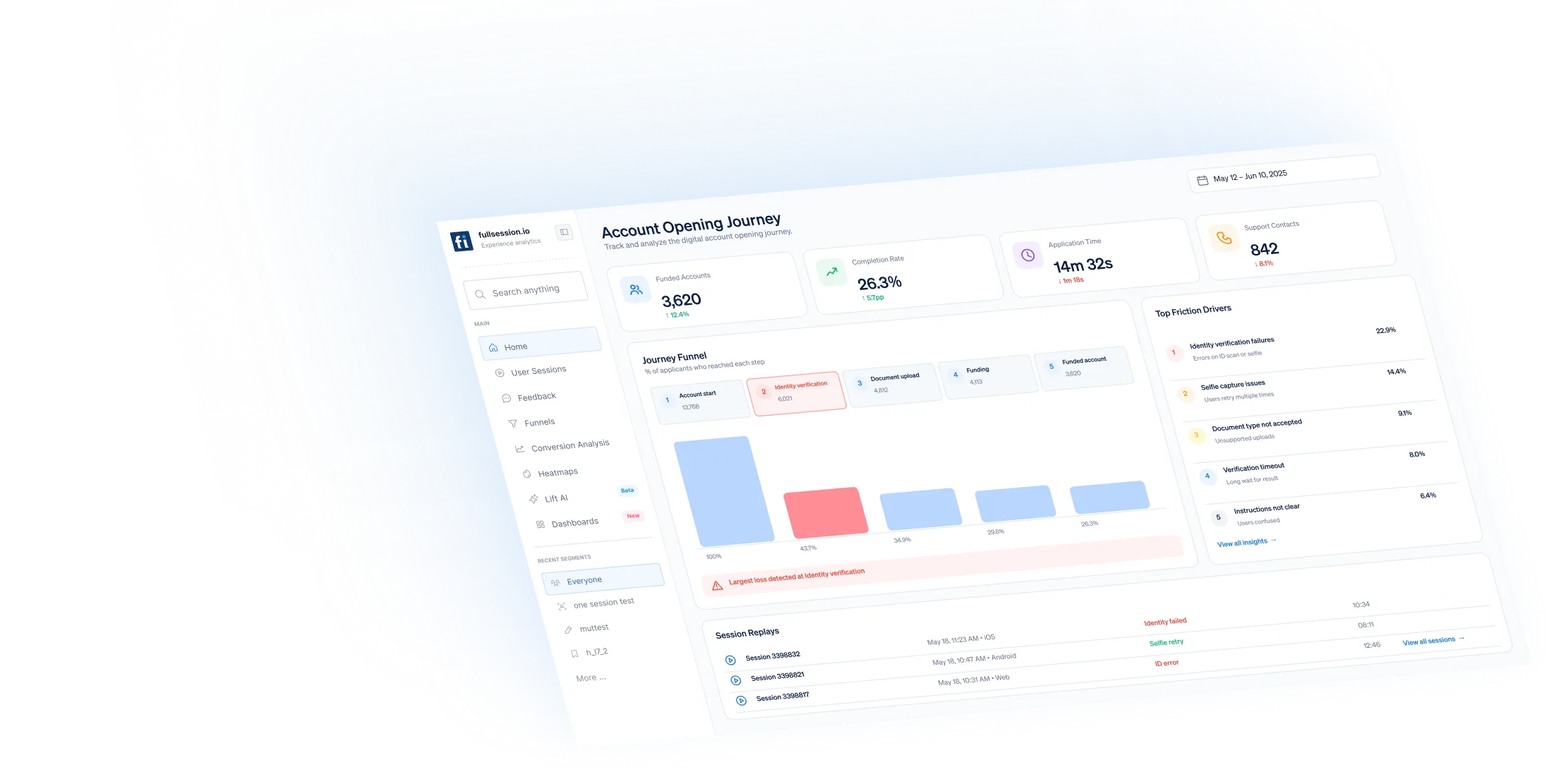
If your churn problem lives in product friction and “why did this customer fail here,” you will almost always need behavioral visibility, like session replay, journey funnels, and error context. (If you’re evaluating behavior analytics approaches, this is where a hub like FullSession session replay becomes relevant early in your shortlist.)
Start with your data sources and the friction questions you must answer
Most teams pick tools by feature labels. A better approach is: match tools to the data you already have, the data you can realistically add, and the questions you must answer to reduce churn.
Step 1: Inventory your “sources of truth”
Typical CX analytics sources in SaaS:
- Feedback: NPS/CSAT, surveys, in-app feedback, reviews, open text comments
- Conversations: support tickets, chat transcripts, call notes
- Behavior: product events, journeys, clicks/taps, sessions
- Ops and outcomes: plan tier, renewal date, expansion, churn reason, refund, SLA
- Reliability: errors, performance, outages, incident tags
Step 2: Turn sources into “must-answer” questions
A simple mapping you can use in stakeholder interviews:
- Retention / churn risk: “What experience patterns show up 30–60 days before churn?”
- Activation failure: “Where do new accounts stall and why?”
- Support cost: “Which issues repeat and which are self-inflicted by UX or bugs?”
- Renewals: “What did accounts experience in the 90 days leading to renewal?”
Step 3: Decide your minimum viable data model
For a churn-focused pilot, your minimum viable model usually needs:
- Account and user identity (including anonymous to known where possible)
- Journey stage (onboarding, key workflow, billing, admin)
- Reason taxonomy (topics, reasons, sentiment where appropriate)
- Outcome markers (activated, downgraded, renewed, churned)
If a vendor cannot explain how they handle identity stitching and journey stage mapping, their “CX analytics” will turn into a reporting exercise.
The evaluation scorecard: shortlist 3 to 5 platforms with confidence
Use this scorecard to compare vendors in a way that survives internal scrutiny. The goal is not “best tool.” The goal is “best fit for our data reality and our first measurable outcomes.”
Scorecard table (use in demos)
Evaluation area |
What "good" looks like |
Demo questions to ask |
Why it matters for churn/NRR |
|---|---|---|---|
Data sources and ingestion |
Native connectors or sane pipelines for feedback, conversations, behavior, and ops |
"Show me the full path from ticket text to a journey stage view." |
If ingestion is brittle, adoption dies |
Identity stitching |
Handles account-level mapping and user-level stitching; supports anonymous-to-known where relevant |
"How do you dedupe users and join to accounts? What breaks?" |
Churn is account-level, but friction is often user-level |
Unstructured feedback and taxonomy |
Tagging, topic clustering support, governance for taxonomy changes |
"Who owns taxonomy changes and how do they propagate?" |
Without taxonomy, you cannot operationalize insights |
Workflow operationalization |
Alerts, assignment, routing to playbooks/backlog, auditability |
"Show alert -> triage -> owner -> resolution loop." |
Insights that do not create action do not move churn |
Outcome validation |
Cohorts, baselines, experiment support, before/after comparison controls |
"How do you avoid 'dashboard vanity'?" |
You need proof, not vibes |
Governance and privacy |
PII handling, access controls, retention policies, redaction/masking |
"What gets stored, for how long, and who can see it?" |
CX data is sensitive and often messy |
This is also where you should be honest about trade-offs. Some teams will keep a survey-first VoC tool and add a behavior analytics platform for root cause. Others will consolidate more aggressively if they need a tighter workflow.
Mid-way through evaluation, it helps to map your CX operating motion to a platform that supports behavior visibility and action loops. If customer success outcomes are your core KPI, use the CS lens and evaluate against a page like solutions for customer success teams as a reality check for “how this gets used on Monday.”
What to implement first: a practical sequence by data maturity
This is the part most listicles skip. Use this sequence to avoid boiling the ocean.
Maturity level 1: Fragmented signals (most teams)
You have surveys, a ticketing system, and product analytics, but they are not joined.
Start here:
- Identity basics: account_id, user_id, plan tier, lifecycle stage
- One journey: pick one churn-adjacent flow (onboarding, billing, permissions, a core feature)
- Baseline metrics: define “good” for that journey (completion, time-to-value proxy, repeat errors)
- Reason taxonomy v1: 10–20 reasons max, mapped to journey stage
- Alerting rules: spikes in failure patterns, not generic “traffic changed”
If you need behavioral truth quickly, build your pilot around a behavior hub like session replay plus a simple funnel view for the chosen journey.
Maturity level 2: Joined data, weak operationalization
You can build dashboards but action is slow.
Upgrade to:
- Triage workflow: who owns which alert types
- Backlog routing: create a standard “insight ticket” template (what happened, who, where, evidence)
- Closed-loop follow-up: did we fix the issue, and did the metric move for the affected cohort
Maturity level 3: Operationalized workflows, weak proof
You ship fixes, but renewal leaders still ask, “Did it matter?”
Add:
- Cohort design: affected vs not affected, or before vs after for comparable accounts
- Guardrails: make sure “better” did not shift pain elsewhere (support load, errors, latency)
- Change log discipline: tie releases to experience shifts
Proving outcomes in 60 to 90 days: how to validate impact without fake certainty
A churn and NRR pilot needs credibility. That means measurement that can survive skeptical questions.
What “good proof” looks like in CX analytics
In a 60–90 day window, you are rarely proving “churn dropped.” Churn cycles are longer. You are proving leading indicators that plausibly drive churn and showing a repeatable loop.
Use this framework:
- Pick one outcome hypothesis
Example: “Fixing billing flow errors reduces downgrade and support escalations for expansion-eligible accounts.” - Define baselines before you change anything
Track current completion rate, repeat failure rate, ticket volume for that reason, and time-to-resolution. - Use cohorts, not averages
Compare accounts exposed to the friction vs those not exposed, or compare pre-fix vs post-fix for similar account cohorts. - Avoid vanity metrics
Time on page is not proof. “More dashboards viewed” is not proof. Proof ties to a behavior or operational outcome that matters. - Add guardrails
If you reduce one failure but create a new support burden, your “win” is fragile.
A practical implementation tip: if your pilot is focused on a journey, pair funnels with diagnostics and build review rituals around them. A page like funnels and conversions is often the simplest way to make “where the drop happens” visible, then you validate why with deeper evidence (sessions, errors, feedback).
The operating model: who does what on Monday
CX analytics fails most often because nobody owns the loop.
Here’s a workable operating model for a SaaS CX Ops team:
Ownership
- Taxonomy owner: CX Ops (with quarterly review input from Support and Product)
- Alert triage owner: rotating on-call between CX Ops and Support Ops
- Fix owner: Product for UX issues, Engineering/QA for bugs, Support for playbook updates
- Measurement owner: CX Ops partners with Product Ops or Analytics
Weekly cadence (lightweight but real)
- Mon: Review top friction alerts and top reasons; assign owners
- Wed: Evidence review: sessions, error traces, tickets; decide fix vs doc vs playbook
- Fri: “Did it move?” check: cohort trend review, guardrails, next hypotheses
If a platform cannot support this as a workflow, you will end up exporting to spreadsheets and losing speed.
Privacy, security, and governance: CX analytics questions buyers should ask
Generic “we take security seriously” is not enough for CX data.
Use this checklist in vendor conversations:
- PII handling: Can you mask/redact sensitive fields in feedback and transcripts? What is stored vs never stored?
- Access controls: Can you restrict sensitive data by role and team?
- Retention policies: Can you enforce retention windows appropriate for transcripts and session data?
- Auditability: Can you see who accessed what and when?
- Data minimization: Can you run a pilot on a single flow with strict masking and short retention?
If your CX analytics platform includes behavioral evidence like sessions, you should also evaluate how it handles errors and sensitive UI states. For example, it can be useful to connect experience friction to technical context using something like errors and alerts during pilot triage, without turning CX into an engineering-only project.
When FullSession fits in the stack (and when it does not)
FullSession is a user behavior analytics platform. It tends to fit best when your churn and NRR problem is tied to product and journey friction that traditional VoC tools and BI cannot explain on their own.
FullSession is a strong fit when you need:
- Behavioral truth for “why” questions (sessions, journeys, friction patterns)
- Faster triage loops across CX, Product, and Engineering
- Governance-friendly visibility so teams can act without creating privacy risk
FullSession is not the right first tool if:
- Your primary need is survey program management and you do not yet have the operational muscle to act on insights
- Your churn drivers are mostly commercial (pricing, contract, competitor) rather than experience friction
A common pattern is to keep a feedback collection tool and use FullSession to connect friction evidence to specific journeys, then operationalize fixes via shared workflows.
Next steps: run the shortlist workflow (and make it measurable)
Use the evaluation scorecard to shortlist 3 to 5 CX analytics platforms, then map each to your data sources and the outcomes you need to validate in the first 60 to 90 days.
Here’s the shortlist workflow (and a quick primer on session recording and replay):
- Pick one churn-adjacent journey and define baseline metrics.
- Run two vendor demos using the same demo script and the same scorecard.
- Choose a pilot winner based on identity stitching, workflow support, and validation capability, not feature count.
- Ship one fix and validate it with cohorts and guardrails.
If you want to see what a behavior-first pilot looks like in practice, start with FullSession session replay and evaluate it through a CS lens on customer success solutions. When you’re ready to validate on your own stack, get a demo or start a free trial and instrument one critical journey first.
FAQ’s
Use diff-in-diff, interrupted time series, or matched cohorts. Pick one, document assumptions, and add a control metric that should not move if your change is the cause.
Pick the earliest user action that strongly predicts long-term value (retention, conversion, expansion). Keep it stable and measurable across releases.
Long enough to smooth weekly volatility and cover the normal operating cycle, often 2–6 weeks. Longer is better if seasonality and campaigns are common.
Assign one primary financial path per initiative and treat others as supporting evidence, or carefully separate overlaps (for example, do not count churn reduction if it is already captured in revenue expansion).
That can still be a win. Report segmented ROI and decide whether to target the change, refine it for weaker segments, or roll back selectively.
Either exclude those periods, include controls, or use time-series methods that model seasonality. Always log the “known events” in your ROI report.
See what’s costing you, and prove whats fixing it is worth
Watch the real journey, rank every issue by revenue impact, and validate the result against baseline.



.svg)
.svg)
212 E Stone Path St Derby, KS 67037 Phone: +1 415-649-4222



All systems operational.