.svg)

UX Analytics in Practice: A Framework for Choosing Metrics, Tools, and What to Fix Next


Most teams “have analytics.” They still argue about UX.
The difference is not more dashboards. It is whether you can connect user struggle to a measurable activation outcome, then prove your fix helped.
What is UX analytics?
A lot of definitions say “quant plus qual.” That is directionally right, but incomplete.
Definition (UX analytics): UX analytics is the practice of measuring how people experience key journeys by combining outcome metrics (funnels, drop-off, time-to-value) with behavioral evidence (replays, heatmaps, feedback) so teams can diagnose friction and improve usability.
If you only know what happened, you have reporting. If you can show why it happened, you have UX analytics.
UX analytics vs traditional analytics for Week-1 activation
Activation problems are rarely “one number is bad.” They are usually a chain: confusion, misclicks, missing expectations, then abandonment.
Traditional analytics is strong at:
- Where drop-off happens (funnel steps, cohorts)
- Which segment is worse (role, plan, device, channel)
UX analytics adds:
- What users tried to do instead
- Which UI patterns caused errors or hesitation
- Whether the issue is comprehension, navigation, performance, or trust
The practical difference for a PM: traditional analytics helps you find the leak, UX analytics helps you identify the wrench that caused it.
Common mistake: treating “activation” as a single event
Teams often instrument one activation event, then chase it for months.
Activation is usually a short sequence:
- user intent (goal)
- first successful action
- confirmation that value was delivered
If you cannot observe that sequence, you will “fix” onboarding copy while the real blocker is a broken state, a permissions dead-end, or a silent validation error.
Choose metrics that map to activation, not vanity
Frameworks like HEART and Goals-Signals-Metrics exist for a reason: otherwise, you pick what is easy to count.
You do not need a perfect framework rollout. You need a consistent mapping from “UX goal” to “signal” to “metric,” so your team stops debating what matters.
A good activation metric is one you can move by removing friction in a specific step, not one that only changes when marketing changes.
A practical mapping for Week-1 activation
(HEART reminder: adoption and task success tend to matter most for activation, while retention is your downstream proof. )
Instrumentation and data quality are the hidden failure mode
Most “UX insights” die here. The dashboard is clean, the conclusion is wrong.
A typical failure mode is mixing three clocks:
- event timestamps
- session replay timelines
- backend or CRM timestamps
If those disagree, you will misread causality.
Your analysis is only as credible as your event design and identity stitching.
What to get right before you trust any UX conclusion:
- Define each activation step with a clear start and finish (avoid “clicked onboarding” style events).
- Use consistent naming for events and properties (so you can compare cohorts over time).
- Decide how you handle identity resolution (anonymous to known) to avoid double-counting or losing the early journey.
- Watch for sampling bias (common in replay/heatmaps). If your evidence is sampled, treat it as directional.
The evidence stack: when to use funnels, replay, heatmaps, and feedback
Most teams pick tools by habit. Better is to pick tools by question type.
Use quant to find where to look, then use behavioral evidence to see what happened, then use feedback to learn what users believed.
A simple “when to use which” path:
- Funnels and cohorts: “Where is activation failing and for whom?”
- Session replay: “What did users try to do at the failing step?”
- Heatmaps: “Are users missing the primary affordance or being drawn to distractions?”
- Feedback and VoC: “What did users think would happen, and what surprised them?”
Decision rule: replay first, heatmaps second
If activation is blocked by a specific step, replay usually gets you to a fix faster than heatmaps.
Heatmaps help when you suspect attention is distributed wrong across a page. Replays help when you suspect interaction is broken, confusing, or error-prone.
A triage model for what to fix next
The backlog fills up with “interesting.” Your job is to ship “worth it.”
A workable prioritization model is:
Severity × Reach × Business impact ÷ Effort
Do not overcomplicate scoring. You mainly need a shared language so design, product, and engineering stop fighting over anecdotal examples.
If a friction point is severe but rare, it is a support issue. If it is mild but common, it is activation drag.
Quick scenario: the false top issue
A team sees lots of rage clicks on a dashboard widget. It looks awful in replay.
Then they check reach: only power users hit that widget in Week 3. It is not Week-1 activation.
The real activation blocker is a permissions modal that silently fails for a common role. It looks boring. It kills activation.
Validate impact without fooling yourself
Pre/post comparisons are seductive and often wrong. Seasonality, marketing mix shifts, and cohort drift can make “wins” appear.
A validation loop that holds up in practice:
- Hypothesis: “Users fail at step X because Y.”
- Change: a small fix tied to that hypothesis.
- Measurement plan: one primary activation metric plus 1 to 2 guardrails.
- Readout: segment-level results, not just the average.
Guardrails matter because activation “wins” can be bought with damage:
- Support tickets spike
- Refunds increase
- Users activate but do not retain
When you need an experiment:
- If the change is large, or affects many steps, use A/B testing.
- If the change is tiny and isolated, directional evidence may be enough, but document the risk.
When to use FullSession for Week-1 activation
If you are trying to lift Week-1 activation, you usually need three capabilities in one workflow:
- pinpoint where activation breaks,
- see what users did in that moment,
- turn the finding into a prioritized fix list with proof.
FullSession is a privacy-first behavior analytics platform, so it fits when you need behavioral evidence (replays, heatmaps) alongside outcome measurement to diagnose friction without relying on guesswork.
If you want a practical next step, start here:
- Use behavioral evidence to identify one activation-blocking moment
- Tie it to one measurable activation metric
- Ship one fix, then validate with a guardrail
FAQs
Product analytics often focuses on feature usage, cohorts, and funnels. UX analytics keeps those, but adds behavioral evidence (like replay and heatmaps) to diagnose why users struggle in a specific interaction.
It is both. It uses quantitative metrics to locate issues and qualitative-style behavioral context to explain them.
Track a journey sequence: time-to-first-value, task success rate on the critical step, and step-level drop-off. Add 1 to 2 guardrails like support contacts or downstream retention.
Always score findings by reach and activation impact. A dramatic replay that affects 2% of new users is rarely your Week-1 lever.
Not always. For high-risk or broad changes, yes. For small, isolated fixes, directional evidence can work if you track a primary metric plus guardrails and watch for cohort shifts.
HEART gives you categories so you do not measure random engagement. For activation, adoption and task success are usually your core, with retention as downstream confirmation.
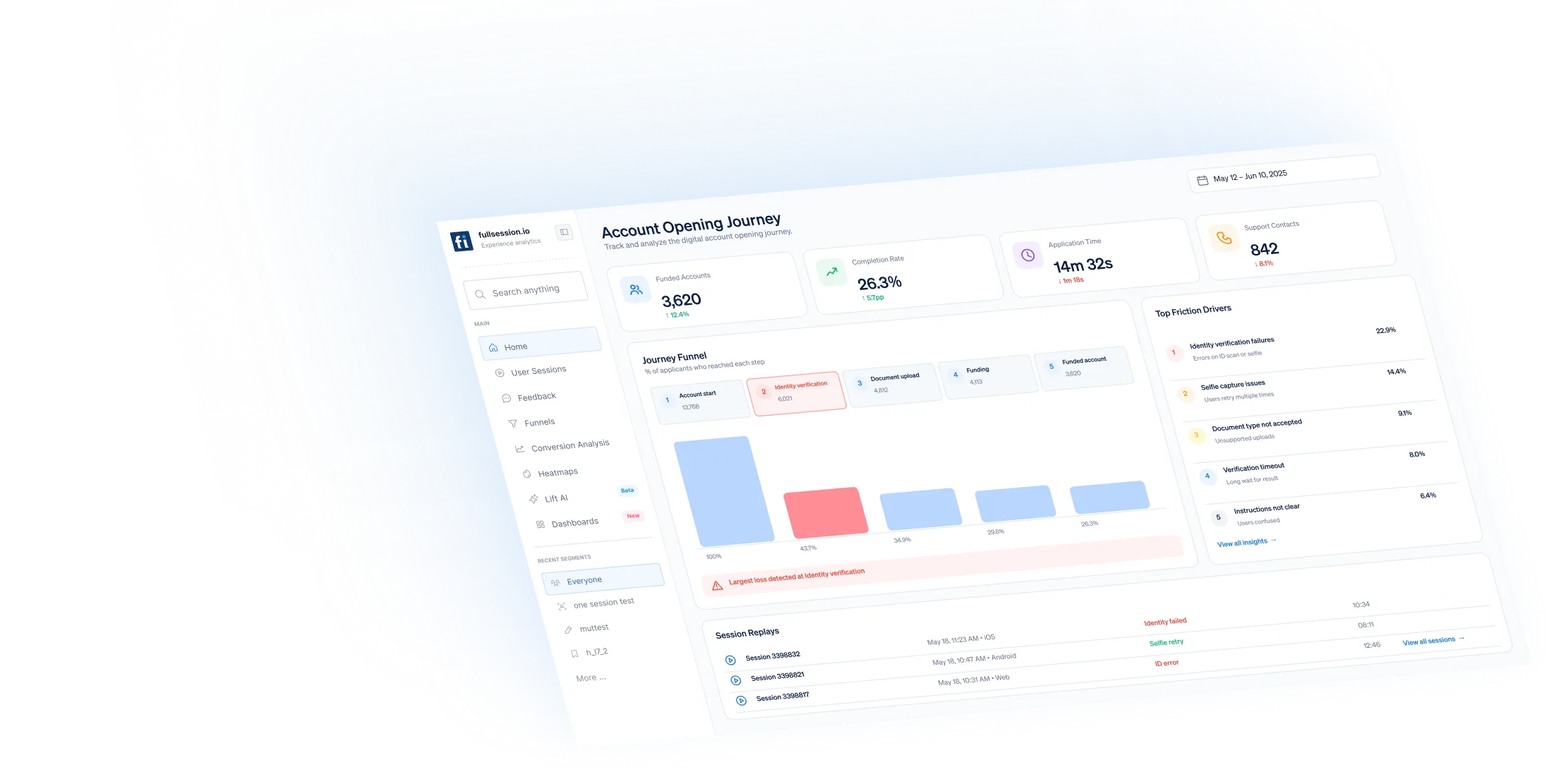
See what’s costing you, and prove whats fixing it is worth
Watch the real journey, rank every issue by revenue impact, and validate the result against baseline.





.svg)
.svg)
212 E Stone Path St Derby, KS 67037 Phone: +1 415-649-4222



All systems operational.