.svg)

User onboarding best practices: how teams decide what actually matters


Quick Takeaway (Answer Summary)
User onboarding best practices only work when they’re prioritized and validated in context. Start by identifying your activation moment, find the highest-friction step that blocks it, choose the smallest onboarding change that should reduce that friction, and validate impact with activation quality and time-to-value not just completion rates.
What is user onboarding?
User onboarding is the set of product experiences that help a new user reach their first meaningful outcome, the point where your product’s value becomes obvious enough to keep going.
When people search “user onboarding best practices,” they’re usually asking a more specific question:
“What should we change first to improve activation, and how do we know it worked?”
This post is a practical answer to that question without pretending every “best practice” matters equally for every product.
Why onboarding matters (beyond “first impressions”)
Onboarding is where your product makes (or breaks) its first value promise.
For SaaS teams, the downstream effects are familiar:
- Activation is flat even though signups increase.
- Users complete onboarding steps but don’t stick.
- Support load spikes with “I’m stuck” tickets that aren’t captured in analytics.
- Sales-assisted deals stall because early users can’t reproduce success.
If you can’t connect onboarding to a measurable activation outcome, you end up shipping tours, checklists, and emails that look busy but don’t change behavior.
Why most “best practices” articles feel true and still don’t help
Most lists share three problems:
- No prioritization logic
A welcome email and role-based routing are not equally important in every product but lists treat them that way. - No sequencing
Teams implement everything at once, then can’t attribute impact. - No validation loop
“Onboarding completion rate” becomes the proxy for success even when users complete steps and still don’t activate.
So, let’s keep the best-practices format (because it’s useful), but anchor it to decisions: what to do first, why, and how to measure it.
The practical decision framework: Prioritize → Design → Validate
Use this 3-phase loop any time you’re deciding which onboarding best practices to implement.
Step 1: Prioritize the activation constraint
Question: What is the single biggest reason a new user fails to reach activation?
You don’t need a perfect model, you need a defensible starting point.
Start with three inputs:
- Your activation moment (the first “meaningful outcome”)
- Your activation path (the 3–7 actions most users take before activation)
- Your highest-friction step (where the most qualified users stall)
Common high-friction patterns:
- Users don’t know what to do next (directional ambiguity)
- Users can’t complete setup (missing prerequisites, technical blockers)
- Users can’t find the feature that matters (discovery failure)
- Users don’t trust the outcome (confidence gap)
Step 2: Design the smallest onboarding change that should remove that constraint
Best onboarding isn’t “more onboarding.” It’s the minimum guidance that helps the user take the next value step.
Pick one primary mechanism per iteration:
- An in-product cue (UI copy, empty state, tooltip, checklist)
- A workflow nudge (templates, sample data, default configuration)
- A lifecycle nudge (email, in-app message)
- A human assist (sales/CS handoff, concierge setup)
Step 3: Validate impact with activation quality and time-to-value
Avoid declaring victory on “onboarding completion.”
Validate with:
- Activation rate (did more users reach the meaningful outcome?)
- Time-to-value (did they reach it faster?)
- Activation quality (did activated users keep using the product?)
- Downstream retention / expansion signals (did cohorts improve?)
If your best practice doesn’t move these, it may still be “nice UX”but it’s not an activation lever.
User onboarding best practices (sequenced, with when they matter)
Below are the “classic” best practices but framed as decisions.
1) Define activation in one sentence (and align the team)
When it matters most: early-stage products, multi-person teams, or any time you’re debating onboarding changes.
What to do: Write a one-sentence definition:
“A user is activated when they ______ within ______.”
Then list the 3–7 actions that typically lead there.
Common failure mode: Teams optimize “setup completion” instead of meaningful outcomes.
2) Reduce setup friction before you add guidance
When it matters most: products with integrations, configuration, or data import.
What to do: Remove or defer prerequisites. Provide defaults, templates, or sample data.
Common failure mode: A polished tour that walks users into a hard blocker.
3) Make the next step obvious at every moment
When it matters most: self-serve onboarding and PLG motions.
What to do: Use clear calls-to-action, empty states that explain value, and contextual prompts.
Common failure mode: “Explore the dashboard” onboarding that creates decision paralysis.
4) Teach by doing (not by telling)
When it matters most: products with a clear “first win” action (create, invite, publish, launch, analyze).
What to do: Convert your onboarding into a guided action path:
- Do the action
- Show immediate result
- Explain what changed (briefly)
- Point to the next value step
Common failure mode: Long modal explanations that users skip.
5) Use progressive disclosure for complex products
When it matters most: multi-role, multi-module, or enterprise workflows.
What to do: Reveal complexity only when it becomes relevant. Start with one core job-to-be-done.
Common failure mode: Asking users to configure everything upfront “just in case.”
6) Segment onboarding by intent (not by persona slides)
When it matters most: products serving multiple use cases (e.g., reporting vs automation vs collaboration).
What to do: Segment by the user’s desired outcome:
- “I want to do X”
- “I’m evaluating for team use”
- “I’m integrating this with Y”
Then route users to the shortest path to that outcome.
Common failure mode: Over-personalization that creates branches you can’t maintain.
7) Add trust and confirmation moments (especially around “risky” actions)
When it matters most: financial, data-impacting, irreversible, or “did that work?” actions.
What to do: Provide clear success states, previews, and undo paths where possible.
Common failure mode: Users stop because they’re not confident they did it right.
8) Close the loop with a validation cadence
When it matters most: always because onboarding is never “done.”
What to do: Run a simple cadence:
- Weekly: review drop-offs and top confusion points
- Biweekly: ship 1–2 small onboarding improvements
- Monthly: cohort review on activation + time-to-value
Common failure mode: Quarterly “big onboarding redesigns” that are hard to attribute.
Prioritization table: map signals → best practice → validation metric
Use this table when you’re resource-constrained and need to pick what matters first.
Scenario 1: Self-serve trial SaaS (speed matters more than completeness)
Context: You run a self-serve trial. Most users will never talk to a human. Your goal is to get qualified users to a first win fast.
What “best practices” usually fail here:
Teams add more education (tours, videos, long checklists) when they really need a shorter path to value.
A practical sequence:
- Define “activated” as one clear outcome (not “completed onboarding”).
- Remove setup steps that aren’t required for the first win.
- Guide users through a single “do the thing → see result” flow.
- Validate with time-to-value and activation quality (not just completions).
Tradeoff to acknowledge:
Reducing friction can increase low-quality activations. That’s why “activation quality” measures whether activated users keep using the product.
Scenario 2: Complex or sales-assisted SaaS (confidence matters more than speed)
Context: Activation depends on configuration, team alignment, permissions, or integration. A fast “first win” may be impossible without setup.
What “best practices” usually miss:
This onboarding needs proof and confidence, not just direction.
A practical sequence:
- Segment by intent: “quick evaluation” vs “implementation path.”
- Provide defaults for evaluation, and a clear checklist for implementation.
- Use progressive disclosure: show only what’s necessary for this stage.
- Validate with activation rate, time-to-value, and fewer “can’t figure this out” escalations.
Tradeoff to acknowledge:
Too much gating can slow evaluation; too little guidance creates misconfiguration and churn later. Your segmentation is how you handle that tradeoff.
What to look for in tooling (if you’re validating onboarding changes)
You can run this framework with basic analytics, but it’s much easier when you can answer two questions quickly:
- Where do users drop off on the activation path? (funnels + segmentation)
- Why do they drop off? (session replay, interaction patterns, and direct feedback)
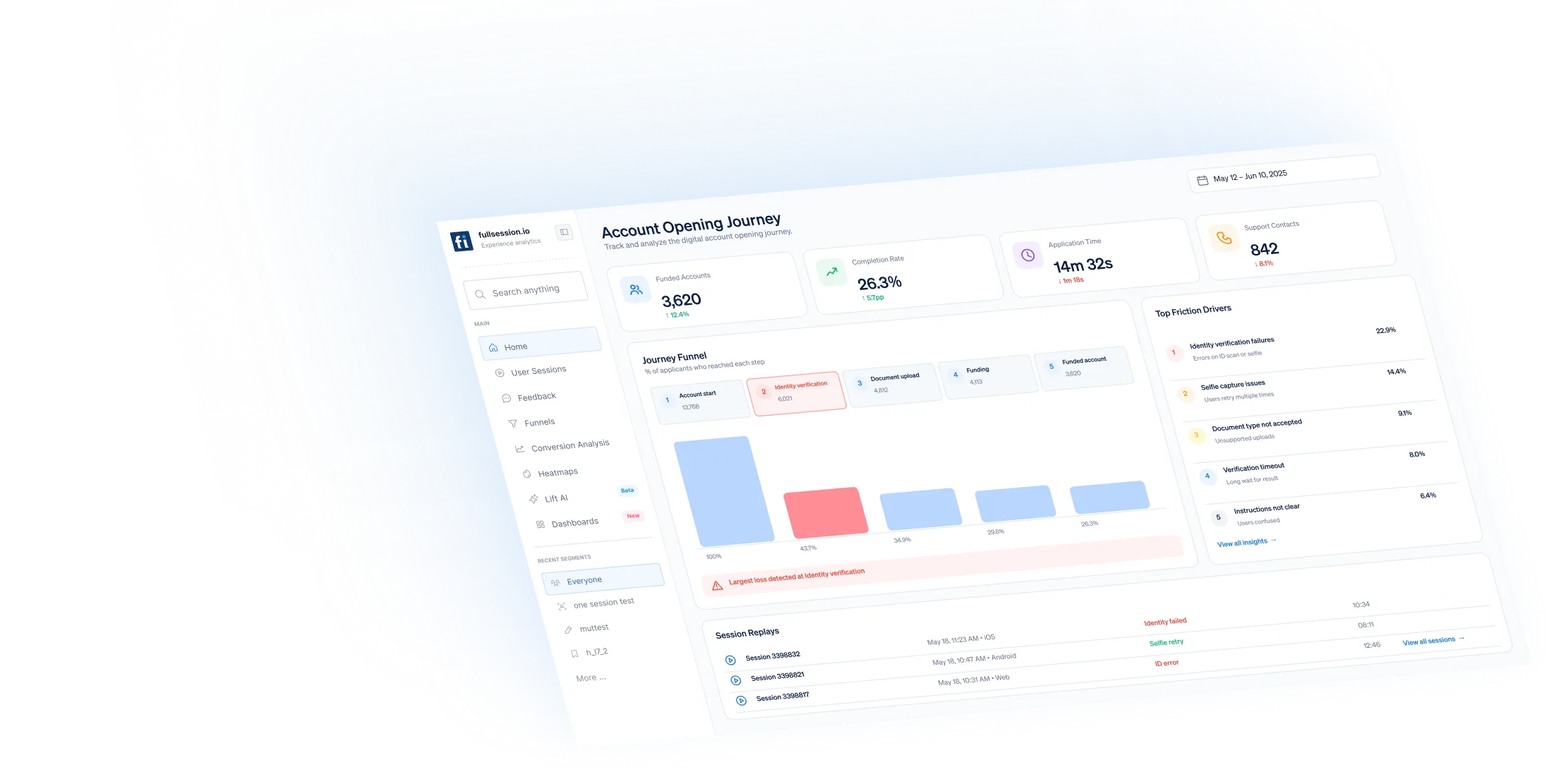
A user behavior analytics platform like FullSession can support this loop by combining funnels, session replay, heatmaps, and in-app feedback so you can see both the metric drop and the real user behavior behind it.
FAQs
The most important practices are the ones that remove the biggest constraint on activation for your product right now. Start by defining activation, then identify the highest-friction step on the path to it. Pick the smallest onboarding change that should reduce that friction, and validate with activation rate and time-to-value.
Avoid relying only on onboarding completion. Measure success with activation rate, time-to-value, and activation quality (whether users who “activate” keep using the product). If you have the data, review cohorts to confirm changes improved downstream retention.
Onboarding completion means users finished the steps you designed. Activation means users achieved a meaningful outcome and experienced value. A user can complete onboarding and still not activate if steps aren’t tied to the first win.
Use a constraint-first approach: pick one drop-off point that blocks activation, ship one change aimed at that point, and measure impact. The goal is not to improve everything; it’s to improve the step that’s currently limiting activation.
Personalization helps when it routes users to different value paths based on intent (what they’re trying to accomplish). It hurts when it creates branching complexity you can’t maintain. Prefer simple intent-based segmentation over heavy persona logic.
Common mistakes include optimizing for completion instead of activation, adding more guidance without removing friction, shipping “explore the dashboard” flows with no next-step clarity, and failing to validate impact with time-to-value and retention.
See what’s costing you, and prove whats fixing it is worth
Watch the real journey, rank every issue by revenue impact, and validate the result against baseline.



.svg)
.svg)
212 E Stone Path St Derby, KS 67037 Phone: +1 415-649-4222


All systems operational.