.svg)

User Behavior Patterns: How to Identify, Prioritize, and Validate What Drives Activation

If you’ve ever stared at a dashboard and thought, “Users keep doing this… but I’m not sure what it means,” you’re already working with user behavior patterns.
The hard part isn’t finding patterns. It’s deciding:
- Which patterns matter most for your goal (here: activation),
- Whether the pattern is a cause or a symptom, and
- What you should do next without shipping changes that move metrics for the wrong reasons.
This guide is a practical framework for Product Managers in SaaS: how to identify, prioritize, and validate user behavior patterns that actually drive product outcomes.
Quick scope (so we don’t miss intent)
When people search “user behavior patterns,” they often mean one of three things:
- Product analytics patterns (what this post is about): repeatable sequences in real product usage (events, flows, friction, adoption).
- UX psychology patterns: design principles and behavioral nudges (useful, but they’re hypotheses until validated).
- Cybersecurity UBA: anomaly detection and baselining “normal behavior” in security contexts (not covered here).
1) What is a user behavior pattern (in product analytics)?
A user behavior pattern is a repeatable, measurable sequence of actions users take in your product often tied to an outcome like “activated,” “stuck,” “converted,” or “churned.”
Patterns usually show up as:
- Sequences (A → B → C),
- Loops (A → B → A),
- Drop-offs (many users start, few finish),
- Time signatures (users pause at the same step),
- Friction signals (retries, errors, rage clicks), or
- Segment splits (one cohort behaves differently than another).
Why this matters for activation: Activation is rarely a single event. It’s typically a path to an “aha moment.” Patterns help you see where that path is smooth, where it breaks, and who is falling off.
2) The loop: Detect → Diagnose → Decide
Most teams stop at detection (“we saw drop-off”). High-performing teams complete the loop.
Step 1: Detect
Spot a repeatable behavior: a drop-off, loop, delay, or friction spike.
Step 2: Diagnose
Figure out why it happens and what’s driving it (segment, device, entry point, product state, performance, confusion, missing data, etc.).
Step 3: Decide
Translate the insight into a decision:
- What’s the change?
- What’s the expected impact?
- How will we validate causality?
- What will we monitor for regressions?
This loop prevents the classic failure mode: “We observed X, therefore we shipped Y” (and later discovered the pattern was a symptom, not the cause).
3) The Behavior Pattern Triage Matrix (so you don’t chase everything)
Before you deep-dive, rank patterns using four factors:
The matrix
Score each pattern 1–5:
- Impact If fixed, how much would it move activation?
- Confidence: How sure are we that it’s real + meaningful (not noise, not instrumentation)?
- Effort: How costly is it to address (engineering + design + coordination)?
- Prevalence How many users does it affect (or how valuable are the affected users)?
Simple scoring approach:
Priority = (Impact × Confidence × Prevalence) ÷ Effort
What “good” looks like for activation work
Start with patterns that are:
- High prevalence near the start of onboarding,
- High impact on the “aha path,” and
- Relatively low effort to address or validate.
4) 10 SaaS activation patterns (with operational definitions)
Below are common patterns teams talk about (drop-offs, rage clicks, feature adoption), but defined in a way you can actually measure.
Tip: Don’t treat these like a checklist. Pick 3–5 aligned to your current activation hypothesis.
Pattern 1: The “First Session Cliff”
What it looks like: Users start onboarding, then abandon before completing the minimum setup.
Operational definition (example):
- Users who trigger Signup Completed
- AND do not trigger Key Setup Completed within 30 minutes
- Exclude: internal/test accounts, bots, invited users (if onboarding differs)
Decision it unlocks:
Is your onboarding asking for too much too soon, or is the next step unclear?
Pattern 2: The “Looping Without Progress”
What it looks like: Users repeat the same action (or return to the same screen) without advancing.
Operational definition:
- Same event Visited Setup Step X occurs ≥ 3 times in a session
- AND Setup Completed not triggered
- Cross-check: errors, retries, latency, missing permissions
Decision it unlocks:
Is this confusion, a broken step, or a state dependency?
Pattern 3: The “Hesitation Step” (Time Sink)
What it looks like: Many users pause at the same step longer than expected.
Operational definition:
- Median time between Started Step X and Completed Step X is high
- AND the tail is heavy (e.g., 75th/90th percentile spikes)
- Segment by device, country, browser, plan, entry source
Decision it unlocks:
Is the content unclear, the form too demanding, or performance degrading?
Pattern 4: “Feature Glimpse, No Adoption”
What it looks like: Users discover the core feature but don’t complete the first “value action.”
Operational definition:
- Viewed Core Feature occurs
- BUT Completed Value Action does not occur within 24 hours
- Compare cohorts by acquisition channel and persona signals
Decision it unlocks:
Is the feature’s first-use path too steep, or is value not obvious?
Pattern 5: “Activation Without Retention” (False Activation)
What it looks like: Users hit your activation event but don’t come back.
Operational definition:
- Users trigger activation event within first week
- BUT no return session within next 7 days
- Check: was the activation event too shallow? was it triggered accidentally?
Decision it unlocks:
Is your activation definition meaningful or are you counting “activity” as “value”?
Pattern 6: “Permission/Integration Wall”
What it looks like: Users drop when asked to connect data, invite teammates, or grant permissions.
Operational definition:
- Funnel step: Clicked Connect Integration
- Drop-off before Integration Connected
- Segment by company size, role, and technical comfort (if available)
Decision it unlocks:
Do you need a “no-integration” sandbox path, better reassurance, or just-in-time prompts?
Pattern 7: “Rage Clicks / Friction Bursts”
What it looks like: Repeated clicking, rapid retries, dead-end interactions.
Operational definition:
- Multiple clicks in a small region in a short time window (e.g., 3–5 clicks within 2 seconds)
- OR repeated Submit attempts
- Correlate with Error Shown, latency, or UI disabled states
Decision it unlocks:
Is this UI feedback/performance, unclear affordance, or an actual bug?
Pattern 8: “Error-Correlated Drop-off”
What it looks like: A specific error predicts abandonment.
Operational definition:
- Users who see Error Type Y during onboarding
- Have significantly lower activation completion rate than those who don’t
- Validate: does the error occur before the drop-off step?
Decision it unlocks:
Fixing one error might outperform any copy/UX tweak.
Pattern 9: “Segment-Specific Success Path”
What it looks like: One cohort activates easily; another fails consistently.
Operational definition:
- Activation funnel completion differs materially across segments:
- role/plan/company size
- device type
- acquisition channel
- first use-case selected
- role/plan/company size
- Identify the “happy path” segment and compare flows
Decision it unlocks:
Do you need different onboarding paths by persona/use case?
Pattern 10: “Support-Driven Activation”
What it looks like: Users activate only after contacting support or reading docs.
Operational definition:
- Opened Help / Contacted Support / Docs Viewed
- precedes activation at a high rate
- Compare with users who activate without help
Decision it unlocks:
Where are users getting stuck and can you preempt it in-product?
5) How to analyze user behavior patterns (methods that don’t drift into tool checklists)
You don’t need more charts. You need a repeatable analysis method.
A) Start with a funnel, then branch into segmentation
For activation, define a simple funnel:
- Signup completed
- Onboarding started
- Key setup completed
- First value action completed (aha)
- Activated
Then ask:
- Where’s the biggest drop?
- Which segment drops there?
- What behaviors differ for those who succeed vs fail?
If you want a structured walkthrough of funnel-based analysis, route readers to: Funnels and conversion
B) Use cohorts to separate “new users” from “new behavior”
A pattern that looks “true” in aggregate may disappear (or invert) when you cohort by:
- signup week (product changes, seasonality)
- acquisition channel (different intent)
- plan (different constraints)
- onboarding variant (if you’ve been experimenting)
Cohorts are your guardrail against shipping a fix for a temporary spike.
C) Use session-level evidence to explain why
Quant data tells you what and where.
Session-level signals help with why:
- hesitation (pauses)
- retries
- dead clicks
- error states
- back-and-forth navigation
- device-specific usability problems
The goal isn’t “watch more replays.” It’s: use qualitative evidence to form a testable hypothesis. For online stores, the same evidence can support ecommerce UX optimization by showing where shoppers hesitate, misclick, abandon product pages, or struggle during checkout.
6) Validation playbook: correlation vs causation (without pretending everything needs a perfect experiment)
A behavior pattern is not automatically a lever.
Here’s a practical validation ladder go up one rung at a time:
Rung 1: Instrumentation sanity checks
Before acting, confirm:
- The events fire reliably
- Bots/internal traffic are excluded
- The same event name isn’t used for multiple contexts
- Time windows make sense (activation in 5 minutes vs 5 days)
Rung 2: Triangulation (quant + qual)
If drop-off happens at Step X, do at least two of:
- Session evidence from users who drop at X
- A short intercept (“What stopped you?”)
- Support tickets tagged to onboarding
- Error/performance logs
If quant and qual disagree, pause and re-check assumptions.
Rung 3: Counterfactual thinking (who would have activated anyway?)
A common trap: fixing something that correlates with activation, but isn’t causal.
Ask:
- Do power users do this behavior because they’re motivated (not because it causes activation)?
- Is this behavior simply a proxy for time spent?
Rung 4: Lightweight experiments
When you can, validate impact with:
- A/B test (best)
- holdout (especially for guidance/education changes)
- phased rollout with clear success metrics and guardrails
Rung 5: Pre/post with controls (when experiments aren’t feasible)
Use:
- comparable cohorts (e.g., by acquisition channel)
- seasonality controls (week-over-week, not “last month”)
- concurrent changes checklist (pricing, campaigns, infra incidents)
Rule of thumb: the lower the rigor, the more cautious you should be about attributing causality.
7) Edge cases + false positives (how patterns fool you)
A few common “looks like UX” but is actually something else:
- Rage clicks caused by slow loads (performance, not copy)
- Drop-off caused by auth/permissions (IT constraints, not motivation)
- Hesitation caused by multi-tasking (time window too tight)
- “Activation” event triggered accidentally (definition too shallow)
- Segment differences caused by different entry paths (apples-to-oranges)
If you change the product based on a false positive, you can make onboarding worse for the users who were already succeeding.
8) Governance, privacy, and ethics (especially with behavioral data)
Behavioral analysis can get sensitive fast, particularly when you use session-level signals.
A few pragmatic practices:
- Minimize collection to what you need for product decisions
- Respect consent and regional requirements
- Avoid capturing sensitive inputs (masking/controls)
- Limit access internally (need-to-know)
- Define retention policies
- Document “why we collect” and “how we use it”
This protects users and it also protects your team from analysis paralysis caused by data you can’t confidently use.
9) Start here: 3–5 activation patterns to measure next (PM-friendly)
If your KPI is Activation, start with the patterns that most often block the “aha path”:
- First Session Cliff (are users completing minimum setup?)
- Permission/Integration Wall (are you asking for trust too early?)
- Hesitation Step (which step is the time sink?)
- Error-Correlated Drop-off (is a specific bug killing activation?)
- Feature Glimpse, No Adoption (do users see value but fail to realize it?)
Run them through the triage matrix, define the operational thresholds, then validate with triangulation before changing the experience.
If you’re looking for onboarding-focused ways to act on these insights, right here: User onboarding
CTA
If you want, use this framework to pick 3–5 high-impact behavior patterns to measure next and define what success looks like before changing the experience.
FAQ
Common examples include onboarding drop-offs, repeated loops without progress, hesitation at specific steps, feature discovery without first value action, and error-driven abandonment.
Start with an activation funnel, locate the biggest drop-offs, then segment by meaningful cohorts (channel, device, plan, persona). Use session-level evidence and qualitative signals to diagnose why.
Product analytics patterns are measured sequences in actual usage. UX behavior patterns are design principles/hypotheses about how people tend to behave. UX patterns can inspire changes; analytics patterns tell you where to investigate and what to validate.
Use a validation ladder: instrumentation checks → triangulation → counterfactual thinking → experiments/holdouts → controlled pre/post when experimentation isn’t possible.
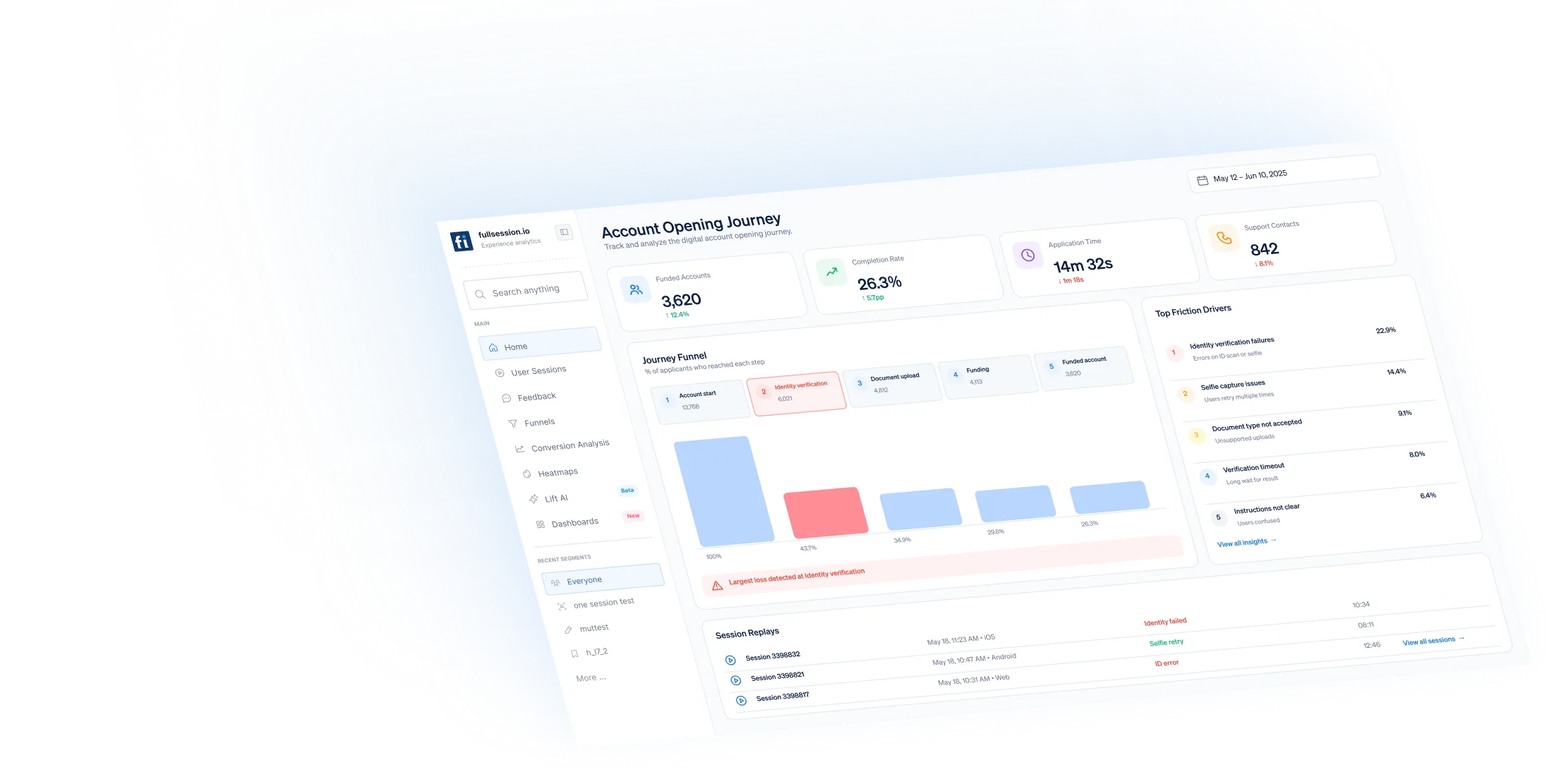
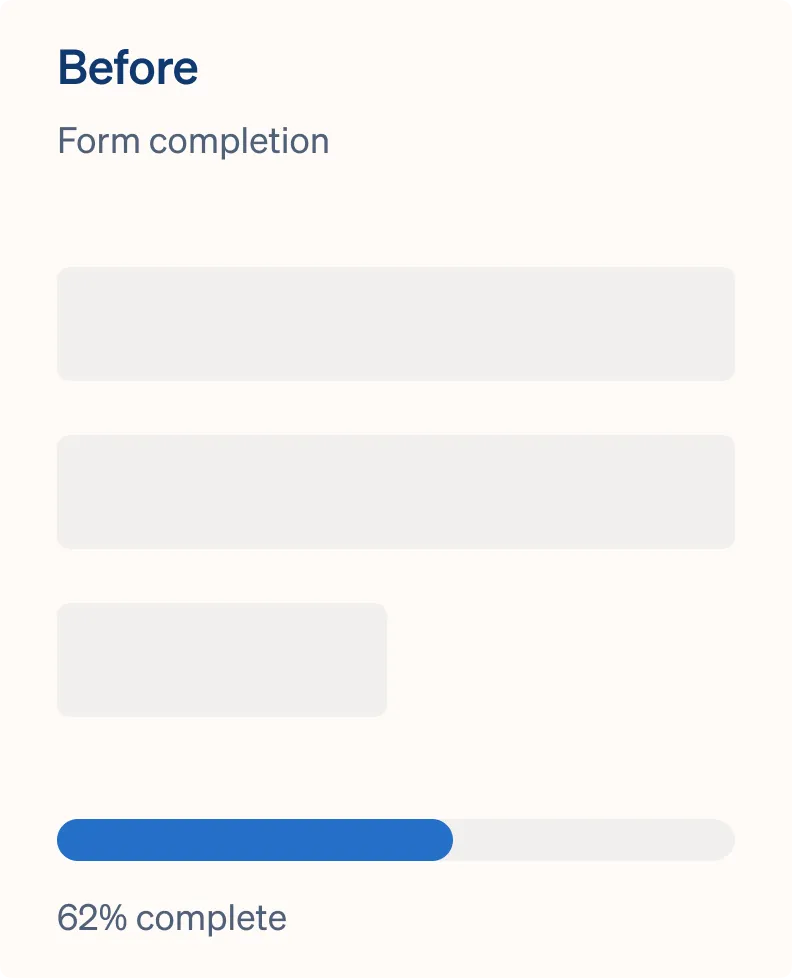
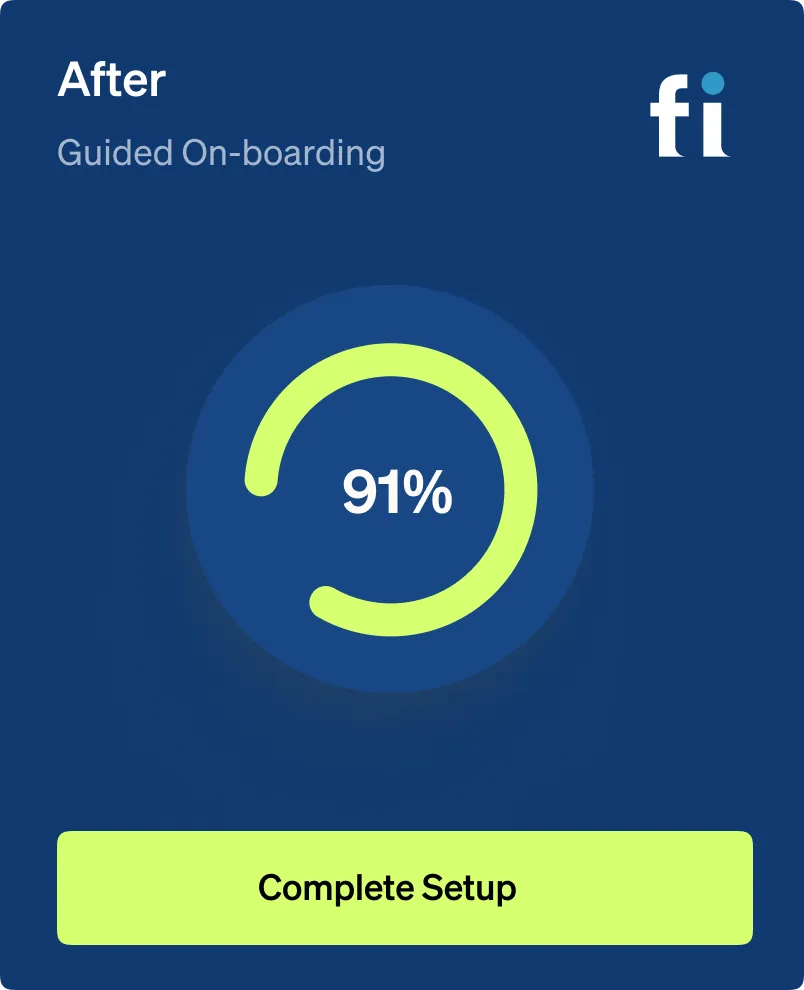
See what’s costing you, and prove whats fixing it is worth
Watch the real journey, rank every issue by revenue impact, and validate the result against baseline.



.svg)
.svg)
212 E Stone Path St Derby, KS 67037 Phone: +1 415-649-4222



All systems operational.