.svg)

Integrating Session Replay With Website Optimization Platforms: Setups, Tagging, and Validation (for Ecommerce CRO)


Quick Takeaway (Answer Summary)
Yes, you can integrate session replay tools with website optimization platforms. The reliable setups either use a native suite or pass experiment and variant IDs into replay as session metadata. The key is validation: confirm exposure, assignment, and sampling so “sessions by variant” comparisons reflect real user journeys, especially on checkout.
If you’re a CRO manager, you already have the symptoms: you shipped an A/B test, conversion moved, and you still can’t explain why. Watching recordings helps, but only if you can confidently tie each session to the exact experiment variant.
This guide covers what’s possible, how teams typically wire it up, and a QA checklist that makes the integration trustworthy.
Related product context: Session replay gives you the “why” behind drop-off and friction, and it pairs naturally with ecommerce optimization workflows.
Why pairing replay with optimization changes what you can fix
Session replay shows how shoppers actually experience your checkout, not just where they dropped out. Optimization platforms tell you which variant won. Replay helps you understand what changed in behavior between variants: hesitation, rage clicks, form resets, field confusion, performance stalls, and error states.
That matters for ecommerce because many “wins” and “losses” are caused by small moments:
- A shipping method that looks selectable but is not.
- A promo code that appears applied but does not update totals.
- A field validation that triggers late and wipes inputs on mobile.
- A payment step that fails silently and forces retry loops.
You do not want replay because it is interesting. You want it because it changes your next action: fix, roll back, iterate, or ship the winning pattern to more traffic.
Can you integrate session replay tools with website optimization platforms?
Yes. In practice, teams do it in two modes:
Mode 1: Native bundle (optimization suite includes replay)
This is the “one vendor, fewer moving parts” setup. It is often good enough when:
- You want fast rollout and minimal engineering involvement.
- Your team is running straightforward tests on a small set of pages.
- You can accept the platform’s default sampling and segmentation rules.
Where it breaks: you may get limited control over what constitutes “exposure,” how SPA route changes are handled, or how you join identities across tools.
Mode 2: Connector approach (experimentation platform + replay tool linked by metadata)
This is the best-of-breed setup. You run experiments in one platform, capture replay in another, and connect them via:
- experiment ID
- variant ID
- exposure timestamp or exposure event
- session ID, user ID, or another join key
It is the right choice when:
- Checkout is complex (SPAs, multi-step flows, third-party payment).
- You need high trust in variant filtering, not “pretty close.”
- Engineering wants a clean, testable contract for attribution and consent.
The architecture that makes “filter by variant” trustworthy
Most articles stop at “filter recordings by variation.” The real question is:
What, exactly, must be true for a replay to be labeled as Variant B?
At minimum, you need three things available inside replay data:
- Assignment: which variant the user was assigned (A, B, etc.)
- Exposure: confirmation the user actually saw the variant (not just assigned on page load)
- Join key: a stable identifier to tie the experiment system’s context to the replay session
If any of these are missing, your variant-based replay review can lie to you:
- Sessions labeled “B” that never saw the B UI
- SPA navigations where the experiment applies after route change but replay never records the updated variant
- Sessions sampled out disproportionately in one variant, causing biased conclusions
For checkout, exposure is the most common failure mode. Many tests “assign” on product page but “expose” in checkout. If you only tag assignment, your replay filtering will include sessions that never reached the tested step.
Three implementation patterns to pass experiment + variant into replay
Pattern 1: Set session attributes client-side (direct)
When the experiment platform decides the variant, your site sets:
- experiment_id
- variant_id
- optionally exposure=true at the moment the variant is rendered
Best for: client-side experiments where you control the render point.
Watch-outs:
- SPAs: ensure the attribute updates on route transitions.
- Late-loading experiments: avoid tagging before the UI actually changes.
Pattern 2: Data layer or tag manager bridge (indirect)
The experiment tool pushes an event into the data layer, and your replay tool reads it to set session attributes.
Best for: teams that already operate via GTM or a data layer contract.
Watch-outs:
- Order-of-operations bugs (replay loads before the data layer event fires).
- Multiple experiments: ensure consistent naming so attributes do not collide.
Pattern 3: Exposure events + join key (most robust)
You log a dedicated “experiment_exposed” event with experiment and variant, and you ensure a stable join key (session ID or user ID) is shared between systems.
Best for: high-stakes flows like checkout where you need auditability.
Watch-outs:
- Identity changes mid-session (logged out → logged in).
- Third-party checkout steps where you lose JavaScript context.
Validation and QA playbook (do not skip this)
If you do nothing else, do this: prove the integration works before you trust it.
Step 1: Known-user test plan
Create a short test plan with:
- a controlled user or test account
- a forced-variant method (if available) or repeated attempts until you hit both variants
- a checklist of expected UI differences per variant
Step 2: Verify exposure tagging, not just assignment
For each variant:
- confirm the replay session contains the expected experiment_id and variant_id
- confirm the replay includes the moment of exposure (the UI actually changes)
- confirm the exposure occurs at the correct step (checkout, not earlier)
Step 3: Event parity checks
Look for “phantom differences” caused by tracking drift:
- Are key events firing equally across variants?
- Did one variant accidentally break a tracking call?
- Are errors more frequent because of code changes, not UX changes?
Step 4: Sampling and bias checks
Replay tools often sample sessions. Optimization tools may also sample or bucket traffic.
Before you draw conclusions from “sessions by variant”:
- confirm both variants have similar replay capture rates
- confirm capture is not skewed toward one device type or region
- if replay is sampled, use it for qualitative pattern finding, not precise quantification
Step 5: Debug checklist when variant data is missing
If replays are not labeled with variants, the cause is usually one of these:
- replay script loads before the experiment decides the variant
- attributes set too early (assignment) and never updated on exposure
- SPA route changes apply variant after navigation but tagging never re-runs
- consent gating blocks replay capture on the pages where exposure occurs
- third-party payment step breaks continuity of session identifiers
Operational workflow: how teams actually use this (so it produces action)
A practical rhythm for ecommerce CRO teams:
- Run the test with a clear hypothesis and a defined “where to look” list (product page, shipping step, payment step).
- Review replays by variant to find repeatable patterns, not one-off weird sessions.
- Turn patterns into tickets with:
- a clipped replay link
- what the shopper tried to do
- what blocked them
- the suspected cause (UX, performance, error, tracking)
- Decide the next move:
- ship the winning pattern
- fix the bug and rerun
- refine the variant
- stop the test because the data is compromised
If you already use behavior analytics, the fastest path to action is usually consolidating the view across replay + funnels + errors, because it reduces the “handoff tax” between CRO and engineering.
Privacy, consent, and masking: the non-negotiables for replay + experimentation
Session replay plus experimentation increases the chance you capture sensitive inputs at the exact moment a shopper struggles.
At minimum, define:
- Consent gating: where replay is allowed to run, and under what consent state
- Masking rules: fields and selectors that must never be captured (address, payment, identifiers)
- Retention: keep only what you need for analysis and debugging
- Access control: who can view replays, and who can share clips externally
Also plan for a common conflict: you may want experimentation cookies, but regional rules and policy interpretations can constrain what is “strictly necessary.” If consent blocks replay on checkout, your “variant filtering” workflow may work perfectly on product pages and fail exactly where you need it most.
Decision framework: which setup should you use?
If your checkout is revenue-critical and engineering is involved in every release, it is usually worth doing the connector setup properly once, then reusing the pattern for future tests.
For teams focused on checkout performance, this is the kind of workflow we see most: instrument the journey, tag experiments, validate attribution, and then use replay to shorten the path from “test result” to “what to fix next.” For more on that outcome, see checkout recovery workflows.
Next steps (with a practical checklist)
If you want a concrete checklist your team can run through, start here:
- Define the “variant attribution contract” (experiment ID, variant ID, exposure moment, join key).
- Pick one critical flow (checkout is the usual first pick).
- Implement tagging using one of the patterns above.
- Run the QA plan and fix gaps before you rely on variant-filtered replay review.
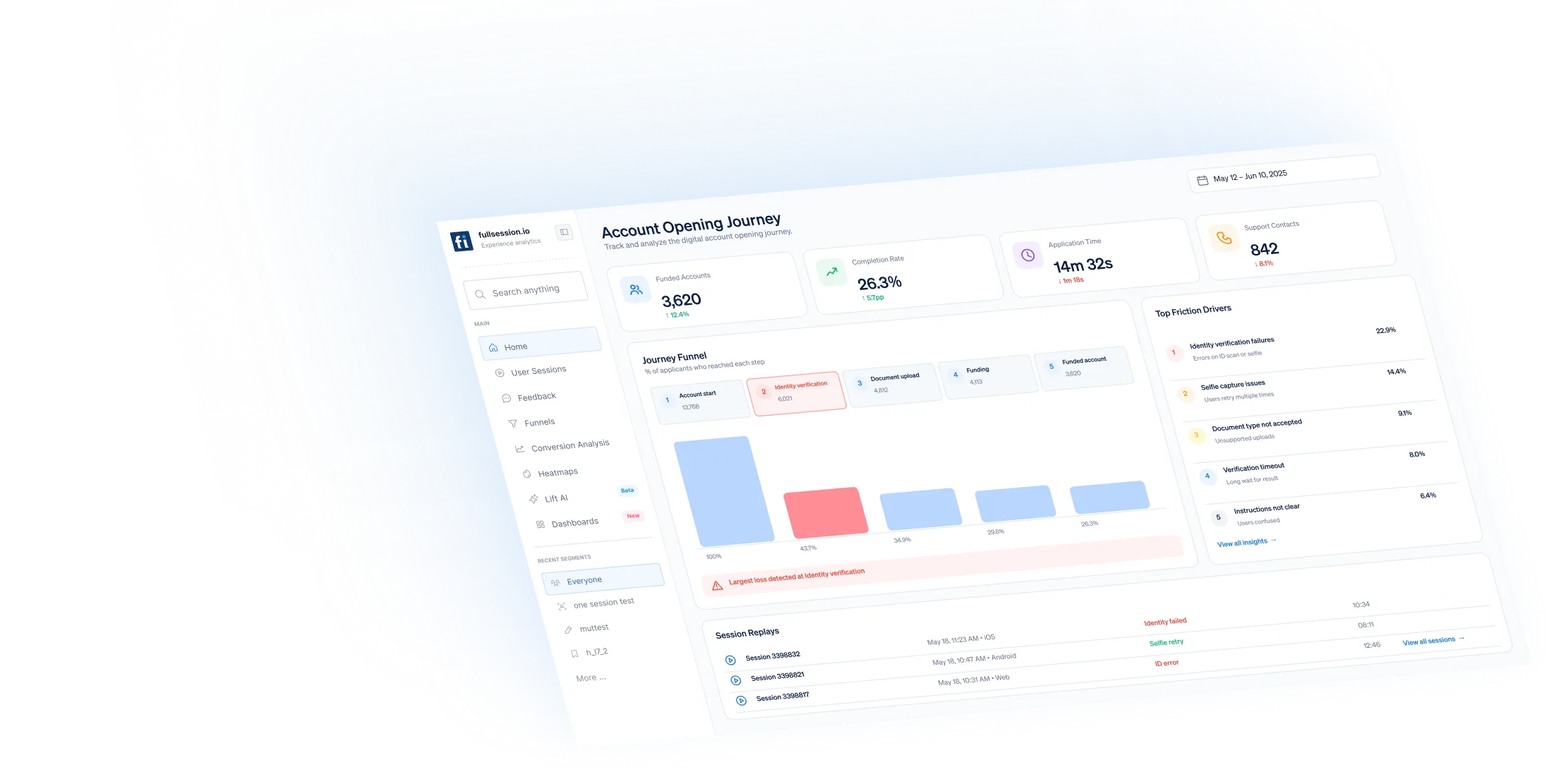
To see how a behavior analytics platform supports this end-to-end, explore FullSession session replay and map it to your test workflow.
Related answers (internal links)
- Session replay for understanding variant behavior
- Checkout recovery workflows for ecommerce teams
- Heatmaps to spot tap and scroll friction
- Funnels and conversions to quantify drop-off points
- Errors and alerts to connect failures to sessions
Common follow-up questions
Assignment alone is often misleading. Exposure tells you the user actually saw the variant UI. For checkout, exposure is frequently later than assignment, so tagging exposure prevents false “variant sessions.”
In SPAs, route changes and re-renders can apply the experiment after the initial page load. If your tagging only runs once, the replay keeps the old value or no value. Make tagging update on route transitions and on exposure.
Yes for qualitative pattern discovery. Sampling can bias counts, so avoid treating replay volume as a reliable measure of “how often” without validating capture rates by variant.
Use a known-user test plan that forces each variant, then confirm the replay session includes experiment and variant metadata and shows the exposure moment at the correct step.
Define what you are looking for before you watch: the step, the expected behavior, and the failure patterns you care about. Then turn recurring patterns into tickets with clips and clear ownership.
Most often it is load order (replay loads before variant decision), tagging too early, SPA transitions not handled, or consent gating blocking capture on the pages where exposure happens.
See what’s costing you, and prove whats fixing it is worth
Watch the real journey, rank every issue by revenue impact, and validate the result against baseline.



.svg)
.svg)
212 E Stone Path St Derby, KS 67037 Phone: +1 415-649-4222



All systems operational.