.svg)
.svg)

How to Analyze an Onboarding Funnel: Find Drop-Offs, Prioritize Friction, and Improve Activation
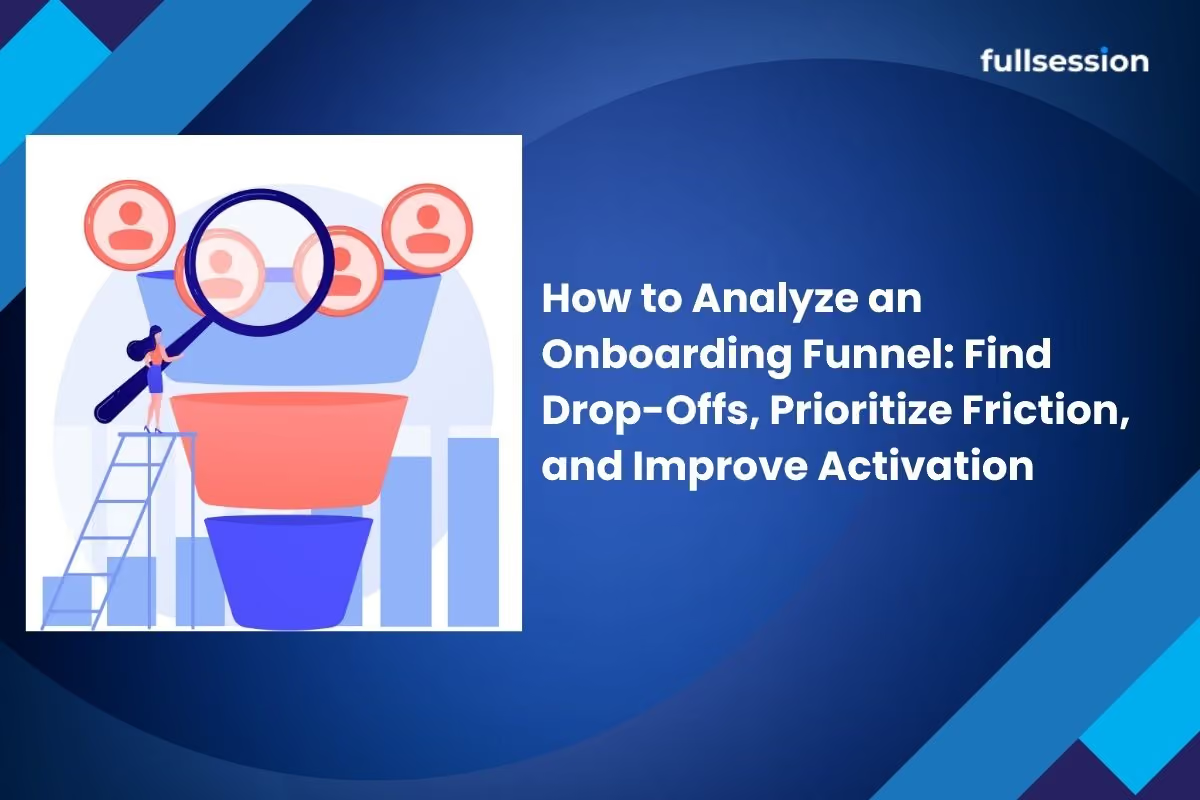

If your trial or self-serve motion is healthy, onboarding is not “a checklist,” it’s the shortest path to first value. Onboarding funnel analysis helps you see where new users stall, why they stall, and which leak to fix first so activation moves, not just step completion.
Quick Takeaway (Answer Summary)
Onboarding funnel analysis maps new users' steps from signup to first value, then measures where they drop, stall, or detour. The goal is to prioritize the leak that most impacts activation, validate root cause with session context, and confirm your fix improved activation quality, not just onboarding completion.
CTA context: Explore Funnels & Conversions to quantify drop-offs, then route investigations into user onboarding workflows with session context.
What “onboarding funnel analysis” actually means (and what it is not)
Onboarding funnel analysis is the process of defining the steps between “new account created” and “user reached first value,” then measuring conversion, drop-off, and time-between-steps so you can prioritize fixes and validate impact on activation.
- Treating onboarding completion as activation (users can click through setup and still not reach value).
- Using a generic stage list that does not match your product’s value moment (activation definition drives the funnel).
Before you start: what you need ready
- A clear activation definition (one observable “first value” milestone).
- A stable onboarding scope (which flows count: self-serve, invite flow, workspace setup).
- Identity rules (user vs workspace vs account, plus cross-device assumptions).
- Segment list you will compare (role/persona, acquisition source, plan tier, device).
Key definitions (for consistent measurement)
- Activation: the user reaches a first value milestone that predicts retention or expansion for your product.
- Onboarding completion: a user finished guided steps (tour, checklist, setup), regardless of value reached.
- Time-to-value (TTV): time from signup (or first session) to activation milestone.
- Drop-off: users who do not proceed to the next defined step.
- Stall: users who do proceed eventually, but with long time gaps between steps.
- Segment: a comparable cohort slice (persona, device, source, plan, use case) that changes the funnel shape.
How teams usually analyze onboarding (and why it breaks)
- Dashboard-only: sees where conversion drops, but not why.
- Random replay sampling: sees some friction, but cannot quantify impact.
- Event overload: tracks too many steps, then cannot decide what matters.
- “Fix everything” sprints: increases completion, but activation stays flat.
Mid-article routing: The quantitative spine lives in Funnels & Conversions. The onboarding-specific interpretation and fixes map cleanly to user onboarding workflows.
A 7-step workflow for onboarding funnel analysis (activation-first)
Step 1: Define “first value” precisely
Write one sentence: “A new user is activated when they ______.” Make it observable (event, URL, or action) and tied to user value, not UI progress.
Step 2: Build a value-based funnel (not a UI checklist)
Start from activation and work backward. Include only steps that enable value, not “nice to have” setup.
Step 3: Add time as a first-class metric
Track conversion per step and time between steps. Stalls often reveal confusion, missing requirements, or broken states.
Step 4: Segment before you decide what to fix
Compare the same funnel across persona, source, plan, and device. If it behaves differently, you have multiple funnels hiding in one.
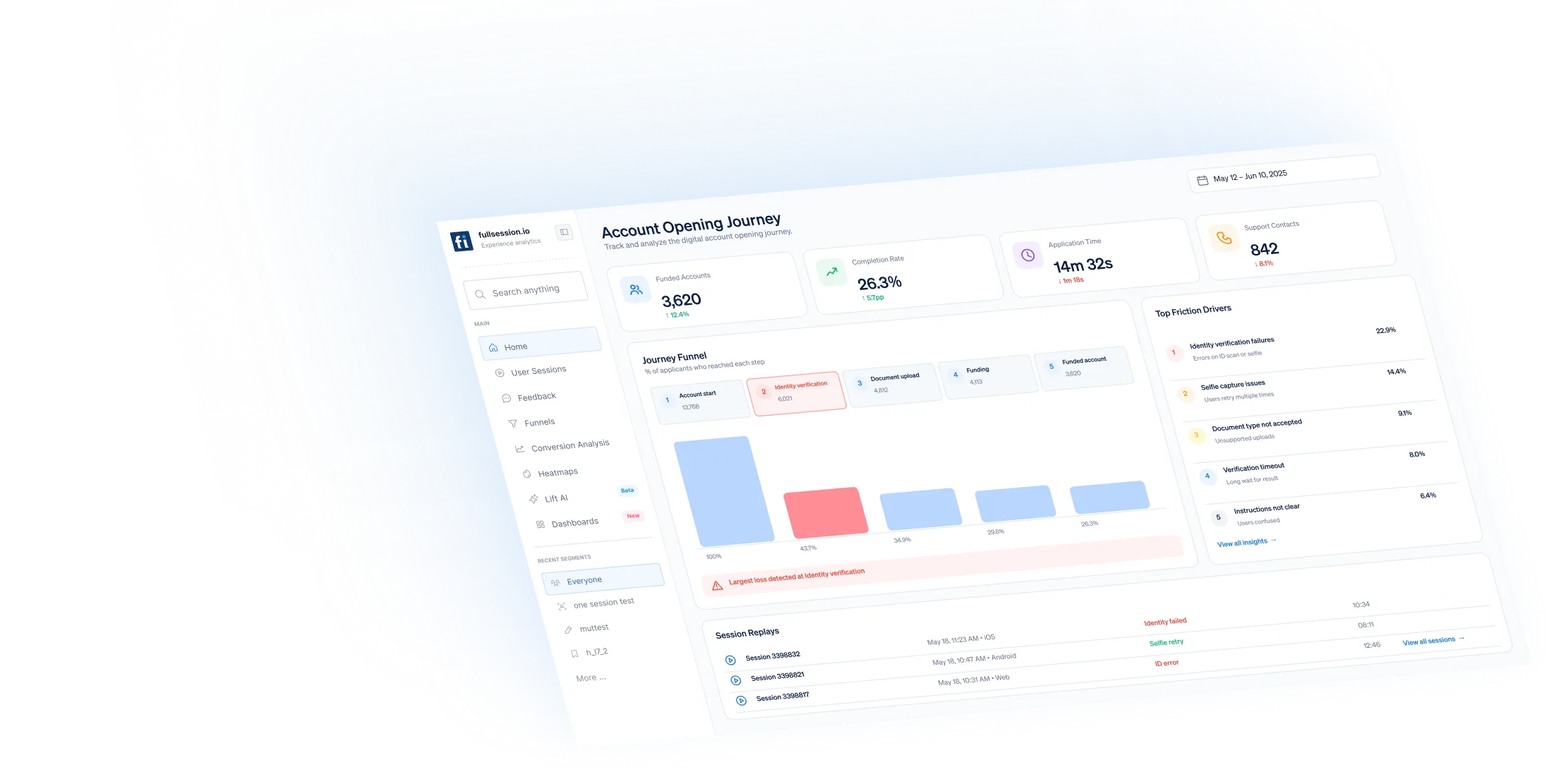
Step 5: Pull the sessions behind the biggest leak
Investigate what users experienced behind the drop: hesitation, loops, rage clicks, detours, and errors. This is where session context turns a leak into a fixable cause.
Step 6: Prioritize with impact logic, not gut feel
Score leaks by volume affected, proximity to activation, severity (hard block vs mild friction), and confidence from evidence. Prefer removing blockers over polish.
Step 7: Validate impact on activation, not completion
Re-measure the same funnel for the same segments after the fix. Confirm activation moves, and watch for side effects (faster completion, worse downstream use).
Late routing reminder: Keep analysis anchored in Funnels & Conversions, and keep fixes anchored in user onboarding workflows.
A symptom-to-cause table you can reuse
What you see in the funnel |
What session context often shows |
Likely root cause |
What to do next |
|---|---|---|---|
Big drop right after signup |
Users bounce after seeing "verify email" |
Misaligned expectation or deliverability friction |
Clarify value earlier, reduce verification friction, check deliverability |
Drop at "create workspace" |
Confusion about naming, teammates, or permissions |
Too many required decisions too early |
Defer choices, offer defaults, add "skip for now" where safe |
High completion, flat activation |
Users finish checklist but never do key action |
Checklist measures effort, not value |
Redefine steps around value milestone, move key action earlier |
Long stalls between setup and key action |
Users wander through settings, docs, or billing |
Missing guidance on next best action |
Tighten next-step guidance, simplify navigation, add contextual prompts |
Segment A converts, segment B collapses |
Different paths, different confusions |
One funnel does not fit all |
Split onboarding by persona, tailor steps, measure separately |
Mini scenario: how a PLG team uses this workflow
A Growth Lead notices activation rate drifting down, but signup volume is steady. Funnel data shows the biggest drop is between “workspace created” and “first key action started.” Segmenting reveals the issue is concentrated in invited teammates. Session context shows invited users land in a blank state with unclear permissions, then bounce or loop. The team fixes the landing experience and error path, then re-measures and confirms activation improves for that segment.
Pitfalls to avoid (these will waste your sprint)
- Optimizing the earliest step just because it has the biggest percentage drop, even if later steps are closer to activation.
- Changing steps without confirming event quality or identity stitching (bad tracking can create fake drop-offs).
- Forcing setup steps that increase completion but reduce downstream usage.
- Looking at averages only, instead of segment variance.
How to evaluate tools for onboarding funnel analysis (PLG edition)
- Funnel definition flexibility (URL, event, or custom steps).
- Segmentation that matches PLG reality (persona, source, plan, device).
- Session context attached to funnel steps.
- Error visibility tied to user impact.
- Qual input tied to behavior.
- Governance basics (masking, capture controls, access controls).
If you want the funnel view plus investigation context in one place, start with Funnels & Conversions and the onboarding workflow framing on user onboarding workflows. Optional: review integrations for stack fit.
Next steps
- Pick one onboarding funnel tied to activation.
- Run the 7-step workflow on one high-volume segment first.
- Ship one fix, then validate activation movement, not just completion.
If you want to see where new users stall and what they experienced, start in Funnels & Conversions and then apply the fixes through user onboarding workflows. For a hands-on walkthrough, book a demo or start a free trial.
See where users stall, then prove what worked
See where new users stall in onboarding, identify the highest-impact leak, and validate whether the fix improves activation. Start with Funnels & Conversions and apply it to user onboarding workflows.
Common follow-up questions
Onboarding is the guided path you present, activation is the user reaching first value. A user can complete onboarding steps without becoming activated if the steps do not force meaningful product use.
Enough to isolate where users stall, not so many that every tiny UI action becomes a “step.” For most PLG products, 5–8 steps is a good starting range, then adjust based on investigation needs.
Include it only if it is required for value. If verification is optional, track it separately so it does not hide product-value leaks.
Use impact logic: early leaks often affect more users, late leaks are closer to activation. Prioritize the leak with the highest combined impact, then validate root cause with session context.
Role/persona, acquisition source, plan tier, and device are usually the fastest to reveal multiple funnels hiding in one.
Track time between key steps, not just overall TTV. Long gaps usually indicate confusion, missing requirements, or a broken state that users cannot recover from.
See what’s costing you, and prove whats fixing it is worth
Watch the real journey, rank every issue by revenue impact, and validate the result against baseline.



.svg)



All systems operational.