.svg)
.svg)

Mobile Session Replay: What It Is, How Teams Use It, and What to Look For

If you own mobile onboarding and activation, you already know the pattern: you can see the drop in the funnel, you can read the support ticket, you can even reproduce it once, but you cannot explain why it happens across real devices, real network conditions, and messy edge cases.
Mobile session replay is most useful when it stops being “watching videos” and becomes a repeatable operating system: decide when replay is the right tool, prioritize which sessions matter, turn findings into fixes or experiments, and then validate whether Week-1 activation actually moved.
Early note for tool evaluation: if you are exploring vendors, start with the category overview at mobile session replay and the activation-specific rollout angle at PLG activation workflows.
Quick Takeaway
Mobile session replay is a way to reconstruct what a real user experienced inside your app (taps, swipes, screens, state changes, and often context like events or errors) so you can diagnose activation blockers that analytics and crash logs cannot fully explain. For activation work, the leverage comes from triaging which sessions to watch first, standardizing a cross-functional review workflow, and closing the loop by measuring whether fixes changed Week-1 activation. If you are evaluating tools, use mobile session replay for baseline requirements, then map your rollout to PLG activation workflows so replay becomes part of your activation system, not an occasional debugging trick.
What mobile session replay is (and what it is not)
Mobile session replay helps you reconstruct a user’s path through your app: screen transitions, gestures, UI interactions, and app-state context. Done well, it answers questions you routinely hit in activation work.
What it is not: a perfect camera recording of the screen with complete meaning baked in. Mobile apps do not have a browser DOM, and native rendering, custom components, and offline behavior introduce fidelity and interpretation tradeoffs. That is why the operational layer matters: you need a consistent way to decide what to review and how to turn a replay into an actionable backlog item.
If you want a category baseline before you operationalize it, start with the mobile session replay overview and then anchor your rollout to PLG activation workflows so the work stays KPI-driven.
When replay is the right tool for activation work
Activation problems tend to fall into three buckets. Your first job is to route the problem to the right primary instrument: measurement integrity, explanation of drop-offs, or reproducibility for errors and crashes.
A practical rule for activation teams: use analytics to find the cliff, then use replay to explain the cliff, then use analytics again to validate the fix. The mobile session replay hub is useful for baseline capabilities, and PLG activation workflows is where you keep the work outcome-tied.
A prioritization system for which sessions to watch firs
- Define the activation-critical segment first so your review time stays tied to Week-1 activation.
- Filter by activation harm signals such as repeated taps, long dwell time, or onboarding errors.
- Rank by business impact, not curiosity, prioritize hard stops on high-volume steps.
- Convert each watched session into a structured output: bug, UX fix, tracking fix, or messaging change.
A 60-minute cross-functional workflow (PM, QA, engineering, support)
Activation issues cross roles. Replay gets leverage when the review ritual is shared and time-boxed, with a small ranked queue and clear outputs.
If you want an example of how teams operationalize this around onboarding, map your ritual to PLG activation workflows and align tooling requirements through the mobile session replay hub.
Mobile-specific tradeoffs you should evaluate before rollout
Mobile replay has real constraints. Your rollout plan should explicitly cover fidelity gaps, performance impact, offline behavior, and privacy governance so you do not discover them mid-incident.
What to look for in a tool (activation-focused checklist)
Focus on triage and filtering, context that reduces handoffs, governance your org can operate, and sampling you can explain.
Ecommerce teams should also evaluate whether a replay platform can capture mobile checkout friction, product page hesitation, cart abandonment signals, and broken buying flows. If your main goal is improving online store conversions, this comparison of session replay tools for ecommerce can help you assess tools built for ecommerce-specific workflows.
How to prove impact on Week-1 activation
Replay does not increase activation by itself. Use a closed-loop proof model: write a measurable hypothesis, choose a leading indicator and a lagging KPI, validate in a release-aware window, and re-check sessions post-fix.
If you want to align this proof loop to a practical rollout plan, anchor your approach in PLG activation workflows and use the mobile session replay hub to pressure-test tool capabilities against your operating model.
Common follow-up questions
- Does mobile session replay record video? Most tools reconstruct sessions from instrumentation and UI state, treat it as reconstruction with context.
- How many sessions should we watch per week for activation? Start with a fixed budget you can sustain, then expand after triage is stable.
- Who should own replay review? PM owns prioritization and outcomes, engineering owns fixes, QA validates, support supplies pattern signals.
- Can replay replace funnels and analytics? No, use analytics to find where, replay to explain why, analytics to validate.
Related answers
- Session replay product overview
- Funnels and conversions
- Errors and alerts
- Solutions for product management
- Solutions for user onboarding
Next steps
Start from the category baseline at mobile session replay, then operationalize it with an activation-first rollout using PLG activation workflows.
Common follow-up questions
There isn’t a single universal threshold. Treat it as a pattern: rapid repeat clicks in the same area that coincide with lack of feedback, delay, or confusion.
Yes. Users sometimes click non-interactive text or icons to test clickability. If it clusters, it still signals an affordance problem.
No. Rage clicks can be performance (slow feedback), technical failures (request fails), or measurement artifacts. Session context is the tie-breaker.
Combine click activity with “no visible response” signals, like no navigation, no state change, or no downstream event. Connecting clicks to replay context reduces false positives.
Whichever occurs on an activation-critical step and blocks progress. Dead clicks often identify the initial failure, rage clicks often reveal where frustration peaks.
Don’t prioritize by click counts alone. Validate via session context, segment concentration, and whether the hotspot aligns with step drop-off toward activation.
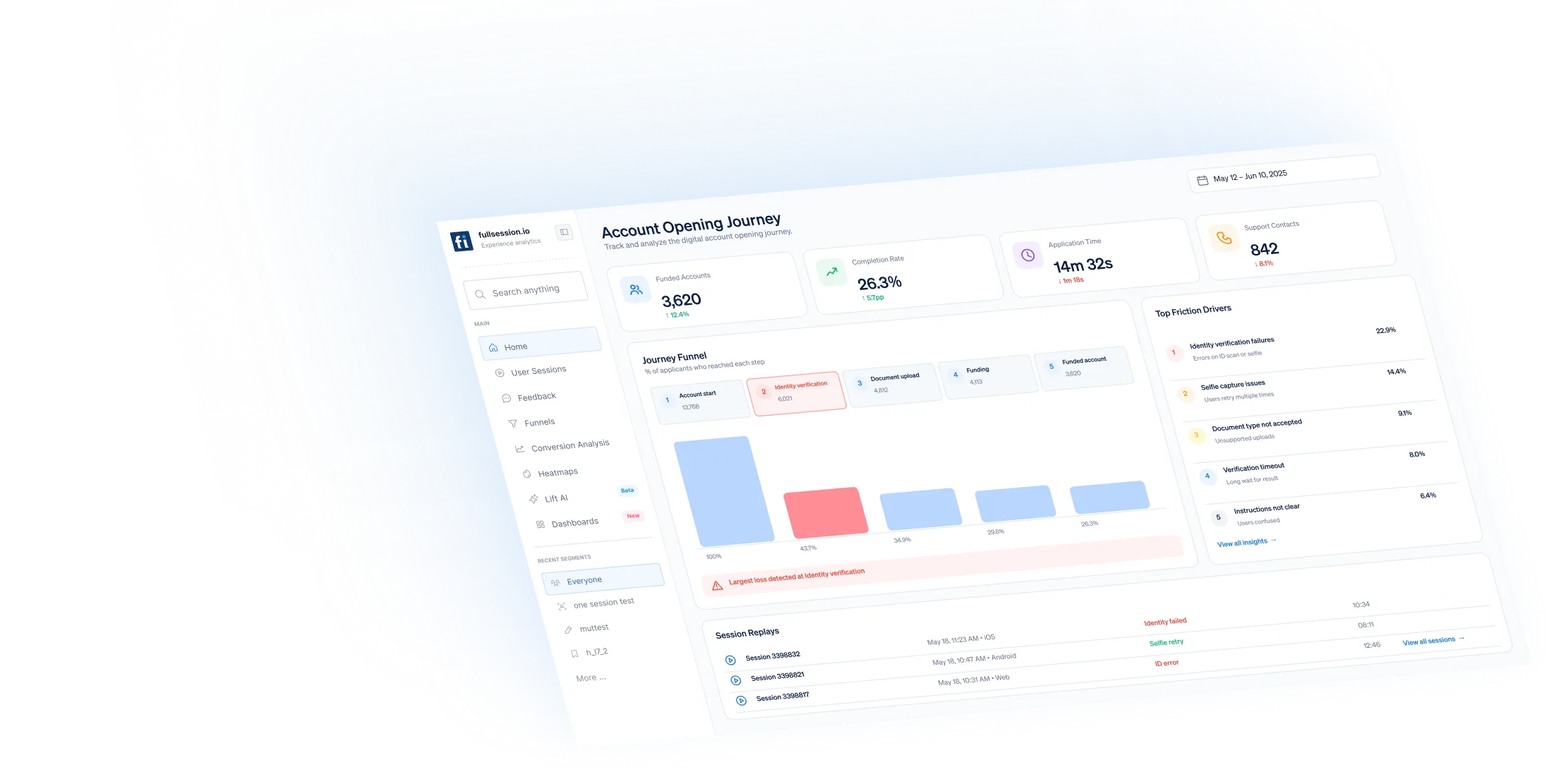
See what’s costing you, and prove whats fixing it is worth
Watch the real journey, rank every issue by revenue impact, and validate the result against baseline.



.svg)



All systems operational.