.svg)

LogRocket alternatives (2026): how to choose the right session replay + debugging stack for your team

If LogRocket helps you replay sessions but you still miss the root cause, you likely need a better “replay plus debugging” workflow, not just a new vendor. Start by choosing your archetype (debug-first, UX optimization, product analytics-first, or self-hosted control). Then run a 7–14 day proof-of-value using real production bugs, measuring time-to-repro and time-to-fix. If MTTR is your north star, prioritize error-to-session linkage, developer workflow fit, and governance controls.
Definition box: What is a “LogRocket alternative”?
A LogRocket alternative is any tool or stack that replaces (or complements) session replay for one of three jobs: reproducing user-facing bugs, diagnosing UX friction, or validating product changes. Some teams swap one replay vendor for another. Others pair lightweight replay with error monitoring, feature flags, and analytics so the first useful clue shows up where engineers already work.
Why teams look for alternatives
You feel the pain when “can’t reproduce” becomes the default status for user-reported bugs.
Session replay is often the first step, not the full answer. The moment you need stack traces, network timelines, release context, or a clean path from “error happened” to “here is the exact user journey,” the tooling choice starts to affect MTTR and release stability.
Common mistake: treating replay as the source of truth
Teams buy replay, then expect it to replace logging, error monitoring, and analytics. It rarely does. Replay is evidence, not diagnosis. Your stack still needs a reliable way to connect evidence to a fix.
The 4 archetypes of a “LogRocket alternative”
Most shortlists fail because they mix tools with different jobs, then argue about features.
A practical scorecard to compare options
The best alternative is the one your team will actually use during an incident.
1) Debug workflow fit
If engineers live in GitHub, Jira, Slack, and an error tracker, the “best” replay tool is the one that meets them there. Check whether you can jump from an error alert to the exact session, with release tags and enough context to act without guessing.
2) Performance and sampling control
If replay increases load time or breaks edge cases, teams quietly reduce sampling until the tool stops being useful. Look for controls like record-on-error, targeted sampling by route, and the ability to exclude sensitive or heavy pages without losing incident visibility.
3) Privacy and governance readiness
If security review blocks rollout, you lose months. Treat masking as table stakes, then validate role-based access, retention settings, and what evidence you can provide during audit or incident review.
Decision rule
If your primary KPI is MTTR, the winning stack is the one that gets a developer from alert to repro in one hop, with minimal extra instrumentation.
Hidden costs and gotchas most teams learn late
What looks like a feature decision usually turns into an ownership decision.
SDK weight and maintenance
A typical failure mode is adding replay everywhere, then discovering it adds complexity to your frontend stack. Watch for framework edge cases (SPAs, Shadow DOM, iframes), bundle size concerns, and how upgrades are handled.
Data volume, retention, and surprise bills
Replay can generate a lot of data fast. If retention is unclear or hard to enforce, you pay twice: once in cost, and again in governance risk.
Who owns the workflow
If support and product see replays but engineering cannot connect them to errors and releases, MTTR does not move. Decide up front who triages, who tags, and where the “source of truth” lives.
Quick scenario: the MTTR bottleneck you can see coming
A B2B SaaS team ships weekly. Post-deploy, support reports “settings page is broken” for a subset of accounts. Product can see the drop-off. Engineers cannot repro because it depends on a flag state plus a browser extension. Replay shows clicks, but not the console error. The team burns two days adding logging, then ships a hotfix on Friday.
A better stack would have captured the error, tied it to the exact session, and tagged it to the release and flag state so the first engineer on call could act immediately.
A 7–14 day proof-of-value plan you can run with real bugs
If you do not validate outcomes, every tool demo feels convincing.
- Pick one primary job-to-be-done and one backup.
- Example: “Reduce MTTR for user-facing bugs” plus “Improve post-deploy stability.”
- Example: “Reduce MTTR for user-facing bugs” plus “Improve post-deploy stability.”
- Instrument only the routes that matter.
- Start with top support surfaces and the first two activation steps.
- Start with top support surfaces and the first two activation steps.
- Define the success metrics before you install.
- Track time-to-repro, time-to-fix, and the error-session rate for the sampled traffic.
- Track time-to-repro, time-to-fix, and the error-session rate for the sampled traffic.
- Set a sampling strategy that matches the job.
- For debug-first, start with record-on-error plus a small baseline sample for context.
- For debug-first, start with record-on-error plus a small baseline sample for context.
- Run two incident drills.
- Use one real support ticket and one synthetic bug introduced in a staging-like environment.
- Use one real support ticket and one synthetic bug introduced in a staging-like environment.
- Validate governance with a real security review checklist.
- Confirm masking, access roles, retention controls, and who can export or share sessions.
- Confirm masking, access roles, retention controls, and who can export or share sessions.
- Decide using a scorecard, not a demo feeling.
- If engineers did not use it during the drills, it will not save you in production.
Shortlist: common categories and tools teams evaluate
You want a shortlist you can defend, not a mixed bag of “sort of similar” tools.
If you are debug-first (MTTR)
Commonly evaluated combinations include a replay tool paired with error monitoring and observability. Teams often shortlist replay vendors like FullStory or Hotjar for context, and pair them with developer-first error tools like Sentry or Datadog, depending on how mature their incident workflow already is.
If you are UX optimization-first
Teams focused on friction and conversion typically prioritize heatmaps, funnels, and form insights, with replay as supporting evidence. Tools in this bucket often overlap with website experience analytics and product analytics, so clarify whether you need qualitative evidence, quantitative funnels, or both.
If you are product analytics-first
If you already have clean event tracking and experimentation, replay is usually a “why did this happen” add-on. In this case, warehouse fit and governance matter more than replay depth, because you will tie insights to cohorts, releases, and experiments.
Teams comparing product analytics-led stacks can also evaluate PostHog alternatives when they need to assess event tracking, feature flags, experimentation, and replay together.
If you need control or self-hosting
If the deployment model is a hard requirement, focus on what you can operate and secure. Self-hosted approaches can reduce vendor risk but increase internal ownership, especially around upgrades, storage, and access review.
When to use FullSession for MTTR-focused teams
If your priority is fixing user-facing issues faster, you want fewer handoffs between tools.
FullSession fits when your team needs behavior evidence that connects cleanly to debugging workflow, without creating a privacy or performance firefight. Start on the Engineering and QA solution page (/solutions/engineering-qa) and evaluate the Errors and Alerts workflow (/product/errors-alerts) as the anchor for MTTR, with replay as the supporting evidence rather than the other way around.
FAQs
If your current issue is “we have replay but still cannot debug,” you likely need an add-on in the error and observability layer. If your issue is “replay itself is hard to use, slow, or blocked by governance,” you are closer to a replacement decision.
For MTTR, measure time-to-repro, time-to-fix, and how often an error can be linked to a specific session. For stability, track post-deploy incident volume and the percentage of user-facing errors caught early.
Start small. Sample only the routes tied to revenue or activation. Prefer record-on-error for debugging, then expand coverage once you confirm overhead and governance.
At minimum: masking for sensitive fields, role-based access, retention controls, and a clear audit story for who can view or export session evidence.
All-in-one can reduce integration work and make triage faster. Best-of-breed can be stronger in one job but increases handoffs. If MTTR is the KPI, favor fewer hops during incident response.
Single-page apps, iframes, Shadow DOM components, and authentication flows are common sources of gaps. Treat “works on our app” as a test requirement, not a promise.
See what’s costing you, and prove whats fixing it is worth
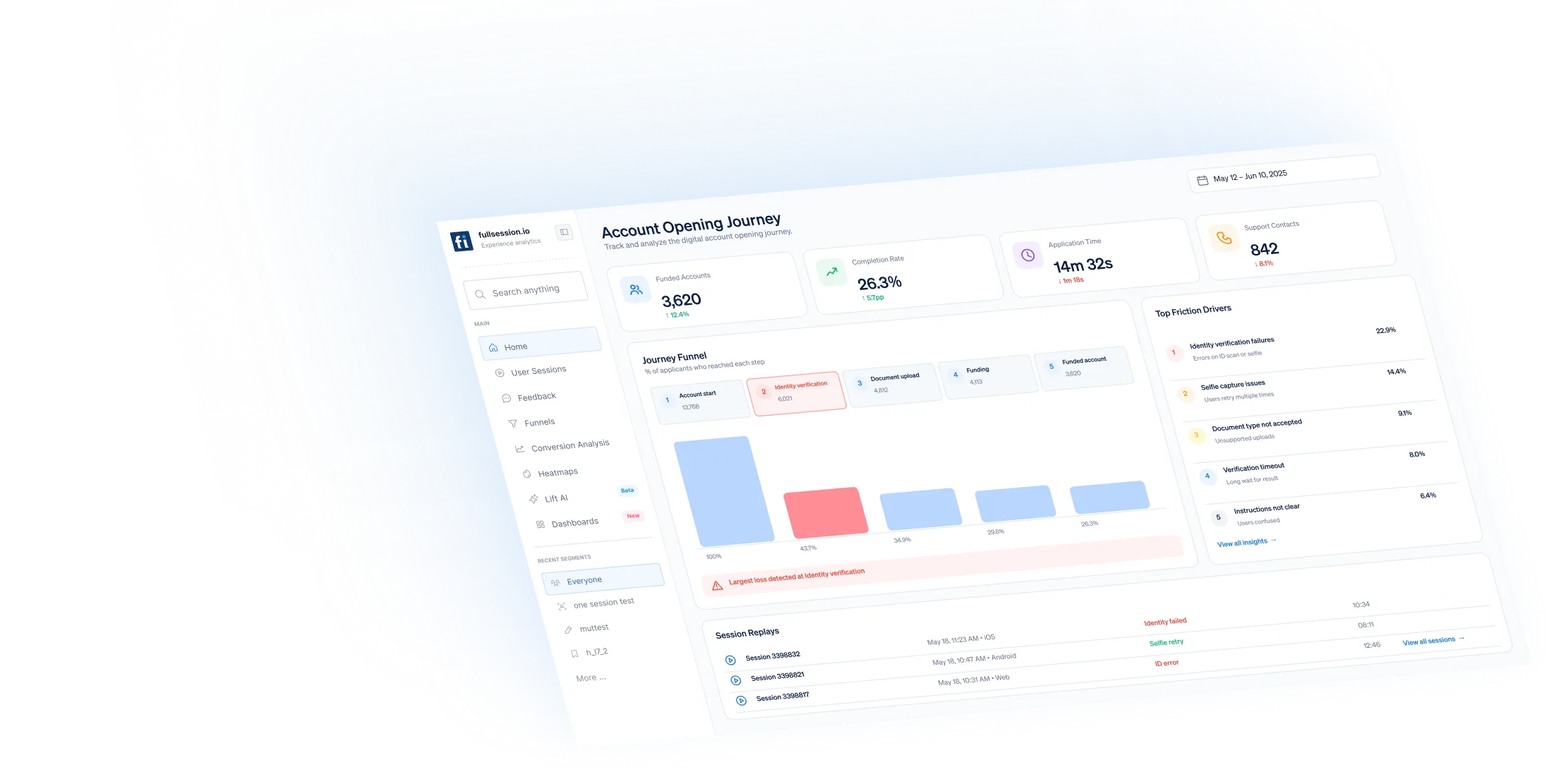
Watch the real journey, rank every issue by revenue impact, and validate the result against baseline.



.svg)
.svg)
212 E Stone Path St Derby, KS 67037 Phone: +1 415-649-4222



All systems operational.