.svg)

Form abandonment: how to measure it, diagnose root causes, and prioritize fixes (not just a checklist)

If you’re a CRO manager at a PLG SaaS, you’ve probably seen this pattern: signups hold steady, but activation flattens. The onboarding form looks “fine.” Funnel charts show where people disappear then everyone argues about why. That’s form abandonment in practice, and it’s fixable when you treat it like a diagnostic problem, not a list of UX tips.
Early in the workflow, it helps to ground your measurement in funnels and conversion paths (not just overall conversion rate). Start by mapping your onboarding journey in a tool or view like funnels and conversions, and keep the activation outcome tied to your PLG motion.
Quick Takeaway / Answer Summary (40–55 words)
Form abandonment is when a user starts a form but leaves before a successful submit. To reduce it, measure drop-offs at the step and field level, diagnose whether the blocker is intent, trust, ability, usability, or technical failure, then prioritize fixes by drop-off × business value × effort, with guardrails for lead quality.
What is form abandonment?
Form abandonment happens when a user begins a form (they see it and start interacting) but does not complete a successful submission.
Form abandonment rate is the share of users who start the form but don’t finish successfully.
Definition box: the simplest way to calculate it
- Form starts: sessions/users that interact with the form (e.g., focus a field, type, or progress to step 2)
- Successful submits: sessions/users that reach “success” (confirmation screen, successful API response, or “account created” event)
Form abandonment rate = (Form starts − Successful submits) ÷ Form starts
Two practical notes:
- In multi-step flows, calculate both overall abandonment and step-level abandonment (Step 1 → Step 2, Step 2 → Step 3, etc.).
- Track “submit attempts” separately from “successful submits”—a lot of “abandonment” is actually submit failure.
Why does form abandonment matter for SaaS activation?
Why should you care about form abandonment if the KPI is activation, not just signup?
Because forms often sit on the critical path to the first value moment: onboarding, workspace creation, inviting teammates, connecting data sources, selecting a template, or choosing a plan key steps that directly impact PLG activation.
If the form blocks progress, you get:
- Lower activation because users never reach the “aha” action
- More support load (“I tried to sign up but…”)
- Misleading experiments (you test copy while a validation loop is the real culprit)
But here’s the nuance most posts miss
Not every abandonment is bad. Some abandoners are:
- Low-intent visitors who were never going to activate
- Users who lack required information (ability), not motivation
- People who hit a trust threshold you may need in regulated contexts
Your goal isn’t “maximize completions at all costs.” It’s: reduce preventable abandonment without degrading lead quality, increasing fraud, or weakening trust.
How do you measure form abandonment without fooling yourself?
What should you track to measure form abandonment accurately?
Track it as a funnel with explicit states (start → progress → submit attempt → success/fail), then add field-level signals to explain the drop-offs.
Start with a form funnel (macro)
At minimum:
- Viewed form
- Started form
- Reached submit
- Submit attempted
- Submit success (and Submit fail)
If you already have a baseline funnel view (or you build one in funnels and conversions), you’ll quickly see if the big cliff is:
- Early (start rate is low → intent mismatch or trust)
- Mid-form (field friction / unclear requirements)
- Late (submit failure, technical errors, hidden constraints)
Add field-level diagnostics (micro)
Track:
- Field drop-off: which field is the last interaction before exit
- Time-in-field: long dwell time can mean confusion or lookup effort
- Validation errors: client-side and server-side; count + field association
- Return rate: users who leave and come back later (and whether they succeed)
Don’t ignore “failure mode” abandonment
A huge share of abandonments are not “user changed mind.” They’re:
- Submit button does nothing
- API error or timeout
- Validation loop (“fix this” but no clear instruction)
- Form resets after an error
- Mobile keyboard covers the CTA or error message
If you only measure “start vs completion,” these get mislabeled as intent problems, and you’ll ship the wrong fixes. In online stores, the same issue can affect ecommerce conversion optimization when checkout forms, payment fields, promo code boxes, or mobile CTAs fail silently and get mistaken for shopper intent problems.
What causes form abandonment? Use the 5-bucket diagnostic taxonomy
What’s the fastest way to diagnose why people abandon a form?
Classify the drop-off into one of five buckets—intent, trust, ability, usability, technical failure—then apply the minimum viable fix for that bucket before you redesign the whole thing.
1) Intent mismatch
Signals
- High form views, low starts
- Drop-off before the first “commitment” field
- Disproportionately high abandonment from certain traffic sources
Likely root cause
- The user expected something else (pricing, demo, content)
- The form appears too early in the journey
- The value exchange isn’t clear
Minimum viable fix
- Clarify value and “what happens next”
- Align the CTA that leads into the form
- Gate less (or move form later) if activation requires early momentum
2) Trust / privacy concern
Signals
- Drop-off spikes at sensitive fields (phone, company size, billing, “work email”)
- Rage-clicking around privacy text or tooltips
- Higher abandonment on mobile (less screen space for reassurance)
Likely root cause
- “Why do you need this?” is unanswered
- Fear of spam / sales pressure
- Unclear data handling
Minimum viable fix
- Add microcopy: why the field is needed, and how it’s used
- Use progressive disclosure for sensitive asks
- Set expectations: “No spam,” “You can edit later,” “We’ll only use this for X”
3) Ability (they can’t provide the info)
Signals
- Long time-in-field on “domain,” “billing address,” “team size,” “tax ID”
- Users pause, switch apps, or abandon at lookup-heavy fields
- Higher return rate (they come back later with info)
Likely root cause
- You’re asking for info users don’t have yet
- The form assumes a context (e.g., admin) the user isn’t in
Minimum viable fix
- Make fields optional where possible
- Allow “I don’t know” or “skip for now”
- Collect later (after activation) when the user has more context
4) Usability / cognitive load
Signals
- Mid-form cliff across many sources/devices
- Errors repeat; users bounce between fields
- Mobile drop-off is materially worse than desktop
Likely root cause
- Too many fields, unclear labels, poor grouping
- Confusing validation rules or error placement
- Accessibility issues (focus states, contrast, screen reader labels)
Minimum viable fix
- Reduce required fields; group logically
- Inline validation with clear, specific messages
- Mobile-first layout, correct input types, keyboard-friendly controls
5) Technical failure
Signals
- Submit attempts without success
- Abandonment correlates with slow performance, browser versions, or releases
- Users retry, refresh, or get stuck in a loop
Likely root cause
- Network/API errors, timeouts
- Client-side bugs, state resets
- Third-party script conflicts
Minimum viable fix
- Improve error handling + retry; preserve user input on failure
- Make failure states visible and actionable
- Pair engineering triage with real sessions (not just logs)
A simple prioritization model: what to fix first
How do you prioritize form fixes without guessing?
Score candidates using Drop-off × Business value × Effort, then add guardrails so you don’t “win” a conversion metric while harming activation quality.
Step 1: Build a shortlist from evidence
From your funnel + field data, list the top issues:
- Top abandonment step(s)
- Top abandoning fields
- Top error messages / submit failure reasons
- Top segments (mobile, new users, certain sources)
Step 2: Score each candidate
Use a lightweight rubric:
Keep the table simple and mobile-friendly. Your goal is not precision—it’s a shared decision model.
Step 3: Add guardrails (the part most teams skip)
Define “success” beyond completion:
- Primary: form completion (or step completion)
- Secondary: time-to-complete, validation error rate, submit failure rate
- Downstream: activation rate, quality signals (e.g., domain verified, team invite, first project created)
This prevents the classic trap: you reduce friction, completions rise, but activation gets worse because you let low-intent or low-quality entries flood the funnel.
The diagnostic workflow (numbered steps)
What’s the most reliable workflow to reduce form abandonment?
Run a tight loop: quantify the drop, diagnose the bucket, apply the smallest fix, then validate with guardrails.
- Measure the funnel state-by-state
Identify whether the cliff is start rate, mid-form progression, submit attempts, or submit success. - Drill into the top abandoning step/field
Look for long time-in-field, repeated errors, resets, and device differences. - Classify the root cause (intent / trust / ability / usability / technical)
Don’t brainstorm solutions until you can name the bucket. - Pick the minimum viable fix for that bucket
Avoid redesigning the whole form when microcopy or validation behavior is the real issue. - Validate with guardrails, not just “conversion”
Confirm completion improves and activation-quality signals don’t degrade. - Document the pattern and templatize it
The goal is not one fix—it’s a repeatable playbook for every form in your product.
Fixes by root-cause bucket (minimum viable first)
Intent: make the value exchange explicit
- Tighten the CTA and surrounding copy so the form matches the promise
- Add “what happens next” in one sentence
- Move non-essential fields to later steps after the user has momentum
Trust: explain why you’re asking (copy patterns that work)
Instead of “Phone number (required),” try:
- “Phone number (only used for account recovery and security alerts)”
- “Work email (so your team can join the right workspace)”
- “Company size (helps us recommend the right onboarding path)”
The goal is reassurance without a wall of policy text.
Ability: reduce lookup burden
- Provide “skip for now”
- Make uncertain fields optional
- Add helper UI: autocomplete, sensible defaults, “I’m not sure” paths
Usability: reduce cognitive load and validation pain
- Reduce required fields to what’s needed for the next activation step
- Use progressive disclosure and conditional logic
- Make validation messages specific and placed where the user is looking
Technical failure: preserve progress and make failure recoverable
- Preserve user input on any error
- Provide retry and clear error states (not silent failures)
- Track and prioritize by user impact, not just error volume
Scenario A (SaaS activation)
A CRO manager notices activation is down, but signups are flat. The onboarding form isn’t long—so the team assumes it’s a motivation issue. Funnel measurement shows the cliff happens after users click “Create workspace,” not at the start. Field-level data points to repeated validation errors on a “workspace URL” field. Session evidence shows a common loop: users enter a name that’s “invalid,” but the error message doesn’t explain the naming rule, and the form clears the input on refresh. The fix isn’t a redesign: tighten validation rules, make the error message explicit, preserve input, and suggest available alternatives. Completion improves, and—more importantly—more users reach the first meaningful in-product action.
Scenario B (different failure mode)
In a different SaaS flow, a “Request access” form sits in front of a core feature. Abandonment spikes at two fields: phone number and “annual budget.” The team considers removing both, but the downstream quality signal is important for sales-assisted activation. Field timing shows users hesitate for a long time, then exit—especially on mobile. The root cause isn’t pure intent; it’s trust + ability. Users don’t know why those fields are needed and often don’t have a budget number handy. The minimum viable fix is progressive disclosure: explain how the data is used, make budget a range with “not sure,” and allow phone to be optional with a clear security/support rationale. Completions rise without turning the flow into a low-quality free-for-all.
When to use FullSession (mapped to Activation)
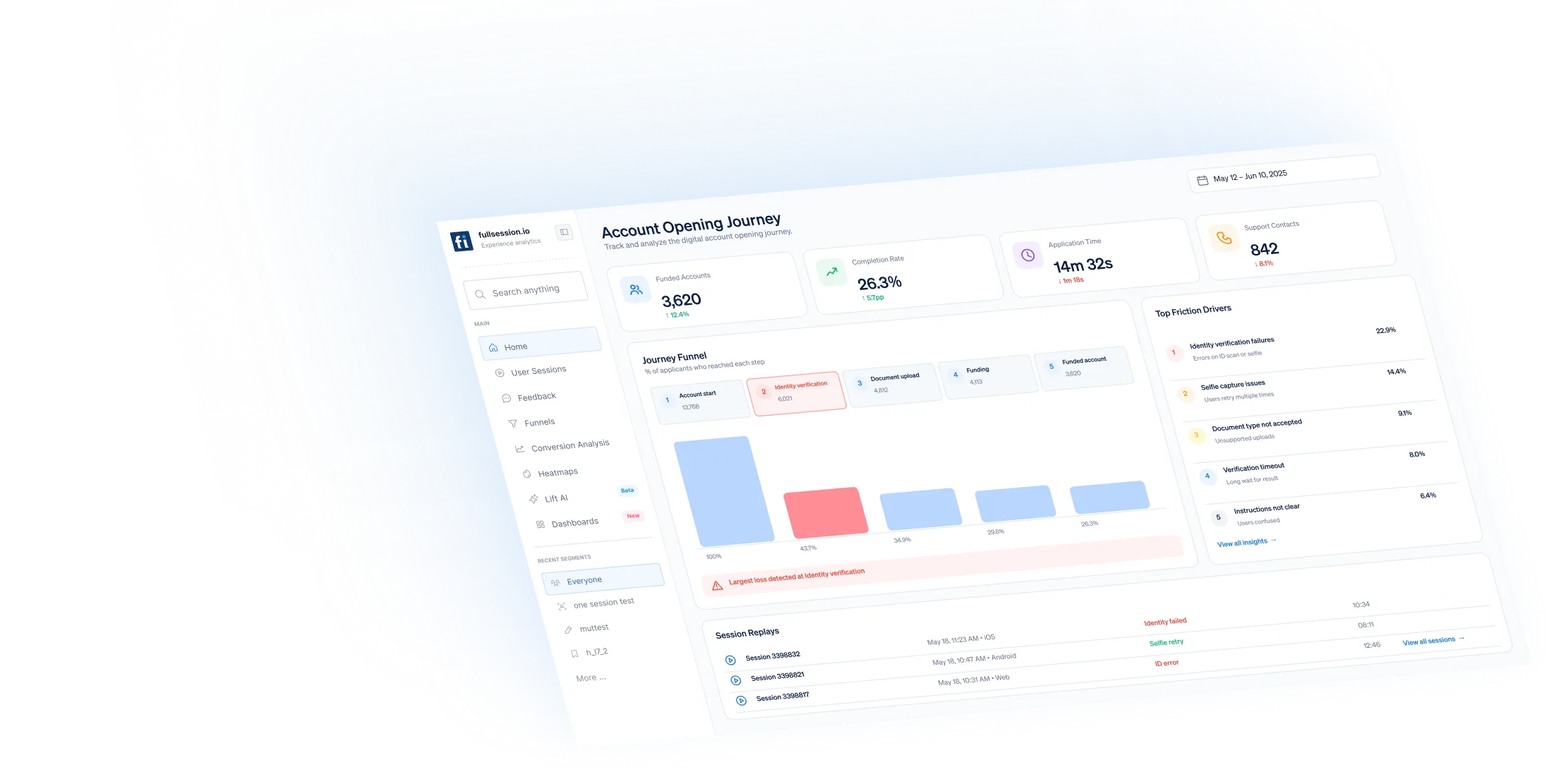
If you’re responsible for activation, form abandonment is rarely “a UX problem” in isolation—it’s a measurement + diagnosis + prioritization problem. FullSession fits when you need to connect where users drop to why it happens and what to fix first, using a workflow that keeps experiments honest.
- Start with funnels and conversions to find the steepest drop-off step and segment it (mobile vs desktop, new vs returning, source).
- Tie the remediation work to the activation journey in /solutions/plg-activation so fixes map to the outcome, not vanity completions.
- Then validate fixes with real-user evidence (sessions, error states, and form behavior) before you scale changes across onboarding.
If you want to see how this workflow looks on your own onboarding journey, you can get a FullSession demo and focus on one critical activation form first.
FAQs
Low conversion rate is the outcome; form abandonment is a specific behavioral failure inside the journey—users start but don’t finish successfully. A page can convert poorly even if abandonment is low (e.g., low starts due to low intent).
There isn’t a universal benchmark that transfers cleanly across form types and traffic quality. Instead, compare by segment (device/source/new vs returning) and by step/field to find your biggest cliffs and easiest wins.
Not always. Removing fields can raise completion while lowering lead quality or weakening security signals. Prefer “minimum viable” reductions: keep what’s needed for the next activation moment, and defer the rest.
Look for a gap between submit attempts and submit success, spikes after releases, browser/device clustering, timeouts, and repeated retries. Treat “silent submit failure” as a top priority because it’s pure waste.
Define guardrails up front: completion plus time-to-complete, error rate, and at least one downstream activation/quality signal. If completion rises but downstream quality drops, it’s not a win.
See what’s costing you, and prove whats fixing it is worth
Watch the real journey, rank every issue by revenue impact, and validate the result against baseline.




.svg)
.svg)
212 E Stone Path St Derby, KS 67037 Phone: +1 415-649-4222



All systems operational.