.svg)

Ecommerce Conversion Optimization: A Practical CRO System for Prioritizing, Testing, and Proving Lift

Most ecommerce teams do not have a “tactic problem.” They have a decision problem.
You can find endless lists telling you to add reviews, tweak your checkout, or speed up pages. The harder part is knowing what to do first, how to prove it worked, and what to do when the data is noisy or the test shows no lift.
This guide gives you a practical CRO system: how to choose the right KPI, diagnose where the money is leaking, prioritize what to fix, and validate results without fooling yourself.
What is ecommerce conversion optimization?
Ecommerce conversion optimization (often called ecommerce CRO) is the practice of increasing revenue from the traffic you already have by reducing friction and improving decision clarity across the shopping journey. If you want a broader set of tactics to pair with this system, see ecommerce conversion optimization strategies
It includes UX changes (navigation, product pages, checkout), offer and trust changes (shipping clarity, returns, guarantees), and measurement changes (choosing the right KPI, instrumenting the funnel correctly).
Definition box: ecommerce conversion rate formula
Ecommerce conversion rate (CVR) is typically calculated as conversion rate is typically calculated as:
CVR = Transactions / Sessions (or Visitors)
That formula is useful, but it can also mislead you. If a change increases average order value (AOV) but slightly reduces CVR, you could still make more money. That is why many teams run CRO against a revenue metric, not just a confirmation-page metric.
Choose the right primary KPI (why RPV often beats CVR)
If you only optimize for CVR, you can accidentally push the business into bad trade-offs: more low-intent orders, worse margins, higher cancellations, or more support load.
A practical default for ecommerce CRO is Revenue per Visitor (RPV) because it bakes in both conversion and basket value.
RPV also forces better questions:
- Are we converting the right traffic, or just more traffic?
- Are we improving checkout completion, or lowering order value to do it?
- Are we shifting revenue between segments (mobile vs desktop) instead of growing it?
Here’s a simple metric selection table you can use when aligning stakeholders.
Counter-metrics to keep you honest: refunds, cancellations, payment failures, support tickets, and delivery exceptions. If your checkout change increases RPV but also increases cancellations, that is not a win. It is a delayed loss.
The practical CRO loop (from signal to shipped change)
A CRO program works when it produces decisions, not decks. You need a repeatable loop that connects funnel data to user-level evidence and then to a test plan.
Here is a workflow that holds up in the real world, including traffic constraints and competing priorities.
- Define the conversion event and the funnel path
Start with what you actually care about: purchase revenue, subscription start, lead with deposit, or whatever “value” means for your store. Then map the steps that create it (product view → add to cart → checkout start → payment success). If you need a full breakdown of funnel stages and what to optimize in each, use ecommerce conversion funnel as a reference. - Find the highest-value drop-off
Look for steps where a meaningful share of users fall out and where the business impact is obvious. “Checkout start to purchase” is often the highest-value zone, but not always. - Segment before you brainstorm
Do not mix all users together. At minimum, split by device, new vs returning, and primary acquisition channels. Many “sitewide” CRO ideas are actually one-segment ideas in disguise. - Collect session-level evidence
Funnel analytics tells you where. It rarely tells you why. Pair the drop-off with session replay, rage clicks, dead clicks, error states, and form hesitation patterns. The goal is not storytelling. It is evidence you can turn into a specific hypothesis. - Write a falsifiable hypothesis
“Improve trust” is not a hypothesis.
“If we show delivery date and total cost earlier in checkout, mobile users will complete payment more often because uncertainty drops” is testable. - Choose the smallest test that can prove or disprove it
You are not trying to rebuild the storefront. You are trying to reduce uncertainty. Start with the smallest change that meaningfully targets the friction source. - Validate with guardrails, then ship or iterate
Decide up front what “good evidence” looks like, what segments you will read, and which counter-metrics must not regress. Then ship the winner, document the result, and feed the learnings back into prioritization.
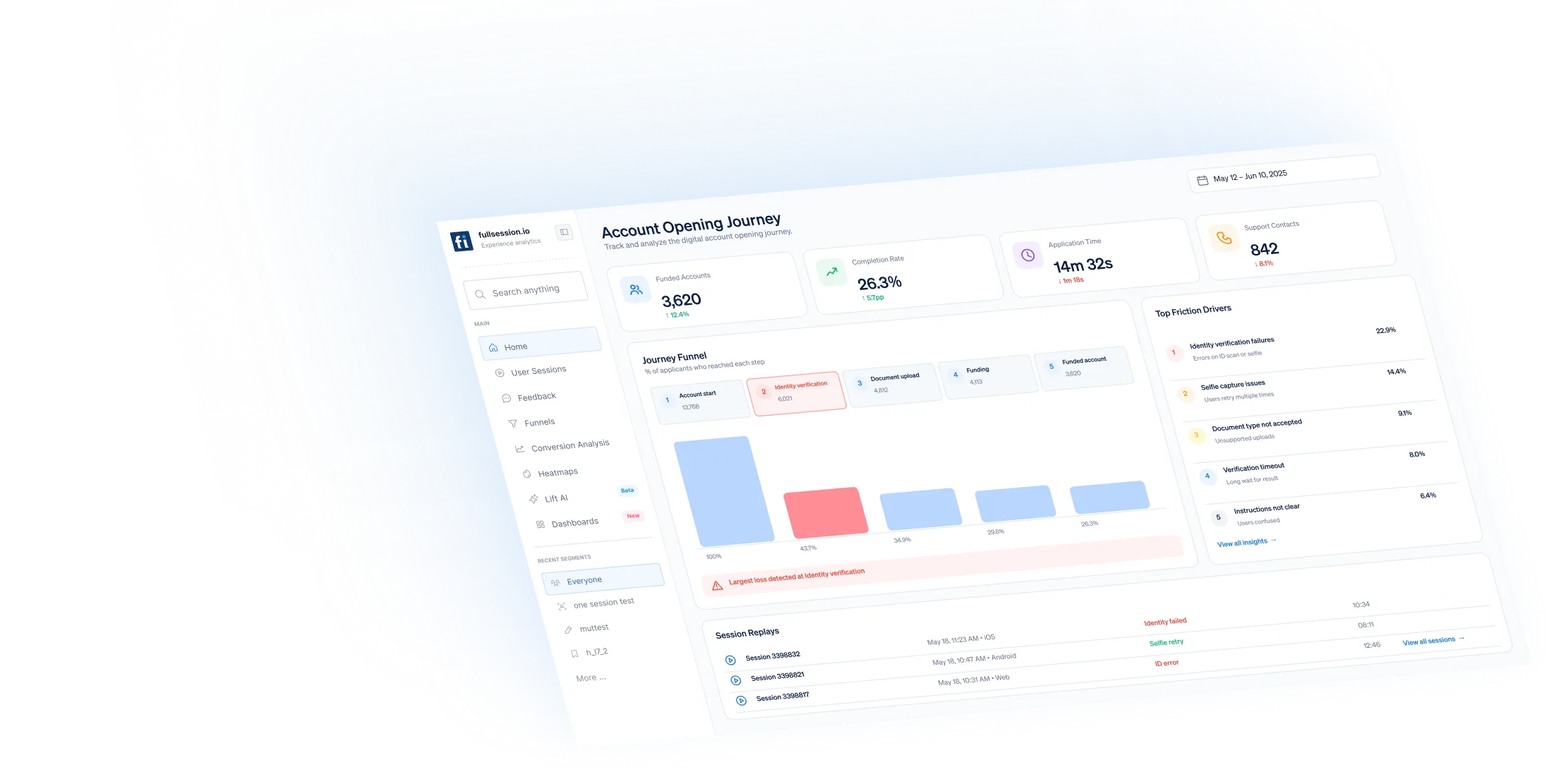
If you want to operationalize steps 1 to 3 with less guesswork, start from your funnel drop-offs and step-to-step completion inside.
Prioritization that survives real constraints
Every ecommerce team has more ideas than capacity. Your system should prevent two failure modes:
- Tactic sprawl: 25 “good ideas” and no focus.
- Local optimization: improving a micro-step that does not move revenue.
A simple prioritization approach that works well in practice is Impact × Confidence ÷ Effort, scored per funnel zone and per key segment.
Impact: If this works, how much revenue could it move?
Confidence: How strong is the evidence (not opinions)?
Effort: How long to build, QA, and measure correctly?
A typical failure mode is treating “confidence” as gut feel. Instead, tie confidence to what you can actually point to:
- A consistent replay pattern (users stuck on the same field).
- A measurable error spike (payment failures, address validation loops).
- A segment-specific drop-off (mobile only, paid social only).
Practical decision rule:
If you cannot describe the friction in one sentence and show at least one supporting artifact (funnel step drop-off, replay pattern, or user feedback), your confidence score should be low. That idea goes to the backlog, not the next sprint.
Diagnose by funnel zone (what to fix first, and why)
Different funnel zones have different “jobs.” If you apply generic tips everywhere, you waste time.
Product page (job: decision clarity)
On product pages, the highest-impact improvements usually reduce uncertainty:
- Can I trust this product?
- Will it fit my use case?
- What will it cost me all-in?
A common failure mode is optimizing for aesthetic polish while the real blocker is missing information. If you see users bouncing between images, shipping info, and returns, that is not “engagement.” It is uncertainty.
What to do first: pick one high-traffic product template and fix clarity issues that affect many SKUs (delivery estimates, return policy visibility, size guidance, variant selection usability).
Cart (job: commitment)
Cart is where doubt spikes. Users are deciding if the order is worth it once fees and shipping become real.
What to do first: reduce surprises. If the total cost changes late, you will see it as sudden exits and back-and-forth navigation.
Checkout (job: completion under constraint)
Checkout is not where you “sell.” It is where you remove reasons to quit. The right checkout optimization software can help teams spot form friction, payment errors, and abandonment patterns before they turn into lost revenue.
Checkout improvements tend to win when they address:
- Form friction (address fields, validation loops, mobile keyboard issues)
- Payment failure and error handling
- Trust signals at the moment of risk (returns, security reassurance, delivery guarantees)
Post-purchase (job: reduce regret and support)
Post-purchase UX affects refunds, cancellations, and repeat purchases. If you only measure confirmation-page conversion, you can miss the damage.
What to do first: track cancellations and refund reasons as part of your CRO feedback loop. If “did not realize shipping cost” shows up after purchase, that is a checkout transparency problem, not a support problem.
Validation guardrails (so you do not “prove” the wrong thing)
Most ecommerce CRO programs fail quietly in measurement. Not because teams do not test, but because they test in ways that overstate confidence.
Here are practical guardrails that keep teams from shipping false wins:
- Decide the primary KPI and counter-metrics before you look at results. If you pick the KPI after the test, you are optimizing for a story.
- Do not peek early and declare victory. Early swings often regress.
- Avoid running overlapping tests on the same funnel step. You will not know what caused the change.
- Treat “no lift” as information, not failure. It often means your hypothesis was wrong or your change was too small, not that CRO is broken.
- Sanity-check tracking before you test. If your checkout events are inconsistent by browser or device, you will chase ghosts.
Show practical judgment here: if your store does not have enough traffic to run clean A/B tests quickly, you can still do CRO. You just need to rely more on stronger qualitative evidence, larger changes, and longer measurement windows. The trade-off is slower certainty, not zero progress.
When to use FullSession for ecommerce CRO
Use FullSession when your KPI is tied to revenue outcomes and you need to connect funnel drop-offs to the real user behaviors causing them.
FullSession is a privacy-first behavior analytics platform that helps you:
- See where users drop in the purchase funnel and which steps are leaking value via – Funnels and Conversion
- Diagnose checkout friction patterns that drive abandonment and payment failure, then route remediation around.
- Turn “we think” into “we saw,” so your confidence score is earned, not guessed.
If you want a starting point that is hard to argue with internally, map your funnel drop-offs first, then pick three high-impact tests you can validate with clean measurement.
FAQs
A “good” conversion rate depends on your category, traffic quality, device mix, and price points. Use your own historical baseline and segment splits (mobile vs desktop, new vs returning) before you chase external benchmarks.
If you can only pick one, RPV is often the better north star because it captures both conversion and order value. Still track CVR and AOV to understand what is driving changes in RPV.
Common causes include surprise costs, forced account creation, slow or confusing checkout on mobile, and payment failures. The fastest path to clarity is pairing funnel drop-off with session-level evidence.
A/B testing is useful, but it is not the only path. If traffic is limited, focus on stronger qualitative evidence, bigger changes, and careful counter-metric tracking. The goal is decision quality, not perfect experimental purity.
Start where revenue leaks are largest and evidence is strongest. For many stores that means checkout transparency, mobile form friction, and payment error handling before you touch cosmetic product page tweaks.
Prioritize per segment. A change that helps desktop organic users can hurt mobile paid traffic. Segment first, then score impact and confidence within that segment so you do not average away the truth.
See what’s costing you, and prove whats fixing it is worth
Watch the real journey, rank every issue by revenue impact, and validate the result against baseline.


.svg)
.svg)
212 E Stone Path St Derby, KS 67037 Phone: +1 415-649-4222



All systems operational.