.svg)

Conversion funnel analysis: a practitioner workflow to diagnose drop-offs, prioritize fixes, and validate impact

Most teams do not fail at finding drop-offs.
They fail at deciding what the drop-off means, what is worth fixing first, and whether the fix actually caused the lift.
If you want funnel analysis to move KPIs like trial-to-paid or checkout completion, you need an operating system, not a dashboard.
Why funnel analysis often disappoints
Funnel analysis should reduce guesswork, but it often creates more debate than action.
A typical failure mode is this:
- Someone spots the “biggest drop-off.”
- A fix ships quickly because it feels obvious.
- The metric moves for a week, then drifts back.
- Everyone stops trusting funnels and goes back to opinions.
The main reasons are predictable:
- The funnel definition is not aligned to the real journey (multi-session, branching, “enter mid-funnel”).
- Instrumentation is inconsistent (events fire differently across devices, identities split, time windows mismatch).
- Drop-off is a feature, not a bug (some steps should filter).
- The team optimizes a step that is upstream of the real friction (symptom chasing).
- Validation is weak (seasonality, novelty, regression to the mean, and selection effects).
Common mistake: treating the biggest drop-off as “the problem”
The biggest percentage drop can be a healthy filter step, a tracking leak, or a segment mix shift.
Treat it as a lead, not a verdict. Your job is to prove whether it is friction, filtering, or measurement.
What is conversion funnel analysis?
Conversion funnel analysis is the process of measuring how users progress through a defined journey, identifying where and why they drop off, then improving the journey with validated changes.
Definition box (keep this mental model)
Conversion funnel analysis = (define the journey) + (measure step-to-step progression) + (segment the story) + (explain the drop-off) + (validate the fix).
If you skip “explain” or “validate,” you are doing drop-off reporting, not funnel analysis.
A conversion funnel can be product-led (signup → activate → invite → pay) or transactional (view product → add to cart → checkout → pay). The analysis needs to match the journey shape, including multi-session behavior and optional paths.When you build funnels in FullSession, you typically start with event-based definitions and step granularity, then use segmentation and session evidence to explain what the numbers cannot.
Instrumentation checkpoints before you optimize anything
Your funnel is only as good as the event system underneath it.
Here are the checks that prevent you from “fixing” a data artifact:
- Event taxonomy consistency
Event names and properties must mean the same thing across web, mobile, and variants. - Identity resolution rules
Decide how you stitch anonymous-to-known users and how you handle cross-device behavior. If your “same person” logic changes week to week, your funnel will look leaky. - Time window definition
Pick the window that matches the buying cycle. A 30-minute window will undercount multi-session checkout. A 30-day window can hide fast-fail friction. - Bot and internal traffic filtering
If you do not filter aggressively, top-of-funnel steps get noisy and downstream ratios become misleading. - Consent and privacy gaps
If consent reduces capture for certain geos or browsers, you need to interpret funnels as partial observation, not ground truth.
The trade-off is real: stricter definitions reduce volume and increase trust. Looser definitions increase volume and increase arguing.
Quick diagnostic: what a drop-off pattern usually means
Different drop-offs have different root causes. Use this table to choose the next diagnostic move instead of jumping to fixes.
Prioritize fixes with a rubric that protects your KPI
Biggest drop-off is not the same as biggest opportunity.
A practical prioritization rubric uses four inputs:
- Impact: How much KPI movement is plausible if this step improves?
- Reach: How many users hit the step in your chosen time window?
- Effort: Engineering, design, approvals, and risk.
- Confidence: Strength of evidence that this is friction (not filtering or tracking).
Add guardrails so you do not “win the funnel and lose the business”:
- For PLG: guardrails might include qualified signup rate or activation quality, not raw signups.
- For ecommerce: guardrails might include refund rate, payment success rate, or support contacts, not just checkout completion.
Decision rule: when a drop-off is worth fixing
Treat a drop-off as “fix-ready” when you can answer all three:
- It is real (not tracking or time window leakage).
- It is concentrated (specific segment, device, source, or UI state).
- You can name the friction in plain language after reviewing sessions.
If you cannot do that, you are still in diagnosis.
A practitioner workflow for conversion funnel analysis
This workflow is designed for teams who can instrument events and want repeatable decisions.
Step 1: Define the journey as users actually behave
Start with one primary conversion path per KPI:
- Trial-to-paid: signup → activation milestone → key action frequency → paywall encounter → plan selection → payment success
- Checkout completion: product view → add to cart → begin checkout → shipping complete → payment attempt → payment success
Treat optional steps as branches, not failures. If users “enter mid-funnel” (deep links, returning users), model that explicitly.
Step 2: Validate measurement quality before interpreting drop-off
Confirm identities, time windows, and event consistency.
If you do not trust the funnel definition, any optimization work is theater.
Step 3: Segment to find where the story changes
Segment by the variables that change behavior, not vanity attributes:
- acquisition source and landing page
- new vs returning
- device and browser
- plan tier intent or cart value bands
- geo or language (especially if consent differs)
This is where funnels become diagnostic instead of descriptive.
Step 4: Use session evidence to explain the drop-off
Numbers tell you where to look. Sessions tell you what happened.
A repeatable protocol:
- Sample sessions from users who dropped and those who progressed at the same step.
- Tag friction patterns (confusion loops, repeated clicks, form errors, hesitation on pricing).
- Stop when new sessions stop producing new patterns.
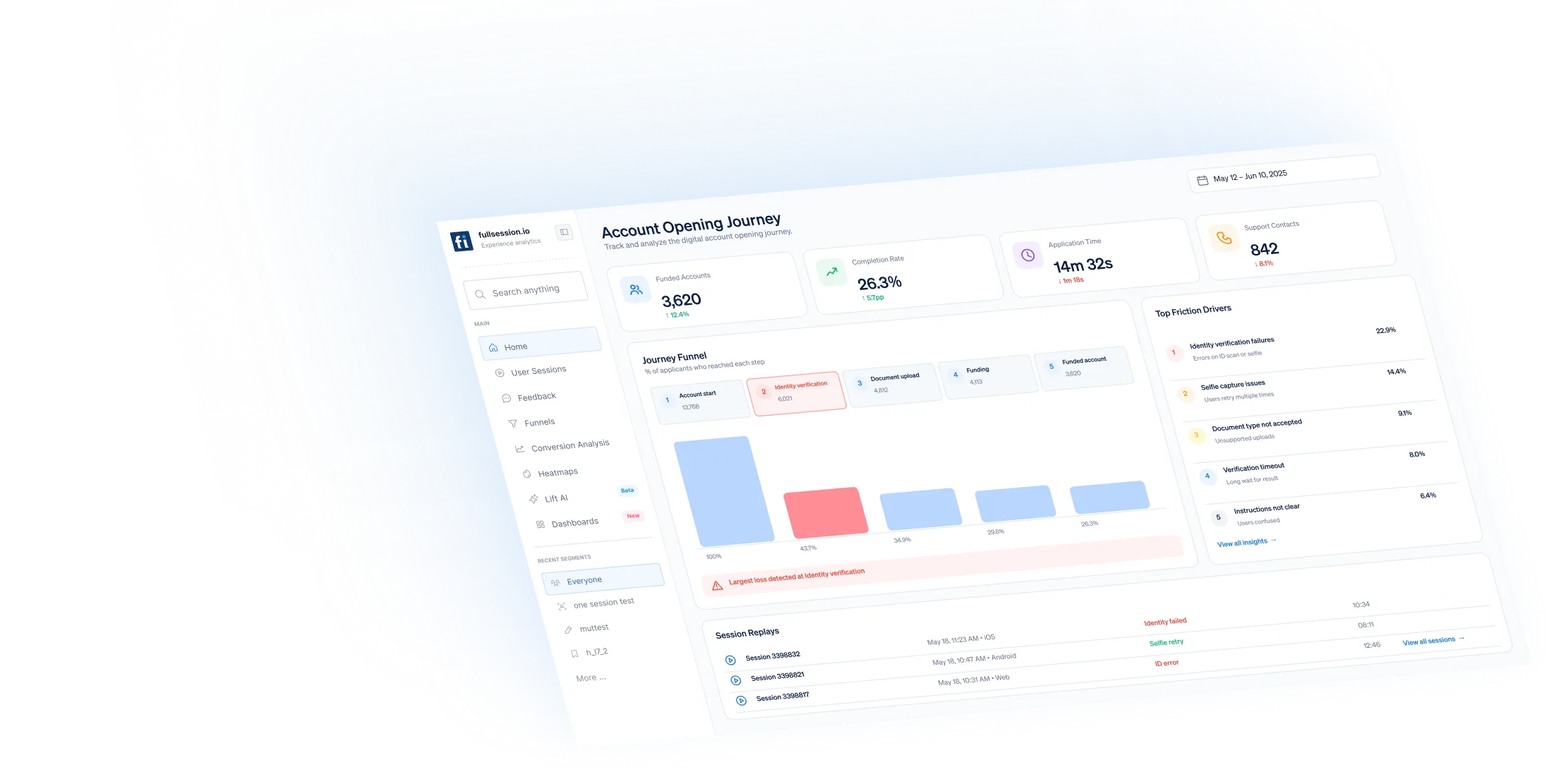
FullSession is built for this paired approach: define the funnel, then jump into session replay and heatmaps to explain why the step fails. (/product/session-replay, /product/heatmaps)
Step 5: Turn patterns into testable hypotheses
Good hypotheses name:
- the friction
- the change you will make
- the expected behavior shift
- the KPI and guardrail you will watch
Example:
“If users cannot see delivery fees until late checkout, they hesitate and abandon. Showing fees earlier will increase shipping completion without increasing refund rate.”
Step 6: Validate impact with an experiment and decision threshold
A/B tests are ideal, but not always possible. If you cannot run a clean experiment, use holdouts, phased rollouts, or geo splits.
Validation discipline that prevents false wins:
- predefine the primary KPI and guardrail
- define the time window (avoid “launch week only” conclusions)
- account for seasonality and campaign mix changes
- watch for regression to the mean on spiky pages
If you are instrumenting errors, error-linked session review can catch “silent failures” that funnels misclassify as user choice.
How to run a quant-to-qual root-cause review without wasting a week
This is the missing bridge in most funnel guides.
Pick one funnel step and run this in 60 to 90 minutes with growth, product, and someone who can ship fixes.
- Bring three slices of data
- overall funnel for the step
- the worst segment and the best segment
- trend over time (before and after any release or campaign)
- Review sessions in pairs
Watch 10 sessions that dropped and 10 that converted. Alternate.
The contrast keeps you honest about what “normal success” looks like. - Tag patterns with a small vocabulary
Use tags like:
- cannot find next action
- validation error loops
- payment method failure
- page performance stall
- trust concerns (pricing surprise, unclear policy)
- distraction loops (back and forth between pages)
- Leave with one fix you can validate
Not five. One.
If the team cannot agree on the single best bet, your evidence is not strong enough yet.
Quick scenario: the “leaky” trial-to-paid funnel
A common pattern in PLG is that users look like they drop after “activated,” but the truth is multi-session behavior plus identity splitting.
The fix is not a UI change. It is identity rules, time windows, and better definition of the activation milestone.
Once the measurement is clean, the real friction often shows up later at plan selection or billing, where session evidence is more decisive.
When to use FullSession
Use FullSession when you need to connect funnel drop-off to concrete evidence quickly, then validate changes with fewer blind spots.
For PLG B2B SaaS: improve trial-to-paid and qualified signups
FullSession fits when:
- you need event-based funnels that reflect activation milestones and multi-session paths
- you need to compare cohorts (high-intent signups vs low-intent signups) and see where behavior diverges
- you need to explain drop-offs with replays and heatmaps so fixes are not based on guesses
If your team is trying to raise trial-to-paid without inflating low-quality signups, route your workflow through /solutions/plg-activation.
A natural next step is to pick one activation funnel, define the time window, then review 20 drop sessions and 20 success sessions before you ship changes.
For ecommerce and DTC: reduce cart abandonment and increase checkout completion
FullSession fits when:
- checkout drop-off is concentrated by device, browser, or payment method
- you suspect form errors, performance stalls, or pricing surprises
you need session evidence to prioritize fixes that reduce abandonment without harming revenue quality
For ecommerce teams, the same funnel evidence can also guide decisions on how to increase revenue per visitor by connecting checkout completion, cart value, payment success, and friction signals to revenue outcomes.
FAQs
Run a light review weekly for monitoring, and a deeper diagnostic cycle monthly or after major releases. Weekly catches breakages. Monthly is where you do root-cause work and validation.
No. Some steps should filter, and some drops are tracking leaks. Prioritize based on KPI impact, reach, confidence, and guardrails, not percentage alone.
Audit instrumentation, identity resolution, and time windows. If those are wrong, every optimization decision downstream will be shaky.
Model the journey as paths and branches, and choose a time window that matches user intent. Treat re-entry mid-funnel as a separate starting point rather than a failure.
At minimum: event-based funnels plus segmentation. To explain why users drop, add session replay and heatmaps. To prove impact, add an experimentation method and guardrails.
Use an experiment when possible. Otherwise use phased rollouts or holdouts, predefine decision thresholds, and monitor seasonality and campaign mix shifts.
See what’s costing you, and prove whats fixing it is worth
Watch the real journey, rank every issue by revenue impact, and validate the result against baseline.


.svg)
.svg)
212 E Stone Path St Derby, KS 67037 Phone: +1 415-649-4222



All systems operational.