.svg)

Checkout Conversion Benchmarks: How to Interpret Averages Without Misleading Decisions
.avif)

What is a checkout conversion benchmark?
A checkout conversion benchmark is a reference range for how often shoppers who start checkout go on to complete purchase, usually expressed as a checkout completion rate (or its inverse, checkout abandonment). It is not the same as sitewide purchase conversion rate, which starts much earlier in the funnel
What checkout conversion benchmarks actually measure
Benchmarks only help when you match the metric definition to your funnel reality.
Most “checkout conversion” stats on the internet blur three different rates:
1) Session-to-purchase conversion rate
Good for acquisition and merchandising questions. Terrible for diagnosing checkout UX.
2) Cart-to-checkout rate
Good for pricing, shipping clarity, and cart UX.
3) Checkout start-to-purchase (checkout completion rate)
Best for payment friction, form errors, address validation, promo code behavior, and mobile UX.
If you do not align the definition, you will compare yourself to the wrong peer set and chase the wrong fix.
Published benchmark ranges you can reference (and the traps)
Numbers can be directionally useful, but only if you treat them as context, not truth.
Here are commonly cited reference points for cart abandonment and checkout completion:
These ranges vary by study design, platform mix, and what counts as a “cart” or “checkout start.” Baymard’s “documented” abandonment rate is an aggregation of multiple studies, so it is useful as a sanity check, not a performance target. Littledata publishes a Shopify-focused checkout completion benchmark, which is closer to what many ecommerce teams mean by “checkout conversion,” but it is still platform- and merchant-mix dependent.
Common mistake: treating a benchmark like a KPI target
If you set “hit the average” as the goal, you will ship changes that look rational but do not move RPV.
A more reliable approach: treat benchmarks as a triage tool:
- Do we have a problem worth diagnosing?
- Where should we segment first?
Is the trend stable enough to act?
How to interpret a gap: act, ignore, or monitor
A benchmark gap is only meaningful when it is stable, segment-specific, and revenue-relevant.
Here is a decision rule that reduces false alarms:
Decision rule: act when the gap is both stable and concentrated
If your checkout completion rate is below a reference range, ask three questions:
- Is it sustained? Look at at least 2 to 4 weeks, not yesterday.
- Is it concentrated? One device type, one user type, one payment method, one browser.
- Is it expensive? The drop shows up in RPV, not just “conversion rate pride.”
If you only have one of the three, monitor. If you have all three, act.
A typical failure mode is reacting to a mobile dip that is actually traffic mix: more top-of-funnel mobile sessions, same underlying checkout quality. That is why you need segmentation before action.
Segments that change the benchmark in real life
Segmentation is where benchmarks become operational.
Two stores can share the same overall checkout completion rate and have opposite problems:
- Store A leaks revenue on mobile payment selection.
- Store B leaks revenue on first-time address entry and field validation.
The minimum segmentation that usually changes decisions:
- Device: mobile vs desktop (mobile often underperforms; treat that as a prompt to inspect, not a verdict)
- User type: first-time vs returning
- Payment method: card vs wallet vs buy-now-pay-later
- Error exposure: sessions with form errors, declines, or client-side exceptions
The trade-off: more segments means more noise if your sample sizes are small. If a segment has low volume, trend it longer and avoid over-testing.
A simple validation method for your own baseline
Your best benchmark is your own recent history, properly controlled.
Use this lightweight workflow to validate whether you have a real checkout issue:
- Lock the definition. Pick one: checkout start-to-purchase, or cart-to-checkout. Do not mix them week to week.
- Create a baseline window. Use a stable period (exclude promos, launches, and outages) and compare to the most recent stable period.
- Diagnose by segment before you test. Find the segment where the delta is largest, then watch sessions to confirm the behavioral cause.
Quick scenario: “Below average” but no real problem
A team sees “70% abandonment” and panics. They shorten checkout and add badges. RPV does not move.
Later they segment and find the real driver: a spike in low-intent mobile traffic from a new campaign. Checkout behavior for returning users was flat the whole time. The correct action was adjusting traffic quality and landing expectations, not reworking checkout.
Benchmarks did not fail them. The misuse did.
When to use FullSession for checkout benchmark work
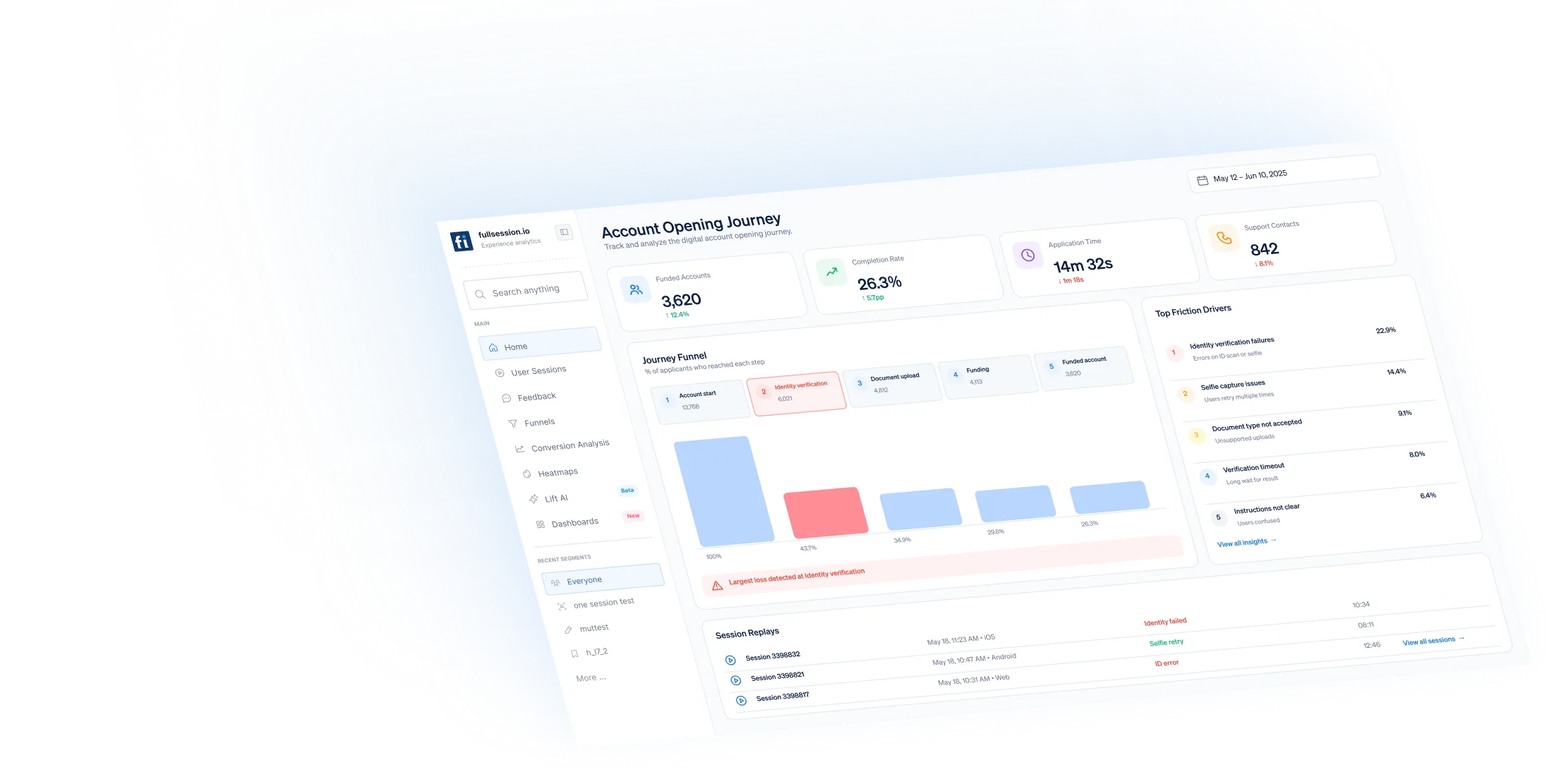
Benchmarks tell you “how you compare.” FullSession helps you answer “what is causing the gap” and “which fix is worth it.” Ecommerce teams can also compare tools to optimize checkout when they need to evaluate platforms for funnel drop-offs, session evidence, errors, and checkout recovery workflows.
Use FullSession when you need to tie checkout performance to RPV with evidence, not guesses:
- When the gap is device-specific: Start with /product/funnels-conversions to isolate the step where mobile diverges, then confirm the friction in replay.
- When you suspect hidden errors: Use session replay plus /product/errors-alerts to catch field validation loops, payment failures, and client-side exceptions that dashboards flatten into “drop-off.”
- When you need a prioritized fix list: Funnels show where; replay shows what; errors show why it broke.
If your goal is higher RPV, the practical win is not “raise checkout completion rate in general.” It is “remove the single friction that blocks high-intent shoppers.”Evaluate how your checkout performance compares, and which gaps actually warrant action. If you want to validate the segment-level cause quickly, route your analysis through /solutions/checkout-recovery.
FAQs
It depends on what counts as “checkout start,” your device mix, and how many shoppers use express wallets. Use published ranges as context, then benchmark against your own trailing periods.
No. Ecommerce conversion rate usually means session-to-purchase. Checkout conversion typically means checkout start-to-purchase (completion) or checkout abandonment. Mixing them causes bad comparisons.
Many sources are talking about abandonment ranges or blended funnel rates, not a clean checkout-start completion metric. Always verify the definition before you adopt the number.
Compare to average to spot outliers worth investigating, then compare to top performers to estimate upside. Treat both as directional until your segmentation confirms where the gap lives.
Start by checking for mix shifts (device, campaign, geo), then look for concentrated deltas (one payment method, one browser). If it is broad but shallow, it is often noise or traffic quality.
Mobile vs desktop, first-time vs returning, and payment method are the highest-yield cuts. They tend to point to different fixes and different RPV impact.
See what’s costing you, and prove whats fixing it is worth
Watch the real journey, rank every issue by revenue impact, and validate the result against baseline.




.svg)
.svg)
212 E Stone Path St Derby, KS 67037 Phone: +1 415-649-4222



All systems operational.