.svg)

Cart Abandonment Analysis: How to Identify, Prioritize, and Fix Checkout Drop-Off


Cart abandonment is easy to measure and deceptively hard to improve.
Most teams stop at a blended “abandonment rate,” brainstorm a few best practices, and ship changes that feel right. Then revenue stays flat because the real issue wasn’t the average shopper. It was one high-impact segment failing for one specific reason.
This guide gives you a practical cart abandonment analysis workflow designed for CRO managers who need to decide what to fix first, prove impact, and improve Revenue per Visitor (RPV)not just clicks, pop-up submissions, or “engagement.”
Cart abandonment vs checkout abandonment (don’t mix these up)
These two get used interchangeably in a lot of content. They shouldn’t be.
- Cart abandonment: A shopper adds items to cart but doesn’t complete a purchase.
- Checkout abandonment: A shopper starts checkout but drops before completing payment.
Why it matters:
- Cart abandonment often includes a lot of low-intent behavior (price checking, shipping discovery, saving for later).
- Checkout abandonment is more likely to contain high-intent shoppers being blocked by friction (form complexity, errors, payment failure, trust concerns).
If you lump them together, you’ll optimize the wrong thing usually at the wrong step.
The RPV-first workflow (overview)
Here’s the loop that turns “analysis” into measurable improvement:
- Find the leak in funnel data
- Segment until you isolate high-impact drop-offs
- Review sessions to see the actual friction
- Write a hypothesis tied to a step and a failure mode
- Prioritize by Impact × Confidence × Effort
- Test (or roll out with measurement discipline)
- Validate using checkout completion rate + RPV
Step 1 Start with segmentation, not averages
Averages hide the only thing you actually need: where revenue is being lost.
Start by segmenting abandonment in three ways:
1) Segment by intent proxy
Use signals that separate “window shoppers” from “likely buyers”:
- Cart value (high vs low)
- Returning vs new visitors
- Product type (commodity vs considered purchase)
- Repeat purchasers vs first-time buyers
A small abandonment issue in a high-value segment can matter more than a large issue in low-value carts.
2) Segment by context
Checkout behavior changes dramatically based on context:
- Device (mobile vs desktop)
- Browser / OS (especially for payment flows)
- Traffic source (paid social vs search vs email)
- Geo (shipping, currency, address formats)
- Payment method availability (wallets, BNPL, local methods)
If your mobile shoppers drop at payment while desktop shoppers don’t, that’s not “general abandonment.” That’s a diagnosable funnel failure.
3) Segment by step + failure mode
Instead of “they dropped,” ask:
- Which step? (shipping → address → payment → review)
- What kind of failure? (validation error, slow load, unexpected cost, payment decline, UI confusion)
This is where you stop guessing and start narrowing.
Step 2 Quantify revenue impact (so you fix the right thing first)
Once you isolate segments, quantify where you’re losing the most RPV.
A practical way to do this without pretending you have perfect attribution:
- Identify the segment’s traffic share
- Identify its drop-off point and relative severity
- Compare to a “healthy” segment (e.g., desktop returning shoppers)
- Estimate directional upside by asking:
“If this segment performed like the healthier benchmark segment, how much more revenue would we capture per visitor?”
You’re not trying to predict lift down to the decimal. You’re trying to rank opportunities so your team spends cycles where it matters.
If you want this to be easier to operationalize, this is the point where behavior-level insight platforms can help connect segment + session evidence + revenue impact in one place. (See: /product/lift-ai)
Step 3 Diagnose friction with the right evidence
Use the right tool for the question you’re answering:
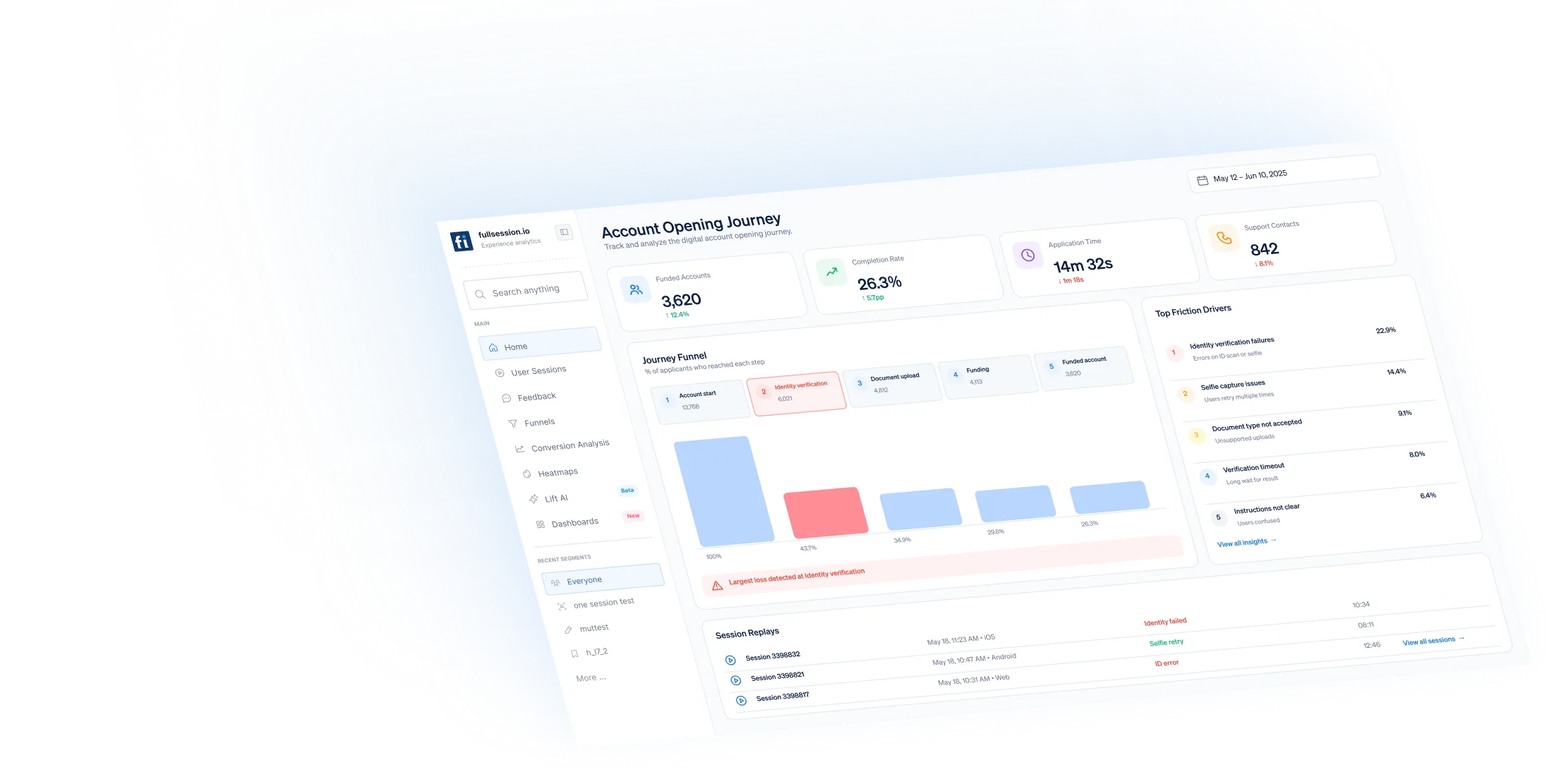
Funnel reports tell you where the leak is
Great for:
- Step-to-step drop-off
- Segment comparisons
- Detecting sudden regressions after releases
Weak for:
- Explaining why it happened
- Seeing micro-friction (rage clicks, field confusion, payment UI issues)
Session-level review shows you why it’s leaking
Session evidence is how you see:
- Coupon hunting loops (back-and-forth behavior)
- Hidden validation errors
- Confusing shipping option presentation
- Payment method friction or missing trust cues
- “Looks fine in aggregate” problems that block real users
The key is to review sessions inside your high-impact segments, not a random sample.
Heatmaps and surveys provide context (but don’t over-trust them)
- Heatmaps can tell you where attention went, not necessarily what caused drop-off.
- Surveys can tell you what people say, which is often helpful, just not always causal.
Treat these as supporting evidence, not the main diagnostic.
Step 4 Prioritize fixes with Impact × Confidence × Effort (ICE)
Once you have candidate issues, rank them with a simple scoring model:
- Impact: How much RPV this could move if fixed (based on segment size + severity + cart value)
- Confidence: Strength of evidence (session proof > hunch)
- Effort: Engineering/design effort + risk
A common trap is choosing the easiest changes first even when they don’t touch the highest-value drop-off.
Example: what rises to the top
High-priority usually looks like:
- High cart value segment + clear session evidence of friction
- Payment or shipping step failures (late-stage drop-off)
- Regressions tied to a recent release
- Mobile-specific issues affecting a large share of sessions
Low-priority usually looks like:
- Cosmetic checkout tweaks with no evidence
- “Best practice” changes that don’t map to a specific segment failure
- Engagement improvements that don’t connect to completion
Step 5 Close the loop: test + validate outcomes (not vibes)
This is where most abandonment content stops short.
If you don’t validate against the right outcomes, you’ll ship changes that improve behavior signals while revenue stays flat.
Primary success metrics
- Checkout completion rate (for the targeted step/segment)
- Revenue per Visitor (RPV) (the business outcome)
Guardrails (so you don’t “win” the wrong way)
- AOV (did you “fix” abandonment by pushing discounts that lower value?)
- Payment success rate (did wallet changes increase declines?)
- Refund/cancel rate (did you create low-quality conversions?)
- Page performance (speed regressions often show up as abandonment)
Common false positives to watch for
- More checkout starts, no improvement in completions
- More clicks on “Apply coupon,” no revenue lift
- Heatmap “engagement” up, payment failures unchanged
- Better completion in low-value carts, RPV unchanged
Common causes of abandonment and how to diagnose each
Instead of a generic list, here’s how to connect causes to evidence:
- Shipping cost shock
- Evidence: drop spikes at shipping step; sessions show “total” surprise; back navigation
- Evidence: drop spikes at shipping step; sessions show “total” surprise; back navigation
- Forced account creation
- Evidence: drop at account/login step; repeated failed password flows; session exits
- Evidence: drop at account/login step; repeated failed password flows; session exits
- Slow checkout / performance issues
- Evidence: long pauses, reloads, repeated taps; segment concentrated on mobile or specific browsers
- Evidence: long pauses, reloads, repeated taps; segment concentrated on mobile or specific browsers
- Payment trust concerns
- Evidence: hesitations at payment step; exits after selecting method; missing reassurance elements
- Evidence: hesitations at payment step; exits after selecting method; missing reassurance elements
- Coupon hunting
- Evidence: switching tabs, leaving checkout to search; repeated “coupon” interactions
- Evidence: switching tabs, leaving checkout to search; repeated “coupon” interactions
- Form validation / errors
- Evidence: repeated attempts, rage clicks, error messages, address format issues by geo
- Evidence: repeated attempts, rage clicks, error messages, address format issues by geo
- Mismatch between expectation and total cost
- Evidence: exits after taxes/fees appear; higher drop for certain products or geos
- Evidence: exits after taxes/fees appear; higher drop for certain products or geos
Tools (no checklist): what to use when
- Use analytics when you need to quantify where drop-off happens and which segments are affected.
- Use session replay when the drop-off is real but the cause is unclear (micro-friction, UI confusion, errors).
- Use heatmaps to understand attention patterns but confirm with sessions and outcomes.
- Use surveys to capture stated objections then validate behaviorally.
- Use experimentation to prove causality and measure RPV change.
If you’re trying to connect segmentation + session evidence + prioritization + validation in one workflow, that’s the gap most stacks don’t cover cleanly especially when multiple teams are involved.
A practical “first 7 days” plan for CRO managers
Day 1–2: Baseline + segmentation
- Separate cart vs checkout abandonment
- Create a shortlist of segments (device, source, cart value, returning/new)
- Identify the worst-performing high-impact segment
Day 3–4: Session diagnosis
- Review sessions only within the target segment
- Tag the top friction patterns (errors, confusion, payment issues, shipping shock)
Day 5–7: Prioritize + test plan
- Score candidates with ICE
- Write hypotheses tied to a step + friction pattern
- Define primary outcome = checkout completion + RPV
- Launch the top 1–2 tests (or phased rollout with rigorous measurement)
If you want an end-to-end workflow for identifying high-impact friction and routing it into measurable fixes, start here: checkout recovery
Conclusion
Cart abandonment analysis isn’t “find a benchmark and ship a popup.” It’s a decision system:
Segment → quantify impact → diagnose with evidence → prioritize → test → validate with RPV.
If you apply that loop consistently, you’ll stop chasing generic best practices and start fixing the specific friction that blocks revenue.
CTA: Want to prioritize checkout fixes by revenue impact (not guesses)? Explore behavior-level insight workflows in Lift AI
FAQ’s
Cart abandonment analysis is the process of identifying where shoppers drop after adding items, segmenting those drop-offs to isolate high-impact patterns, diagnosing root causes with behavioral evidence, and validating fixes with outcome metrics like checkout completion rate and RPV.
Cart abandonment happens after add-to-cart but before checkout begins; checkout abandonment happens after checkout starts but before payment completes. Cart abandonment often contains more low-intent behavior; checkout abandonment more often indicates solvable friction.
Rank issues using a model like Impact × Confidence × Effort, where impact is tied to segment size, cart value, and where in checkout the drop happens (later-step friction often has higher revenue leverage).
Use checkout completion rate (for the targeted segment/step) and Revenue per Visitor (RPV) as primary outcomes, with guardrails like AOV and payment success rate.
Use funnel reports to find where drop-off occurs and which segment is affected; use session recordings to see why it happens (errors, confusion, friction) and to build confident hypotheses.
See what’s costing you, and prove whats fixing it is worth
Watch the real journey, rank every issue by revenue impact, and validate the result against baseline.



.svg)
.svg)
212 E Stone Path St Derby, KS 67037 Phone: +1 415-649-4222



All systems operational.