.svg)

Behavior Analytics for SaaS Product Teams: Choose the Right Method and Prove Impact on Week-1 Activation


If you searched “behavior analytics” and expected security UEBA, you are in the wrong place. This guide is about digital product behavior analytics for SaaS onboarding and activation.
What is behavior analytics?
Behavior analytics is the practice of using user actions (clicks, inputs, navigation, errors, and outcomes) to explain what users do and why, then turning that evidence into decisions you can validate.
Behavior analytics, defined (and what it is not)
You use behavior analytics to reduce debate and speed up activation decisions.
Behavior analytics is most valuable when it turns a drop-off into a specific fix you can defend.
In product teams, “behavior analytics” usually means combining quantitative signals (funnels, segments, cohorts) with qualitative context (session evidence, frustration signals, feedback) so you can explain drop-offs and fix them.
Security teams often use similar words for a different job: UEBA focuses on anomalous behavior for users and entities to detect risk. If your goal is incident detection, this article will feel misaligned by design.
Quick scenario: Two people, same query, opposite intent
A PM types “behavior analytics” because Week-1 activation is flat and the onboarding funnel is leaking. A security analyst types the same phrase because they need to baseline logins and flag abnormal access. Same term, different outcomes.
Start with the activation questions, not the tool list
Your method choice should follow the decision you need to make this sprint.
The fastest way to waste time is to open a tool before you can name the decision it should support.
If your team is already evaluating product analytics platforms, comparing PostHog competitors for SaaS can help you assess which tools fit your activation workflow before adding more complexity.
Typical Week-1 activation questions sound like: Where do new users stall before reaching first value? Is the stall confusion, missing permissions, performance, or a bug? Which segment is failing activation, and what do they do instead? What change would remove friction without breaking downstream behavior? The right user behavior tools should help answer these questions with evidence, not just add more dashboards.
When these are your questions, “more events” is rarely the answer. The answer is tighter reasoning: what evidence would change your next backlog decision?
A practical selection framework: question → signal → method → output → action
A method is only useful if it produces an output that triggers a next action.
Pick the lightest method that can answer the question with enough confidence to ship a change.
Use this mapping to choose where to start for activation work.
Common mistake: Watching replays without a targeting plan
Teams often open session evidence too early and drift into browsing. Pick the funnel step and the segment first, then review a small set of sessions that represent that cohort.
A simple rule that helps: if you cannot name the decision you will make after 10 minutes, you are not investigating. You are sightseeing.
Funnels vs session evidence: what each can and cannot do
You need both, but not at the same time and not in the same order for every question.
Funnels tell you where the leak is; session evidence tells you why the leak exists.
Funnels answer “where” and “for whom.” Session evidence answers “what happened” and “what blocked the user.”
The trade-off most teams learn the hard way is that event-only instrumentation can hide “unknown unknowns.” If you did not track the specific confusion point, the funnel will show a drop-off with no explanation. Context tools reduce that blind spot, but only if you constrain the investigation.
A 6-step Week-1 activation workflow you can run this week
This workflow is designed to produce one fix you can validate, not a pile of observations.
Activation improves when investigation, ownership, and validation live in the same loop.
- Define activation in behavioral terms. Write the Week-1 “must do” actions that indicate first value, not vanity engagement.
- Map the onboarding journey as a funnel. Use one primary funnel, then segment it by cohorts that matter to your business.
- Pick one leak to investigate. Choose the step with high drop-off and high impact on Week-1 activation.
- Collect session evidence for that step. Review a targeted set of sessions from the failing segment and tag the repeated failure mode.
- Classify the root cause. Use categories that drive action: UX confusion, missing affordance, permissions, performance, or defects.
- Ship the smallest change that alters behavior. Then monitor leading indicators before you declare victory.
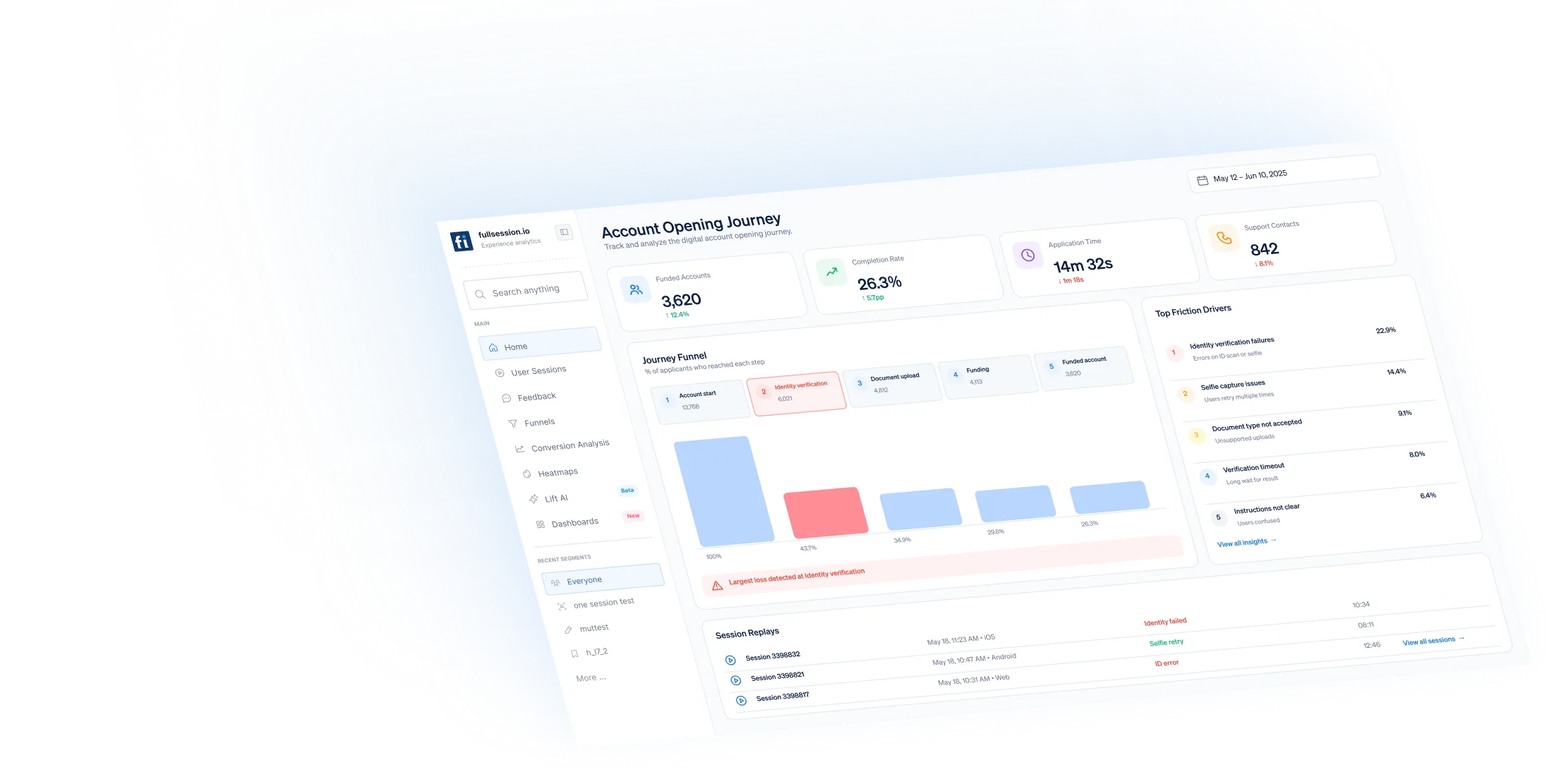
When you are ready to locate activation leaks and isolate them by segment, start with funnels and conversions.
Impact validation: prove you changed behavior, not just the UI
Validation is how you avoid celebrating a cosmetic improvement that did not change outcomes.
If you cannot say what would count as proof, you are not measuring yet.
A practical validation loop looks like this. Baseline the current behavior on the specific funnel step and segment. Ship one change tied to one failure mode. Track a leading indicator that should move before Week-1 activation does (step completion rate, time-to-first-value, error rate). Add a guardrail so you do not trade activation for downstream pain (support volume, error volume, feature misuse).
Decision rule: Stop when the evidence repeats
Session evidence is powerful, but it is easy to over-collect. If you have seen the same failure mode three times in a row for the same segment and step, pause. Write the change request. Move to validation.
When to use FullSession for Week-1 activation work
Add a platform when it tightens your activation loop and reduces time-to-decision.
FullSession fits when you need to connect funnel drop-offs to session-level evidence quickly and collaboratively.
FullSession is a strong fit when your funnel shows a leak but the team argues about cause, when “cannot reproduce” slows fixes, or when product and engineering need a shared artifact to agree on what to ship.
If you want to see how product teams typically run this workflow, start here: Product Management
If you want to pressure-test fit on your own onboarding journey, booking a demo is usually the fastest next step.
Next steps
Pick one onboarding path and run the six-step workflow on a single Week-1 activation leak.
You will learn more from one tight cycle than from a month of dashboard debate.
When you want help connecting drop-offs to evidence and validating changes, start with the funnels hub above and consider a demo once you have one activation question you need answered.
FAQs about behavior analytics for SaaS
In product contexts, teams usually use them interchangeably. The important part is defining the behaviors tied to your KPI and the evidence you will use to explain them.
Often, yes, in digital product work. People use the phrase to mean tool categories like funnels, session evidence, heatmaps, feedback, and experimentation. A better approach is to start with the decision you need to make, then choose the minimum method that can justify that decision.
Traditional analytics is strong at counts, rates, and trends. Behavior analytics adds context so you can explain the reasons behind those trends and choose the right fix.
Start with funnels when you need to locate the leak and quantify impact. Use session evidence when you need to explain the leak and create a reproducible failure mode.
Pick one activation behavior, map the path to it as a funnel, isolate a failing segment, investigate a single drop-off with session evidence, ship one change, and validate with a baseline, a leading indicator, and a guardrail.
UEBA is typically used in security to detect abnormal behavior by users and entities. It shares language and some techniques, but the goals, data sources, and teams involved are different.
See what’s costing you, and prove whats fixing it is worth
Watch the real journey, rank every issue by revenue impact, and validate the result against baseline.



.svg)
.svg)
212 E Stone Path St Derby, KS 67037 Phone: +1 415-649-4222



All systems operational.