.svg)

How to Choose SaaS Analytics Tools Without Buying an Overlapping Stack


Most SaaS teams do not fail at analytics because they picked the wrong dashboard.
They fail because they bought three tools that all do funnels, none of them own identity, and no one trusts the numbers when a launch week hits.
If you are a Product leader in a PLG B2B SaaS trying to improve week-1 activation, the goal is not “more analytics”.
It is a small stack that answers your next decisions, and stays maintainable.
What are SaaS analytics tools?
You are buying decision support, not charts.
Definition: SaaS analytics tools are products that help you collect, query, and act on data about acquisition, in-product behavior, revenue, and retention.
In practice, they fall into categories like product analytics, behavioral UX analytics (session replay and heatmaps), subscription and revenue analytics, BI, and monitoring.
The right stack depends on which decisions you need to make next, and where your source-of-truth data will live.
The overlap problem you are probably paying for
Overlap creates conflicting truths that slow down decisions.
Tool overlap happens when multiple products try to be your “one place to analyze”, but each is only partially correct.
Teams typically see it as small annoyances at first, then it turns into decision paralysis.
A typical failure mode is funnel math drift. One tool counts events client-side, another uses server-side events, and a third merges identities differently. You end up debating numbers instead of fixing onboarding.
Common mistake: buying tools before you own the questions
If you cannot name the next three activation decisions you need to make, a feature grid will push you into redundancy.
Start with decisions, then choose categories, then pick vendors.
Start with the activation decision you need to make
Week-1 activation work lives or dies on clarity.
For week-1 activation, you usually need to answer one of these questions.
Frame them as decision statements rather than metrics:
- “Which onboarding step is the real drop-off point for new accounts?”
- “Which segment is failing to reach the activation moment, and why?”
- “Is the problem product confusion, technical friction, or missing value proof?”
If the decision requires “why”, you need behavior context, not another chart.
The five tool categories and what each is actually for
Categories keep you from comparing apples to dashboards.
Most “SaaS analytics tools” pages blend categories. That is why readers overbuy.
Here is a clearer map you can use when you are building the smallest viable stack.
1) Product analytics
Product analytics answers: “What paths, funnels, and cohorts describe behavior at scale?”
It is where you define activation funnels, segment users, and compare conversion across releases.
Where it breaks down: it often shows what happened without showing what the user experienced in the moment.
2) Session replay and UX behavior analytics
Session replay answers: “What did the user do, and what did they see?”
For activation, replay is the fastest way to validate whether a drop-off is confusion, friction, or a defect.
It also helps teams align, because you can point to evidence instead of arguing about opinions.
Where it breaks down: without a clear funnel and segmentation, you can watch replays all day and still miss the real pattern.
3) Subscription and revenue analytics
Subscription analytics answers: “How do accounts convert, expand, churn, and pay over time?”
It is critical for LTV and churn work, but it is rarely the first tool you need to fix onboarding activation.
Where it breaks down: it often lags behind product behavior, and it will not explain why a user did not activate.
4) BI and warehouse analytics
BI answers: “How do we create a shared KPI layer across teams?”
If you have multiple products, complex CRM data, or strict governance needs, BI is how you standardize definitions.
Where it breaks down: it is powerful, but slow. If every question requires a ticket or a SQL rewrite, teams stop using it.
5) Monitoring and observability analytics
Monitoring answers: “Is the product healthy right now?”
For activation, it becomes relevant when drops are caused by performance issues, errors, or third-party dependencies.
Where it breaks down: it will tell you the system is failing, not what users did when it failed.
A small-stack decision tree that prevents redundancy
You want one owner for truth and one owner for evidence.
The smallest stack that supports activation usually looks like this:
- A product analytics layer to define the activation funnel and segment cohorts.
- A behavior layer (session replay) to answer “why” at the moment of drop-off.
- A KPI layer (often BI or a lightweight metrics hub) only when definitions need cross-team governance.
Decision rule to keep it small:
Use one tool as the system of record for the activation funnel.
Use the others only when they add a different kind of evidence.
Quick scenario: the “three funnel tools” trap
A team buys a product analytics tool for funnels, then adds a web analytics tool because marketing wants attribution, then adds a replay tool because support wants evidence.
Six weeks later, onboarding conversion differs across the tools, and every weekly review turns into “which number is right”.
The fix is not another integration.
The fix is picking one funnel definition, enforcing one identity policy, and using replay as supporting evidence, not a competing truth source.
A 3-step workflow to choose tools based on week-1 activation
This is the shortest path to a stack you can maintain.
- Define the activation moment and the funnel that leads to it.
Pick one moment that predicts retention for your product, then list the 3 to 6 steps that usually precede it. - Choose a single system of record for counts and conversion.
Decide where the funnel will live, and how identities will be merged. If you cannot enforce identity, your metrics will drift. - Add behavior evidence for the drop-off step.
Once the funnel identifies the biggest leak, use session replay to classify the failure mode: confusion, defect, friction, or missing value proof.
A redundancy map you can use during procurement
Overlap is usually the same question answered three different ways.
Use this table when you are evaluating tools and deciding what to keep.
The implementation realities that determine whether the tools work
Tool choice matters less than operational ownership.
Most teams do not budget for the ongoing cost of analytics.
That cost shows up as broken tracking, duplicate events, and unowned definitions.
Tracking plan and event governance
Your tracking plan is not a spreadsheet you make once.
It is a contract: event naming, versioning, and a small set of events that represent real user intent.
If you do not version events, a redesign will silently break funnels and you will not notice until your activation rate “improves” for the wrong reason.
Identity and data quality
Activation analysis depends on identity resolution: anonymous to user, user to account, and account to plan.
If those rules change across tools, your cohorts are unreliable.A minimal QA habit:
When a key event changes, validate it in three places: raw event stream, funnel report, and a handful of replays that should contain the event
How to validate the tools paid off
Impact proof keeps the stack from expanding by default.
If you cannot show impact, the stack will expand anyway because “we still need more visibility”.
A practical loop:
- Insight: identify the biggest drop-off step and classify the failure mode using replay evidence.
- Action: ship one fix or run one onboarding experiment tied to that failure mode.
- Measurement: compare week-1 activation for the affected segment before and after, with a stable definition.
The goal is not perfect attribution. The goal is a repeatable loop that produces decisions weekly.
When to use FullSession for week-1 activation work
FullSession should show up when you need evidence, not more debate.
FullSession is a privacy-first behavior analytics platform.
It is a good fit when you need to connect activation funnel drop-offs to direct evidence of what users experienced.
Teams tend to get value from FullSession when:
- Your funnel shows a clear drop-off step, but you cannot explain why it happens.
- Support or CS reports “users are confused”, but you need proof you can act on.
- Engineering needs concrete reproduction steps for onboarding defects.
- You want to reduce the number of tools needed to investigate activation issues.
If your next job is to standardize KPI definitions across finance, sales, and product, start with a KPI layer first, then add FullSession to shorten investigations.
Next steps
Do the small thing that forces a real decision.
Pick one onboarding journey and apply the 3-step workflow this week.
If you find a major drop-off but cannot explain it, add session replay to your investigation loop and standardize it as part of your activation review.
If you want to see how FullSession supports this workflow, start a trial or book a demo.
FAQs
Not always. Consolidation helps when your team is wasting time reconciling numbers and switching contexts.
Pick the tool that can enforce your identity rules and event definitions with the least operational overhead.If your team already relies on a warehouse for trust and governance, that may be the right source.
Replay is your “why” layer. Use it to classify drop-offs and confirm a hypothesis, not to replace segmentation and funnel counts.
Track the minimum set that describes intent and progress, then add depth only when you can maintain it.
List the top five questions your team asks weekly, then write the tool you use to answer each.
Write down the event definitions, identity rules, and reporting locations.
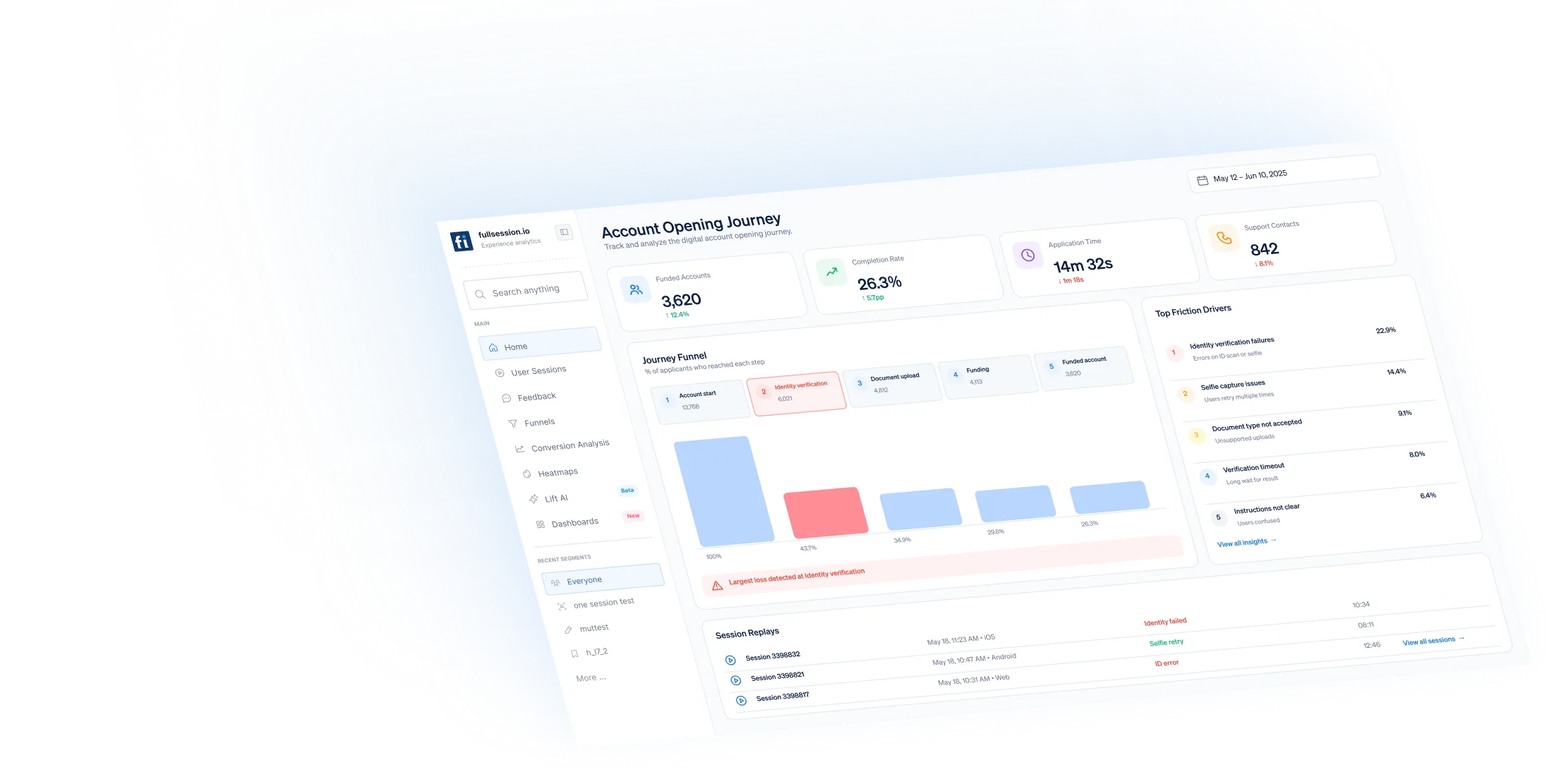
See what’s costing you, and prove whats fixing it is worth
Watch the real journey, rank every issue by revenue impact, and validate the result against baseline.



.svg)
.svg)
212 E Stone Path St Derby, KS 67037 Phone: +1 415-649-4222



All systems operational.